
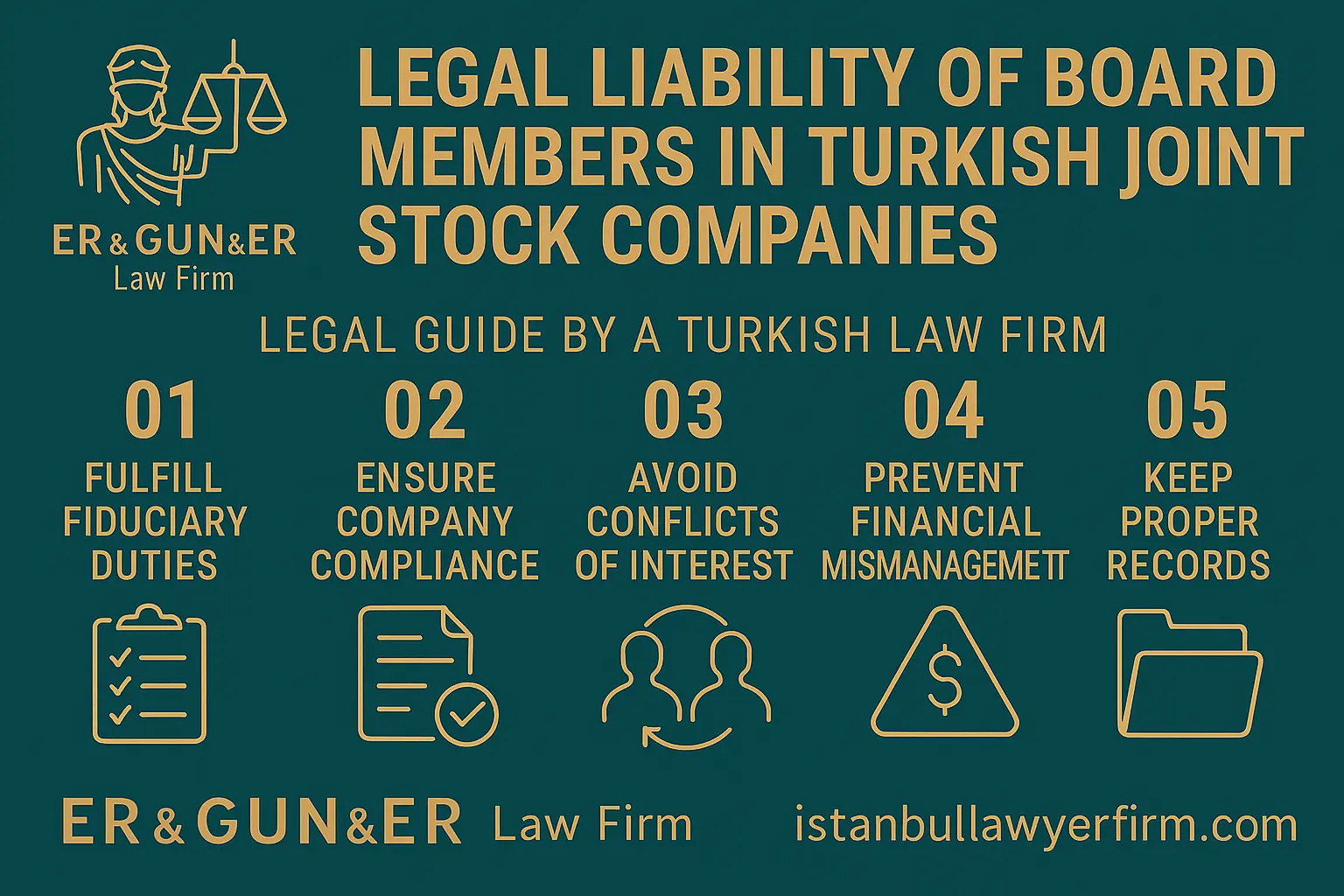
Board member liability in Turkish joint stock companies (anonim şirket, AŞ) is governed by a complex interaction of legal frameworks that operate simultaneously — creating personal financial exposure for directors in multiple dimensions that cannot be eliminated simply by resigning from the board before problems materialize. The primary framework is the Turkish Commercial Code (Türk Ticaret Kanunu, TTK, Law No. 6102) Articles 553-560, which establish the general civil liability of board members (yönetim kurulu üyeleri) to the company, shareholders, and creditors for breaches of their legal duties. Parallel to this civil liability framework, board members of Turkish AŞ companies face personal joint and several liability for unpaid corporate tax obligations under the Tax Procedure Law (Vergi Usul Kanunu, VUK, Law No. 213) Article 10 and for unpaid Social Security Institution (SGK) premiums under Law No. 5510 Article 88 — liabilities that survive corporate insolvency and can be enforced against the director's personal assets. For directors of listed companies, the Capital Markets Law (Sermaye Piyasası Kanunu, SPK, Law No. 6362) creates additional disclosure and liability obligations administered by the Capital Markets Board. And across all these frameworks, specific conduct by board members — false financial statements, fraudulent insolvency, tax crimes — carries criminal liability under the Turkish Penal Code (TCK, Law No. 5237) and the VUK. This guide explains each liability framework, its specific requirements and defenses, and the governance documentation practices that protect directors from avoidable exposure. Practice may vary by authority and year — verify current TTK, VUK, and TCK application standards directly before relying on any information in this guide.
TTK Article 553 civil liability — the general framework for board member liability
A lawyer in Turkey advising board members on civil liability must explain that TTK Article 553 establishes the primary civil liability framework for AŞ directors — specifically, that board members who negligently or intentionally breach their duties under TTK or the company's articles of association are jointly and severally liable to the company, its shareholders, and its creditors for the resulting damage. The critical characteristics of TTK Article 553 liability are: it is based on fault (fault-based liability, rather than strict liability — the claimant must prove that the director acted negligently or intentionally); it extends to all three categories of potential claimants simultaneously (the company, individual shareholders, and company creditors — with different procedural paths for each); it is joint and several (solidary) among all board members who participated in or failed to prevent the breaching decision; and it requires a causal link between the director's breach and the claimed damage. The statute of limitations for TTK Article 553 claims is defined in TTK Article 560: 2 years from the date the claimant discovered the damage and the liable party, and 5 years from the date the damaging act occurred (or up to 10 years where the act also constitutes a criminal offense with a longer limitation period). Practice may vary by authority and year — verify current TTK Article 553 liability assessment standards and limitation period calculation methodology applicable to the specific alleged breach before any board liability defense strategy.
An Istanbul Law Firm advising on TTK board member duties must explain that the two foundational duties from which TTK Article 553 liability flows are: the duty of care (özen yükümlülüğü) under TTK Article 369, which requires board members to manage the company with the care and diligence of a prudent businessperson (basiretsiz bir iş insanı standardı) in comparable circumstances; and the duty of loyalty (sadakat yükümlülüğü) under TTK Article 369, which requires board members to prioritize the company's interests over their personal interests and to avoid using their position for personal gain at the company's expense. The duty of care creates liability for negligence — for decisions that a reasonable businessperson in the same position would not have made, or for failures to monitor and supervise that allow harm to occur. The duty of loyalty creates liability for self-dealing — for transactions in which the director has a personal interest that conflicts with the company's interest, including insider transactions regulated by TTK Article 395. A director who votes for a resolution without understanding its consequences has potentially breached the duty of care; a director who causes the company to enter a transaction that benefits the director personally at non-market terms has potentially breached the duty of loyalty. Practice may vary — verify current Turkish commercial court duty of care and duty of loyalty assessment standards before any TTK Article 553 liability evaluation.
A law firm in Istanbul advising on TTK Article 553 liability defenses must explain that the most effective defense against a TTK Article 553 claim is a documented decision-making process that demonstrates compliance with the duty of care standard — specifically, evidence that the board member obtained adequate information before making the decision, acted in good faith on that information, and did not have a personal interest conflicting with the company's interest in the decision. The business judgment rule doctrine (iş kararı standardı), while not explicitly codified in the same terms as in Anglo-American corporate law, is recognized by Turkish commercial courts in the sense that courts do not second-guess the substantive merits of business decisions made through a proper process — they assess the process, not the outcome. Defensive documentation for a business judgment defense includes: board meeting agenda and notice showing advance information was provided; expert reports, valuations, and management presentations that the board received before the decision; board meeting minutes recording the board's deliberations and the specific basis for the decision; records of conflicts disclosed and the recusal of conflicted directors; and independent expert opinion where the decision was outside the board's direct expertise. Practice may vary — verify current Turkish commercial court business judgment defense standards and the specific documentation that courts consider persuasive before any board liability defense documentation program. Practice may vary — check current guidance before acting on any information on this page.
Personal tax liability under VUK Article 10 — the most immediate director risk
An English speaking lawyer in Turkey advising on director tax liability must explain that VUK Article 10 creates personal joint and several liability for company directors (and other legal representatives) for the company's unpaid tax obligations — making tax liability one of the most significant and most frequently overlooked personal financial risks for Turkish AŞ directors. The personal liability arises where the company's tax obligations go unpaid and the failure to pay is attributable to the legal representative's failure to fulfill their duties (görevlerini yerine getirmemeleri nedeniyle vergi ödenmemişse) — and the Revenue Administration's practice is to pursue legal representatives directly when the company cannot pay, without needing to demonstrate that the director personally caused the non-payment through deliberate wrongdoing. The VUK Article 10 liability extends to: corporate income tax (kurumlar vergisi) and provisional corporate income tax (geçici vergi); value added tax (katma değer vergisi, KDV); withholding taxes (stopaj vergisi); and all associated default surcharges (gecikme zammı) and tax penalties (vergi cezaları). Practice may vary by authority and year — verify current Revenue Administration VUK Article 10 enforcement practice and the specific attribution standards applicable to AŞ directors with different authority scopes before any director tax liability assessment.
A Turkish Law Firm advising on VUK Article 10 liability defense must explain that the defense against VUK Article 10 personal liability requires demonstrating either that the non-payment was not attributable to the director's failure to fulfill their duties, or that the director took all available steps to prevent non-payment but was prevented from doing so by circumstances beyond their control (such as the company's total insolvency without any reachable assets). The practical defense options include: demonstrating that the tax arose during a period when the director had resigned and was no longer a legal representative (the liability follows the legal representative who was in place at the time the tax obligation arose and the payment obligation fell due); demonstrating that the director was legally prevented from accessing company funds to make payments (for example, by court-ordered asset freezes); or challenging the underlying tax assessment on substantive grounds to reduce or eliminate the underlying obligation that forms the basis for personal liability. A director who is concerned about VUK Article 10 exposure should ensure that resignation from the board is properly registered with the Turkish Trade Registry — because a resignation that is not registered may not be effective against the Revenue Administration even if it is agreed internally. Practice may vary — verify current Revenue Administration VUK Article 10 enforcement standards and the specific resignation timing rules applicable before any VUK Article 10 liability defense strategy.
A lawyer in Turkey advising on proactive VUK compliance for directors must explain that the most effective protection against VUK Article 10 liability is a governance structure that ensures tax compliance is treated as a board-level oversight obligation — not merely as an accounting department operational matter — with the board receiving regular confirmations of tax payment status and specific reporting when payment is at risk. Directors should specifically receive: confirmation of filing and payment of quarterly provisional corporate income tax; monthly KDV filing and payment confirmation; confirmation of monthly SGK premium payments (which interact with VUK Article 10 obligations); and immediate notification when tax payments cannot be made due to cash flow constraints. A director who receives these confirmations and who takes documented action when problems are flagged — such as directing management to arrange payment arrangements with the Revenue Administration, or documenting the decision to seek external financing to cure the tax arrears — is in a significantly stronger VUK Article 10 defense position than a director who was unaware that tax obligations were accumulating. Practice may vary — verify current Revenue Administration tax compliance reporting obligations applicable to AŞ boards and the specific documentation standards before any director tax compliance governance program. Practice may vary — check current guidance before acting on any information on this page.
SGK premium liability under Law No. 5510 Article 88 — personal exposure for unpaid social security
An Istanbul Law Firm advising on SGK premium liability must explain that Law No. 5510 Article 88 creates personal joint and several liability for company directors (and other legal representatives) for the company's unpaid Social Security Institution (SGK) premium obligations — operating as a direct analog to VUK Article 10 but for social security contributions rather than tax. The SGK premium liability for a typical AŞ company is substantial: the total SGK premium rate for most employees is approximately 37.5% of gross salary (combined employer and employee contributions, with the employer's share approximately 22.5% and the employee's share approximately 15%), and for a company with a significant payroll, premium arrears can accumulate rapidly during periods of financial stress. The Law No. 5510 Article 88 personal liability extends to: employer-side SGK premiums (işveren payı) for all registered employees; employer-side unemployment insurance contributions (işsizlik sigortası); and all associated default charges (gecikme cezası and gecikme zammı) that accrue on unpaid premiums. Practice may vary by authority and year — verify current SGK enforcement practice and the specific director attribution standards applicable to AŞ companies with different board structures before any SGK premium liability assessment.
A law firm in Istanbul advising on SGK liability defense must explain that the procedural path for SGK's enforcement of personal director liability begins with the SGK issuing a debit notice (tahakkuk fişi) or enforcement notice (icra emri) to the company, and upon the company's failure to pay, the SGK can then pursue the legal representatives personally through enforcement proceedings (icra takibi) against their personal assets. The critical timing consideration is that SGK personal liability follows the legal representative whose name was registered with the SGK as the company's legal representative at the time the premium obligation arose and at the time payment was due — not necessarily the director who was most responsible for the decision not to pay. Directors who are about to resign from boards of companies with SGK arrears should specifically obtain confirmation from the SGK that their personal records reflect the resignation effective date, because the SGK's administrative records may not be automatically updated when the Trade Registry record changes. Practice may vary — verify current SGK enforcement procedures and the specific legal representative registration requirements applicable to the company's SGK records before any resignation or succession in a company with SGK arrears.
An English speaking lawyer in Turkey advising on combined VUK and SGK liability management must explain that in the Turkish enforcement practice, the Revenue Administration's VUK Article 10 enforcement and the SGK's Law No. 5510 Article 88 enforcement frequently operate simultaneously against the same directors for the same period — because companies experiencing financial distress typically fail to pay both tax and SGK obligations at the same time, and both authorities actively pursue the personal liability of legal representatives when corporate collection fails. Directors of financially distressed Turkish AŞ companies therefore face the risk of simultaneous enforcement from two different public authorities, each pursuing personal liability for a significant portion of the company's payroll-related obligations. The defense strategies for the two types of liability are similar in principle — demonstrating either that the non-payment was not attributable to the director's failure, or that the underlying obligation is legally contestable — but must be pursued in parallel proceedings before different administrative authorities and courts. Practice may vary — verify current parallel VUK and SGK enforcement procedures and the specific priority rules applicable when both authorities are pursuing enforcement against the same director simultaneously. Practice may vary — check current guidance before acting on any information on this page.
Criminal liability for AŞ board members — TCK, VUK, and capital markets offenses
A Turkish Law Firm advising on criminal liability for AŞ board members must explain that Turkish law creates specific criminal offenses applicable to AŞ board members — distinct from the general criminal law — where the conduct involves the abuse of the director's corporate position. The most significant criminal provisions include: TTK Article 562, which creates criminal sanctions (fines and imprisonment up to 3 years) for specific violations of the TTK's procedural obligations including failure to maintain required commercial books (defterlerin tutulmaması), false entries in commercial books, and unauthorized conveyance of company information; TCK Article 161 (hileli iflas — fraudulent insolvency), which provides up to 8 years imprisonment for directors who engage in fraudulent acts designed to harm creditors before or during insolvency; TCK Article 162 (taksiratlı iflas — reckless insolvency), which provides up to 2 years imprisonment for directors whose reckless management contributed to the company's insolvency; and TCK Article 235 (ihaleye fesat karıştırma — bid-rigging), applicable where company officers participate in fraudulent procurement. Practice may vary by authority and year — verify current TCK and TTK criminal offense requirements and the specific intent standards applicable to each offense before any criminal liability assessment for AŞ board members.
An Istanbul Law Firm advising on VUK tax crimes must explain that the VUK contains specific criminal provisions for tax evasion and tax fraud that apply directly to directors who approve or participate in corporate tax fraudulent conduct. The key VUK criminal offenses include: VUK Article 359(a), which creates a sentence of 18 months to 3 years imprisonment for tax evasion through false books, false documents, or other fraudulent means (kaçakçılık suçu); VUK Article 359(b), which creates a sentence of 3 to 5 years imprisonment for more serious tax fraud including use of forged official documents and false invoicing schemes; and VUK Article 360, which provides for criminal charges to be waived if the evaded tax and related penalties are paid before prosecution — creating a specific remedy for directors whose companies engaged in tax fraud that the directors discover after the fact. The VUK criminal provisions distinguish between the director who actively participated in the fraudulent scheme (who faces direct criminal liability) and the director who failed to prevent fraud by subordinates (who may face civil liability but not criminal liability absent a specific duty to detect and prevent the fraud). Practice may vary — verify current VUK criminal prosecution standards and the specific active participation attribution rules applicable to AŞ board members with different authority scopes before any VUK criminal defense strategy.
A lawyer in Turkey advising on Capital Markets Law criminal liability for listed company directors must explain that directors of companies listed on Borsa Istanbul (BIST) face additional criminal liability under the Capital Markets Law (SPK, Law No. 6362) for violations of the specific disclosure and market integrity obligations that apply to publicly traded companies. The key SPK criminal provisions include: SPK Article 103, which creates imprisonment of up to 5 years for insider trading (piyasa dolandırıcılığı) — trading on material non-public information about the listed company; SPK Article 104, which creates imprisonment of up to 5 years for market manipulation (piyasa manipülasyonu) — creating artificial price movements or false impressions about trading activity; and SPK Article 106, which creates penalties for failure to file mandatory public disclosures (kamuyu aydınlatma) within the required timeframes. For directors of listed Turkish AŞ companies, the SPK's Public Disclosure Platform (Kamuyu Aydınlatma Platformu, KAP) creates a continuous obligation to disclose material developments immediately — and the determination of what is "material" and what the disclosure timing obligation requires is a specific area of SPK regulatory expertise. Practice may vary — verify current SPK criminal liability standards for listed company directors and the specific KAP disclosure obligation requirements applicable to the company's listing category before any capital markets liability assessment. Practice may vary — check current guidance before acting on any information on this page.
Shareholder derivative actions and third-party liability claims
An English speaking lawyer in Turkey advising on shareholder derivative actions must explain that TTK Article 553 creates the legal basis for shareholder derivative actions (pay sahiplerinin şirkete zarar veren yönetim kurulu üyelerine karşı açabileceği davalar) — civil lawsuits in which shareholders sue board members directly for damages caused to the company, where the company itself has failed or refused to pursue the claim. The derivative action is procedurally distinct from a direct shareholder claim: in a derivative action, the shareholder is asserting rights on behalf of the company rather than their own personal rights — which means the recovered damages go to the company rather than to the individual shareholder. Under TTK Article 555, a single shareholder (holding any amount of shares) can bring a derivative action; the court will assess whether the company has been damaged, whether the board member's conduct breached the applicable duty, and whether the individual board member's conduct caused the specific damage. The limitation period for derivative actions tracks the TTK Article 560 limitation periods. Practice may vary by authority and year — verify current Turkish commercial court derivative action procedural standards and the specific standing and admissibility requirements before any derivative action assessment.
A Turkish Law Firm advising on insider transactions and related-party liability must explain that TTK Article 395 and Article 396 create specific prohibitions on board members engaging in transactions with the company (Article 395 — işlemde menfaati olan üye) and competing with the company (Article 396 — rekabet yasağı) without proper authorization from the general assembly — and violations of these provisions create both civil liability (under TTK Article 553) and criminal liability (under TTK Article 562). Article 395 prohibits a board member who has a personal interest in a transaction from participating in the board vote on that transaction — the conflicted director must disclose the conflict and abstain. Article 396 prohibits board members from operating a competing business or participating in transactions in the company's main business area without general assembly authorization. Both provisions reflect the duty of loyalty and are strictly interpreted by Turkish courts. Directors who structure transactions through affiliated parties without proper disclosure and authorization create significant liability exposure even if the transaction's ultimate terms were commercially reasonable. Practice may vary — verify current TTK Article 395 conflict disclosure requirements and the specific general assembly authorization procedure for director competing business activities before any related-party transaction approval process.
A lawyer in Turkey advising on creditor claims against board members must explain that TTK Article 553 liability extends to company creditors — not only to the company and its shareholders — which means that in insolvency situations, creditors have a direct claim against board members who caused or aggravated the company's insolvency through negligent or intentional conduct. The creditor's TTK Article 553 claim requires establishing: that the board member breached a duty owed to creditors specifically (the duty to ensure the company is not operated in a state of insolvency without proper disclosure or filing); that this breach caused a specific quantifiable loss to the creditor (typically measured as the reduction in the creditor's recovery compared to what it would have received if the board had acted properly); and that the loss is distinct from the loss caused by the company's general insolvency (because creditors cannot recover under TTK Article 553 simply because the company became insolvent — they must show specific director misconduct that increased their loss). In practice, creditor claims against board members most commonly arise from: directors continuing to incur new obligations after the point at which insolvency was or should have been apparent; directors making selective payments to connected parties that depleted the assets available to general creditors; and directors making false financial statements that induced creditors to extend credit they would not otherwise have extended. Practice may vary — verify current TTK Article 553 creditor claim standards and the specific loss causation analysis applicable in insolvency situations before any creditor liability defense strategy. Practice may vary — check current guidance before acting on any information on this page.
Governance documentation — protecting directors through process evidence
An Istanbul Law Firm advising on board governance documentation must explain that the single most effective protection against TTK Article 553 civil liability claims is contemporaneous written documentation of the board's decision-making process — specifically, documentation showing that each board member obtained adequate information, deliberated in good faith, and acted without a personal conflicting interest. The core governance documentation required for a credible business judgment defense includes: board meeting notice and agenda distributed in advance, showing that board members had time to prepare; management presentations, expert reports, financial analyses, and other information packages that the board received before the decision; board meeting minutes (yönetim kurulu toplantı tutanağı) that record the discussion, the information relied upon, dissenting opinions, and conflicts disclosed and managed — not merely the resolution adopted; records of board member attendance and voting, including abstentions for conflicted matters; and follow-up monitoring records showing that the board supervised management's implementation of the decision. Turkish commercial law requires that AŞ board resolutions be documented in writing, but the legal minimum (recording the resolution and signatures) provides minimal defense value — the substantive deliberations that demonstrate the exercise of duty of care are what courts assess in liability disputes. Practice may vary by authority and year — verify current Turkish commercial court board governance documentation standards and the specific board minute format that courts consider adequate evidence of duty of care compliance before any board governance documentation program design.
A law firm in Istanbul advising on expert reliance as a liability defense must explain that a board member's reliance on professional expert advice — from external auditors, financial advisors, legal counsel, or technical experts — is a significant factor in the duty of care assessment, provided that the reliance was reasonable and in good faith. TTK Article 369's duty of care standard explicitly recognizes that directors are entitled to rely on expert opinions for matters outside their direct expertise — but the reliance must be informed rather than passive. A director who receives an expert report, asks substantive clarifying questions, understands the assumptions and limitations of the report's conclusions, and makes a decision based on those conclusions has demonstrated the exercise of duty of care. A director who simply approves a transaction because a report exists — without engaging with its content — has not established the same defense quality. Directors should specifically: retain expert advice in writing rather than verbal form; request that experts specifically address the key risk questions rather than providing general opinions; document the board's specific reliance on the expert opinion in the board meeting minutes; and file the expert report in the board's decision documentation. Practice may vary — verify current Turkish commercial court expert reliance defense standards and the specific documentation requirements before any expert reliance defense is established in a board liability matter.
An English speaking lawyer in Turkey advising on dissent recording as a protection mechanism must explain that a board member who opposes a resolution — and whose opposition is properly recorded in the board meeting minutes — is in a significantly stronger TTK Article 553 defense position than a director who was present and voted in favor of a resolution later found to have been improper. TTK Article 557 provides that a board member's liability is individual — each member is liable for their own breach — and a dissenting member who records their dissent is demonstrating that they did not breach their duty of care even if the majority of the board did. The dissent must be recorded in the board meeting minutes with the specific reasons for the dissent — not merely a notation that the director voted against. A director who believes a proposed resolution is legally problematic or commercially imprudent should: request that the specific concerns be recorded in the minutes; request that the board obtain additional expert analysis before proceeding; and if the board proceeds despite these objections, ensure the dissent and its reasons are clearly documented. A director who fails to record a dissent at the time — even if they disagreed privately — cannot effectively claim dissent in later litigation. Practice may vary — verify current TTK Article 557 individual liability defense standards and the specific dissent recording requirements that Turkish commercial courts consider effective before any board meeting dissent management protocol. Practice may vary — check current guidance before acting on any information on this page.
D&O insurance, indemnification agreements, and liability protection structures
A Turkish Law Firm advising on D&O insurance must explain that Directors and Officers Liability Insurance (D&O) is increasingly available in the Turkish market and provides a critical financial protection layer for AŞ board members — covering the legal defense costs, settlements, and judgments arising from civil claims under TTK Article 553 (subject to specific exclusions) even where the insured director is ultimately found to have acted negligently. Turkish D&O policies typically provide three coverage towers: Side A coverage (protecting individual directors where the company cannot or will not indemnify them); Side B coverage (reimbursing the company for its indemnification payments to directors); and Side C coverage (protecting the company entity itself for securities claims). The specific exclusions in Turkish D&O policies require careful analysis — standard exclusions typically include claims arising from intentional fraud or dishonest conduct (excluding the fraudulent insolvency and deliberate tax fraud criminal provisions from coverage), bodily injury and property damage, and pollution claims. The D&O policy should be reviewed specifically for its treatment of: legal defense costs advance (whether costs are advanced before final determination or only reimbursed); coverage for regulatory investigations (which represent the most frequent risk for listed company directors); and severability provisions (which prevent one director's misconduct from voiding coverage for innocent co-directors). Practice may vary by authority and year — verify current Turkish insurance market D&O product coverage standards and the specific exclusion interpretation standards applied by Turkish courts before any D&O policy assessment.
An Istanbul Law Firm advising on indemnification agreement design must explain that Turkish AŞ companies can provide indemnification to board members for civil liability incurred in the course of their duties — but with significant limitations that distinguish Turkish indemnification from the broader indemnification available in some other jurisdictions. Under Turkish law, the company can indemnify directors for: legal defense costs in civil proceedings where the director is ultimately successful; settlements of civil claims where the company's board (excluding the indemnified director) determines that indemnification is appropriate; and D&O insurance premium contributions. However, Turkish law prohibits the company from indemnifying directors for: criminal penalties (including the fines and imprisonment provided by TCK, VUK, and SPK criminal provisions); intentional misconduct that damages the company; and — as a practical matter — the VUK Article 10 and Law No. 5510 Article 88 personal tax and SGK premium liabilities, because these are statutory obligations that cannot be transferred by contract. An indemnification agreement should specifically address: the procedure for the indemnified director to request indemnification; the board approval process for indemnification decisions; the advance of legal defense costs pending final determination of liability; and the director's obligation to cooperate in the company's defense of the underlying claim. Practice may vary — verify current Turkish law indemnification scope limitations and the specific board approval requirements for director indemnification decisions before any indemnification agreement design.
A lawyer in Turkey advising on the interplay between indemnification and D&O insurance must explain that the most effective protection structure for AŞ board members combines a well-designed indemnification agreement with a D&O policy that backstops the company's indemnification obligation — because neither mechanism alone provides complete protection. The indemnification agreement alone is limited by the company's financial ability to perform: if the company is insolvent (which is often the case when director liability claims are most likely to arise), the company's indemnification obligation is worthless. The D&O policy provides protection even when the company cannot perform its indemnification obligation — because the insurer's obligation to pay Side A coverage is direct to the director and does not depend on the company's financial health. Conversely, the D&O policy alone is limited by its exclusions (particularly for intentional conduct) and by the claim reporting requirements that may create gaps where the director does not timely notify the insurer of a potential claim. The combined structure provides the broadest protection: the indemnification agreement establishes the legal entitlement and the process; the D&O policy funds the entitlement when the company cannot. Practice may vary — verify current Turkish insurance law requirements for the interaction between company indemnification and D&O insurance before any combined protection structure design. Practice may vary — check current guidance before acting on any information on this page.
Special liability topics — capital markets, restructuring, and resignation timing
An Istanbul Law Firm advising on listed company director obligations must explain that directors of AŞ companies listed on Borsa Istanbul (BIST) face disclosure obligations under the Capital Markets Board (SPK) regulations — specifically the obligations administered through the Public Disclosure Platform (Kamuyu Aydınlatma Platformu, KAP) — that create liability exposure significantly beyond the TTK's general corporate governance requirements. The KAP disclosure obligations require immediate disclosure of any material development that could affect investment decisions — including management changes, material contracts, court decisions, regulatory actions, and significant financial developments — and the determination of materiality is assessed by the SPK based on its guidelines. Listed company board members are also subject to the SPK's corporate governance communiqué, which sets mandatory and recommended governance practices for listed companies, and compliance with or deviation from these practices must be specifically disclosed. The SPK has enforcement authority to impose administrative sanctions (idari para cezası) on companies and their directors for KAP disclosure violations without requiring a criminal prosecution. Directors who join listed company boards should obtain a complete briefing on the KAP disclosure obligations — which operate on a different timeline and with different content requirements than the TTK's general disclosure obligations — before assuming their first board responsibilities. Practice may vary by authority and year — verify current KAP disclosure requirements and the specific materiality assessment standards applicable to the company's listing category before any listed company board appointment.
A law firm in Istanbul advising on director liability in restructuring and insolvency situations must explain that board members of AŞ companies facing financial distress face specific additional duties — and specific additional liability risks — in the period immediately preceding and during restructuring or insolvency proceedings that require careful governance management. TTK Article 376 creates an obligation for the board to call an extraordinary general assembly and propose specific remedial measures (iyileştirici önlemler) when the company's losses erode capital to specific statutory thresholds: when half of the share capital plus legal reserves are consumed, the board must call a general assembly and report the financial position; when two-thirds are consumed, the general assembly must decide whether to dissolve the company, to reduce capital to the remaining assets, or to complete additional capital. A board that fails to comply with TTK Article 376's mandatory obligations creates direct liability for the damage to creditors that results from continued operation beyond the point at which the statutory remedy was required. Practice may vary — verify current TTK Article 376 capital loss remedy thresholds and the specific general assembly meeting requirements applicable to the current capital loss level before any board response to capital erosion is designed.
An English speaking lawyer in Turkey advising on resignation timing and its effect on liability must explain that resignation from the AŞ board does not automatically eliminate a director's liability exposure — because liability follows the legal representative who was in place during the period when the obligation arose or when the breach occurred, rather than the representative at the time the claim is filed. A director who resigns after months of non-payment of SGK premiums or tax obligations has personal liability for the full period of non-payment during which they served as a legal representative — the resignation does not retroactively eliminate that liability. Similarly, a director who resigns after a damaging board resolution has been adopted may still face TTK Article 553 liability for the damage caused by that resolution even if the damage materializes after the resignation. Conversely, a director who resigns before a problematic resolution is adopted is not liable for the resolution's consequences — provided the resignation is properly and timely registered with the Trade Registry so that the effective date of resignation is clearly established. Directors considering resignation from boards with compliance problems should specifically obtain legal advice on: the specific obligations that have already been incurred during their service period; whether resignation affects those obligations; how to document the resignation effectively; and what disclosures or notifications should be made in connection with the resignation to protect against later claims. Practice may vary — verify current Turkish Trade Registry resignation registration timing requirements and VUK and SGK legal representative succession standards before any director resignation in a company with compliance issues. Practice may vary — check current guidance before acting on any information on this page.
How we advise board members on liability prevention and defense
A lawyer in Turkey advising AŞ board members on liability management explains that our approach is structured around two parallel workstreams: prevention (designed to minimize the likelihood that liability will arise) and response preparation (designed to ensure that if liability is claimed, the board member has a documented defense). Prevention involves: a governance documentation program that ensures board minutes record the deliberations and information basis for major decisions, not merely the resolutions; a conflicts of interest management protocol that identifies and properly manages all Article 395 conflicts before they create liability; a regular compliance monitoring program that keeps the board informed of tax, SGK, and regulatory compliance status before arrears accumulate; a D&O insurance and indemnification structure review; and specific training on the KAP disclosure obligations for listed company directors. Response preparation involves: developing the defense narrative and identifying the documentary evidence that supports it before a claim is filed; assessing the strength of the business judgment defense for specific decisions under scrutiny; and where criminal exposure exists, developing a cooperation strategy that protects the director's interests without compromising the defense.
ER&GUN&ER advises AŞ board members, executive directors, and their companies across the complete spectrum of board liability prevention and defense — TTK Article 553 civil liability assessment and defense documentation; business judgment defense preparation; VUK Article 10 personal tax liability defense and Revenue Administration engagement; Law No. 5510 Article 88 SGK premium personal liability defense; TCK fraudulent and reckless insolvency defense; VUK criminal tax offense defense; SPK and KAP listed company disclosure compliance; TTK Article 395 conflict of interest management; shareholder derivative action defense; creditor claims in insolvency situations; D&O insurance review and indemnification agreement design; TTK Article 376 capital loss remedy compliance; resignation timing and legal representative succession planning; and board governance documentation programs. We work in English throughout all international mandates and advise both Turkish and foreign directors on the specific liability frameworks applicable to their board roles. For the general corporate governance framework — see the resource on corporate legal services in Turkey under the TTK framework. For the insolvency-related director liability framework — see the resource on bankruptcy procedures in Turkey and director liability. Practice may vary — check current guidance before acting on any information on this page.
Frequently Asked Questions
- What is the legal basis for board member civil liability in Turkish AŞ companies? TTK Article 553 establishes that board members who negligently or intentionally breach their duties under TTK or the company's articles are jointly and severally liable to the company, its shareholders, and its creditors for the resulting damage. Liability is fault-based (requiring proof of negligence or intentional breach) and requires a causal link between the breach and the damage claimed. The limitation period is 2 years from knowledge and 5 years from occurrence (up to 10 years for criminal conduct). Practice may vary — verify current TTK Article 553 standards.
- What are a board member's fundamental duties under Turkish law? TTK Article 369 establishes two foundational duties: the duty of care (özen yükümlülüğü), requiring management with the care and diligence of a prudent businessperson; and the duty of loyalty (sadakat yükümlülüğü), requiring prioritization of the company's interests over personal interests. Breach of either duty that causes damage to the company, shareholders, or creditors creates liability under TTK Article 553. Practice may vary — verify current Turkish commercial court duty assessment standards.
- What is VUK Article 10 personal tax liability and how does it affect directors? VUK Article 10 creates personal joint and several liability for AŞ directors (as legal representatives) for unpaid corporate tax obligations — including corporate income tax, KDV, withholding tax, and associated surcharges — where the non-payment is attributable to the director's failure to fulfill their duties. This liability survives the company's insolvency and can be enforced against the director's personal assets through enforcement proceedings. Practice may vary — verify current VUK Article 10 enforcement standards.
- What SGK premium liability do Turkish directors face personally? Law No. 5510 Article 88 creates personal joint and several liability for directors (as legal representatives) for unpaid SGK premium obligations — including employer-side premiums at approximately 22.5% of gross salary plus unemployment insurance contributions. This liability operates in parallel to VUK Article 10 and can be simultaneously enforced by the SGK against directors' personal assets. Practice may vary — verify current SGK enforcement standards and legal representative registration requirements.
- Does resignation from the board eliminate personal tax and SGK liability? No — resignation does not retroactively eliminate liability for obligations that arose during the director's service period. Personal liability follows the legal representative who was in place when the obligation arose and when payment was due. Resignation must be properly and timely registered with the Trade Registry to establish the effective date, and directors should obtain specific legal advice on pre-existing obligations before resigning from boards with compliance problems. Practice may vary — verify current Trade Registry resignation registration standards.
- What criminal liability do AŞ board members face under Turkish law? Criminal liability includes: TTK Article 562 (commercial book and disclosure violations, up to 3 years imprisonment); TCK Article 161 (fraudulent insolvency, up to 8 years); TCK Article 162 (reckless insolvency, up to 2 years); VUK Article 359 (tax fraud, 18 months to 5 years depending on severity); and SPK Article 103-104 for listed company directors (insider trading and market manipulation, up to 5 years). Criminal liability requires criminal intent or recklessness beyond ordinary negligence. Practice may vary — verify current criminal prosecution standards.
- What is the business judgment rule defense in Turkish corporate law? Turkish commercial courts recognize that courts should not second-guess the substantive merits of business decisions made through a proper governance process — they assess the process, not the outcome. A director who obtained adequate information, deliberated in good faith, acted without a conflicting personal interest, and relied on appropriate expert advice has a strong defense against TTK Article 553 claims even if the decision ultimately turned out poorly. The defense requires contemporary documentation of the decision-making process. Practice may vary — verify current court business judgment defense standards.
- How should board meeting minutes be drafted to provide liability protection? Minutes should record: the information and analysis the board received before the decision; the substance of the board's deliberations (not merely the resolution); conflicts disclosed and how they were managed; dissenting opinions and their stated reasons; expert opinions relied upon and the specific basis for reliance; and attendance and voting records. The legal minimum (recording the resolution and signatures) provides minimal defense value — substantive deliberations are what courts assess. Practice may vary — verify current court board minute adequacy standards.
- Can a dissenting director avoid TTK Article 553 liability? Yes — TTK Article 557 provides for individual liability, and a board member who records a dissent in the meeting minutes with the specific reasons for dissent is demonstrating that they did not breach their duty of care for that resolution even if the majority did. The dissent must be recorded in the minutes at the time — not asserted after the fact. The stated reasons for dissent are particularly important if they identify the specific legal risk that ultimately materialized. Practice may vary — verify current TTK Article 557 individual liability defense standards.
- What does D&O insurance cover for Turkish AŞ directors? Turkish D&O policies typically cover legal defense costs and settlements for civil claims under TTK Article 553 subject to exclusions for intentional fraud and dishonest conduct. Side A coverage protects directors directly where the company cannot indemnify; Side B reimburses the company for indemnification; Side C protects the company for securities claims. Policies require careful review for exclusions covering regulatory investigations, criminal proceedings, and the scope of conduct that triggers the intentional conduct exclusion. Practice may vary — verify current Turkish D&O product coverage standards.
- What are the specific disclosure obligations for directors of listed Turkish companies? Directors of BIST-listed companies must ensure compliance with KAP (Public Disclosure Platform) immediate disclosure obligations for material developments — including management changes, material contracts, regulatory actions, financial developments, and litigation. The SPK's corporate governance communiqué sets mandatory and recommended governance practices. Violations create SPK administrative sanctions without requiring criminal prosecution. Practice may vary — verify current KAP disclosure requirements and SPK corporate governance communiqué standards applicable to the company's listing category.
- What is TTK Article 376 and what obligations does it create for boards of financially distressed companies? TTK Article 376 requires the board to convene an extraordinary general assembly and report on corrective measures when the company's losses consume half of share capital plus legal reserves; when two-thirds are consumed, the assembly must decide between dissolution, capital reduction to remaining assets, or additional capital contribution. Failure to comply creates direct board liability for creditor damage from continued operation beyond the statutory remedy point. Practice may vary — verify current TTK Article 376 threshold calculations and meeting requirements.
- Can the company indemnify directors for criminal penalties? No — Turkish law prohibits company indemnification for criminal penalties (including TCK, VUK, and SPK criminal sanctions) and for intentional misconduct damaging the company. Indemnification is available for legal defense costs in civil proceedings where the director is successful, for settlements of civil claims approved by the board, and for D&O insurance premium contributions. VUK Article 10 and Law No. 5510 Article 88 personal tax and SGK liabilities also cannot be transferred by company indemnification. Practice may vary — verify current indemnification scope limitations under Turkish law.
- What foreign director-specific advice should non-Turkish board members receive? Foreign directors serving on Turkish AŞ boards should receive specific briefing on: the VUK Article 10 and Law No. 5510 Article 88 personal liability frameworks (which have no direct equivalent in most Western legal systems); the KAP disclosure obligations for listed companies; the TTK Article 395 conflict disclosure requirements; the Trade Registry registration requirements for proper documentation of board membership; the SGK registration requirements for any Turkish employees; and the resignation timing considerations that affect personal liability. Foreign directors cannot limit their Turkish law liability simply because they reside outside Turkey.
- Do you represent both directors facing liability claims and companies pursuing liability claims against directors? We advise directors seeking to manage and minimize their liability exposure through governance documentation, VUK/SGK compliance programs, D&O insurance review, and — where claims have been filed — through civil and criminal defense representation. We also advise companies and their shareholders on the assessment of potential claims against directors, the evidence required for TTK Article 553 claims, and the procedural path for shareholder derivative actions. Conflict of interest analysis is conducted at intake to determine which representation is appropriate in any specific matter.
Author: Mirkan Topcu is an attorney registered with the Istanbul Bar Association (Istanbul 1st Bar), Bar Registration No: 67874. His practice focuses on cross-border and high-stakes matters where evidence discipline, procedural accuracy, and risk control are decisive.
He advises AŞ board members, executive directors, and their companies across TTK Article 553 Civil Liability Assessment and Defense Documentation, Business Judgment Defense Preparation, VUK Article 10 Personal Tax Liability Defense, Law No. 5510 Article 88 SGK Premium Personal Liability Defense, TCK Fraudulent and Reckless Insolvency Defense, VUK Criminal Tax Offense Defense, SPK and KAP Listed Company Disclosure Compliance, TTK Article 395 Conflict of Interest Management, Shareholder Derivative Action Defense, Creditor Claims in Insolvency Situations, D&O Insurance Review and Indemnification Agreement Design, TTK Article 376 Capital Loss Remedy Compliance, and Board Governance Documentation Programs matters where procedural precision and statutory compliance documentation are decisive.
Education: Istanbul University Faculty of Law (2018); Galatasaray University, LL.M. (2022). LinkedIn: Profile. Istanbul Bar Association: Official website.