

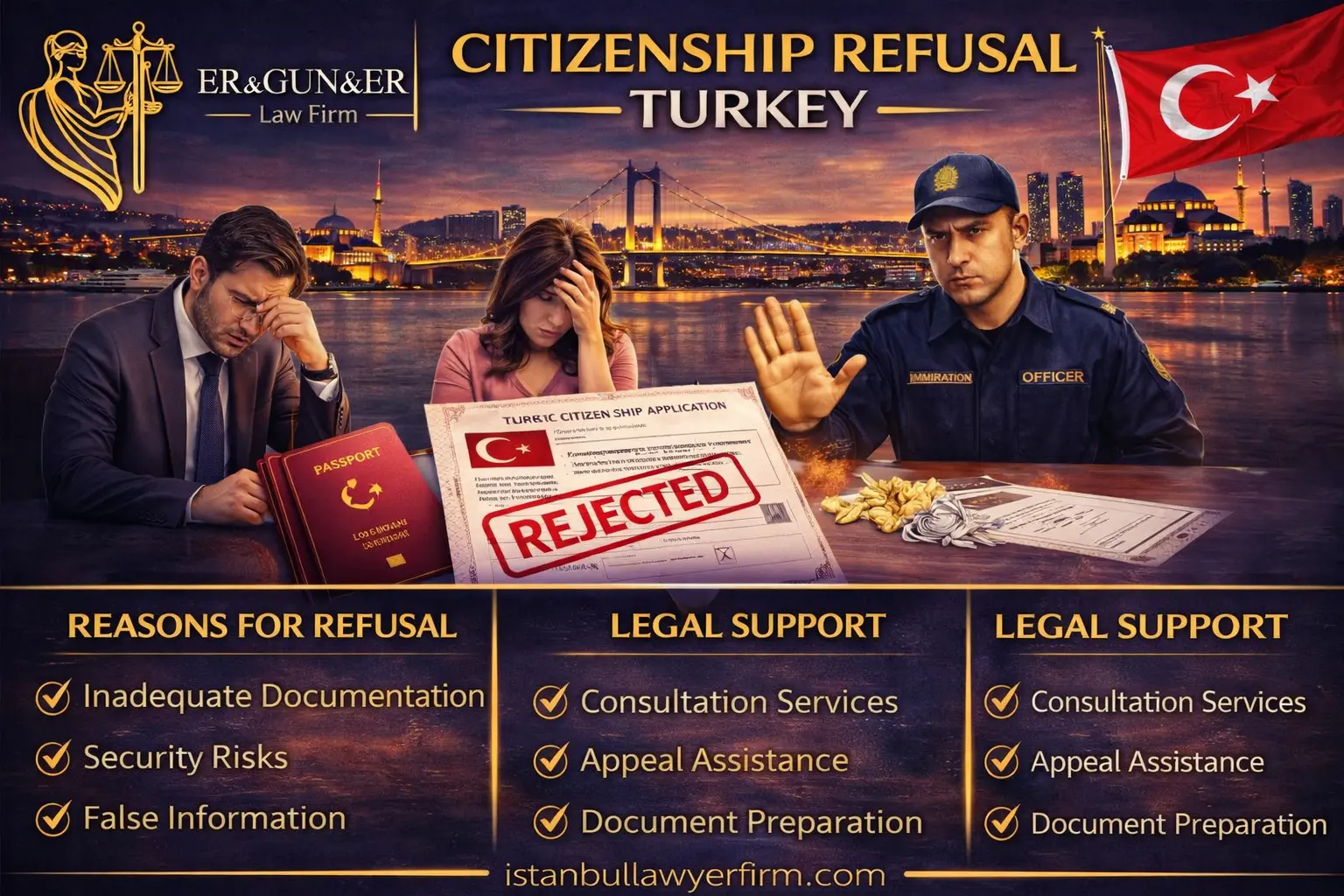
Citizenship application refusal Turkey is a file-and-chronology problem: the refusal decision issued by the Interior Ministry—whether on a general naturalization application, an investment citizenship application, or a marriage-route application—traces to a specific deficiency in the application's evidence base, a specific mismatch between the claimed eligibility and the conditions of the Turkish Citizenship Law, or a specific adverse finding in the background and security review, and the refusal cannot be effectively challenged or corrected without first identifying precisely which of these categories applies to the specific case. The reasons for Turkish citizenship refusal are not always disclosed in full in the refusal notification: a security-based refusal may state only that the application was not approved on national security grounds without identifying the specific finding; a document-based refusal may identify the specific missing or defective document but not the broader deficiencies in the file's overall coherence; and an investment compliance refusal may identify a specific threshold or verification issue without addressing the secondary documentation deficiencies that compound the primary problem. The Turkish citizenship by investment refusal category—where the investment's qualification fails the verification standards established by the implementing presidential decisions—is particularly consequential because the investor may have already committed substantial financial resources to the qualifying investment before the refusal is issued, and the refusal creates both a citizenship failure and an investment management challenge that must be addressed simultaneously. The document legalization apostille citizenship Turkey failures—where required documents have not been processed through the Hague Apostille Convention chain or consular legalization, or where the certified Turkish translation does not meet sworn translator certification standards—represent the most preventable category of citizenship refusal, because these failures can be identified and corrected through a systematic pre-filing document audit that any qualified citizenship attorney will conduct as a matter of standard practice. The remedy selection decision after a citizenship refusal—whether to challenge the decision through administrative objection or administrative court review, or to address the identified deficiencies through a corrected reapplication—is among the most strategically important decisions in the post-refusal response, because the wrong choice consumes time and resources without improving the applicant's actual position. This article provides a comprehensive, practice-oriented analysis of citizenship application refusal Turkey as it operates in 2026, addressed to applicants who have received or anticipate a citizenship refusal and who need to understand the specific legal frameworks, the specific refusal categories, and the specific response strategies that most effectively protect their position and advance their citizenship objectives.
Refusal decision overview
A lawyer in Turkey advising on a citizenship application refusal Turkey situation must begin with the legal character of the decision received: the Turkish citizenship refusal is an administrative act (idari karar) issued under the authority of the Turkish Citizenship Law (Law No. 5901), accessible at Mevzuat, and carries the legal weight of a formal administrative decision that is subject to challenge through the administrative objection and judicial review mechanisms established by Turkish administrative law. The Turkish citizenship application rejected decision is formally communicated to the applicant through a written notification from the Directorate of Civil Registration and Citizenship Affairs (NVİ) or the relevant processing authority, and this notification—while it may be brief and limited in detail—is the foundational document for any subsequent challenge because it establishes the specific legal basis on which the refusal was made, the date from which any challenge deadline runs, and the identity of the administrative authority that must be named in any subsequent administrative objection or judicial review petition. The Turkish citizenship law 5901 refusal notification's content and specificity varies by refusal category: document-based refusals typically identify the missing or defective document; investment compliance refusals typically identify the specific qualification failure; but security-based refusals typically provide limited substantive explanation of the specific security finding that produced the adverse decision. Practice may vary by authority and year — check current guidance on the current NVİ notification format and content requirements for citizenship refusal decisions and on the specific information that the processing authority is currently required to disclose in the refusal notification.
An Istanbul Law Firm advising on the immediate response to a citizenship refusal notification must explain that the time-sensitive nature of the response is not primarily about the formal challenge deadlines—though those must be respected—but about the practical immigration status consequences that a citizenship refusal may create for the applicant and their family. An applicant who was relying on the citizenship application's pending status to maintain a specific immigration posture—for example, an applicant whose Turkish residence permit has expired but who expected the citizenship to resolve the status question—faces an immediate unauthorized status issue upon the citizenship refusal that requires independent management through the residence permit system. An investment citizenship applicant whose Turkish residence permit was specifically linked to the investment citizenship timeline may need to obtain an independent residence permit to maintain lawful status during the challenge or reapplication period. The intersection of the citizenship refusal with the applicant's ongoing immigration status requires simultaneous assessment of both the citizenship challenge strategy and the residence status maintenance strategy. The comprehensive Turkish citizenship options and routes framework—providing context for understanding the specific route on which the refusal was based—is analyzed in the resource on Turkish citizenship options. Practice may vary by authority and year — check current guidance on the current interaction between citizenship application refusal and Turkish residence permit status maintenance for applicants who were relying on the citizenship process to address their immigration status.
A Turkish Law Firm advising on the refusal decision documentation that must be assembled immediately after receipt of the refusal notification must explain the evidence collection priorities that determine the quality of any subsequent challenge or reapplication. The refusal notification itself must be preserved in its original form as the primary legal document. All supporting documents submitted with the original citizenship application must be inventoried and assessed for their completeness, currency, and compliance with the applicable standards—because the refusal may have been based on deficiencies in documents the applicant believed were adequate. The investment verification certificates, property appraisal reports, bank transfer documentation, and government agency confirmation letters relevant to an investment citizenship application must be specifically reviewed against the specific compliance standards established by the applicable presidential decision. Any communications between the applicant and the processing authority during the application's review period—supplementary document requests, interview notifications, correspondence about the application's status—must be collected and organized because they provide evidence of what the processing authority identified as problematic during the review. Practice may vary by authority and year — check current guidance on the current NVİ document retention practices for rejected citizenship applications and on the procedures for obtaining copies of the application file and supporting documents from the processing authority after a refusal.
For the full procedural framework on the qualifying investment routes and the institutional review architecture at the Vatandaşlık Daireleri, see our pillar guide on the investment citizenship procedure and its rejection pitfalls.
Common refusal reason patterns
A law firm in Istanbul advising on the reasons for Turkish citizenship refusal must explain that refusals cluster into identifiable categories that reflect both the specific route being pursued and the specific administrative review standards applied by the Interior Ministry and NVİ. The most consistently encountered categories of citizenship application refusal in Turkish practice include: route eligibility failures (where the applicant does not actually satisfy the legal conditions of the citizenship route they applied under); document deficiency failures (where required documents are missing, authentication is incomplete, or translations are not certified to the required standard); investment compliance failures specific to the investment citizenship pathway (where the investment does not meet the qualifying threshold, the verification documentation is incomplete, or the payment structure does not satisfy the foreign-currency origin requirement); source of funds concerns (where the origin of the investment or deposit funds raises questions in the background review); criminal record or security findings (where the background check reveals an adverse history or where the national security review produces an unfavorable determination); and residence history inconsistencies (where the naturalization route application's claimed continuous residence is not supported by the documented permit history). Each category requires a different analytical approach and a different response strategy, and a refusal that falls into multiple categories simultaneously—as is common, because file deficiencies tend to cluster—requires a response that addresses all identified categories rather than only the most prominent one. Practice may vary by authority and year — check current guidance on the current Interior Ministry and NVİ refusal standard categories and on any recently changed assessment criteria that may affect the categorization of specific refusal grounds.
The Turkish citizenship by investment refusal category is the most commercially consequential refusal type because it occurs after significant financial resources have been committed to the qualifying investment—and the refusal does not automatically entitle the investor to reverse or exit the investment, which must be managed separately through the investment's own terms and the applicable holding period restrictions. The most common investment citizenship refusal grounds relate to documentation failures rather than substantive investment inadequacy: a real estate investment that meets the minimum value threshold but whose appraisal report was prepared by an appraiser not recognized by the relevant authority, a bank deposit that meets the minimum amount but whose holding period annotation was not entered in the correct format, or a fixed capital investment that meets the minimum amount but whose Ministry of Industry and Technology verification certificate was not obtained through the specific verification process required for the citizenship application route. These documentation failures are preventable through comprehensive pre-filing compliance verification by qualified legal counsel, and the investor who discovers them for the first time through a refusal notification has paid a significant price for inadequate pre-filing preparation. Practice may vary by authority and year — check current guidance on the current investment citizenship verification documentation standards and on the specific compliance failures that most commonly produce investment citizenship refusals in current administrative practice.
The security clearance citizenship Turkey refusal category is the most difficult to manage because it reflects a substantive adverse determination about the applicant's profile by the national security and intelligence agencies whose assessment criteria and specific findings are not publicly disclosed and are typically not shared with the applicant. A security-based citizenship refusal provides limited information about the specific finding that produced the adverse determination—the applicant typically receives a notification that the citizenship application was not approved on national security grounds without any further detail. This limited disclosure makes the security-based refusal both difficult to challenge specifically (because the specific ground is unknown) and difficult to address through reapplication (because the specific concern that must be resolved is not identified). The English speaking lawyer in Turkey who manages a security-based citizenship refusal must work with both the limited information available in the refusal notification and any inference that can be drawn from the applicant's profile—their nationality, their professional background, their business associations, their travel history—to identify the most likely basis for the security concern and to assess whether that concern can be addressed through changed circumstances, additional documentation, or high-level engagement with the processing authority. Practice may vary by authority and year — check current guidance on the current Turkish citizenship security review standards and on the specific circumstances under which a security-based citizenship refusal can be effectively challenged through administrative or judicial proceedings.
Route eligibility mismatches
A Turkish Law Firm advising on route eligibility mismatch refusals must explain that these are among the most fundamental category of citizenship refusal—occurring when the application is filed under a specific citizenship acquisition route but the applicant does not actually satisfy the substantive legal conditions of that route as established by the Turkish Citizenship Law 5901 and its implementing regulations. A general naturalization applicant who has not completed the required continuous lawful residence period at the time of filing—because the applicant counted periods of tourist entry or periods of unauthorized status that do not satisfy the continuity requirement—has filed an application under a route for which they are not yet eligible, and the refusal is legally correct regardless of how much the applicant believes they have "lived in Turkey for long enough." A marriage-route applicant who has not yet completed the qualifying marriage duration at the time of filing—because the marriage was more recent than the required period—has similarly filed under a route for which they are not yet eligible. A Turkish citizenship by investment applicant whose investment does not meet the minimum threshold established by the relevant presidential decision at the time of the application has applied under a route whose threshold condition they do not satisfy. Practice may vary by authority and year — check current guidance on the current residency requirement for Turkish citizenship in general naturalization applications and on the specific waiting periods applicable to marriage-route and investment-route applications under the current implementing regulations.
The route eligibility mismatch refusal has a specific practical implication that distinguishes it from other refusal categories: where the refusal is based on a threshold condition that the applicant has not yet met but could meet in the future (such as insufficient residence duration or insufficient marriage duration), the refusal is not necessarily a permanent denial—it is a denial that becomes eligible for corrected reapplication once the threshold condition is satisfied. An applicant refused for insufficient continuous residence duration who was only months short of the required period at the time of filing can reapply once the required period has elapsed from a continuous residence baseline, without needing to restart the residence accumulation from zero. An applicant refused because their qualifying investment fell slightly below the minimum threshold—for example, where the property appraisal valued the investment slightly below the required minimum—can reapply after supplementing the investment to bring it above the threshold. These threshold-based refusals are fundamentally different from disqualification-based refusals (criminal record, security finding) because they reflect a timing or quantitative deficiency rather than a qualitative disqualification. Practice may vary by authority and year — check current guidance on the current Turkish citizenship threshold conditions applicable to each route and on any recently changed thresholds that may affect the gap between the applicant's current position and the eligibility threshold.
A law firm in Istanbul advising on the misrepresentation risk in route eligibility cases must address the serious legal consequences that arise where the route eligibility mismatch reflects not a timing deficiency but a deliberate misrepresentation of the qualifying facts. An applicant who falsely declares a continuous residence period that did not exist, who submits fabricated residence permit copies to support a general naturalization application, or who artificially inflates the stated investment value through manipulated documentation has not merely submitted an ineligible application—they have committed a fraud on the processing authority that may result in criminal liability under Turkish law, permanent disqualification from future citizenship applications, and potentially the revocation of any citizenship that was mistakenly granted on the basis of the fraudulent representation. The distinction between an honest timing deficiency (the applicant genuinely believed they had satisfied the threshold based on a misunderstanding of how the period is calculated) and a fraudulent misrepresentation (the applicant knew they had not satisfied the threshold and submitted false evidence to overcome the deficiency) is critical to the legal analysis of the response options and the litigation risk. Practice may vary by authority and year — check current guidance on the current Turkish criminal law provisions applicable to false declarations in citizenship applications and on the administrative consequences of identified misrepresentation in citizenship refusal proceedings.
Missing document deficiencies
An English speaking lawyer in Turkey advising on missing document deficiencies in Turkish citizenship applications must explain that the document completeness requirement for citizenship applications is more exacting than for any other Turkish immigration application—because citizenship is a permanent status change rather than a temporary permit, and the processing authority treats the completeness and integrity of the application file as evidence of the applicant's fitness for the permanent status being sought. A citizenship application file that is missing required documents—an apostilled birth certificate, a foreign criminal clearance certificate, a certified bank statement showing financial sufficiency, an investment verification certificate from the relevant government agency—will typically be returned for completion or refused rather than processed with supplementary document requests, and the refusal based on a missing document is a refusal that could have been entirely avoided through a complete pre-filing document audit. The document completeness standard for Turkish citizenship applications is also more demanding than many applicants expect because it requires not only the presence of each required document but also the currency of that document at the time of filing—a criminal clearance certificate that was obtained many months before filing may be rejected as no longer current, requiring a new certificate to be obtained before the application can be successfully resubmitted. Practice may vary by authority and year — check current guidance on the current NVİ document completeness requirements for each citizenship application category and on any specific document currency standards that have recently been established or changed.
The most common categories of missing document deficiency in Turkish citizenship applications include: the foreign criminal clearance certificate from the home country—which many applicants either forget entirely or delay obtaining until too close to the filing date; the marriage certificate or birth certificate in certified form—particularly for applicants whose civil status documents are from countries with complex or non-standard certification procedures; the financial sufficiency evidence—which is more demanding than applicants expect, requiring evidence of income or assets sufficient to maintain the applicant and their dependents in Turkey; and, for investment citizenship applications, the specific investment verification certificate from the designated government agency that confirms the investment's compliance with the applicable presidential decision's requirements. Each of these missing document categories requires a different acquisition and authentication timeline, and the document acquisition planning must begin well before the filing date to account for the time required for apostille processing, certified translation, and the delivery of official certificates from foreign authorities. The document legalization apostille citizenship Turkey dimension of the completeness requirement is analyzed in detail in the following section. Practice may vary by authority and year — check current guidance on the current mandatory document list for each citizenship application route and on any recently added document requirements that may not have been reflected in older guidance materials.
A best lawyer in Turkey advising on the response to a missing document refusal must explain the specific correction steps required to address the deficiency and the specific risk that a refusal for missing documents creates for the applicant's ongoing immigration status. A missing document refusal is typically the most straightforward category to address through reapplication—the missing document must be obtained, authenticated, translated, and included in the new application. However, the time required to obtain a missing document from a foreign authority, process it through the apostille chain, and have it translated may be significant—particularly for documents from countries with slow civil registry or apostille processing procedures. During this correction period, the applicant's citizenship application is no longer pending, which means that any immigration status benefit that depended on the pending citizenship application—such as a tolerance of the applicant's presence without an active Turkish residence permit—is no longer available. The intersection of the missing document correction timeline with the applicant's ongoing immigration status management is a practical coordination challenge that must be addressed simultaneously with the document correction work. Practice may vary by authority and year — check current guidance on the current Turkish immigration status management options for applicants who are between a refusal and a reapplication during the document correction period.
Translation and apostille errors
A Turkish Law Firm advising on translation errors citizenship application Turkey and apostille failures must explain that these are the most preventable category of citizenship refusal and yet consistently account for a significant proportion of application failures, because applicants routinely underestimate the specific technical standards required for both the authentication of foreign documents and the quality and certification of their Turkish translations. The document legalization apostille citizenship Turkey requirement has two distinct components that must both be satisfied: the apostille or consular legalization that authenticates the document's official character and the signatory's authority, and the certified Turkish translation that renders the document's content in Turkish for the processing authority's review. A document that has been correctly apostilled but whose Turkish translation was prepared by a bilingual individual without sworn translator certification fails the translation component; a document whose Turkish translation is certified by a qualified sworn translator but whose apostille was applied by an authority other than the competent authority in the issuing country fails the authentication component. Both failures produce a document that the NVİ processing authority will not accept as satisfying the documentary requirement, and the only remedy is to correct the specific deficiency—either by obtaining the correct apostille from the correct authority or by replacing the informal translation with a properly certified sworn translation. Practice may vary by authority and year — check current guidance on the current NVİ translation and authentication standards for Turkish citizenship applications and on the specific sworn translator qualification requirements currently applied by the processing authority.
The Hague Apostille Convention apostille process—the internationally recognized authentication mechanism for official documents from Convention member states—requires specific procedural steps that applicants frequently misunderstand. The apostille must be placed by the competent authority designated in the issuing country for the specific type of document being apostilled—different countries designate different competent authorities for different document types (courts, ministries of justice, notary chambers, prefectures), and an apostille placed by the wrong authority is not valid even if it appears formally complete. A birth certificate apostilled by the ministry of foreign affairs of the issuing country when the competent authority for birth certificates in that country is actually the relevant regional court or civil registry is an invalid apostille that will be rejected by the NVİ processing authority despite its apparent authenticity. The applicant who discovers this error after the application has been filed—through a deficiency notification from NVİ—must return the document to the issuing country, have the incorrect apostille recognized or corrected, obtain a new apostille from the correct authority, and have the new apostilled document translated and the translation certified before the document can be resubmitted. Practice may vary by authority and year — check current guidance on the current Hague Apostille Convention competent authority designations for specific document types from specific member states and on the Turkish citizenship processing authority's current approach to apostille authority verification.
The translation quality standard for Turkish citizenship applications requires translations that are not only linguistically accurate but that are complete—covering every word of the original document—and that are formally certified by a sworn translator (yeminli tercüman) whose certification meets the specific format requirements of Turkish notarial standards. A translation that omits sections of the document because the translator considered them irrelevant or repetitive is not acceptable even if the omitted sections are genuinely non-substantive—the processing authority requires a complete translation of the entire document. A translation whose certification is informal—a signed statement by the translator that the translation is accurate without meeting the specific sworn translator certification format—is not acceptable even if the translator is genuinely bilingual and the translation is genuinely accurate. The translation of legally technical documents—criminal clearance certificates, court orders, civil status records, corporate documents—requires translators with both linguistic proficiency and legal terminology expertise, and the use of general-purpose translators for specialized legal documents creates specific quality risks that may not be apparent until the processing authority identifies specific terminology errors. Practice may vary by authority and year — check current guidance on the current Turkish citizenship application translation quality standards and on the specific certification format requirements that NVİ currently imposes on certified translations in citizenship files.
Investment route compliance issues
A law firm in Istanbul advising on Turkish citizenship by investment refusal arising from investment route compliance issues must explain that the investment citizenship pathway is governed by Presidential Decision No. 2018/11608 and subsequent amendments—including Presidential Decision No. 2022/482 published in the Official Gazette—and that these decisions establish the specific qualifying investment types, the minimum investment thresholds, the verification procedures for each investment type, and the documentation required to evidence compliance. These presidential decisions are accessible through the Mevzuat official portal at mevzuat.gov.tr and through the Official Gazette (Resmî Gazete), and constitute the authoritative source for the current compliance standards—not the promotional materials of real estate agencies, investment brokers, or citizenship consultancies that may reflect outdated information. The investment route compliance refusal arises when the investment does not satisfy the specific requirements of the applicable presidential decision: a real estate investment that does not meet the minimum appraised value threshold; an investment that does not hold the required "no-sales" annotation in the Land Registry; a bank deposit that does not bear the withdrawal restriction annotation from the designated bank; or an investment whose verification certificate was not obtained from the correct designated government agency. Practice may vary by authority and year — check current guidance on the current presidential decision investment thresholds and verification requirements and on any recent amendments that may have changed the qualifying standards since the applicant's investment was made.
The real estate appraisal compliance issue—where the property's official appraisal value falls below the minimum threshold despite the purchase price being at or above the threshold—is one of the most frequently encountered investment citizenship compliance refusal grounds. The official appraisal (ekspertiz raporu) for investment citizenship purposes must be conducted by a licensed appraiser recognized by the relevant authority, must use the correct valuation methodology specified for investment citizenship purposes, and must produce a final appraised value that equals or exceeds the minimum threshold. A property that was purchased at the minimum threshold price but whose independent appraisal values it below the threshold—because the purchase price exceeded the market value, because the property has characteristics that reduce its appraised value, or because the appraisal methodology applied differs from the one required—does not satisfy the investment citizenship threshold regardless of the purchase price. This appraisal risk means that a pre-purchase appraisal from a recognized appraiser—before the purchase commitment is finalized—is an essential risk-control step for every investment citizenship real estate purchase, because the discovery of an insufficient appraisal value after the purchase is completed creates a situation that is both financially and legally difficult to resolve. Practice may vary by authority and year — check current guidance on the current recognized appraiser qualifications and the specific appraisal methodology required for investment citizenship real estate compliance verification.
An English speaking lawyer in Turkey advising on the investment route holding period compliance issue must explain that the citizenship acquired through the investment route includes a specific obligation to maintain the qualifying investment for a specified holding period after the citizenship is granted, and that compliance with this obligation is monitored—a disposal of the qualifying investment before the holding period expires can result in citizenship revocation proceedings. The specific holding period applicable to each investment sub-category is established by the relevant presidential decision and must be confirmed from current official sources; practice may vary by authority and year — check current guidance on the current holding period requirements for each investment citizenship sub-category and on the specific notification or annotation systems through which the holding period obligation is tracked. An investment citizenship holder who is considering disposing of the qualifying investment before the holding period expires should seek specific legal advice about the consequences and the available options—including whether partial investment restructuring is permissible or whether the full holding period must be maintained. The investment route compliance dimension of the citizenship process—including the pre-acquisition due diligence steps that prevent investment citizenship refusals—is analyzed in detail in the resource on Turkish citizenship options. Practice may vary by authority and year — check current guidance on the current investment citizenship holding period monitoring procedures and on the specific administrative consequences of early investment disposal for investment citizenship holders.
Source of funds questions
A Turkish Law Firm advising on source of funds citizenship Turkey concerns must explain that the source of funds review—examining the origin of the money used to make a qualifying investment or bank deposit for citizenship purposes—is a mandatory component of the investment citizenship process and a common source of refusals and processing delays. The source of funds review serves both anti-money laundering (AML) purposes—confirming that the investment funds are not proceeds of crime—and national security purposes—confirming that the investment represents the applicant's own legitimate resources rather than funds provided by a third party with an interest in obtaining Turkish citizenship for the applicant. The fundamental requirement is that the investment must be made from the applicant's own funds—funds that can be traced back to the applicant's legitimate income and wealth through an auditable documentation trail—and that the funds must originate from sources outside Turkey (reflecting the investment as genuine foreign capital contribution rather than domestic capital recycling). An investment funded through a Turkish bank loan or through Turkish-source financing does not satisfy the foreign capital contribution requirement regardless of whether the applicant's intention is legitimate. Practice may vary by authority and year — check current guidance on the current Turkish investment citizenship source of funds documentation requirements and on the specific evidence that the processing authority currently requires to verify the foreign origin of investment funds.
The source of funds documentation that provides the most reliable evidence of legitimate foreign capital origin typically includes: the applicant's foreign bank account statements for a specified period prior to the investment showing the accumulation of the investment funds from identifiable legitimate income sources; documentation of the specific income sources from which the funds were accumulated—employment contracts, salary records, tax returns, business income records, investment portfolio records, inheritance or gift documentation where applicable; the bank-to-bank transfer records showing the transfer of funds from the applicant's foreign bank account to the Turkish destination account (for a bank deposit) or to the seller's account or developer's account (for a real estate purchase); and currency conversion documentation where the funds were converted between the source currency and Turkish Lira or another currency as part of the transfer process. A funds trail that is incomplete—where there are gaps between identifiable income sources and the total funds available—or that includes funds from unclear or undocumented sources creates the source of funds concern that triggers refusal or additional scrutiny. Practice may vary by authority and year — check current guidance on the current documentation period and depth requirements for source of funds verification in investment citizenship applications and on whether any specific income source categories currently require additional documentation beyond standard records.
A best lawyer in Turkey advising on a source of funds refusal or concern identified during the investment citizenship process must explain the specific difference between the source of funds review by the Turkish citizenship processing authority and the know-your-customer (KYC) review conducted by the Turkish banks and financial institutions involved in the investment transaction. The Turkish bank that receives the investment deposit or processes the real estate purchase payment conducts its own independent KYC and AML review, and a transaction that passes the bank's KYC review may still face source of funds questions from the citizenship processing authority—because the citizenship authority applies a more comprehensive review standard that extends beyond the bank's transactional documentation focus. An investor who has satisfied the Turkish bank's KYC requirements should not assume that the citizenship source of funds review will reach the same conclusion—the citizenship authority may request documentation of the origin of funds at a level of detail and historical depth that the bank's KYC process did not require. The coordination between the bank's KYC documentation and the citizenship application's source of funds documentation should be managed by the same legal team to ensure consistency and to avoid gaps between the two documentation sets that create questions in the citizenship review. Practice may vary by authority and year — check current guidance on the current relationship between Turkish banking KYC documentation and Turkish citizenship investment route source of funds requirements and on whether the bank's KYC clearance has any formal recognition in the citizenship source of funds review.
Criminal record and security
A law firm in Istanbul advising on criminal record check citizenship Turkey refusal must explain that the background check component of the Turkish citizenship application covers both the applicant's Turkish criminal record—accessible through Turkey's official criminal records (adli sicil) system—and their foreign criminal record—documented through the criminal clearance certificate from the applicant's home country or countries of prior residence. The criminal record check for Turkish citizenship is more comprehensive than the background check for a Turkish residence permit, reflecting the permanent and irreversible character of citizenship acquisition relative to the temporary and revocable character of a residence permit. A Turkish criminal record involving specific offense categories—terrorism, organized crime, serious drug offenses, offenses against state security, serious fraud and financial crime—is typically disqualifying for citizenship acquisition; a Turkish criminal record involving less serious offenses may not be disqualifying but will be assessed as part of the overall good character evaluation with weight proportional to the severity, recency, and circumstances of the offense. Practice may vary by authority and year — check current guidance on the current Interior Ministry assessment standards for specific offense categories in citizenship applications and on any recently changed disqualification criteria that may affect applicants with specific types of criminal records.
The foreign criminal record documentation—the criminal clearance certificate from the applicant's home country—is both a mandatory document in the citizenship application file and a substantive eligibility factor that the processing authority assesses against the same standards applicable to Turkish criminal records. A foreign criminal clearance certificate that is clean—confirming no criminal record in the issuing country—is a necessary but not sufficient condition for the criminal record component of the citizenship review; the processing authority also considers criminal records from countries other than the home country where the applicant has lived for significant periods. An applicant who has lived in multiple countries and who has criminal records in one or more of those countries—but not in the home country where the primary clearance certificate was obtained—faces a specific documentation challenge: they must either obtain criminal clearance certificates from each country of significant residence or must disclose the criminal history in their application and provide documentation explaining the specific convictions and their circumstances. The security clearance citizenship Turkey dimension extends beyond criminal records to include the intelligence-based national security review that is conducted independently of the criminal records check. Practice may vary by authority and year — check current guidance on the current Turkish citizenship application requirements for criminal clearance certificates from multiple countries of prior residence and on the specific acceptable age and format of criminal clearance certificates at the time of application filing.
An English speaking lawyer in Turkey advising on the national security review component of the Turkish citizenship background check must address the limited transparency of this review and the specific challenges it creates for applicants who receive a security-based refusal. The national security review is conducted by Turkish intelligence and security agencies whose assessment criteria are classified, whose specific findings are typically not disclosed to applicants, and whose determinations are given substantial deference by the administrative courts in judicial review proceedings. An applicant who receives a citizenship refusal citing national security grounds and who seeks to challenge this refusal faces both the substantive challenge of not knowing the specific concern to address and the procedural challenge of arguing against a determination whose basis is not publicly available. The categories of applicant profile that most commonly attract national security review concerns—based on publicly available information about Turkish national security priorities—include applicants with connections to countries or organizations of national security concern to Turkey, applicants with politically sensitive professional histories, and applicants whose financial structures suggest third-party interests in obtaining Turkish citizenship on their behalf. A pre-application profile assessment that identifies potential national security review concerns—and that allows the applicant to make an informed decision about whether and when to file—is the most effective risk management tool for applicants with profiles that may attract security scrutiny. Practice may vary by authority and year — check current guidance on the current Turkish national security review standards for citizenship applications and on the specific applicant categories that are currently subject to enhanced security scrutiny.
Residence history inconsistencies
A Turkish Law Firm advising on residence history inconsistencies in general naturalization citizenship applications must explain that the residence history documentation must establish continuous lawful residence in Turkey for the required statutory period without gaps, without unauthorized status periods, and without absences from Turkey that exceed the permissible absence limits under the Turkish Citizenship Law 5901. The processing authority—NVİ—queries the DGMM immigration database to verify the residence history claimed in the application, and any discrepancy between the claimed residence history and the database record is a basis for refusal. Common residence history inconsistencies include: permit gaps (periods between one permit's expiry and the next permit's issuance during which the applicant was technically in unauthorized status even if they were physically present in Turkey); unauthorized status periods (periods when the applicant remained in Turkey after a permit expired without filing a renewal application); and excessive absences (cumulative absences from Turkey that exceed the permissible limits for continuous residence under the citizenship law). Each of these inconsistencies requires a specific analysis to determine whether it is genuinely disqualifying for the citizenship claim or whether it can be explained within the residence continuity framework. Practice may vary by authority and year — check current guidance on the current DGMM residence permit gap treatment in citizenship applications and on the specific unauthorized status duration thresholds that currently qualify as disqualifying gaps in the continuous residence calculation.
The absence period calculation for continuous residence purposes in general naturalization applications is a source of both confusion and refusals, because the Turkish Citizenship Law establishes specific permissible absence limits that must be verified from the current law text rather than from informal advice. Practice may vary by authority and year — check current guidance on the current Turkish Citizenship Law 5901 absence period provisions applicable to naturalization applicants and on the specific calculation methodology—whether the permissible absence is calculated annually, cumulatively over the entire residence period, or using some other method. An applicant who has travelled extensively outside Turkey during the qualifying residence period—even for entirely legitimate reasons—may have exceeded the permissible absence limits in ways that interrupt the continuity of the qualifying period. The residence history analysis must account for every departure from and return to Turkey during the qualifying period, based on the passport stamp record and the DGMM departure/return database, to determine whether the cumulative absence exceeds the applicable limits. The Directorate General of Migration Management at goc.gov.tr provides the institutional context for residence permit history relevant to citizenship applications. Practice may vary by authority and year — check current guidance on the current DGMM database information accessible for citizenship applicants' residence history verification and on the procedures for obtaining a formal residence history confirmation for use in citizenship applications.
A law firm in Istanbul advising on the residence history pre-audit—the systematic verification of the applicant's residence history before the citizenship application is filed—must explain why this pre-audit is one of the most valuable pre-filing investment a general naturalization applicant can make. A pre-audit that identifies a permit gap from five years ago—one that the applicant had forgotten about but that the DGMM database records—allows the applicant to make one of three decisions before filing: to acknowledge the gap, assess its legal significance, and determine whether the qualifying period restarts from a later date when continuous residence resumed; to investigate whether the gap actually represented an unauthorized status period or whether there is documentation (a pending renewal application receipt, a DGMM administrative acknowledgment) that explains the gap without creating a disqualifying interruption; or to defer the citizenship application until additional qualifying residence time has been accumulated from an unambiguous continuous baseline. None of these options are available after the application has been filed and the refusal has been issued based on the residence history inconsistency—at that point, the applicant must either challenge the refusal's legal analysis of the gap's significance or accept the refusal and restart the residence accumulation timeline. Practice may vary by authority and year — check current guidance on the current DGMM procedures for providing official residence history confirmation to citizenship applicants and on the specific documentation that NVİ currently requires to explain or resolve identified residence history gaps in citizenship applications.
Interview and file review
An English speaking lawyer in Turkey advising on the interview component of the Turkish citizenship application process must explain that the NVİ or the Interior Ministry may call a citizenship applicant for an interview as part of the application's file review process—particularly for marriage-route applications (to assess the genuineness of the marital relationship), for general naturalization applications with complex residence histories, and for applications where the documentary file raises specific questions that the processing authority wishes to address directly with the applicant. The interview, if scheduled, is typically conducted in Turkish, and an applicant who cannot communicate adequately in Turkish during the interview faces a specific challenge that may contribute to a refusal finding on the Turkish language sufficiency condition required by the citizenship law. The preparation for a citizenship interview must cover not only the factual content of the application—the applicant must be able to answer accurately and consistently about their residence history, their family situation, their financial circumstances, and the details of any investment—but also the Turkish language component of the preparation, which should be treated as an active preparation task rather than an assumed capability. Practice may vary by authority and year — check current guidance on the current NVİ interview requirements for different citizenship application categories and on whether any translation or interpretation assistance is available at the interview for applicants with insufficient Turkish language proficiency.
The file review process—separate from the interview—is the administrative examination of the citizenship application's documentary file by the NVİ review officers and, for investment citizenship applications, by the designated verification agencies. During the file review, the processing authority may issue a supplementary document request (ek belge talebi) asking the applicant to provide additional documentation or to clarify specific aspects of the file—these requests must be responded to within the stated deadline, and a failure to respond adequately and promptly to a supplementary document request is a ground for refusal in itself, separate from any underlying substantive deficiency. An applicant who receives a supplementary document request must treat it as a critical communication that requires immediate legal analysis—assessing whether the request identifies a correctable deficiency (requiring the specifically requested documents to be obtained and submitted) or whether the request signals a deeper concern that the supplementary documents alone will not resolve. A supplementary document request about the source of investment funds, for example, is not simply a request for additional bank statements—it reflects a concern about the origin and character of the investment that may require both documentary and explanatory responses. Practice may vary by authority and year — check current guidance on the current NVİ supplementary document request procedures and on the specific response format and deadline requirements currently applicable to supplementary document requests in citizenship file reviews.
A Turkish Law Firm advising on the file review process for investment citizenship applications must address the specific multi-agency character of the verification process—where different government agencies verify different aspects of the investment before the citizenship application can be forwarded to NVİ for the citizenship decision. The Ministry of Environment and Urbanization (or the relevant successor authority) verifies the real estate investment's compliance with the presidential decision requirements; the Banking Regulation and Supervision Agency (BDDK) or the relevant bank verifies the deposit investment's compliance; the Ministry of Industry and Technology verifies the fixed capital investment's compliance; and the Capital Markets Board (SPK) verifies the fund investment's compliance. Each verification agency has its own documentation standards, its own review process, and its own certification format, and the citizenship application cannot proceed to NVİ until all relevant verification certificates have been obtained. A delay or deficiency at any one verification agency stage delays the entire citizenship process, and a verification denial—where the agency determines that the investment does not meet the compliance standards for the citizenship route—is effectively a refusal at the verification stage rather than at the NVİ stage. Practice may vary by authority and year — check current guidance on the current verification agency procedures for investment citizenship compliance review and on the specific documentation standards currently applied by each designated verification agency.
Reapplication strategy design
A best lawyer in Turkey advising on reapplication strategy design for reapply Turkish citizenship after refusal must begin with the same root cause analysis framework that applies to any refusal challenge: identifying every stated and implicit ground for the refusal, assessing whether each ground reflects a correctable deficiency or a substantive disqualification, determining whether all grounds can be addressed through a corrected reapplication or whether some grounds require administrative or judicial challenge as a prerequisite, and assessing whether any changed circumstances since the original application improve the reapplication's prospects. A reapplication submitted without first addressing all identified refusal grounds will receive another refusal on the same or similar grounds—the processing authority assessing the reapplication will have access to the original refusal and the original application file, and a reapplication that does not specifically address the prior refusal's grounds creates an unfavorable impression of the applicant's understanding of the requirements and their commitment to compliance. The reapplication strategy must therefore be developed with specific reference to each identified refusal ground and must demonstrate—through the corrected documentation, the amended application structure, or the changed circumstances—that each prior deficiency has been specifically addressed. Practice may vary by authority and year — check current guidance on the current NVİ reapplication procedures after a citizenship refusal and on whether any waiting period or additional requirement applies to reapplications from applicants with prior refusal records.
The timing dimension of the reapplication strategy requires careful assessment of both the practical timeline for correcting the identified deficiencies and the immigration status management obligations during the period between the refusal and the reapplication. A document deficiency that requires obtaining new apostilled and translated documents from a foreign country has a minimum correction timeline that may be several weeks or months depending on the specific country and document type—and the reapplication should not be filed until all deficiencies are corrected, because a second refusal for the same grounds strengthens the adverse administrative record and may affect the processing authority's assessment of the applicant's good faith. An investment compliance deficiency that requires supplementing the investment value—for example, purchasing an additional property or making an additional deposit to bring the aggregate investment above the minimum threshold—requires both the additional financial transaction and the additional verification documentation, and the reapplication should not be filed until both the additional investment and its verification certificate are complete. Practice may vary by authority and year — check current guidance on the current NVİ processing timelines for reapplications following a prior refusal and on whether reapplications from previously refused applicants are subject to enhanced scrutiny or additional review steps.
An English speaking lawyer in Turkey advising on the reapplication option versus the administrative challenge option must help the applicant make this strategic choice based on a realistic assessment of each option's likelihood of producing the desired citizenship outcome within the applicant's practical constraints. For a refusal based on a correctable document deficiency, reapplication with corrected documents is almost always more efficient than administrative challenge—because an administrative challenge to a factually correct refusal (one where the document genuinely was missing or defective) has no legal merit and will be dismissed, while a corrected reapplication with the properly obtained and authenticated document has a high likelihood of success. For a refusal based on a legal error—where the processing authority applied the wrong legal standard or made a specific factual error in assessing the documents—administrative challenge may be more appropriate than reapplication, because the error can be specifically identified and corrected through the challenge without the additional cost and delay of a full reapplication. For a refusal based on a security or criminal record finding, neither reapplication nor standard administrative challenge may be effective in the short term—the applicant must assess whether the specific finding can be addressed through changed circumstances or additional documentation, or whether a waiting period before reapplication is the most realistic strategy. Practice may vary by authority and year — check current guidance on the current processing timelines and success rates for administrative challenges to different categories of citizenship refusal decisions and on whether any recent administrative or judicial developments have changed the effectiveness of challenge options for specific refusal categories.
Administrative objection options
A Turkish Law Firm advising on the appeal Turkish citizenship refusal administrative objection route must explain that the administrative objection (itiraz) filed with the Interior Ministry or NVİ is the first-line formal challenge mechanism available against a Turkish citizenship refusal, and that it must be filed within the applicable administrative procedure deadline from the date of the refusal notification. The administrative objection must present specific legal and factual arguments for why the refusal decision was incorrect under the Turkish Citizenship Law 5901 and the applicable implementing regulations: a specific legal error in the application of the citizenship law's eligibility conditions; a specific factual error in the assessment of the submitted documentation; a specific procedural defect in how the application was reviewed or how the decision was communicated; or a specific disproportionality in the application of discretionary criteria to the specific facts of the applicant's case. An administrative objection that merely expresses the applicant's disagreement with the refusal outcome—without identifying specific legal errors or factual misassessments—will not succeed and constitutes an inefficient use of the limited time available between the refusal and any applicable judicial review deadline. Practice may vary by authority and year — check current guidance on the current administrative objection deadline applicable to Turkish citizenship refusal decisions and on the specific procedural format and content requirements for administrative objections to NVİ citizenship decisions.
The strategic value of the administrative objection depends on the specific refusal category and the specific grounds on which the objection can be based. An administrative objection has the highest practical value where the refusal was based on a specific, identifiable legal or factual error—the processing authority misread a document, applied the wrong legal standard, or failed to consider a submitted document. In these cases, a well-constructed objection that presents the specific error with supporting evidence has a genuine prospect of producing an administrative reversal without requiring court proceedings. An administrative objection has lower value where the refusal was based on a discretionary determination—such as a security finding or a good character assessment—because the processing authority has wide discretion in these areas and an objection challenging the exercise of discretion must demonstrate a specific abuse of discretion rather than a simple difference of opinion about the outcome. The Turkish Law Firm advising on an administrative objection must candidly assess the objection's realistic prospect of success before filing—a weak objection that is predictably rejected simply delays the judicial review process without improving the applicant's position. Practice may vary by authority and year — check current guidance on the current Interior Ministry administrative objection resolution timelines for citizenship refusal cases and on whether the administrative objection suspends the judicial review deadline or runs concurrently with it.
The administrative objection for a Turkish citizenship by investment refusal presents specific opportunities that are not available for other categories of refusal, because the investment compliance requirements are defined in specific presidential decisions whose technical requirements can be analyzed with precision against the specific facts of the investment. An investment refusal based on a specific compliance gap—an insufficient appraisal value, a missing holding period annotation, an incomplete payment documentation package—can be challenged through a detailed technical objection that presents the specific legal argument for why the investment's documentation satisfies the requirements of the applicable presidential decision, or that identifies the specific supplementary documentation that would resolve the identified gap. This technical objection may be most effective where the compliance gap is genuinely ambiguous—where the applicable presidential decision's language does not clearly address the specific documentation format in question—and where the technical argument for compliance has legal merit. The investment citizenship context and the applicable presidential decision framework are analyzed in the resource on Turkish citizenship options. Practice may vary by authority and year — check current guidance on the current administrative objection procedures for investment citizenship refusals and on the specific technical arguments currently being accepted or rejected in administrative review of investment citizenship compliance determinations.
Court review under IYUK
An English speaking lawyer in Turkey advising on the IYUK lawsuit citizenship refusal Turkey judicial review option must explain the legal framework under which Turkish citizenship refusal decisions are subject to administrative court review. The Code of Administrative Procedure (İYUK, Law No. 2577), accessible at Mevzuat, establishes the procedural framework for challenging administrative acts—including citizenship refusal decisions—through the administrative courts. The administrative court citizenship Turkey review is available as a formal judicial challenge to the legality of the citizenship refusal decision: the court assesses whether the Interior Ministry or NVİ applied the correct legal standards, whether the factual assessment was adequately evidenced, whether the required procedural steps were followed, and whether any discretionary elements of the decision were exercised within the bounds of administrative law. The İYUK lawsuit citizenship refusal Turkey petition must be filed within the applicable deadline from the date the applicant received the formal refusal notification—this deadline is established by İYUK and must be confirmed from the current legal text, as practice may vary by authority and year — check current guidance on the current İYUK filing deadline applicable to Turkish citizenship refusal challenges and on any exceptions or extensions that may apply in specific circumstances.
The administrative court's standard of review for Turkish citizenship refusal decisions varies by the specific type of ground being reviewed. For legal and procedural grounds—where the challenge is that the processing authority applied the wrong legal standard, misread the legal requirements, or violated required procedural steps—the administrative court applies a standard review that gives no special deference to the processing authority's legal interpretation, and the court can substitute its own legal analysis for the authority's legal analysis if it finds the authority's interpretation incorrect. For factual determinations—where the challenge is that the processing authority incorrectly assessed the documentary evidence—the court typically applies a reasonableness standard and defers to the authority's factual assessment where there is adequate evidentiary support, rather than making its own independent assessment of the facts. For security determinations—where the challenge is to the intelligence and security agencies' national security assessment—the court gives significant deference to the security determination and typically limits its review to whether the determination was made within legal bounds rather than assessing its substantive correctness. Practice may vary by authority and year — check current guidance on the current Turkish administrative court standard of review for citizenship refusal decisions in each ground category and on any recent judicial decisions that have affected the scope and intensity of review for specific types of citizenship refusal.
A law firm in Istanbul advising on the practical management of the administrative court citizenship challenge must address the specific documentation and evidence requirements for the administrative court petition and the realistic range of outcomes that the court can produce. The petition must present the specific legal arguments for why the challenged decision is unlawful, supported by the relevant provisions of the Turkish Citizenship Law 5901 and the applicable implementing presidential decisions. The petition must attach the refusal decision and all supporting documentation as exhibits. If the applicant's Turkish residence status or physical presence in Turkey is affected by the citizenship refusal—and the challenge requires a suspension of the enforcement of the refusal decision to protect the applicant's status—a simultaneous stay of execution application must be filed alongside the main petition. The court's judgment, if favorable, typically annuls the challenged refusal decision and orders NVİ to reassess the application in compliance with the court's legal findings—it does not typically order NVİ to grant citizenship, but removes the unlawful obstacle to reassessment. The residence permit rejection Turkey broader administrative court challenge framework—which provides the procedural context applicable to citizenship refusal challenges as well—is analyzed in the resource on residence permit rejection Turkey. Practice may vary by authority and year — check current guidance on the current Turkish administrative court processing timelines for citizenship refusal challenges and on the realistic prospect of obtaining a stay of execution pending the court's merits review.
Stay of execution themes
A best lawyer in Turkey advising on stay of execution themes in the Turkish citizenship refusal context must explain that the stay of execution (yürütmeyi durdurma kararı) available through the administrative courts is a mechanism for suspending the enforcement of the challenged administrative act—the citizenship refusal—during the period while the court reviews the merits of the challenge. The stay of execution in a citizenship refusal case is typically sought where the refusal decision has specific enforcement consequences that are occurring or threatening to occur while the challenge is pending: most commonly, where the citizenship refusal has created or will create an unauthorized immigration status that requires management through an emergency judicial order. Unlike a residence permit cancellation—where the stay immediately suspends an enforcement action that deprives the person of lawful status—a citizenship refusal typically does not itself deprive the applicant of an existing status but rather denies the grant of a new status. The stay application in a citizenship refusal case therefore serves a more limited immediate function than in a permit cancellation case: it prevents the refusal decision from being treated as a final, binding determination while the court review is pending, and it may prevent any secondary enforcement consequences (such as an immigration status notice based on the citizenship refusal). Practice may vary by authority and year — check current guidance on the current Turkish administrative court standards for stay of execution applications in citizenship refusal cases and on the specific enforcement consequences that most commonly trigger stay applications in this context.
The stay of execution application in an investment citizenship refusal case presents specific considerations because the refusal may have triggered—or may trigger—specific enforcement actions related to the investment itself: notifications to the Land Registry about the qualifying property's status, notifications to the bank about the qualifying deposit's status, or actions affecting the investment vehicle's citizenship-purpose annotation. An investor who has been refused investment citizenship and who is challenging the refusal through administrative court proceedings may need a stay of execution to prevent the investment's citizenship-purpose annotations from being removed during the challenge period—because the removal of the holding period annotation would allow the investment to be freely disposed, which might affect both the challenge's prospects and the investor's future options if the challenge succeeds. The technical coordination between the investment management track and the citizenship challenge track—ensuring that the investment's legal status is protected during the challenge—requires simultaneous management of both dimensions by the same legal team. Practice may vary by authority and year — check current guidance on the current administrative court procedures for stay of execution applications in investment citizenship refusal cases and on any specific Land Registry or banking system notifications that may be triggered by a citizenship refusal decision.
An English speaking lawyer in Turkey advising on the stay application standard must explain that the administrative court assesses a stay application against two conditions: the prima facie likelihood that the underlying challenge will succeed on the merits (fumus boni juris), and the irreversible harm that will result if the enforcement of the challenged decision continues during the review period (periculum in mora). A stay application in a citizenship refusal case must demonstrate both that the specific legal argument against the refusal has genuine merit—not merely that the applicant disagrees with the outcome—and that a specific harm will occur during the review period that cannot be remedied by a subsequent favorable judgment. In most citizenship refusal cases, the periculum in mora condition is harder to establish than in permit cancellation cases, because the citizenship refusal does not deprive the applicant of an existing status but only denies the grant of a new one—and the denial of a new status can typically be remedied by a subsequent grant if the challenge succeeds. The strongest stay applications in citizenship refusal cases typically involve secondary enforcement consequences—immigration status problems, investment annotation removals, or family separation issues—that are genuinely irreversible in a way that can be specifically demonstrated. Practice may vary by authority and year — check current guidance on the current administrative court's approach to stay applications in citizenship refusal cases and on the specific harm types that have been accepted as satisfying the periculum in mora standard in recent citizenship challenge proceedings.
Family members and dependents
A Turkish Law Firm advising on dependent applications citizenship Turkey in the context of a citizenship refusal must explain that the family dimension of a Turkish citizenship refusal creates specific compound problems—where the primary applicant's refusal produces cascading consequences for the spouse and children whose citizenship applications are linked to the primary applicant's. In an investment citizenship application, the spouse and dependent children of the primary applicant are typically included in the same application or in derivative applications filed simultaneously, and a refusal of the primary applicant's application typically produces refusals of all the linked family member applications as well—because the family members' citizenship eligibility is derivative of the primary applicant's qualifying investment. Similarly, in a general naturalization application, the applicant's family members may have been included as dependents or may have filed their own parallel applications based on the same qualifying residence history, and a refusal of the primary applicant based on a residence history inconsistency may affect the family members whose applications relied on the same residence history. Practice may vary by authority and year — check current guidance on the current NVİ procedures for handling family member applications following a primary applicant's citizenship refusal and on whether family members have independent challenge or reapplication rights separate from the primary applicant's challenge.
The dependent applications citizenship Turkey dimension requires specific attention to the independent citizenship rights that family members may have based on their own circumstances—separate from their derivative claim through the primary applicant. A foreign national child who was included in a primary applicant's investment citizenship application may also have an independent citizenship claim if they have a Turkish citizen parent or if they qualify under another citizenship acquisition route. A foreign national spouse who was included in a primary applicant's general naturalization application may have their own qualifying residence period for independent naturalization. The assessment of these independent citizenship claims—and the decision about whether to pursue them alongside or instead of the derivative claim through the primary applicant—requires the same eligibility analysis as any citizenship planning exercise but with the specific advantage that the family member's independent basis may not be affected by the grounds that produced the primary applicant's refusal. An investment citizenship refusal based on a source of funds issue, for example, does not affect a family member's independent claim based on their own separate qualifying residence history. Practice may vary by authority and year — check current guidance on the current Turkish citizenship eligibility assessment for family members who have both derivative claims through a primary applicant and independent qualifying circumstances.
A law firm in Istanbul advising on the immigration status management for dependent family members during the period between the primary applicant's citizenship refusal and any reapplication or successful challenge must address the specific status maintenance challenge. If the family members were relying on their derivative citizenship application to maintain their Turkish immigration status—particularly where their Turkish residence permits were approaching expiry during the citizenship application period—the citizenship refusal creates an urgent immigration status management problem for each family member. The dependency between the primary applicant's citizenship status and the family members' immigration status must be analyzed for each family member independently, and the most appropriate status maintenance mechanism for each—whether a family residence permit based on a different qualifying relationship, a short-term permit based on an independent qualifying purpose, or another available status—must be identified and activated promptly. The comprehensive overview of Turkish residence permit options available to family members is analyzed in the resource on types of residence permits Turkey. Practice may vary by authority and year — check current guidance on the current Turkish residence permit options available to foreign national family members whose Turkish status was dependent on a now-refused citizenship application.
Practical recovery roadmap
A Turkish Law Firm developing a practical recovery roadmap after a Turkish citizenship application refusal must structure the response around four sequential priorities: understanding the specific refusal grounds; assessing the available response options and their realistic prospects; implementing the most appropriate response while managing any collateral immigration status issues; and planning the medium-term path back to citizenship eligibility. The understanding phase—which must be completed within days of receiving the refusal notification—involves the specific legal analysis of each identified refusal ground, the assessment of whether each ground is legally correct or arguably incorrect, and the identification of any additional grounds that the refusal notification may have only partially disclosed. This analysis is the foundation of every subsequent decision, and an applicant who proceeds directly to a response action without completing this analysis is making strategic decisions without adequate information. The Turkish citizenship lawyer refusal engagement at this understanding phase—before any response action is taken—is the most important investment in the recovery process because it prevents the adoption of a response strategy that is poorly matched to the specific refusal grounds. Practice may vary by authority and year — check current guidance on the current NVİ refusal notification content requirements and on the procedures available for obtaining additional information about the basis for a citizenship refusal where the notification is insufficiently specific.
The response option assessment—which follows the understanding phase—requires the applicant to choose among three primary options: administrative objection (appropriate where the refusal contains specific legal or factual errors that can be specifically challenged); corrected reapplication (appropriate where the refusal reflects correctable deficiencies that can be addressed through a new application with improved documentation); and waiting and preparation (appropriate where the refusal reflects a substantive disqualification that requires changed circumstances or additional qualifying time before a successful reapplication is possible). The best lawyer in Turkey who manages this assessment will present the applicant with a frank analysis of each option's prospects, timeline, and cost—without overselling any option or creating unrealistic expectations about what the challenge or reapplication process will achieve. A security-based refusal that genuinely reflects an adverse security determination may not be effectively addressed through either administrative challenge or reapplication in the short term—and the most honest advice may be that a substantial waiting period and significant changed circumstances are needed before a successful reapplication is realistic. Practice may vary by authority and year — check current guidance on the current success rates and processing timelines for different response options to Turkish citizenship refusals and on any recent changes to the administrative challenge or reapplication procedures that affect the strategic assessment.
A best lawyer in Turkey completing the practical recovery roadmap must address the longer-term citizenship planning dimension—the path that the applicant will follow over the months or years required to address the refusal grounds and ultimately achieve Turkish citizenship. A refusal that resulted from a residence history gap that interrupted the continuous residence period requires the applicant to establish a clean residence baseline from the date of the gap's resolution and to accumulate the required continuous residence from that date—a potentially multi-year timeline. A refusal that resulted from an investment documentation failure requires correcting the documentation and reapplying—potentially a matter of months if the correction is straightforward. A refusal that resulted from a security determination may require addressing the specific security concern through changed professional circumstances, changed associations, or simply the passage of time that demonstrates the concern's resolution. The Istanbul Bar Association at istanbulbarosu.org.tr provides resources for identifying qualified citizenship and immigration law practitioners in Istanbul who can manage the full recovery process from refusal analysis through ultimate citizenship achievement. The full-service immigration and citizenship support framework available for managing citizenship refusal recovery is described in the resource on full-service immigration law firm Turkey. Practice may vary by authority and year — check current guidance on any recent changes to Turkish citizenship eligibility conditions, processing procedures, or investment route thresholds that may affect the recovery planning timeline before implementing any aspect of this article's general analysis in a specific current citizenship refusal situation.
Author: Mirkan Topcu is an attorney registered with the Istanbul Bar Association (Istanbul 1st Bar), Bar Registration No: 67874. His practice focuses on cross-border and high-stakes matters where evidence discipline, procedural accuracy, and risk control are decisive.
He advises individuals and companies across Sports Law, Criminal Law, Arbitration and Dispute Resolution, Health Law, Enforcement and Insolvency, Citizenship and Immigration (including Turkish Citizenship by Investment), Commercial and Corporate Law, Commercial Contracts, Real Estate (including acquisitions and rental disputes), and Foreigners Law. He regularly supports corporate clients on governance and contracting, shareholder and management disputes, receivables and enforcement strategy, and risk management in Turkey-facing transactions—often in matters involving foreign shareholders, investors, or cross-border documentation.
Education: Istanbul University Faculty of Law (2018); Galatasaray University, LL.M. (2022). LinkedIn: Profile. Istanbul Bar Association: Official website.