

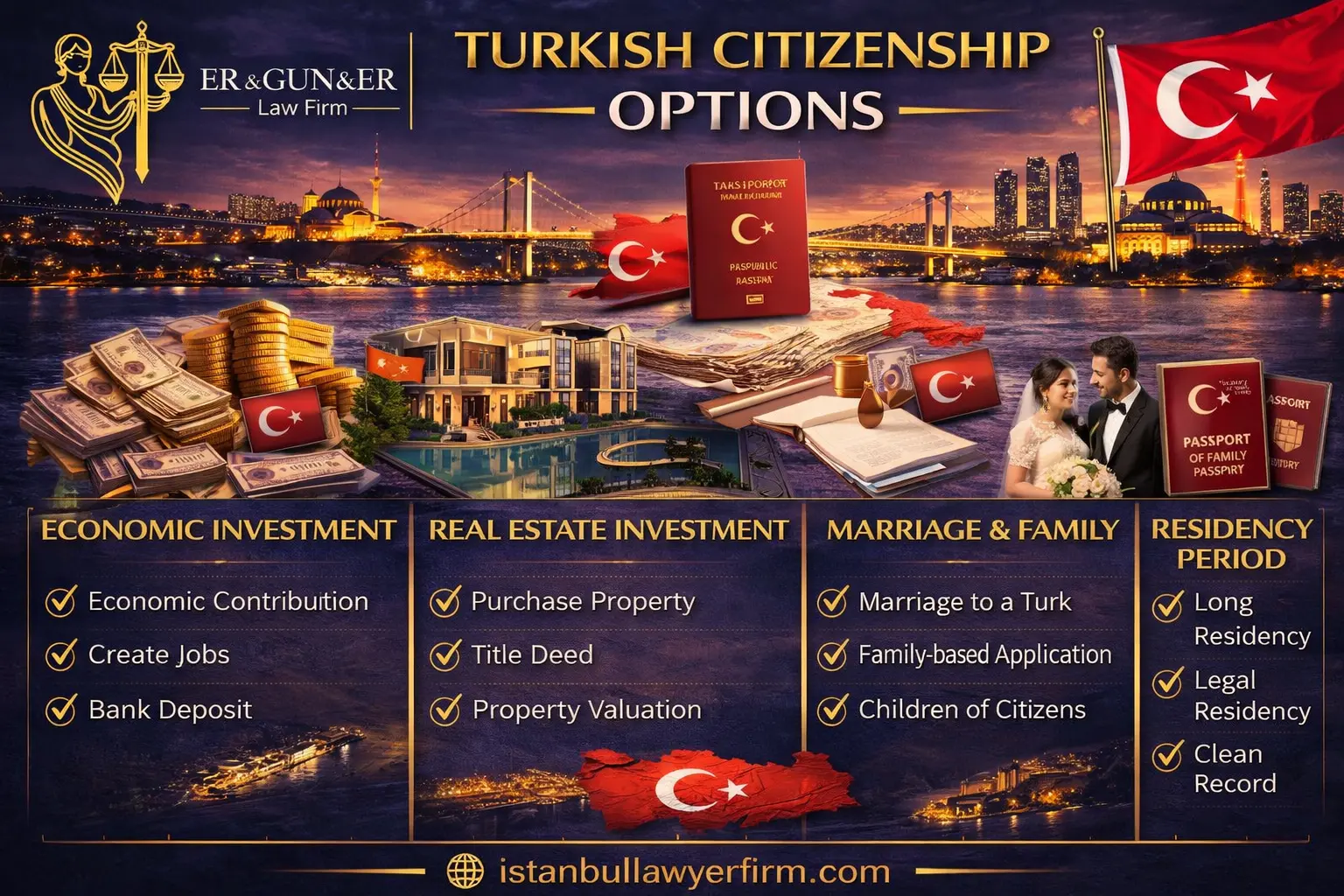
Turkish citizenship options are determined by an evidence-and-chronology framework in which the applicant must demonstrate—through authenticated, translated, and precisely organized documents—that they satisfy the specific legal conditions of the route they are pursuing, and neither the applicant's subjective sense of having "lived in Turkey for a long time" nor the informal advice of community groups constitutes adequate legal preparation for an application that will be assessed by the Directorate of Civil Registration and Citizenship Affairs against specific statutory criteria. The route selection decision is among the most consequential early choices in the citizenship planning process, because the general naturalization route requires documented lawful residence of a specified continuous duration, the exceptional investment route requires specific qualifying investment transactions verified by designated authorities, and the marriage-based route requires a qualifying period of marriage to a Turkish citizen followed by conditions that the applicant must continuously satisfy—and an application built on the wrong route, or on a route for which the applicant does not yet qualify, produces either a refusal or a withdrawal that generates an adverse record in the administrative system. The Turkish citizenship by investment options that have attracted the most international attention—particularly the real estate investment route and the capital deposit route—are governed by specific presidential decisions that establish the qualifying investment thresholds, the verification procedures, and the documentation requirements, and those thresholds must be confirmed from the current official instruments rather than from secondary marketing materials that may reflect outdated or inaccurate information. The due diligence dimension of the Turkish citizenship application—the Interior Ministry's background check and security assessment—is a substantive review that examines the applicant's criminal history in Turkey and abroad, their immigration compliance record, and their broader profile against national security criteria, and an application submitted without a realistic prior assessment of how the applicant will fare in this review is an application that may spend months in processing before encountering an avoidable obstacle. The document legalization and translation requirements for Turkish citizenship applications are demanding: every foreign-source document—birth certificate, marriage certificate, criminal clearance from the home country, foreign education certificates—must be processed through the Hague Apostille Convention chain or consular legalization, followed by certified Turkish translation, before it will be accepted by the processing authority. This article provides a comprehensive, practice-oriented guide to Turkish citizenship options as they operate in 2026, addressed to foreign nationals who are considering or actively pursuing Turkish citizenship and who need to understand the legal frameworks, the procedural requirements, and the risk factors that determine the outcome of their application.
Citizenship routes overview
A lawyer in Turkey advising on Turkish citizenship options must begin with the legislative foundation: Turkish citizenship law is governed by Law No. 5901 on Turkish Citizenship (Türk Vatandaşlığı Kanunu), whose full text is accessible at Mevzuat. The Turkish Citizenship Law 5901 establishes the full framework of citizenship acquisition routes—both standard and exceptional—and defines the substantive eligibility conditions for each. The law distinguishes between acquisition of citizenship by birth (through descent from a Turkish citizen parent, or in specific circumstances through birth on Turkish territory), acquisition through marriage to a Turkish citizen, acquisition through naturalization (based on lawful residence in Turkey for a qualifying period), and acquisition through exceptional grant (which the investment-based route falls within, alongside extraordinary contributions to Turkey and other specific exceptional circumstances recognized by the Council of Ministers or the President). Each route has its own specific conditions, its own evidence requirements, and its own processing authority, and the first task in citizenship planning is identifying which route or routes the applicant genuinely qualifies for—or is approaching eligibility for—given their specific factual circumstances. Practice may vary by authority and year — check current guidance on the current Turkish Citizenship Law 5901 provisions and on any recent presidential decisions or legislative amendments that may have modified the eligibility conditions for specific citizenship acquisition routes.
An Istanbul Law Firm advising on the citizenship routes overview must help applicants understand that Turkish citizenship options are not interchangeable pathways where the applicant simply chooses the one most convenient for them—each route requires the applicant to satisfy specific legal conditions that are genuine and not manufactured, and an application based on a route for which the applicant does not genuinely qualify will be identified and refused in the processing phase. The general naturalization route requires genuinely accumulated lawful residence in Turkey for the prescribed continuous period—it cannot be substituted by frequent short tourist visits that amount to the same calendar time but do not satisfy the continuity and lawfulness conditions. The exceptional investment route requires a genuine qualifying investment that meets the specific thresholds—it cannot be structured through nominal transactions designed to appear as qualifying investments without the substantive economic character required. The marriage-based route requires a genuine marriage to a Turkish citizen and the satisfaction of specific durational and behavioral conditions—it cannot be used for a sham marriage entered into specifically for immigration purposes. The route selection analysis must be conducted by a Turkish citizenship lawyer who understands the specific legal conditions of each route and who can assess the applicant's specific factual situation against those conditions with complete honesty rather than with a marketing orientation. Practice may vary by authority and year — check current guidance on the current Turkish citizenship application assessment standards and on any recent changes to the processing procedures applicable to each citizenship acquisition route.
A Turkish Law Firm advising on the how to get Turkish citizenship question from the perspective of an applicant who has not yet begun any citizenship-related process must explain the preliminary assessment steps that should precede any application filing. The preliminary assessment covers: which route or routes the applicant currently qualifies for; which route or routes the applicant could qualify for within a planning horizon of one to three years through deliberate preparation; what the current documentary requirements are for each feasible route; what the current estimated processing times are for each route; and what the specific risks—refusal grounds, investment loss risks, process delays—are associated with each route. This preliminary assessment is best conducted by a qualified Turkish citizenship lawyer rather than through self-assessment from marketing materials or online forums, because the specific legal standards and the specific risks cannot be reliably assessed without legal expertise. The Directorate General of Migration Management at goc.gov.tr provides context on the residence permit system that underlies the general naturalization route, and the Mevzuat official portal at mevzuat.gov.tr provides access to the current legal text of all relevant legislation. Practice may vary by authority and year — check current guidance on the current Turkish citizenship acquisition routes and on any recently added, modified, or discontinued routes through presidential decision or legislative change.
For the full procedural framework on the qualifying investment routes and the institutional review architecture at the Vatandaşlık Daireleri, see our pillar guide on turkish citizenship by investment.
General naturalization route
A law firm in Istanbul advising on the naturalization requirements Turkey general route must explain that this is the standard pathway through which a foreign national who has established lawful residence in Turkey for a qualifying continuous period can apply for Turkish citizenship without needing to satisfy any investment threshold or exceptional contribution requirement. The Turkish Citizenship Law 5901 establishes the specific continuous lawful residence period required for general naturalization eligibility, and this period must be continuous—meaning that the applicant must have maintained valid Turkish residence permits without status gaps throughout the qualifying period. Practice may vary by authority and year — check current guidance on the current Turkish Citizenship Law 5901 continuous residence requirement and on whether any changes have been made to this requirement through legislative amendment or implementing regulation since this article was prepared. The general naturalization applicant must also satisfy a set of additional conditions beyond the residence duration: they must have an intention to settle in Turkey (anlaşılabilir bir yerleşme niyeti); they must have sufficient income or financial means to support themselves and their dependents in Turkey; they must not have a disease that poses a public health risk; they must have good moral character (iyi ahlak); they must speak Turkish at a sufficient level; and they must not have conduct that would be contrary to national security and public order. Each of these conditions requires specific documentation or a declaration at the application stage, and the absence of evidence for any condition is a refusal ground. Practice may vary by authority and year — check current guidance on the current documentation standards required for each eligibility condition in the general naturalization application and on any changes to the documentary evidence requirements since this article was prepared.
The Turkish language sufficiency requirement for general naturalization—the applicant's obligation to demonstrate adequate Turkish language skills—is one of the conditions that applicants most frequently underestimate in their preparation. The Turkish language requirement does not typically require a formal language proficiency examination certificate for all applicants, but it does require that the applicant can communicate adequately in Turkish during the interview stage of the application process, and an applicant who cannot communicate with the processing authorities in Turkish may face difficulty satisfying this condition. A foreign national who has lived in Turkey for the qualifying residence period through employment in an international environment, with English as their primary working language, may have developed minimal Turkish language skills despite their extended residence—creating a potential bottleneck in the naturalization process. The preparation for the Turkish language component of the naturalization process should begin well before the application is filed, because language acquisition takes time and cannot be addressed at the last minute. Practice may vary by authority and year — check current guidance on the current Turkish language proficiency standards applicable to general naturalization applicants and on any formal examination or assessment requirements that may currently be imposed for specific applicant categories.
A English speaking lawyer in Turkey advising on the good moral character and national security conditions of the general naturalization route must explain that these conditions are assessed through the background check and security review that accompanies every citizenship application—a review that covers both the applicant's Turkish record and their foreign record, and that can identify issues the applicant may not have disclosed or may not have been aware were relevant. The good moral character assessment includes the applicant's criminal history—both in Turkey and in their home country—and an applicant with a criminal record must assess whether their specific history is likely to be considered disqualifying under the Interior Ministry's current assessment standards. The national security assessment is broader and less transparent—it considers factors that are not publicly disclosed but that relate to the applicant's associations, activities, and profile, and it can result in a citizenship refusal on national security grounds without specific explanation of the basis for the refusal. An applicant who has any aspect of their history that might attract adverse assessment in a security review should seek legal advice before filing the application, because a refusal on security grounds creates an adverse record that affects all future applications. Practice may vary by authority and year — check current guidance on the current Interior Ministry security review standards for general naturalization applications and on the specific grounds currently being applied in security-based citizenship refusals.
Residence history importance
A Turkish Law Firm advising on the residency requirement for Turkish citizenship under the general naturalization route must explain that the residence history documentation is the most critical evidentiary component of the general naturalization application, because the application's foundational claim—that the applicant has resided in Turkey lawfully and continuously for the qualifying period—depends entirely on the documentary evidence that supports it. The residence history evidence consists of the authenticated record of every residence permit that the applicant held during the qualifying period—certified copies of all prior permit cards, DGMM confirmation of the permit history, and evidence that there were no gaps in valid permit status during the residence period. A single gap in lawful status—a period during which the applicant's permit had expired before the renewal was granted, a period of unauthorized overstay, or a period during which no permit was held—interrupts the continuity of the qualifying residence and may restart the qualifying period from the date the continuous status resumed. The importance of maintaining complete, organized records of every residence permit throughout the Turkish residence history—not just the most recent permit—is therefore not merely an administrative formality but the evidentiary foundation of any future citizenship application. Practice may vary by authority and year — check current guidance on the current Interior Ministry standards for residence history documentation and on the specific types of status gaps that are treated as interrupting the continuity of the qualifying period.
An Istanbul Law Firm advising on the absence periods during the qualifying residence must explain that the Turkish Citizenship Law 5901 addresses the permissible absence periods—the time that an applicant may spend outside Turkey during the qualifying residence period without the absence being treated as an interruption of the continuous residence. Practice may vary by authority and year — check current guidance on the current Turkish Citizenship Law 5901 absence period provisions and on how these are currently applied in naturalization applications to determine whether a specific pattern of absences is treated as interrupting or not interrupting the continuous residence. An applicant who spent significant periods outside Turkey during the qualifying period—for family reasons, for work-related travel, or for other personal reasons—must specifically assess whether those absences are within the permissible limits before filing the naturalization application, because an application that overstates the qualifying residence period by counting absence periods that were not permissible creates a misrepresentation issue that is more serious than simply not yet satisfying the residence requirement. The residence history for a foreign national who has held multiple types of residence permits over the qualifying period—short-term permits, family permits, long-term permits—must be assessed in its entirety, because different permit types may be treated differently in the continuity calculation. Practice may vary by authority and year — check current guidance on the current treatment of different permit types in the continuous residence calculation for naturalization eligibility purposes.
The residence history documentation for an applicant who has been in Turkey for many years must be assembled with specific attention to the completeness of the permit record—because permits from many years ago may not be easily accessible through the applicant's own records, and the DGMM database query that the processing authority will conduct may reveal a more complex permit history than the applicant's memory suggests. A proactive DGMM immigration history query—conducted by the applicant's lawyer before the citizenship application is filed—identifies the complete permit record, reveals any gaps or adverse entries, and provides the applicant with the opportunity to address any issues before the citizenship application's processing authority discovers them. A citizenship application that is submitted with a complete, pre-audited residence history—with the attorney's analysis confirming that all continuity conditions are satisfied—is in a fundamentally stronger position than one submitted without this pre-audit. The comprehensive residence permit framework that underlies the general naturalization route's residence requirement is analyzed in the resource on types of residence permits Turkey. Practice may vary by authority and year — check current guidance on the current DGMM immigration history query procedures available to citizenship applicants and on the format in which the DGMM produces residence history confirmation for citizenship application purposes.
Exceptional citizenship pathway
A best lawyer in Turkey advising on the exceptional citizenship Turkey pathway must explain that the Turkish Citizenship Law 5901 provides for citizenship acquisition through an exceptional grant by the President or the Council of Ministers for foreign nationals whose admission to Turkish citizenship is assessed as being in the national interest—a category that includes the investment-based citizenship route as its most commercially significant component but that is not limited to investment. The exceptional citizenship provisions give the Turkish state significant discretion in determining which applicants' admission to citizenship serves the national interest, and this discretionary character means that the exceptional route—including the investment sub-route—does not operate as an automatic entitlement but as a qualified opportunity that requires both objective qualification (meeting the investment threshold) and the subjective favorable exercise of administrative discretion. The investment-based sub-categories of the exceptional citizenship pathway are operationalized through specific presidential decisions that define the qualifying investment types, the minimum investment thresholds, the verification procedures, and the relevant government agencies—and these presidential decisions are the authoritative source for the current thresholds and requirements, not marketing materials or promotional websites. Practice may vary by authority and year — check current guidance on the current presidential decisions governing the exceptional citizenship by investment route and on any recent amendments that may have changed the investment thresholds, qualifying investment types, or procedural requirements.
The exceptional citizenship pathway for extraordinary contributions—separate from the investment route—is available to foreign nationals who have made or can make extraordinary contributions to Turkey in specific fields: science and technology, culture and arts, sports, and economic and social contributions that the Council of Ministers determines to be in the national interest. This pathway is genuinely exceptional—it is not available to ordinary applicants and does not have published qualification criteria in the same way as the investment route, because the assessment of "extraordinary contribution" is inherently discretionary. A foreign national who believes they have made exceptional contributions to Turkey in one of these fields should seek legal advice about whether and how to structure an extraordinary contribution citizenship application, because the presentation of the application—the specific framing of the contribution, the supporting evidence, and the endorsements from relevant Turkish institutions—is as important as the substance of the contribution itself. The extraordinary contribution pathway is mentioned in this overview for completeness but is not the focus of the detailed sections that follow, which address the investment-based sub-categories in greater detail. Practice may vary by authority and year — check current guidance on the current procedures for extraordinary contribution citizenship applications and on the specific fields and contribution types that are currently being approved through this pathway.
A Turkish Law Firm advising on the procedural positioning of an exceptional citizenship application—whether investment-based or contribution-based—must explain that the exceptional route does not require prior Turkish residence permits, which is one of its most significant practical advantages for applicants who do not want to establish long-term residence in Turkey before obtaining citizenship. An investment-based applicant can obtain Turkish citizenship without ever holding a Turkish residence permit, by completing the qualifying investment, obtaining the specific documentation confirming the investment's compliance with the presidential decision's requirements, and submitting the citizenship application directly through the Turkish Citizenship by Investment pathway. However, the absence of a prior Turkish residence requirement does not mean that the applicant can be unknown to Turkish authorities—the security review and background check apply equally to exceptional citizenship applicants and to general naturalization applicants, and an applicant with an adverse immigration or security history faces the same risk of refusal through the exceptional route as through the general route. Practice may vary by authority and year — check current guidance on the current exceptional citizenship application procedures and on whether any residence or presence in Turkey is required or beneficial for the application process itself, regardless of not being a legal prerequisite for qualification.
Investment route framework
A law firm in Istanbul advising on the Turkish citizenship by investment options framework must explain that the investment citizenship pathway is governed by Presidential Decision No. 2018/11608 and subsequent amendments—including Presidential Decision No. 2022/482 published in the Official Gazette, which established the current investment thresholds—and that these decisions are accessible through the Mevzuat portal and the Official Gazette (Resmî Gazete) and constitute the authoritative source for the specific requirements. The investment citizenship framework offers multiple qualifying investment sub-categories: real estate acquisition at the prescribed minimum value; fixed capital investment at the prescribed minimum amount; bank deposit in Turkish banks at the prescribed minimum amount; government debt instrument purchase at the prescribed minimum amount; real estate investment fund share or venture capital investment fund share purchase at the prescribed minimum amount; and employment creation at the prescribed minimum number of employees. Each sub-category has its own specific documentation and verification requirements—different designated government agencies verify compliance for different investment types—and the applicant must follow the specific verification path designated for their chosen investment type to obtain the certificate or confirmation required for the citizenship application. Practice may vary by authority and year — check current guidance on the current official investment thresholds from the relevant presidential decision and on any subsequent amendments that may have changed the thresholds or added new qualifying investment categories since this article was prepared.
The Turkish passport investment program has attracted significant international interest since the investment thresholds were adjusted by successive presidential decisions, and Turkey has processed a substantial volume of investment citizenship applications in recent years—a volume that has created processing infrastructure and administrative experience at the Ministry of Interior and the relevant verification agencies. The investor applicant who approaches the investment citizenship process with a thorough understanding of the specific requirements—the correct investment type, the correct minimum value, the correct holding period commitment, the correct verification agency, the correct documentation format—and who has engaged qualified legal counsel to manage the process from investment structuring through citizenship certificate issuance, is in a significantly better position than one who relies on informal advice or promotional materials from real estate agents, investment brokers, or citizenship promotion websites that may have financial incentives to downplay the risks. The investment citizenship process requires both legal expertise—to structure the investment correctly, verify the documentation, and manage the application—and due diligence discipline—to confirm that the investment meets all requirements before any funds are committed. Practice may vary by authority and year — check current guidance on the current processing timelines for investment citizenship applications and on the current administrative infrastructure managing these applications.
A Turkish Law Firm advising on the investment commitment requirement—the obligation to maintain the qualifying investment for a specified period after citizenship is granted—must explain that the Turkish citizenship by investment routes require the investor to commit to maintaining the investment for a specified holding period, and that the citizenship may be revoked if the investor disposes of the qualifying investment before the holding period expires. Practice may vary by authority and year — check current guidance on the current holding period requirements established by the relevant presidential decision and on the specific consequences of early investment disposal. The investment holding period commitment must be evaluated as part of the investment planning, because the investment cannot be treated as a short-term transactional vehicle—it must be genuinely held for the specified period, and the investor's exit strategy must account for this requirement. An investment citizenship applicant who structures their investment with a clear understanding of the holding period and a realistic exit strategy for the post-holding-period disposal has made the most commercially disciplined use of the investment citizenship pathway. Practice may vary by authority and year — check current guidance on the current Turkish citizenship revocation standards for investment citizenship holders who dispose of the qualifying investment before the holding period expires and on any grace periods or exceptions currently recognized in the regulations.
Real estate investment route
An English speaking lawyer in Turkey advising on the Turkish citizenship by real estate route must explain the specific requirements that differentiate a qualifying real estate investment from an ordinary real estate purchase in Turkey. The current minimum real estate value for investment citizenship eligibility is established by the relevant presidential decision and must be confirmed from official sources—practice may vary by authority and year — check current guidance on the current minimum real estate value threshold and on whether this value must be assessed against the purchase price, the appraisal value, or both. The property must be acquired under a Turkish title deed (tapu), the purchase must involve a completed title deed transfer registered at the Turkish Land Registry, and the property cannot be purchased from a Turkish citizen whose citizenship was itself obtained through the investment route—a restriction designed to prevent circular investment arrangements. The real estate acquisition must be accompanied by a "no sales" annotation (satılamaz şerhi) entered in the Turkish Land Registry for the specified holding period, restricting the property's transfer until the holding period has elapsed. Practice may vary by authority and year — check current guidance on the current Land Registry annotation procedures for investment citizenship real estate and on whether the annotation is entered automatically as part of the citizenship application process or must be specifically requested.
The appraisal requirement for investment citizenship real estate is one of the most practically important procedural steps: the property's value must be established through an official appraisal (ekspertiz raporu) conducted by a licensed real estate appraiser (gayrimenkul değerleme uzmanı) recognized by the relevant Turkish authority, and the appraisal value must meet the minimum threshold. The appraisal is not the same as the purchase price—the appraisal is an independent professional assessment of the property's market value at the time of the appraisal, and a property whose purchase price meets the threshold but whose appraisal value falls below it does not qualify. An investor who purchases a property at a price significantly above its appraisal value—a situation that occurs in some markets and with some property types—is paying more than the investment requires and may have concerns about the economic basis of the transaction that the due diligence process must address. A property whose purchase price is at the minimum threshold but whose appraisal value is uncertain should be appraised before the purchase commitment is made, not after, because the discovery of an insufficient appraisal value after the purchase has been completed creates a situation where the investment must be either supplemented with additional real estate or restructured. Practice may vary by authority and year — check current guidance on the current appraisal requirement format, licensed appraiser qualifications, and the interaction between the appraisal value and the purchase price in meeting the investment citizenship threshold.
A Turkish Law Firm advising on the specific real estate due diligence required for an investment citizenship property must explain that the citizenship investment purpose adds a layer of documentation and compliance requirements beyond those applicable to an ordinary Turkish real estate purchase. The property must be in the applicant's name (not in a company's name) or in a specific joint ownership structure that meets the investment citizenship requirements; the purchase must be made in a qualifying manner (typically through a foreign currency wire transfer from a foreign bank account to the seller's account, documented through bank records that establish the investment's foreign currency origin); and the property must not be subject to any encumbrance, legal dispute, or official restriction that would undermine the investment's qualifying character. The title deed lawsuit Turkey risk dimension—where a property is subject to a pending legal challenge to its title—is a specific due diligence concern for investment citizenship purchases, because a property whose title is subsequently challenged creates complications for the citizenship that was based on that property. The title deed due diligence and verification procedures for foreign property buyers are analyzed in the resource on title deed lawsuits and property due diligence in Turkey. Practice may vary by authority and year — check current guidance on the current official documentation requirements for the real estate investment citizenship pathway and on any recently changed standards for the foreign currency payment documentation required to verify the investment's qualifying character.
Capital and deposit options
A best lawyer in Turkey advising on the capital and deposit options within the Turkish citizenship by investment options framework must explain the specific qualifying investment types in these categories and the specific documentation required for each. The fixed capital investment sub-category—where the investor makes a qualifying minimum capital investment in a Turkish company or Turkish business activity—requires documentation from the Ministry of Industry and Technology or another designated verification authority confirming that the investment meets the minimum threshold and satisfies the qualifying conditions. The bank deposit sub-category—where the investor places a qualifying minimum deposit in a Turkish bank for the specified holding period—requires documentation from the Banking Regulation and Supervision Agency (BDDK) or the relevant Turkish bank confirming the deposit, its amount, its holding period commitment, and the annotation restricting withdrawal during the holding period. The government debt instrument purchase sub-category requires documentation from the Turkish Treasury or the Capital Markets Board confirming the instrument's acquisition and the holding period annotation. Each of these sub-categories involves a different government agency in the verification process, and the documentation produced by each verification agency must be in the format specified for the citizenship application. Practice may vary by authority and year — check current guidance on the current minimum thresholds for each investment sub-category and on the specific documentation format required from the relevant verification agency for each type of investment.
The real estate investment fund (gayrimenkul yatırım fonu) and venture capital investment fund (girişim sermayesi yatırım fonu) sub-categories provide an alternative to direct property or business investment—the investor acquires a qualifying minimum value of fund units rather than making a direct investment in a specific property or company. These fund-based options may appeal to investors who want exposure to Turkish real estate or Turkish growth companies without the management responsibilities of direct asset ownership, or who prefer the portfolio diversification that a fund investment provides over a single property or business investment. The fund-based investment citizenship option requires documentation from the Capital Markets Board (SPK) confirming the fund unit acquisition and the holding period annotation. The investment-return profile of a fund-based investment citizenship option differs from a direct property purchase, and investors comparing the fund option against the real estate option should make this comparison on investment merits as well as on citizenship application convenience. Practice may vary by authority and year — check current guidance on the current minimum thresholds for fund-based investment citizenship options and on the specific fund types and SPK documentation requirements currently applicable to these sub-categories.
An Istanbul Law Firm advising on the practical investment structuring for a citizenship by deposit application must explain the specific documentation chain that connects the investor's foreign funds to the Turkish bank deposit in a manner that satisfies the investment citizenship requirements. The funds used for the investment must originate from the investor's own resources—not from a Turkish loan or a Turkish-source financing facility—and the payment trail must document the foreign origin of the investment funds through bank-to-bank transfer records, foreign source account statements, and any currency conversion documentation. A deposit funded through a Turkish bank loan does not satisfy the investment citizenship requirements because the investment does not represent the investor's own capital contribution to Turkey. The interaction between the investment citizenship bank deposit and Turkey's anti-money laundering (AML) and know-your-customer (KYC) requirements at Turkish banks means that investors must be prepared for the bank's own due diligence process alongside the citizenship application process, and investors with complex fund origins, non-standard income sources, or politically exposed person status may face enhanced due diligence requirements. Practice may vary by authority and year — check current guidance on the current Turkish banking AML and KYC requirements applicable to investment citizenship bank deposits and on the specific documentation that Turkish banks currently require from investment citizenship depositors.
Employment and business options
A Turkish Law Firm advising on the employment creation sub-category of the investment citizenship route must explain the specific requirements: the investor must create a specified minimum number of permanent employment positions in Turkey through a Turkish business entity, and the employment creation must be documented and verified by the Ministry of Family and Social Services through the Turkish Social Security Institution (SGK) records. The employment creation threshold is established by the relevant presidential decision and must be confirmed from official sources—practice may vary by authority and year — check current guidance on the current minimum employment threshold for the employment creation citizenship pathway and on any recent adjustments to this threshold. The employment creation must be through new positions created by the investor's Turkish business activity—not through the acquisition of a business that already employs the required number of people, though this distinction requires specific legal analysis given the complexity of business acquisition structures. The SGK documentation confirming the employment—showing the required number of employees registered as insured by the investor's Turkish entity—is the primary verification document for this citizenship sub-category. Practice may vary by authority and year — check current guidance on the current Ministry of Family and Social Services verification procedures for employment creation citizenship applications and on the specific SGK documentation format required for the citizenship application file.
The business investment option for investment citizenship—where the investor makes a qualifying fixed capital investment through a Turkish corporate entity—requires specific coordination between the investment structure and the citizenship documentation requirements. The corporate entity through which the investment is made must be a Turkish entity with the investor's participation (shareholding), and the fixed capital investment must be documented through the entity's capital account records and the Ministry of Industry and Technology's investment verification certificate. An investor who makes a genuine business investment in Turkey—establishing a manufacturing facility, a technology company, or a service operation—and who structures that investment in compliance with the investment citizenship requirements creates the most commercially substantive use of the investment citizenship pathway. A nominal business investment—one created primarily for the citizenship application without any genuine operational intent—creates both regulatory risk (if the nominal character is identified in the review process) and does not contribute to the investor's Turkish business interests beyond the citizenship outcome. Practice may vary by authority and year — check current guidance on the current Ministry of Industry and Technology verification procedures for fixed capital investment citizenship applications and on the specific documentation required to establish that a capital investment meets the minimum threshold.
An English speaking lawyer in Turkey advising on the combined investment approach—where an investor uses multiple investment types across different sub-categories to reach the aggregate qualifying threshold—must address whether the Turkish citizenship by investment rules permit or preclude this aggregation approach. Practice may vary by authority and year — check current guidance on the current official position on whether investment values across different sub-categories can be aggregated to reach the minimum threshold, or whether each sub-category must independently meet its own minimum threshold. The practical and legal analysis of the combined investment approach requires specific legal advice rather than reliance on informal community advice or promotional materials, because the official position on aggregation is not always clearly stated in the implementing regulations and may be applied inconsistently in practice. An investor who structures a combined investment based on an informal understanding of the aggregation rules and who discovers at the application verification stage that the structure does not qualify has made a costly and time-consuming error that specific legal advice would have prevented. Practice may vary by authority and year — check current guidance on the current Turkish citizenship investment verification procedures and on the specific structuring approaches that have been successfully used for combined investment citizenship applications in recent months.
Marriage and family route
A law firm in Istanbul advising on the marriage based Turkish citizenship route must explain the specific conditions that apply under the Turkish Citizenship Law 5901: a foreign national who is married to a Turkish citizen may apply for Turkish citizenship after the marriage has subsisted for a specified period and after both the marriage continuity and other specific conditions have been satisfied throughout that period. Practice may vary by authority and year — check current guidance on the current Turkish Citizenship Law 5901 provisions establishing the qualifying marriage duration and the additional conditions that must be satisfied during the marriage period—including cohabitation with the Turkish citizen spouse, absence of conduct threatening national security or public order, and the general good character and integration conditions applicable to all citizenship applicants. The marriage route differs from the general naturalization route in that it does not require a specific Turkish residence duration—the citizenship is available based on the marriage relationship rather than on the independent accumulation of Turkish residence time. The foreign national spouse's own Turkish residence permit history may be relevant to the application as contextual evidence of genuine residence and integration in Turkey, but the absence of a Turkish residence permit history does not disqualify the marriage-route applicant where the other qualifying conditions are met. Practice may vary by authority and year — check current guidance on the current residence permit requirements for marriage-route citizenship applicants and on the interaction between the marriage-route conditions and any Turkish residence permit the applicant may hold.
The marriage route citizenship application requires extensive documentation of the marriage and the qualifying marriage period: the marriage certificate (apostilled and translated); evidence that the marriage has been registered in the Turkish civil registry (nüfus müdürlüğü) if it was contracted abroad; evidence of cohabitation throughout the qualifying period (shared address registrations, joint household evidence); evidence of the Turkish citizen spouse's Turkish citizenship (their Turkish national identity card); and the applicant's own identity and background documentation. The genuineness of the marriage is assessed as part of the application review—the Turkish Interior Ministry's assessment of marriage-based citizenship applications includes a credibility review that examines whether the marriage has the genuine family life character required by the citizenship law, and an application based on a marriage of convenience will be refused and may trigger criminal investigation of both parties. The documentation of a genuine and ongoing marital relationship—through evidence of shared residence, shared financial life, family photographs, communications records, and testimony where required—is as important as the formal marriage certificate in the marriage-route citizenship application. Practice may vary by authority and year — check current guidance on the current Interior Ministry assessment standards for the genuineness of marriage in citizenship applications and on the specific evidence that is currently most persuasive in demonstrating genuine marital relationship character.
A Turkish Law Firm advising on the marriage-route citizenship in the context of a difficult or deteriorating marriage must address the specific legal implications that arise when the qualifying marriage period has been satisfied but the marriage itself has broken down. A foreign national who has been married to a Turkish citizen for the qualifying period but whose marriage has deteriorated—and who applies for citizenship while still technically married but with the intention to divorce after the citizenship is granted—is in a legally sensitive position that the processing authority's review may identify. The citizenship law's requirement that the marriage subsist for the qualifying period does not necessarily require that the marriage be genuinely intact at the moment of application, but the combination of the legal marriage's continuity and the behavioral conditions required during the qualifying period creates a substantive—not merely formal—marriage requirement. The legal analysis of the marriage-route application in a deteriorating marriage situation requires specific legal advice about the specific circumstances, the specific evidence the applicant can produce of the marriage's qualifying character during the required period, and the specific risk of a refusal based on a finding that the behavioral conditions were not met. Practice may vary by authority and year — check current guidance on the current Interior Ministry assessment standards for marriage-route applications where the marriage appears to have deteriorated during the qualifying period.
Children and dependents
A best lawyer in Turkey advising on Turkish citizenship for children must explain the different mechanisms through which a child can acquire Turkish citizenship—by birth from a Turkish citizen parent (the principal route), through the citizenship acquisition of a parent, and through an independent citizenship application based on the child's own qualifying circumstances. A child born to a Turkish citizen parent—whether the birth occurred in Turkey or abroad—acquires Turkish citizenship by descent (soybağı yoluyla vatandaşlık) and is entitled to a Turkish birth certificate and Turkish identity registration from birth. A child born in Turkey to foreign national parents does not automatically acquire Turkish citizenship through birth on Turkish territory—Turkish citizenship law follows the jus sanguinis principle (citizenship by bloodline) rather than the jus soli principle (citizenship by place of birth)—and must acquire citizenship through another route. The Turkish citizenship for children dimension of the investment citizenship route is particularly important: when a primary applicant acquires Turkish citizenship through the exceptional investment route, their minor children and spouse are typically included in the same application or in a derivative application, and the family unit's citizenship applications are processed together. Practice may vary by authority and year — check current guidance on the current procedures for including spouse and minor children in an investment citizenship application and on the specific documentation required for each family member's inclusion in the application.
The dependent residency process Turkey framework—through which dependent family members maintain their Turkish residence status before the primary applicant obtains citizenship—is analyzed in the resource on dependent residency process Turkey. The family dimension of citizenship planning requires coordination across all family members' status: where the primary applicant is pursuing investment citizenship, the spouse and children may hold family residence permits during the investment period before the citizenship application is filed, and the transition from residence permit status to citizenship status must be managed without creating gaps in lawful status for any family member. A child who reaches the age of majority during the citizenship application process—between the time the primary applicant's investment is completed and the citizenship certificate is issued—may need to be considered separately from the minor children in terms of their derivative citizenship claim. Practice may vary by authority and year — check current guidance on the current age threshold for inclusion as a minor child in an investment citizenship application and on the procedures for handling a child who reaches majority during the citizenship application process.
An English speaking lawyer in Turkey advising on the citizenship status of children whose parents have different nationalities must address the specific Turkish citizenship law provisions governing citizenship acquisition through a Turkish citizen parent where the other parent is a foreign national. A child born to a Turkish citizen father and a foreign national mother, or to a Turkish citizen mother and a foreign national father, is entitled to Turkish citizenship by descent regardless of whether the birth occurred in Turkey or abroad—but the documentation and registration steps required to formally establish the child's Turkish citizenship may vary depending on whether the birth was in Turkey or abroad and whether the Turkish parent's citizenship was already registered in the Turkish civil registry. A child with a Turkish citizen parent who has not yet been formally registered in the Turkish civil registry as a Turkish citizen is a Turkish citizen by law but may not have the identity documents to prove this status—creating a practical problem that must be addressed through the civil registration process. Practice may vary by authority and year — check current guidance on the current Turkish civil registration procedures for children born abroad to Turkish citizen parents and on the documentation required to establish and register the child's Turkish citizenship.
Criminal record and security
A Turkish Law Firm advising on the criminal record check for Turkish citizenship must explain that every citizenship application—regardless of route—triggers a comprehensive background check and security review conducted by the Interior Ministry and relevant security agencies. The criminal record check covers both the applicant's Turkish criminal record (accessible through the Turkish criminal records system—adli sicil) and their foreign criminal record (obtained through the applicant's criminal clearance certificate from their home country or countries of prior residence). A criminal record involving specific offense categories—terrorism, organized crime, drug trafficking, human trafficking, serious fraud, offenses against national security—is typically disqualifying for Turkish citizenship, and an applicant with such a record should seek specific legal advice before filing any citizenship application. A criminal record involving less serious offenses—minor traffic violations, minor administrative infringements—may not be disqualifying but will be reviewed as part of the overall good character assessment, and the specific impact on the citizenship application depends on the nature of the offense, its severity, the time elapsed since the offense, and the applicant's subsequent conduct. Practice may vary by authority and year — check current guidance on the current Interior Ministry assessment standards for specific offense categories in citizenship applications and on any recent changes to the disqualifying offense list.
The criminal clearance certificate from the applicant's home country—the primary document evidencing the applicant's foreign criminal record—is a mandatory component of every Turkish citizenship application file. This certificate must be obtained from the competent authority in the applicant's home country (typically the national police or ministry of justice), must be apostilled (for countries party to the Hague Apostille Convention) or consularly legalized, and must be certified-translated into Turkish. A criminal clearance certificate that is outdated—obtained many months before the citizenship application is filed—may not be accepted as current, because the certificate must reflect the applicant's criminal status as close to the application date as possible. An applicant who has resided in multiple countries must typically obtain criminal clearance certificates from each country where they have lived for more than a specified period, because the Turkish processing authority will assess the completeness of the clearance documentation against the applicant's residence history. Practice may vary by authority and year — check current guidance on the current Turkish citizenship application requirements for criminal clearance certificates and on the acceptable age of the certificate at the time of application filing.
The national security review component of the Turkish citizenship background check is the most opaque dimension of the process—it is conducted by security and intelligence agencies whose assessment criteria are not publicly disclosed, and it can result in a citizenship refusal or an indefinite processing delay without any specific explanation to the applicant. An applicant who has personal or professional associations with individuals or organizations that are of concern to Turkish national security authorities, who has traveled to or maintained connections with specific countries or regions, or whose financial background or business activities raise security-related concerns faces a higher risk in this dimension of the review. The legal analysis of the security review risk requires a candid assessment of the applicant's specific profile against the publicly available information about Turkish national security concerns—an assessment that should be conducted before the application is filed so that the applicant can make an informed decision about whether and when to file. A citizenship application that is refused on national security grounds cannot typically be rehabilitated through supplementary documentation or legal argument—it reflects a substantive security determination that may require significant changed circumstances over time before a successful reapplication is possible. Practice may vary by authority and year — check current guidance on the current Turkish security review standards for citizenship applications and on the specific circumstances under which a security-based refusal can be challenged through administrative or judicial proceedings.
Document legalization and translation
A law firm in Istanbul advising on the document legalization apostille Turkish citizenship requirements must explain that the document authentication and translation requirements for a Turkish citizenship application are among the most demanding in any country's citizenship process, and that applicants who underestimate these requirements consistently encounter processing delays and application deficiencies that are entirely preventable through careful pre-filing preparation. Every foreign-source document in the citizenship application file—birth certificate, marriage certificate, criminal clearance certificate, education certificates, divorce decrees, prior court orders—must be processed through the applicable authentication chain before it will be accepted by the Turkish processing authority. For documents from countries party to the Hague Apostille Convention, this means obtaining an apostille from the competent authority in the issuing country—the apostille certifies the document's authenticity and the signatory's authority, and is the internationally recognized authentication mechanism for official documents. For documents from countries not party to the Hague Convention, the consular legalization chain applies: certification by the national authority, then by the home-country foreign ministry, then by the Turkish consulate or embassy in the home country. Practice may vary by authority and year — check current guidance on the current Hague Apostille Convention member country list and on the specific consular legalization chain applicable for documents from specific non-Convention countries.
The certified Turkish translation requirement—applying to every foreign-language document in the citizenship file—requires that the translation be prepared by a sworn translator (yeminli tercüman) recognized under Turkish notarial standards, and that the translation be a complete and accurate rendering of the original document including all its content—not a summary, a partial translation, or a translation of only the information the applicant considers relevant. The sworn translator's certification confirms their qualification and the accuracy of the translation, and the certification must meet the specific format requirements of the Turkish processing authority. A document that is authentically apostilled but accompanied by an uncertified translation—one prepared by a bilingual person without sworn translator certification—will be rejected at the processing stage despite the document's underlying authenticity. The translation of technical legal documents—criminal clearance certificates, court orders, corporate documents—requires translators with both linguistic proficiency and legal-terminology expertise, and the use of general language translators for specialized legal documents creates specific translation quality risks. Practice may vary by authority and year — check current guidance on the current Turkish citizenship application translation certification requirements and on any specific format or qualification standards that Turkish processing authorities currently apply to sworn translator certifications in citizenship files.
A Turkish Law Firm advising on the document currency requirement for Turkish citizenship applications must explain that documents must typically be recent—not obtained many months before the application—because the processing authority assesses the applicant's status as of the application date rather than as of some prior date. Criminal clearance certificates, bank statements showing financial means, and tax compliance certificates must all reflect the applicant's current status, and documents that were current when obtained but that are outdated at the time of filing or assessment create processing problems that require new documents to be obtained. The specific acceptable age for different document types is not uniformly specified across all citizenship application types, and practice may vary by authority and year — check current guidance on the current acceptable age for each mandatory document category in Turkish citizenship applications and on any specific document currency requirements that have recently been added or changed. The planning of document acquisition should work backwards from the expected application filing date—identifying how far in advance each document can be obtained without becoming outdated at the time of assessment—and building in a buffer for the processing time of each authentication step. Practice may vary by authority and year — check current guidance on the current Apostille Convention processing timelines in specific countries and on any alternative authentication procedures that may be available to accelerate the document preparation phase.
Application workflow and interviews
An English speaking lawyer in Turkey advising on the Turkish citizenship application process workflow must explain the procedural sequence through which an application progresses from initial filing through the processing phases to the final citizenship certificate and passport issuance. The citizenship application is filed at the Directorate of Civil Registration and Citizenship Affairs (Nüfus ve Vatandaşlık İşleri Genel Müdürlüğü, NVİ) office responsible for the applicant's registered address in Turkey (for applicants already in Turkey on a residence permit) or at the relevant Turkish consulate or embassy abroad (for applicants applying from abroad). The application file must be complete at the time of filing—the processing authority typically does not accept applications with missing documents and then follow up for the missing items, but returns incomplete applications for completion before filing. The investment citizenship applications filed through the exceptional route follow a slightly different procedural path that involves the relevant investment verification agencies (Ministry of Environment and Urbanization for real estate, Ministry of Industry and Technology for capital investment, BDDK for bank deposits, and so on) before the application file reaches the Interior Ministry for the citizenship decision. Practice may vary by authority and year — check current guidance on the current NVİ application filing procedures and on the specific document checklist for the relevant citizenship application category.
The interview component of the Turkish citizenship application—where the applicant is called for an interview with the processing authority to verify their identity, their understanding of the citizenship obligations, and their integration into Turkish society—is not universally required for all citizenship applications but may be conducted at the processing authority's discretion for specific categories of applicants or specific types of applications. A general naturalization applicant who has been resident in Turkey for many years may be assessed primarily on the documentary file, while a marriage-route applicant or an investment citizenship applicant may be called for an interview if the processing authority has specific questions about the qualifying relationship or the investment's qualifying character. The interview, if conducted, is typically conducted in Turkish—which reinforces the importance of Turkish language preparation for all citizenship applicants regardless of route. An applicant who cannot communicate adequately in Turkish at the interview stage of the process faces a specific obstacle that documentation alone cannot overcome. Practice may vary by authority and year — check current guidance on the current interview practices for different categories of Turkish citizenship applications and on any preparation guidance that the processing authority currently provides to applicants who are called for interview.
A best lawyer in Turkey advising on the citizenship certificate and passport issuance phase—the final stages of a successful citizenship application—must explain the practical steps required after the citizenship decision to complete the citizenship registration and obtain the specific identity documents that Turkish citizenship provides. The citizenship decision produces a Presidential Decree (Cumhurbaşkanlığı Kararnamesi) approving the applicant's acquisition of Turkish citizenship, and this decree is published in the Official Gazette (Resmî Gazete). The newly approved citizen must then register their citizenship in the Turkish civil registry, obtain their Turkish national identity card (T.C. Kimlik Kartı), and apply for their Turkish passport through the relevant Interior Ministry offices. These post-decision steps require the citizen's physical presence in Turkey (or management through a power of attorney by a Turkish lawyer) and must be completed within a reasonable period after the citizenship decision. The full-service immigration support framework available for managing the citizenship application from planning through post-decision registration is described in the resource on full-service immigration law firm Turkey. Practice may vary by authority and year — check current guidance on the current post-decision citizenship registration procedures and on any time limits that may apply between the citizenship decision and the required registration and identity document steps.
Refusals and risk factors
A Turkish Law Firm advising on citizenship application refusal Turkey risk factors must explain the categories of risk that are most likely to produce a refusal decision, because an accurate pre-filing assessment of these risks determines both the quality of the application and the strategic decision about whether and when to file. The most commonly encountered citizenship refusal grounds include: insufficient continuous residence documentation for general naturalization applications—where the residence history shows gaps, short overstays, or periods of unauthorized status that interrupt the qualifying period; investment documentation deficiencies for investment citizenship applications—where the property appraisal is insufficient, the payment trail is incomplete, or the holding period annotation has not been entered; criminal record findings—where the background check reveals an offense that the applicant did not disclose or that the applicant did disclose but whose significance they underestimated; security findings—where the national security review produces an adverse determination on the applicant's profile; and marriage genuineness findings—where the processing authority determines that the marriage was contracted for immigration purposes rather than as a genuine family relationship. Each refusal category requires a specific legal analysis to determine whether and how the application can be improved for resubmission or challenged through administrative or judicial proceedings. Practice may vary by authority and year — check current guidance on the current Interior Ministry and NVİ refusal standards for each citizenship application category and on any recent changes to the refusal criteria that may affect the risk assessment for specific applicant profiles.
The investment citizenship application refusal risk from documentation deficiencies deserves specific attention because the investment citizenship market has attracted a range of intermediary service providers—real estate agents, investment brokers, citizenship consultants—some of whom oversimplify the requirements or provide inaccurate information about what is needed. An investor who relies on a real estate agent's assurance that the property meets all citizenship requirements—without independent legal verification of the property's value, title, and compliance with the investment citizenship specific requirements—may discover at the application stage that the property does not qualify, after the investment has already been committed. The specific documentation requirements for investment citizenship applications—the official appraisal report, the title deed, the no-sales annotation, the foreign currency payment documentation, the investment verification certificate from the designated government agency—must each be individually verified by qualified legal counsel against the current official standards, not simply assumed to be in order because the real estate agent or investment broker says so. A pre-filing document audit by a qualified Turkish citizenship lawyer is the most reliable risk-reduction measure available to investment citizenship applicants. Practice may vary by authority and year — check current guidance on the current investment citizenship documentation standards and on any recent changes to the verification procedures that may affect applications already in preparation.
An English speaking lawyer in Turkey advising on the risk of post-citizenship revocation—the risk that a citizenship granted through the exceptional or investment route is subsequently revoked—must explain the grounds on which Turkish citizenship can be revoked after it has been acquired. The Turkish Citizenship Law 5901 establishes specific grounds for citizenship revocation, including: the discovery that the citizenship was acquired through false documents or false declarations; conduct that is contrary to Turkish national security interests; and failure to satisfy specific post-acquisition conditions, including the investment holding period requirement for investment citizenship holders. A citizenship that is revoked through an administrative decision reverts the individual to foreign national status, and the consequences—loss of all Turkish citizenship rights, potential exit from Turkey as a foreign national, potential loss of any Turkish property or business rights connected to the citizenship—are severe. An investment citizenship holder who complies with the holding period requirement, maintains the investment for the specified period, and has no adverse security, criminal, or fraud issues faces minimal revocation risk after the holding period expires. Practice may vary by authority and year — check current guidance on the current Turkish citizenship revocation standards and procedures and on any recent cases or administrative changes that may affect the revocation risk assessment for investment citizenship holders.
Appeals and litigation posture
A law firm in Istanbul advising on the appeals and litigation posture after a Turkish citizenship application refusal must explain the administrative and judicial remedies available under Turkish administrative law for challenging a citizenship refusal decision. The citizenship refusal is an administrative act (idari karar) issued by the Interior Ministry (or the President through a Presidential Decree confirming a refusal recommendation), and it is subject to both administrative objection and judicial review through the administrative courts under the Code of Administrative Procedure (İYUK). The administrative objection to a citizenship refusal is filed with the Interior Ministry or the relevant processing authority within the applicable deadline established by the administrative procedure rules, and must present specific legal and factual arguments for why the refusal decision was incorrect. An administrative objection is most effective where the refusal was based on a legal or factual error—an incorrect application of the citizenship law, a misreading of the documentary evidence, or a procedural violation in the assessment process—and is unlikely to be effective where the refusal was correctly based on a genuinely adverse finding about the applicant's criminal record, security profile, or investment qualification. Practice may vary by authority and year — check current guidance on the current administrative objection timelines and procedures for Turkish citizenship refusal decisions and on the specific arguments that are currently being accepted as grounds for administrative reconsideration.
The administrative court judicial review of a Turkish citizenship refusal provides the secondary challenge mechanism, and the administrative court can review the legality of the refusal decision—whether the Interior Ministry applied the correct legal standard, whether the factual assessment was adequately evidenced, and whether the required procedural steps were followed. The challenge of a security-based citizenship refusal is particularly difficult through the judicial review route because the courts typically accord substantial deference to the security agencies' factual determinations and do not independently assess the national security risk posed by the applicant. A citizenship refusal that rests entirely on a security finding—without any specific factual basis disclosed to the applicant—presents a challenge in the judicial review context because the applicant cannot specifically rebut a finding whose basis has not been disclosed. The visa rejection and residence permit rejection Turkey context—which covers the administrative and judicial challenge frameworks for immigration and citizenship refusals—is analyzed in the resource on residence permit rejection Turkey. Practice may vary by authority and year — check current guidance on the current Turkish administrative court standard of review for citizenship refusal decisions and on any recent judicial decisions affecting the scope and intensity of court review in citizenship cases.
A Turkish Law Firm advising on the reapplication strategy after a citizenship refusal must help the applicant understand that the strategic decision—whether to challenge the refusal or to address the refusal grounds and reapply—depends entirely on the specific refusal grounds and the specific remedies available for each. A refusal based on a correctable document deficiency—an apostille that was missing, a translation that was not certified, a criminal clearance that had expired before the application was filed—is most efficiently addressed through correction of the deficiency and reapplication rather than through an administrative or judicial challenge to the refusal. A refusal based on a legally incorrect assessment of the investment's qualifying character—where the processing authority applied the wrong valuation methodology or rejected a document that should have been accepted—is most efficiently challenged through the administrative objection route with a specific legal argument for why the investment does qualify. The Turkish citizenship lawyer advising on the post-refusal strategy must combine a legal analysis of the refusal grounds with a realistic assessment of the administrative and judicial challenge prospects, and must present the applicant with a clear recommendation rather than a menu of theoretical options. Practice may vary by authority and year — check current guidance on the current processing timelines for citizenship refusal challenges and on any recent changes to the administrative objection or judicial review procedures applicable to citizenship cases.
Practical planning roadmap
A Turkish Law Firm developing a practical planning roadmap for a Turkish citizenship application must structure the preparation around four sequential phases: eligibility assessment, documentation preparation, application filing and processing management, and post-decision citizenship registration. The eligibility assessment phase—conducted well before any commitment to a specific route is made—covers the identification of the most appropriate citizenship route given the applicant's specific circumstances, the verification of current eligibility or the planning timeline to eligibility, the identification of potential refusal risk factors and their mitigation options, and the development of a pre-filing document preparation checklist. This phase must be conducted with qualified Turkish citizenship legal advice rather than through self-assessment or promotional consultation, because the stakes of a citizenship application—both the financial investment in the case of investment citizenship and the personal and professional importance of citizenship in all cases—are too high to be managed through inadequately informed preliminary analysis. A pre-filing risk assessment that identifies a potentially disqualifying criminal record, a residence history gap, or an investment documentation deficiency before the application is filed is worth far more than the cost of the assessment, because it prevents the commission of resources to an application that will be refused. Practice may vary by authority and year — check current guidance on the current Turkish citizenship eligibility conditions and on any recently changed requirements before finalizing the route selection decision.
The documentation preparation phase—which follows the eligibility assessment and route selection—is the longest and most detailed phase of the citizenship planning process for most applicants, because the document collection, authentication, and translation requirements involve multiple steps in multiple jurisdictions that cannot be compressed below a minimum timeline. The foreign criminal clearance certificate must be requested, received, apostilled, and translated. The foreign birth certificate and marriage certificate must be apostilled and translated. For an investment citizenship applicant, the property must be identified, appraised, purchased with proper payment documentation, and the required annotations must be entered and the investment verification certificate obtained. Each of these steps has its own timeline and its own dependency on the prior step, and the overall document preparation timeline must be mapped from the end backward from the intended application filing date to identify when each step must begin. An investment citizenship applicant who has not mapped this timeline before committing to a property transaction may discover that the specific document preparation steps cannot be completed within the timeframe they expected, creating pressure to file an incomplete application or to wait longer than anticipated. Practice may vary by authority and year — check current guidance on the current processing timelines for each documentation and authentication step and on any expedited procedures currently available for specific document categories.
A best lawyer in Turkey completing the practical planning roadmap must address the tax and financial planning dimensions that accompany Turkish citizenship acquisition—because the acquisition of Turkish citizenship creates both new rights (including all the rights of Turkish citizenship, access to the Turkish passport, and the elimination of residence permit renewal obligations) and new responsibilities (including the potential implication of Turkish tax residency if the new citizen establishes actual residence in Turkey). The tax residency foreigners Turkey dimension—analyzing the Turkish income tax consequences of extended presence in Turkey and the availability of double tax treaty relief—is analyzed in the resource on tax residency foreigners Turkey. The Istanbul Bar Association at istanbulbarosu.org.tr provides resources for identifying qualified citizenship and immigration law practitioners in Istanbul who can support the full citizenship planning and application process from initial eligibility assessment through post-decision registration. Practice may vary by authority and year — check current guidance on any recent changes to Turkish citizenship law thresholds, investment route conditions, or application processing procedures before implementing any aspect of this article's general analysis in a specific current citizenship planning situation.
Author: Mirkan Topcu is an attorney registered with the Istanbul Bar Association (Istanbul 1st Bar), Bar Registration No: 67874. His practice focuses on cross-border and high-stakes matters where evidence discipline, procedural accuracy, and risk control are decisive.
He advises individuals and companies across Sports Law, Criminal Law, Arbitration and Dispute Resolution, Health Law, Enforcement and Insolvency, Citizenship and Immigration (including Turkish Citizenship by Investment), Commercial and Corporate Law, Commercial Contracts, Real Estate (including acquisitions and rental disputes), and Foreigners Law. He regularly supports corporate clients on governance and contracting, shareholder and management disputes, receivables and enforcement strategy, and risk management in Turkey-facing transactions—often in matters involving foreign shareholders, investors, or cross-border documentation.
Education: Istanbul University Faculty of Law (2018); Galatasaray University, LL.M. (2022). LinkedIn: Profile. Istanbul Bar Association: Official website.