

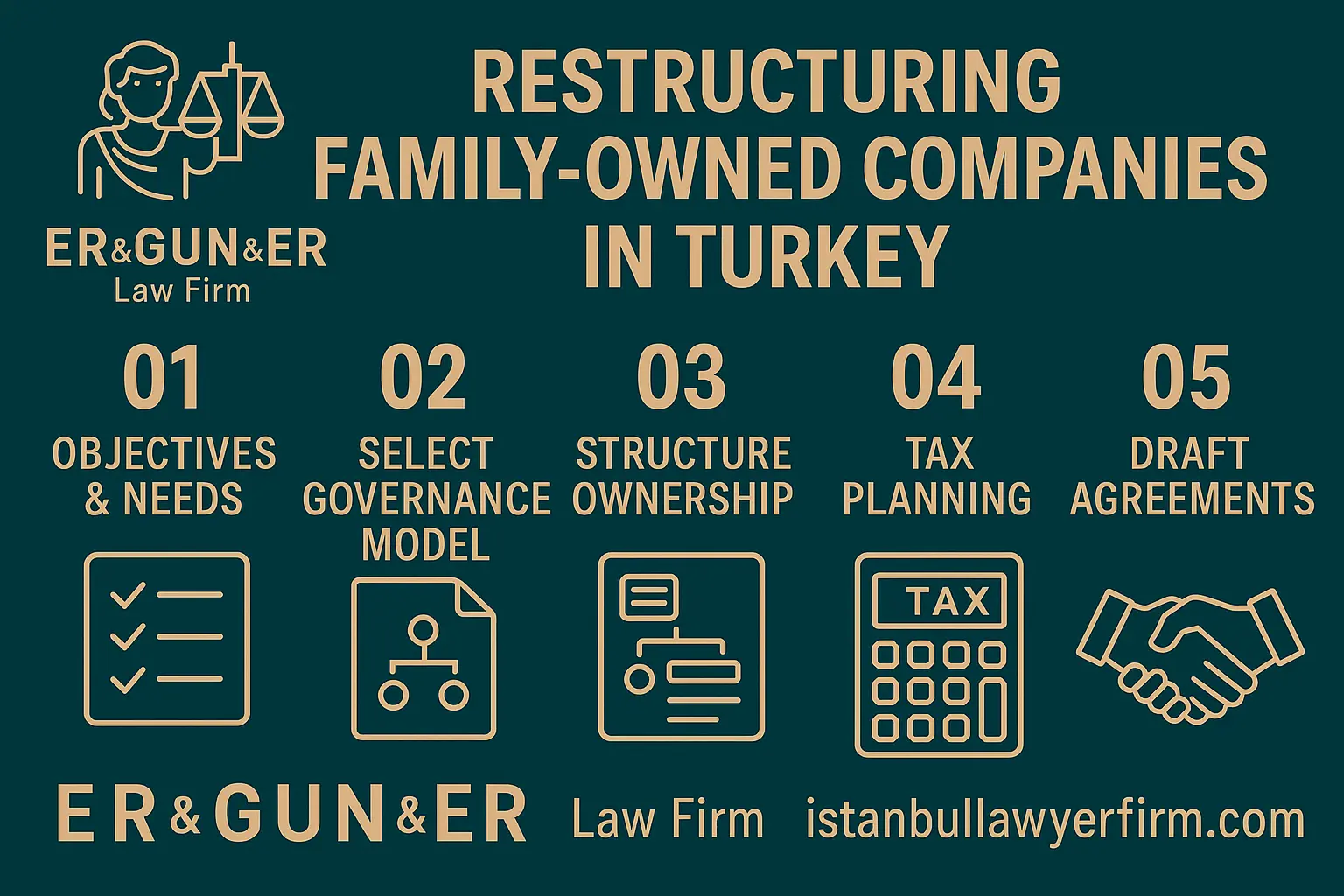
A lawyer in Turkey who advises family-owned businesses understands that restructuring a Turkish family company is among the most legally and interpersonally complex engagements in corporate practice—because family business restructuring simultaneously requires technical command of Turkish Commercial Code governance requirements, Turkish Civil Code inheritance provisions, Revenue Administration tax regulations, and Trade Registry compliance procedures, while also managing the family dynamics, generational expectations, and relationship sensitivities that make a technically correct restructuring plan fail if it is not also acceptable to the family members whose cooperation is essential for implementation. An Istanbul Law Firm that advises family businesses on legal restructuring provides comprehensive support across the complete restructuring agenda: formalizing and reforming corporate governance through shareholder agreements, board composition rules, and voting threshold structures aligned with Turkish Commercial Code requirements; designing succession frameworks that address both the orderly transfer of management authority and the legally structured transfer of ownership interests to the next generation; implementing inheritance-protective shareholding structures that prevent fragmentation of business ownership through the intestate succession provisions whose application to business shares can disrupt business continuity; designing holding company structures that consolidate family business ownership, simplify succession, and provide tax efficiency across the family business group; implementing conflict prevention mechanisms including family councils, mediation protocols, and governance-embedded escalation procedures that address disputes before they reach the litigation stage; and advising on exit structures for family members who wish to monetize their interests without disrupting the business's continuity. A Turkish Law Firm that specializes in family business law Turkey understands that legal structure alone does not produce sustainable family business outcomes—because governance documents that do not reflect the family's actual values, relationships, and ambitions will not be respected when tested by succession events or disputes. An English speaking lawyer in Turkey who coordinates family business restructuring for international family groups ensures that family members based outside Turkey can participate meaningfully in governance design and succession planning without the communication and legal framework gaps that often leave foreign-based family members inadequately represented in structures designed by counsel who do not communicate effectively with them. Practice may vary by authority and year — verify current Turkish Commercial Code requirements, current Turkish Civil Code inheritance provisions, and current Tax Administration regulations with qualified counsel before implementing any family business restructuring strategy.
Governance Reform and Shareholder Agreement Structuring
A lawyer in Turkey who advises on corporate governance for family businesses explains that the most common governance deficiency in Turkish family companies is the absence of formal shareholder agreements and board composition rules—creating a situation where the company's legal governance relies entirely on the Turkish Commercial Code's default provisions, whose application to family business situations often produces outcomes that no family member actually intended but that none of the default provisions override without a properly drafted agreement. An Istanbul Law Firm that designs shareholder agreements for family businesses implements the specific governance provisions most effective for each family's situation: board composition rules that specify how many board seats each shareholder group holds, what qualifications directors must meet, how directors are nominated and removed, and what the board quorum and decision thresholds are for different categories of decision—distinguishing between routine operational decisions requiring simple majority, significant capital or strategic decisions requiring supermajority, and reserved matters requiring unanimous consent; voting rights structures that can separate economic participation rights from voting control where the family's succession planning requires the founder generation to maintain control during transition while transferring economic value to the next generation through non-voting or limited-voting share classes; shareholder protections for minority family members who hold less than majority economic interests but whose cooperation is essential for business continuity, including information rights, anti-dilution protections, and tag-along rights that prevent majority shareholders from selling their interests to third parties without extending equivalent terms to minority shareholders; and dispute resolution provisions that establish a defined escalation pathway—negotiation, then family council, then mediation, then arbitration—before any shareholder dispute reaches commercial court litigation. Turkish lawyers advising on shareholder agreement design help family businesses understand that the provisions most important for long-term stability are often the provisions that feel least urgent to address when the family is functioning harmoniously—because the governance provisions most needed in a crisis are those that must be agreed when the crisis has not yet arrived. Practice may vary by authority and year — verify current Turkish Commercial Code requirements for shareholder agreements, current share class structures available under Turkish law, and current Trade Registry filing requirements with qualified counsel before finalizing any shareholder agreement. For the full procedural framework, see our pillar guide on company formation in Turkey.
An Istanbul Law Firm that advises on share capital restructuring for family businesses explains that share capital restructuring—through recapitalization, share class creation, preference share issuance, or share reallocation—is frequently the mechanism through which governance reform objectives are implemented in the company's formal legal structure, requiring both legal drafting expertise and Trade Registry compliance management to take effect. Turkish lawyers advising on share capital restructuring help family businesses implement the specific changes most relevant to each restructuring objective: creation of multiple share classes that separate voting rights from economic participation rights, enabling the founder generation to retain voting control while allocating economic participation to the next generation—with the specific share class rights, restrictions, and conversion mechanics precisely defined in amended articles of association that satisfy Turkish Commercial Code requirements; capital increase and decrease procedures that adjust the company's formal capital structure to reflect the restructured ownership—with the specific MERSIS filing, Trade Registry notification, and creditor protection requirements applicable to each capital change satisfied in the correct sequence; and share transfer mechanisms including pre-emption rights, right of first refusal procedures, and share transfer restrictions that control how ownership interests move between family members and prevent shares from transferring to non-family parties without the family's collective consent. An English speaking lawyer in Turkey who manages share capital restructuring for family businesses with international members provides English-language summaries of each restructuring step and its legal implications, enabling foreign-based family members to give their informed consent to changes in the formal legal structure of the family business. Practice may vary by authority and year.
A Turkish Law Firm that advises on exit strategy planning for family shareholders explains that well-designed family shareholder agreements address exit mechanisms from the beginning—because the absence of defined exit pathways creates either shareholder imprisonment in a business they no longer wish to participate in or disruptive negotiated exits that damage the business's operational continuity and family relationships. An English speaking lawyer in Turkey who designs exit mechanisms for family shareholder agreements helps families implement the specific provisions most effective for each likely exit scenario: buy-out provisions that specify how a departing shareholder's interests are valued—using agreed formulas, independent valuation, or audited financial metrics—and how the purchase price is paid over time to avoid the liquidity disruption that large immediate cash payments can create; put and call option arrangements that give the departing shareholder the right to require the remaining shareholders or the company to purchase their interest, while giving the remaining shareholders the right to require a departing or defaulting shareholder to sell, creating a defined resolution pathway for exit situations; and family lock-up provisions that restrict share transfers during defined periods—such as the first decade of the next generation's management tenure—providing operational stability during the most vulnerable transition period while allowing defined exit windows at specific intervals. Practice may vary by authority and year.
Succession Planning and Next-Generation Integration
A lawyer in Turkey who advises on business succession planning explains that succession is the most consequential governance challenge for Turkish family businesses—because poorly planned succession produces the fragmented ownership, management authority vacuum, and shareholder conflict that permanently damage businesses whose decades of accumulated value could otherwise be transferred intact to the next generation. An Istanbul Law Firm that designs succession plans for family businesses implements the specific mechanisms most effective for each family's succession situation: management succession plans that establish the specific criteria and process for selecting the next generation's management leadership—distinguishing between family members who lead based on merit assessed against defined professional standards and family members who participate in governance as shareholders without management roles; ownership succession frameworks that specify how shares will transfer from the founder generation to the next—whether through lifetime gifts, testamentary transfers, or structured buyout arrangements—with the tax implications, Turkish Civil Code reserved share implications, and shareholder agreement compatibility of each mechanism assessed before the transfer mechanism is selected; and transition timelines that specify when and how management authority transfers from the founder generation to the next, including the interim period during which authority is shared, the specific milestones that trigger authority transfer, and the safeguards that protect the business if the planned next-generation leadership proves unable to sustain business performance. Turkish lawyers advising on succession planning help family businesses understand that effective succession requires beginning earlier than most families believe necessary—because the practical implementation of succession plans, including the tax-efficient structuring of share transfers and the establishment of next-generation governance competence, requires years of preparation whose benefits are lost when succession planning begins only in response to a health crisis or generational conflict. Practice may vary by authority and year — verify current Turkish Civil Code succession provisions, current gift and inheritance tax regulations, and current company law succession requirements with qualified counsel before implementing any succession plan.
An Istanbul Law Firm that advises on next-generation integration into family business governance explains that sustainable generational transition requires not only legal structuring of ownership transfer but also deliberate governance mechanisms that develop the next generation's business understanding and stakeholder relationships before full responsibility transfers. Turkish lawyers advising on next-generation integration help families design the specific mechanisms most effective for each family's generational transition: advisory board structures that create a formal role for next-generation family members in business governance without prematurely transferring decision authority—providing observation and input opportunities that develop governance competence while the founder generation retains operational control; equity vesting schedules that tie next-generation ownership acquisition to completion of educational qualifications, achievement of professional milestones, or performance in defined business roles—creating a merit-based element in ownership transfer that enhances both next-generation motivation and the founder generation's confidence in the transition; and shadow board programs that create structured exposure to strategic decision-making for designated next-generation successors, including attendance at board meetings, participation in strategy discussions, and mentorship relationships with senior management. An English speaking lawyer in Turkey who designs next-generation integration programs for family businesses with internationally educated successors ensures that the governance frameworks accommodate family members whose professional and educational experience is primarily international, integrating their international business perspective with the specific Turkish legal and business context they are joining. Practice may vary by authority and year.
A Turkish Law Firm that advises on intergenerational equity balancing in family business structures explains that sustainable family business succession requires addressing the economic interests of all family members—not only those who will take active roles in business management—through governance structures that distinguish between ownership rights and management roles without creating resentment among family members who receive different types of participation. An English speaking lawyer in Turkey who designs intergenerational equity frameworks for family businesses helps families implement the specific mechanisms most effective for each family's distribution philosophy: dividend priority structures that provide consistent economic returns to passive shareholders while directing reinvestment-oriented returns to active management shareholders—addressing the different financial needs and investment horizons of family members with active versus passive roles; family employment and compensation policies that establish transparent, merit-based criteria for family members working in the business—preventing the compensation disputes that arise when family members perceive that other family members are inappropriately compensated relative to their contribution; and family charter provisions that articulate the family's shared values, ownership philosophy, and expectations for family member conduct as shareholders and employees—creating a reference point for resolving disputes about what the governance structure is intended to achieve. Practice may vary by authority and year.
Inheritance Structuring and Asset Preservation
A lawyer in Turkey who advises on inheritance law for family businesses explains that Turkish Civil Code inheritance provisions—including the reserved share rules that guarantee minimum inheritance fractions to spouses, children, and parents regardless of testamentary instructions—create specific risks for family business continuity when business ownership interests are part of the decedent's estate, because forced heirship claims can fragment business ownership in ways that disrupt management control and create deadlock among heirs with incompatible business objectives. An Istanbul Law Firm that designs inheritance-protective structures for family businesses helps business owners implement the specific mechanisms most effective for each family's inheritance risk profile: shareholder agreement provisions that address share transfers on death—specifying whether the decedent's shares pass to heirs by operation of law, whether the surviving shareholders have rights to purchase shares from the estate, and what valuation and payment terms apply to any such purchase—preventing the default intestate succession rules from placing business shares with heirs who may not be appropriate long-term business owners; usufruct and bare ownership separation structures that can separate the economic benefits of share ownership from the voting rights, allowing the surviving parent to retain the practical governance benefit of shares while their economic value passes to the next generation—structures whose legal viability requires careful analysis under Turkish Civil Code provisions; and family foundation or pooling arrangements that consolidate family business ownership into structures whose governance rules prevent fragmentation regardless of individual family members' inheritance and succession decisions—providing business continuity protection that survives multiple generational transitions. Turkish lawyers advising on inheritance structuring help business owners understand that advance planning produces substantially better inheritance outcomes than the default intestate succession rules whose application to business situations may produce results that no family member intended. Practice may vary by authority and year — verify current Turkish Civil Code inheritance provisions, current reserved share calculation rules, and current structures available for inheritance protection with qualified counsel before implementing any inheritance structuring.
An Istanbul Law Firm that advises on holding company structures for family business inheritance planning explains that the concentration of family business ownership in a single holding company—rather than the direct ownership of operational companies and assets by individual family members—simplifies succession by reducing the number of separate ownership interests that must be addressed in succession planning and by providing a single governance framework applicable to the family's complete business portfolio. Turkish lawyers advising on holding company design for inheritance purposes help families implement the specific structures most effective for each business group's complexity: Turkish joint-stock holding company structures whose flexible share class provisions enable separation of voting control from economic participation—allowing the founder generation to maintain control during transition while gradually transferring economic value; intragroup service agreements and dividend distribution policies that manage cash flows between the holding company and operating subsidiaries in ways that satisfy Revenue Administration arm's length requirements while efficiently directing economic returns to family shareholders; and coordinated succession plans that address holding company share succession simultaneously with operational company management succession—ensuring that the governance of the overall family business group is planned holistically rather than leaving the holding company ownership succession unaddressed while planning operational succession. An English speaking lawyer in Turkey who designs holding structures for international family groups coordinates Turkish holding company design with the applicable foreign structures—including European holding companies, UAE family holding vehicles, and trust structures used by international family groups—ensuring that the Turkish holding structure integrates coherently with the family's overall international structure rather than creating inconsistencies that complicate consolidated governance. Practice may vary by authority and year.
A Turkish Law Firm that advises on inheritance and gift tax planning for family business restructuring explains that share transfers between family members—whether through lifetime gift, succession, or restructuring transactions—trigger Turkish inheritance and gift tax obligations whose planning can substantially affect the economic efficiency of the transfer. An English speaking lawyer in Turkey who advises on inheritance and gift tax planning for family business transactions helps businesses implement the specific strategies most effective for each transfer type: valuation planning that determines the appropriate method for establishing business share values for tax purposes—with independently supportable valuation positions that reduce the risk of tax authority reassessment; transfer timing planning that sequences share transfers to optimize the tax burden across family members and across tax periods—taking into account the applicable progressive rate structure and the available exemptions and deductions; and coordinated legal and tax planning that ensures the governance objectives of each transfer are achieved through structures that also satisfy tax efficiency objectives rather than implementing separate legal and tax strategies that conflict with each other's objectives. Practice may vary by authority and year — verify current Turkish inheritance and gift tax rates, current exemption provisions, and current valuation requirements with qualified Turkish tax counsel before making any share transfer decisions based on anticipated tax treatment.
Conflict Prevention, Internal Dispute Resolution and Family Governance
A lawyer in Turkey who advises on family business conflict prevention explains that family business disputes—among siblings over management control, between generations over strategic direction, and between active and passive family members over dividend policy—produce some of the most destructive litigation in Turkish commercial law because they combine the full force of shareholder and corporate law disputes with the family relationship dimensions that make settlement and compromise psychologically difficult. An Istanbul Law Firm that designs conflict prevention systems for family businesses implements the specific mechanisms most effective for each family's risk profile: family council governance structures that provide a formal forum for family shareholders to discuss family business matters—separate from the board's commercial decision-making—with defined authority to address family-specific governance issues including employment of family members, dividend policy, and succession preparation; shareholder agreement dispute escalation provisions that specify the precise sequence of conflict resolution steps required before any dispute can proceed to commercial court or arbitration—including mandatory senior family member negotiation, family council review, and independent mediation—creating both a cooling-off process and a documented record that good-faith resolution was attempted; and governance protocols that address the specific flashpoint issues most likely to generate conflict in each family's context—including dividend distribution policy, family member employment and compensation, decision authority boundaries between board and shareholders, and information rights that prevent information asymmetries from fueling suspicion. Turkish lawyers advising on conflict prevention design help family businesses understand that the provisions most difficult to agree in advance—particularly those addressing shareholder exit and corporate control in deadlock situations—are precisely the provisions whose absence creates the most destructive disputes when the situations they would have governed eventually arise. Practice may vary by authority and year.
An Istanbul Law Firm that provides family business mediation and dispute resolution services explains that when governance mechanisms fail to prevent conflict, the resolution approach that most effectively protects both the business and the family relationship is structured mediation—because mediated settlement enables family members to address the relational dimensions of their dispute alongside the legal dimensions, producing resolutions whose durability and completeness exceeds what court-imposed judgments can achieve. Turkish lawyers advising on family business dispute resolution help families assess the specific resolution approach most appropriate for each dispute's nature: mediation for disputes whose resolution requires the parties to reach a mutually acceptable arrangement—where the mediator facilitates negotiation rather than imposing a resolution, preserving the parties' control over the outcome; arbitration for disputes that require definitive resolution of factual and legal questions but where the parties want confidentiality, specialized expertise, and procedural flexibility that commercial court litigation does not provide; and litigation as a last resort for disputes where mediation and arbitration have failed or are not available, with court representation that protects the family member's legal interests while the dispute is being adjudicated. An English speaking lawyer in Turkey who manages family business disputes for international family groups provides the bilingual dispute management that enables family members based in different countries to participate effectively in dispute resolution proceedings conducted under Turkish law and in Turkish. Practice may vary by authority and year.
A Turkish Law Firm that advises on formalization of family business governance explains that many Turkish family businesses have grown over decades through informal arrangements—oral understandings about roles and compensation, handshake agreements about succession intentions, and unwritten conventions about how decisions are made—whose informality creates increasing legal exposure as the business grows, the founding generation ages, and the next generation joins the business with their own perspectives about what the informal arrangements entail. An English speaking lawyer in Turkey who manages governance formalization for family businesses helps business owners convert informal arrangements into enforceable written governance documents: interviewing family stakeholders to understand the informal governance expectations that currently govern the business; drafting governance documents that accurately reflect the agreed informal arrangements while adding the specificity and enforceability that formal documents require; managing the Trade Registry registration of formal governance changes—including articles of association amendments, board composition changes, and shareholder agreement registration where applicable; and facilitating the family conversation about governance formalization in ways that treat the process as an opportunity to align expectations rather than a legalistic imposition on existing relationships. Practice may vary by authority and year.
Holding Structures, Tax Optimization and Regulatory Compliance
A lawyer in Turkey who advises on holding company design for family business groups explains that Turkish family businesses that have grown into multi-entity groups—with multiple operational companies, real estate holdings, and investment assets—benefit from consolidating ownership under a formal holding company structure that provides centralized control, simplified succession planning, and tax-efficient cash flow management across the group. An Istanbul Law Firm that designs holding structures for Turkish family business groups implements the specific structural elements most effective for each group's situation: Turkish joint-stock holding company formation with appropriate share capital, articles of association provisions that reflect the family's governance requirements, and board composition that gives the founder generation appropriate control during transition; intercompany shareholding arrangements that establish the holding company's ownership of each operational subsidiary with the specific ownership percentages, shareholder rights, and governance arrangements applicable to each subsidiary; intragroup service and management fee arrangements that allow the holding company to charge subsidiaries for group services—including management, treasury, legal, and administrative services—on arm's length terms that satisfy Revenue Administration requirements; and dividend policy frameworks that specify how cash flows from operational subsidiaries are distributed to the holding company and ultimately to family shareholders in ways that optimize the overall group's tax burden. Turkish lawyers advising on holding structure design help family business owners understand that holding structures require ongoing governance and compliance management—including annual general assembly requirements, intragroup transfer pricing documentation, and group-wide financial reporting—whose cost must be weighed against the holding structure's governance and tax efficiency benefits. Practice may vary by authority and year — verify current Turkish tax treatment of holding company dividend flows, current transfer pricing requirements for intragroup transactions, and current corporate governance requirements for Turkish joint-stock companies with qualified counsel before implementing any holding structure.
An Istanbul Law Firm that advises on tax optimization in family business restructuring explains that restructuring transactions—including share reclassification, holding company formation, intercompany asset transfers, and succession-related share transfers—trigger specific Turkish tax consequences whose advance planning can substantially affect the economic efficiency of each transaction. Turkish lawyers advising on tax optimization in restructuring help family businesses coordinate their legal restructuring with appropriate tax planning: transaction sequencing that orders restructuring steps to minimize aggregate tax burden across the restructuring program—because the Turkish tax consequences of a series of restructuring transactions may differ substantially depending on the order in which each step is implemented; Revenue Administration advance ruling applications where the tax consequences of a planned transaction are ambiguous under current regulations—providing a binding administrative position before the transaction is executed rather than relying on legal counsel's interpretation without administrative confirmation; and voluntary disclosure management for historical informality whose tax implications should be addressed proactively before regulatory scrutiny creates enforcement risk—allowing the family business to regularize its tax position on favorable terms available through voluntary disclosure rather than under the less favorable terms of regulatory enforcement. An English speaking lawyer in Turkey who coordinates tax optimization with governance restructuring for family businesses with international dimensions ensures that Turkish tax planning is consistent with the applicable tax obligations in other jurisdictions where family members or group entities are located—preventing the situations where Turkish tax optimization creates inadvertent foreign tax consequences that reduce or eliminate the intended benefit. Practice may vary by authority and year.
A Turkish Law Firm that advises on regulatory compliance for restructured family businesses explains that Turkish family businesses emerging from informal governance arrangements face specific regulatory compliance requirements whose satisfaction is necessary before restructured governance documents can be registered with the Trade Registry and take effect. An English speaking lawyer in Turkey who manages regulatory compliance for family business restructuring helps businesses satisfy each applicable compliance requirement: MERSIS registration of articles of association amendments, board composition changes, and authorized signatory updates; Trade Registry filing of capital structure changes, share class creation, and other formal governance changes with the specific documentation the registry requires; beneficial ownership registration of ultimate beneficial owners in the Central Registry Agency's beneficial ownership database, which is required for Turkish companies and whose non-compliance creates specific administrative penalties; and Revenue Administration notification of holding company formation and intercompany arrangement initiation, satisfying the reporting requirements applicable to newly established group structures. Practice may vary by authority and year — verify current compliance requirements for each regulatory filing with the specific Turkish regulatory authority before completing any governance registration step.
External Investment Integration and Full Business Sale Planning
A lawyer in Turkey who advises on external investor integration for family businesses explains that some Turkish family businesses reach a stage where strategic external investment—through minority private equity participation, strategic partner investment, or pre-IPO capital raising—provides access to capital and expertise that the family cannot provide internally while maintaining family control of the operational business. An Istanbul Law Firm that manages external investor integration helps family businesses implement the specific governance arrangements most effective for each external investment structure: investor rights provisions that give external investors appropriate information access, board representation, and protective rights over major decisions—structured to provide reasonable governance protections without transferring operational control; pre-emption rights and tag-along provisions that protect both parties' interests in subsequent share transfer situations; and family control preservation mechanisms that ensure the family maintains voting control and management authority while sharing economic participation—using appropriate share class structures and reserved matter veto rights. Turkish lawyers advising on external investor integration help family businesses understand that the negotiation of investor rights provisions requires balancing the investor's reasonable governance protections against the family's legitimate interest in maintaining the operational independence that makes the family business's culture and decision-making distinctive. Practice may vary by authority and year.
An Istanbul Law Firm that advises on full business sale planning for family businesses explains that when a family business owner decides to sell the entire business, the legal structuring of the sale—including the sale structure, pre-sale governance preparation, and post-sale obligations—significantly affects both the economic outcome and the protection of the family's interests after the transaction. Turkish lawyers advising on family business sale transactions help owners implement the specific preparation and transaction management practices that maximize value and minimize post-sale liability: pre-sale restructuring that addresses governance and compliance issues buyer due diligence will identify—eliminating documentation gaps, regulatory non-compliances, and related party transaction concerns whose discovery gives buyers price reduction leverage; transaction structure selection between asset sale and share sale—with each structure having different Turkish tax consequences for the seller and different liability profiles for the buyer; and post-sale covenant negotiation that balances the buyer's need for non-competition protection against the selling family's interests in economic freedom and continued professional activities. An English speaking lawyer in Turkey who manages family business sale transactions for international buyers and sellers provides the bilingual transaction management enabling all parties to participate effectively in a process conducted under Turkish law and in the buyer's language simultaneously. A lawyer in Turkey for family business restructuring combines technical command of Turkish commercial, inheritance, and tax law with the interpersonal sensitivity that makes family business legal matters fundamentally different from purely commercial transactions. Practice may vary by authority and year.
A Turkish Law Firm that advises on post-sale transition planning for founding family members explains that the departure from business ownership after a lifetime of family business involvement creates both legal obligations—including non-competition commitments, warranty claims management, and consultation arrangements—and personal transition planning needs whose management benefits from coordinated legal and advisory support. An English speaking lawyer in Turkey who advises founding family members on post-sale transition helps clients implement the specific planning most effective for each post-sale situation: non-compete and non-solicit obligation management that maps the geographic and temporal scope of post-sale restrictions against the founder's planned post-sale professional activities—identifying activities that can proceed without restriction and activities that require modification or deferral; warranty claim management procedures that establish internal tracking of the claim notification periods specified in the sale agreement and that preserve the documentation needed to assess and respond to claims that buyers submit within those periods; and ongoing advisory relationship structures that allow the founding family member to remain involved in the business's development in a consultative capacity that serves both the founder's professional engagement needs and the new owner's transition knowledge needs without violating the governance authority boundaries that the sale transferred. Practice may vary by authority and year.
Exit Planning and Partial Liquidity for Family Shareholders
A lawyer in Turkey who advises on exit planning for family business shareholders explains that effective exit planning is not the opposite of business continuity planning but a component of it—because family businesses whose governance structures include well-designed exit mechanisms can accommodate the legitimate liquidity needs of family shareholders who wish to monetize their interests without the business disruption and family conflict that arise when shareholders seeking exit have no defined pathway to do so. An Istanbul Law Firm that designs exit mechanisms for family business shareholders implements the specific structures most effective for each family's exit planning objectives: buyout agreements that specify how a departing shareholder's interests are valued using a predefined formula—typically based on audited financial metrics including EBITDA multiples, book value, or independently appraised enterprise value—and how the purchase price is paid over a defined period using the business's operational cash flow without requiring refinancing or asset sales that would disrupt operations; share redemption programs that allow the company to purchase shares from departing shareholders when the business's financial position permits, providing a company-funded liquidity mechanism that does not require other shareholders to fund the buyout from personal resources; and staged liquidity mechanisms that allow family shareholders to realize partial liquidity at defined intervals—through secondary share sales, special dividends, or structured return of capital—without requiring full exit from the business, accommodating the needs of family members who want reduced economic risk without complete separation from the family business community. Turkish lawyers advising on exit structure design help families understand that the valuation methodology used in shareholder buyouts is as commercially important as any other term in the exit agreement—because disputes about how to apply an unclear valuation formula are among the most contentious and expensive disputes in family business governance. Practice may vary by authority and year.
An Istanbul Law Firm that advises on partial divestment and external investor integration for family businesses explains that some Turkish family businesses reach a stage where strategic external investment—through minority private equity participation, strategic partner investment, or pre-IPO capital raising—offers access to capital and expertise that the family cannot provide while maintaining family control of the business. Turkish lawyers advising on external investor integration help family businesses implement the specific governance and contractual arrangements most effective for each external investment structure: investor rights provisions that give external investors appropriate information rights, board representation rights, and protective rights over major decisions—structured to provide the investor with reasonable governance protections without giving the investor control over operational decisions that the family retains; pre-emption rights and tag-along provisions that give both the family and the external investor clear rights in subsequent share transfer situations; and family control preservation mechanisms that ensure the family maintains voting control and management authority even as the external investor holds a significant economic interest—using appropriate share class structures, board reservation provisions, and reserved matter veto rights that protect both parties' legitimate interests. An English speaking lawyer in Turkey who manages external investor negotiations for family businesses with international investors provides the bilingual deal management that enables international investors to engage with Turkish family businesses whose legal governance framework is established under Turkish law but whose investment documentation may be structured under applicable international standards. Practice may vary by authority and year.
A Turkish Law Firm that advises on full exit and business sale planning for family businesses explains that when a family business owner decides to sell the entire business rather than continue through succession to the next generation, the legal structuring of the sale—including the sale structure, the pre-sale governance preparation, and the post-sale obligations—significantly affects both the economic outcome of the sale and the protection of the family's interests after the transaction. An English speaking lawyer in Turkey who manages family business sale transactions for seller families helps owners implement the specific preparation and transaction management practices that maximize transaction value and minimize post-sale liability: pre-sale restructuring that addresses the governance and compliance issues that would be identified in buyer due diligence—eliminating the documentation gaps, regulatory non-compliances, and related party transaction concerns whose discovery during due diligence gives buyers negotiating leverage for price reduction; transaction structure selection that determines whether the sale proceeds as an asset sale or a share sale—with each structure having different Turkish tax consequences for the seller and different liability profiles for the buyer; and post-sale covenant negotiation that balances the buyer's need for non-competition protection and management continuity against the selling family's interests in economic freedom, privacy, and continued professional activities. A lawyer in Turkey for family business restructuring combines deep knowledge of Turkish commercial law, inheritance law, tax law, and family governance practice with the interpersonal sensitivity to navigate the family dynamics that make family business legal matters different from purely commercial transactions. Practice may vary by authority and year.
Family Charter, Governance Documentation and Institutional Memory
A lawyer in Turkey who advises on family governance documentation explains that the most durable family business governance frameworks combine legally binding commercial documents—shareholder agreements, articles of association, and employment contracts—with non-binding but morally authoritative governance documents—family charters, ownership philosophy statements, and governance principles—that provide the context for interpreting the commercial documents and for resolving governance ambiguities in ways consistent with the family's stated values. An Istanbul Law Firm that facilitates family charter development helps businesses create the specific documents most relevant to each family's governance needs: family charter or family constitution that articulates the family's shared values, the purpose of the family business in the family's collective life, the ownership philosophy governing how business assets are stewardship rather than individually owned, the family's expectations for family member conduct as shareholders and employees, and the long-term vision that governance structures are designed to serve—creating a foundation document that gives meaning to the technical governance rules; ownership philosophy statements that address the family's positions on contested governance questions including dividend policy versus business reinvestment, family employment priority versus merit-based external hiring, and risk appetite versus capital preservation; and conflict of interest policies that establish clear standards for how family members identify and manage situations where their personal interests may conflict with the business's interests. Turkish lawyers advising on family charter development help families understand that the process of developing a family charter—which requires family members to discuss and reach consensus about their shared values and governance expectations—often produces as much value as the document itself by revealing and resolving misaligned expectations before they generate disputes. Practice may vary by authority and year.
An Istanbul Law Firm that advises on institutional memory management for family businesses explains that family businesses are particularly vulnerable to the loss of institutional knowledge when founding generation members retire, become incapacitated, or pass away—because the founder's accumulated knowledge of customer relationships, supplier terms, informal business conventions, and strategic context is typically undocumented and exists only in the founder's memory until transferred deliberately. Turkish lawyers advising on institutional memory management help families implement the specific practices most effective for preserving and transferring institutional knowledge: documented business history that records the company's development, key strategic decisions and their rationale, important customer and supplier relationships and their history, and the informal business conventions that are important to operational continuity; customer and supplier relationship transfer programs that systematically introduce next-generation management to key business relationships during the transition period, before the founder generation is no longer available to facilitate introductions; and management knowledge transfer protocols that document the founder's operational knowledge in formats that next-generation management can access and build upon—including decision frameworks, risk assessment approaches, and industry expertise that would otherwise leave the business with the founder's departure. An English speaking lawyer in Turkey who advises on institutional memory management for family businesses with internationally located successors helps design knowledge transfer programs that enable the next generation—wherever they are based—to acquire the institutional knowledge they need to lead the business effectively. Practice may vary by authority and year.
A Turkish Law Firm that advises on governance review and evolution for family businesses explains that governance documents prepared at a specific moment in a family business's development will not remain appropriate indefinitely—because the business's scale, complexity, and competitive environment will change, the family's membership and interpersonal dynamics will change, and the applicable legal and regulatory requirements will change in ways that make periodic governance review and updating a necessary part of sustainable family business governance. An English speaking lawyer in Turkey who provides ongoing governance advisory services for family businesses helps businesses implement the specific review practices most effective for each governance element: annual governance review meetings that assess whether each element of the shareholder agreement and family charter continues to serve its intended purpose—identifying provisions that have become obsolete, provisions that have proved inadequate in practice, and provisions that need updating to reflect changed family or business circumstances; triggering event reviews that comprehensively reassess governance documents when specific events occur—including generational transitions, significant business acquisitions or disposals, introduction of external investors, and entry or departure of family members from management—that materially change the context in which the governance framework operates; and regulatory change reviews that assess each governance document's continued compliance when applicable Turkish Commercial Code, Civil Code, or tax regulations change in ways that affect the document's provisions or the transactions it governs. Governance review programs that are implemented systematically maintain governance framework effectiveness over multiple decades of family business operation rather than allowing governance documents to become obsolete relics of the business's earlier development stage. Practice may vary by authority and year.
Frequently Asked Questions
- What is a shareholder agreement and why is it essential for Turkish family businesses? A shareholder agreement is a private contract among the shareholders of a company that supplements the company's articles of association with provisions governing shareholder relationships, governance rights, transfer restrictions, and dispute resolution. For Turkish family businesses, shareholder agreements are essential because they address the specific governance needs of family ownership situations—including succession provisions, family employment policies, and exit mechanisms—that the Turkish Commercial Code's default provisions do not adequately address for family business contexts. Practice may vary by authority and year.
- How does Turkish inheritance law affect family business ownership? Turkish Civil Code inheritance provisions include reserved share rules that guarantee minimum inheritance fractions to specified heirs regardless of testamentary instructions. For family businesses, this means that shares owned by a deceased family member may pass to heirs—including heirs who may not be appropriate long-term business owners—in proportions that the decedent could not entirely control through their will. Advance planning through shareholding structures, shareholder agreements, and usufruct arrangements can substantially reduce the disruptive effects of intestate succession on business continuity. Practice may vary by authority and year.
- What are the benefits of establishing a holding company for a Turkish family business? Turkish family business holding structures provide centralized control over a multi-entity business group, simplified succession planning by reducing the number of separate ownership interests that must be addressed, tax-efficient cash flow management between group entities, and a single governance framework applicable to the family's complete business portfolio. Holding structures also facilitate separation of voting control from economic participation that enables generational transition while preserving founder generation control. Practice may vary by authority and year.
- What succession planning documents are most important for Turkish family businesses? Key succession planning documents for Turkish family businesses include the shareholder agreement's succession provisions addressing share transfer on death, management succession plans specifying criteria and process for next-generation leadership selection, family charter or family constitution articulating the family's shared values and ownership philosophy, and coordinated testamentary documents that are consistent with the shareholder agreement's succession provisions. These documents should be reviewed together as a coherent system rather than prepared separately. Practice may vary by authority and year.
- How can Turkish family businesses prevent shareholder disputes? Turkish family businesses prevent shareholder disputes through shareholder agreement provisions that define governance authority and decision procedures with sufficient specificity to prevent ambiguity-based disputes; family council governance structures that provide a constructive forum for addressing family business matters before they escalate to formal disputes; defined escalation procedures that specify the conflict resolution steps required before litigation or arbitration; and regular governance review processes that identify and address emerging tensions before they become entrenched disputes. Practice may vary by authority and year.
- What tax obligations arise when family business shares are transferred between generations? Turkish inheritance and gift tax applies to share transfers between family members whether through lifetime gift or succession at death. The applicable rate depends on the relationship between the parties and the value of the shares transferred, with different rate structures for different family relationships. Valuation of business shares for inheritance and gift tax purposes requires independently supportable valuation positions. Tax planning can structure transfers to minimize aggregate tax burden while achieving succession objectives. Practice may vary by authority and year.
- Can non-family professionals be appointed to the board of a Turkish family company? Yes. Turkish Commercial Code provisions allow appointment of non-shareholder directors to company boards, and many Turkish family businesses benefit from appointing independent professional directors who bring industry expertise, governance experience, and objective perspective to board decision-making. Shareholder agreements can reserve specified board seats for non-family professional directors while maintaining family majority on the board. Practice may vary by authority and year.
- How does a family business create exit mechanisms for shareholders who want to leave? Family business exit mechanisms include shareholder buyout provisions with predetermined valuation formulas and payment terms, put and call option arrangements giving specified parties rights to require purchase or sale in defined circumstances, share redemption programs funded from company cash flow, and staged liquidity mechanisms providing partial liquidity at defined intervals without requiring full exit. Effective exit mechanisms require advance agreement on valuation methodology before the exit situation arises. Practice may vary by authority and year.
- What regulatory filings are required when restructuring a Turkish family company? Turkish family company restructuring typically requires MERSIS registration of articles of association amendments, Trade Registry filing of capital structure changes and board composition changes, beneficial ownership registration updates in the Central Registry Agency's database, and Revenue Administration notifications for structural changes affecting tax obligations. Specific filing requirements depend on the nature of each restructuring transaction. Practice may vary by authority and year.
- How should Turkish family businesses address governance formalization of historical informal arrangements? Governance formalization begins with documenting the informal arrangements that currently govern the business through interviews with key stakeholders, then drafting formal governance documents that accurately reflect agreed arrangements while adding enforceable specificity, registering formal governance changes with required regulatory authorities, and facilitating the family conversation that aligns stakeholder expectations around the formal governance framework. Formalization should treat historical informality as an opportunity to align expectations rather than as a compliance problem. Practice may vary by authority and year.
- What pre-sale preparation is most important for family businesses considering a full sale? Pre-sale preparation for Turkish family business sales includes governance and compliance formalization that addresses issues buyer due diligence will identify, regularization of related party transactions on arm's length terms, resolution of pending disputes or regulatory compliance gaps, preparation of organized financial and corporate records demonstrating the business's operational and legal health, and consideration of the sale structure—asset sale versus share sale—based on the tax and liability implications for each structure. Practice may vary by authority and year.
- Can international family members participate in Turkish family business governance? Yes. Turkish company law does not restrict foreign nationals from serving as shareholders or directors of Turkish companies. Shareholder agreements and governance documents can be prepared in bilingual versions that accommodate family members based outside Turkey. Powers of attorney enable foreign-based family members to exercise their governance rights through representatives. International family members' succession planning considerations must also account for the interaction between Turkish inheritance law and the applicable foreign law. Practice may vary by authority and year.
- What is a family constitution or family charter and should Turkish family businesses have one? A family charter or family constitution is a governance document that articulates the family's shared values, ownership philosophy, employment and compensation policies, family member expectations, and the long-term vision for the family business. It is not a legally binding commercial contract but a consensus document that provides context and guidance for interpreting the shareholder agreement's provisions and for resolving governance ambiguities in ways consistent with the family's stated values. Turkish family businesses that invest in developing a family constitution typically have more durable governance arrangements because stakeholders understand the principles behind the specific governance rules. Practice may vary by authority and year.
- How do transfer pricing requirements affect intragroup arrangements in Turkish family business holding structures? Turkish transfer pricing regulations require that transactions between related parties—including services, loans, royalties, and asset transfers between a holding company and its subsidiaries—be priced on arm's length terms comparable to what unrelated parties would agree. Holding structures with significant intragroup transactions require contemporaneous transfer pricing documentation supporting each transaction's arm's length pricing. Revenue Administration audits of family business holding structures routinely examine intragroup pricing and can assess additional tax and penalties for transactions found to deviate from arm's length terms. Practice may vary by authority and year.
- Does ER&GUN&ER Law Firm advise on family business restructuring in Turkey? Yes. ER&GUN&ER Law Firm provides comprehensive legal advisory services for Turkish family business restructuring including shareholder agreement design and drafting, share capital restructuring and Trade Registry compliance, succession planning documentation, next-generation integration frameworks, inheritance structuring and asset preservation, holding company formation and governance design, conflict prevention system design, family dispute mediation support, tax optimization in restructuring transactions, regulatory compliance management, exit mechanism design, external investor integration, and full business sale transaction management—with English-language client communication and bilingual documentation throughout each engagement.
Author: Mirkan Topcu is an attorney registered with the Istanbul Bar Association (Istanbul 1st Bar), Bar Registration No: 67874. His practice focuses on cross-border and high-stakes matters where evidence discipline, procedural accuracy, and risk control are decisive.
He advises individuals and companies across Immigration and Residency, Real Estate Law, Tax Law, and cross-border documentation matters where procedural accuracy and evidence discipline are decisive.
Education: Istanbul University Faculty of Law (2018); Galatasaray University, LL.M. (2022). LinkedIn: Profile. Istanbul Bar Association: Official website.