

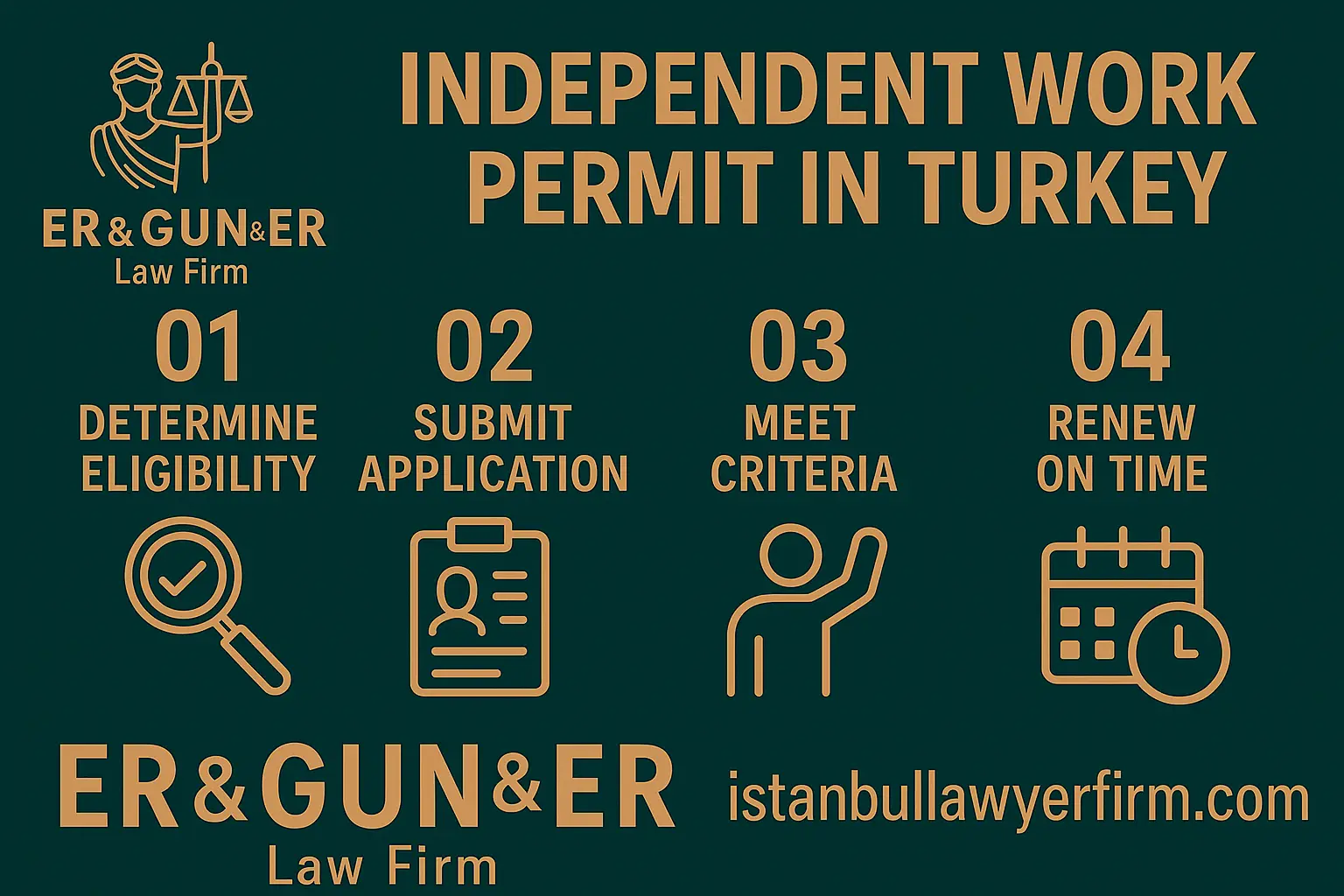
A lawyer in Turkey who advises on work permit law understands that an independent work permit in Turkey—the authorization that enables foreign nationals to engage in self-employment, professional services, or business activity in Turkey without an employer sponsoring a dependent work permit—is a distinct authorization category whose eligibility conditions, required documentation, application process, and ongoing compliance obligations differ fundamentally from the employer-sponsored work permit framework that covers employed foreign workers. An Istanbul Law Firm that advises on independent work permit applications provides the integrated guidance covering every stage of this process: assessing eligibility against the legal criteria applicable to each professional profile; identifying whether the intended activity falls within the independent work permit framework or requires a different authorization route; assembling the documentation required to demonstrate professional qualification, financial viability, and lawful business activity; managing the application submission and any follow-up requests from the Directorate of Migration Management; coordinating post-approval registration with tax authorities and the Social Security Institution; maintaining the ongoing compliance obligations that protect permit validity through renewal periods; managing sectoral licensing requirements for regulated professional activities; and structuring long-term professional presence in Turkey in a way that connects work permit status to broader immigration and business goals. A Turkish Law Firm that advises on independent work permit Turkey applications for foreign professionals and entrepreneurs understands that this authorization type requires demonstrating not only the applicant's professional credentials but also the genuine business viability and legal compliance architecture that supports an independent professional activity rather than an employment relationship. An English speaking lawyer in Turkey who advises on independent work permit applications provides the bilingual coordination that enables foreign nationals to navigate the Turkish immigration and business registration systems without the language barrier creating additional compliance risk at each procedural stage. Practice may vary by authority and year — verify current eligibility criteria, current documentation requirements, current fee schedules, and current application procedures with qualified counsel before submitting any independent work permit application, since the Turkish work permit framework is administered through regulations and administrative practice whose current applicable versions determine the specific requirements and processing timelines relevant to each applicant's situation. Practice may vary by authority and year.
Independent Work Permit Turkey: Legal Framework, Eligibility and Permit Categories
A lawyer in Turkey who advises on independent work permit eligibility explains that this permit type is available to foreign nationals who intend to engage in professional activity, self-employment, or business operations in Turkey under their own name or through a business structure that they control—and that the eligibility assessment must address both the personal qualifications of the applicant and the legal and commercial characteristics of the intended activity. An Istanbul Law Firm that advises on independent work permit eligibility assessment helps applicants understand the specific qualification approach most important for each professional profile: confirming that the intended activity falls within the categories for which an independent work permit can be issued—including liberal professions, consultancy activities, freelance services, and business ownership; identifying whether the professional activity requires sectoral licensing beyond the work permit itself, including registration with professional bodies such as bar associations, medical chambers, or engineering unions; assessing whether minimum capital requirements, Turkish partner involvement thresholds, or other activity-specific conditions apply to the intended business model; and evaluating how prior work permit history in Turkey affects the application, since switching from a dependent permit category to independent status involves additional procedural steps. Turkish lawyers advising on permit category selection help applicants understand that selecting the correct permit category from the beginning is critical because an application for the wrong category generates delays, document requests, and in some cases rejection that affects future application credibility—and that a preliminary eligibility assessment conducted before any documentation is assembled or submitted prevents the wasted investment in preparing documents for an inapplicable permit pathway. Practice may vary by authority and year.
An Istanbul Law Firm that advises on professional qualification documentation for independent work permit applications explains that the applicant's educational credentials, professional experience, and demonstrated competence in the intended activity form a central component of the eligibility evidence—and that foreign qualifications must be presented in a format that Turkish immigration authorities can assess against Turkish professional standards. Turkish lawyers advising on credential documentation help applicants implement the specific documentation approach most effective for each qualification type: obtaining apostille certification for educational diplomas and professional certificates issued in Hague Convention countries, or consular legalization for documents from non-Convention countries; engaging sworn translators to produce Turkish translations that accurately reflect the credential's content without interpretation or simplification; preparing a professional activity plan that describes the intended services, target clients, revenue model, and market rationale in concrete rather than general terms; and assembling bank statements, financial references, and other evidence of financial viability that demonstrates the applicant can sustain the proposed independent activity. An English speaking lawyer in Turkey who advises on credential documentation for independent work permit applications provides the quality control that prevents the minor inconsistencies in name transliteration, date formatting, and credential description that commonly generate authority requests for clarification—and confirms that the professional activity plan is specific enough to demonstrate genuine professional capacity rather than generic enough to raise questions about the applicant's actual intended activities. Practice may vary by authority and year.
A Turkish Law Firm that advises on the interface between immigration status and independent work permit applications explains that the applicant's current visa or residence permit status at the time of application affects both the procedural pathway and the practical logistics of obtaining an independent work permit. An English speaking lawyer in Turkey who advises on immigration status transitions for independent work permit applicants helps individuals navigate the specific transition most applicable to their situation: applicants who enter Turkey on a business or tourist visa and seek to convert to independent work permit status; applicants who hold an existing residence permit and need to align their residence basis with their independent professional activity; and applicants who held a dependent work permit and seek to transition to an independent category, which requires specific change-of-status steps to avoid gaps in lawful authorization. Practice may vary by authority and year — verify current status transition procedures and current visa category interactions with qualified counsel before making any changes to immigration status, since transitions between permit categories involve specific procedural sequences whose correct order prevents gaps in authorization that could affect both the new permit application and the individual's ongoing lawful presence in Turkey. Practice may vary by authority and year.
Required Documentation and Application Submission Procedure
A lawyer in Turkey who advises on independent work permit documentation explains that submitting a complete and internally consistent application file is the most important factor in avoiding delays and additional requests—and that the documentation must demonstrate eligibility, professional qualification, business viability, and compliance infrastructure through concrete evidence rather than general statements. An Istanbul Law Firm that advises on independent work permit documentation management helps applicants build the specific document file most effective for each professional profile: core identity documents including valid passport with sufficient remaining validity and biometric photographs in the required format; professional qualification documents including translated and legalized educational certificates, professional registration confirmations, and evidence of relevant professional experience; business establishment documents including trade registry certificate, tax identification certificate, and registered business address documentation where the activity is conducted through a registered entity; financial viability evidence including bank statements covering the required period, financial references from institutions, and supporting evidence of the planned revenue sources; and activity plan documentation that describes the services to be provided, the expected client base, and the commercial rationale for the intended independent activity in Turkey. Turkish lawyers advising on documentation preparation help applicants understand that each document should be assessed not only for its individual completeness but for its consistency with every other document in the file—because inconsistencies between, for example, the stated business address and the registered address in the trade registry, or between the activity description and the professional qualifications presented, generate authority requests that extend processing timelines and that a pre-submission consistency review of the complete document file is consistently more cost-effective than addressing inconsistency after a request for clarification has been received. Practice may vary by authority and year.
An Istanbul Law Firm that advises on business registration requirements for independent work permit applications explains that most independent work permit applicants must establish a formal business presence in Turkey—either through a sole proprietorship registration or through a company structure—whose documentation must accompany the permit application and whose ongoing compliance obligations must be maintained throughout the permit period. Turkish lawyers advising on business registration coordination help applicants implement the specific registration approach most effective for each activity type: coordinating trade registry registration with the permit application timeline so that the registration is valid and current at the time of submission; confirming that the business purpose registered at the trade registry matches the activity described in the permit application; obtaining the required tax plates and tax identification documentation from the revenue administration; and confirming that the registered business address is a genuine operational address rather than a virtual office arrangement that could raise questions about the credibility of the business activity. An English speaking lawyer in Turkey who coordinates business registration and work permit applications in parallel for foreign professionals provides the timeline coordination that ensures the registrations are completed in the sequence that satisfies the permit application requirements—and confirms that each registration is complete and reflected in the relevant authority's records before the permit application file is assembled. Practice may vary by authority and year.
A Turkish Law Firm that advises on application submission procedures explains that the independent work permit application is submitted through the Directorate of Migration Management's designated channels—either through the electronic system or through the relevant provincial directorate—and that the submission process includes paying the applicable government fees, providing appointment confirmation where required, and tracking the application status through the appropriate monitoring channel. An English speaking lawyer in Turkey who manages independent work permit submissions for foreign professional clients provides the submission management that ensures all required components are submitted together rather than in fragments, that submission confirmations are preserved as dated exhibits in the compliance file, that any follow-up requests from the authority are identified promptly and responded to within the applicable timeframe, and that the complete submission file is archived in a format that can be referenced during the permit renewal assessment to demonstrate consistency between the original application and the renewal documentation. Practice may vary by authority and year — verify current submission procedures, current fee schedules, and current processing timelines with qualified counsel before preparing any application submission.
Application Processing, Interview Procedure and Approval Steps
A lawyer in Turkey who advises on the independent work permit application review process explains that after submission the Directorate of Migration Management reviews the application file against the applicable eligibility criteria—and that the review may include a request for additional documentation, an interview, or clarification of specific elements of the application before a decision is issued. An Istanbul Law Firm that advises on application review management for independent work permit applicants helps individuals implement the specific response approach most effective for each authority request: organizing supplementary documentation in an indexed format that directly addresses the specific question raised rather than submitting general additional materials; preparing written responses that are factual, concise, and consistent with the original application file; and coordinating with the authority's procedural timeline so that responses are submitted within the required deadline without the urgency that commonly leads to incomplete or inconsistent responses. Turkish lawyers advising on interview preparation help applicants approach any interview stage with organized documentation that can be referenced during the discussion, and with clear factual answers to the questions most commonly raised about professional background, business plan, and future intentions in Turkey. Practice may vary by authority and year.
An Istanbul Law Firm that advises on the interview stage of independent work permit applications explains that interviews—when required—typically cover the applicant's professional background and qualifications, the specific services or business activity to be conducted, the intended client or customer base, and the applicant's plans for maintaining the business activity through the permit period. Turkish lawyers advising on interview readiness help applicants prepare by reviewing their professional profile against the activity plan submitted in the application and confirming that oral answers are consistent with the written materials already submitted—since inconsistencies between interview answers and application documents are among the most common grounds for unfavorable review outcomes, and that a pre-interview rehearsal that tests factual consistency across all dimensions of the application file reduces the risk of inadvertent inconsistency under interview conditions. An English speaking lawyer in Turkey who provides bilingual support during interview procedures for non-Turkish-speaking applicants provides the language assistance that prevents misunderstandings from creating factual inconsistencies in the official record of the interaction. Practice may vary by authority and year.
A Turkish Law Firm that advises on the permit approval stage explains that when the Directorate of Migration Management approves an independent work permit application, the approval triggers a series of steps that the applicant must complete to receive the permit card and activate the authorization—including biometric registration, fee payment, and confirmation that the personal details on the permit card match the application accurately. An English speaking lawyer in Turkey who manages the post-approval completion process for independent work permit applicants coordinates the specific steps required at each stage: scheduling biometric appointments promptly after receiving the approval notification; verifying the details on the permit card against the application documents and requesting correction of any discrepancies before accepting the card; preserving the full set of approval documents in a compliance archive that can be produced to authorities, banks, or professional bodies as needed; and using the approval confirmation to initiate the concurrent post-approval registrations with tax authorities and SGK without delay. Practice may vary by authority and year.
Post-Approval Registration: Tax, Social Security and Compliance Setup
A lawyer in Turkey who advises on post-approval compliance obligations explains that receiving an independent work permit triggers several concurrent registration and compliance obligations that must be addressed promptly to ensure the permit holder operates lawfully from the first day of professional activity. An Istanbul Law Firm that advises on post-approval registration coordination helps independent work permit holders implement the specific compliance setup most effective for each business profile: registering with the local tax office—Vergi Dairesi—to obtain a tax identification number and activate the applicable tax registration for the professional activity; registering with the Social Security Institution—SGK—and confirming the applicable premium category and contribution schedule for an independent professional; understanding the income tax, VAT, and withholding obligations applicable to the specific type of professional activity and the client base served; and establishing an invoicing system that satisfies the current requirements of Turkish tax law, including the applicable electronic invoicing obligations for professionals who meet the triggering thresholds. Turkish lawyers advising on post-approval compliance setup help independent work permit holders understand that these registration obligations are not optional administrative steps but legal prerequisites whose absence creates compliance risk that could affect both the professional's financial obligations and the validity of the work permit itself—and that completing the registrations promptly after permit approval rather than deferring them until professional activity generates income ensures that the compliance infrastructure is in place before any financial transaction occurs. Practice may vary by authority and year.
An Istanbul Law Firm that advises on SGK obligations for independent work permit holders explains that social security registration and regular premium payment are ongoing requirements that must be maintained continuously throughout the permit period—and that gaps in SGK coverage create both a financial liability for back premiums and a compliance record that may affect permit renewal assessments. Turkish lawyers advising on SGK compliance help independent professionals implement the specific contribution management approach most effective for each income profile: confirming the applicable premium category and base for an independent professional; establishing a payment calendar that ensures monthly premiums are paid within the required timeframe; and maintaining SGK payment receipts and contribution records in the compliance archive alongside the work permit documentation. An English speaking lawyer in Turkey who advises on SGK and tax compliance for foreign independent work permit holders provides the bilingual guidance that enables foreign professionals to understand their ongoing financial obligations under Turkish social security and tax law without relying on informal advice that may not reflect current requirements—and implements a periodic compliance calendar that tracks SGK payment deadlines, tax declaration due dates, and permit renewal windows so that compliance obligations are managed proactively rather than reactively. Practice may vary by authority and year.
A Turkish Law Firm that advises on banking and operational setup for independent work permit holders explains that professional activity in Turkey typically requires a Turkish business bank account for receiving payments, issuing invoices, and managing the financial flows that are visible to tax authorities—and that establishing banking relationships requires the work permit, tax identification number, and business registration documents assembled during the application process. An English speaking lawyer in Turkey who advises on banking setup for foreign independent work permit holders provides the coordination that ensures banking onboarding requirements are satisfied in a sequence consistent with the permit holder's compliance obligations, that the account structure appropriately separates business and personal financial flows, and that the explanations provided during bank KYC processes are consistent with the work permit application narrative. Practice may vary by authority and year — verify current registration requirements with tax authorities, SGK, and relevant professional bodies with qualified counsel before completing any post-approval registration step, since the specific documentation required for each registration and the applicable deadlines for completing each registration vary by taxpayer category and by the nature of the professional activity. Practice may vary by authority and year.
Renewal, Amendment, Termination and Activity Scope Expansion
A lawyer in Turkey who advises on independent work permit renewal explains that permits are typically valid for one year and that renewal requires demonstrating continued eligibility, ongoing business activity, and maintained compliance throughout the prior permit period—making the renewal assessment a retrospective review of the permit holder's compliance track record as much as a prospective assessment of continued eligibility. An Istanbul Law Firm that advises on independent work permit renewals helps permit holders implement the specific renewal preparation approach most effective for each business profile: beginning renewal preparation at least sixty days before expiry to allow sufficient time for document collection, translation, and submission without creating a gap in authorization; assembling updated evidence of business activity including invoices issued, contracts signed, and financial statements for the permit period; confirming that tax filings and SGK contributions are current and that any outstanding compliance obligations have been addressed before the renewal file is submitted; and preparing an updated activity description that reflects any evolution in the professional activity during the prior permit period. Turkish lawyers advising on renewal preparation help permit holders understand that a renewal application whose documentation is consistent with the original application and demonstrates continuous lawful activity receives significantly more efficient processing than one that raises questions about the continuity or genuineness of the professional activity—and that maintaining an organized compliance archive throughout the permit period makes renewal preparation significantly less burdensome since the required evidence is already organized rather than needing to be reconstructed. Practice may vary by authority and year.
An Istanbul Law Firm that advises on independent work permit amendments explains that changes to the permit holder's business circumstances—including address changes, changes in the scope of professional activity, changes in capital structure, or the addition of employees—may require formal amendments to the permit or to the underlying business registration that supports it. Turkish lawyers advising on permit amendment procedures help permit holders implement the specific amendment approach most appropriate for each change type: confirming whether the intended change requires a formal permit amendment, a business registration update, or both; preparing the supporting documentation for the amendment including updated trade registry certificates, revised activity plans, and any additional sectoral authorizations required; and submitting the amendment within the timeline required by the applicable authority rather than making operational changes without notifying the relevant authorities. An English speaking lawyer in Turkey who advises on permit amendments for foreign independent professionals provides the procedural guidance that ensures changes are managed through the correct formal channels rather than through informal arrangements whose undisclosed nature could affect permit validity—and helps professionals understand which changes are material enough to require a formal amendment versus which can be managed through administrative notifications to the relevant registration authorities. Practice may vary by authority and year.
A Turkish Law Firm that advises on permit termination and exit procedures explains that when an independent work permit is terminated—whether through voluntary discontinuation of the professional activity, through permit revocation due to compliance failures, or through the applicant's decision to leave Turkey—specific steps must be taken to close the business registrations, settle outstanding tax and SGK obligations, and notify the relevant authorities in the order and within the timelines required. An English speaking lawyer in Turkey who advises on permit exit procedures for foreign professionals provides the specific guidance that prevents the common situation where a permit holder leaves Turkey without formally closing the business registrations—leaving open tax and SGK obligations that accumulate penalties and create administrative records that affect future applications, and ensures that all required notifications to the Directorate of Migration Management are completed in the order and within the timelines that prevent additional enforcement risk after departure. Practice may vary by authority and year.
Sectoral Licensing, Compliance Audits and Administrative Sanctions
A lawyer in Turkey who advises on sectoral licensing requirements explains that for many regulated professional activities—including health services, education, legal services, financial services, tourism, and real estate—an independent work permit alone does not provide authorization to practice, because the regulated activity also requires specific sectoral licensing or registration with the relevant professional body or regulatory authority. An Istanbul Law Firm that advises on sectoral compliance for independent work permit holders helps professionals identify the specific additional authorizations applicable to their activity: registration with professional chambers including bar associations for lawyers, medical chambers for healthcare professionals, and engineering unions for engineers; ministerial approvals including Ministry of Health authorizations for medical practices, Ministry of National Education permits for educational services, and Ministry of Culture and Tourism permits for tourism services; and technical compliance requirements including facility inspection requirements, personnel qualification standards, and equipment certification whose satisfaction is assessed by the relevant regulatory authority before the sectoral license is issued. Turkish lawyers advising on sectoral licensing coordination help professionals understand that the sectoral license and the independent work permit must both be maintained concurrently—and that the failure to maintain either authorization can affect the validity of the other, making it essential to include sectoral license renewal deadlines in the same compliance calendar as permit renewal and tax filing deadlines rather than managing them as separate unrelated obligations. Practice may vary by authority and year.
An Istanbul Law Firm that advises on compliance audit readiness for independent work permit holders explains that Turkish authorities periodically review the compliance of independent work permit holders against the conditions of the permit, the applicable sectoral regulations, and the ongoing tax and SGK obligations—and that permit holders who maintain organized, current compliance documentation consistently experience faster and less burdensome audit reviews than those who must reconstruct their compliance history from scattered records. Turkish lawyers advising on audit readiness help permit holders implement the specific documentation management approach most effective for each compliance audit scenario: maintaining a compliance archive that stores the work permit, business registration documents, sectoral licenses, tax filings, SGK contribution receipts, and client contracts in a single organized location; running periodic internal compliance checks that test whether all authorizations are current and whether all filing obligations have been met; and responding to any authority inquiries promptly with organized documentary evidence rather than with verbal explanations that cannot be independently verified. An English speaking lawyer in Turkey who advises on compliance audit response for foreign independent work permit holders provides the bilingual documentation support that enables the permit holder to present compliance evidence in a format that the reviewing authority can assess efficiently. Practice may vary by authority and year.
A Turkish Law Firm that advises on compliance audit evidence organization explains that permit holders who have maintained complete, organized, and consistent compliance documentation throughout the permit period can typically demonstrate their compliance record to reviewing authorities without the delays and additional requests that arise when records must be reconstructed from fragmented sources. An English speaking lawyer in Turkey who advises on compliance documentation for foreign independent work permit holders helps clients implement the specific archive organization approach that ensures compliance evidence is accessible and legible to reviewing authorities without requiring the permit holder to be physically present to explain the record. Practice may vary by authority and year.
A Turkish Law Firm that advises on administrative sanction response explains that when compliance failures lead to administrative warnings, fines, or permit suspension, the permit holder's ability to preserve their authorization depends on the speed and quality of the remediation response—and that engaging qualified legal counsel at the earliest warning stage consistently produces better outcomes than waiting until enforcement measures have progressed to revocation. An English speaking lawyer in Turkey who advises on administrative sanction defense for independent work permit holders implements the specific response approach most effective for each enforcement situation: preparing a factual response that directly addresses the stated compliance concern with documentary evidence; developing a remediation plan that demonstrates concrete steps to cure the identified deficiency; where appropriate, engaging with the reviewing authority to establish a compliance timeline whose completion prevents escalation to more serious enforcement; and maintaining a written record of every communication with the authority during the enforcement process so that the chronology of the remediation is documented. Practice may vary by authority and year.
Tax Obligations, Double Tax Treaties and Financial Compliance
A lawyer in Turkey who advises on tax obligations for independent work permit holders explains that professional activity conducted under an independent work permit generates income tax, VAT, and SGK obligations that must be managed as ongoing compliance requirements rather than as one-time registrations—and that failure to maintain current tax filings and payments creates both financial penalties and a compliance record that affects permit renewal. An Istanbul Law Firm that advises on tax compliance for independent professionals helps permit holders implement the specific compliance approach most effective for each income and activity profile: understanding the income tax category applicable to the professional activity—professional self-employment income (serbest meslek kazancı) for most liberal professions, commercial income for business-structured activities; maintaining the required accounting books and records for the applicable taxpayer category including the serbest meslek kazanç defteri where required; issuing compliant invoices or receipts for each service transaction; filing the required periodic tax declarations and annual income tax return within the applicable deadlines; and managing the withholding tax that clients deduct from professional fee payments as an advance against the annual income tax liability. Turkish lawyers advising on tax compliance for foreign independent professionals help clients understand that the tax treatment of professional income differs by income category, client type, and business structure—and that these distinctions affect both the calculation of the tax due and the documentation required to support the filed position, including the specific records that must be maintained under the Tax Procedure Law for each income category. Practice may vary by authority and year.
An Istanbul Law Firm that advises on double tax treaty application for independent work permit holders explains that foreign professionals who are also tax resident in another jurisdiction may be able to access relief from double taxation through Turkey's bilateral tax treaty network—whose provisions can reduce Turkish withholding rates or allocate taxing rights to the professional's country of residence depending on the nature of the income and the applicable treaty article. Turkish lawyers advising on treaty relief help foreign independent professionals implement the specific treaty claim approach most effective for each income situation: establishing Turkish tax residency status through the applicable legal tests before assessing treaty entitlement; mapping the professional income stream to the appropriate treaty article—typically business profits, professional services income, or employment income depending on how the activity is characterized; maintaining a certificate of residence from the treaty partner country for the relevant tax period; and following the procedural requirements of the GİB for claiming treaty relief in the annual income tax return. An English speaking lawyer in Turkey who advises on double tax treaty application for foreign independent work permit holders provides the integrated tax analysis that connects the Turkish income tax obligation to the professional's foreign tax position in a way that minimizes total tax cost while maintaining compliance in both jurisdictions—and confirms that the treaty claim is supported by the documentary evidence required by both the Turkish GİB's procedure and the treaty partner country's requirements. Practice may vary by authority and year.
A Turkish Law Firm that advises on VAT compliance for independent work permit holders explains that professional services provided in Turkey are generally subject to Value Added Tax at the applicable rate—and that VAT registration, monthly declaration filing, and payment obligations must be maintained continuously alongside income tax and SGK obligations. An English speaking lawyer in Turkey who advises on VAT compliance for foreign independent professionals provides the guidance that enables permit holders to understand the invoicing requirements, the applicable VAT rates, the quarterly or monthly declaration deadlines, the input VAT deduction rules that determine the net VAT payable, and how VAT obligations interact with the invoicing requirements applicable to the specific professional activity category. The best lawyer in Turkey for independent work permit matters combines knowledge of Turkish work permit law, business registration requirements, sectoral licensing regimes, tax compliance obligations, social security contribution requirements, the administrative sanction and dispute resolution procedures, and the long-term immigration pathways that connect sustained permit compliance to broader professional and personal immigration goals—with the English-language communication that enables foreign nationals to manage their Turkish professional authorization and compliance effectively throughout each stage of their professional presence in Turkey. Practice may vary by authority and year.
Long-Term Professional Strategy and Integration in Turkey
A lawyer in Turkey who advises on long-term professional strategy for independent work permit holders explains that the permit is a foundation for professional activity rather than an end point—and that building a sustainable professional presence in Turkey requires connecting the work permit framework to broader business development, financial planning, and immigration strategy in a way that allows the professional to scale activities, expand the business structure, and eventually access longer-term immigration status options. An Istanbul Law Firm that advises on long-term strategy for foreign professionals in Turkey helps permit holders implement the specific planning approach most effective for each long-term goal: connecting consistent permit renewals and compliance history to the longer-term residence pathways that reward demonstrated commitment to lawful professional activity in Turkey; assessing whether the current business structure—sole proprietorship, limited liability company, or joint stock company—remains appropriate as the professional activity grows; identifying Turkish R&D incentive programs, investment support mechanisms, and sectoral development opportunities that may provide financial benefits for qualifying professional activities; and planning the transition from independent work permit status to longer-term immigration status where the professional's activity profile and residence history satisfy the applicable criteria. Turkish lawyers advising on long-term professional strategy help foreign professionals understand that the documentation discipline maintained during permit periods—consistent filing records, organized compliance archives, and coherent business activity documentation—becomes the evidence base for future immigration applications whose strength depends on the quality of the record built over time, and that building this record as a routine compliance practice is significantly more effective than attempting to reconstruct it when a future application requires it. Practice may vary by authority and year.
An Istanbul Law Firm that advises on investment-linked work permit extensions and expanded immigration options explains that independent work permit holders who make qualifying investments in Turkey—including real estate investment, capital injection into Turkish companies, or employment creation—may access expanded immigration options including Turkish citizenship by investment pathways, whose specific qualifying conditions and thresholds must be verified from current regulations. Turkish lawyers advising on investment-linked immigration pathways help independent work permit holders assess whether their planned business activities could also satisfy investment thresholds that provide access to longer-term immigration status. Practice may vary by authority and year.
An Istanbul Law Firm that advises on professional network development and market integration for foreign independent work permit holders explains that professional associations, trade chambers, and sectoral bodies in Turkey provide both compliance infrastructure and business development resources that independent professionals benefit from accessing proactively rather than reactively. Turkish lawyers advising on professional network integration help foreign professionals implement the specific approach most effective for each professional sector: assessing whether membership in the relevant professional chamber or trade association is mandatory for the licensed activity or advantageous for credibility and business development; understanding the reporting, fee, and activity obligations that chamber membership creates alongside the work permit compliance obligations; and identifying partnership, subcontracting, and collaborative arrangements with Turkish professionals that expand the service offering while maintaining the compliance framework appropriate to the independent work permit category. An English speaking lawyer in Turkey who advises on professional network development for foreign work permit holders provides the practical guidance that enables foreign professionals to build productive professional relationships in Turkey without creating inadvertent changes to their authorization status—including guidance on how subcontracting and joint service arrangements should be structured to remain consistent with the independent work permit framework rather than implying an employment relationship that would require a different authorization. Practice may vary by authority and year.
A Turkish Law Firm that advises on exit readiness and transition planning for independent work permit holders explains that whether the professional plans to continue indefinitely, transition to a different immigration category, or eventually leave Turkey, having a documented exit or transition plan prevents the common situation where a departure or status change creates lingering compliance obligations—open tax registrations, unsettled SGK contributions, or undisclosed business closures—that generate penalties and administrative complications after the professional has already left. An English speaking lawyer in Turkey who advises on transition and exit planning for foreign independent work permit holders implements the specific planning approach most appropriate for each transition scenario: assessing which business registrations must be formally closed before departure; confirming that all tax and SGK obligations through the closure date have been settled and that final declarations have been filed; obtaining formal closure confirmations from the revenue administration and SGK; preserving the complete compliance archive for the retention period applicable under Turkish law so that future questions about the closed period can be addressed with organized documentary evidence; and confirming that the permit holder has no open enforcement matters or unresolved administrative procedures before departure. Practice may vary by authority and year.
Frequently Asked Questions
- Who can apply for an independent work permit in Turkey? Foreign nationals who intend to engage in self-employment, provide professional services under their own name, or operate a business in Turkey can apply for an independent work permit. Eligibility depends on professional qualifications, business viability, financial capacity, and compliance with applicable legal criteria including any sectoral requirements for the intended activity. Practice may vary by authority and year.
- How does an independent work permit differ from a standard work permit? A standard work permit is employer-sponsored and tied to a specific employment relationship. An independent work permit authorizes the holder to work independently—as a self-employed professional, freelancer, or business owner—without an employer sponsor. The independent permit requires demonstrating business viability and professional qualification rather than an employment contract. Practice may vary by authority and year.
- What documents are required for an independent work permit application? Required documents typically include a valid passport, biometric photographs, legalized and translated educational and professional credentials, a professional activity plan, financial viability evidence including bank statements, business registration documents, tax identification certificate, and registered business address documentation. Additional documents may be required depending on the professional sector and the specific eligibility criteria applicable to the intended activity. Practice may vary by authority and year.
- Do I need to register a business entity before applying? Most independent work permit applications require an established business presence in Turkey—either a sole proprietorship or a company whose registration documents accompany the permit application. The business registration purpose must match the activity described in the permit application. Practice may vary by authority and year.
- How long does the independent work permit application process take? Processing timelines vary depending on the authority's workload, the completeness of the application file, and whether additional documentation or an interview is required. A complete and consistent initial application generally receives more efficient processing than one that generates multiple follow-up requests. Verifying current processing expectations with qualified counsel before submission is advisable. Practice may vary by authority and year.
- What tax obligations arise from holding an independent work permit? Independent work permit holders must register with the Turkish revenue administration, maintain applicable books and records, issue compliant invoices for services, file periodic tax declarations and annual income tax returns, and pay applicable income tax, VAT, and any withholding tax obligations. SGK contribution obligations also apply. The specific obligations depend on the income category and business structure. Practice may vary by authority and year.
- How does withholding tax work for independent professionals in Turkey? Clients who pay professional service fees to independent Turkish professionals typically deduct a withholding tax percentage at the time of payment and remit it to the revenue administration on the professional's behalf. This withheld amount is credited against the professional's annual income tax liability when the annual return is filed. The applicable withholding rate must be verified from current regulations. Practice may vary by authority and year.
- Are there sectoral licensing requirements beyond the work permit? Yes. Many regulated professional activities require licensing or registration with sectoral regulators or professional bodies in addition to the independent work permit. Health, education, legal services, financial services, and tourism activities each have specific regulatory requirements whose satisfaction must be demonstrated before the professional activity can lawfully commence. Practice may vary by authority and year.
- How long is an independent work permit valid and how is it renewed? Independent work permits are typically issued with a one-year validity and can be renewed annually upon demonstrating continued eligibility and maintained compliance. Renewal applications should be submitted before expiry—ideally at least sixty days in advance—with updated business activity evidence, current tax filing and SGK contribution records, and any amended business registration documents. Practice may vary by authority and year.
- Can a double tax treaty reduce Turkish income tax for foreign professionals? Where the professional is also tax resident in a country with which Turkey has a bilateral tax treaty, the treaty may allocate taxing rights or reduce applicable withholding rates. Accessing treaty benefits requires demonstrating treaty residency through a current certificate of residence and following the GİB's procedural requirements for treaty claims. Practice may vary by authority and year.
- What happens if I hire employees as an independent work permit holder? Hiring employees as an independent permit holder requires formal amendments to the business registration, confirmation that the permit scope covers employing staff, and SGK registration for each employee. Operating as an employer before completing these amendments creates compliance risk for both the employer and the employee. Practice may vary by authority and year.
- What are the consequences of non-compliance with independent work permit conditions? Non-compliance can result in administrative warnings, financial penalties, permit suspension, or revocation depending on the severity and persistence of the violation. Tax and SGK non-compliance generates separate penalties that accumulate independently of permit enforcement actions. Early engagement with qualified counsel when any compliance issue is identified consistently produces better outcomes than delayed response. Practice may vary by authority and year.
- Can I switch from another work permit category to an independent work permit? Switching from a dependent work permit category to an independent permit requires specific change-of-status procedures including notifying the authority, submitting new application documentation, and ensuring no gaps in lawful authorization occur during the transition. The specific steps depend on the current permit category and the circumstances of the transition. Practice may vary by authority and year.
- How does the independent work permit connect to Turkish residence status? An independent work permit typically provides the authorization to both work and reside in Turkey during its validity period, but the specific residence authorization details depend on the permit type and any linked residence permit arrangements. Permit holders should confirm that their residence status is clearly documented and consistent with their work authorization. Practice may vary by authority and year.
- Does ER&GUN&ER Law Firm provide legal services for independent work permit applications in Turkey? Yes. ER&GUN&ER Law Firm provides legal services for independent work permit Turkey applications including eligibility assessment, permit category selection, documentation preparation and legalization coordination, business registration advice, application submission management, interview preparation, post-approval tax and SGK registration coordination, sectoral licensing guidance, permit renewal and amendment procedures, compliance audit preparation, administrative sanction response, tax obligation advisory including double tax treaty claim management, and long-term professional strategy planning—with English-language client communication and bilingual documentation throughout each engagement.
Author: Mirkan Topcu is an attorney registered with the Istanbul Bar Association (Istanbul 1st Bar), Bar Registration No: 67874. His practice focuses on cross-border and high-stakes matters where evidence discipline, procedural accuracy, and risk control are decisive.
He advises individuals and companies across Immigration and Residency, Real Estate Law, Tax Law, and cross-border documentation matters where procedural accuracy and evidence discipline are decisive.
Education: Istanbul University Faculty of Law (2018); Galatasaray University, LL.M. (2022). LinkedIn: Profile. Istanbul Bar Association: Official website.