

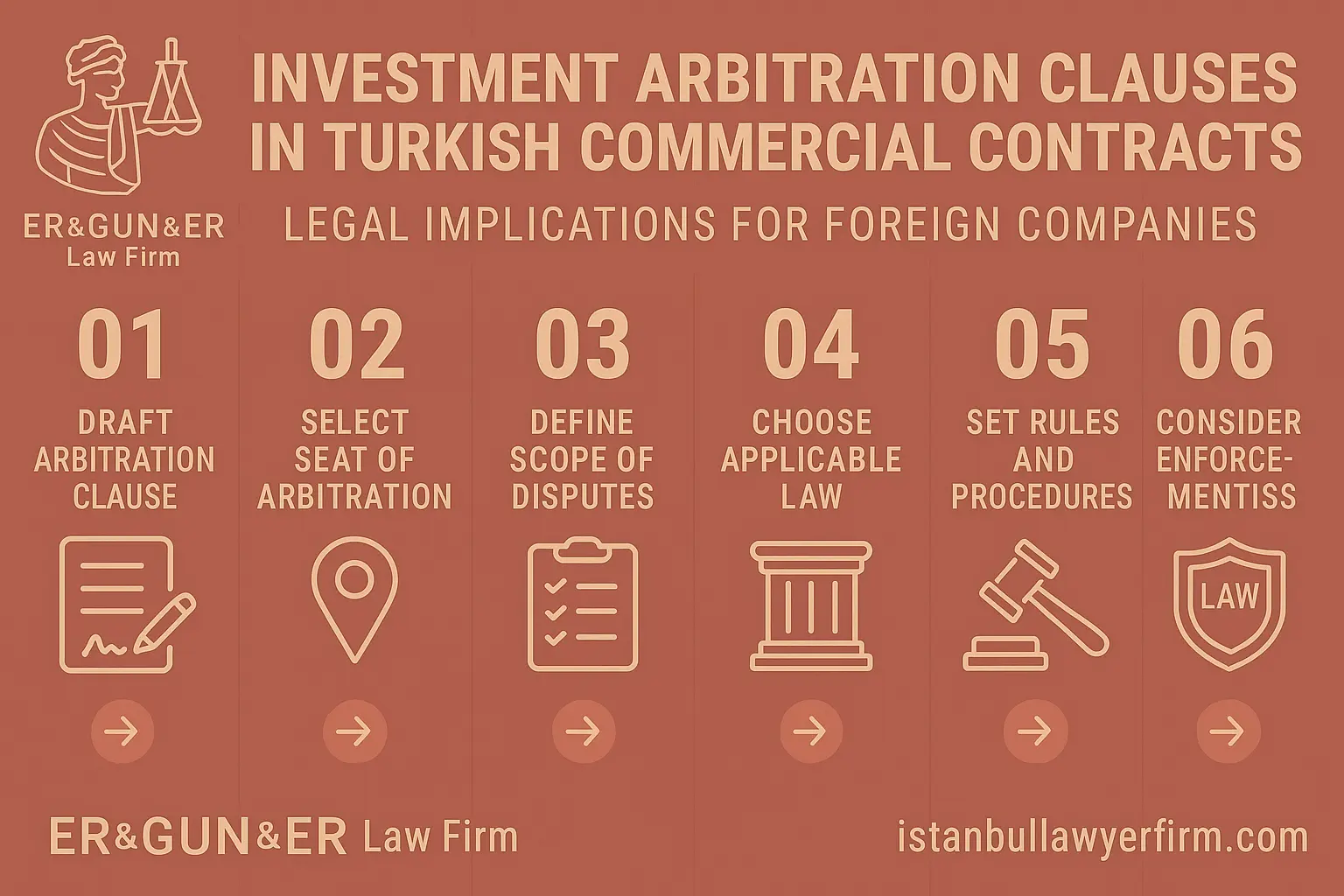
Investment arbitration clauses in Turkish commercial contracts sit at the intersection of domestic arbitration statutes, institutional rules, international treaty frameworks, and the enforcement mechanics that convert an arbitral award into realized commercial recovery. Foreign companies contracting with Turkish counterparties, investing in Turkish assets, or structuring cross-border projects with Turkish elements use arbitration clauses to select a neutral forum, stabilize dispute resolution expectations, and secure enforceability paths that do not depend exclusively on a single national court system. A well-drafted arbitration clause defines the scope of arbitrable disputes, specifies the institutional rules or ad hoc framework, selects the seat of arbitration with its supervisory court consequences, establishes the governing law for the underlying substantive dispute, allocates arbitrator appointment authority, addresses language, handles cost allocation and confidentiality, and anticipates emergency relief mechanisms for urgent situations before a full tribunal can be constituted. A lawyer in Turkey drafting these clauses for foreign companies works across several parallel frameworks — the International Arbitration Law No. 4686 governing foreign-element arbitrations, the Code of Civil Procedure No. 6100 governing purely domestic arbitrations, the ICSID Convention where investor-state protection under bilateral investment treaties is relevant, the New York Convention governing recognition and enforcement of foreign commercial arbitral awards, and the institutional rules of the selected forum whether ISTAC, ICC, UNCITRAL, or another established institution. Each framework produces distinct consequences for validity, procedure, and enforcement. Practice may vary by authority and year, so every clause element addressed below must be verified against current Turkish judicial practice, institutional rule amendments, and the applicable treaty framework before contract execution. This guide is general legal information rather than advice for any specific transaction — clause drafting choices carry long-term consequences and should be made with individualized counsel reviewing the specific commercial context. For broader context on arbitration procedure in Turkey, readers can also review our international arbitration guide for foreign companies.
Legal framework and statutory applicability
A Turkish Law Firm evaluating the legal framework for an arbitration clause begins by identifying which statutory regime will apply to the agreement and the resulting arbitration. The International Arbitration Law No. 4686, commonly referenced by its Turkish acronym MTK, applies to arbitrations with a foreign element or with the seat in Turkey where one of the specified foreign-element criteria is met — the parties' places of business or habitual residence are in different states, the seat of arbitration is outside the states where the parties have their places of business, or a substantial part of the obligations arising from the underlying commercial relationship must be performed in a foreign state. The Code of Civil Procedure No. 6100, commonly referenced as HMK, governs purely domestic arbitrations through Articles 407 through 444. The distinction matters because the two regimes differ on certain procedural questions including the formal requirements for the arbitration agreement, the scope of judicial intervention, the grounds for setting aside awards, and the standard for recognition and enforcement. Where the contract contains foreign elements within the MTK definition, the MTK regime applies and the parties benefit from a framework closely aligned with the UNCITRAL Model Law on International Commercial Arbitration. Practice may vary by authority and year, and statutory regime selection should be analyzed against specific factual patterns rather than assumed from the parties' nationality alone.
Turkish lawyers who draft arbitration clauses for foreign-element contracts consider the interaction between the chosen institutional rules and the applicable statutory framework. Institutional rules such as those of the Istanbul Arbitration Centre, the International Chamber of Commerce, the London Court of International Arbitration, or the Singapore International Arbitration Centre govern procedural aspects of the arbitration including appointment of arbitrators, case management, hearing procedure, and award issuance. The institutional rules operate within the limits of the applicable statutory framework at the seat of arbitration, and mismatches between the chosen rules and the seat's statutory framework can produce procedural problems. For example, selecting institutional rules that assume procedural features available in one seat but unavailable in another seat can complicate specific procedural steps. Ad hoc arbitration under the UNCITRAL Arbitration Rules provides flexibility but requires the parties to address administrative matters — appointment procedures, scrutiny of awards, fees — that institutional arbitration handles automatically. The Turkish Court of Cassation has addressed various arbitration clause validity questions through its jurisprudence, including scenarios involving English-language clauses in foreign-element contracts, pathological clauses with inconsistent or ambiguous wording, and clauses that do not fully specify the arbitration framework. Practice may vary by authority and year, and clause drafting should account for current Court of Cassation precedent on validity questions relevant to the specific clause structure.
An English speaking lawyer in Turkey coordinating the treaty and multilateral framework for investment arbitration clauses maps the applicable bilateral investment treaties, the ICSID Convention, the New York Convention, and sector-specific multilateral frameworks that may provide additional dispute resolution channels. Turkey has ratified the ICSID Convention and is a party to numerous bilateral investment treaties that provide investor-state dispute settlement mechanisms for qualifying investments. The applicability of treaty-based arbitration depends on the investor's nationality, the nature of the investment, the terms of the specific treaty, and the specific dispute. Contract-based arbitration clauses and treaty-based investor-state arbitration operate in parallel rather than as alternatives — an investor may have both a contract claim under the commercial arbitration clause and a treaty claim under an applicable bilateral investment treaty, and the two paths can be pursued sequentially or in coordination depending on the specific circumstances. The New York Convention governs recognition and enforcement of foreign commercial arbitral awards in Turkey, while ICSID awards are enforced directly under Article 54 of the ICSID Convention which requires contracting states to recognize the pecuniary obligations imposed by the award as if they were final judgments of a domestic court — this distinction is significant because ICSID enforcement bypasses the usual recognition procedures applicable to other foreign awards. Practice may vary by authority and year, and treaty framework analysis should be refreshed whenever new bilateral treaties are signed, existing treaties are amended or terminated, or the specific investment structure changes.
Drafting essentials: anatomy of the arbitration clause
A lawyer in Turkey drafting a complete arbitration clause addresses each essential element because omissions or ambiguities can produce pathological clauses that lead to expensive jurisdictional disputes or outright invalidity. The core elements include the agreement to arbitrate with clear scope identification, the institutional rules or ad hoc framework selected, the number of arbitrators and the method of their appointment, the seat of arbitration determining the lex arbitri and the supervisory court, the substantive law governing the underlying dispute, the language of the arbitration, the scope of arbitrable matters with any carve-outs for specific dispute categories, and procedural details including confidentiality, cost allocation, and interim relief access. The scope of the arbitration agreement should use broad language covering all disputes arising out of or in connection with the contract, including its validity, interpretation, performance, termination, and any related obligations, rather than narrow language that could be construed to exclude specific dispute categories. Carve-outs for specific categories such as tax disputes that must be resolved in tax courts, insolvency matters subject to mandatory court jurisdiction, or intellectual property registration matters that fall within specific administrative forums should be identified explicitly rather than left to inference. Practice may vary by authority and year, and clause drafting should be reviewed against current institutional model clauses and recent jurisprudence addressing clause validity questions.
Turkish lawyers who address arbitrator appointment in drafting specify both the number of arbitrators and the appointment mechanism clearly to avoid delays when a dispute arises. A sole arbitrator is appropriate for lower-value disputes where procedural efficiency is the priority, while three-member tribunals are standard for higher-value and complex disputes. The default institutional appointment mechanism under the selected rules provides a safety net, but specific party preferences — such as qualifications requirements, nationality considerations, or language requirements — should be addressed in the clause or in the subsequent terms of reference. Party-appointed arbitrator mechanisms for three-member tribunals allow each party to appoint one arbitrator with the presiding arbitrator selected by the two party-appointed arbitrators or by the institution, and the specific appointment timelines should be calibrated to avoid tactical delay. Challenge procedures under the applicable institutional rules address situations where an arbitrator's independence or impartiality is questioned. Multi-party and multi-contract scenarios — including consortia, joint ventures, and related commercial arrangements — require specific drafting to handle consolidation of related arbitrations, appointment when multiple claimants or respondents exist, and consistency across related contracts. For multi-party complexity in investment structures, readers can consult our M&A legal process guide. Practice may vary by authority and year, and multi-party clause drafting should be tested against the specific institutional rules applicable to the transaction.
An Istanbul Law Firm handling language and formal requirements in arbitration clauses addresses the interaction between Law No. 805 on Compulsory Use of Turkish and the arbitration clause language. Law No. 805 establishes a Turkish-language requirement for certain commercial books and contracts involving Turkish commercial entities, though its application to arbitration clauses in foreign-element contracts has been refined through Court of Cassation jurisprudence recognizing the validity of English-language arbitration clauses in specific circumstances. Bilingual drafting — with a Turkish version and an English version where the controlling version is clearly identified — provides protection against Law No. 805 validity challenges while preserving the commercial practicality of English as the working language for international transactions. The controlling language clause should specify which version prevails in case of inconsistency and should be supported by consistent terminology across both versions. The language of the arbitration itself — separate from the language of the contract — can be specified in the clause, and English is common for international arbitrations seated in Turkey. Translation of pleadings, exhibits, and witness testimony during arbitration proceedings should be addressed through institutional rules or through specific clause provisions where the default rules are insufficient. Practice may vary by authority and year, and language clause drafting should account for current Turkish court practice on Law No. 805 applicability and the specific commercial context of the contract.
ICSID arbitration and treaty-based investor-state protection
A Turkish Law Firm advising foreign investors on treaty-based protections identifies the bilateral investment treaty or multilateral framework applicable to the specific investment because investor-state dispute settlement rights depend entirely on treaty consent rather than on contract language alone. Turkey has concluded numerous bilateral investment treaties with investor states across Europe, Asia, the Middle East, and the Americas, and each treaty defines its own scope of protected investments, its own standards of treatment including fair and equitable treatment, national treatment, most-favored-nation treatment, and protection against expropriation without compensation, and its own dispute resolution provisions. The ICSID Convention provides the institutional framework for arbitration between contracting states and nationals of other contracting states when consent to ICSID jurisdiction exists, which consent is typically given through the bilateral investment treaty's dispute resolution clause rather than through the commercial contract. ICSID Additional Facility Rules provide an alternative framework when one party is not a contracting state or the dispute does not otherwise satisfy the requirements for ICSID Convention jurisdiction. UNCITRAL arbitration under treaty consent provides another path commonly used in bilateral investment treaty arbitration. Practice may vary by authority and year, and treaty eligibility analysis should be refreshed against current treaty status because bilateral investment treaties are subject to termination, renegotiation, and amendment that affects their scope and duration.
Turkish lawyers who structure commercial contracts with treaty-protected investors address the relationship between the commercial arbitration clause and potential parallel treaty claims. A commercial arbitration clause governs disputes between the contract parties arising from the commercial relationship, while a treaty claim addresses conduct by the host state that violates treaty obligations, and the two claims can proceed in parallel when the underlying facts support both. Fork-in-the-road provisions in some bilateral investment treaties require the investor to choose between treaty arbitration and domestic remedies irrevocably, while more common umbrella clauses allow treaty protection for commercial obligations undertaken by the state or state-owned entities. Waiting period provisions requiring cooling-off periods before treaty arbitration can be initiated must be observed, and the specific documentation required to satisfy the waiting period should be preserved as evidence. The investor's nationality and the nationality of the investment vehicle determine treaty eligibility, and restructuring to access treaty protection after a dispute has crystallized can be viewed as abusive and defeat jurisdiction. For context on corporate structuring that supports treaty eligibility, readers can consult our corporate law services guide for foreign investors. Practice may vary by authority and year, and treaty protection planning should be done at the investment structuring stage rather than after disputes arise because post-dispute restructuring carries jurisdictional risk.
An English speaking lawyer in Turkey coordinating ICSID award enforcement emphasizes the distinctive enforcement framework that distinguishes ICSID awards from other foreign arbitral awards. Under Article 54 of the ICSID Convention, each contracting state must recognize an award rendered under the Convention as binding and enforce the pecuniary obligations imposed by the award as if it were a final judgment of a court in that state. This self-enforcing mechanism bypasses the usual recognition procedures applied to commercial arbitral awards under the New York Convention, and the grounds for resisting enforcement are limited to the narrow annulment grounds available within the ICSID system itself rather than the broader grounds available for resisting New York Convention awards. ICSID Additional Facility awards and UNCITRAL awards rendered under treaty consent are enforced through the New York Convention rather than through Article 54 because they fall outside the ICSID Convention's direct enforcement mechanism. The distinction affects strategic planning because awards in different frameworks carry different enforcement profiles in Turkey and in other jurisdictions where enforcement may be pursued. Coordination with foreign counsel in jurisdictions where the counterparty holds assets is essential for multi-jurisdictional enforcement, and asset identification should begin at the commencement of arbitration rather than at the award stage because effective enforcement often depends on preserving assets during the proceedings. Practice may vary by authority and year, and ICSID enforcement strategy should be coordinated with the specific arbitration framework and the anticipated jurisdictions of enforcement.
Emergency arbitration and interim measures
A lawyer in Turkey drafting emergency relief mechanisms into arbitration clauses considers the interplay between institutional emergency arbitrator procedures, court-ordered interim measures, and tribunal-ordered interim measures once the tribunal is constituted. Most major institutional rules including the ICC Rules, ISTAC Rules, LCIA Rules, and SIAC Rules provide emergency arbitrator procedures allowing a single emergency arbitrator to be appointed on an expedited basis to address urgent relief before the full tribunal is constituted. Emergency arbitrator procedures typically require the applicant to demonstrate urgency, irreparable harm, a reasonable likelihood of success on the merits, and balance of convenience favoring the requested relief. The emergency arbitrator's decision is typically binding between the parties but may face enforceability challenges in jurisdictions that do not recognize emergency arbitrator decisions as arbitral awards for enforcement purposes. Court-ordered interim measures remain available in parallel with emergency arbitrator procedures, and the availability of court relief is typically preserved by specific clause language clarifying that access to court for interim measures does not waive the agreement to arbitrate on the merits. Turkish courts under the MTK framework can grant interim measures in support of arbitration both at the seat and where assets are located, and the specific procedural requirements differ from general civil interim measure procedures. Practice may vary by authority and year, and emergency relief planning should anticipate the specific institutional framework and the Turkish procedural requirements applicable where enforcement would be sought.
Turkish lawyers who coordinate emergency arbitration and court-ordered interim measures structure the relief strategy around the specific urgency and the asset location. Emergency arbitration is appropriate when the parties have agreed to institutional emergency procedures and when the urgency is compatible with the institutional timeline for emergency arbitrator appointment and decision — typically measured in days rather than weeks. Court-ordered interim measures through Turkish courts are appropriate when urgent relief is needed within hours or days, when the relief requires assistance from public enforcement authorities such as bailiffs, or when assets are located in Turkey and the measure must be directly enforceable against Turkish counterparties or third parties. Asset preservation measures available through Turkish courts include precautionary attachment (ihtiyati haciz) for monetary claims and precautionary injunction (ihtiyati tedbir) for non-monetary claims, and the specific procedural requirements including security provisions must be satisfied. Preservation of evidence through court-ordered discovery, document preservation orders, and witness statement preservation can be relevant when the concern is loss of evidence rather than asset dissipation. For broader context on business litigation approaches, readers can consult our business litigation guide for foreign companies. Practice may vary by authority and year, and interim relief strategy should be coordinated across the arbitration and court tracks to avoid inconsistent positions or procedural complications.
An Istanbul Law Firm handling enforcement of emergency arbitrator decisions and tribunal-ordered interim measures in Turkey navigates the question of how these instruments are treated under Turkish procedural law. The MTK framework addresses recognition and enforcement of interim measures issued by tribunals seated in Turkey and, through the interaction with the New York Convention, interim measures issued by foreign-seated tribunals in certain circumstances. Emergency arbitrator decisions issued under institutional rules occupy a specific position because they are not always classified as arbitral awards under national law, which can affect their enforceability through ordinary recognition procedures. Where direct enforcement of an emergency arbitrator decision is uncertain, a parallel application to a Turkish court for an equivalent interim measure can achieve the same practical result through domestic procedure, using the emergency arbitrator decision as persuasive evidence supporting the Turkish court application. Tribunal-ordered interim measures issued once the tribunal is constituted generally carry stronger enforceability because they are issued by the tribunal that will ultimately decide the merits, though specific procedural requirements for recognition and enforcement must still be satisfied. Coordination between the arbitration track and the enforcement track should preserve consistent documentation and avoid inconsistent factual assertions that could be used to resist enforcement. Practice may vary by authority and year, and interim measure enforcement strategy should account for current Turkish court practice regarding emergency arbitrator decisions and tribunal-ordered measures.
Governing law, seat, and jurisdiction design
A Turkish Law Firm structuring the governing law and seat selections for an arbitration clause distinguishes clearly between the four distinct legal choices that must be made: the law governing the substantive contract, the law governing the arbitration agreement itself, the procedural law of the arbitration (the lex arbitri determined by the seat), and the procedural rules applicable to the arbitration (institutional or ad hoc rules). Conflation of these choices in drafting is a frequent source of clause problems. The substantive law choice — Turkish law, English law, Swiss law, the law of a neutral third jurisdiction, or the law of the counterparty's jurisdiction — affects contract interpretation, default rules, remedies for breach, and limitation periods. The law governing the arbitration agreement determines the validity of the arbitration clause itself and the interpretation of its scope, and absent express designation it is typically the law of the seat or the law governing the contract depending on the applicable analytical framework. The lex arbitri — determined by the seat — governs procedural questions including the powers of the supervisory court, the grounds for setting aside awards, and the standard for court intervention. The procedural rules govern the conduct of the arbitration proceedings. Practice may vary by authority and year, and governing law and seat selection should be made with express attention to each of the four distinct choices rather than through default assumptions.
Turkish lawyers who select the seat of arbitration address the consequences for supervisory court access, lex arbitri characteristics, and award enforcement. Istanbul as seat with arbitration under ISTAC rules or ICC rules provides proximity to the commercial activity, familiarity with the legal environment for Turkish counterparties, and a developing institutional framework. A foreign seat such as Paris, London, Zurich, Geneva, Singapore, or Hong Kong provides a neutral jurisdiction outside both parties' home countries and is backed by established arbitration-friendly legal frameworks and sophisticated courts experienced with arbitration matters. Neutrality considerations often favor a foreign seat when neither party wants arbitration in the other's home country, though the foreign seat does not prevent enforcement of the resulting award in either party's country through the New York Convention framework. The seat's treaty status for recognition of awards matters — Turkey and most major commercial jurisdictions are parties to the New York Convention, but specific reservation and enforcement practice vary by country. The supervisory court at the seat can provide assistance with tribunal constitution, interim measures, and challenges to arbitrators, and the quality and speed of that supervisory support varies significantly between jurisdictions. Multi-hearing flexibility allowing hearings to be held in locations other than the seat is available under most institutional rules without changing the legal seat, providing practical convenience without affecting the legal framework. Practice may vary by authority and year, and seat selection should be analyzed against the specific commercial context, the anticipated enforcement jurisdictions, and the characteristics of the supervisory court system.
An English speaking lawyer in Turkey integrating court jurisdiction clauses with arbitration clauses addresses the non-arbitrable matters, the pre-arbitration court access, and the post-award court enforcement functions that remain with court jurisdiction. Non-arbitrable matters under Turkish law include specific categories such as certain family law disputes, insolvency proceedings affecting the rem, and matters reserved to specific administrative or criminal forums by mandatory statute. These non-arbitrable matters must be addressed through court proceedings even where the commercial relationship is otherwise governed by an arbitration clause. Pre-arbitration court access for interim measures and emergency relief must be preserved without waiving the agreement to arbitrate on the merits, typically through specific clause language confirming that application to courts for interim or emergency relief does not constitute a breach of the arbitration agreement. Post-award court access for recognition and enforcement, challenges to awards, and execution of award obligations is inherent in the arbitration system and does not require specific clause language beyond the selection of the arbitration framework. Specific jurisdiction clauses for matters falling outside arbitration — intellectual property registration disputes, competition law issues subject to administrative enforcement, regulatory disputes — can coexist with arbitration clauses through careful scope design. Practice may vary by authority and year, and jurisdiction integration should be verified against current Turkish court practice on arbitrability questions and the specific commercial context of the contract.
Cost allocation and arbitral budgeting
A lawyer in Turkey addressing cost allocation in arbitration clauses anticipates the categories of costs that will arise during arbitration — institutional administrative fees, arbitrator fees and expenses, legal representation costs, expert witness fees, translation and interpretation costs, hearing room and logistics expenses, and post-award enforcement costs. The default rule under most institutional frameworks is that the tribunal has discretion to allocate costs in the final award based on the outcome of the proceedings, typically applying a costs follow the event principle subject to adjustments for the parties' conduct and the reasonableness of claimed costs. Specific clause provisions can modify the default rule by establishing fixed allocations, by imposing caps on recoverable legal costs, by requiring each party to bear its own costs regardless of outcome, or by specifying particular cost categories for different allocation treatments. Cost security mechanisms — requiring a party to provide security for costs — can be relevant when there is concern about the counterparty's ability to pay a costs award, and these mechanisms can be addressed in the clause or applied for during the arbitration. Practice may vary by authority and year, and cost allocation drafting should be calibrated to the specific commercial context and the parties' expectations about the likely scale of proceedings.
Turkish lawyers who plan arbitration budgeting for foreign corporate clients develop scenario-based projections covering multiple possible procedural paths. A simplified scenario might include a single hearing with limited document production and two to three expert witnesses, while a complex scenario might include extensive document production, multiple hearing sessions, extensive expert evidence, and potential consolidation with related proceedings. Institutional fee schedules such as the ICC cost calculator, the ISTAC fee schedule, and the LCIA fee schedule allow projection of institutional and tribunal costs based on the claim amount. Legal representation costs depend on the complexity of the dispute, the volume of documentation, the number of hearing sessions, and the geographic scope of evidence gathering. Expert witness costs for technical disputes can be substantial and should be anticipated in the budget. Interim application costs — including emergency arbitrator applications and court interim measure applications — should be accounted for separately because they can arise at multiple points during proceedings. Cost recovery in the final award depends on the outcome and the tribunal's allocation decision, and successful parties typically recover a portion of reasonable costs rather than full actual costs. Practice may vary by authority and year, and budget planning should be refreshed throughout the proceedings as scope and complexity evolve.
An Istanbul Law Firm supporting clients through cost management during active arbitration addresses the cash flow implications of the proceedings and the coordination between the client's internal budgeting and the payment schedules imposed by the institution and the tribunal. Institutional fee advances are typically required at the commencement of proceedings and at subsequent milestones, with the total advance typically split between claimant and respondent in the first instance subject to final allocation in the award. Tribunal fees are often paid through the institution in administered arbitrations and directly to arbitrators in ad hoc proceedings, and the specific payment mechanism affects both timing and administrative burden. Security for costs applications during proceedings can impose additional cash requirements that disrupt budgeting if not anticipated. Settlement discussions at various stages of proceedings can produce cost savings when they result in termination or narrowing of the proceedings, and cost considerations should inform settlement strategy alongside substantive considerations. Third-party funding arrangements are increasingly available for arbitration proceedings and can change the cost dynamics by transferring some or all of the proceedings costs to a funder in exchange for a share of any recovery. Disclosure of third-party funding arrangements is required under some institutional rules and some seats' procedural requirements. Practice may vary by authority and year, and cost management strategy should be coordinated with the client's broader financial and commercial considerations.
Confidentiality, data protection, and privacy standards
A Turkish Law Firm drafting confidentiality provisions in arbitration clauses addresses the scope of protected information, the parties subject to confidentiality obligations, the exceptions permitting disclosure, and the remedies for breach. The default confidentiality position varies by institutional rules and governing law — some institutional rules impose express confidentiality obligations while others leave the question to the parties' agreement or to the tribunal's case management. Turkish court practice on confidentiality of arbitration proceedings does not provide a uniform default rule, so express clause provisions are important for predictability. The scope of protected information typically includes the existence of the arbitration, the underlying claims and defenses, documents produced and witness testimony given, expert reports, and the award itself. Exceptions commonly permit disclosure to counsel, experts, insurers, and third-party funders subject to equivalent confidentiality commitments, disclosure to regulatory authorities where required by law, disclosure in connection with court proceedings for recognition and enforcement, and disclosure in accordance with public reporting obligations for listed companies. Remedies for breach typically include injunctive relief and damages, though proving damages from confidentiality breach can be difficult. Practice may vary by authority and year, and confidentiality drafting should account for current institutional rules, Turkish judicial practice, and the specific commercial sensitivity of the dispute.
Turkish lawyers who address data protection in arbitration proceedings navigate the interaction between the Turkish Personal Data Protection Law No. 6698 commonly known as KVKK, the European Union's General Data Protection Regulation where it applies extraterritorially, and the confidentiality and document production requirements of arbitration proceedings. KVKK imposes requirements on the processing of personal data including consent and legitimate basis requirements, data subject rights, cross-border transfer restrictions, and security obligations. Arbitration proceedings routinely involve personal data — witness identities, employee information, customer records, communications — and the processing of this data must comply with applicable data protection rules. Cross-border transfer of data between Turkey and other jurisdictions for purposes of arbitration may require specific legal bases including data subject consent, adequacy determinations for the destination country, or contractual safeguards such as standard contractual clauses. Data protection considerations should be addressed in the arbitration clause through specific provisions or through incorporation of compliance commitments, and in the proceedings themselves through document production protocols that account for data protection requirements. For technology and data compliance context, readers can consult our technology law services guide. Practice may vary by authority and year, and data protection planning should account for current KVKK guidance, cross-border transfer developments, and sector-specific data protection requirements.
An English speaking lawyer in Turkey handling privacy-sensitive arbitration matters implements specific protocols for document production, evidence management, and hearing logistics that protect sensitive information while allowing the proceedings to develop the factual record necessary for resolution. Confidentiality agreements with counsel, experts, and other participants establish the contractual framework for protection. Secure document management platforms with access controls, audit logs, and encryption provide technical protection for electronic information during proceedings. Redaction protocols for produced documents can protect irrelevant personal information while preserving the substantive content relevant to the dispute. Witness examination procedures can be structured to avoid unnecessary disclosure of personal information while allowing substantive testimony on relevant facts. Hearing logistics including whether hearings are held in person or by video conference, whether transcripts are prepared, and how exhibit lists are managed all interact with confidentiality considerations. Post-award data retention and destruction protocols address the ongoing protection of information after proceedings conclude, with specific attention to document retention obligations under applicable law and the legitimate interests of the parties in preserving records for potential follow-on proceedings. Practice may vary by authority and year, and privacy protocols should be reviewed against current regulatory expectations and the specific sensitivity profile of the dispute.
Enforcement of awards and preventive clause audits
A Turkish Law Firm handling enforcement of foreign commercial arbitral awards in Turkey applies the New York Convention framework through the specific domestic procedures established under Turkish law. Turkey is a contracting party to the Convention on the Recognition and Enforcement of Foreign Arbitral Awards (New York Convention), which provides the framework for recognizing and enforcing foreign arbitral awards subject to the narrow grounds for refusal specified in Article V of the Convention. The procedural path in Turkey involves a recognition and enforcement application (tenfiz davası) before the competent court, supported by the authenticated award, the authenticated arbitration agreement, and certified translations where required. The narrow refusal grounds include procedural defects such as invalid arbitration agreement, improper notice or opportunity to be heard, awards exceeding the scope of the arbitration agreement, improper tribunal composition, and awards that are not yet binding or have been set aside at the seat, alongside substantive grounds including non-arbitrability under Turkish law and violation of Turkish public policy. Public policy objections are interpreted narrowly to preserve the pro-enforcement bias of the New York Convention, but specific issues such as fraud, corruption, and fundamental procedural violations can support refusal. Practice may vary by authority and year, and enforcement strategy should account for current Turkish court practice on specific refusal grounds and recent Court of Cassation jurisprudence.
Turkish lawyers who handle enforcement of ICSID awards follow the distinctive self-enforcing mechanism under Article 54 of the ICSID Convention which bypasses the general New York Convention framework. Upon presentation of a certified copy of the award to the competent Turkish authority, the pecuniary obligations imposed by the award are treated as if they were final judgments of a Turkish court, without review of the substantive merits. This streamlined framework contrasts with the broader refusal grounds available under the New York Convention and reflects the deliberate choice in the ICSID Convention to provide a robust and predictable enforcement mechanism for investor-state awards. Non-pecuniary obligations under ICSID awards — such as orders requiring specific state action — are not subject to the Article 54 self-enforcing mechanism and must be addressed through other frameworks if compliance is not forthcoming. Annulment challenges to ICSID awards proceed through the specific ICSID annulment committee rather than through court review, and these challenges do not affect recognition outside the narrow grounds within the ICSID system itself. ICSID Additional Facility awards fall outside the Article 54 mechanism and are enforced through the New York Convention because they are not rendered under the ICSID Convention itself. Asset tracing and pre-award attachment in anticipation of enforcement requires coordination between the arbitration proceedings and the specific jurisdictions where assets are held, and this coordination should begin early in the arbitration rather than at the award stage. Practice may vary by authority and year, and enforcement planning should account for the specific framework applicable to the award type.
An Istanbul Law Firm coordinating preventive clause audits and contract upgrades for existing arbitration clauses addresses the risk that clauses drafted in earlier periods no longer reflect current institutional rules, treaty frameworks, or judicial practice. Periodic review identifies pathological clauses with ambiguous seat selection, outdated references to institutional rules that have been amended, expired treaty references where the underlying treaty has been terminated or replaced, missing emergency arbitrator provisions under updated institutional rules, inadequate language clause provisions, and other defects that could produce problems if a dispute arises. Clause upgrade through addendum agreements can remediate identified defects without renegotiating the underlying commercial contract, provided the parties agree to the amendment. Coordination across related contracts — security agreements, supplemental letters, financing covenants, intercompany agreements — ensures consistent dispute resolution structures across a transaction or corporate portfolio. New commercial developments such as joint ventures, subsidiaries, new business lines, or market entries may require new or amended arbitration clauses calibrated to the specific commercial structure rather than copied from generic templates. Compliance updates reflecting new institutional rule amendments, new treaty frameworks, and new regulatory requirements maintain clause currency. Audit findings should be documented as dated memoranda recording the reviewed clauses, the identified defects, the recommended remediation, and the adopted amendments, so that the audit record itself becomes part of the contract governance evidence. Where multiple clauses across a corporate portfolio share common structural choices such as seat, institutional rules, or governing law, portfolio-wide amendments through a single master update document can be more efficient than contract-by-contract revisions. Practice may vary by authority and year, and preventive audit cycles should be established as part of broader contract management practice rather than triggered only when disputes arise. For ongoing commercial contract review context in Turkey, clause audit work coordinates with broader contract governance across the relevant commercial relationships.
Author: Mirkan Topcu is an attorney registered with the Istanbul Bar Association (Istanbul 1st Bar), Bar Registration No: 67874. His practice focuses on cross-border and high-stakes matters where evidence discipline, procedural accuracy, and risk control are decisive, with particular concentration on international commercial arbitration, investor-state arbitration under bilateral investment treaties and the ICSID Convention, arbitration clause drafting for Turkish commercial contracts, emergency arbitrator and interim measure coordination, enforcement of foreign arbitral awards in Turkey under the New York Convention and ICSID Article 54 mechanisms, and commercial dispute resolution for foreign companies and multinational groups operating through Turkish contractual structures.
He advises individuals and companies across Arbitration and Dispute Resolution, International Trade, Commercial and Corporate Law, Commercial Contracts, Enforcement and Insolvency, Citizenship and Immigration (including Turkish Citizenship by Investment), Real Estate (including acquisitions and rental disputes), International Tax, Foreigners Law, Sports Law, Health Law, and Criminal Law. He regularly supports foreign companies on arbitration clause drafting and audit, preliminary dispute strategy, institutional arbitration proceedings under ICC, ISTAC, UNCITRAL, and LCIA rules, investor-state arbitration support under applicable bilateral investment treaties, and enforcement of awards through Turkish court proceedings with coordinated asset preservation and tracing where required.
Education: Istanbul University Faculty of Law (2018); Galatasaray University, LL.M. (2022). LinkedIn: Profile. Istanbul Bar Association: Official website.
Frequently asked questions
- Which statute governs arbitration in Turkey? The International Arbitration Law No. 4686 (MTK) governs arbitrations with a foreign element or with the seat in Turkey meeting specific foreign-element criteria. The Code of Civil Procedure No. 6100 (HMK) Articles 407-444 governs purely domestic arbitrations without the foreign-element criteria.
- Is Turkey a party to the New York Convention? Yes, Turkey is a contracting party to the 1958 Convention on the Recognition and Enforcement of Foreign Arbitral Awards. Foreign commercial arbitral awards are enforced through recognition and enforcement proceedings applying the Convention's framework subject to the narrow Article V refusal grounds.
- How are ICSID awards enforced in Turkey? ICSID awards are enforced under Article 54 of the ICSID Convention, which requires contracting states to recognize pecuniary obligations imposed by the award as if they were final judgments of a domestic court. This self-enforcing framework bypasses the usual recognition procedures applicable to other foreign awards.
- What is the Istanbul Arbitration Centre (ISTAC)? ISTAC is the institutional arbitration provider established to administer domestic and international arbitrations with seat in Istanbul. It provides its own arbitration rules, fee schedule, and administrative infrastructure, and can serve as the appointing authority for tribunals.
- Can arbitration clauses be drafted in English for Turkish contracts? Turkish Court of Cassation jurisprudence has recognized the validity of English-language arbitration clauses in foreign-element contracts in specific circumstances, though Law No. 805 establishes Turkish-language requirements for certain commercial contracts. Bilingual drafting with a clearly identified controlling version is the safer practice.
- What is the relationship between commercial arbitration and investor-state arbitration? Commercial arbitration is based on contract consent and resolves disputes between private parties arising from the commercial relationship. Investor-state arbitration is based on treaty consent and resolves disputes between an investor and a host state regarding treaty-protected investments. The two can proceed in parallel when the underlying facts support both.
- How is the seat of arbitration selected? Seat selection affects the lex arbitri, supervisory court access, and enforcement profile. Istanbul provides proximity and familiarity for Turkish-related disputes, while foreign seats such as Paris, London, Zurich, Singapore, or Hong Kong provide neutrality and established arbitration-friendly frameworks. The choice should reflect the specific commercial and strategic considerations.
- What are emergency arbitrator procedures? Emergency arbitrator procedures under most major institutional rules allow appointment of a single arbitrator on an expedited basis to address urgent interim relief before the full tribunal is constituted. The emergency arbitrator's decision is typically binding between the parties subject to review by the full tribunal once constituted.
- Can Turkish courts grant interim measures in support of arbitration? Yes, Turkish courts can grant interim measures under the MTK framework to support arbitration both at the seat and where assets are located. Precautionary attachment for monetary claims and precautionary injunction for non-monetary claims are the principal mechanisms, subject to specific procedural requirements.
- How is the governing law selected in an arbitration clause? Governing law selection covers the substantive law of the contract, the law of the arbitration agreement, the procedural law of the arbitration (lex arbitri determined by the seat), and the procedural rules. Each should be addressed expressly to avoid ambiguity. Turkish law, English law, Swiss law, and the law of neutral third jurisdictions are common substantive choices.
- What grounds exist for refusing enforcement of a foreign arbitral award in Turkey? Grounds include invalid arbitration agreement, procedural defects in notice or opportunity to be heard, awards exceeding the arbitration agreement scope, improper tribunal composition, awards that are not yet binding or have been set aside, non-arbitrability under Turkish law, and violation of Turkish public policy interpreted narrowly.
- How are arbitration costs typically allocated? The tribunal has discretion to allocate costs in the final award, typically applying a costs-follow-the-event principle subject to adjustments for the parties' conduct. Specific clause provisions can modify this default by establishing fixed allocations, caps on recoverable costs, or each-party-bears-own-costs arrangements.
- Is arbitration confidential by default in Turkey? Confidentiality depends on the applicable institutional rules, the governing law, and specific clause provisions. Express clause provisions are important because Turkish court practice does not establish a uniform default confidentiality rule applicable to all arbitrations seated in Turkey.
- How often should arbitration clauses be audited and updated? Periodic review — typically annually for active commercial portfolios and whenever institutional rules are amended or treaties affecting the contract are changed — identifies defects that could produce problems if disputes arise. Addendum agreements can remediate defects without renegotiating the underlying commercial contract.
- How does ER&GUN&ER Law Firm structure arbitration engagements for foreign companies? Engagements begin with scope mapping — contract portfolio, investment structure, treaty eligibility, and anticipated dispute profile — translated into a coordinated plan covering clause drafting or audit, institutional selection, governing law analysis, emergency and interim relief planning, cost budgeting, confidentiality framework, and enforcement readiness across relevant jurisdictions.