

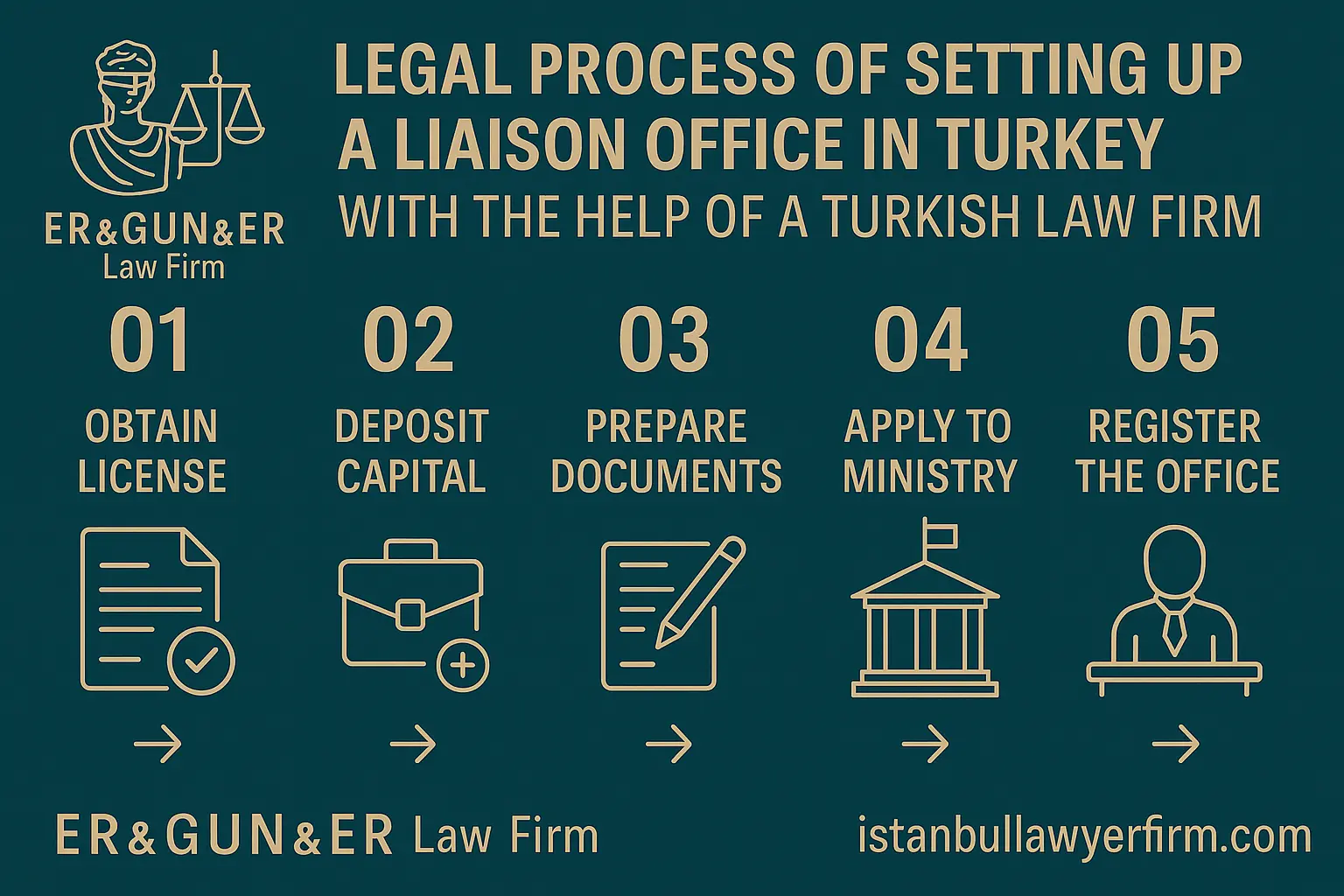
A Turkish Law Firm advising on liaison office establishment and ongoing operation provides integrated counsel across the lifecycle that begins with strategic positioning before application and continues through post-closure document retention. The legal framework operates under the Foreign Direct Investment Law No. 4875 of 17 June 2003 and the FDI Implementation Regulation (Doğrudan Yabancı Yatırımlar Kanunu Uygulama Yönetmeliği) of 20 August 2003 Article 6, with the competent licensing authority being the Ministry of Industry and Technology (Sanayi ve Teknoloji Bakanlığı) General Directorate of Incentive Implementation and Foreign Capital (Teşvik Uygulama ve Yabancı Sermaye Genel Müdürlüğü — TUYSG), operating through the e-TUYS electronic platform. The licensing authority is the Ministry of Industry and Technology, not the Ministry of Trade (Ticaret Bakanlığı) as sometimes misstated in secondary sources — the Ministry of Trade has jurisdiction over customs, foreign trade, and specific export-import matters but does not license liaison offices. Counsel engagement typically spans application architecture (scope strategy, documentation coordination, Ministry interaction), operational compliance (tax posture including the distinctive Income Tax Law No. 193 Article 23/14 wage exemption for employees paid through foreign-source parent transfers, SGK registration under Law No. 5510, employment under Labor Law No. 4857 with work permits under Law No. 6735, annual activity reporting by 15 January each year), ongoing governance (quarterly scope audits, incident cure documentation, banking discipline under MASAK Law No. 5549), transition planning (migration to branch under TTK No. 6102 Article 40 or subsidiary companies as commercial readiness develops), and closure coordination (Ministry notification, employment termination under Labor Law severance framework, tax and SGK deregistration, record retention under Tax Procedure Law No. 213 Article 253 for five years, KVKK No. 6698 data protection compliance). Practice may vary by authority and year, and counsel-led liaison office management produces better regulatory outcomes than reactive compliance responses to issues as they arise. Turkish lawyers who support foreign parents through this lifecycle bring integrated legal, tax, employment, and banking coordination that preserves regulatory compliance while enabling operational effectiveness. For the general conceptual framework, readers can consult our liaison office overview; for the detailed procedural framework, readers can consult our liaison office legal requirements guide.
Legal counsel role and strategic positioning before application
An Istanbul Law Firm coordinating liaison office strategy for foreign parent companies begins engagement with strategic positioning analysis that precedes formal application preparation. Strategic fit assessment addresses whether the parent's intended Turkish activities align with liaison office permissible scope — parent companies seeking observation, coordination, and non-commercial representation present strong strategic fit, while parents requiring commercial operations, Turkish invoicing, or revenue generation should consider branch or subsidiary structures from the outset because liaison office applications by parents with commercial intent face rejection or subsequent cancellation as operations diverge from declared non-commercial scope. Activity category selection within FDI Implementation Regulation Article 6 framework identifies which permitted category best matches the parent's intended operations — representation and hosting, quality control and supplier audit, technical support, communication and information transfer, regional management center, or market research — with each category having its own substantive boundaries and renewal implications (market research activities face particularly restrictive renewal treatment with limited extension beyond the initial three-year period, while operational categories support five-year renewal frameworks). Timing coordination addressing when the liaison office fits within the parent's broader Turkish market entry strategy supports integrated planning. Practice may vary by authority and year, and strategic positioning before application substantially affects approval timeline, subsequent compliance experience, and long-term relationship with Turkish regulatory authorities.
Turkish lawyers who address the pre-application counsel phase work through multiple analytical dimensions simultaneously. Parent company readiness assessment reviews whether the parent has the operating history (typically three or more years recommended), financial capacity (audited financial statements demonstrating ability to fund Turkish operations), and corporate governance (board authority to commit to Turkish presence) that support a credible application. Newly formed parent entities face closer Ministry review with heightened documentation requirements, and strategic counsel may recommend deferring application until parent operational history supports a stronger submission. Structural alternative analysis compares liaison office positioning against branch office under TTK Article 40 (commercial capability with Trade Registry registration and full tax integration), subsidiary company (separate Turkish legal personality with A.Ş. TRY 250,000 minimum capital or Ltd. Şti. TRY 50,000 minimum capital effective 1 January 2024), representative office arrangements in sector-regulated contexts, and other structures — the comparison examines commercial capability, tax consequences, liability allocation, operational complexity, and strategic flexibility. Country-of-origin considerations affect application documentation requirements because parent companies from Hague Apostille Convention member states (Turkey acceded 29 September 1985 through Law No. 3028) use apostille authentication while parents from non-Convention states require consular legalization, affecting documentation timeline and cost. For framework on representative office alternatives in specific sectors, readers can consult our representative office guide.
A lawyer in Turkey leading the strategic counsel phase produces deliverables that support both application and ongoing operations. Strategic memorandum addresses the parent's Turkish presence objectives, recommended structural approach with rationale, activity category selection with supporting justification, timeline estimate including documentation preparation and Ministry review, and resource planning covering documentation costs, establishment costs, and ongoing operational costs. Board deck supporting parent company approval presents the recommendation in board-appropriate format with decision criteria and supporting analysis. Scope boundary definition articulates the specific activities the liaison office will undertake, the activities it will not undertake, the cure procedures for boundary incidents, and the internal training framework supporting scope discipline — this definition becomes foundational for subsequent compliance architecture. Engagement letter with Turkish counsel establishes the advisory relationship including scope of services, fee structure, conflict management, and other professional elements. Pre-filing readiness review confirms all documentation is authentication-ready, translation is coordinated, Ministry filings are prepared, and the launch sequence is scheduled. Practice may vary by authority and year, and strategic counsel work at the pre-application phase typically represents four to eight weeks of intensive coordination before Ministry submission.
Application phase: counsel-led dossier architecture and Ministry interaction
A Turkish Law Firm coordinating the application phase works through the integrated documentation and procedural elements that produce successful Ministry review. Dossier architecture begins with the Ministry application form completed with internally consistent information across all elements, the activity declaration narrowly framed within the selected Article 6 category with testable operational parameters, the non-commercial undertaking explicitly stated, parent company authority documentation (certificate of incorporation, articles of association, good standing certificate within current validity period, most recent financial statements), board resolution authorizing Turkish liaison office establishment and appointing the representative, power of attorney (vekaletname) from parent to representative with specific authority scope, representative identification, office address plan evidenced by lease or letter of intent, and funding commitment from parent sufficient for projected operations. Foreign document authentication proceeds through apostille (Hague Convention states) or consular legalization (non-Convention states) before sworn translation by a translator registered with a Turkish notary under Notary Law No. 1512 Article 96. For framework on sworn translation services, readers can consult our legal translation services guide. Document sequencing matters because authentication must precede translation — translators capture authenticated elements in the translated version. Practice may vary by authority and year, and dossier quality substantially affects Ministry review timeline and approval likelihood.
Turkish lawyers who handle Ministry interaction through the e-TUYS electronic platform work through the procedural framework that has evolved with increasing digitization. Electronic submission through e-TUYS uploads the structured application with all supporting documents. Ministry review typically completes within 15 business days for complete applications meeting standard requirements, with longer periods for applications requiring clarification (ek bilgi talebi) or additional documentation. Clarification responses should address the Ministry's specific concerns with targeted supplemental documentation rather than broad re-explanation. Electronic correspondence preservation through the e-TUYS system creates an audit trail, but counsel should also maintain independent records of all Ministry communications. Initial license issuance (kuruluş izni) authorizes the liaison office for an initial three-year term with the license document specifying the permitted activity category, representative identity, and operational address. Post-approval procedures including Tax Office registration for tax identification number, SGK workplace registration within 30 days of first employee hiring, bank account opening at a Turkish commercial bank with MASAK Law No. 5549 KYC compliance, and office lease finalization complete the operational setup. Counsel coordination across these post-approval steps ensures that the Ministry license, Tax Office registration, SGK registration, and banking documentation all reflect consistent information supporting subsequent compliance. For framework on how the procedural sequence operates in practice, readers can consult our liaison office opening procedural guide.
An English speaking lawyer in Turkey coordinating bilingual document workflow for cross-border corporate groups addresses the language and communication dimensions that affect execution quality. Bilingual documentation strategy determines which documents operate in Turkish with English translations (Ministry filings, Tax Office registration, SGK documents, formal employment contracts), which operate in English with Turkish translations (internal parent documents, board materials, executive communications), and which require simultaneous bilingual execution (POA, board resolutions with dual-language versions). Glossary discipline ensures consistent translation of key terms across documents — parent company name transliteration (where applicable), representative name spelling consistent with passport, corporate terminology alignment, and other tokens should be captured in a glossary and applied consistently. Translation quality review addresses both technical accuracy (correct legal terminology, precise numerical values, accurate corporate details) and operational usability (clear document structure, consistent formatting, supportable in subsequent use). Communication protocols between parent company decision-makers, Turkish counsel, and Turkish representative support efficient execution while preserving appropriate confidentiality. Document retention framework establishing which documents are retained by parent, which by liaison office, which by Turkish counsel, and specific retention periods supports both operational access and compliance requirements. Practice may vary by authority and year, and bilingual workflow coordination is particularly valuable for parents with limited Turkish-language capability.
Ongoing compliance: tax, SGK, and reporting governance
A lawyer in Turkey coordinating ongoing compliance for liaison office clients works through the governance framework that supports continuing regulatory alignment. Tax posture oversight addresses the absence of corporate income tax liability (because no Turkish-source income exists), absence of VAT obligations (because no taxable transactions occur), and other tax categories applicable to liaison office operations. The distinctive Income Tax Law No. 193 Article 23/14 wage exemption for employees paid through foreign-source transfers from limited-tax-liability parent companies provides substantial compensation efficiency — under the exemption, wages paid by foreign employers without Turkish legal or business centers to employees in Turkey, through transfers of the employer's foreign-source earnings, are exempt from Turkish income tax. Documentation supporting the exemption includes SWIFT confirmations showing foreign-source transfers, liaison office bank statements showing parent-origin receipts, payroll records tying transfers to wage payments, and internal policy documentation confirming the foreign-source payment methodology. Counsel review of quarterly payroll operations confirms continued exemption eligibility and identifies any risk areas. Tax Office interaction including any inquiries, audit requests, or specific other tax authority communications requires counsel coordination. SGK compliance including monthly declarations by the 23rd of the following month under Law No. 5510, annual reconciliation, and specific employment event reporting continues as standard employment obligation regardless of income tax exemption status because the exemption applies only to income tax, not social security. Practice may vary by authority and year, and integrated tax-employment-counsel coordination supports clean compliance posture.
Turkish lawyers who handle annual activity reporting coordination work through the substantive and procedural elements that determine report quality. Report content addresses the liaison office's operations during the reporting period — activity descriptions consistent with declared category, personnel information including number of employees and roles, financial summary of operational expenditure and parent funding, organizational information including any representative changes or operational structure changes, and confirmation of continued non-commercial status. Supporting documentation includes bank statements showing inbound parent transfers, expense documentation aligned with activity categories, employment documentation confirming personnel consistency, and other operational records. Submission through the e-TUYS platform by the 15 January deadline for the preceding calendar year's operations maintains compliance — late submission can trigger Ministry inquiry and potential license action. Counsel review of the annual report before submission identifies any boundary concerns, documentation gaps, or narrative issues that might attract Ministry attention. Multi-year trend analysis across annual reports supports renewal preparation by demonstrating consistent compliance pattern. Practice may vary by authority and year, and annual reporting governance benefits from systematic approach that builds institutional knowledge across reporting cycles.
A Turkish Law Firm addressing quarterly internal compliance audits works through the framework that identifies and corrects drift before it reaches regulatory visibility. Activity review samples recent operations against the declared activity category to identify any boundary incidents — transactions suggesting commercial activity (payments received, invoicing, commercial contracts), role evolution suggesting commercial positioning (title changes, target metrics including revenue components), communication patterns suggesting independent commercial authority (external-facing positioning), or specific other drift indicators. Documentation audit reviews file completeness including employment records, expense documentation, bank statements, lease and operational contracts, and other records — gaps identified during internal audit support targeted remediation before external review. Banking pattern review examines inbound flows (should originate from parent, labeled consistently with operational funding rather than commercial activity) and outbound flows (should correspond to documented operational expenses). Employment review verifies continued compliance with Article 23/14 exemption requirements where applicable, ongoing SGK compliance, and work permit renewals approaching. Incident cure procedures for any boundary issues identified include reversal of inappropriate receipts with written explanations to counterparties, internal memo documenting the incident and cure, and updated training to prevent recurrence. Practice may vary by authority and year, and proactive internal audit is substantially more efficient than reactive response to external inquiry.
Employment, work permits, and staff risk management
A Turkish Law Firm coordinating employment architecture for liaison offices works within Labor Law No. 4857 of 22 May 2003, Social Insurance Law No. 5510 of 16 June 2006, and Work Permit for Foreigners Law No. 6735 of 13 August 2016 frameworks. Employment contracts between the liaison office (on behalf of the parent) and employees require role descriptions aligned with permitted scope — titles and job descriptions should avoid sales and commercial language, performance metrics should avoid revenue components, and authority scope should reflect non-commercial operational character. Indefinite-term contracts as the default form under Article 8 suit liaison office operations; definite-term contracts require objective justification and written form when exceeding one year. Probationary period up to two months (extendable to four months by collective agreement) supports initial performance assessment under Article 15. Working time regulations including 45-hour weekly limit, overtime at 1.5x rate with 270 annual hour cap, rest periods under Article 63, and annual leave accrual (14 days for 1-5 years service, 20 days for 5-15 years, 26 days for over 15 years) apply standardly. Termination procedures under Article 17 specify notice periods calibrated to service duration, with severance pay under still-effective Labor Law No. 1475 Article 14 accruing from day one at one month's gross wage per year of service with statutory ceiling applicable. Occupational health and safety under Law No. 6331 applies based on workplace risk classification. Practice may vary by authority and year, and employment compliance architecture requires ongoing attention beyond initial contract execution.
Turkish lawyers who coordinate foreign employee work permits under Law No. 6735 work through the e-İzin electronic platform submission process. Documentation package includes the liaison office Ministry license, parent company documentation, employment contract compliant with non-commercial scope, foreign employee diploma with apostille and sworn translation, CV and previous experience documentation, passport copy, and specific sector-specific materials. Role design should describe duties in neutral terms consistent with liaison office permitted activities — coordinator, technical specialist, regional manager, representative all align; sales representative, commercial director, business development manager (with revenue authority) do not. Minimum salary thresholds require compensation at specific multiples of minimum wage — 6.5x for senior managers, 4x for engineers and architects, with Ministry of Labor regulations establishing current thresholds that should be verified at each application. The 5:1 Turkish-to-foreign employee ratio applies to most employers with specific exceptions. Turquoise Card (Turkuaz Kart) under Law No. 6735 Article 11 provides indefinite work authorization for qualified foreign nationals meeting educational, experience, investment, or recognized expertise criteria. Family residence permits under YUKK Law No. 6458 Article 34 support family unification for working-age family members with corresponding work permit applications. For broader framework on work permits, readers can consult our work permit guide.
A lawyer in Turkey addressing ongoing staff risk management works through the framework that addresses employment disputes, termination scenarios, and compliance issues. Employment dispute prevention through clear contractual terms, consistent policy application, documented performance management, and specific workplace dispute mechanisms reduces litigation exposure. Labor disputes when they arise proceed through Labor Courts (İş Mahkemesi) under specialized procedural framework with compulsory mediation (arabuluculuk) as precondition for most employment claims under Labor Law reforms effective 1 January 2018. Mediation typically completes within three to four weeks with written settlement or unresolved status proceeding to litigation. Severance and notice pay calculation during termination requires precise computation with specific legal thresholds — errors affect either employee rights (under-payment creating litigation risk) or parent company cost (over-payment as needless expense). Mutual termination agreements (ikale sözleşmesi) provide flexibility for amicable separation with specific legal requirements for enforceability. Collective dismissal procedures under Article 29 apply when employee reductions meet specific thresholds requiring Turkish Employment Agency (İŞKUR) notification and other steps. Workplace safety compliance under Law No. 6331 includes risk assessments, health and safety training, and other elements. Practice may vary by authority and year, and ongoing staff risk management benefits from preventive orientation rather than reactive response.
Office premises, lease, and insurance coordination
An Istanbul Law Firm coordinating office premises arrangements for liaison offices works through the integrated framework supporting operational presence and regulatory compliance. Lease negotiation for commercial premises under Turkish Code of Obligations No. 6098 Articles 299-378 (general lease) and Articles 339-356 (commercial and residential lease specific provisions) addresses specific commercial concerns including rent escalation mechanisms (inflation-indexed adjustments under TÜFE or ÜFE as permitted, with specific limitations under specific Law No. 7409 of 11 June 2022 temporary restrictions), term and renewal (typically one-year minimum with automatic renewal unless terminated, though parties may negotiate longer fixed terms), termination rights (including tenant rights under Article 347 framework and landlord rights under specific grounds including owner use, building reconstruction, and other justifications), security deposit (typically three months rent with specific limitations), and other commercial lease provisions. For framework on legal address considerations including specific virtual office arrangements, readers can consult our legal address guide for foreign companies. Address verification through municipal records confirms the premises supports commercial operations consistent with liaison office use. Zoning compliance confirms the location permits office activity. Practice may vary by authority and year, and lease arrangement affects both operational functionality and ongoing compliance positioning.
Turkish lawyers who address insurance and liability coordination work through the framework managing operational risk. Property insurance covering the leased premises (typically landlord responsibility for building, tenant responsibility for contents) addresses physical loss scenarios. General liability insurance addressing third-party claims arising from office operations (visitor injury, property damage) protects against specific liability exposure. Professional indemnity insurance where applicable to specific consulting or professional services operations addresses service-related claims. Employer liability insurance covering workplace injury claims operates alongside mandatory SGK coverage under Law No. 5510. Cyber insurance addressing data breach and cyber incident exposure becomes increasingly relevant with KVKK No. 6698 data protection framework imposing breach notification and other obligations. Insurance policy review identifies coverage gaps, ensures terms align with Turkish legal requirements, and confirms limits are appropriate for operational scale. Claims management procedures for incident response, insurance notification, and claim documentation support effective response to specific loss events. Practice may vary by authority and year, and insurance coordination complements rather than substitutes for operational risk management through procedural discipline.
A lawyer in Turkey coordinating premises lifecycle management works through the framework addressing address changes, lease renewals, and specific premises transitions. Address change management treats the change as a controlled project rather than administrative routine — Ministry notification with updated lease documentation, Tax Office registration update, SGK workplace registration update, banking documentation refresh, service provider notifications, and internal documentation updates including letterheads, contracts, and operational records. Lease renewal evaluation addresses both commercial terms (market rent assessment, specific lease term negotiation, renewal protections) and strategic fit (whether current premises continue to support liaison office operational needs). Relocation projects when strategic needs change proceed through similar controlled framework. Lease termination at end of liaison office operations (on closure or transition to different structure) requires coordination with landlord including notice under specific provisions, property condition handover, security deposit return, and final utility reconciliation. Sublease or assignment where specific circumstances permit requires both lease permission and Ministry coordination. Property dispute resolution where disagreements with landlord or building management arise proceeds through Turkish courts or alternative dispute resolution with specific procedural framework. Practice may vary by authority and year, and premises lifecycle management supports continuous operational stability while maintaining regulatory alignment.
Strategic advisory on scope boundaries and common pitfalls
A Turkish Law Firm providing strategic advisory on liaison office scope boundaries works through the framework that supports sustained compliance while enabling operational effectiveness. Common pitfall identification draws from the patterns that have historically led to Ministry inquiry or enforcement action — scope creep where liaison activities gradually expand toward commercial characteristics, personnel role evolution where individual employees' activities drift beyond declared scope, inadequate annual reporting creating Ministry concern about continued compliance, documentation gaps undermining evidence base for non-commercial status, improper claim of exception categories, banking pattern inconsistencies where flows suggest commercial activity, tax authority interaction management failures creating secondary issues, and other pitfall categories. Preventive framework development addresses each pitfall category through targeted controls including scope statement clarity supporting consistent internal interpretation, role description discipline for all positions with periodic review, annual reporting quality standards exceeding minimum requirements, documentation retention exceeding regulatory minimums, banking pattern monitoring with anomaly cure, tax authority communication protocols maintaining professional engagement, and other preventive elements. Early warning indicators for drift detection support timely intervention before issues compound. Practice may vary by authority and year, and strategic advisory on pitfalls benefits from aggregated experience across multiple liaison office engagements that individual parent companies cannot replicate internally.
Turkish lawyers who address scope evolution management work through the framework that permits operational adaptation within statutory constraints. Activity category modification through Ministry application with updated activity declaration and supporting documentation enables shifts within the permitted Article 6 categories — a liaison office initially established for market research may transition to technical support as the parent's Turkish presence matures and the operational focus shifts. Scope expansion within existing activity category for increased operations (additional personnel, expanded geographic coverage, enhanced reporting, larger operational budget) generally proceeds through notification without formal re-application, though substantial changes may require formal approval. Permitted sub-activity addition within the broader category based on evolving operational needs operates similarly. Testing activities near the commercial boundary requires particular caution — activities that would produce revenue even if structured as cost-reimbursement, fee arrangements, or specific other mechanisms likely cross the commercial threshold regardless of labeling. Documentation of activity evolution supports subsequent renewal applications and defends against any Ministry inquiry about scope alignment. Specific counsel review before implementing scope changes helps ensure continued compliance. Practice may vary by authority and year, and scope evolution should align with actual operational development rather than anticipatory over-designation at initial licensing.
An English speaking lawyer in Turkey addressing boundary incidents and cure procedures works through the framework that responds to specific compliance deviations when they occur. Incident identification through quarterly internal audits, external feedback (counterparty inquiries, bank KYC refreshes raising questions, specific other external signals), or internal escalation captures potential issues before they compound. Immediate response sequence includes cease-and-desist of the problematic activity with documented internal directive, reversal of any inappropriate receipts with written explanation to counterparties, internal memo documenting the incident with cause analysis and corrective action, and other cure steps tailored to the incident nature. Counsel review of the incident and cure confirms the response adequately addresses the regulatory risk. Documentation retention of the incident and cure creates audit-ready records supporting response to any subsequent Ministry inquiry. Training updates addressing the circumstances that enabled the incident support prevention of recurrence. Policy revision where the incident reveals systemic gaps produces enhanced framework. External communication planning addressing whether and how to notify the Ministry, Tax Office, or other authorities about the incident and cure requires careful judgment — some incidents are appropriately addressed internally without external notification while others warrant proactive disclosure with cure. Practice may vary by authority and year, and incident cure discipline distinguishes well-managed liaison offices from those whose incidents compound into regulatory action.
Transition to commercial structures: branch, subsidiary, or merger scenarios
A lawyer in Turkey addressing transition from liaison office to commercial structures works through the framework that enables graduation as commercial readiness develops. Transition triggers include readiness for Turkish customer contracts with revenue generation, need for invoicing capability in Turkey, regulatory requirements that differ between liaison and commercial structures, strategic expansion requiring full commercial presence, Turkish customer preference for Turkish counterparty, tender participation requiring Turkish bidder status, and other operational drivers. Structural alternatives include branch office under TTK No. 6102 Article 40 creating Turkish commercial presence with Trade Registry registration, full tax integration including corporate income tax and VAT, commercial contracting capability, and continuing parent liability because branches lack separate legal personality; joint stock company (A.Ş.) under TTK Articles 329-572 with TRY 250,000 minimum capital effective 1 January 2024 creating separate Turkish legal personality with full commercial capability and limited parent liability; and limited liability company (Ltd. Şti.) under TTK Articles 573-644 with TRY 50,000 minimum capital providing similar separate legal personality with simpler governance framework. The choice between branch and subsidiary depends on commercial strategy (whether Turkish presence should reflect parent identity or independent Turkish entity), tax planning (specific tax consequences vary between structures), liability preferences (subsidiary provides liability limitation while branch extends parent liability), and other factors. For framework on branch office establishment, readers can consult our branch office establishment guide. Practice may vary by authority and year, and transition architecture benefits from integrated planning across Ministry liaison office closure and commercial entity establishment.
Turkish lawyers who coordinate transition execution work through the framework managing continuity across the structural change. Parallel establishment of the new commercial structure while the liaison office continues operating provides operational continuity but requires careful separation of activities — the liaison office continues non-commercial operations while the new entity handles commercial activities until liaison office closure completes. Sequential transition with liaison office closure preceding commercial entity establishment creates a gap in Turkish presence that may affect customer relationships, employee continuity, and other operational elements. Employment transition through contract novation to the new entity (new employer assuming existing employment relationships) or termination and rehire (liaison office terminating with new entity hiring) has different tax, SGK, and severance implications — novation typically preserves service credit and avoids severance payment but requires employee consent; termination-rehire restarts service credit with severance payment. Asset transition including office equipment, operational assets, intellectual property developed during liaison operations, and other assets requires documented transfer with appropriate tax characterization. Customer relationship transition addressing existing parent-customer relationships operated through liaison office with new commercial entity requires communication planning and contractual transition. For framework on broader company formation in Turkey, readers can consult our company formation guide.
An Istanbul Law Firm addressing merger and acquisition scenarios involving liaison offices works through the integration frameworks that arise in corporate transaction contexts. Parent company acquisition where the parent of a Turkish liaison office is acquired by another entity requires Ministry notification and potentially new license application if the acquiring parent's corporate identity materially differs from the original parent — the liaison office license is tied to the original parent as licensed entity. Corporate restructuring at the parent level including mergers, demergers, or reorganizations requires coordination with the Turkish liaison office status because the licensed entity's survival affects license continuity. Liaison office integration into broader Turkish corporate structure through establishment of commercial entity alongside the liaison office creates dual-track operations during transition with eventual liaison office closure as commercial operations absorb all functions. Spin-off scenarios where the parent separates specific business lines with the Turkish liaison office aligned to one business line require parent entity restructuring coordination. Cross-border M&A transactions affecting the parent's ownership create downstream effects on Turkish liaison office licensing that require proactive management. Strategic counsel on transaction timing and structure supports integrated planning across home-country and Turkish dimensions. Practice may vary by authority and year, and M&A scenarios involving liaison offices benefit from parallel coordination between corporate and Turkish counsel.
Exit planning, closure, and post-closure counsel continuity
A Turkish Law Firm coordinating liaison office closure works through the procedural framework that documents orderly termination. Parent company decision through board resolution or equivalent corporate action initiates the closure process, with closure notification (kapanış bildirimi) to the Ministry of Industry and Technology's General Directorate of Incentive Implementation and Foreign Capital through the e-TUYS platform or current Ministry-designated channel. The closure notification includes parent decision documentation, representative closure confirmation, final activity report covering operations from the last annual report through closure date, employment termination documentation, and supporting closure materials. Employment termination under Labor Law No. 4857 requires notice periods under Article 17 (2 weeks for under 6 months service, 4 weeks for 6-18 months, 6 weeks for 18-36 months, 8 weeks for over 36 months), severance pay under Labor Law No. 1475 Article 14 for employees with one-year-plus service at one month's gross wage per service year subject to statutory ceiling, notice pay where notice periods are compensated rather than worked, and SGK employee exit notification within 10 days of termination under Law No. 5510. Outstanding employee obligations including final wages, accrued unused vacation compensation calculated under Article 59, and other amounts must be settled before closure completes. Collective dismissal procedures under Article 29 apply if the closure involves employee reductions meeting specific thresholds. Practice may vary by authority and year, and employment exit discipline protects against subsequent labor disputes and regulatory issues.
Turkish lawyers who address asset disposition and financial closure work through the framework resolving outstanding obligations. Asset disposition including office equipment, furniture, vehicles (if any), and other assets through sale at documented fair value, transfer to parent company with appropriate documentation, or disposal with documentation supports asset clearance. Contract termination for operational agreements including office lease (early termination fees may apply per lease terms under TBK Articles 325-347 framework), utility accounts with final meter readings and reconciliation, service provider contracts with notice and final settlement, and other operational contracts requires orderly wind-down. SGK workplace deregistration (işyeri kapatılması) through specific SGK procedures with final reconciliation documents employment cessation. Tax Office deregistration through final tax declarations including any remaining payroll tax, stamp tax, or specific other tax obligations and closure notification with the local Tax Office completes tax presence termination. Bank account closure after final reconciliation including transfer of remaining balances to parent through documented instructions, outstanding check clearance, and other closure elements supports financial wind-down. Intellectual property transfer to parent for any IP developed during liaison operations including reports, databases, customer information, and other IP operates through appropriate documentation. Practice may vary by authority and year, and closure discipline benefits from comprehensive approach addressing each element systematically.
An English speaking lawyer in Turkey addressing post-closure counsel continuity works through the framework supporting continuing parent company interests after operational cessation. Record retention under Tax Procedure Law No. 213 Article 253 requires five-year retention of tax records (extendable for specific categories including customs and other areas), with parent company responsibility for maintaining Turkish tax records and supporting documentation for the retention period. Employment record retention addressing potential future labor claims during applicable statute of limitations (generally five years for most claims under Article 32 of Labor Law) supports defense against post-closure disputes. KVKK No. 6698 data protection obligations for personal data (employee data, counterparty data, specific other personal data) continue after closure with retention, deletion, or transfer procedures required under KVKK framework and specific Board decisions. Potential subsequent tax inquiry (vergi incelemesi) within the statute of limitations period may require response and documentation support after closure — maintaining Turkish counsel relationship supports responsive handling of any such inquiries. Ministry follow-up inquiry addressing specific closure-related questions or broader parent group compliance occasionally arises, supporting the value of continued local counsel availability. Future reestablishment through fresh liaison office application if circumstances evolve proceeds as independent new application without presumption based on prior approval — documentation currency, representative selection, and scope framework apply fresh to the new application. Practice may vary by authority and year, and post-closure counsel continuity protects parent company interests and preserves optionality for future Turkish engagement.
Author: Mirkan Topcu is an attorney registered with the Istanbul Bar Association (Istanbul 1st Bar), Bar Registration No: 67874. His practice focuses on cross-border and high-stakes matters where evidence discipline, procedural accuracy, and risk control are decisive, with particular concentration on liaison office counsel-led engagement across the lifecycle in Turkey including pre-application strategic positioning under Foreign Direct Investment Law No. 4875 of 17 June 2003 and Implementation Regulation Article 6 framework, Ministry of Industry and Technology General Directorate of Incentive Implementation and Foreign Capital (Teşvik Uygulama ve Yabancı Sermaye Genel Müdürlüğü — TUYSG) interaction through e-TUYS platform with clear authority attribution distinguishing the Industry and Technology Ministry licensing authority from the Ministry of Trade which does not license liaison offices, dossier architecture with apostille authentication under the Hague Convention (Turkey acceded 29 September 1985 through Law No. 3028) and sworn translation under Notary Law No. 1512 Article 96, ongoing compliance governance including tax posture with corporate income tax exemption through absence of taxable events, VAT non-applicability through absence of taxable transactions, the distinctive Income Tax Law No. 193 Article 23/14 wage exemption for employees paid through foreign-source transfers from limited-tax-liability parent companies, SGK registration under Law No. 5510 with monthly declarations, annual activity reporting by 15 January each year, and renewal framework with category-specific extension treatment, employment under Labor Law No. 4857 with Article 17 notice periods and Labor Law No. 1475 Article 14 severance framework, work permits under Law No. 6735 with Turquoise Card Article 11 indefinite authorization framework, premises arrangements under TBK Articles 299-378 lease framework with specific commercial and residential provisions, strategic advisory on scope boundary discipline and common pitfalls across scope creep, personnel evolution, reporting quality, and banking pattern consistency, incident cure procedures, transition to branch under TTK No. 6102 Article 40 or subsidiary companies under TTK Articles 329-572 (A.Ş. TRY 250,000 effective 1 January 2024) and Articles 573-644 (Ltd. Şti. TRY 50,000 effective 1 January 2024), M&A scenarios affecting liaison office status, and orderly closure with employment termination, SGK deregistration, Tax Office deregistration, bank account closure, record retention under Tax Procedure Law No. 213 Article 253 for five years, and KVKK No. 6698 data protection compliance.
He advises foreign parent companies on strategic counsel relationships spanning the liaison office lifecycle from pre-application positioning through post-closure continuity, application dossier architecture with integrated authentication and translation coordination, Ministry interaction through e-TUYS electronic platform, quarterly internal compliance audits and incident cure documentation, annual activity reporting with multi-year trend analysis, employment architecture with Article 23/14 exemption documentation and work permit coordination, office premises lifecycle management across lease negotiation, renewal, relocation, and termination, strategic advisory on scope evolution within statutory boundaries, transition planning to commercial structures when commercial readiness develops, M&A coordination when parent-level transactions affect Turkish liaison office status, orderly closure with systematic asset and liability wind-down, and post-closure counsel continuity supporting record retention, potential subsequent inquiries, and future reestablishment optionality. His practice spans Commercial and Corporate Law, Commercial Contracts, Foreign Investment, Data Protection and Privacy, Intellectual Property, Arbitration and Dispute Resolution, Enforcement and Insolvency, Citizenship and Immigration, Real Estate, International Tax, International Trade, Foreigners Law, Sports Law, Health Law, and Criminal Law.
Education: Istanbul University Faculty of Law (2018); Galatasaray University, LL.M. (2022). LinkedIn: Profile. Istanbul Bar Association: Official website.
Frequently asked questions
- Which authority licenses liaison offices in Turkey? The Ministry of Industry and Technology (Sanayi ve Teknoloji Bakanlığı) General Directorate of Incentive Implementation and Foreign Capital (Teşvik Uygulama ve Yabancı Sermaye Genel Müdürlüğü) through the e-TUYS platform. The Ministry of Trade (Ticaret Bakanlığı) handles customs and foreign trade matters but does not license liaison offices.
- What activities are permitted? FDI Implementation Regulation Article 6 permits representation and hosting, quality control and supplier audit, technical support, communication and information transfer, regional management center activities, and market research. Commercial transactions generating Turkish-source income are absolutely prohibited.
- Do liaison offices pay corporate income tax? No, because they generate no Turkish-source income. This operates through absence of taxable events rather than specific statutory exemption. Similarly VAT does not apply because no taxable transactions occur.
- What is the Article 23/14 wage exemption? Income Tax Law No. 193 Article 23/14 exempts from Turkish income tax wages paid by foreign employers without Turkish legal or business centers to employees in Turkey through transfers of the employer's foreign-source earnings. Liaison office employees typically qualify. SGK contributions continue to apply regardless.
- How long is the initial license? Three years from approval date under Implementation Regulation Article 6. Renewal is available for operational categories (typically five years) with restrictive extension for market research activities.
- What is the annual reporting deadline? 15 January each year for the preceding calendar year's operations, submitted through e-TUYS platform. Late submission can trigger Ministry inquiry and potential license action.
- Can foreign nationals work at the office? Yes, with work permits under Law No. 6735 through e-İzin platform. Role design should be defensibly non-commercial. Turquoise Card under Article 11 provides indefinite authorization for qualified candidates.
- What documents are required for application? Parent company certificate of incorporation, articles of association, good-standing certificate, recent financials, board resolution, POA to Turkish representative — all with apostille or consular legalization and sworn translation. Activity declaration and representative documentation complete the package.
- How does counsel support ongoing compliance? Through quarterly internal audits identifying scope drift or documentation gaps before regulatory visibility, annual reporting preparation with multi-year trend analysis, incident cure procedures for any boundary issues, Tax Office and SGK interaction support, employment architecture review, and strategic advisory on scope evolution within statutory boundaries.
- What happens if the office crosses the commercial boundary? Ministry may cancel the license, tax authorities may retroactively assess the office as permanent establishment with corporate income tax and VAT liability, SGK may reassess, administrative fines may apply, and reputational consequences may affect future Turkish engagement. Counsel-supported incident cure with reversal, documentation, and other steps mitigates consequences.
- Can the office transition to branch or subsidiary? Yes. Branch under TTK Article 40 creates Turkish commercial presence with continuing parent liability. Subsidiary as A.Ş. (TRY 250,000 capital) or Ltd. Şti. (TRY 50,000 capital) creates separate Turkish legal personality with limited parent liability. Transition planning coordinates liaison closure, commercial entity establishment, employment novation, asset transfer, and customer relationship continuity.
- What happens during closure? Closure notification to Ministry, final activity report, employment termination with Labor Law severance and notice obligations, SGK workplace deregistration within 10 days, Tax Office deregistration, bank account closure, asset disposition, and record retention under Tax Procedure Law No. 213 Article 253 for five years.
- Does counsel engagement continue after closure? Yes, for record retention support, potential subsequent tax or SGK inquiries within statute of limitations, employment claim defense if issues arise, KVKK data protection continuing obligations, and future reestablishment planning if circumstances evolve.
- Can a new liaison office be established after closure? Yes, through fresh application meeting current standards. The application is independent of any prior operation without presumption of prior approval. Current documentation, current regulatory requirements, and current strategic rationale apply to the new submission.
- How does ER&GUN&ER Law Firm structure liaison office counsel engagements? Engagements begin with strategic positioning analysis before application, proceed through dossier architecture with authentication and translation coordination, Ministry interaction through e-TUYS, post-approval operational setup, ongoing compliance governance through quarterly audits and annual reporting, employment and premises coordination, strategic advisory on scope boundaries, transition planning when commercial readiness develops, orderly closure, and post-closure counsel continuity.