

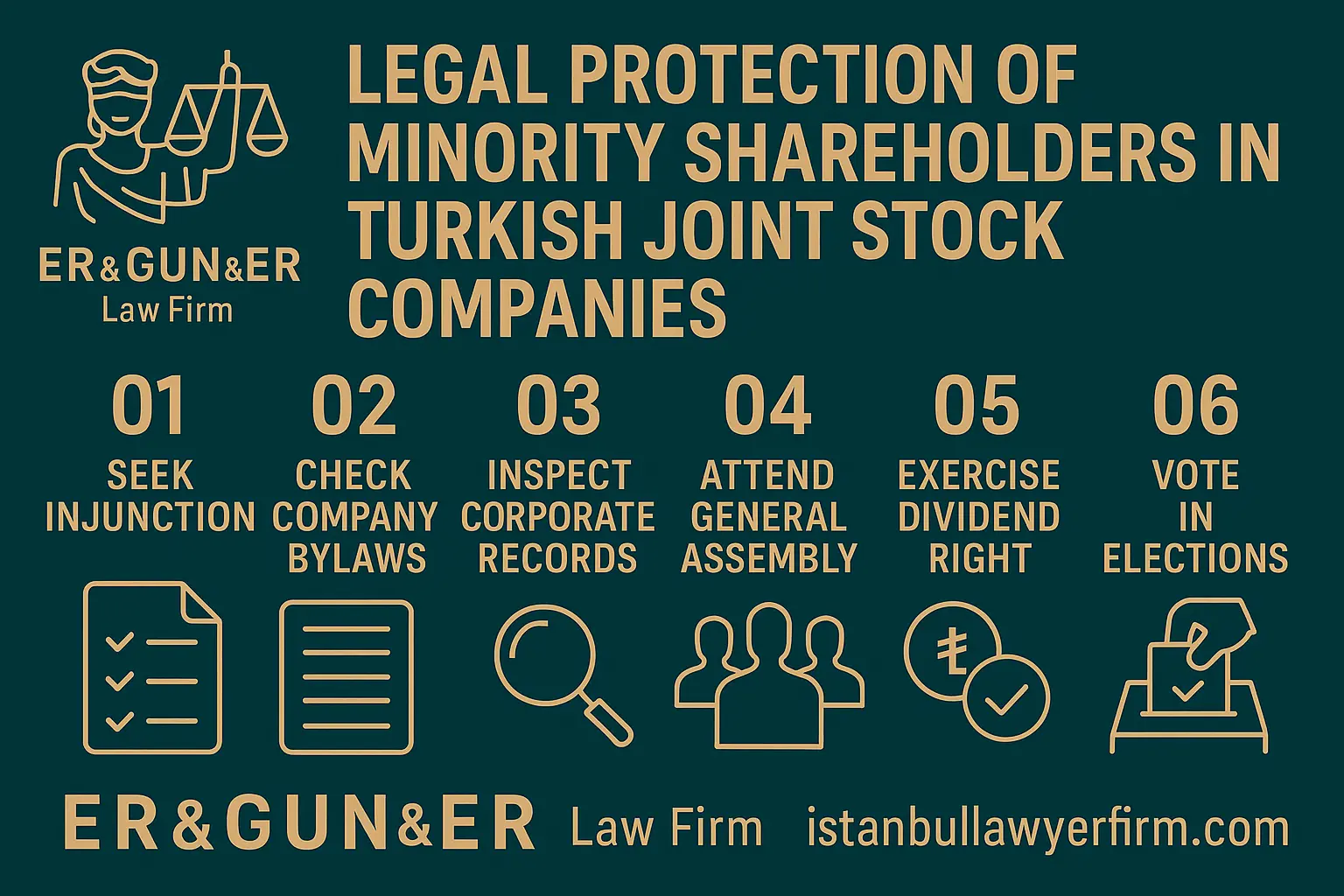
Minority shareholder protection in Turkish joint stock companies (anonim şirket, A.Ş.) operates within an integrated legal framework combining the Turkish Commercial Code No. 6102 (TTK) provisions distinguishing individual shareholder rights (paysahipliği hakları) — available to every shareholder regardless of stake — from qualified minority rights (azınlık hakları) available only upon reaching statutory thresholds (10% for closed companies, 5% for publicly-listed companies). Individual rights include information rights under Article 437, voting rights, preemption rights under Article 461 during capital increases, dividend rights under Articles 507-509, and annulment standing under Article 446 for shareholders having recorded dissent. Qualified minority rights accessible at 10% (closed) or 5% (public) threshold include general assembly convocation under Article 411, agenda addition under Article 413, financial statement approval postponement by one month under Article 420, special auditor appointment under Articles 438-439, and just cause dissolution action under Article 531. Annulment action framework under Articles 445-451 permits challenge of unlawful general assembly resolutions with 3-month limitation period from resolution date. Director liability framework under Articles 553-559 provides compensation mechanism for breach of fiduciary duties with 2-year knowledge-based, 5-year absolute, and 10-year criminal-conduct limitation periods. Capital Markets Law No. 6362 Article 23 provides additional protections for publicly-listed company shareholders including exit right (ayrılma hakkı) for significant transactions, Article 27 squeeze-out and sell-out rights at 98% threshold, and Article 26 mandatory tender offer protection at 50%+ control acquisition. Group-of-companies framework under Articles 202-204 establishes controlling shareholder liability for abusive exercise of control. HMK Article 389-399 provisional injunction framework supports urgent protection. For framework on minority shareholder rights in Turkish joint stock companies from an alternative analytical angle, readers can consult our minority shareholder rights companion guide. Practice may vary by authority and year, and minority shareholder matters benefit from integrated legal coordination across statutory rights, contractual protections, and procedural deployment. A lawyer in Turkey coordinates rights activation, procedural timing, evidence preservation, and strategic deployment of available protections.
Statutory framework for minority shareholder rights
A Turkish Law Firm advising minority shareholders works from the Turkish Commercial Code No. 6102 (TTK) as the foundational framework protecting minority interests. The Code distinguishes two fundamental categories of shareholder rights: individual rights (paysahipliği hakları) available to every shareholder regardless of stake size, and qualified minority rights (azınlık hakları) accessible only upon meeting statutory thresholds — 10% of capital for closed joint stock companies and 5% of capital for publicly-listed joint stock companies. This distinction affects strategic deployment: individual rights provide baseline protection for every shareholder while qualified minority rights provide enhanced collective tools requiring threshold aggregation. Individual rights include information and inspection rights under Article 437 permitting shareholders to request information about company affairs and inspect documents with specific limitations, voting rights with one-share-one-vote default under Article 434 subject to permissible voting privileges under Article 479 (maximum 15x multiplier), preemption rights under Article 461 protecting shareholders against dilution during capital increases with procedural framework, dividend rights under Articles 507-509 subject to general assembly distribution decision, and annulment standing under Article 446 for shareholders meeting procedural requirements. Practice may vary by authority and year, and foundational rights framework understanding is prerequisite to strategic minority protection.
Turkish lawyers who address qualified minority rights work through the Articles 411-413 general assembly convocation and agenda control framework. Article 411 general assembly convocation right permits shareholders representing 10% of capital (5% for listed companies) to request general assembly convocation — request addressed to board of directors with specific content requirements including agenda proposal and justification. Article 412 judicial convocation becomes available when board of directors refuses or fails to respond to valid convocation request — shareholders may apply to commercial court which orders convocation at company expense. Article 413 agenda addition right permits same threshold (10%/5%) to add items to general assembly agenda — written request to board within specific timeframe before general assembly date with agenda item specification. Article 420 financial statement postponement right permits qualified minority to postpone financial statement approval and board discharge for one month — may trigger special auditor consideration or additional scrutiny before approval. Articles 438-439 special auditor (özel denetçi) appointment framework permits qualified minority to request court appointment of special auditor to investigate matters — particularly valuable for suspected related-party abuse, financial statement accuracy concerns, management misconduct, or other integrity concerns. Court-appointed special auditor conducts investigation with specific authority, produces detailed report, and receives compensation from company. Practice may vary by authority and year, and qualified minority rights deployment requires threshold achievement through aggregation among allied shareholders where individual holding is insufficient.
An Istanbul Law Firm addressing the just cause dissolution framework works through TTK Article 531 providing qualified minority with powerful exit mechanism. Article 531 just cause dissolution action (haklı sebeple fesih davası) permits shareholders representing 10% of capital (5% for listed companies) to file action seeking company dissolution based on just cause — just causes include persistent operational losses, ongoing shareholder conflicts preventing normal operation, loss of shared purpose, specific significant violations of shareholder rights, and other fundamental disruptions. Court evaluation addresses whether circumstances warrant dissolution — courts favor alternative remedies where available rather than terminal dissolution. Alternative remedies available under Article 531 include: (a) buyout of applicant minority at fair value determined by court with independent valuation, (b) other remedies preserving company existence while addressing minority grievances. Buyout alternative is most common practical outcome — provides exit at judicially-determined value without corporate termination. Just cause dissolution action serves dual purpose: potential actual dissolution where circumstances warrant, and credible exit threat creating negotiating leverage for minority shareholders pursuing resolution short of litigation. For framework on shareholder deadlock resolution, readers can consult our shareholder deadlock guide. Practice may vary by authority and year, and just cause dissolution action is powerful tool requiring careful factual foundation and procedural preparation.
Annulment and nullity actions against general assembly resolutions
A lawyer in Turkey coordinating annulment action (iptal davası) under TTK Articles 445-451 works through the framework permitting shareholders to challenge procedurally or substantively defective general assembly resolutions. Article 445 establishes annulment grounds including: (a) violation of law (mandatory legal provisions), (b) violation of company Articles of Association (esas sözleşme), (c) violation of good faith principle (dürüstlük kuralı) under Turkish Civil Code Article 2. Law violations include improper convocation (inadequate notice, missing agenda items, improper meeting venue), quorum deficiencies (insufficient attendance for valid meeting), voting procedure violations, and other mandatory provision breaches. Articles of Association violations include resolutions exceeding Articles of Association-authorized board powers, violating Articles-specified voting thresholds, or contradicting specific Articles provisions. Good faith violations include resolutions intended to harm shareholders, abusive majority exercise serving only majority interests at minority expense, or other good-faith violations. Article 446 annulment standing belongs to: (a) shareholders who voted against resolution AND recorded dissent in meeting minutes (olumsuz oy + muhalefet şerhi), (b) shareholders unable to participate due to improper convocation or participation-preventing procedural irregularities, (c) board of directors, (d) individual board members for director-affecting resolutions. Practice may vary by authority and year, and annulment action requires procedurally proper positioning (recorded dissent) and substantive defect identification.
Turkish lawyers who address nullity action (butlan davası) under Article 447 work through the framework addressing fundamental resolutions violations too severe for annulment framework. Article 447 nullity grounds apply to resolutions violating specific fundamental principles — resolutions substantively contrary to mandatory legal principles, resolutions infringing inalienable shareholder rights (protected core rights that cannot be waived), resolutions violating governance principles, and other fundamental violations. Nullity versus annulment distinction affects procedural framework: nullity can be asserted by any person with legitimate interest (not limited to shareholders with dissent recording), nullity is not subject to the annulment action 3-month limitation period, and nullity resolutions are void ab initio rather than voidable. Nullity declaration action seeks court confirmation of already-existing nullity rather than creating the nullity through judicial decision. Article 448 establishes 3-month limitation period for annulment actions from resolution date — strict deadline with limited extension possibilities. Limitation calculation begins from date of general assembly resolution publication in Trade Registry Gazette for most resolutions, with variations for resolution types. Procedural framework includes filing with competent commercial court in company headquarters jurisdiction, other procedural steps, notification of all shareholders and company, potential preliminary injunction to suspend resolution execution pending determination, and other procedural elements. Practice may vary by authority and year, and annulment versus nullity categorization affects available remedies and limitation framework.
An English speaking lawyer in Turkey addressing provisional injunction framework works through the HMK Articles 389-399 framework supporting urgent relief during annulment proceedings. Provisional injunction (ihtiyati tedbir) framework permits court to order temporary measures preserving status quo pending final determination — particularly valuable for preventing irreversible resolution execution during multi-year annulment proceedings. Injunction against resolution execution pending annulment determination — prevents implementation of challenged resolutions, preserves financial or operational status quo, prevents third-party rights crystallization. Injunction elements include: (a) showing of prima facie case (reasonable likelihood of success on merits), (b) demonstration of urgent need and irreparable harm absent injunction, (c) security deposit (teminat) to protect against unjustified injunction damages. Specific injunction applications address: suspension of share transfer transactions that would prejudice minority, suspension of capital increase execution pending preemption dispute resolution, suspension of merger or other corporate transactions pending challenge, suspension of management changes pending governance dispute resolution, and other injunction applications. Enforcement mechanism through execution office (icra müdürlüğü) with specific compliance framework. Injunction duration typically extends through final determination unless specifically vacated. For framework on shareholder agreements that may specify additional dispute resolution, readers can consult our shareholder agreement guide. Practice may vary by authority and year, and provisional injunction strategy requires rapid deployment given timing-sensitive corporate actions.
Preemption rights and capital increase protections
A Turkish Law Firm coordinating preemption rights (rüçhan hakkı) protection works through TTK Article 461 framework preserving shareholder proportionate participation in capital increases. Article 461 establishes preemption right as mandatory default — existing shareholders have right to subscribe to new shares in capital increase proportionate to their existing stake, preserving ownership percentage and preventing dilution without consent. Exercise requirements include subscription within specified period (typically 15 days minimum), full payment under capital increase terms, and compliance with procedural requirements. Preemption right restriction or exclusion permitted only through qualified majority vote under Article 461 with conditions — general assembly may restrict or exclude preemption by specific voting threshold (typically requiring 50%+ of capital attendance and 2/3 of attending votes), decision must serve company's important interest, other substantive requirements. Common legitimate reasons for preemption exclusion include strategic partnership with specific new investor, employee stock option programs, technical acquisitions where specific target shareholders are the counterparty, other strategic situations. Abusive preemption exclusion — restriction intended primarily to dilute minority shareholders rather than serve company interest — may support annulment action under Articles 445-451. Practice may vary by authority and year, and preemption rights analysis is central to capital increase defense for minority shareholders.
Turkish lawyers who address share valuation and dilution defense work through the framework protecting minority shareholders from disguised dilution. Share issuance at below fair value constitutes indirect dilution — new shares issued at nominal rather than fair market value transfer value from existing shareholders to new shareholders without proportionate compensation. Article 459 framework requires capital increase share prices be specified in general assembly resolution — resolution content with minimum elements. Share issuance restrictions preventing below-value issuance include: (a) minimum value requirements (typically at least nominal value plus specific considerations), (b) fair value analysis for share issuance to affiliated parties, (c) other protections. Below-value issuance challenge grounds include: (a) breach of fiduciary duty by board approving below-value issuance, (b) violation of good faith under Civil Code Article 2, (c) other substantive grounds. Remedies include annulment of capital increase resolution, damages claim against directors approving below-value issuance, other remedies. Related-party share issuance receives enhanced scrutiny — transactions between company and directors, significant shareholders, or their affiliates require fair value terms with appropriate governance procedures including board independence and potentially minority shareholder approval for significant transactions. Disclosure requirements for share issuances include Trade Registry filings, Articles of Association amendments where applicable, and other disclosure elements. Practice may vary by authority and year, and capital increase defense requires specific attention to pricing, procedure, and disclosure dimensions.
An Istanbul Law Firm addressing reduction of capital and other capital actions works through the framework governing share capital adjustments beyond increases. Capital reduction (sermaye azaltımı) under Article 473 requires procedural framework — creditor protection provisions (three-month public announcement period permitting creditor objection), mandatory approval thresholds (typically similar to capital increase), and other procedural requirements. Capital reduction may affect minority shareholders specifically through specific elimination of share classes, disproportionate reduction affecting minority shareholders asymmetrically, other targeted reductions. Share redemption and share retirement under framework require procedural compliance and equal treatment principles. Consolidation of shares (pay birleştirmesi) combines multiple shares into single larger shares — may affect minority shareholders particularly where consolidation creates fractional shares requiring cash settlement at potentially unfavorable valuation. Stock splits, bonus issues, and other capital structure actions carry minority-impact analysis. Cross-shareholding and specific group structure capital actions may affect minority shareholders through intra-group value shifts. Governance principle — all capital actions must comply with equal treatment principle (eşit işlem ilkesi) treating shareholders of same class identically absent justification. Practice may vary by authority and year, and capital action defense requires integrated analysis across procedural compliance, substantive fairness, and minority impact dimensions.
Director and controlling shareholder liability framework
A lawyer in Turkey coordinating director liability claims works through TTK Articles 553-559 framework providing compensation for breach of directorial duties. Article 553 establishes foundational directorial liability — board directors are liable to company, shareholders, and creditors for damages caused by culpable violation of their duties under law, Articles of Association, or general assembly resolutions. Director duties include: (a) duty of care (özen yükümlülüğü) requiring prudent management at standard of reasonable director (işadamı basiretli davranışı), (b) duty of loyalty (sadakat yükümlülüğü) prohibiting self-dealing without proper authorization, (c) specific fiduciary duties toward company and shareholders. Article 554 addresses founder liability for specific founding-stage violations. Article 555 establishes standing framework — company itself may sue directors (typically through board decision or other authorization mechanism), individual shareholders may sue directors directly for damages to the shareholder, and shareholders may sue directors derivatively for company damages through specific derivative action framework. Article 556 limitation periods establish: 2 years from knowledge of damage and responsible party, 5 years absolute from damage-causing act, 10 years where act constitutes criminal conduct (crime against company). Article 558 general assembly discharge (ibra) resolution ordinarily releases directors from liability for actions within discharged period — discharge does not apply to matters including fraudulent actions, actions not disclosed to general assembly, other exceptions. For framework on director liability specifically, readers can consult our director liability guide. Practice may vary by authority and year, and director liability framework provides substantial minority protection against directorial misconduct.
Turkish lawyers who address derivative actions work through the framework permitting shareholders to pursue claims on behalf of company. Derivative action (pay sahibi davası) permits shareholder to bring action on behalf of company for damages to company where company itself has not pursued claim — addresses collective action problem where directors controlling company are themselves the defendants. Standing requirements — shareholder standing for derivative action typically requires ongoing shareholding through proceedings, reasonable effort to obtain company action first (demand-on-board or demand-futility analysis), and other procedural requirements. Derivative action scope includes: (a) director liability claims under Articles 553-559, (b) breach of fiduciary duty claims, (c) related-party transaction claims for damages to company, (d) other claims belonging to company. Procedural framework includes filing with competent commercial court, other procedural steps, notification of company and affected directors, other procedural elements. Damages recovery flows to company rather than directly to plaintiff shareholder — benefits all shareholders proportionately through enhanced company value. Plaintiff shareholder may recover legal costs from company where action succeeds. For framework on derivative actions specifically, readers can consult our shareholder derivative actions guide. Practice may vary by authority and year, and derivative actions require procedural discipline particularly regarding demand and standing requirements.
An English speaking lawyer in Turkey addressing controlling shareholder liability works through TTK Articles 202-204 framework addressing abusive exercise of control in group-of-companies situations. Article 202 establishes group-of-companies framework identifying controlling shareholder (hakim ortak) and controlled company (bağlı şirket) relationships with specific definitional criteria based on direct/indirect voting control, board composition control, or other control indicators. Article 203 addresses controlling shareholder's use of control to cause controlled company's action or inaction — permits controlling shareholder to exercise control but imposes liability where control is used to cause controlled company damage without fair compensation. Controlling shareholder liability triggers include: (a) causing controlled company to enter disadvantageous transactions benefiting controlling shareholder, (b) causing controlled company to forego advantageous transactions, (c) other damage-causing control exercises. Liability extends to: controlling shareholder, controlling shareholder's representatives on controlled company's board, and other involved parties. Article 204 protective framework permits controlled company minority shareholders to pursue other remedies — demand for fair compensation at control-causing transaction, annulment or damages where inadequate compensation, other remedies. Defense framework — controlling shareholder can avoid liability by demonstrating: (a) controlled company received fair compensation for any disadvantage, (b) specific transactions would have occurred at arm's-length terms, (c) other justifications. Practice may vary by authority and year, and controlling shareholder liability framework is particularly important in corporate group situations where minority shareholders in subsidiaries face inherent structural disadvantages.
Shareholder agreements and contractual protection architecture
A Turkish Law Firm coordinating shareholder agreement (pay sahipleri sözleşmesi) drafting works through the framework supplementing statutory protections with contractual provisions tailored to minority protection needs. Reserved matters (saklı tutulan konular) framework specifies decisions requiring qualified shareholder approval beyond ordinary majority — typical reserved matters include fundamental transactions (mergers, major acquisitions, sale of business, significant asset transfers), capital structure changes (capital increases/decreases, new share class creation, change of Articles of Association), governance changes (changes to board composition, CEO appointment, major policy changes), related-party transactions above specific threshold, dividend policy changes, and other fundamental matters. Supermajority voting requirements (75%, 80%, or 90%) for reserved matters provide effective minority veto on specific critical decisions while preserving majority flexibility on ordinary business. Board composition provisions specify minority board representation — minority right to appoint specific board member(s), observer rights for non-voting board attendance, other representation mechanisms. Information rights provisions enhance statutory Article 437 information rights — expanded information delivery, scheduled management presentations to minority, access to financial reporting and other information beyond statutory minimums. Practice may vary by authority and year, and shareholder agreement architecture substantially enhances minority protection beyond statutory default framework.
Turkish lawyers who address transfer restrictions and exit mechanisms work through the framework governing share ownership changes. Right of first refusal (ROFR, önalım hakkı) permits existing shareholders to match third-party offers for other shareholders' shares — preserves shareholder composition against unwanted new shareholders. Right of first offer (ROFO) requires selling shareholder to offer shares to existing shareholders first at specified pricing before external sale. Tag-along rights (birlikte satış hakkı) protect minority by requiring purchaser acquiring majority to offer same terms to minority if majority agrees to sell — prevents majority from obtaining control premium while leaving minority with reduced market value or control uncertainty. Drag-along rights (birlikte satış zorunluluğu) permit majority to compel minority participation in bulk sale at same pricing — supports majority exit strategies while protecting minority through price parity and other protections. Put option (satma hakkı) permits minority to compel majority or company purchase of minority shares at predetermined pricing or formula under specific triggering circumstances — provides minority exit certainty. Call option (satın alma hakkı) permits majority to compel minority share sale under circumstances — typical circumstances include breach of shareholder agreement, change in minority holder, other specified events. Practice may vary by authority and year, and transfer restriction architecture balances preservation of existing composition with flexibility for legitimate transitions.
An Istanbul Law Firm addressing dispute resolution and enforcement works through the framework governing shareholder agreement breach remedies and other enforcement mechanisms. Dispute resolution clause in shareholder agreements typically specifies arbitration through ISTAC, ICC, or other institution with seat determination — arbitration preferred over court litigation for confidentiality and specialized expertise. Governing law typically Turkish law for Turkish company shareholder agreements though specific situations may support other law selection. Specific performance remedies for breach — Turkish court or arbitral tribunal may order performance of shareholder agreement provisions where monetary damages inadequate (e.g., performance of ROFR obligation, performance of voting commitments, other performance). Damages claims for breach — compensation for losses caused by shareholder agreement breach with specific calculation methodologies. Injunction and other equitable relief — provisional injunction pending full dispute resolution, permanent injunction as part of final relief. Liquidated damages provisions (cezai şart) pre-determine damages for specific breaches — provides certainty and other benefits, enforceable under Turkish law subject to other restrictions on excessive liquidated damages. Termination and specific exit triggers — circumstances permitting shareholder agreement termination or triggered exit mechanisms. For framework on international arbitration supporting shareholder agreement dispute resolution, readers can consult our international arbitration guide. Practice may vary by authority and year, and enforcement architecture requires integrated attention to remedies, procedure, and other enforcement elements.
Publicly-listed company minority protections under Capital Markets Law
A lawyer in Turkey coordinating publicly-listed company minority rights works through Capital Markets Law No. 6362 (SPK) providing enhanced protections beyond TTK framework. Article 23 significant transactions and exit right (ayrılma hakkı) framework permits minority shareholders to sell their shares at fair value where company enters significant transactions opposed by the minority — significant transactions include material mergers, spin-offs, substantial asset sales, specific material related-party transactions, fundamental business changes, and other transactions as defined by Communiqué II-23.1 (Significant Transactions and Exit Rights Communiqué). Exit right exercise framework — shareholder who did not vote affirmatively for significant transaction may exercise exit right within period, company must purchase shares at fair value determined under specific valuation methodology. Fair value determination typically based on weighted average share price over period preceding transaction announcement with other valuation considerations. Procedural framework includes formal notification, valuation report preparation, other procedural steps, and specific timing requirements. Article 26 mandatory tender offer framework protects minority at control transition — acquirer obtaining 50% or more voting rights or management control must offer to purchase remaining publicly-held shares at pricing under Communiqué II-26.1 (Tender Offer Communiqué). Tender offer pricing based on framework including weighted average trading price, other considerations. Exemptions from mandatory tender offer obligation available in circumstances. Practice may vary by authority and year, and publicly-listed company minority protections supplement TTK framework with specific capital markets-focused enhancements.
Turkish lawyers who address squeeze-out and sell-out rights work through SPK Article 27 framework at 98% threshold in publicly-listed companies. Squeeze-out right (ortaklıktan çıkarma hakkı) permits controlling shareholder holding 98% or more of voting rights to compel remaining minority to sell their shares at fair value — supports final consolidation of control after tender offer or extended accumulation. Sell-out right (satma hakkı) permits minority shareholders of company where controlling shareholder holds 98% or more to compel controlling shareholder to purchase minority shares at fair value — prevents minority from being trapped in company without effective market for shares. Communiqué II-27.1 (Squeeze-Out and Sell-Out Rights Communiqué) governs procedural and substantive framework — fair value determination methodology, procedural timing, other procedural elements. Fair value for squeeze-out/sell-out typically based on independent valuation methodology with specific components including discounted cash flow, comparable company analysis, comparable transaction analysis, other methodologies weighted appropriately. Dispute resolution for valuation challenges through framework. These 98% threshold rights complement Article 208 TTK squeeze-out framework for 90%+ closed company controlling shareholders though with procedural and substantive differences reflecting public company context. Practice may vary by authority and year, and squeeze-out/sell-out framework provides definitive resolution mechanism for concentrated-ownership situations.
An English speaking lawyer in Turkey addressing capital markets disclosure and fairness protections works through the framework enhancing transparency and fair treatment for public company shareholders. Material fact disclosure (özel durum açıklaması) under SPK Article 15 requires public companies to publicly disclose information material to investment decisions — provides minority shareholders access to information unavailable to closed company shareholders. Specific disclosure categories include financial performance updates, material transactions, significant agreements, governance changes, litigation matters, and other material matters. Insider trading prohibition under Article 101 protects against abuse of material non-public information — supports fair trading market for minority shareholders. Related-party transaction disclosure requirements under Capital Markets Board framework require disclosure, board committee review, and other governance elements for transactions with controlling shareholders, board members, or their affiliates. Corporate governance principles (Kurumsal Yönetim İlkeleri) published by Capital Markets Board provide comply-or-explain framework for corporate governance including board composition, committee structure, minority protection, and other governance elements. Independent board members requirement for public companies supports minority interests through non-management directors providing independent judgment. Practice may vary by authority and year, and publicly-listed company governance framework provides layered protection beyond TTK baseline.
Equal treatment principle and abuse-of-rights doctrine
A Turkish Law Firm coordinating equal treatment principle (eşit işlem ilkesi) enforcement works through TTK framework requiring treating shareholders of same class identically absent justification. Equal treatment foundation under TTK general principles requires company to treat all shareholders within same class on equal terms — same voting rights per share, same dividend per share within class, same information access, same transferability rights, and other equal treatment elements. Permissible distinctions include: (a) legitimate class distinctions created through Articles of Association with governance and other safeguards, (b) specific situational distinctions with appropriate justification, (c) other justified distinctions. Equal treatment violations include: (a) preferential information delivery to shareholders, (b) differentiated transaction opportunities (other insider opportunities), (c) asymmetric decision involvement, (d) other violations. Remedies for equal treatment violations include damages, injunction, other remedies. Strategic use of equal treatment argument — minority shareholders may assert equal treatment as additional ground strengthening annulment or damages claims where conduct involves disparate treatment alongside other violations. Practice may vary by authority and year, and equal treatment analysis adds other analytical dimension to minority shareholder defense.
Turkish lawyers who address abuse-of-rights doctrine work through Turkish Civil Code Article 2 good faith principle underlying other restrictions on abusive conduct. Civil Code Article 2 good faith (dürüstlük kuralı) requires exercising rights and performing obligations in good faith — prohibits abuse of rights (hakkın kötüye kullanılması) even where formally within legal boundaries. Abuse-of-rights application in shareholder context addresses majority exercise of voting control in manner serving only majority interests at disproportionate minority expense — formally compliant resolution or action may still constitute abuse where motivation or effect is predominantly harmful to minority without compensating legitimate company benefit. Analytical framework examines: (a) whether conduct formally complies with legal requirements, (b) whether conduct serves legitimate company interest versus narrow majority interest, (c) whether minority harm is proportionate to legitimate benefits versus excessive, (d) other good-faith indicators. Common abuse scenarios include: (a) capital increase designed to dilute minority without legitimate business need, (b) management compensation or related-party transactions extracting value at minority expense, (c) other specific patterns. Remedies include annulment of abusive resolutions, damages for abuse-caused harm, injunction against continuation, other remedies. Abuse-of-rights argument strengthens minority position by providing additional ground beyond technical legal compliance — courts consider totality of circumstances rather than narrow technical analysis. For framework on choosing between joint stock and limited liability company structures with different minority protection frameworks, readers can consult our LLC versus joint stock company comparison. Practice may vary by authority and year, and abuse-of-rights doctrine provides flexible tool for other situations not fitting statutory frameworks.
An Istanbul Law Firm addressing minority shareholder information and inspection rights works through TTK Article 437 framework and other information-access mechanisms. Article 437 information and inspection rights permit every shareholder to: (a) request information from board of directors about company affairs during general assembly, (b) request inspection of documents including financial statements, meeting minutes, other records. Information request must be relevant to shareholder's rights evaluation and may not disclose information where disclosure would harm company legitimate interests. Board response obligation — board must provide requested information where proper request made, may refuse only where disclosure would cause significant company harm or request is abusive. Judicial enforcement — shareholder may seek court order compelling information provision where board improperly refuses. Enhanced information rights through shareholder agreements supplement statutory baseline — specific expanded information delivery obligations, scheduled reporting, board member briefings, management access, and other enhanced rights. Information rights interaction with confidentiality — information received through shareholder rights typically subject to confidentiality with other restrictions on use, particularly regarding trading or other commercial use. Strategic use of information rights — information gathering supports other protection actions including annulment grounds development, director liability evidence, other strategic purposes. For framework on corporate governance generally, readers can consult our corporate governance guide. Practice may vary by authority and year, and systematic information gathering is foundational for effective minority shareholder strategy.
Exit mechanisms and specific dispute resolution architecture
A lawyer in Turkey coordinating exit strategy works through the integrated framework combining statutory and contractual exit mechanisms. Statutory exit mechanisms include: (a) Article 531 just cause dissolution action with potential buyout alternative, (b) Article 141 withdrawal right in merger scenarios for dissenting shareholders, (c) Article 208 squeeze-out framework for 90%+ controlling shareholders with minority right to receive fair value, (d) SPK Article 23 exit right for publicly-listed company significant transactions, (e) SPK Article 27 sell-out right for publicly-listed 98%+ controlling shareholder context. Contractual exit mechanisms supplement statutory framework: put options with pricing and triggers, tag-along rights providing parity with majority exits, drag-along provisions with minority protections, ROFR/ROFO mechanisms supporting other transitions, other contractual exit paths. Valuation methodology typically critical to exit mechanism effectiveness — methodology specification in advance (shareholder agreement) provides certainty while post-dispute judicial or expert determination provides neutrality. Fair value principles include going-concern basis (not liquidation), minority discount considerations (typically disallowed for squeeze-out fairness but may apply in other contexts), control premium considerations, other valuation elements. Practice may vary by authority and year, and exit strategy development requires integrated analysis of statutory rights, contractual mechanisms, valuation methodology, and timing considerations.
Turkish lawyers who address settlement and negotiation strategies work through the framework leveraging legal rights to achieve practical resolution. Negotiation leverage analysis — minority shareholder tools including: (a) Article 411 general assembly convocation pressure, (b) Articles 438-439 special auditor appointment creating scrutiny, (c) annulment action potential for resolutions, (d) Article 531 just cause dissolution action threat, (e) director liability claims, (f) other available actions. Settlement structures for minority shareholder disputes include: (a) buyout agreements at negotiated value with other payment terms, (b) enhanced governance arrangements (increased minority protections without exit), (c) specific transaction restructuring addressing minority concerns, (d) specific combination of remedies. Mediation through professional mediators may facilitate resolution — particularly effective where ongoing relationship preservation matters or where creative solutions beyond binary win/lose outcomes benefit parties. Structured negotiation frameworks provide neutral ground for dispute resolution without immediate litigation escalation — joint counsel-facilitated negotiation, other structured approaches. Documentation discipline throughout negotiation and settlement — all communications should be documented, settlement agreements should be comprehensive and specific, and other documentation elements. Practice may vary by authority and year, and skillful negotiation often achieves superior outcomes versus protracted litigation while preserving relationships for continued operation or other future interactions.
An English speaking lawyer in Turkey addressing cross-border enforcement works through the framework for international minority shareholder protections. Cross-border enforcement challenges where foreign minority shareholder seeks Turkish remedy or where Turkish judgment requires foreign enforcement. Turkish court jurisdiction over Turkish company shareholder disputes generally applies — Turkish company matters typically heard in Turkish commercial courts regardless of shareholder nationality. Arbitration election frequently preferred for cross-border matters — ISTAC (Istanbul Arbitration Centre), ICC, LCIA, or SIAC seats provide neutral forums with specialized expertise and enforcement facility through New York Convention 1958. MÖHUK (Private International Law) Article 50 tenfiz framework for foreign judgment recognition in Turkey — required where foreign judgment seeks enforcement against Turkish assets, with conditions including public policy compliance and other requirements. Bilateral investment treaty (BIT) protections may provide additional framework for foreign investor shareholder disputes — specific treaties vary but typically include fair and equitable treatment standards, protection against expropriation, other protections, and investor-state dispute settlement mechanism. Service of process and other procedural elements require integrated planning for cross-border execution. For framework on share purchase agreements, readers can consult our SPA guide. Practice may vary by authority and year, and cross-border shareholder disputes benefit from integrated Turkish and home-country counsel coordination.
Author: Mirkan Topcu is an attorney registered with the Istanbul Bar Association (Istanbul 1st Bar), Bar Registration No: 67874. His practice focuses on cross-border and high-stakes matters where evidence discipline, procedural accuracy, and risk control are decisive, with particular concentration on minority shareholder protection in Turkish joint stock companies across the integrated legal framework combining Turkish Commercial Code No. 6102 (TTK) individual shareholder rights (paysahipliği hakları) including information rights under Article 437, voting rights under Article 434 with permissible voting privileges under Article 479 capped at 15x, preemption rights under Article 461 protecting against capital increase dilution, dividend rights under Articles 507-509, annulment standing under Article 446 requiring recorded dissent, qualified minority rights (azınlık hakları) accessible at 10% capital threshold for closed companies and 5% for publicly-listed companies including general assembly convocation right under Article 411 with judicial convocation under Article 412, agenda addition right under Article 413, financial statement approval postponement under Article 420, special auditor (özel denetçi) appointment under Articles 438-439, board representation arrangements under Article 434 where Articles of Association permit, just cause dissolution action (haklı sebeple fesih davası) under Article 531 with alternative remedies including minority buyout, annulment action framework under Articles 445-451 with grounds including law violation, Articles of Association violation, and good faith principle violation, nullity framework under Article 447 for fundamental violations without limitation period, 3-month annulment limitation under Article 448 from resolution date, director liability framework under Articles 553-559 with company and shareholder standing, duty of care (özen) and duty of loyalty (sadakat), 2-year knowledge-based limitation, 5-year absolute limitation, and 10-year limitation for criminal conduct under Article 556, general assembly discharge under Article 558 with specific exceptions, derivative action framework permitting shareholders to pursue company claims against directors, group-of-companies controlling shareholder liability under Articles 202-204 with liability for abusive control exercise, minority protection in merger scenarios under Article 141 withdrawal right, squeeze-out framework under Article 208 at 90% threshold with minority fair value protection, capital reduction protection under Article 473 with creditor protection period, equal treatment principle (eşit işlem ilkesi) restricting disparate treatment of same-class shareholders, Capital Markets Law No. 6362 (SPK) publicly-listed company enhancements including Article 23 significant transaction exit right (ayrılma hakkı) under Communiqué II-23.1, Article 26 mandatory tender offer under Communiqué II-26.1 at 50%+ control, Article 27 squeeze-out and sell-out rights at 98% threshold under Communiqué II-27.1, Article 15 material fact disclosure, Article 101 insider trading prohibition, related-party transaction governance framework, Turkish Civil Code Article 2 good faith principle underlying abuse-of-rights doctrine providing flexible protection, HMK Articles 389-399 provisional injunction framework supporting urgent protection including resolution execution suspension, and MÖHUK Article 50 tenfiz framework for foreign judgment recognition.
He advises minority shareholders on integrated protection strategy from initial investment analysis through dispute resolution and exit, pre-investment due diligence identifying governance risks and existing protection gaps, shareholder agreement architecture supplementing statutory protection with reserved matters, supermajority voting, board representation, information rights, transfer restrictions including ROFR/ROFO, tag-along/drag-along, put/call options, preemption rights deployment during capital increases with dilution defense strategies, general assembly strategy including information gathering, agenda positioning, voting coordination, dissent recording for annulment standing, post-meeting challenge preparation, annulment action pursuit with procedural compliance and substantive defect analysis, special auditor applications under Articles 438-439 for investigation of matters, director liability claims coordination including derivative actions for company claims, controlling shareholder liability pursuit under Articles 202-204 in group situations, just cause dissolution action leverage for negotiated resolution through minority buyout alternative, publicly-listed company specific protections including exit right exercises and mandatory tender offer protections, equal treatment principle and abuse-of-rights doctrine deployment for flexible protection, provisional injunction pursuit for urgent preservation during dispute resolution, negotiation and settlement strategies leveraging available actions, and cross-border enforcement coordination. His practice spans Commercial and Corporate Law, Commercial Contracts, Foreign Investment, Data Protection and Privacy, Intellectual Property, Arbitration and Dispute Resolution including corporate dispute arbitration, Enforcement and Insolvency, Citizenship and Immigration, Real Estate, International Tax, International Trade, Foreigners Law, Sports Law, Health Law, and Criminal Law.
Education: Istanbul University Faculty of Law (2018); Galatasaray University, LL.M. (2022). LinkedIn: Profile. Istanbul Bar Association: Official website.
Frequently asked questions
- What are the minority shareholder thresholds in Turkish law? Under TTK, qualified minority rights (azınlık hakları) are accessible at 10% of capital for closed joint stock companies and 5% of capital for publicly-listed joint stock companies. Individual shareholder rights (paysahipliği hakları) are available to every shareholder regardless of stake — information rights under Article 437, voting rights, preemption rights under Article 461, dividend rights, and annulment standing under Article 446.
- What is the annulment action framework under TTK Articles 445-451? Annulment action permits shareholders to challenge general assembly resolutions on grounds of: (a) law violation, (b) Articles of Association violation, (c) good faith principle violation. 3-month limitation period under Article 448 applies from resolution date. Standing under Article 446 requires recorded dissent in meeting minutes for shareholders, or other qualifying positions (board, individual directors).
- Can minority shareholders force dissolution of the company? TTK Article 531 permits shareholders at 10% (closed) or 5% (public) threshold to file just cause dissolution action. Courts typically favor alternative remedies including minority buyout at fair value rather than terminal dissolution. The action is powerful leverage tool beyond direct dissolution outcome.
- What is a special auditor under TTK Articles 438-439? Qualified minority (10%/5%) may request court appointment of special auditor (özel denetçi) to investigate matters — particularly valuable for suspected related-party abuse, financial statement concerns, management misconduct. Court-appointed auditor conducts investigation with compensation paid by company.
- How are director liability claims pursued? Under Articles 553-559, directors are liable for breach of care and loyalty duties. Company may sue through board authorization; individual shareholders may sue for shareholder damages; derivative actions permit shareholders to pursue company claims. Limitations: 2 years from knowledge, 5 years absolute, 10 years for criminal conduct.
- What are preemption rights and how are they protected? TTK Article 461 provides existing shareholders right to subscribe to new shares in capital increase proportionate to existing stake — preserves ownership percentage and prevents dilution. Restriction requires supermajority vote with legitimate company purpose. Abusive exclusion supports annulment action.
- What is the controlling shareholder liability framework? Articles 202-204 address group-of-companies situations with controlling shareholder (hakim ortak) and controlled company relationships. Article 203 imposes liability where control is used to cause controlled company damage without fair compensation. Article 204 permits minority to pursue specific remedies including fair compensation claims.
- What exit rights do publicly-listed company minority shareholders have? SPK Article 23 provides exit right (ayrılma hakkı) for significant transactions under Communiqué II-23.1. Article 26 mandatory tender offer applies at 50%+ control acquisition under Communiqué II-26.1. Article 27 sell-out right applies at 98% controlling shareholder threshold under Communiqué II-27.1.
- What is squeeze-out in Turkish joint stock companies? TTK Article 208 permits 90%+ controlling shareholder in closed companies to squeeze out minority at fair value under procedural framework. SPK Article 27 applies 98% threshold for publicly-listed companies. Both require fair value determination with specific methodologies and safeguards for minority protection.
- What provisional injunctions are available during shareholder disputes? HMK Articles 389-399 framework permits court-ordered provisional injunctions preserving status quo pending final determination. Applications typically include suspension of resolution execution pending annulment determination, transfer suspension, capital increase suspension. Requires prima facie case, urgent need demonstration, and security deposit.
- How do tag-along and drag-along rights work? Tag-along (birlikte satış hakkı) permits minority to join majority sale at same price — prevents majority control premium extraction at minority expense. Drag-along (birlikte satış zorunluluğu) permits majority to compel minority participation in bulk sale at same pricing — enables majority exit while providing minority price parity protection.
- How are shareholder agreements enforced in Turkey? Shareholder agreements are enforceable contracts under Turkish Obligations Code. Specific performance available for breach where damages inadequate. Liquidated damages (cezai şart) enforceable subject to restrictions on excessive amounts. Arbitration through ISTAC, ICC, or other institutions common for dispute resolution. Provisional injunctions available for urgent enforcement.
- What is the abuse-of-rights doctrine in shareholder context? Turkish Civil Code Article 2 good faith principle prohibits abusive exercise of rights even where formally legal. In shareholder context, majority voting control exercised primarily to harm minority without legitimate company benefit may constitute abuse. Analysis examines formal compliance, legitimate purpose, proportionality, and other factors.
- Can foreign minority shareholders enforce rights in Turkey? Yes. Turkish courts exercise jurisdiction over Turkish company shareholder disputes regardless of shareholder nationality. Arbitration commonly elected for cross-border matters through ISTAC, ICC, or other institutions. MÖHUK Article 50 tenfiz framework supports foreign judgment recognition where applicable. Bilateral investment treaties may provide additional protections.
- How does ER&GUN&ER Law Firm structure minority shareholder engagements? Engagements begin with comprehensive situation assessment covering ownership structure, existing protections, specific grievances, and strategic objectives, proceed through statutory rights analysis, contractual protection review, evidence preservation and gathering, deployment strategy development, execution across rights activation, negotiation support, and litigation or arbitration where required, and post-resolution implementation including settlement execution, governance changes, or exit completion.