

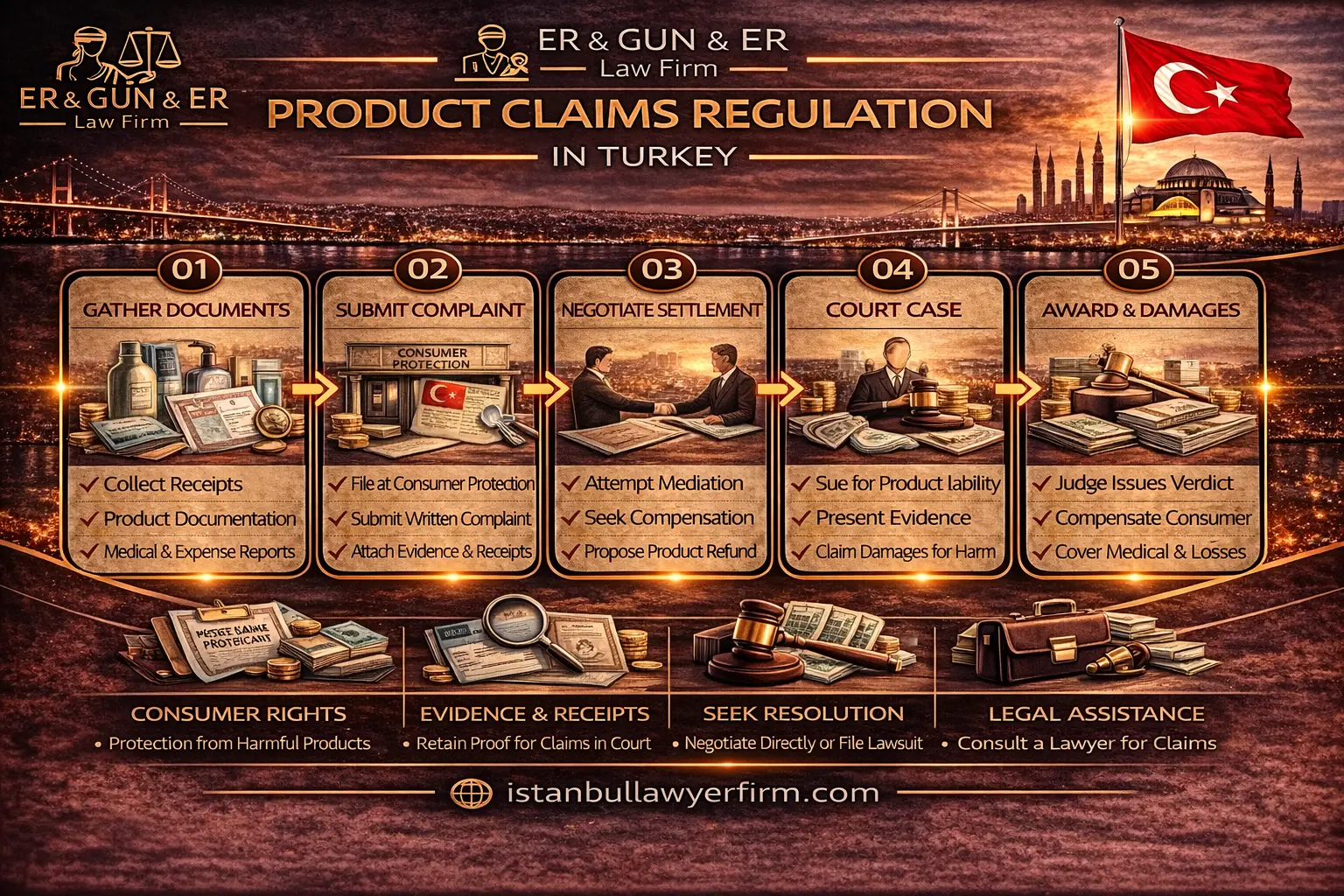
Product claims regulation in Turkey is the framework that determines what a company can lawfully say on packaging, labels, websites, marketplaces and advertising in the Turkish market. The framework is set primarily by the Tüketicinin Korunması Hakkında Kanun (Law No. 6502, the Consumer Protection Law), which prohibits misleading and unfair commercial practices and protects the average consumer's purchase decision-making against distortion; the Ticari Reklam ve Haksız Ticari Uygulamalar Yönetmeliği (the Regulation on Commercial Advertising and Unfair Commercial Practices), which sets the operational standards for commercial communications; the Türk Ticaret Kanunu (Law No. 6102, the Turkish Commercial Code), whose unfair competition provisions allow competitors to challenge claims that distort market behavior; and a layer of sector-specific rules that apply to food, food supplements, cosmetics, medical devices, and other regulated product categories. The Reklam Kurulu (Advertising Board), operating under the Ministry of Trade, is the principal administrative authority reviewing commercial advertising disputes; sector-specific authorities engage where product category triggers their jurisdiction. Practice may vary by authority and year.
An English speaking lawyer in Turkey advising consumer-facing brands on product claim compliance will treat the regulatory exposure as document-driven: the question that determines complaint outcomes is not what the brand intended to communicate but whether the company can produce, on demand, a pre-existing substantiation file that supports the claim's net impression on the average consumer. The body of this guide walks through the legal framework, the misleading-risk analysis, the substantiation file architecture, the high-risk claim categories (price and discount, comparative and superlative, sector-specific green-health-cosmetic), the online and influencer governance layers, and the complaint and corrective-action discipline that converts compliance from a marketing-side aspiration into an operational program. For procedural orientation on adjacent commercial-law topics, our notes on consumer protection laws in Turkey, unfair competition under Turkish law and e-commerce legal requirements can be read alongside this material.
1) Legal Framework: Product Claims under Consumer Protection and Advertising Regulation
A lawyer in Turkey who maps the product claims framework will start with the Tüketicinin Korunması Hakkında Kanun, which establishes the core prohibitions on misleading commercial practices and frames the analytical lens through which consumer-facing claims are evaluated. The framework treats a "product claim" broadly: any communication that creates an impression of a product's features, performance, origin, certification, comparative advantage, environmental impact, health effect or commercial value falls within the regulatory scope, regardless of whether the communication appears on packaging, on a label, on a website, in a marketplace listing, in a social media post, in influencer content, in advertising visuals, or in product names that imply outcomes. The procedure ordinarily requires brands to map each communication touchpoint against this scope at the start of every product launch, because subsequent enforcement is driven by the actual published communication rather than by the brand's internal description of what was intended.
An Istanbul Law Firm coordinating the regulatory map will identify the implementing layer: the Ticari Reklam ve Haksız Ticari Uygulamalar Yönetmeliği translates the Consumer Protection Law's principles into operational standards covering claim substantiation, comparative advertising, environmental claims, health-related claims and other specific categories. The Türk Ticaret Kanunu's unfair competition provisions add a parallel cause of action that competitors can invoke directly through civil court proceedings before the Asliye Ticaret Mahkemesi (Commercial Court), with remedies including injunction, removal of the offending communication, damages and corrective publication where granted by the court. Sector-specific rules add further layers: food and food supplements operate under the regulatory framework administered by the Tarım ve Orman Bakanlığı (Ministry of Agriculture and Forestry); cosmetics under the framework administered by the Sağlık Bakanlığı (Ministry of Health) through Türkiye İlaç ve Tıbbi Cihaz Kurumu (TİTCK); medical devices under TİTCK's specific regime. Practice may vary by authority and year.
A Turkish Law Firm designing a compliance program will treat the regulatory framework as a layered system rather than as a single rule set, because enforcement risk arises from the interaction of consumer protection principles, advertising regulation specifics, sector-specific rules and unfair competition exposure. The standard approach is to build a single internal claim register that maps each claim against each applicable regulatory layer and identifies the governing authority, the evidentiary standard, the format requirements and the responsible internal owner. The discipline outlined in our note on consumer protection laws in Turkey covers the general consumer-protection framework; the specific advertising-regulation layer is the Reklam Kurulu's operational territory, and the unfair competition layer is the Türk Ticaret Kanunu's separate framework that runs in parallel rather than as an alternative. Mapping the framework once at program design time, and refreshing the map periodically as regulatory practice evolves, prevents the inconsistency that fragmented department-level approaches typically produce. The Reklam Kurulu's own composition reflects the multi-stakeholder structure of the framework: the board includes representatives from consumer organizations, advertising professionals, sector regulators and the Ministry of Trade, and its decisions accordingly draw on multiple disciplinary perspectives that compliance programs should anticipate at the drafting stage rather than at complaint stage. Reklam Kurulu meetings are typically held monthly, with decisions published periodically as referenced cases that establish the regulatory direction on specific claim types — for example, on green claims, on price representations, on health claim boundaries — and the published-decision flow is itself a useful internal training resource that should be reviewed periodically by the compliance owner and incorporated into the company's claim review templates. Practice may vary by authority and year, and the Reklam Kurulu's published decision pattern has continued to evolve as new claim categories have emerged through marketplace and social media commercial communications.
2) Misleading Claim Risks and the Net Impression Test
An English speaking lawyer in Turkey advising on misleading-risk analysis will explain that the controlling standard is net impression on the average consumer rather than literal truth. Under the Tüketicinin Korunması Hakkında Kanun's framework, a claim can be misleading by being factually false, by being incomplete in a material way, by exaggerating an effect beyond the supporting evidence, by using visuals that imply outcomes the text does not state, by suggesting third-party approval that does not exist, by implying scientific certainty without a reliable basis, by implying exclusivity without a substantiated comparator set, by implying price advantage without a stable reference, by hiding limitations in unreadable disclaimers, by implying that a typical user will achieve an exceptional result, by shifting claim meaning across different channels, by allowing resellers to publish stronger claims than the brand publishes, or by using icons that consumers read as regulated certifications. The procedure ordinarily requires every claim to be tested through an "average consumer reading" before publication, with the test result documented in the claim file.
Turkish lawyers who advise on the boundary between aggressive marketing and misleading practice will identify the typical risk amplifiers that escalate ordinary claims into enforcement targets. Risk amplifies when claim wording and evidence scope diverge: the claim implies universal effect but the evidence supports only a subset of users; the claim implies real-world performance but the evidence is from controlled lab settings without consumer-condition validation; the claim is applied to an entire product line but the evidence covers only one variant; the claim relies on third-party data without showing why the data is relevant; the claim relies on internal testing without showing protocol and quality control; the claim relies on consumer feedback without sampling discipline. Risk also amplifies when the claim's channel context changes: a claim qualified in long-form web copy becomes misleading when shortened into a marketplace product title; a claim softened by spoken disclaimers in a video becomes misleading when the disclaimer is not readable on small screens; a claim with footnoted limitations becomes misleading when consumers read the headline impression in three seconds without scrolling.
An Istanbul Law Firm advising on the link between misleading claims and unfair competition exposure will note that the same factual pattern that triggers Reklam Kurulu enforcement frequently triggers competitor litigation under the Türk Ticaret Kanunu's unfair competition provisions. Where a claim pulls customers away by suggesting a unique advantage, competitors may challenge it as market distortion regardless of whether a consumer complaint has been filed. Where a claim implies competitor inferiority without a fair comparator basis, the affected competitor can pursue civil remedies including injunction and damages. Where a claim uses a competitor's mark or product name in a way that creates confusion or implies affiliation, trademark and unfair competition claims overlap. The standard approach is to evaluate every claim through both the consumer-protection and the unfair-competition lens at the drafting stage, because remediation after publication is slower, costlier and more public than reformulation before publication. Practice may vary by authority and year. In limited categories, misleading claims can also approach criminal exposure under the Türk Ceza Kanunu's fraud (dolandırıcılık) framework where the misrepresentation rises to the level of inducing material economic loss through the consumer's reliance on the false statement; this exposure is rarely the primary risk in routine advertising disputes but becomes material in cases involving fabricated certifications, counterfeit safety claims, false claims of regulatory approval, or claims that disguise dangerous product characteristics. The standard approach is to apply heightened scrutiny to claims at the boundary between aggressive marketing and active deception, and to escalate borderline cases through legal review rather than through marketing-side judgment alone, because the criminal-exposure dimension changes the nature of the company's response posture and can extend personal liability to individual decision-makers whose names appear in the approval trail. The discipline outlined in our note on unfair competition under Turkish law covers the parallel competitor-driven exposure in greater depth.
3) Substantiation Evidence Files: Scientific, Test and Operational Proof
A Turkish Law Firm building the substantiation architecture for a consumer brand will treat the evidence file as the single most important risk control in the claim program. The procedure ordinarily requires the file to capture the claim exactly as used (with screenshots, dates and channel identifiers), to identify the claim type (performance, safety, sustainability, price, health), to identify the evidentiary standard reasonable for that claim type, to gather the underlying documents (test reports, protocols, certificates, supplier declarations), to verify that the documents match the exact product variant and exact claim wording, to confirm that the evidence is current where the claim implies current performance, to record limitations transparently in a memo linking evidence to wording, to track version history of the claim wording, to document internal sign-off, and to store the file in a searchable repository with access logs. The standard approach is to design the file for adversarial reading rather than for internal reassurance — a reviewer evaluating the file will ask whether the evidence predates the claim, whether it addresses the same product, whether it is robust or anecdotal, and whether limitations are disclosed or hidden.
An English speaking lawyer in Turkey advising on scientific and test claims will note that this category carries a higher substantiation burden because the claims present themselves as objective truth rather than opinion. The standard approach is to treat every scientific headline as the last sentence of a substantiation memo rather than the first: start by drafting "what was tested" in plain language, then "what was not tested," then the "average consumer reading" of the proposed wording to check net impression, then the "claim wording that fits the proof" as the approved text. Attach the protocol, the test report and the sample information as exhibits; attach a data integrity note covering storage, custody and revision history; attach a translation consistency note where the claim runs in multiple languages; attach a scope note identifying which SKUs and batch variations are covered; attach a variance note specifying whether future formulation changes trigger revalidation. Where the headline uses terms like "scientifically proven," "clinically tested," "up to," "tested" or "certified," each term carries specific evidentiary expectations that the file should anticipate rather than discover at complaint time. Translation discipline is itself a recurring failure point in international brands' Turkish-market communications: the source-language claim that satisfied the brand's home-jurisdiction substantiation standard frequently strengthens or weakens in Turkish translation in ways the marketing team does not detect because the translation is performed by language professionals rather than by claim reviewers. The standard approach is to operate a controlled glossary that fixes Turkish translations for each substantive claim term, to require legal review of any new translation before deployment, and to track the Turkish version's net impression separately from the source-language version because the Turkish text is the operative communication for Reklam Kurulu review and for Turkish consumer interpretation regardless of what the source-language file says. Where the brand operates in multiple languages within the Turkish market — for example, with English-language packaging or product descriptions targeting expatriate or tourist consumers alongside Turkish-language versions for the broader market — the bilingual files should be treated as a single coordinated communication rather than as parallel independent communications, with the substantiation analysis covering both versions and their interaction at the consumer-impression level. The same coordination applies where the brand operates through international e-commerce platforms with both Turkish and English language settings accessible to Turkish consumers, because consumer protection enforcement reaches the communication as Turkish consumers actually encounter it rather than only the language version the brand intended for the local market.
Turkish lawyers who manage the cross-functional architecture of substantiation will also coordinate evidence across departments so that R&D, marketing, procurement, sustainability and pricing teams do not create different versions of the truth. If R&D states a performance result, marketing must use the same conditions and limitations; if procurement states a supplier certification, marketing must ensure the certificate covers the stated attribute; if the sustainability team claims an environmental benefit, marketing must ensure it is measurable and not a vague impression; if the pricing team claims a discount, marketing must ensure the reference price is documented. The standard approach is to assign a single named compliance owner per product line, to maintain a single approved-claim register, to operate a single sign-off matrix, and to schedule periodic revalidation as products and suppliers change. Practice may vary by authority and year, and the substantiation architecture is the foundation on which all subsequent claim-category-specific controls (price, comparative, sector-specific, online, influencer) are built. The cross-functional aspect deserves particular attention because in many companies the practical failure pattern is structural rather than substantive: the marketing team writes a claim based on its understanding of a benefit; the R&D team has different evidence with different conditions; the procurement team has supplier documentation covering a different scope; the sustainability team has a methodology that the marketing team's claim wording does not reflect. The standard approach is to require every claim to pass through a single approval workflow that connects the relevant functions before publication, with the workflow producing a documented evidence trail that all functions have reviewed and approved. Where the company operates across multiple product lines, multiple brands or multiple international markets, the cross-functional layer expands to include local market alignment so that Turkish-market claims do not drift from the global brand's substantiation framework, and so that local marketing teams do not produce claim variants that the central evidence file cannot support.
4) Price and Discount Claims under Documentary Discipline
A lawyer in Turkey advising on price and discount claims will explain that this category is enforced through documentation rather than persuasion, because the controlling question is whether the consumer was misled about savings. The procedure ordinarily requires every discount claim to have a documented reference price (the "before" price), a documented comparison period during which the reference price actually applied, a documented scope identifying which products and variants are included, a documented channel scope (online, in-store, both), a documented time scope with actual start and end dates, a documented inventory scope where stock is limited, and a documented bundle logic where products are sold as sets. Headline phrases like "was X" pricing must be supported by actual prior practice rather than by a hypothetical list price never charged; "lowest price" claims require a comparator set and a time window or should be removed; "free" claims require condition disclosure where conditions exist; scarcity language ("last chance," "limited time," "only today") requires the asserted limitation to be real and not a perpetual tactic.
An Istanbul Law Firm coordinating price-evidence packs will design the file structure so that the company can produce supporting evidence within hours of a complaint rather than scrambling through scattered systems. The standard approach is a dedicated price-evidence pack that begins with the advertised claim as captured (with date, channel and screenshot), continues with reference-price evidence supporting the "before" price (system extracts, receipt records, marketplace history snapshots), continues with applied-price evidence supporting the "after" price at checkout, includes a calculation memo explaining how the percentage or amount-saved figure was computed, includes a scope memo identifying excluded items and channels, includes an inventory memo where stock limits apply, includes a change log for any edits to the promotion wording after launch, includes approval records identifying who validated the reference price and approved the public claim, includes reseller guidance where marketplaces are involved, includes a monitoring note recording spot checks during the campaign, and includes a remedy template specifying the team's response to mid-campaign mismatches.
Turkish lawyers who handle pricing disputes will note that consumers react to headline numbers more than to detail, which is why headline discipline is the primary risk control. If the headline states "50% off," the file must show how the figure was computed and why it is not misleading; if it says "lowest price," the file must show the comparator set and time window; if it says "free," the file must show conditions; if it uses scarcity language, the file must ensure the limitation is real. The standard approach is to align headline number with checkout reality, because the most common complaint pattern is the consumer finding at checkout that the headline savings did not translate into actual paid amount. Where complaints arrive, the response should retrieve the price-evidence pack rather than improvise an explanation, and customer service should avoid making new claims while responding because chat logs become evidence in any subsequent investigation. Practice may vary by authority and year, and the Reklam Kurulu has consistently treated price misrepresentation as a documentation question rather than as a contestable consumer-impression question. The reseller and marketplace dimension of price claims deserves separate operational attention because resellers frequently amplify discount claims for conversion purposes — using "was" prices that do not reflect the brand's actual prior pricing, applying brand-wide promotion language to specific units that are not in the promotion scope, or misaligning marketplace-displayed savings with checkout reality. The standard approach is to ban resellers from constructing their own savings claims and to provide a controlled brand-side discount communication that resellers may use, with monitoring captures verifying compliance and a takedown protocol where deviations occur. Where the brand operates through multi-tier distribution and ultimately faces enforcement exposure for reseller communications it could not control directly, the documented reseller-control regime — contractual prohibitions on independent claim construction, monitoring records, takedown logs — is the central evidence the brand uses to demonstrate that the misleading communication was not authorized by the brand and that the brand applied reasonable controls to prevent it.
5) Comparative, Ranking and "Best" Claims: Comparator Files and Superlative Discipline
A Turkish Law Firm advising on comparative claims will treat them as combining consumer-protection risk with competitor-conflict risk, because both authorities and competitors review the same factual pattern through different remedial lenses. The procedure ordinarily requires every comparative claim to be based on like-for-like products and comparable conditions, to identify what is being compared (even where the competitor is not named explicitly), to use metrics relevant to consumer decision-making rather than cherry-picked, to avoid mixing different time periods or contexts to create false advantage, to avoid implying competitor inferiority beyond evidence support, to avoid using competitor marks in confusion-creating ways, and to avoid untestable superiority statements presented as facts. The standard approach is to build a comparator file that includes product specifications, test conditions, full dataset, dated snapshot of the competitor product used (because competitor products change), a method memo explaining comparator selection and metric relevance, a fairness memo checking whether the claim could mislead by omission, and a trademark and unfair competition review confirming that wording does not imply affiliation or disparagement.
An English speaking lawyer in Turkey handling "best," "No.1," "leading," "most trusted" and similar superlative claims will note that these formulations are high-risk because they imply comparator sets, metrics and time frames even where none are stated. A claim of "best" implies a comparator set, a metric and a time frame; "No.1" implies market definition and measurement basis; "most trusted" implies survey methodology that must be robust; "top rated" implies a rating platform, sampling window and non-manipulated dataset; "award-winning" implies a real award with disclosed scope and date; "leading" implies leadership criteria rather than impression; "#1 seller" implies sales data and defined channel; "best value" implies a comparator basket and a value metric; "most eco-friendly" implies lifecycle proof rarely available in straightforward form; "best for health" implies health claim controls and strong evidence subject to sector-specific rules. The defensible approach for any superlative is to anchor it to a defined ranking with documented dataset, time window and methodology, or to rewrite it as a descriptive feature statement.
Turkish lawyers who advise on the comparative-and-ranking interaction with influencer and reseller content will note that comparative claims drift particularly fast through unmonitored channels. An influencer's spontaneous "best on the market" creates the same enforcement exposure as the brand's official claim where the brand scripted, approved or controlled the messaging; a reseller's repetition of "outperforms competitors" without comparator evidence creates the same risk where the brand has not disciplined the reseller channel. The standard approach is to maintain a strict no-paraphrase rule for comparative claims (the approved text or no comparative claim), a dated competitor snapshot file, a revalidation schedule because rankings become stale quickly, a withdrawal rule specifying when the claim must be removed if data no longer supports it, and a monitoring routine that captures third-party drift early. Practice may vary by authority and year. The discipline outlined in our note on unfair competition under Turkish law covers the competitor-driven side of the comparative-claim exposure. Where the company operates in a category with active competitor monitoring — pharmaceuticals, cosmetics, electronics, automotive, FMCG — the standard approach is to assume that competitor counsel reviews the company's claims systematically and that any comparative or superlative formulation will be tested against the company's evidence pack within weeks of publication. The competitive intelligence dimension of comparative-claim discipline is itself a strategic consideration: aggressive comparative claims invite reciprocal challenge that the company's competitors can file under the Türk Ticaret Kanunu's unfair competition provisions, and a court-ordered injunction during peak commercial seasons can be far more disruptive than the marginal commercial benefit of the original claim. The standard approach for high-stakes campaigns is to model the competitor-response scenario at the planning stage and to weigh the comparative-claim's expected commercial benefit against the realistic litigation exposure rather than to discover the exposure after publication.
6) Sector-Specific High-Risk Claims: Green, Health, Food Supplement and Cosmetic
An Istanbul Law Firm advising on green and sustainability claims will treat them as a discrete high-risk category because they create strong purchase impulses while being hard to verify objectively. Phrases like "eco-friendly," "recyclable," "carbon neutral," "plastic-free," "biodegradable," "sustainable," "reduced emissions," "natural," "chemical-free" and "ocean-friendly" each carry specific evidentiary expectations. The procedure ordinarily requires the claim to define what aspect is improved and against what baseline, to match packaging components and recycling reality (rather than theoretical material properties), to show quantified scope and verified programs for carbon-related statements, to define which packaging components fall within "plastic-free," to show test standards and conditions for biodegradability, to anchor "sustainable" to measurable practices and supplier inputs, and to specify life-cycle stages for emissions reductions. Absolute formulations like "chemical-free" should be rewritten into specific "free from X ingredient" statements that are verifiable, because absolutes invite immediate scrutiny that defined statements do not. The greenwashing exposure is itself a risk category that the Reklam Kurulu has identified through its published decisions on environmental marketing, with particular attention to claims that imply environmental benefit through aesthetic cues (green color schemes, leaf imagery, "natural" framing) that the underlying product attributes do not support. The standard approach is to test the green claim's net impression independently of the product's literal text, because consumers form an impression from the visual aesthetic and the headline together rather than from a clause-by-clause reading of the disclosure. Where the brand's marketing aesthetic relies heavily on environmental framing, the substantiation file should document the cumulative impression created by the visual identity rather than only the discrete textual claims, with the file demonstrating that the company anticipated the aggregate net impression and aligned the underlying product practice with the implied messaging.
A lawyer in Turkey handling health, nutrition and food supplement claims will treat this category as the highest-risk class because consumer interpretation can quickly cross into medical territory and trigger both Reklam Kurulu enforcement and sector-specific regulatory scrutiny by Tarım ve Orman Bakanlığı, Sağlık Bakanlığı and Türkiye İlaç ve Tıbbi Cihaz Kurumu. Phrases like "boosts immunity," "detox," "reduces cholesterol," "clinically proven," "recommended by doctors," "safe for everyone," "no side effects," "supports weight loss" and "prevents disease" each carry specific risk profiles. The standard approach is a strict approval gate routing every physiological or nutrition-related claim through legal review and evidence verification before publication, classification documentation confirming which authority guidance applies to the product category, alignment of label, website and influencer content with the approved claim text (because regulators review net impression across channels), composition specifications linking claimed benefits to defined ingredient functions without overstatement, and a "do not say" library for sales and customer-service teams because risky claims often appear in chat replies rather than in official copy.
Turkish lawyers who advise cosmetic brands on claim discipline will note that cosmetic messaging is heavily claim-driven and that aggressive performance claims invite review from both consumer-protection and TİTCK directions. Phrases like "eliminates wrinkles," "repairs DNA," "clinically proven," "dermatologist tested," "hypoallergenic," "instant results," "permanent," "organic," "100% natural" and "free from chemicals" each have defined evidentiary expectations. The standard approach is to treat each beauty claim as a performance claim requiring substantiation matched to exact wording, to rewrite scientifically problematic absolutes into defined statements, to control before-and-after visuals by storing original unedited images and documenting production conditions, to align label statements with online listing statements so consumers do not face channel-driven inconsistencies, and to monitor reseller listings for unauthorized "results" photos. The discipline outlined in our note on import-export and supply chain documentation intersects with sector-specific claims because origin, certification and supply chain documentation underpin many sustainability and naturalness claims. Practice may vary by authority and year. The boundary between cosmetic claims and medical device or medicinal product claims deserves specific attention because aggressive performance claims can transform a product's regulatory classification: a cosmetic claim that crosses into therapeutic effect may bring the product within TİTCK's medicinal product or medical device regulatory framework, with consequences extending beyond advertising compliance to product registration, market authorization, and post-market surveillance obligations. The standard approach for borderline product types is to draft the claim portfolio so that the cumulative impression remains within cosmetic territory rather than drifting into medicinal claim space, with a written classification memo documenting why the claim portfolio supports the product's cosmetic registration. Similar boundary considerations apply for food supplements approaching health claim territory and for beauty devices approaching medical device territory, with sector-authority pre-engagement available in some cases for classification confirmation.
7) Online Listings, Marketplaces and Influencer Endorsements
A Turkish Law Firm advising on online and marketplace governance will explain that online listings are where claim risk spreads fastest because multiple parties publish in multiple formats often without central control. E-commerce pages compress information into headlines, icons and snippets, which amplifies net-impression risk: a claim qualified in a long PDF becomes misleading when shortened into a product title; a claim defensible on a label becomes risky when resellers add conversion-driven promises; a claim approved for one channel drifts when copied into a marketplace template by a third party. The drift problem is structural rather than incidental: marketplaces are designed for fast cataloging and reseller-driven listing creation, which means that the same product appears in dozens or hundreds of listing variants across major platforms with different titles, different bullet points, different images and different descriptions, each constructed by different sellers with different claim discipline. The brand owner who has not deployed a structured governance regime typically discovers the scope of the drift only when a complaint surfaces a specific listing variant the brand never approved. The procedure ordinarily requires a listing governance program with controlled templates, an approved-claim library for product titles, bullet points and descriptions with prohibited phrases marked, a reseller content rule stored as a contractual or policy exhibit, a monitoring process capturing top-listing screenshots with dates, a correction process documenting takedown requests and platform tickets, and consistency checks between product-page pricing and checkout-page pricing because checkout mismatch is a frequent complaint trigger.
An English speaking lawyer in Turkey advising on influencer governance will note that influencer marketing combines persuasion, informality and speed, which often produces exaggerated promises that the brand later inherits as enforcement exposure. A sponsored post is treated as commercial communication when it promotes a product even where written in personal tone, and the brand cannot assume it is insulated where it provided scripts, approvals or product briefs. The standard approach is a structured influencer compliance program covering disclosure of advertising relationship through clear and timely labeling under the Reklam Kurulu's framework on disguised advertising, prohibition of objective claims requiring substantiation (performance, health, environmental) unless supported by a brand-side evidence file, prohibition of absolute wording ("guaranteed," "works for everyone"), control of before-and-after visuals through storage of originals and documentation of conditions, alignment of testimonials with typicality (with explicit disclosure where results are exceptional), and consistency checks between influencer claim and label/product-page statements.
Turkish lawyers who manage the operational integration between online governance and influencer governance will treat both as extensions of the brand's central substantiation architecture rather than as separate marketing worlds. The standard approach is to extend the claim register to capture every published claim across owned channels, marketplace listings and influencer content; to maintain a unified evidence repository accessible across departments; to operate a unified sign-off matrix routing high-risk claim categories through legal review before publication regardless of channel; to monitor cross-channel drift through periodic captures with dated screenshots; to maintain a unified correction protocol that preserves original-state evidence before changes; and to align customer-service scripts so that chat replies do not create new claims while complaints are being resolved. The discipline outlined in our notes on e-commerce legal requirements and influencer agreement law in Turkey covers the underlying contractual and regulatory architecture in greater depth. Practice may vary by authority and year. The platform-side enforcement layer adds a third dimension to online claim governance because major marketplaces operate their own internal compliance regimes covering misleading content, prohibited claims and seller account integrity; platform-side action (listing suspension, account restriction, payout holds) can occur on faster timelines than regulatory action and can disrupt commercial operations independently of the regulatory outcome. The standard approach is to maintain platform-specific guidelines integrated into the brand's claim register, to monitor platform policy updates as part of the periodic compliance review, and to maintain separate evidence packs adapted to each major platform's substantiation expectations because some platforms apply higher standards on specific claim categories than the regulatory baseline requires. Where the company operates through international platforms with cross-border policy enforcement, the platform layer can itself create reputational and operational consequences that exceed the underlying regulatory exposure.
8) Complaints, Investigations, Corrective Action and Compliance Program
A lawyer in Turkey advising on complaint and investigation handling will treat the response architecture as a stress test of the entire compliance program rather than as a discrete event. Reklam Kurulu reviews are document-driven: the procedure ordinarily requires the company to produce, on request, a coherent factual pack covering the claim as used (with channel and date), the substantiation file that predates publication, the test protocol and dataset where scientific claims are at issue, the price-history evidence where discount claims are at issue, the certification scope and validity where badges and seals are used, the influencer contracts and disclosures where influencer content is at issue, and the internal approval trail showing the company's governance discipline. The standard approach is calm, evidence-led and consistent communication rather than rhetorical argument: investigations expand beyond the original complaint when the reviewer perceives weak governance, so demonstrating governance protects the broader claim portfolio rather than only the specific claim under review.
An Istanbul Law Firm advising on corrective action will note that remediation is not only removing a claim but fixing the underlying governance and evidence mismatch that produced the risk. The procedure ordinarily requires preserving the original claim state as evidence (because subsequent changes need a baseline), classifying the failure type (wrong claim type, insufficient evidence, channel-control gap, translation drift), deciding whether the claim can be rewritten into a defensible bounded statement or must be removed entirely, updating the substantiation file with a dated change log, updating all channels (labels, websites, marketplaces, influencer scripts) because partial fixes leave residual exposure, sending reseller guidance and tracking corrections, retraining marketing and customer-service teams, adding a pre-publication review gate for the claim category that failed, adding a monitoring routine that captures drift early, updating templates to replace risky adjectives with defined statements, and documenting all corrective steps in a remediation memo because remediation is itself evidence of good governance.
Turkish lawyers who design comprehensive compliance programs will treat the program as a repeatable cycle rather than as a one-time setup. The standard approach builds a claim register listing every claim per product, per channel and per language; builds a substantiation file for each claim with the claim captured as used and the evidence captured as pre-existing; builds a claim classification system tagging each claim as performance, price, comparative, green, health, cosmetic or endorsement; builds pre-publication review gates for high-risk tags requiring written approval; builds packaging review gates so label text and symbols are checked before print; builds marketplace governance with reseller content rules and monitoring; builds influencer governance with script approval and disclosure verification; builds a complaint response playbook retrieving evidence packs rather than inventing arguments; builds corrective action workflows with version control; builds training modules focused on net impression and prohibited phrases; builds periodic audits sampling claims and verifying evidence readiness; and builds a secure repository with access logs because evidence files contain sensitive commercial data. Practice may vary by authority and year, and the most practical outcome of a well-built program is that complaints become retrieval tasks rather than crises. The program's audit cadence deserves explicit design rather than ad hoc execution because audits both surface latent compliance gaps and produce documentary evidence of the company's compliance posture for use in subsequent investigations. The standard approach is a tiered audit calendar combining quarterly sampling audits across the active claim register, semi-annual deep audits on high-risk categories (green, health, comparative, ranking), annual program audits covering governance documentation and training records, and event-driven audits triggered by complaint receipt, regulatory action, product launches, or material changes in the company's commercial communication profile. Each audit produces a documented finding-and-remediation record that becomes part of the evidence trail demonstrating ongoing program operation. Where the company faces a Reklam Kurulu investigation, the audit record demonstrates that the company maintained a compliance program before the complaint rather than constructing one in response to the investigation, which materially affects how the regulator characterizes the company's culpability and remedial posture.
9) Frequently Asked Questions for Brands and Compliance Teams
- What is the legal framework for product claims in Turkey? Product claims are governed primarily by the Tüketicinin Korunması Hakkında Kanun (Law No. 6502), the Ticari Reklam ve Haksız Ticari Uygulamalar Yönetmeliği (Regulation on Commercial Advertising and Unfair Commercial Practices), the Türk Ticaret Kanunu's unfair competition provisions, and sector-specific rules administered by Tarım ve Orman Bakanlığı, Sağlık Bakanlığı and Türkiye İlaç ve Tıbbi Cihaz Kurumu. The Reklam Kurulu (Advertising Board) is the principal administrative authority for commercial advertising disputes.
- What counts as a product claim? Any communication creating an impression about a product's features, performance, origin, certification, comparative advantage, environmental impact, health effect or commercial value — on packaging, labels, websites, marketplace listings, social posts, influencer content, advertising visuals, before-and-after imagery, badges, comparative statements, price representations and "free-from" statements.
- What standard is used to evaluate misleading risk? Net impression on the average consumer, not literal truth or brand intent. A claim is misleading where the overall impression diverges from the underlying evidence, regardless of whether the literal words are technically defensible in isolation.
- What is the substantiation file and why is it central? A pre-existing evidence pack that supports the claim's exact wording, scope and channel. Because enforcement is document-driven, the practical question at complaint time is whether the company can produce the file quickly with pre-existing evidence rather than constructing post-hoc support.
- What is the difference between Consumer Protection enforcement and unfair competition action? Consumer Protection enforcement runs through administrative review at the Reklam Kurulu (with possible referrals to sector authorities); unfair competition action runs through civil court proceedings before the Asliye Ticaret Mahkemesi and is initiated by competitors. The same factual pattern can trigger both routes simultaneously.
- What discipline applies to price and discount claims? Documentary discipline: every discount claim requires a documented reference price, a documented comparison period, a documented scope (products, channels, time, inventory), and consistency between the headline and the actual checkout amount. "Was X" pricing must be supported by actual prior practice rather than a hypothetical list price never charged.
- What is required for comparative claims? Like-for-like products and conditions, identification of what is being compared, metrics relevant to consumer decisions rather than cherry-picked, dated competitor snapshots, a method memo explaining comparator selection, raw data preservation, and trademark/unfair-competition review of wording.
- How are "best" and ranking claims evaluated? As implied comparative claims requiring a defined ranking with documented dataset, time window, market scope and methodology. Generic "best" formulations without underlying ranking evidence are typically rewritten as descriptive feature statements or removed.
- What rules apply to green and sustainability claims? Defined terms with measurable proof. Vague adjectives ("eco-friendly," "sustainable," "natural") require anchoring to specific improvements against baselines; absolutes ("chemical-free," "100% natural") are typically rewritten into specific verifiable statements; carbon and lifecycle claims require quantified scope and verified programs.
- What rules apply to health and food supplement claims? Strict approval gates and alignment with sector-specific regulatory frameworks administered by Tarım ve Orman Bakanlığı for food and food supplements and Sağlık Bakanlığı for health-related categories. Phrases implying treatment, prevention, universal effect or medical-style outcomes are typically routed through legal review and evidence verification before publication.
- What rules apply to cosmetic claims? TİTCK's regulatory framework governs cosmetic product compliance alongside the general advertising regulation. Performance claims require substantiation matched to exact wording; absolutes are typically rewritten; before-and-after visuals require original-image storage and production-condition documentation.
- What governance is required for online listings and marketplaces? A controlled-template approved-claim library, a reseller content rule stored as contractual or policy exhibit, a monitoring process with dated captures, a correction process documenting takedowns, consistency between product-page and checkout-page pricing, and readability checks for disclaimers on mobile displays.
- What governance is required for influencer endorsements? Clear advertising disclosure, prohibition of unscripted objective claims requiring substantiation, prohibition of absolute wording, control of before-and-after visuals, alignment with label/product-page statements, contract and brief preservation as exhibits, and monitoring captures because ephemeral posts disappear.
- What is the corrective action discipline when a problem is identified? Preserve the original state as evidence, classify the failure, decide between rewriting and removing the claim, update the substantiation file with a dated change log, update all channels (label, website, marketplace, influencer), retrain teams, add pre-publication review gates for the failed category, and document all steps in a remediation memo.
- Does ER&GUN&ER Law Firm advise consumer-facing brands on Turkish product claims compliance? Yes. ER&GUN&ER Law Firm is an Istanbul-based law firm advising consumer-facing brands, importers, manufacturers and online retailers on Turkish product claims regulation including substantiation file architecture, net impression analysis, comparative and ranking claim discipline, sector-specific high-risk categories (green, health, food supplement, cosmetic), online listings and marketplace governance, influencer endorsement compliance, Reklam Kurulu complaint and investigation handling, unfair competition exposure under the Türk Ticaret Kanunu, and corrective action and compliance program design — with English-language client communication and bilingual documentation throughout each engagement. Files in this area are typically led personally by the managing partner rather than delegated.
Author: Mirkan Topcu is an attorney registered with the Istanbul Bar Association (Istanbul 1st Bar), Bar Registration No: 67874. His practice focuses on cross-border and high-stakes matters where evidence discipline, procedural accuracy, and risk control are decisive.
He advises consumer-facing brands, importers, manufacturers, online retailers and international groups on Turkish product claims regulation including substantiation file architecture under the Tüketicinin Korunması Hakkında Kanun and the Ticari Reklam ve Haksız Ticari Uygulamalar Yönetmeliği, net impression and misleading-risk analysis, comparative and superlative claim discipline, sector-specific high-risk categories spanning green and sustainability, health and food supplement, and cosmetic claims, online listings and marketplace governance, influencer endorsement compliance, Reklam Kurulu complaint and investigation handling, unfair competition exposure under the Türk Ticaret Kanunu, and corrective action and compliance program design across multi-channel commercial communication.
Education: Istanbul University Faculty of Law (2018); Galatasaray University, LL.M. (2022). LinkedIn: Profile. Istanbul Bar Association: Official website.