

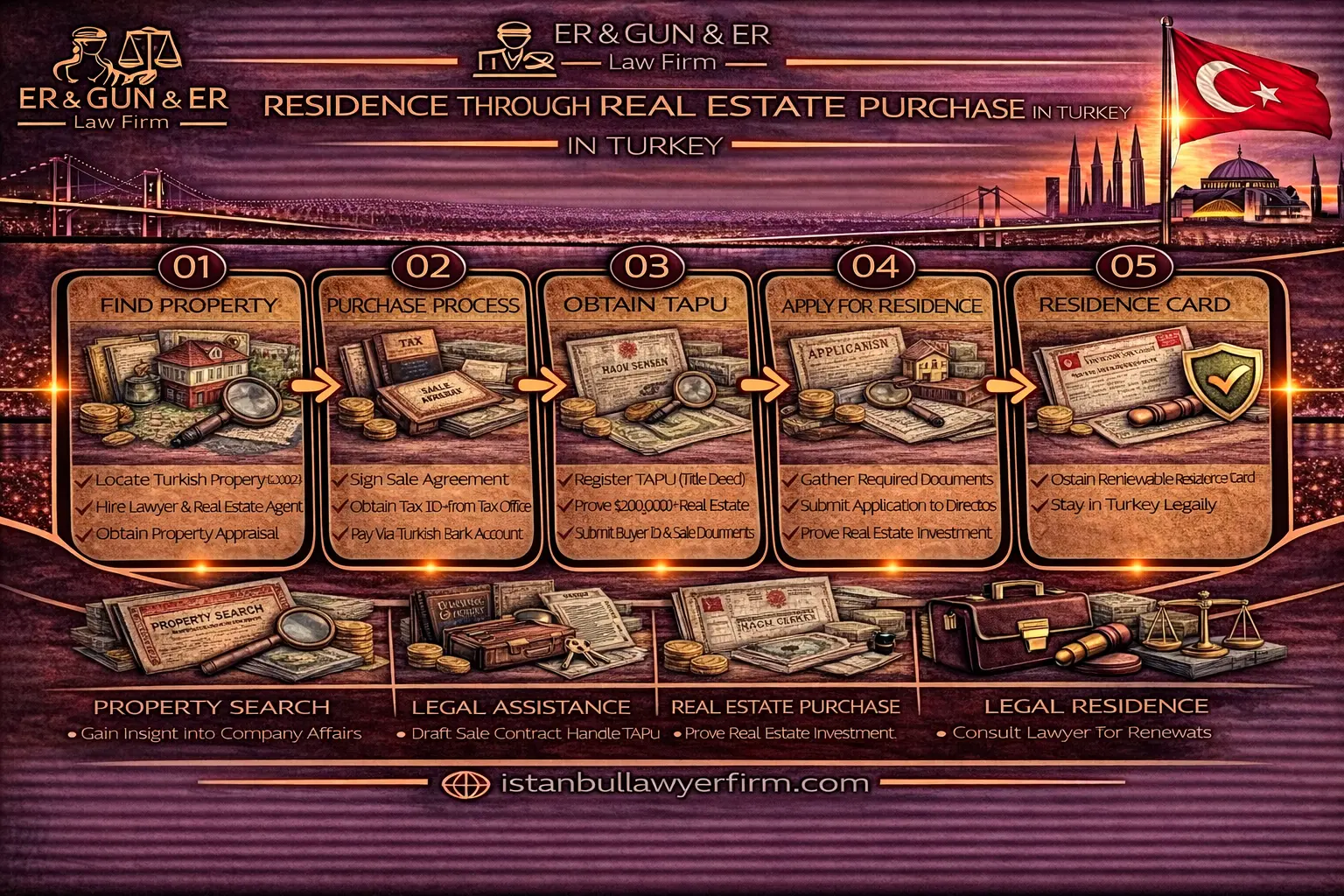
Residence through real estate purchase in Turkey is commonly used as a residence pathway when a foreign national owns qualifying residential property, with the file evaluated under structured general migration conditions producing a coherent residence permit framework rather than a guaranteed approval mechanism. The framework that governs the relevant questions is set primarily by the 6458 sayılı Yabancılar ve Uluslararası Koruma Kanunu (YUKK) administered through Göç İdaresi Başkanlığı (Presidency of Migration Management — restructured from the earlier Göç İdaresi Genel Müdürlüğü) with the operational interface through İl Göç İdaresi Müdürlükleri (provincial migration management directorates), covering m.21 (Türkiye'ye giriş ve vize / 90-day filing framework), m.31 (kısa dönem ikamet izni / short-term residence permit) including m.31/1-j (taşınmaz sahibi olma / property ownership pathway) operating as the primary substantive basis for property-based residence positioning, m.34-35 (aile ikamet izni / family residence permit), m.41-42 (uzun dönem ikamet izni / long-term residence permit requiring 8 years continuous residence), m.53 (sınırdışı etme / deportation framework with 15-day appeal under m.53/3), and m.99 (adres bildirim yükümlülüğü / address reporting within 20 business days); the e-İkamet system (e-ikamet.goc.gov.tr) operating as Turkey's mandatory online residence permit application platform; the Tapu Müdürlüğü framework administering land registry transactions through TAKBİS (Tapu ve Kadastro Bilgi Sistemi); the kapalı mahalle (closed neighborhood) framework effective 1 July 2022 establishing geographic restrictions on property-based residence applications under YUKK m.31/1-j in 1,336 initial neighborhoods plus subsequent additions where foreign-population density exceeds 20%; the 1567 sayılı Türk Parası Kıymetini Koruma Hakkında Kanun framework governing döviz alım belgesi (foreign currency purchase document) requirements for foreign-currency-denominated real estate transactions; the 5901 sayılı Türk Vatandaşlığı Kanunu (TVK) including m.11 (genel yoldan kazanma / general pathway requiring 5 years continuous residence — distinct from the YUKK m.42 8-year long-term residence requirement) and m.12 (istisnai vatandaşlık / exceptional citizenship including the CBI program with 13 Haziran 2022 BKK $400,000 real estate threshold — distinct from the YUKK m.31/1-j residence permit pathway); the 6305 sayılı Afet Sigortaları Kanunu governing DASK (Doğal Afet Sigortaları Kurumu) zorunlu deprem sigortası; the Notarlık Kanunu Law No. 1512 governing vekaletname (power of attorney); the 1961 La Haye Konvansiyonu (Hague Convention on Apostille) governing apostille recognition; the 5490 sayılı Nüfus Hizmetleri Kanunu governing Adres Kayıt Sistemi (AKS) administered through Nüfus ve Vatandaşlık İşleri Genel Müdürlüğü (NVİGM); and the 2577 sayılı İdari Yargılama Usulü Kanunu (İYUK) m.7 governing the 60-day filing period for İdare Mahkemesi appeals against rejection decisions. Practice may vary by authority and year.
An English speaking lawyer in Turkey advising on property-based residence will explain that effective positioning requires structured coordination across substantive ownership eligibility, e-İkamet system navigation, Tapu Müdürlüğü documentary discipline, address registration compliance, foreign currency compliance, kapalı mahalle status verification, and integrated longer-horizon positioning supporting both immediate residence approval and broader residency-trajectory objectives. The body of this guide walks through the property-based residence overview with owner qualification and family eligibility; the Tapu Müdürlüğü ownership evidence and purchase payment documentation discipline; the foreign currency compliance framework; the address registration under YUKK m.99 with health insurance discipline; the e-İkamet application workflow and appointment procedure; the renewal strategy and rejection defense framework; the sale, transfer, and renting-out scenarios with kapalı mahalle analysis; and the travel, re-entry and long-term residency trajectory under YUKK m.42 and TVK m.11. For procedural orientation on adjacent topics, our notes on legal residence through real estate purchase, residence permit applications in Turkey for expats and residence permit extension in Turkey can be read alongside this material.
1) Property-Based Residence under YUKK m.31/1-j: Overview, Owner Qualification, and Family Eligibility under m.34-35
A lawyer in Turkey advising on the property-based residence framework will explain that taşınmaz sahibi olma (property ownership) operates as a structured residence pathway under YUKK m.31/1-j with specific substantive requirements distinguishing it from both the broader kısa dönem ikamet izni framework and the Turkish Citizenship by Investment (CBI) program under TVK m.12. The procedure ordinarily considers the substantive ownership-evidence framework where the applicant must own qualifying immovable property in Turkey with structured documentary support including current Tapu (title deed) and ownership-verification documentation through Tapu Müdürlüğü and TAKBİS (Tapu ve Kadastro Bilgi Sistemi); the kapalı mahalle (closed neighborhood) framework effective 1 July 2022 establishing geographic restrictions on property-based residence permit applications in 1,336 initial neighborhoods plus subsequent additions where foreign-population density exceeds 20% — applicants whose property is located in kapalı mahalle locations cannot obtain new residence permits under YUKK m.31/1-j based on that property; the strategic positioning where YUKK m.31/1-j residence permit pathway is distinct from the Turkish CBI program under TVK m.12 with its 13 Haziran 2022 BKK $400,000 threshold — these are separate programs producing different outcomes (residence versus citizenship); and the broader integration with the residence permit framework where ownership operates as a supporting ground rather than as a guarantee of approval, with structured general migration conditions including identity continuity, lawful entry, address registration under YUKK m.99, and health insurance compliance.
An Istanbul Law Firm advising on owner qualification will note that ownership eligibility begins with how the title deed records the holder and the share of ownership, with structured documentary discipline supporting both initial application and subsequent renewal. The procedure ordinarily considers the substantive title-deed framework where the applicant is expected to be recorded on the Tapu as an owner (not only as a future buyer) with structured share documentation supporting the ownership claim; the joint-ownership framework where the office may evaluate whether the applicant's share is real and not nominal, with structured documentary support addressing co-ownership scenarios; the corporate-ownership framework where property held through a company changes the analysis because the owner is the company and not the individual — owning shares of a company that owns property does not automatically qualify the individual for residence under YUKK m.31/1-j; the spousal co-ownership framework where each spouse's name should appear on the title deed if each spouse will claim ownership basis separately; the inheritance-ownership framework where inheritance documentation and updated title registration support the new owner's residence positioning under TMK miras hukuku framework; the vekaletname (power of attorney) framework under Notarlık Kanunu Law No. 1512 where property purchases through power of attorney require structured documentary preservation supporting the broader purchase-and-residence narrative; the usufruct and limited-rights framework where rights that look like ownership but are recorded differently (such as usufruct or long-term use rights) may support address registration but are not identical to full title ownership for YUKK m.31/1-j purposes; and the encumbrance-disclosure framework where mortgages, liens, or other annotations should be disclosed to maintain credibility throughout the application process.
A Turkish Law Firm advising on family eligibility will note that aile ikamet izni (family residence permit) under YUKK m.34-35 operates as the structured framework supporting dependent residence positioning when the principal owner holds property-based residence, with specific procedural mechanics affecting the integrated household residency trajectory. The procedure ordinarily considers the substantive family-eligibility framework where the principal owner holds property-based residence under YUKK m.31/1-j and dependents demonstrate relationship and household link through structured civil status documentation; the marriage-certificate framework where foreign marriage certificates require apostille certification under the 1961 La Haye Konvansiyonu (Hague Convention) and Turkish translation through registered yeminli tercüman; the birth-certificate framework where foreign birth certificates require similar apostille and translation discipline supporting child dependency positioning; the household-evidence framework where dependents should be registered at the same address as the principal under YUKK m.99 with structured AKS coordination supporting the broader co-residence narrative; the identity-token framework where families with passports in different spellings benefit from structured token-sheet preparation maintaining identity consistency across the household dossier; the dependency-transition framework where children turning 18 may face category transition affecting renewal positioning; the divorce or custody-change framework where civil status changes affect family eligibility and require prompt file updating; the duration framework where aile ikamet izni typically supports up to 3-year duration with structured renewal possibilities; and the broader strategic integration where family-residence positioning operates within the broader household residency framework rather than as isolated individual proceedings. Practice may vary by authority and year.
2) Tapu Müdürlüğü Ownership Evidence and Purchase Payment Documentation Discipline
An English speaking lawyer in Turkey advising on Tapu Müdürlüğü ownership evidence will explain that the land registry record operates as the official proof of ownership with structured documentary mechanics affecting both initial application and subsequent renewal positioning. The procedure ordinarily considers the substantive Tapu (title deed) framework where current extracts (rather than old photocopies) demonstrate ownership through structured documentation showing parcel identifiers, independent section information, share percentages, and any encumbrances recorded; the TAKBİS (Tapu ve Kadastro Bilgi Sistemi) framework where the integrated digital land registry system supports verification of ownership status, encumbrances, and transaction history; the encumbrance-disclosure framework where annotations such as mortgages, liens, or use restrictions should be disclosed to maintain credibility — undisclosed encumbrances can create credibility issues during officer review; the joint-title framework where the extract should show the exact share rather than leaving ownership as a vague assertion; the recently-updated framework where current extracts capture all annotations including any structured updates affecting ownership status; the property-type framework where the registered property type (residential, commercial, agricultural) affects the residence narrative — non-residential property may produce structured complications for residence permit positioning; the name-spelling reconciliation framework where deed name spelling differing from passport spelling (typically due to transliteration) requires a reconciliation note supported by identity copies; and the broader integration where Tapu evidence operates as the foundational ownership documentation supporting the entire residence permit trajectory.
A Turkish Law Firm advising on the due diligence framework will note that ownership evidence benefits from structured pre-application due diligence supporting both immediate application discipline and longer-horizon credibility positioning. The procedure ordinarily considers the substantive due-diligence framework confirming that the seller had lawful authority, that the property is not subject to hidden restrictions, and that the transaction record is internally coherent; the purchase-binder framework where seller identity proof, payment receipts, and registry extracts are organized in one unified purchase binder supporting comprehensive transaction documentation; the contract-and-registry framework where the purchase contract, the Tapu Müdürlüğü appointment record, and the final transfer evidence are preserved as integrated transaction documentation; the bank transfer framework where bank transfer proofs matching the contract amounts and the registry receipts support the funds-flow chronology; the translation and vekaletname framework where any Turkish translations and powers of attorney used in the transaction are preserved for authenticity verification; the cross-border purchase framework where signatures executed and authenticated abroad require structured documentary discipline supporting the broader transaction narrative; and the strategic-coordination framework where the due diligence file supports both immediate residence application and longer-horizon banking, tax, and renewal positioning.
Turkish lawyers who advise on purchase payment documentation will note that payment-trail documentation proves the property transaction was real and traceable, with structured implications for both Tapu Müdürlüğü transaction acceptance and subsequent residence permit positioning. The procedure ordinarily considers the substantive bank-transfer framework where bank transfer records (rather than cash statements) operate as the primary payment evidence with structured documentation including sender identification, receiver identification, reference line content, and transaction date; the SWIFT-payment framework where international wire transfers preserve SWIFT confirmations and receiving bank credit slips supporting cross-border funds traceability; the deposit-and-closing-payment framework where sequential payment events (deposit, closing payment) are documented as separate dated events supporting the structured payment chronology; the loan-funded purchase framework where loan agreements and disbursement proofs are preserved supporting the bank-credit funds-flow narrative; the escrow framework where escrow agreements (if used) are preserved supporting the structured payment-protection narrative; the agent-payment framework where agent authority and invoice documentation supports payments routed through intermediaries; the documentary-pack framework where payment documentation operates as an evidence pack with structured indexing and cross-referencing rather than as loose files; the cash-payment risk framework where cash payments without bank trail produce structured authenticity problems for both Tapu and residence positioning; and the integration framework where purchase payment documentation supports the broader residence permit narrative through traceable funds origin and consistent transaction-purpose documentation. Practice may vary by authority and year.
3) Foreign Currency Compliance and Türk Parası Kıymetini Koruma Hakkında Kanun (1567 sayılı) Framework
An Istanbul Law Firm advising on foreign currency compliance will note that property purchases involving foreign-currency funding require structured compliance with the broader Turkish foreign exchange framework with specific documentary mechanics affecting both Tapu acceptance and subsequent residence positioning. The procedure ordinarily considers the substantive 1567 sayılı Türk Parası Kıymetini Koruma Hakkında Kanun (Law on the Protection of the Value of Turkish Currency) framework establishing the foundational Turkish foreign exchange regulatory framework with implementing regulations and BKK (Bakanlar Kurulu Kararı / Council of Ministers Decision) directives; the döviz alım belgesi (foreign currency purchase document) framework where bank-issued documentation supports conversion and traceability of foreign-currency funding for property purchases — this document is often required for Tapu Müdürlüğü transaction acceptance reflecting auditable funding requirements; the documentary discipline framework where the döviz alım belgesi must show buyer name matching passport spelling, property reference linking the purchase to the broader transaction, conversion amount and currency, and bank-issued reference number supporting the chronology; the documentary-format framework where different banks may label the document differently but the proof logic remains consistent across institutions; the multi-batch framework where multi-tranche foreign currency conversions are preserved as separate dated documents supporting the broader funding chronology; and the structured-coordination framework where döviz alım belgesi operates within the broader purchase payment documentation framework supporting integrated transaction credibility.
A lawyer in Turkey advising on the document-chain framework will explain that foreign exchange compliance is assessed as a structured document chain rather than as a single page, with specific reconciliation discipline supporting comprehensive credibility positioning. The procedure ordinarily considers the substantive conversion-channel framework where conversion through regulated banking channels supports the foundational compliance narrative; the amount-matching framework where the converted amount aligns with the property payment amounts — surplus or deficit scenarios require structured documentary explanation; the bank-account-statement framework where the conversion credit entry and the property-payment debit entry on the same account support the integrated funds-flow narrative; the third-party-funding framework where funds from related parties (family members, business partners) require structured relationship documentation and transfer-chain reconciliation; the multi-account-flow framework where funds moving through multiple accounts benefit from a dated flow schedule supporting the broader funds-chronology narrative; the pre-signing-vs-post-signing framework where conversion timing relative to contract signing is documented through preserved contract clauses and conversion documents; and the strategic-evidence-consistency framework where structured document-chain consistency operates as the primary defense against later authenticity questions across both Tapu and residence permit contexts.
A Turkish Law Firm advising on common foreign exchange mistakes will note that structured awareness of common errors supports both immediate compliance and longer-horizon evidentiary positioning. The procedure ordinarily considers the substantive cash-payment risk framework where paying cash without bank trail reduces traceability and increases authenticity questions in both Tapu and residence review; the multiple-payer documentation framework where multiple payers without documented relationship and mandate produce credibility complications; the name-spelling consistency framework where conversion documents listing different buyer name spellings produce identity-drift complications; the conversion-reference linking framework where failure to link conversion reference to specific property payment produces broken funds-chain documentation; the bank-error correction framework where banks issuing documents with errors should be requested to correct before submission rather than after; the lost-document recovery framework where lost conversion documents should be replaced through the bank with structured request preservation; the informal-exchange-receipt risk framework where informal exchange receipts are difficult to authenticate compared to bank-issued documentation; the descriptor-consistency framework where payment descriptors should remain consistent between bank memos and the deed file across the entire transaction chronology; and the broader strategic integration where coherent foreign exchange chain protects both the property file and the residence permit file across the entire residency trajectory. Practice may vary by authority and year.
4) Address Registration under YUKK m.99 (20 Business Days), AKS Coordination, and Health Insurance Discipline
An English speaking lawyer in Turkey advising on address registration will explain that address compliance operates as the structured bridge between ownership and actual residence with specific procedural mechanics under YUKK m.99 affecting both initial registration and ongoing compliance positioning. The procedure ordinarily considers the substantive YUKK m.99 framework where foreign nationals must report address changes to the İl Göç İdaresi Müdürlüğü within 20 business days (yirmi iş günü) of the address change; the substantive scope covering both initial address registration following permit issuance and subsequent address changes throughout the residency period; the integration with the broader Adres Kayıt Sistemi (AKS / Address Registration System) under the 5490 sayılı Nüfus Hizmetleri Kanunu administered through Nüfus ve Vatandaşlık İşleri Genel Müdürlüğü (NVİGM); the e-İkamet alignment framework where the e-İkamet address field must align with the registered AKS record exactly with structured cross-system coordination; the parcel-to-municipal mapping framework where deed parcel descriptors are mapped to municipal address format supporting registration accuracy; the multi-property framework where applicants owning multiple properties should choose one main residence address and register it consistently rather than rotating addresses across registration cycles; the abroad-registration framework where applicants outside Turkey require representative coordination supporting timely address registration completion; the kapalı mahalle interaction framework where address changes to kapalı mahalle locations may produce structured restrictions affecting permit validity; and the structured-consequence framework where failure to comply with the 20-business-day reporting requirement may produce administrative penalties and broader residence permit complications.
A Turkish Law Firm advising on the actual-residence framework will note that address evidence should demonstrate both the right to occupy and the actual registration confirmation through structured documentary discipline supporting comprehensive residence credibility. The procedure ordinarily considers the substantive title-deed-versus-address-registration framework where Tapu shows ownership but does not by itself show address registration — these are separate compliance requirements operating through different documentary frameworks; the official-confirmation framework where AKS address confirmation printouts (where available) preserve the registered status with structured date documentation; the deed-page framework where the deed page showing property location and independent unit details supports the location-mapping narrative; the utility-invoice framework where utility invoices showing the same address with reasonable consumption patterns support the actual-occupancy narrative; the municipal-service-contract framework where utilities activated in the applicant's name support the resident-relationship narrative; the building-management framework where building management letters operate as supporting material rather than as primary proof; the host-letter framework where host arrangements require structured host identity verification, host ownership or lease proof, and integrated documentary discipline; the joint-ownership framework where co-owner consent proof may support the broader occupancy narrative; the company-rental framework where property rented to the applicant by a company the applicant owns requires clear relationship documentation; and the broader integration framework where coherent address pack supports both residence permit renewals and the structured card-delivery framework through PTT.
Turkish lawyers who advise on health insurance discipline will note that health coverage operates as a structured prerequisite for property-based residence with specific qualification requirements affecting both initial approval and ongoing compliance positioning. The procedure ordinarily considers the substantive health-insurance framework where YUKK requires applicants to demonstrate valid Turkish health insurance coverage either through özel sağlık sigortası (private health insurance) meeting Göç İdaresi-approved standards or through SGK genel sağlık sigortası where applicable; the policy-schedule framework where the policy schedule showing effective date, end date, and insured name (matching passport spelling exactly) operates as the foundational documentary support; the coverage-period framework where policy dates must cover the requested permit period with structured renewal coordination supporting continuous coverage; the dependent-listing framework where family residence permit holders must demonstrate dependent inclusion in the policy or separate dependent coverage with structured documentary support; the identity-mismatch framework where insurer printing different passport numbers, shortened names, or wrong birth date formats requires structured correction or reconciliation supporting the broader identity-coherence narrative; the date-gap framework where short coverage gaps trigger structured questions during continuous-residence assessment; the renewal-timing framework where insurance renewal should precede residence renewal supporting the broader procedural coordination; and the structured-evidence framework where premium payment receipts, endorsements, and continuous-coverage documentation support comprehensive insurance positioning across multiple renewal cycles. Practice may vary by authority and year.
5) e-İkamet System (e-ikamet.goc.gov.tr) Application Workflow and Appointment Discipline
An Istanbul Law Firm advising on the e-İkamet application workflow will note that the online system operates as the entry point for property-based residence applications with structured procedural mechanics affecting both filing efficiency and substantive evaluation prospects. The procedure ordinarily considers the substantive e-İkamet platform framework where applicants create user accounts, complete structured online application forms with substantive eligibility information, upload required documentary support, and receive structured appointment scheduling for biometric submission; the identity-field framework where identity entries must match the passport exactly including spelling, passport number, and date format precision; the property-address-field framework where property address entries must match the official AKS registration record (rather than only the deed text) supporting the broader address-coherence narrative; the contact-detail framework where current contact details support reliable receipt of office requests and delivery notices; the document-upload framework where readable scans of the Tapu, insurance schedules, and address proofs support structured documentary review; the generated-PDF framework where the e-İkamet generated PDF operates as a frozen exhibit proving what was declared at submission; the confirmation-page framework where confirmation page screenshots and application numbers support timing proof and procedural-history documentation; the dependent-coordination framework where each dependent file uses the same address and identity token sheet supporting household coherence; the index-page framework where physical files mirroring portal sections support comprehensive documentary integration; and the YUKK m.21 90-day filing framework where applications must be filed within 90 days of Turkish entry under tourist visa or visa exemption status.
A lawyer in Turkey advising on the appointment process will explain that the biometric appointment operates as the structured verification step where the office checks originals against uploaded copies with specific documentary discipline supporting effective verification. The procedure ordinarily considers the substantive appointment-documentation framework where applicants bring their passport, current permit (if applicable), generated application PDF, Tapu in original or certified form, title deed pages showing ownership and parcel details, insurance schedules and endorsements, address registration proof, supporting housing documents, purchase payment documentation, and a simple index page supporting officer review efficiency; the dependent-coordination framework where dependents prepare separate sub-folders with shared household proofs at the front; the representative framework where representative authority documents and identity proof support represented submissions where applicable; the verbal-explanation framework where the office decides from exhibits rather than from verbal explanations — missing documents should not be addressed through verbal narrative; the missing-document-request framework where officer requests for missing documents are answered through dated supplements with structured documentary chain; the receipt-preservation framework where stamped receipts, confirmation pages, and attendance proof preserve the procedural history; and the high-volume-province framework where appointment logistics may be strict in metropolitan jurisdictions supporting structured early preparation.
A Turkish Law Firm advising on the submission process will note that submission may include mail delivery of the full paper file after online submission depending on local practice with structured tracking discipline supporting comprehensive procedural integrity. The procedure ordinarily considers the substantive mail-packaging framework where documents are packaged in the same order as the portal sections and the index supporting officer review efficiency; the application-number-marking framework where the application number and contact details are written where instructed supporting package-to-file matching; the full-copy framework where complete copies of mailed materials are preserved because mailed packages are not returned; the tracking-receipt framework where tracking receipts and package label photographs preserve dispatch and delivery proof; the supplement-labeling framework where supplements are labeled sequentially (Supplement 1, Supplement 2) with separate tracking receipts supporting structured procedural history; the address-change framework where address changes during submission require AKS update and office notification through accepted channels; the insurance-change framework where insurance changes during submission produce supplement filings with structured date documentation; the card-delivery framework where residence permit card delivery through PTT depends on accurate address registration and proper record linkage; and the broader integration where mailing discipline operates as both compliance positioning and procedural-record-preservation supporting potential subsequent appellate framework. Practice may vary by authority and year.
6) Renewal Strategy, Rejection Defense and İYUK m.7 60-Day Appeal Framework
An English speaking lawyer in Turkey advising on renewal strategy will explain that property-based residence renewal operates as a structured continuity assessment rather than a fresh evaluation, with specific compliance positioning across multiple parallel categories supporting comprehensive renewal prospects. The procedure ordinarily considers the substantive Tapu-currency framework where renewal applications typically require fresh Tapu extracts (rather than initial-application photocopies) supporting current ownership verification; the address-registration framework where current YUKK m.99 compliance and AKS registration support the broader continuity narrative; the insurance-continuity framework where continuous health insurance coverage supports the longer-horizon compliance positioning; the passport-validity framework where current passport validity and identity-token consistency support cross-document coherence; the funds-and-support framework where the support narrative remains coherent across renewal cycles supporting the broader credibility positioning; the rental-out framework where rental scenarios require structured documentation reconciling ownership with actual residence narrative; the property-change framework where property purchases, sales, or renovations during the permit period require structured transition documentation; the renewal-timing framework where renewals can typically be filed up to 60 days before permit expiry supporting continuous residency positioning; the renewal-calendar framework where simple renewal calendars track passport expiry, insurance renewal, and lease renewals where applicable; and the broader strategic positioning where renewal operates as document maintenance project rather than as isolated filing event.
A Turkish Law Firm advising on rejection defense will note that property-based residence rejections produce structured response pathways with specific procedural mechanics affecting both immediate appellate response and broader longer-horizon residency positioning. The procedure ordinarily considers the substantive rejection-grounds framework where common rejection grounds include address mismatch, insurance gaps, ownership-evidence inadequacy (including outdated Tapu extracts), payment-documentation gaps, household inconsistencies, travel-pattern concerns, and purpose-drift scenarios where property ownership appears to mask unauthorized work activity; the rejection-notice preservation framework where the formal decision notice and notification proof become essential evidentiary documents; the cure-approach framework where structured response addresses the specific stated reason through targeted exhibits rather than overloading the file with unrelated documents that may introduce new inconsistencies; the address-cure framework where address-related rejections benefit from corrected AKS registration and matching housing/utility evidence; the insurance-cure framework where insurance-related rejections benefit from policy continuity correction with full schedules and endorsements; the ownership-cure framework where ownership-related rejections benefit from fresh Tapu extracts and name-spelling reconciliation notes; the payment-cure framework where payment-related rejections benefit from comprehensive bank proofs and döviz alım belgesi documentation matching the original purchase chronology; and the broader strategic-positioning framework where rejection-cure responses preserve continuity rather than creating new timeline gaps.
A lawyer in Turkey advising on the judicial appeal framework will note that adverse residence permit decisions face structured judicial review through İdare Mahkemesi under the 2577 sayılı İdari Yargılama Usulü Kanunu (İYUK) framework with specific procedural mechanics affecting appellate prospects. The procedure ordinarily considers the substantive İYUK m.7 framework where adverse residence permit decisions face İdare Mahkemesi appeals within 60 days of notification (distinct from the 15-day YUKK m.53/3 framework applicable specifically to sınırdışı etme deportation decisions); the substantive grounds framework covering procedural-defect challenges, substantive-error challenges, proportionality challenges, and discretionary-review challenges; the constitutional-foundation framework under Anayasa m.125 establishing that all administrative acts and decisions face structured judicial review; the appellate-hierarchy framework through Bölge İdare Mahkemesi (regional administrative court) under istinaf and Danıştay (Council of State) under temyiz where applicable; the AYM bireysel başvuru framework under the 6216 sayılı Anayasa Mahkemesinin Kuruluşu ve Yargılama Usulleri Hakkında Kanun m.45-49 where ordinary remedies are exhausted and fundamental rights are involved; the AİHM (European Court of Human Rights) framework where domestic remedies are exhausted; the yürütmenin durdurulması framework under İYUK m.27 where structured documentary support of açıkça hukuka aykırılık (apparent illegality) and telafisi güç veya imkansız zarar (irreparable harm) may support stay orders; and the broader strategic integration where appellate positioning supports both immediate residency preservation and longer-horizon residency-trajectory continuity. The discipline outlined in our note on residence permit rejection appeals in Turkey covers the broader rejection defense framework. Practice may vary by authority and year.
7) Sale, Transfer, Renting Out and Use Issues with Kapalı Mahalle (1 July 2022) Framework Analysis
An Istanbul Law Firm advising on sale and transfer scenarios will note that property transactions affecting the underlying residence basis produce structured procedural implications requiring disciplined transition planning supporting continuous residency positioning. The procedure ordinarily considers the substantive sale-event framework where selling the property without acquiring qualifying replacement property may eliminate the YUKK m.31/1-j basis at renewal — though this does not necessarily produce automatic loss of status on the day of sale, the file requires prompt reassessment; the transition-binder framework where sales and replacement purchases benefit from structured transition documentation showing old ownership ending and new ownership beginning with integrated address registration updates; the spousal-transfer framework where transferring property to a spouse may change the principal owner in the file and require dependent file realignment; the corporate-transfer framework where transferring property to a company changes the analysis because the owner becomes the company rather than the individual; the share-modification framework where adding or removing co-owners requires structured registry-extract updates and broader integrated household documentation; the inheritance-transfer framework where inheritance scenarios require structured TMK miras hukuku coordination including inheritance proof and updated title registration showing the new owner; and the corporate-restructuring framework where corporate restructuring requires structured corporate registry evidence supporting the broader ownership-transition narrative.
A lawyer in Turkey advising on the renting-out framework will note that rental scenarios create structured file risks where the declared residence address no longer matches actual occupancy, requiring disciplined narrative coordination supporting comprehensive credibility positioning. The procedure ordinarily considers the substantive rental-residence-distinction framework where the residence narrative is about where the applicant lives rather than only about what is owned; the address-registration discipline framework where renting out the property and not residing there means avoiding registration of that address as residence without lawful basis and consistent supporting evidence; the investment-property framework where investment-purpose ownership may still support property-residence eligibility in some contexts but requires truthful documentation about actual residence; the alternative-residence-address framework where applicants residing elsewhere benefit from structured factual explanation separating ownership proof from occupancy proof — supported by alternative-address registration, lease documents, and a clear timeline; the partial-rental framework where renting out a portion while residing in another portion requires clear unit-structure documentation and lawful occupancy evidence; the seasonal-residence framework where seasonal residence patterns require structured registered-address consistency and credible residence narrative; the long-absence framework where extended absences from Turkey require structured travel logs supporting the broader continuous-residence narrative; and the household-coherence framework where dependent files must avoid contradictions between principal residence and dependent residence registration.
A Turkish Law Firm advising on the kapalı mahalle framework will explain that geographic restrictions effective 1 July 2022 produce specific implications for property-based residence positioning with structured procedural mechanics affecting both initial application and longer-horizon residency stability. The procedure ordinarily considers the substantive kapalı mahalle framework effective 1 July 2022 establishing geographic restrictions on foreign residence permit applications in 1,336 initial neighborhoods plus subsequent additions where foreign-population density exceeds 20%; the substantive scope where property-based residence permit applicants under YUKK m.31/1-j cannot obtain new residence permits based on property in kapalı mahalle locations — pre-existing permits in kapalı mahalle locations are typically grandfathered subject to specific transitional analysis; the address-change interaction where moves to kapalı mahalle locations during the permit period may produce structured complications affecting renewal positioning; the property-purchase framework where new property purchases in kapalı mahalle locations cannot serve as residence permit basis, requiring pre-purchase status verification supporting strategic property selection; the official-list framework where the Göç İdaresi Başkanlığı maintains official kapalı mahalle lists with structured updates supporting current verification; the family-residence interaction framework where family residence permit applications under YUKK m.34-35 face similar geographic restrictions where applicable; and the broader strategic integration where pre-purchase kapalı mahalle status verification supports both immediate purchase decisions and longer-horizon residence stability. Practice may vary by authority and year.
8) Travel, Re-Entry Discipline and Long-Term Residency Trajectory under YUKK m.42 (8 Years) and TVK m.11 (5 Years)
An English speaking lawyer in Turkey advising on travel discipline will explain that border movements produce structured procedural implications for property-based residence applicants with specific documentary preparedness supporting effective re-entry positioning. The procedure ordinarily considers the substantive travel-document-preparedness framework where applicants maintain offline access to e-İkamet PDFs, mail tracking proofs, residence card copies, and passport identity copies supporting reliable border presentation; the renewed-passport framework where old passport identity page copies preserve identity-history continuity supporting longer-horizon residency positioning; the travel-log framework where structured travel records support both immediate border explanations and longer-horizon continuous-residence verification; the long-absence framework where extended absences from Turkey require structured factual explanation with supporting evidence (medical documentation, family obligations) where applicable; the outdated-document framework where outdated leases or insurance cards contradicting the current file should not be carried during border interactions; the household-travel framework where dependent travel coordination supports household address registration and insurance continuity coherence; the address-question framework where border questions about address are answered consistently with the registered AKS record; the purpose-of-stay framework where border questions are answered consistently with the YUKK m.31/1-j permit basis avoiding unauthorized-work narratives; and the pending-file framework where travel during pending applications requires structured planning avoiding missed appointments and document requests.
A Turkish Law Firm advising on re-entry risk management will note that re-entry scenarios produce structured procedural implications where lawful basis gaps or uncertainties emerge, requiring disciplined documentary preparedness supporting effective response. The procedure ordinarily considers the substantive expired-card scenario framework where expired residence permit cards combined with renewal submission proofs require clear and verifiable submission documentation supporting the lawful-basis narrative; the lost-submission-proof framework where lost receipts and screenshots produce structured border-narrative weakness — preservation discipline supports effective re-entry positioning; the property-sale interaction framework where property sales during pending residence applications produce structured re-entry complications where the basis may have changed; the rental-out interaction framework where rental scenarios with address-registration changes support consistent border response across residence-pattern questions; the immigration-decision framework where pending immigration decisions require notice preservation and structured travel-decision discipline; the overstay-exposure framework where suspected overstay exposure requires structured date preservation and record-based legal advice rather than reliance on informal sources; the work-activity-question framework where border questions about work activity require structured response consistent with the YUKK m.31/1-j non-work residence basis; the foreign-funds framework where Turkish-bound foreign funds for property maintenance require structured bank-record consistency with declared purpose avoiding business-activity misclassification; the under-review-travel framework where reachable contact details support response to document requests during travel periods; and the broader integration framework where disciplined travel file operates as integrated component of renewal discipline supporting longer-horizon residency stability.
A lawyer in Turkey advising on the long-term residency trajectory will note that property-based residence operates within a broader Turkish-residency framework producing specific transition opportunities through long-term residence under YUKK m.42 (8 years continuous residence) and citizenship under TVK Law No. 5901 m.11 (5 years continuous residence) — with the practitioner discipline supporting clear understanding of which pathway serves the applicant's specific circumstances. The procedure ordinarily considers the substantive YUKK m.42 long-term residence framework requiring (i) 8 years of continuous Turkish residence (sekiz yıl kesintisiz) through valid residence permits, (ii) absence of social-assistance dependency during the last 3 years, (iii) sufficient and regular income, (iv) valid health insurance, (v) absence of public order or public security threats, and (vi) Bakanlık (Ministry) approval — supporting permanent residency status without renewal requirements; the substantive TVK m.11 citizenship framework requiring 5 years continuous Turkish residence (beş yıl kesintisiz) prior to application — substantially shorter than the YUKK m.42 8-year long-term residence requirement — with additional substantive requirements including good moral conduct, sufficient Turkish-language capability, sufficient and regular income, and absence of public order or public security threats; the distinction with TVK m.12 CBI framework where the istisnai vatandaşlık (exceptional citizenship) under m.12 supports accelerated pathways including the Turkish CBI program with the 13 Haziran 2022 BKK $400,000 real estate threshold — operating as separate pathway distinct from both the YUKK m.31/1-j residence permit and the TVK m.11 5-year general citizenship pathway; the parallel-pathway framework where applicants meeting the 5-year TVK m.11 threshold may pursue citizenship without first acquiring long-term residence under YUKK m.42; the strategic-coordination framework where property-based residence positioning during the years 1-5 must support both immediate residency and longer-horizon TVK m.11 eligibility; the dual-pathway exploration framework where some applicants benefit from pursuing both long-term residence (under YUKK m.42 after 8 years) and citizenship (under TVK m.11 after 5 years) where strategic considerations support multiple pathway pursuit; and the broader strategic integration where the integrated residency-citizenship trajectory operates through coordinated planning rather than reactive procedural responses to discrete events. The discipline outlined in our note on Turkish citizenship legal representation covers the broader citizenship framework. Practice may vary by authority and year.
9) Frequently Asked Questions for Property-Based Residence Applicants
- What law governs property-based residence? The 6458 sayılı Yabancılar ve Uluslararası Koruma Kanunu (YUKK) m.31/1-j (taşınmaz sahibi olma / property ownership pathway) operating as the substantive basis for property-based residence positioning. The framework is administered through Göç İdaresi Başkanlığı (Presidency of Migration Management — restructured from the earlier Göç İdaresi Genel Müdürlüğü) with operational interface through İl Göç İdaresi Müdürlükleri.
- How is YUKK m.31/1-j distinct from the CBI program? The YUKK m.31/1-j residence permit pathway is distinct from the Turkish Citizenship by Investment (CBI) program under TVK Law No. 5901 m.12 with its 13 Haziran 2022 BKK $400,000 real estate threshold. These are separate programs producing different outcomes — residence under YUKK m.31/1-j versus citizenship under TVK m.12 — with different substantive requirements and procedural mechanics.
- How do I apply? Applications proceed through the e-İkamet system (e-ikamet.goc.gov.tr) with structured online application forms, document uploads, and scheduled biometric appointments at the appropriate İl Göç İdaresi Müdürlüğü. YUKK m.21 establishes the 90-day filing window from Turkish entry under tourist visa or visa exemption status.
- What ownership evidence is required? Current Tapu (title deed) extracts (rather than old photocopies) demonstrate ownership through structured documentation showing parcel identifiers, independent section information, share percentages, and any encumbrances recorded. The Tapu Müdürlüğü administers land registry transactions through TAKBİS (Tapu ve Kadastro Bilgi Sistemi). Encumbrance disclosure (mortgages, liens, use restrictions) supports broader credibility.
- What is the kapalı mahalle framework? Effective 1 July 2022, the kapalı mahalle (closed neighborhood) framework establishes geographic restrictions on foreign residence permit applications in 1,336 initial neighborhoods plus subsequent additions where foreign-population density exceeds 20%. Property-based residence permit applicants under YUKK m.31/1-j cannot obtain new residence permits based on property in kapalı mahalle locations. Pre-purchase status verification supports strategic property selection.
- What is the döviz alım belgesi? The döviz alım belgesi (foreign currency purchase document) operates under the 1567 sayılı Türk Parası Kıymetini Koruma Hakkında Kanun framework as bank-issued documentation supporting conversion and traceability of foreign-currency funding for property purchases. Tapu Müdürlüğü transactions typically require this document for foreign-currency-denominated transactions reflecting auditable funding requirements. Different banks may label the document differently but the proof logic remains consistent.
- How does address registration work? Under YUKK m.99, foreign nationals must report address changes to the İl Göç İdaresi Müdürlüğü within 20 business days (yirmi iş günü) of the change. The framework integrates with the broader Adres Kayıt Sistemi (AKS) under the 5490 sayılı Nüfus Hizmetleri Kanunu administered through Nüfus ve Vatandaşlık İşleri Genel Müdürlüğü (NVİGM). Failure to comply may produce administrative penalties.
- What documents need apostille and translation? Foreign-source documents require apostille certification under the 1961 La Haye Konvansiyonu (Hague Convention on Apostille) from the issuing jurisdiction's competent authority. All foreign-language documents require Turkish translation through registered yeminli tercüman (sworn translator) with subsequent notary certification. Common documents include marriage certificates (for family residence), birth certificates, criminal record documentation, and financial-resources documentation.
- What is required for family members? Aile ikamet izni (family residence permit) under YUKK m.34-35 supports dependent residence positioning when the principal owner holds property-based residence. Marriage certificates and birth certificates require apostille and yeminli tercüman discipline. Dependents should be registered at the principal's address under YUKK m.99 with structured AKS coordination supporting the broader co-residence narrative. Aile ikamet izni typically supports up to 3-year duration.
- What is the appeal deadline if my application is rejected? The standard residence permit rejection appeal period through İdare Mahkemesi is 60 days under İYUK Law No. 2577 m.7 from notification of the adverse decision. This is distinct from the 15-day appeal period under YUKK m.53/3 applicable specifically to sınırdışı etme (deportation) decisions — the two timeframes must not be confused. Anayasa m.125 establishes the constitutional foundation for judicial review.
- How does insurance work? YUKK requires demonstration of valid Turkish health insurance coverage either through özel sağlık sigortası (private health insurance) meeting Göç İdaresi-approved standards or through SGK genel sağlık sigortası where applicable. The policy schedule must show effective date, end date, and insured name matching passport spelling exactly. Policy dates must cover the requested permit period. DASK (Doğal Afet Sigortaları Kurumu) zorunlu deprem sigortası under the 6305 sayılı Afet Sigortaları Kanunu also applies to property ownership.
- What about renting out the property? Renting out the property creates file risks where the declared residence address no longer matches actual occupancy. Investment-purpose ownership may still support property-residence eligibility but requires truthful documentation about actual residence. Applicants residing elsewhere should align AKS address registration to actual residence with structured factual explanation separating ownership proof from occupancy proof. Partial rental scenarios require clear unit-structure documentation supporting lawful occupancy evidence.
- What is the long-term residence requirement? Under YUKK m.42, uzun dönem ikamet izni requires 8 years of continuous Turkish residence (sekiz yıl kesintisiz) through valid residence permits, plus structured substantive criteria. The permit operates as permanent (süresiz) without renewal requirements.
- What is the citizenship residence requirement? Turkish citizenship under TVK Law No. 5901 m.11 (genel yoldan / general pathway) requires 5 years continuous Turkish residence (beş yıl kesintisiz) — substantially shorter than the YUKK m.42 8-year long-term residence requirement. The two pathways are distinct: TVK m.11 requires 5 years for citizenship; YUKK m.42 requires 8 years for long-term residence. TVK m.12 (istisnai / exceptional citizenship including the CBI program with 13 Haziran 2022 BKK $400,000 threshold) operates as separate accelerated pathway.
- Does ER&GUN&ER Law Firm advise on property-based residence? Yes. ER&GUN&ER Law Firm is an Istanbul-based law firm advising foreign nationals, foreign families, foreign investors, family offices, and corporate-relocation clients on Turkish property-based residence matters, including substantive eligibility under YUKK Law No. 6458 m.31/1-j (taşınmaz sahibi olma); kapalı mahalle (closed neighborhood) status verification under the 1 July 2022 framework with 1,336 initial neighborhoods plus subsequent additions; Tapu Müdürlüğü ownership evidence with TAKBİS coordination; e-İkamet system application coordination through Göç İdaresi Başkanlığı interface with 90-day filing under YUKK m.21; address registration coordination under YUKK m.99 (20-business-day timeline) with AKS coordination under the 5490 sayılı Nüfus Hizmetleri Kanunu through NVİGM; documentary discipline including 1961 La Haye Konvansiyonu apostille certification, yeminli tercüman translation, and vekaletname (power of attorney) preparation under Notarlık Kanunu Law No. 1512; foreign currency compliance under the 1567 sayılı Türk Parası Kıymetini Koruma Hakkında Kanun framework with döviz alım belgesi documentary discipline; family residence permit coordination under YUKK m.34-35 with marriage certificate and birth certificate apostille and translation discipline; health insurance compliance and DASK coordination under the 6305 sayılı Afet Sigortaları Kanunu; rejection defense including administrative review and İdare Mahkemesi appeals under İYUK Law No. 2577 m.7 60-day filing period (distinct from YUKK m.53/3 15-day deportation appeal); appellate framework through Bölge İdare Mahkemesi istinaf, Danıştay temyiz, AYM bireysel başvuru under Law No. 6216 m.45-49, and AİHM application; yürütmenin durdurulması coordination under İYUK m.27; long-term residence pathway under YUKK m.41-42 (8 years continuous residence); citizenship transition strategy under TVK Law No. 5901 m.11 (5 years general pathway), m.12 (CBI exceptional pathway with 13 Haziran 2022 BKK $400,000 real estate threshold), and m.16 (3-year marriage pathway); sale, transfer, and renting-out scenarios with structured transition documentation; and broader compliance maintenance — with English-language client communication and bilingual documentation throughout each engagement. Files in this area are typically led personally by the managing partner rather than delegated.
Author: Mirkan Topcu is an attorney registered with the Istanbul Bar Association (Istanbul 1st Bar), Bar Registration No: 67874. His practice focuses on cross-border and high-stakes matters where evidence discipline, procedural accuracy, and risk control are decisive.
He advises foreign nationals, foreign families, foreign investors, foreign legal counsel, family offices, and multinational corporate-relocation participants on Turkish property-based residence matters under the 6458 sayılı Yabancılar ve Uluslararası Koruma Kanunu (YUKK) administered through Göç İdaresi Başkanlığı (Presidency of Migration Management — restructured from the earlier Göç İdaresi Genel Müdürlüğü) and İl Göç İdaresi Müdürlükleri including m.21 (90-day filing), m.31 (kısa dönem ikamet izni / short-term residence permit categories) with particular focus on m.31/1-j (taşınmaz sahibi olma / property ownership pathway), m.34-35 (aile ikamet izni / family residence permit), m.41-42 (uzun dönem ikamet izni / long-term residence permit requiring 8 years continuous residence), m.53 (sınırdışı etme / deportation framework with 15-day appeal period under m.53/3 distinct from the standard 60-day İYUK m.7 residence permit appeal framework), and m.99 (adres bildirim yükümlülüğü / 20-business-day address reporting requirement); the e-İkamet system (e-ikamet.goc.gov.tr) operating as Turkey's mandatory online residence permit application platform; the kapalı mahalle (closed neighborhood) framework effective 1 July 2022 establishing geographic restrictions on foreign residence permit applications in 1,336 initial neighborhoods plus subsequent additions where foreign-population density exceeds 20%; the Tapu Müdürlüğü framework administering land registry transactions through TAKBİS (Tapu ve Kadastro Bilgi Sistemi); the 1567 sayılı Türk Parası Kıymetini Koruma Hakkında Kanun framework governing döviz alım belgesi (foreign currency purchase document) requirements for foreign-currency-denominated real estate transactions with implementing BKK directives; the 5901 sayılı Türk Vatandaşlığı Kanunu (TVK) including m.11 (genel yoldan kazanma / general pathway requiring 5 years continuous Turkish residence — substantially shorter than the YUKK m.42 8-year long-term residence requirement), m.12 (istisnai vatandaşlık / exceptional citizenship including the CBI program with 13 Haziran 2022 BKK $400,000 real estate threshold — operating as separate pathway distinct from both the YUKK m.31/1-j residence permit and the TVK m.11 5-year general citizenship pathway), and m.16 (evlilik yoluyla / marriage pathway requiring 3 years continuous marriage to Turkish national); the 2577 sayılı İdari Yargılama Usulü Kanunu (İYUK) including m.7 governing the 60-day filing period for İdare Mahkemesi appeals against standard residence permit decisions (distinct from the YUKK m.53/3 15-day period for sınırdışı etme appeals), m.11 governing optional administrative review (idari itiraz), and m.27 governing yürütmenin durdurulması (stay of execution); the appellate framework through Bölge İdare Mahkemesi istinaf, Danıştay temyiz, AYM bireysel başvuru under the 6216 sayılı Anayasa Mahkemesinin Kuruluşu ve Yargılama Usulleri Hakkında Kanun m.45-49, and AİHM application under the European Convention on Human Rights; the Anayasa m.125 establishing the constitutional foundation that all administrative acts and decisions face structured judicial review; the 6305 sayılı Afet Sigortaları Kanunu governing DASK (Doğal Afet Sigortaları Kurumu) zorunlu deprem sigortası; the Notarlık Kanunu Law No. 1512 governing vekaletname (power of attorney) including foreign-issued vekaletname coordination; the 1961 La Haye Konvansiyonu (Hague Convention on Apostille) governing apostille recognition with Turkey's accession effective 1985; the 5490 sayılı Nüfus Hizmetleri Kanunu governing Adres Kayıt Sistemi (AKS) administered through Nüfus ve Vatandaşlık İşleri Genel Müdürlüğü (NVİGM); and the 6735 sayılı Uluslararası İşgücü Kanunu governing work permits administered through Çalışma ve Sosyal Güvenlik Bakanlığı with SGK (Sosyal Güvenlik Kurumu) registration coordination. His advisory work covers structured property-based residence eligibility analysis under YUKK m.31/1-j with kapalı mahalle status verification supporting strategic property selection; Tapu Müdürlüğü ownership evidence coordination including current Tapu extract verification, encumbrance analysis, and TAKBİS verification; e-İkamet platform navigation with structured documentary upload, identity-token consistency, and address-coordination discipline; foreign currency compliance under the 1567 sayılı Türk Parası Kıymetini Koruma Hakkında Kanun framework with döviz alım belgesi documentary discipline; address registration coordination under YUKK m.99 with 20-business-day timeline discipline and AKS coordination; family residence coordination under YUKK m.34-35 with apostille and yeminli tercüman discipline; rejection defense including substantive evaluation of rejection grounds, optional administrative review under İYUK m.11, and İdare Mahkemesi appeals under İYUK m.7 60-day filing period; appellate framework coordination through Bölge İdare Mahkemesi istinaf, Danıştay temyiz, AYM bireysel başvuru, and AİHM application; yürütmenin durdurulması coordination under İYUK m.27; renewal strategy supporting continuous residence accumulation; sale, transfer, and renting-out scenario analysis with structured transition documentation; long-term residence pathway analysis under YUKK m.41-42 with 8-year continuous residence verification; citizenship transition strategy under TVK m.11 (5-year general pathway distinct from m.42 8-year long-term residence pathway), m.12 (exceptional/CBI), and m.16 (marriage); and exit coordination including permit cancellation and longer-horizon return-positioning preservation.
Education: Istanbul University Faculty of Law (2018); Galatasaray University, LL.M. (2022). LinkedIn: Profile. Istanbul Bar Association: Official website.