

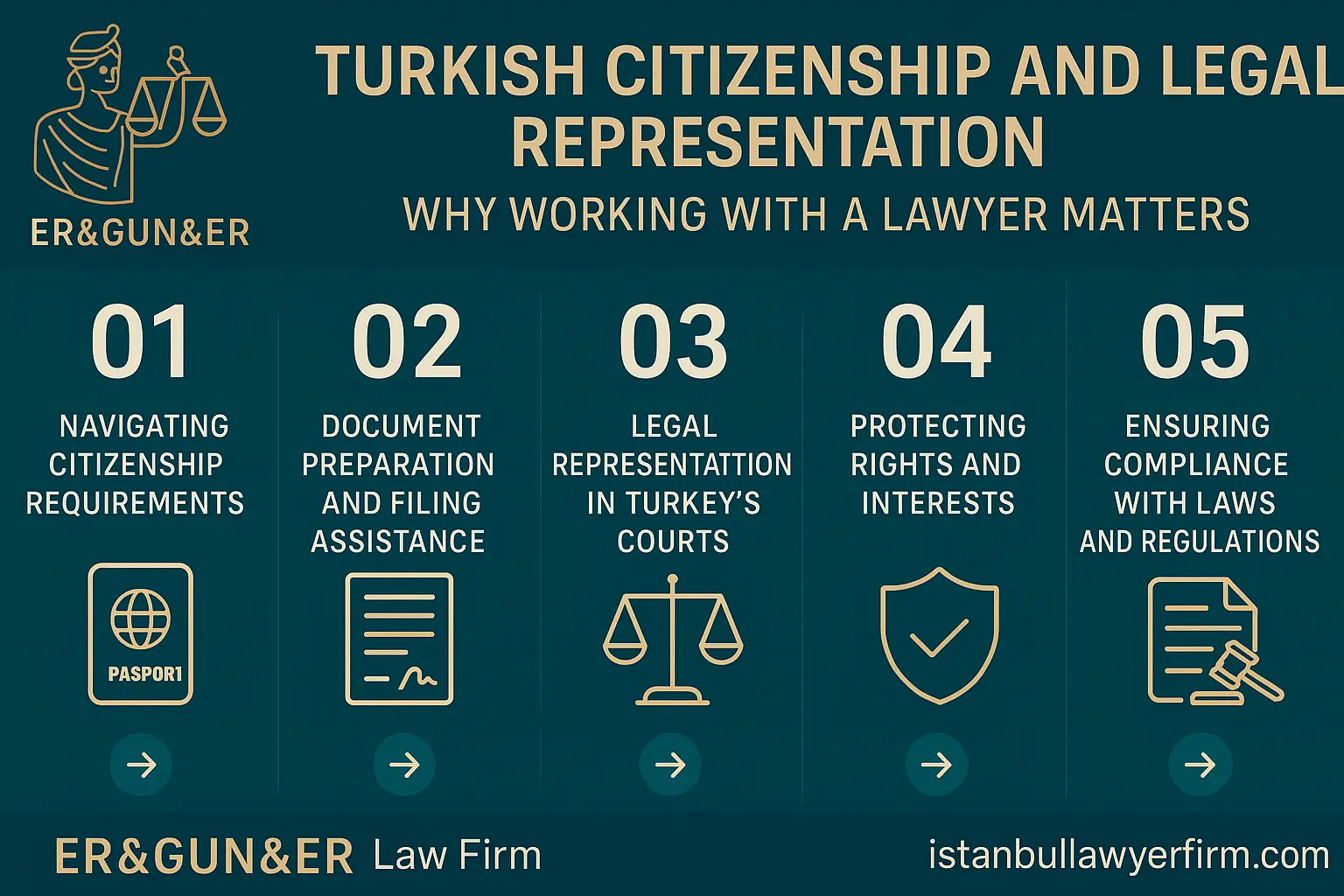
Turkish citizenship for foreign nationals can be acquired through five distinct statutory pathways under Türk Vatandaşlığı Kanunu (Law No. 5901, "TVK") framework, each with its own substantive eligibility tests, documentary requirements, ministerial interfaces, and timing patterns. Counsel selection and engagement structure should reflect the specific pathway analysis rather than treating "Turkish citizenship" as a single procedural matter handled the same way across all routes. The qualifying pathway determines which Turkish institution holds primary review authority, what evidentiary record the file must construct, what foreign-jurisdiction coordination is required, and what remedies are available where the application encounters obstacles.
The five pathways are: ordinary naturalisation under TVK Article 11 framework (five-year continuous residence with Turkish-language capacity, intent to settle, and supporting conditions); descent under TVK Article 7 (citizenship through Turkish-citizen parent, with sub-rules for marital and non-marital children); marriage under TVK Article 16 (three-year valid marriage to a Turkish citizen with substantive marital community); exceptional merit under TVK Article 12 sub-paragraph (a) (extraordinary scientific, technological, economic, social, sporting, cultural, or artistic contribution, plus the industrial plant establishment alternative); and exceptional naturalisation through investment under TVK Article 12 sub-paragraph (b) with implementing regulation Cumhurbaşkanı Kararı No. 5042 (commonly known as CBI). A re-acquisition pathway under TVK Article 13 is available for former Turkish citizens seeking to recover the citizenship they previously held.
This guide addresses the counsel role across these pathways rather than the operational mechanics of any single one, which our companion guides on investment-based citizenship, investment rejection risks, and investment pitfalls and appeals address pathway-specifically. The framing here is service-side: where does counsel add value, what does counsel do that self-filing or unlicensed intermediary handling does not produce, and how does counsel coordinate the multi-institutional, multi-jurisdictional, multi-stage engagement that any successful Turkish citizenship file requires.
The Pathway Architecture: TVK 5901 Naturalisation Routes
Pathway selection is the first substantive analytical task in any Turkish citizenship engagement. The pathways are not interchangeable — each has distinct eligibility tests, documentary requirements, processing timelines, and outcome probabilities. A Turkish Law Firm experienced in citizenship work begins every engagement by analysing the applicant's profile against the five available pathways and identifying which is the appropriate route, recognising that some applicants qualify for multiple pathways and the strategic question becomes which pathway optimises across timing, probability, family inclusion scope, and post-grant compliance picture.
Ordinary naturalisation under TVK Article 11 is the standard pathway with the broadest substantive scope. The qualifying conditions include: legal capacity under the applicant's national law and under Turkish law; continuous residence in Türkiye for five years preceding the application without interruption exceeding the specified limits; intention to establish a settled life in Türkiye, evidenced through residence, employment, family connections, or property; sufficient knowledge of Turkish language for daily life communication; good moral character and absence of disqualifying criminal indicators; absence of public-health concerns; and adequate financial capacity to support oneself and dependents. The pathway routes through standard residence permit infrastructure, with the citizenship application following completion of the qualifying residence period.
Descent under TVK Article 7 produces citizenship through the Turkish-citizen parent rather than through naturalisation. Article 7/1 provides that a child born to a Turkish-citizen mother or to a Turkish-citizen father where soybağı (legal parent-child relationship) is established acquires Turkish citizenship by birth. For non-marital paternal-line cases, Article 7/2 makes the citizenship conditional on soybağı establishment through tanıma (paternity acknowledgment under TMK Article 295), babalık davası (paternity action under TMK Article 301), or equivalent foreign-state legal recognition. The pathway is operationally distinct from naturalisation — for adult applicants whose parent's Turkish citizenship was not registered at birth, descent typically operates through registration rather than fresh application.
Marriage under TVK Article 16 covers foreign nationals married to Turkish citizens, with citizenship available after three years of valid marriage where the marital community subsists. The qualifying conditions include: the marriage's validity under both Turkish private international law (MÖHUK Law No. 5718 Article 13 framework for marriage formal validity) and the parties' applicable national law; substantive marital community rather than nominal marriage; absence of disqualifying conditions under TVK Article 11/8 framework. The substantive review at Vatandaşlık Daireleri tests whether the marital community is genuine — files where the marriage circumstances suggest non-substantive structuring face deeper review.
Exceptional merit under TVK Article 12 sub-paragraph (a) covers foreign nationals whose extraordinary contribution to Türkiye in scientific, technological, economic, social, sporting, cultural, or artistic fields supports exceptional naturalisation, plus those who bring industrial plants to Türkiye. The pathway is discretionary, requires sponsoring ministry recommendation, and operates without numerical thresholds. Our companion exceptional merit guide addresses the operational mechanics for athletes, founders, and strategic investors using this route.
Investment under TVK Article 12 sub-paragraph (b) covers foreign nationals satisfying the investment thresholds in Cumhurbaşkanı Kararı No. 5042 — currently USD 400,000 real estate or USD 500,000 alternatives across fixed capital, government bonds, mutual or venture capital fund participation, bank deposit, private pension fund, or 50-employee SGK-registered employment. The pathway is threshold-driven rather than discretionary, with the qualifying decision turning largely on whether the investment satisfies the quantitative tests.
Re-acquisition under TVK Article 13 covers former Turkish citizens who previously held Turkish citizenship and seek to recover it. Article 14 sets the qualifying conditions, which are typically less demanding than fresh naturalisation given the prior citizenship history. The pathway interacts with TVK Article 28 Mavi Kart framework for those who lost citizenship through foreign naturalisation under prior framework rules.
For the full procedural framework on the qualifying investment routes and the institutional review architecture at the Vatandaşlık Daireleri, see our pillar guide on the investment-based citizenship pathway.
Eligibility Assessment: What Counsel Actually Examines
The eligibility assessment at engagement start is the analytical foundation that determines whether the engagement should proceed and which pathway optimises the applicant's position. Counsel performing the assessment looks beyond the surface eligibility test into substantive elements that affect the file's actual probability of success.
Identity and civil-status verification runs first. The applicant's documentary identity must be consistent across passport, foreign-state identity documents, foreign birth certificate, and any name-change documentation through marriage or court order. Discrepancies — different name spellings across documents, date-of-birth variations, parental-name inconsistencies — require remediation before the file can proceed. Counsel identifies these issues at engagement start rather than at filing when timing pressure complicates remediation.
Residence history analysis is critical for ordinary naturalisation under Article 11. The five-year continuous residence requirement is stricter than commonly understood — interruptions exceeding the specified limits during the qualifying period reset the clock. Counsel reviews the applicant's actual presence in Türkiye through residence permit history, entry-exit records under Pasaport Kanunu (Law No. 5682) and YUKK (Law No. 6458) frameworks, and supporting documentation establishing the qualifying continuous-residence pattern.
Marriage substantive analysis for Article 16 cases tests whether the marital community is genuine. The framework's substantive test under Article 16/1 requires the marriage to subsist in fact, not merely on paper. Recently celebrated marriages, marriages where the parties live separately without explained reason, or marriages where the qualifying period was technically met but the marital community broke down before application produce substantive review challenges. Counsel analyses the marital evidence honestly at engagement start to identify whether the substantive case supports filing.
Descent claim verification for Article 7 cases turns on the Turkish-citizen parent's status documentation, the parent-child relationship documentation, and any prior registration of the applicant's status in Turkish civil records. Many descent claims rest on parents whose Turkish citizenship was not maintained through the parent's life — through foreign naturalisation that produced citizenship loss under prior TVK 403 framework, or through documentary gaps that make the parent's Turkish citizenship hard to establish today. Counsel's analysis often reveals that the descent claim requires the parent's status to be reconstructed through Devlet Arşivleri Genel Müdürlüğü (State Archives General Directorate) Cumhuriyet Arşivi research before the descent application can proceed.
Investment-pathway eligibility for Article 12/b cases tests the substantive satisfaction of CK 5042 thresholds — USD 400,000 real estate value at SPK-licensed valuation, or USD 500,000 alternative-pathway investment with operational compliance. Counsel reviews the proposed investment for SPK valuation risk, source-of-funds documentary depth, country-eligibility under Cumhurbaşkanı Kararı No. 6302 framework, and pathway-specific operational requirements.
Exceptional merit eligibility for Article 12/a cases tests the substantive olağanüstü hizmet (extraordinary service) standard against the applicant's documented contribution. Counsel's honest probability assessment matters most heavily on this pathway — files where the contribution is strong but does not clearly cross the "extraordinary" threshold produce frustration that engagement structure should address through honest conversation rather than optimistic filing.
Foreign-jurisdiction coordination identification runs across all pathways. The applicant's home jurisdiction's rules on dual nationality, the applicant's home-country tax position, the applicant's foreign asset structures, and any foreign legal proceedings affecting the applicant all interact with the Turkish citizenship engagement. Counsel identifies these coordination points at engagement start to plan integrated handling rather than discover them mid-engagement.
File Construction and the Application Filing Process
The application file at the Vatandaşlık Daireleri (Citizenship Departments) within Genel Müdürlüğü Nüfus ve Vatandaşlık İşleri (Directorate General of Population and Citizenship Affairs) carries weight proportional to the documentary discipline applied at construction. Files arriving in coherent, indexed, bilingually consistent form receive substantively easier review than files where the case officer must reconstruct the substantive case from disorganised exhibits.
The foundational documentary layer establishes identity and civil status. Passport with full Turkish translation of relevant pages where the passport is not in Latin alphabet, foreign-state identity documents, apostilled or consularly-legalised foreign birth certificate establishing personal details, marriage certificate where applicable, and police clearance documentation from jurisdictions of significant residence. Each foundational document requires authentication under either 1961 Hague Apostille framework (Türkiye party through Law No. 6303 since 1985, with recent additions UAE 2022, Canada 2024, Qatar 2024) or consular legalisation for documents from non-party jurisdictions, plus sworn translation by yeminli tercüman registered with the relevant noter under HMK (Law No. 6100) Article 223 framework.
The substantive pathway-specific layer addresses the qualifying conditions of the chosen pathway. Ordinary naturalisation files include residence permit history, Turkish-language capacity evidence, employment or financial-capacity documentation, and intention-to-settle evidence. Marriage files include marriage certificate, marital community documentation through joint financial records or family-life evidence, and address documentation establishing cohabitation. Descent files include parental documentation establishing Turkish citizenship status, soybağı evidence for non-marital cases, and any prior registration documentation. Investment files include the investment documentation, valuation reports, payment evidence including DAB under Decree 32 framework, and source-of-funds documentation under MASAK Law No. 5549 framework. Exceptional merit files include sponsoring-ministry recommendation, third-party validation through federation, university, or chamber endorsements, and substantive contribution documentation.
The Turkish-side documentation establishes the applicant's current Turkish position. Residence permit during the application processing period (or qualifying residence-permit history for ordinary naturalisation), tax identification number issuance through the relevant Vergi Dairesi, address registration through e-Devlet system or relevant nüfus office, and where applicable Turkish bank account documentation establishing the financial-capacity element.
The application forms themselves require completion in Turkish with applicant or counsel signature. Power of attorney for counsel handling the file is executed under proper authentication framework — powers executed abroad require Hague Apostille or consular legalisation, sworn Turkish translation, and registration at a Turkish noter for Turkish use, with specific authorisation for the substantive actions counsel will take. The power must specifically authorise citizenship application filing, document collection, and ministry coordination rather than generic authority that may be insufficient for specific operational steps.
Filing through the Vatandaşlık Daireleri runs at the relevant office with jurisdiction over the applicant's residence or, for non-resident filings under specific pathways, the centralised processing framework. The filing produces an application reference number that tracks the file through the review process. Files filed without counsel handling sometimes face access barriers at later stages — case officers prefer to communicate with registered counsel rather than directly with applicants on technical matters.
Processing stages run in sequence. Preliminary review at the Vatandaşlık Daireleri checks file completeness; substantive review evaluates the merits of the case against the relevant pathway's framework; additional information requests where they arise are addressed within specified deadlines; Ministry of Interior coordination produces the recommendation document; Cumhurbaşkanı Kararı decision and Resmi Gazete publication formalise the grant. The standard timeline runs 6-12 months for clean files and may extend toward 18-24 months for files with substantive complexity.
Self-Filing Risks and Database Reconciliation
Foreign applicants attempting to file Turkish citizenship applications without legal representation often encounter avoidable errors that translate into rejection, file return for completion, or extended processing. The risks concentrate in several areas where the institutional knowledge gap between professional counsel and self-filing applicants matters most.
Database reconciliation across Turkish institutional systems is one of the dominant self-filing risks. The applicant's data must align across MERNIS (Merkezi Nüfus İdaresi Sistemi — Central Population Administration System database), Göç İdaresi Genel Müdürlüğü (Directorate General of Migration Management) records for residence permit history, Tapu ve Kadastro Genel Müdürlüğü records for property ownership where relevant, Gelir İdaresi Başkanlığı (Revenue Administration) tax identification records, and SGK records for employment-based pathways. Inconsistencies across these systems — different name spellings, different date-of-birth recordings, different address registrations — produce data-mismatch issues that delay processing.
The institutional logic is that each Turkish system has its own data-entry protocol applied at the time the applicant entered that system, and historical entries may reflect different transliterations of the applicant's foreign name, different administrative interpretations of family structure, or different recording of address details. Self-filing applicants typically discover these inconsistencies only when the citizenship review process surfaces them; counsel-handled files address the inconsistencies before they become processing obstacles through pre-filing database reconciliation.
Translation and authentication errors are another dominant self-filing risk. Translations performed by non-registered translators, translations lacking proper certification, translations with format errors that do not match the Turkish framework's expectations, all produce return for proper translation. Apostille errors — documents authenticated incorrectly, documents from non-party jurisdictions submitted with apostille rather than consular legalisation, documents whose apostille is on the document copy rather than the original — produce similar return cycles.
Document currency tracking is operationally simple but commonly mishandled by self-filers. Police clearance certificates with currency requirements (typically six-month windows from issuance), passport pages that expire during processing, and similar time-bounded documents require renewal during the engagement when the original document ages out. Files where the documents were current at original filing but aged out during processing without supplementation face return for fresh documentation.
Pathway-selection errors in self-filed applications arise where the applicant qualifies for one pathway but files under another. Marriage-pathway applicants who file ordinary naturalisation framework face delay; ordinary-naturalisation applicants who file marriage framework face substantive review under the wrong test. Descent claimants who file naturalisation rather than registration produce procedural mismatches. Counsel's pathway analysis at engagement start prevents the framework-mismatch errors that compound through processing.
Unlicensed intermediary handling produces particular risks. Real estate agents, immigration consultants, and other non-attorney intermediaries lack the institutional standing to file citizenship applications, communicate with case officers on substantive matters, or appear at Vatandaşlık Daireleri proceedings. Files handled through unlicensed intermediaries often need to be reconstructed through proper counsel after self-filing or intermediary-filing has produced procedural issues. The institutional discipline of using a licensed Istanbul Law Firm or other Turkish Law Firm with citizenship-pathway experience prevents this category of risk entirely.
Vatandaşlık Daireleri Coordination and Interview Preparation
Files in active processing benefit substantially from professional coordination with Vatandaşlık Daireleri case officers. The institutional culture rewards careful follow-through; cases where counsel maintains professional relationship with the assigned case officer process more smoothly than cases without such coordination.
Routine follow-up runs at appropriate intervals — too aggressive produces institutional pushback; too passive produces drift in queue position. Professional follow-up typically operates through periodic written inquiries seeking status confirmation, addressing specific identified issues, and providing supplementary documentation where the case officer has signaled need. Counsel access to the institutional system through licensed-counsel framework allows status inquiries that self-filing applicants cannot make directly.
Additional information requests at substantive review require precise response within specified deadlines. The case officer's request typically identifies specific issues — documentary gaps, substantive questions on the qualifying case, clarifications on inconsistencies. Response that addresses the specific issues fully, with supporting documentation where applicable, allows the file to proceed. Response that is incomplete, that addresses different issues than the request raised, or that lacks supporting evidence produces additional information cycles that extend timing. Counsel's professional discipline in drafting responses to specific case officer concerns is operational standard practice.
Interview preparation matters for pathways where personal interview is part of the substantive review framework. Marriage-pathway applications under TVK Article 16 typically include interview component testing the substantive marital community. Ordinary naturalisation under Article 11 may include interview component testing Turkish-language capacity and intention to settle. Descent claims with documentary complexity may produce interview as part of the substantive evaluation. Counsel preparation for interview typically includes review of the file with the applicant, anticipated questions based on the pathway and case officer's identified concerns, and procedural briefing on interview format.
Marriage interview preparation specifically benefits from careful coordination. The interview tests substantive marital community through questions about daily life, joint decision-making, family routines, and the parties' knowledge of each other's lives. Couples who have lived together substantively answer such questions easily; couples whose marriage is technically valid but operationally distant produce concerning answer patterns. Counsel preparation honestly assesses the substantive marital pattern and prepares the applicant for the substantive analysis the interview will produce.
Joint interviews with both spouses may occur in marriage-pathway cases. The framework tests consistency between the parties' answers to questions about shared life. Pre-interview preparation that produces forced consistency reads to experienced case officers as preparation rather than substantive marital community; preparation that focuses on the parties' authentic shared knowledge produces interviews that demonstrate substantive marriage.
Post-interview follow-up addresses any specific issues the interview surfaced. Where the interviewer identified concerns or signaled need for additional documentation, counsel coordination ensures the response is timely and substantively responsive. Files where post-interview follow-up is handled professionally maintain forward momentum; files where post-interview drift occurs face delays that compound through subsequent stages.
Court Representation: Administrative Appeals Under IYUK
Where the citizenship application receives an adverse decision, the administrative appeal framework under İdari Yargılama Usulü Kanunu (Law No. 2577, "IYUK") provides the formal challenge mechanism. The 60-day window from notification of the rejection decision under IYUK Article 7/1 framework establishes the jurisdictional limit for filing administrative-court (idare mahkemesi) lawsuit. Appeals filed after the window face dismissal as time-barred regardless of substantive merits.
Notification timing under Tebligat Kanunu (Law No. 7201) framework determines the appeal-window calculation. The notification date is when the rejection decision is properly served on the applicant under the framework's specific service rules, not when the applicant first becomes aware of the decision. Calculating the appeal window precisely matters; mistakes on notification date can produce either premature filings (technically defective) or late filings (jurisdictionally barred).
The administrative-court lawsuit is filed through the relevant idare mahkemesi with jurisdiction over the decision-maker. Citizenship rejections by Cumhurbaşkanlığı route through Ankara administrative courts generally; specific jurisdictional rules apply to other administrative actors. The lawsuit names the decision-making authority as defendant, identifies the challenged decision, and presents the substantive and procedural grounds for the challenge. The case proceeds through written submissions, possible expert opinions where complex factual or technical questions are involved, and judicial decision typically within 12-24 months at first instance.
The administrative court's review focuses on procedural regularity and reasoned decision-making rather than de novo merits review of the discretionary citizenship decision. Courts evaluate whether the decision-maker followed proper procedure under TVK 5901 and the implementing framework, considered material evidence the file presented, applied the correct legal framework, and produced reasoning that engages with the substantive case. Successful judicial review typically rests on procedural defects identifiable through the rejection's reasoning rather than substantive disagreement with the decision-maker's discretionary analysis.
Interim relief under IYUK Article 27 framework — yürütmenin durdurulması (stay of execution) — is available where the underlying rejection produces immediate harm that judicial decision cannot adequately remedy at final judgment. The administrative court grants interim relief based on apparent illegality of the challenged decision and irreparability of harm absent the relief. Interim relief is operationally meaningful where the rejection affects ongoing residence permits, business operations, or family stability that final judgment timing cannot protect.
Outcomes of successful judicial review include several categories. Annulment with remand returns the file to the decision-maker for reconsideration on a corrected procedural basis — this is the most common successful outcome. Annulment with direct grant produces the citizenship grant directly through court order — this is rare. Partial annulment addresses specific defects while leaving other elements intact in some cases. Appellate review through Danıştay (Council of State) is available from idare mahkemesi decisions; appellate timeline extends another 12-24 months.
Strategic positioning between resubmission and judicial review depends on the rejection grounds. Substantive deficiencies that can be remedied through enhanced evidence are typically better addressed through resubmission rather than judicial review. Procedural defects in the rejection decision itself are appropriate for judicial review where the underlying substantive case is sound. Counsel's strategic analysis at the rejection stage walks the applicant through the comparative analysis rather than reflexively defaulting to one path.
Power of Attorney and Remote Representation
Many Turkish citizenship applicants are not resident in Türkiye during the engagement and need remote representation for substantive aspects of the file's handling. Power of attorney to Turkish counsel allows the file to proceed without continuous applicant presence in Türkiye, with applicant visits limited to specific procedural elements that require physical presence.
Power of attorney execution requires specific formalities. Powers executed in Türkiye are produced at a Turkish noter under Noterlik Kanunu (Law No. 1512) framework with the applicant present for authentication. Powers executed abroad require execution at a Turkish consulate (which produces a noter-equivalent authentication directly) or execution at a foreign notary with subsequent Hague Apostille authentication, sworn Turkish translation, and registration at a Turkish noter for Turkish use. The Turkish consulate route is operationally simpler where consulate access is available; the foreign-notary plus apostille route is the standard alternative.
The substantive scope of the power matters operationally. Powers must specifically authorise the actions counsel will take — citizenship application filing, document collection from foreign and Turkish institutions, banking transactions where applicable, communication with Vatandaşlık Daireleri and Ministry of Interior, signature on substantive procedural documents. Generic powers of attorney that authorise "all legal matters" may be insufficient for specific institutional acceptances; specific enumeration of citizenship-related authorities prevents power-scope objections at later stages.
The power's duration should cover the full expected engagement. Powers with short duration that expire mid-engagement require renewal that can produce procedural complications. The standard practice is to execute powers with duration of two to three years, covering the expected engagement period plus margin for any extensions through resubmission or judicial review.
Specific procedural elements that typically require applicant physical presence include biometrics collection at residence permit application or specific Vatandaşlık Daireleri verification points, occasional in-person interview elements depending on pathway and case officer determination, and final passport issuance at the relevant nüfus office or consular office. The applicant's Türkiye visit timing is planned around these elements rather than the full file processing.
Remote representation through counsel produces operational efficiency but does not eliminate the applicant's substantive engagement with the file. Decision points throughout the engagement — pathway selection, document approach for specific issues, response to additional information requests, strategic decisions on rejection or appeal — require the applicant's substantive input. Counsel's role is to handle the operational execution and to surface decision points appropriately, not to make substantive decisions on the applicant's behalf.
Communication discipline through the engagement involves regular written updates, specific decision-point notification, and document-status reporting. The applicant's engagement with the file remains substantive even through power-of-attorney handling; the physical presence question is operationally distinct from the substantive engagement question.
Investment Pathway: Counsel Role Beyond Documentation
The investment pathway under TVK Article 12/b carries documentary and operational complexity that benefits particularly from professional counsel. Our companion guides address the investment pathway operational mechanics in detail; this section addresses where counsel adds value beyond documentation in the investment context.
Pathway selection within the six investment alternatives — USD 400,000 real estate, USD 500,000 fixed capital, USD 500,000 government bonds, USD 500,000 mutual fund or venture capital fund, USD 500,000 bank deposit, USD 500,000 private pension fund, or 50-employee employment — should reflect the investor's risk profile, time horizon, connection-to-Türkiye objectives, and post-grant compliance preferences. Counsel walks the investor through the comparative analysis rather than defaulting to real estate as the marketing-default option.
SPK valuation coordination for real estate pathway investors involves selecting the licensed valuation firm, reviewing the valuation methodology relative to comparable transactions, and managing valuation timing relative to contract execution. Pre-contract SPK valuation as contingency on properties at marginal threshold positions prevents the post-contract valuation-failure scenarios. Threshold-margin maintenance — typically USD 430,000 to USD 450,000 minimum contract price for properties whose underlying market value approaches the threshold — is operational discipline rather than excess investment.
Source-of-funds file pre-assembly under MASAK Law No. 5549 framework runs in parallel with property selection or alternative-pathway structuring. The documentary file is constructed before the funds movement to Türkiye, with pre-clearance at the receiving Turkish bank to identify documentary gaps before the wire. The pre-clearance protocol involves the bank's compliance team reviewing the source-of-funds documentation, identifying specific concerns, and confirming the file's adequacy before the transaction proceeds.
Tapu sicili şerh annotation supervision at title transfer ensures the three-year non-disposal restriction is entered with correct wording, correct duration, and correct Cumhurbaşkanı Kararı reference. Counsel attendance at the Tapu Sicil Müdürlüğü during the transfer and immediate post-transfer title deed review confirm the annotation before the parties leave the office. This discipline prevents the post-grant discovery of annotation defects that produce title-correction proceedings under Tapu Kanunu (Law No. 2644) Article 1027 framework.
Property history due diligence through Tapu Kayıt Örneği with full transfer history identifies recycled-CBI-property risks before commitment. Properties with active CBI annotations within the three-year holding period from prior grants cannot independently support fresh CBI applications. Properties whose CBI annotation has lapsed may face history-related substantive scrutiny depending on the transfer pattern.
Country-eligibility analysis under Cumhurbaşkanı Kararı No. 6302 framework identifies whether the investor's nationality faces restrictions including total prohibitions, area limits per province, or special-zone exclusions. Most major investor nationalities are eligible without restriction, but specific country combinations face restrictions that pre-engagement analysis identifies.
Three-year post-grant compliance management runs through the holding period for whichever investment pathway the investor selected. Real estate pathway compliance involves the tapu sicili şerh restriction; alternative-pathway compliance involves the qualifying investment maintenance through the holding period. Counsel coordination during the holding period ensures compliance issues do not produce citizenship-status questions even after grant.
Post-Grant Integration: Civil Registration and Family Inclusion
Citizenship grant through Cumhurbaşkanı Kararı and Resmi Gazete publication is the operational milestone but produces a series of post-grant administrative integration steps that the new Turkish citizen must navigate. Counsel coordination through these steps produces clean administrative integration rather than the documentary inconsistencies that can complicate later interactions.
Civil registration through nüfus kaydı at the relevant nüfus müdürlüğü integrates the new citizen into MERNIS with full personal data including name, date and place of birth, parental information, and address. The nüfus kaydı entry produces TC Kimlik Numarası (Turkish Republic Identity Number) — the eleven-digit identifier that operates as the universal Turkish administrative identifier across all institutional interactions. The TC Kimlik Numarası issuance triggers downstream system integrations across tax, banking, healthcare, and other systems.
Name spelling decisions under Alfabe Kanunu (Law No. 1353) require committed transliteration choices for foreign names. The Turkish alphabet does not include Q, W, or X, and certain diacritical combinations specific to other languages do not have direct Turkish equivalents. The transliteration choice committed at registration applies across all subsequent administrative interactions. Where the applicant's professional or brand identity uses original Latin-alphabet spelling, the dual-form strategy maintains the original name for international purposes alongside the Turkish transliteration for Turkish official purposes.
Passport application through the relevant nüfus office or e-Devlet system completes the standard documentary integration. Turkish passports issue with five-year or ten-year validity depending on age and other factors; passport collection requires applicant presence at the relevant office. For applicants residing abroad, consular passport application through Turkish embassy or consulate is the operational alternative.
Family inclusion administrative steps follow the principal grant where family members were included. Spouse, minor children, and dependent disabled children each receive their own civil registration, TC Kimlik Numarası, and passport documentation. The integration runs in parallel with the principal's integration but requires its own administrative attention rather than automatic flow-through.
Tax identification update through Vergi Dairesi runs where the applicant previously held foreign-national tax identification. The post-grant tax identification reflects the Turkish citizenship status, with implications for future Turkish tax filings and reporting. Tax residency under GVK (Income Tax Law No. 193) Article 4 framework remains determined by physical presence and domicile rather than citizenship — the citizenship grant does not automatically establish Turkish tax residency.
Banking integration runs across Turkish bank accounts where the applicant holds accounts. The accounts' KYC information is updated to reflect the Turkish citizenship status, with FATCA and CRS reporting implications adjusting based on the applicant's overall citizenship and tax-residency profile. US-citizen applicants who acquire Turkish citizenship continue to face FATCA reporting through their Turkish banks; CRS reporting follows tax residency rather than citizenship.
Address registration maintenance through e-Devlet system or relevant nüfus office records ensures the registered address corresponds to documented presence. Address changes during the post-grant period require timely registration update; gaps can produce administrative cleanup requirements at later interactions.
Dual Nationality Coordination Across Foreign Jurisdictions
Türkiye permits dual nationality without restriction. The Turkish framework does not require renunciation of the applicant's existing nationalities, does not impose disclosure obligations to foreign authorities of the Turkish citizenship grant, and treats the new citizen as a Turkish citizen for Turkish-law purposes regardless of other nationalities held. The complication runs entirely on the foreign-jurisdiction side, where the applicant's home country's rules govern whether the Turkish citizenship can be retained alongside, requires disclosure, or triggers loss-of-nationality consequences.
Austria has historically maintained a strict prohibition on dual nationality with narrow exceptions. Austrian citizens who acquire foreign nationality without prior Austrian government authorisation under Section 27 of the Austrian Nationality Act framework lose Austrian citizenship automatically. Austrian applicants pursuing Turkish citizenship through any pathway need home-side analysis through Austrian counsel — typically before initiating the Turkish file — and may need to either obtain prior authorisation (rare and case-specific), accept Austrian citizenship loss, or restructure the engagement around the Austrian framework.
Germany underwent substantial reform with the Staatsangehörigkeitsrechtsreformgesetz which took effect in June 2024, broadly permitting dual nationality where it had previously been restricted. German citizens acquiring Turkish citizenship after the reform's effective date generally retain German citizenship without the prior renunciation requirement that previously applied. The Turkish-German bilateral context is particularly relevant given the substantial German-Turkish population — the reform has been transformative for German-Turkish dual nationality arrangements.
The Netherlands maintains restrictions on dual nationality with specific exceptions, including for spouses of Dutch citizens and for persons born with multiple nationalities. Dutch citizens acquiring Turkish citizenship through naturalisation typically lose Dutch citizenship under Article 15 of the Dutch Nationality Act, with exceptions applying only in limited scenarios. Dutch applicants pursuing Turkish citizenship need careful Dutch-side analysis through Dutch counsel — the loss of Dutch citizenship may be unintended where the applicant's primary identity remains Dutch.
Japan requires Japanese citizens with foreign nationality to choose between nationalities by age twenty-two under Article 14 of the Japanese Nationality Act, with foreign-nationality acquisition by adult Japanese citizens producing automatic loss of Japanese citizenship under Article 11. The framework is enforced inconsistently in practice but the legal position is clear.
The United States permits dual nationality but imposes ongoing tax and FBAR reporting obligations regardless of where the citizen resides. US citizens who acquire Turkish citizenship retain US citizenship and remain subject to US worldwide income taxation, FBAR reporting on foreign financial accounts (including Turkish bank accounts where aggregate exceeds USD 10,000 at any point in the year), and FATCA reporting through their Turkish banks. The dual-nationality status is operationally permissive but produces meaningful ongoing US compliance obligations.
The United Kingdom permits dual nationality without restriction. UK citizens acquiring Turkish citizenship retain UK citizenship without disclosure or renunciation obligations on the UK side.
Iran has historically not recognised dual nationality and treats Iranian citizens with foreign citizenship as Iranian citizens for Iranian-law purposes. The Iran-Türkiye context produces specific complications particularly around Iranian-side reporting and travel obligations.
Saudi Arabia and the United Arab Emirates have specific dual-nationality frameworks with home-country authorisation requirements for foreign-citizenship acquisition by Saudi or Emirati citizens. Applicants from these jurisdictions need home-side analysis before pursuing Turkish citizenship.
The general principle is that Turkish citizenship grant on the Turkish side does not produce dual-nationality complications, but the foreign-jurisdiction's framework determines whether the new Turkish citizenship can be acquired without losing existing citizenship. Honest counsel raises this analysis at engagement start; intermediaries that do not raise it leave the applicant exposed to outcomes the applicant did not intend. A Turkish Law Firm coordinating with foreign counsel in the applicant's home jurisdiction produces integrated analysis rather than Turkish-only handling that misses critical foreign-side considerations.
Frequently Asked Questions
- What are the five citizenship pathways under TVK 5901? Ordinary naturalisation under Article 11 (five-year residence with Turkish-language capacity, intention to settle, and supporting conditions); descent under Article 7 (citizenship through Turkish-citizen parent); marriage under Article 16 (three-year valid marriage to Turkish citizen with substantive marital community); exceptional merit under Article 12/a (extraordinary contribution in scientific, technological, economic, social, sporting, cultural, or artistic fields, plus industrial plant establishment); and investment under Article 12/b with CK 5042 implementing regulation. Re-acquisition under Article 13 is available for former Turkish citizens.
- Can I apply for Turkish citizenship without being in Turkey? Yes for several pathways through power of attorney to Turkish counsel. Specific procedural elements typically require physical presence — biometrics collection, occasional interview elements, final passport issuance — but the substantive file handling can proceed remotely. The standard practice is to plan applicant Türkiye visits around these specific elements rather than continuous presence.
- Is Turkish language required for citizenship? Required for ordinary naturalisation under Article 11 framework, where sufficient Turkish for daily-life communication is part of the qualifying conditions. Not required as a substantive condition for marriage pathway under Article 16, descent pathway under Article 7, exceptional merit under Article 12/a, investment under Article 12/b, or re-acquisition under Article 13.
- Do I need to give up my original citizenship? Not on the Turkish side — Türkiye permits dual nationality without restriction. Whether the Turkish citizenship can be retained alongside existing citizenship depends on the home jurisdiction's rules: Austria, Netherlands in many scenarios, Japan, Iran, Saudi Arabia, and similar restrictive frameworks require home-side analysis. Germany after June 2024 reform broadly permits dual nationality. The United States and United Kingdom permit dual nationality without restriction.
- How long does the citizenship application take? Standard timeline runs 6-12 months from filing to grant for clean files. Files with documentary issues, additional information requests, complex source-of-funds, or unusual family structures extend toward 18-24 months. Resubmission after rejection extends timeline meaningfully. Administrative appeal through judicial review can extend three to four years from initial rejection through final appellate decision.
- What is power of attorney and how does it work? Authorisation from the applicant to Turkish counsel allowing counsel to handle substantive aspects of the file remotely. Powers executed at Turkish noter under Noterlik Kanunu (Law No. 1512) framework or at Turkish consulate, or executed at foreign notary with subsequent Hague Apostille and registration at Turkish noter. The power must specifically authorise citizenship application filing, document collection, banking transactions where applicable, and ministry coordination.
- Can I include my spouse and children in one application? Yes for several pathways. Investment pathway under Article 12/b includes spouse, minor children under eighteen, and dependent disabled children regardless of age. Exceptional merit under Article 12/a similarly includes core family. Marriage pathway under Article 16 covers the foreign spouse. Descent pathway under Article 7 covers the descended individual. Adult children, parents, siblings, and other extended family pursue separate pathways.
- What if my application is rejected? Two pathways: resubmission with strengthened evidence addressing the original rejection grounds, or administrative appeal through idare mahkemesi at first instance under İdari Yargılama Usulü Kanunu (Law No. 2577) Article 7/1 60-day window framework. Resubmission typically suits substantive deficiencies; judicial review typically suits procedural defects in the rejection decision.
- How does name spelling work for foreign names? Alfabe Kanunu (Law No. 1353) governs transliteration into the Turkish alphabet, which does not include Q, W, or X. The transliteration choice is committed at registration and applied consistently across all parallel administrative integrations (banking, tax, registry). Where professional or brand identity uses original Latin-alphabet spelling, dual-form strategy maintains the original name for international purposes alongside Turkish transliteration for Turkish official purposes.
- Will I become a Turkish tax resident automatically? No. Tax residency under Income Tax Law (GVK, Law No. 193) Article 4 framework is determined by physical presence over six months in a calendar year or domicile under TMK Article 19, not by citizenship. Citizenship grant does not automatically establish Turkish tax residency.
- Are there military service implications? Askerlik Kanunu (Law No. 1111) applies to male Turkish citizens regardless of how citizenship was acquired. Male applicants under conscription age and male children included in family inclusion below conscription age acquire the obligation. Döviz karşılığı askerlik (paid military service) framework allows discharge through fee payment and shortened service for foreign-resident males.
- What happens after citizenship is granted? Civil registration through nüfus kaydı integrates the new citizen into MERNIS with TC Kimlik Numarası issuance; passport application follows; tax identification update reflects the new status; banking integration adjusts KYC and reporting profiles; family member integration runs in parallel where included. The post-grant administrative integration typically runs 1-3 months from formal grant.
- What if I'm a former Turkish citizen? Re-acquisition pathway under TVK Article 13 with conditions in Article 14 covers former Turkish citizens seeking to recover citizenship. The qualifying conditions are typically less demanding than fresh naturalisation. Mavi Kart status under TVK Article 28 is available for those who lost citizenship through prior framework rules, preserving real estate ownership, inheritance, and residence-without-permit rights without continuing the citizenship.
- What does counsel actually do beyond document handling? Pathway selection analysis at engagement start; eligibility verification across identity, residence, marital, descent, investment, or merit elements; database reconciliation across MERNIS, Göç İdaresi records, Tapu records, tax identification records; document authentication coordination through Hague Apostille or consular legalisation; sworn translation through HMK Article 223 framework; Vatandaşlık Daireleri filing and case officer coordination; interview preparation for pathway-relevant cases; additional information request response coordination; rejection analysis with resubmission or judicial review strategic positioning; post-grant administrative integration; dual-nationality coordination with home-jurisdiction counsel; family inclusion coordination including foreign-parent consent for minor children.
- Where does ER&GUN&ER Law Firm support citizenship engagements? As a Turkish Law Firm experienced in cross-border citizenship work, support across all five TVK 5901 pathways — ordinary naturalisation under Article 11, descent under Article 7 with TMK 4721 soybağı framework analysis, marriage under Article 16 with MÖHUK Article 13 marriage validity analysis, exceptional merit under Article 12/a with sponsoring ministry coordination, investment under Article 12/b with CK 5042 framework — plus re-acquisition under Article 13; pre-engagement substantive analysis with honest probability assessment; identity and civil-status verification with Hague Apostille (Türkiye party through Law No. 6303 since 1985 with recent additions UAE 2022, Canada 2024, Qatar 2024) and HMK Article 223 sworn translation; database reconciliation across MERNIS, Göç İdaresi, Tapu, tax, and SGK records; pathway-specific file construction including residence permit history and Turkish-language documentation for ordinary naturalisation, marriage validity and substantive marital community evidence for marriage pathway, soybağı and parental status documentation for descent pathway, sponsoring ministry coordination and federation/university/chamber endorsements for exceptional merit, SPK valuation and source-of-funds documentation for investment pathway; power of attorney execution at Turkish noter or consulate or through foreign-notary plus Apostille route under Noterlik Kanunu (Law No. 1512) and Türk Borçlar Kanunu (Law No. 6098) Articles 504-514 framework; Vatandaşlık Daireleri filing and case officer coordination; interview preparation for marriage and ordinary naturalisation pathways with substantive marital community and Turkish-language readiness analysis; additional information request response coordination; administrative appeal through idare mahkemesi at first instance under İdari Yargılama Usulü Kanunu (Law No. 2577) Article 7/1 60-day window framework with Tebligat Kanunu (Law No. 7201) notification analysis and IYUK Article 27 yürütmenin durdurulması interim relief framework; appellate review through Danıştay; resubmission strategy with strengthened evidence addressing original rejection grounds; post-grant administrative integration including nüfus kaydı, TC Kimlik Numarası issuance, passport application, name spelling under Alfabe Kanunu (Law No. 1353), banking and tax-identification integration, family member parallel integration; dual nationality coordination including Austrian Nationality Act Section 27 strict prohibition, German Staatsangehörigkeitsrechtsreformgesetz June 2024 reform, Dutch Nationality Act Article 15 restriction, Japanese Nationality Act Articles 14 and 11 choice-of-nationality framework, USA dual-permitted with FATCA and FBAR ongoing reporting, UK dual-permitted, Iran non-recognition, Saudi Arabia and UAE home-side authorisation; tax residency analysis under GVK Article 4 framework; military service framework under Askerlik Kanunu (Law No. 1111) including döviz karşılığı askerlik; Mavi Kart positioning under TVK Article 28; inheritance positioning under TMK Articles 495-682 with saklı pay analysis under Articles 506-507 and MÖHUK Article 20 cross-border coordination; integrated multi-generational planning across the entire citizenship lifecycle from initial pathway analysis through post-grant integration and ongoing compliance.
Author: Mirkan Topcu is an attorney registered with the Istanbul Bar Association (Istanbul 1st Bar), Bar Registration No: 67874. His practice at this Turkish Law Firm focuses on cross-border and high-stakes matters where evidence discipline, procedural accuracy, and risk control are decisive.
He advises foreign individuals, families, high-net-worth applicants, family offices, and multinational executives across Turkish citizenship engagements under Türk Vatandaşlığı Kanunu (Law No. 5901) framework including Article 11 ordinary naturalisation pathway with five-year continuous residence, Turkish-language capacity, intention-to-settle, financial-capacity, and good-moral-character analysis under YUKK (Law No. 6458) residence permit framework; Article 7 descent pathway with TMK (Law No. 4721) soybağı framework including TMK Article 282 soybağı genel framework, Article 295 tanıma framework, Article 301 babalık davası framework, and Devlet Arşivleri Genel Müdürlüğü archival research where parental status reconstruction is required; Article 16 marriage pathway with MÖHUK (Law No. 5718) Article 13 marriage formal validity framework and substantive marital community analysis; Article 12 sub-paragraph (a) exceptional merit pathway with sponsoring ministry coordination through Gençlik ve Spor Bakanlığı for athletes, Sanayi ve Teknoloji Bakanlığı for technology and industrial profiles, Kültür ve Turizm Bakanlığı for cultural figures, sectorally relevant ministries for strategic investors, and Yükseköğretim Kurulu or TÜBİTAK for research profiles; Article 12 sub-paragraph (b) investment pathway with Cumhurbaşkanı Kararı No. 5042 framework including USD 400,000 real estate pathway with SPK Sermaye Piyasası Kurulu licensed valuation, USD 500,000 fixed capital under Yatırım Teşvik Belgesi framework through Sanayi ve Teknoloji Bakanlığı with TTK (Law No. 6102) corporate framework, USD 500,000 government bond pathway under Hazine and Maliye Bakanlığı framework, USD 500,000 mutual fund or venture capital fund pathway under SPK qualifying-fund framework, USD 500,000 bank deposit pathway under BDDK and Bankacılık Kanunu (Law No. 5411) framework, USD 500,000 private pension pathway through Bireysel Emeklilik Sistemi, and 50-employee SGK-registered employment alternatives; Article 13 re-acquisition pathway for former Turkish citizens with Article 14 conditions; Article 27 voluntary renunciation framework; Article 28 Mavi Kart and citizenship-loss framework with fraud-based, national-security, public-order, and criminal-conviction revocation analysis; Article 29 retention framework; Implementing Regulation (Türk Vatandaşlığı Kanununun Uygulanmasına İlişkin Yönetmelik, Resmi Gazete 6 April 2010 No. 27544) Articles 20-22 framework for Article 12 applications and broader procedural framework across all pathways; Foreign Exchange Compliance under Decree No. 32 (Türk Parasının Kıymetini Koruma Hakkında 32 Sayılı Karar) with Döviz Alım Belgesi (DAB) documentation; MASAK Law No. 5549 Source-of-Funds verification with Şüpheli İşlem Bildirimi ten-business-day reporting; Country-Eligibility framework under Cumhurbaşkanı Kararı No. 6302 with province-specific area limits and special-zone exclusions including Law No. 2565 military zones, Law No. 2863 cultural heritage, Law No. 5403 agricultural zones, Law No. 6306 disaster zones, Law No. 6831 forest zones, Law No. 3621 coastal zones, Law No. 2873 national parks; Document Authentication including 1961 Hague Apostille Convention (Türkiye party through Law No. 6303 since 1985 with recent additions UAE 2022, Canada 2024, Qatar 2024) and consular legalisation for non-party-state issuers, HMK (Law No. 6100) Article 223 sworn translation through yeminli tercüman registered with relevant noter; Power of Attorney execution at Turkish noter under Noterlik Kanunu (Law No. 1512) framework or Turkish consulate, or foreign-notary execution with Hague Apostille authentication and Turkish noter registration with specific authority enumeration under Türk Borçlar Kanunu (Law No. 6098) Articles 504-514; Family Inclusion analysis for spouse, minor children under eighteen, dependent disabled children regardless of age, with foreign-parent consent coordination through home-jurisdiction custody and nationality frameworks; Application Coordination through Vatandaşlık Daireleri at Genel Müdürlüğü Nüfus ve Vatandaşlık İşleri; Cumhurbaşkanı Kararı decision tracking through Resmi Gazete publication; Post-Grant Administrative Integration including nüfus kaydı with TC Kimlik Numarası issuance, passport application through nüfus and consular framework, name spelling decisions under Alfabe Kanunu (Law No. 1353) with dual-form strategy for professional and brand-identity preservation, banking KYC update with FATCA and CRS reporting profile adjustment, tax-identification update through Vergi Dairesi, address registration through e-Devlet system, family member parallel integration; Administrative Appeal through idare mahkemesi at first instance under İdari Yargılama Usulü Kanunu (Law No. 2577) Article 7/1 60-day window framework with Tebligat Kanunu (Law No. 7201) notification date analysis and IYUK Article 27 yürütmenin durdurulması interim relief framework; Appellate Review through Danıştay; Resubmission Strategy with strengthened evidence development addressing original rejection grounds; Dual Nationality Coordination including Austrian Nationality Act Section 27 strict prohibition framework, German Staatsangehörigkeitsrechtsreformgesetz June 2024 reform broadly permitting dual nationality, Dutch Nationality Act Article 15 restriction with narrow exceptions, Japanese Nationality Act Articles 14 and 11 choice-of-nationality framework, United States dual-permitted framework with FATCA and FBAR ongoing reporting obligations, United Kingdom dual-permitted framework, Iran non-recognition of dual nationality, Saudi Arabia and United Arab Emirates home-side authorisation requirements, and other jurisdiction-specific frameworks; Tax Residency Analysis under Income Tax Law (GVK, Law No. 193) Article 4 framework with Article 6 worldwide income obligations, Article 123 foreign tax credit framework, double taxation treaty network covering 89+ countries with mukimlik belgesi protocol, OECD CRS reporting framework, FATCA framework where applicable; Military Service Framework under Askerlik Kanunu (Law No. 1111) of 21.6.1927 including döviz karşılığı askerlik paid military service framework for foreign-resident males and Milli Sporcu Belgesi framework through Gençlik ve Spor Bakanlığı for elite athletes; Inheritance Positioning under TMK Articles 495-682 yasal mirasçılar with saklı pay analysis under Articles 506-507 and Articles 514-544 vasiyetname succession planning; Cross-border Estate Coordination under MÖHUK (Law No. 5718) Article 20 lex rei sitae and Articles 50-59 tenfiz framework; and integrated multi-generational planning across the entire citizenship lifecycle from initial pathway selection through post-grant integration and ongoing compliance management.
Education: Istanbul University Faculty of Law (2018); Galatasaray University, LL.M. (2022). LinkedIn: Profile. Istanbul Bar Association: Official website.