

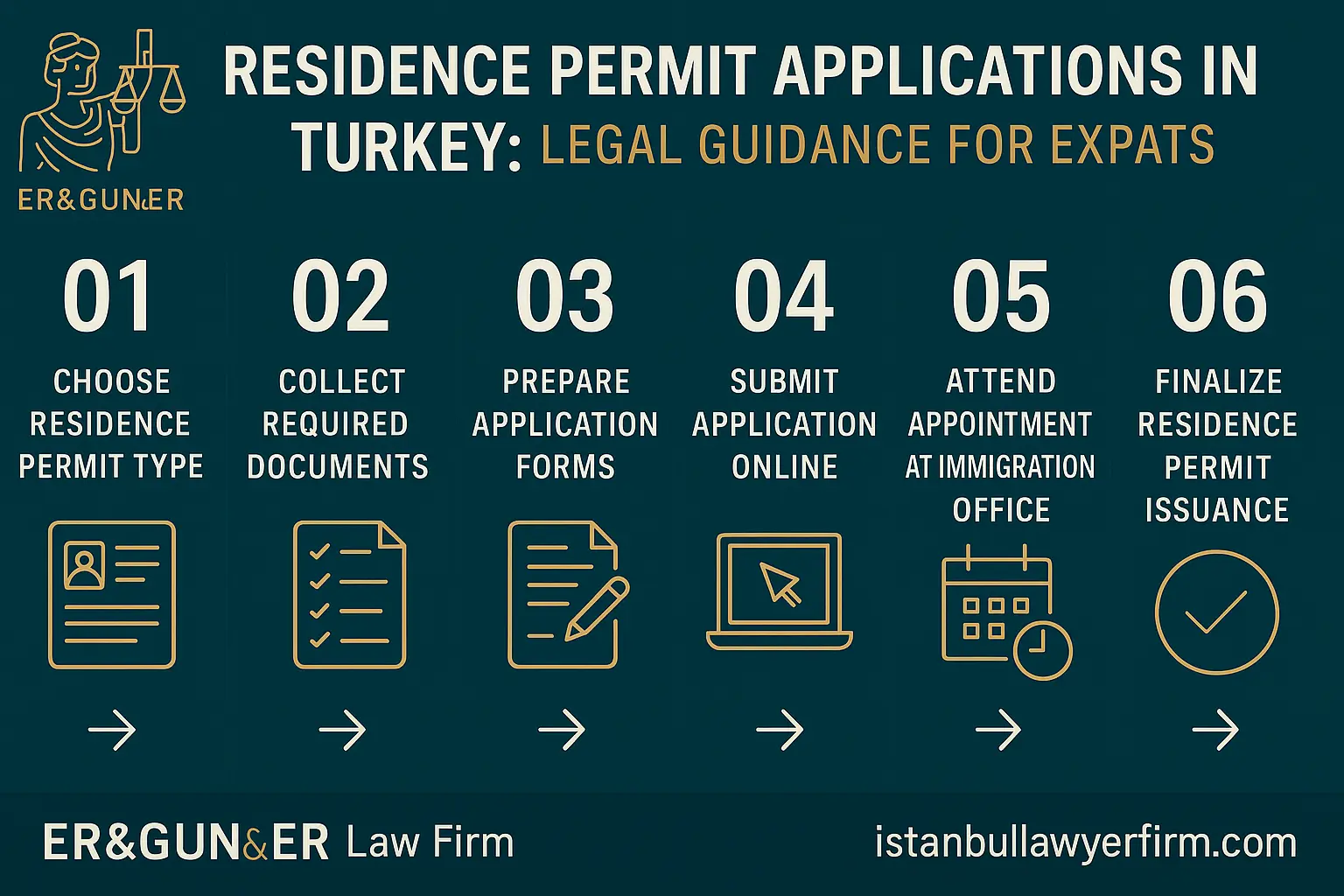
Residence permit applications in Turkey for foreign nationals operate within a structured substantive and procedural framework that combines specialized permit categories, mandatory online application procedures, evolving documentary requirements, geographic restrictions, and integrated compliance obligations producing the comprehensive immigration discipline that experienced practitioners support across the full residency lifecycle. The framework that governs the relevant questions is set primarily by the 6458 sayılı Yabancılar ve Uluslararası Koruma Kanunu (YUKK) administered through Göç İdaresi Başkanlığı (Presidency of Migration Management) with the operational interface through İl Göç İdaresi Müdürlükleri (provincial migration management directorates) covering m.21 (Türkiye'ye giriş ve vize / entry and visa framework), m.31 (kısa dönem ikamet izni / short-term residence permit categories including m.31/1-j taşınmaz sahibi olma / property ownership pathway), m.32 vd. (başvuru ve genel hükümler / application and general provisions), m.33 (kısa dönem ikamet izni süreleri / short-term residence permit duration up to 2 years), m.34-35 (aile ikamet izni / family residence permit), m.38-39 (öğrenci ikamet izni / student residence permit), m.41-42 (uzun dönem ikamet izni / long-term residence permit with 8-year continuous residence requirement), m.46 (insani ikamet izni / humanitarian residence permit), and m.99 (adres bildirim yükümlülüğü / address reporting obligation within 20 business days); the e-İkamet system (e-ikamet.goc.gov.tr) operating as the mandatory online application platform; the kapalı mahalle (closed neighborhood) framework effective 1 July 2022 establishing geographic restrictions on foreign residence permit applications in neighborhoods with foreign-population density exceeding 20% with 1,336 initial neighborhoods plus subsequent additions; the 2577 sayılı İdari Yargılama Usulü Kanunu (İYUK) including m.7 governing the 60-day filing period for administrative court appeals against adverse permit decisions; the 6735 sayılı Uluslararası İşgücü Kanunu governing work permits administered through Çalışma ve Sosyal Güvenlik Bakanlığı; the 5901 sayılı Türk Vatandaşlığı Kanunu (TVK) including m.11 (genel yoldan kazanma / general pathway requiring 5 years continuous residence), m.12 (istisnai vatandaşlık / exceptional citizenship including the CBI investment pathway), and m.16 (evlilik yoluyla / marriage pathway); the 6305 sayılı Afet Sigortaları Kanunu governing DASK (Doğal Afet Sigortaları Kurumu) zorunlu deprem sigortası; the Notarlık Kanunu Law No. 1512 governing vekaletname (power of attorney); and the 1961 La Haye Konvansiyonu (Hague Convention on Apostille) governing apostille recognition with Turkey's accession effective 1985. Practice may vary by authority and year.
An English speaking lawyer in Turkey advising on residence permit applications will explain that effective immigration response requires structured coordination across permit category selection, e-İkamet system navigation, documentary discipline including apostille and yeminli tercüman compliance, geographic restriction analysis under the kapalı mahalle framework, deadline management across multiple parallel timelines, and integrated compliance maintenance supporting both initial application success and longer-horizon residency continuity. The body of this guide walks through the YUKK m.31-46 permit category architecture; the application procedure through e-İkamet with 90-day filing requirement under m.21; the documentary discipline including apostille, translation, and property-based residence requirements with the kapalı mahalle framework; the family residence permit under m.34-35 and work permit coordination under Law No. 6735; the renewal, address change under m.99, and exit coordination; the rejection defense and administrative court appeals under İYUK m.7; the compliance maintenance including health insurance, VKN tax number, and DASK; and the long-term residence under m.41-42 and citizenship bridge under TVK Law No. 5901. For procedural orientation on adjacent topics, our notes on legal residence through real estate purchase, Turkish citizenship legal representation and title deed verification in Turkey can be read alongside this material.
1) YUKK Law No. 6458 m.31-46 Permit Categories and Strategic Selection
A lawyer in Turkey advising on permit category architecture will explain that the 6458 sayılı YUKK framework establishes structured residence permit categories with each category producing specific eligibility requirements, duration provisions, and substantive limitations affecting both immediate application strategy and longer-horizon residency positioning. The procedure ordinarily considers the kısa dönem ikamet izni (short-term residence permit) framework under YUKK m.31 covering multiple sub-categories including m.31/1-a (research-related stay), m.31/1-b (commercial purposes), m.31/1-c (course or training participation), m.31/1-d (specific educational programs), m.31/1-e (medical treatment), m.31/1-f (judicial or administrative process participation), m.31/1-g (tourism), m.31/1-h (cultural or scientific activities), m.31/1-i (Turkish language education), m.31/1-j (taşınmaz sahibi olma / property ownership pathway), m.31/1-k (commercial connection or investment), m.31/1-l (Turkish-origin descendants), m.31/1-m (humanitarian considerations), and other specified categories; the duration framework under YUKK m.33 establishing maximum 2-year duration for kısa dönem permits with structured renewal possibilities; the aile ikamet izni (family residence permit) framework under YUKK m.34-35 supporting Turkish nationals' or Turkish-resident foreign nationals' family members with up to 3-year duration; the öğrenci ikamet izni (student residence permit) framework under YUKK m.38-39 supporting accredited educational institution attendance; and the uzun dönem ikamet izni (long-term residence permit) framework under YUKK m.41-42 supporting permanent residency status with structured 8-year continuous residence prerequisite.
An Istanbul Law Firm advising on category selection strategy will note that the optimal permit category depends on the applicant's substantive circumstances, intended Turkish activities, and longer-horizon objectives, with structured pre-application analysis substantially affecting both immediate approval prospects and longer-horizon residency positioning. The procedure ordinarily considers the substantive eligibility analysis matching the applicant's specific circumstances against the available permit categories' substantive requirements; the duration-strategy analysis where category selection affects both initial permit duration and renewal possibilities, with longer-duration categories supporting more stable residency positioning; the convertibility-strategy analysis where some categories support easier transition to long-term residence (m.41-42) or citizenship (TVK Law No. 5901) than others, with strategic planning supporting the desired longer-horizon trajectory; the documentary-burden analysis where categories vary substantially in their documentary requirements with structured pre-application preparation supporting efficient filing; and the broader integration with parallel procedural frameworks including work permit coordination, family-member residency coordination, and broader compliance positioning.
A Turkish Law Firm advising on the property-based pathway (m.31/1-j) will note that the taşınmaz sahibi olma (property ownership) pathway under YUKK m.31/1-j operates as one of the most popular foreign-investor pathways with specific substantive requirements and geographic restrictions affecting eligibility analysis. The procedure ordinarily considers the substantive ownership requirement where the applicant must own qualifying immovable property in Turkey with structured documentary support including current Tapu (title deed) and ownership-verification documentation through Tapu Müdürlüğü and TAKBİS (Tapu ve Kadastro Bilgi Sistemi); the value-threshold framework where 2022 regulatory changes established structured minimum-value requirements (with the specific threshold subject to ongoing regulatory adjustment) — note that the property-based residence permit pathway under YUKK m.31/1-j is distinct from the Turkish Citizenship by Investment (CBI) program under the 5901 sayılı Türk Vatandaşlığı Kanunu (TVK) m.12 with its 13 Haziran 2022 BKK $400,000 threshold; the kapalı mahalle (closed neighborhood) framework discussed in detail in section 3 below; and the broader strategic positioning where the m.31/1-j pathway supports residence-permit access without producing automatic Turkish nationality, with separate citizenship pathways available through structured planning. The discipline outlined in our note on legal residence through real estate purchase covers the broader property-based pathway analysis. Practice may vary by authority and year.
2) Application Procedure: e-İkamet System and Göç İdaresi Başkanlığı Coordination with YUKK m.21 90-Day Filing Period
An English speaking lawyer in Turkey advising on the application procedure will explain that residence permit applications operate through the structured e-İkamet system (accessible at e-ikamet.goc.gov.tr) administered through Göç İdaresi Başkanlığı with the operational interface through İl Göç İdaresi Müdürlükleri (provincial migration management directorates), with structured procedural mechanics affecting both filing efficiency and approval prospects. The procedure ordinarily considers the e-İkamet platform navigation where applicants create user accounts, complete structured online application forms with substantive eligibility information, upload required documentary support in specified formats, and receive structured appointment scheduling for biometric submission; the appointment-scheduling framework where the e-İkamet system schedules biometric appointments at the appropriate İl Göç İdaresi Müdürlüğü based on the applicant's residence address; the biometric-submission framework where the appointment includes fingerprint capture, photograph confirmation, and document verification with original documents reviewed against the previously uploaded copies; the approval framework where the İl Göç İdaresi Müdürlüğü evaluates the application against the substantive YUKK requirements with structured timeline producing approval, denial, or supplementary documentation request; and the residence permit card delivery framework where approved permits are produced and delivered through structured mailing or pickup arrangements. Note that the application platform is the e-İkamet system — Turkey does not operate an "IRIS system" for residence permit applications.
A lawyer in Turkey advising on filing-deadline discipline will note that the YUKK framework imposes strict timing requirements affecting application prospects, with 90-day filing windows operating as critical procedural deadlines under YUKK m.21 and related provisions. The procedure ordinarily considers the substantive 90-day filing requirement where the applicant must complete the e-İkamet application within 90 days of Turkish entry under tourist visa or visa exemption status, with applications filed beyond this period facing structured procedural complications; the entry-stamp documentation framework where the applicant's Turkish entry timestamp (typically through international airport entry stamps) operates as the trigger for the 90-day calculation; the visa-exemption coordination where nationalities with visa-exemption agreements with Turkey face structured 90-day calculation from initial entry with supporting passport-stamp documentation; the visa-required-jurisdiction coordination where applicants from visa-required jurisdictions must arrive with appropriate Turkish entry visa and complete the residence permit application within the visa's validity period; and the structured pre-application preparation supporting efficient e-İkamet filing within the applicable 90-day window through documentary preparation, translation completion, and apostille coordination preceding Turkish arrival where possible.
A Turkish Law Firm advising on procedural representation will note that foreign applicants typically benefit from structured legal representation through Turkish counsel under power of attorney supporting application preparation, e-İkamet navigation, and broader Göç İdaresi coordination. The procedure ordinarily considers the vekaletname (power of attorney) preparation through Notarlık Kanunu Law No. 1512 framework with structured notarization requirements supporting Turkish counsel representation; the foreign-issued vekaletname coordination requiring apostille certification under the 1961 La Haye Konvansiyonu (Hague Convention) framework with subsequent Turkish-translation through yeminli tercüman (sworn translator) and notary verification; the e-İkamet representation framework where Turkish counsel can manage the substantive application preparation and platform navigation, though biometric submission generally requires the applicant's personal appearance at the İl Göç İdaresi Müdürlüğü appointment; the structured-communication framework supporting clear coordination between the foreign applicant and Turkish counsel across the application timeline; and the broader strategic-coordination framework where legal representation supports both immediate procedural efficiency and broader strategic positioning across the residency framework. The discipline outlined in our note on Turkish citizenship legal representation covers the broader procedural representation framework relevant to immigration matters. Practice may vary by authority and year.
3) Documentary Discipline, 1961 Hague Apostille, Yeminli Tercüman Translation and Property-Based Residence under YUKK m.31/1-j with Kapalı Mahalle Framework (Effective 1 July 2022)
An Istanbul Law Firm advising on documentary discipline will note that residence permit applications require structured documentary support with specific formatting and authentication requirements affecting both filing acceptance and substantive evaluation. The procedure ordinarily considers the core documentary requirements including valid passport (with sufficient remaining validity beyond the requested permit duration), Turkish entry-stamp documentation, biometric photographs meeting specified formatting requirements, residence address documentation (typically lease agreement, Tapu, or hosting documentation), private health insurance documentation meeting Göç İdaresi standards, financial-resources documentation supporting the applicant's ability to maintain residence, and structured supplementary documentation depending on the specific permit category; the apostille framework under the 1961 La Haye Konvansiyonu (Hague Convention) where foreign-source documents (including birth certificates, marriage certificates, criminal record documentation, financial documentation) require apostille certification from the issuing jurisdiction's competent authority; the yeminli tercüman (sworn translator) framework where all foreign-language documents require Turkish translation through registered yeminli tercüman with subsequent notary certification; the formatting discipline supporting structured documentary presentation with appropriate organization, clear identification of each document category, and consistent presentation across all required materials; and the structured pre-filing review supporting documentary completeness and accuracy before e-İkamet submission.
Turkish lawyers who advise on the property-based residence pathway will note that YUKK m.31/1-j (taşınmaz sahibi olma / property ownership) applications require specific documentary support beyond the standard residence permit documentation, with structured property-related discipline supporting both substantive eligibility demonstration and broader procedural compliance. The procedure ordinarily considers the substantive property-ownership documentation including current Tapu (title deed) reflecting the applicant's ownership, ownership-acquisition history through Tapu Müdürlüğü records, structured property valuation documentation supporting the applicable threshold analysis (with the 2022 regulatory framework establishing structured minimum-value requirements subject to ongoing adjustment), and broader property-status documentation; the DASK (Doğal Afet Sigortaları Kurumu / Natural Disaster Insurance Pool) documentation under the 6305 sayılı Afet Sigortaları Kanunu where the property requires zorunlu deprem sigortası (mandatory earthquake insurance) supporting both regulatory compliance and broader property-related discipline; the utility registration documentation supporting the applicant's actual residence at the property; the property-tax current-status documentation supporting the broader property compliance positioning; and the structured documentary chain supporting both immediate residence permit application and longer-horizon property positioning.
A lawyer in Turkey advising on the kapalı mahalle (closed neighborhood) framework will note that effective 1 July 2022, structured geographic restrictions limit foreign residence permit applications in neighborhoods with high foreign-population density, with substantial implications for property-based residence permit strategy and broader residency positioning. The procedure ordinarily considers the substantive kapalı mahalle framework where neighborhoods with foreign-population density exceeding 20% are designated as kapalı mahalle (closed neighborhood) status — meaning that new foreign residence permit applications in those neighborhoods face structured restrictions; the initial designation effective 1 July 2022 covering 1,336 initial neighborhoods across multiple Turkish provinces with substantial foreign-population concentrations; the subsequent additions framework where the kapalı mahalle list has been expanded through subsequent regulatory determinations as additional neighborhoods exceed the 20% threshold; the substantive-impact framework where property-based residence permit applicants under YUKK m.31/1-j cannot obtain residence permits based on property in kapalı mahalle locations, with the broader strategic implications affecting both pre-purchase analysis and post-purchase residency planning; the existing-resident framework where current residents in kapalı mahalle locations face structured continuation provisions, though new applications and certain renewal scenarios face the broader restriction; and the integration with the broader real estate strategy where structured pre-purchase verification of the property's kapalı mahalle status operates as essential pre-acquisition discipline. The discipline outlined in our note on title deed verification in Turkey covers the broader Tapu Müdürlüğü verification framework relevant to property-based residence applications. Practice may vary by authority and year.
4) Family Residence Permit under YUKK m.34-35 and Work Permit Coordination under Law No. 6735
An English speaking lawyer in Turkey advising on family residence permit architecture will explain that aile ikamet izni (family residence permit) under YUKK m.34-35 supports family members of Turkish nationals or qualifying foreign-resident sponsors with structured eligibility requirements and procedural mechanics distinct from the kısa dönem ikamet izni framework. The procedure ordinarily considers the eligible family-member framework under YUKK m.34 covering spouses (eş), minor children (reşit olmayan çocuklar), and dependent adult children (kendi başına yaşayamayacak durumdaki bağımlı çocuklar), with structured documentation supporting each relationship category; the eligible sponsor framework where Turkish nationals, qualifying foreign-resident long-term residents, qualifying foreign-resident scientific or research participants, and other specified sponsor categories support family residence applications; the duration framework under YUKK m.35 where aile ikamet izni operates with up to 3-year duration with structured renewal possibilities; the documentary requirements including marriage certificates (for spousal applications), birth certificates (for child applications), structured sponsor-relationship verification documentation, and broader family-relationship support documentation, all subject to apostille and yeminli tercüman discipline; and the integration with the broader sponsor framework where the sponsor's continuing residence status, financial resources, and structured family-support capacity affect the family residence permit's continuing validity.
A Turkish Law Firm advising on work permit coordination will note that work-related residence positioning operates through structured coordination between the 6735 sayılı Uluslararası İşgücü Kanunu (work permit framework) administered through Çalışma ve Sosyal Güvenlik Bakanlığı (Ministry of Labor and Social Security) and the YUKK residence permit framework, with the integrated framework producing specific procedural mechanics affecting work-eligible foreign nationals. The procedure ordinarily considers the substantive work permit framework under Law No. 6735 where foreign nationals seeking employment in Turkey must obtain çalışma izni (work permit) through structured employer-sponsored application with specific eligibility requirements; the integrated residence framework where valid çalışma izni produces structured residence-eligibility supporting Turkish residence without separate ikamet izni in many cases under YUKK provisions; the application-coordination framework where work permit applications and residence positioning operate through structured procedural integration with potential family-member coordination supporting integrated family-employment immigration scenarios; the documentary discipline including employer documentation (Ticaret Sicil Gazetesi for employer companies, employer SGK / Social Security registration verification, employer financial-resources demonstration, structured employment contract), employee documentation (apostilled educational credentials with yeminli tercüman translation, criminal record documentation, supporting professional qualifications), and broader supporting documentation; the structured timeline framework where work permit applications require coordinated timing with the broader residence positioning; and the renewal framework where ongoing work permit validity supports continuing residence positioning across the broader employment relationship.
A lawyer in Turkey advising on the broader strategic family-and-work integration will note that family-residence-and-work scenarios produce structured strategic considerations affecting both immediate procedural positioning and longer-horizon residency strategy. The procedure ordinarily considers the integrated family-employment scenario where the working spouse's çalışma izni supports the spouse's residence with potential aile ikamet izni for family members through structured procedural coordination; the documentary-coordination framework where employment, residence, and family relationships require structured documentary chain supporting all parallel procedural frameworks; the timing-coordination framework integrating work permit timeline with residence permit timeline and broader family-member arrival positioning; the convertibility-strategy framework where employment-based residence may transition to long-term residence under YUKK m.41-42 (discussed in section 8 below) with structured planning supporting the longer-horizon trajectory; the cross-border tax coordination where work-related residence may produce structured Turkish tax positioning interacting with the foreign employee's home-country tax framework; and the broader strategic integration where the family-employment immigration framework operates as integrated strategic positioning rather than disconnected procedural events. Practice may vary by authority and year.
5) Renewal Applications, Address Change under YUKK m.99 (20 Business Days) and Exit Coordination
An Istanbul Law Firm advising on renewal application discipline will note that residence permit renewal operates through structured procedural mechanics requiring continued substantive eligibility, supplemental documentary support, and timing discipline affecting both renewal success and broader residency continuity. The procedure ordinarily considers the substantive continued-eligibility framework where the renewal applicant must demonstrate continuing satisfaction of the original permit category's substantive requirements with structured documentary support; the renewal-timing framework where renewal applications must be filed within structured timeframes (typically up to 60 days before permit expiry with specific provisions for individual permit categories) supporting continuous residency positioning without procedural gaps; the e-İkamet renewal procedure where renewal applications proceed through the same e-İkamet system as initial applications with structured procedural integration; the supplemental documentation framework where renewal applications typically require updated documentation including current residence verification, current financial-resources documentation, updated health insurance documentation, and broader supporting materials; the kapalı mahalle interaction where renewal applications in kapalı mahalle locations face structured analysis with potential complications affecting renewal prospects; and the strategic-planning framework where structured pre-renewal review supports both immediate renewal success and broader longer-horizon residency positioning.
Turkish lawyers who advise on address-change discipline will note that YUKK m.99 establishes specific address-reporting obligations with substantial implications for residence permit validity and broader compliance positioning. The procedure ordinarily considers the substantive address-reporting requirement under YUKK m.99 where foreign nationals must report address changes to the İl Göç İdaresi Müdürlüğü within 20 business days (yirmi iş günü) of the address change; the substantive scope covering both initial address registration following permit issuance and subsequent address changes throughout the residency period; the procedural framework through e-Devlet / e-İkamet platform reporting or in-person İl Göç İdaresi Müdürlüğü reporting with structured documentary support; the substantive consequences framework where failure to comply with the 20-business-day reporting requirement may produce administrative penalties and broader residence permit complications including potential permit revocation; the integration with the broader Adres Kayıt Sistemi (AKS / Address Registration System) under the 5490 sayılı Nüfus Hizmetleri Kanunu where comprehensive address registration supports both YUKK compliance and broader Turkish-administrative positioning; and the cross-jurisdictional address-change framework where moves between provinces may produce specific procedural requirements affecting İl Göç İdaresi Müdürlüğü jurisdiction and broader residency positioning.
A Turkish Law Firm advising on exit coordination will note that residence permit holders departing Turkey face structured procedural considerations affecting both immediate departure positioning and potential future return prospects. The procedure ordinarily considers the residence permit cancellation framework where departing residents may pursue structured permit cancellation through Göç İdaresi reporting supporting clean exit positioning; the alternative continuation framework where temporarily-departing residents may maintain permit validity through structured procedural compliance including maintenance of Turkish residence address, continuing health insurance, and broader compliance positioning; the overstay-defense framework where overstay scenarios produce structured administrative penalty exposure with potential exit-ban (yurt dışına çıkış yasağı) implications requiring structured legal response; the broader cross-border coordination framework where exit positioning interacts with home-country tax frameworks, banking arrangements, and broader international positioning; the future-return planning framework where structured exit coordination supports potential future Turkish residency through preserved historical residency records and broader procedural goodwill; and the structured documentary preservation framework supporting both immediate exit and longer-horizon Turkish-residency positioning. Practice may vary by authority and year.
6) Permit Rejection Defense and Administrative Court Appeals under İYUK Law No. 2577 m.7 (60-Day Filing Period)
An English speaking lawyer in Turkey advising on rejection defense will explain that residence permit rejections produce structured appeal pathways through both administrative review within Göç İdaresi and subsequent judicial review through İdare Mahkemesi (administrative court), with the procedural framework requiring disciplined response within strict procedural deadlines. The procedure ordinarily considers the substantive rejection-evaluation framework analyzing the rejection's specific grounds (typical grounds include documentary inadequacy, substantive eligibility deficiency, kapalı mahalle violation, criminal record concerns, public security or order considerations under YUKK m.7, prior immigration violation history, or financial-resources inadequacy); the administrative review framework where some rejections support immediate administrative reconsideration through supplementary documentation or clarification before judicial review pursuit; the structured documentary preparation supporting the appeal positioning through comprehensive evidence chain including substantive eligibility demonstration, documentary supplementation addressing specific rejection grounds, structured legal argument addressing applicable YUKK provisions, and broader supporting materials; and the strategic-pathway analysis determining whether the optimal response involves administrative reconsideration, immediate judicial review, or coordinated parallel pathways.
A lawyer in Turkey advising on İdare Mahkemesi appeals will note that judicial review of adverse residence permit decisions operates through the structured 2577 sayılı İdari Yargılama Usulü Kanunu (İYUK) framework with specific procedural mechanics affecting appeal prospects. The procedure ordinarily considers the İdare Mahkemesi (administrative court of first instance) jurisdiction over residence permit denials and revocations, with the appropriate court determined by the geographic location of the issuing İl Göç İdaresi Müdürlüğü; the 60-day filing period under İYUK m.7 from notification of the adverse decision, with the timeline operating as a strict procedural deadline — applications filed beyond this period face structured procedural complications and likely dismissal; the substantive appeal architecture covering procedural-defect challenges (where the residence permit decision was made without appropriate procedural compliance), substantive-error challenges (where the decision misapplies the underlying YUKK framework), proportionality challenges (where the consequences are disproportionate to the underlying conduct), and discretionary-review challenges (where the discretionary aspects of the decision-making warrant judicial review); the documentary discipline supporting the appeal through structured evidence chains including the original application materials, the rejection decision, supplementary supporting documentation, and structured legal argument; and the timeline framework where İdare Mahkemesi proceedings typically extend across multiple months with structured procedural milestones.
A Turkish Law Firm advising on the appellate framework will note that adverse İdare Mahkemesi decisions face structured further appeal options through Bölge İdare Mahkemesi (regional administrative court) and Danıştay (Council of State) supporting comprehensive judicial review across multiple appellate levels. The procedure ordinarily considers the istinaf (intermediate appeal) framework through Bölge İdare Mahkemesi where adverse İdare Mahkemesi decisions face appellate review with structured procedural mechanics; the temyiz (cassation) framework through Danıştay where exceptional cases meeting specific procedural and substantive thresholds support further appellate review; the AYM bireysel başvuru (Constitutional Court individual application) framework under the 6216 sayılı Anayasa Mahkemesinin Kuruluşu ve Yargılama Usulleri Hakkında Kanun m.45-49 where ordinary remedies are exhausted and the case involves alleged violation of fundamental rights protected by the Anayasa or the European Convention on Human Rights; the AİHM (European Court of Human Rights) framework where domestic remedies are exhausted and the case involves alleged Convention violations supporting Strasbourg-level review; and the broader strategic integration supporting consistent positioning across the entire judicial review trajectory with structured documentary preservation supporting each appellate level. Practice may vary by authority and year.
7) Compliance Maintenance: Health Insurance, VKN Tax Number Coordination and DASK under Law No. 6305
An Istanbul Law Firm advising on health insurance compliance will note that valid health insurance operates as a structural prerequisite for most residence permit categories under YUKK with specific qualification requirements affecting both initial approval and ongoing renewal positioning. The procedure ordinarily considers the substantive health insurance requirement where YUKK m.31 vd. typically requires applicants to demonstrate valid Turkish health insurance coverage either through özel sağlık sigortası (private health insurance) meeting Göç İdaresi-approved standards or through SGK genel sağlık sigortası (Social Security Institution general health insurance) where applicable to specific employment-based residence scenarios; the qualification framework where eligible private health insurance policies must meet specific structural requirements including minimum coverage limits, structured benefit categories, and Turkish-territory coverage scope, with not all online-purchased policies meeting Göç İdaresi standards; the structured-renewal framework where insurance coverage must continue throughout the residence permit period with appropriate documentation supporting both initial filing and renewal applications; the compliance-monitoring framework where insurance coverage gaps may produce residence permit complications including potential renewal denial or permit revocation; and the strategic-coordination framework where insurance selection benefits from structured pre-purchase verification supporting both regulatory compliance and substantive coverage adequacy.
Turkish lawyers who advise on tax-number coordination will note that VKN (Vergi Kimlik Numarası / Tax Identification Number) registration operates as essential infrastructure for foreign nationals' Turkish activities with structured implications across multiple parallel procedural frameworks. The procedure ordinarily considers the substantive VKN framework where foreign nationals seeking Turkish residence, property ownership, banking relationships, or broader Turkish-territorial activities require VKN registration through Vergi Dairesi (tax office) with structured procedural mechanics; the alternative Yabancı Kimlik Numarası (Foreign ID Number / 99XXX format) framework where residence-permit-holder foreign nationals receive structured Turkish identification supporting integrated administrative positioning; the substantive integration where VKN supports tax filings, property transactions, banking arrangements, contract execution, and broader Turkish-administrative positioning; the documentary discipline supporting VKN registration through structured passport documentation and supporting materials; and the broader strategic integration where the foreign national's Turkish administrative positioning operates through coordinated VKN, Yabancı Kimlik Numarası, and broader identification framework supporting comprehensive residency positioning.
A lawyer in Turkey advising on DASK and broader compliance maintenance will note that property-based residence positioning produces additional structured compliance considerations beyond the immediate residence permit framework. The procedure ordinarily considers the DASK (Doğal Afet Sigortaları Kurumu / Natural Disaster Insurance Pool) framework under the 6305 sayılı Afet Sigortaları Kanunu where Turkish property ownership requires zorunlu deprem sigortası (mandatory earthquake insurance) with structured policy renewal supporting both regulatory compliance and broader property-related positioning; the property-tax framework where property ownership produces structured emlak vergisi (property tax) obligations through belediye (municipality) coordination with structured payment timing across the calendar year; the utility-account coordination supporting both substantive property use and broader residence-verification positioning; the broader compliance positioning where Turkish residence integrates with multiple parallel administrative frameworks producing structured ongoing compliance obligations; the cross-border tax coordination where Turkish residence may produce structured Turkish-tax-residency analysis interacting with home-country tax positioning; and the strategic-coordination framework where structured ongoing compliance maintenance supports both immediate procedural positioning and broader longer-horizon residency stability. Practice may vary by authority and year.
8) Long-Term Residence under YUKK m.41-42 (8-Year Continuous Residence) and Citizenship Bridge under TVK Law No. 5901
An English speaking lawyer in Turkey advising on long-term residence positioning will explain that uzun dönem ikamet izni (long-term residence permit) under YUKK m.41-42 supports permanent residency status with structured eligibility requirements producing substantial residency stability beyond the renewable kısa dönem framework. The procedure ordinarily considers the substantive eligibility framework under YUKK m.42 requiring (i) 8 years of continuous Turkish residence (sekiz yıl kesintisiz) through valid residence permits, (ii) absence of social-assistance dependency during the last 3 years, (iii) sufficient and regular income supporting the applicant and dependents, (iv) valid health insurance, (v) absence of public order or public security threats, and (vi) Bakanlık (Ministry) approval through structured discretionary review; the substantive permanent-residence framework where uzun dönem ikamet izni operates as permanent permit (süresiz) without renewal requirements, supporting long-term residency stability; the broader procedural framework where the application proceeds through structured Göç İdaresi review with comprehensive documentary support and substantive evaluation; the substantive benefits framework where uzun dönem permit holders receive enhanced rights including visa-exempt entry across multiple categories, simplified administrative positioning, and broader residency integration; and the strategic positioning where long-term residence supports both continued Turkish residency and potential future citizenship pursuit through structured TVK pathway analysis.
A Turkish Law Firm advising on citizenship bridge architecture will note that Turkish citizenship operates through the 5901 sayılı Türk Vatandaşlığı Kanunu (TVK) framework with structured pathways producing different eligibility requirements and procedural mechanics depending on the substantive route. The procedure ordinarily considers the genel yoldan vatandaşlık (general pathway) under TVK m.11 requiring 5 years continuous Turkish residence prior to application with additional substantive requirements including good moral conduct, sufficient Turkish-language capability, sufficient and regular income, and absence of public order or public security threats; the istisnai vatandaşlık (exceptional citizenship) under TVK m.12 supporting accelerated pathways including the Turkish Citizenship by Investment (CBI) program where qualifying investments (real estate at $400,000 threshold under the 13 Haziran 2022 BKK, fixed bank deposit at $500,000, and other qualifying categories) support exceptional citizenship without the standard 5-year residence requirement; the evlilik yoluyla vatandaşlık (marriage pathway) under TVK m.16 supporting Turkish-spouse marriages with structured 3-year continuous marriage and broader substantive requirements; the formal application framework through Nüfus ve Vatandaşlık İşleri Genel Müdürlüğü (NVİGM) with structured procedural mechanics, documentary discipline, and timeline framework; and the procedural integration where citizenship application typically follows or coordinates with stable residence permit positioning.
A lawyer in Turkey advising on the integrated long-term strategy will note that effective long-term Turkish residency planning benefits from structured integration of residence permit positioning, property strategy, family considerations, and citizenship pathway analysis producing comprehensive longer-horizon trajectory rather than isolated permit-by-permit decision-making. The procedure ordinarily considers the multi-year residency framework where structured residence permit positioning supports both immediate residency objectives and longer-horizon citizenship eligibility under TVK m.11; the property-strategy integration where property-based residence under YUKK m.31/1-j operates within the broader real-estate framework supporting both residency and potential citizenship considerations; the family-coordination framework where spousal and dependent-children residence positioning operates within integrated family-immigration strategy; the cross-border tax coordination where Turkish residence integrates with home-country tax frameworks through structured planning supporting consistent positioning; the broader cultural-integration framework where Turkish-language acquisition, social integration, and broader Turkish-residency engagement support both legal eligibility and longer-horizon residency stability; and the structured strategic-coordination framework where the integrated residency-citizenship trajectory operates through coordinated planning across multiple years rather than reactive procedural responses to discrete events. The discipline outlined in our note on Turkish citizenship legal representation covers the broader citizenship framework relevant to longer-horizon residency planning. Practice may vary by authority and year.
9) Frequently Asked Questions for Foreign Residents and Their Advisors
- What law governs residence permits in Turkey? The 6458 sayılı Yabancılar ve Uluslararası Koruma Kanunu (YUKK) administered through Göç İdaresi Başkanlığı (Presidency of Migration Management) with operational interface through İl Göç İdaresi Müdürlükleri (provincial migration management directorates). YUKK m.31-46 establishes the residence permit categories including kısa dönem (short-term), aile (family), öğrenci (student), uzun dönem (long-term), and insani (humanitarian) permits.
- How do I apply? Applications proceed through the e-İkamet system (e-ikamet.goc.gov.tr) — Turkey's official online residence permit application platform. Applicants create user accounts, complete structured online application forms, upload required documentary support, and receive structured appointment scheduling for biometric submission at the appropriate İl Göç İdaresi Müdürlüğü. Note that Turkey does not operate an "IRIS system" for residence permit applications — the platform is e-İkamet.
- What is the application deadline after Turkish entry? Under YUKK m.21, applicants typically must complete the e-İkamet application within 90 days of Turkish entry under tourist visa or visa exemption status. The Turkish entry-stamp documentation operates as the trigger for the 90-day calculation. Applications filed beyond this period face structured procedural complications.
- What is the property-based residence pathway? Under YUKK m.31/1-j (taşınmaz sahibi olma / property ownership), foreign property owners can apply for short-term residence based on Turkish property ownership. The 2022 regulatory framework established structured minimum-value requirements (subject to ongoing adjustment). Note that the property-based residence permit pathway under YUKK m.31/1-j is distinct from the Turkish Citizenship by Investment (CBI) program under TVK m.12 with its 13 Haziran 2022 BKK $400,000 threshold — these are separate programs producing different outcomes.
- What is the kapalı mahalle framework? Effective 1 July 2022, neighborhoods with foreign-population density exceeding 20% are designated as kapalı mahalle (closed neighborhood) status, restricting new foreign residence permit applications in those neighborhoods. The initial designation covered 1,336 neighborhoods with subsequent additions. Property-based residence permit applicants under YUKK m.31/1-j cannot obtain residence permits based on property in kapalı mahalle locations, making structured pre-purchase verification essential.
- How do family residence permits work? Aile ikamet izni under YUKK m.34-35 supports family members of Turkish nationals or qualifying foreign-resident sponsors. Eligible family members include spouses (eş), minor children (reşit olmayan çocuklar), and dependent adult children. Duration is up to 3 years with structured renewal possibilities. Documentary requirements include marriage certificates, birth certificates, and structured sponsor-relationship verification — all subject to apostille and yeminli tercüman discipline.
- How do work permits coordinate with residence? Under the 6735 sayılı Uluslararası İşgücü Kanunu administered through Çalışma ve Sosyal Güvenlik Bakanlığı, foreign nationals seeking Turkish employment must obtain çalışma izni (work permit) through structured employer-sponsored application. Valid çalışma izni produces structured residence-eligibility supporting Turkish residence without separate ikamet izni in many cases. Work permit applications and residence positioning operate through coordinated procedural integration.
- What documents need apostille and translation? Foreign-source documents require apostille certification under the 1961 La Haye Konvansiyonu (Hague Convention on Apostille) from the issuing jurisdiction's competent authority. All foreign-language documents require Turkish translation through registered yeminli tercüman (sworn translator) with subsequent notary certification. Common requiring documents: birth certificates, marriage certificates, criminal record documentation, financial-resources documentation.
- How do address changes work? Under YUKK m.99, foreign nationals must report address changes to the İl Göç İdaresi Müdürlüğü within 20 business days (yirmi iş günü) of the address change. Failure to comply may produce administrative penalties and broader residence permit complications including potential permit revocation. Reporting proceeds through e-Devlet / e-İkamet platform or in-person İl Göç İdaresi Müdürlüğü reporting.
- How are permit renewals handled? Renewal applications proceed through the e-İkamet system within structured timeframes (typically up to 60 days before permit expiry). The renewal applicant must demonstrate continuing satisfaction of the original permit category's substantive requirements with updated documentation including current residence verification, financial-resources documentation, and updated health insurance documentation. Kapalı mahalle interaction may affect renewal prospects in restricted neighborhoods.
- What if my application is rejected? Rejections face structured appeal pathways through (i) administrative review within Göç İdaresi for some scenarios and (ii) judicial review through İdare Mahkemesi (administrative court) under the 2577 sayılı İdari Yargılama Usulü Kanunu (İYUK). The 60-day filing period under İYUK m.7 operates as a strict procedural deadline from notification of the adverse decision. Appellate review proceeds through Bölge İdare Mahkemesi (istinaf) and Danıştay (temyiz). AYM bireysel başvuru under Law No. 6216 m.45-49 may apply where fundamental rights are involved.
- What are the long-term residence requirements? Under YUKK m.42, uzun dönem ikamet izni requires (i) 8 years of continuous Turkish residence (sekiz yıl kesintisiz) through valid residence permits, (ii) absence of social-assistance dependency during the last 3 years, (iii) sufficient and regular income supporting the applicant and dependents, (iv) valid health insurance, (v) absence of public order or public security threats, and (vi) Bakanlık approval. The permit operates as permanent (süresiz) without renewal requirements.
- What is the citizenship pathway? Turkish citizenship operates through the 5901 sayılı Türk Vatandaşlığı Kanunu (TVK): m.11 (genel yoldan / general pathway requiring 5 years continuous residence), m.12 (istisnai / exceptional citizenship including CBI investment pathway), and m.16 (evlilik / marriage pathway requiring 3 years continuous marriage to Turkish national). Application proceeds through Nüfus ve Vatandaşlık İşleri Genel Müdürlüğü (NVİGM).
- What about VKN tax number? Foreign nationals seeking Turkish residence, property ownership, banking, or broader Turkish-territorial activities require VKN (Vergi Kimlik Numarası / Tax Identification Number) registration through Vergi Dairesi. Residence permit holders also receive Yabancı Kimlik Numarası (Foreign ID Number / 99XXX format) supporting integrated Turkish administrative positioning. VKN supports tax filings, property transactions, banking, contract execution, and broader administrative activities.
- Does ER&GUN&ER Law Firm advise on residence permit applications? Yes. ER&GUN&ER Law Firm is an Istanbul-based law firm advising foreign nationals, foreign families, foreign legal counsel, employers, family offices, and corporate-relocation clients on Turkish residence permit matters, including permit category strategic selection across YUKK Law No. 6458 m.31 (kısa dönem ikamet izni including m.31/1-j taşınmaz sahibi olma), m.34-35 (aile ikamet izni), m.38-39 (öğrenci ikamet izni), m.41-42 (uzun dönem ikamet izni with 8-year continuous residence requirement), and m.46 (insani ikamet izni); e-İkamet system application coordination through Göç İdaresi Başkanlığı and İl Göç İdaresi Müdürlüğü interface with structured 90-day filing under YUKK m.21; documentary discipline including 1961 La Haye Konvansiyonu apostille coordination, yeminli tercüman translation through Notarlık Kanunu Law No. 1512 framework, vekaletname (power of attorney) preparation, and structured documentary chain assembly; property-based residence under YUKK m.31/1-j with kapalı mahalle (closed neighborhood) framework analysis effective 1 July 2022; family residence permit under YUKK m.34-35 with sponsor-relationship documentation and family-member coordination; work permit coordination under the 6735 sayılı Uluslararası İşgücü Kanunu administered through Çalışma ve Sosyal Güvenlik Bakanlığı; renewal application coordination with structured pre-renewal review; address change reporting under YUKK m.99 (20-business-day requirement) with Adres Kayıt Sistemi (AKS) coordination under the 5490 sayılı Nüfus Hizmetleri Kanunu; rejection defense including administrative review and İdare Mahkemesi appeals under İYUK Law No. 2577 m.7 60-day filing period with subsequent Bölge İdare Mahkemesi istinaf, Danıştay temyiz, and AYM bireysel başvuru under Law No. 6216 m.45-49 where applicable; compliance maintenance including health insurance qualification, VKN tax number coordination through Vergi Dairesi, Yabancı Kimlik Numarası 99XXX framework, DASK coordination under the 6305 sayılı Afet Sigortaları Kanunu, and emlak vergisi positioning; long-term residence pathway under YUKK m.41-42; citizenship transition under TVK Law No. 5901 m.11 (general 5-year pathway), m.12 (exceptional / CBI), and m.16 (marriage pathway) through NVİGM coordination; and exit coordination including permit cancellation, overstay defense, and yurt dışına çıkış yasağı (travel ban) response — with English-language client communication and bilingual documentation throughout each engagement. Files in this area are typically led personally by the managing partner rather than delegated.
Author: Mirkan Topcu is an attorney registered with the Istanbul Bar Association (Istanbul 1st Bar), Bar Registration No: 67874. His practice focuses on cross-border and high-stakes matters where evidence discipline, procedural accuracy, and risk control are decisive.
He advises foreign nationals, foreign families, foreign legal counsel, employers, family offices, and multinational corporate-relocation participants on Turkish residence permit matters under the 6458 sayılı Yabancılar ve Uluslararası Koruma Kanunu (YUKK) administered through Göç İdaresi Başkanlığı (Presidency of Migration Management) and İl Göç İdaresi Müdürlükleri including m.21 (Türkiye'ye giriş ve vize / entry and visa framework with 90-day filing period), m.31 (kısa dönem ikamet izni / short-term residence permit categories including m.31/1-a research, m.31/1-b commercial, m.31/1-c training, m.31/1-d educational programs, m.31/1-e medical treatment, m.31/1-f judicial process, m.31/1-g tourism, m.31/1-h cultural and scientific, m.31/1-i Turkish language education, m.31/1-j taşınmaz sahibi olma / property ownership pathway, m.31/1-k commercial connection or investment, m.31/1-l Turkish-origin descendants, and m.31/1-m humanitarian considerations), m.32 vd. (başvuru ve genel hükümler / application and general provisions), m.33 (kısa dönem ikamet izni süreleri / up to 2-year duration), m.34-35 (aile ikamet izni / family residence permit with up to 3-year duration), m.38-39 (öğrenci ikamet izni / student residence permit), m.41-42 (uzun dönem ikamet izni / long-term residence permit with 8-year continuous residence requirement and structured substantive criteria including financial sufficiency, health insurance, public order, and Bakanlık approval), m.46 (insani ikamet izni / humanitarian residence permit), and m.99 (adres bildirim yükümlülüğü / 20-business-day address reporting requirement); the e-İkamet system (e-ikamet.goc.gov.tr) operating as Turkey's mandatory online residence permit application platform — Turkey does not operate an "IRIS system" for residence permit applications; the kapalı mahalle (closed neighborhood) framework effective 1 July 2022 establishing geographic restrictions on foreign residence permit applications in 1,336 initial neighborhoods plus subsequent additions where foreign-population density exceeds 20%; the 2577 sayılı İdari Yargılama Usulü Kanunu (İYUK) m.7 governing the 60-day filing period for İdare Mahkemesi appeals with subsequent Bölge İdare Mahkemesi istinaf and Danıştay temyiz framework; the 6216 sayılı Anayasa Mahkemesinin Kuruluşu ve Yargılama Usulleri Hakkında Kanun m.45-49 governing AYM bireysel başvuru where fundamental rights are involved; the 6735 sayılı Uluslararası İşgücü Kanunu governing work permits administered through Çalışma ve Sosyal Güvenlik Bakanlığı; the 5901 sayılı Türk Vatandaşlığı Kanunu (TVK) including m.11 (genel yoldan kazanma / general pathway requiring 5 years continuous Turkish residence), m.12 (istisnai vatandaşlık / exceptional citizenship including the CBI program with 13 Haziran 2022 BKK $400,000 real estate threshold and other qualifying categories administered through Nüfus ve Vatandaşlık İşleri Genel Müdürlüğü / NVİGM), and m.16 (evlilik yoluyla vatandaşlık / marriage pathway requiring 3 years continuous marriage to Turkish national); the 6305 sayılı Afet Sigortaları Kanunu governing DASK (Doğal Afet Sigortaları Kurumu) zorunlu deprem sigortası; the Notarlık Kanunu Law No. 1512 governing vekaletname (power of attorney) including foreign-issued vekaletname coordination; the 1961 La Haye Konvansiyonu (Hague Convention on Apostille) governing apostille recognition with Turkey's accession effective 1985; the 5490 sayılı Nüfus Hizmetleri Kanunu governing Adres Kayıt Sistemi (AKS); and the Tapu Kanunu (Law No. 2644) governing real estate registry through Tapu Müdürlüğü and TAKBİS (Tapu ve Kadastro Bilgi Sistemi). His advisory work covers structured permit category selection analysis matching applicant circumstances against available YUKK categories with longer-horizon residency trajectory consideration; e-İkamet application preparation including platform navigation, structured documentary upload, biometric appointment coordination, and integrated procedural management; documentary discipline including foreign-source document apostille coordination, yeminli tercüman translation coordination with notary verification, vekaletname preparation supporting Turkish counsel representation, and structured documentary chain assembly; property-based residence analysis under YUKK m.31/1-j including pre-acquisition kapalı mahalle status verification, value-threshold compliance analysis under 2022 regulatory framework, Tapu Müdürlüğü ownership verification, DASK coordination, and broader property-positioning analysis; family residence coordination under YUKK m.34-35 including spousal-relationship documentation, minor-children documentation with Vesayet/Velayet coordination where applicable, sponsor-eligibility verification, and integrated family-immigration strategy; work permit coordination under Law No. 6735 including employer documentation, Çalışma ve Sosyal Güvenlik Bakanlığı procedural coordination, integrated work-residence positioning, and family-member coordination through aile ikamet izni; renewal application coordination with structured pre-renewal review, supplementary documentation preparation, and continuous residency analysis supporting both immediate renewal and longer-horizon trajectory; address change coordination under YUKK m.99 with 20-business-day timeline discipline; rejection defense including substantive evaluation of rejection grounds, administrative review pursuit where applicable, and İdare Mahkemesi appeals under İYUK m.7 60-day filing period with structured legal argument and documentary chain; appellate framework coordination through Bölge İdare Mahkemesi istinaf, Danıştay temyiz, AYM bireysel başvuru, and AİHM application where applicable; compliance maintenance including health insurance qualification analysis with Göç İdaresi-approved policy verification, VKN registration through Vergi Dairesi, Yabancı Kimlik Numarası 99XXX coordination, DASK ongoing renewal, emlak vergisi positioning through belediye coordination, and broader Turkish-administrative positioning; long-term residence pathway analysis under YUKK m.41-42 with 8-year continuous residence verification and structured substantive criteria evaluation; citizenship transition strategy under TVK Law No. 5901 with pathway analysis (m.11 general, m.12 exceptional/CBI, m.16 marriage) and NVİGM coordination; and exit coordination including structured permit cancellation, overstay administrative penalty defense, yurt dışına çıkış yasağı (travel ban) response, and longer-horizon return-positioning preservation.
Education: Istanbul University Faculty of Law (2018); Galatasaray University, LL.M. (2022). LinkedIn: Profile. Istanbul Bar Association: Official website.