

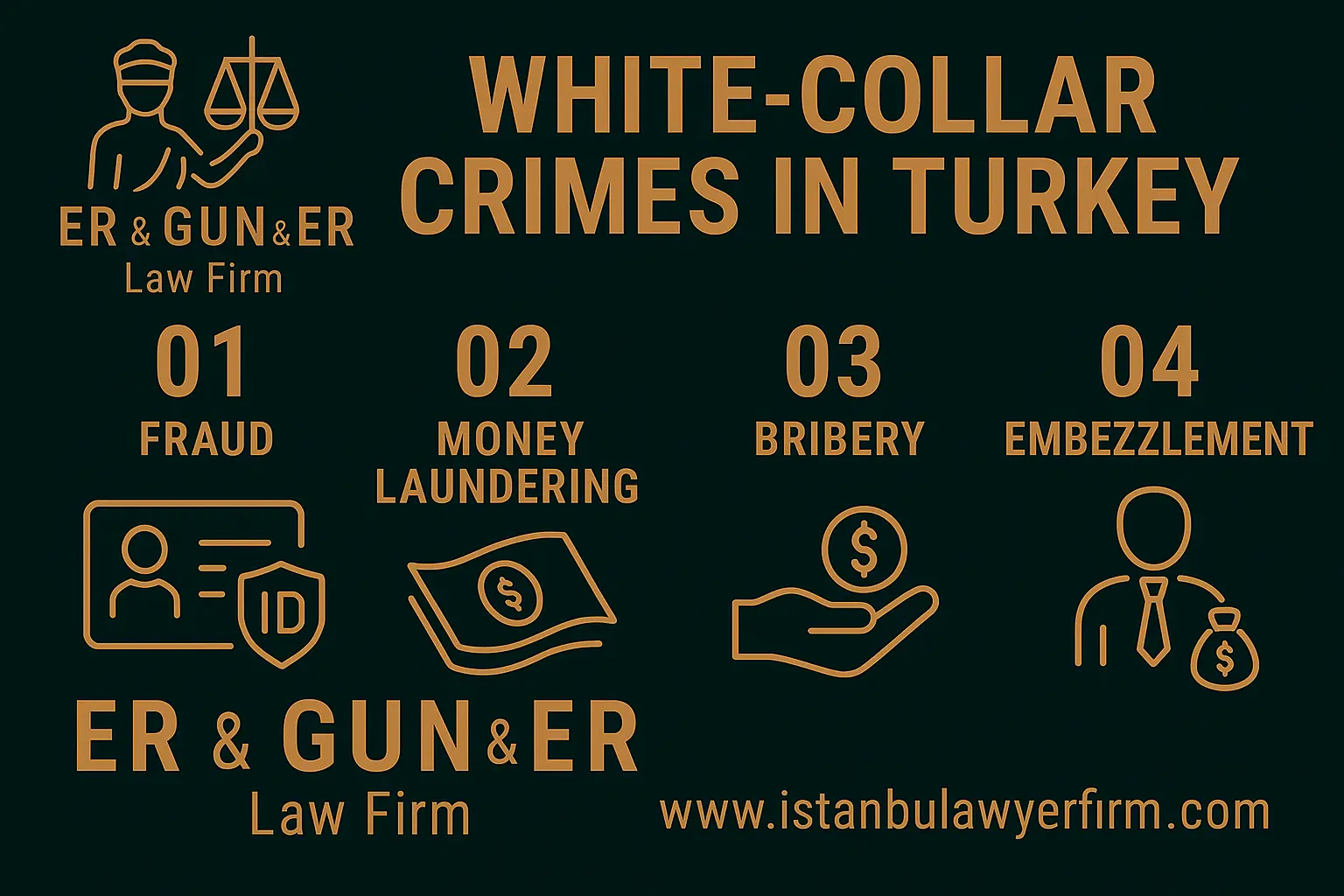
White-collar crime in Turkey covers a wide range of non-violent offences committed for financial gain — fraud, embezzlement, bribery, insider trading, market manipulation, money laundering, document forgery, and tax fraud. The legal framework is layered. The principal catalogue lives in the Turkish Penal Code (Türk Ceza Kanunu, abbreviated TCK), which is Law No. 5237 and was published in the Official Gazette on 12 October 2004. But sectoral statutes — the Capital Markets Law (Law No. 6362), the Banking Law (Law No. 5411), the Public Procurement Law (Law No. 4734), the Anti-Money Laundering Law (Law No. 5549), and the Tax Procedure Law (Law No. 213) — each create their own offences, their own administrative penalties, and their own enforcement authorities. For a foreign executive or a foreign-headquartered group operating in Turkey, the risk is rarely a single statute. It is the interaction between the criminal Penal Code track and the parallel administrative tracks run by separate regulators, each of which can independently produce significant exposure even when the criminal track collapses. This article walks through the offence catalogue, explains who investigates what, sets out the corporate-liability ceiling under Turkish law, addresses the cross-border architecture for foreign suspects, and describes the procedural and substantive defence tools that an English-speaking lawyer in Turkey deploys on a typical white-collar file. It is a guide for foreign clients and their international counsel, written in plain English with the relevant Turkish legal terms identified at first mention.
1. The Catalogue of White-Collar Offences Under Turkish Law
A Turkish Law Firm advising on a financial-crime file begins by mapping the suspected conduct against the catalogue inside the Penal Code. Fraud (dolandırıcılık) is criminalised at TCK Article 157, with a basic sentence range of one to five years and a judicial fine. The aggravated forms at Article 158 elevate the sentence to three to ten years where the fraud is committed using a public institution or a bank as the instrumentality, where it exploits a victim's vulnerable position, where it abuses a professional capacity, where the victim is a legal person, where the conduct is carried out by an organised criminal grouping, or where the resulting loss is substantial. Abuse of trust (güveni kötüye kullanma) at Article 155 protects the confidence relationship arising from custody over an asset and carries six months to two years in its basic form, escalating where the act takes place inside a service or business relationship. Embezzlement (zimmet) at Article 247 carries five to twelve years for misappropriation of public funds, with an aggravated form at Article 247/2 where fictitious documentation is used to conceal the misappropriation. Article 248 then sets out a tiered effective-remorse mechanism (etkin pişmanlık), under which restitution made before the prosecutor opens an investigation produces the largest reduction, restitution made before the indictment produces a smaller reduction, and restitution made before judgment produces a smaller one still.
An Istanbul Law Firm reviewing a fact pattern also screens for the corruption catalogue. Bribery (rüşvet) is criminalised at TCK Articles 252 to 256, with the headline offences at Article 252 (giving and receiving a bribe to a public official, four to twelve years) and Article 253 (attempts to influence judicial officials, with elevated penalties). Article 252/8 specifically covers bribery of foreign public officials and is Turkey's implementation of the OECD Anti-Bribery Convention. Article 254 sets out the effective-remorse architecture for bribery, with sharply different reduction outcomes depending on which side of the bribery transaction reports first. Bid-rigging (ihaleye fesat karıştırma) sits at Article 235 and runs in a three-to-seven-year band; it interacts with the Public Procurement Law (Kamu İhale Kanunu, Law No. 4734) under which a contractor found to have rigged a tender can be entered onto the prohibition list and excluded from public tenders for one to two years. Misuse of public office (görevi kötüye kullanma) at Article 257 covers conduct outside the bribery and embezzlement boundary where a public official acts contrary to the requirements of office and causes harm or unjust benefit. Influence-peddling (nüfuz ticareti) at Article 255 fills a related gap: it criminalises a person who claims influence over a public official and accepts a benefit in exchange for purported intervention, even where the official is not in fact aware of or party to the arrangement. The corruption catalogue therefore covers not only the classic two-sided bribery transaction, but a wider perimeter of conduct that creates exposure for foreign-headquartered groups operating through local intermediaries — agents, sales representatives, joint-venture partners — who present themselves as having access to public-sector decision-makers.
A lawyer in Turkey advising on financial-crime exposure also flags the document-related and laundering offences. Document forgery is split between public document forgery (resmi belgede sahtecilik, Article 204, two to five years in its basic form) and private document forgery (özel belgede sahtecilik, Article 207, one to three years), with sharply different sanction bands and evidentiary thresholds. Money laundering (suç gelirlerinin aklanması) at Article 282 carries three to seven years plus a judicial fine of up to twenty thousand days; the offence is predicate-linked, meaning the laundering charge requires an underlying crime whose proceeds were then concealed, transferred, or integrated. Insider trading and market manipulation are not in the Penal Code but in the Capital Markets Law at Articles 106 and 107. A banking-sector form of embezzlement, applicable inside private banks, sits at Banking Law Article 160. Tax fraud is in the Tax Procedure Law (Law No. 213) at Article 359. The first task on any new file is to identify which provision actually applies, because the choice of provision drives sentencing exposure, prescription periods, available procedural reliefs, and which authority leads the file.
2. Investigating Authorities: Public Prosecutor, MASAK, SPK and BDDK
An English speaking lawyer in Turkey running a financial-crime mandate has to know which authority sits at which stage. The criminal investigation is led by the Public Prosecutor's Office (Cumhuriyet Başsavcılığı), operating under the Code of Criminal Procedure (Ceza Muhakemesi Kanunu, abbreviated CMK, Law No. 5271, published in the Official Gazette on 17 December 2004). The prosecutor controls the investigation, decides whether to indict, and represents the public interest at trial. The prosecutor cannot, however, order intrusive investigative measures unilaterally. Searches, seizures, asset freezes, communication interceptions, and similar coercive measures must be authorised by a Magistrate's Court (Sulh Ceza Hakimliği) under specific provisions of CMK Articles 116 to 135. The investigation file is in principle confidential under CMK Article 157 until the indictment stage, with restricted access for the suspect's defence counsel where a confidentiality order has not been imposed. The defence's first procedural move, on appointment, is to file the power of attorney, apply for access to the file, audit the existing coercive-measure orders for jurisdictional and scope compliance, and identify any unlawfully obtained evidence that can later be challenged for inadmissibility under CMK Articles 206/2 and 217/2.
A Turkish Law Firm running a parallel-track matter must also map the supervisory layer. Turkey's financial intelligence unit is the Financial Crimes Investigation Board (Mali Suçları Araştırma Kurulu, MASAK), established under Law No. 5549, published in the Official Gazette on 18 October 2006. MASAK does not prosecute. It receives suspicious transaction reports from regulated entities — banks, capital-markets institutions, insurance providers, payment-services and electronic-money institutions, real-estate agents, jewellers, notaries, and certain categories of attorneys — runs financial-intelligence analysis on those reports, can impose administrative penalties under Article 13 of Law No. 5549 for know-your-customer and reporting failures, and refers files to the Public Prosecutor's Office where it identifies a money-laundering predicate. The Capital Markets Board (Sermaye Piyasası Kurulu, SPK) supervises capital-markets conduct under Law No. 6362 and runs its own administrative-investigation track for insider-trading and market-manipulation conduct. The Banking Regulation and Supervision Agency (Bankacılık Düzenleme ve Denetleme Kurumu, BDDK) supervises banking-sector conduct under Law No. 5411. The tax administration, through the Tax Inspection Board (Vergi Denetim Kurulu), handles the tax-fraud predicates that often sit beneath money-laundering files.
Turkish lawyers who handle parallel-track files have to understand that an administrative finding by the Capital Markets Board, MASAK, or the Banking Regulation and Supervision Agency substantially shapes the criminal track that follows. The administrative file becomes part of the evidence base in the prosecutor's investigation, and the defendant's positions before the regulator are scrutinised for consistency by the criminal court later. A self-incriminating concession made to an administrative regulator, in order to limit the administrative fine, can become the pivotal evidence in a later criminal indictment. Cross-border financial-services groups also have to reconcile MASAK reporting with their home-jurisdiction reporting obligations — the Financial Crimes Enforcement Network in the United States, the National Crime Agency in the United Kingdom, Tracfin in France — because the volumes diverge, the formats diverge, and a poorly-reconciled programme is one of the recurring areas where compliance gaps surface during a regulator-led inspection. Our standard advice on a developing file is to map every authority that could plausibly assert jurisdiction before any disclosure goes out, then sequence those disclosures with the criminal-track exposure firmly in mind. The cost of failing to do this is a defensive posture that contradicts itself across forums, which is the single most damaging development on a white-collar file.
3. Fraud, Embezzlement and Breach of Trust in Practice
A lawyer in Turkey running a defence on an Article 158 aggravated-fraud file deals with a statute that catalogues, at sub-paragraph level, the aggravating circumstances that elevate ordinary fraud into the three-to-ten-year band. The constitutive elements that defence counsel routinely test are: a deceptive act objectively capable of misleading a reasonable counterparty; the perpetrator's intent at the time of the act; an unlawful gain to the perpetrator or to a third party; and a corresponding loss to the counterparty. In our practice on commercial-context Article 158 files, the most defensible fact patterns turn on whether the alleged deception passes the objective threshold or instead reflects a contract-performance dispute that should sit before the civil courts under the Turkish Code of Obligations rather than before the criminal courts. A recharacterisation argument, when properly pleaded, can convert a criminal indictment into a private-law dispute, which is a materially better outcome for an executive than even a successful criminal acquittal because it removes the file from the criminal-record system entirely.
An Istanbul Law Firm handling an abuse-of-trust file under Article 155 examines whether the protected legal interest is the confidence relationship arising from a custodial role over the asset, distinct from the deception element of fraud. The aggravated form at Article 155/2 — committed in the course of a service or business relationship — carries six months to two years and a judicial fine, but the practical consequence is rarely the prison ceiling. It is the impact on the defendant's criminal record, professional licensing, and ability to hold corporate office. Where the conduct is alleged inside a public-sector role, the analysis shifts to embezzlement under Article 247, which carries five to twelve years and is itself layered: an ordinary form, an aggravated form where fictitious documentation is used to conceal the misappropriation, and the effective-remorse ladder at Article 248 that scales the reduction by the timing of restitution. The structure of the effective-remorse ladder makes early intervention by counsel decisive: the difference between a restitution made the day before the prosecutor opens the file and the day after it can be the difference between a two-thirds reduction and a one-half reduction.
Turkish lawyers who handle financial-crime defence routinely cross-train with forensic accountants, because the evidentiary battleground in fraud and embezzlement files is the transaction trail, not the witness room. In our filings, the standard reconstruction package combines audited financial statements, bank micro-data (interbank transfer and SWIFT message-level records, not just account-statement summaries), the company's internal-control documentation, and where relevant the audit logs from the SAP, ERP, or accounting system. The objective is not to win a forensic competition with the prosecutor's expert witness. It is to produce a clean, internally-consistent alternative narrative that a single-judge Criminal Court of First Instance (Asliye Ceza Mahkemesi) or a three-judge panel of the Heavy Criminal Court (Ağır Ceza Mahkemesi) can adopt as a basis for acquittal or for a sharply reduced count. Where the conduct is undeniable and the realistic objective is mitigation, the defence pivots early to restitution, effective-remorse documentation, and an application for deferment of the announcement of judgment under CMK Article 231, conditional on the two-year sentencing ceiling, the absence of a prior comparable conviction, and victim-compensation evidence. Where the imposed sentence falls above the two-year HAGB ceiling but below the alternative-sanctions threshold under TCK Articles 50 and 51, the defence pivots to suspended sentence, conversion of imprisonment into a judicial fine, or other non-custodial dispositions that preserve the defendant's commercial life while the file is administered. The combined toolkit — HAGB, suspension, conversion, and the discretionary reduction at TCK Article 62 — produces a wide range of non-custodial outcomes for first-time defendants in the white-collar catalogue, and the strategic question on a developing file is rarely "acquittal or conviction" but "which non-custodial disposition is realistically achievable on this fact pattern".
4. Money Laundering and Asset Concealment
An Istanbul Law Firm advising on a money-laundering charge under TCK Article 282 works on a predicate-linked offence. The laundering charge does not stand alone. It requires an underlying crime — the predicate offence — whose proceeds are then concealed, transferred, or integrated. The sentence band sits at three to seven years plus a judicial fine of up to twenty thousand days, with aggravation where the conduct is committed in the course of professional duties such as banking, finance, or accounting. The act of concealment can cover both the classic placement-layering-integration laundering mechanics and the simpler concealment of cash receipts from a predicate offence. A lawyer in Turkey defending an Article 282 charge focuses first on the predicate. If the underlying crime fails — for evidentiary reasons, statute-of-limitations expiry, or because the conduct does not in fact constitute an offence under Turkish law — the laundering count typically cannot stand. The second line of defence is intent: Article 282 requires intent as to the criminal origin of the funds, which means a defendant who handled the proceeds without knowledge of their tainted origin (the standard fact pattern for downstream commercial counterparties) has a doctrinal acquittal route.
An English speaking lawyer in Turkey advising a foreign-headquartered regulated entity on its Anti-Money Laundering Law obligations works on a different track: the supervisory-compliance file with MASAK. The Law No. 5549 obligations include customer due diligence (the Turkish know-your-customer regime), enhanced due diligence for high-risk relationships, suspicious transaction reporting within the prescribed period, internal training, internal audit, and the appointment of a compliance officer for institutions above the size threshold. MASAK administrative penalties under Article 13 of Law No. 5549 run on a separate track from the criminal Article 282 file. An institution can be sanctioned for know-your-customer and reporting failures even where no underlying criminal money-laundering charge is established. The supervisory framework also overlaps with Turkey's asset-freezing regime under the Prevention of the Financing of Terrorism Law (Law No. 6415), which implements United Nations Security Council asset-freezing resolutions through a separate domestic mechanism.
A Turkish Law Firm handling laundering defence and asset-freezing motions works most often on the asset-preservation angle under CMK Article 128. The freeze typically arrives before the indictment, often based on a referral package built from suspicious transaction reports forwarded by MASAK to the Public Prosecutor's Office. In our motions before the Magistrate's Court, the discharge argument turns on three pillars. The first is lawful-source documentation: audited financial statements, contracts, bank receipts, and where the source documents originate abroad, notarised translations and apostille-authenticated foreign-public-document certifications. The second is proportionality: CMK Article 123 requires the freeze to track an identifiable economic equivalence with the alleged proceeds, not the defendant's wider asset universe. The third is procedural compliance: whether the underlying authorisation order specifies the asset universe with the precision the case-law of the Court of Cassation (Yargıtay, Turkey's supreme court of appeal in civil and criminal matters) requires. Where a freeze covers operational accounts that fund payroll or supplier payments, we also pursue partial-discharge applications targeted at maintaining business continuity, supported by an undertaking to preserve the disputed quantum in escrow. The procedural sequencing also matters: a discharge motion brought before the indictment runs through the Magistrate's Court under CMK Article 128, while a discharge motion brought after the indictment shifts to the trial court — Criminal Court of First Instance or Heavy Criminal Court — that has been seized of the file, with appellate review through the regional appeal court and the Court of Cassation. Foreign clients are often surprised that a freeze remains in place even where the prosecutor has formally referred the file to dismissal, until the Magistrate's Court specifically lifts the order in a separate decision. Counsel's role on a frozen-asset file is therefore not just to win the substantive merits, but to operationalise the discharge mechanics in a way that keeps the client's commercial operations functioning during what can be a multi-year investigation.
5. Insider Trading and Market Manipulation
A Turkish Law Firm advising a Borsa Istanbul-listed issuer or a foreign dual-listed group with Turkish operations works on the Capital Markets Law framework. Article 106 of Law No. 6362 criminalises insider trading: the use, in connection with a capital-markets transaction, of non-public price-sensitive information by a person who possesses that information by virtue of their corporate role, contractual access, or position. Article 107 criminalises market manipulation: transactions and orders that produce or are capable of producing a misleading signal about price, supply, or demand, including pump-and-dump schemes, spoofing, layering, and trade-based manipulation patterns. The sanction architecture combines criminal sentencing in the two-to-five-year band with judicial fines calibrated to the gain produced by the conduct, plus a wide range of Capital Markets Board administrative powers including transaction nullification, transaction-related disgorgement, blocking of account access, and referral to the Public Prosecutor's Office for the criminal track.
An Istanbul Law Firm running an Article 106 defence operates against an evidentiary architecture built largely on quantitative signals: the timing of orders against the publication window of price-sensitive information, the deviation of order patterns from the defendant's historical trading profile, account-level connections between the alleged insider and the executing accounts, and communication-trace evidence drawn from CMK Article 135 interception orders. The standard defence pillars are: that the information was not in fact non-public at the relevant time (it had been disclosed via the Public Disclosure Platform, the Borsa Istanbul disclosure portal known as KAP, in a prior window); that the information was not in fact price-sensitive (the materiality threshold under Capital Markets Board practice was not met); that the trading pattern was independently explicable (a pre-existing investment programme, a portfolio-rebalancing pattern, a fund-mandate-driven allocation); or that the defendant did not have access to the information through the alleged channel. In our practice on layered insider-trading files, the most decisive single document is often the issuer's insider list and the contemporaneous emails between the issuer's in-house counsel and the counterparty's deal team, both of which speak directly to the access question.
A lawyer in Turkey advising on a market-manipulation file works on a different evidentiary battleground. Quantitative analysis dominates: order-book reconstructions, microstructure analysis of the cancellation-to-execution ratio, cross-account coordination patterns, and the price-impact attribution of the trades alleged to be manipulative. The Capital Markets Board's administrative-investigation track produces an investigation report before the file moves to the criminal docket. Defence counsel must engage at the Capital Markets Board stage rather than waiting for the criminal forum, because the administrative findings shape the prosecutor's legal classification of the conduct, and the regulator's file becomes part of the criminal evidence base. Foreign-issuer groups also have to reconcile their Capital Markets Board defence with parallel proceedings before the United States Securities and Exchange Commission, the United Kingdom Financial Conduct Authority, or other home-jurisdiction regulators, because inconsistent factual narratives across regulators are themselves a recurring source of incremental exposure.
6. Bribery and Public Procurement Offences
An English speaking lawyer in Turkey advising a foreign investor on bribery and procurement risk works against a layered statute. Bribery under TCK Article 252 covers conduct involving public officials and carries four to twelve years. Article 252/8 specifically covers bribery of foreign public officials, the Turkish implementation of the OECD Convention on Combating Bribery of Foreign Public Officials in International Business Transactions. Article 253 elevates the conduct where the recipient is a judicial officer. Article 254 sets out the effective-remorse architecture, with sharply different reduction outcomes depending on which side of the bribery transaction reports first and within what window. Article 255 covers a related offence: a public official securing an unlawful benefit for an act outside their authority. Bid-rigging in public procurement at Article 235 runs in a three-to-seven-year band and operates alongside the Public Procurement Law's administrative debarment regime.
A Turkish Law Firm advising a foreign-headquartered group with Turkish operations also works on the consequences under the Public Procurement Law that run alongside the criminal track. A bid-rigging finding, even at the administrative stage, can trigger debarment from public tenders. The prohibition list maintained under Article 58 of Law No. 4734 disqualifies the listed entity, its representatives, and connected parties from public tenders for a period of one to two years. For an investor whose Turkish revenue stream depends on the public sector — infrastructure, defence, healthcare, energy — debarment is often a more material commercial consequence than the headline criminal sentence. We sequence defence accordingly. Arguments aimed at avoiding the debarment trigger — typically by attacking the legal classification of the conduct, the proportionality of the proposed measure, or the procedural compliance of the underlying inspection — run in parallel with the criminal-track defence and are too often handled as an afterthought rather than as a strategic pillar.
Turkish lawyers who advise on cross-border bribery exposure also have to manage the United States Foreign Corrupt Practices Act and the United Kingdom Bribery Act 2010 overlay. The Turkish subsidiary of a United-States-issuer group can produce simultaneous Securities and Exchange Commission and Department of Justice exposure on the same fact pattern that supports a TCK Article 252 indictment in Turkey. The United Kingdom Bribery Act's Section 7 corporate-failure-to-prevent offence has extra-territorial reach over United-Kingdom-incorporated parents and their associated persons. In our cross-border files we run a synchronisation protocol: privilege management between Turkish and home-jurisdiction counsel, evidence-disclosure sequencing that does not surrender Turkish criminal-defence positions to satisfy a United States discovery demand, and consistency in the factual narrative across regulators. Inconsistencies between Securities and Exchange Commission submissions and Turkish prosecutor submissions are a recurring source of incremental exposure that is entirely avoidable with proper sequencing. We also advise clients on the third-party risk vectors that often produce a Turkish bribery indictment for a foreign-headquartered group: the local sales agent paid on commission, the procurement intermediary engaged to navigate licensing, the consultant retained to expedite a regulatory approval, the joint-venture partner with deep public-sector connections. Each is a foreseeable channel for conduct that, if it occurred, would expose the foreign principal under both the Turkish bribery framework and the home-jurisdiction equivalent. The defensive infrastructure on these third-party vectors is built pre-incident: contractual anti-bribery undertakings, audit rights, payment controls that prevent disbursements outside approved channels, and a documented onboarding due-diligence file that survives prosecutorial scrutiny years after the relationship closes.
7. Corporate and Director Liability Under Turkish Law
A lawyer in Turkey responding to a foreign general counsel's first question — "can my company be charged in Turkey?" — has to walk the corporate-liability ceiling carefully. TCK Article 20/2 codifies the general principle that legal persons cannot be subject to criminal punishment in the strict prison-or-judicial-fine sense. Companies can, however, be subjected to security measures under TCK Article 60, principally confiscation of the proceeds and instruments of the offence, and revocation of the permits or authorisations that enabled the conduct. Personal criminal liability, by contrast, attaches to the natural-person director, officer, or employee whose conduct, intent, and causal contribution meet the offence elements. The architecture is meaningfully different from common-law corporate-criminal-liability regimes — where the entity itself appears on the docket as a defendant — and it shifts the strategic centre of gravity. A foreign group's defence priority in Turkey is overwhelmingly the protection of the natural-person directors and officers, because the entity's exposure is principally administrative and asset-side rather than docket-side.
An Istanbul Law Firm advising a board-level audience also has to cover the parallel civil-track exposure under the Turkish Commercial Code (Türk Ticaret Kanunu, Law No. 6102) at Article 553 — the directors' personal-liability regime — and the related liability of statutory auditors at Article 554. Article 553 imposes liability where the director, by violating the duty of care, causes loss to the company, the shareholders, or the company's creditors. The applicable standard of care is the diligent-merchant standard at Article 18/2 of the Commercial Code, calibrated by the role and the information reasonably available to the director. A criminal acquittal does not extinguish Article 553 civil liability. The standards of proof, the burden of proof, and the evidentiary thresholds differ between criminal and civil tracks, and a criminal-track outcome that turns on prosecutorial-burden failure may leave the civil-track exposure intact. Foreign-headquartered groups also have to map the director-liability regime onto their group-level directors-and-officers insurance programme. The standard Turkish-language directors-and-officers wording is built around a different liability architecture than the New York or London market wording, and a gap analysis on the policy schedule is one of the recurrent post-incident exercises in our practice.
Turkish lawyers who advise on group-level structures also work on the indirect-liability angle. A director who did not personally execute the conduct can still be charged as an instigator or accomplice under TCK Articles 38 and 39, where the evidentiary chain establishes the requisite participation and intent. The defence pillars on indirect liability are: the absence of intent at the relevant time; the absence of effective control over the executing actor; and the presence of a documented compliance and supervision infrastructure that operationally allocated the risk to a different layer of the organisation. The third pillar — compliance documentation — is the one most under counsel's control before the file opens, and it is the area where pre-incident investment in policies, training records, escalation logs, and audit-committee minutes pays out when an indictment lands. A board that can produce a contemporaneous record of having delegated, supervised, and acted on red flags is in a fundamentally different evidentiary position than a board that cannot.
8. Cross-Border Enforcement, Extradition and Foreign Judgments
A Turkish Law Firm advising a foreign suspect on the cross-border architecture works first on the extradition framework. Turkey's extradition framework is set out principally in the Law on Judicial Cooperation in Criminal Matters with Foreign Countries (Law No. 6706), supplemented by the bilateral and multilateral treaties to which Turkey is a party. Turkey is a contracting state to the 1957 European Convention on Extradition and the 1959 European Convention on Mutual Assistance in Criminal Matters. Turkey does not extradite Turkish citizens — a constitutional protection under Article 38 of the Constitution — but a Turkish citizen accused of conduct abroad can be prosecuted domestically under the territorial, active-personality, passive-personality, or universality jurisdictional bases set out in TCK Articles 8 to 13. For foreign nationals located in Turkey and the subject of an extradition request, the request is reviewed by the competent Heavy Criminal Court under Law No. 6706, with appellate review through the regional appeal court and ultimately the Court of Cassation.
An English speaking lawyer in Turkey representing a client subject to an Interpol Red Notice works on a different procedural axis. A Red Notice is not an arrest warrant. It is a request circulated by the International Criminal Police Organisation for the provisional arrest of a person pending an extradition decision. The remedies a defence team has on a Red Notice are: a substantive challenge before the Commission for the Control of Files at Interpol headquarters in Lyon, on the grounds that the notice violates Article 3 of Interpol's Constitution (the political-character bar) or Article 2 (the human-rights bar); engagement with the Turkish National Central Bureau, which sits within the Directorate General of Security; and substantive arguments under the bilateral or multilateral treaty governing the underlying request. We also advise foreign clients on the financial-services consequences of a Red Notice. The practical impact on banking access, correspondent-banking relationships, and visa applications often exceeds the procedural impact, and the risk-mitigation architecture has to address both the legal-track and the financial-services track.
Turkish lawyers who handle the civil and asset-recovery angles of cross-border financial-crime files also work on the Code on Private International Law and Procedural Law (Law No. 5718) at Articles 50 to 58 — the recognition and enforcement of foreign judgments and arbitral awards in Turkey. A foreign restitution judgment against a Turkish-based asset holder is enforced through an enforcement action before the competent court, subject to the conditions in Article 54: reciprocity between Turkey and the issuing jurisdiction, jurisdictional regularity of the foreign court, public-order compatibility of the substantive outcome, and proper service of process on the defendant in the foreign proceeding. Foreign arbitral awards are recognised and enforced under the 1958 New York Convention, to which Turkey has been a contracting state since 1992, with the standard recognition defences tracking Article V of the Convention. The practical sequencing for a restitution-track plaintiff is rarely the recognition motion itself. It is the prior asset-tracing exercise that locates the assets in Turkey against which enforcement can be directed.
9. Pre-Trial and Trial Defence Strategy
A lawyer in Turkey running a financial-crime defence works through a procedural-tool inventory before turning to substantive arguments, because the procedural tools shape the substantive forum. The first tool is the non-prosecution decision under CMK Article 171/2, which the prosecutor may issue where the evidence does not support an indictment. The complainant or victim can challenge that decision through the appeal route in CMK Article 173 to the Magistrate's Court. The second tool is deferment of the opening of prosecution under CMK Article 172, available for natural-person defendants where the offence ceiling, the absence of a prior comparable conviction, and the victim-compensation conditions are met. Deferral runs for five years and converts to non-prosecution if the conditions are observed throughout. The third tool is deferment of the announcement of judgment, abbreviated in Turkish practice as HAGB, under CMK Article 231. HAGB is available where the imposed sentence is at or below two years, the defendant has no prior comparable conviction, and victim compensation is paid. HAGB runs for five years and on satisfactory completion the prosecution is deemed never to have been pronounced. It is the single most-used disposition tool on financial-crime files within the eligibility band.
A Turkish Law Firm advising on substantive defence runs the effective-remorse architecture in parallel. The structure varies by offence. TCK Article 248 (embezzlement) tiers the reduction by the timing of restitution: before the prosecutor's investigation opens, before the indictment, before judgment. TCK Article 254 (bribery) tiers reduction by which side of the transaction reports first and within what window. TCK Article 282 (money laundering) does not contain an embedded effective-remorse ladder, but the discretionary-reduction provision at Article 62 and the alternative-sanctions tracks at Articles 50 and 51 — suspended sentence, conversion of imprisonment into a judicial fine, conversion of imprisonment into community service, or other alternative sanctions for sentences below the statutory threshold — remain available. The strategic point is that effective remorse is overwhelmingly time-sensitive. A restitution made before the prosecutor's investigation opens may produce a two-thirds reduction. The same restitution made after indictment may produce only a one-third reduction. A restitution made after the trial-court judgment has been entered into the file is too late for the statutory ladder, although it remains available for discretionary reduction. Counsel's role on a developing file is to surface the option to the client at the earliest viable point and to document the restitution mechanics in a way that survives the prosecutor's audit.
Turkish lawyers who handle procedural defence also work the evidence-exclusion track under CMK Articles 206/2 and 217/2. Unlawfully obtained evidence is inadmissible. The recurring exclusion arguments turn on coercive-measures procedure: was the search authorised by the Magistrate's Court under CMK Articles 116 to 119 with the required scope and address specificity; was the suspect's right to defence-counsel presence under Article 119 respected; was the digital-evidence chain under Article 127 — including the expert-witness imaging and hash-verification steps — operationally complete; was the asset-freeze authorisation under Article 128 specific to the asset universe rather than a generic catch-all; was the communication-interception order under Article 135 time-bounded and limited to the offences enumerated in the statute. We also screen for defects in the questioning procedure under Articles 147 and 148 — the suspect's right to silence, the prohibition on coercive techniques (physical or psychological pressure, fatigue-based questioning, deception, drug-induced statements), and the mandatory-defence-counsel rule under Article 150 for offences carrying a sentence ceiling of five years or more. A material defect at the investigation stage that produces an exclusion ruling at the trial stage can collapse the prosecution's evidentiary architecture even on a strong-on-paper file. Where the defence position has been exhausted before the Court of Cassation and the conviction has become final, two further layers of review remain available. The Constitutional Court (Anayasa Mahkemesi) accepts individual applications under Article 148 of the Constitution within a thirty-day window from the final domestic decision, on the grounds of violations of fundamental rights and freedoms guaranteed by the Constitution and the European Convention on Human Rights. The European Court of Human Rights at Strasbourg accepts applications after exhaustion of the Constitutional Court route within the Convention's prescribed window. The supranational review is not a third instance on the merits, but a check on whether the Convention's procedural guarantees were respected during the domestic process.
10. Compliance Architecture: Prevention and Post-Incident Response
An Istanbul Law Firm advising a foreign group on Turkey-side compliance architecture works on the pre-incident layer first. The standard package includes: a written code of conduct adapted to Turkish-language operational reality; an anti-bribery and anti-corruption policy that maps onto the conduct categories at TCK Articles 235 and 252 to 256; an Anti-Money Laundering Law-aligned know-your-customer and suspicious-transaction-reporting programme for any group entity within the regulated-entity perimeter; a Personal Data Protection Law (Law No. 6698) programme covering data minimisation, retention, and the lawful-basis architecture under Articles 5 and 6; a Capital Markets Law-aligned insider-list and pre-trade-clearance programme for any group entity with capital-markets exposure; and a director-conduct policy that operationalises the diligent-merchant standard under the Commercial Code in a way that produces documentary evidence of compliance. The objective is not paper compliance. It is documentary defensibility. Every policy line should be supported by training-completion records, internal-audit trail, and a documented escalation history, because in a regulator-led inspection the gap between policy and execution is what produces exposure.
A Turkish Law Firm running the internal-investigation function for a foreign client works against a different architecture. There is no statutory privilege for internal investigations of the type the United States attorney-client and work-product doctrine confers. The protective architecture is built up indirectly: through the attorney's confidentiality obligation under Article 34 of the Law on Lawyers (Avukatlık Kanunu, Law No. 1136), through the protection of attorney-client communications during the criminal process under CMK Article 136, and through contractual confidentiality undertakings. The practical implication is that internal-investigation memoranda must be structured from inception with the criminal-track exposure in mind. The report's distribution list, its commissioning channel — a board-level engagement letter to external counsel, rather than an internal compliance memorandum — and its content discipline (legal analysis rather than free-form factual narrative) all shape the protected status of the work product. We routinely advise on a two-tier architecture: a privileged legal-analysis memorandum prepared by external counsel, distinct from a non-privileged factual-investigation file maintained by internal compliance, with controlled bridging between the two.
Turkish lawyers who handle post-incident remediation also work on the regulator-facing dimension. Where the Capital Markets Board, MASAK, or the Banking Regulation and Supervision Agency has opened an inspection that produced an administrative-penalty proposal, the remediation programme — typically including governance changes, training programmes, control upgrades, and an undertaking-letter to the regulator — is a leverage point on the penalty calibration. Where the criminal track is also live, the same remediation evidence runs into the discretionary-reduction assessment under TCK Article 62 and the victim-compensation prong of HAGB under CMK Article 231. Sequencing matters. A remediation programme rolled out pre-emptively, before the regulator's penalty proposal lands, has materially more weight than the same programme produced reactively after the proposal. In our practice, the foreign clients who emerge from a Turkish financial-crime exposure with the smallest commercial damage are uniformly the ones who started the remediation work the week the file opened, not the week the indictment landed. A criminal-defence practice without a remediation arm is, on a financial-crime file, an incomplete practice.
Frequently Asked Questions
- Which statutes form the white-collar catalogue in Turkey? The principal catalogue is the Turkish Penal Code (Law No. 5237), which covers fraud, embezzlement, bribery, abuse of trust, document forgery, misuse of public office, and money laundering. Sectoral overlays sit in the Capital Markets Law (Law No. 6362), the Banking Law (Law No. 5411), the Public Procurement Law (Law No. 4734), the Anti-Money Laundering Law (Law No. 5549), and the Tax Procedure Law (Law No. 213).
- Can a company be criminally charged in Turkey? No, not in the strict prison-or-judicial-fine sense. The Penal Code limits criminal punishment to natural persons. Legal entities are subject to security measures — confiscation of proceeds and revocation of authorisations — and to administrative penalties under the relevant sectoral statutes. Personal criminal liability attaches to the directors, officers, and employees whose conduct meets the offence elements.
- Which authorities investigate financial crime in Turkey? The Public Prosecutor's Office leads the criminal investigation. The Financial Crimes Investigation Board (MASAK) runs financial-intelligence analysis under the Anti-Money Laundering Law. The Capital Markets Board (SPK) supervises capital-markets conduct. The Banking Regulation and Supervision Agency (BDDK) supervises banking-sector conduct. The Tax Inspection Board handles tax-fraud predicates.
- What is the sentencing range for fraud and embezzlement? Ordinary fraud carries one to five years. Aggravated fraud carries three to ten years plus a judicial fine. Embezzlement of public funds carries five to twelve years, with tiered effective-remorse reductions calibrated to the timing of restitution.
- What is the sentencing range for bribery? Bribery of public officials carries four to twelve years. The same range applies to bribery of foreign public officials under the Penal Code provision implementing the OECD Anti-Bribery Convention. Bid-rigging in public procurement carries three to seven years and triggers debarment from public tenders for one to two years.
- What is the sentencing range for money laundering? Three to seven years plus a judicial fine of up to twenty thousand days, with aggravation for conduct in the course of professional duties such as banking, finance, or accounting. The offence is predicate-linked: a laundering charge requires an underlying crime whose proceeds were concealed, transferred, or integrated.
- How does asset freezing work? The Public Prosecutor's Office applies to the Magistrate's Court under Article 128 of the Code of Criminal Procedure for an order freezing real estate, shareholdings, bank accounts, and receivables. The freeze can be challenged through discharge motions, and partial-discharge motions are available to preserve operational continuity for a defendant company.
- Does Turkish law recognise plea bargaining? No, not in the Anglo-American sense. Turkish criminal procedure does not include a plea-bargain mechanism. The functionally adjacent procedural reliefs are non-prosecution under Article 171/2, deferment of the opening of prosecution under Article 172, deferment of the announcement of judgment (HAGB) under Article 231, and the offence-specific effective-remorse ladders in the Penal Code.
- Can a foreign citizen be prosecuted in Turkey? Yes. The Penal Code establishes territorial jurisdiction over conduct in Turkey and additional jurisdictional bases for foreign nationals where Turkish citizens or interests are affected, where the conduct affects Turkey's security, or where the offence is one of the categories subject to universal jurisdiction.
- How does Turkey handle extradition requests for white-collar suspects? Extradition runs under Law No. 6706 on Judicial Cooperation in Criminal Matters with Foreign Countries and the relevant treaties, including the 1957 European Convention on Extradition. Turkey does not extradite its own citizens, but can prosecute them domestically. Foreign nationals subject to extradition requests are reviewed by the competent Heavy Criminal Court.
- What is the role of MASAK? MASAK is Turkey's financial intelligence unit. It receives suspicious transaction reports from regulated entities, runs financial-intelligence analysis, can impose administrative penalties for know-your-customer and reporting failures, and refers files to the Public Prosecutor's Office where it identifies a money-laundering predicate.
- What is HAGB? HAGB is the Turkish-language abbreviation for deferment of the announcement of judgment. It is available under Article 231 of the Code of Criminal Procedure where the imposed sentence is at or below two years, the defendant has no prior comparable conviction, and victim compensation is paid. HAGB runs for five years; on satisfactory completion the prosecution is deemed never to have been pronounced.
- Are internal investigations privileged in Turkey? There is no statutory privilege of the United States attorney-client and work-product type. Protection is built indirectly through the attorney's confidentiality obligation under Article 34 of the Law on Lawyers, the protection of attorney-client communications under Article 136 of the Code of Criminal Procedure, and contractual confidentiality. Internal-investigation memoranda should be structured from inception with the criminal-track exposure in mind.
- Does a criminal acquittal extinguish a director's civil liability? No. Director civil liability under Article 553 of the Turkish Commercial Code runs on a separate evidentiary standard and burden. A criminal-track outcome that turns on prosecutorial-burden failure can leave Article 553 civil liability intact.
- How are foreign judgments and arbitral awards enforced in Turkey? Foreign court judgments are enforced through an enforcement action under Articles 50 to 58 of the Code on Private International Law, subject to reciprocity, jurisdictional regularity, public-order compatibility, and proper service. Foreign arbitral awards are enforced under the 1958 New York Convention.
About the Author
Av. Mirkan Günay Topcu is the managing partner of ER&GUN&ER Law Firm (Istanbul) and is registered with the Istanbul Bar Association under No. 67874. His practice covers cross-border financial-crime defence, capital-markets and corporate-governance work for foreign-headquartered groups operating in Turkey, and the procedural-defence side of financial-crime investigations where the procedural posture is set in the early investigation window.
The author works principally with foreign nationals, foreign-incorporated entities, and multinational legal teams who require a Turkish Law Firm able to interface in English with home-jurisdiction counsel while maintaining substantive depth on Turkish criminal procedure and case-law. Day-to-day work covers Public Prosecutor's Office investigations, Magistrate's Court coercive-measures motions, Capital Markets Board and MASAK administrative-track files, and HAGB and prosecution-deferral applications across the white-collar offence catalogue described in this article.
Profile: LinkedIn. ER&GUN&ER Law Firm advises foreign nationals and foreign-headquartered groups on the full Turkey legal interface — from real estate and citizenship by investment to corporate, tax, immigration, and the financial-crime defence catalogue covered in this article and its companion guide on white-collar crime defence procedure in Turkey.
Contact ER&GUN&ER Law Firm