

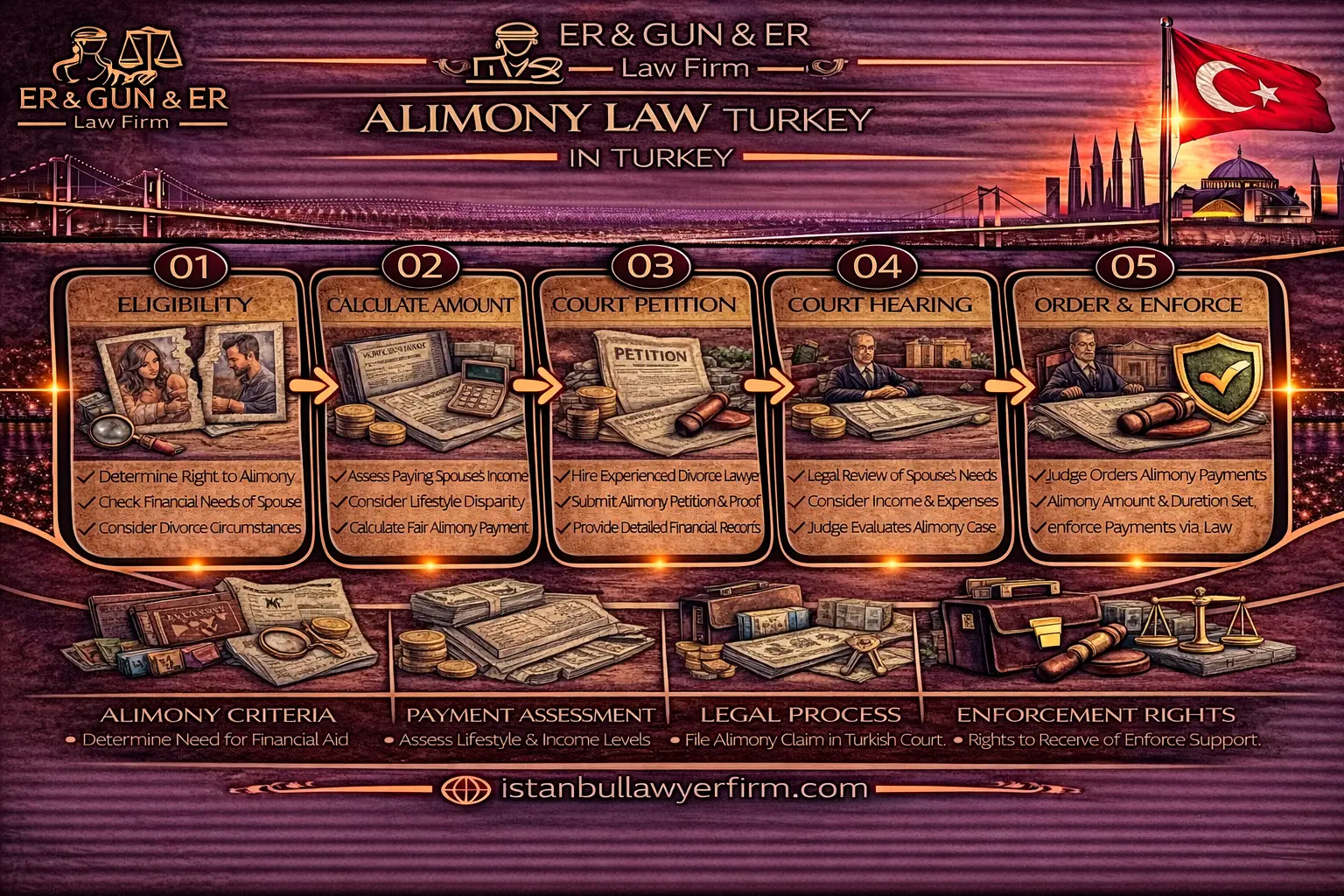
In Turkey, alimony is a court-ordered support obligation that can arise during a divorce case or after a divorce judgment. People use the term alimony law Turkey to describe both interim support during proceedings and post-divorce support awarded on the merits. The second concept is divorce alimony Turkey, which is not a single product but a set of support measures tied to needs, ability to pay, and fairness. Interim support is designed to stabilize housing, daily expenses, and children’s routines while the case is pending. Post-divorce support is assessed with longer-term prospects in mind and is usually argued with financial and lifestyle evidence rather than slogans. Because courts decide on documents, the winning strategy is to prove needs and ability with bank records, payroll, invoices, and credible witness-free paper trails. Parties who rely on verbal assurances or social media formulas often lose leverage because they cannot prove the underlying facts. If you are a foreign spouse or you live abroad, bilingual documentation and consistent translations become decisive, and an English speaking lawyer in Turkey can prevent name and date mismatches from undermining the file. For case management and procedural accuracy, early guidance from a lawyer in Turkey helps you avoid admissions, preserve evidence, and select the right remedy at the right time.
Alimony law overview
Spousal support Turkey is not an automatic entitlement, because Turkish family courts assess the parties’ circumstances and the reason the support is requested. The legal source is the Turkish Civil Code alimony principles, but the practical outcome is shaped by the case file and the court’s fact findings. Support can be requested during the case to protect immediate living conditions, and it can also be requested after divorce to address ongoing need. The court usually looks at the standard of living during marriage, the current needs of the applicant, and the proven ability of the other party to contribute. The court also considers whether the request is proportionate and whether it would create unjust hardship on the payer. Because there is no single universal formula, parties should focus on credible documentation rather than on internet calculators. A reliable legal adviser will start by building a timeline of marriage, separation, interim orders, and the financial records that correspond to each period. The same adviser will identify what must be proven now for interim relief and what can be proven later for the final judgment. Many disputes arise because one party mixes asset division arguments with support arguments without separating evidence and legal bases. Separating the issues early helps negotiation because it clarifies which payments are temporary support and which are property-settlement tradeoffs. In cross-border marriages, the court record must also explain residence history and currency realities without exaggeration. If you need a structured approach, an Istanbul-based practice such as a law firm in Istanbul can organize evidence, translations, and hearing preparation under one indexed file. This organization matters because missing exhibits are often more damaging than weak arguments. When the court’s expectations differ by city or judge, practice may vary by authority and year — check current guidance. A good overview therefore is not a promise of outcome, but a map of what the court can verify and what the parties can realistically enforce.
Support disputes should be evaluated together with custody, visitation logistics, and property division, but each issue must keep its own evidence trail. Alimony is typically argued with monthly budgets, household expenses, and proof of prior contributions during the marriage. Courts are cautious about purely aspirational budgets, so each budget line should be tied to invoices, contracts, or market-level references. On the payer side, ability-to-pay is not proven by self-serving statements, but by payroll, tax filings, and bank movement indicators. If one party is self-employed, the court may require a deeper review of company accounts and cash flow realities. If one party is unemployed by choice, the court may scrutinize earning capacity and realistic job prospects. If one party claims health limitations, medical evidence should be presented in a controlled way that is readable and verifiable. The court also evaluates whether the support request is connected to the marriage breakdown or to unrelated voluntary choices. Where parties cohabitate after separation or where third-party support exists, the file should document the actual living arrangement. The more fact-specific the record is, the less the decision depends on credibility impressions at hearing. This is why written communication, delivery proofs, and consistent narratives across petitions are central. A coordinated legal team within a Turkish Law Firm can also prevent contradictory submissions when multiple relatives or foreign advisers are involved. If interim orders exist, both sides should track compliance precisely because non-compliance influences later trust and risk assessments. It is also important to anticipate enforcement early, because a strong judgment with weak collectability has limited practical value. The overview stage is therefore where you decide whether to pursue aggressive litigation, structured settlement, or a hybrid approach.
Before taking any procedural step, clarify whether your dispute is primarily about interim stability or long-term post-divorce support. If you need orientation on how Turkish courts structure family disputes, the family law landscape provides context on how support, custody, and property issues are sequenced. Your first strategic decision is whether to seek interim support immediately or to focus on final judgment preparation. Interim requests require speed and targeted proof, while final requests require fuller financial mapping and longer-term projections. The second decision is whether you will accept negotiation-driven resolution or insist on a full evidentiary hearing. Negotiation can be effective when both sides can verify income and expenses and when payment mechanisms are enforceable. Litigation is usually necessary when income is concealed, when the payer is hostile, or when the parties cannot even agree on baseline living costs. In either route, you should avoid public accusations and stick to document-backed assertions. You should also avoid assuming that one court practice in one province will automatically apply in another province. Where children are involved, the court expects that support proposals do not undermine the child’s stability or schooling. Where a spouse relocated abroad, the court record should explain how expenses are paid and how currency movements affect real purchasing power. If one party claims that the other is supported by relatives, that claim must be proven with credible records, not speculation. If the dispute includes domestic violence allegations, counsel must coordinate protective measures separately from support calculations. The best preparation is to maintain a clean file with dated exhibits and a chronological index that can be referenced quickly at hearing. When the overview is complete, the rest of the case becomes an evidence project with defined targets rather than a moving argument.
Types of alimony Turkey
The term Types of alimony Turkey is commonly used, but Turkish practice recognizes several distinct support concepts with different purposes. One widely discussed category is poverty alimony Turkey, which is a post-divorce support concept tied to ongoing need and comparative hardship. Another category is interim support ordered while a divorce or separation case is pending, intended to stabilize living conditions before final judgment. There is also child-related support that focuses on the child’s needs and the parents’ contribution abilities, which should not be confused with spouse support. Some files include contributions for education or health expenses that are not monthly support but are still framed as periodic obligations. Support can also be structured as periodic payments or as a lump-sum arrangement if the parties agree and the court accepts the structure. Lump-sum structures are often negotiated to reduce long-term enforcement risk, but they require careful valuation and payment security. Periodic structures provide flexibility, but they create long-term compliance and modification questions. The correct category matters because each category has different evidentiary focus and different modification triggers. Mislabeling a request can weaken credibility because the court may interpret the request as legally confused. Therefore, counsel should draft petitions with clear category description and clear factual basis. The petition should explain whether the request is temporary support, post-divorce support, or child-centered support. It should also explain why the requested type fits the case stage and the parties’ living arrangement. Because categorization can change with procedural stage, practice may vary by authority and year — check current guidance. A clean categorization helps later settlement because each payment can be mapped to a legal purpose and documented obligations.
Choosing the right support category is a strategic choice because it controls what you must prove and how fast you must prove it. If your goal is immediate stability, you prioritize provisional requests and narrow evidence that shows urgent need. If your goal is long-term support, you prioritize full financial mapping and a narrative tied to marriage standard of living. If your goal is child stability, you isolate child expenses from spouse expenses so the court can see the child’s needs clearly. Parties often make mistakes by requesting a single large number without explaining which expenses it covers. Courts respond better to structured budgets with supporting documents than to one global figure. You should also avoid claiming punitive support because Turkish family courts generally assess support as need-based and fairness-based. Where one party proposes support as a bargaining chip for property division, the agreement should be documented carefully to avoid later disputes. A competent adviser will explain that support and property division have different legal bases, even when negotiated together. Because outcomes are fact-driven, the value of a best lawyer in Turkey is in evidence strategy and procedural sequencing, not in predictions. Ask counsel to clarify which documents are mandatory at each stage and which documents are helpful but optional. Ask counsel to clarify how interim payments will be credited or treated when the final judgment is issued. Ask counsel to clarify how a lump-sum proposal would be secured and what happens if the payer defaults. When the payer’s income is unstable, counsel should discuss whether periodic payments or structured installments are more enforceable. The right type is the one that the court can verify and that you can realistically enforce through available mechanisms.
Types should also be aligned with the case narrative to avoid contradictory positions. If you claim you are self-sufficient for property division purposes but needy for support purposes, explain the difference clearly. If you claim you have no income but show high spending, expect the court to ask how spending is funded. If you claim the other party has high income but cannot show any work records, expect the court to demand concrete indicators. If a party lives abroad, clarify whether foreign support obligations exist and how they interact with the Turkish file. If the parties have a prenuptial or marital property agreement, clarify whether it affects support arguments indirectly. If the marriage is short, the court may focus more on interim stabilization than on long-term dependency narratives. If the marriage included significant lifestyle differences, document the lifestyle baseline with provable records rather than exaggerations. If a spouse has a disability or caregiving responsibilities, present official documents that show the limitation and its economic effect. If the payer has other dependants, document those obligations because ability-to-pay analysis considers total responsibilities. If support is agreed by settlement, ensure the settlement specifies payment method, indexation concept, and enforcement route. If support is ordered by court, ensure the order is clear enough to be executed without interpretive disputes. If there is disagreement on the category, focus on facts and propose alternative formulations rather than insisting on labels. Keep in mind that the court’s language can differ from the parties’ language, and wording choices affect enforcement. A disciplined approach is to treat categories as tools and to choose the tool that fits your evidence and enforcement reality.
Interim support measures
Interim support is usually requested early in the case to prevent immediate financial shock. The phrase interim alimony Turkey is used to describe temporary court-ordered support pending the final divorce judgment. The court’s focus at this stage is urgency, minimal sufficiency, and documentary plausibility. The applicant should present a realistic monthly budget tied to rent, food, transport, and essential bills. The applicant should also present evidence that the other party has ability to contribute, such as payroll indicators or bank movements. Interim requests should avoid speculative future expenses and instead focus on current, unavoidable needs. Interim requests should also avoid punitive language and focus on stability and fairness. If children are involved, the interim request should separate child expenses from spouse expenses to avoid confusion. The payer should respond with documented ability-to-pay evidence, not only denials. If the payer claims inability, the payer should show current liabilities and support obligations with proof. Because interim orders can be issued quickly, document collection must be prioritized from day one. This is where experienced Turkish lawyers add value by preparing a short, court-readable evidence bundle rather than a long narrative. Interim measures can include support for housing, healthcare, and temporary schooling continuity when documented. The specific approach can differ by court and by city, so practice may vary by authority and year — check current guidance. A clean interim order also improves later negotiation because it anchors a baseline payment expectation while facts are investigated.
Interim applications should be synchronized with other protective measures in the divorce file. If the applicant needs exclusive use of the marital home, that request should be framed separately and supported by facts. If there is domestic violence risk, protective orders should be sought through the appropriate channels without mixing legal bases. Interim support can be requested as a provisional measure in the divorce petition or through a separate interim request depending on practice. Interim support orders are typically provisional, which means they can be adjusted as evidence evolves. Therefore, both parties should keep updating evidence of income and expenses during the case. If the applicant finds work during proceedings, that change should be documented and communicated to avoid later credibility issues. If the payer loses income during proceedings, that change should be documented and communicated to avoid later enforcement disputes. Interim support should be paid through traceable channels so that payment history is provable later. Cash payments are risky because later disputes about whether payments were made are common. If the payer pays irregularly, the applicant should document missed payments in a simple ledger with bank proof. If the payer claims to have paid, the payer should provide transfer receipts with clear references. If the order is unclear, the parties should request clarification rather than interpreting it differently. Interim support interacts with settlement leverage, because parties often negotiate final terms around interim payment history. A disciplined interim record therefore serves both immediate stability and future litigation positioning.
Interim support disputes often become emotional, so written discipline is essential. The applicant should keep every request, response, and submission receipt in one folder with stable filenames. The payer should also keep a folder, because later allegations of non-payment can be rebutted only with receipts. If the parties agree on a temporary amount, record it in a written protocol to avoid later denial. If the parties cannot agree, the applicant should focus on provable essentials and avoid exaggeration. If you need a structured starting point for the divorce file, the divorce counsel guide explains how interim measures and main claims are typically sequenced. Interim support is not a substitute for final support analysis, so continue collecting evidence even after an interim order is issued. If the payer starts paying voluntarily, document voluntary payments as voluntary and preserve the transfer narrative. If the payer stops paying, document the stop and consider whether enforcement steps are proportionate to the amount. If the applicant needs urgent cash, consider whether family support exists temporarily and document it carefully to avoid later misunderstandings. If the applicant receives support from relatives, clarify whether it is a loan or a gift and keep proof where possible. If the payer claims that the applicant is supported by a new partner, that claim must be proven with credible evidence. If the parties live in different cities, coordinate service addresses and keep contact details current to avoid missed notices. Because interim proceedings move quickly, clarity and brevity in petitions often outperform long storytelling. The strategic goal is to stabilize life while preserving a clean record for final judgment and later modification.
Needs and ability analysis
Needs and ability analysis is the engine of every support decision. People search alimony calculation Turkey expecting a formula, but courts generally assess needs and ability through a fact pattern and supporting documents. The applicant should present a realistic monthly budget that reflects actual living costs, not aspirational lifestyle. The budget should separate fixed costs such as housing from variable costs such as food and transport. The budget should also separate personal needs from child-related needs to prevent double counting. The applicant should attach invoices and contracts that support key lines such as rent, health costs, and education. If the applicant claims a special need, such as ongoing medical treatment, the claim should be supported by official medical records and payment proofs. On the payer side, the ability-to-pay analysis should start with net disposable income, not gross slogans. Ability should consider regular income, predictable bonuses, and stable business profits where documented. Ability should also consider unavoidable obligations such as other dependants or legally provable debts. However, the payer cannot reduce ability by creating artificial debts that are not substantiated. Courts also look at whether the payer’s expenses are discretionary or essential, so lifestyle evidence can matter. When the parties disagree about budgets, the dispute should be narrowed to provable lines rather than argued as fairness. Because courts and judges can weigh similar evidence differently, practice may vary by authority and year — check current guidance. A disciplined budget and ability file turns the debate into document comparison rather than subjective accusation.
A needs file should also explain the marital standard of living in objective terms. Objective terms can include housing level, regular family expenses, and documented spending patterns during the marriage. If the family traveled regularly, show travel receipts or bank records rather than relying on narrative. If the family lived in a company-provided house, document the housing benefit and its replacement cost after separation. If the applicant was a homemaker, document contributions to household management and childcare to explain economic dependency. If the applicant worked part-time, document employment history and reasons for reduced hours. If the applicant can work now, the file should address realistic earning capacity without speculation. The payer may argue that the applicant can immediately earn a certain income, but that should be tested against market and skills evidence. If the payer is self-employed, ability should be tested against company accounts and lifestyle indicators rather than only declared salary. If the payer uses cash business, bank movements and third-party contracts can be important indicators. If the payer has assets that generate passive income, document those assets through registry records and investment statements. If the payer claims zero income but maintains high spending, the inconsistency should be documented rather than asserted. A court will often prefer stable evidence such as payroll and bank statements over uncertain estimates. Therefore, the parties should focus on producing primary documents and reducing reliance on hearsay. When budgets are built carefully, settlement becomes easier because both sides can see which lines are truly in dispute.
Practical ability analysis also requires anticipating enforcement, because an unrealistic order can be uncollectable. If the payer has irregular income, consider whether payment method and schedule should be structured to reduce default risk. If the payer is paid in foreign currency, currency volatility should be documented and addressed cautiously without assuming fixed rules. If the payer plans relocation, document relocation plans and their impact on collectability and enforcement. If the applicant plans relocation, document new housing costs and any transition expenses with proof. If children are involved, ensure that child-related expenses are recorded separately so support calculations are not blurred. If the parties share custody, document the actual time split and the expense allocation so needs analysis reflects reality. If a party receives in-kind benefits, such as company car or housing, document the benefit and its economic value conceptually. If a party claims debts, request documentary proof and test whether the debts are enforceable and unavoidable. If a party claims to support relatives, request evidence of that support and clarify whether it is voluntary or legal obligation. In contested cases, assembling the budget, ability evidence, and exhibit index is a project, not a last-minute task. A coordinated practice such as an Istanbul Law Firm can manage evidence collection, witness-free documentation, and hearing preparation without inflaming the dispute. This coordination is especially useful when records are in multiple languages and require consistent translation. The goal is to make the file readable to the court, with each claim supported by one exhibit and one date. Once the needs and ability framework is documented, the remaining litigation steps become targeted and less vulnerable to credibility attacks.
Evidence of income and assets
Courts decide support on what can be proved, so the file should be built around primary financial records. Begin with stable income sources such as payroll, pension letters, or employer confirmations that show regularity. If a party is self-employed, request corporate payroll records, dividend statements, and business bank statements that show actual cash flow. Use bank statements to test whether declared income matches incoming transfers and recurring payments. Keep statements in full-page form with account holder identity visible to avoid authenticity challenges. For alimony calculation Turkey, judges often compare recurring expenses to recurring inflows rather than relying on one-off receipts. A useful discipline is to map each claimed expense to one invoice and one payment proof, and to map each income claim to one statement source. evidence for alimony Turkey is strongest when it is contemporaneous, such as statements generated during the relevant months, not reconstructed later. If a party receives cash, document cash deposits, ATM patterns, and cash-intensive business indicators without guessing motives. If income is paid through a company, document the company role, authority, and compensation channel so income is not treated as speculative. If support is requested, document the applicant’s rent contract, utilities, transportation, and health spending with receipts. If the payer claims inability, document unavoidable obligations such as other dependants, verified debts, and essential living costs. Avoid presenting budget numbers with no receipts, because unproven budgets are treated as negotiation positions, not evidence. practice may vary by authority and year — check current guidance. A disciplined law firm in Istanbul file will present a clean index so the court can verify each item quickly. When the evidence is clean, the hearing tends to focus on fairness rather than on credibility fights.
Asset evidence matters because lifestyle and ability to pay are not captured by salary alone. Start by identifying real estate, vehicles, bank accounts, investment portfolios, and shareholdings in companies, using registry extracts where possible. If a spouse controls property through relatives, record those connections only when a document supports them, such as a registry showing transfers or a corporate chart. Courts often compare household standard of living during marriage to the post-separation needs profile to assess spousal support Turkey. The same asset map also informs divorce alimony Turkey negotiations because a party with significant assets may have higher capacity even with lower declared salary. Document property ownership with title records, and document vehicles with registration and insurance records that show consistent use. Document bank accounts with bank letters and statements, and document investment accounts with brokerage summaries and custody statements. If one party holds shares in a business, document the share ledger position and any dividends, director fees, or shareholder loans. Separate asset division from support in your narrative, because support is about needs and ability, while division is about marital property rules. For that separation, review property settlement guidance and keep the two evidence tracks distinct. If the court asks why assets are relevant to monthly payments, explain that assets can generate income and can reflect capacity. Avoid claiming exact asset values without a valuation source, because unsupported valuations reduce credibility. When assets are held abroad, keep official translations and avoid informal screenshots that cannot be authenticated. practice may vary by authority and year — check current guidance. A careful Turkish Law Firm will ensure each asset claim is tied to one document, not to a suspicion. This approach reduces escalation because the other party must answer documents rather than narratives.
Evidence gathering should be planned as a sequence that preserves admissibility and avoids unlawful methods. Start with documents you already control, such as your own bank statements, your own invoices, and your own employment records. Then request documents from the other side in writing, specifying categories and time ranges to keep the request defensible. Record delivery proof for every request so later denials of receipt are not credible. If the other side refuses, preserve the refusal because it becomes a procedural fact in the case file. If the other side provides partial documents, create a gap list that shows exactly what is missing. Do not attempt private surveillance or hacking, because illegal collection can backfire and can be excluded. Where third-party records exist, such as employer payroll confirmations or bank letters, obtain them through lawful channels. Where the case requires an expert, define the expert mandate narrowly around authenticity, reconciliation, or lifestyle indicators. If you rely on digital evidence, preserve metadata and store originals, not only screenshots. evidence for alimony Turkey is stronger when it is organized as a chronology with exhibit numbers and short descriptions. Courts often respond better to a structured bundle than to a long narrative petition. If the record is bilingual, keep translations consistent so the same transaction is not described differently in different documents. practice may vary by authority and year — check current guidance. The role of a best lawyer in Turkey is to prevent evidentiary drift and to keep the file court-readable. When the evidence plan is coherent, settlement discussions become more rational because both sides can see the provable range.
Hidden income and lifestyle
Hidden income disputes arise when declared earnings do not match observed spending. Courts do not accept lifestyle arguments as gossip, so lifestyle must be converted into documents. Begin by listing recurring high-cost indicators such as private school payments, high rent, luxury car leases, or frequent travel. Then identify which of those indicators can be proven through invoices, bank transfers, or contractual records. If payments are made by a company, document the company and the benefit as a non-cash compensation indicator. If payments are made in cash, document cash withdrawals and cash deposit patterns without speculating about the source. evidence for alimony Turkey should focus on consistent patterns rather than on one dramatic purchase. If a party claims low income but maintains high monthly fixed costs, present a reconciliation table showing the mismatch. If the payer funds relatives or receives funds from relatives, document those transfers and their regularity. If social media is used, capture only publicly available content and preserve timestamps and URLs responsibly. Avoid using edited screenshots that can be challenged as manipulated. Lifestyle evidence is usually persuasive when it shows a stable standard of living relevant to spousal support Turkey. A hostile party may attempt to reframe lifestyle as debt-financed, so request debt proof and repayment traces. practice may vary by authority and year — check current guidance. Experienced Turkish lawyers treat lifestyle claims as a document project, not as a moral argument. When the file is disciplined, the court can test capacity without relying on impressions.
Proving hidden income often requires triangulation rather than a single document. Start by comparing declared payroll or tax filings with bank inflows and consistent expenditures. If the payer uses multiple accounts, document account links through transfer chains and consistent beneficiary patterns. If the payer is self-employed, analyze business accounts separately from personal accounts and note cross-payments. If a company pays personal expenses, treat those payments as capacity evidence and attach invoices and payment proofs. If the payer owns real estate, document rental income possibilities and actual rent transfers where visible. If the payer holds vehicles, document insurance and fuel patterns that indicate regular use and ongoing cost. If the payer receives foreign transfers, document SWIFT records and recurring sender patterns where lawfully obtainable. For alimony calculation Turkey, the court often needs a coherent picture of sustainable capacity, not a single month anomaly. evidence for alimony Turkey therefore should cover multiple months and should show consistency. If the payer claims to be unemployed, document job history and professional capacity without assuming guaranteed employment. If the payer claims business losses, request objective business records that show losses and not only verbal claims. If the payer is paid partly in cash, document cash withdrawals and business turnover indicators without guessing exact amounts. practice may vary by authority and year — check current guidance. A strategic lawyer in Turkey will frame hidden income as inconsistency that the payer must explain with documents. This framing reduces argument noise because it assigns proof burdens to specific records.
Hidden income arguments can also create privacy and admissibility problems if evidence is collected improperly. Do not use spyware, unauthorized recordings, or private account access because those methods create legal and practical risk. Focus on lawful sources such as public registries, official statements, court-requested documents, and your own transaction records. When you receive documents, store them in original form and preserve source identifiers. If you use photographs, keep original files with metadata and avoid editing that changes content. If you use messaging records, preserve full conversation context rather than isolated lines. Courts often assess credibility by looking at consistency across multiple sources, so avoid selective presentation. Where lifestyle indicators involve children, protect the child’s privacy and avoid unnecessary disclosure of personal data. If a party is abroad, translation quality becomes important because small mistranslations can change meaning. Use one terminology sheet for names and dates to avoid different spellings across documents. If you need bilingual coordination, an English speaking lawyer in Turkey can keep the file consistent across languages and forums. When allegations are serious, consider focusing on a few provable inconsistencies rather than alleging every suspicion. Over-pleading weak points can reduce the weight of your strongest points. practice may vary by authority and year — check current guidance. A disciplined approach keeps the dispute within the court’s evidentiary comfort zone and reduces collateral conflict. Once the hidden income file is stable, negotiations become more predictable because the capacity range is document-backed.
Child support interaction
Child-related support should be separated from spousal support because the legal purpose and evidence differ. child support Turkey is centered on the child’s needs and the parents’ contribution capacities. spousal support Turkey is centered on adult need and comparative hardship after separation. When the same expense line is presented under both categories, courts may treat it as double counting. Therefore budgets should allocate children’s school fees, healthcare, and activities under the child section with invoices. Adult housing and personal subsistence should be listed separately under the spouse section with receipts. If the child lives primarily with one parent, document the time allocation because it affects expense allocation arguments. If the child spends substantial time with both parents, document the shared costs and how they are paid in practice. If the dispute includes education continuity, attach school letters and payment receipts rather than general statements. For a focused overview of how courts treat child costs, review child support guidance and keep your file aligned. Interim requests should show immediate child expenses separately from interim adult expenses to keep the court order readable. If the payer argues that child expenses are inflated, respond with invoices and market-level comparisons rather than slogans. If the recipient argues that the payer understates capacity, link capacity evidence to child stability needs without exaggeration. practice may vary by authority and year — check current guidance. In complex parenting schedules, an Istanbul Law Firm can help structure the file so child and spouse claims do not contradict. Clear separation usually improves negotiation because each side can see what is truly contested.
Custody and visitation arrangements shape support because they determine who carries which day-to-day costs. If custody is contested, financial arguments should not assume a final custody outcome without evidence. Instead, present the current care pattern and document it with school and healthcare communications. If a parent seeks interim alimony Turkey and also seeks interim child support, present two separate calculations with separate proofs. This separation prevents the payer from claiming that one request duplicates the other. If the court issues interim custody arrangements, update the budget to reflect the interim schedule and preserve the court order. If the child travels between parents, document transport costs and who paid them with receipts. If the child has special healthcare needs, document recurring costs with medical invoices and payment proofs. If one parent pays expenses directly to the school, document direct payments so the court sees actual allocation. If one parent pays in cash, request written receipts because cash disputes are hard to reconstruct later. For a structured explanation of custody patterns and their legal framing, see child custody law overview and align your narrative. If the parties use a parenting protocol, attach it and show compliance history to support credibility. If the parties do not have a protocol, propose one in writing and preserve responses to show reasonableness. practice may vary by authority and year — check current guidance. Courts often prefer clear, documented routines because routine supports child stability and reduces manipulation risk. A disciplined interaction record helps the court separate genuine child costs from strategic positioning.
Child support and spouse support also interact with property settlement negotiations, but they should not be conflated. If a party offers to waive support in exchange for property, the waiver should be documented carefully and reviewed for enforceability. Courts will still focus on the child’s best interests, so child-related support cannot be treated purely as a bargaining chip. If the payer offers in-kind support such as paying school directly, document that arrangement and confirm whether it substitutes cash payment. If the recipient prefers cash, document why cash is needed for flexible child expenses and show receipts that require cash coverage. If the payer claims the child is supported by grandparents, require documents before accepting that narrative. If the recipient receives public benefits, document them transparently because hidden benefits can later be used to attack credibility. If child expenses are in foreign currency, document conversion and payment path without assuming fixed exchange rules. If the child attends an international school, document fees and contract terms so the court sees the obligation is real. If the parties dispute extracurricular activities, document the child’s participation history to show whether the expense is habitual or newly proposed. If a party accuses the other of misusing child support, focus on bank traces and receipts rather than personal attacks. If the parties agree on a shared expense ledger, keep it updated and store it as evidence of cooperation. If cooperation fails, preserve the failure record because courts often evaluate good faith in interim decisions. practice may vary by authority and year — check current guidance. A clean separation between child and spouse categories reduces conflict and makes enforcement easier later. It also protects the child because litigation becomes less chaotic when financial requests are structured.
Foreign currency and payments
Foreign currency issues arise when one party earns, saves, or spends in a currency other than Turkish lira. This is common in foreign spouse alimony Turkey files where salaries are paid abroad or remote work is paid in hard currency. The court will still want a stable payment concept that can be executed in Turkey without confusion. Parties should avoid assuming that a foreign currency clause is always accepted in the same way across courts. practice may vary by authority and year — check current guidance. A practical approach is to document income currency, household expense currency, and the conversion method used for budgeting. If the applicant’s rent is in foreign currency, attach the rent contract and payment receipts to prove real exposure. If the payer’s salary is in foreign currency, attach salary slips and bank statements that show actual inflow. If exchange volatility is significant, focus on a sustainable range rather than a single day rate. Avoid presenting exact future rates as facts because rates are not within court control. If the parties propose divorce alimony Turkey payments in foreign currency, define how and when payment is made and how proof is produced. Proof should be a bank transfer record with clear reference lines, not cash or informal apps. If a payer claims inability due to currency loss, document the loss with bank records and do not rely on narrative. If a recipient claims increased need due to currency loss, document increased bills and payment proofs. If the parties live in different countries, document which bank channels are realistically usable and what compliance checks may occur. A clean currency narrative reduces later enforcement disputes because the obligation is easier to interpret.
Payment mechanics are part of risk management because disputes often arise from unclear references and disputed receipts. Use bank transfers and keep full SWIFT or domestic transfer records for every payment. Reference lines should state the month and the obligation type to prevent later disputes about what a payment covered. If the payer pays multiple obligations, use separate transfers or clear allocation notes to prevent misallocation claims. If the recipient changes bank accounts, record the change by written notice with delivery proof to prevent “wrong account” disputes. If the payer pays from a foreign account, preserve bank confirmations because local statements may not show sender identity clearly. If the recipient receives cash, immediately convert it into a receipt and deposit trace because cash disputes are hard to prove. spousal support Turkey payments should be recorded consistently so both parties can reconcile without argument. evidence for alimony Turkey is stronger when it shows a continuous payment pattern rather than sporadic lump sums. If a payment is late, document the reason and the correction payment so the court can see whether non-payment is strategic or incidental. If the payer claims that payments were made in-kind, such as paying rent directly, keep landlord receipts and bank proofs. If the recipient disputes in-kind payments, respond with written objections and propose a unified payment channel. If the parties use an app-based transfer, ensure you can export official receipts that show sender, receiver, date, and amount. practice may vary by authority and year — check current guidance. Clear payment mechanics also protect the payer because they reduce the risk of false non-payment allegations. They protect the recipient because they reduce the risk of payment denial during enforcement.
Cross-border cases add a second layer because payment may need to be enforced against assets in another country. cross-border alimony enforcement Turkey planning starts by ensuring the Turkish decision is clear, final, and properly served. The enforcement of alimony Turkey then depends on whether the debtor has assets and whether the foreign jurisdiction will recognize the Turkish decision. Do not assume automatic recognition because family judgments can have specific recognition requirements abroad. practice may vary by authority and year — check current guidance. If the debtor is abroad, preserve debtor identity data, addresses, and employer details that can support recognition and collection steps. If the debtor is paid by a foreign employer, document employment evidence because wage attachment mechanisms differ by country. If the recipient is abroad, document where payments should be received and what bank compliance requirements apply. If the parties have dual proceedings, keep narratives consistent to avoid contradictory statements that weaken recognition. If the decision requires indexation or currency adjustment, define the mechanism clearly to reduce interpretive disputes abroad. If enforcement is pursued abroad, coordinate with foreign counsel early and provide a clean evidence index from the Turkish file. The Turkish file should include payment history, non-payment ledger, and service proofs because foreign courts often ask for them. If the debtor threatens relocation, consider interim asset protection strategies where legally available. Keep all translations certified and consistent because translation errors can defeat recognition even when merits are strong. Document every cross-border communication in writing to preserve the enforcement narrative. A realistic cross-border plan focuses on collectability and evidence, not on assumptions about speed.
Modification and termination
Modification of alimony Turkey is typically argued when a material change occurs after an order was made. The court does not revisit the past, but it re-evaluates the present facts that justify continuing or adjusting support. A change can be on the payer side, such as verified loss of income, health impairment, or new legally relevant responsibilities. A change can be on the recipient side, such as a documented new income stream, reduced expenses, or improved earning capacity. Courts usually expect the change to be real, sustained, and evidenced, not a temporary fluctuation or a voluntary choice designed to reduce obligations. For example, leaving a job voluntarily without a credible reason can be treated differently from a forced termination supported by official documents. If the payer’s income is tied to a business, the change should be shown through business records and bank inflows, not only a self-declared salary. If the recipient’s needs changed due to relocation or housing change, the new rent contract and payment proof should be shown. Termination of alimony Turkey is usually debated when the legal basis for support no longer exists or when continuing support becomes clearly unjust under the updated facts. Common triggers can include remarriage, long-term cohabitation, or a proven shift from dependency to self-sufficiency, depending on the file. The safest approach is to present the trigger as an evidence package rather than as a moral argument. Keep the payment history clean because arrears issues can distract the court from the modification merits. If you anticipate a contested modification, preserve messages and receipts because they show when the change started and how both parties reacted. Working with a lawyer in Turkey helps keep the petition narrowly focused on provable facts and avoids statements that can be used against you later. practice may vary by authority and year — check current guidance.
A modification petition should start with a short chronology that identifies the existing order, its basis, and the period it covers. Attach the full text of the order and the service proof so the court sees the operative language without relying on summaries. Then show the changed circumstance with third-party documents, such as employment records, medical reports, or official statements, rather than private explanations. If the claim is income decrease, include the last period bank statements before the decrease and the bank statements after the decrease to show trend. If the claim is income increase, include new contracts, payroll, or business inflow indicators that demonstrate sustained capacity. If the claim is new household support, provide proof of the new obligation and the date it became effective, because timing drives credibility. If the claim is cohabitation or new relationship affecting need, present only verifiable indicators and avoid intrusive narratives that are not provable. If the parties exchanged messages about a change, include full context to avoid selective quotations that mislead the court. Courts also evaluate good faith, so a party who refused reasonable adjustment discussions may face a less sympathetic view. When the recipient’s needs changed due to employment, document the net income and the stability of that employment, not only the job offer. When the payer’s income changed due to business volatility, document how the business functions and what portion of revenue is available for personal support. Because records can be bilingual, an English speaking lawyer in Turkey can keep translations consistent and avoid name or date drift that undermines authenticity. If the parties want an interim adjustment while the modification case is pending, the request should be supported by urgency evidence and a narrow relief proposal. Avoid claiming fixed court timelines because modification hearings and expert steps can differ widely by court and workload. practice may vary by authority and year — check current guidance.
A practical termination strategy begins by isolating the legal trigger from the emotional narrative. If remarriage is the trigger, rely on official registry proof rather than on hearsay. If cohabitation is argued, focus on objective shared-household indicators and avoid intrusive allegations you cannot support. If self-sufficiency is argued, show stable income, stable housing, and consistent expense coverage rather than a single high month. If the recipient started receiving family support, distinguish temporary help from sustainable replacement of support. If the payer claims inability, confirm that the inability is not self-created through voluntary asset transfer or unjustified job changes. If the parties can agree, a written protocol that adjusts the amount can prevent months of dispute and reduce enforcement friction. Any protocol should specify the payment method, the start date, and how past arrears are treated so later misunderstandings do not arise. If you are the payer, avoid unilateral stopping of payments before you have a new decision or a signed protocol, because unilateral cessation often creates arrears. If you are the recipient, avoid refusing reasonable document-based adjustment offers without explanation, because refusal may be used to argue bad faith. Keep a separate folder for modification evidence so that it is not mixed with property division documents and custody documents. Where children are involved, make sure that child expenses are not silently shifted into spouse support disputes, because that creates double counting. If the case includes foreign currency payments, record the actual transfers and their value concept in the relevant months rather than arguing on abstract exchange rates. If the parties live in different jurisdictions, clarify which court will hear the modification and how service will be completed so the petition is not delayed procedurally. A disciplined termination request is typically more persuasive than a broad request because the court can see the precise factual change without guessing.
Non-payment consequences
Unpaid alimony consequences Turkey are primarily procedural, because the system responds through enforcement files rather than through moral judgments. The first consequence is that arrears accumulate on a documented ledger, which later becomes the basis for execution requests. The second consequence is that the debtor can face attachment measures against wages, bank accounts, or other assets once an enforceable instrument exists. The third consequence is that missed payments create credibility damage in ongoing custody and divorce proceedings, because courts consider compliance behavior. Non-payment also increases legal costs because each enforcement step requires filings, service, and objections management. If the debtor claims inability, inability must be proven with documents, and lack of documentation is usually treated as lack of good faith. If the debtor pays irregularly, the creditor should record each payment with bank receipts to prevent later disputes about what was paid. If the creditor accepts cash, the creditor should immediately create written receipts and deposit traces so later denial is not possible. If the debtor leaves the city or changes employer, enforcement becomes harder, so early address and employer information should be preserved. Some consequences can include coercive measures under execution practice, but their availability and procedure depend on the specific instrument and the file history. practice may vary by authority and year — check current guidance. A predictable way to reduce escalation is to propose a payment plan in writing and tie it to documented income evidence. A payment plan should not waive the underlying right unless full payment is received, and this should be stated clearly. If the debtor is represented, structured correspondence through Turkish lawyers often prevents inconsistent promises and reduces later objections. The most important practical point is that silence and delay usually strengthen the creditor’s enforcement posture rather than weaken it.
When a payment is missed, the creditor should first confirm whether the miss is technical, such as a bank error, or substantive refusal. Ask for written confirmation of payment date and payment method rather than relying on phone conversations. If the debtor claims they paid, request the transfer receipt with sender, receiver, date, and reference line. If the debtor offers partial payment, record partial payment as partial and keep the right to pursue the balance in writing. If the debtor proposes set-off against alleged property claims, separate that argument from support because support orders are enforced through their own channel. If the debtor proposes to pay in kind, such as paying rent directly, document the arrangement and the landlord receipts so you can prove actual performance. If the creditor needs immediate liquidity, consider whether interim enforcement steps are proportionate to the amount and the debtor’s asset profile. Avoid threatening criminal complaints without a concrete legal basis because such threats often create counter-allegations and distract the court. Keep the case file calm and evidence-led, because enforcement offices respond to documents, not to conflict language. If you are the debtor, do not stop payments unilaterally based on your belief that support is unfair, because fairness arguments must be raised through modification. If you are the debtor and you genuinely cannot pay, document the change immediately and file a modification request rather than letting arrears grow. If a payment plan is negotiated, specify installment dates conceptually and require bank transfer as the only accepted method to avoid later disputes. Record every agreed installment with a separate reference line so allocation is clear for future reconciliation. If either party moves abroad, immediately update service addresses and communication channels so notices are not missed. A disciplined response in the first month of default often prevents the dispute from turning into years of enforcement friction.
Non-payment also influences settlement posture because the creditor may treat default as evidence that voluntary compliance is unlikely. That perception can harden positions in property division negotiations and custody discussions. For the creditor, keeping a simple arrears schedule with dates and amounts helps the court see pattern without calculation confusion. For the debtor, keeping proof of partial payments and attempts to renegotiate can reduce negative inferences about intent. If the debtor claims that the recipient’s need has ended, the correct route is a termination petition supported by evidence, not passive default. If the debtor claims that the child’s expenses are being misused, the correct route is to request accounting evidence or to seek a tailored order, not to stop paying. If the creditor claims hidden income, the correct route is to build a documented lifestyle file and present it in modification or enforcement-related hearings. If the creditor relies on social media accusations without bank evidence, the case becomes a credibility dispute and often loses momentum. If the debtor relies on verbal excuses without official documents, the excuse usually fails under scrutiny. If the parties want to de-escalate, they can propose mediation-like meetings with written agendas and follow-up notes. Any de-escalation meeting should focus on payment method, arrears schedule, and future adjustment triggers, not on blame. If arrears are large, the creditor should consider whether seeking security on assets is more effective than repeated small enforcement attempts. If the debtor is self-employed, enforcement can be slower, so the creditor should prioritize asset mapping and record preservation. If the debtor is salaried, wage attachment can be a practical tool, so the creditor should preserve employer information and payroll indicators. A careful strategy keeps the family law dispute focused on child stability and lawful process rather than on escalating retaliation.
Enforcement and collection
Enforcement of alimony Turkey typically runs through execution files that rely on a clear enforceable instrument and a clean arrears schedule. The first task is identifying the instrument, such as an interim order, final judgment, or approved protocol, and keeping certified copies ready. The second task is building a month-by-month ledger that shows due amounts and received amounts with bank receipts. Execution offices operate on documents, so your file should be organized as a chronology and an index, not as a narrative. The creditor should also confirm the debtor’s identity, address, and employer details so service and attachments are not misdirected. The debtor should monitor notifications and respond in time, because silence can allow attachments to proceed without the debtor’s explanation being heard. If the debtor wants to raise a defense, the defense must be framed with documents, such as payment receipts or proof that the order was modified. If the creditor wants speed, the creditor should avoid inflating the claim with unproven items, because disputes about side items delay the core enforcement. A useful procedural overview is available in enforcement proceedings guidance, which helps you plan steps without guessing timelines. practice may vary by authority and year — check current guidance. If the debtor holds assets in multiple banks, the creditor should document known bank relationships and preserve any lawful bank correspondence. If the debtor is a company owner, the creditor should document corporate affiliations to target lawful attachments to receivables where possible. If the creditor is abroad, a representative may be needed to follow execution steps, and authority should be documented early. When the file is sensitive and needs controlled messaging, a law firm in Istanbul can coordinate the execution record and keep correspondence consistent. Clean enforcement records also support later cross-border action because foreign authorities often request proof of service and arrears history.
Collection strategy should be proportionate to the amount, because aggressive steps on small arrears can create costs that exceed recovery. Before choosing steps, map collectability by identifying salary, bank accounts, real estate, and vehicles through lawful evidence channels. If the debtor is salaried, wage attachment may be more efficient than chasing bank balances that move daily. If the debtor is self-employed, receivable attachment and asset mapping may be more effective than relying on voluntary payment promises. If the debtor frequently travels, preserve passport and address data that may be relevant to service and compliance tracking. If the creditor is also litigating modification, coordinate filings so enforcement claims and modification arguments do not contradict. If arrears are disputed, separate undisputed arrears from disputed items and seek enforcement only on the undisputed portion to reduce objections. If the debtor offers a settlement, insist on a written protocol with bank transfer method and default consequences. If installments are agreed, document each installment as a separate transfer with reference lines so later allocation disputes are minimized. If the creditor needs assistance in drafting enforceable protocols, the topic phrase divorce lawyer Turkey alimony should be understood as selecting counsel who can integrate family court orders with execution mechanics. An Istanbul Law Firm can also coordinate the family court record and the execution record so that the same facts appear in both files. If the debtor claims that payments were made in cash, require signed receipts because oral claims rarely survive execution objections. If the creditor claims that the debtor is hiding income, preserve the lifestyle evidence and present it in the proper procedural channel rather than in execution objections. If the debtor’s assets are under third-party control, consider whether third-party claims will arise and plan documentary defenses. The practical goal is to choose the shortest path to real collection while keeping the file defensible if challenged.
Enforcement disputes often arise from ambiguous payment references, so payment references should always include the month and the obligation type. If a payment is intended to cover both child and spouse components, allocate it explicitly in writing so later disputes do not reclassify it. If the order is denominated in a currency conceptually different from payment currency, keep a consistent conversion approach and record it with bank proofs. If the debtor pays through a third party, document the third party relationship and require that transfer references still identify the debtor. If the creditor changes bank accounts, notify the debtor in writing with delivery proof so wrong-account disputes are prevented. If the creditor receives partial payments, maintain an updated ledger that shows remaining balance so execution requests remain accurate. If the creditor seeks interest or costs, rely on the order wording and execution file rules rather than stating assumptions in correspondence. If the debtor challenges service, preserve service proofs and address update proofs because service disputes can stall collection for long periods. If the debtor claims inability after attachment, the debtor should pursue modification rather than flooding execution objections with narrative. If the creditor believes assets will be dissipated, consider whether interim asset protection measures are needed and coordinate them with family court counsel. If the debtor is in financial distress, consider whether enforceability is limited by insolvency procedures and adjust expectations accordingly. If insolvency risk appears, use a realistic strategy rather than spending on steps that will not produce collection. If the dispute becomes complex, keep communications calm and exhibit-referenced, because execution officers and judges respond to documents. If the parties want to close the matter, a structured settlement with clear payment security is usually more effective than repeated execution cycles. A clean collection history also supports future travel, banking, and compliance narratives because you can prove lawful payment behavior when needed.
Interim injunctions and freezes
Interim measures are used when there is a credible risk that the debtor will dissipate assets before a final decision or before arrears can be collected. In family disputes, interim measures must be framed carefully so they protect value without functioning as a final judgment. The applicant should first identify the specific asset or income stream that is at risk, such as a bank account, a receivable, or a pending sale. Then the applicant should present documentary indicators of risk, such as recent asset transfers, sudden account closures, or documented statements of intent to leave. Courts generally expect urgency to be supported by documents, not by fear-based narratives. A common tool in commercial practice is precautionary attachment, and the concept is explained in precautionary attachment guidance. Whether and how that concept is applied in a family support context depends on the instrument, the claim characterization, and the court’s approach. practice may vary by authority and year — check current guidance. If you seek a freeze, you should be ready to show standing, the existence of a support claim, and the proportionality of the requested measure. If you request a broad freeze without asset identification, the request is more likely to be treated as overreach. If you request a narrow measure tied to a specific transfer risk, the request is more likely to be seen as protective rather than punitive. The evidence package should include service proofs and a clean arrears ledger so the court sees what is due and why delay is harmful. A strong interim strategy is often designed by a best lawyer in Turkey who prioritizes narrow, provable risk facts over dramatic claims. If the debtor disputes urgency, the debtor should provide counter-evidence such as stable employment proofs and stable address proofs rather than generic denials. Interim steps should also be coordinated with the main divorce file so that the interim narrative does not contradict the merits narrative.
Freezing requests are not only about money, because evidence can be destroyed or manipulated during separation conflicts. If a party controls business records, bank accounts, or company ledgers, the other party may need court-assisted evidence preservation to prevent later denial. Evidence preservation starts with lawful requests for documents and lawful capturing of your own records, such as your own bank statements and your own invoices. If the other party refuses disclosure, preserve the refusal because obstruction is a relevant procedural fact. If the other party provides partial disclosure, create a gap list and keep it updated with dates so the court sees what is missing. If the dispute involves a company, consider whether corporate records can be obtained through lawful corporate channels and whether the spouse has standing to request them. If the dispute involves real estate, obtain registry extracts and record any recent transfers with certified copies where available. If the dispute involves vehicles, obtain registration confirmations and insurance records that show consistent use. If the dispute involves cash businesses, focus on objective indicators such as recurring cash deposits and consistent high spending patterns. Interim evidence measures should avoid unlawful surveillance because unlawful methods can backfire and harm credibility. Where bilingual documents are needed, control translation quality so that dates and names do not drift between versions. A coordinated Turkish Law Firm can maintain a single evidence vault and a single index so that interim petitions and main petitions cite the same exhibits. If a temporary agreement is possible, record it in writing and include clauses that preserve evidence and prohibit disposal of assets without notice. If the other party breaches a preservation promise, document the breach and treat it as urgency proof for court assistance. Interim measures are most effective when they are precise, proportionate, and built on a clean chain of documents.
Interim asset measures should be viewed as risk controls, not as a replacement for proving the alimony claim on the merits. If you rely only on a freeze request and neglect the merits evidence, the case may collapse later when the court reviews needs and ability. Therefore, continue collecting expense invoices, employment records, and payment receipts while interim steps are pursued. If the debtor is cooperative, a voluntary security arrangement can sometimes replace court freezes and reduce cost. A voluntary security arrangement should define the secured amount, the holding account, and the release trigger in writing. If the debtor refuses any security and also shows dissipation indicators, a focused interim petition becomes more defensible. If the debtor has already moved assets, focus on tracing and proving the transfer path rather than asking for broad undefined freezes. If the debtor is abroad, consider whether local courts can provide interim relief and coordinate with foreign counsel early. If a settlement is being negotiated, do not drop interim protection prematurely unless payment security is verifiable. If the case includes children, ensure that interim measures do not disrupt child stability, such as freezing a household account used for child expenses without an alternative plan. If you propose a structured payment plan, include monitoring and reporting duties so future defaults are detected early. If you propose escrow or blocked account holding, confirm bank operational feasibility before you sign, because impractical clauses fail at execution. If you anticipate that litigation will last, keep your contact details updated so you do not miss court notices or execution notices. If the court rejects interim measures, treat the rejection as guidance on what evidence was missing and correct the file accordingly. The long-term objective is to convert risk into a documented, enforceable order while keeping the dispute as narrow and factual as possible.
Settlement and agreements
Settlement is often the most durable solution in support disputes because it reduces long-term enforcement friction. An alimony agreement Turkey divorce should be drafted as an enforceable instrument, not as a polite promise. The agreement should define the support type, the payment frequency, and the payment channel in clear language. It should define the start date and how partial months are handled so there is no ambiguity in the first payment cycle. It should define whether payments are made by bank transfer only and what reference line is required for proof. It should define whether payments cover only spousal support or also cover specific child expenses, and it should avoid double counting by separating categories. If the agreement includes child-related items, align it with child support Turkey logic and include school and health expense mechanisms. If the agreement includes a lump sum, define installment dates conceptually and include payment security such as escrow or staged release conditions. Do not assume that a handshake agreement will be enforceable if one party later refuses to pay. Keep the agreement consistent with the broader divorce framework and avoid writing provisions that contradict custody or property protocols. If the agreement is bilingual, define the prevailing language and keep translations certified to avoid meaning drift. If the agreement includes foreign currency payments, define the currency and the bank channel without promising fixed exchange outcomes. practice may vary by authority and year — check current guidance. A disciplined agreement drafted with Turkish lawyers typically reduces later disputes because it is written for execution, not for persuasion.
Settlement is also an evidence strategy, because a well-drafted protocol can close multiple disputes at once while preserving narrow rights. If support is traded against property or other concessions, the agreement should state the exact trade and include the property settlement exhibits. For reference on separating these tracks, consult property settlement guidance and ensure your protocol does not mix categories in a confusing way. Agreements should define how modification requests will be handled if circumstances change, without inserting unverified “automatic” triggers. Instead, define that changes are addressed through documented negotiation and, where needed, court modification procedures. If parties want indexation concepts, describe them conceptually and avoid claiming fixed index formulas unless you can verify them. If the agreement provides for non-cash contributions, such as paying rent or school fees directly, define the proof standard, such as bank receipt and invoice, and define what happens if a provider changes. If the parties agree that some payments are temporary, state the temporary nature clearly and define what closes the temporary period. If the parties agree that a payment ends on a certain event, define the event with objective proof, such as official registry evidence, rather than vague lifestyle assumptions. If the parties include confidentiality, ensure it does not block lawful enforcement or court submission, because confidentiality clauses often conflict with enforcement realities. If the agreement is signed while emotions are high, insist on a cooling-off review and ensure both parties understand what they sign. A law firm in Istanbul can coordinate signatures, certified copies, and a clean exhibit index so the agreement can be used later without disputes about authenticity. practice may vary by authority and year — check current guidance.
Agreement planning should also consider how the agreement will be used in enforcement if a default occurs. A payment obligation that is not linked to an enforceable instrument can force the creditor into a new lawsuit instead of an execution file. Therefore, structure the agreement so it can be presented as a clear basis for enforcement where possible under current practice. Avoid writing payment obligations as vague “support as needed” promises because those phrases are not executable. Use exact monthly figures or exact expense categories with clear proof requirements. If a party fears default, include a security mechanism such as a collateral undertaking or a bank standing instruction, but verify operational feasibility first. If a party fears harassment through repeated enforcement, include a structured cure notice period concept, but do not state fixed legal deadlines unless you can verify them. If the payer is paid by salary, consider whether a standing order is possible and document it in the protocol. If the payer is self-employed, consider whether a secured installment approach is more realistic than unsecured monthly promises. If cross-border transfer is required, define bank channels and beneficiary identity precisely and require notice for account changes with delivery proof. If the agreement includes arrears settlement, define arrears amount, installment schedule, and how payments are allocated to arrears versus ongoing support. If the parties later reconcile, document reconciliation because it can affect termination narratives in some files. If one party remarries, document it because termination of alimony Turkey arguments often rely on objective status change. Keep the agreement in original form and store certified copies in a secure folder because lost originals create avoidable disputes. A settlement that is written like an enforcement file is usually the settlement that survives future conflict.
Court procedure roadmap
Court procedure starts with choosing the correct claim set and the correct forum, usually a Family Court with competence over divorce and support disputes. A clear roadmap begins with a petition that separates interim support requests from final support requests. Interim requests should be supported by immediate budget evidence and basic capacity indicators. Final requests should be supported by deeper evidence for alimony Turkey and a structured needs and ability analysis. The petition should attach marriage records, identity records, and, where children are involved, custody and schooling evidence. The petition should also include a short chronology of separation and current living arrangements because the court evaluates current realities. If an interim order is sought, the petition should explain urgency without exaggeration and should propose a realistic figure. The respondent should answer with documentary refutation, not with blanket denials, because courts respond better to proof than to rhetoric. If the case includes property division, separate the property track and avoid using property claims as a substitute for support evidence. For a broader divorce map, review divorce process guidance and align your procedural sequence accordingly. Court calendars vary, so avoid making timeline promises in correspondence. practice may vary by authority and year — check current guidance. A disciplined file with an exhibit index often moves more predictably because the court can verify facts without repeated requests. The objective is to keep the court focused on the decisive evidence rather than on emotional conflict.
Procedure also includes service, hearings, and expert steps where necessary. Service is critical because a party who is not properly served can later challenge enforceability and delay the case. If a party is abroad, service logistics must be planned early, and address accuracy becomes a strategic issue. If the parties exchange financial documents, keep delivery proofs so later claims of non-disclosure are weakened. If a party requests third-party documents, make the request through lawful procedural channels and avoid private collection. If expert review is needed, define the expert mandate narrowly around reconciliation of bank movements or evaluation of realistic expenses. Broad mandates often prolong the case and create a report that neither side can use. If the court orders interim support, record payments carefully because payment history influences credibility and later modifications. If the payer claims inability, bring official employment records and bank statements rather than general hardship claims. If the recipient claims hidden income, bring objective lifestyle evidence rather than social accusations. If there are children, coordinate support arguments with custody and visitation to avoid contradictory schedules. For custody framing, consult custody law overview so your support budget reflects the care schedule realistically. If the parties want settlement, propose a structured protocol and submit it properly so the court record reflects it. If a party violates interim orders, document violations with bank receipts and written reminders because courts respond to proven non-compliance. practice may vary by authority and year — check current guidance. A predictable roadmap is one where every procedural step produces a document that can be executed later.
At the end of procedure, the quality of the judgment text matters because enforcement depends on clarity. Ensure that the judgment specifies the payer, the recipient, the payment frequency, and the payment start concept clearly. Ensure that the judgment distinguishes between spousal support and child support Turkey obligations so enforcement allocation is clear. If the judgment includes arrears, ensure the arrears period and amount are clear and supported by the ledger. If the judgment includes foreign currency, ensure that the payment mechanism is described clearly to avoid later conversion disputes. If the judgment is appealed, track appeal posture because enforcement can depend on finality and procedural rules. practice may vary by authority and year — check current guidance. If the parties plan cross-border enforcement, ensure that service proofs and certified copies are preserved because foreign courts often require them. If the payer relocates, update addresses in the record to avoid service delays for enforcement notices. If the recipient relocates, update bank details and contact details with delivery proof to prevent “wrong account” disputes. Maintain a case archive with the petition, responses, interim orders, payment receipts, and final judgment in one indexed folder. This archive becomes the foundation for modification of alimony Turkey or enforcement steps later. If you anticipate future modification, keep evidence of changes in income and expenses after judgment, because modification petitions rely on change proof. A procedural roadmap is therefore a lifecycle plan, not a filing plan, because support cases often last beyond the divorce judgment.
Cross-border enforcement
Cross-border alimony enforcement Turkey issues arise when the debtor, the creditor, or assets are outside Turkey. The first step is confirming that you have an enforceable Turkish instrument, such as a final judgment or a recognized settlement. The second step is confirming where the debtor’s assets and income actually are, because enforcement follows assets, not emotions. If assets are in Turkey, enforcement can proceed through Turkish execution even if the debtor is abroad, provided service and identity data are correct. If assets are abroad, Turkish enforcement is not automatically effective and you may need recognition in the foreign jurisdiction. The recognition route depends on the foreign country’s rules and on whether the country treats Turkish family judgments as recognisable. Do not assume automatic recognition because family judgments can have additional due process requirements. practice may vary by authority and year — check current guidance. A common preparation step is maintaining certified copies of the judgment, finality evidence, and service proofs. Another preparation step is keeping an arrears ledger and payment history that is easy to verify. If a foreign authority asks for translations, use certified translations and keep terminology consistent across documents. For a structured overview of the recognition logic for foreign court decisions in Turkey and the reciprocal concept, consult recognition and enforcement guidance and align your document set. Cross-border success depends more on documentation and asset mapping than on legal rhetoric. If the debtor works for a foreign employer, employer identity evidence becomes relevant because wage attachment mechanisms differ. If the debtor is self-employed abroad, asset tracing and bank evidence become more important. A controlled plan should be built before arrears grow to unmanageable levels.
Cross-border files also require careful narrative consistency because statements made in one country can be used against you in another. Maintain one chronology and one terminology sheet for names, dates, and addresses. If the debtor claims that the recipient is not in need, the debtor may use foreign filings to support that narrative, so keep your own filings consistent. If the recipient claims inability to work, ensure that the claim is supported by official documents and does not contradict foreign employment records. If the debtor claims inability to pay, ensure that the claim does not contradict bank inflow evidence or lifestyle evidence. If a party moved for immigration reasons, document the move and the reason without exaggeration. Foreign spouse alimony Turkey cases often include visa and residence issues that affect work ability and expenses, so document these objectively. If the debtor tries to hide by changing addresses, document returned mail and updated address efforts because foreign courts may ask whether reasonable service attempts were made. If the debtor travels frequently, preserve travel indicators where lawfully available because they can support capacity and location arguments. If you instruct foreign counsel, provide them with a clean indexed bundle rather than a disorganized set of screenshots. If foreign counsel requests proof of Turkish finality, obtain it promptly because it is often the gating document for recognition abroad. If the foreign jurisdiction requires apostille or consular legalization, plan it early and keep courier proofs. practice may vary by authority and year — check current guidance. Cross-border enforcement is an administrative project with legal steps, and the administrative side often determines the practical outcome.
Enforcement can also be pursued in parallel: Turkish enforcement for Turkish assets and foreign enforcement for foreign assets. Parallel enforcement requires careful coordination to avoid double recovery allegations and to avoid inconsistent arrears calculations. Keep one master ledger and update it whenever any payment is received. Record payments with date, currency, sender, and reference, and attach bank receipts for each payment. If a payment is received through foreign enforcement, notify the Turkish execution file promptly with proof so records remain accurate. If foreign enforcement is slow, consider whether settlement is economically rational and whether payment security can be obtained through guarantees or escrow. If a settlement is reached cross-border, draft it with clear jurisdiction and enforcement language and verify that it can be executed in both countries. Avoid agreeing to non-enforceable promises based on trust, because cross-border default is expensive to remedy. If the debtor is in an insolvency process abroad, assess whether support claims have priority status under that jurisdiction’s rules, and adjust strategy accordingly. If the debtor holds assets through companies, consider whether corporate veil issues arise and whether corporate enforcement is possible, but do not assume it without legal review. If the debtor is hiding income, focus on lawful evidence sources such as payroll confirmations, public registries, and bank proof obtained through proper channels. If the recipient fears immediate dissipation, coordinate interim asset protection where feasible, but keep requests proportional. practice may vary by authority and year — check current guidance. A good cross-border plan therefore is a combination of document readiness, asset mapping, and consistent ledger management. The most common failure point is poor documentation, not lack of legal theory.
Practical checklist
Start by building a single evidence vault that contains marriage records, identity documents, and children’s records. Build a monthly budget that is realistic and tie key lines to invoices and contracts. Separate spouse expenses from child expenses and store proofs in separate folders. Collect payroll and bank records for both parties where lawfully available. Preserve any employment contracts, business ownership proofs, and dividend records that show capacity. Create a timeline that records separation date, interim order date, and payment dates. Keep a payment ledger and attach bank receipts for each payment. If you expect hidden income arguments, build a lifestyle indicator folder with only verifiable exhibits. If the case involves foreign currency, store original statements in original currency and record your conversion method consistently. Prepare a written request list for missing documents and keep delivery proofs for each request. Avoid using unlawful evidence methods because admissibility risk can harm your whole file. If you seek interim support, file early with a narrow evidence bundle that proves urgency. If you seek modification later, keep post-judgment change evidence in a dated folder. Keep contact details and service addresses updated and stored in writing. This checklist keeps the case evidence-led and reduces procedural surprises.
For the claimant, the core objective is to prove need and to prove that the payer has ability to contribute. That requires structured budgets, consistent receipts, and a clean narrative. For the payer, the core objective is to show realistic ability without concealment and to show that the request is disproportionate if it is. That requires documentary proof of income, obligations, and reasonable living costs. Both parties should avoid broad accusations and instead use head-by-head evidence comparisons. Both parties should maintain one communication channel and avoid contradictory messages from relatives or friends. Both parties should preserve court notices, service proofs, and submission receipts because procedural defects create avoidable delays. Both parties should consider structured settlement and document it as an enforceable protocol if agreement is possible. If settlement is reached, define payment method and proof standards clearly and store signed originals securely. If enforcement is needed, prepare the execution file with a clean arrears ledger and certified copies of the order. If interim asset protection is needed, gather urgency evidence and propose a narrow measure. Where cross-border issues exist, keep a consistent terminology sheet and use certified translations. If you need help coordinating the full lifecycle, consult a law firm in Istanbul that can manage evidence, procedure, and enforcement under one file. practice may vary by authority and year — check current guidance.
Finally, treat alimony as a lifecycle obligation that continues after judgment through renewals, modifications, and enforcement. Keep every year’s payments and receipts in a yearly folder so future modification disputes are not rebuilt from memory. If your income changes materially, document the change quickly and consider filing for adjustment rather than letting arrears grow. If the recipient’s needs change materially, document the change and consider negotiated adjustment rather than waiting for conflict. If the child’s schooling or healthcare costs change, document the change and update agreements or orders accordingly. If a party moves abroad, preserve travel and residence evidence and plan service logistics early. If you anticipate cross-border enforcement, maintain certified copies and finality proofs in an accessible folder. If you rely on foreign counsel, give them an indexed bundle rather than an unstructured set of files. If you are the payer, make payments through bank transfer with clear reference lines to avoid later denial disputes. If you are the recipient, keep a ledger and confirm receipt in writing when disputes are likely. If you are negotiating, keep drafts version-controlled and avoid signing under time pressure without review. If you are litigating, keep pleadings consistent with prior letters and avoid shifting narratives. This discipline reduces stress and reduces cost because the file becomes predictable and court-readable. The strongest practical advantage in Turkish family support disputes is not rhetoric but clean evidence and controlled procedure.
FAQ
Q1: Alimony in Turkey can include interim support during proceedings and post-divorce support depending on the facts. Courts focus on needs and ability to pay rather than fixed formulas. practice may vary by authority and year — check current guidance.
Q2: There is no universal percentage formula for alimony calculation Turkey that applies to every case. The court evaluates documented income, expenses, and marriage lifestyle baseline. Evidence is usually more important than argument.
Q3: Interim alimony Turkey is requested to stabilize life during a pending case and is often decided quickly on a narrow evidence bundle. The request should show urgency and realistic essential expenses. Payment should be tracked by bank receipts.
Q4: Poverty alimony Turkey is a post-divorce concept and depends on continuing need and comparative circumstances. It is not automatic and requires evidence of dependency and inability to maintain basic living conditions. practice may vary by authority and year — check current guidance.
Q5: Child support Turkey should be separated from spousal support to avoid double counting. Budgets should allocate child expenses and attach invoices and school records where relevant. Custody schedules influence expense allocation.
Q6: Modification of alimony Turkey is typically based on a material, sustained change in circumstances proven with documents. Voluntary job changes without proof can be viewed differently from forced changes. Keep before-and-after records.
Q7: Termination of alimony Turkey arguments often rely on objective status changes such as remarriage or proven self-sufficiency, depending on the file. Use official records and avoid speculative narratives. practice may vary by authority and year — check current guidance.
Q8: Non-payment creates arrears and shifts the dispute into enforcement of alimony Turkey procedures. Maintain a ledger and preserve bank receipts for every month. Avoid cash payments without receipts.
Q9: Enforcement usually proceeds through execution files and requires a clear enforceable instrument and service proofs. Use structured exhibits and follow execution practice with counsel where needed. practice may vary by authority and year — check current guidance.
Q10: Alimony agreements should be drafted as enforceable protocols with clear payment method and proof standards. Avoid vague promises and define what happens on default. Store signed originals securely.
Q11: Cross-border alimony enforcement Turkey requires document readiness, finality proof, and asset mapping in the target country. Recognition requirements differ by country and procedure. practice may vary by authority and year — check current guidance.
Q12: The most reliable strategy is an evidence vault with budgets, receipts, bank statements, and a clean chronology. Keep communications factual and consistent across filings. This reduces stress and improves negotiation and enforcement outcomes.
Author: Mirkan Topcu is an attorney registered with the Istanbul Bar Association (Istanbul 1st Bar), Bar Registration No: 67874. His practice focuses on cross-border and high-stakes matters where evidence discipline, procedural accuracy, and risk control are decisive.
He advises individuals and companies across Sports Law, Criminal Law, Arbitration and Dispute Resolution, Health Law, Enforcement and Insolvency, Citizenship and Immigration (including Turkish Citizenship by Investment), Commercial and Corporate Law, Commercial Contracts, Real Estate (including acquisitions and rental disputes), and Foreigners Law. He regularly supports corporate clients on governance and contracting, shareholder and management disputes, receivables and enforcement strategy, and risk management in Turkey-facing transactions—often in matters involving foreign shareholders, investors, or cross-border documentation.
Education: Istanbul University Faculty of Law (2018); Galatasaray University, LL.M. (2022). LinkedIn: Profile.