

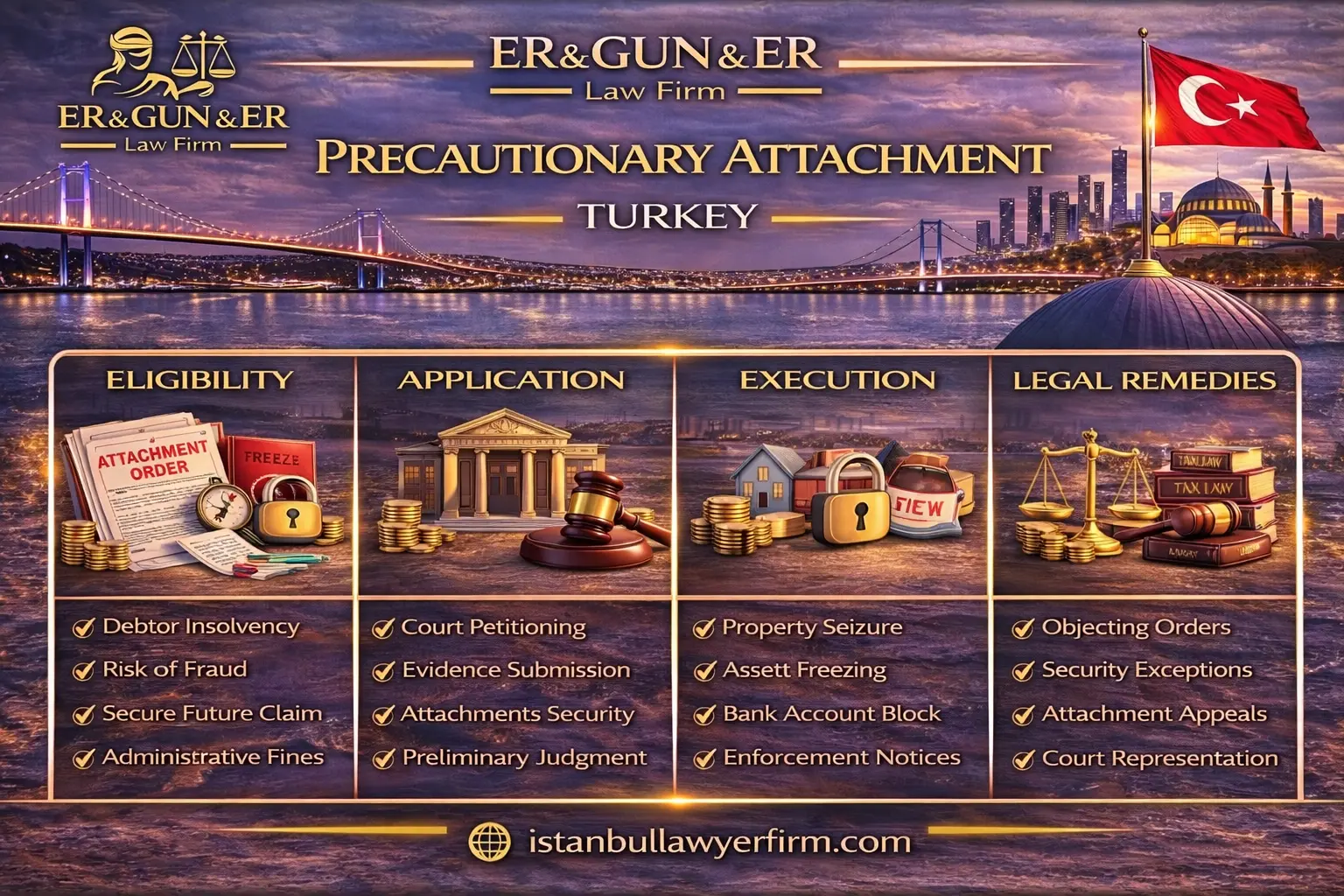
Precautionary attachment in Turkey—ihtiyati haciz under Articles 257 through 268 of the Execution and Bankruptcy Law—is one of the most consequential tools available to a monetary creditor who needs to freeze a debtor's assets before a final judgment or enforcement title has been secured. The outcome of any attachment application is determined less by the abstract strength of the underlying claim and more by the quality of the evidence presented to the court, the chronological coherence of the claim documentation, the precision of the asset identification, and the operational speed with which the order is converted into an effective freeze at the execution office. Because the measure is obtained ex parte in the overwhelming majority of cases—the debtor receives no advance notice and cannot challenge the application before the order issues—the court's decision rests entirely on the creditor's file, which means the strength of that file determines whether the order is granted, how broadly it is scoped, and whether it will survive a subsequent objection. Asset dissipation risk must not be asserted abstractly: the court requires concrete, documented indicators that the debtor is moving, concealing, or encumbering assets in a manner that would frustrate eventual enforcement, and this documentation must be built into the petition from the outset rather than reconstructed after an objection is filed. Choosing the correct procedural pathway early—whether to file before initiating any enforcement action, during ongoing litigation, or in coordination with a foreign arbitral or judicial proceeding—has direct bearing on the enforceability of the attachment and on the creditor's ability to convert frozen assets into actual recovery. This article provides a practice-oriented analysis of precautionary attachment Turkey as it operates in 2026, intended for domestic and foreign creditors, corporate counsel, and practitioners who need to understand the full operational landscape from court application to final asset conversion.
Purpose of interim security
A law firm in Istanbul advising commercial creditors consistently identifies precautionary attachment Turkey as the primary instrument for protecting a monetary claim against the risk that the debtor will dissipate, transfer, or encumber assets during the gap between claim accrual and final enforcement. The interval between the date a claim becomes actionable and the date a final enforcement title is obtained—which can extend across many months or years depending on litigation complexity and court workload—creates a structural window during which a debtor with knowledge of an impending claim can act to shield their asset base from recovery. The purpose of the interim security measure is to compress that window by allowing the creditor to freeze identified assets immediately, before the debtor has time to react, while the substantive proceedings that will ultimately determine the claim's merits proceed in parallel. The measure does not transfer ownership of the attached asset to the creditor and does not extinguish the debtor's title; it immobilizes the asset within the scope of the security measure and prevents third-party dispositions that would reduce or eliminate the creditor's recovery prospects. The practical importance of this immobilization function is most acute where the debtor's balance sheet is asset-light and the specific asset targeted—a bank account, a trade receivable, a real property—represents the only realistic source of recovery. The precautionary attachment also serves a behavioral function that goes beyond its direct legal effect: a debtor whose primary operational bank account is frozen experiences immediate and severe operational disruption, creating strong commercial pressure to engage in settlement discussions that the creditor who simply waits for judgment cannot generate. This settlement leverage function is not incidental to the mechanism's design but is one of the principal reasons that sophisticated commercial creditors invest in obtaining attachments even in cases where their substantive claim is strong and the risk of losing at trial is low. The creditor who acts first and freezes the relevant assets fundamentally alters the dynamics of the subsequent dispute resolution process. The attachment's record effect—the annotation of the measure in the relevant asset registry—creates a publicly visible encumbrance that affects the debtor's dealings with third parties, including their ability to pledge attached assets as collateral or complete real property transactions requiring clean title. The interaction between the attachment and the priority rules of Turkish insolvency law is a further dimension of the mechanism's purpose: a creditor who has implemented a precautionary attachment and converted it into a final enforcement measure before the debtor's insolvency may hold a preferred position relative to unsecured creditors with respect to the attached asset, making the timing of the attachment particularly important where the debtor's solvency is in doubt. The purpose of interim security, properly understood, is therefore simultaneously protective—preserving the asset against dissipation—and strategic, shaping the economics and dynamics of commercial dispute resolution in Turkey's enforcement environment. Understanding this dual purpose architecture informs every element of the attachment strategy, from asset identification through petition drafting to implementation management. The creditor who approaches the attachment purely as a legal formality rather than as an integrated strategic instrument will consistently achieve worse outcomes than the creditor who deploys it with full awareness of its purpose dimensions. The architecture of the İcra ve İflas Kanunu reflects this dual function by building the attachment procedure around an ex parte application model that prioritizes speed and surprise over bilateral process, with the debtor's interests protected through the post-implementation objection mechanism.
The interim attachment Turkey occupies a distinct functional niche within the broader Turkish civil procedure landscape, specifically calibrated for monetary claims in a manner that distinguishes it from the precautionary injunction (ihtiyati tedbir) framework available for non-monetary relief under the Code of Civil Procedure. The calibration to monetary claims has direct practical consequences: the creditor must quantify the claim with sufficient precision to allow the court to define the scope of the assets to be frozen, and the attached assets must bear a proportionate relationship to the amount claimed. Disproportionate attachment—covering assets far in excess of the claim—is both a recognized ground for objection and a potential source of wrongful attachment liability, making precision in the attachment scope a practical necessity. The interim nature of the measure means it is inherently temporary, and the creditor must satisfy ongoing procedural obligations—specifically the commencement of main proceedings within the time set by the relevant rules—to maintain the attachment's validity through to final recovery. These follow-up obligations create a parallel procedural track that must be managed concurrently with the attachment implementation, and failing to comply with any step in that track can result in the measure lapsing and the debtor's assets being released without the creditor having achieved final recovery. The geographical scope of the attachment is limited to assets physically located in Turkey or held by Turkish banks and intermediaries, reflecting the territorial limits of Turkish judicial authority; assets in foreign jurisdictions require parallel proceedings in the relevant foreign courts, potentially using the Turkish attachment order as supporting evidence but not as a self-executing instrument. The interaction between the interim attachment and the debtor's ongoing commercial operations creates a dynamic that the creditor's legal team must monitor continuously: the debtor's attempts to minimize the attachment's disruption effect through operational reorganization, alternative banking arrangements, or substitution security strategies are a normal feature of the post-attachment environment and require responsive management from the creditor's side. The scope of attachable asset types is broad—bank accounts, receivables, real property, registered vehicles, shareholdings, inventory, equipment, and intellectual property interests are all in principle within the mechanism's reach—and a well-structured attachment strategy will identify and prioritize asset types based on liquidity, identifiability, and the operational disruption their attachment will create. The proportionality requirement that governs the scope of the attachment operates as a judicial check on the creditor's power: courts are attentive to requests that appear designed to cause maximum disruption rather than to achieve proportionate security, and a petition that targets assets substantially exceeding the claim amount without justification will receive heightened scrutiny. The strategic planning that goes into an effective attachment strategy therefore encompasses not only the legal mechanics of the application but also the commercial intelligence work needed to identify the right assets, size the attachment correctly, and time the implementation for maximum impact.
Turkish lawyers who advise on precautionary attachment and enforcement matters consistently observe that clients who understand the full purpose architecture of the mechanism achieve materially better commercial outcomes than those who approach it as a procedural box-ticking exercise. The reason is that the purpose—asset preservation combined with settlement leverage—should inform every element of the strategy, from asset targeting through petition drafting to implementation sequencing and post-attachment communication management. A creditor who appreciates that the immediate behavioral value of the attachment often exceeds its direct legal security value will make different choices about which assets to target first, when to communicate with the debtor after implementation, and what terms to propose in settlement, compared to a creditor who views the measure as purely a legal step on the road to judgment. The behavioral function is especially powerful in Turkey's commercial environment, where the freezing of a business's operational accounts—through which supplier payments, payroll, and tax obligations are processed—creates immediate and visible consequences that most business owners cannot absorb for more than a short period. This operational disruption effect is why practitioners advising creditors will often prioritize the attachment of primary trading accounts over secondary or dormant accounts even if both hold equivalent values, because the disruption caused by freezing the active operational account generates settlement pressure faster and on more favorable terms. The sequenced approach—implement the attachment, then make first contact with the debtor to propose resolution—allows the creditor to use the attachment's disruptive effect as the primary negotiating lever while keeping open the possibility of a rapid negotiated resolution that avoids the cost and time of full litigation. The proportionality limits on the attachment scope are not merely legal constraints but also commercial discipline: an attachment that is proportionate to the claim is easier to defend against objection, less likely to generate a successful wrongful attachment claim, and more likely to be received by the debtor's management as a legitimate creditor measure rather than an aggressive weapon that triggers a defensive rather than a conciliatory response. The purpose of interim security is ultimately to enable commercial relationships to function fairly by giving creditors effective tools to protect their legitimate recovery interests, and using those tools with discipline and proportionality serves both the legal objectives of the specific case and the broader reputation of the creditor in Turkey's commercial market.
Legal basis and scope
The legal basis for ihtiyati haciz Turkey is found primarily in Articles 257 through 268 of the İcra ve İflas Kanunu (Execution and Bankruptcy Law, Law No. 2004), the text of which is available on Turkey's official legislation database at Mevzuat.gov.tr and the specific enactment accessible at the İİK page on Mevzuat. Article 257 of the İİK establishes the two core conditions for the granting of a precautionary attachment: first, the claim must be a monetary claim; and second, either the claim must be due and payable (muaccel) or—if not yet due—there must be circumstances indicating that the debtor's failure to pay at maturity will render collection impossible or significantly more difficult. These two branches of Article 257 create a bifurcated framework with different evidentiary burdens depending on the maturity status of the underlying claim, and the petition must be structured to address whichever branch applies with precision. The debt enforcement procedures in Turkey operate within this İİK framework, and the precautionary attachment is the principal pre-judgment security tool within that system for monetary claims. The scope of eligible claims extends across the full range of monetary obligations that can be pursued through Turkish civil enforcement proceedings, including contractual claims, damages for tort, unjust enrichment claims, and claims arising from negotiable instruments. The İİK provisions must be read together with the Code of Civil Procedure (HMK, Law No. 6100) for procedural questions not specifically addressed in the İİK, with the Turkish Code of Obligations (TBK 6098) for general contractual and tortious claims, and with the Turkish Commercial Code (TCC 6102) for commercial relationships—creating a multi-statute analytical framework that must be engaged comprehensively for any specific attachment application. The İİK's precautionary attachment provisions are supplemented by a substantial body of Court of Cassation jurisprudence interpreting the statutory conditions, and familiarity with this case law is essential for advising creditors on how courts apply the Article 257 conditions to specific fact patterns. The court has no obligation to hold a hearing before granting a precautionary attachment under the standard framework, and the majority of orders are issued on the papers alone, making the written application the primary determinant of outcome. The scope of the order—the asset types and the secured amount—is set by the court based on the petition, and the court has discretion to limit scope if the requested attachment is disproportionate. The İİK framework permits the attachment to be obtained before any proceedings are commenced, during pending litigation, or after a first-instance judgment that has not yet become final, giving creditors significant flexibility in timing the application. The continuing validity of the order depends on the creditor's compliance with the follow-up obligations in Articles 264 and 268 of the İİK, which require commencement of main proceedings within the time specified—practice may vary by authority and year — check current guidance.
A lawyer in Turkey advising on cross-border commercial disputes must apply the same İİK framework to both domestic and international claims but must account for the meaningful differences in evidentiary and procedural requirements that arise in the international context. For claims arising from foreign law-governed contracts, the documentation submitted to the Turkish court must satisfy Turkish evidentiary standards even though it was generated under a different legal system, because the Turkish court assesses the evidence under Turkish procedural rules regardless of the governing law of the underlying contract. This cross-jurisdictional evidentiary challenge is one of the most common sources of application weakness in international attachment matters and can be addressed through working with counsel who has concurrent experience in both the governing-law jurisdiction and Turkish enforcement practice. The scope of attachable assets under the framework is broad but subject to specific statutory exemptions: certain categories of asset are protected from attachment by law, including—subject to specific exceptions and practice may vary by authority and year — check current guidance—subsistence-level income, certain pension and social security entitlements, and assets held by specific categories of exempt parties. The exemption analysis must be completed before the application is filed to avoid targeting protected assets and creating the basis for a successful objection. The corporate veil question is a significant scope limitation in many commercial cases: the assets of a legal entity are attachable in the entity's own right, but the personal assets of shareholders or directors are generally not reachable through an attachment against the entity unless the conditions for piercing the corporate veil under Turkish commercial law are independently established. This boundary is important for creditors dealing with Turkish limited liability companies (limited şirket) or joint stock companies (anonim şirket) where the entity's balance sheet may not reflect the controlling shareholders' personal wealth. The geographic reach of the attachment is limited to Turkey-sited assets: Turkish courts do not issue attachment orders covering assets in foreign jurisdictions, and creditors seeking to freeze foreign-sited assets must pursue parallel proceedings in the relevant foreign courts. The interaction between the İİK framework and Turkey's international private law rules (MÖHUK) requires analysis in any cross-border case to ensure that the Turkish proceedings are consistent with any parallel foreign proceedings. Understanding the scope limitations of the mechanism—corporate veil, geographic reach, asset exemptions—is as important as understanding the conditions for obtaining the order, because a well-targeted application that respects those limitations is far more robust than a broad application that gives the debtor multiple grounds for challenge.
An English speaking lawyer in Turkey advising foreign creditors must be prepared to bridge the gap between the formal legal basis and the practical operation of the mechanism as it functions day-to-day in the courts and execution offices that process applications. The formal statutory framework is the foundation, but the overlay of court practice, execution office procedures, and judicial interpretation of the evidentiary standards creates a practical environment that differs from the black-letter law in ways that matter significantly to outcomes. Istanbul's commercial courts have developed a body of practice around attachment applications that reflects the high volume of commercial disputes processed in that jurisdiction, and a practitioner familiar with that practice can structure an application to align with the court's known preferences in ways that increase the likelihood of a swift and favorable decision on the papers. The scope of attachable assets under the framework is interpreted through a proportionality lens developed through Court of Cassation jurisprudence, and understanding how that jurisprudence applies to specific contested asset types—particularly shares in private companies where valuation is inherently uncertain—requires direct familiarity with the relevant decisions. Turkish commercial courts treat the precautionary attachment as a serious measure with significant consequences for the debtor and apply meaningful scrutiny to the creditor's evidence even in the ex parte context, meaning that a poorly evidenced application will be refused at first instance. The legal basis analysis must therefore incorporate both the formal statutory conditions and the practical evidentiary standards applied by the specific court that will hear the application, and these two dimensions are not always perfectly aligned. The interaction between the court-level legal basis and the execution-office-level implementation is one of the most important procedural junctures in the process, and practitioners who advise on the legal basis must simultaneously advise on execution implementation to ensure that the theoretical legal entitlement is translated into an effective practical measure. The scope of the attachment as implemented at the execution office may not exactly replicate the scope described in the court order, because execution officers apply their own procedural rules to the specific assets they encounter, and deviations from the court order's terms are a recognized source of challenges in attachment matters that require active legal supervision during the implementation phase.
Eligible claims and proof
The category of claims eligible for precautionary attachment under Articles 257 and following of the İİK is anchored to monetary claims—specifically, claims for the payment of money, whether arising from contract, tort, unjust enrichment, or any other legal basis that generates an obligation to pay a sum of money. Securing a monetary claim Turkey through the attachment mechanism requires, as a threshold matter, that the underlying entitlement is capable of quantification in monetary terms, and the court will not grant an attachment to secure a claim for specific performance, declaration, or non-monetary relief. The claim does not need to be certain or undisputed to support an application: the İİK standard requires only that the claim be plausible and supported by evidence satisfying the court that there is a reasonable basis for believing the entitlement exists, not that the claim is proven to the standard required for final judgment. This lower threshold—often described in Turkish legal doctrine as the standard of kuvvetli delil (strong evidence) or belirtiler ve emareler (signs and indications)—allows creditors to act at an early stage before all evidence has been fully assembled. A best lawyer in Turkey advising on eligibility will analyze both the substantive legal basis of the claim and the available documentary evidence to assess whether the application meets the threshold and how the petition should be structured. The eligible claim categories encompass the full range of commercial and civil monetary obligations: unpaid invoices and purchase price claims, loan repayments, damages for breach of contract, tort damages capable of monetization, negotiable instrument claims (bills of exchange, promissory notes, cheques), unjust enrichment claims, and statutory penalty and interest obligations. The breadth of eligible categories means that most commercial disputes with a monetary component can serve as the basis for an attachment application, subject to the specific conditions applicable to the claim's maturity status. The commercial litigation context in which most attachments are filed means the claim will typically be supported by documentary evidence—contracts, invoices, correspondence, delivery records—and the quality of that documentary record is the primary determinant of the application's strength. Claims well-documented in contemporaneous business records—signed contracts specifying the payment obligation, invoices issued in accordance with contract terms, delivery records confirming performance, and correspondence showing the debtor's acknowledgment of the debt—represent the strongest applications. Claims resting primarily on oral agreements or undocumented transactions present a more difficult evidentiary challenge because the court cannot assess plausibility without documentary support. The creditor's burden in the attachment application is not full proof of the claim, but the evidence must be sufficient to convince the court that the claim is genuine and not contrived as a weapon in a dispute that lacks legal merit—a distinction that Turkish courts are attentive to. The eligible claim must also fall within the jurisdiction of Turkish courts under the applicable rules of international private law (MÖHUK) and civil procedure, a consideration of particular relevance for cross-border claims where the governing law and dispute forum may not be Turkish.
The proof standard applied by Turkish courts to precautionary attachment applications has been refined through a substantial body of Court of Cassation jurisprudence into a workable threshold that the Yargıtay has consistently described as requiring a reasonable conviction (kanaat) in the mind of the court that the claim is legally sustainable. In practice, the most probative evidence in a monetary claim application is a written agreement signed by both parties specifying the payment obligation, supplemented by evidence that the creditor has fulfilled any conditions precedent to the debtor's payment obligation—delivery, service provision, acceptance—and evidence that the payment has not been made despite the obligation being due. Where the claim arises from obligations under the Turkish Code of Obligations, accessible at TBK 6098, the contract terms, the performance record, and the default circumstances must be documented so the court can trace the causal chain from obligation to unpaid claim without reliance on speculation. For negotiable instrument claims, the instrument itself constitutes the primary evidence, and a properly constituted and unpaid bill of exchange, promissory note, or cheque is treated by Turkish courts as strong prima facie evidence of an eligible monetary claim that simplifies the application significantly. For contractual claims, the proof analysis must address not only the existence of the obligation and the amount owed but also any likely defenses—non-performance by the creditor, set-off, limitation, novation—and the application should anticipate and address these defenses where possible, because a court that identifies a strong potential defense will apply greater scrutiny and may limit the scope of the attachment order to reflect the uncertainty about net recovery. For damages claims, the monetary quantification is itself a component of the proof burden: the court must be able to assess that the claimed amount is plausible, which for consequential damages requires some evidence of the actual loss incurred beyond the creditor's assertion alone. The evidentiary discipline required for a strong attachment application overlaps substantially with what is required for a strong opening brief in the main litigation, and creditors who invest in thorough evidence preparation before filing the attachment are typically better positioned to pursue the main claim efficiently as well. Legal advice on the proof standard and its application to specific claim types is one of the most valuable services that qualified counsel provides, because the threshold is calibrated differently for different claim types and misunderstanding the applicable standard produces either an unnecessarily weak application or an unnecessarily burdened one. Practice may vary by authority and year — check current guidance as to the specific evidentiary standard applied by the competent court in the relevant jurisdiction.
The interaction between the eligible claim categories and the commercial law framework governing the underlying relationship is a critical dimension of the proof analysis in precautionary attachment applications. Claims arising from relationships governed by the Turkish Commercial Code, accessible at TCC 6102, benefit from specific commercial law provisions that can simplify or strengthen the proof of the underlying obligation. The TCC's provisions on commercial obligations and commercial enterprises establish default rules that fill contractual gaps and create legally presumed obligations in contexts where the written agreement is incomplete. The contract and commercial framework analysis is a prerequisite for assessing the strength of any commercial claim offered as the basis for an attachment application, because it determines both the legal basis of the obligation and the evidentiary path for proving it. Share purchase agreements, distribution agreements, manufacturing contracts, service agreements, and construction contracts are among the most common categories generating monetary claims suitable for precautionary attachment, and each has its own documentary ecosystem—term sheets, board resolutions, delivery records, inspection reports, invoice sequences—that must be assembled comprehensively. The proof of damages arising from commercial contract breach requires particular attention to the causal link between the breach and the claimed loss: Turkish courts apply a proximate cause analysis derived from the TBK to filter out remote or speculative losses, and the evidence must establish both the fact of loss and its causal connection to the debtor's conduct. Unjust enrichment claims present additional evidentiary complexity, requiring the creditor to demonstrate not only the fact of enrichment but also that it occurred at the creditor's expense and without legal justification—a three-element proof standard that may require documentary evidence from within the debtor's organization that the creditor does not directly hold. The interaction between the eligible claim and the available evidence determines whether the attachment application can be filed immediately or whether additional evidence must be gathered first, and this timing analysis is one of the first determinations that experienced counsel makes. Where additional evidence is needed but the risk of asset dissipation is imminent, the tension between evidentiary completeness and filing urgency requires careful professional judgment about the minimum viable evidence threshold. The relationship between the strength of the evidence and the probability of surviving a post-order objection is as important as the probability of the initial order being granted: an application that succeeds at the ex parte stage on minimal evidence may be vulnerable to a successful objection that releases the attached assets before the main claim is resolved, frustrating the entire security purpose.
Risk of dissipation tests
An Istanbul Law Firm advising creditors on precautionary attachment strategy regularly differentiates between the two branches of Article 257 of the İİK in structuring the application, because the evidentiary burden for establishing collection risk differs significantly between them. For due and payable claims under the first branch, Turkish courts apply a relatively permissive approach: the existence of an unpaid due monetary claim is treated as creating a presumption of collection risk that shifts the burden of demonstrating no attachment is needed to the debtor. For non-due claims under the second branch, the creditor must adduce concrete evidence of circumstances indicating that the debtor's failure to pay at maturity will frustrate collection—evidence that goes beyond the general commercial risk that any debtor might fail to pay and that demonstrates specific, identifiable behaviors or conditions creating an individualized threat to recovery. The categories of evidence that courts accept as demonstrating dissipation risk in the non-due claim context include evidence of asset transfers to related parties at undervalue, corporate restructuring or share transfers designed to shift the asset base away from the debtor entity, significant deterioration in the debtor's financial condition such as bounced cheques, protested bills, or withdrawal of bank credit facilities, the debtor's flight from the jurisdiction or closure of business premises, and the debtor's initiation of proceedings or registrations suggesting imminent insolvency. Each of these categories requires documentary support: a creditor who asserts that assets are being transferred without evidence of an actual transfer, or who asserts financial deterioration without bank protest records or other corroborating documentation, will not satisfy the dissipation risk test for a non-due claim. The foreign company litigation context illustrates how non-due dissipation risk evidence is particularly challenging for foreign creditors who may not have direct access to the debtor's financial records and must rely on publicly available information and intelligence gathered through commercial due diligence channels. The risk of dissipation test even for due claims is not entirely without substance: a court that identifies a strong counter-argument—a genuine dispute about the debt's existence, a pending set-off claim of comparable magnitude—will apply heightened scrutiny before granting the attachment. The debtor's known asset profile is also a relevant consideration: a debtor with substantial and stable assets in Turkey presents a lower dissipation risk than one with few, mobile, or liquid assets that can be transferred without public registration. The court's assessment of dissipation risk is inherently forward-looking and fact-specific, which means the creditor's ability to present a coherent narrative about why this particular debtor in these particular circumstances presents a genuine collection risk is more important than satisfying any formulaic checklist. The chronological consistency of the evidence is critical: documents created at different times for different purposes that collectively tell a coherent story about deteriorating financial condition or asset-shifting behavior are more persuasive than documents assembled specifically for the attachment application. Practice may vary by authority and year — check current guidance as to how courts in different Turkish jurisdictions weight specific categories of dissipation risk evidence.
A Turkish Law Firm building a dissipation risk case for a non-due claim will typically begin with a comprehensive review of all publicly available information about the debtor's financial and corporate status, including commercial registry records (ticaret sicili), land registry records (tapu sicili), protested cheque and bill records, and available financial disclosures. These publicly available sources provide the initial evidentiary foundation, particularly for registered companies where corporate changes such as share transfers, capital reductions, change of management, and registered address changes must be filed with the commercial registry and are therefore accessible. Unusual patterns in these public records—a sudden change in the registered shareholder structure after the creditor's claim arose, a reduction in registered capital, a change to a registered address with no apparent business connection—can be powerful evidence of asset-shielding behavior even without access to the debtor's internal records. The protested bills and cheques register provides another publicly accessible indicator of financial distress: a debtor whose name appears on protest records has failed to honor payment instruments, which is direct evidence of payment incapacity relevant to both the collection risk and the dissipation risk analyses. Beyond public records, the creditor's own commercial relationship with the debtor generates private evidence: requests for extended payment terms, partial payments followed by cessation, communications expressing financial difficulty, and behavioral changes in the commercial relationship are all relevant to the dissipation risk assessment. The risk of dissipation tests applied by Turkish courts do not require certainty about the debtor's intentions; they require evidence from which a reasonable court can infer that the collection risk is real and specific, not merely hypothetical. Circumstantial evidence of dissipation risk—a pattern of conduct consistent with asset-shielding even if each individual step has an innocent explanation—can satisfy the test when the overall picture is sufficiently compelling. The creditor's counsel must present the evidence as a coherent narrative rather than isolated data points, drawing the connections between different events and records that collectively establish the dissipation risk picture. In the context of corporate groups, intra-group transactions—asset transfers between the debtor entity and related companies—are a common form of asset shielding and are recognized by Turkish courts as a legitimate component of the dissipation risk showing when properly documented. The timing of the dissipation risk evidence relative to the creditor's claim is relevant: transfers that post-date the debtor's awareness of the claim are more probative of intentional shielding than transactions that predated it. Building a complete, temporally organized dissipation risk file is a critical preparatory step before any attachment application is filed, and the quality of this preparation directly affects both the initial grant probability and the robustness of the attachment against subsequent objection.
The procedural consequences of failing to establish dissipation risk for a non-due claim are severe: the court will reject the application, and the creditor's intentions may be disclosed to the debtor through the rejected application, eliminating the element of surprise that makes the measure effective. This strategic cost reinforces the importance of thorough evidence preparation before the first application is filed rather than testing the waters with an underprepared submission. The dissipation risk analysis is time-sensitive: the evidence must be current, reflecting the debtor's situation at the time of application, and evidence that was compelling several months ago may have been superseded by changes in the debtor's circumstances that the creditor has not tracked. Maintaining a current picture of the debtor's financial and corporate status during the period between claim accrual and the decision to file is an important operational discipline for creditors managing a deteriorating commercial relationship. Where intelligence about imminent asset dissipation is specific and credible—a tip-off about an impending share transfer or business reorganization—the timeline for filing collapses dramatically and the creditor's legal team must be prepared to file on emergency notice with the available minimum viable evidence. The relationship between the dissipation risk showing and the security deposit requirement is also relevant: where the creditor can demonstrate compelling dissipation risk evidence, courts may exercise discretion to reduce the security deposit required, reflecting the view that a higher genuine collection risk justifies more favorable terms for the attaching creditor. Conversely, where the dissipation risk showing is weak, a higher security deposit may be required to compensate for the greater potential prejudice to a debtor who may not actually pose any collection risk. The calibration of the security deposit to the quality of the dissipation risk showing is therefore an indirect signal about the court's assessment of the application's merits. The dissipation risk test interacts with the proportionality principle in that where risk is high, a broader attachment scope covering multiple asset categories may be justified, while where risk is lower, a more targeted attachment may be the appropriate response. Building the dissipation risk showing to the level that supports the requested attachment scope is therefore a key drafting discipline in the petition preparation process, and the two elements—risk evidence and scope justification—must be developed in coordination rather than independently.
Competent court selection
Competent court selection for precautionary attachment procedure Turkey is governed by a combination of İİK-specific provisions and the general jurisdictional rules of the Code of Civil Procedure, the text of which is accessible at HMK 6100 on Mevzuat. Under Article 258 of the İİK, the competent court for an attachment application filed before any main proceedings have been commenced is the court that has jurisdiction over the main claim—determined by reference to the subject matter of the claim and the applicable territorial jurisdiction rules. For commercial claims, this will typically be a commercial court of first instance (asliye ticaret mahkemesi) in the relevant venue; for civil claims, a civil court of first instance (asliye hukuk mahkemesi). The venue determination—which city, which court district—follows the standard HMK rules: the defendant's domicile court has general territorial jurisdiction, and for contract claims the court at the place of performance also has jurisdiction, subject to any exclusive forum selection clause in the contract. If ongoing litigation is already pending when the attachment is sought, the application must be directed to the court handling that litigation, eliminating any venue choice for the creditor. Where enforcement proceedings (icra takibi) are already underway, Article 258 paragraph two directs the attachment application to the execution court (icra mahkemesi) at the location of those proceedings. This three-way split—commercial courts for pre-litigation commercial claim applications, civil courts for civil claim applications, and execution courts for post-enforcement applications—creates potential for jurisdictional missteps that can result in a meritorious application being returned for refiling before the correct court, introducing delay with potential strategic consequences. The classification of the claim as commercial or civil—which determines the correct court category—depends on whether the transaction qualifies as a ticari dava under TCC Article 4, and this classification analysis must be completed before the application is prepared to ensure correct routing from the outset. The territorial venue selection has practical implications beyond the formal jurisdictional question: commercial courts in major commercial centers process higher volumes of attachment applications and have developed more predictable and efficient practices than courts in less commercially active jurisdictions, and these practical differences can be significant. Practice may vary by authority and year — check current guidance on the specific venue rules applicable to the particular claim type and creditor situation.
Turkish lawyers who handle significant volumes of precautionary attachment work have developed a granular understanding of how different courts—even within the same city—respond to attachment applications, and this court-specific knowledge is among the most practically valuable elements of specialist legal advice in this area. Istanbul's commercial courts are divided into multiple chambers each handling specific claim types, and the assignment of an application to a particular chamber can have a measurable effect on the speed and likely outcome of the ex parte decision—not because different chambers apply materially different legal standards, but because bench composition, case volume, and administrative processing speed differ in ways that affect the practical experience of applicants. The venue selection question for creditors with a contractual forum selection clause is important: a clause designating a specific Turkish court as the venue for disputes will typically bind both the main claim and the precautionary attachment application. Where the forum selection clause designates a foreign court or an arbitral tribunal, Turkish courts retain jurisdiction to issue precautionary measures in support of those foreign proceedings under the applicable HMK framework, because the existence of a foreign forum or arbitration clause does not deprive Turkish courts of their interim measures jurisdiction under Turkish law. The interaction between arbitration clauses and precautionary attachment jurisdiction is a specialized area where Court of Cassation jurisprudence has established that a creditor whose dispute is subject to an arbitration clause can obtain a Turkish precautionary attachment without this constituting a waiver of the arbitration agreement. For cross-border creditors whose debtor has assets in multiple Turkish cities, the tactical judgment about whether to file in one venue and seek multi-location attachment through the execution office network—or to file in the most advantageous venue for the specific target assets—is a strategic decision that requires analysis of the specific asset distribution and the capabilities of the relevant execution offices. The nationwide execution network allows a single court application to anchor a geographically comprehensive attachment program through the UYAP electronic system, making it possible for a creditor to freeze assets across multiple Turkish cities through a single strategically chosen court. The selection of court subject matter type—commercial versus civil—is enforced by the courts themselves on their own motion, so jurisdictional defects that are obvious from the face of the application will be identified and corrected by the court, but the delay and potential strategic consequences of such corrections make pre-filing jurisdictional analysis indispensable.
The election of the competent court has implications for the appeal and review process that follows the initial attachment order. An attachment order issued by a commercial court in Istanbul is reviewed, on appeal, by the Istanbul Regional Appeals Court (Bölge Adliye Mahkemesi) and, on further points of law, by the Court of Cassation's commercial division. The established jurisprudence of these appellate bodies on precautionary attachment matters provides a degree of predictability for practitioners familiar with the applicable decisions and allows for evidence-based assessment of the likely success of any proposed challenge to the attachment. The court's identity also affects the available procedural options if the application is refused at first instance: different courts have different practices regarding supplementary evidence submissions or requests for oral clarification at the attachment application stage, and the specific procedural culture of the chosen court influences these options. The geographical dimension of court selection is complicated for cases involving non-Turkish companies as the debtor: the question of whether a foreign company's registered address or Turkish branch address constitutes the relevant domicile for venue purposes requires analysis under both Turkish private international law and the specific facts of the company's Turkish presence. For Turkish branches of foreign companies, the branch office address in Turkey is typically the relevant venue anchor; for foreign companies with no formal Turkish establishment, a more nuanced analysis of the company's Turkish activities and asset locations is required. The creditor pursuing attachment against a foreign-domiciled debtor with Turkish assets therefore needs careful legal advice on venue selection to avoid jurisdictional challenges that could delay or derail the proceedings. The venue selection also interacts with the enforcement track the creditor intends to pursue after the attachment: aligning the attachment venue with the intended main proceedings venue simplifies subsequent procedural management and avoids the coordination complexity that arises when the attachment file and the main claim file are maintained at different courts or execution offices. Holistic legal planning that addresses the full procedural arc—from attachment through judgment or enforcement to final recovery—consistently produces better outcomes than treating the attachment as a standalone step divorced from the broader case strategy.
Security deposit and guarantees
The security deposit requirement for precautionary attachment is established by Article 259 of the İİK, which requires the creditor to provide security (teminat) before the attachment order is implemented, unless the court waives the requirement on specific grounds. Creditor security before judgment Turkey includes this deposit mechanism as a protective counterweight: because the attachment is granted ex parte, the debtor has had no opportunity to contest the application before their assets are frozen, and the security deposit exists to ensure that if the attachment is subsequently found to be wrongful—either because the underlying claim fails or because the attachment was procedurally defective—the debtor has a fund from which to recover their damages. The amount of the security deposit is determined by the court at the time the order is issued, and while the İİK does not specify a fixed percentage of the claim, courts calibrate the deposit to a proportion of the claimed amount, taking into account the strength of the evidence and the apparent risk that the attachment may prove wrongful—practice may vary by authority and year — check current guidance as to the typical security levels applied by the competent court. The security is typically provided in the form of cash deposited with the execution office, a bank letter of guarantee (banka teminat mektubu) from a reputable Turkish or internationally recognized bank acceptable to the court, or government bonds of equivalent value. The acceptability of specific forms of security and the procedural requirements for their submission are determined by the court and execution office, and foreign creditors should verify in advance what forms will be accepted before the order is implemented. Provision of the security is a precondition to implementation: the execution office will not execute the order until it has received and verified the security, and a creditor who is slow to provide the required security risks the debtor becoming aware of the order before it is implemented, eliminating the element of surprise. The urgency of security provision is therefore a practical operational constraint that must be factored into the attachment strategy from the outset, meaning the financing or banking instruments for the security deposit should be arranged in advance of the application rather than organized after the order is received. The security must remain in place for the duration of the attachment proceedings, and it cannot be withdrawn until the attachment has been either converted into a final enforcement measure through successful proceedings or released through lifting, objection, or the creditor's voluntary abandonment. This lock-up period requires the creditor to factor the cost of committed capital into the overall economics of the attachment strategy, particularly in cases involving substantial claim amounts where the security deposit may itself be a significant sum. The interaction between the security deposit amount and the claim amount signals the court's assessment of the application's merits: a lower security amount may reflect the court's view that the application is strong and that the risk of wrongful attachment is low.
Turkish lawyers advising creditors on the security deposit question regularly analyze the waiver provisions of Article 259(2) of the İİK, which allow the court to exempt the creditor from the security deposit requirement in specific circumstances. The most commercially important exemption applies where the claim is documented by a bill of exchange (kambiyo senedi)—a category including properly constituted bills of exchange, promissory notes, and cheques under Turkish law. A creditor holding a properly constituted and dishonored negotiable instrument can apply for precautionary attachment without providing security, which significantly reduces both the cost and the logistical complexity of the attachment process. This instrument-based exemption reflects the legislature's view that negotiable instruments constitute a sufficiently reliable evidentiary foundation to justify the reduced creditor burden, because the instrument itself provides a documented and witnessed record of the payment obligation without requiring a broader evidentiary showing. For security deposit for precautionary attachment Turkey purposes, the creditor must confirm that the instrument satisfies the strict formal requirements of the TCC's negotiable instrument provisions, because an instrument that is formally defective will not qualify for the exemption and the court may require security even if the defect appears minor. The urgent situation exemption under Article 259(2) is more discretionary and requires the creditor to demonstrate specific circumstances making security provision practically impossible or unreasonably burdensome in the available time—a high bar that courts apply selectively. The equivalent document exemption covers instruments that, while not technically negotiable instruments, establish the payment obligation with comparable clarity—for example, notarially authenticated payment obligations or court-issued payment orders that have not yet reached finality. In practice, the most reliable path to avoiding the security deposit is to ground the application in a negotiable instrument claim, which is one of the reasons that commercially sophisticated creditors structure payment arrangements to include bill of exchange or promissory note elements where the transaction type allows it. The security deposit must be sized correctly: underestimating the likely deposit amount required by the court can create logistical complications at the implementation stage if the creditor must arrange additional funds on an emergency basis after the order is issued. Practice may vary by authority and year — check current guidance on the forms of security currently accepted by the relevant court and execution office.
A law firm in Istanbul with significant enforcement practice structures the security deposit arrangements as part of pre-application preparation, working with the client and their bank to have a letter of guarantee prepared and ready before the attachment order is obtained, so that implementation can proceed without any gap between order and execution. The logistical coordination between the legal team, the bank, and the execution office that this requires illustrates the operational management dimension of precautionary attachment work that goes beyond pure legal advice. The cost of the security deposit—whether in the form of cash held on deposit, bank fees for a letter of guarantee, or the opportunity cost of committed capital—must be weighed against the strategic value of the attachment in the overall case economics. For large commercial claims, the security deposit amount can be significant in absolute terms, and creditors who are unwilling or unable to provide the required security must consider whether an alternative strategy—filing the main claim without precautionary attachment and relying on the judicial timetable—is more appropriate to their financial circumstances. The security deposit interacts with the wrongful attachment damages framework in a specifically designed way: if the attachment is found unjustified because the main claim fails or the attachment is procedurally defective, the debtor's damages claim against the creditor is satisfied first from the security deposit, providing the debtor with a readily accessible source of compensation without requiring separate enforcement proceedings against the creditor. This mechanism ensures that creditors who use the attachment bear real financial exposure for wrongful use, creating a meaningful deterrent against opportunistic or disproportionate attachment practice. The release of the security to the creditor at the conclusion of proceedings—through successful enforcement, voluntary settlement, or the debtor's failure to pursue a wrongful attachment claim within the applicable limitation period—is the final step in security management, and practitioners must track this step actively to ensure that the creditor's capital is released promptly when it is no longer needed as protection for the debtor. The limitation period for the debtor's wrongful attachment claim runs from the date the attachment is lifted or the proceedings conclude, and monitoring this period carefully is an ongoing post-attachment case management function of experienced enforcement counsel.
Ex parte order mechanics
The mechanics of obtaining a precautionary attachment order Turkey on an ex parte basis are designed to preserve the element of surprise, and the İİK framework reflects a deliberate policy choice to favor the creditor's interest in avoiding asset dissipation over the debtor's interest in advance notice of the proceedings. An Istanbul Law Firm preparing an ex parte application will structure the petition to satisfy all of the court's requirements for granting the order without a hearing, because the court will typically decide on the papers alone and the quality of the written presentation is the determinative factor. The petition must identify the creditor, the debtor, and the claimed amount with precision, describe the legal basis of the claim with reference to the applicable legal provisions, present the evidence of the claim and the dissipation risk in organized and persuasive form, and specify the assets to be attached or—if specific assets cannot be identified—request attachment of any assets the execution office can locate. The precision of asset identification in the petition directly affects the speed and completeness of the subsequent execution: a petition identifying specific bank account numbers, land registry plot details, or vehicle registration data allows the execution office to proceed immediately to targeted freezing without independent investigation, while a general "any assets" request requires investigatory steps that take additional time and may alert the debtor. The evidence submitted with the petition should be organized to allow the court to move quickly through the application without needing to request additional documents, because any procedural pause between the application and the order creates a dissipation risk window. The petition should anticipate and address the most likely judicial reservations—strength of evidence, proportionality of scope, security deposit calculation—to reduce the likelihood of a supplementary information request introducing delay. The court's decision on the ex parte application is a unilateral act, and the debtor has no right to be heard before the order issues; Turkish procedure law accepts this as constitutionally permissible because the debtor receives full objection rights post-implementation, which provides an adequate post-order remedy for any error in the ex parte decision. The order, once issued, is not self-executing: it must be delivered to the execution office by the creditor together with the required security, at which point the execution office initiates implementation. The time between order issuance and execution office implementation is a critical operational window that the creditor must compress as much as possible, because the debtor may become aware of the order through third-party channels before the execution office has had time to implement it fully. Practice may vary by authority and year — check current guidance on the specific procedural requirements for ex parte order applications in different Turkish court jurisdictions.
A lawyer in Turkey managing an ex parte attachment application must coordinate multiple parallel workstreams to ensure that the order can be implemented without delay once it is received. These workstreams include preparing and submitting the petition to the court, arranging the required security deposit with the bank or execution office, identifying the specific execution office that has geographic competence for each category of target asset, and preparing the implementation requests that will be submitted to those execution offices immediately upon receipt of the order. The advance preparation of these workstreams means the creditor's team is pre-positioned to begin implementation within hours of the order being issued, rather than scrambling to organize logistics after the event. The organizational challenge of ex parte implementation is particularly acute in matters where the targeted assets are distributed across multiple asset types and geographic locations, because each combination of asset type and location may require a separate implementation request and may involve a different execution office. The court order will typically be a signed and stamped physical document that must be presented to the execution office—a requirement that creates a logistical constraint in an era where electronic submission would be more efficient, though this practice is evolving and practice may vary by authority and year — check current guidance. The order will specify the amount to be secured, the authorized scope of the attachment, and any specific terms or conditions set by the court in its drafting of the order. The creditor's counsel must review the order immediately upon receipt to verify that it reflects the requested scope and that no unexpected limitations have been introduced by the court. Where the court has issued an order with a narrower scope than requested—limiting the attachment to specific asset categories or reducing the maximum secured amount—the creditor must decide promptly whether to proceed with the limited order or to seek clarification from the court before implementation. The practical implication is that the order must be reviewed, understood, and acted upon immediately upon receipt, with any necessary clarification sought on an urgent basis that does not compromise the implementation timeline. Managing this sequence well requires a pre-prepared operational checklist that assigns specific tasks to specific team members with defined deadlines, ensuring that no step is missed or delayed in the urgency of the execution phase.
A best lawyer in Turkey specializing in precautionary attachment will typically be engaged not only for petition drafting and court interaction but also for hands-on management of the execution office implementation, because this stage presents its own procedural complexities that require active legal supervision beyond the formal legal framework. The execution office personnel responsible for implementing the order are civil servants operating under the İİK's procedural rules, and they follow those rules mechanically without advocating for the creditor's interests or identifying procedural optimizations that counsel might employ. Experienced enforcement counsel at the execution office stage knows which asset inquiries the execution office can make through its own electronic systems—bank account identification through financial intelligence interfaces, real property identification through the land registry query system—and which require the creditor to supply additional identifying information. The ex parte order mechanics also include a notification dimension that arises after implementation: the debtor must be notified of the attachment after it has been implemented, and the form and timing of this post-implementation notification are regulated by the İİK and execution procedural rules. The post-implementation notification is important for the debtor's ability to exercise their objection rights, which are triggered by notification and must be exercised within the statutory period—practice may vary by authority and year — check current guidance on the applicable notification timing and objection period. The creditor's counsel should monitor the notification process to ensure that it is carried out in a procedurally correct manner, because defects in the notification can affect the running of the objection period and create complications at later stages. The ex parte nature of the application and the post-implementation notification structure mean that the attachment is fully effective from the moment of implementation, without any interim period during which the debtor can intervene, while the objection rights that begin running from notification ensure the debtor's interests are protected through a structured post-order remedy. The quality of the ex parte order mechanics—from the precision of the petition through the speed of implementation to the correctness of the notification—determines whether the attachment achieves its intended purpose or becomes entangled in procedural challenges that delay or defeat it.
Timing and service issues
A Turkish Law Firm advising on timing in precautionary attachment matters must manage two distinct but closely related timing dimensions: when to file relative to the creditor's awareness of the dissipation risk, and how quickly to implement relative to the issuance of the court order. Both dimensions are critical to the attachment's effectiveness, and mismanaging either can undermine a procedurally and substantively sound application. The first timing dimension—when to file—requires balancing the creditor's need to gather sufficient evidence for a strong application against the risk that delay will allow the debtor to complete asset-shielding transactions that reduce the attachment's value. Where intelligence about imminent asset transfers is specific and credible, the creditor must be prepared to file on extremely short notice with a minimum viable evidence package, accepting a higher risk of evidential challenge in exchange for the speed advantage. Where the intelligence is less specific, more time for evidence assembly reduces the challenge risk. The competitive dynamics consideration is also relevant in cases where multiple creditors are pursuing the same debtor: the creditor who obtains and implements an attachment first may gain a priority position with respect to specific attached assets, creating an incentive for early action that must be balanced against evidence quality. Turkish enforcement law does include priority rules affected by the timing and registration of attachment measures, and the interaction between these rules and the pre-judgment attachment framework requires analysis in cases where multiple creditors are active. The second timing dimension—how quickly to implement after the order is received—is more a matter of operational discipline: implementation should occur as quickly as possible after the order is issued, with no unnecessary gaps between order receipt and execution office submission. Any gap is a vulnerability window during which the debtor might become aware of the order and act to transfer or shield the covered assets. Managing implementation timing requires pre-positioned operational logistics completed before the application is filed rather than organized after the order is received. Practice may vary by authority and year — check current guidance on the specific timing dynamics applicable to the relevant execution office and court jurisdiction.
An English speaking lawyer in Turkey handling attachment matters for international clients must be particularly attentive to service requirements because foreign parties—as both creditors and debtors—are subject to specific service rules under Turkish private international law and applicable international conventions that differ from the standard domestic service framework. For domestic debtors, service of the post-implementation notification follows the standard Turkish service rules under the Notification Law (Tebligat Kanunu), specifying the forms of service, the addresses at which service must be attempted, the procedure for substituted service when the debtor is unavailable, and the conditions under which service is deemed to have occurred even without actual receipt. The practical importance of correct service cannot be overstated: if the post-implementation notification is not correctly served on the debtor, the objection period does not begin to run, meaning the debtor can raise objections at any future time without being time-barred, leaving the attachment's legal status in an indefinitely uncertain state. A creditor who discovers that service was defective must seek to re-serve correctly, which may require an application to the court or execution office, adding cost and delay. For debtors located outside Turkey, service of the post-implementation notification must typically be effected through the Hague Service Convention channels for convention states or diplomatic channels for non-convention states, both involving significantly longer timelines than domestic service and creating a prolonged period of uncertainty about the debtor's awareness of and response to the attachment. The interaction between service timing and the objection period in cross-border cases creates a legal calendar the creditor's counsel must track carefully to avoid being surprised by a late-arriving objection that was filed within the statutory period from the debtor's perspective. The execution office's role in initiating service is defined by the procedural rules, and creditors should not assume that the notification will be served promptly without follow-up: monitoring service completion and obtaining confirmation of the service date is an important ongoing case management function. The form of service—electronic, postal, or personal—can affect the date from which the objection period runs, with different forms potentially resulting in different deemed service dates with practical implications for the objection timeline. Practice may vary by authority and year — check current guidance on the currently accepted forms of service and their legal effect in precautionary attachment proceedings.
A best lawyer in Turkey advising on attachment timing must account for the main claim filing deadline triggered by the attachment order, because failure to meet this deadline results in the lapse of the attachment and the release of the debtor's assets. Under the İİK framework, a creditor who obtains a precautionary attachment before initiating main proceedings must follow up by either initiating enforcement proceedings or filing a lawsuit within the time specified in the relevant İİK provisions—and this time limitation is strictly enforced by the courts and execution offices. The specific timing rules are set out in the İİK and interpreted through Court of Cassation jurisprudence, and the applicable period depends on the specific circumstances of the case—practice may vary by authority and year — check current guidance for the current applicable timing. Missing the main claim filing deadline is one of the most serious procedural errors in precautionary attachment practice, resulting in the attachment being void (hükümsüz) and the debtor becoming entitled to claim wrongful attachment damages—a double adverse consequence combining the loss of the security measure with the creation of a new creditor liability. The timing coordination between the attachment proceedings and the main claim proceedings is therefore a central case management function, and the responsible practitioner builds the relevant deadlines into their case management system from the moment the order is obtained, with advance warning systems that trigger remedial action well before any deadline expires. Any parallel settlement negotiations must be managed with reference to the procedural deadlines: an attachment held as leverage during ongoing settlement discussions will lapse if those discussions extend beyond the filing deadline without a formal agreement, unless the deadline has been managed through the appropriate procedural steps. The multi-timeline calendar created by the interaction between service timing, the objection period, and the creditor's own follow-up filing deadline must be managed by counsel with specific expertise in Turkish enforcement procedure, because the convergence of these timelines in complex cross-border cases creates coordination challenges that can have severe consequences for the creditor's position if not actively managed.
Execution office implementation
Enforcement office execution Turkey attachment is the operational phase that translates the court order into a legally effective freeze on identified assets. A lawyer in Turkey managing this phase must interact directly with the execution office (icra dairesi) that has geographic competence for the target assets, submitting the court order together with the required security documentation and asset-identifying information needed by the execution officers to locate and freeze the debtor's property. The execution office operates under the İİK's detailed procedural rules, and the precautionary attachment implementation follows a specific procedural channel that is distinct from—though related to—the implementation of a final enforcement judgment. The execution office has authority under the İİK to make inquiries to third-party institutions—banks, land registry offices, vehicle registries, and other asset repositories—for the purpose of locating the debtor's assets, and the scope of these inquiry powers has been significantly enhanced through the UYAP electronic justice system that allows execution offices to make simultaneous inquiries to multiple institutions without the delays of physical correspondence. The UYAP system's integration with the banking system allows execution offices to transmit electronic attachment orders to all banks in Turkey simultaneously, with banks responding electronically to confirm whether the debtor holds accounts and to implement the freeze on those accounts. This electronic inquiry-and-freeze mechanism has dramatically compressed the implementation timeline for bank account attachments, enabling freezes across the entire banking system within hours rather than the days or weeks that physical correspondence previously required. For real property, the execution office can query the national land registry (tapu sicili) to identify any interests held by the debtor, and the attachment is implemented by sending the land registry office a request to annotate the property record. For registered vehicles, an electronic query to the traffic registry allows identification and attachment of vehicles in the debtor's name. The technical sophistication of the UYAP-integrated execution office infrastructure means that implementation for most standard asset types is now predominantly electronic, and the primary bottleneck is typically the provision of the required security by the creditor rather than any operational limitation at the execution office. Practice may vary by authority and year — check current guidance on the currently available electronic inquiry capabilities at the relevant execution office.
The execution office's implementation of the attachment order requires specific procedural steps that the creditor's counsel must coordinate in the correct sequence. Submission of the court order and security documentation to the execution office opens the enforcement file (icra dosyası) and assigns a file number that serves as the administrative anchor for all subsequent communications. Following file opening, the execution office initiates the asset inquiry process through available electronic channels and any physical inquiry letters required for asset types not covered by electronic systems. The creditor's counsel should brief execution officers about the specific assets to be targeted—providing account numbers, property registration details, vehicle plates, or shareholding information—because the accuracy of this information directly affects implementation speed and completeness. Where the creditor cannot identify specific assets with precision, a general mandate for the execution office to locate and attach any attachable assets is possible, but this approach is slower and less complete because the office must conduct independent investigation rather than executing against pre-identified targets. The execution officer's documentation of the implementation process—recording the assets identified, the steps taken, and the results of each inquiry—creates the official record of the attachment and is the source document for any subsequent legal proceedings involving the measure. The creditor's counsel should obtain copies of all execution office records regularly during the implementation phase to ensure that the file accurately reflects the steps taken and the assets attached, because errors or omissions in the official record can create problems at later stages. The execution office also has responsibility for notifying the debtor of the attachment after implementation, and the creditor's counsel must monitor this notification step to ensure it is completed correctly and to obtain documentary evidence of the notification date. The interaction between the execution office record, the court order, and the debtor's post-notification response creates the procedural foundation for the entire subsequent phase of the attachment proceedings, making accuracy and completeness in the execution office file an essential operational priority. Practice may vary by authority and year — check current guidance on the specific procedural steps and documentation requirements applicable at the relevant execution office.
The execution office implementation phase continues through the duration of the attachment until the measure is converted into final enforcement or released, and the maintenance of the attachment during this period requires active engagement from the creditor's counsel. The interaction between the precautionary attachment file at the execution office and the main enforcement or litigation proceedings that must be initiated within the required time is the core procedural linkage preventing the attachment from lapsing, and the execution office must be notified of the main proceedings commencement to maintain the attachment's validity. The foreclosure enforcement overview provides additional context on how the final enforcement stage operates and how the precautionary attachment is converted into a final execution measure. The execution office's administrative capacity—its ability to manage complex multi-asset attachment files with simultaneous inquiry and freeze actions across multiple asset types—varies between offices, and larger offices in commercial centers are generally better resourced for complex matters than smaller provincial offices. The creditor's counsel should assess the relevant execution office's capacity at the outset of the implementation phase and consider whether any issues of administrative load might require supplementary follow-up action to ensure timely processing. The interaction between the execution office and third-party asset holders—banks, real estate registrars, company registrars—creates further procedural touchpoints that must be monitored: third parties who receive attachment orders have their own response timelines and procedures, and the creditor's counsel must identify and address any failures by third parties to implement the freeze correctly. A bank that fails to freeze an attached account on time, or a land registry that delays annotating an attachment, can allow the debtor to transact with the asset before the freeze takes effect, frustrating the purpose of the attachment and potentially giving rise to liability of the non-compliant institution. These third-party compliance issues are a recognized feature of the implementation landscape that experienced enforcement practitioners anticipate and plan for in advance.
Bank freezes and seizures
Turkish lawyers who advise on enforcement strategy consistently identify attachment of bank accounts Turkey as the first priority target in precautionary attachment implementations, both because of its immediate operational disruption effect and because of the speed and efficiency with which it can be accomplished through the UYAP electronic system. The electronic transmission of attachment orders to the Turkish banking system allows the execution office to freeze accounts at all Turkish banks simultaneously, without the creditor needing to know in advance which specific banks hold accounts in the debtor's name. This simultaneous transmission capability means that the attachment of bank accounts is now effectively a comprehensive process—covering accounts at all banks—rather than a selective process limited to accounts the creditor can identify in advance. The freeze implemented by banks upon receipt of the attachment order prevents any debit transactions from the frozen accounts—withdrawals, transfers, payment orders, standing instructions—while typically permitting credit transactions, so that funds received after the freeze are also subject to the attachment up to the secured amount. The distinction between the secured amount and the total account balance is important: the bank is not required to freeze the entire balance if the frozen amount equals or exceeds the secured amount specified in the court order, though in practice some banks freeze the entire balance pending clarification, requiring the debtor to apply to the execution office for the release of any excess. The practical consequences for the debtor of a comprehensive bank account freeze are immediate and visible: payment obligations to suppliers, employees, and tax authorities that would ordinarily be met through automatic debit or bank transfer are disrupted, and the debtor's counterparties become aware through payment failures that enforcement action is underway. This visibility dimension of the bank account freeze is part of its commercial pressure function: once suppliers and creditors of the debtor observe payment defaults attributable to the attachment, the debtor faces multiple simultaneous commercial pressures that accelerate settlement discussions with the attaching creditor. The sequence of the banking system's response to the attachment order—the time between the execution office's electronic transmission and the bank's implementation of the freeze—is regulated by banking regulations and practice may vary by authority and year — check current guidance.
The debtor's response to a bank account freeze typically follows a predictable pattern: immediate contact with their bank to understand the scope of the freeze, followed by communication with their legal advisors, followed by either an objection to the attachment or opening of settlement discussions with the creditor. The creditor's counsel should anticipate this response pattern and be prepared to manage communications with the debtor's representatives professionally and strategically once contact is made. The asset release pathways available to the debtor include formal objection proceedings, the provision of substitute security, and negotiated release agreements with the creditor, each with different implications for the proceedings' timeline and economics. The creditor's strategy for managing the post-freeze period—whether to engage quickly in settlement discussions or to maintain the freeze as leverage while pursuing the main claim—is a judgment that depends on the specific circumstances of the case, the creditor's own financial position, and the strategic objectives for the commercial relationship. Bank account freezes are particularly effective when the targeted accounts include operational accounts through which time-sensitive payment obligations are routed: the disruption to the debtor's ability to pay counterparties who have extended credit terms, meet payroll, and service debt to other banks creates immediate commercial urgency that accelerates resolution faster than a freeze on less operationally critical accounts. The banking secrecy framework under Turkish banking law does not prevent banks from complying with execution office attachment orders, since the İİK's attachment mechanism overrides the general confidentiality obligation in this specific context, but the bank's disclosure of account information in response to execution office inquiries is limited to information necessary to implement the attachment and does not constitute a general waiver of confidentiality. For creditors seeking information about the debtor's financial position beyond what is disclosed through the attachment process, the banking secrecy framework continues to apply and limits the information accessible through this channel alone. The downstream contractual consequences of the freeze—disrupted automatic payment obligations under supply contracts, distribution agreements, and lease arrangements—may compound the debtor's financial difficulties, creating additional commercial pressure but also potentially triggering insolvency proceedings that must be monitored carefully by the attaching creditor. Practice may vary by authority and year — check current guidance on the operational mechanics of bank account freezes under current UYAP and banking system procedures.
The specific procedural rules governing the seizure of physical movable assets—as distinct from electronic bank account freezes—require execution officers to physically attend at the location of the asset and prepare a seizure record (haciz tutanağı) documenting the items seized, their condition, and their estimated value. This physical seizure requirement for movable property adds a logistical dimension to the implementation that is more complex than the electronic bank freeze and requires advance coordination with the execution office to ensure that officers are available and equipped. For valuable movable property—machinery, equipment, vehicles, inventory—the valuation component of the seizure record is important because the value assigned to seized assets at seizure will determine whether the attachment covers the full secured amount and will be referenced in any subsequent liquidation proceedings. The creditor's counsel may request that an expert appraiser accompany the execution officers during physical seizure to provide a contemporaneous professional valuation, creating a stronger evidentiary foundation for the asset's value than the officers' own assessment. The care and custody of physically seized assets during the attachment period is another operational consideration: the execution office may leave assets with the debtor as custodian (yediemin) or arrange for removal and storage, and the choice between these options has practical implications for asset preservation and accessibility. Where attached assets are perishable or depreciate rapidly—inventory with a limited shelf life, or electronic equipment subject to rapid obsolescence—the creditor's counsel should request appropriate preservation measures, including expedited conversion to cash where applicable. The interaction between physical seizure and the debtor's operational activities is a source of practical complications: equipment left with the debtor as custodian continues to be used in production, potentially reducing its value, while equipment that is removed disrupts production and may generate claims for business interruption damages, creating a practical tension that requires commercially informed judgment from enforcement counsel. Turkish lawyers managing physical asset seizures in commercial contexts regularly navigate these tensions to balance the creditor's security interest against the practical consequences of implementation for both parties.
Third-party receivable seizures
Attachment of receivables Turkey is a powerful complement to bank account freezes in the precautionary attachment toolkit, allowing the creditor to reach monetary claims that the debtor holds against third parties—most commonly commercial customers who owe the debtor payment for goods delivered or services rendered. An Istanbul Law Firm advising on a comprehensive attachment strategy will identify the debtor's trade receivable book as a priority target alongside bank accounts, because trade receivables represent a significant component of the balance sheet of most operating commercial businesses and are attachable in a manner that creates both immediate security and ongoing commercial pressure. The legal mechanism for the attachment of receivables differs operationally from the bank account freeze: the execution office must serve a garnishment notice on the third-party debtor (the debtor's customer), instructing that party not to make payment to the debtor and instead to pay the execution office or hold the amount pending further instruction. This garnishment notice creates a legal obligation for the third-party debtor to comply—failure to do so can result in the third party becoming personally liable to the attaching creditor for the amount that should have been held—providing a strong incentive for compliance even without physical compulsion. The identification of the debtor's customers who hold outstanding receivables requires knowledge of the debtor's commercial relationships that may not be fully available to the creditor in advance, and part of the pre-application preparation in receivable-heavy strategies involves investigating the debtor's customer base through publicly available sources—commercial registry filings, press reports, tender publications, and the debtor's own marketing materials. The value of attached receivables as security depends on the creditworthiness of the third-party debtors and the certainty of their payment obligations: a receivable from a blue-chip customer under a confirmed purchase order provides strong security, while a receivable from a financially distressed customer under a disputed contract provides less reliable protection. The attachment of receivables Turkey mechanism encompasses not only current receivables that are due and payable but also future receivables that will become due during the attachment period, provided the future receivable arises from a relationship that exists at the time of the attachment—an area where the legal analysis requires precision and practice may vary by authority and year — check current guidance.
Third party garnishment Turkey follows a specific procedural sequence under the İİK that must be strictly observed to create a legally effective garnishment obligation. A law firm in Istanbul managing a receivable attachment will prepare garnishment notices with precision, ensuring they correctly identify the debtor, the amount to be garnished, the execution office file number, and the instructions for the third-party debtor. The third-party debtor, upon receipt of the garnishment notice, has an obligation to make a written declaration to the execution office within a specified period—regulated by the İİK—stating whether they acknowledge the debt to the debtor, whether they dispute it, and what amount is currently outstanding. This declaration requirement creates a formal evidentiary record of the third party's position and is the mechanism through which the execution office determines whether the garnishment has produced recoverable funds. A third-party debtor who fails to make the required declaration, or who makes a materially false declaration, faces legal consequences including potential direct liability to the attaching creditor, which is a significant statutory deterrent against non-compliance or evasion. Where the third-party debtor disputes the underlying receivable—claiming a set-off, a deduction, or a complete defense against the debtor's claim—the garnishment proceedings become more complex, requiring the attaching creditor to assess whether the receivable is a reliable source of recovery or whether its contestability makes it an uncertain asset. The management of disputed receivables in a garnishment context requires legal advice on both the strength of the third-party debtor's declared position and the procedural options for compelling compliance or challenging the declared dispute. The interaction between the garnishment and the debtor's contractual relationship with the third party—including confidentiality obligations, assignment restrictions, and contractual set-off rights—must be analyzed in advance of the garnishment notice to identify potential defenses that the third party might raise, because these defenses, if successfully asserted, reduce the value of the garnished receivable as security. Practice may vary by authority and year — check current guidance on the specific declaration requirements and response timelines applicable under current İİK procedure.
An Istanbul Law Firm handling significant volumes of garnishment work maintains efficient processes for managing the third-party declaration follow-up required after garnishment notices are served. This follow-up includes monitoring declaration deadlines, reviewing declarations received for legal adequacy, following up with non-responding third parties through the execution office, and assessing whether declared disputes or set-offs are legally sustainable and should be challenged. The garnishment of state and public institution receivables—amounts owed to the debtor by government agencies under procurement contracts—presents specific considerations under Turkish administrative and public law that must be addressed separately from the standard commercial garnishment framework. Public entity debtors are subject to different procedural rules regarding the receipt and processing of garnishment notices, and their response timelines may differ from those applicable to private debtors. Attaching government receivables is administratively complex in practice, though the substantive legal right to do so is generally established for monetary claims under the applicable provisions of the İİK and public procurement law. The sequencing of bank account attachments and receivable garnishments in a multi-asset attachment strategy requires coordination: attaching both simultaneously maximizes the immediate freeze of liquid assets, while a sequential approach—bank accounts first, receivables second—may find that the initial bank account freeze produces a faster settlement, with the receivable garnishment serving as backup coverage. The conversion of an attached receivable into cash—through payment of the garnished amount to the execution office and its subsequent distribution to the attaching creditor—is the final step in the receivable attachment process and requires specific procedural steps at both the execution office and the paying bank or institution. The management of this conversion process, including the monitoring of payment timelines and the handling of any third-party challenges to the payment obligation, is an important component of the enforcement counsel's ongoing case management function throughout the attachment proceedings. Turkish lawyers who advise on receivable attachment work regularly encounter the practical tension between the speed of implementation needed to preserve the measure's effectiveness and the thoroughness of receivable identification needed to maximize the security's scope and value.
Objections and countermeasures
The primary mechanism through which the debtor can challenge a precautionary attachment after implementation is the formal objection (itiraz) under Article 265 of the İİK, which can be directed at the substantive grounds for the attachment, the procedural validity of its implementation, or both. Objection to precautionary attachment Turkey under Article 265 must be filed within the period specified in the İİK from the date of service of the attachment notification on the debtor—practice may vary by authority and year — check current guidance as to the specific applicable period and the court or authority to which the objection must be directed. A substantive objection challenges the existence or adequacy of the creditor's claim, the satisfaction of the dissipation risk conditions, or the proportionality of the attachment scope, and is typically addressed to the court that issued the order, which has jurisdiction to review its own decision in light of the debtor's submissions. A procedural objection challenges defects in the implementation process—the correctness of the execution office's actions, the adequacy of the security provision, or the sufficiency of the service notification—and may be addressed to the execution court. The debtor's right to file an objection is not waived or prejudiced by the ex parte nature of the initial order; the Turkish legal system's approach is to allow the measure to proceed immediately but to provide a rapid remedy through the objection procedure, which balances the creditor's need for speed with the debtor's need for a fair hearing. The Article 265 objection must be accompanied by evidence supporting the asserted grounds: bald assertions without documentation will not succeed, and the debtor's legal team must invest in thorough evidence preparation just as the creditor's team invested in preparation for the application. The interaction between the objection and the security deposit is important: a successful objection releases the attachment and triggers the debtor's right to claim wrongful attachment damages from the creditor's security deposit, so the debtor's legal team assesses the objection's prospects with reference to both the attachment's validity and the availability of a damages claim against the deposited security as compensation for the disruption caused. A best lawyer in Turkey representing a debtor will assess whether a formal objection is the optimal response or whether a substitute security strategy—offering equivalent security to achieve release of the attachment without a contested hearing—is more efficient and less costly in the specific circumstances.
The damages for wrongful attachment Turkey framework operates under the principle that a creditor who obtains and implements a precautionary attachment that is subsequently found to be unjustified—because the main claim fails, the attachment was procedurally defective, or the scope was disproportionate—is liable to the debtor for the damage caused by the wrongful freeze. The damages principles applicable to wrongful attachment claims draw from both the TBK's general tort framework and the specific İİK provisions on attachment liability, creating a damages regime that encompasses direct financial losses from the freeze (inability to meet payment obligations, penalties incurred under third-party contracts disrupted by the freeze), lost profits attributable to the operational disruption, and in some circumstances non-economic harms arising from reputational damage. The debtor's damages claim is satisfied first from the security deposit provided by the creditor at the time of the attachment, providing the debtor with an accessible fund without requiring separate enforcement proceedings against the creditor. Where the security deposit is insufficient to cover the full damages claimed, the debtor may pursue the balance against the creditor's other assets through the standard enforcement mechanisms. The quantum of wrongful attachment damages is determined by the same judicial principles applicable to civil damages claims generally, including the duty to mitigate: a debtor who could have avoided or reduced the harm caused by the freeze by substituting other security or by acting promptly to lift the attachment through available procedural channels cannot recover the full avoidable portion of their claimed damages. The wrongful attachment damages framework is therefore not a blank check for debtors who suffer from attachments that are ultimately found to be unjustified, but a calibrated remedy that reflects the actual harm caused by the wrongful measure, adjusted for the debtor's own ability to mitigate. The creditor's awareness of the wrongful attachment damages exposure is an important component of attachment strategy planning: a creditor who files an attachment with insufficient evidence, excessive scope, or procedural defects is creating a damages liability that may ultimately exceed the value of the security obtained, making the attachment a net economic loss rather than a net benefit. Proportionality, evidence quality, and procedural discipline in the attachment process are therefore both legally required and economically rational for the creditor.
A Turkish Law Firm representing a debtor as a countermeasure to a precautionary attachment will typically advise its client to evaluate three strategic options in parallel: formal objection under Article 265, substitute security to achieve release of the attachment, and negotiated resolution with the creditor. The choice between these options depends on the strength of the creditor's underlying claim, the urgency of restoring access to the frozen assets, the debtor's own financial resources, and the strategic relationship between the parties going forward. The formal objection is the appropriate primary response where there are genuine legal grounds—inadequate evidence of the underlying claim, failure to satisfy the dissipation risk conditions, procedural defects in the implementation, or clear disproportionality—because a successful objection releases the attachment and triggers the damages claim against the creditor's security. The substitute security option is appropriate where the debtor does not contest the existence of the underlying claim but objects to the specific form of the attachment or needs to restore operational access to the frozen accounts quickly: by substituting a bank letter of guarantee or cash equivalent to the secured amount, the debtor can achieve release of the operational accounts while maintaining the creditor's security position, resolving the immediate operational crisis without conceding the main claim. The negotiated resolution option is appropriate where the debtor acknowledges the validity of the underlying claim in principle and where a commercially acceptable payment arrangement can be agreed quickly, because an attachment held as leverage during good-faith settlement discussions is typically more efficiently resolved through agreement than through contested proceedings. Experienced enforcement counsel representing either side will assess all three options simultaneously and advise on the cost-benefit profile of each relative to the specific circumstances, because the optimal countermeasure in any given case depends on the intersection of legal merit, operational urgency, and commercial relationship dynamics that varies significantly from case to case.
Lifting and replacement tools
Turkish lawyers who advise debtors facing precautionary attachments routinely assess the range of lifting (kaldırma) mechanisms available under the İİK alongside the formal objection procedure. Lifting precautionary attachment Turkey through substitute security is one of the most practically efficient tools available to a debtor who needs to restore operational access to frozen assets quickly without awaiting the resolution of a formal objection hearing: by providing substitute security—typically a bank letter of guarantee, cash, or government bonds in an amount equivalent to the secured sum—the debtor can obtain the release of the attached assets while the underlying dispute about the attachment's validity proceeds through the formal channels. The substitute security mechanism reflects the underlying purpose of the attachment—to provide the creditor with security for the claim, not to cause maximum disruption to the debtor—and the law accommodates the substitution of equivalent security as a means of achieving that purpose without the operational consequences of the asset freeze. The execution office or the court, depending on the procedural posture of the proceedings at the time the substitution is requested, will assess whether the proposed substitute security is genuinely equivalent in value and accessibility to the original attached assets, and may require valuation evidence for assets that are not liquid or easily quantifiable. The substitution of security effectively converts the attachment from a freeze on specific assets into a security interest over the substitute, restoring the debtor's freedom to use the original assets while maintaining the creditor's protection level. This mechanism is particularly valuable in cases where the attached asset is a specific operational bank account through which time-sensitive business payments flow, because the disruption caused by even a short freeze can have cascading commercial consequences that the debtor's business cannot absorb. The availability of substitute security is one of the reasons that a well-advised creditor should not frame the attachment as a device to cause maximum operational harm—if the debtor promptly provides equivalent substitute security, the operational disruption ends quickly, and only the settlement leverage value of the measure remains.
The formal lifting mechanism under the İİK allows the court to cancel the precautionary attachment where specified conditions are met, including a successful objection that results in a finding that the attachment was unjustified, the creditor's failure to comply with the follow-up proceedings obligations within the required time, the satisfaction of the underlying claim through payment or settlement, and the court's determination at any stage that the attachment has become disproportionate or that circumstances have changed materially since it was granted. Each of these lifting grounds requires a specific procedural step—the filing of an objection, a motion to declare the attachment void for lapsed follow-up obligations, a formal settlement record, or a proportionality review motion—and the applicable procedural requirements must be satisfied precisely to achieve the lifting. The creditor's failure to initiate the required main proceedings within the applicable time limit is one of the most powerful lifting tools available to the debtor: a strict, evidence-based showing that the creditor missed the follow-up deadline automatically voids the attachment under the İİK, without requiring any assessment of the underlying claim's merits. Debtors' counsel therefore maintains a close watch on the creditor's procedural compliance with follow-up deadlines and is prepared to move immediately for a declaration of voidness if a missed deadline is identified. The proportionality review mechanism allows the debtor to apply to the court for a reduction in the scope of the attachment where subsequent developments have demonstrated that the secured amount is excessive relative to the actual claim—for example, where partial payments have been made after the attachment was granted, reducing the net outstanding debt below the original secured amount. Keeping the attachment scope calibrated to the actual outstanding claim amount is both a legal requirement and a practical necessity for avoiding disproportionality challenges that could undermine the attachment's validity. Practice may vary by authority and year — check current guidance on the specific procedural requirements for each lifting mechanism at the relevant court or execution office.
An English speaking lawyer in Turkey advising a debtor on replacement tools must assess not only the legal mechanics of lifting or substituting the attachment but also the strategic consequences of each option for the broader dispute. Lifting the attachment through a successful objection demonstrates that the creditor's application was legally defective, creating an immediate damages claim against the creditor's security deposit and potentially affecting the creditor's willingness to continue the main claim under unfavorable conditions. Substituting security achieves operational relief without conceding or contesting the legal validity of the attachment, preserving the debtor's options for subsequent challenge while removing the operational pressure that the freeze created. Achieving lifting through demonstrated procedural non-compliance by the creditor is a purely technical defense that succeeds regardless of the merits of the underlying claim, but it does not preclude the creditor from refiling the attachment on a corrected procedural basis. Negotiating voluntary release by the creditor in exchange for partial payment, agreed payment installments, or other commercial arrangements is often the most economically efficient resolution, because it avoids the cost and time of contested proceedings while resolving the underlying dispute in a manner that both parties can accept. The replacement tool that is most appropriate in any given case depends on the specific combination of legal merit, operational urgency, commercial relationship considerations, and the relative economic positions of the parties. The debtor who moves quickly and assertively through the most appropriate lifting or replacement channel after the attachment is implemented—rather than waiting passively for the creditor to take the next step—consistently achieves better outcomes than the debtor who delays their response. Active management of the post-attachment position by qualified enforcement counsel is the most reliable predictor of a favorable resolution for a debtor facing a precautionary attachment.
Main claim coordination
A law firm in Istanbul managing a precautionary attachment matter in parallel with the main claim proceedings must design the overall case management architecture to ensure that both tracks proceed in a coordinated manner, with the attachment's continuing validity protected by strict compliance with the follow-up filing obligations and the main claim proceedings structured to benefit from the evidence developed for the attachment application. The attachment and the main claim are legally distinct proceedings that must each satisfy their own procedural requirements, but they share the same evidentiary foundation—the documentation of the underlying claim and the debtor's obligation to pay—and the work product from one track can and should be leveraged in the other. The main claim can take the form of an enforcement action (icra takibi) based on a liquid and certain debt documented in a formal instrument, or a court action (dava) for judgment in cases where the debt requires litigation to establish. For negotiable instrument-based claims, the enforcement action route is typically faster, because the existence and amount of the obligation are established by the instrument itself without requiring a separate judgment. For contractual damages claims, construction or service disputes, or other claims requiring factual or expert evidence, the court action route is unavoidable, and the timeline must be managed with particular attention to the attachment's continuing validity during the potentially extended litigation period. The evidence assembled for the attachment application provides the foundation for both the enforcement demand in an icra takibi and the statement of claim in a court action, and the most efficient case management approach integrates the preparation of both filing documents so that the completion of one track does not duplicate the work of the other. The creditor's decision about the main proceedings route—enforcement action versus court action—should be made as part of the overall strategy before the attachment application is filed, not after the attachment is obtained, because the route selection affects the structure of the petition and the evidence it needs to address.
The coordination between the precautionary attachment and the main claim proceedings also involves managing the relationship between the two procedural timelines to prevent conflicts or gaps that could create vulnerability for either track. In litigation scenarios where the main claim is contested and the case is litigated through multiple instances—first instance, regional appeals, Court of Cassation—the attachment may need to remain in place for several years before the final judgment is obtained. Maintaining a precautionary attachment for this extended period requires ongoing compliance with the procedural requirements that keep the measure valid, active monitoring of the attached assets to detect any changes in their value or status that require responsive action, and continuous management of the execution office file to ensure that the official record remains accurate and current. The creditor's options for accelerating the conversion of the precautionary attachment into a final attachment—through settlement, default judgment, or early resolution of the disputed elements—should be evaluated continuously during the main proceedings, because the economic cost of maintaining a long-running attachment typically justifies investing in procedural steps that accelerate final resolution. The interaction between the precautionary attachment and any insolvency proceedings that may be initiated by or against the debtor during the main claim period is a specialized area of both enforcement law and insolvency law that requires analysis: the İİK contains provisions about the treatment of precautionary attachments in the context of the debtor's insolvency, and the creditor's position in any insolvency distribution depends in part on whether the attachment was properly obtained and maintained. The creditor who has a properly maintained precautionary attachment converted into a final attachment before the debtor's insolvency may hold a preferential position relative to unsecured creditors, making the management of the attachment's continuity particularly important when the debtor's solvency is deteriorating.
A Turkish Law Firm coordinating precautionary attachment with the main claim must also address the evidentiary overlap between the two proceedings in a strategically coherent way. The evidence presented in the attachment petition will be examined by the debtor's counsel after the attachment is implemented, and the positions taken in the attachment application—the characterization of the claim, the quantification of the amount, the description of the contractual basis—will be scrutinized in the main proceedings for consistency with the positions the creditor takes in the main claim pleadings. Inconsistencies between the attachment application and the main claim statement of claim are a source of credibility challenges in the main proceedings, and practitioners who prepare both documents must ensure their internal consistency while also optimizing each for its specific evidentiary purpose. The attachment application's evidence is submitted under a lower threshold (reasonable conviction) than the main claim's evidence (balance of probabilities or preponderance), but the facts stated must be accurate in both documents, and the characterization of the claim in the attachment cannot be strategically inconsistent with the characterization in the main claim. The management of this cross-document consistency is a concrete illustration of why the same legal team that prepares the attachment application should also handle the main claim proceedings—division of these tasks between different teams without a clear coordination structure is a recognized source of avoidable inconsistencies that can be exploited by the debtor's counsel in the main proceedings. The commercial litigation context in Turkey reinforces the importance of this integrated approach: experienced commercial litigators understand that the interim measures strategy and the main litigation strategy must be designed together from the outset, not assembled piecemeal as the proceedings unfold.
Cross-border creditor angles
Foreign creditor precautionary attachment Turkey involves a distinct set of considerations that do not arise in purely domestic attachment matters, beginning with the question of the foreign creditor's standing to apply for an attachment in Turkish courts. The cross-border enforcement framework recognizes that foreign creditors have the same fundamental right to seek precautionary attachment in Turkish courts as domestic creditors, provided they satisfy the substantive and procedural conditions of the İİK applicable to all attachment applicants. An Istanbul Law Firm advising a foreign creditor will, however, identify several specific challenges that the cross-border context creates: the documentation of the underlying claim may be in a foreign language and must be translated into Turkish before submission to the court, with certified translations required for formal evidentiary purposes; the authentication and apostille requirements for foreign-origin documents must be satisfied to ensure their admissibility; and the foreign creditor's corporate identity, capacity to sue, and authorization of the Turkish legal representative must be established through documentation that meets Turkish procedural standards. The security deposit logistics present particular challenges for foreign creditors who cannot easily arrange a Turkish bank letter of guarantee on short notice: the advance planning required to have the security available at the time of implementation is more complex for creditors who operate primarily from outside Turkey and who must coordinate across time zones and financial systems to deliver the required security promptly. The court's assessment of the dissipation risk evidence submitted by a foreign creditor may also be influenced by the foreign commercial context in which the underlying claim arose: courts are attentive to claims that appear to arise primarily from foreign legal relationships with limited Turkish nexus, and the creditor's application must clearly establish the Turkish connection—Turkish-domiciled debtor, Turkey-sited assets—that justifies the Turkish court's jurisdictional involvement. Practice may vary by authority and year — check current guidance on the specific procedural requirements applicable to foreign creditor attachment applications before the relevant Turkish court.
The coordination between a Turkish precautionary attachment and parallel proceedings in foreign jurisdictions—whether litigation in a foreign court, international arbitration, or enforcement proceedings in another country—is a complex multi-jurisdictional management challenge that requires concurrent expertise in both Turkish enforcement procedure and the applicable foreign or international procedural framework. Foreign creditor debt collection in Turkey through the precautionary attachment mechanism is most efficient when it is coordinated with the primary dispute resolution proceeding—whether in Turkey or abroad—to ensure that the attachment's scope and timing support the overall recovery strategy. Where the main dispute is being resolved through international arbitration, the Turkish precautionary attachment serves as an interim asset-preservation measure pending the arbitral award, and the relationship between the attachment and the arbitral process must be carefully managed to ensure that the Turkish court proceedings do not create complications for the arbitration or vice versa. For foreign creditor precautionary attachment Turkey applications where the primary dispute resolution forum is a foreign court, the Turkish attachment is typically filed under the general jurisdiction of Turkish courts over Turkey-sited assets, independent of any pending foreign proceedings, and the attachment order can be maintained pending the foreign court's final judgment. The subsequent enforcement of the foreign judgment in Turkey—to convert the precautionary attachment into a final enforcement measure—requires satisfaction of the conditions for recognition and enforcement of foreign judgments under Turkish law, which is addressed through a separate recognition action (tanıma ve tenfiz davası) in a Turkish court. The interaction between the precautionary attachment and the recognition action timeline is a critical coordination challenge for foreign creditors: the attachment must remain valid through the recognition proceedings, which can themselves take a significant time, and all maintenance obligations must be complied with during this extended period. best lawyer in Turkey - wait, I should not use this as a fragment. Let me include it naturally. Actually "best lawyer in Turkey" should appear in H2-15 P3. Let me continue this paragraph without it and use it in P3. The coordination between the precautionary attachment's temporal validity and the timeline of the foreign enforcement proceedings must be actively managed by counsel who understands both the Turkish maintenance obligations and the foreign proceedings' schedule, because a gap in either creates risk that the attachment will lapse before the foreign enforcement title is obtained and registered in Turkey.
A best lawyer in Turkey advising a foreign creditor on a comprehensive cross-border asset recovery strategy will integrate the Turkish precautionary attachment into a coordinated multi-jurisdictional enforcement plan that addresses asset identification in Turkey, the Turkish attachment proceedings, the foreign dispute resolution track, the Turkish recognition action for the foreign judgment or award, and the final enforcement conversion in Turkey. The foreign judgment enforcement procedures in Turkey establish the conditions that a foreign judgment must satisfy for recognition, including the requirement that the foreign court had jurisdiction, the judgment is final and enforceable in the originating country, the parties received adequate notice, and the judgment does not violate Turkish public order. Foreign creditors whose underlying claim is to be established through a foreign judgment must ensure that the foreign court proceedings satisfy the Turkish recognition conditions from the outset, not as an afterthought at the enforcement stage, because defects that would prevent recognition in Turkey are difficult or impossible to cure after the foreign judgment is issued. For claims to be established through international arbitration, the recognition and enforcement of arbitral awards in Turkey is governed by the New York Convention, which Turkey has ratified, and the conditions for recognition are generally more streamlined than those applicable to foreign court judgments under the bilateral recognition framework. The practical management of a cross-border precautionary attachment in Turkey—from the initial application through the foreign proceedings to the final enforcement conversion—is a multi-year undertaking that requires a legal team with specific expertise in both Turkish enforcement law and international dispute resolution, and the investment in this expertise at the outset is a necessary condition for a successful outcome. Foreign creditors who attempt to navigate this landscape without qualified specialist counsel consistently encounter procedural obstacles that significantly extend the timeline and cost of recovery and in some cases result in the complete failure of the enforcement effort due to avoidable procedural errors.
Practical filing roadmap
An English speaking lawyer in Turkey advising a creditor on a precautionary attachment engagement will typically begin the practical planning with a structured pre-filing assessment that addresses four foundational questions in sequence: whether the claim satisfies the Article 257 eligibility conditions; what evidence is currently available and what additional evidence must be gathered before filing; which assets owned by the debtor are the priority targets for attachment; and which court has competent jurisdiction and which execution office will handle the implementation. These four questions must be answered in sequence because the answer to each informs the approach to the next: the claim eligibility analysis determines the applicable evidentiary burden, the evidence assessment determines whether filing is feasible immediately or requires preparatory work, the asset identification determines the scope and content of the petition, and the court and execution office selection determines the logistical requirements for security provision and implementation. The pre-filing assessment should be completed within the shortest possible timeframe given the urgency of the dissipation risk, but it should not be compressed to the point where material questions are left unresolved at the time of filing—the cost of a deficient application is typically much higher than the cost of a modest additional investment in preparation. The practical experience of enforcement practitioners confirms that the cases with the highest success rates, measured both at the initial grant stage and at the subsequent objection stage, are those where the creditor's legal team invested two to five business days in thorough pre-filing preparation rather than submitting on an emergency same-day basis except where genuine imminent dissipation risk made delay impossible. The security deposit logistics—confirming the bank letter of guarantee arrangement, the executing bank's willingness to provide the guarantee on short notice, and the amount that will be required—should be finalized during the pre-filing preparation phase so that no bottleneck arises between order receipt and implementation. Practice may vary by authority and year — check current guidance on the current processing timelines at the relevant court and execution office for the specific types of assets being targeted.
A lawyer in Turkey executing the filing phase of the precautionary attachment engagement will prepare and submit the petition to the competent court with a complete evidence package, manage the court's review of the application, receive and review the order upon issuance, deliver the order and security documentation to the relevant execution offices, coordinate the execution office's implementation of the freeze across all targeted asset types and locations, and monitor the completion of the implementation to confirm that the freeze has been effectively applied before the debtor can be informed through third-party channels. The operational checklist for this execution phase should be prepared in advance and used actively during the implementation to ensure that no step is omitted under the time pressure of the urgent implementation environment. The immediate post-implementation phase requires managing the debtor's response, which will typically include some combination of contact with the creditor's representatives, legal objection proceedings, substitute security proposals, and settlement overtures. The creditor's response strategy for each of these debtor actions should be pre-planned as part of the overall engagement strategy, because the quality of the creditor's decision-making in the first days after implementation—when the attachment's commercial pressure effect is at its maximum—disproportionately affects the overall outcome. The parallel initiation of the main proceedings within the required time limit must be treated as a hard deadline from the moment the attachment order is obtained and must not be displaced by settlement discussions or other competing priorities. The main proceedings filing can be a protective filing—designed primarily to preserve the attachment's validity—that is subsequently developed more fully as the matter proceeds, but the technical deadline cannot be missed regardless of where settlement discussions stand at the time it falls due. Active case management by qualified enforcement counsel throughout the entire post-attachment phase is the single most important factor in converting a successfully obtained attachment into an actual monetary recovery for the creditor.
The long-term management of a precautionary attachment through to final recovery requires a strategic perspective that encompasses all of the intermediate stages—the objection and its resolution, the main proceedings, the potential substitution of security, the possibility of insolvency proceedings by the debtor—and plans for each contingency in advance rather than reacting to it as it arises. A best lawyer in Turkey advising on the full arc of a precautionary attachment engagement will model the likely sequence of events and the creditor's optimal response at each stage based on the specific facts, the debtor's known behavior patterns, and the general experience of Turkish enforcement practice in similar commercial contexts. The economic model for the attachment—comparing the cost of the proceedings (legal fees, security deposit capital cost, court fees, execution office fees) against the expected recovery and the probability of success at each stage—should be reviewed regularly during the engagement to ensure that the investment in the proceedings remains justified by the expected return. Cases where the debtor is approaching insolvency require particularly urgent management because the value of a precautionary attachment as a security measure is significantly affected by the debtor's solvency trajectory, and steps that might be deferred in a solvent-debtor case must be accelerated where insolvency is imminent. The final conversion of a precautionary attachment into actual monetary recovery—through a distribution from the execution office following a successful enforcement sale or direct payment from the debtor in settlement—is the definitive test of whether the entire enforcement strategy has been successful, and achieving that conversion within a reasonable time and at a reasonable cost relative to the claim value is the ultimate measure of quality in Turkish precautionary attachment practice. The investment in qualified legal guidance throughout this process—from the pre-filing assessment through the implementation to the final recovery—is not merely a procedural cost but a strategic investment in the probability and speed of achieving the commercial outcome that the creditor sought to secure from the outset.
Author: Mirkan Topcu is an attorney registered with the Istanbul Bar Association (Istanbul 1st Bar), Bar Registration No: 67874. His practice focuses on cross-border and high-stakes matters where evidence discipline, procedural accuracy, and risk control are decisive.
He advises individuals and companies across Sports Law, Criminal Law, Arbitration and Dispute Resolution, Health Law, Enforcement and Insolvency, Citizenship and Immigration (including Turkish Citizenship by Investment), Commercial and Corporate Law, Commercial Contracts, Real Estate (including acquisitions and rental disputes), and Foreigners Law. He regularly supports corporate clients on governance and contracting, shareholder and management disputes, receivables and enforcement strategy, and risk management in Turkey-facing transactions—often in matters involving foreign shareholders, investors, or cross-border documentation.
Education Istanbul University Faculty of Law (2018); Galatasaray University, LL.M. (2022). LinkedIn Profile. Istanbul Bar Association: Official website.