

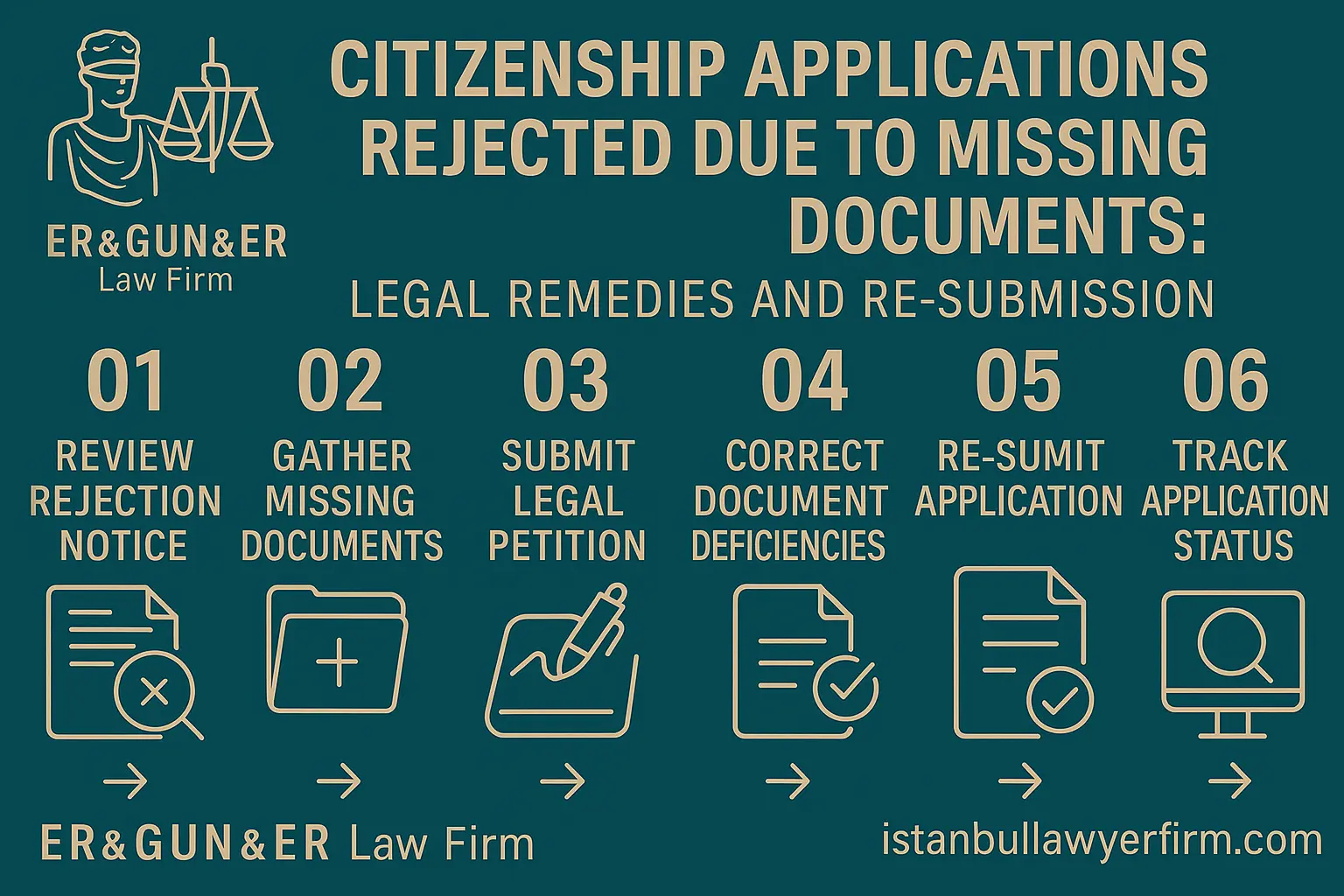
A lawyer in Turkey who represents foreign nationals whose citizenship applications have been rejected due to missing or deficient documentation understands that an application rejection by the General Directorate of Civil Registration and Nationality (Nüfus ve Vatandaşlık İşleri Genel Müdürlüğü, NVİGM) is not necessarily the end of the process—it is a procedural setback that can often be resolved through systematic identification of the deficiency, correction or replacement of the missing documents, and strategic re-submission or administrative appeal that addresses the specific grounds cited in the rejection notice. An Istanbul Law Firm that handles citizenship rejection cases helps applicants analyze the rejection letter, identify exactly which documents were missing, incomplete, expired, improperly authenticated or incorrectly formatted, and develop a corrective action plan that addresses every identified deficiency while ensuring that the remaining documents in the file remain current and compliant. A Turkish Law Firm with experience in citizenship applications coordinates the document correction process across multiple jurisdictions—obtaining replacement documents from foreign authorities, arranging apostille or consular legalization, commissioning certified Turkish translations, and assembling the corrected file in the format and sequence expected by the reviewing authority. An English speaking lawyer in Turkey who manages citizenship rejection responses for international clients ensures that the rejection grounds, the corrective steps required, the applicable deadlines and the strategic options available are communicated clearly to clients who may be located abroad and who depend on their Turkish legal counsel to navigate an administrative process conducted entirely in Turkish. Turkish lawyers who specialize in citizenship law bring practical familiarity with the NVİGM's internal review procedures, the documentation standards applied by provincial population directorates, the administrative objection process, and the administrative court litigation pathway available when objections are denied. This guide explains the common causes of rejection, the legal remedies available, the re-submission strategy and the procedural steps that a methodical lawyer in Turkey applies to turn citizenship rejections into successful approvals.
Common Documentation Deficiencies That Cause Citizenship Application Rejections
A lawyer in Turkey who reviews citizenship rejection notices explains that the most frequently cited documentation deficiencies fall into several recurring categories that reflect the complexity of assembling a multi-jurisdictional application file that must satisfy Turkish administrative standards for authentication, translation, formatting and currency. The first and most common category involves authentication failures: foreign-issued documents—birth certificates, marriage certificates, divorce decrees, criminal record certificates, educational credentials and identity documents—that were submitted without the required apostille from a Hague Convention country or without consular legalization from a non-Hague country, or that bear an apostille or legalization that is incomplete, that was issued by an authority not competent to apostille the specific document type, or that does not match the document to which it is attached because of a clerical error in the apostille certificate. The second common category involves translation deficiencies: documents that were not accompanied by a certified Turkish translation prepared by a sworn translator, translations that contain errors, omissions or inconsistencies relative to the original document, or translations that were prepared by a translator who is not registered with a Turkish notary and whose certification is therefore not recognized by the reviewing authority. The third category involves document expiry: criminal record certificates, bank statements, medical reports or other time-sensitive documents that were valid when obtained but that expired before the application file was submitted because the overall preparation process took longer than anticipated. Practice may vary by authority and year — verify current documentation standards, authentication requirements and validity periods before any citizenship application or re-submission.
An Istanbul Law Firm that diagnoses documentation deficiencies in rejected citizenship applications notes that a fourth common category involves identity inconsistencies across documents in the file—the applicant's name as spelled in the passport differs from the name as transliterated in the Turkish translation of the birth certificate, which differs from the name as recorded in the property title deed or bank deposit certificate, creating identity verification concerns that the reviewing authority cannot resolve without additional documentation or clarification. These inconsistencies typically arise from differences in transliteration conventions between languages and scripts, from data entry errors by banks, notaries or land registry clerks who recorded the applicant's name based on oral communication rather than documentary reference, or from the applicant's use of different name formats, middle name combinations or surname conventions in different countries. Turkish lawyers who review rejected files conduct a comprehensive cross-document consistency audit, comparing every instance of the applicant's name, date of birth, nationality, passport number and civil status across all documents in the file, and identifying discrepancies that need to be resolved through corrective applications to the issuing authority, supplementary identity declarations or explanatory cover letters that establish the equivalence of different name spellings with reference to the passport as the primary identity document.
A Turkish Law Firm that handles complex citizenship rejection cases also identifies a fifth category of deficiency that is particularly common in investment citizenship applications: the failure to provide adequate documentation of the qualifying investment transaction itself. This may include missing or incomplete conformity certificates from the General Directorate of Land Registry and Cadastre, bank letters that do not contain all required information or that are formatted in a way that does not meet the NVİGM's expectations, property valuation reports that are missing or that show a value below the qualifying threshold, fund transfer documentation that does not create a complete chain of evidence from the buyer's source account to the seller's receiving account, or source-of-funds documentation that is insufficient to satisfy the due diligence standards applied by the reviewing authority. An English speaking lawyer in Turkey who analyzes investment-related documentation deficiencies helps clients understand exactly what additional documentation is needed, coordinates with banks, land registry offices and property developers to obtain the missing documents, and ensures that the corrected investment documentation package satisfies both the NVİGM's administrative requirements and the financial due diligence standards applied during the security screening process.
For the full procedural framework on the qualifying investment routes and the institutional review architecture at the Vatandaşlık Daireleri, see our pillar guide on the citizenship by investment legal framework.
Legal Remedies and Administrative Appeal Procedures After Rejection
A lawyer in Turkey who advises on the legal remedies available after a citizenship application rejection explains that Turkish administrative law provides a structured, multi-level framework of objection and appeal rights that enables applicants to challenge rejection decisions through both administrative and judicial channels, with each level offering distinct procedural characteristics, timelines and strategic advantages. The first and most commonly used remedy is the administrative objection (itiraz), which involves filing a written objection with the authority that issued the rejection—typically the provincial population directorate that processed the original application, or in some cases directly with the NVİGM at the central level—within sixty days of the date the rejection notice was served on the applicant or their authorized representative. The administrative objection is the preferred first-line remedy because it is faster, less expensive and less procedurally complex than judicial review, and because it allows the reviewing authority to reconsider the application based on corrected documentation without requiring the applicant to navigate the formalities, costs and timelines of court litigation. The administrative objection document should identify the specific rejection grounds cited in the rejection notice with precise reference to the language used in the notice, explain clearly and with supporting evidence why each identified deficiency has been cured—whether through replacement of the missing document, correction of the authentication chain, re-translation by a certified translator, renewal of an expired certificate, or clarification of an identity inconsistency with supporting documentation—attach every corrected or replacement document in properly authenticated and translated form, and formally request that the authority withdraw the rejection decision and approve the citizenship application based on the supplemented and corrected file. Turkish lawyers who draft administrative objections structure the submission as a formal legal brief rather than an informal cover letter, citing the applicable provisions of the Turkish Citizenship Law (Law No. 5901), the implementing regulations (Regulation on the Application of the Turkish Citizenship Law), and any relevant administrative circulars or NVİGM directives that support the applicant's position on the specific deficiency at issue, because the quality, formality and legal precision of the objection influences both the likelihood of success and the speed with which the objection is processed by the reviewing authority. Practice may vary by authority and year — verify current objection filing procedures, deadlines and documentation requirements before any administrative appeal submission.
An Istanbul Law Firm that manages citizenship appeal processes explains that the sixty-day objection deadline is calculated from the date of service of the rejection notice, not from the date the notice was issued or the date the applicant learned of the rejection through informal channels, and that missing this deadline extinguishes the right to administrative objection and forces the applicant to pursue more costly and time-consuming judicial remedies. The service date is determined by the method of notification—personal service, postal delivery with return receipt, or electronic notification through the e-Government portal—and the applicant's attorney must verify the service date immediately upon learning of the rejection to calculate the remaining time available for preparing and filing the objection. Turkish lawyers who handle time-sensitive citizenship objections maintain pre-prepared templates and document checklists that enable rapid assembly of the objection file, minimizing the preparation time and maximizing the available window for obtaining replacement documents from foreign authorities. In cases where the replacement documents cannot be obtained within the sixty-day objection period—because of processing delays at foreign consulates, apostille offices or government agencies—the attorney may file the objection with a partial document package accompanied by a written explanation of the pending documents and a request for an extension to complete the file, although the success of such requests depends on the reviewing authority's discretion and the specific circumstances.
A Turkish Law Firm that pursues judicial remedies for citizenship rejections explains that when the administrative objection is denied, when the sixty-day objection period has expired without an objection being filed, or when the applicant seeks a definitive judicial determination that the administrative authority's rejection was unlawful, disproportionate or based on an error of fact or law that should be corrected through judicial intervention, the applicant may file an administrative court lawsuit (idari dava) with the competent Administrative Court in the judicial district where the rejection was issued or where the applicant is registered in the population records. The administrative court lawsuit must be filed within sixty days of the denial of the administrative objection or, if no objection was filed, within sixty days of the date the original rejection notice was served. The court petition must identify the challenged administrative act with specificity, referencing the rejection notice number, date and issuing authority; state the factual circumstances of the application, the rejection and the corrective measures taken; present the legal grounds for the challenge, arguing that the rejection was unlawful because the deficiency did not constitute a valid basis for rejection under the Turkish Citizenship Law and its implementing regulations, or that the rejection was disproportionate because the authority should have requested supplementary documentation rather than rejecting the application outright, or that the rejection was based on a factual error because the cited document was actually present in the original file but was overlooked or misclassified by the case officer; attach all supporting documentary evidence including the original application file, the rejection notice, any correspondence with the authority, the corrected documents and expert opinions or legal analysis that support the applicant's position; and specify the relief requested—typically annulment of the rejection decision and an order directing the administrative authority to reconsider and process the application based on the complete, corrected file. An English speaking lawyer in Turkey who represents citizenship applicants in administrative court proceedings prepares the court petition with the detailed legal analysis, documentary evidence and case law references that Turkish administrative courts expect, and ensures that international clients are informed about the procedural posture, expected timeline and potential outcomes at every stage of the litigation.
Preparing a Successful Re-Submission Package
A lawyer in Turkey who prepares citizenship re-submission packages after rejection explains that the re-submission process requires more than simply replacing the missing documents and re-filing the application—it requires a comprehensive, ground-up review of the entire application file to ensure that every document remains current, properly authenticated, accurately translated and internally consistent with every other document in the file, because the passage of time between the original submission and the re-submission inevitably causes some previously valid documents to expire, because the applicant's personal circumstances—address, employment, family composition, financial status—may have changed in ways that require updated documentation, because regulatory standards or documentation requirements may have been amended since the original submission was prepared, and because the reviewing authority will apply heightened scrutiny to a re-submitted file on the reasonable assumption that an applicant whose original file was rejected requires closer examination than a first-time applicant with a clean submission history. The re-submission package should be assembled as a complete, standalone application file rather than as a partial supplement to the original rejected file, for several important reasons: the reviewing authority may not have convenient access to the original file if it has been archived, returned or transferred to a different office; a complete re-submission demonstrates thoroughness, professionalism and attention to detail that builds confidence in the file's overall integrity; and a standalone file enables the case officer to evaluate the application on its own merits without the burden of cross-referencing multiple submissions, comparing original and replacement documents, or tracking which deficiencies have been addressed and which remain outstanding. Turkish lawyers who prepare re-submission packages create a master checklist that tracks every required document by category—identity documents, civil status documents, criminal record certificates, financial documentation, investment transaction documents, medical certificates, photographs and biometric records—noting the current status of each document, its validity period and expiry date, its authentication chain from issuance through apostille or consular legalization to certified Turkish translation, and any corrections made since the original submission. The complete file is then assembled in the order and format expected by the NVİGM, accompanied by a detailed cover letter that references the original application number, identifies each rejection ground cited in the rejection notice, explains specifically how each deficiency has been corrected with reference to the replacement document's location in the file, and provides a comprehensive index listing every document included in the re-submission with its authentication and translation details so that the case officer can verify completeness by reference to the index without searching through the entire file. Practice may vary by authority and year — verify current re-submission procedures, documentation checklists and formatting requirements before any re-filing.
An Istanbul Law Firm that manages the document replacement process for rejected citizenship applications coordinates with multiple institutions across multiple jurisdictions simultaneously to minimize the time required to obtain corrected or replacement documents and to ensure that the overall re-submission timeline does not exceed the available deadline window. Criminal record certificates must be re-obtained from each country where the applicant has resided during the relevant lookback period, re-apostilled or re-legalized through the applicable authentication chain in each issuing country, and re-translated into Turkish by a certified sworn translator—a process that can take anywhere from two weeks to three months depending on the responsiveness of the foreign criminal records authority, the processing backlog at the apostille or consular legalization office, and the availability of sworn translators with expertise in the language and legal terminology of the issuing country. Bank statements and financial certificates must be re-issued with current dates that fall within the applicable validity window, and the re-issued documents must contain all of the specific information fields required by the NVİGM including account holder identity, account number, balance figures, transaction history for the relevant period, and any lock or restriction annotations for investment citizenship applications. Medical reports must be refreshed if the previous reports have expired, requiring the applicant to undergo new medical examinations at an approved healthcare facility. Property documentation including conformity certificates, title deed extracts, non-sale annotation confirmations and bank payment records must be updated to reflect the current status of the investment as of the re-submission date, which may require coordination with the General Directorate of Land Registry and Cadastre, the depositary bank and any escrow agents involved in the original transaction. Turkish lawyers who coordinate this multi-institutional, multi-jurisdictional document replacement process maintain direct contact with foreign consulates in Turkey, foreign apostille offices through their international correspondent networks, certified sworn translators in multiple language pairs, and the Turkish institutional counterparts at the land registry, banking and population directorates to track progress across all replacement activities simultaneously, identify bottlenecks before they become critical delays, and expedite processing wherever institutional relationships or procedural mechanisms permit faster handling. An English speaking lawyer in Turkey who manages the replacement process for clients located in different countries provides regular progress updates through a unified tracking dashboard, coordinates international courier logistics for documents that must be physically transported between countries for authentication and submission, and ensures that replacement documents are obtained and authenticated in the strategically optimal sequence that minimizes the risk of early-obtained documents expiring before late-obtained documents are ready for inclusion in the re-submission file.
A Turkish Law Firm that conducts pre-submission quality control for citizenship re-applications emphasizes that the final review before re-submission is the most critical step in the process—a step that catches the errors, inconsistencies and omissions that would otherwise trigger a second rejection and further delay the applicant's path to citizenship. The quality control review examines every document in the file for authentication completeness, checking that apostilles bear the correct reference numbers, dates and authority stamps; for translation accuracy, comparing key information in the translation against the original document; for identity consistency, verifying that the applicant's name, date of birth, nationality and passport number appear identically across all documents; for currency, confirming that no document has expired since it was obtained; and for format compliance, ensuring that documents are assembled in the sequence, pagination and binding format expected by the receiving office. An English speaking lawyer in Turkey who conducts the final quality review with the client walks through every document in the file, explaining its purpose, confirming its accuracy and obtaining the client's confirmation before the file is submitted—a step that both protects the client's interests and creates a record that the client reviewed and approved the file before submission.
Timing Management, Deadline Compliance and Document Validity Coordination
A lawyer in Turkey who manages timing in citizenship rejection responses explains that the interplay between the sixty-day objection deadline, individual document validity periods, institutional processing times at foreign authorities and domestic offices, courier and mail transit times for international document delivery, and the applicant's geographic location relative to the relevant Turkish and foreign authorities creates a complex timing puzzle that must be solved correctly to preserve the applicant's legal rights, maintain document currency and maximize the chances of a successful outcome. The sixty-day deadline for filing an administrative objection begins running from the date of service of the rejection notice, and every day consumed by the identification of deficiencies, the sourcing of replacement documents from foreign authorities, the processing of apostilles and consular legalizations, the commissioning and completion of certified translations, and the assembly and review of the corrected file reduces the available window for filing the objection before the deadline expires. For applicants located abroad—which is frequently the case in investment citizenship applications where the applicant may reside in a different country from where their original documents were issued—the timing pressure can be intense, particularly when the foreign authority from which the replacement document must be obtained requires in-person applications at a specific government office, when apostille processing times at the relevant foreign authority are measured in weeks rather than days due to heavy processing backlogs, when the document must be transmitted by international courier to Turkey for translation and filing, or when public holidays, weekends or institutional closures in either the foreign country or Turkey reduce the effective number of working days available during the sixty-day period. Turkish lawyers who manage these timing constraints begin working on the objection strategy immediately upon learning of the rejection—often within hours of receiving the rejection notice—filing preliminary communications with the reviewing authority that acknowledge the rejection and signal the applicant's intent to file a corrected objection, and then coordinating the document replacement, authentication and translation activities in parallel rather than in sequence to compress the overall timeline to the greatest extent possible. Practice may vary by authority and year — verify current objection deadlines, document processing times and institutional schedules before any timing-dependent strategy decisions.
An Istanbul Law Firm that coordinates document validity across multi-jurisdictional citizenship files explains that the challenge of maintaining all documents within their validity periods simultaneously becomes more acute in re-submission scenarios because the applicant is working against both the objection deadline and the validity clocks of documents that were obtained at different times during the original application preparation and the correction process. A criminal record certificate obtained six months ago for the original application may have only days of validity remaining when the re-submission is ready, while a bank statement obtained fresh for the re-submission may have a validity period that extends well beyond the anticipated processing time. Turkish lawyers who manage these overlapping validity windows create a document validity matrix that tracks the issuance date, validity period and expiry date of every document in the file, and that identifies the critical path—the sequence of documents whose validity windows create the narrowest available submission window—so that the re-submission can be timed to fall within the period when all documents are simultaneously valid.
A Turkish Law Firm that provides ongoing timeline management for citizenship applicants notes that the timing challenges do not end with the re-submission—the post-submission processing period may generate additional document requests from the reviewing authority that must be answered within short response windows, and any delay in responding may result in the file being closed or the application being deemed abandoned. An English speaking lawyer in Turkey who monitors the application status through the e-Government portal and through direct communication with the reviewing authority provides immediate notification to the client when additional requests are received, coordinates the rapid preparation and submission of responsive documents, and files confirmation receipts that document timely compliance with each request. This ongoing monitoring and rapid-response capability is particularly important for applicants located abroad who cannot visit the reviewing authority's office in person and who depend on their attorney to maintain the momentum of the application through every stage of the review process.
Integration with Investment, Residency and Immigration Processes
A lawyer in Turkey who manages citizenship re-submissions in coordination with related immigration processes explains that citizenship applications frequently overlap with residence permit renewals, investment program compliance obligations, tax filing requirements and property registration proceedings, and that a citizenship rejection can create cascading effects on these related processes if the interconnections are not managed proactively. An applicant whose residence permit is tied to the citizenship application may need to ensure that the permit remains valid during the re-submission and review period, because a lapsed residence permit may affect both the immigration status and the citizenship eligibility. An applicant whose qualifying investment is subject to a holding period may need to confirm that the rejection and re-submission process does not affect the holding period calculation or the investment compliance status. Turkish lawyers who coordinate citizenship re-submissions with related immigration and investment processes maintain a unified compliance dashboard that tracks the status and deadlines of all related proceedings, ensuring that actions taken in one process do not inadvertently compromise another. Practice may vary by authority and year — verify current coordination requirements between citizenship, immigration and investment compliance processes before any strategic decisions.
An Istanbul Law Firm that advises investment citizenship applicants on the interaction between the rejection response and the investment compliance framework explains that a citizenship rejection does not automatically affect the status of the qualifying investment or the holding period obligation—the property remains registered in the applicant's name, the bank deposit remains locked, and the investment compliance obligations continue regardless of the citizenship application status. However, the applicant must ensure that the investment documentation is updated as part of the re-submission to reflect the current status of the investment, including any changes in property valuation, any bank correspondence regarding the deposit lock period, and any regulatory changes that may have altered the investment qualification criteria since the original application was filed. Turkish lawyers who manage investment citizenship re-submissions coordinate with banks, land registry offices and the General Directorate to obtain updated investment documentation that satisfies both the current regulatory requirements and the specific deficiency grounds cited in the rejection notice.
A Turkish Law Firm that handles multi-process coordination for international clients also advises on the tax and financial reporting implications of the citizenship application status. An English speaking lawyer in Turkey who manages the intersection of citizenship, immigration and tax compliance ensures that the applicant's tax declarations, financial disclosures and institutional registrations remain accurate and consistent throughout the rejection response and re-submission period, and that any changes in the applicant's circumstances—such as changes in residence address, employment status, family composition or investment portfolio—are reflected in all relevant administrative records simultaneously. This comprehensive coordination prevents the situation in which a successful citizenship re-submission is followed by a compliance inquiry from a different administrative authority that discovers inconsistencies between the citizenship file and the tax or immigration records.
Administrative Court Litigation for Citizenship Rejection Disputes
A lawyer in Turkey who litigates citizenship rejection cases in the Administrative Courts explains that judicial review is available when the administrative objection is denied, when the sixty-day objection period has expired, or when the applicant seeks a definitive judicial determination that the rejection was unlawful, disproportionate or based on an error of fact or law. The administrative court lawsuit is filed with the Administrative Court in the judicial district where the rejection was issued or where the applicant is registered, and the petition must identify the challenged administrative act, state the factual and legal grounds for the challenge, present the evidence supporting the applicant's position, and specify the relief requested—typically annulment of the rejection decision and an order directing the administrative authority to reconsider the application based on the corrected file. Turkish lawyers who litigate citizenship cases in the Administrative Courts prepare detailed legal briefs that analyze the rejection grounds against the applicable provisions of the Turkish Citizenship Law, the implementing regulations and the administrative law principles governing proportionality, procedural fairness and the duty to assist applicants in correcting curable deficiencies rather than rejecting applications outright for technical non-compliance. Practice may vary by authority and year — verify current administrative court filing procedures, deadlines and legal standards for citizenship rejection challenges before any litigation decision.
An Istanbul Law Firm that handles administrative court proceedings for citizenship applicants explains that the court process involves the submission of the petition, the respondent authority's defense submission, any supplementary briefs from either party, and the court's evaluation and judgment—a process that typically takes several months to a year depending on the court's caseload and the complexity of the issues. The court may also order the parties to submit additional evidence or explanations, and may appoint an expert to evaluate contested factual issues such as document authenticity, translation accuracy or investment valuation. Turkish lawyers who represent citizenship applicants in administrative court proceedings coordinate the evidence presentation, manage the briefing schedule, and attend hearings where oral argument is permitted or required. An English speaking lawyer in Turkey who manages administrative court litigation for international clients provides regular case status updates, translates court communications and orders, and ensures that the client understands the procedural posture of the case and the expected timeline for resolution.
A Turkish Law Firm that pursues parallel strategies in citizenship rejection cases advises that filing a new citizenship application simultaneously with the administrative court lawsuit can be an effective dual-track strategy that maximizes the applicant's chances of obtaining citizenship through whichever channel produces a result first. The new application is prepared with a complete, fully corrected document package that addresses all deficiencies identified in the original rejection, and is submitted as an independent application rather than as a supplement to the rejected file. Meanwhile, the administrative court proceeding challenges the lawfulness of the original rejection, potentially resulting in a court order directing the authority to reconsider the original application. If the new application is approved before the court proceeding concludes, the court case becomes moot and can be withdrawn; if the court orders reconsideration before the new application is processed, the court order provides an additional pathway to approval. This parallel approach requires careful coordination to ensure that the two applications do not create contradictions or administrative confusion, but when managed by experienced counsel, it significantly accelerates the path to citizenship approval.
Post-Approval Procedures and Long-Term Compliance
A lawyer in Turkey who advises citizenship recipients on post-approval procedures explains that the grant of Turkish citizenship initiates a series of sequential administrative steps that must be completed in the correct order before the new citizen can exercise the full rights and privileges of Turkish nationality—including population registry registration at the provincial population directorate, national identity card (kimlik) application and issuance, Turkish passport application and issuance, voter registration, military service status assessment and notification for male applicants within the applicable age range, tax identification number update to reflect the new nationality status, social security registration where applicable, and notification of relevant foreign authorities and institutions about the acquisition of Turkish nationality. An Istanbul Law Firm that manages post-approval procedures coordinates these administrative steps in a sequenced workflow that ensures each step is completed in the correct order and within any applicable deadlines, with the output documents from each step—such as the identity card, the population registry extract and the passport—serving as inputs for subsequent steps. Turkish lawyers who handle post-approval procedures ensure that the new citizen's identity information—including name spelling, date of birth, place of birth, nationality, marital status and family composition—is recorded accurately and consistently across all Turkish administrative systems from the population registry through the identity card, passport, tax administration and social security records, preventing the identity discrepancies that can arise when different institutions record the same information differently and that create practical problems for the citizen in subsequent administrative interactions. Practice may vary by authority and year — verify current post-approval procedures and administrative requirements before any post-grant steps.
An Istanbul Law Firm that advises on dual nationality coordination for newly naturalized Turkish citizens explains that many citizenship recipients retain their original nationality alongside their new Turkish citizenship, creating dual nationality status that requires careful management to ensure compliance with the laws of both countries. Some countries require their citizens to notify the government when they acquire a second nationality, others impose restrictions on the exercise of dual nationality, and a few do not recognize dual nationality at all—meaning that the acquisition of Turkish citizenship could theoretically affect the applicant's status under the laws of their original country. An English speaking lawyer in Turkey who coordinates dual nationality matters helps newly naturalized citizens understand their notification obligations, assess any restrictions that may apply under their original country's laws, and take the administrative steps necessary to ensure that both nationalities are properly registered and maintained.
A Turkish Law Firm that provides long-term compliance support for citizenship recipients advises that maintaining comprehensive records of the entire citizenship application process—including the original application, the rejection notice, the objection or re-submission, the corrective documentation, the approval decision and all post-approval administrative steps—is essential for future administrative needs. These records may be required for passport renewal, for verification of citizenship status by foreign authorities, for inheritance proceedings, for property transactions that reference the owner's citizenship status, or for any future administrative inquiry regarding the circumstances of the citizenship grant. Turkish lawyers who archive citizenship case files maintain secure, indexed records that can be accessed quickly when needed, providing the client with documented proof of every step in the process from initial application through final citizenship grant and post-approval registration. The best lawyer in Turkey for citizenship matters treats the case file not as a closed matter after the grant but as a living record that serves the client's interests for years and decades after the citizenship is obtained.
Strategic Role of Legal Counsel in Citizenship Re-Submission and Appeals
A lawyer in Turkey who represents citizenship applicants through the rejection response process explains that the involvement of experienced legal counsel significantly increases the likelihood of a successful outcome by ensuring that the rejection grounds are correctly diagnosed based on a precise reading of the rejection notice and the underlying administrative file, that the corrective measures address every identified deficiency completely and without creating new inconsistencies or deficiencies in the process, that the re-submission or objection is filed within the applicable deadline with all required documents properly authenticated and translated, that the documentation meets the current administrative standards as applied by the specific reviewing office rather than generic standards that may have been superseded, and that the overall strategy is calibrated to the specific circumstances of the case including the severity of the deficiency, the availability of replacement documents, the applicant's timeline constraints and the cost-benefit analysis of different strategic options. Self-represented applicants who attempt to respond to citizenship rejections without professional legal guidance frequently make errors that compound the original deficiency rather than resolving it—submitting replacement documents with incorrect or incomplete authentication chains that trigger the same type of deficiency that caused the original rejection, filing objections that address only some of the cited rejection grounds while overlooking others that the applicant did not fully understand, missing the sixty-day deadline because the applicant underestimated the time required to obtain replacement documents from foreign authorities, or creating new identity inconsistencies between the corrected documents and the uncorrected documents remaining in the file that trigger additional queries and delays from the reviewing authority. Turkish lawyers who specialize in citizenship applications bring institutional knowledge of the NVİGM's internal review procedures, documentation format preferences, institutional processing patterns and the specific expectations of individual reviewing offices that enables them to prepare re-submissions and objections that anticipate the reviewing authority's likely concerns and that present the corrected file in the format and structure most likely to result in prompt approval without additional requests for supplementary documentation or clarification. Practice may vary by authority and year — verify current administrative practices and documentation expectations before any re-submission or appeal filing.
An Istanbul Law Firm that provides end-to-end legal representation for citizenship rejection responses explains that the attorney's role extends beyond document preparation to include strategic decision-making about whether to file an administrative objection, submit a new application, pursue administrative court litigation, or combine multiple strategies in a parallel approach. The optimal strategy depends on the nature and severity of the deficiency, the availability of corrective documentation, the time remaining within the applicable deadlines, the applicant's overall immigration status, and the cost and time implications of each available option. Turkish lawyers who advise on strategy evaluate these factors in consultation with the client and recommend the approach that offers the best balance of likelihood of success, speed of resolution and cost-effectiveness. An English speaking lawyer in Turkey who manages strategy consultations for international clients presents the options in clear, practical terms that enable the client to make informed decisions about how to proceed.
A Turkish Law Firm that handles high-volume citizenship cases brings the additional advantage of pattern recognition—the ability to identify recurring deficiency types, anticipate the reviewing authority's likely concerns based on experience with similar cases, and apply lessons learned from previous rejections and successful re-submissions to optimize the current client's file. An English speaking lawyer in Turkey who maintains a practice focused on citizenship matters for international clients develops expertise in the specific documentation challenges that foreign applicants face—multi-jurisdictional criminal record checks, cross-border authentication chains, name transliteration inconsistencies and investment documentation coordination—that distinguishes specialized citizenship counsel from generalist practitioners. The combination of specialized expertise, institutional knowledge and strategic judgment that experienced citizenship counsel provides transforms the rejection response from a stressful administrative burden into a structured, professionally managed process with a clear path to a successful outcome.
Frequently Asked Questions
- Can I re-submit my citizenship application after rejection? Yes. If the rejection was based on missing or deficient documentation, you can correct the deficiencies and re-submit the application as either an administrative objection within sixty days of the rejection notice or as a fresh application with a complete, corrected document package. The choice between objection and new application depends on the nature of the deficiency and the strategic assessment of your attorney.
- What is the deadline for filing an objection to a citizenship rejection? The administrative objection must be filed within sixty days of the date the rejection notice was served on you or your authorized representative. Missing this deadline extinguishes the right to administrative objection and requires the applicant to either file a new application or pursue administrative court litigation within the applicable judicial deadline.
- What happens if I miss the sixty-day objection deadline? If the objection deadline has passed, you may file an administrative court lawsuit challenging the rejection within the applicable judicial deadline, which is also sixty days from the date the objection was denied or, if no objection was filed, from the original rejection notice. Alternatively, you can file a completely new application with corrected documentation without relying on the objection or appeal process.
- Can my lawyer file the objection on my behalf? Yes, with a notarized power of attorney that specifically authorizes the attorney to file administrative objections and appeals on your behalf with the relevant citizenship and population authorities. The power of attorney must be properly authenticated—apostilled for Hague Convention countries or consularly legalized for non-Hague countries—and translated into Turkish.
- What documents are most commonly missing in rejected applications? The most frequently cited deficiencies include criminal record certificates that are missing or expired, birth or marriage certificates without proper apostille or consular legalization, translations that contain errors or were prepared by non-certified translators, identity inconsistencies across documents, expired financial or medical certificates, and investment documentation that is incomplete or does not meet the current administrative standards.
- How long does the re-submission process take? The timeline depends on the complexity of the deficiencies and the time required to obtain replacement documents from foreign authorities. Simple corrections may be completed within a few weeks, while complex multi-jurisdictional document replacements may require two to three months. The administrative review of the re-submitted file typically takes several additional weeks to months.
- Can I file a new application while my objection is pending? Yes. Filing a new application simultaneously with the pending objection is a legitimate dual-track strategy that maximizes your chances of obtaining citizenship through whichever channel produces a result first. The new application must be prepared as a complete, standalone file that addresses all previously identified deficiencies.
- Will my investment be affected by the citizenship rejection? The citizenship rejection does not automatically affect the status of your qualifying investment. The property remains in your name, the bank deposit remains locked, and the investment compliance obligations continue. However, the investment documentation must be updated as part of the re-submission to reflect current status and any regulatory changes since the original filing.
- Can I pursue administrative court litigation for a citizenship rejection? Yes. Administrative court litigation is available when the administrative objection is denied or when the objection deadline has passed. The court evaluates whether the rejection was lawful, procedurally correct and proportionate, and may order the authority to reconsider the application if the rejection is found to be unlawful.
- What is a conformity certificate and why might it be missing? The conformity certificate is issued by the General Directorate of Land Registry and Cadastre and confirms that the property meets the minimum value threshold for the citizenship program. It may be missing from the file because it was not requested during the original application preparation, because the processing was delayed, or because the property's assessed value fell below the qualifying threshold.
- Do I need to attend in person for a re-submission? Not necessarily. Your attorney can submit the corrected file on your behalf with a valid power of attorney. However, if biometric appointments are required—for photographs, fingerprints or signature capture—your personal attendance may be necessary, and your attorney can coordinate the scheduling and logistics.
- What is the cost of re-submission and appeal services? Costs vary depending on the complexity of the case, the number of documents requiring replacement and re-authentication, the need for administrative court litigation, and the geographic coordination required. Your attorney should provide a transparent fee estimate that itemizes document preparation, authentication, translation, filing and representation costs before commencing work.
- Can I prevent future rejections after re-submission? Yes. The most effective prevention strategy is to maintain a complete, indexed archive of all citizenship-related documents with their authentication chains, validity periods and translation records, and to conduct periodic reviews with your attorney to ensure that all documents remain current and that any changes in circumstances are reflected in the file before they create deficiencies.
- How does dual nationality affect the re-submission process? Dual nationality may require additional documentation from both countries, including criminal record checks from each country of nationality, consular declarations regarding nationality status, and compliance with any notification obligations imposed by either country when the other country's citizenship is acquired.
- Does ER&GUN&ER Law Firm handle citizenship rejection cases? Yes. ER&GUN&ER Law Firm provides comprehensive legal services for citizenship application rejections, including deficiency diagnosis, document replacement coordination, administrative objection filing, re-submission preparation, administrative court litigation, post-approval procedures and dual nationality coordination, with bilingual English-Turkish legal support throughout the process.
Author: Mirkan Topcu is an attorney registered with the Istanbul Bar Association (Istanbul 1st Bar), Bar Registration No: 67874. His practice focuses on cross-border and high-stakes matters where evidence discipline, procedural accuracy, and risk control are decisive.
He advises individuals and companies across Immigration and Residency, Real Estate Law, Tax Law, and cross-border documentation matters where procedural accuracy and evidence discipline are decisive.
Education: Istanbul University Faculty of Law (2018); Galatasaray University, LL.M. (2022). LinkedIn: Profile. Istanbul Bar Association: Official website.