

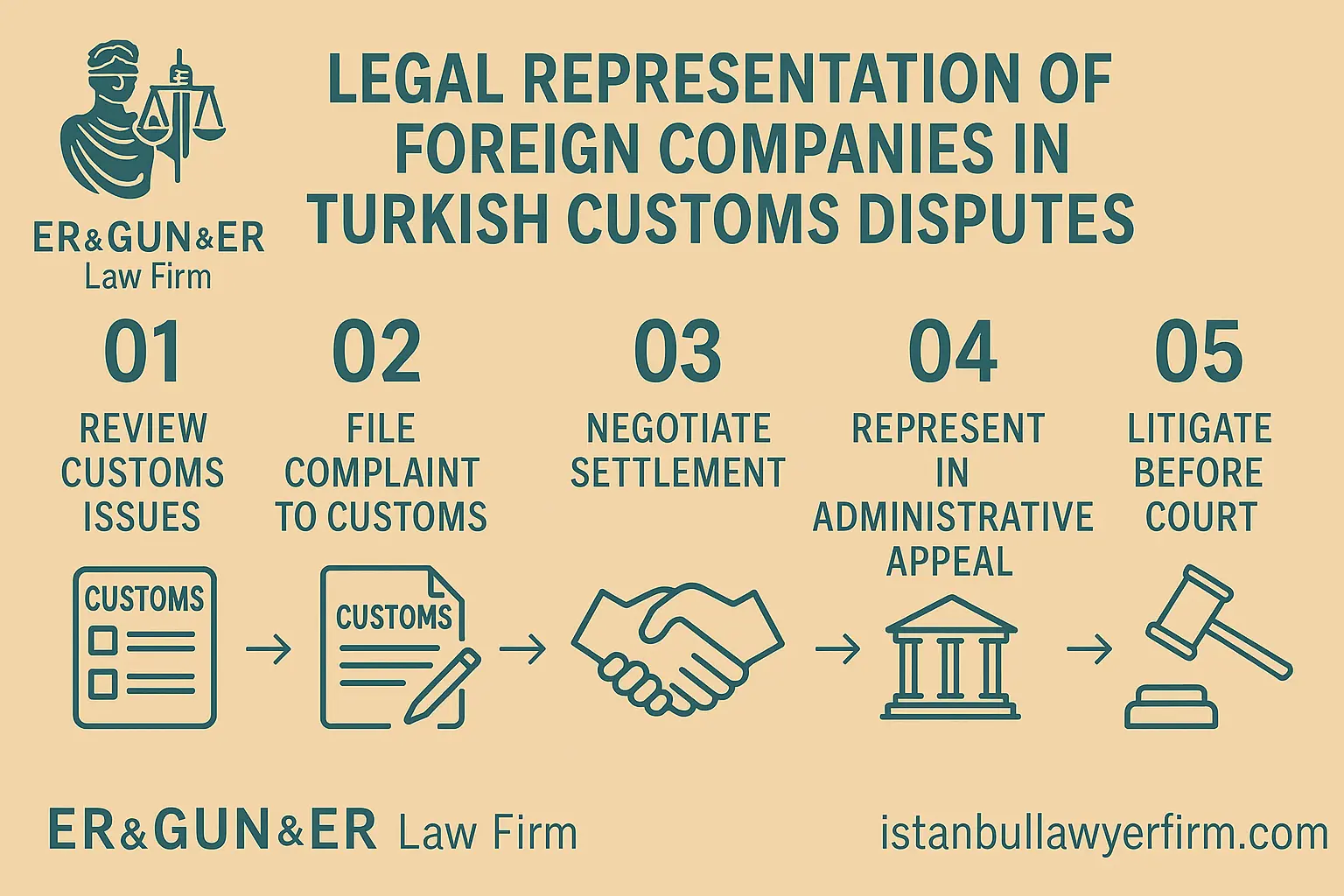
A lawyer in Turkey who represents foreign companies in Turkish customs disputes understands that customs-related legal challenges—arising from disputed HS code classifications, undervaluation findings, documentation deficiencies, origin certification failures, AML-triggered payment suspensions or outright goods seizure—can create immediate operational disruption for foreign companies whose supply chains depend on predictable import and export processing, and that effective customs dispute management requires simultaneous legal action across multiple tracks that must be coordinated without delay from the moment a customs authority issue is identified. An Istanbul Law Firm that provides comprehensive customs dispute representation for foreign companies defends client interests across every stage and dimension of Turkish customs proceedings: providing on-site representation during customs audits and inspections at ports, warehouses and logistics facilities; preparing and filing timely administrative objections that challenge customs authority decisions on factual, documentary and legal grounds within the strict procedural deadlines that Turkish customs law imposes; managing administrative appeal proceedings before regional customs directorates with comprehensive evidentiary submissions that address every element of the customs authority's adverse decision; representing companies in administrative court litigation including temporary injunction applications, suspension of execution petitions and full merits proceedings before Turkish administrative courts; conducting classification, valuation and origin analysis that substantiates the company's declared positions with technical documentation, expert analysis and comparative trade data; coordinating broker relationships, internal compliance teams and logistics providers to ensure that customs dispute responses are supported by consistent, accurate documentary evidence from every relevant operational source; designing proactive trade risk assessment programs that identify customs compliance vulnerabilities before they generate disputes; and managing structured settlement negotiations, voluntary disclosure procedures and post-resolution compliance implementation that close disputes efficiently while positioning the company for compliant future operations. A Turkish Law Firm with experience representing multinational companies in Turkish customs proceedings brings practical knowledge of how Turkish customs authority audit teams select targets, what documentation packages most efficiently satisfy auditor inquiries, what legal arguments Turkish administrative courts find most persuasive in customs appeals, and how Turkish customs settlement procedures can be navigated to achieve commercially reasonable outcomes. An English speaking lawyer in Turkey who manages customs disputes for foreign companies provides the bilingual coordination that enables head office compliance teams, global supply chain managers and international legal counsel to remain fully informed of Turkish proceedings at every stage—ensuring that Turkish customs dispute strategy is integrated with the company's global trade compliance posture rather than managed as an isolated Turkish legal matter without connection to the company's broader legal and operational context.
Common Triggers and Legal Risks in Turkish Customs Disputes
A lawyer in Turkey who advises on Turkish customs dispute triggers explains that customs authority challenges of foreign company import and export transactions most commonly arise from three categories of discrepancy: documentary discrepancies where the information declared in customs documentation is internally inconsistent or inconsistent with information from other government databases or the customs authority's own intelligence; valuation discrepancies where the declared transaction value of imported goods differs from reference values that Turkish customs authorities apply based on comparable product pricing data maintained in their systems; and classification discrepancies where the HS tariff code applied to goods in customs declarations is challenged by customs authorities who determine that the goods should be classified under a different code with higher duty rates or additional import restrictions. An Istanbul Law Firm that advises foreign companies on Turkish customs dispute risk management conducts pre-dispute risk analysis that identifies the specific documentation patterns, valuation structures and classification decisions most likely to attract customs authority scrutiny in each client's specific trade profile: companies importing products with transfer pricing between related parties face heightened valuation scrutiny because customs authorities apply transaction value provisions that require arm's-length pricing and may challenge intragroup prices that appear below market value; companies importing products in categories that Turkish customs authorities have identified as high-risk for under-declaration—including luxury goods, electronics, agricultural products and pharmaceuticals—face elevated audit probability requiring stronger documentation practices; and companies with complex supply chains involving multiple countries of origin, intermediate processing and component sourcing face origin certificate challenges that require comprehensive supply chain documentation to defend. Turkish lawyers advising on customs dispute risk identification examine each client's recent customs declaration history, identify patterns that customs intelligence systems may flag, and advise on the documentation practices and valuation methodologies that reduce the probability of dispute initiation before disputes actually arise. Practice may vary by authority and year — verify current Turkish Customs Law provisions on customs value assessment, current Turkish customs authority audit selection criteria, current HS tariff classification circulars applicable to specific product categories, and current origin verification requirements under Turkey's preferential trade agreements before assessing any specific customs compliance risk profile.
An Istanbul Law Firm that advises on the legal risks arising from Turkish customs disputes explains that customs authority adverse decisions create a cascade of potential consequences that extend well beyond the immediate duty assessment or penalty notice—including the suspension of customs release for current and future shipments pending resolution of the dispute; restriction or cancellation of the economic operator authorization that the company relies on for simplified customs procedures and reduced inspection frequency; administrative penalties for violations of customs declaration requirements that accumulate for each affected shipment; criminal referral where customs authorities determine that declaration discrepancies reflect fraudulent intent rather than error; and reputational damage to the company's customs authority relationship that increases audit frequency and reduces the cooperative engagement that facilitates efficient future customs processing. Turkish lawyers advising on customs dispute risk management emphasize that the scale of consequence is directly related to the speed and quality of legal response—because early, well-organized legal intervention that addresses customs authority concerns with comprehensive documentary evidence typically produces more favorable outcomes than delayed responses that allow initial adverse decisions to become final and that allow procedural deadlines to expire without protective filings. An English speaking lawyer in Turkey who manages Turkish customs dispute risk for foreign companies ensures that the company's global legal team understands the specific Turkish procedural environment—including the strict deadlines for objection and appeal filing that differ from those in many other customs jurisdictions, the documentary standards that Turkish administrative courts apply to customs dispute evidence, and the specific characteristics of Turkish customs settlement procedures that differ from negotiated resolution approaches available in other jurisdictions.
A Turkish Law Firm that advises on emergency customs dispute response explains that goods seizure and immediate enforcement actions require the fastest possible legal response—because Turkish customs law's procedural rules impose specific deadlines for challenging seizures, and because failing to respond within those deadlines can result in forfeiture of seized goods, conversion of provisional measures to permanent enforcement actions, and loss of procedural rights that cannot be recovered through subsequent legal proceedings. An English speaking lawyer in Turkey who manages emergency customs response for foreign companies maintains the operational readiness to deploy experienced customs litigation attorneys to affected ports, warehouses and logistics facilities immediately upon notification of a seizure or enforcement action—filing the emergency suspension applications, injunction petitions and procedural objections that protect the company's goods and legal rights from the moment the enforcement action commences rather than after the initial procedural windows have closed.
Appeal Procedures and Litigation for Customs Sanctions
A lawyer in Turkey who advises on Turkish customs appeal procedures explains that Turkish customs law provides a structured hierarchy of administrative and judicial remedies for foreign companies challenging adverse customs authority decisions—with administrative objection to the customs directorate that issued the decision as the mandatory first step, followed by administrative court litigation if the objection is rejected or not resolved within the statutory response period, and further judicial review by the Council of State (Danıştay) for significant legal questions arising in customs cases. An Istanbul Law Firm that manages Turkish customs appeal proceedings for foreign companies prepares each appeal level with the comprehensive evidentiary and legal support that maximizes success probability at each stage: the administrative objection petition presenting every factual, documentary and legal argument against the customs decision with supporting evidence including commercial contracts, price lists, technical product specifications, certificates of origin, laboratory analyses, expert opinions and comparative customs ruling references that establish the strength of the company's position from the outset; the administrative court petition organizing the most legally compelling arguments for judicial review within the framework of Turkish administrative procedure law, with particular attention to procedural violations committed by the customs authority, legal errors in the application of customs valuation or classification standards, and evidence of customs authority departure from established administrative practice that entitles the company to expect consistent treatment. Turkish lawyers managing customs litigation develop comprehensive litigation strategies that integrate Turkish administrative law, WTO customs valuation standards, GATT principles, Turkey's preferential trade agreements and Turkish constitutional provisions protecting property rights and due process—using every available legal framework to maximize the pressure on Turkish administrative courts to review customs authority decisions with appropriate rigor. Practice may vary by authority and year — verify current Turkish administrative procedure law provisions on customs dispute litigation, current appeal deadlines applicable to each type of customs authority decision, current Turkish Council of State jurisprudence on customs valuation and classification disputes, and current evidence standards applied by Turkish administrative courts in customs cases before developing litigation strategy for any specific customs dispute.
An Istanbul Law Firm that represents foreign companies in Turkish customs litigation explains that Turkish administrative court proceedings in customs cases—while following general Turkish administrative procedure law framework—present specific characteristics that differ from the customs litigation environment in many foreign companies' home jurisdictions: Turkish administrative courts apply an inquisitorial approach where judges actively examine case files and may request additional evidence or expert opinions without the parties' initiative; customs cases often involve highly technical questions about HS tariff classification, customs valuation methodology and origin determination where expert opinion evidence carries significant weight in judicial decision-making; and the administrative court proceeding timeline in customs cases varies substantially depending on court workload, case complexity and the need for technical expert assessment, making realistic timeline expectations essential for companies managing cash flow implications of disputed duty assessments during the litigation period. Turkish lawyers representing foreign companies in customs litigation manage the complete litigation process with the attention to procedural detail and evidentiary quality that administrative courts expect: timely preparation and filing of all required submissions within procedural deadlines; organization of technical expert opinions from qualified customs valuation, HS tariff classification or supply chain specialists that provide courts with the technical foundation needed to evaluate complex factual disputes; translation and authentication of foreign-language documentary evidence in formats that Turkish administrative courts accept; and courtroom representation that presents the legal arguments in the direct, organized format that Turkish administrative judges find most efficient. An English speaking lawyer in Turkey who manages Turkish customs litigation for foreign companies provides regular English-language case status updates that enable global compliance teams to maintain accurate visibility of Turkish proceedings without requiring Turkish language proficiency.
A Turkish Law Firm that advises on alternative resolution for Turkish customs disputes explains that some customs disputes—particularly those involving disputed duty assessments without allegations of fraudulent intent—can be resolved through structured administrative settlement negotiations that avoid the cost, delay and uncertainty of full administrative court litigation. Turkish lawyers advising on settlement strategy for customs disputes evaluate each case's settlement eligibility and realistic settlement range based on the specific customs authority decision challenged, the strength of the available documentary and legal arguments, the customs authority's current settlement approach in comparable cases, and the company's commercial priorities regarding cost efficiency, timeline and maintaining the customs authority relationship that continued trade operations require. An English speaking lawyer in Turkey who manages settlement negotiations for foreign companies in Turkish customs disputes coordinates the negotiation strategy with the litigation preparation—ensuring that settlement discussions are conducted from a position of genuine legal strength while maintaining the procedural options needed to pursue litigation if settlement discussions do not produce commercially acceptable outcomes.
On-Site Audit Support and Immediate Compliance Measures
A lawyer in Turkey who advises on customs audit response for foreign companies explains that Turkish customs audits—whether announced in advance or conducted as surprise inspections at ports, warehouses, free zones or production facilities—create immediate legal risk if the company's response is not managed with the procedural precision and documentary completeness that Turkish customs auditors expect, because audit responses that fail to satisfy auditor information requests, provide inconsistent information across different documentary sources, or miss the procedural deadlines for responding to specific audit requirements routinely result in more extensive audit scope, larger duty assessments and higher penalty exposure than prompt, comprehensive responses would produce. An Istanbul Law Firm that provides on-site audit support for foreign companies during Turkish customs inspections deploys experienced customs attorneys to the inspection location immediately upon notification—enabling real-time legal guidance on what documentation must be provided in response to each specific auditor request, what information can be appropriately withheld pending legal review, how to manage auditor access to company systems and records in a manner that preserves legal privilege where applicable, and how to document the audit proceedings in a way that creates an accurate record of the audit's scope and conduct for any subsequent appeal or litigation. Turkish lawyers providing on-site audit support ensure that the company's communications with customs auditors are consistent with the positions taken in customs declarations and with the documentary evidence available to support those positions—because inconsistencies between oral statements made during audits and documentary evidence reviewed later are frequently cited by customs authorities as evidence supporting adverse audit findings. Practice may vary by authority and year — verify current Turkish customs audit procedure requirements including documentation request response deadlines, current customs auditor access rights for different audit categories, and current Turkish customs law provisions on audit scope limitations before developing any audit response protocol for a specific company's customs operations.
An Istanbul Law Firm that manages audit documentation for foreign companies during Turkish customs proceedings explains that the specific documentation that Turkish customs auditors request varies depending on the audit category—post-clearance audits of declared customs values typically focus on commercial contracts, price lists, payment records and intercompany pricing arrangements; origin verification audits focus on certificates of origin, supplier declarations, production records and supply chain documentation; and HS classification audits focus on technical product specifications, laboratory analysis reports, product literature and comparable classification decisions. Turkish lawyers managing audit documentation responses coordinate between the company's internal teams—including finance, supply chain, import-export operations and information technology—and the external parties whose records support the company's customs positions, including suppliers, freight forwarders, customs brokers and third-party logistics providers, to assemble comprehensive, consistent documentary packages that address every auditor information request completely and in the format Turkish customs auditors can evaluate efficiently without requiring supplementary clarification. An English speaking lawyer in Turkey who manages documentation assembly for multinational companies during Turkish customs audits coordinates the Turkish audit response with the company's global trade compliance team—ensuring that information provided to Turkish customs auditors is consistent with positions taken in the company's customs filings in other jurisdictions and with the company's global transfer pricing documentation for intercompany transactions.
A Turkish Law Firm that advises on provisional measures management during customs audits explains that customs authorities may impose provisional duty assessments, goods release conditions or interim seizures during ongoing audits before completing the full audit assessment—and that responding to these provisional measures with appropriate legal challenges and security arrangements enables companies to minimize operational disruption and financial exposure during the audit period without prejudicing their legal rights in the substantive audit outcome. An English speaking lawyer in Turkey who manages provisional measures for foreign companies during Turkish customs audits files suspension applications, security bond arrangements and procedural objections that protect the company's goods and operational continuity while the audit proceeding continues—enabling the company to maintain supply chain operations rather than experiencing extended goods detention that disrupts production schedules, customer commitments and commercial relationships dependent on reliable import and export processing.
Classification, Valuation and Origin Dispute Resolution
A lawyer in Turkey who advises on HS tariff classification disputes in Turkey explains that HS code classification—the assignment of goods to the specific tariff code in the Harmonized System that determines the applicable customs duty rate, import restrictions, licensing requirements and preferential trade treatment—is the most technically complex and frequently disputed element of Turkish customs declarations, requiring both expertise in the Harmonized System's classification logic and familiarity with the specific classification interpretations that Turkish customs authorities and administrative courts have established for contested product categories. An Istanbul Law Firm that manages HS classification dispute resolution for foreign companies conducts comprehensive classification reviews that analyze every relevant factor under the Harmonized System's General Rules of Interpretation and Turkey's implementing tariff notes: the product's physical composition and chemical characteristics; the product's functional characteristics and intended use in commerce; the General Rules' hierarchy for applying classification when multiple descriptions could apply; the classification notes accompanying the relevant sections and chapters of Turkey's import tariff; binding tariff information (BTI) rulings issued by Turkish customs authorities for comparable products; and Council of State and administrative court precedents on classification disputes for the specific product category. Turkish lawyers challenging customs authority classification decisions prepare technical classification opinions supported by product specifications, laboratory analysis, industry references and comparative classification authorities from World Customs Organization guidance that establish the company's classification position as the technically correct application of the Harmonized System's rules rather than an administrative convenience choice. Practice may vary by authority and year — verify current Turkish import tariff classification notes, current Turkish customs authority binding tariff information ruling practice, and current Council of State classification jurisprudence for the specific product category before developing any classification dispute strategy.
An Istanbul Law Firm that manages customs valuation disputes for foreign companies explains that Turkish customs authorities' challenges to declared transaction values—asserting that declared prices are artificially low relative to reference values maintained in customs intelligence systems—require documentary defense strategies that establish the genuineness of the declared transaction price through comprehensive evidence of the commercial relationship, pricing determination methodology, and comparability of the specific transaction to the reference prices that customs authorities apply. Turkish lawyers managing customs valuation disputes for foreign companies assemble the documentary evidence package that the WTO Customs Valuation Agreement's Article 1 transaction value method requires for defense: the commercial invoice and purchase order establishing the declared price as the actual price paid or payable in the commercial transaction; the sales contract or framework agreement establishing the pricing terms applicable to the specific transaction; payment records confirming that the actual payment received by the supplier corresponds to the declared value; transfer pricing documentation for intercompany transactions establishing that the intracompany price satisfies the arm's-length standard; and, where available, comparable arm's-length prices for identical or similar goods in comparable transactions that support the company's declared value as commercially reasonable. An English speaking lawyer in Turkey who manages customs valuation disputes for multinational companies ensures that the transfer pricing documentation prepared for tax authority purposes is aligned with the customs valuation defense position—because inconsistencies between transfer pricing analysis and customs valuation arguments create additional exposure for both customs and tax compliance simultaneously.
A Turkish Law Firm that advises on origin certification disputes in Turkey explains that challenges to preferential origin certificates—which enable reduced or zero duty rates under Turkey's Free Trade Agreements with the European Union, European Free Trade Association states and numerous bilateral treaty partners—require supply chain documentation that demonstrates the goods' qualification for preferential treatment under the specific origin rules applicable to the relevant FTA chapter and product category. Turkish lawyers managing origin disputes for foreign companies verify the complete supply chain documentation chain from raw material acquisition through final product export: supplier declarations or certificates of origin for each input component confirming its qualifying origin; production records establishing the transformation processing performed in the preferential origin country; value added calculations demonstrating that the goods meet percentage value content requirements where applicable; and the procedural requirements for the specific preferential origin certificate format used in the specific transaction. An English speaking lawyer in Turkey who advises on origin certification dispute resolution ensures that the documentary defense addresses both the technical origin qualification analysis under the applicable FTA rules and the procedural validity of the origin documentation format used—because Turkish customs authorities may challenge origin claims on either substantive qualification grounds or documentary procedural grounds, and both grounds require specific documentary responses.
Enforcement Suspension and Post-Decision Remedies
A lawyer in Turkey who advises on enforcement suspension in Turkish customs disputes explains that when a customs authority decision becomes final through the expiration of administrative objection deadlines or through rejection of an administrative objection, the company faces immediate enforcement risk unless it obtains judicial suspension of the decision's execution pending the outcome of administrative court litigation—and that Turkish administrative court procedural law enables petitioners to obtain such suspension orders where they can demonstrate that immediate execution of the decision would cause severe harm that cannot be remedied after the administrative court's final decision on the merits. An Istanbul Law Firm that manages enforcement suspension applications for foreign companies in Turkish customs disputes prepares comprehensive suspension petitions that satisfy the legal standards Turkish administrative courts apply to suspension requests: the irreparable harm standard requiring demonstration that immediate execution of the customs decision would create financial harm of a nature and scale that cannot be compensated through damages after the case's final resolution; the prima facie merits standard requiring demonstration that the substantive legal arguments against the customs decision are sufficiently credible to justify the court's interim protection of the applicant's position; and the balance of interests analysis weighing the harm from immediate execution against the public interest in the customs authority's decision being immediately effective. Turkish lawyers filing enforcement suspension applications coordinate the immediate filing of court petitions with the simultaneous preservation of all documentary evidence supporting the suspension request—because Turkish administrative courts evaluate suspension applications on an expedited basis using the evidentiary record available at the time of the application, making comprehensive initial filing essential. Practice may vary by authority and year — verify current Turkish administrative procedure law provisions on interim measures and suspension of execution applications, current Turkish administrative court standards for evaluating customs dispute suspension requests, and current emergency application procedures and timelines before preparing any suspension application in connection with a customs dispute.
An Istanbul Law Firm that manages post-decision remedies for foreign companies in Turkish customs disputes explains that even after an administrative court first-instance decision that is unfavorable, additional judicial remedies including appeal to regional administrative courts and Council of State review for legal questions of general importance remain available—and that these remedies are pursued through continuation of the litigation strategy that has been developed throughout the proceeding, applying the same comprehensive legal and evidentiary analysis to the more limited scope of questions that appellate review addresses compared to first-instance proceedings. Turkish lawyers managing multi-level customs litigation for foreign companies prepare each appellate level submission with awareness of the specific legal questions and evidentiary standards that each appellate body applies—focusing Council of State applications on the legal interpretation questions where that body's jurisdiction provides the strongest basis for review while ensuring that all factual and evidentiary arguments have been fully presented at the appropriate prior proceeding level. An English speaking lawyer in Turkey who manages multi-jurisdictional enforcement response for foreign companies coordinates Turkish customs enforcement proceedings with any parallel actions in other relevant jurisdictions—including export country customs authority proceedings, supplier compliance inquiries and third-country trade authority matters that may be connected to the same underlying transaction patterns that Turkish customs authorities have questioned.
A Turkish Law Firm that advises on bilateral investment treaty and international trade agreement remedies for foreign companies in Turkish customs disputes explains that where Turkish customs authority actions constitute violations of Turkey's obligations under bilateral investment treaties or free trade agreements with the foreign company's home country, international dispute resolution mechanisms—including investor-state arbitration under applicable BITs and trade agreement dispute settlement procedures—may provide additional remedies beyond those available in Turkish domestic proceedings. An English speaking lawyer in Turkey who advises on international remedies for foreign companies in Turkish customs disputes evaluates the availability and effectiveness of international remedies in parallel with domestic Turkish proceedings—ensuring that the company preserves its international remedy options through timely notification and procedural steps while simultaneously pursuing the most favorable available outcome through Turkish domestic dispute resolution.
Broker Coordination, Internal Controls and Compliance Integration
A lawyer in Turkey who advises on customs broker coordination for foreign companies explains that customs brokers—who prepare and file customs declarations on behalf of importers and exporters in Turkish customs proceedings—are typically the first point of contact when customs authority issues arise, and that effective customs dispute management requires seamless coordination between the company's legal team, its Turkish customs broker and its internal import-export compliance operations to ensure that the legal defense strategy, broker operational response and internal record management are aligned rather than operating independently with potentially inconsistent positions and documentation. An Istanbul Law Firm that manages broker coordination for foreign companies in Turkish customs disputes establishes clear communication protocols from the moment a customs issue is identified: immediate notification to the legal team enabling simultaneous initiation of dispute response and evidence preservation; legal team review of broker records and declarations to identify any discrepancies between declared information and supporting documentation before those discrepancies are highlighted by customs authorities; coordination on documentary responses to customs information requests that ensures consistency between broker-prepared responses and legal submissions; and broker contract review identifying whether the broker's engagement terms provide adequate indemnity for errors in broker-prepared declarations that contributed to the customs dispute. Turkish lawyers managing broker relationships for foreign companies in customs disputes document every material communication with the customs broker concerning the disputed transaction—creating the contemporaneous record that protects the company if the dispute involves broker error that creates liability questions between the company and its broker. Practice may vary by authority and year — verify current Turkish customs broker legal responsibility provisions, current Turkish customs authority procedures for broker error cases, and current documentary standards for broker-company communication records before establishing any broker coordination protocol for customs dispute management.
An Istanbul Law Firm that designs internal customs compliance programs for foreign companies operating in Turkey explains that companies whose customs declarations are repeatedly challenged by Turkish customs authorities—indicating systematic compliance gaps rather than isolated transactional errors—require comprehensive internal compliance program design that addresses the root causes of customs declaration deficiencies through procedural improvements, training and technology implementation rather than relying solely on case-by-case legal defense after disputes have already been initiated. Turkish lawyers advising on internal customs compliance program design help companies implement the structural improvements that reduce customs dispute frequency: a customs compliance manual documenting the company's procedures for each category of customs decision including HS classification, customs value determination, origin certification, import licensing and customs special procedure eligibility; a pre-shipment review process that applies the customs compliance manual's standards to each new product category and each significant new supplier relationship before the first customs declaration is filed; a periodic self-audit program reviewing a sample of completed customs declarations against the compliance manual's standards and the documentation available to support each declared position; and a customs knowledge management system that tracks Turkish customs authority interpretive positions, administrative court decisions and regulatory changes relevant to the company's specific product categories and trade routes. An English speaking lawyer in Turkey who manages customs compliance program development for foreign companies ensures that the Turkish compliance program is integrated with the company's global trade compliance framework—maintaining consistent classification and valuation methodologies across all jurisdictions where the company declares comparable goods, preventing the cross-jurisdictional inconsistencies that create additional customs dispute exposure when customs authorities compare declarations made in different countries for the same products.
A Turkish Law Firm that advises on post-audit compliance improvement for foreign companies explains that the period following resolution of a customs dispute provides the most productive opportunity for comprehensive compliance improvement—because the completed audit has identified the specific compliance gaps that created the dispute, the company's management is most receptive to compliance investment, and implementing improvements based on specific audit findings provides the strongest possible demonstration of remediation commitment that supports favorable treatment in any subsequent enforcement proceedings. An English speaking lawyer in Turkey who manages post-audit compliance improvement for foreign companies delivers a structured remediation plan that addresses every compliance gap identified in the audit: specific procedural improvements for each identified deficiency; training requirements for the personnel whose activities contributed to declaration errors; technology or system improvements that reduce the risk of human error in customs declaration preparation; and periodic monitoring metrics that enable ongoing assessment of whether compliance improvements are sustaining the intended reduction in declaration error frequency.
Trade Risk Analysis and Customs Dispute Prevention
A lawyer in Turkey who advises on proactive customs compliance risk management for foreign companies explains that the most cost-effective approach to Turkish customs disputes is preventing them from arising through systematic risk assessment that identifies potential compliance vulnerabilities in advance and implements targeted controls addressing each identified risk before customs authority contact occurs. An Istanbul Law Firm that provides proactive customs risk analysis services for foreign companies conducts comprehensive trade risk assessments covering every dimension of the company's Turkish customs compliance exposure: HS classification risk assessment reviewing the company's current classification decisions for key product categories against Turkish customs authority classification interpretations and binding tariff information rulings, identifying classifications that may be challenged in future audits; customs valuation risk assessment reviewing the company's declared value determination methodology—particularly for intracompany transactions—against Turkish customs authority valuation approach and WTO customs valuation standards, identifying value determination practices that create audit risk; origin certification risk assessment reviewing the company's certificates of origin and supplier declarations against the specific origin rules applicable to each preferential trade agreement that the company relies on, identifying origin claims that may not be supportable by the underlying supply chain documentation; and licensing and permit compliance assessment reviewing the company's import license, product certification and special procedure compliance against Turkish import regulatory requirements applicable to each product category. Turkish lawyers conducting risk assessments present findings in prioritized risk reports that enable company management to allocate compliance resources to the highest-priority risk areas and to implement controls in the sequence that provides the most efficient reduction in overall customs compliance exposure. Practice may vary by authority and year — verify current Turkish customs authority audit selection criteria and high-risk commodity categories, current HS tariff classification notes relevant to the company's specific products, and current preferential origin rule requirements for each applicable FTA before conducting any compliance risk assessment.
An Istanbul Law Firm that advises on advance classification rulings and binding tariff information for foreign companies explains that obtaining advance binding tariff information (BTI) rulings from Turkish customs authorities—which provide legally binding classification determinations that the customs authority must apply consistently to declared goods that match the ruling's product description—is one of the most effective tools available for eliminating classification dispute risk for significant recurring import categories. Turkish lawyers managing advance ruling applications for foreign companies prepare comprehensive BTI applications that provide Turkish customs authorities with the complete product technical description, physical sample where required, relevant industry standards references and any applicable WTO and World Customs Organization guidance that establishes the applicant's preferred classification as the technically correct application of the Harmonized System's rules—creating a ruling application that maximizes the probability of receiving a BTI consistent with the company's preferred position. An English speaking lawyer in Turkey who manages advance ruling applications for multinational companies coordinates Turkish BTI applications with BTI applications in other relevant jurisdictions—ensuring that classification positions established in Turkish BTI rulings are consistent with classification positions in rulings obtained from customs authorities in other countries where the same products are imported, preventing the cross-jurisdictional inconsistencies that create export country compliance questions when customs authorities exchange information about product classifications declared for the same goods in different member countries.
A Turkish Law Firm that advises on industry-specific customs compliance for high-risk sectors explains that certain industries—including automotive components, pharmaceutical products, electronics, food and agricultural products, and dual-use technology goods—face heightened Turkish customs audit attention due to sector-specific characteristics including complex HS tariff structures, specific Turkish import restrictions, import licensing requirements, product safety certification obligations and the frequency of misclassification and undervaluation in comparable sector imports that has led Turkish customs authorities to prioritize these categories in their risk-based audit selection. An English speaking lawyer in Turkey who advises on sector-specific customs compliance for foreign companies in high-risk industries develops customized compliance frameworks that address the specific customs compliance challenges most relevant to each sector: pharmaceutical companies face product classification challenges between finished pharmaceutical products, active pharmaceutical ingredients and medical devices that involve overlapping tariff chapter descriptions and specific WCO classification guidance that may differ from the company's regulatory submission classification; automotive importers face specific Turkish local content requirements, type approval documentation obligations and HS classification rules for component parts that require documentation beyond standard commercial invoices; and electronics importers face product-specific Turkish import restrictions, conformity assessment certification requirements and classification challenges for multi-function devices that require specific analysis of the General Rules of Interpretation's methodology for composite or multi-function product classification.
Structured Settlements, Voluntary Disclosures and Long-Term Governance
A lawyer in Turkey who advises on customs dispute settlement in Turkey explains that Turkish customs law provides specific administrative settlement mechanisms—including administrative compromise (uzlaşma) for certain categories of customs administrative sanctions and structured payment arrangements for confirmed duty shortfalls—that enable companies to resolve customs disputes at lower overall cost than full litigation while maintaining the procedural protections that ensure the settlement is legally effective and does not create additional compliance liability. An Istanbul Law Firm that manages customs dispute settlement negotiations for foreign companies evaluates each dispute's settlement eligibility and optimal negotiation strategy based on the specific penalty category, the strength of the available legal defense, the customs authority's settlement pattern in comparable cases, and the company's commercial priorities regarding cost, timeline and maintaining productive customs authority relationships. Turkish lawyers negotiating customs settlement on behalf of foreign companies coordinate the settlement documentation with the company's internal tax and accounting team—ensuring that duty assessments confirmed through settlement are properly recorded in the company's accounts, that any settlement payments are correctly characterized for corporate tax purposes, and that the settlement documentation creates the clear evidentiary closure that prevents customs authorities from treating settled matters as precedent for additional enforcement actions against comparable future transactions. Practice may vary by authority and year — verify current Turkish Customs Law settlement eligibility provisions for each penalty category, current Turkish customs authority settlement practice and negotiation approach, and current procedural requirements for formalizing customs administrative settlement agreements before negotiating any customs dispute settlement.
An Istanbul Law Firm that manages voluntary disclosure procedures for foreign companies with Turkish customs compliance issues explains that Turkish customs law's provisions for voluntary correction of customs declarations—which enable companies that identify past declaration errors to notify customs authorities proactively and pay correct duties before audit identification—typically result in significantly reduced penalty exposure compared to the penalties applied when customs authorities identify the same errors through their own audit activity. Turkish lawyers advising on voluntary disclosure strategy help companies evaluate whether identified compliance issues meet the conditions for voluntary disclosure eligibility, design comprehensive disclosure packages that accurately describe the nature and scope of the compliance issue without creating additional exposure through overly broad characterization, and negotiate the administrative processing of disclosures with customs authorities in a manner that demonstrates genuine remediation commitment while protecting the company from disproportionate penalty assessment. An English speaking lawyer in Turkey who manages voluntary disclosure for multinational companies coordinates Turkish disclosure with any parallel voluntary disclosure obligations in other customs jurisdictions—ensuring that disclosures made to Turkish customs authorities are consistent with positions disclosed in other jurisdictions and that the voluntary disclosure strategy in Turkey does not inadvertently create additional compliance exposure in connected jurisdictions that are monitoring the same transactions. The best lawyer in Turkey for customs dispute management combines deep knowledge of Turkish customs law's substantive and procedural provisions with practical experience managing the complete range of customs dispute scenarios—enabling foreign companies to achieve the most favorable legally available outcome in each customs matter while building the compliance infrastructure that reduces future dispute frequency and severity.
A Turkish Law Firm that advises on long-term customs governance for foreign companies in Turkey explains that the most resilient approach to Turkish customs compliance is establishing a permanent governance framework that maintains continuous compliance monitoring rather than implementing improvements only in response to specific disputes. An English speaking lawyer in Turkey who provides long-term customs governance advisory for foreign companies delivers ongoing legal monitoring that keeps the governance framework current with Turkish regulatory developments: annual review of HS classification decisions against updated Turkish tariff notes and customs authority interpretive circulars; periodic assessment of customs valuation methodology against evolving Turkish customs authority valuation approach and WTO guidance updates; monitoring of Turkey's bilateral trade agreement preferential origin rule updates that may affect origin certification requirements for the company's supply chain; and proactive notification of significant Turkish customs regulatory changes that require adjustment to the company's compliance procedures before the new requirements become effective. Companies that maintain genuine ongoing customs compliance governance through qualified legal counsel consistently experience lower customs dispute frequency, more favorable audit outcomes when inspections occur, and more productive relationships with Turkish customs authorities than companies that invest in compliance only reactively after disputes have already created significant financial and operational consequences.
Frequently Asked Questions
- Can foreign companies appeal Turkish customs fines and duty assessments? Yes. Turkish customs law provides a structured hierarchy of administrative and judicial remedies for challenging adverse customs decisions. The process begins with a written administrative objection to the issuing customs directorate within the statutory deadline, followed by administrative court litigation if the objection is rejected. Council of State review is available for significant legal questions. Legal deadlines for each appeal level are strictly enforced and must be carefully tracked from the date of the adverse decision.
- What documents are typically required for Turkish customs audit defense? Post-clearance audit responses typically require commercial invoices, purchase orders, sales contracts, payment records, price lists, certificates of origin, packing lists, transport documents, product technical specifications and any intercompany pricing documentation relevant to the declared customs value. The specific documents required depend on the audit category—valuation, classification and origin audits each focus on different documentary evidence. Practice may vary by authority and year.
- Can Turkish customs penalties be reduced through settlement? Yes, in many cases. Turkish customs law provides specific administrative settlement mechanisms that enable companies to resolve penalty assessments at reduced amounts, particularly for administrative sanctions where the company demonstrates good-faith cooperation and compliance commitment. Structured payment arrangements for confirmed duty shortfalls are also available. Settlement eligibility and terms depend on the specific penalty category and the customs authority's administrative discretion. Practice may vary by authority and year.
- Is Turkish language required for customs appeal filings? Yes. All submissions to Turkish customs authorities and Turkish administrative courts must be prepared in Turkish. Foreign companies require qualified Turkish legal counsel who can prepare and file Turkish-language submissions while maintaining communication with the company's English-speaking management team. Sworn translations of supporting documents in foreign languages must be provided alongside the Turkish-language originals.
- Does Istanbul Law Firm provide on-site representation during Turkish customs inspections? Yes. ER&GUN&ER Law Firm deploys experienced customs attorneys to ports, warehouses, free zones and other inspection locations to provide real-time legal guidance during customs authority inspections—advising on appropriate responses to auditor requests, managing information provision in a manner that preserves legal rights and privilege, and documenting audit proceedings for the contemporaneous record needed in subsequent appeal proceedings.
- Can settlement negotiations be pursued simultaneously with litigation? Yes. Turkish customs dispute strategy often involves parallel pursuit of administrative appeal or litigation while simultaneously exploring settlement options—because maintaining litigation leverage frequently produces more favorable settlement terms, and because settlement discussions that fail to produce acceptable outcomes can be abandoned without prejudicing the ongoing litigation strategy. The decision whether to settle or litigate is continuously evaluated as case developments unfold.
- Can errors in Turkish customs declarations be proactively corrected? Yes. Turkish customs law provides voluntary correction mechanisms that enable companies to proactively identify and disclose past declaration errors before customs authorities identify them through audit activity—typically resulting in significantly reduced penalty exposure compared to what would apply if the same errors were discovered in an audit. Voluntary disclosure strategy requires careful assessment of disclosure eligibility, scope and documentation to maximize the benefit available under the applicable provisions.
- Is seized goods release possible after Turkish customs seizure? Often yes. Turkish administrative court applications for suspension of execution of seizure orders, combined with security bond arrangements and legal challenges to the seizure's procedural and substantive basis, frequently produce conditional goods release that restores operational access to seized goods pending the substantive legal proceedings' resolution. The probability and timing of goods release depend on the specific legal basis for the seizure and the strength of the available legal challenge. Practice may vary by authority and year.
- What is the typical timeline for Turkish customs litigation? First-instance administrative court proceedings in customs cases typically take between twelve and thirty months from petition filing to first-instance judgment, depending on court workload, case complexity and any expert opinion requirements. Council of State appellate proceedings add additional time beyond the first-instance decision. Enforcement suspension applications are decided on an expedited basis, typically within weeks of filing.
- Can binding tariff information be obtained from Turkish customs authorities in advance? Yes. Turkish customs authorities issue binding tariff information (BTI) rulings that provide legally binding HS classification determinations for specific products, enabling companies to resolve classification uncertainty before importation and to defend classification positions with official binding authority if subsequently challenged. BTI applications require comprehensive product technical documentation and a clear classification argument. Practice may vary by authority and year.
- How do Turkish customs authorities treat voluntary disclosures of past errors? Turkish customs law's voluntary correction provisions typically provide substantially reduced penalty exposure for companies that proactively disclose and correct past declaration errors before customs authorities identify them through audit. The specific penalty reduction available depends on the timing and scope of the disclosure and the category of errors disclosed. Voluntary disclosure strategy requires careful legal assessment before execution to maximize benefit while minimizing additional exposure risk.
- What internal compliance steps reduce future Turkish customs dispute risk? Effective customs compliance risk reduction involves implementing systematic pre-shipment HS classification review, customs valuation methodology documentation for each transaction category, origin certification verification against applicable FTA rules of origin, import license and certification compliance monitoring, periodic self-audit review of completed declarations against compliance standards, and ongoing monitoring of Turkish customs regulatory updates that affect the company's specific product categories and trade routes.
- Can international arbitration be used to resolve Turkish customs disputes? International arbitration is available for customs disputes in specific circumstances—particularly where the customs authority's actions constitute violations of Turkey's obligations under a bilateral investment treaty or free trade agreement that provides investor-state or state-to-state dispute resolution mechanisms. International remedies supplement rather than replace Turkish domestic proceedings and require careful procedural management to preserve eligibility while domestic proceedings continue.
- How does Turkish customs dispute representation differ for multinational companies? Multinational companies face additional dimensions in Turkish customs disputes including potential cross-jurisdictional inconsistency between Turkish and foreign customs declaration positions for the same products, transfer pricing alignment between Turkish customs valuation defense and corporate tax transfer pricing documentation, and the need to coordinate Turkish dispute strategy with global legal and compliance teams maintaining oversight across multiple jurisdictions simultaneously. English-speaking representation that integrates Turkish customs proceedings with the company's global compliance framework is essential.
- Does ER&GUN&ER Law Firm provide customs dispute representation for foreign companies throughout Turkey? Yes. ER&GUN&ER Law Firm provides comprehensive customs dispute representation for foreign companies including on-site audit support, administrative objection preparation, administrative court litigation, Council of State proceedings, HS classification defense, customs valuation defense, origin certification defense, enforcement suspension applications, structured settlement negotiations, voluntary disclosure management, customs broker coordination, internal compliance program design, proactive trade risk assessment and long-term customs governance advisory—with bilingual English-Turkish legal services throughout each engagement.
Author: Mirkan Topcu is an attorney registered with the Istanbul Bar Association (Istanbul 1st Bar), Bar Registration No: 67874. His practice focuses on cross-border and high-stakes matters where evidence discipline, procedural accuracy, and risk control are decisive.
He advises individuals and companies across Immigration and Residency, Real Estate Law, Tax Law, and cross-border documentation matters where procedural accuracy and evidence discipline are decisive.
Education: Istanbul University Faculty of Law (2018); Galatasaray University, LL.M. (2022). LinkedIn: Profile. Istanbul Bar Association: Official website.