

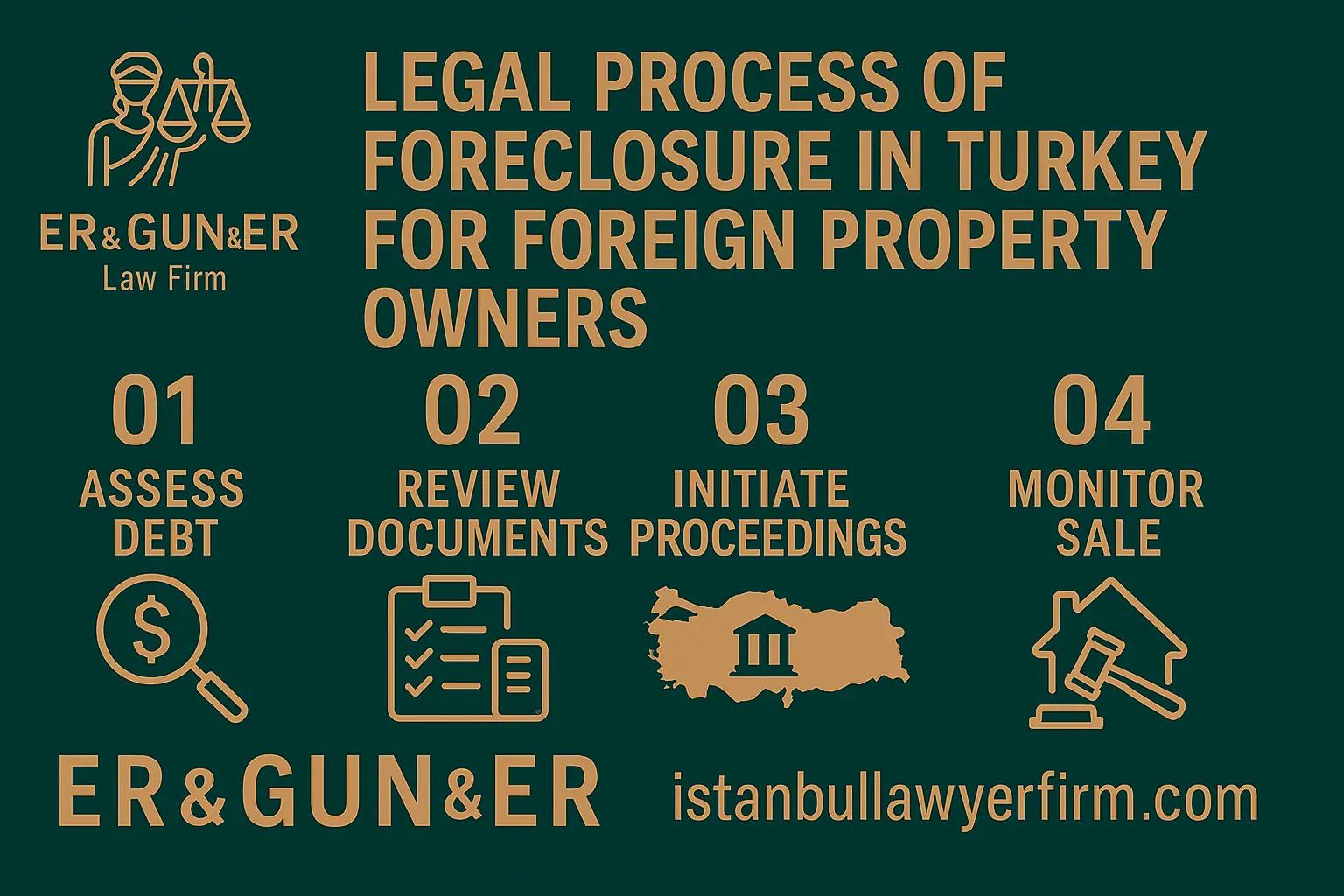
A lawyer in Turkey who advises foreign property owners on enforcement matters understands that foreclosure in Turkey—the legal process by which a creditor enforces a mortgage security interest to recover an unpaid debt through seizure and auction of the mortgaged property—operates through a specialized enforcement framework under the Turkish Enforcement and Bankruptcy Law that is substantially more creditor-favorable and procedurally faster than the foreclosure systems of most foreign property owners' home countries, making early legal intervention and systematic procedural management the decisive factors that determine whether a foreign owner retains the property, restructures the debt on acceptable terms, or loses the asset through forced sale at a price that may not reflect its actual market value. An Istanbul Law Firm that advises foreign nationals facing Turkish mortgage enforcement explains that the foreclosure process's speed and creditor favorability make it essential for foreign property owners to engage qualified Turkish legal counsel at the earliest possible stage—ideally upon receiving the first overdue payment notification from the lender—rather than waiting until enforcement proceedings have already advanced to stages where the available defenses and delay options are substantially reduced. A Turkish Law Firm that handles mortgage enforcement defense for foreign property owners provides comprehensive legal support across the complete foreclosure timeline: assessing the mortgage documentation and enforcement basis; filing timely procedural objections that are the primary mechanism for challenging enforcement validity and delaying auction; negotiating debt restructuring arrangements with Turkish lenders before and during enforcement proceedings; managing the auction procedure and its legally available defenses; pursuing post-auction remedies where the auction outcome is challengeable; and coordinating cross-border legal representation for foreign owners who cannot physically attend Turkish proceedings. An English speaking lawyer in Turkey who advises foreign property owners on Turkish foreclosure law ensures that international clients understand the specific procedural deadlines—some as short as seven days—whose violation permanently forfeits available defenses, enabling clients to make timely, informed decisions rather than missing critical response windows because procedural requirements were not communicated effectively. Practice may vary by authority and year — verify current Turkish Enforcement and Bankruptcy Law provisions, current enforcement court procedures, and current mortgage enforcement practices with qualified counsel before taking any action in response to Turkish foreclosure proceedings.
Overview of Turkish Foreclosure Law and Enforcement Framework
A lawyer in Turkey who advises on the Turkish foreclosure legal framework explains that Turkish foreclosure operates primarily through the Turkish Enforcement and Bankruptcy Law—İcra ve İflas Kanunu—administered by specialized enforcement offices and enforcement courts whose procedures are distinct from ordinary civil litigation, enabling creditors to initiate property seizure and auction without first obtaining a court judgment in many circumstances. An Istanbul Law Firm that advises foreign property owners on the foreclosure framework helps clients understand the specific procedural pathways most relevant to their situation: the administrative enforcement pathway available when the creditor holds a registered mortgage deed—tapu ipoteği—in the Land Registry, which enables the creditor to initiate enforcement directly through the enforcement office by serving a payment order without first obtaining a court judgment; and the judicial enforcement pathway applicable in some circumstances where the creditor must first obtain a court judgment before enforcement can proceed—typically in cases involving disputes about the debt's validity or amount that cannot be resolved administratively. Turkish lawyers advising on the foreclosure pathway applicable to each foreign owner's situation help clients understand that the pathway determines both the speed of enforcement and the specific defense mechanisms available—because administrative enforcement proceeds faster and with fewer formal judicial oversight opportunities than judicial enforcement. Practice may vary by authority and year — verify current Turkish enforcement law provisions, current administrative enforcement procedures, and current judicial oversight mechanisms with qualified counsel before planning any foreclosure defense strategy.
An Istanbul Law Firm that advises on the foreclosure timeline explains that the enforcement process moves through a series of defined procedural stages—each with specific deadlines and required actions—whose systematic management determines whether available defenses are preserved or forfeited. Turkish lawyers advising on foreclosure timeline management help foreign owners understand the specific milestones most critical to their situation: the payment order stage, where the enforcement office serves an official payment demand requiring response within seven days—with failure to respond converting the payment order into a basis for continued enforcement without further judicial review; the attachment stage, where the enforcement office annotates the Land Registry title deed to reflect the enforcement proceedings, restricting voluntary transfer; and the auction scheduling stage, where the enforcement office arranges the property's public auction with specific announcement and publication requirements whose procedural regularity can be challenged. An English speaking lawyer in Turkey who manages foreclosure timeline tracking for foreign property owners provides regular status updates in English at each procedural milestone, enabling foreign owners to make timely decisions about defense strategy, debt restructuring, and auction participation rather than discovering that critical deadlines have passed while the client was not adequately informed. Practice may vary by authority and year.
A Turkish Law Firm that advises on the mortgage security framework applicable to Turkish property enforcement explains that the specific rights a creditor can enforce through foreclosure depend on how the mortgage security was created and registered—with mortgages registered as formal hypothecation in the Land Registry providing the broadest enforcement rights and other security arrangements providing different levels of enforcement authority. An English speaking lawyer in Turkey who advises foreign property owners on the specific enforcement basis applicable to their situation helps clients understand: the distinction between a hypothecation mortgage—which grants the creditor the right to initiate enforcement directly through the administrative pathway—and other security arrangements whose enforcement may require judicial proceedings; the specific mortgage deed terms that define the secured amount, the interest calculation method, and the circumstances that trigger enforcement; and the Land Registry annotation that records the mortgage and that enforcement offices rely on to verify the creditor's right to initiate enforcement proceedings. Practice may vary by authority and year.
Procedural Defenses and Objection Strategies for Foreign Owners
A lawyer in Turkey who advises on procedural defenses in Turkish foreclosure proceedings explains that the most important and time-sensitive defense mechanism available to property owners is the formal objection to the enforcement payment order—which must be filed within seven days of receiving the payment order to prevent the order from becoming final and providing the basis for continued enforcement without judicial review of its underlying validity. An Istanbul Law Firm that manages foreclosure objections for foreign property owners implements the specific objection strategy most effective for each situation: reviewing the payment order's formal validity—including whether the debt amount is accurately stated, whether interest calculations comply with the mortgage deed's terms, and whether the debtor's identity is correctly stated—to identify procedural defects that support objection; assessing the mortgage deed's terms and the history of payments to identify substantive grounds for challenging the claimed default amount; and filing the objection through the correct procedural channel within the mandatory seven-day deadline—because a missed objection deadline permanently forfeits the right to challenge the enforcement order through that mechanism, though other procedural challenges may remain available. Turkish lawyers advising on objection strategy help foreign owners understand that even objections whose ultimate success on the merits is uncertain produce the important tactical benefit of temporarily suspending the enforcement process and creating time for debt restructuring negotiations—making timely objection strategically valuable even when the substantive debt is genuine. Practice may vary by authority and year — verify current objection deadline requirements, current objection grounds available under Turkish enforcement law, and current procedural requirements for enforcement objections with qualified counsel before filing any objection to a Turkish foreclosure payment order.
An Istanbul Law Firm that advises on property valuation challenges in foreclosure proceedings explains that Turkish enforcement procedure requires a formal property appraisal before an auction can be conducted—and that the appraisal's result directly determines the auction's starting bid, making an inadequate appraisal that undervalues the property one of the most financially significant procedural elements in the foreclosure process. Turkish lawyers advising on valuation challenges help foreign owners implement the specific challenge approaches most effective for each valuation dispute: requesting an independent counter-appraisal that documents the property's market value based on comparable sales, property improvements, location factors, and current market conditions—creating the evidentiary basis for challenging a creditor-commissioned appraisal that undervalues the property; filing a formal objection to the creditor's appraisal within the applicable procedural deadline and requesting court appointment of an independent expert appraiser; and documenting the property's condition, improvements, and comparable market transactions in preparation for the appraisal challenge proceedings. An English speaking lawyer in Turkey who manages valuation challenges for foreign property owners helps clients gather the specific documentation most persuasive in Turkish enforcement court valuation proceedings—including photographs of property improvements, comparable property sales evidence, and market analysis from local real estate professionals. Practice may vary by authority and year.
A Turkish Law Firm that advises on notification defects as grounds for foreclosure challenge explains that Turkish enforcement law imposes specific requirements on how foreclosure notices must be served—including requirements about the specific address at which service must be attempted and the procedures for service when service at the primary address fails—and that service defects are among the most technically available bases for challenging foreclosure proceedings, particularly for foreign property owners whose registered address in Turkey may differ from their actual residence location. An English speaking lawyer in Turkey who identifies notification defects in foreclosure proceedings for foreign owners helps clients understand the specific notification requirements most relevant to their situation: the requirement that enforcement notices be served at the debtor's address as registered in the Central Population Registration System—MERNIS—rather than only at an address stated in the loan documents; the specific procedures that enforcement offices must follow when service at the primary address is not possible; and the legal consequences of defective service, which may include the right to challenge enforcement actions taken on the basis of notices that were not properly served. Practice may vary by authority and year.
Auction Procedures, Redemption Rights and Bidding Strategy
A lawyer in Turkey who advises on the Turkish property auction procedure in foreclosure proceedings explains that the auction process—through which the mortgaged property is sold to recover the creditor's claim—involves specific procedural requirements including mandatory publication periods, starting bid calculations based on the appraisal, and deposit requirements that determine who can participate as a bidder. An Istanbul Law Firm that advises foreign property owners on auction procedure implements the specific monitoring and participation practices most effective for each auction situation: tracking auction announcement publications to ensure the property owner has current information about the auction date, starting bid, and procedural requirements; assessing whether the announced starting bid accurately reflects the property's appraised value and whether any valuation challenge remains viable before the auction date; and preparing for the property owner's potential participation as a bidder if repurchasing the property at auction would produce a better economic outcome than continuing to pursue debt restructuring. Turkish lawyers advising on auction strategy help property owners understand that Turkish law sets starting bid minimums—typically as a percentage of the appraised value—and that bidding begins from this minimum and proceeds until no higher bid is received, with the property going to the highest bidder. Practice may vary by authority and year — verify current auction procedure requirements, current starting bid calculation rules, and current bidder participation requirements with qualified counsel before planning any auction participation strategy.
An Istanbul Law Firm that advises on redemption rights in Turkish foreclosure proceedings explains that Turkish enforcement law provides property owners with specific statutory rights to redeem their property by paying the debt before the auction occurs—and that exercising these rights within the applicable deadline is often the most effective strategy for preventing forced sale of a property that the owner wishes to retain. Turkish lawyers advising on redemption rights help property owners implement the specific redemption approach most effective for each situation: calculating the exact redemption amount required—including principal, accrued interest, enforcement costs, and any other charges that the creditor is entitled to recover—to determine whether redemption is financially feasible; coordinating with the enforcement office to confirm the deadline for redemption and the specific payment method and account through which payment must be made; and managing the logistics of cross-border fund transfer for foreign owners who must arrange payment from abroad within the required timeline. An English speaking lawyer in Turkey who manages redemption coordination for foreign property owners provides the bilingual practical guidance—including translated payment instructions, deadline tracking, and enforcement office communication—that enables foreign owners to exercise their redemption rights within the required timeline despite not being physically present in Turkey. Practice may vary by authority and year.
A Turkish Law Firm that advises on strategic auction participation for property owners in foreclosure proceedings explains that when debt restructuring and redemption before auction are not viable, participating in the auction as a bidder—potentially repurchasing the property at the auction's starting bid—may produce a better economic outcome than allowing the property to be purchased by an unknown third party at a price that may be less favorable than what the owner could achieve through repurchase. An English speaking lawyer in Turkey who advises property owners on auction participation strategy helps clients evaluate the specific factors most relevant to whether repurchase at auction is advisable: comparing the auction's starting bid to the outstanding debt to assess whether the auction starting price represents a net financial benefit relative to debt satisfaction; understanding the specific bidder registration and deposit requirements that must be satisfied before the auction to enable participation; and planning the financial logistics of repurchase including fund availability in Turkey, deposit placement, and the timeline for completing purchase payment after a successful bid. Turkish lawyers advising on auction strategy help property owners understand that any decision about auction participation requires advance preparation—because bidder registration requirements and deposit placement must be completed before the auction date. Practice may vary by authority and year.
Debt Restructuring, Settlement and Foreclosure Prevention
A lawyer in Turkey who advises on foreclosure prevention through debt restructuring explains that Turkish banks and other mortgage creditors generally prefer debt recovery through restructuring agreements over forced auction—because auction proceedings are administratively burdensome, produce uncertain recovery amounts depending on market conditions at the auction date, and take significant time to complete—making creditor willingness to negotiate restructuring arrangements a realistic option for foreign property owners who engage in negotiation promptly and with a credible restructuring proposal. An Istanbul Law Firm that advises on debt restructuring negotiations for foreign property owners implements the specific negotiation approach most effective for each creditor relationship: preparing a formal restructuring proposal that presents a realistic repayment plan based on the property owner's actual financial position—because proposals that overstate the debtor's payment capacity create credibility problems when they cannot be performed; presenting this proposal through formal written communication to the creditor's legal or collections department rather than attempting informal negotiation through branch contacts whose authority to bind the bank is limited; and coordinating the timing of restructuring negotiations with the procedural timeline of enforcement proceedings—because restructuring discussions that occur while enforcement is proceeding create implicit time pressure on both parties that can facilitate agreement. Turkish lawyers advising on restructuring negotiations help foreign property owners understand the specific restructuring arrangements most commonly acceptable to Turkish mortgage creditors—including payment deferment, installment restructuring, interest rate adjustment, and partial debt forgiveness in some circumstances. Practice may vary by authority and year — verify current Turkish banking restructuring practice and current regulatory framework applicable to mortgage restructuring negotiations with qualified counsel before making any restructuring proposal to a Turkish mortgage creditor.
An Istanbul Law Firm that advises on enforcement stay mechanisms explains that Turkish enforcement law provides specific mechanisms through which enforcement proceedings can be temporarily suspended while debt restructuring negotiations or other dispute resolution processes proceed—creating the operational breathing room that enables genuine restructuring discussions without the pressure of an imminent auction date. Turkish lawyers advising on enforcement stay options help foreign property owners implement the specific stay mechanisms most effective for their situation: negotiated stay agreements with the creditor that temporarily suspend enforcement in exchange for interim payments or other undertakings by the debtor; procedural stay options available under Turkish enforcement law when specific grounds for challenging enforcement validity are presented; and court-ordered stays in circumstances where enforcement proceeding defects provide a legal basis for judicial intervention. An English speaking lawyer in Turkey who manages enforcement stay coordination for foreign property owners provides the ongoing monitoring that ensures stay arrangements are properly documented, that any conditions attached to the stay are satisfied, and that the stay's expiry does not produce an unexpected resumption of enforcement without the client's awareness. Practice may vary by authority and year.
A Turkish Law Firm that advises on the financial and legal analysis required for foreclosure prevention decisions explains that the decision about whether to pursue debt restructuring, redeem the property before auction, participate in the auction, or allow the enforcement to proceed without intervention requires a specific financial and legal assessment—comparing the cost of each available option against the property's value and the debtor's overall financial position. An English speaking lawyer in Turkey who conducts foreclosure prevention analysis for foreign property owners helps clients implement the specific analytical approach most effective for each situation: calculating the total cost of each available option—including debt amounts, enforcement costs, legal fees, and the opportunity cost of illiquid capital deployment; comparing these costs against the property's realistic market value to assess whether the property is worth the financial commitment required to retain it; and identifying which option's combination of cost, risk, and probability of success best matches the client's overall financial objectives. Turkish lawyers advising on foreclosure prevention decisions help foreign property owners understand that the economically optimal decision in each situation depends on specific facts about the debt amount, the property value, the timeline remaining before auction, and the creditor's actual negotiating position—making generic advice about foreclosure prevention substantially less useful than situation-specific analysis. Practice may vary by authority and year.
Post-Auction Remedies and Recovery Options
A lawyer in Turkey who advises on post-auction remedies in Turkish foreclosure proceedings explains that the completion of a property auction does not in all circumstances permanently and irrevocably transfer title to the auction purchaser—because Turkish enforcement law provides specific grounds on which auction results can be challenged and potentially cancelled, and because property owners may retain specific post-auction rights whose exercise can affect the practical outcome of the foreclosure even after the auction has occurred. An Istanbul Law Firm that advises on post-auction remedies for foreign property owners implements the specific challenge approaches most effective for each post-auction situation: challenging the auction result based on valuation inadequacy—where the property was sold at a price substantially below its market value due to an inadequate appraisal that was not successfully challenged before the auction; challenging the auction result based on procedural defects in the auction process itself—including irregularities in the announcement publication, bidder registration process, or auction conduct; and pursuing claims against the creditor for improper enforcement conduct that caused economic damage to the property owner beyond what proper enforcement would have produced. Turkish lawyers advising on post-auction challenges help property owners understand that post-auction challenge options have specific time limitations whose expiry eliminates the challenge right—making prompt legal assessment after an adverse auction outcome essential for preserving whatever remedies remain available. Practice may vary by authority and year — verify current Turkish enforcement law provisions on post-auction challenge rights, current challenge deadline requirements, and current procedural requirements for cancellation petitions with qualified counsel before planning any post-auction challenge.
An Istanbul Law Firm that advises on cross-border dimensions of post-auction outcomes explains that foreign property owners who lose property through Turkish foreclosure may have legal obligations in their home countries—including reporting obligations related to the disposition of foreign assets, tax filing obligations related to the loss or gain on the property, and implications for foreign asset declarations—whose management requires coordination between Turkish legal counsel and the foreign owner's home country advisors. Turkish lawyers advising on the cross-border implications of Turkish foreclosure outcomes help foreign property owners identify and address the specific obligations most relevant to their situation: capital gains or loss reporting obligations related to the property's disposition through foreclosure auction; inheritance and estate planning implications where the property represented a significant component of the owner's overall asset portfolio; and banking and financial reporting obligations in the owner's home country related to the receipt or loss of foreign property proceeds. An English speaking lawyer in Turkey who coordinates cross-border outcome management for foreign property owners provides the Turkish-law documentation and explanation that the owner's home country advisors need to correctly address the Turkish legal aspects of the foreclosure outcome in home country reporting and planning. Practice may vary by authority and year.
A Turkish Law Firm that advises on residual rights after Turkish foreclosure explains that even after a property is sold through foreclosure auction, specific residual rights and obligations may remain between the former owner and other parties—including potential claims against the creditor for excess enforcement costs, rights related to any auction proceeds in excess of the creditor's claim, and continuing obligations related to property-linked liabilities that survive the foreclosure auction. An English speaking lawyer in Turkey who advises foreign property owners on post-foreclosure residual rights helps clients understand the specific rights and obligations most relevant to their situation: the right to receive any auction proceeds in excess of the creditor's total claim including enforcement costs—because the creditor is entitled only to recover the debt amount and legitimate enforcement costs, with any surplus belonging to the debtor; potential claims against the creditor for enforcement costs that were improperly assessed or exceeded what Turkish enforcement law permits; and continuing obligations related to the property that may survive the foreclosure, including outstanding utility debts, building management fees, and tax obligations from the period of ownership. Practice may vary by authority and year.
Legal Actions Against Creditors and Enforcement Officers
A lawyer in Turkey who advises on challenging creditor conduct in foreclosure proceedings explains that Turkish enforcement law defines specific procedural obligations that creditors and enforcement offices must satisfy in conducting foreclosure—and that failures to satisfy these obligations can provide grounds for challenging enforcement actions, seeking damages, or filing administrative complaints against enforcement officers. An Istanbul Law Firm that advises on enforcement conduct challenges for foreign property owners implements the specific challenge approaches most effective for each conduct issue: reviewing the enforcement file for procedural irregularities including incorrect debt calculations, improper notification procedures, and incorrect application of the mortgage deed's terms; filing formal complaints against enforcement officers who have failed to comply with their statutory obligations; and pursuing damage claims against creditors whose enforcement conduct exceeded their legal authority or caused economic harm to the property owner beyond what proper enforcement would have produced. Turkish lawyers advising on enforcement conduct challenges help foreign owners understand that these challenges are distinct from the primary foreclosure defense—and that they may be available as additional remedies even when the primary defense against the foreclosure itself has been unsuccessful. Practice may vary by authority and year — verify current Turkish enforcement law provisions on creditor obligations, current enforcement officer oversight mechanisms, and current remedies for improper enforcement conduct with qualified counsel before filing any challenge to creditor or enforcement officer conduct.
An Istanbul Law Firm that advises on challenging improper debt calculations in foreclosure proceedings explains that creditors sometimes include in their foreclosure claims amounts that are not properly secured by the mortgage or that exceed what the mortgage deed and Turkish enforcement law permit—and that challenging these inflated claims can reduce the total amount required to redeem the property or restructure the debt, producing significant financial benefit for the property owner. Turkish lawyers advising on debt calculation challenges help foreign property owners identify the specific calculation elements most frequently subject to improper inflation: interest rate applications that exceed the rate specified in the mortgage deed or the maximum rate permitted under Turkish law; compound interest calculations that convert accrued interest into principal in ways not authorized by the mortgage deed; and enforcement costs and fees that exceed what Turkish enforcement law permits the creditor to recover. An English speaking lawyer in Turkey who manages debt calculation challenges for foreign property owners prepares the specific comparative analysis—showing the claimed amount versus the properly calculated amount with the legal basis for each difference—that most effectively supports the challenge before the enforcement court. Practice may vary by authority and year.
A Turkish Law Firm that advises on proactive creditor accountability measures for foreign property owners explains that the most effective approach to mortgage enforcement disputes is not purely reactive defense but also proactive monitoring and documentation of the creditor's conduct throughout the enforcement proceeding—creating the evidentiary record that supports any subsequent challenge or damage claim. An English speaking lawyer in Turkey who manages proactive monitoring for foreign property owners in enforcement proceedings helps clients implement the specific monitoring practices most effective for each enforcement situation: maintaining organized records of all enforcement-related communications and documents from the beginning of the enforcement proceeding; documenting any instances of procedurally improper conduct by the creditor or enforcement officers with specific reference to the applicable legal requirement that was violated; and preserving evidence of the property's market value throughout the enforcement period—through professional appraisals, comparable sales records, and market analysis—that supports both valuation challenges during enforcement and damage claims if enforcement conduct caused economic harm. Practice may vary by authority and year.
International Representation and Cross-Border Coordination
A lawyer in Turkey who advises on cross-border coordination in Turkish foreclosure proceedings for foreign property owners explains that effectively defending against Turkish foreclosure while residing abroad requires specific practical arrangements that enable the foreign owner to participate in Turkish proceedings, receive Turkish legal notices, and give instructions to Turkish legal counsel in real time—without the participation gaps that arise when communication between the foreign client and Turkish counsel is not systematically managed. An Istanbul Law Firm that provides cross-border foreclosure defense coordination for foreign property owners implements the specific arrangements most effective for each international situation: power of attorney documentation that authorizes Turkish legal counsel to act on the foreign owner's behalf in all aspects of the foreclosure proceeding—including filing objections, attending hearings, negotiating with creditors, and receiving official notifications—with the power of attorney authenticated through the applicable consular or apostille process; Turkish address registration management that ensures the foreign owner's Turkish address in the Central Population Registration System reflects a valid address where enforcement notices will actually be received and managed; and regular English-language communication that keeps the foreign owner informed about each procedural milestone and the specific decisions required at each stage. Turkish lawyers advising on cross-border coordination help foreign property owners understand that passive participation—where the owner is only notified of outcomes after they occur—is insufficient for effective foreclosure defense, which requires timely instruction from the owner on each significant strategic decision. Practice may vary by authority and year — verify current Turkish power of attorney requirements for enforcement proceedings and current address registration requirements with qualified counsel before establishing any cross-border representation arrangement.
An Istanbul Law Firm that advises on coordinating Turkish foreclosure proceedings with home country legal matters explains that Turkish foreclosure often has legal implications in the foreign owner's home country—including impacts on the owner's overall asset portfolio, tax position, and estate planning—whose management requires the Turkish legal counsel and the home country legal or financial advisors to communicate effectively about the Turkish proceedings' status and likely outcomes. Turkish lawyers advising on home country coordination help foreign property owners manage the specific coordination needs most relevant to each international situation: providing home country advisors with Turkish-language enforcement documents translated into English with explanations of their legal significance; advising on the Turkish law aspects of cross-border implications—including how Turkish enforcement law treats guarantors, how Turkish property disposition is treated for Turkish tax purposes, and what documentation the home country advisor will need from the Turkish proceedings; and aligning the timing of Turkish legal decisions with home country planning needs—for example, ensuring that home country estate planning that references Turkish property is updated to reflect the enforcement proceeding's effect on ownership. An English speaking lawyer in Turkey who coordinates Turkish foreclosure proceedings with home country advisors provides the integrated communication that enables all advisors to understand the Turkish proceedings' status and implications without requiring Turkish language expertise. Practice may vary by authority and year.
A Turkish Law Firm that advises on multi-party enforcement situations explains that some Turkish property enforcement proceedings involve multiple owners, multiple creditors, or multiple security interests—creating coordination challenges that require specific legal management to ensure that each party's rights are properly represented and that the enforcement proceeding's outcome accurately reflects the applicable legal priorities among competing claims. An English speaking lawyer in Turkey who manages multi-party enforcement proceedings for foreign property owners helps clients understand the specific coordination requirements most relevant to their situation: the legal priority of competing security interests—where multiple mortgages or other security interests exist on the same property, the priority of each interest determines which creditor's claim is satisfied first from auction proceeds; the rights of co-owners in enforcement proceedings—where the property is owned by multiple parties, each co-owner's rights and obligations in the enforcement proceeding require separate legal analysis; and the implications for guarantors—where the foreign owner has guaranteed another party's debt that is now being enforced against property owned by the guarantor. The best lawyer in Turkey for foreign property owner foreclosure defense combines specific knowledge of Turkish enforcement law's procedural requirements and defense mechanisms with the cross-border communication capability that enables foreign clients to participate effectively in Turkish proceedings from wherever they are located. Practice may vary by authority and year.
Risk Mitigation Before Default and Proactive Legal Planning
A lawyer in Turkey who advises foreign property owners on proactive mortgage risk management explains that the most effective and least costly foreclosure defense strategy begins before a default occurs—because foreign property owners who anticipate potential payment difficulties and engage Turkish legal counsel before missing payments have substantially more options available than owners who first seek legal assistance after enforcement proceedings have already been initiated. An Istanbul Law Firm that advises foreign property owners on proactive mortgage risk management implements the specific monitoring and early intervention practices most effective for each property situation: regular review of the mortgage documentation to ensure that the owner understands the specific events that trigger the creditor's right to declare default and initiate enforcement—including not only missed payments but also breaches of specific mortgage covenants such as insurance maintenance, property maintenance, and notification requirements that foreign owners may not be aware of; early communication with the Turkish mortgage creditor when payment difficulties are anticipated—because creditors who are notified of potential difficulties before a payment is missed are generally more receptive to voluntary restructuring discussions than creditors who are first informed of the debtor's situation after enforcement has already been initiated; and maintaining current Turkish address registration and active contact with the Turkish mortgage creditor throughout the loan's term—because communication gaps that lead to missed enforcement notices create the scenario where foreign owners discover that enforcement has advanced significantly while they had no awareness of the proceedings. Turkish lawyers advising on proactive mortgage risk management help foreign property owners understand that the cost of proactive legal monitoring and early intervention is almost always substantially lower than the cost of foreclosure defense after enforcement proceedings have advanced to later stages. Practice may vary by authority and year — verify current Turkish mortgage covenant requirements and current creditor early warning communication practices with qualified counsel before relying on any proactive risk management approach.
An Istanbul Law Firm that advises on documentation maintenance for Turkish mortgage holders explains that maintaining complete and organized documentation of the mortgage relationship—including loan origination documents, payment records, communications with the creditor, and property maintenance evidence—creates the information foundation that enables effective foreclosure defense if enforcement proceedings are initiated. Turkish lawyers advising on documentation maintenance help foreign property owners implement the specific practices most effective for each documentation category: maintaining complete records of all payments made toward the mortgage debt—including bank transfer confirmations, payment receipts, and account statements—so that any creditor claim of non-payment can be immediately challenged with specific documentary evidence; preserving all written communications with the creditor throughout the loan's term—because communications that acknowledge partial payments, agree to payment deferrals, or make other commitments are legally significant and may provide defenses not otherwise available from the loan documentation; and documenting property improvements and maintenance throughout the ownership period—because property condition evidence is relevant to valuation challenges if foreclosure proceedings begin. An English speaking lawyer in Turkey who manages documentation maintenance programs for foreign mortgage holders provides the systematic organization and periodic review that ensures documentation is complete and retrievable when needed rather than assembled from scattered sources under time pressure when enforcement proceedings begin. Practice may vary by authority and year.
A Turkish Law Firm that advises on the intersection of Turkish mortgage enforcement with other Turkish legal obligations of foreign property owners explains that foreign property owners with Turkish mortgaged properties may have other Turkish legal obligations—including property tax payments, building management fee obligations, and compulsory earthquake insurance maintenance—whose non-fulfillment can create independent legal complications that interact with mortgage enforcement in ways that compound the owner's legal difficulties. An English speaking lawyer in Turkey who provides integrated property compliance monitoring for foreign mortgage holders helps clients maintain current compliance with each obligation relevant to their mortgaged property: annual property tax payment monitoring and declaration filing to prevent the tax authority from initiating separate enforcement for unpaid property taxes; compulsory earthquake insurance renewal management to ensure that the DASK policy required by Turkish property law remains current throughout the ownership period; and building management fee tracking for apartment owners to prevent the site management from initiating separate enforcement for unpaid aidat that could complicate the overall property's legal status. The best lawyer in Turkey for foreign property owner foreclosure defense combines specific knowledge of Turkish enforcement law's complete procedural framework—from pre-default risk management through post-auction recovery—with the English-language communication and cross-border coordination that enables international property owners to manage their Turkish mortgage obligations and enforcement risks from wherever they are located. Practice may vary by authority and year.
Frequently Asked Questions
- What is the legal basis for foreclosure proceedings in Turkey? Foreclosure in Turkey is primarily governed by the Turkish Enforcement and Bankruptcy Law—İcra ve İflas Kanunu—administered by specialized enforcement offices and courts. When a mortgage is registered as a formal hypothecation in the Land Registry, the creditor can initiate enforcement administratively without first obtaining a court judgment, by serving a payment order through the enforcement office. Practice may vary by authority and year.
- How quickly must a foreign property owner respond to a Turkish foreclosure payment order? The Turkish Enforcement and Bankruptcy Law generally requires that an objection to a foreclosure payment order be filed within seven days of receiving the order. Failure to file within this deadline can result in the payment order becoming final and the enforcement proceeding continuing without the benefit of that objection mechanism. Foreign owners should immediately contact Turkish legal counsel upon receiving any enforcement-related communication. Practice may vary by authority and year.
- What procedural defenses are available in Turkish foreclosure proceedings? Available procedural defenses include formal objections to the payment order for defects including incorrect debt amounts, improper notification, and debt calculation errors; challenges to the property valuation appraisal used to set the auction starting price; challenges to notification defects where enforcement notices were not properly served; and challenges to auction procedure irregularities. Each defense has specific filing deadlines whose violation forfeits that defense. Practice may vary by authority and year.
- What is the property redemption right in Turkish foreclosure and when must it be exercised? Turkish enforcement law provides the property owner with the right to redeem the property by paying the full debt amount before the auction occurs. The specific deadline for exercising the redemption right and the exact amount required for redemption—including principal, accrued interest, and enforcement costs—must be confirmed with Turkish legal counsel for each specific proceeding, as these vary based on the specific enforcement circumstances. Practice may vary by authority and year.
- Can a foreign property owner participate in the auction of their own property? Yes. A foreign property owner can participate as a bidder in the auction of their mortgaged property, potentially repurchasing it at the auction starting price if no other bidder exceeds that amount. Auction participation requires registration and deposit placement before the auction date. Whether repurchase at auction is financially advisable compared to other options depends on the specific economic analysis of each situation. Practice may vary by authority and year.
- Can the Turkish foreclosure auction result be challenged after the auction occurs? Turkish enforcement law provides specific grounds on which a completed auction can be challenged, including valuation inadequacy where the property sold substantially below market value, procedural defects in the auction process, and creditor misconduct. Post-auction challenge rights have specific time limitations whose expiry eliminates the challenge right. Turkish legal counsel should be engaged immediately after any adverse auction outcome to assess whether challengeable grounds exist. Practice may vary by authority and year.
- Can a foreign property owner negotiate debt restructuring with a Turkish mortgage creditor during enforcement proceedings? Yes. Turkish banks and mortgage creditors generally prefer restructuring over forced auction and are often willing to negotiate during enforcement proceedings. Viable restructuring arrangements include payment deferment, installment restructuring, interest rate adjustment, and in some circumstances partial debt reduction. Turkish legal counsel can facilitate restructuring negotiations and draft restructuring agreements that suspend or terminate enforcement proceedings. Practice may vary by authority and year.
- What happens to any auction proceeds that exceed the creditor's claim? Under Turkish enforcement law, the creditor is entitled to recover only the secured debt amount plus legitimate enforcement costs. Any auction proceeds remaining after the creditor's claim is satisfied belong to the former property owner. Turkish legal counsel can monitor the enforcement office's distribution of auction proceeds and challenge any improper deductions from the surplus amount. Practice may vary by authority and year.
- Can a foreign property owner challenge the appraisal used to set the auction starting price? Yes. Turkish enforcement law allows property owners to challenge the appraisal used to set the auction starting price within specific procedural deadlines. Effective challenges are supported by independent professional appraisals documenting the property's market value through comparable sales, property improvements, and current market conditions. Successful valuation challenges can increase the auction starting price, improving economic outcomes for both the property owner and the creditor. Practice may vary by authority and year.
- How can a foreign property owner residing abroad manage Turkish foreclosure proceedings? Foreign property owners can manage Turkish foreclosure proceedings through Turkish legal counsel holding a properly authenticated power of attorney with specific authority covering all aspects of the enforcement proceeding. The power of attorney must be notarized, apostilled or consularly legalized, and translated into Turkish. Turkish legal counsel can then file objections, attend hearings, negotiate with creditors, and receive official notifications on the owner's behalf. Practice may vary by authority and year.
- What are the tax implications of losing property through Turkish foreclosure? A property disposed of through Turkish foreclosure auction may generate Turkish tax implications including capital gains or loss reporting obligations. Foreign property owners should consult both Turkish tax counsel and home country tax advisors about the specific obligations applicable to their situation, as the implications depend on the property's purchase price, the auction proceeds, the owner's tax residence status, and applicable double taxation treaties. Practice may vary by authority and year.
- Can a foreign property owner claim damages against a creditor for improper foreclosure conduct? Turkish enforcement law defines specific procedural obligations creditors must satisfy in conducting foreclosure, and violations of these obligations can provide grounds for damage claims. Grounds may include improper debt calculation inflating the amount claimed, notification defects that prejudiced the owner's ability to respond, and auction conduct irregularities that resulted in the property selling below its proper value. Turkish legal counsel can assess whether specific creditor conduct provides viable grounds for damage claims. Practice may vary by authority and year.
- How does Turkish foreclosure affect other assets of the property owner? Turkish mortgage foreclosure proceedings are generally limited to the specific property that is the subject of the mortgage security. However, if the mortgage debt is also supported by personal guarantees or if the enforcement proceeds are insufficient to satisfy the debt, the creditor may pursue additional enforcement actions against the debtor's other assets in Turkey. Foreign owners should understand the complete scope of the mortgage documentation to assess their overall exposure. Practice may vary by authority and year.
- What documentation should a foreign property owner preserve to support foreclosure defense? Foreign property owners facing Turkish foreclosure should preserve the original mortgage deed and all loan documentation, all correspondence with the lender about the debt, evidence of all payments made toward the debt, the property's purchase documentation, evidence of any improvements to the property supporting higher valuation, and all notices received from the enforcement office with their receipt dates. This documentation forms the foundation of both procedural objections and valuation challenges. Practice may vary by authority and year.
- Does ER&GUN&ER Law Firm provide legal services for foreign property owners facing Turkish foreclosure? Yes. ER&GUN&ER Law Firm provides comprehensive legal services for foreign property owners facing Turkish foreclosure including mortgage documentation review and enforcement basis assessment, payment order objection filing within mandatory deadlines, property valuation appraisal challenges, notification defect challenges, debt restructuring negotiation and documentation, auction monitoring and participation coordination, post-auction challenge and cancellation petition filing, cross-border legal coordination and power of attorney management, creditor conduct challenges and damage claim assessment, and enforcement completion documentation management—with English-language client communication and bilingual documentation throughout each engagement.
Author: Mirkan Topcu is an attorney registered with the Istanbul Bar Association (Istanbul 1st Bar), Bar Registration No: 67874. His practice focuses on cross-border and high-stakes matters where evidence discipline, procedural accuracy, and risk control are decisive.
He advises individuals and companies across Immigration and Residency, Real Estate Law, Tax Law, and cross-border documentation matters where procedural accuracy and evidence discipline are decisive.
Education: Istanbul University Faculty of Law (2018); Galatasaray University, LL.M. (2022). LinkedIn: Profile. Istanbul Bar Association: Official website.