

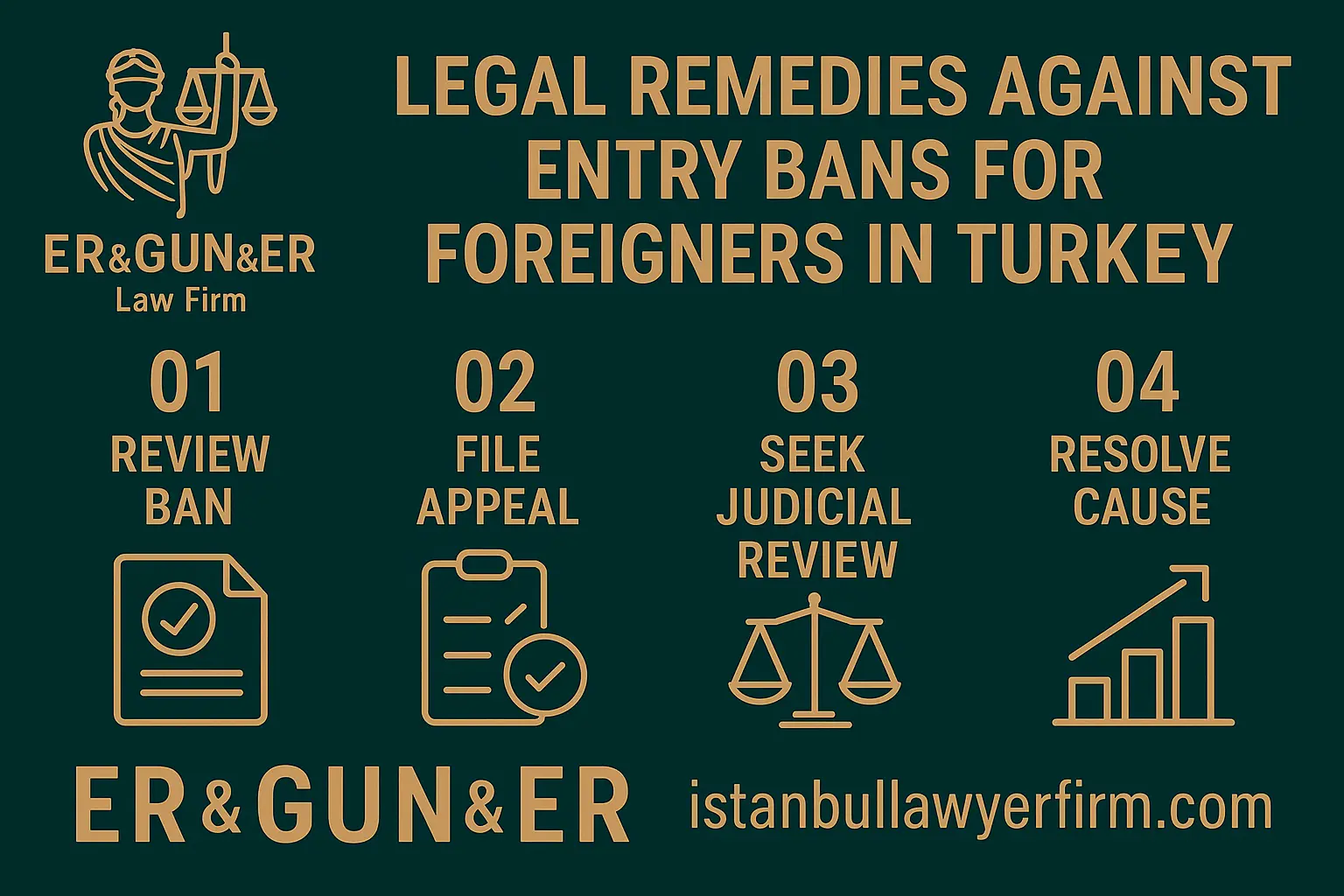
Entry bans imposed on foreign nationals under Turkish immigration enforcement operate under a layered statutory and procedural framework requiring careful analysis rather than generic appeal assumptions. The foundational framework derives from the Foreigners and International Protection Law No. 6458 (YUKK — Yabancılar ve Uluslararası Koruma Kanunu) enacted in 2013 as the comprehensive immigration framework governing entry, stay, and removal of foreign nationals. YUKK Article 9 provides the statutory basis for prohibiting entry (giriş yasağı) on grounds including public order, public security, public health, and other enumerated categories. YUKK Article 15 addresses visa denial and cancellation grounds that may accompany or lead to entry bans. YUKK Article 53 establishes the deportation order (sınır dışı etme kararı) framework with a distinctive procedural feature — the seven-day direct judicial review period under Article 53/3 that differs materially from the general sixty-day administrative court filing period applicable to most administrative actions. YUKK Article 55 establishes the non-refoulement principle protecting specific categories from deportation including persons facing death penalty, torture, or inhuman or degrading treatment in the destination country, persons with serious health conditions, pregnant women, persons with life-threatening medical conditions undergoing treatment, victims of domestic violence, and victims of human trafficking. YUKK Article 57 addresses administrative detention (idari gözetim) with maximum durations and periodic review requirements. The Administrative Procedure Law No. 2577 (İYUK — İdari Yargılama Usulü Kanunu) provides the general administrative procedure framework including Article 7 on filing periods, Article 11 on optional administrative appeals, Article 27 on stay of execution (yürütmenin durdurulması), Articles 45-46 on regional administrative court appeals (istinaf), and Articles 49-50 on Council of State (Danıştay) cassation. Constitutional Court individual application under Article 148/3 of the Constitution (introduced through the 2010 constitutional amendments enacted by Law No. 5982 and operational since 23 September 2012) provides a further remedy after exhaustion of ordinary judicial remedies. European Court of Human Rights (ECHR) applications under Convention Article 34 are available after domestic remedy exhaustion under Article 35, with the filing period reduced from six months to four months effective 1 February 2022 through Protocol No. 15. The Presidency of Migration Management (Göç İdaresi Başkanlığı) under the Ministry of Interior administers the immigration framework. Practice may vary by authority and year, and entry ban remedies benefit from careful procedural analysis because generic appeal assumptions frequently miss critical procedural features that determine outcomes. A lawyer in Turkey coordinating entry ban remedies establishes the strategy through rigorous analysis of the ban's statutory basis and the available remedy pathways.
Legal characterization of entry bans under YUKK No. 6458
A Turkish Law Firm characterizing an entry ban under the Turkish immigration framework begins with identifying the statutory basis, factual grounds, and procedural context that together determine available remedies. Entry bans under YUKK Article 9 rest on grounds including public order concerns, public security concerns, public health concerns, prior deportation history, visa overstay, false or misleading representations in prior immigration interactions, and other enumerated categories defined in regulation. Deportation orders under YUKK Article 54 with associated entry bans operate under a distinct framework from pure entry bans, with the Article 53/3 seven-day direct judicial review period as the defining procedural feature that changes the remedy calculus entirely. Administrative restriction codes (tahdit kodları) assigned to foreign nationals in the GBT (Genel Bilgi Toplama) immigration database indicate restriction categories with specific implications: V-77 typically indicates visa overstay, V-84 indicates unauthorized employment, V-71 indicates general public order or public security concerns, G-78 indicates terrorism-related restrictions, G-87 indicates narcotics-related restrictions, N-99 indicates a permanent or indefinite restriction, and other codes apply to specific circumstances — the code assigned affects both the ban's scope and the available remedy strategy. Visa refusals under YUKK Article 15 may be standalone or may accompany entry bans, with each element requiring separate procedural analysis. International protection dimensions apply where a foreign national simultaneously faces entry restriction and has a pending or prospective international protection claim under YUKK Chapter Three, requiring integrated analysis. Identity and other administrative errors where the ban reflects mistaken identity, outdated records, or database errors call for a correction-focused approach rather than a substantive merits challenge. For framework on immigration law generally, readers can consult our immigration law guide. Practice may vary by authority and year, and entry ban characterization benefits from early and thorough factual development because the ban basis drives the remedy strategy more than any other single factor.
Turkish lawyers who address evidence development for entry ban challenges work through the factual foundation that supports subsequent proceedings. Ban documentation — the notification form, the record of notification date and method, stated ban duration and scope, and any associated deportation or detention order — provides the procedural baseline and fixes the filing deadline. Underlying factual circumstances including complete travel history (entry and exit stamps, boarding pass records where available), residence permit history with dates and categories, visa application history, prior immigration encounters, and relevant family and business context support substantive challenge. Alleged violation documentation — overstay calculations where overstay is alleged, employer records where unauthorized work is alleged, criminal records where criminal grounds are cited, border records where prior refusal is the basis — supports targeted rebuttal where the alleged violation is factually contested. Administrative procedural review examines whether proper notification procedures were followed, whether the foreign national was informed of rights and timelines, whether required records were maintained, and whether the decision was made by the competent authority; procedural defects in the administrative process can be a sufficient ground for reversal independent of merits. Mitigating circumstances documentation covers family ties in Turkey (Turkish citizen spouse, Turkish citizen minor children, family integration), business or property interests, health considerations, and the foreign national's overall Turkey connection for proportionality and humanitarian arguments. Supporting evidence including travel documents, residence records, financial records, family documentation, medical records, and employment records develops the factual foundation. Practice may vary by authority and year, and evidence development benefits from systematic approach because cumulative documentation materially affects remedy outcomes.
An English speaking lawyer in Turkey coordinating records access addresses the framework for obtaining the records that support strategy development. Formal records requests to the Presidency of Migration Management for decision records, underlying factual basis records, and administrative file contents support development of the full administrative record — the client's right to access their own file is the practical foundation of meaningful merits defense. Border authority records regarding entry and exit history support timeline reconstruction, particularly where the client's own records are incomplete. Consulate and embassy records where prior visa applications were processed may contain relevant decision records accessible through formal inquiry. Electronic records through e-Devlet, where the foreign national holds an identification number permitting access, provides certain records directly. Attorney representation through notarized power of attorney (vekaletname) with specific scope for immigration matters supports attorney records access rights. Third-party records including employment records, property records, and family member records require separate access mechanisms with appropriate consent. Foreign records coordination where relevant records exist in foreign jurisdictions involves apostille or consular legalization — apostille where both Turkey and the foreign country are Hague Apostille Convention parties, consular legalization otherwise. Translation coordination for records originally in languages other than Turkish requires sworn translation (yeminli tercüman) for most official purposes, with the translator's seal and the notary's approval as commonly required. Practice may vary by authority and year, and records access benefits from coordinated approach because the cumulative record development supports both substantive arguments and procedural positioning for subsequent proceedings.
Administrative remedies and optional İYUK Article 11 appeal
A lawyer in Turkey coordinating administrative remedy strategy works through the framework where administrative remedies may or may not be available depending on the specific action challenged. İYUK Article 11 optional administrative appeal permits filing an administrative petition with the competent authority (or its superior) within the ordinary judicial filing period; the authority has sixty days to respond, and silence after sixty days is treated as implicit rejection (zımni ret). The key procedural effect is that the Article 11 petition tolls the judicial filing period — the applicant can file judicial review within the remaining balance of the original period once the administrative decision or implicit rejection is obtained. This provides a potential administrative resolution channel without immediately committing to judicial proceedings, but it adds weeks to the overall timeline and should be weighed against the urgency of the case. Important qualification: for deportation orders under YUKK Article 53, the seven-day direct judicial filing period under Article 53/3 applies and İYUK Article 11 does not generally extend this period — deportation order challenges must proceed directly to the administrative court within seven days of notification, and using an Article 11 petition in place of a judicial application typically results in the seven-day window expiring and the direct judicial remedy being foreclosed. For pure entry bans without an associated deportation order, Article 11 may be available, though practical utility depends on the likelihood of administrative reconsideration in the specific case. Informal administrative resolution pathways through the Presidency of Migration Management — correction of database errors, clarification of erroneously-applied codes, reconsideration of humanitarian circumstances — occasionally resolve matters without formal proceedings, though these pathways should not substitute for protective judicial filing within the applicable deadline. For framework on immigration appeal process generally, readers can consult our immigration appeal process guide. Practice may vary by authority and year, and administrative remedy selection benefits from careful analysis because a mis-timed administrative petition can extinguish the more valuable judicial remedy.
Turkish lawyers who address administrative appeal documentation work through the framework that supports substantive and procedural arguments. Petition drafting addresses the legal and factual grounds for reversal, any procedural defects in the original decision, proportionality arguments weighing the ban against the underlying conduct and the foreign national's circumstances, humanitarian arguments where applicable, and alternative remedy requests (for example, ban shortening where full reversal is unlikely). Legal framework citations reference YUKK provisions applicable to the specific ban type, İYUK procedural provisions, Constitutional Court and ECHR jurisprudence where relevant, and ordinary administrative law principles. Precedent citations from Council of State (Danıştay) decisions, regional administrative court (BİM) decisions, Constitutional Court individual application decisions in comparable matters, and ECHR judgments against Turkey in immigration contexts strengthen the argument. Factual documentation with a systematic index, organized by argument section, with supporting documents referenced to specific argument points, makes review efficient for the administrative authority. Sworn translation of non-Turkish documentation is required for formal filings; informal working translations are not adequate for official purposes. Service of the petition through registered mail, KEP (registered electronic mail) where applicable to the counterpart authority, or in-person filing with receipt acknowledgment, establishes the filing date definitively. Follow-up documentation — supplemental submissions where additional materials develop during pendency, status inquiries after reasonable intervals, and formal response tracking — supports active case management rather than passive waiting. Practice may vary by authority and year, and administrative appeal documentation benefits from professional discipline because the documentation quality affects consideration outcomes.
An Istanbul Law Firm coordinating administrative interim requests addresses the framework where urgent circumstances require preservation of specific rights during pendency. Urgent circumstances can include family emergencies in Turkey (serious illness or death of close family members requiring attendance), critical business matters requiring personal presence for specific transactions or corporate events, medical treatment needs where Turkey-based treatment is ongoing, educational obligations including scheduled examinations or defended academic milestones, and judicial proceedings where the foreign national's personal appearance is required in another matter. Documentation supporting urgency includes medical documentation signed by qualified physicians, employer letters with corporate identification, educational institution documentation, court-issued summons or schedules, and other urgency-supporting records as the circumstance requires. Administrative consideration channels include expedited review requests through the competent provincial directorate, consulate coordination for visa-based matters, Ministry of Interior pathways for cross-provincial or policy-sensitive matters, and humanitarian exception consideration under YUKK Article 55 and related provisions. Interim entry authorization — a limited-purpose and limited-duration permission to enter Turkey for specific humanitarian or urgent business reasons — is discretionary and is granted sparingly, but is not unavailable; documentation and legal advocacy materially affect outcomes. Where administrative interim relief is not forthcoming, parallel judicial strategy through İYUK Article 27 stay of execution applications in the main judicial proceeding provides the formal interim protection channel. Coordination between administrative pressure and judicial stay applications, where the cases warrant both, is often the most effective approach. Practice may vary by authority and year, and interim relief coordination benefits from experienced handling because administrative discretion patterns do not follow published rules alone.
Judicial review under administrative court framework with stay of execution
A Turkish Law Firm coordinating judicial review of entry bans works through the administrative court framework that provides the primary formal remedy. Administrative court jurisdiction under İYUK No. 2577 covers most immigration administrative actions, with filing periods differing by decision type. General administrative actions — including most pure entry bans without an associated deportation order — fall under Article 7 sixty-day filing period measured from notification. Deportation orders under YUKK Article 53 fall under the Article 53/3 seven-day filing period, measured from notification of the deportation order itself; this seven-day period is strict and cannot generally be extended through İYUK Article 11 administrative appeal, and missing it typically forecloses direct judicial review of the deportation order regardless of the underlying merits. Petition requirements under İYUK include plaintiff and defendant identification (the defendant being the authority that issued the decision), factual and legal grounds organized systematically, specific relief requested (annulment, stay of execution, costs), supporting documentation with index, and compliance with formal requirements including Turkish-language submission. Competent court jurisdiction depends on the authority location and subject matter — for most provincial-level immigration actions, the administrative court in the province where the authority is seated has jurisdiction; for centrally-issued decisions, jurisdiction follows the central authority's seat. Electronic filing through UYAP (Ulusal Yargı Ağı Projesi) is the standard submission channel with specific procedural requirements for foreign counsel admission. Sworn translation of non-Turkish documentation is required for formal submission. Substantive arguments typically address procedural defects in the original decision, factual errors in the underlying basis, legal misinterpretation by the administrative authority, disproportionate measures relative to the underlying conduct or circumstances, and violations of fundamental rights protected under the Constitution and ECHR. For framework on entry ban appeals specifically, readers can consult our entry ban appeal guide. Practice may vary by authority and year, and judicial review benefits from early engagement because the Article 53/3 seven-day timing cannot be recovered retroactively.
Turkish lawyers who address the stay of execution framework under İYUK Article 27 work through the interim relief mechanism that provides protection during pending proceedings. Stay of execution (yürütmenin durdurulması) requires the plaintiff to demonstrate two cumulative elements: açıkça hukuka aykırılık (clear unlawfulness of the challenged administrative act on its face) and telafisi güç veya imkânsız zararlar (harm that is difficult or impossible to remedy if the act is not suspended). Both elements must be met — clear unlawfulness alone without demonstrated irreparable harm, or irreparable harm alone without demonstrated unlawfulness, typically fails. The stay application is commonly included in the initial petition as an alternative requested relief, though supplementary applications during pendency are also possible. Expedited consideration is the norm: the court typically decides the stay request before deciding the underlying merits, often within weeks of filing. Preliminary or provisional stay (ön karar) in genuinely urgent circumstances may be granted immediately before full stay consideration, though this is exceptional. Bond or security requirements are uncommon in immigration matters but can theoretically be imposed. Appeal of stay decisions through interlocutory review (itiraz) to the regional administrative court provides a second-look mechanism, typically within seven days of the stay decision. Scope of stay can address specific elements of the administrative action rather than the entire decision, which becomes relevant where the ban is multi-faceted (for example, entry ban plus residence permit cancellation), and the stay request should be drafted with the specific protective needs in mind. Duration of stay typically continues until the merits decision, appeal resolution, or specific triggering events defined in the stay order. Practice may vary by authority and year, and stay of execution benefits from careful application development because the demonstration of both elements to the court's satisfaction is what separates effective applications from those that fail at the interim stage.
An English speaking lawyer in Turkey coordinating regional administrative court appeal and Council of State cassation addresses the appellate framework for adverse administrative court decisions. İYUK Articles 45-46 provide the regional administrative court (Bölge İdare Mahkemesi — operational as the general intermediate appellate level since 20 July 2016 following Law No. 6545 of 2014) appeal framework, known as istinaf, with a thirty-day filing period from notification of the administrative court decision. Istinaf review covers both legal and factual reconsideration within the scope defined by the appeal, providing a full second-look rather than pure legal review. Monetary and subject-matter thresholds define whether cases become final at the istinaf level (kesin) or may proceed to Council of State cassation — the thresholds are periodically adjusted, and specific verification against current regulation is appropriate at the time of appellate strategy. Council of State (Danıştay) cassation under İYUK Articles 49-50 is the highest administrative court review, with a thirty-day filing period from istinaf notification, grounds limited to legal errors rather than factual reconsideration, and procedural requirements reflecting the cassation nature of the review. Cassation outcomes include affirmance (onama), reversal with remand (bozma) for further proceedings at a lower level, or reversal with direct decision where the legal issue is clear. Strategic considerations at each appellate level include whether the appellate proceedings functionally delay or support entry ban resolution — stay of execution continues through istinaf in most configurations but may require separate continuation requests at later stages — and the resource-to-benefit calculation. Coordination with Constitutional Court individual application pathways where ordinary remedy exhaustion supports subsequent constitutional application requires advance planning so that the record developed at ordinary levels supports constitutional arguments. Practice may vary by authority and year, and appellate strategy benefits from specialized experience because the appellate dynamics differ fundamentally from trial-level considerations.
Constitutional Court individual application and ECHR
A lawyer in Turkey coordinating Constitutional Court individual application for entry ban matters works through the framework introduced by the 2010 constitutional amendments (enacted by Law No. 5982 and ratified in the 12 September 2010 referendum) and operational since 23 September 2012. Constitutional basis under Article 148/3 of the Constitution permits individuals claiming violation of fundamental rights protected under the Constitution and within the scope of the European Convention on Human Rights to file individual application (bireysel başvuru) with the Constitutional Court after exhaustion of ordinary legal remedies. Exhaustion requirement mandates completion of administrative court proceedings, istinaf appeal where applicable, and Council of State cassation where the case qualifies for cassation — bypassing any available remedy typically produces inadmissibility. Filing deadline is thirty days from the final domestic decision, which is strict, and missing it results in procedural inadmissibility regardless of merits. Rights commonly implicated in entry ban matters include the right to respect for private and family life (Constitution Article 20 and ECHR Article 8 counterpart) where the ban separates the foreign national from Turkish family members, freedom of movement under Constitution Article 23 in specific configurations, prohibition of torture or inhuman or degrading treatment (Constitution Article 17 and ECHR Article 3 counterpart) where deportation to a specific country implicates those risks, right to effective remedy where domestic procedural protections were inadequate, and other rights depending on circumstances. Procedural requirements include the specific application form, supporting documentation, legal argumentation with express reference to the constitutional provisions and the violation theory, and compliance with filing requirements. Constitutional Court decisions can find violation (ihlal), non-violation (ihlal yok), declare inadmissibility (kabul edilemezlik), or other outcomes. Violation findings can trigger retrial or reopening of the underlying ordinary proceedings under yargılamanın yenilenmesi procedure, compensation, and requirements for remedial steps by the responsible authority. For framework on deportation defense generally, readers can consult our deportation defense guide. Practice may vary by authority and year, and Constitutional Court application benefits from specialized experience because procedural and substantive requirements differ from ordinary judicial practice.
Turkish lawyers who address European Court of Human Rights application for entry ban and deportation matters work through the Strasbourg framework under the European Convention on Human Rights. ECHR application requires exhaustion of domestic remedies under Convention Article 35, which in the Turkish context typically includes completion of the Constitutional Court individual application before ECHR becomes admissible — the Constitutional Court is recognized by ECHR as a domestic remedy that must be exhausted. Filing deadline under Article 35 was reduced from six months to four months effective 1 February 2022 through Protocol No. 15; applications for events after that effective date must meet the four-month standard, while applications for events before it may qualify under the prior six-month rule if the final domestic decision also pre-dates the effective date. Substantive Convention rights commonly invoked in immigration matters include Article 3 (prohibition of torture, inhuman or degrading treatment) particularly where deportation implicates risks in the destination country, Article 8 (right to respect for private and family life) where family unity is affected by the ban or deportation, Article 13 (right to effective remedy) where the domestic remedy framework is alleged inadequate, and Protocol provisions where applicable. Procedural requirements include submission through the official application form, clear statement of alleged violations, documentation of domestic remedy exhaustion, factual narrative, and supporting documentation. Interim measures under Rule 39 of the Court Rules can be requested in genuinely urgent situations where deportation would create a serious risk of irreparable harm — Rule 39 is typically granted in Article 3 cases involving imminent removal to a country where the applicant faces a real risk of torture or inhuman treatment, and the standard is high. Interim measures, when granted, bind the respondent state and typically prevent deportation until the Court decides admissibility or merits. Judgment enforcement under Convention Article 46 obligates states to comply with final judgments, with supervision by the Committee of Ministers. Post-judgment remedies in Turkey include retrial procedures (yargılamanın yenilenmesi) following ECHR violation findings as a recognized ground for reopening. Practice may vary by authority and year, and ECHR applications benefit from specialized experience because Strasbourg-specific procedure and jurisprudence require expertise beyond domestic Turkish practice alone.
An Istanbul Law Firm coordinating strategic sequencing across remedy pathways addresses the framework where entry ban challenges may involve multiple successive layers. Initial administrative court pathway establishes the factual and legal foundation: the arguments, evidence, and legal theories developed at this level set the trajectory of all subsequent review, and gaps at this stage are difficult to fill later. Istinaf appeal addresses both legal and factual issues within scope, permitting some record development but not a full re-trial. Council of State cassation addresses pure legal errors, with the factual record largely fixed at lower levels. Constitutional Court individual application, after ordinary exhaustion, reframes the case as a constitutional rights violation rather than an ordinary administrative error. ECHR application, after Constitutional Court completion, shifts to international-level review under Convention standards. Timing coordination across remedy layers matters: the thirty-day Constitutional Court deadline and the four-month ECHR deadline are each strict, and a calendar error at any layer can foreclose subsequent layers even where merits are strong. Resource allocation across levels is a real consideration — each level involves legal fees, court fees where applicable, translation costs for any documents not already prepared in the required language, and for ECHR, time costs measured in years rather than months. Substantive development at each level requires some refinement: arguments that worked at administrative court may need reframing for Constitutional Court (as rights violations rather than administrative errors) and again for ECHR (with explicit Convention analysis). Practical considerations including the entry ban's duration relative to remedy timelines, parallel life planning, and the client's capacity to sustain multi-year proceedings all affect pathway decisions. Practice may vary by authority and year, and remedy sequencing benefits from integrated strategic planning at the outset because early-stage decisions materially affect later-stage options.
Timelines, costs, and practical considerations
A Turkish Law Firm providing timeline analysis for entry ban remedies works through realistic expectations across remedy layers. The deportation order Article 53/3 seven-day filing period is the most time-critical deadline in immigration practice — missing it typically forecloses direct judicial review of the deportation order. The general sixty-day filing period under İYUK Article 7 for non-deportation actions including most pure entry bans provides materially more preparation time, though this period should not be used as license for delay. The İYUK Article 11 optional administrative appeal with sixty-day authority response period (silence after sixty days treated as implicit rejection) and subsequent judicial filing structures a three- to four-month alternative pathway that adds protection against administrative reconsideration being overlooked but adds the same time cost. Administrative court decision timeframes vary with case complexity, court caseload, and procedural developments — straightforward cases may reach decision within several months, while complex cases extend substantially longer. Stay of execution decisions typically come before merits decisions, often within weeks, providing interim protection while the merits process continues. Regional administrative court (istinaf) appeal timeframes add further duration varying by regional court caseload. Council of State cassation adds another layer of duration at the highest ordinary level. Constitutional Court individual application processing extends over a significant period, commonly measured in years for merits decisions, with priority treatment for specific case categories. ECHR application processing follows Strasbourg timing patterns, typically extending over multiple years from application to judgment. Cumulative multi-level timeline for a case pursued through all layers may extend to several years of total processing. For framework on residence application processes that may support parallel pathways during remedy proceedings, readers can consult our residence application guide. Practice may vary by authority and year, and timeline planning benefits from realistic expectations because overoptimistic assumptions frequently produce strategic errors that cannot be reversed once made.
Turkish lawyers who address cost structure for entry ban remedies work through the cost components across remedy layers. Attorney fees are typically structured by engagement level — initial case analysis and strategy, administrative court proceedings including stay applications, istinaf appeal, Council of State cassation, Constitutional Court individual application, and ECHR application each represent discrete engagement scopes with separate fee arrangements. Our firm discloses detailed attorney fees after case-specific assessment, with all fees collected through formal official receipts (resmi makbuz). Court filing fees under the Harç Kanunu No. 492 tariff apply at administrative court, istinaf, and cassation levels, scaled to case type; Constitutional Court filing fees are set separately under applicable regulation; ECHR has no filing fee. Translation costs for sworn translation (yeminli tercüme) of supporting documentation into Turkish are typically one of the larger cost components where the client's home jurisdiction documents, foreign records, or foreign judgments must be filed. Notarial and apostille costs for foreign documents apply where documents originating outside Turkey require authentication — apostille where both Turkey and the originating country are Hague Apostille Convention parties (the Convention entered into force for Turkey on 29 September 1985), consular legalization otherwise. Expert witness costs apply in cases where medical experts support health-based claims, country-condition experts support non-refoulement claims, or other experts address specific technical issues. Travel and courier costs, while typically modest, are real components particularly where the client resides outside Turkey and documents move across borders. Other incidental costs — notary fees for power of attorney, document certification, and similar — round out the total. Practice may vary by authority and year, and cost planning benefits from realistic budgeting because underestimation frequently produces strategic compromises during the proceedings that weaken the overall case.
An English speaking lawyer in Turkey coordinating parallel life planning during entry ban proceedings addresses the practical framework where clients must manage their lives during remedy proceedings that may extend over years. Travel planning works around the Turkey restriction: the entry ban prevents Turkey travel but does not necessarily prevent travel to other countries, and clients can often continue third-country travel where they have legal status elsewhere. Business continuity planning where the client has Turkish business interests requires delegation of operational responsibilities to Turkish counterparts or empowered representatives, remote management frameworks for matters that can be handled without physical presence, and limited powers of attorney for specific actions that require personal execution. Family coordination where the ban affects family visits requires alternative arrangements: family travel to third countries where all parties can meet, scheduled communication, and arrangements for Turkish family members to travel where they retain that capability. Property and financial continuity including property management arrangements, banking access (many banks allow remote management with proper authorization, though some Turkish banking actions still require physical presence), ongoing tax compliance, and other financial matters require specific planning. Health care continuity where Turkey-based medical care was ongoing requires transition planning including records transfer and continuity of treatment abroad. Education continuity for family members — particularly children in Turkish schools — requires planning that accounts for the uncertainty of timing. Employment continuity where the client's employment involved Turkey presence may require employment adjustments or leave arrangements. Practice may vary by authority and year, and parallel life planning benefits from comprehensive approach because practical continuity often proves as challenging as the legal proceedings themselves.
Humanitarian, health, and family grounds under YUKK Article 55
A lawyer in Turkey addressing humanitarian exceptions and non-refoulement works through YUKK Article 55 and related provisions. Article 55 protects from deportation: persons facing death penalty, torture, or inhuman or degrading treatment in the destination country; persons with serious medical conditions for whom the travel itself or the post-arrival care gap poses a serious risk; pregnant women; persons with life-threatening medical conditions undergoing specific ongoing treatment; victims of domestic violence; and victims of human trafficking. The protection is formally a bar to deportation rather than automatic annulment of an entry ban, but the same circumstances that support Article 55 protection typically carry weight in entry ban proceedings and in administrative accommodation requests. International protection framework under YUKK Chapter Three — refugee status, conditional refugee status, subsidiary protection — provides distinct protection pathways with their own procedural framework for qualifying applicants, and the PMM's International Protection Division handles these applications separately from ordinary immigration matters. Humanitarian residence permits (insani ikamet izni) under YUKK Articles 46-47 provide residence status for foreign nationals whose circumstances warrant humanitarian accommodation, issued by the Ministry of Interior with specific criteria including serious health situations, minor children with Turkish connections, victims of trafficking, and other humanitarian grounds. Documentation supporting humanitarian claims requires country-condition evidence for non-refoulement claims (often including reports from recognized human rights organizations, government reports, and specific case documentation), medical documentation for health-based claims, protection-specific documentation for trafficking and domestic violence claims, and other category-specific evidence. ECHR Article 3 analysis in parallel with Turkish Article 55 protection provides an additional protection layer in deportation contexts where destination-country torture or inhuman treatment risks exist. For framework on deportation ban based on family ties, readers can consult our deportation ban based on family ties guide. Practice may vary by authority and year, and humanitarian claims benefit from rigorous evidence development because the protection standards require substantiation beyond assertion.
Turkish lawyers who address family unity considerations for entry ban challenges work through the integrated framework where family ties support both humanitarian arguments and formal legal positions. Turkish citizen spouse scenarios where the foreign national is married to a Turkish citizen support family residence permit pathways under YUKK Articles 34-37 and carry substantial weight under ECHR Article 8 in challenges to entry bans that separate the couple; the marriage must be genuine and durable, and formal documentation (marriage certificate with apostille or consular legalization, cohabitation evidence, and joint-life documentation) is the evidentiary foundation. Turkish citizen minor children scenarios where the foreign national is the parent of Turkish citizen minor children carry particularly strong weight because the best interests of the child analysis under ECHR jurisprudence and Turkish Civil Code Article 339 emphasizes child-parent relationship preservation; where separation would adversely affect the child, courts and authorities apply heightened scrutiny to the restriction. Extended family relationships with Turkish citizen relatives may support family-based arguments depending on relationship closeness and demonstrated dependency — elderly-parent dependency or sibling-caretaking arrangements can be relevant though they carry less automatic weight than spouse and child relationships. Family residence permit holders in Turkey where close family members hold valid residence permits support family integration arguments. Documentation supporting family unity includes marriage certificates with appropriate legalization, birth certificates establishing parent-child relationships, cohabitation evidence (utility bills, lease agreements, shared bank accounts), financial interdependence evidence where applicable, and photographs and records of family life. Children's best interests analysis under ECHR jurisprudence and Turkish family law provides an analytical framework where minor children are affected by the entry ban. Alternative family-based pathways — family residence permit application (for the foreign national abroad where the ban permits visa application) or residence permit renewal (for those already in Turkey when the ban was imposed) — may provide parallel tracks even during remedy proceedings. Practice may vary by authority and year, and family-based arguments benefit from documentation discipline because evidentiary standards require substantive proof.
An Istanbul Law Firm coordinating health-based humanitarian claims addresses the framework where medical considerations support entry ban relief. Serious medical condition documentation requires medical records from qualified medical professionals (with specialist credentials where the condition is specialized), treatment plans showing ongoing medical needs, prognosis documentation, and medication and therapy records. Turkish medical care necessity where specific treatment is available in Turkey with quality or availability characteristics not matched elsewhere supports Turkey-presence justification — specialized cardiac centers, particular cancer treatment programs, or other specialized care that the foreign national accessed pre-ban are relevant. Foreign medical care inadequacy where treatment is unavailable, quality is deficient, or access is limited in the alternative location provides a comparative framework; documentation of the foreign country's medical infrastructure gaps is part of this analysis. Travel risk documentation where travel itself poses medical risks — cardiovascular conditions contraindicating air travel, post-surgical recovery periods, specific conditions where travel is medically contraindicated — supports travel-restriction arguments. Medical professional attestations from qualified professionals with documented credentials, supporting examination records, and specific professional opinions provide the evidentiary foundation. Ministry of Health coordination may be relevant where the specific condition or treatment involves Ministry oversight. Insurance and payment documentation supporting medical access arrangements addresses practical elements. Privacy considerations for medical documentation require KVKK compliance because medical data is special category personal data under KVKK Article 6 requiring explicit consent or other special-category lawful basis for processing, sharing, and submission to authorities. Practice may vary by authority and year, and health-based claims benefit from comprehensive medical documentation because the evidentiary standards require substantive medical substantiation beyond symptomatic descriptions.
Re-entry strategy and ongoing compliance
A Turkish Law Firm coordinating re-entry strategy following successful entry ban remedies works through the framework that supports sustainable future Turkey access. Ban lifting documentation includes the decision document (the court judgment or administrative decision lifting the ban), confirmation of implementation through database clearance in the GBT system, border authority communication confirming the clearance at operational level, and documentation preserved for future reference should questions arise at a later border entry. Database verification through border authority inquiries, Migration Management coordination, and consulate confirmation establishes that the database status matches the formal decision — a gap between formal decision and database implementation is uncommon but not impossible, and pre-entry verification protects against unpleasant surprises at the border. Residual flags or cautionary notations may persist in databases even after formal ban lifting, requiring additional administrative attention; these are generally resolvable but need explicit handling rather than assumption. Visa strategy for post-ban entry depends on nationality and purpose: citizens of countries with Turkey visa-exemption or e-Visa eligibility can often enter under those regimes after ban clearance, while citizens of countries requiring consular visas need to apply through the competent consulate with documentation addressing the prior ban history. Residence permit integration where the post-ban pathway includes residence permit application provides more stable long-term status than repeated short-term visits; category selection (short-term under YUKK Article 31, family under Articles 34-37, long-term under Article 42 after eight years, student, work, humanitarian under Articles 46-47, or other) depends on circumstances. Consulate coordination where visa application proceeds through a specific consulate requires preparation addressing prior ban history, the resolution, and current circumstances. Address registration on arrival (NÜFUS / e-Devlet) and early residence permit application where applicable establish ongoing compliance. For framework on family residence permits applicable where family connections support re-entry planning, readers can consult our family residence permit guide. Practice may vary by authority and year, and re-entry planning benefits from comprehensive preparation because post-ban procedural elements require attention beyond the core remedy success.
Turkish lawyers who address ongoing immigration compliance for re-entered foreign nationals work through the framework that supports stable status and prevents new restrictions. Residence permit lifecycle management includes tracking expiration dates, renewal applications within sixty days before expiration, renewal documentation (passport validity, current address documentation, health insurance, financial sufficiency where required, and category-specific documentation), and procedural compliance. Address registration obligations under immigration framework require notification of address changes through e-ikamet and the Civil Registration system within the statutory window; outdated address registration is a common cause of missed official communications including enforcement notices. Permit-type compliance requirements vary by category: work permit holders must work only for the employer on the permit and in the role specified; student residence permit holders must maintain student status; family residence permit holders must maintain the family relationship supporting the permit; each category has specific compliance obligations. Entry and exit tracking is relevant for permits with absence thresholds — long-term residence permits and citizenship pathway residence computations can be affected by cumulative absences. Criminal conduct avoidance is particularly important given prior ban history; even minor criminal matters can trigger heightened immigration consequences. Financial and tax compliance — tax registration for foreign nationals with Turkey income or Turkey-based business, annual tax filings as applicable, and bank compliance — forms part of the overall compliance picture. Documentation discipline — residence documentation preservation, address change records, and records of renewals — supports future verification needs. Periodic compliance review through legal consultation addresses status verification and compliance confirmation proactively. Practice may vary by authority and year, and ongoing compliance benefits from systematic attention because cumulative discipline materially affects future immigration interactions.
An English speaking lawyer in Turkey coordinating high-risk conduct avoidance for previously-banned foreign nationals addresses the framework where prior ban history produces heightened scrutiny in future interactions. Previous ban history appears in immigration databases and typically influences the scrutiny applied to future visa applications, residence permit applications, and border entries; this is not discriminatory but reflects the legitimate administrative interest in tracking prior enforcement. Visa overstay avoidance with strict attention to permit expiration dates and departure timing is essential; even a single overstay with prior ban history is treated more seriously than first-time overstay. Unauthorized employment avoidance with careful compliance with work permit scope — working only for the permit-holding employer, in the specified role, and within the permit's validity — is similarly critical. Address registration compliance with timely initial registration, updates on address changes, and documentation preservation supports clean compliance. Financial and tax compliance including tax registration, timely filings, and banking compliance forms part of the overall clean record. Criminal conduct avoidance with awareness that criminal involvement post-ban can trigger enhanced immigration consequences regardless of the specific offense is important. Life pattern documentation including regular legal consultation, documentation of compliance activities, and records supporting the foreign national's compliant presence provides future verification support. Emergency preparation with contingency planning for scenarios where new immigration issues may arise, emergency contact arrangements, and documentation accessibility reduces stress if issues occur. Practice may vary by authority and year, and post-ban compliance benefits from enhanced discipline because the cumulative pattern following a prior ban substantially affects future immigration treatment.
Long-term migration planning and citizenship
A lawyer in Turkey coordinating long-term migration planning for foreign nationals with prior entry ban history works through the framework that addresses sustainable long-term status. Residence permit progression from short-term through long-term permits supports stable status development — continuous residence with consistent documentation, compliance record, and purpose consistency supports the progression. Long-term residence permit (uzun dönem ikamet izni) under YUKK Article 42 requires eight years of uninterrupted legal residence with specific qualifying conditions including financial sufficiency, absence of social assistance dependency, absence of threats to public order or public security, and documented integration; it provides substantially more stable status than renewable short-term permits. Citizenship pathway by general naturalization under Turkish Nationality Law (Türk Vatandaşlığı Kanunu) No. 5901 Article 11 requires five years of continuous residence with specific integration demonstrations including Turkish language capability and good moral conduct; the competent ministry has substantial discretion, and prior ban history is a factor in the discretionary analysis. Turkish Citizenship by Investment under Law No. 5901 Article 12 and the implementing Presidential Decree No. 2018/106 provides an exceptional naturalization pathway through qualifying investment: real estate acquisition at minimum USD 400,000 (raised from USD 250,000 effective 12 June 2022) with a three-year non-disposal commitment, capital deposit at minimum USD 500,000 held for three years, government bond purchase at the same threshold, creation of employment for at least fifty Turkish citizens, or other qualifying categories. Prior ban history effects on citizenship eligibility require careful analysis: formal resolution of prior bans through proper legal channels typically receives different treatment than unresolved or incompletely-resolved issues, and source-of-funds scrutiny for investment-based citizenship is enhanced where immigration compliance history includes prior issues. Family-based pathways — spouse of Turkish citizen under TVK Article 16 with three-year marriage requirement, parent of Turkish citizen child in specific circumstances, and descent-based recognition where applicable — provide parallel routes. For framework on Turkish Citizenship by Investment specifically, readers can consult our Turkish Citizenship by Investment guide. Practice may vary by authority and year, and long-term planning benefits from integrated strategy because pathway selection materially affects outcomes.
Turkish lawyers who address investment-based long-term planning for foreign nationals with immigration history considerations work through the framework where investment pathways interact with background considerations. Investment planning structuring includes category selection based on the investor's circumstances, liquidity, and long-term intentions; investment amount planning meeting the statutory minimum with a margin for valuation fluctuation; investment timing relative to family planning and other life considerations; and investment structure (direct versus through family members, single-asset versus diversified) as the specific circumstances require. Source-of-funds documentation is the hinge of investment-based citizenship applications: funds origin documentation supporting legitimate source (business income with supporting financial statements and tax records, employment income with payroll records, inheritance with legal documentation, investment returns with trading records, or other legitimate sources), banking documentation showing the fund flow, tax documentation from relevant jurisdictions, and additional substantiation as the source complexity requires. Prior ban history typically intensifies the source-of-funds scrutiny, and preparation should anticipate enhanced documentation requests. Investment holding period compliance — three years for the standard real estate, capital deposit, and government bond categories — requires planning for the entire holding period, not just the application. Family inclusion for spouse and minor children under the applicable framework requires their separate documentation and integration into the application. Procedural compliance includes application documentation, residence permit coordination (the applicant typically obtains a short-term residence permit first, then proceeds to citizenship application), submission through the competent provincial civil registration office (il nüfus müdürlüğü), and coordination with the Directorate General of Population and Citizenship. Background investigation during citizenship processing examines prior immigration history including any ban history; successful resolution documentation from prior proceedings supports favorable background check outcomes. Practice may vary by authority and year, and investment-based citizenship with prior immigration history benefits from meticulous preparation because enhanced scrutiny requires enhanced documentation.
An Istanbul Law Firm coordinating comprehensive family integration planning addresses the framework where immigration planning integrates with family considerations across generations. Multi-generational planning where the client has children, parents, or other family members with Turkish connections supports integrated planning — the parent-child relationship may open certain citizenship pathways that individual planning would miss, and inheritance planning can interact with immigration planning in meaningful ways. Inheritance and succession planning under Turkish Civil Code No. 4721 Articles 495-682 governs asset transfer across generations with implications for real estate, financial assets, and business interests located in Turkey; Private International Law No. 5718 Article 20 addresses the applicable law for inheritance in cross-border estates, generally applying the deceased's national law to movables and Turkish law to immovables located in Turkey. Tax planning across jurisdictions where the client has assets and income in multiple countries requires Turkey tax residency analysis (the 183-day rule and the Turkey-connection test), home country tax planning, double taxation treaty analysis (Turkey has over 85 DTTs in force), and cross-border tax structuring. Education planning for family members including educational pathway choices, documentation preservation, and transition planning supports family stability. Healthcare planning addressing family healthcare needs across jurisdictions, insurance arrangements, and continuity of care supports health security. Real estate planning including acquisition structure (individual, joint, corporate), holding structure considerations (Turkish entity versus direct holding), and property management supports the property foundation. Business planning where family members have Turkish business interests including corporate structure, succession planning, and continuity arrangements supports business sustainability. Practice may vary by authority and year, and comprehensive family integration planning benefits from long-term perspective because cumulative decisions across these dimensions produce substantial long-term outcomes.
Author: Mirkan Topcu is an attorney registered with the Istanbul Bar Association (Istanbul 1st Bar), Bar Registration No: 67874. His practice focuses on cross-border and high-stakes matters where evidence discipline, procedural accuracy, and risk control are decisive, with particular concentration on entry ban and deportation remedies including statutory analysis under YUKK No. 6458 covering Article 9 entry ban grounds, Article 15 visa denial, Article 53 deportation order with the Article 53/3 seven-day direct judicial review framework, Article 55 non-refoulement protection, Articles 46-47 humanitarian residence permits, and Article 57 administrative detention; administrative restriction code (tahdit kodları) analysis in the GBT database including V-77, V-84, V-71, G-78, and N-99 categorizations; administrative remedies under İYUK No. 2577 including Article 7 sixty-day filing, Article 11 optional administrative appeal with sixty-day implicit rejection, Article 27 stay of execution (yürütmenin durdurulması) requiring clear unlawfulness plus irreparable harm, Articles 45-46 regional administrative court (Bölge İdare Mahkemesi) istinaf appeal operational since 20 July 2016 under Law No. 6545, and Articles 49-50 Council of State (Danıştay) cassation; Constitutional Court individual application under Article 148/3 of the Constitution introduced by Law No. 5982 (ratified in the 12 September 2010 referendum) and operational since 23 September 2012; European Court of Human Rights application under Convention Article 34 with the Protocol No. 15 four-month framework effective 1 February 2022; ECHR Rule 39 interim measures in Article 3 removal scenarios where applicable; humanitarian and family-based protection frameworks under YUKK Articles 34-37 family residence permits and Articles 46-47 humanitarian residence permits; residence permit integration across short-term (Article 31), family, long-term (Article 42 after eight years), student, work, and humanitarian categories; and long-term migration and citizenship planning under Turkish Nationality Law No. 5901 including Article 11 five-year general naturalization and Article 12 exceptional naturalization with Presidential Decree No. 2018/106 Turkish Citizenship by Investment coordination.
He advises individuals and companies across Foreigners Law (including entry bans, visa matters, residence permits, deportation defense, and international protection), Citizenship and Immigration (including Turkish Citizenship by Investment), Commercial and Corporate Law, Foreign Investment, Real Estate (including acquisitions and rental disputes), Data Protection and Privacy, Intellectual Property, Arbitration and Dispute Resolution, Enforcement and Insolvency, International Tax, International Trade, Sports Law, Health Law, and Criminal Law. He regularly represents foreign national clients from initial case analysis and factual development through administrative remedies, judicial review before administrative courts, regional administrative court appeals, Council of State cassation, Constitutional Court individual applications, ECHR applications with Rule 39 interim measures where applicable, and subsequent re-entry planning with residence permit integration and long-term migration and citizenship planning.
Education: Istanbul University Faculty of Law (2018); Galatasaray University, LL.M. (2022). LinkedIn: Profile. Istanbul Bar Association: Official website.
Frequently asked questions
- What is the statutory basis for entry bans in Turkey? Foreigners and International Protection Law No. 6458 (YUKK) Article 9 provides the primary statutory basis. Associated deportation orders fall under Article 53 with distinct procedural framework. Administrative restriction codes (tahdit kodları) in the GBT database — V-77 (overstay), V-84 (unauthorized work), V-71 (public order/security), G-78 (terrorism), N-99 (permanent), and others — reflect the categorization.
- What is the filing deadline for challenging a deportation order? Seven days from notification under YUKK Article 53/3 for direct judicial review before the administrative court. This period is strict and cannot generally be extended through İYUK Article 11 administrative appeal — missing it typically forecloses direct judicial review.
- What is the filing deadline for challenging a pure entry ban? Generally sixty days under İYUK Article 7 from notification. İYUK Article 11 optional administrative appeal may effectively extend filing by the time consumed in administrative consideration, but the option should be used only with clear strategy.
- Is administrative appeal to the Provincial Directorate mandatory before court filing? No. İYUK Article 11 administrative appeal is optional for most administrative actions. For deportation orders under Article 53, direct judicial review within seven days is the standard pathway and Article 11 does not generally extend this period.
- What is the role of the Constitutional Court versus Council of State? The Council of State (Danıştay) is the highest ordinary administrative court handling cassation under İYUK Articles 49-50. The Constitutional Court (Anayasa Mahkemesi) is separate, handling individual applications for fundamental rights violations under Constitution Article 148/3 after ordinary remedy exhaustion. They are sequential, not alternative — Constitutional Court review comes after Council of State where applicable.
- What is the ECHR filing deadline? Four months from the final domestic decision effective 1 February 2022 under Protocol No. 15, reduced from the prior six-month framework. Events with final domestic decisions before 1 February 2022 may qualify under the prior rule.
- Who is protected under non-refoulement? YUKK Article 55 protects persons facing death penalty, torture, or inhuman or degrading treatment in the destination country, persons with serious health conditions, pregnant women, persons with life-threatening medical conditions undergoing treatment, domestic violence victims, and human trafficking victims. ECHR Article 3 provides parallel protection against removal to countries where torture or inhuman treatment risks exist.
- Can interim relief be obtained during court proceedings? Yes. İYUK Article 27 stay of execution (yürütmenin durdurulması) is available where the plaintiff demonstrates both clear unlawfulness (açıkça hukuka aykırılık) and irreparable harm (telafisi güç veya imkânsız zararlar). The court typically decides stay applications before merits decisions, often within weeks.
- How long does an entry ban typically remain in effect? Duration varies by category and underlying grounds — some bans are time-limited (one, three, or five years being common for specific categories) while others are open-ended (N-99 codes). Successful remedy proceedings can result in early lifting; without successful challenge, bans continue for their specified duration.
- Will a prior entry ban affect future visa applications? Yes. Prior ban history appears in immigration databases and typically affects the scrutiny applied to future applications even after the ban expires. Successful formal resolution through legal proceedings generally receives different treatment than unresolved issues.
- Can family members be affected by one person's entry ban? Generally entry bans apply only to the named individual and do not automatically extend to family members. However, certain cumulative factors — shared legal representation, shared travel history, or shared alleged violations — can produce family-adjacent consequences requiring specific analysis.
- What family-based residence pathways exist? Family residence permits under YUKK Articles 34-37 are available for foreign spouses of Turkish citizens or permit holders, foreign parents of Turkish citizen minor children, and certain other close family relationships with documentation and evidentiary requirements.
- What humanitarian pathways exist for entry ban relief? YUKK Article 55 non-refoulement protection, humanitarian residence permits (insani ikamet izni) under Articles 46-47, international protection framework under YUKK Chapter Three for qualifying applicants, and medical and family urgency frameworks provide humanitarian pathways.
- How does entry ban history affect Turkish citizenship eligibility? Prior ban history is examined during citizenship background investigation. Successful formal resolution through proper legal channels is distinguished from unresolved issues. Investment-based citizenship under Turkish Nationality Law No. 5901 Article 12 and Presidential Decree No. 2018/106 requires enhanced source-of-funds documentation where prior immigration issues exist.
- How does ER&GUN&ER Law Firm structure entry ban engagements? Engagements begin with integrated analysis of the ban's statutory basis, underlying factual grounds, and available remedy pathways, translated into filing strategy respecting the Article 53/3 seven-day or İYUK Article 7 sixty-day period, administrative court petition preparation with Article 27 stay of execution requests where applicable, appellate progression through istinaf and Council of State where warranted, Constitutional Court individual application preparation after ordinary exhaustion, ECHR application with Rule 39 interim measures where applicable, and subsequent re-entry and long-term migration planning.