

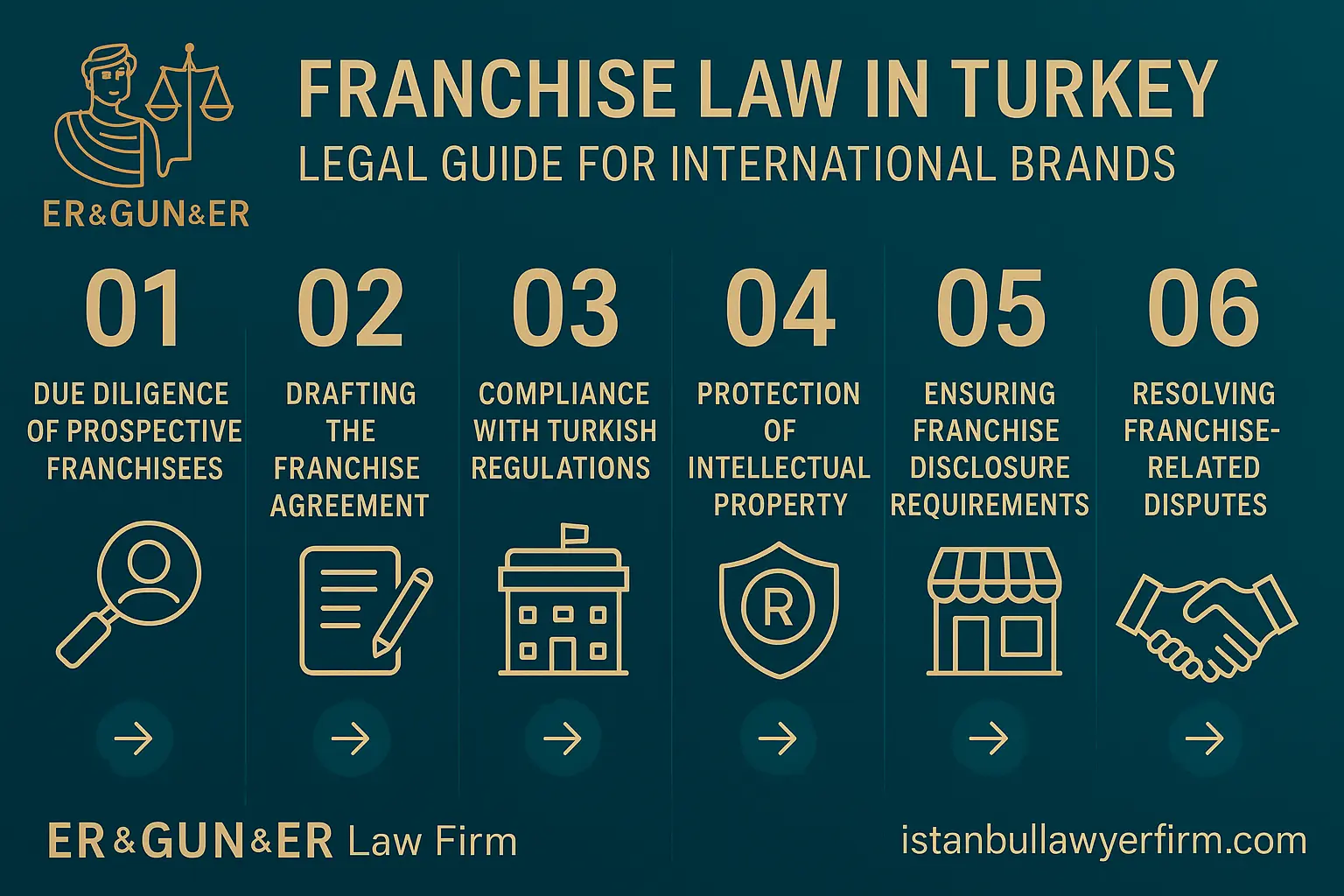
A lawyer in Turkey who advises international brands on franchise market entry understands that franchise law in Turkey operates through a composite framework of general civil and commercial law provisions, competition regulation, consumer protection requirements, and intellectual property legislation—rather than through a dedicated franchise statute—and that navigating this composite framework effectively requires both specific knowledge of each applicable legal source and the practical experience of having structured franchise relationships that perform commercially across Turkey's diverse regional markets. An Istanbul Law Firm that provides franchise law advisory for international brands entering Turkey offers the integrated legal service that enables foreign franchisors to establish legally secure, operationally effective, and commercially sustainable franchise systems: assessing the Turkish legal framework applicable to each franchise model, drafting and negotiating franchise agreements, managing trademark registration and license recording, advising on competition law compliance, structuring royalty and fee flows for Turkish tax compliance, supporting pre-contractual disclosure processes, managing franchisee network compliance, and representing clients in franchise disputes. A Turkish Law Firm that specializes in franchise law for international clients understands the specific challenges that foreign franchisors face when adapting global franchise systems to Turkish market requirements—including the need to translate international operational standards into Turkish-enforceable contractual obligations, the need to protect global trademark portfolios through Turkish-specific registration and enforcement processes, and the need to comply with Turkish financial regulations for cross-border royalty and fee flows. An English speaking lawyer in Turkey who advises international brands on Turkish franchise law provides the bilingual legal guidance that enables foreign franchisors to understand their Turkish franchise system's complete legal requirements rather than relying on simplified summaries that omit the specific compliance obligations that determine whether the franchise system is legally sustainable over the long term. Practice may vary by authority and year — verify current Turkish franchise legal framework provisions, current Turkish Competition Authority franchise guidance, and current Turkish Patent and Trademark Office trademark license registration requirements with qualified counsel before establishing any franchise system in Turkey.
Turkish Franchise Legal Framework: Contract Law, Competition Rules and Consumer Protection
A lawyer in Turkey who advises on the Turkish legal framework for international franchise systems explains that the Turkish Code of Obligations' general contract provisions govern the formation, performance, and termination of franchise agreements—and that the Code's specific principles, including good faith performance obligations, continuous performance contract duties, and pre-contractual information obligations, create an implicit legal structure for franchise relationships that supplements and sometimes overrides the express terms that international franchisors include in their standard agreement templates. An Istanbul Law Firm that advises on Turkish franchise legal framework compliance helps international franchisors understand the specific Code of Obligations principles most relevant to their franchise system: the good faith obligation that requires each party to exercise their contractual rights in ways that respect the other party's legitimate commercial expectations—and whose violation Turkish courts have used to limit franchisors' exercise of termination rights that, while contractually authorized, were exercised in commercially disproportionate ways; the pre-contractual disclosure obligation that requires franchisors to share material information about the franchise system with prospective franchisees during the pre-contractual period—and whose violation may expose franchisors to claims for compensation from franchisees who entered franchise relationships based on incomplete information; and the continuous performance contract principles that Turkish courts apply to ongoing commercial relationships like franchises—whose implications for how Turkish courts interpret cooperation obligations, information sharing duties, and dispute resolution procedures should inform how franchise agreement provisions are drafted. Turkish lawyers advising on Code of Obligations compliance help international franchisors understand that Turkish courts' interpretation of franchise agreements may produce results that differ from what the same provisions would produce in common law jurisdictions—making Turkish-specific legal review of international franchise templates an essential step before deploying those templates in Turkey. Practice may vary by authority and year.
An Istanbul Law Firm that advises on Turkish Competition Law compliance for franchise systems explains that franchise agreements' commercial restrictions—including territorial exclusivity, supply chain exclusivity, resale price provisions, and post-term non-compete obligations—are assessed by the Turkish Competition Authority under the Block Exemption Communiqué on Vertical Agreements, and that provisions outside the block exemption's scope require individual competition law analysis whose outcome determines the restriction's enforceability. Turkish lawyers advising on competition law compliance help international franchisors assess the specific provisions most likely to create competition law issues: resale price maintenance provisions—which the Turkish Competition Authority treats as hard-core restrictions not eligible for block exemption and whose inclusion in franchise agreements creates enforcement risk regardless of the franchisor's legitimate quality control justifications; exclusive supply obligations—which may be exempt within specific duration and market share thresholds but require careful assessment when they cover substantial portions of the franchisee's input requirements; and non-compete obligations—both during and after the franchise term—whose duration and scope must be within the block exemption's limits for automatic exemption or must satisfy individual justification requirements for provisions outside those limits. An English speaking lawyer in Turkey who advises on competition law integration in franchise agreements provides the specific competition law analysis that enables international franchisors to implement the commercial restrictions their franchise system requires within the Turkish competition law framework rather than discovering through enforcement proceedings that standard international franchise restrictions are not permissible in Turkey. Practice may vary by authority and year.
A Turkish Law Firm that advises on consumer protection compliance in Turkish franchise systems explains that many international franchise systems operate in B2C sectors where Turkish Consumer Protection Law creates specific obligations—including mandatory disclosure requirements, withdrawal rights, warranty obligations, and unfair commercial practice prohibitions—that apply to the franchised business's consumer-facing operations and that must be specifically addressed in the franchise agreement's compliance framework. An English speaking lawyer in Turkey who advises on consumer protection integration for international franchise systems helps franchisors implement the specific compliance approach most effective for each franchise sector: confirming which Turkish Consumer Protection Law provisions apply to the franchise system's specific products and services—because different B2C categories are subject to different specific regulations; allocating compliance responsibility between the franchisor and franchisee clearly in the franchise agreement—specifying which consumer law obligations are franchisor brand standards whose consistent implementation the franchisor monitors and which are franchisee operational obligations whose satisfaction is the franchisee's direct responsibility; and establishing the monitoring and audit mechanisms that enable the franchisor to verify that franchisees' consumer-facing operations comply with both the franchisor's brand standards and the applicable Turkish consumer protection requirements. Practice may vary by authority and year.
Pre-Contractual Disclosure, Franchisee Selection and Due Diligence
A lawyer in Turkey who advises on pre-contractual disclosure for international franchise systems explains that while Turkey does not mandate a statutory franchise disclosure document comparable to the requirements of some other jurisdictions, the Turkish Code of Obligations' general pre-contractual good faith obligations require franchisors to share material information about the franchise system with prospective franchisees before the franchise agreement is executed—and that structuring this disclosure through a formal disclosure process, rather than leaving pre-contractual information sharing to informal conversation, significantly reduces the franchisor's exposure to later misrepresentation claims. An Istanbul Law Firm that structures pre-contractual disclosure processes for international franchisors implementing Turkish market entry helps franchisors understand the specific disclosure elements most important for Turkish franchise market entry: financial information about the franchise system including historical financial performance data for the Turkish market where available, or equivalent market data where Turkey-specific data is not yet available; material terms of the franchise relationship including fee structure, royalty rates, mandatory supplier requirements, and territory parameters; the obligations that the franchisee must satisfy including investment requirements, training completion, operational standards, and reporting obligations; and the franchisor's support obligations—including initial training, ongoing operational support, marketing assistance, and system update delivery—whose specific description enables prospective franchisees to evaluate whether the support matches the fee structure. Turkish lawyers advising on pre-contractual disclosure help franchisors understand that the disclosure document's value is not merely legal protection against misrepresentation claims but also a commercial tool that helps prospective franchisees make informed decisions—reducing the probability that the franchise relationship will fail due to misaligned expectations. Practice may vary by authority and year.
An Istanbul Law Firm that advises on franchisee selection due diligence for international brands entering Turkey explains that the quality of the franchisee selection process significantly determines the franchise system's Turkish market success—because a well-designed franchise system implemented by a franchisee who lacks the financial capacity, operational experience, or brand alignment to succeed will produce poor results that harm both the franchisee's investment and the franchisor's Turkish market reputation. Turkish lawyers advising on franchisee selection help international franchisors implement the specific assessment approach most effective for the Turkish market: financial capacity assessment through review of the prospective franchisee's financial statements, bank references, and business plan—confirming that the franchisee has sufficient capital for the initial investment, the operating costs during the launch period, and the financial resilience to sustain operations through early challenges; business and management experience assessment—evaluating whether the franchisee has prior experience in business operations, the relevant sector, and Turkish commercial relationship management; and alignment assessment—evaluating whether the prospective franchisee's operational approach, customer service orientation, and brand values alignment indicate a franchisee who will implement the franchise system as designed rather than adapting it in ways that compromise brand consistency. An English speaking lawyer in Turkey who advises on franchisee due diligence coordination manages the legal components of the assessment—including background verification, corporate structure review, and legal history inquiry—in coordination with the franchisor's operational assessment to produce a complete picture of each franchisee candidate's suitability. Practice may vary by authority and year.
A Turkish Law Firm that advises on franchise agreement negotiation with Turkish franchisees explains that the franchise agreement negotiation process with Turkish franchisee candidates typically involves discussion of specific provisions—including territorial scope, renewal conditions, fee structures, and exit rights—and that managing this negotiation effectively requires both the legal knowledge to assess which proposed modifications are legally acceptable and the commercial judgment to identify which modifications would compromise the franchise system's legal integrity or operational standards. An English speaking lawyer in Turkey who manages franchise agreement negotiations with Turkish franchisee candidates provides the negotiation management that enables international franchisors to achieve franchise agreements that are commercially acceptable to qualified Turkish franchisees while maintaining the legal structure and operational standards that the franchise system requires. Practice may vary by authority and year.
Royalties, Tax Compliance and Cross-Border Financial Flows
A lawyer in Turkey who advises on royalty and fee structure for international franchise systems in Turkey explains that the franchise agreement's financial provisions—including initial franchise fees, ongoing royalties, marketing fund contributions, and other periodic payments—must be structured to comply with Turkish tax law, Turkish foreign exchange regulations, and transfer pricing requirements for related-party transactions, and that addressing these compliance dimensions at the agreement drafting stage is significantly more effective than attempting to restructure financial flows after the franchise relationship is established. An Istanbul Law Firm that structures franchise financial provisions for cross-border compliance implements the specific approach most effective for each franchise financial model: defining the royalty calculation base with Turkish-specific accounting precision—identifying which revenue items are included in the royalty base, which Turkish accounting standards govern the financial records that form the calculation basis, and what currency conversion methodology applies when royalties are calculated on Turkish lira revenues but payable to a foreign franchisor in another currency; structuring withholding tax compliance by specifying whether the stated royalty rate is net or gross of Turkish withholding tax, and whether the franchisee must gross up payments to ensure the franchisor receives the stated net amount after withholding; and managing Central Bank reporting and documentation requirements for cross-border royalty transfers—because Turkish banking regulations impose specific transaction documentation requirements for international payments whose satisfaction is a condition to transferring royalty payments abroad. Turkish lawyers advising on franchise financial structure help international franchisors understand that Turkish withholding tax on royalty payments is assessed at the applicable domestic rate—subject to reduction under double taxation treaties whose benefits require specific documentation—and that franchise agreements should specifically address the treaty benefit procedures to enable franchisees to apply reduced rates. Practice may vary by authority and year — verify current Turkish withholding tax rates on royalty payments, current double taxation treaty benefit procedures, and current Central Bank transaction documentation requirements with qualified tax and legal counsel before finalizing any franchise financial provisions.
An Istanbul Law Firm that advises on transfer pricing compliance for international franchise systems explains that royalty payments between related parties—where the Turkish franchisee and the foreign franchisor are within the same corporate group—are subject to Turkish transfer pricing rules requiring that the royalty rate reflect arm's length market conditions and that contemporaneous transfer pricing documentation demonstrate the rate's arm's length basis. Turkish lawyers advising on transfer pricing compliance for related-party franchise arrangements help clients implement the specific documentation approach most effective for each intercompany structure: maintaining transfer pricing documentation that describes the franchise system's economic contribution, the functional analysis of each party's role in the value creation, and the comparable uncontrolled transaction basis for the royalty rate—organized and updated annually in compliance with Turkish transfer pricing documentation requirements; coordinating the Turkish transfer pricing documentation with the global transfer pricing policy to ensure that the positions maintained in Turkey are consistent with positions maintained in other jurisdictions in which the franchise system operates; and preparing for potential Turkish Revenue Administration audit of the franchise royalty payments—because related-party royalty flows attract specific audit attention—by maintaining organized, complete documentation that enables clear explanation of the arm's length rate determination. An English speaking lawyer in Turkey who coordinates transfer pricing compliance for international franchise royalty flows provides the Turkish-specific documentation analysis that enables foreign franchisors to maintain compliant intercompany royalty flows. Practice may vary by authority and year.
A Turkish Law Firm that advises on foreign currency provisions in Turkish franchise agreements explains that Turkish foreign exchange regulations—which impose specific restrictions on foreign currency denomination of transactions between Turkish residents—affect how franchise fee and royalty provisions can be structured in agreements where both the franchisee and the franchisee's Turkish operations are subject to Turkish law. An English speaking lawyer in Turkey who advises on foreign currency compliance for franchise financial provisions helps franchisors understand the current Turkish foreign exchange regulatory framework's implications for franchise fee structures, the conditions under which foreign currency indexation of franchise fees may be permissible, and the Turkish lira structuring alternatives that comply with current regulations while maintaining the financial value of the franchise fee arrangements. Practice may vary by authority and year.
Brand Protection, Trademark Enforcement and Network Compliance
A lawyer in Turkey who advises on brand protection for international franchisors explains that maintaining effective brand control across a Turkish franchise network requires implementing both the contractual brand compliance framework in the franchise agreement and the Turkish trademark registration and enforcement tools that give the franchisor legal standing to act against unauthorized brand use—because contractual rights against the franchisee are only part of the brand protection framework; the trademark registration provides the independent legal standing to act against third-party infringers whose conduct is outside the franchise agreement's scope. An Istanbul Law Firm that manages comprehensive brand protection for international franchise systems entering Turkey implements the specific approach most effective for each brand's Turkish market requirements: registering all trademark classes relevant to the franchise system's Turkish operations with the Turkish Patent and Trademark Office—ensuring that the franchisor has Turkish trademark rights as the legal basis for both the franchise license and enforcement against infringers; recording trademark licenses with the Turkish Patent and Trademark Office—ensuring that the franchise trademark license is enforceable against third parties rather than being a purely contractual arrangement between the franchisor and franchisee; and implementing trademark monitoring to identify potential conflicts between the franchise system's marks and third-party applications—enabling the franchisor to oppose conflicting applications before they register rather than litigating removal after registration. Turkish lawyers advising on trademark protection management help international franchisors understand that Turkish trademark prosecution timelines—from application to registration—create a gap during which the franchise system may be operating under unregistered marks that have weaker legal protection, and that accelerated registration timelines should be a priority for franchise systems with imminent Turkish market entry plans. Practice may vary by authority and year.
An Istanbul Law Firm that advises on franchise network compliance monitoring explains that the operational consistency whose maintenance across a growing Turkish franchise network protects both the brand's consumer reputation and the franchisor's legal ability to enforce quality standards—because franchisors who do not monitor and enforce operational standards consistently may find that Turkish courts treat their failure to enforce as an implied modification of the standards that makes subsequent enforcement more difficult. Turkish lawyers advising on network compliance management help franchisors implement the specific monitoring approach most effective for each franchise network: systematic inspection programs whose specific schedule, scope, and assessment criteria are defined in the franchise agreement and implemented consistently across all franchise locations—enabling the franchisor to identify compliance issues early and address them through the agreement's progressive enforcement process; reporting systems that require franchisees to submit operational performance data, financial reports, and regulatory compliance certifications on a scheduled basis—providing the franchisor with regular visibility into network-wide performance without requiring on-site inspections for each compliance cycle; and franchisee communication systems that enable the franchisor to deliver operational updates, brand standard modifications, and compliance guidance to all franchisees simultaneously—ensuring that the franchise network operates on consistent current standards rather than allowing individual franchisees to continue operating under outdated procedures. An English speaking lawyer in Turkey who advises on franchise network compliance management provides the practical guidance that enables international franchisors to implement effective network monitoring from their headquarters location without requiring Turkey-based management presence for routine compliance oversight. Practice may vary by authority and year.
A Turkish Law Firm that advises on franchise trademark enforcement in Turkey explains that when unauthorized use of the franchise system's marks occurs—whether by a former franchisee continuing to use the brand after termination, a third party adopting a confusingly similar mark, or a current franchisee using the brand outside the licensed scope—Turkish law provides specific enforcement mechanisms whose effective use requires both the trademark registration that establishes the franchisor's legal standing and the procedural knowledge to deploy those mechanisms efficiently. An English speaking lawyer in Turkey who advises on Turkish trademark enforcement for international franchise systems helps franchisors implement the specific enforcement approach most appropriate for each infringement scenario: cease-and-desist communications for cases where the infringer may comply without court proceedings; Turkish civil court injunction proceedings for urgent cases where the infringement continues despite demand and where interim injunctive relief can prevent ongoing brand damage during litigation; customs seizure applications for trademark infringement occurring through importation or distribution; and criminal complaint filings for cases of intentional trademark counterfeiting whose severity justifies the use of criminal enforcement mechanisms alongside civil remedies. Practice may vary by authority and year.
Franchise Dispute Resolution, Litigation and Network Exit Management
A lawyer in Turkey who advises on franchise dispute resolution explains that franchise disputes in Turkey—whether arising from franchisee payment defaults, operational non-compliance, termination disagreements, or post-termination brand use—involve specific legal issues whose resolution through Turkish legal mechanisms requires both the contractual preparation that the franchise agreement's dispute resolution provisions establish and the procedural knowledge to use those mechanisms effectively when disputes arise. An Istanbul Law Firm that represents international franchisors in Turkish franchise disputes implements the specific approach most effective for each dispute type: payment default disputes—where the franchisor's recovery depends on the validity of the default notice, the satisfaction of the cure period requirements, and the enforceability of the financial obligations through Turkish civil enforcement proceedings; operational compliance disputes—where the franchisor's ability to enforce standards or terminate depends on having documented specific violations through the inspection and notification process that the franchise agreement requires; and post-termination disputes—where the franchisor's ability to enforce de-identification obligations, confidentiality requirements, and non-compete provisions requires both the contractual foundation of these obligations and the Turkish court proceedings through which they are enforced. Turkish lawyers advising on franchise dispute management help international franchisors understand that Turkish commercial court litigation timelines and procedural requirements differ from those of common law jurisdictions—making the advice of qualified Turkish counsel essential for managing disputes through Turkish proceedings effectively. Practice may vary by authority and year.
An Istanbul Law Firm that advises on arbitration for Turkish franchise disputes explains that arbitration—whether through the Istanbul Arbitration Centre, the ICC International Court of Arbitration, or another institutional body—provides international franchisors with specific advantages for franchise dispute resolution that Turkish commercial court litigation does not offer, and that the arbitration clause's design determines whether these advantages are actually realized in practice. Turkish lawyers advising on franchise arbitration clause design help international franchisors implement the specific provisions most effective for each dispute scenario: specifying the institutional arbitration framework with sufficient procedural detail that the clause is enforceable under Turkish Arbitration Law—because arbitration clauses that do not meet Turkish law's validity requirements may be challenged, and courts may assume jurisdiction over disputes that should have been resolved through arbitration; designating the arbitration seat and the procedural rules with attention to the enforcement implications—because the New York Convention's framework for enforcing arbitration awards in Turkey requires that the award be made in a jurisdiction that is a Convention member; and determining whether the arbitration clause covers all franchise disputes or whether specific dispute categories—including urgent injunctive relief applications—are carved out for Turkish court proceedings where faster interim measures may be available. An English speaking lawyer in Turkey who advises on franchise arbitration clause design for international franchisors provides the integrated analysis of Turkish arbitration law, international arbitration procedure, and Turkish enforcement practice that enables franchisors to design effective arbitration clauses for their Turkish franchise agreements. Practice may vary by authority and year.
A Turkish Law Firm that advises on franchise network exit and restructuring explains that franchise network exits—whether resulting from the franchise system's decision to exit the Turkish market, the termination of a master franchise relationship, or the consolidation of a regional franchise network—require specific legal management that enables the network's wind-down without creating commercial losses through uncontrolled brand use, customer disruption, or unresolved contractual obligations. An English speaking lawyer in Turkey who advises on franchise network exit management helps international franchisors implement the specific approach most effective for each exit scenario: managing the franchise agreement termination process in compliance with the specific notice and cure requirements that make termination legally effective; coordinating the de-identification of franchise locations—including brand signage removal, digital presence deactivation, and product and packaging transition—within the timeline that the franchise agreement and Turkish law require; and addressing the employment implications of network exit for franchise location employees whose employment relationships are governed by Turkish Labor Law—because franchise system exits may trigger specific Labor Law obligations whose management requires coordination with the franchisee. The best lawyer in Turkey for international brand franchise law combines specific knowledge of Turkish franchise legal framework, Turkish Competition Law vertical agreement provisions, Turkish consumer protection requirements, Turkish trademark registration and enforcement procedures, Turkish cross-border royalty tax compliance, franchise agreement drafting and negotiation, and franchise dispute resolution with the English-language communication and international franchise law expertise that enables foreign franchisors to establish and manage legally secure Turkish franchise systems. Practice may vary by authority and year.
Franchise Disclosure Documents, Compliance Manuals and Operational Systems
A lawyer in Turkey who advises on franchise disclosure and operational systems explains that the franchise disclosure document and operational compliance manual—while distinct in their legal function—together form the informational foundation of the franchise relationship, with the disclosure document informing the prospective franchisee's decision to enter the relationship and the compliance manual guiding the franchisee's implementation of the franchise system throughout the relationship's duration. An Istanbul Law Firm that prepares franchise disclosure documentation for international brands entering Turkey helps franchisors create disclosure documents that satisfy both the Turkish Code of Obligations' pre-contractual good faith standards and the substantive disclosure expectations that informed Turkish franchisee candidates apply when evaluating franchise opportunities: financial information about the franchise system whose specificity and accuracy enable prospective franchisees to assess the investment's expected financial performance rather than relying on optimistic projections; material term disclosure that describes the franchise agreement's key provisions in accessible language whose comprehensibility enables prospective franchisees to understand their obligations before they commit to a long-term contractual relationship; and risk disclosure that identifies the material risks specific to the franchise system's Turkish market operations—including competitive market conditions, regulatory compliance obligations, and operational challenges—whose candid description reflects the franchisor's commitment to informed franchisee selection rather than aggressive recruitment. Turkish lawyers advising on franchise disclosure documentation help international franchisors understand that disclosure quality affects not only the franchisor's legal protection against misrepresentation claims but the long-term success of the franchise relationship—because franchisees who enter with accurate expectations are better positioned to manage the operational challenges they will actually encounter. Practice may vary by authority and year.
An Istanbul Law Firm that advises on franchise operations manual preparation for Turkish market deployment explains that the operations manual—which provides the detailed procedural guidance that translates the franchise agreement's general standards into specific daily operational procedures—must be adapted for the Turkish market's specific regulatory requirements, consumer expectations, and operational conditions rather than simply translated from the global version. Turkish lawyers advising on operations manual Turkish market adaptation help franchisors identify the specific adaptations most important for each franchise sector: regulatory compliance procedures that reflect the specific Turkish permits, certifications, and reporting obligations applicable to the franchise sector—because the global operations manual's compliance procedures may reference regulatory requirements that do not exist in Turkey or may omit Turkish-specific requirements; supplier and purchasing procedures that reflect the Turkish supply chain rather than global sourcing channels—because Turkish franchisees must operate with Turkish suppliers whose specific characteristics differ from the global supply chain; and consumer interaction procedures that reflect Turkish consumer protection law obligations and Turkish consumer service expectations—because the global operations manual's consumer interaction guidance may not address the specific requirements and expectations of Turkish consumer relationships. An English speaking lawyer in Turkey who advises on operations manual Turkish market adaptation provides the legal review that identifies compliance gaps between the global manual's procedures and Turkish regulatory requirements—enabling the franchisor to deploy an operations manual that creates legally compliant procedures rather than accidentally prescribing procedures that violate Turkish law. Practice may vary by authority and year.
A Turkish Law Firm that advises on franchise audit and compliance verification systems explains that maintaining operational consistency across a Turkish franchise network requires systematic compliance verification whose methodology, documentation, and enforcement consequences are defined in the franchise agreement and implemented through a coordinated program that applies consistent standards to all franchise locations. An English speaking lawyer in Turkey who advises on franchise audit system design helps franchisors implement the specific compliance verification approach most effective for each franchise system: defining the audit categories—financial compliance, operational standards, brand presentation, and regulatory compliance—whose assessment enables comprehensive evaluation of each franchisee's system adherence; establishing the audit methodology—including site inspection protocols, financial record review procedures, mystery shopping programs, and digital compliance monitoring—that enables consistent, objective assessment across the franchise network; and documenting the audit findings management process—including the specific notice requirements, remediation timeline expectations, and escalating consequence framework for identified deficiencies—that transforms audit findings into operational improvements rather than disputes about the franchise agreement's compliance standards. Practice may vary by authority and year.
Multi-Unit Expansion, Area Development and Turkish Market Growth
A lawyer in Turkey who advises on multi-unit franchise expansion for international brands explains that growing a franchise network across Turkey's diverse regional markets—from Istanbul's cosmopolitan commercial environment to Ankara's government-focused economy and Izmir's Aegean commercial culture—requires franchise agreement structures that provide consistent brand standards while accommodating regional operational variations, and that planning the expansion structure before the first Turkish franchise agreement is executed significantly reduces the legal complexity of managing a growing multi-location network. An Istanbul Law Firm that advises on Turkish franchise expansion strategy helps international franchisors assess the specific expansion structure most appropriate for their Turkish market ambitions: single-unit franchise agreements whose sequential execution enables gradual market development with direct franchisor control over each franchisee relationship—providing the strongest operational consistency but requiring the most direct franchisor management involvement; area development agreements whose development schedule obligations and territory exclusivity conditions enable committed multi-unit development by a single capable operator—balancing expansion speed with the reduced monitoring complexity of a single development relationship; and master franchise agreements whose comprehensive delegation to a Turkish master franchisee enables more aggressive market development than the franchisor could achieve through direct management—but requires more robust master franchisee selection due diligence and more sophisticated master franchise agreement structure. Turkish lawyers advising on franchise expansion structure selection help international franchisors understand the specific legal obligations that each structure creates—because each expansion vehicle's legal framework creates different trademark license recording obligations, different compliance monitoring responsibilities, and different dispute resolution complexities that must be managed throughout the expansion. Practice may vary by authority and year.
An Istanbul Law Firm that advises on area development agreement structuring for Turkish franchise expansion explains that area development agreements—which grant a Turkish developer the exclusive right to open multiple franchise units within a defined territory according to an agreed development schedule—provide a specific balance between expansion ambition and operational control whose effectiveness depends on the agreement's development obligation provisions. Turkish lawyers advising on area development agreement design help franchisors implement the specific provisions most effective for each Turkish development situation: development schedule provisions that specify the minimum number of units the developer must open by specific dates within the development territory—with the schedule calibrated to reflect realistic Turkish market development timelines rather than aspirational projections that create perpetual developer default; territory exclusivity conditions whose maintenance depends on the developer's schedule compliance—so that the territory exclusivity benefit motivates schedule adherence rather than being granted unconditionally regardless of development performance; and open unit performance obligations that apply to each unit the developer opens—ensuring that the developer's area development rights do not excuse operational non-compliance at individual franchise locations within the development territory. An English speaking lawyer in Turkey who advises on area development agreements for international franchise expansion provides the commercial real estate coordination that enables development schedule provisions to reflect actual Turkish commercial real estate availability in the development territory rather than theoretical development pace. Practice may vary by authority and year.
A Turkish Law Firm that advises on master franchise agreement structuring for Turkish market delegation explains that master franchise agreements—which grant a Turkish master franchisee the comprehensive right to develop, operate, and sublicense the franchise system throughout a large Turkish territory—require specific legal structures that maintain the international franchisor's brand control and royalty rights while delegating operational management to the master franchisee whose local market knowledge and resources enable more aggressive Turkish market development than the international franchisor could achieve through direct management. An English speaking lawyer in Turkey who structures master franchise agreements for international brands helps franchisors implement the specific framework most effective for each master franchise relationship: sublicensing authority provisions that define the master franchisee's right to grant unit franchise sublicenses—including the approval process for each sublicensee, the form sublicense agreement that the master franchisee must use, and the master franchisee's obligations to ensure each sublicensee's compliance with system standards; royalty flow provisions that specify how franchise fees and royalties from unit franchisees are collected and distributed between the master franchisee and the international franchisor—including the master franchisee's withholding and remittance obligations; and franchisor step-in rights that authorize the international franchisor to intervene directly in the master franchise territory if the master franchisee fails to develop the territory, maintain standards, or satisfy royalty remittance obligations. The best lawyer in Turkey for international brand franchise law combines specific knowledge of Turkish franchise legal framework, Turkish Competition Law, Turkish trademark registration and enforcement, Turkish cross-border royalty tax compliance, franchise disclosure best practices, franchise agreement drafting and negotiation, network compliance monitoring, and multi-unit expansion structuring with the English-language communication and international franchise law expertise that enables foreign franchisors to build sustainable, legally secure Turkish franchise systems. Practice may vary by authority and year.
Regulatory Inspections, Administrative Proceedings and Franchisor Risk Management
A lawyer in Turkey who advises on regulatory risk management for Turkish franchise operations explains that Turkish franchise systems are subject to administrative oversight from multiple regulatory authorities whose inspection and enforcement activities create specific compliance management obligations—and that a franchise agreement whose operational standards provisions account for Turkish regulatory requirements enables the franchisor to manage regulatory risk across the franchise network systematically rather than reactively responding to individual franchisee regulatory incidents. An Istanbul Law Firm that advises on regulatory risk management for international franchise systems operating in Turkey helps franchisors understand the specific regulatory oversight most relevant to each franchise sector: Turkish Standards Institution and municipal authority oversight of product quality and food safety standards—whose inspection programs cover franchise locations in the food service sector and whose findings can trigger operating license suspension or revocation; Ministry of National Education oversight of private educational institution operations—whose monitoring of curriculum compliance, teacher qualifications, and facility standards creates specific ongoing compliance obligations for education sector franchises; Turkish Data Protection Authority oversight of data processing activities—whose enforcement of KVKK compliance includes administrative investigations and financial penalties for inadequate data protection practices; and Turkish Advertising Board oversight of commercial advertising and promotional materials—whose assessment of franchise marketing materials for compliance with Turkish advertising law standards applies to franchise-level campaigns and individual franchisee promotional activities. Turkish lawyers advising on regulatory risk management help international franchisors understand that the regulatory inspection risk is distributed across the franchise network—with each franchisee's operations creating independent regulatory inspection exposure—and that the franchise agreement's notification and coordination provisions determine how effectively the franchisor can manage regulatory incidents at individual franchise locations. Practice may vary by authority and year.
An Istanbul Law Firm that advises on administrative proceeding management for Turkish franchise networks explains that when a Turkish regulatory authority initiates an administrative proceeding against a franchise location—including inspections that result in formal findings, license suspension proceedings, or administrative fines—the franchise agreement's provisions determine whether the franchisor is notified, how the franchisor can coordinate the response, and what consequences the administrative finding creates for the franchise relationship. Turkish lawyers advising on administrative proceeding coordination help franchisors implement the specific provisions most effective for each regulatory scenario: mandatory notification obligations that require the franchisee to notify the franchisor within a specific period after receiving any regulatory inspection notice, administrative warning, or formal finding—enabling the franchisor to assess the regulatory risk and determine whether to engage directly in the proceeding or to manage the risk through the franchise relationship; cooperation obligations that require the franchisee to implement the franchisor's guidance in responding to regulatory proceedings that involve brand reputation risk—particularly for proceedings involving product safety, consumer complaints, or advertising standards whose outcome affects the franchise brand's reputation across the entire network; and termination trigger provisions for specific regulatory outcomes—including license revocation, criminal conviction of the franchisee's management, or repeated administrative violations in the same category—whose occurrence enables the franchisor to terminate the affected franchise relationship and minimize the brand's continued association with a non-compliant operation. An English speaking lawyer in Turkey who advises on administrative proceeding management for international franchise systems provides the regulatory law expertise that enables foreign franchisors to understand the Turkish administrative system's procedures and to engage effectively with Turkish regulatory authorities when franchise-level regulatory issues arise. Practice may vary by authority and year.
A Turkish Law Firm that advises on franchisor liability risk management in Turkish commercial operations explains that international franchisors whose Turkish franchise networks are characterized by high operational control—particularly control over franchisee employees' working conditions, customer interactions, and operational decisions—face specific liability risks under Turkish law that must be addressed through careful franchise system design rather than through contractual disclaimers whose effectiveness against third-party claims is limited. An English speaking lawyer in Turkey who advises on franchisor liability risk management helps international franchisors implement the specific design features most effective for managing liability exposure: maintaining clear operational independence in the franchise system design—ensuring that the franchisor monitors and assesses franchisee operational outcomes rather than directing individual franchisee employee activities; implementing specific contractual protections—including indemnification obligations, insurance requirements, and disclaimer provisions—that create contractual allocation of liability between the franchisor and franchisee for specific categories of operational risk; and maintaining organized records of the franchise system's structure and each franchisee's independence—creating documentary evidence of the operational independence that supports the legal distinction between the franchisor's system oversight and the franchisee's direct operational management. The best lawyer in Turkey for franchise law advisory for international brands combines specific knowledge of Turkish franchise legal framework, Turkish Competition Law, Turkish trademark registration and enforcement, Turkish tax compliance for cross-border royalty flows, Turkish consumer protection requirements, Turkish regulatory oversight of franchise sectors, franchise network compliance management, and dispute resolution procedures with the English-language advisory and bilingual documentation capability that enables foreign franchisors to build and manage legally compliant, operationally effective Turkish franchise systems. Practice may vary by authority and year.
Frequently Asked Questions
- Is there a specific franchise law statute in Turkey? No. Turkey does not have a standalone franchise law. Franchise relationships are governed by the Turkish Code of Obligations, Turkish Commercial Code, Turkish Competition Law, and Turkish Consumer Protection Law, among other applicable statutes. This composite legal framework requires franchise agreements to be specifically drafted to comply with multiple legal sources simultaneously. Practice may vary by authority and year.
- What pre-contractual disclosure is required before a franchise agreement is signed in Turkey? While Turkey does not mandate a statutory franchise disclosure document, the Turkish Code of Obligations' pre-contractual good faith obligations require franchisors to share material information about the franchise system with prospective franchisees before the agreement is executed. Structuring this disclosure through a formal disclosure document reduces misrepresentation risk and establishes a clear record of what information was provided. Practice may vary by authority and year.
- What Turkish Competition Law provisions apply to franchise agreements? Franchise agreements' commercial restrictions—including territorial exclusivity, supply chain exclusivity, resale price provisions, and post-term non-compete obligations—are assessed under the Turkish Block Exemption Communiqué on Vertical Agreements. Provisions within the block exemption's scope receive automatic exemption. Resale price maintenance is not eligible for exemption. Provisions outside the block exemption require individual competition law analysis. Practice may vary by authority and year.
- How should trademark licenses in franchise agreements be structured for Turkish enforceability? Trademark licenses in franchise agreements must be recorded with the Turkish Patent and Trademark Office to be enforceable against third parties. The license recording requires submission of specific supporting documentation including the franchise agreement and power of attorney. Unrecorded trademark licenses are not enforceable against third-party infringers. Practice may vary by authority and year.
- What withholding tax applies to royalty payments from Turkish franchisees to foreign franchisors? Turkish withholding tax applies to royalty payments from Turkish franchisees to foreign franchisors at the domestic rate, subject to reduction under applicable double taxation treaties. Treaty benefit application requires the franchisor to provide Turkish tax residency documentation. Related-party royalty flows require transfer pricing documentation. Practice may vary by authority and year.
- Do Turkish foreign exchange regulations affect franchise fee structuring? Yes. Turkish foreign exchange regulations impose specific restrictions on foreign currency denomination of transactions between Turkish residents that affect how franchise fee and royalty provisions can be structured. The current regulatory framework's implications for franchise financial provisions should be specifically assessed with qualified counsel. Practice may vary by authority and year.
- What operational standards provisions should international franchise agreements include? Franchise agreements should specify product quality requirements, customer service standards, facility maintenance obligations, staff training requirements, reporting obligations, and audit access rights at the operational outcome level. Standards should be defined to enable objective assessment and graduated enforcement. The distinction between operational outcome standards and individual employee management is important for avoiding joint employer risk. Practice may vary by authority and year.
- How are franchise compliance inspections managed under Turkish law? Franchise agreements should specifically authorize inspection rights including scheduled and unannounced visits, financial record access, and operational performance assessment. The specific notice requirements, scope of access, and documentation obligations for inspections should be defined in the agreement. Consistent implementation of inspection programs across the franchise network is important for enforcement consistency. Practice may vary by authority and year.
- Is arbitration or Turkish court litigation better for franchise disputes? The appropriate mechanism depends on the dispute type and the franchisor's priorities. Arbitration provides confidentiality, neutral venue, and New York Convention enforcement framework. Turkish commercial courts provide established procedures and domestic enforcement without separate recognition proceedings. Many franchise agreements use multi-tier dispute resolution combining mediation and arbitration or litigation. Practice may vary by authority and year.
- What are the main risks of not recording the trademark license in Turkey? Failing to record the trademark license with the Turkish Patent and Trademark Office means the license is not enforceable against third parties. This prevents the franchisor from pursuing trademark infringement actions against third-party infringers who are not parties to the franchise agreement. It also creates uncertainty about the franchisee's exclusive territory rights against competing users of the mark. Practice may vary by authority and year.
- How should post-termination obligations be structured in Turkish franchise agreements? Post-termination obligations should include license termination provisions that automatically end all IP licenses upon agreement termination, de-identification obligations requiring removal of brand signage and digital presence within a specified period, confidential information return and destruction requirements with documented certification, and non-compete provisions whose scope must be calibrated to Turkish enforceability standards. Practice may vary by authority and year.
- What transfer pricing documentation is required for related-party franchise royalties in Turkey? Turkish transfer pricing rules require contemporaneous documentation for related-party royalty flows demonstrating that the royalty rate reflects arm's length market conditions. Documentation includes functional analysis of the parties' roles, comparable uncontrolled transaction analysis supporting the rate, and annual update filings with the corporate tax return. Practice may vary by authority and year.
- How are franchisee candidates assessed before franchise agreement execution? Franchisee due diligence typically includes financial capacity assessment through review of financial statements and business plans, business and management experience evaluation, corporate structure review, legal history inquiry, and brand alignment assessment. The franchise agreement's franchisee selection criteria should reflect the standards the franchisor applies during assessment. Practice may vary by authority and year.
- What sector-specific regulatory compliance applies to Turkish franchise operations? Franchise systems in food service, healthcare, education, and financial services sectors face sector-specific Turkish regulatory licensing requirements beyond the general franchise legal framework. These requirements vary by sector and include municipal operating permits, ministry facility authorizations, and sector-specific certification requirements. Regulatory feasibility should be verified before franchise locations are identified. Practice may vary by authority and year.
- Does ER&GUN&ER Law Firm provide franchise law advisory services for international brands in Turkey? Yes. ER&GUN&ER Law Firm provides comprehensive franchise law services for international brands including Turkish legal framework assessment, pre-contractual disclosure document preparation, franchisee selection due diligence support, franchise agreement drafting and negotiation, trademark registration and license recording management, Turkish Competition Law compliance assessment, royalty and fee tax compliance advisory, transfer pricing documentation for related-party arrangements, consumer protection compliance integration, brand protection and trademark enforcement, franchise network compliance monitoring advisory, dispute resolution mechanism design, arbitration and litigation representation, and franchise network exit management—with English-language client communication and bilingual documentation throughout each engagement.
Author: Mirkan Topcu is an attorney registered with the Istanbul Bar Association (Istanbul 1st Bar), Bar Registration No: 67874. His practice focuses on cross-border and high-stakes matters where evidence discipline, procedural accuracy, and risk control are decisive.
He advises individuals and companies across Immigration and Residency, Real Estate Law, Tax Law, and cross-border documentation matters where procedural accuracy and evidence discipline are decisive.
Education: Istanbul University Faculty of Law (2018); Galatasaray University, LL.M. (2022). LinkedIn: Profile. Istanbul Bar Association: Official website.