

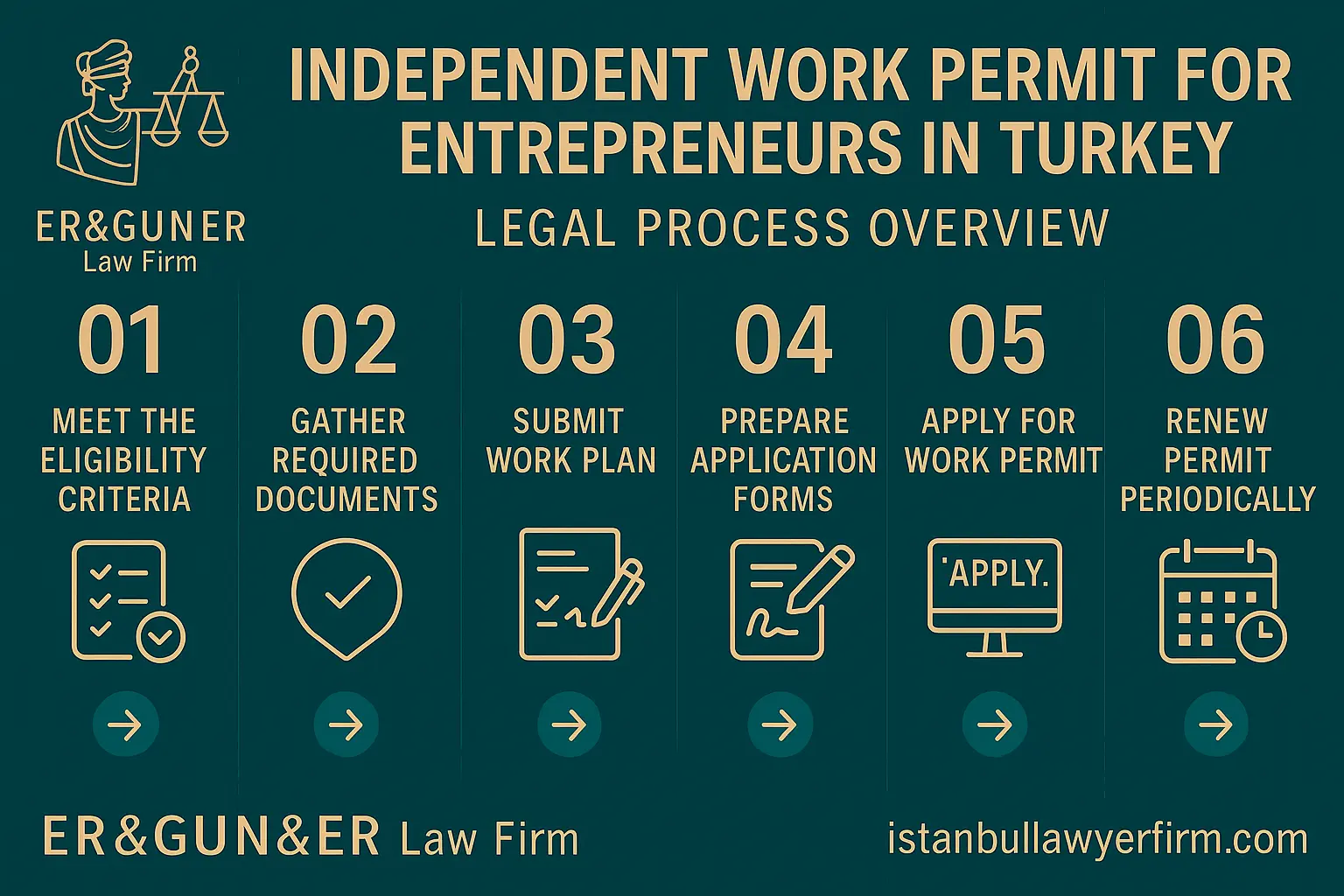
A lawyer in Turkey who advises on business immigration understands that obtaining an independent work permit in Turkey is the legal foundation that enables foreign entrepreneurs to operate their own business, provide professional services, or conduct investment activities in Turkey without relying on employer-sponsored work permit arrangements—and that securing this authorization requires satisfying interconnected eligibility conditions covering company formation, capital investment, ownership structure, professional qualification, and economic contribution whose correct simultaneous management is essential for a successful application. An Istanbul Law Firm that advises on independent work permits for foreign entrepreneurs provides the integrated guidance covering every stage of this process: assessing eligibility against the International Labor Force Law requirements applicable to independent work permit applicants; selecting and establishing the appropriate corporate entity structure with the correct capital, shareholder configuration, and registered business purpose; assembling and submitting the documentation required to demonstrate professional qualification, investment commitment, and economic viability; managing the application process through the Ministry of Labor and Social Security's review; coordinating the post-approval registration steps for tax, social security, and banking compliance; integrating the work permit with the corresponding residence permit and visa status; and developing the long-term permit renewal and status upgrade strategy that connects sustained permit compliance to Turkish citizenship pathway planning. A Turkish Law Firm that advises on entrepreneurial immigration for foreign nationals understands that the independent work permit application is evaluated against criteria including educational and professional qualifications, capital investment level, employment creation for Turkish workers, economic contribution to the Turkish market, and alignment with Turkey's international labor force policy—making the quality and completeness of the supporting documentation as decisive as the underlying eligibility. An English speaking lawyer in Turkey who advises on independent work permit applications for foreign entrepreneurs provides the bilingual coordination that enables applicants to navigate the Turkish corporate, immigration, and compliance systems effectively. Practice may vary by authority and year — verify current eligibility criteria, current capital thresholds, current company formation requirements, and current application procedures with qualified counsel before submitting any independent work permit application, since the regulatory framework governing independent work permits for foreign entrepreneurs is applied through regulations and administrative practice whose current applicable versions determine the specific requirements and timelines relevant to each applicant's individual situation. Practice may vary by authority and year.
Legal Framework, Eligibility and Investment Thresholds
A lawyer in Turkey who advises on the independent work permit legal framework explains that this permit type is governed by the International Labor Force Law and its implementing regulations, which establish the criteria under which the Ministry of Labor and Social Security evaluates whether a foreign national's proposed entrepreneurial activity qualifies for independent work authorization in Turkey. An Istanbul Law Firm that advises on independent work permit eligibility for entrepreneurs helps applicants understand the specific assessment dimensions most important for each entrepreneur profile: confirming that the proposed business activity falls within the categories for which an independent work permit can be granted; assessing whether minimum capital investment requirements apply to the intended corporate structure and verifying the current applicable thresholds from official Ministry guidance; evaluating whether the employment creation condition—typically requiring the company to employ a minimum number of Turkish citizens—can be satisfied by the proposed business model; and assessing the professional qualification requirements including educational credentials, relevant work experience, and professional certifications that demonstrate capacity to conduct the intended activity. Turkish lawyers advising on eligibility assessment help entrepreneurs understand that the Ministry evaluates applications holistically against all criteria simultaneously—meaning that a strong business plan with clear economic contribution can support the application even where individual criteria are at the borderline of eligibility—and that conducting a specific eligibility assessment before beginning company formation prevents the significant cost and time of corporate setup from being invested in a permit pathway that is unlikely to succeed given the applicant's professional profile. Practice may vary by authority and year.
An Istanbul Law Firm that advises on the capital investment dimension of independent work permit applications explains that the minimum capital requirements applicable to the corporate entity established by the foreign entrepreneur depend on the type of entity and any sector-specific requirements that may apply to the intended activity. Turkish lawyers advising on corporate entity selection help entrepreneurs understand the specific entity selection approach most effective for each business model: a limited liability company—limited şirketi—is frequently used for smaller entrepreneurial operations and has specific minimum capital requirements that must be verified from current company law; a joint stock company—anonim şirketi—may be more appropriate for larger investment operations or for activities requiring specific licensing; and sole proprietorship arrangements may be available in limited circumstances for specific professional activities. An English speaking lawyer in Turkey who advises on entity formation for independent work permit applications coordinates the corporate formation process with the permit application timeline so that the company registration is complete and reflected in the trade registry before the permit application file is assembled—and confirms that the registered purpose in the articles of association is appropriate for both the permit application's activity description and the company's intended commercial operations. Practice may vary by authority and year — verify current minimum capital requirements and current entity formation procedures from official sources before any corporate formation decision is made.
A Turkish Law Firm that advises on the ownership structure requirements for independent work permit eligibility explains that the legislation governing foreign-owned companies in Turkey may include Turkish citizen shareholding requirements whose satisfaction affects the permit application—and that the specific requirements applicable to each sector and entity type must be confirmed from current regulations rather than assumed from general descriptions. An English speaking lawyer in Turkey who advises on ownership structure planning for foreign entrepreneurs helps applicants implement the specific shareholder configuration most effective for each business situation: understanding whether the Turkish citizen shareholding requirements apply to the intended company type and activity; structuring shareholder agreements that satisfy the legal requirements while preserving the foreign entrepreneur's operational control through governance arrangements; and confirming that the shareholding structure disclosed in the permit application is consistent with the corporate registry records and with the company's internal governance documents. Practice may vary by authority and year.
A Turkish Law Firm that advises on strategic capital planning for independent work permit applications explains that the capital deposited in the company must be genuine rather than circular—meaning that the capital must be deposited into the company's bank account from the entrepreneur's own verifiable funds and must remain in the company's account through the period of the permit application review. An English speaking lawyer in Turkey who coordinates capital deposit documentation for foreign entrepreneur permit applications helps applicants prepare the bank confirmation and fund tracing documentation that demonstrates the capital's origin and deposit in a form that satisfies the Ministry's verification standards. Practice may vary by authority and year.
Company Formation Requirements and Employment Obligations
A lawyer in Turkey who advises on company formation for independent work permit eligibility explains that establishing the corporate entity is typically the first concrete step in the independent work permit process—and that the formation must be completed correctly with the right registered purpose, the required minimum capital, and the appropriate governance structure before the permit application can be submitted with the supporting company registration documentation. An Istanbul Law Firm that advises on company formation for foreign entrepreneurs manages the specific formation process most effective for each entity type: preparing the articles of association in a form that satisfies both Turkish company law requirements and the permit application's requirement that the stated business purpose matches the intended professional activity; coordinating the capital deposit with a Turkish bank that issues the required blocking certificate; registering the company with the trade registry and obtaining the trade registry gazette publication; registering with the revenue administration for tax purposes and obtaining the tax identification number; and registering the company with the relevant chamber of commerce or sectoral body where required. Turkish lawyers advising on company formation help foreign entrepreneurs understand that the articles of association's description of the company's permitted activities is a document that both company law and immigration authorities will review—and that a description that is either too narrow or too broad relative to the intended activity creates compliance risk in different ways, making the drafting of this provision one of the most important early decisions in the permit application process. Practice may vary by authority and year.
An Istanbul Law Firm that advises on the employment creation requirements for independent work permit eligibility explains that the requirement to employ Turkish citizens—whose number and specific conditions are determined by the applicable regulatory framework for the permit year—is an ongoing compliance obligation rather than a one-time eligibility condition whose satisfaction must be maintained throughout the permit period. Turkish lawyers advising on employment planning help entrepreneurs implement the specific employment approach most defensible for each business model: preparing an employment plan that identifies the Turkish citizen employees to be engaged, their roles, and their expected start dates that is consistent with the company's business plan; registering each Turkish employee with the Social Security Institution—SGK—within the required timeframe; maintaining SGK premium payment records that demonstrate continuous employment throughout the permit period; and understanding that changes in the number of Turkish employees or gaps in employment coverage can affect permit renewal eligibility. An English speaking lawyer in Turkey who advises on employment compliance for independent work permit holders provides the payroll and SGK compliance management that ensures the employment condition is maintained as an ongoing matter rather than addressed only at renewal time—and implements the internal control approach that alerts the entrepreneur immediately if any employment gap creates a risk that the minimum employment threshold is not being met during any month of the permit period. Practice may vary by authority and year.
A Turkish Law Firm that advises on the economic contribution documentation required for independent work permit applications explains that the Ministry evaluates the entrepreneur's anticipated economic contribution through business plans, financial projections, signed client contracts, market analysis, and other evidence that demonstrates the business will generate genuine economic activity in Turkey rather than merely providing a permit vehicle for the foreign entrepreneur. An English speaking lawyer in Turkey who advises on economic contribution documentation for independent work permit applications helps entrepreneurs prepare the specific evidence package most persuasive for each business profile: a detailed business plan that describes the services or products, the target market, the expected revenue, and the employment creation in concrete and quantifiable terms; financial projections supported by market research or comparable sector data; signed service contracts or letters of intent from Turkish clients where available; evidence of professional qualifications and track record in the same or similar business activity; and any sectoral certifications, patent filings, or recognized expertise that demonstrates the entrepreneur's professional standing. Practice may vary by authority and year.
A Turkish Law Firm that advises on business plan preparation for independent work permit applications explains that the business plan submitted with the application must be specific enough to be credible rather than generic enough to apply to any business—and that the Ministry review often distinguishes between plans that describe real intended activity with concrete client identification and financial projections and plans that are drafted as template documents without the specificity that demonstrates genuine entrepreneurial intent. An English speaking lawyer in Turkey who assists with business plan preparation for foreign entrepreneur permit applications provides the legal review that ensures the plan's content is consistent with the company's articles of association, the applicant's stated professional qualifications, and the economic contribution claims made in the permit application. Practice may vary by authority and year.
Application Process, Documentation and Interview Management
A lawyer in Turkey who advises on the independent work permit application process explains that applications are submitted through the Ministry of Labor and Social Security's designated online system, and that the application file must contain all required documents in the prescribed format before submission—since incomplete applications generate follow-up requests that extend processing timelines. An Istanbul Law Firm that advises on independent work permit application management for foreign entrepreneurs helps applicants implement the specific submission approach most effective for each applicant profile: assembling the complete document file—including passport, company registration documents, tax registration certificate, SGK registration confirmation, employment plan, business plan, professional credentials, financial evidence, and any sectoral licenses—before opening the application; confirming that each foreign-language document is accompanied by a certified Turkish translation prepared by a sworn translator; confirming that documents requiring apostille certification are apostilled in the source country before the application is submitted; and submitting the application as a complete package rather than in fragments whose sequential arrival extends the review period unnecessarily. Turkish lawyers advising on documentation management help entrepreneurs understand that each document in the file should be assessed for its internal consistency with every other document—since the Ministry reviewer will compare the stated business activity against the company registration purpose, the capital investment evidence against the banking documentation, and the employment plan against the SGK records—and that running a pre-submission consistency review that tests these cross-references before the application is filed is consistently more cost-effective than addressing inconsistencies after a follow-up request from the Ministry. Practice may vary by authority and year.
An Istanbul Law Firm that advises on the Ministry interview stage for independent work permit applications explains that some applications include an interview at the Ministry's offices or at a Turkish consulate abroad—and that interview preparation is a specific compliance task whose quality affects the outcome as much as the quality of the documentary file. Turkish lawyers advising on interview preparation help entrepreneurs prepare by reviewing the entire application file to ensure that oral answers during the interview are consistent with every written statement in the documents; preparing for the questions most commonly raised about the entrepreneur's professional background, the specific business activity, the business plan's feasibility, the employment creation plan, and the entrepreneur's long-term intentions in Turkey; and understanding that the interviewer will compare oral answers against the documentary record in real time—making factual consistency across every element of the application the most important single preparation objective. An English speaking lawyer in Turkey who provides bilingual interview support for foreign entrepreneur applicants helps non-Turkish-speaking applicants understand and respond to Turkish-language interview questions accurately without the language barrier creating inadvertent inconsistencies in the interview record—and prepares a pre-interview summary document in both languages that the applicant can reference to ensure the core factual statements about the business are consistent across the entire interaction. Practice may vary by authority and year.
A Turkish Law Firm that advises on post-submission tracking and follow-up management explains that after submission the applicant should monitor the application status through the official system and should respond to any additional requests promptly within the timeframe specified by the authority—since delayed responses are treated the same way as non-responses in terms of their effect on the application timeline. An English speaking lawyer in Turkey who manages post-submission tracking for independent work permit applications provides the monitoring service that identifies follow-up requests immediately, coordinates a complete and consistent response with the original application file rather than treating each follow-up as a separate communication, and preserves each response submission as a dated exhibit in the application file so that the procedural history of the review process is fully documented. Practice may vary by authority and year — verify current processing timelines and current application portal procedures with qualified counsel before submitting any independent work permit application.
Residence Permit Integration, Visa Status and Status Changes
A lawyer in Turkey who advises on the integration of independent work permits with residence status explains that once the independent work permit is approved, the foreign entrepreneur needs to ensure that their residence authorization in Turkey is consistent with the work permit—since both authorizations must be maintained and their expiry dates must be managed in coordination to prevent gaps in lawful stay or employment authorization. An Istanbul Law Firm that advises on residence permit coordination for independent work permit holders helps entrepreneurs navigate the specific alignment approach most effective for each immigration situation: confirming the residence permit type and validity period that corresponds to the independent work permit; submitting the residence permit application to the Directorate of Migration Management with the required documentation including the work permit approval, accommodation proof, health insurance, and financial capacity evidence; and ensuring that the renewal timelines for both the work permit and the residence permit are tracked in one coordinated compliance calendar rather than managed as separate independent obligations. Turkish lawyers advising on residence permit integration help entrepreneurs understand that the work permit and residence permit are both required for lawful professional activity and that allowing either to lapse—even temporarily—creates a compliance gap that affects both the permit holder's lawful status and the work permit renewal assessment. Practice may vary by authority and year.
An Istanbul Law Firm that advises on renewal management for independent work permits and residence permits explains that both authorizations typically have one-year validity periods with renewal requirements that must be satisfied in advance of expiry—and that preparing renewal applications at least sixty days before expiry with current documentation is the standard that prevents status gaps. Turkish lawyers advising on renewal preparation help entrepreneurs implement the specific renewal approach most effective for each permit profile: assembling updated evidence of continued business activity including current trade registry status, current tax registration, current SGK contribution records, and updated financial statements; confirming that the employment condition continues to be satisfied and that SGK records reflect active employment of the required Turkish workers; preparing the renewal application with updated business plan information where the business has evolved since the original application; and submitting the renewal application through the Ministry's designated system with all required exhibits in current format. An English speaking lawyer in Turkey who manages renewal applications for foreign entrepreneur permit holders provides the systematic renewal tracking that ensures both the work permit and the residence permit are renewed before expiry without the entrepreneur needing to personally monitor each deadline—and confirms at each renewal that the complete compliance record for the prior permit period is organized and available to support the renewal assessment without the urgency of last-minute document collection. Practice may vary by authority and year.
A Turkish Law Firm that advises on status change procedures for independent work permit holders explains that when an entrepreneur's circumstances change—including changing the company structure, transitioning to an employee-based work permit, or adding dependent family members—specific procedures must be followed to ensure the status change is properly recorded by the relevant authorities without creating gaps in authorization. An English speaking lawyer in Turkey who manages status changes for foreign entrepreneurs provides the transition coordination that aligns company registry updates, Ministry of Labor notifications, Migration Management filings, and residence permit amendments in the sequence that maintains continuous lawful status throughout the transition—and confirms that each notification reaches the relevant authority within the required timeframe rather than assuming that filing with one authority automatically notifies the others. Practice may vary by authority and year.
SGK Registration, Payroll Compliance and Social Security Obligations
A lawyer in Turkey who advises on SGK compliance for independent work permit holders explains that registering with the Social Security Institution—SGK—is a mandatory legal obligation that must be completed within the required timeframe after the company commences operations, and that maintaining continuous SGK registration and premium payment is both a standalone legal obligation and a condition whose satisfaction affects permit renewal eligibility. An Istanbul Law Firm that advises on SGK compliance for foreign entrepreneur work permit holders implements the specific compliance approach most effective for each business profile: registering the foreign entrepreneur as both employer and insured individual with SGK under the applicable activity code; registering each Turkish employee with SGK within the required timeframe from their employment start date; establishing a payroll system that calculates employer and employee contributions correctly and generates monthly SGK declarations; submitting monthly declarations to SGK by the applicable deadline; and maintaining SGK payment receipts and contribution records in the compliance archive that supports both the current permit period and future renewal applications. Turkish lawyers advising on SGK compliance help foreign entrepreneurs understand that SGK contribution records are one of the primary sources that the Ministry of Labor reviews during permit renewal assessment—and that gaps in coverage or late payments create compliance red flags that can complicate renewal even when the underlying employment is genuine, making monthly SGK monitoring a compliance priority rather than an administrative afterthought. Practice may vary by authority and year.
An Istanbul Law Firm that advises on employment contract standards for independent work permit company employees explains that Turkish employees hired under the permit company must be engaged through employment contracts that satisfy the Turkish Labor Law requirements—and that both the employment contract terms and the actual payroll records must be consistent with the conditions used to support the permit application. Turkish lawyers advising on employment contract preparation help entrepreneurs draft contracts that reflect the actual employment relationship, include the required legal provisions about working hours, minimum wage compliance, and termination rights, and are consistent with the role descriptions used in the permit application's employment plan. An English speaking lawyer in Turkey who provides bilingual employment compliance support for foreign entrepreneur work permit holders prepares employment documentation in both Turkish and English so that the foreign entrepreneur understands each employment obligation and its consequences for permit compliance. Practice may vary by authority and year.
An Istanbul Law Firm that advises on work contract standards for Turkish employees of independent work permit companies explains that the employment contracts must satisfy the mandatory provisions of the Turkish Labor Law including minimum wage compliance, working hour limits, leave entitlement, and termination procedures—and that preparing these contracts at the commencement of employment rather than after an audit request is consistent with the compliance posture that produces the cleanest permit renewal record. An English speaking lawyer in Turkey who prepares bilingual employment contracts for foreign entrepreneur work permit companies provides the contract drafting service that ensures each employee relationship is documented in a format that satisfies both Turkish Labor Law requirements and the practical need for the foreign entrepreneur to understand each employment obligation. Practice may vary by authority and year.
A Turkish Law Firm that advises on ongoing SGK monitoring for permit continuity explains that monthly SGK declaration submissions and premium payments must be tracked as a standing compliance obligation throughout the permit period rather than addressed only at renewal time—and that the SGK compliance record visible to the Ministry during renewal assessment covers the entire permit period rather than only the period immediately before the renewal application. An English speaking lawyer in Turkey who provides continuous SGK compliance monitoring for independent work permit holders implements the specific monitoring approach that prevents the accumulation of SGK deficiencies during the permit period by confirming each month's declarations and payments are completed before the applicable deadline, retaining records in the compliance archive, and flagging any discrepancy between the declared payroll and the actual bank payment transfers before the discrepancy becomes a finding in an SGK audit. Practice may vary by authority and year.
Tax Registration, Banking Setup and Post-Permit Financial Compliance
A lawyer in Turkey who advises on post-approval financial compliance explains that once the independent work permit is approved and company formation is complete, the entrepreneur must promptly complete the financial infrastructure registrations—tax office registration, bank account opening, and SGK registration—that enable lawful commercial operations and satisfy the ongoing compliance obligations whose status affects permit renewal. An Istanbul Law Firm that advises on tax registration for independent work permit companies manages the specific registration process most effective for each company type: registering with the local tax office—Vergi Dairesi—to activate the company's tax account and obtain the tax identification number; understanding the applicable tax obligations including corporate income tax, value added tax, and withholding tax on employee salaries; establishing an electronic invoicing system where the company meets the triggering thresholds for mandatory e-invoice and e-archive compliance; and coordinating with a Turkish certified public accountant who will manage periodic tax declarations and annual return filings throughout the permit period. Turkish lawyers advising on tax compliance for foreign entrepreneur work permit holders help entrepreneurs understand that tax filing records are reviewed during permit renewal assessment—and that maintaining current tax compliance is both a standalone legal obligation and a permit renewal condition whose monitoring should be integrated into the company's regular operational management rather than addressed only when the renewal date approaches. Practice may vary by authority and year.
An Istanbul Law Firm that advises on Turkish bank account setup for independent work permit companies explains that establishing a Turkish business bank account is a practical prerequisite for commercial operations—enabling the receipt of client payments, the payment of employee salaries, and the management of SGK and tax payments through verifiable banking channels. Turkish lawyers advising on banking setup for foreign entrepreneur companies help entrepreneurs prepare the specific documentation required by Turkish banks for business account opening: work permit, company tax registration certificate, trade registry extract, and articles of association in current form. An English speaking lawyer in Turkey who coordinates banking setup for foreign entrepreneur clients provides the appointment support that ensures the entrepreneur understands each bank requirement, that the account is established with the appropriate signatory authorities for the company's governance structure, and that the KYC documentation provided to the bank is consistent with the work permit application narrative—since banks and immigration authorities may both review source-of-funds documentation whose inconsistency between contexts creates unnecessary credibility questions. Practice may vary by authority and year.
A Turkish Law Firm that advises on annual tax compliance for independent work permit company entrepreneurs explains that the annual income tax return, annual VAT declarations, and annual corporate income tax filing obligations must be managed through a coordinated compliance calendar whose deadlines are tracked alongside the work permit and residence permit renewal windows. An English speaking lawyer in Turkey who advises on integrated compliance planning for foreign entrepreneur work permit holders implements the specific calendar approach that connects the tax filing deadlines, SGK contribution payment dates, permit renewal submission windows, and residence permit renewal dates into a single coordinated compliance timeline whose management prevents any single deadline from being missed—and produces a quarterly compliance summary that keeps the foreign entrepreneur informed of upcoming obligations without requiring the entrepreneur to personally monitor every regulatory timeframe. The best lawyer in Turkey for independent work permit matters for foreign entrepreneurs combines knowledge of the International Labor Force Law, Turkish company law, SGK obligations, tax compliance requirements, residence permit law, and the long-term immigration pathways—including the permanent work permit and Turkish citizenship by investment routes—with the English-language communication that enables foreign entrepreneurs to manage their Turkish professional authorization effectively, and provides the ongoing advisory relationship that ensures each year's compliance decisions are made in the context of the long-term strategy rather than in isolation. Practice may vary by authority and year.
Professional Qualifications, Sectoral Licensing and Labor Law Alignment
A lawyer in Turkey who advises on professional qualification requirements for independent work permit applications explains that the Ministry of Labor evaluates each applicant's educational credentials, professional experience, and relevant professional certifications against the nature of the proposed entrepreneurial activity—and that applicants in regulated professional sectors face additional qualification verification requirements whose satisfaction must be confirmed before the main work permit application is submitted. An Istanbul Law Firm that advises on professional qualification documentation for independent work permit applications helps entrepreneurs prepare the specific credential file most effective for each professional background: obtaining certified translations of educational diplomas prepared by sworn translators whose credentials satisfy Turkish consulate or Ministry standards; preparing a professional experience documentation package covering the applicant's career history, prior business activities, and relevant professional achievements in the intended field; identifying any professional certification, license, or sectoral registration that strengthens the application by demonstrating recognized expertise; and where the activity is in a regulated sector, confirming with the relevant regulatory authority the specific qualification recognition steps required before the work permit application can proceed. Turkish lawyers advising on professional qualification documentation help entrepreneurs understand that the Ministry's qualification assessment is calibrated to the complexity and risk profile of the intended business activity—and that a more complex or specialized activity requires a more robust qualification file whose preparation should begin at the eligibility assessment stage rather than after the company formation is complete and the application deadline is approaching. Practice may vary by authority and year.
An Istanbul Law Firm that advises on sectoral licensing requirements for independent work permit entrepreneurs explains that activities in regulated sectors including healthcare, education, financial services, engineering, law, and tourism require specific sectoral approvals from the relevant ministry or regulatory body that must be obtained in addition to the independent work permit—and that the sectoral approval and the work permit must both be maintained throughout the permit period. Turkish lawyers advising on sectoral license coordination help entrepreneurs identify the specific approvals applicable to their intended activity; understand the qualification, facility, and procedural requirements of the relevant regulatory body; and coordinate the sectoral approval application with the work permit application timeline so that both are progressed in the sequence that minimizes delays. An English speaking lawyer in Turkey who advises on sectoral compliance for foreign entrepreneur work permit holders provides the regulatory mapping service that identifies every sectoral requirement applicable to the intended business activity so that no compliance obligation is overlooked during the application preparation stage—and confirms that each sectoral authorization is obtained in the sequence that allows it to be included in the main permit application file rather than submitted as a late supplement after the main application has already been reviewed. Practice may vary by authority and year.
A Turkish Law Firm that advises on labor law alignment for independent work permit entrepreneurs explains that the company's employment practices—including work contract terms, working hour arrangements, minimum wage compliance, and employee rights—must satisfy Turkish Labor Law requirements whose compliance forms part of the company's overall compliance profile visible to permit authorities. An English speaking lawyer in Turkey who advises on labor law compliance for foreign entrepreneur work permit holders implements the specific employment compliance approach that ensures the company's HR practices are consistent with both the work permit application's employment plan and Turkish Labor Law's mandatory provisions—and identifies potential compliance gaps between the planned HR approach and Turkish labor law standards before the company begins employment rather than after the first labor authority inquiry. Practice may vary by authority and year.
A Turkish Law Firm that advises on credential equivalency recognition for foreign professionals explains that professionals whose credentials are from countries without automatic recognition agreements with Turkey may need to go through formal equivalency assessment procedures before their qualifications can be accepted by the Ministry or relevant professional body—and that identifying whether an equivalency assessment is needed and initiating it early prevents the main permit application from being delayed by this procedural step. An English speaking lawyer in Turkey who advises on credential equivalency for foreign entrepreneur permit applicants coordinates the equivalency assessment process with the overall application timeline and ensures that the equivalency certificate is obtained in the format required. Practice may vary by authority and year.
Extensions, Long-Term Strategy and Citizenship Pathway Planning
A lawyer in Turkey who advises on independent work permit renewal and extension planning explains that permits are initially issued for up to one year and that the renewal and extension strategy must be developed from the beginning of the permit period rather than at expiry—since the renewal assessment draws on the entire permit period's compliance record and a well-maintained record consistently produces more efficient renewals than one that must be reconstructed from scattered sources. An Istanbul Law Firm that advises on long-term independent work permit strategy for foreign entrepreneurs helps entrepreneurs implement the specific long-term planning approach most effective for each business and immigration goal: maintaining the company's SGK, tax, and trade registry records in a format that can be produced immediately for any permit renewal assessment; planning the business development trajectory—including employment creation, capital increases, and revenue growth—in a way that strengthens each successive renewal application; assessing the conditions for longer-term work authorization including the permanent work permit—Süresiz çalışma izni—which becomes available after specified years of lawful employment; and understanding how the Turkish citizenship by investment route or long-term work permit status connect to the independent work permit history being built. Turkish lawyers advising on long-term permit strategy help entrepreneurs understand that the compliance discipline built during each permit year creates the evidentiary foundation for future status upgrades—and that treating each permit year as a building block in a long-term presence strategy rather than as a standalone annual compliance task produces a significantly stronger evidentiary position when longer-term applications are prepared. Practice may vary by authority and year.
An Istanbul Law Firm that advises on the Turkish citizenship pathway for long-term independent work permit holders explains that sustained lawful residence and work authorization in Turkey—maintained through continuous permit renewals with documented compliance—forms one of the factual bases that can connect to Turkish citizenship applications through the residence-based naturalization pathway after the applicable required period. Turkish lawyers advising on citizenship planning for foreign entrepreneurs help applicants understand the specific evidence required for citizenship applications that draws from the same compliance archive built during the work permit period: SGK contribution history, tax filing records, permit history documentation, and uninterrupted residence evidence whose organization in the compliance archive makes citizenship application preparation significantly less burdensome. An English speaking lawyer in Turkey who advises on integrated immigration and citizenship planning for foreign entrepreneur work permit holders provides the long-term strategy that connects each year's compliance work to the eventual goal of extended presence or naturalization rather than managing each permit year in isolation—and maintains the compliance archive in a format that makes the multi-year evidentiary package for citizenship applications readily available when the applicable residence threshold is met. Practice may vary by authority and year.
A Turkish Law Firm that advises on family member immigration planning for independent work permit holders explains that the entrepreneur's spouse and dependent children can apply for family residence permits in Turkey whose terms are linked to the principal permit holder's status—and that planning family immigration alongside the principal's permit management ensures that the family's presence in Turkey is similarly compliant and continuously documented. An English speaking lawyer in Turkey who advises on dependent family permit management for foreign entrepreneur work permit holders coordinates the dependent permit applications with the principal's work and residence permit renewals so that the entire family's Turkish immigration status is managed through one coordinated compliance timeline—preventing the situation where the principal's permit renewal proceeds smoothly while a dependent's permit has lapsed and created a separate compliance problem. Practice may vary by authority and year — verify current requirements for dependent residence permits and current requirements for long-term status upgrades with qualified counsel before making any immigration planning decisions.
Frequently Asked Questions
- What is an independent work permit in Turkey and who can apply? An independent work permit authorizes foreign nationals to engage in entrepreneurial activity, self-employment, or business operations in Turkey without an employer sponsor. Applicants must typically establish a Turkish company, meet minimum capital and employment creation requirements, demonstrate professional qualifications, and show economic contribution to the Turkish market. Practice may vary by authority and year.
- What minimum capital investment is required for an independent work permit? The minimum capital requirement depends on the company type and applicable sector. A limited liability company has specific minimum capital requirements under Turkish company law, and some sectors may impose higher thresholds. The specific applicable figures must be verified from current Ministry of Labor guidance and current company law provisions since these thresholds can be updated. Practice may vary by authority and year.
- Does the company need to employ Turkish citizens to qualify? Yes. The independent work permit framework typically requires the company to employ a minimum number of Turkish citizens as an ongoing condition of permit eligibility. This employment obligation must be maintained throughout the permit period, not only at the time of initial application. SGK records demonstrating continuous employment are reviewed during renewal. Practice may vary by authority and year.
- Can a foreign entrepreneur own 100% of a Turkish company? Full foreign ownership of a Turkish limited liability company or joint stock company is possible in many sectors under Turkish company law. However, specific sectors may have Turkish citizen shareholding requirements whose applicability depends on the activity type and the applicable regulatory framework. The ownership structure must be confirmed against current sector-specific rules before company formation. Practice may vary by authority and year.
- What documents are required for an independent work permit application? Required documents typically include passport, company trade registry extract, tax registration certificate, SGK registration confirmation, articles of association, business plan, employment plan, professional credentials with certified translations, financial viability evidence, and any sectoral licenses applicable to the intended activity. Each document must meet the format and certification requirements specified by the Ministry. Practice may vary by authority and year.
- How long does the independent work permit application process take? Processing timelines vary depending on the completeness of the application, the Ministry's current workload, and whether an interview is required. Incomplete applications or applications with follow-up requests take longer than complete, consistent applications. Verifying current processing expectations with qualified counsel before planning operational timelines around the expected approval date is advisable. Practice may vary by authority and year.
- How does the independent work permit relate to the residence permit? An approved independent work permit entitles the holder to apply for a corresponding residence permit from the Directorate of Migration Management for the same period. Both authorizations must be maintained and renewed in coordination. Allowing either to lapse creates a compliance gap that affects both the individual's lawful status and the next renewal assessment. Practice may vary by authority and year.
- What SGK obligations apply to independent work permit holders? Both the foreign entrepreneur and any Turkish employees must be registered with SGK. Monthly declaration and premium payment obligations apply from the date employment commences. The employer must submit monthly declarations by the applicable deadline and maintain payment records throughout the permit period. SGK compliance records are reviewed during permit renewal. Practice may vary by authority and year.
- What tax obligations arise from company operations under an independent work permit? The company must register with the Turkish tax office, comply with corporate income tax, VAT, and withholding tax obligations, file periodic declarations and annual returns by the applicable deadlines, and maintain the books and records required by Turkish tax law. Electronic invoicing obligations may apply depending on the company's activity and turnover. Practice may vary by authority and year.
- When should the independent work permit renewal application be submitted? Renewal applications should be submitted at least sixty days before the permit's expiry date. The renewal file must include updated evidence of continued business activity, current SGK contribution records, current tax compliance documentation, and updated company registration information. Preparing renewal documentation systematically throughout the permit period rather than reactively near expiry produces more efficient renewals. Practice may vary by authority and year.
- Are there sectoral licensing requirements in addition to the work permit? Yes. Activities in regulated sectors—including healthcare, education, financial services, engineering, and tourism—require specific approvals from the relevant ministry or regulatory authority in addition to the independent work permit. Both the work permit and the sectoral license must be maintained throughout the permit period. The applicable sectoral requirements should be identified before the main application is submitted. Practice may vary by authority and year.
- Can the independent work permit lead to permanent status or Turkish citizenship? Sustained lawful employment under independent work permits, maintained through continuous compliant renewals over the required period, forms part of the factual basis that can connect to applications for a permanent work permit after specified years of lawful employment, and to Turkish citizenship through the residence-based naturalization pathway after the required continuous residence period. The specific applicable conditions must be verified from current immigration law. Practice may vary by authority and year.
- Can my family members join me in Turkey under a dependent permit? Yes. The spouse and dependent children of an independent work permit holder can typically apply for family residence permits in Turkey linked to the principal holder's status. Dependent permit applications should be coordinated with the principal's own permit and residence permit renewals. The specific documentation requirements for dependent permits should be confirmed from current Migration Management guidance. Practice may vary by authority and year.
- What happens if I want to change my business activity or company structure? Changes to the business activity registered in the permit file, changes to the company's capital structure, or transitions between permit types require formal notification to and approval from the relevant authorities before the changes take operational effect. Implementing changes without prior authorization can create compliance risk for both the current permit validity and future renewals. Qualified legal advice should be obtained before any material change is made. Practice may vary by authority and year.
- Does ER&GUN&ER Law Firm provide legal services for independent work permit applications for entrepreneurs in Turkey? Yes. ER&GUN&ER Law Firm provides legal services for foreign entrepreneur independent work permit applications including eligibility assessment, company formation coordination, ownership structure planning, capital investment verification, employment plan preparation, documentation assembly and translation management, application submission and interview preparation, post-approval SGK and tax registration coordination, banking setup advisory, residence permit integration, renewal management, sectoral licensing coordination, labor law compliance review, long-term strategy planning, and citizenship pathway advisory—with English-language client communication and bilingual documentation throughout each engagement.
Author: Mirkan Topcu is an attorney registered with the Istanbul Bar Association (Istanbul 1st Bar), Bar Registration No: 67874. His practice focuses on cross-border and high-stakes matters where evidence discipline, procedural accuracy, and risk control are decisive.
He advises individuals and companies across Immigration and Residency, Real Estate Law, Tax Law, and cross-border documentation matters where procedural accuracy and evidence discipline are decisive.
Education: Istanbul University Faculty of Law (2018); Galatasaray University, LL.M. (2022). LinkedIn: Profile. Istanbul Bar Association: Official website.