

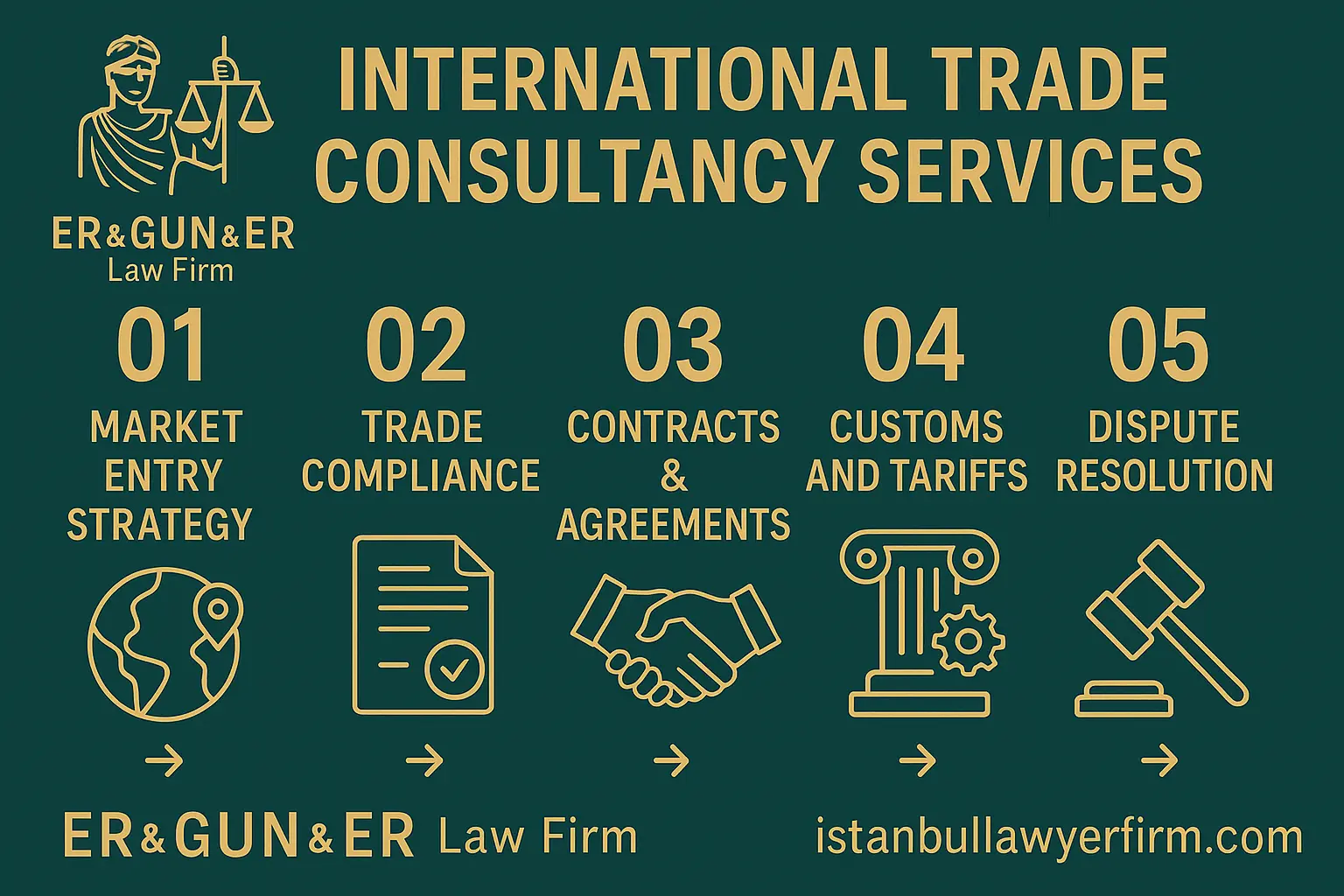
International trade practice in Turkey sits at the intersection of domestic customs law, bilateral and multilateral trade agreements, export control regimes, sanctions compliance, supply chain contract architecture, and cross-border dispute resolution. A Turkish Law Firm advising foreign exporters, importers, logistics providers, and multinational manufacturers must coordinate all of these work streams as a single integrated compliance system rather than as separate silos, because trade disputes almost always arise from inconsistencies between customs filings, commercial contracts, licensing documentation, and banking compliance records. The international client operating in or through Turkey faces a written-record environment — customs authorities, tribunals, and courts decide from documents rather than from intent, and foreign regulators, banks, and counterparties increasingly compare Turkish-side filings against parallel records maintained abroad. Customs classification, origin certification, export licensing, sanctions screening, compliance audits, dispute resolution, and logistics contract structuring all depend on the same underlying discipline — documentation must be consistent at the time it is created, contracts must match operational reality, and characterization choices must remain defensible across every system where they appear. Practice may vary by authority and year, so each framework addressed below must be verified against current Turkish and international guidance before shipments are scheduled, licenses are applied for, or cross-border contracts are finalized. The purpose of this guide is not to list headline tariff rates or HS code numbers that shift with each customs regulation update — it is to give foreign businesses and their advisers a structural framework that performs under audit, investigation, and litigation regardless of which customs cycle, export control interpretation, or sanctions program applies during the relevant period. Many international operators coordinate these workstreams with a lawyer in Turkey from the pre-shipment planning stage forward, because early documentation discipline is significantly cheaper than reconstruction during customs seizure or sanctions investigations. For foreign businesses planning local presence in Türkiye, the coordination between trade compliance and corporate sequencing can be reviewed alongside the branch office setup guide.
Customs law framework and tariff classification discipline
A Turkish Law Firm handling customs law advisory work begins with the statutory framework before moving to the operational layer of classification and declaration. The Turkish Customs Law No. 4458, together with its implementing regulations and the EU–Turkey Customs Union framework, governs import, export, and transit procedures for goods crossing the Turkish customs territory. Customs tariff classification follows the Harmonized System, which assigns six-digit headings supplemented by national subheadings in the Turkish Customs Tariff Schedule. Correct HS classification determines the tariff rate, the applicable preferential treatment, the need for sectoral licenses or certificates, and whether dual-use or sanctions screening is triggered. Misclassification is one of the most common causes of administrative fines, cargo seizures, and post-clearance reassessments, because customs authorities test declarations against physical inspections, technical documentation, and industry patterns. A defensible classification posture requires technical product descriptions, supporting catalogs and datasheets, consistent invoice language, and an internal classification memo explaining how the HS code was selected. For sensitive sectors such as medical devices, electronics, chemicals, and dual-use products, classification disputes can cascade into licensing questions and sanctions exposure. Origin documentation must be aligned with classification because preferential tariff treatment depends on both the tariff heading and the certified origin. Banking compliance also reads classification because certain goods trigger additional screening, and bank-facing commercial invoices must match the customs declaration in both description and HS code. Practice may vary by authority and year, so classification decisions should always be documented through an internal approval memo that records the basis for the applied code, the exhibits relied upon, and the person responsible for the determination. Statutory amendments should be verified against the Official Gazette before declarations are filed.
Turkish lawyers who advise on customs valuation and declaration discipline treat the valuation file as the evidential foundation of every import operation. Customs value is determined primarily under transaction value principles, adjusted for royalties, commissions, assists, insurance, and other additions defined by customs legislation. The declared value must reconcile with commercial invoices, payment records, transport and insurance documents, and any related-party pricing analysis retained by the importer. When goods are imported under related-party conditions, the customs authority may request transfer pricing documentation and the underlying intercompany contracts, because valuation and pricing frequently overlap in audit. Preferential origin claims require the correct certificate — A.TR, EUR.1, EUR-MED, Form A, or supplier declarations — supported by underlying production and processing evidence that can demonstrate substantial transformation where required. Free trade zones, inward processing regimes, outward processing regimes, and bonded warehouses each carry distinct documentation and reporting obligations, and any drift between authorized activity and actual operation creates reassessment risk that is difficult to resolve after the fact. For background on the broader regulatory environment, readers can consult our import-export regulations guide. Customs declarations also interact with restricted goods lists, standards conformity certification, and sectoral import licenses, and each of these interfaces must be managed before shipment rather than after arrival. A clean customs file therefore includes the purchase contract, the commercial invoice, the packing list, the transport documents, the origin certificate, the classification memo, the valuation workpaper, and any sectoral approvals preserved as dated exhibits under version control. Practice may vary by authority and year, which is why operational teams should maintain version-controlled documentation templates updated against current authority expectations rather than frozen at project inception.
An English speaking lawyer in Turkey coordinating customs files for multinational clients focuses particularly on terminology stability across English commercial contracts, Turkish customs declarations, and banking instructions, because language drift between systems is the single most common cause of unnecessary customs questions. If a contract describes a shipment as finished goods but the declaration uses a component-level HS code, the customs authority may challenge both the classification and the value. If the invoice describes a transaction as a sale but the declaration uses a royalty-based characterization, the post-clearance review can recharacterize both the payment and the duty base. Disciplined practice standardizes English-Turkish product descriptions across the trade document set, defines who approves classification and valuation decisions, and builds a single version-controlled template bank for commercial invoices, packing lists, and origin declarations. When post-clearance audits occur, the response file must be indexed, chronological, and delivered through one coordinator rather than scattered across subsidiaries, customs brokers, and freight forwarders. If a customs authority proposes a reclassification or additional assessment, the response should request the factual and methodological basis in writing and test it against the existing classification memo rather than introduce new explanations under time pressure. If a cargo is seized, the release petition must demonstrate consistent documentation rather than supply contradictory narratives. Practice may vary by authority and year, and a coordinated response protocol — with pre-agreed roles for the importer, the customs broker, external counsel, and the freight forwarder — is substantially more effective than ad hoc case-by-case responses. Coordination through an Istanbul Law Firm allows customs, contract, and banking narratives to remain aligned across every shipment cycle rather than reconstructed reactively.
Export controls, licensing, and sanctions compliance
A lawyer in Turkey reviewing export control exposure begins by mapping the product catalog against Turkish export control lists, European Union dual-use regulations referenced through the Customs Union framework, United States Export Administration Regulations where re-export jurisdiction applies, and the sanctions regimes administered by the United Nations, the European Union, the United Kingdom, the United States, and other relevant jurisdictions. Export licensing in Turkey is coordinated primarily through the Ministry of Trade, the General Directorate of Exports, and the sectoral bodies responsible for specific categories such as defense industry products, dual-use goods, cultural property, agricultural commodities, and controlled chemicals. A defensible export control file requires a product classification against control lists, an end-user and end-use analysis supported by verifiable counterparty documentation, a restricted-party screening record preserved as dated evidence, and an internal approval memo that records who authorized the shipment and on what basis. Sanctions compliance extends beyond list screening because sectoral sanctions, secondary sanctions, and geographic restrictions can affect transactions even when counterparties do not appear on named lists. Banking compliance overlaps with export control because payment processors increasingly apply their own screening frameworks, and a rejected payment can block an otherwise compliant shipment. Practice may vary by authority and year, and export control programs update frequently through regulatory amendments, general licenses, and enforcement advisories that must be tracked through dedicated monitoring rather than assumed from prior cycles.
Turkish lawyers who build sanctions compliance programs for international trade clients structure the program around written policies, restricted-party screening at defined trigger points, end-use verification procedures, red-flag escalation protocols, and periodic audit routines that test actual practice against written policy. The policy must identify who approves transactions with elevated risk indicators, how diversion risk is assessed for dual-use and defense-related products, and how compliance questions are escalated through legal review before shipments are released. End-user certificates should be obtained for controlled items, verified against corporate records and sanctions lists, and preserved with date-stamped evidence of the verification steps taken. Re-export clauses in distribution agreements should require counterparties to comply with applicable export controls and sanctions, to notify the exporter of onward transfers, and to provide evidence of compliance on request. For broader context, readers engaged in cross-border trade can review our international trade law overview for foreign company structuring. When regulatory inquiries arise — whether from Turkish customs authorities, foreign regulators issuing subpoenas or civil investigative demands, correspondent banks applying enhanced due diligence, or freight forwarders escalating concerns — the response must be coordinated through a single legal channel with consistent narratives across every submission. Practice may vary by authority and year, so compliance programs should be reviewed annually against current sanctions lists, general licenses, and enforcement priorities rather than treated as static documentation completed once at program launch.
An Istanbul Law Firm handling sanctions investigations and enforcement responses treats each inquiry as a document project first and an advocacy project second, because authorities decide from evidence and inconsistent submissions create cascading exposure. When a Turkish customs authority questions an export shipment, the response file must present the product classification, the end-user verification, the restricted-party screening record, the internal approval memo, and any export license with dated exhibits that reconcile against the shipment record. When a foreign regulator issues an information request regarding Turkey-routed transactions, the response must coordinate with foreign counsel so that the Turkey-side submission aligns with the parallel foreign submission rather than contradicting it in unnoticed detail. When a correspondent bank demands source-of-funds or purpose documentation for trade-related transfers, the banking file must match the customs file in descriptions, amounts, and counterparty identity. Self-disclosure decisions require careful evaluation because voluntary disclosure can mitigate penalties in some regimes but can also expand exposure if handled without coordination across jurisdictions. Where enforcement results in penalties, negotiation strategies should focus on agreed fact patterns, demonstrated remediation, and cooperation credit rather than on interpretive argument alone. Practice may vary by authority and year, and compliance counsel advising foreign-owned Turkish operations should maintain current awareness of both Turkish enforcement trends and the extraterritorial reach of major foreign sanctions regimes to avoid inadvertent secondary exposure.
Trade agreements and preferential origin schemes
A Turkish Law Firm advising on preferential trade utilization begins with the agreement architecture that applies to each trade lane. The EU–Turkey Customs Union governs industrial goods traded between Turkey and the European Union and requires A.TR certificates for eligible goods, alongside compliance with the common external tariff for third-country imports. Free trade agreements between Turkey and other partner countries — including EFTA members, regional partners, and bilateral signatories — each carry distinct preferential rules, rules of origin, and documentary requirements that must be met before preferential treatment is claimed. Agricultural products, textiles, automotive components, and certain sensitive sectors are often excluded or subject to tariff rate quotas that require additional application procedures rather than automatic preferential access. The Generalized System of Preferences applies to Turkey as a beneficiary country under certain partner schemes and as a granting country under its own preferential program for developing economies, and eligibility depends on origin compliance supported by Form A or equivalent documentation. A defensible preferential origin claim requires a rules-of-origin analysis that identifies the applicable criterion — wholly obtained, substantial transformation, value-added thresholds, or specific processing operations — together with production records, supplier declarations, and accounting evidence that supports the calculation. Practice may vary by authority and year, which is why origin files should be kept as contemporaneous binders including supplier declarations, bill of materials records, and production documentation rather than assembled reactively when a certificate is requested.
Turkish lawyers who structure origin compliance programs for multinational manufacturers begin with a product catalog review, mapping each finished good to its likely tariff heading, the target export markets, and the applicable preferential schemes for each market. The rules of origin differ significantly between agreements — some require specific tariff heading changes, others require value-added percentages, and some combine both tests with sector-specific exceptions for textiles, agriculture, or automotive. Cumulation provisions allow origin to be built across multiple partner countries under certain agreements, which can convert otherwise non-originating materials into originating inputs when processed in qualifying territories. Suppliers must provide declarations that support the manufacturer's origin claim, and those declarations must be preserved with evidence that the manufacturer conducted reasonable verification rather than accepted the declaration without scrutiny. For sector-specific guidance on agricultural trade, readers can review our agricultural investment insights. When origin verification requests arrive from the importing country's customs authority — particularly common in EU verification procedures — the response must reconcile the supplier declarations, production records, bills of materials, and accounting records into a coherent evidential narrative. Late reconstruction rarely succeeds because authorities expect contemporaneous records, not retrospective explanations. Practice may vary by authority and year, so origin programs should be audited internally at least annually and whenever the manufacturer changes suppliers, moves production lines, or modifies product specifications that could affect the substantial transformation analysis.
An English speaking lawyer in Turkey coordinating preferential origin files for bilingual groups pays particular attention to terminology consistency because origin disputes often turn on how products are described across the trade document set. A product described as finished goods on the commercial invoice but as components on the supplier declaration invites verification questions about whether the claimed transformation actually occurred. A production record that lists inputs in one nomenclature while the supplier declaration uses another nomenclature creates reconciliation problems that can defeat an otherwise valid origin claim. Origin verification requests typically arrive months or years after the shipment, which means the file must be preserved in a state that can be produced quickly without reconstruction from scattered sources. Suppliers sometimes change ownership, close operations, or refuse to cooperate in verification, so the manufacturer's file must be robust enough to support the claim even if the supplier becomes unreachable. When origin is rejected, the importer typically faces retrospective duty assessment, interest charges, and potential penalties, and the manufacturer may face commercial liability under the supply contract. Practice may vary by authority and year, and origin risk is most effectively managed through contract clauses that allocate verification obligations, preserve audit rights, and provide for indemnification when supplier declarations prove unreliable. Coordination across manufacturing, logistics, legal, and finance teams ensures that origin claims remain defensible throughout the verification window without reactive reconstruction.
Trade compliance audits and supply chain risk management
Turkish lawyers who conduct trade compliance audits for multinational supply chains treat the audit as a structured evidence exercise rather than as a generic policy review. The audit scope begins with the product catalog and transaction flow, mapping inbound and outbound shipments to their customs declarations, export licenses, origin certificates, and sanctions screening records. Sample transactions are selected across product categories, destination markets, and risk indicators, and each sample is traced from contract through shipment to payment with reconciliation across customs, banking, and accounting systems. Discrepancies between systems — inconsistent descriptions, mismatched values, conflicting counterparty details, or gaps in screening records — are documented with specific remediation recommendations rather than generalized observations. The audit also tests written policies against actual practice, because gap risk most often arises when operational teams deviate from policy under time pressure without documented escalation. Licensing conditions are verified against actual shipment records because conditions such as end-user restrictions, re-export controls, and technical specifications can be violated inadvertently when sales teams modify transactions without legal review. Bonded warehouse and inward processing operations are tested against authorized activity profiles because drift between authorization and operation is a frequent source of retrospective assessment exposure. Practice may vary by authority and year, and audit scope should be adjusted to reflect current enforcement priorities, regulatory amendments, and the client's specific risk profile rather than applied from a generic template.
A lawyer in Turkey managing third-party inspections, freight audits, and regulatory visits coordinates the response through a single escalation protocol that preserves evidence while preventing inconsistent statements across operational teams. When a customs post-clearance audit begins, the response team must be identified in advance, with defined roles for customs brokers, freight forwarders, internal finance, internal logistics, and external counsel, and all communications with the authority must route through the designated coordinator. When a freight forwarder's records are audited, the client's records must reconcile with the forwarder's records because inconsistencies expose both parties to scrutiny. When a registry visit occurs — for example, at a bonded warehouse, an inward processing facility, or a free zone operation — the on-site response team must present authorized activity records rather than improvise explanations. For related maritime and port operational guidance, readers can consult our maritime shipping law services for context on port-side compliance obligations. Pre-inspection readiness exercises — including mock audits, document-production drills, and staff briefings — substantially reduce friction when actual audits occur because the response workflow is tested rather than improvised. Practice may vary by authority and year, which is why audit response protocols should be refreshed periodically against current authority expectations and recent enforcement outcomes rather than frozen at program inception.
An Istanbul Law Firm integrating supply chain risk management into the compliance program focuses on contractual allocation of compliance duties across the logistics chain. Supply contracts should allocate customs compliance obligations, origin verification duties, sanctions screening responsibilities, and notification duties for regulatory changes that affect the counterparty. Freight forwarder contracts should include service level commitments for document production, audit cooperation clauses, and liability allocation for declaration errors caused by the forwarder. Warehousing contracts should address bonded storage compliance, inventory record-keeping obligations, and the allocation of reassessment risk when inventory reconciliation fails. Distribution contracts should include re-export restrictions, end-user certification obligations, and termination rights when counterparty compliance failures expose the principal to enforcement risk. Insurance arrangements should be reviewed for coverage gaps arising from compliance-related losses — such as seizures, penalties, or cargo holds pending investigation — because standard cargo insurance rarely covers regulatory exposure. Supplier codes of conduct should address export control and sanctions compliance, labor standards where relevant, and audit cooperation rights that the buyer can exercise when risk indicators arise. Practice may vary by authority and year, and supply chain risk programs should be audited against both current regulatory expectations and the evolving expectations of banks, insurers, and downstream customers who increasingly impose their own compliance requirements on upstream counterparties.
Trade dispute resolution and contract enforcement
A Turkish Law Firm handling international trade dispute resolution begins by identifying the dispute architecture — the underlying contract, the governing law, the dispute resolution clause, the payment instrument used, the shipping documents issued, and the commercial incoterm that allocates risk between the parties. Trade disputes commonly arise from delivery delays, quality disputes, non-payment, documentary credit discrepancies, shipping losses, customs detention, and counterparty insolvency, and each category requires distinct procedural tools. When the contract contains an arbitration clause — typically ICC, ISTAC, or a similar institution — the arbitration path must be preserved by avoiding court filings that could be characterized as waiver. When the contract provides for Turkish court jurisdiction, the commercial court track must be coordinated with parallel enforcement steps such as cargo attachment, bank account freezes, or letter of credit interventions. Documentary credit disputes under UCP 600 require precise analysis of document discrepancies because banks decide on their face review of the documents rather than on the underlying performance dispute. Cargo claims require coordination with the carrier, the insurer, and the freight forwarder because time limits under transport conventions can be shorter than general commercial limitation periods. Practice may vary by authority and year, which is why dispute strategy must consider current court practice, arbitration institution rules, and enforcement pathways rather than assumed outcomes from earlier cycles. For further procedural context, readers can review our shipping law overview.
Turkish lawyers who coordinate cross-border contract enforcement focus on evidence assembly from the earliest notice phase because courts and arbitral tribunals decide from documents rather than from narrative assertion. The evidence package should include the signed contract with all amendments, the commercial correspondence documenting performance and non-performance, the shipping documents with carrier confirmations, the payment instruments and bank confirmations, the quality inspection records where relevant, and any prior dispute correspondence that shows the counterparty's position. Default notices should be drafted with specificity — identifying the contractual clause breached, the factual basis, and the remedy sought — rather than as general grievance letters, because vague notices can be attacked as procedurally defective. Limitation periods run differently under different governing laws and transport conventions, so time-critical claims should be preserved through protective filings or written notices that toll the limitation period where applicable. Interim relief — including attachment of bank accounts, cargo, or receivables — can change the commercial dynamic significantly because counterparties often settle when their operational continuity is at risk. Preservation of assets should be pursued through proportionate measures supported by evidence of risk rather than through overbroad attachments that can be lifted on appeal. Practice may vary by authority and year, so enforcement strategy must be calibrated to current court practice regarding security requirements, interim measures, and service of process on foreign defendants.
An English speaking lawyer in Turkey coordinating multilingual trade disputes focuses on document authentication and translation discipline because foreign-language evidence must be usable before Turkish courts and before foreign enforcement authorities. Foreign-language contracts must be translated by sworn translators where they will be relied upon in court, and the translations must preserve operative terminology consistently across the entire document set. Apostille and legalization requirements vary by country and by document type, and delays in legalization can defeat otherwise meritorious claims when limitation periods run. Witness statements from foreign witnesses require careful preparation because Turkish court practice regarding witness evidence differs from common-law jurisdictions, and statements that are effective in one system may be inadmissible in another. Electronic evidence — emails, messaging applications, cloud-stored documents — requires authentication protocols that courts will accept, and chain-of-custody documentation becomes essential when counterparties challenge authenticity. Enforcement of foreign judgments and arbitral awards in Turkey follows distinct procedural tracks — recognition proceedings for judgments, New York Convention enforcement for arbitral awards — and each track carries documentation requirements that should be anticipated during the dispute rather than addressed reactively at enforcement. Practice may vary by authority and year, and international dispute strategy should integrate Turkish procedural discipline with foreign counsel coordination so that parallel filings remain mutually reinforcing rather than inconsistent.
Customs and trade regulation litigation
A lawyer in Turkey handling customs and trade regulation litigation begins with the administrative objection phase because Turkish customs law typically requires internal administrative review before judicial review becomes available. Objections must be filed within the applicable statutory window against the specific assessed act — whether a customs value adjustment, a classification redetermination, an origin rejection, a penalty assessment, or a goods detention — and must be supported by the evidence package that will later form the basis of any court filing. The objection file should present a dated chronology of the transaction, the declarations filed, the supporting documents submitted at clearance, the authority's findings, and the specific legal and factual grounds on which the assessed act is challenged. Each disputed point should be structured separately with exhibit references so that the authority can accept some points while maintaining others, which creates settlement opportunities within the administrative phase. When the administrative objection does not resolve the dispute, judicial review proceeds through the tax court track for duty and penalty assessments or through the administrative court track depending on the specific act challenged. Higher instance review is available through the relevant appellate structure, and cases of broad legal significance can reach the Council of State. Practice may vary by authority and year, which is why litigation strategy must account for current court practice on evidence standards, expert witness use, and procedural timing rather than assumptions from earlier cycles.
Turkish lawyers who litigate customs disputes place particular emphasis on contemporaneous evidence because courts test the declaration file rather than retrospective explanations. The classification memo prepared at the time of declaration — if properly documented — supports the good-faith basis of the classification and can affect penalty exposure even when the authority's alternative classification ultimately prevails. The valuation workpaper prepared at declaration — if it reconciles to commercial invoices, payment records, and intercompany agreements — supports the declared transaction value against reassessment challenges. The origin file prepared at declaration — if it includes supplier declarations, production records, and bill of materials evidence — supports the preferential claim against verification challenges. Late reconstruction of these files rarely succeeds because authorities and courts distinguish between contemporaneous evidence and retrospective explanation. Injunction petitions to halt enforcement actions — cargo seizures pending appeal, bond forfeiture pending review, or warehouse auctions pending litigation — can preserve the commercial position while litigation proceeds, but such petitions require a showing of reversible harm and legal merit that can be demonstrated from the existing evidence rather than from future discovery. Expert witness use in customs litigation covers technical product analysis, industry pricing benchmarks, and production process documentation, and expert scope must be framed narrowly to specific disputed points rather than broadly to the entire assessment. Practice may vary by authority and year, so litigation teams must track current precedent regarding evidence admissibility, expert methodology, and standard-of-review questions.
An Istanbul Law Firm coordinating parallel proceedings in customs disputes — administrative objection, tax court litigation, injunction petitions, criminal complaints where applicable, and enforcement office filings — manages the file as a unified narrative across all forums because contradictions between filings are used against the client in subsequent hearings. The exhibit numbering should be stable across all submissions so that the same document carries the same reference whether cited in the administrative objection, the tax court petition, or the injunction application. Translations should be consistent across all submissions because terminology drift between filings creates credibility problems that are difficult to remediate. Submissions should be frozen as dated bundles preserved under version control, and any supplementary submissions should be clearly identified as supplements rather than silently modified versions of earlier filings. Settlement discussions during litigation should proceed through written memos that record what would be conceded and what would be preserved so that later appeals are not compromised by ambiguous oral statements. Where multiple transactions are under dispute, each transaction should be treated as a separate mini-file with its own evidence chronology rather than merged into a single composite narrative that invites broader challenge. Practice may vary by authority and year, and successful customs litigation depends on exhibit architecture, chronological discipline, and consistent terminology more than on interpretive argument alone. A well-built litigation file also supports negotiation because authorities can verify the documentary basis of the client's position rather than evaluate competing assertions.
Cross-border logistics and contractual structuring
A Turkish Law Firm structuring cross-border logistics begins with the incoterm analysis because the incoterm allocates risk, cost, and compliance responsibility between buyer and seller at precisely defined transfer points. EXW, FCA, CPT, CIP, DAP, DPU, DDP for any mode of transport and FAS, FOB, CFR, CIF for sea and inland waterway transport each create distinct obligations regarding customs clearance, insurance, transport arrangement, and risk transfer. Misapplied incoterms create frequent disputes because operational teams sometimes behave inconsistently with the term chosen — for example, the seller may handle import clearance despite an EXW or FOB term that places that obligation on the buyer. Customs-linked warehousing arrangements require contract clauses that address bonded storage compliance, inventory reconciliation obligations, reassessment liability allocation, and termination rights when the warehouse operator loses its authorization. Freight forwarder contracts should address document production timelines, customs declaration accuracy, audit cooperation duties, and liability caps that do not eliminate accountability for errors that cause assessment exposure. Carrier contracts — maritime, road, rail, or air — should address limitation of liability under applicable transport conventions, insurance duties, route deviation rights, and force majeure allocations. Practice may vary by authority and year, and logistics contracts should be reviewed periodically against current incoterm editions, transport convention amendments, and industry practice rather than treated as static templates carried forward indefinitely.
Turkish lawyers who advise on multi-modal logistics operations focus on jurisdiction and governing law clauses because trade disputes frequently involve parties and events across multiple countries. Jurisdiction clauses should identify a court or arbitration forum that is practical for enforcement against the likely defendant, because a favorable judgment that cannot be enforced is a symbolic victory rather than a commercial remedy. Governing law clauses should reflect the substantive law regime that best supports the operational structure rather than default choices that may create unexpected outcomes. Service of process arrangements should be anticipated in the contract so that cross-border notice does not become a procedural obstacle to enforcement. Insurance arrangements should be reviewed for alignment between cargo coverage, liability coverage, and business interruption coverage because gaps between policies create unallocated losses. Cross-docking arrangements, last-mile contracting, and container leasing each carry specific risk allocation questions that should be addressed in the underlying agreements rather than left to default rules. Port usage arrangements in Turkish ports require coordination with port regulations, vessel agency arrangements, and customs-side terminal procedures that affect operational timing. Practice may vary by authority and year, so logistics structuring should integrate current regulatory expectations regarding port operations, terminal procedures, and intermodal coordination rather than relying on historical patterns that may no longer reflect operational reality.
An English speaking lawyer in Turkey supporting foreign logistics operators entering the Turkish market coordinates corporate structure, licensing, and operational contracts so that the compliance and commercial architecture is aligned from the outset. Entity choice — subsidiary, branch, liaison office, or contractual representation — carries distinct tax, regulatory, and operational consequences that must be evaluated against the intended business model rather than chosen by default. Sectoral licensing for freight forwarders, customs brokers, vessel agents, and warehouse operators each carries separate application procedures and ongoing compliance obligations that should be mapped before operations begin. Tax registrations and banking onboarding should proceed on a coordinated timeline with corporate formation because gaps in registration can block invoicing and payment processing. Employment arrangements for local staff should align with the operational model and with customs authorization requirements where staff are directly involved in declaration activities. Data processing arrangements require attention because logistics operations generate substantial personal and commercial data subject to Turkish data protection regulations and, where applicable, foreign data protection regimes applied extraterritorially. Practice may vary by authority and year, and logistics market entry should be staged through verification checkpoints that confirm current authority expectations before each phase of the setup is finalized. This staged approach reduces the risk that operational launch is delayed by missing authorizations or misaligned contractual arrangements.
Trade policy monitoring and compliance program governance
A lawyer in Turkey building a trade policy monitoring function for a multinational client treats it as a continuous intelligence process rather than as periodic reporting. Monitoring sources include the Official Gazette for Turkish customs communiqués, trade regulations, and sanctions-related announcements; Ministry of Trade releases on import and export measures; European Union publications for Customs Union and preferential trade developments; United Nations, European Union, and United States sanctions list updates and general license modifications; and industry-specific sources relevant to the client's sector. Monitoring is useful only when it translates into action, so the function should include a defined escalation protocol that identifies which regulatory changes trigger contract reviews, supplier notifications, or licensing reassessments within specific timelines. Quarterly trade law reports summarizing new risks and opportunities should be tailored to the client's sector and markets rather than produced as generic summaries of all trade law activity. Executive-level briefings for senior management and board members should address strategic implications rather than technical detail, because leadership decisions depend on understanding commercial exposure and opportunity rather than on tracking every regulatory amendment. Practice may vary by authority and year, so monitoring programs should be reviewed annually for source coverage, escalation effectiveness, and alignment with the client's evolving footprint rather than treated as fixed infrastructure.
Turkish lawyers who design compliance training programs for operational teams focus on scenario-based exercises rather than on abstract regulatory summaries because operational teams apply compliance rules under time pressure and need practical decision frameworks. Customs declaration teams need training on classification decision-making, valuation reconciliation, and post-clearance audit response protocols. Export sales teams need training on restricted-party screening, end-use verification, and red-flag escalation protocols. Procurement teams need training on supplier onboarding diligence, sanctions exposure in supplier chains, and origin verification coordination with suppliers. Finance teams need training on banking compliance questions, source-of-funds documentation, and payment routing that aligns with trade documentation. Legal and compliance functions need training on investigation response, regulatory inquiry handling, and internal escalation when operational teams raise compliance concerns. Bilingual training materials — English for multinational consistency and Turkish for operational practicality — reduce misunderstanding risk across the compliance team. Training records should be preserved as evidence of program implementation because regulatory inquiries and enforcement actions often consider the strength of the compliance program in assessing penalty exposure and cooperation credit. Practice may vary by authority and year, and training programs should be refreshed at least annually to reflect current regulatory priorities, recent enforcement actions, and specific risk patterns identified through internal audits or external monitoring.
An Istanbul Law Firm coordinating policy advocacy and stakeholder engagement for international trade clients does so as part of the broader compliance function rather than as a separate activity. Industry associations, chambers of commerce, and sectoral bodies provide channels for structured engagement with regulatory authorities during consultation periods preceding regulatory amendments. Written submissions during consultation periods allow clients to influence regulatory development based on operational experience rather than theoretical concerns, and well-drafted submissions preserve the client's position for later reference if enforcement becomes contentious. Position papers, legal opinions, and stakeholder reports submitted to Turkish authorities, European Union bodies where applicable, and international trade organizations can shape policy direction when submitted with supporting evidence rather than assertion alone. Coordination with foreign counsel ensures that Turkish-side positions align with parallel submissions in other jurisdictions where the client operates because inconsistencies between submissions can be used against the client in enforcement proceedings. Strategic engagement with policy development is most effective when it is treated as a continuous activity rather than as reactive intervention during specific disputes. Practice may vary by authority and year, and policy monitoring and advocacy programs should be reviewed against current consultation calendars, regulatory priorities, and the client's strategic posture rather than operated as static functions.
Author: Mirkan Topcu is an attorney registered with the Istanbul Bar Association (Istanbul 1st Bar), Bar Registration No: 67874. His practice focuses on cross-border and high-stakes matters where evidence discipline, procedural accuracy, and risk control are decisive, with particular concentration on international trade law, customs classification and valuation defense, export controls and sanctions compliance, preferential origin programs, supply chain contract structuring, and the defense of customs audits, administrative objections, and customs and tax court litigation for foreign-owned groups and multinational operators trading with or through Turkey.
He advises individuals and companies across International Trade, Customs and Regulatory Law, Commercial and Corporate Law, Commercial Contracts, Arbitration and Dispute Resolution, Enforcement and Insolvency, Citizenship and Immigration (including Turkish Citizenship by Investment), Real Estate (including acquisitions and rental disputes), Foreigners Law, Sports Law, Health Law, and Criminal Law. He regularly supports corporate clients on governance and contracting, shareholder and management disputes, receivables and enforcement strategy, and cross-border trade compliance and risk management in Turkey-facing transactions — often in matters involving foreign exporters, importers, logistics providers, distributors, licensing holders, and multinational manufacturing groups requiring bilingual documentation and coordinated parallel filings across customs, banking, and regulatory authorities.
Education: Istanbul University Faculty of Law (2018); Galatasaray University, LL.M. (2022). LinkedIn: Profile. Istanbul Bar Association: Official website.
Frequently asked questions
- When should an international trader engage a Turkish Law Firm for trade compliance support? Engagement is most valuable before shipments begin, because customs classification, origin files, export licensing, and sanctions screening are significantly easier to defend when documentation is aligned from the outset rather than reconstructed under audit or seizure pressure. Practice may vary by authority and year, so early engagement also allows verification against current guidance before commercial commitments are finalized.
- How is customs tariff classification determined for imports into Turkey? Classification follows the Harmonized System with national subheadings, supported by technical product descriptions, catalogs, and an internal classification memo that records the basis for the applied HS code. Misclassification is a frequent cause of reassessment and penalty exposure, so documentation discipline matters as much as the classification itself.
- What does customs valuation require in Turkey for imported goods? Customs value is determined primarily under transaction value principles adjusted for royalties, commissions, assists, insurance, and other additions defined by customs legislation. The declared value must reconcile with commercial invoices, payment records, transport documents, and any related-party pricing analysis preserved by the importer.
- How does preferential origin certification work under the EU–Turkey Customs Union? The EU–Turkey Customs Union covers industrial goods with A.TR movement certificates, supported by origin evidence where required. Other trade agreements use EUR.1, EUR-MED, Form A, or supplier declarations with distinct rules of origin that must be documented through production records and bill of materials evidence.
- What export control regimes apply to goods shipped from Turkey? Turkish export controls coordinate with the EU dual-use framework through the Customs Union, with United States Export Administration Regulations where re-export jurisdiction applies, and with United Nations, EU, UK, and US sanctions regimes. A defensible export control file requires control list analysis, restricted-party screening, and end-use verification.
- How should sanctions compliance programs be structured for Turkey-based trade operations? Programs should include written policies, restricted-party screening at defined trigger points, end-use verification procedures, red-flag escalation protocols, and periodic audit routines testing actual practice against written policy. Banking compliance overlaps with sanctions screening and should be integrated rather than siloed.
- What does a trade compliance audit cover in Turkish international trade practice? The audit maps inbound and outbound shipments to customs declarations, export licenses, origin certificates, and sanctions screening records. Sample transactions are traced across customs, banking, and accounting systems to identify reconciliation gaps, and written policies are tested against actual operational practice.
- How are trade disputes resolved when shipments cross Turkish borders? Disputes are resolved through arbitration under institutional rules such as ICC or ISTAC when the contract provides for arbitration, or through Turkish commercial courts when litigation is the chosen path. Documentary credit disputes follow UCP 600 analysis, and cargo claims are subject to time limits under applicable transport conventions.
- What happens when goods are detained at Turkish customs? Release petitions must demonstrate consistent documentation reconciling with the original declaration rather than introduce new explanations. Administrative objection procedures provide the first structured challenge, followed by judicial review through the tax court or administrative court track depending on the specific act challenged.
- How does the administrative objection process work for customs assessments? Objections must be filed within the statutory window against the specific assessed act, structured point by point with exhibit references, and supported by the contemporaneous evidence package from the original declaration. The objection preserves the record for later judicial review and must maintain consistent terminology with subsequent filings.
- When does a customs dispute move to court litigation in Turkey? Litigation becomes necessary when administrative objection does not resolve the matter. The tax court track handles duty and penalty assessments while the administrative court track handles other regulatory acts, and higher instance review is available through the relevant appellate structure up to the Council of State.
- What role do incoterms play in international trade contracts with Turkish parties? Incoterms allocate risk, cost, and compliance responsibility between buyer and seller at defined transfer points. Misapplied or inconsistent operational behavior relative to the chosen term is a frequent source of disputes, so contract drafting should match actual operational practice.
- How are bonded warehouses and inward processing regimes regulated in Turkey? Each regime carries distinct documentation and reporting obligations, and drift between authorized activity and actual operation creates reassessment exposure. Compliance requires inventory reconciliation, contemporaneous record-keeping, and periodic internal audits against the authorization terms.
- What trade policy monitoring approach serves multinational trade operators? Monitoring covers Turkish customs communiqués, Ministry of Trade releases, Customs Union developments, sanctions list updates, and sector-specific sources. Quarterly reports, executive briefings, and defined escalation protocols connecting monitoring to operational action are more effective than generic summaries.
- How does ER&GUN&ER Law Firm structure international trade engagements for foreign clients? Engagements begin with scope mapping — product catalog, transaction flows, trade lanes, and counterparty chart — translated into a risk register covering customs classification, valuation, origin, export controls, sanctions, and dispute readiness. Each risk is assigned a document owner, a standard evidence package is built, and verification checkpoints are scheduled against current authority expectations.