

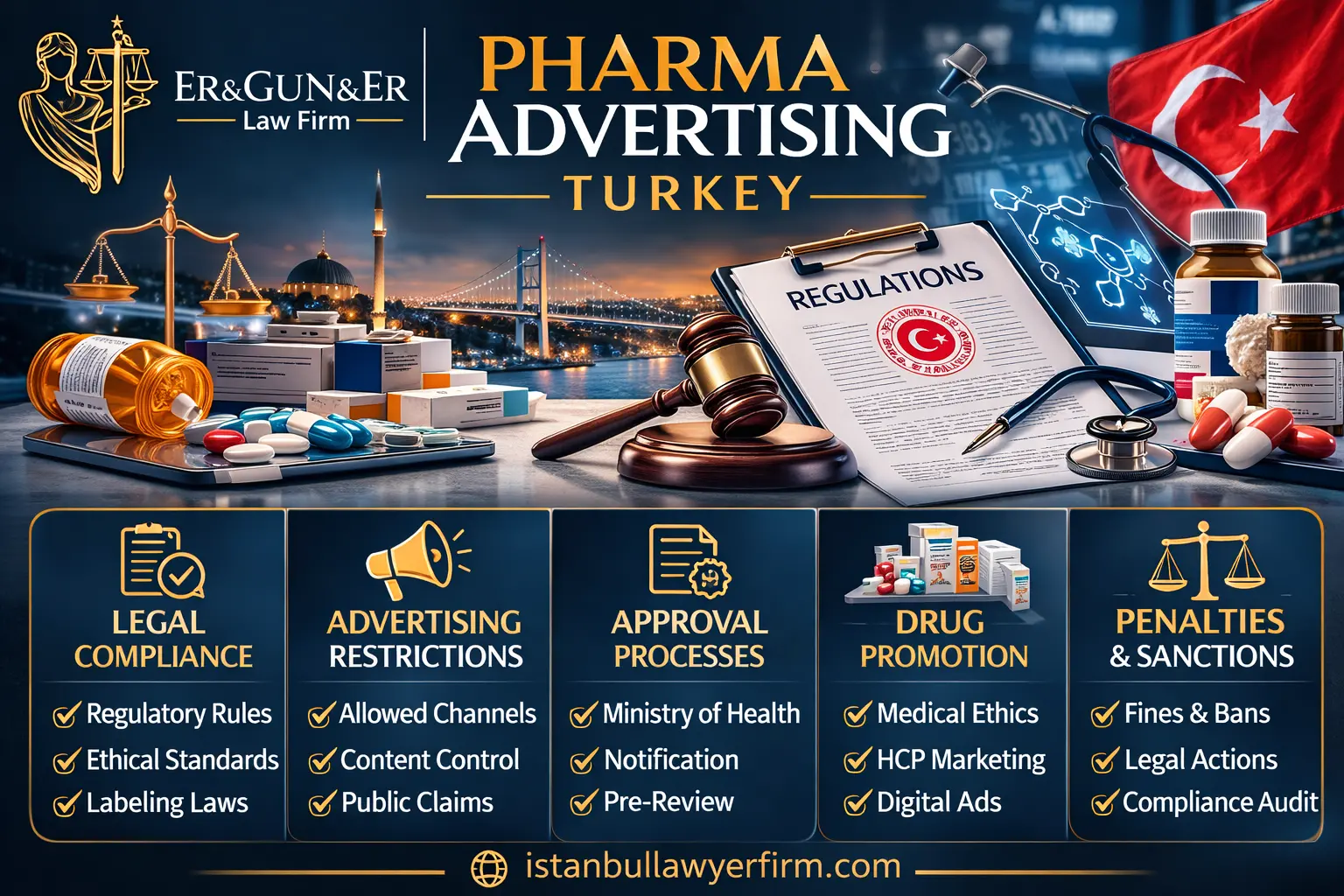
Pharmaceutical advertising regulation Turkey operates on a product-classification-first logic that determines, before any creative decision is made, which legal framework governs a planned communication, which channels are permitted, which claims require pre-approval, and which forms of healthcare professional engagement are allowed or prohibited. The Turkish Medicines and Medical Devices Agency (TİTCK) is the primary regulatory authority for pharma advertising regulation Turkey, and its guidelines define the operational compliance boundary for every company marketing health products in this market. Every therapeutic claim, comparative reference, indication-specific statement, and safety communication in any advertising or promotional material must be substantiated by approved product documentation and, where required, by independently verifiable clinical evidence whose quality the regulator may independently assess. Pharmaceutical promotion Turkey is therefore not a creative exercise subject only to general consumer advertising rules—it is a specialized regulatory discipline where failure to observe classification-specific restrictions, claim substantiation standards, and pre-approval requirements exposes companies to administrative sanctions, product withdrawal orders, and enforcement consequences that can outlast any single proceeding. Digital marketing amplifies compliance risk in this sector because online channels—websites, social media, search advertising, influencer content, and third-party publications—can reach patients, healthcare professionals, and the general public simultaneously, without the channel-specific controls that once separated different regulatory audiences. Internal controls reduce enforcement exposure: a company that can demonstrate systematic pre-publication review, documented approval workflows, and evidence-based claim files is in a fundamentally stronger defensive position than one whose compliance infrastructure exists only as policy without operational implementation. This article analyzes the full compliance landscape for pharmaceutical and medical device advertising in Turkey as it stands in 2026, addressing multinational companies, domestic manufacturers, medical device companies, marketing agencies, and their legal and compliance teams.
Scope and product categories
A lawyer in Turkey advising on pharmaceutical advertising compliance must begin every engagement with a precise product classification analysis, because the applicable regulatory framework depends entirely on how the product is classified by TİTCK. The primary categories subject to health-product advertising regulation include: prescription-only medicinal products (reçeteli ilaçlar), whose advertising to the general public is essentially prohibited; non-prescription over-the-counter medicines (OTC), whose advertising is permitted subject to strict content and pre-approval requirements; medical device advertising Turkey regulation, covering all device risk classes; food supplements, which face a separate framework with distinct claim restrictions; traditional herbal medicines; and cosmetics—each with its own advertising control regime. The classification of a product within one of these categories is not always self-evident: a food supplement making therapeutic claims may be treated as a medicinal product; a diagnostic medical device may face the stricter rules applicable to its risk class; and a cosmetic claiming skin-healing properties may trigger medicinal product advertising restrictions. The TİTCK advertising guidelines are published on the agency's official website at titck.gov.tr, and any product at a regulatory boundary—between food supplement and medicinal product, or between medical device and software—should be formally clarified with TİTCK before advertising strategy is designed. Combination products—where a device and a medicinal substance are combined—require simultaneous compliance with both the medicinal product and the medical device frameworks, creating complexity that demands integrated legal review. Practice may vary by authority and year — check current guidance on the current TİTCK classification criteria for boundary products before finalizing any advertising strategy for a product whose regulatory category is uncertain.
An Istanbul Law Firm advising a multinational pharmaceutical company on Turkish advertising obligations must assess the full product portfolio against both the Turkish regulatory framework and the company's global compliance standards, because the Turkish framework may impose restrictions that differ from home-country requirements in ways requiring specific local adaptation. A global advertising campaign compliant in the European Union or the United States may contain prescription medicine consumer advertising—permitted in some jurisdictions under specific conditions—that violates the Turkish advertising prohibition without modification for the Turkish market. The classification of a product for Turkish regulatory purposes follows Turkish law rather than the home-country's classification, and a product available without prescription at home may require a prescription in Turkey, meaning its advertising status here is more restrictive than abroad. Companies entering the Turkish market for the first time must conduct a classification mapping exercise for each product before any marketing materials are developed, because the cost of retroactive compliance revision of a fully developed campaign substantially exceeds the cost of upfront classification analysis. The corporate governance dimensions of pharma advertising compliance—including board-level accountability for compliance program adequacy and the interaction between advertising violations and the company's broader regulatory standing—are analyzed in the resource on corporate governance and compliance in Turkey. Practice may vary by authority and year — check current guidance on the current Turkish regulatory framework for specific product categories, including any recent TİTCK guidance on digital therapeutics and AI-enabled medical software.
A Turkish Law Firm providing healthcare regulatory services must help clients understand the distinction between advertising, promotion, and scientific communication as applied in the Turkish regulatory framework, because the same communication may be treated differently depending on its characterization. Advertising in the strict commercial sense—paid communications intended to influence purchasing or prescribing behavior through mass media—is subject to specific pre-approval requirements and channel restrictions. Promotion in the broader professional sense—including medical representative detailing, symposia, sample distribution, educational grants, and market research—is subject to a separate set of rules governing healthcare professional interactions with its own documentation requirements. A communication that blurs the line between scientific information and commercial promotion—a journal article reprint with commercial framing, or an "educational" presentation primarily promoting a specific product—must be carefully assessed for its regulatory characterization before dissemination. The Turkish regulatory framework does not provide bright-line rules for all borderline circumstances, and assessing hybrid communications requires judgment informed by regulatory precedent and enforcement practice. The interaction between the pharmaceutical advertising framework and the general Consumer Protection Law means that health product advertising must simultaneously comply with both regulatory sets, and a communication passing the pharmaceutical-specific test may still fail the general consumer protection standard if it is misleading in ways not specifically addressed by the pharmaceutical rules. Practice may vary by authority and year — check current guidance on the current TİTCK distinction between promotional material and scientific communication.
Prescription advertising limits
A law firm in Istanbul advising on the prescription drug advertising ban Turkey framework must convey clearly that advertising prescription-only medicines to the general public is subject to a comprehensive prohibition reflecting the principle that prescription medicines are selected by healthcare professionals for individual patients on the basis of clinical assessment. This prohibition covers all media channels—television, radio, print, outdoor advertising, digital media, websites, social media platforms—regardless of the content of the advertisement; even a technically accurate, non-misleading advertisement for a prescription medicine directed at the general public violates the prohibition simply by targeting a non-professional audience. The prohibition extends to indirect advertising—where a campaign does not explicitly identify a prescription medicine but creates an overall impression that one is being promoted—assessed based on the communication's overall effect on the audience rather than whether the product name appears. Enforcement of the prescription advertising ban is one of TİTCK's most actively monitored areas, and violations reaching a broad public audience typically generate faster and more serious regulatory responses than those in limited distribution channels. A company launching a consumer-facing disease awareness campaign—permitted in some jurisdictions under specific conditions—must ensure in Turkey that it does not cross the line into prescription product promotion, requiring careful content design reviewed by regulatory counsel before launch. The enforcement mechanisms available to TİTCK for prescription advertising ban violations include immediate cessation orders, material withdrawal requirements, and administrative sanctions. The broader enforcement framework for regulated communications is analyzed in the resource on enforcement proceedings in Turkey. Practice may vary by authority and year — check current guidance on the current TİTCK approach to disease awareness campaigns for prescription medicines.
An English speaking lawyer in Turkey advising on prescription medicine promotion to healthcare professionals must help clients understand that the prohibition on general public advertising does not extend to communications directed exclusively at licensed healthcare professionals in a professional context—these are governed by separate rules that permit product information sharing with practitioners, subject to specific content and presentation requirements. Promotional communications to healthcare professionals must be consistent with the medicine's approved product information (Ürün Bilgileri Özeti, equivalent to the Summary of Product Characteristics), must include the mandatory information required by applicable regulations, and must not make claims beyond what the approved indication and clinical evidence support. The approved product information is the boundary document for all prescription pharmaceutical promotion Turkey to healthcare professionals, and a material presenting information about a use not reflected in the approved product information constitutes off-label promotion violating the regulatory framework. Off-label promotion is prohibited under Turkish pharmaceutical regulations even where the off-label use may be clinically established and widely practiced: the promoted use must correspond to the approved indication, and materials must not suggest, imply, or facilitate off-label use even through selective data presentation. The regulatory framework allows companies to respond to unsolicited healthcare professional inquiries about off-label uses with factual scientific information, but the distinction between responding to unsolicited inquiries and initiating promotional contact requires careful procedural management and documentation to remain credible. The promotional material review process for prescription medicines must assess each claim against the approved product information and the clinical evidence on which it is based. Practice may vary by authority and year — check current guidance on the current TİTCK requirements for mandatory information inclusion in promotional materials directed at healthcare professionals for prescription medicines.
A best lawyer in Turkey advising on scientific information management must design a specific protocol ensuring the scientific information function does not blend into prohibited off-label promotion. The protocol must identify who may respond to scientific information requests, what information may be provided in response to each category of request, how responses must be documented, and how the company confirms that inquiries were genuinely unsolicited. A medical affairs team that proactively distributes data on off-label uses to healthcare professionals—even framed as "educational"—engages in off-label promotion regardless of the internal framing, and the regulatory characterization depends on the substance of the activity. The documentation of scientific information requests and responses must be maintained in a dedicated register capturing the date of the inquiry, the inquiring professional's identity, the nature of the inquiry, the responder's identity, and the response content. Prescription medicine promotional materials for healthcare professionals must be submitted to TİTCK for pre-approval before dissemination, applying to new materials and material modifications but not to routine distribution of an already-approved material through additional placements in the same media type. Medical representatives presenting prescription materials must be specifically trained on the boundaries of the approved product information and the off-label promotion prohibition, because an unapproved claim made during a detail visit creates corporate regulatory exposure regardless of whether the approved materials themselves are compliant. Practice may vary by authority and year — check current guidance on the current TİTCK pre-approval submission requirements for prescription medicine promotional materials and on the format requirements for mandatory information inclusion.
OTC advertising boundaries
Turkish lawyers advising on OTC medicine advertising Turkey rules must explain that while non-prescription medicines may be advertised to the general public—unlike prescription medicines—this permission is conditional on compliance with strict content, format, pre-approval, and channel requirements regulated by TİTCK. The advertising of OTC medicines to consumers must be accurate and not misleading, must not exaggerate efficacy or minimize risks, must not claim effects beyond the approved indication, and must include mandatory regulatory content—product name, active ingredients, indications, contraindications, and a directive to read the package information leaflet. The mandatory information must be clearly legible in a manner that consumers can actually read, with media-specific format requirements: television advertisements must include audible and visible mandatory content; print advertisements must present it in a specified minimum type size; and digital advertisements must display it for sufficient duration and prominence. The pre-approval requirement is critical: before any OTC advertising campaign launches—in any medium—materials must be submitted to TİTCK for review and approval, and the campaign may not launch until written approval is received. This pre-approval timeline must be built into the campaign development schedule from the outset, because failing to account for TİTCK's processing time may result in a missed launch date or a launch without approval creating immediate enforcement risk. The VAT and corporate operational compliance context for pharmaceutical companies operating in Turkey is addressed in the resource on VAT compliance for companies in Turkey. Practice may vary by authority and year — check current guidance on the current TİTCK pre-approval application format, required submission components, and typical processing timelines for OTC medicine advertising approvals.
A lawyer in Turkey advising on specific OTC content restrictions must address the prohibition on creating a misleading overall impression even when each individual statement in an advertisement is technically accurate. An OTC advertisement presenting a clinical study result alongside imagery suggesting universal efficacy, without acknowledging the study's limitations, may create a misleading overall impression violating advertising standards even if the specific study result mentioned is accurate. The content restrictions for OTC advertising prohibit language encouraging excessive use, suggesting the medicine is superior to professional medical advice for serious conditions, or implying effectiveness for conditions outside the approved indication. OTC advertising must include a direction for consumers with persistent or serious symptoms to consult a healthcare professional, and the prominence of this direction is assessed as part of TİTCK's overall review. The interaction between OTC advertising content rules and the general Consumer Protection Law creates a dual compliance requirement—a material passing TİTCK's pharmaceutical-specific review must also comply with general commercial advertising standards, with violation of either framework creating independent enforcement exposure. Children-targeted OTC advertising is subject to specific additional restrictions prohibiting advertising formats, characters, or appeals specifically designed to attract a child audience, and time-slot restrictions for television and radio advertising are designed in part to prevent OTC advertising from reaching predominantly child audiences. Practice may vary by authority and year — check current guidance on the current time-slot restrictions applicable to OTC medicine television and radio advertising and on digital OTC advertising targeting restrictions.
An Istanbul Law Firm advising on OTC comparative advertising must assess whether a specific comparative claim meets both the pharmaceutical advertising framework and the general consumer protection advertising standard, because both apply simultaneously to consumer-directed health product advertising. The OTC advertising framework prohibits comparative claims—explicit or implied—not supported by specific head-to-head data comparing the promoted product to the identified comparator, and a statement of general superiority or market leadership requires specific supporting evidence. The general advertising framework's requirement for accurate, verifiable comparative advertising adds a substantiation dimension: an unsubstantiated comparative claim creates both a pharmaceutical advertising violation and a general unfair advertising violation with dual enforcement exposure across two regulatory frameworks. An OTC campaign using comparative language—"more effective," "better tolerated," "fewer side effects"—should be reviewed specifically for whether head-to-head data supports each specific claim, and any claim relying only on separate, non-comparative studies should be assessed for whether the implied comparison is accurate. The OTC pre-approval process at TİTCK provides an opportunity to obtain regulatory review of comparative claims before launch, and a company that submits a campaign with comparative claims and receives TİTCK approval is in a stronger defensive position against a competitor challenge than one that launches without pre-approval. Practice may vary by authority and year — check current guidance on the current TİTCK evidentiary standards for comparative claims in OTC advertising.
Promotion to healthcare professionals
A Turkish Law Firm advising on healthcare professional promotion Turkey must help pharmaceutical and medical device companies understand the comprehensive regulatory framework governing all forms of commercial engagement with healthcare professionals—formal promotional materials, medical representative visits, sponsored education, gifts, hospitality, advisory arrangements, and research collaborations. The fundamental principle is that prescribing and treatment independence must be protected from commercial influence outside the legitimate boundaries of scientific information exchange, and the specific rules for each engagement category are designed to enforce this operationally. Medical representatives are subject to licensing and conduct requirements governing what they may say, what materials they may present, and what items they may provide during visits; materials presented must be consistent with the approved product information, include mandatory content, and not make unsubstantiated comparative claims. Documentation of medical representative visits—which materials were presented, which claims were made, which professionals were visited—is a compliance requirement that must be maintained systematically, because visit records will be requested in any regulatory investigation. The anti-corruption dimension is particularly important for interactions with public hospital physicians, who are government employees subject to public procurement and anti-corruption rules in addition to the pharmaceutical promotion framework, and a benefit permissible under the promotion rules may still violate anti-corruption provisions when provided to a public employee. Cross-border legal service dimensions of foreign pharmaceutical companies managing healthcare professional engagement programs are addressed in the resource on full-service legal support for foreign companies in Turkey. Practice may vary by authority and year — check current guidance on the current TİTCK requirements for medical representative licensing, conduct standards, and visit documentation.
A law firm in Istanbul advising on advisory boards, speaker programs, and consultancy arrangements must address the compliance risks arising when commercial objectives are embedded in activities formally characterized as scientific or educational. A genuine scientific advisory board—where qualified healthcare professionals provide independent expert input on product development or medical affairs strategy—is legitimate; an arrangement structured as an advisory board but functioning as a payment mechanism for professionals expected to promote products in return is a disguised promotional payment violating both the promotion rules and potentially the anti-corruption framework. The distinction between legitimate consulting and a promotional payment depends on substance: whether the service provided is genuine, whether the compensation is proportionate and at fair market value, whether the professional was selected for relevant expertise rather than prescribing volume, and whether the arrangement is documented in a formal written agreement with specific deliverables. Speaker programs must ensure scientific content is genuine, balanced, and not primarily promotional, and speaker selection must be based on expertise and presentation skills rather than prescribing patterns. Fair market value assessment for healthcare professional services must be conducted through a verifiable methodology documented before any arrangement commences, because disproportionate compensation will be treated as a disguised inducement regardless of formal documentation. The VAT treatment of consultancy fees and speaker payments to healthcare professionals is a related compliance dimension addressed in the resource on tax compliance for corporate operations in Turkey. Practice may vary by authority and year — check current guidance on the current TİTCK and Ministry of Health position on the distinction between legitimate scientific collaboration and disguised promotional payments.
An English speaking lawyer in Turkey advising on hospitality for healthcare professionals must explain the proportionality principle governing what companies may provide in connection with legitimate scientific or educational activities. A modest meal provided during a company-sponsored symposium where the primary activity is clinical data presentation is at a different compliance point than an all-expenses-paid resort stay framed as a "consultant meeting" with minimal scientific content. The principle that hospitality must be subordinate to and proportionate to the legitimate scientific purpose is the core of the framework, and regulators assess the venue quality, the ratio of social to scientific activity, and the selection criteria for invited professionals. Foreign pharmaceutical company staff managing hospitality programs for Turkish healthcare professionals must understand that home-country standards may be more permissive than Turkish standards, and that Turkish rules govern events involving Turkish healthcare professionals regardless of where those events occur. Personal accountability of individual company employees who authorize non-compliant hospitality is a risk that must be addressed in compliance training, because administrative sanctions do not exclude the personal accountability of responsible managers in serious cases. Tax implications for healthcare professionals receiving benefits—including income tax treatment of meals, gifts, conference attendance, and travel—create an additional compliance dimension assessed by tax authorities independently of TİTCK's promotion review. Practice may vary by authority and year — check current guidance on the current TİTCK hospitality proportionality standards and on the specific restrictions applicable to hospitality for public sector healthcare professionals.
Scientific claims and evidence
A best lawyer in Turkey advising on scientific claims must explain that every claim in a promotional communication—about efficacy, safety, mechanism of action, comparative performance, or patient outcomes—must be substantiated by evidence meeting the regulatory standards applicable to that specific claim type. The substantiation requirement is not merely that some evidence supports the claim; it requires that the supporting evidence meets the quality, relevance, and methodological standards that TİTCK expects for the specific claim. A claim that a medicine is effective in treating a specific condition must be supported by clinical trial data of sufficient quality and size—anecdotal case reports or mechanistic rationale are inadequate for a direct efficacy claim. Misleading health claims Turkey enforcement extends to technically accurate statements that create a misleading overall impression: presenting a statistically significant effect that is clinically irrelevant as if it were a meaningful clinical benefit constitutes misleading advertising under the Turkish pharmaceutical framework. The claim substantiation file—the collection of clinical, scientific, and technical evidence assembled to support each specific claim—must be prepared and maintained for every approved promotional material, accessible for regulatory review on request. The commercial litigation dimensions of false or misleading health claims—including competitor unfair competition actions and consumer damages claims—are addressed in the resource on commercial litigation in Turkey. The specific claim language used requires particular scrutiny: superlative terms ("most effective," "superior"), comparative terms without supporting data, and guarantee-type language ("always works") are prohibited and must be identified and removed during review. Practice may vary by authority and year — check current guidance on the current TİTCK evidence standards for specific claim categories and on the study types accepted as adequate substantiation for efficacy, safety, and comparative claims.
Turkish lawyers managing the claim review process must help marketing teams understand the critical distinction between the approved product information (ÜBO/SPC) as the boundary for permitted claims and the broader clinical data the company may have available. The approved product information reflects the clinical data reviewed by TİTCK at the time of the marketing authorization, and claims beyond that information—even where additional supporting data exists—constitute off-label promotion until the approved information is updated through a formal variation procedure. The variation procedure allows the approved product information to be updated to reflect new clinical evidence, and a company accumulating evidence supporting a broader claim should pursue the variation rather than using unapproved data in promotion while the application is pending. The tension between regulatory timelines for variation approvals and commercial pressure to use available clinical data is a recurrent compliance challenge that must be managed through strict adherence to approved information boundaries. Scientific references used to support claims must accurately reflect what those references demonstrate—a citation that supports only a weaker form of the claimed effect, or that was conducted in a different patient population, must not be presented as directly supporting the full stated claim for the approved indication. The interaction between clinical claims and regulatory affairs requires close coordination to ensure that promotion stays within current approved information while the regulatory function pursues broader approvals through the variation pathway. Practice may vary by authority and year — check current guidance on the current TİTCK positions on specific claim language categories and how regulators assess the relevance and quality of clinical references cited in promotional materials.
A lawyer in Turkey advising on real-world evidence (RWE) use in promotional claims must address the specific questions arising when companies seek to use registry data, electronic health record analyses, and other observational study types to support advertising. TİTCK assesses evidence quality against the established hierarchy of clinical evidence types, and observational data generally carries less weight than randomized controlled trial data for direct efficacy claims, though it may be appropriate for specific claim types about real-world effectiveness. Health economic and pharmacoeconomic claims—cost-effectiveness claims, budget impact claims—are subject to specific evidentiary standards different from those applicable to clinical efficacy and safety claims, and modeling assumptions in economic analyses must be transparent, validated, and appropriate for the Turkish healthcare system context. Companies seeking to use real-world evidence in promotional claims must assess whether the specific evidence type meets the quality and relevance standards applicable to the specific claim, and must be prepared to defend that assessment if TİTCK or a competitor challenges the substantiation. The fundamental principle is that the evidence must honestly represent what it shows, without selection bias, omission of contrary findings, or presentation in contexts that amplify beyond what the data actually demonstrates. Practice may vary by authority and year — check current guidance on the current TİTCK approach to real-world evidence and health economic evidence as substantiation for promotional claims in the Turkish market.
Digital marketing and social media
An Istanbul Law Firm advising on digital pharma marketing Turkey compliance must explain that the digital channel does not create a separate or more permissive regulatory framework—the same substantive rules applying to television, radio, and print advertising apply equally to websites, social media platforms, email marketing, search engine advertising, mobile applications, and any other digital medium through which health product promotion reaches its audience. The digital environment creates specific application challenges: the ability to target narrow audiences, the interactive nature of social media, global content reach, the persistence of searchable content, and the speed of viral spread all amplify compliance risks beyond what traditional media creates. A prescription medicine website containing information directed at healthcare professionals may simultaneously reach the general public if adequate access controls are not implemented, creating a de facto consumer advertising situation despite the company's intent. The access control architecture for prescription medicine online content—login systems, professional credential verification, and geo-restriction tools—must be robust and regularly tested, because a system easily bypassed or regularly failing to restrict access does not provide the compliance protection the company assumes. Social media health product advertising Turkey creates specific challenges because platforms' terms of service, algorithms, and audience composition do not map neatly onto the traditional audience-specific restrictions of pharmaceutical advertising regulation, and a professional-audience post on one platform may reach a general consumer audience on another. The pre-approval requirement for OTC medicine advertising extends to digital content, and campaign approval must specify the approved version, platforms, and target audiences so that subsequent modifications or platform expansions trigger new TİTCK submission. Practice may vary by authority and year — check current guidance on the current TİTCK approach to digital channel compliance requirements and the access control standards expected for prescription medicine online content.
A Turkish Law Firm advising on pharmaceutical company social media presence must help clients design content policies preventing the corporate presence from inadvertently crossing into prescription product promotion. Corporate social media channels used for health awareness content, company news, and regulatory milestone announcements must be managed to ensure that posts referencing specific medicines, disease areas, or treatment outcomes are not assessed as product advertising by TİTCK. Corporate social media is not a regulatory-exempt channel simply because posts are framed as corporate communications: a consistent series of posts featuring a disease area in which the company's prescription products hold dominant market share may be assessed as a coordinated indirect prescription product advertising campaign even without product naming. Social media engagement policies must address user comment management: a pharmaceutical company's social media page where consumers discuss prescription medicine experiences, ask dosing questions, or share treatment testimonials may generate regulatory concern if those discussions create the impression of an approved product information or testimonial function. The real-time nature of social media creates tension with the pre-approval requirement: a company whose team wants to respond immediately to a health news story cannot comply with a pre-approval requirement on the same timeline, requiring either pre-approved response templates for anticipated scenarios or an expedited review track for time-sensitive content. Practice may vary by authority and year — check current guidance on the current TİTCK approach to social media content management for pharmaceutical companies and on the specific platforms or content types regulators currently scrutinize most actively.
A law firm in Istanbul advising on global website compliance for multinationals must address the specific risk that global web content compliant in the host country may violate Turkish advertising regulations when accessed by Turkish users. The Turkish regulatory framework does not provide a general exemption for foreign-language content or content hosted on servers outside Turkey, and TİTCK has regulatory authority over advertising communications reaching Turkish audiences regardless of origin. A multinational whose global website contains prescription medicine consumer advertising—permitted in the United States under specific conditions—must assess whether that content reaches Turkish audiences and implement geo-restriction controls accordingly, because the content violates the Turkish prescription advertising ban even when hosted outside Turkey. The technical implementation of geo-restrictions requires ongoing maintenance to ensure the restriction technology remains functional as content and platforms are updated, and to ensure restricted content categories are consistently blocked for Turkish IP addresses. A company implementing reasonable geo-restriction but whose content is occasionally accessed through VPNs is in a better defensive position than one making no effort to restrict access, because reasonable technical efforts are recognized in enforcement assessments even where technical limitations prevent perfect control. Practice may vary by authority and year — check current guidance on the current TİTCK standards for geo-restriction adequacy and on any specific technical requirements for prescription medicine professional platforms.
Influencers and third parties
An English speaking lawyer in Turkey advising on influencer marketing pharma Turkey must explain the fundamental principle that the company whose product is being promoted is responsible for ensuring all promotion complies with applicable regulations, regardless of whether the communication is made directly by the company or by a third party on its behalf. A pharmaceutical company engaging an influencer to promote an OTC medicine assumes full regulatory responsibility for that influencer's communications about the product, and the fact that the communication appears to come from an independent individual does not reduce the company's enforcement exposure. The content of influencer communications about health products must be subject to the same pre-approval process as any other OTC medicine advertising—posts must be reviewed and approved by the company's regulatory affairs team before publication, and records of all approved influencer content and the approval process must be maintained. Influencer marketing for prescription medicines directed at consumers is prohibited under the same framework prohibiting all consumer advertising of prescription products—an influencer cannot legally promote a prescription medicine to their general audience in Turkey regardless of how the communication is framed. Influencer campaigns for OTC products reaching an audience including minors must comply with restrictions on health product advertising likely to reach children, and the content design and platform selection must account for the influencer's actual audience demographics rather than only the intended audience. The influencer selection process must include an assessment of whether the influencer's platform and audience composition are appropriate for the specific product category and applicable restrictions. Practice may vary by authority and year — check current guidance on the current TİTCK and general advertising regulatory approach to influencer marketing responsibility for pharmaceutical companies.
A best lawyer in Turkey advising on the influencer engagement contract must ensure that the agreement clearly establishes the compliance infrastructure required to manage regulatory risk. The contract must: assign to the company the right to review and approve all content before publication; prohibit unilateral modifications to approved content or improvised additional health claims; require the legally required commercial relationship disclosure in all sponsored content; specify the exact language and format of mandatory disclosures; prohibit content about the product outside the scope of the approved engagement; and provide the company with an immediate termination right if the influencer violates compliance requirements. The disclosure requirement—identifying influencer content as sponsored or paid—applies under Turkey's general consumer protection advertising rules as well as the pharmaceutical-specific framework, and failure to disclose the commercial relationship creates both a pharmaceutical advertising violation and a general consumer deception violation under separate legal frameworks with separate enforcement authorities. The company's post-publication monitoring of influencer content—verifying approved content was published without unauthorized modification and that no additional unauthorized product content appears on the influencer's channels—is a necessary compliance component that must be actively implemented rather than assumed. Influencer content generating consumer questions about dosing, side effects, or prescription requirements creates a situation where the influencer may respond in a manner constituting pharmaceutical information outside the approved claim set, and the contract must prohibit such responses and require directing inquiries to the company's consumer information channels. Practice may vary by authority and year — check current guidance on the current disclosure format requirements for sponsored health product content on specific social media platforms in Turkey.
Turkish lawyers advising on programmatic advertising and third-party platform placements must help clients understand that automating advertising placement does not remove responsibility for ensuring that placements occur in compliant contexts. A pharmaceutical company using programmatic advertising—where algorithms automatically place advertisements on third-party websites based on audience targeting criteria—may find approved OTC medicine advertisements appearing alongside content or in contexts that would not have been approved by the compliance team if subject to manual review. The company remains responsible for all its advertising placements regardless of automation, and programmatic campaigns for health products require specific safeguards—brand safety filters, website exclusion lists, content adjacency restrictions, and regular auditing of actual placements—to ensure approved content appears only in compliant contexts. Placements of prescription medicine professional advertising that reaches the general public through programmatic targeting—because demographic criteria included consumers matching the professional audience—constitute a violation regardless of intent, and technical targeting configuration must be reviewed carefully to ensure the professional restriction is actually operational. A periodic audit of programmatic placements—sampling actual placements and assessing whether they occurred in compliant contexts—is a necessary monitoring component for any pharmaceutical company using automated placement technology. The contractual relationship with advertising networks and programmatic platforms must include the company's right to audit placements and the network's obligation to honor brand safety and content adjacency requirements for health product advertising. Practice may vary by authority and year — check current guidance on the current regulatory approach to pharmaceutical advertising placements through programmatic networks.
Samples gifts and hospitality
A lawyer in Turkey advising on samples and gifts pharma Turkey compliance must explain the regulatory framework governing the provision of free product samples and other items to healthcare professionals, which reflects the principle that commercial benefit to the professional must not influence prescribing behavior. Medicine samples may only be provided to healthcare professionals authorized to prescribe or dispense the product, must be provided in response to the professional's explicit written request, must be in the minimum quantity necessary for evaluative purposes, and must not be used as a de facto distribution mechanism. The documentation requirements are mandatory: records must capture which professional requested which samples, the delivery date, the quantity delivered, the lot number, and the written request, all maintained in a form accessible for regulatory audit. Gifts to healthcare professionals are subject to a near-comprehensive prohibition: companies may not provide gifts, promotional items, or items of commercial value in connection with promotional activities, with narrow exceptions for items of negligible commercial value directly relevant to medical practice. The prohibition on gifts extends to indirect gift-giving through third parties—a company sponsoring a third party to provide gifts to healthcare professionals has not avoided the prohibition. Promotional items bearing company or product branding are subject to the gift prohibition regardless of monetary value, and even a notepad bearing a product name may create a compliance concern under a strict interpretation of the gift rules. The tax implications of sample programs—including transfer pricing aspects for multinational companies providing samples to Turkish subsidiaries—are addressed in the resource on tax dispute resolution in Turkey. Practice may vary by authority and year — check current guidance on the current TİTCK sample request documentation requirements and the current definition of "items of negligible commercial value" applicable to the gift prohibition.
An Istanbul Law Firm advising on hospitality compliance must help companies apply the proportionality principle consistently across all categories of professional event hosting. The proportionality principle requires that hospitality be ancillary to and proportionate to a genuine scientific or educational purpose: the hospitality must not be the primary reason for the professional to attend, must not exceed what the professional would reasonably incur in the normal course of business attendance, and must be appropriate to the professional context. Company-hosted scientific symposia with relevant clinical content, modest meals, and standard business accommodation are at the compliant end; resort-based "advisory meetings" with extensive leisure programming and high-end accommodation are at the non-compliant end regardless of whether any scientific content is formally included. The hospitality assessment must account for the cumulative benefit provided to any individual healthcare professional across multiple events in a given period, because a series of individually borderline events may collectively constitute an unacceptable level of benefit. Restrictions applicable to hospitality for public hospital physicians—government employees subject to anti-corruption provisions in addition to the pharmaceutical promotion rules—require particular attention: benefits permissible for private-sector professionals may violate public procurement and anti-corruption provisions when provided to public employees. Hospitality records must be maintained centrally, with each event documented by date, location, attendees, purpose, hospitality provided, estimated value, and business justification. Practice may vary by authority and year — check current guidance on the current TİTCK and Ministry of Health hospitality standards and on the specific legal provisions applicable to hospitality for public sector healthcare professionals.
A Turkish Law Firm advising on the documentation system for samples, gifts, and hospitality must help companies understand that comprehensive, contemporaneous documentation of every benefit provided to healthcare professionals is not merely bureaucratic compliance but the evidentiary foundation of the company's defense in any regulatory investigation. A company facing regulatory inquiry about its interactions with specific healthcare professionals can only demonstrate legitimacy if it has records created at the time of each interaction—not retrospectively—identifying what was provided, to whom, for what purpose, and in what quantity. The absence of documentation creates a presumption that unrecorded interactions may have occurred, and a regulatory investigator who cannot find documentation for a benefit a professional's records indicate they received will draw adverse inferences. The interaction tracking system must be structured so that every type of benefit—samples, meals, travel, speaker fees, advisory payments, conference registrations, and educational grants—is captured in a single consolidated record allowing the company to see the totality of any individual professional relationship. The system must also capture the internal approval process for each benefit—who authorized it, on what basis, under what compliance framework—demonstrating that appropriate compliance review occurred before the benefit was provided. The precautionary attachment and asset preservation mechanisms available in enforcement contexts are discussed in the resource on precautionary attachment in Turkey. Practice may vary by authority and year — check current guidance on the current TİTCK documentation retention requirements and format standards for healthcare professional interaction compliance records.
Sponsorships and congresses
A law firm in Istanbul advising on congress sponsorship pharma Turkey rules must explain that pharmaceutical company sponsorship of medical congresses, conferences, and healthcare professional educational events is a recognized and legitimate activity subject to specific conditions ensuring that company commercial interests do not inappropriately influence educational content or participant decision-making. The sponsorship framework requires that sponsored educational events have a genuine educational purpose, that scientific content is sound and balanced, that speaker selection is based on expertise rather than prescribing volume, that hospitality is proportionate and subordinate to the scientific program, and that the company's commercial interest is disclosed to participants. Sponsoring an independent medical congress—providing financial support without controlling the scientific program—creates different compliance obligations from organizing a company satellite symposium using the congress platform, and this distinction must be understood and reflected in company compliance procedures. The satellite symposium—entirely company-organized in terms of content and logistics—falls squarely within the company's advertising and promotion framework, and all content must comply with promotional material requirements including claim accuracy, approved product information consistency, and balanced presentation. The independent congress sponsorship involves a different risk profile: less content liability but requirements to ensure that the sponsorship arrangement does not create conditions undermining genuine independence of the scientific program through implicit content expectations or hospitality that exceeds appropriate levels. Congress attendance supported by company funding—company-paid registration, travel, and accommodation for third-party congress attendance—is subject to the same hospitality proportionality standard as other company-provided hospitality, with the additional requirement that the congress's educational content must be genuinely relevant to the professional's practice area. Practice may vary by authority and year — check current guidance on the current TİTCK requirements for disclosure of pharmaceutical company sponsorship at medical education events.
An English speaking lawyer in Turkey advising on independent medical education grants must help companies structure grant programs that are genuinely independent from the company's commercial interests while serving legitimate educational and scientific purposes. An independent education grant program must be designed with formal criteria—grant eligibility, application process, independent review committee, reporting requirements—ensuring that supported activities are selected on scientific merit rather than commercial alignment. The grant must not be conditioned on the educational content including specific product information, must not be directed at activities primarily serving the company's commercial interests in the relevant therapeutic area, and must not channel hospitality or other benefits to healthcare professionals outside legitimate frameworks. Documentation of the grant process—selection criteria, review committee deliberations, funding agreement, and activity report—must demonstrate the program's independence if examined in a regulatory context. Grants consistently awarded to the same organizations, consistently funding activities in the company's core therapeutic areas, and consistently requested and supported by the same medical representatives managing those organizations' key opinion leader relationships are at risk of being characterized as disguised promotion regardless of the formal independence of the grant structure. Practice may vary by authority and year — check current guidance on the current TİTCK and Ministry of Health position on independent medical education grants and on the documentation requirements for demonstrating program independence.
A best lawyer in Turkey advising on international congress sponsorships involving Turkish healthcare professionals must address the applicable regulatory framework when a Turkish company sponsors an international event or when a multinational's Turkish subsidiary participates in global event sponsorship. The conservative compliance position—applying Turkish standards to all healthcare professional interaction activities involving Turkish professionals regardless of event location—is the most defensible regulatory posture for multi-jurisdiction operators, because Turkish pharmaceutical promotion rules are understood to apply to all promotion directed at Turkish professionals irrespective of where the activity occurs. Documentation requirements for international congress sponsorships involving Turkish professionals are identical to those for domestic events: attendance must be documented, hospitality must be within applicable limits, and professional selection criteria must be competence-based. Multi-country events attended by healthcare professionals from multiple countries create a multi-standard compliance challenge, and the compliance team must identify the most restrictive standard applicable to each professional and apply it consistently rather than applying different standards to different attendee categories. The engagement between Turkish pharmaceutical companies' promotional and scientific activities and the international regulatory environment requires ongoing monitoring as other jurisdictions update their frameworks in ways that may influence Turkish regulatory practice. Practice may vary by authority and year — check current guidance on the current TİTCK approach to the extraterritorial application of Turkish pharmaceutical promotion rules to international events involving Turkish healthcare professionals.
Comparative advertising risks
Turkish lawyers advising on comparative advertising medicine Turkey risks must explain that comparative advertising—explicitly or implicitly comparing a medicine's properties to a competitor product—is subject to restrictions going beyond the general comparative advertising rules applicable to other commercial sectors. The general comparative advertising framework in Turkey requires that comparisons be objective, accurate, verifiable, and not misleading or disparaging, and the pharmaceutical sector supplements these requirements with the rule that comparisons must be based on the approved product information of both the promoted product and the comparator. A claim that product A is better than product B—whether explicit or implied through selective data presentation—requires specific comparative clinical evidence from studies designed to compare the two specific products, not merely that product A performed well in its own trials while product B performed less well in separate, incomparable studies with different patient populations. Even a comparison accurate in its specific factual components may violate the framework if it creates a misleading overall impression about the magnitude or significance of the difference, because the misleading impression test evaluates the communication as a whole. Comparative advertising claims referencing a competitor by brand name require specific legal assessment for both the pharmaceutical advertising framework and the general trademark and unfair competition framework, because an inaccurate or disparaging brand reference creates additional legal exposure beyond the pharmaceutical advertising violation. The claim review process for any advertisement containing explicit or implied comparative language must specifically address whether head-to-head clinical data supports each comparison being made. Practice may vary by authority and year — check current guidance on the current TİTCK evidentiary standards for comparative claims and on the Turkish judicial approach to competitor pharmaceutical advertising challenges.
The competitor response dimension of pharmaceutical comparative advertising—challenging a competitor's advertising believed to be inaccurate or non-compliant—involves both the pharmaceutical regulatory complaint channel and commercial litigation options under Turkish law. A regulatory complaint to TİTCK about a competitor's non-compliant advertising may result in material withdrawal and administrative sanctions against the competitor, but the regulatory process does not provide direct compensation for commercial harm or an injunction available on the same timeline as a civil court application. A civil injunction application—seeking an immediate court order requiring cessation of false comparative advertising on unfair competition grounds—may be the more effective remedy where the advertising is causing immediate, ongoing commercial harm that cannot wait for regulatory process conclusion. The combination of regulatory complaint and civil injunction application is sometimes the most effective approach: the regulatory complaint creates an official non-compliance record while the civil injunction provides the immediate relief the regulatory process alone cannot deliver on the required timeline. The evidentiary requirements for both channels include documentation of the non-compliant claim, analysis against applicable scientific and regulatory standards, and where relevant, expert evidence on clinical accuracy. Precautionary measures available through Turkish courts to address urgent commercial harms are analyzed in the resource on precautionary measures in Turkish court proceedings. Practice may vary by authority and year — check current guidance on the current Turkish court approach to urgent injunctive relief in pharmaceutical comparative advertising disputes.
The indirect comparative advertising risk—comparing a medicine not to a named competitor but to a category of treatments, a standard of care, or a described competitor identifiable without being named—requires the same substantiation standards as explicit named comparisons. A claim that a medicine is superior to "conventional therapies" or "standard treatment" implies a comparison requiring comparative clinical data demonstrating superiority over the specific conventional or standard treatments referenced. The use of surrogate or intermediate endpoints in comparative claims creates an additional misleading impression risk: a comparison based on a laboratory value improvement that does not necessarily translate to patient-meaningful outcomes may be technically accurate on the measured endpoint but misleading about the clinical significance of the difference. An OTC campaign implying product superiority through visual comparisons—showing products of category A failing while the promoted product succeeds—creates the same regulatory risk as explicit verbal comparison and requires the same substantiation. The claim review process for any advertisement containing explicit or implied comparative language must specifically address whether head-to-head data supports the comparison and whether the overall impression accurately reflects the clinical significance of any demonstrated difference. Practice may vary by authority and year — check current guidance on the current TİTCK approach to implied comparative claims and on how regulators assess the clinical significance standard for comparative endpoint claims.
Labeling and packaging claims
A lawyer in Turkey advising on the interface between labeling, packaging, and promotional advertising must explain that the approved labeling—the Summary of Product Characteristics, the package leaflet, and outer packaging text—defines both the boundary conditions for permissible promotional claims and the mandatory content that must be included in all promotional communications. Any promotional claim beyond or contradicting the approved labeling constitutes both an advertising violation and a potential challenge to the marketing authorization's integrity, because the authorization is granted on the specific indications, contraindications, dosing regimens, and warnings reflected in the approved text. The labeling-to-promotion link requires systematic coordination between regulatory affairs—managing the marketing authorization—and the marketing and medical affairs functions developing and approving promotional materials. A change in the approved labeling—adding a new indication, narrowing an existing indication, adding a contraindication, strengthening a safety warning—must be immediately reflected in all active promotional materials, and materials referencing the prior labeling must be identified, withdrawn, and replaced. The material change tracking system must connect regulatory affairs records to the promotional material repository, so that every labeling variation triggers an automatic review of all current materials for consistency with the modified approved text. Failure to update promotional materials following a labeling variation restricting the approved use—where materials continue promoting a use no longer within the approved indication—is a particularly serious compliance failure indicating systematic advertising compliance deficiencies rather than an isolated error. Tax residency and corporate compliance dimensions for foreign pharmaceutical companies operating in Turkey are addressed in the resource on tax residency for foreign companies in Turkey. Practice may vary by authority and year — check current guidance on the current TİTCK requirements for promotional material withdrawal timelines following approved labeling variations.
An Istanbul Law Firm advising on packaging claims must help companies understand that approved packaging language—reviewed as part of the marketing authorization labeling—may create compliance issues when reproduced in advertising contexts in ways that amplify or transform the original labeling statement into a promotional claim subject to full advertising substantiation standards. An efficacy description approved on outer packaging may be accurate as a brief product description in a labeling context but may mislead if reproduced in an advertising campaign alongside testimonials, performance graphics, or comparative data not part of the original labeling approval. The distinction between a statement regulated as labeling and one regulated as advertising is not sharp in all cases, and a company reproducing approved packaging language in a promotional context must assess whether the promotional context materially changes the nature or impact of the claim. The consistency requirement between approved packaging claims and promotional materials applies in both directions: promotional materials must not exceed the packaging claims in scope or strength, and packaging claims must not be inconsistent with the promotional framework for the same product. In OTC medicine cases where the packaging is itself a significant marketing tool—displayed in pharmacies where consumers inspect it without professional intermediation—the packaging claim review should address not only labeling regulatory requirements but also advertising regulatory requirements, because consumer-facing packaging functions as advertising in the self-service retail context. Practice may vary by authority and year — check current guidance on the current TİTCK approach to claims made on OTC medicine outer packaging in retail contexts and on whether pre-approval requirements apply to packaging serving as a primary consumer-facing promotional medium.
A Turkish Law Firm advising on labeling-to-promotion consistency management must help companies design a systematic review process tracking the currency of every active promotional material against the current approved labeling for each product. The review process must include: a database of all active promotional materials identifying which approved product information version each material was approved against; an alert system triggering automatic review of all active materials when a labeling variation is approved; a defined timeline within which materials inconsistent with revised labeling must be identified, quarantined, and replaced; a communication to field forces and distributors requiring immediate removal of superseded materials; and a documentation record confirming that withdrawal and replacement was completed. The complexity of this management increases proportionally with the product portfolio size and the frequency of labeling variations, and a large pharmaceutical company with multiple products in active development should expect to conduct this review exercise multiple times per year. The global nature of multinational operations means that a labeling variation approved in Europe may simultaneously reflect a change to the Turkish approved labeling or anticipate a comparable Turkish variation, and promotional materials management must account for these international labeling evolution dynamics. Practice may vary by authority and year — check current guidance on the current TİTCK labeling variation procedures and on the promotional material update requirements triggered by different variation categories.
Compliance approvals workflow
A law firm in Istanbul advising on the design of a pharmaceutical advertising compliance approvals workflow must help companies understand that pre-approval of promotional materials through internal review is not merely a best practice but a regulatory compliance requirement whose absence will be assessed adversely in any enforcement investigation. The pharma compliance program Turkey framework requires all promotional materials—for all channels, all audiences, and all product categories—to be reviewed against applicable regulatory standards before dissemination, generating a documented record demonstrating compliance at any subsequent point. The approval workflow must involve at minimum: a medical affairs review confirming accuracy and clinical integrity of all scientific claims; a regulatory affairs review confirming claims are within current approved product information and mandatory content requirements are met; a legal review confirming compliance with applicable advertising regulations and identifying specific risks; and a final documented approval decision identifying reviewers, date, and any conditions or modifications required. A material modified after receiving internal approval—even with apparently minor changes—must be re-submitted for review before the modified version is disseminated, because each approval is specific to the reviewed version. The documentation of the approval process must be maintained in a promotional material management system linking each approved material to its evidence base, approval records, and distribution history, creating a complete audit trail. The workflow must be applied consistently to all materials regardless of perceived importance or commercial urgency, because the absence of a compliance-review record for a specific material will be noted in any investigation even if the material itself is substantively compliant. Practice may vary by authority and year — check current guidance on the current TİTCK expectations for internal pre-approval workflows and on qualification requirements for personnel signing off on promotional material approvals.
An English speaking lawyer in Turkey advising on digital-specific approval workflow dimensions must address the challenge of applying a document-centric pre-approval process to dynamic, interactive content updated at digital media cadence rather than print production timelines. A corporate website containing promotional content must route all content updates—new pages, content modifications, blog publications, responses to comments—through the approval workflow before publication, not just the initial website launch. Social media content management requires either pre-approved templated content options selectable without further review, or an expedited review track for time-sensitive posts maintaining substantive review requirements while accommodating faster publishing cadence. Email marketing campaigns for healthcare professionals must be approved as any other directed promotional communication, including review of the email list targeting criteria to confirm that the audience is appropriately restricted for the product category being promoted. Search engine advertising—particularly keyword-targeted sponsored results for OTC medicines—must be reviewed to confirm that ad copy complies with content requirements and that selected keywords do not result in OTC advertising appearing in response to searches characteristic of prescription medicine queries. Version control discipline for digital content—ensuring that the version disseminated corresponds precisely to the approved version—must be technically enforced through the content management system rather than relying on manual process compliance. Practice may vary by authority and year — check current guidance on the current regulatory expectations for digital content pre-approval processes and on any specific TİTCK guidance on social media and website content management for pharmaceutical companies.
A best lawyer in Turkey advising on the external TİTCK pre-approval process must help companies integrate the regulatory submission timeline into overall campaign development as a fixed constraint rather than a target that can be waived under commercial pressure. Internal company approval and external TİTCK approval are separate and sequential requirements for OTC medicine advertising: internal approval confirms that the company considers the material compliant with its standards, and TİTCK approval confirms the regulatory authority has reviewed and found the material acceptable—neither substitutes for the other. The dissemination hold that must be maintained until TİTCK approval is received creates a hard dependency in the campaign schedule: no material may be distributed, placed in media, or made publicly available before TİTCK written approval. The documentation of TİTCK approvals—the specific approved version, the date of the approval letter, any conditions or modifications required, and the company's response to conditions—must be preserved in the promotional material archive as part of the permanent compliance record. A company receiving TİTCK conditional approval must implement required modifications precisely, re-verify that the modified version matches the approved conditions, and maintain records confirming implementation before proceeding with dissemination. Practice may vary by authority and year — check current guidance on the current TİTCK pre-approval submission procedures and timelines and on the format and content requirements for OTC medicine advertising approval applications.
Monitoring and recordkeeping
A Turkish Law Firm advising on the monitoring dimension of pharmaceutical advertising compliance must help companies understand that compliance does not end when a material is approved and launched—it requires continuous monitoring confirming that active promotional activities remain within their approved parameters throughout their active life. The monitoring function encompasses: verification that promotional materials in the field correspond to currently approved versions and have not been superseded by labeling changes or regulatory instructions; monitoring of third-party communications—contracted speakers, sponsored organizations, influencers—to confirm continued compliance with each specific approval's terms; monitoring of healthcare professional feedback and field reports where comments about materials suggest potential claim concerns; and active surveillance of competitor activities for comparative advertising violations. The monitoring function is most reliable when systematic—with defined schedules, defined procedures, and defined escalation paths for identified concerns—rather than reactive to complaints or investigation triggers. Field force monitoring—periodic review of materials that medical representatives are actually presenting to healthcare professionals, including unannounced field accompaniment exercises—is one of the most effective mechanisms for detecting unauthorized materials or unauthorized claims that differ from the approved promotional message. Immigration and residence status of foreign pharmaceutical company employees working in Turkey is a related operational compliance dimension addressed in the resource on visa and work authorization for foreign nationals in Turkey. Practice may vary by authority and year — check current guidance on the current TİTCK expectations for active compliance monitoring programs and on specific monitoring requirements for digital content.
An Istanbul Law Firm advising on the recordkeeping dimension must explain that documentation gaps—even where the underlying activities were compliant—create evidentiary vulnerabilities that an enforcement investigation can exploit, because absent records leave the company unable to demonstrate the compliance it claims occurred. The minimum document retention scope includes: the complete file for every promotional material including all draft and final versions, review comments and approvals, TİTCK correspondence, and distribution records; complete records of all healthcare professional interactions including visit reports, sample documentation, hospitality records, congress support, and all advisory and consulting arrangements; and training records demonstrating that all relevant personnel received role-appropriate training. Specific record retention periods must comply with Turkish regulatory requirements and any longer periods that litigation risk management would suggest for records related to activities subject to potential investigation, and records must be maintained in a manner accessible to regulatory authorities upon request. The interaction between promotional records and pharmacovigilance records—where adverse events reported during promotional activities create documentation obligations under the pharmacovigilance framework as well as the promotion compliance framework—requires coordination between regulatory affairs, safety, and compliance functions to ensure that each obligation is met through a coherent integrated reporting process. Digital records—email correspondence, approval system entries, electronic signatures, version history in content management systems—must be maintained in formats that are stable, retrievable, and authenticatable over the required retention period, creating specific technical requirements for the archiving systems used for promotional material approvals. Practice may vary by authority and year — check current guidance on the current TİTCK and Ministry of Health records retention requirements and on the format and accessibility standards for digital compliance records.
The interaction between compliance monitoring, recordkeeping, and the internal audit program creates the systematic quality assurance infrastructure supporting both ongoing compliance and regulatory defense. Internal audits of the promotional materials approval process—assessing whether the workflow is consistently followed, approvals correctly documented, post-approval monitoring occurring, and field force compliance maintained—provide management with assurance that the compliance program functions as designed rather than only as a formal policy document. Internal audit findings identifying compliance gaps must be addressed through documented corrective action, and corrective action records—identifying the gap, root cause, corrective measure, implementation timeline, and verification of effectiveness—are themselves important compliance records demonstrating good faith commitment to continuous improvement. A company facing regulatory investigation that can present a history of internal audit activity, self-identified gaps, and documented corrective actions is in a substantially stronger defensive position than one whose compliance infrastructure exists only in policy documents without operational implementation. The independent external audit of pharmaceutical compliance programs—conducted by specialized regulatory compliance consultants or law firms with pharmaceutical regulatory expertise—provides an additional layer of assurance that internal processes may miss, and is increasingly expected by global company compliance standards for operations in regulated markets. Practice may vary by authority and year — check current guidance on whether TİTCK currently gives regulatory credit for self-auditing programs and on any guidance on the characteristics of adequate pharmaceutical advertising compliance programs in Turkey.
Investigations and inspections
A lawyer in Turkey advising on regulatory investigation management must explain that TİTCK has broad authority to investigate pharmaceutical companies' advertising and promotional practices—requesting documentation, conducting site visits and interviews, and issuing administrative orders requiring cessation of non-compliant activities pending formal enforcement proceedings. Regulatory investigations into pharmaceutical advertising violations in Turkey are typically triggered by a competitor complaint, a routine or targeted compliance inspection, a review of materials submitted for pre-approval that reveals systemic concerns, a TİTCK media monitoring exercise identifying potentially non-compliant materials, or a consumer or healthcare professional complaint. Sanctions for pharma advertising Turkey violations—including administrative fines, cessation orders, material withdrawal requirements, and in serious cases suspension of marketing authorization—create significant operational and commercial consequences requiring urgent management. A company receiving a TİTCK inquiry—whether as a formal investigation notice, a document production request, or an inspection notification—must respond promptly and professionally, with legal counsel involved from the first communication to protect the company's legal position while cooperating appropriately. The initial response to a regulatory inquiry sets the tone for the entire investigation: a company that is transparent, well-organized, and demonstrably committed to compliance creates a more favorable regulatory dynamic than one that delays responses, produces disorganized documentation, or minimizes the significance of the regulator's concerns. The tax and corporate dispute context for enforcement proceedings is addressed in the resource on corporate tax compliance in Turkey. Practice may vary by authority and year — check current guidance on the current TİTCK investigation procedures, including response timelines for document requests and the availability of legal representation during investigative interviews.
An Istanbul Law Firm managing a company under pharmaceutical advertising investigation must help the client conduct an immediate internal review of all potentially relevant promotional activities upon receiving the investigation notice—before the regulatory inquiry becomes more specifically targeted. The internal review identifies not only the activities at issue in the current inquiry but also related compliance concerns the investigation may expand to address, allowing the company to assess its complete compliance posture before the regulator does. Where the internal review identifies previously unknown compliance violations, the voluntary disclosure question—whether to acknowledge them to the regulator before independent discovery—requires careful legal judgment weighing the potential mitigation benefit of voluntary disclosure against the risk of creating admissions that might otherwise not arise. The privilege considerations for internal investigation materials—legal advice, investigation reports, and attorney-client communications—must be carefully managed from the outset, because materials produced in connection with the internal review may be subject to privilege or producible to the regulator depending on their content and circumstances of creation. Coordination between a TİTCK investigation and any parallel proceedings—a Ministry of Health inspection covering the same activities, or a competition authority inquiry into the same healthcare professional engagement program—requires an integrated management strategy ensuring consistency of the company's positions across all proceedings. Practice may vary by authority and year — check current guidance on the current TİTCK enforcement posture toward voluntary disclosure and self-reporting in pharmaceutical advertising investigations.
A Turkish Law Firm advising on inspection preparation must help companies develop the readiness infrastructure that allows them to respond efficiently and professionally when a regulatory inspection is announced. Inspection readiness involves: maintaining a current, organized, and searchable promotional material archive; ensuring healthcare professional interaction records are complete and accessible; having a designated inspection response team with defined roles and preparation procedures; training relevant personnel on their rights and obligations during a regulatory inspection; and having pre-prepared documentation packages for common inspection topics. An inspection revealing well-organized records, evidence of systematic compliance processes, and personnel who can coherently explain the company's compliance program is far more likely to conclude quickly and without adverse findings than one revealing disorganized records, inconsistent practices, and personnel unfamiliar with compliance requirements. The pharmaceutical advertising enforcement dimensions—sanctions and appeals—are analyzed in the following section, and the enforcement proceedings framework described in the resource on enforcement proceedings in Turkey provides the general procedural context for administrative enforcement actions. Practice may vary by authority and year — check current guidance on the current TİTCK inspection procedures and on the company's rights during an on-site inspection under the applicable Turkish administrative law framework.
Sanctions and defense strategy
A lawyer in Turkey advising on the sanctions framework for pharmaceutical advertising violations must convey a realistic picture of the administrative consequences without inventing specific fine amounts or fixed schedules, because these are established by legislation and regulations subject to periodic revision—practice may vary by authority and year — check current guidance on the current sanction schedule applicable to specific categories of pharmaceutical advertising violation. The administrative sanctions available to TİTCK include: administrative fines whose amount reflects the severity and nature of the violation, the company's size, and any aggravating or mitigating factors; orders to immediately cease the non-compliant advertising; orders to withdraw specific promotional materials from the entire distribution network within a defined period; orders to publish corrective statements in the same channels where the non-compliant advertising appeared; and, in the most serious cases, suspension or revocation of the marketing authorization for the affected product. The most immediately operationally disruptive sanction is often the cessation and material withdrawal order—requiring removal of all materials containing a specific claim from a national distribution network within a very short timeframe—rather than the financial penalty, because the operational cost of compliance can substantially exceed the fine itself. Repeated violations, violations involving prescription medicine consumer advertising, or violations demonstrating systematic non-compliance attract more serious sanctions than first-time, isolated mistakes in OTC advertising where the company has a demonstrable compliance program. The administrative dispute resolution and corporate compliance framework, including general principles of administrative sanction defense, is analyzed in the resource on commercial litigation and administrative dispute resolution in Turkey. Practice may vary by authority and year — check current guidance on the current TİTCK enforcement posture and on any published guidance on factors influencing sanction severity in pharmaceutical advertising proceedings.
An English speaking lawyer in Turkey advising on the defense strategy for a pharmaceutical advertising enforcement proceeding must develop a response approach simultaneously addressing the legal merits of the allegation and the regulatory relationship management dimension. The legal defense addresses: the specific regulatory basis for the alleged violation; the accuracy of the regulator's characterization of the promotional material; the adequacy of the scientific evidence relied upon by the regulator; and any procedural defects in the enforcement proceeding. The regulatory relationship dimension addresses the company's posture vis-à-vis TİTCK: a company perceived as cooperative, transparent, and genuinely committed to compliance is treated differently from one perceived as adversarial, evasive, or dismissive of regulatory obligations. The most effective defense strategy combines a substantive legal response to specific legal errors in the enforcement decision with a constructive regulatory engagement posture—challenging points where the challenge has merit while demonstrating good faith through compliance improvements and continued cooperation. Where the enforcement proceeding identifies genuine compliance violations, the company's response should acknowledge them honestly, present corrective actions already taken, and demonstrate that the compliance program is designed to prevent recurrence—because a company demonstrating genuine improvement is in a better position at the sanction stage than one contesting every aspect of the proceeding in a manner that appears obstructive. Practice may vary by authority and year — check current guidance on the current TİTCK enforcement appeal procedures and the available administrative and judicial recourse against TİTCK enforcement decisions.
A best lawyer in Turkey advising on the appeal process for pharmaceutical advertising enforcement decisions must explain the administrative appeal route within TİTCK or the Ministry of Health and the judicial review route available through Turkish administrative courts for decisions surviving the internal appeal. The administrative appeal must be filed within the applicable administrative appeal period from the date of the enforcement decision—practice may vary by authority and year — check current guidance on the current administrative appeal timelines applicable to TİTCK pharmaceutical advertising enforcement decisions. The judicial review route—challenging the enforcement decision before the administrative courts—is available after the administrative appeal is concluded or, in some circumstances, without exhausting the administrative route, and allows the court to review the decision for both factual and legal errors. The criminal law dimension of pharmaceutical advertising violations—where conduct constituting an advertising violation also constitutes a criminal offense under Turkish health or consumer protection law—requires specific attention, because administrative and criminal proceedings are governed by different procedural rules, involve different standards of proof, and require different defense strategies. A company official personally implicated in a violation alleged to involve deliberate intent, fraud, or corruption rather than organizational negligence faces personal criminal exposure in addition to the company's administrative liability, requiring a defense strategy accounting for this personal dimension from the earliest investigation stage. Practice may vary by authority and year — check current guidance on the current criminal law provisions applicable to pharmaceutical advertising violations in Turkey and on procedural coordination requirements between TİTCK administrative enforcement and any parallel criminal investigation.
Practical compliance roadmap
A Turkish Law Firm developing a practical compliance roadmap for a pharmaceutical or medical device company must begin with a diagnostic gap assessment mapping current promotional practices against the applicable Turkish regulatory framework, identifying existing gaps, and prioritizing remediation based on the combination of enforcement risk and remediation difficulty. The gap assessment must cover: the active promotional material portfolio—reviewing current materials for claim compliance, labeling consistency, mandatory information inclusion, and TİTCK pre-approval status; the healthcare professional interaction program—reviewing medical representative practices, sample management, hospitality, and scientific engagement against regulatory requirements; the digital marketing activities—reviewing websites, social media presences, and digital advertising for channel-specific requirements; and the internal compliance infrastructure—assessing the approval workflow, documentation system, training program, and monitoring activities against regulatory expectations. The gap assessment output is a prioritized action plan addressing the highest-risk deficiencies first—those most likely to generate immediate regulatory attention or involving fundamental advertising prohibitions—while providing a longer-term trajectory for systemic compliance enhancements. Companies entering the Turkish market for the first time should complete the gap assessment before launching any promotional activities, because retroactive compliance remediation of materials already in circulation is more costly and operationally disruptive than initial compliance design. Corporate tax and structure dimensions of a pharmaceutical company's Turkey market entry—including the tax implications of different commercial presence models—are addressed in the resource on corporate tax services for companies in Turkey. Practice may vary by authority and year — check current guidance on the current TİTCK enforcement priorities before finalizing any compliance risk ranking in the gap assessment.
An English speaking lawyer in Turkey advising on the compliance infrastructure building phase must help the company design and implement operational systems enabling sustained compliance rather than one-time remediation. The core compliance infrastructure components include: a promotional material management system tracking all active materials, their approval status, regulatory basis, and review dates; a standard operating procedure for the approval workflow defining roles, responsibilities, and documentation requirements for each review step; a healthcare professional interaction tracking system capturing all benefits provided to healthcare professionals; a training program for all personnel involved in promotional activities—marketing staff, medical representatives, medical affairs professionals, and external agency partners—specific to each role's regulatory exposure; and a monitoring program regularly auditing active promotional materials and healthcare professional interactions. Each infrastructure component must be operationally implemented and actively used—a compliance program existing only in policy documents provides little protection in a regulatory investigation. The regulatory monitoring function—tracking TİTCK publications, Official Gazette updates at resmigazete.gov.tr, Ministry of Health guidance at saglik.gov.tr, and legislation at mevzuat.gov.tr—is a continuous function embedded in the compliance program's operations. Practice may vary by authority and year — check current guidance on any recent TİTCK guidance or policy statements about the characteristics of adequate pharmaceutical advertising compliance programs in Turkey before finalizing any compliance infrastructure design.
A law firm in Istanbul completing the practical compliance roadmap must address the post-implementation maintenance phase, which ensures that the compliance program evolves with the regulatory environment and does not become outdated as TİTCK issues new guidance, the Ministry of Health updates policies, new product categories enter the advertising framework, or enforcement priorities shift. The regulatory monitoring function must systematically identify new developments and assess their implications for current compliance practices, so that updates are implemented proactively rather than reactively following an enforcement action identifying the gap. The TİTCK official website at titck.gov.tr is the primary source for new regulatory guidance, and a designated monitoring responsibility within the compliance function ensures that new guidance is reviewed, its implications assessed, and the findings communicated to affected business functions within a defined timeframe. The Istanbul Bar Association at istanbulbarosu.org.tr can assist in identifying qualified Turkish healthcare regulatory counsel with current TİTCK enforcement experience for companies seeking external legal support. The annual compliance program review—assessing adequacy in light of the year's regulatory developments, enforcement actions across the Turkish market, and any internal compliance incidents identified through monitoring and audit functions—provides the structured mechanism for continuous improvement that makes a compliance program genuinely effective over time rather than only formally adequate at its design point. Practice may vary by authority and year — check current guidance on any recent changes to the Turkish pharmaceutical advertising regulatory framework—including new TİTCK guidelines, regulatory circulars, or enforcement policy statements—before implementing or relying on any aspect of this article's general analysis in a specific current compliance situation.
Author: Mirkan Topcu is an attorney registered with the Istanbul Bar Association (Istanbul 1st Bar), Bar Registration No: 67874. His practice focuses on cross-border and high-stakes matters where evidence discipline, procedural accuracy, and risk control are decisive.
He advises individuals and companies across Sports Law, Criminal Law, Arbitration and Dispute Resolution, Health Law, Enforcement and Insolvency, Citizenship and Immigration (including Turkish Citizenship by Investment), Commercial and Corporate Law, Commercial Contracts, Real Estate (including acquisitions and rental disputes), and Foreigners Law. He regularly supports corporate clients on governance and contracting, shareholder and management disputes, receivables and enforcement strategy, and risk management in Turkey-facing transactions—often in matters involving foreign shareholders, investors, or cross-border documentation.
Education: Istanbul University Faculty of Law (2018); Galatasaray University, LL.M. (2022). LinkedIn: Profile. Istanbul Bar Association: Official website.