

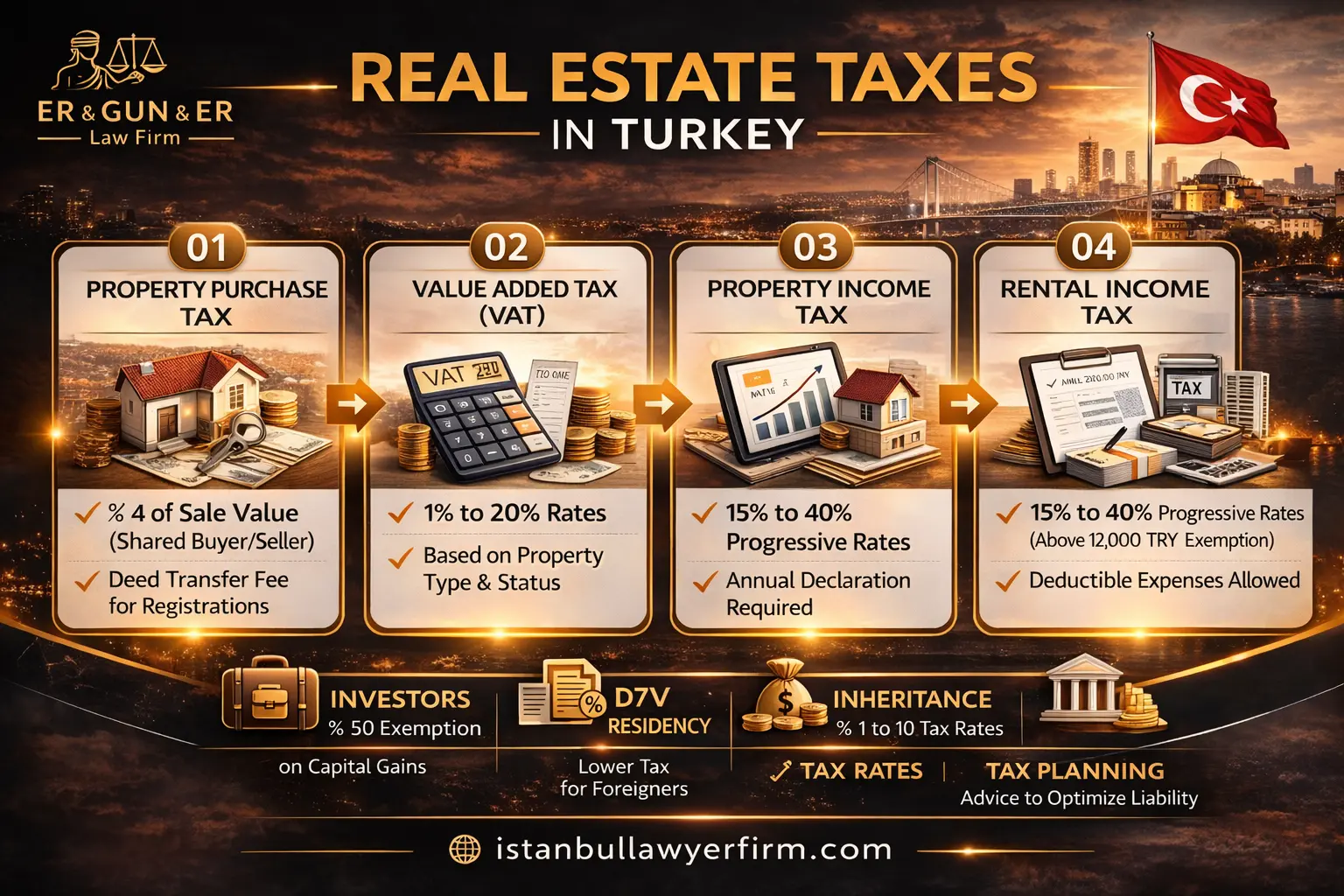
Real estate taxation in Turkey must be managed as a lifecycle file rather than as a sequence of isolated calculations. The framework that governs the relevant questions is set primarily by the Harçlar Kanunu (Law No. 492) governing the Tapu Harcı (title deed fee) on real estate transfers; the Katma Değer Vergisi Kanunu (Law No. 3065) governing KDV on certain transactions including specific exemption provisions under m.17/4; the Damga Vergisi Kanunu (Law No. 488) governing damga vergisi (stamp tax) on documents creating monetary obligations (with title deed transfers themselves typically not generating damga vergisi but ancillary contractual instruments potentially generating it); the Emlak Vergisi Kanunu (Law No. 1319) governing the annual property tax administered through municipalities, including the Değerli Konut Vergisi (Law No. 1319 m.42 vd., introduced by Law No. 7194) for high-value residential properties; the Gelir Vergisi Kanunu (Law No. 193, GVK) governing individual taxation including m.70 (gayrimenkul sermaye iradı / real estate capital income) for rental income, m.94 (stopaj / withholding tax) where the tenant is a corporation or specific category of payer, and m.80 (değer artış kazancı / value-increase gains) for capital gains on dispositions within five years; the Kurumlar Vergisi Kanunu (Law No. 5520, KVK) governing corporate taxation including m.5/1-e (75 percent exemption for qualifying real estate dispositions held at least two years); the Veraset ve İntikal Vergisi Kanunu (Law No. 7338) governing inheritance and gift taxation with progressive-rate tariff; the Türk Borçlar Kanunu (Law No. 6098) governing the underlying contractual frameworks; the Tapu Kanunu (Law No. 2644) and Law No. 6302 amendments governing the underlying real estate acquisition; and the Çifte Vergilendirmeyi Önleme Anlaşmaları (ÇVÖA / double taxation treaties) Turkey has executed with most major investor jurisdictions producing residency-certificate-based relief mechanisms. Practice may vary by authority and year.
An English speaking lawyer in Turkey advising foreign owners on Turkish real estate taxation will explain that the categorical complexity reflects the multiple authorities involved (Tapu Müdürlüğü, the Vergi Dairesi system administered by the Gelir İdaresi Başkanlığı, the relevant municipality for Emlak Vergisi and Değerli Konut Vergisi, and indirectly MASAK through bank-compliance review under the 5549 sayılı Suç Gelirlerinin Aklanmasının Önlenmesi Hakkında Kanun) and the multiple temporal stages from acquisition through holding, rental and disposition. The body of this guide walks through the lifecycle architecture supporting evidence-led tax compliance; the acquisition-stage taxes covering Tapu Harcı, KDV and damga vergisi positioning; the holding-stage taxes covering Emlak Vergisi and Değerli Konut Vergisi; the rental income taxation framework covering GVK m.70 and GVK m.94 stopaj; the disposition-stage taxation covering GVK m.80 capital gains, valuation discipline and deductible expense documentation; the inheritance and gift taxation under Veraset ve İntikal Vergisi Kanunu; the corporate holding structures with KVK framework and share-sale architecture; and the cross-border coordination through ÇVÖA treaties and bank compliance discipline. For procedural orientation on adjacent topics, our notes on title deed check steps, real estate due diligence for foreigners and Turkish citizenship by real estate investment can be read alongside this material.
1) Lifecycle Architecture and Evidence Discipline for Real Estate Taxation
A lawyer in Turkey advising on the lifecycle architecture for real estate taxation will note that Turkish real estate taxation operates across four distinct stages — acquisition, holding, rental and disposition — with each stage producing different reporting duties, different evidence sets, and different authority exposures. The procedure ordinarily requires a scope note at the outset that describes the property, the parties and the intended use, with the scope note serving as the anchor for the contract narrative, the bank trail, and the eventual filing positions. The standard approach maintains a chronology from the first negotiation message that becomes a term to the last receipt that closes the loop, with the title deed record treated as the anchor document because later comparisons typically start from the official record. Bank transfers should be treated as primary proof with reference lines mirroring contract terminology, and any side arrangements proposed by counterparties should be brought into written alignment or declined. Document custody discipline including originals, notarized copies and access rules supports both the immediate transaction and the multi-year compliance horizon that real estate ownership produces.
An Istanbul Law Firm advising on the categorical evidence requirements will note that the lifecycle map should distinguish transaction taxes (tied to events like the transfer day or contract execution), municipal charges (tied to the holding stage with annual recurring obligations), and income-based taxes (tied to economic benefit with rental and disposition triggers). Each category requires a different evidence set and a different authority interface. Transaction items live in the closing pack with receipts, submission confirmations and inter-authority documentation. Municipal items live in the annual holding folder with payment receipts, address-based records and any classification documentation. Income items live in the rental and disposition files with bank receipts, contract extracts, expense documentation and any third-party documentation supporting the economic narrative. The standard approach maintains a short internal memo for each category defining what the owner believes applies, what exhibits support the belief, and where the inevitable interpretive uncertainties have been documented as assumptions rather than asserted as guarantees. Practice may vary by authority and year.
A Turkish Law Firm advising on the cure framework where lifecycle mapping has produced inconsistencies will note that authorities and counterparties test credibility through consistency, with inconsistency typically producing follow-up that escalates the underlying issue. The procedure ordinarily treats each major event as a project milestone with a close-out pack covering what was signed, what was submitted, what was paid, and what was received in return; isolates inconsistencies as discrete issues with paused additional steps until the issue is framed; produces short correction memos identifying the inconsistent exhibit, stating the intended correction, and attaching both versions; and updates the chronology so a reviewer can follow the sequence without inference. If a document was re-signed, the re-signing date is recorded and the old version is marked as superseded, not deleted. If a portal submission was corrected, the submission reference is stored with the correction memo. If a bank payment reference must remain as originally sent, the memo explains the mismatch without overstatement. A controlled cure pack often prevents a small error from becoming a long compliance dispute. Practice may vary by authority and year. The cure-discipline operational mechanics deserve separate attention because the difference between an effectively cured inconsistency and a poorly cured one can substantially affect downstream credibility and review outcomes. The standard approach treats the cure memo as a document with specific structural requirements: a clear identification of what was inconsistent, a clear statement of what is being corrected, an attached reference to the new authoritative version, an attached reference to the prior superseded version (preserved rather than deleted), a chronology entry recording the cure event, and a circulation list confirming who has been notified of the correction. Avoid expansive legal assertions in the cure memo because the memo's value depends on factual precision rather than on argumentative breadth. Avoid retroactive rewriting of bank reference lines or other downstream artifacts that already exist in third-party records; instead document the inconsistency factually and explain the underlying reason without reconstructing the original transactional reality. The post-cure reviewer should be able to follow the sequence from original document through inconsistency identification through cure execution without inferring intermediate steps.
2) Acquisition-Stage Taxes: Tapu Harcı, KDV, Damga Vergisi and Closing Pack Discipline
An English speaking lawyer in Turkey advising foreign buyers on acquisition-stage taxation will explain that the principal acquisition-stage tax is the Tapu Harcı (title deed fee) under the Harçlar Kanunu (Law No. 492), calculated as four percent of the declared transfer value typically split equally between buyer and seller (two percent each) but contractually allocable through the parties' agreement subject to the underlying statutory framework. The procedure ordinarily requires the declared transfer value to be supported by the contractual consideration and the bank trail, with significant gaps between declared value and actual transaction value creating exposure under both the Harçlar Kanunu framework and the broader anti-evasion mechanisms. The Tapu Müdürlüğü processes the Tapu Harcı payment as part of the title transfer procedure with official receipt issuance supporting the buyer's documentary chain. The standard approach treats the Tapu Harcı as both a transaction-cost item and a documentary-chain element supporting subsequent disposition-stage capital gains calculations under the GVK m.80 framework where the Tapu Harcı paid forms part of the acquisition cost basis.
A lawyer in Turkey advising on the KDV (Katma Değer Vergisi) framework for real estate transactions will note that KDV applicability depends on the transaction's specific characterization under the 3065 sayılı Katma Değer Vergisi Kanunu rather than on the parties' contractual labels. The procedure ordinarily considers KDV applicability where the seller is a corporate seller selling new-construction property as part of business activity (with the standard rate framework applying); the reduced-rate framework applicable to certain residential transactions depending on size and value categories; the m.17/4 exemption framework affecting certain transactions including specific provisions for foreign-buyer first-acquisitions where qualifying conditions are met; and the m.17/4-r exemption applicable to certain qualifying corporate transactions involving real estate as part of corporate restructuring or qualifying portfolio dispositions. The damga vergisi (stamp tax) framework under the Damga Vergisi Kanunu (Law No. 488) operates separately, with the title deed transfer itself typically not generating damga vergisi (the Tapu Harcı operating as the principal transfer-event fee) but ancillary contractual instruments creating monetary obligations potentially generating damga vergisi exposure depending on the specific document type and content.
An Istanbul Law Firm advising on the closing pack discipline will note that the acquisition-stage evidence pack should be built as if it will be reused for future audits and for a future sale, with structured documentation supporting both immediate compliance and the multi-year horizon. The procedure ordinarily requires the signed contract and all annexes stored as the authoritative version with consistent naming; the Tapu records, official prints and appointment confirmations stored together; the bank trail for all payments including deposits, escrow-like arrangements and final consideration movements; the identity documentation and notarization pages stored with the supporting documents rather than separated; the closing memo summarizing facts of signing and payment in neutral language; and the parallel English summary mirroring the Turkish file without adding new claims for international buyers. The discipline outlined in our note on title deed check steps covers the foundational registry verification supporting the broader acquisition file. Practice may vary by authority and year. The closing pack architectural detail deserves separate operational attention because the closing pack's structure determines how easily the file can be reused for future audit, future sale, and future refinancing scenarios across the multi-year property holding horizon. The procedure ordinarily organizes the closing pack across several substantive sections: the contractual section covering the principal contract, all amendments, all annexes and any related contractual instruments; the title section covering the new Tapu, the Tapu Müdürlüğü appointment and execution documentation, and any supporting registry documentation; the payment section covering all bank transfers including pre-closing deposits, principal consideration movements, and any post-closing payment activity with reference lines and supporting payment instructions; the tax section covering Tapu Harcı receipts, any KDV documentation including invoices issued, and any damga vergisi documentation for ancillary instruments where applicable; the identity section covering buyer identification, seller identification, signatory authorities, and any vekaletname documentation; and the regulatory section covering any specific regulatory clearances obtained including military-zone clearance, agricultural-property approvals, or other category-specific approvals where applicable. The structured closing pack supports both immediate post-closing review and long-horizon documentary access without requiring reconstruction.
3) Holding-Stage Taxes: Emlak Vergisi, Değerli Konut Vergisi and Municipal Compliance Architecture
A Turkish Law Firm advising on holding-stage taxation will note that ongoing real estate ownership in Turkey produces annual taxation obligations administered through specific frameworks requiring structured compliance discipline. The procedure ordinarily begins with the Emlak Vergisi (annual property tax) under the Emlak Vergisi Kanunu (Law No. 1319) administered through the relevant municipality, with the property's classification (mesken / residential, işyeri / commercial premises, arsa / building plot, arazi / land) determining the applicable rate framework; the annual declaration, payment and receipt cycle with payment typically due in two installments per year; and the property's official Emlak Vergisi value (emlak vergisi değeri) updated periodically through municipal valuation cycles. The standard approach treats annual Emlak Vergisi as a recurring compliance task with payment proofs, period labeling and a stable address file ensuring that municipal notices reach the correct owner.
A lawyer in Turkey advising on the Değerli Konut Vergisi framework will note that high-value residential properties face an additional taxation layer under the Değerli Konut Vergisi (DKV) framework introduced into the Emlak Vergisi Kanunu through Law No. 7194 (codified at Law No. 1319 m.42 vd.). The procedure ordinarily considers the threshold framework establishing minimum property values triggering DKV obligations (with the threshold updated periodically through the valuation revaluation framework); the progressive rate structure applying tiered rates to value brackets above the threshold; the property classification requirements where residential properties (meskenler) face DKV exposure while commercial properties operate outside the DKV framework; the declaration and payment cycle separate from the ordinary Emlak Vergisi cycle; and the assessment-based mechanics where the property's official valuation drives the DKV calculation rather than transaction-based or appraisal-based values. The DKV framework specifically targets high-value residential properties and creates an additional compliance interface for owners of properties potentially within the qualifying value range.
An English speaking lawyer in Turkey advising on the broader municipal compliance architecture will note that Emlak Vergisi and DKV operate within a broader municipal-relationship framework producing additional compliance considerations beyond the principal taxation obligations. The procedure ordinarily considers Çevre Temizlik Vergisi (environmental cleaning tax) for occupied properties; the various municipality-specific charges depending on the property's location and classification; the address registration framework where the property's registered address affects both notice delivery and various administrative interactions; the DASK (Doğal Afet Sigortaları Kurumu) zorunlu deprem sigortası (mandatory earthquake insurance) for residential properties operating as a mandatory adjunct rather than a tax but relevant to the broader holding-stage compliance file; and the kentsel dönüşüm (urban transformation) framework under Law No. 6306 where qualifying properties face specific obligations and incentives affecting the broader compliance posture. Practice may vary by authority and year. The municipal-relationship management dimension deserves separate operational attention because municipalities frequently update internal records lagging behind formal title changes, with the resulting record discrepancies producing notice delivery to old owners or registry mismatches that surface only when the next transactional or compliance event occurs.
4) Rental Income Taxation: GVK m.70, GVK m.94 Stopaj and Tenant Classification
An Istanbul Law Firm advising on rental income taxation will note that rental income from Turkish real estate operates through the gayrimenkul sermaye iradı (real estate capital income) framework under the Gelir Vergisi Kanunu (Law No. 193, GVK) m.70, with specific rules affecting the tax base, the deduction framework, and the interface with the broader tax-residency and treaty framework. The procedure ordinarily considers the GVK m.70 framework establishing rental income as a taxable category; the deduction framework permitting either götürü gider (lump-sum deduction at a fixed percentage of gross rent under GVK m.74) or gerçek gider (actual expense deduction supported by documentary proof of specific expense categories including repairs, insurance, depreciation and other specified items); the istisna haddi (exemption threshold) under GVK m.21 establishing a residential-rental exemption applicable where specific conditions are met; the annual declaration requirement (yıllık beyanname) with the standard March filing deadline; and the foreign-resident specific framework where non-resident landlords face specific reporting and potentially withholding-based obligations rather than standard annual declaration mechanics.
A Turkish Law Firm advising on the GVK m.94 stopaj (withholding tax) framework will note that rental income paid by certain payer categories triggers source-side withholding obligations under GVK m.94, with the framework substantially affecting the practical mechanics for rental arrangements involving these categories. The procedure ordinarily applies stopaj where the tenant is a corporate tenant (anonim şirket, limited şirket, etc.), a sole proprietor with professional or commercial activity treating the lease payment as a deductible business expense, a foundation or association meeting the specified categorical criteria, or other category-specific payers under the GVK m.94 framework; the standard withholding rate framework applies (typically twenty percent on gross rent for domestic-resident landlords, with potentially different rates for non-resident landlords subject to applicable ÇVÖA treaty modification); the tenant's withholding obligation operates through monthly or periodic muhtasar beyanname (withholding declaration) submitted to the Vergi Dairesi; and the landlord's annual declaration interaction where the stopaj already withheld is credited against the landlord's annual income tax liability.
Turkish lawyers who advise on rental file documentary discipline will note that defensible rental income reporting requires structured documentation across the lease, the bank trail, the withholding chain (where applicable) and the annual declaration coordination. The procedure ordinarily requires the lease (kira sözleşmesi) under the Türk Borçlar Kanunu konut kira sözleşmesi or işyeri kira sözleşmesi framework with rent terms clearly stated and consistent with the broader payment narrative; monthly rent receipts through banking channels with reference lines tying back to the lease and the tenant identity; tenant-issued withholding certificates (where stopaj applies) stored alongside the corresponding monthly receipts; expense documentation supporting any gerçek gider deduction claims through the broader documentary chain (repair invoices, insurance receipts, depreciation calculations); and the annual declaration package with supporting reconciliations supporting the tax-base calculation and the credit for any stopaj already withheld. Mixed personal and property bank accounts complicate the rental documentary chain and should be avoided where the rental activity warrants disciplined separation. Practice may vary by authority and year. The rental documentary chain integration with broader compliance interfaces deserves separate operational attention because rental income reporting frequently surfaces in cross-functional reviews including bank-compliance reviews, broader tax authority reviews, and any subsequent disposition-stage analysis. The procedure ordinarily integrates rental documentation across several specific interfaces: the bank-compliance interface where rental receipts establish income legitimacy supporting Source of Funds analysis; the tax authority interface where annual declarations and any periodic submissions interact with the broader Vergi Dairesi review framework; the cross-border tax interface where home-jurisdiction reporting interacts with Turkish-side reporting through ÇVÖA treaty mechanics; the disposition-stage interface where rental history affects both the property's economic narrative and any specific tax-position analysis (including for example whether the property qualifies as an income-producing asset for specific exemption purposes); and the inheritance-stage interface where rental history forms part of the broader property file that heirs and their advisers will rely on. The integrated rental documentary discipline supports each of these interfaces consistently rather than producing different narratives for different audiences.
5) Disposition-Stage Taxation: GVK m.80 Capital Gains, Valuation Discipline and Deductible Expenses
A lawyer in Turkey advising on disposition-stage taxation will note that real estate dispositions trigger capital gains analysis under different frameworks depending on the seller's category, with substantively different mechanics for individual sellers and corporate sellers. The procedure ordinarily considers individual seller taxation under the Gelir Vergisi Kanunu m.80 (değer artış kazancı / value-increase gains) framework where dispositions within five years of acquisition produce taxable capital gains calculated as the disposition consideration less the inflation-adjusted acquisition cost less qualifying expenses; the five-year holding period exemption where dispositions after five years from acquisition typically fall outside the GVK m.80 framework; corporate seller taxation under the Kurumlar Vergisi Kanunu (Law No. 5520, KVK) where dispositions produce ordinary corporate income subject to corporate income tax; the KVK m.5/1-e framework providing a 75 percent exemption for qualifying real estate held at least two years and meeting specific procedural requirements (including the disposition proceeds being tracked through specific accounting mechanisms and the underlying property qualifying for exemption-eligible treatment); and the procedural overlay where the disposition documentation must satisfy both the immediate transfer requirements and the subsequent annual declaration documentary chain.
An Istanbul Law Firm advising on valuation and declared price discipline will note that the declared transfer value affects multiple compliance interfaces simultaneously, with declared value choices producing implications across Tapu Harcı calculation, capital gains base calculation, and broader documentary credibility. The procedure ordinarily requires the declared price to align with the contractual consideration and the bank trail, with significant gaps creating exposure under both the Harçlar Kanunu valuation framework (where municipal-valuation-based minimums may apply) and the broader anti-evasion mechanisms across the Vergi Dairesi system; the SPK-licensed gayrimenkul değerleme şirketi appraisal where the transaction structure or regulatory requirement supports formal appraisal documentation; the renovation and improvement documentation supporting acquisition-cost basis adjustments through the GVK m.80 calculation framework; and the broader documentary chain supporting both the immediate transfer's regulatory compliance and the subsequent capital gains declaration discipline. The standard approach treats valuation as a strategic file element rather than as a residual transaction-execution matter, with the declared value choice coordinated against the broader tax position rather than treated in isolation.
A Turkish Law Firm advising on the deductible expense documentation will note that the GVK m.80 capital gains calculation permits specific expense deductions reducing the taxable base, with the deductible categories requiring structured documentary support throughout the holding period. The procedure ordinarily considers acquisition-cost basis including the purchase price, the Tapu Harcı paid by the seller, the notary and translation costs supporting the acquisition documentation, and other directly attributable acquisition costs; the improvement and renovation costs (sermaye nitelikli giderler) supported by contractor invoices, payment receipts and the broader documentary chain demonstrating the improvements' capital nature rather than ordinary maintenance character; the inflation-adjustment framework permitting acquisition-cost basis revaluation against inflation indices for the holding period; and the disposition-side costs including the seller's share of Tapu Harcı, broker commissions, and other directly attributable disposition costs. Disciplined documentation across the holding period substantially affects the realized capital gains burden when disposition occurs. Practice may vary by authority and year. The capital-improvement-versus-routine-maintenance categorization deserves separate operational attention because the categorization affects whether expenses are eligible for capital-cost-basis treatment under GVK m.80 or whether they are treated as ordinary expenses without basis-adjustment effect. The procedure ordinarily considers structural improvements, additions, major renovations and other capital-nature works as basis-eligible (sermaye nitelikli giderler); routine maintenance, ordinary repairs, and recurring upkeep as ordinary expenses without basis effect; and the documentary discipline supporting the categorization including contractor scope documentation, before-and-after evidence supporting the improvement nature, and the broader documentary chain demonstrating the works' substantive character. The categorization analysis should be conducted contemporaneously with the work rather than reconstructed at disposition time when the supporting documentation may be less readily available.
6) Inheritance and Gifts: Veraset ve İntikal Vergisi under Law No. 7338
An English speaking lawyer in Turkey advising on inheritance taxation for real estate will explain that succession events involving Turkish real estate trigger taxation under the Veraset ve İntikal Vergisi Kanunu (Law No. 7338) with structured procedural requirements that the inheritance file must satisfy alongside the substantive inheritance law framework. The procedure ordinarily considers the taxable event categorization where ölüm (death) triggers veraset (succession) taxation and ivazsız intikal (gratuitous transfer) including inter vivos gifts (bağışlama under TBK m.285 vd.) triggers intikal taxation; the taxable base calculation through property valuation (with specific valuation mechanics differing from the Emlak Vergisi or transaction-context valuations); the progressive-rate tariff applying differential rates to value brackets, with rates differing between ölüm-triggered and ivazsız-intikal-triggered events; the exemption framework establishing minimum thresholds and category-specific exemptions including specific provisions for transfers between spouses, parents and children, and other close relations; and the declaration and payment framework with specific timing requirements following the taxable event.
A lawyer in Turkey advising on the cross-border inheritance taxation interaction will note that foreign-resident testators and foreign-resident heirs interact with the Veraset ve İntikal Vergisi framework through specific procedural mechanics requiring structured cross-jurisdictional coordination. The procedure ordinarily considers the substantive tax-residency analysis where the testator's tax-residency at death and the heirs' tax-residency at acquisition affect the framework's application; the conflict-of-laws coordination under the Milletlerarası Özel Hukuk ve Usul Hukuku Hakkında Kanun (Law No. 5718) where Turkish-situs immovable property typically falls within Turkish substantive inheritance law for partition mechanics while the underlying tax framework operates separately; the documentary chain supporting both Turkish-side declaration and home-country-side declaration where the home jurisdiction also asserts inheritance taxation rights; the apostille and sworn translation discipline supporting cross-jurisdictional documentary acceptance; and the practical execution coordination through the Tapu Müdürlüğü inheritance-transfer mechanics integrating both tax-side compliance and the underlying property-rights transfer.
An Istanbul Law Firm advising on the gift taxation framework will note that inter vivos transfers operate under the Veraset ve İntikal Vergisi Kanunu's intikal (transfer) framework with specific mechanics distinguishing taxable gifts from non-taxable transfers and with structured documentary requirements affecting both immediate compliance and subsequent inheritance-stage interaction. The procedure ordinarily considers the categorical distinction between bağışlama (gift) under TBK m.285 vd. and other transfer categories that may operate outside the intikal framework; the valuation framework applicable to the gift transfer for taxation purposes; the declaration timing requirement following the gift execution; the rate framework applicable to the specific gift type and value; and the interaction with the saklı pay (reserved share) framework under the Türk Medeni Kanunu m.505 vd. where inter vivos gifts can affect the eventual inheritance partition through the muris muvazaası (testator collusion) and tenkis davası (reduction action) frameworks under TMK m.560-571. The standard approach considers gifts as both immediate compliance events and longer-term inheritance-stage considerations rather than as isolated transactions. Practice may vary by authority and year.
7) Corporate Holding Structures: KVK Framework and Share-Sale Architecture
Turkish lawyers who advise on corporate holding structures for Turkish real estate will note that holding property through a Turkish corporate vehicle (anonim şirket or limited şirket under the Türk Ticaret Kanunu, Law No. 6102) substantively changes the taxation framework, the governance overhead and the disposition mechanics, with the structural choice warranting deliberate evaluation against the investor's broader strategy rather than reflexive adoption. The procedure ordinarily considers the KVK (Kurumlar Vergisi Kanunu, Law No. 5520) framework where the corporate entity pays corporate income tax on net income with the standard rate applicable to taxable corporate income; the dividend distribution framework where shareholder distributions face dividend withholding tax (with potential ÇVÖA treaty modification for foreign shareholders); the KVK m.5/1-e 75 percent exemption framework for qualifying real estate dispositions held at least two years under specific procedural conditions; the operational compliance overhead including ongoing accounting, audit (where threshold-applicable), tax filings, and corporate governance compliance; and the inheritance interaction where corporate ownership produces share-transfer rather than property-transfer mechanics affecting both procedural treatment and the Veraset ve İntikal Vergisi exposure.
A Turkish Law Firm advising on the share-sale versus asset-sale architecture will note that exit transactions involving corporate-held real estate can operate through either share disposition (selling the corporate vehicle's shares with the property remaining within the corporate vehicle) or asset disposition (selling the underlying property with the corporate vehicle continuing or being subsequently dissolved), with the structural choice substantially affecting the tax implications and the buyer-side diligence intensity. The procedure ordinarily considers share disposition mechanics where the seller's gain operates through the share-disposition framework (under GVK m.80 for individual shareholders subject to specific holding-period considerations, or under KVK for corporate shareholders) and the buyer inherits the corporate vehicle's history including historical tax positions, contingent liabilities, and the broader corporate-record continuity; asset disposition mechanics where the corporate vehicle's gain operates through KVK with potential m.5/1-e exemption application and the buyer acquires the property with a fresh acquisition basis but without inheriting the corporate vehicle's history; and the diligence intensity differential where share-sale buyers typically require substantially more extensive diligence than asset-sale buyers reflecting the historical-liability inheritance.
A lawyer in Turkey advising on the corporate-vehicle compliance discipline will note that corporate ownership produces ongoing compliance obligations beyond the property-specific framework, with the corporate vehicle's compliance posture affecting both the property-specific tax position and the broader corporate viability. The procedure ordinarily requires the corporate vehicle's accounting records to track the property as an asset with supporting documents attached and consistent with the legal narrative; the lease and service contracts to be signed by authorized signatories and filed with corporate-resolution support; the corporate bank accounts to maintain a clean trail of property-related receipts and payments without commingling with unrelated business lines; the dividend or shareholder distribution documentation supporting both immediate compliance and subsequent shareholder-tax positions; the intercompany funding documentation through written instruments rather than informal transfers; the governance calendar for board approvals and shareholder meetings; and the broader corporate-formality compliance distinguishing corporate ownership from individual ownership where corporate formalities are tested in audit and dispute contexts. Practice may vary by authority and year.
8) Cross-Border Coordination: ÇVÖA Treaty Framework, Residency Evidence and MASAK Bank Compliance
An English speaking lawyer in Turkey advising on cross-border real estate taxation will explain that Turkey has executed Çifte Vergilendirmeyi Önleme Anlaşmaları (ÇVÖA / double taxation treaties) with most major investor jurisdictions, with the treaty framework providing structured coordination mechanisms preventing double taxation on rental income, capital gains and inheritance taxation while imposing specific procedural requirements for treaty-benefit claims. The procedure ordinarily considers the residency-tiebreaker rules determining which jurisdiction's tax-residency applies for treaty purposes where both jurisdictions assert residency over the taxpayer; the source-of-income rules establishing which jurisdiction has primary taxing rights for various income categories with real estate income typically following the situs (location) jurisdiction principle; the credit-or-exemption methods relieving double taxation where both jurisdictions have valid taxing rights; the certificate-of-residency (mukim belgesi) documentation supporting treaty-benefit claims through the relevant procedural mechanisms requiring both home-jurisdiction issuance and Turkish-side acceptance; and the treaty-specific provisions affecting specific income categories where the treaty's substantive provisions modify the default Turkish-domestic-law treatment.
An Istanbul Law Firm advising on the residency evidence discipline will note that residency evidence operates as the foundation for treaty-benefit claims and broader cross-border tax positioning, with the evidence pack typically reviewed by both Turkish authorities and home-jurisdiction authorities at different times during the multi-year compliance horizon. The procedure ordinarily requires residency certificates from the relevant authority in the claimed-residency jurisdiction (typically the home-country tax authority issuing certificates supporting Turkish-side treaty claims); passport copies, entry and exit records where available, and address proofs supporting the residency factual basis; the Turkish-side address registration and tax-identification documentation supporting any Turkish-residency claims; the property-specific lease documentation, rental receipts and the residency-timeline alignment supporting the rental income's residency-attribution; the foreign tax return excerpts where the Turkish income has been reported in the home jurisdiction supporting consistency-of-reporting analysis; and the dated chronology supporting the residency-status's evolution over time where multi-year analysis is needed.
A Turkish Law Firm advising on the MASAK and bank compliance interaction will note that Turkish bank-compliance procedures under the 5549 sayılı Suç Gelirlerinin Aklanmasının Önlenmesi Hakkında Kanun (MASAK / anti-money-laundering framework) interact extensively with real estate transaction documentation, with the bank-side compliance review frequently producing documentary requests that the broader tax-compliance discipline must support consistently. The procedure ordinarily requires Source of Funds documentation for foreign-currency inflows funding real estate acquisitions; the Döviz Alım Belgesi (DAB) chain documenting foreign-currency-to-Turkish-lira conversions through Turkish banks; the broader transaction documentation supporting bank-compliance review including contracts, identity documentation, and any specific category-related documentation that the bank's compliance framework requires; the consistency between bank-compliance documentary positions and tax-compliance documentary positions across the multi-stakeholder, multi-authority compliance landscape; and the disciplined response framework where bank compliance requests, tax authority requests and other authority requests are answered through one coherent documentary set rather than through ad hoc separate explanations that produce inconsistent narratives. The discipline outlined in our note on real estate due diligence for foreigners covers the broader cross-border transaction architecture supporting consistent documentary positioning. Practice may vary by authority and year. The MASAK-bank-compliance interaction operational dimension deserves separate attention because Turkish banks operate substantial compliance infrastructure under both the 5549 sayılı Suç Gelirlerinin Aklanmasının Önlenmesi Hakkında Kanun framework and the broader CDD (Customer Due Diligence) framework supporting both domestic and international compliance obligations. The procedure ordinarily considers the bank-compliance documentary requests covering Source of Funds analysis where foreign-currency inflows fund Turkish property acquisitions; the customer-risk-profile assessment where the bank's internal risk-rating affects the documentary intensity required; the periodic refresh framework where the bank may request updated documentation across the multi-year banking relationship; the transaction-monitoring framework where specific transaction patterns may trigger enhanced documentation requests; and the suspicious-transaction-reporting framework where banks may report transactions to MASAK based on the underlying compliance assessment. The disciplined response framework treats bank compliance requests as legitimate documentary opportunities to reinforce the broader compliance narrative rather than as obstacles to be navigated around, with consistency between bank-compliance positions and tax-compliance positions supporting credibility across both interfaces.
9) Frequently Asked Questions for Foreign Owners and Real Estate Investors
- What is the Tapu Harcı? The Tapu Harcı (title deed fee) under the Harçlar Kanunu (Law No. 492) is the principal acquisition-stage tax on Turkish real estate transfers, calculated as four percent of the declared transfer value typically split equally between buyer and seller (two percent each). The Tapu Müdürlüğü processes payment as part of the title transfer with official receipt issuance.
- When does KDV apply to real estate transactions? KDV under the Katma Değer Vergisi Kanunu (Law No. 3065) applies to specific real estate transactions including new-construction sales by corporate sellers, with reduced-rate frameworks for certain residential transactions and exemption provisions under m.17/4 affecting categories including foreign-buyer first-acquisitions where qualifying conditions are met, and m.17/4-r covering certain corporate-portfolio dispositions.
- What about damga vergisi on property transfers? Title deed transfers themselves typically do not generate damga vergisi (the Tapu Harcı operating as the principal transfer-event fee). However, ancillary contractual instruments creating monetary obligations may generate damga vergisi exposure under the Damga Vergisi Kanunu (Law No. 488) depending on the specific document type and content.
- What is Emlak Vergisi? Emlak Vergisi (annual property tax) under the Emlak Vergisi Kanunu (Law No. 1319) is the principal holding-stage tax administered through the relevant municipality, with property classification (mesken, işyeri, arsa, arazi) determining the applicable rate framework and payment typically due in two installments per year.
- What is the Değerli Konut Vergisi? The Değerli Konut Vergisi (DKV) under Law No. 1319 m.42 vd. (introduced by Law No. 7194) is an additional taxation layer on high-value residential properties, applying a progressive-rate structure to value brackets above the threshold. The threshold updates periodically through the valuation revaluation framework.
- How is rental income taxed? Rental income operates through the gayrimenkul sermaye iradı framework under GVK m.70 with deduction options including götürü gider (lump-sum deduction under GVK m.74) or gerçek gider (actual expense deduction with documentation); the istisna haddi residential exemption under GVK m.21 where conditions are met; and the annual declaration requirement (yıllık beyanname) with March filing deadline.
- When does GVK m.94 stopaj apply? Stopaj (withholding tax) under GVK m.94 applies where the tenant is a corporate tenant, sole proprietor with professional or commercial activity, foundation, association, or other category-specific payer, with the tenant's withholding obligation operating through monthly muhtasar beyanname submitted to the Vergi Dairesi. The standard rate is twenty percent on gross rent for domestic-resident landlords subject to applicable ÇVÖA treaty modification for foreign-resident landlords.
- How is capital gains tax calculated on dispositions? For individual sellers, GVK m.80 (değer artış kazancı) applies to dispositions within five years of acquisition, calculated as disposition consideration less inflation-adjusted acquisition cost less qualifying expenses. Dispositions after five years typically fall outside the GVK m.80 framework. For corporate sellers, KVK applies with potential KVK m.5/1-e 75 percent exemption for qualifying real estate held at least two years.
- What expenses are deductible against capital gains? Under GVK m.80, the acquisition-cost basis includes the purchase price, the Tapu Harcı paid by the seller, the notary and translation costs supporting the acquisition, and other directly attributable acquisition costs. Improvement and renovation costs (sermaye nitelikli giderler) supported by contractor invoices and payment receipts are deductible. Inflation-adjustment is applied to the acquisition basis. Disposition-side costs including the seller's share of Tapu Harcı and broker commissions are also deductible.
- How does inheritance taxation work? Veraset ve İntikal Vergisi under Law No. 7338 applies to ölüm (death) and ivazsız intikal (gratuitous transfer including gifts), with progressive-rate tariff applying differential rates to value brackets. The exemption framework establishes minimum thresholds and category-specific exemptions including specific provisions for transfers between spouses, parents and children. Cross-border heirs face structured procedural mechanics requiring apostille and sworn translation discipline.
- How does corporate ownership affect taxation? Corporate ownership through anonim şirket or limited şirket under TTK changes the taxation framework with KVK applying to corporate income; dividend withholding affecting shareholder distributions; KVK m.5/1-e 75 percent exemption available for qualifying real estate dispositions held at least two years; and share-sale versus asset-sale architecture options for exit transactions producing different tax treatments.
- What are ÇVÖA treaties? Çifte Vergilendirmeyi Önleme Anlaşmaları (double taxation treaties) Turkey has executed with most major investor jurisdictions, providing residency-tiebreaker rules, source-of-income allocation rules, credit-or-exemption methods preventing double taxation, and certificate-of-residency (mukim belgesi) documentation requirements supporting treaty-benefit claims for cross-border investors.
- What documentation should foreign owners maintain? Residency certificates from the home jurisdiction; passport copies, entry/exit records, and address proofs; Turkish-side address registration and tax-identification documentation; property-specific lease, rental receipts and tax declarations; foreign tax return excerpts where Turkish income has been reported; the Döviz Alım Belgesi chain documenting foreign-currency conversions; and the broader cross-jurisdictional documentary coordination supporting consistent positioning.
- How does MASAK bank compliance interact with real estate? The 5549 sayılı Suç Gelirlerinin Aklanmasının Önlenmesi Hakkında Kanun (MASAK / anti-money-laundering framework) administered through Mali Suçları Araştırma Kurulu produces bank-compliance review interfaces that frequently request Source of Funds documentation, transaction-supporting documentation, and consistency between bank-compliance and tax-compliance positions across the multi-authority landscape.
- Does ER&GUN&ER Law Firm advise on Turkish real estate taxation? Yes. ER&GUN&ER Law Firm is an Istanbul-based law firm advising foreign individual investors, corporations, family offices, institutional participants and multinational groups on Turkish real estate taxation across the full lifecycle, including acquisition-stage Tapu Harcı under the Harçlar Kanunu (Law No. 492), KDV under the Katma Değer Vergisi Kanunu (Law No. 3065), and damga vergisi positioning under the Damga Vergisi Kanunu (Law No. 488); holding-stage Emlak Vergisi under Law No. 1319 and Değerli Konut Vergisi under Law No. 1319 m.42 vd. (introduced by Law No. 7194); rental income taxation under GVK m.70 with götürü gider and gerçek gider deduction options, GVK m.21 istisna haddi residential exemption, and GVK m.94 stopaj framework for corporate tenants and qualifying payer categories; disposition-stage taxation under GVK m.80 değer artış kazancı with inflation-adjustment framework, KVK corporate-seller treatment with KVK m.5/1-e 75 percent exemption analysis, and SPK-licensed gayrimenkul değerleme şirketi appraisal coordination; Veraset ve İntikal Vergisi under Law No. 7338 for ölüm-triggered succession and ivazsız-intikal-triggered gifts with progressive-rate tariff and cross-border MÖHUK coordination; corporate holding structures under TTK and KVK with share-sale versus asset-sale architecture; ÇVÖA treaty framework coordination with mukim belgesi (residency certificate) discipline; and MASAK bank-compliance interaction under the 5549 sayılı Kanun framework — with English-language client communication and bilingual documentation throughout each engagement. Files in this area are typically led personally by the managing partner rather than delegated.
Author: Mirkan Topcu is an attorney registered with the Istanbul Bar Association (Istanbul 1st Bar), Bar Registration No: 67874. His practice focuses on cross-border and high-stakes matters where evidence discipline, procedural accuracy, and risk control are decisive.
He advises foreign individual investors, corporations, family offices, institutional participants and multinational groups on Turkish real estate taxation under the Harçlar Kanunu (Law No. 492) governing Tapu Harcı, the Katma Değer Vergisi Kanunu (Law No. 3065) including m.17/4 exemption framework, the Damga Vergisi Kanunu (Law No. 488), the Emlak Vergisi Kanunu (Law No. 1319) including the Değerli Konut Vergisi framework introduced through Law No. 7194 (codified at Law No. 1319 m.42 vd.), the Gelir Vergisi Kanunu (Law No. 193, GVK) including m.21 istisna haddi (residential rental exemption), m.70 (gayrimenkul sermaye iradı), m.74 (götürü gider deduction), m.80 (değer artış kazancı / value-increase gains capital gains), and m.94 (stopaj / withholding tax), the Kurumlar Vergisi Kanunu (Law No. 5520, KVK) including m.5/1-e 75 percent exemption for qualifying real estate dispositions, the Veraset ve İntikal Vergisi Kanunu (Law No. 7338) covering ölüm-triggered succession and ivazsız intikal (gratuitous transfer) including bağışlama under TBK m.285 vd., the Türk Borçlar Kanunu (Law No. 6098) governing underlying contractual frameworks, the Türk Medeni Kanunu (Law No. 4721) including m.505 vd. saklı pay and m.560-571 tenkis davası framework, the Tapu Kanunu (Law No. 2644) and Law No. 6302 amendments, the Türk Ticaret Kanunu (Law No. 6102) for corporate holding structures, the Milletlerarası Özel Hukuk ve Usul Hukuku Hakkında Kanun (Law No. 5718) for cross-border coordination, the 5549 sayılı Suç Gelirlerinin Aklanmasının Önlenmesi Hakkında Kanun governing MASAK anti-money-laundering compliance, and the Çifte Vergilendirmeyi Önleme Anlaşmaları (ÇVÖA) Turkey has executed with most major investor jurisdictions providing residency-tiebreaker rules, source-of-income allocation, credit-or-exemption methods, and mukim belgesi (residency certificate) documentation requirements. His advisory work covers acquisition-stage closing pack discipline integrating contract, Tapu records, bank trail and identity documentation; holding-stage Emlak Vergisi and Değerli Konut Vergisi compliance with municipal-relationship management; rental income taxation including lease structuring, götürü-versus-gerçek gider deduction strategy, stopaj framework where corporate or qualifying-payer tenants are involved, and annual declaration coordination; disposition-stage capital gains analysis covering acquisition-cost basis assembly, inflation-adjustment calculation, qualifying-expense documentation, KVK m.5/1-e exemption qualification analysis, and valuation-discipline coordination; inheritance and gift taxation including substantive Veraset ve İntikal Vergisi calculation, declaration timing, cross-jurisdictional coordination through apostille and sworn translation discipline, and interaction with TMK saklı pay framework through tenkis davası and muris muvazaası analysis; corporate holding structuring including share-sale versus asset-sale architecture and KVK compliance discipline; cross-border treaty coordination through ÇVÖA framework with residency evidence assembly; and MASAK bank-compliance interaction across the multi-authority compliance landscape.
Education: Istanbul University Faculty of Law (2018); Galatasaray University, LL.M. (2022). LinkedIn: Profile. Istanbul Bar Association: Official website.