

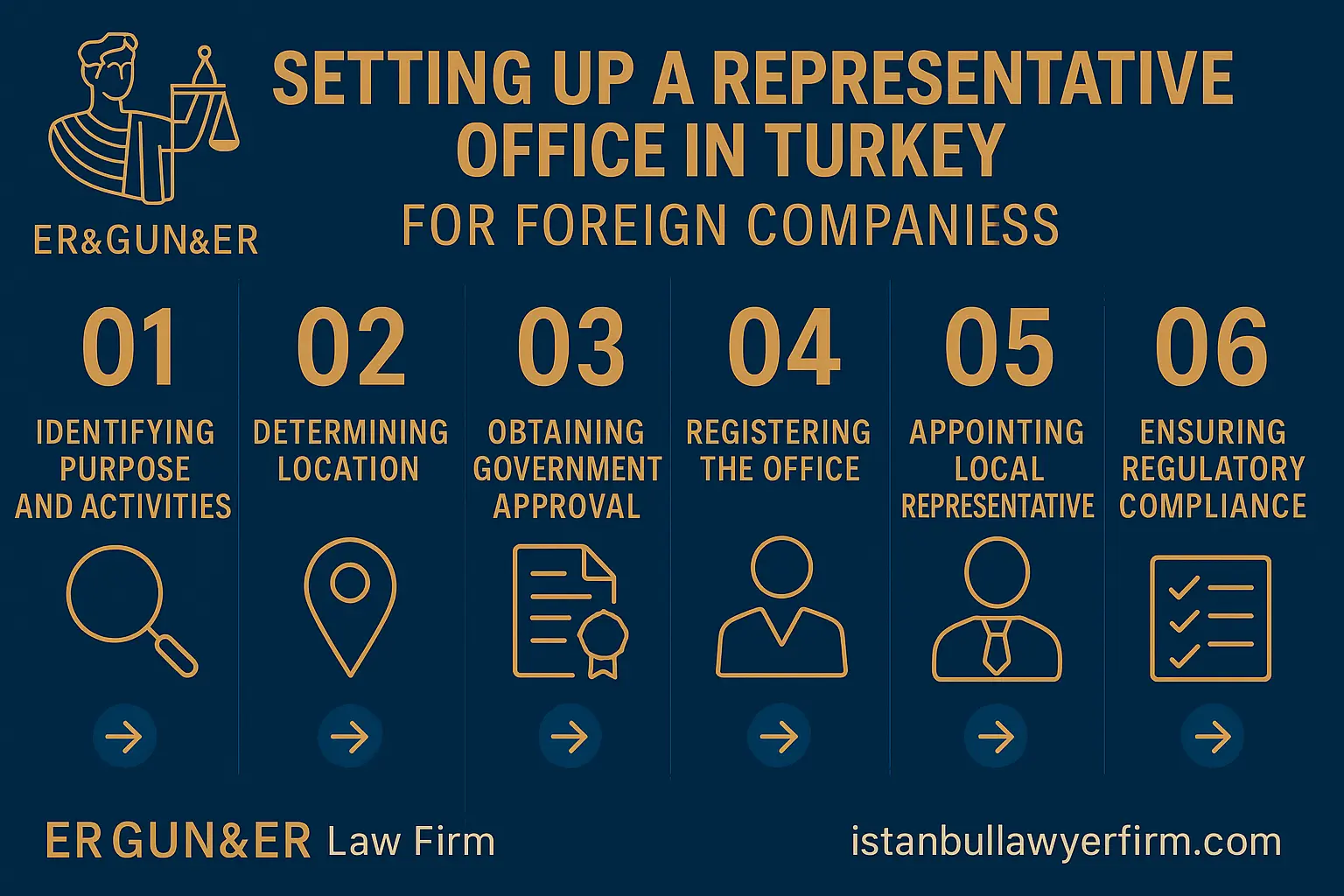
A liaison office (irtibat bürosu) — the term used as "representative office" in some English-language sources — is the lightest legal presence a foreign company can establish in Turkey. It allows a foreign-incorporated parent to maintain a registered footprint in Turkey for non-commercial purposes, hire local and foreign staff, lease office space, and conduct specific defined activities, all without becoming a Turkish taxpayer for corporate income tax purposes and without entering the Turkish trade registry. This last point is the source of most confusion in legacy guides: liaison offices are not Turkish commercial entities, are not registered with the Trade Registry, and are not subject to Turkish Commercial Code formation rules. They sit in an entirely separate legal regime.
The governing framework is the Foreign Direct Investment Law (Law No. 4875, dated 5 June 2003, Official Gazette of 17 June 2003 No. 25141), specifically Article 3/h, which authorises the Ministry to grant permission to foreign-incorporated companies to open a liaison office in Turkey on condition that the office does not engage in commercial activity. The implementing rules are in the Foreign Direct Investment Implementation Regulation (Official Gazette of 20 August 2003 No. 25205), as amended notably by the Regulation of 3 July 2012 (No. 28342). Articles 6, 7, and 8 of the Implementation Regulation cover ministerial permission, application documents, and the operating regime. The competent authority is the Ministry of Industry and Technology, specifically the Directorate General for Incentive Implementation and Foreign Investment (Teşvik Uygulama ve Yabancı Sermaye Genel Müdürlüğü) in Ankara. ER&GUN&ER Law Firm advises foreign parent companies on liaison office establishment, permission applications, scope of permitted activity, employment of local and foreign staff, the GVK Article 23/14 wage tax exemption, annual reporting compliance, and conversion to a Turkish branch or subsidiary when commercial expansion becomes the right next step.
What a Liaison Office Can and Cannot Do
The defining restriction on a liaison office is the prohibition on commercial activity, set out in Article 3/h of Law No. 4875 and reinforced in Article 6 of the Implementation Regulation. A liaison office cannot enter into commercial contracts, cannot issue invoices, cannot collect payments for goods or services, cannot conclude sales transactions, and cannot generate any form of revenue. Its operating costs must be funded entirely through foreign currency transfers from the parent company, evidenced by bank documentation. Failure to respect this boundary is the most common reason for permission cancellation: where the Ministry determines through audit or third-party complaint that the office has engaged in commercial activity, it gives the office 30 days to apply for permission for the actual activity, and if that path is unavailable (because liaison offices cannot apply to convert to a commercial vehicle in place), the permission is revoked.
Article 8 of the Implementation Regulation defines the categories of permitted non-commercial activity. The current categories are: representation and hospitality (temsil ve ağırlama); quality and standards inspection of Turkish suppliers and supplier sourcing for the parent's procurement chain; technical support to the parent's distributors, dealers, or customers in Turkey; communication and information transfer between the parent and the Turkish market; regional management centre activities for the parent's operations across multiple countries; and market research and product promotion for the parent's products or services. Each category has its own permission term and renewal mechanics, and the application must specify which category or categories the office will conduct.
The category choice affects the practical scope of work. A regional management centre liaison office can coordinate the parent's operations across the EMEA region from Istanbul, including back-office functions, and can receive permission for terms longer than the standard category. A market research and product promotion office can introduce the parent's products to potential Turkish customers but cannot take orders or quote prices binding on the parent. A technical support office can train Turkish distributors on the parent's products but cannot charge them for the training. Practice may vary by authority and year on how strictly the Ministry interprets the boundaries between categories; in our experience the General Directorate has tightened scrutiny since 2020, and applications now benefit from precise alignment between the declared category and the operational reality.
Permission Application: Documents and Process
Article 7 of the Implementation Regulation specifies the application file. The foreign parent submits to the General Directorate: an activity certificate (faaliyet belgesi) issued by the trade registry of the parent's country of incorporation, apostilled or legalised through the Turkish consulate; a recent activity report or balance sheet and income statement of the parent; a declaration setting out the scope of work the liaison office will perform and undertaking that the office will not conduct commercial activity, signed by an authorised representative of the parent with documentation of that representative's signing authority; a power of attorney issued to the persons appointed to manage the liaison office's operations; and a power of attorney to the lawyer if the application is filed through counsel.
The General Directorate reviews applications against three substantive factors: the parent company's field of activity (the liaison office's planned activity must be a logical extension of the parent's business), the parent's capital base, and the parent's employee headcount. For newly-incorporated foreign companies, the Ministry can require a one-year minimum existence before granting permission. For companies operating in regulated financial sectors — banking, capital markets, insurance — the application is routed to the relevant sector regulator (BDDK, SPK, SEDDK) for primary review under that sector's specific rules.
The processing time is set in the Regulation as 15 business days from the date the application file is complete. In our practice, the 15-day clock typically resets one or two times because the General Directorate requests clarification or additional documentation, particularly for first-time applicants from less common jurisdictions. Filing a clean, complete file at the first submission is the single largest determinant of how fast permission issues. An English speaking lawyer in Turkey running this file for a foreign parent prepares the parent's documents in their original language with apostille and certified Turkish translation, drafts the activity declaration in alignment with the chosen category under Article 8, and confirms in advance that the parent's home-jurisdiction trade registry document is in the form the General Directorate accepts.
Permission Term and Renewal Mechanics
Article 8/a of the Implementation Regulation provides that the initial permission is granted for up to three years within the scope of the declared activity. Renewal is governed by Article 8/b: the office files a renewal application before the existing permission expires, and the General Directorate decides on the renewal based on the office's past activities, the parent's future business plan and targets in Turkey, the office's current and projected expenditure, and its employee headcount.
The renewal terms vary by activity category. For representation and hospitality, supplier quality control, technical support, communication and information transfer, and regional management centre activities, the renewal can be granted for up to five additional years per renewal cycle. Regional management centres in particular can receive longer cumulative terms reflecting the strategic role they play. For market research and product promotion offices, however, the Regulation specifically restricts renewal: this category is not extended beyond the initial three-year term, on the rationale that market research and product promotion are inherently introductory activities that should culminate in a commercial decision (incorporate a Turkish entity, open a branch, or exit the market) within three years.
Annual reporting is the procedural backbone of the permission system. Under Article 8/d of the Implementation Regulation, every liaison office must submit by the end of May each year an annual information form (İrtibat Bürolarının Faaliyetlerine İlişkin Bilgi Formu) covering the previous calendar year's activities, signed by the authorised representative, and accompanied by supporting documentation. Offices that fail to submit the annual form on time lose their renewal eligibility — the General Directorate will not consider a renewal application from an office whose annual reporting is incomplete — and the permission can be revoked outright. We track the May deadline as a fixed compliance date in every client engagement.
Tax Position: Why Liaison Offices Are Genuinely Tax-Efficient
Because a liaison office is prohibited from generating commercial income, it does not become a corporate income taxpayer in the practical sense. It is technically captured by the limited-liability taxpayer regime of Article 3/2 of the Corporate Tax Law (Law No. 5520) as a place of business of a non-resident corporation, but the Article 6 taxable base — commercial earnings derived from operations in Turkey — does not exist for a properly-operated liaison office, and the office accordingly does not file annual corporate tax returns. The Revenue Administration's general practice has consistently confirmed this position, and rulings issued to taxpayers confirm that liaison offices conducting only the activities permitted under the Implementation Regulation are outside the scope of corporate income taxation.
The wage tax exemption is the genuinely valuable tax feature of the liaison office structure. Article 23/14 of the Income Tax Law (Law No. 193) exempts from income tax the salaries paid to employees by employers whose legal headquarters and place of management are outside Turkey, where the salary is paid in foreign currency from foreign-source funds. This exemption applies directly to liaison office personnel: salaries paid by the foreign parent in foreign currency, transferred into Turkey, and paid out to liaison office employees are exempt from Turkish income tax at the employee level. The conditions are strict — the parent must genuinely be the employer in legal substance, the funds must originate abroad in foreign currency, and the documentary trail through the bank must be intact — but where the conditions are satisfied, the post-tax compensation cost to the parent is materially lower than for an equivalent commercial-entity payroll in Turkey.
Practice may vary by authority and year on the documentation accepted to evidence Article 23/14 conditions; the Revenue Administration has issued multiple rulings refining the requirements for the foreign-currency origin trail. We structure the parent-to-office cash flow for every client to satisfy the documentation standard from the first transfer rather than retrofitting later. VAT is not exempt at the liaison office level: the office pays VAT on the goods and services it consumes (rent, utilities, professional services) and cannot recover that VAT because it is not a VAT-registered taxpayer. Stamp duty under Law No. 488 applies to documents executed by the office under standard rules. The withholding tax obligation on certain payments — particularly rent under Article 94/5(a) of the Income Tax Law (currently 20%) — applies to the liaison office as an employer-payer, even though the office is not a corporate income taxpayer, and the office must file monthly muhtasar declarations covering the withholding obligations it triggers.
Employment: Local and Foreign Staff
A liaison office can hire Turkish nationals and foreign nationals as employees, subject to standard Turkish employment law. Turkish Labour Law (Law No. 4857) applies in full to liaison office personnel: the same severance accrual under Articles 14 and 17, the same notice periods, the same 45-hour weekly limit under Article 63, the same annual leave entitlements under Article 53, and the same job security protections under Articles 18-21 for offices with 30 or more employees. The Social Insurance Law (Law No. 5510) requires SGK registration of employees within standard deadlines, and the office acts as the SGK employer for premium reporting and payment. Occupational health and safety obligations under Law No. 6331 apply at the workplace level.
Work permits for foreign employees of liaison offices are governed by the International Labour Force Law (Law No. 6735) and its implementing regulations, with specific accommodations for liaison office personnel. The standard 5:1 ratio of Turkish to foreign employees that applies to ordinary Turkish employers is generally relaxed for liaison offices, recognising the structural reality that liaison offices commonly run lean and bring in foreign personnel from the parent specifically because of their parent-side product or market knowledge. The Ministry of Labour and Social Security's circulars on liaison office work permits set out the documentation required: the parent's appointment letter, the liaison office permission, the employee's CV and qualifications, the proposed employment terms, and the SGK pre-registration. Practice may vary by authority and year on the specific accommodations applied; we calibrate each work permit application to the Ministry's current circulars at the time of filing.
The wage tax exemption under Article 23/14 of the Income Tax Law applies to both Turkish and foreign liaison office employees, provided the salary genuinely originates from the foreign parent in foreign currency. For foreign employees, the work permit issued under Law No. 6735 also serves as a residence permit during its validity, so a separate residence permit application under Law No. 6458 is not required for the duration of the work permit. On work permit expiry without renewal, a 10-day grace period applies before the foreign employee falls into residence-permit breach, and we manage the timeline conservatively to avoid that gap.
The "Office Representative" Role and Its Documentation
The liaison office must have at least one person designated to manage its operations and to represent it before the General Directorate, the Tax Office, the SGK, and other Turkish authorities. The Implementation Regulation refers to this person as the office representative or the authorised manager. The role is filled by a power of attorney (yetki belgesi or vekaletname) issued by the parent company, executed before a notary in the parent's home jurisdiction with apostille, and translated and notarised in Turkey before submission to the General Directorate.
Contrary to a widespread misconception in legacy guides, the office representative does not have to be a Turkish citizen. Foreign nationals can serve as office representatives, subject to obtaining a work permit under Law No. 6735 if they reside in Turkey, or operating from abroad if the practical management of the office is delegated to a local manager with on-the-ground responsibilities. Many liaison offices use a hybrid arrangement: a foreign senior representative based abroad with overall accountability, plus a Turkish-resident operational manager with the day-to-day signing authority, both documented in the General Directorate's file.
The scope of the power of attorney is a planning point. A narrow power of attorney limited to specific operational acts (signing the lease, opening the bank account, dealing with the SGK, executing employment contracts within the permitted activity scope) is preferable to a broad power of attorney that purports to authorise the representative to bind the parent generally. Banks in particular ask to see the power of attorney text when opening the liaison office's foreign-currency operating account, and a narrow but precise power of attorney facilitates the bank onboarding. Practice may vary by authority and year on what banks require for liaison office account opening; the post-2018 tightening of MASAK guidance on cross-border transfers has affected the documentation level expected.
Office Premises and the Lease Question
Liaison offices typically lease commercial office space in Istanbul, Ankara, İzmir, or other major commercial centres. The lease is signed by the office representative under the power of attorney, with the foreign parent as the contracting principal or the liaison office itself named in the contract under the parent's umbrella. Standard Turkish commercial lease law under the Code of Obligations (Law No. 6098) Articles 299-378 applies: the maximum 5-year term for commercial leases, the rent-increase ceiling tied to producer price index movements where applicable, the eviction protections for the tenant under defined conditions, and the security deposit cap of three months' rent.
The lease must be submitted to the General Directorate after signature, as part of the documentation supporting the issued permission. The office address recorded in the General Directorate's file becomes the liaison office's official address for service of process, tax correspondence, and SGK communications, and any address change requires notification to the General Directorate within one month of the change under Article 8/d of the Implementation Regulation. We coordinate the lease, the bank account opening, and the General Directorate notification on a single integrated timeline to avoid sequencing gaps.
Withholding tax on rent paid by the liaison office is the operational tax exposure most parents underestimate. Article 94/5(a) of the Income Tax Law requires the lessee to withhold 20% of the rent payment and remit the withheld amount through monthly muhtasar declarations. The liaison office, although not a corporate income taxpayer, is a withholding agent for this purpose. The withholding obligation runs from the first month of the lease and continues throughout the term. Failure to withhold creates personal liability for the office representative and exposes the parent to remediation cost.
Ongoing Compliance: Annual Reports, Notifications, and Audits
The annual information form due by the end of May is the primary ongoing compliance event. The form covers the previous calendar year's activities — what the office did, how many staff it employed, what its expenditure was, what foreign-currency transfers funded the operation, and how those activities aligned with the permitted category. Supporting documentation includes the bank statements evidencing the foreign-currency transfers, the SGK declarations evidencing the employment, and any contracts the office signed (lease, employment, professional services) that the General Directorate may want to review. We prepare this filing in Q1 each year for every active liaison office client, because the May deadline arrives quickly and a rushed filing creates avoidable inconsistencies.
Article 8/d of the Implementation Regulation requires notification within one month of changes to the office representative, the office address, the office name, the parent's name or capital structure, or other material elements of the registered position. The notification is made to the General Directorate with supporting documentation. Practice may vary by authority and year on what counts as a material change requiring notification; the General Directorate has historically accepted minor administrative changes through annual reporting rather than separate one-month notifications, but the safe practice is to notify rather than wait.
The General Directorate retains audit authority over every active liaison office. Audits can be triggered by random selection, by complaint from a third party (commonly a competitor or a former employee), or by inconsistency observed in the annual reporting. An audit examines whether the office is operating within the permitted category, whether the foreign-currency funding trail is intact, whether SGK and tax obligations are being met, and whether the documentation supports the declared facts. Where the audit finds operation outside the permitted scope, the office receives 30 days to apply for permission for the actual activity (which may be unavailable if the activity is commercial), failing which the permission is cancelled. In our experience, the audit rate has increased materially since 2022 as the General Directorate has digitalised the supervision process.
Closure or Conversion to a Commercial Entity
Closure of a liaison office is initiated by application to the General Directorate, accompanied by tax office clearance evidencing no outstanding tax obligations, SGK clearance evidencing no outstanding social security obligations, and documentation of the closure of employment relationships, the lease, and the bank account. The General Directorate revokes the permission, the Tax Office terminates the office's tax registration, and the SGK closes the employer file. The whole process typically runs 60-120 days from application to final closure, depending on the speed of the tax office and SGK clearances.
Conversion to a commercial entity is not a procedural conversion in the legal sense — a liaison office cannot transform into a Turkish branch or subsidiary by amendment of its existing legal status. The process is sequential: the foreign parent incorporates a new Turkish entity (branch under TTK Article 40/4 or subsidiary as a joint stock or limited liability company), the new entity opens its own tax and SGK files, the liaison office's lease and employment relationships are transferred to the new entity through novation, and the liaison office's permission is then closed out through the closure procedure described above. The two parallel timelines — incorporation of the new entity and closure of the liaison office — need to align so that the office's operational continuity is not interrupted.
The economic case for conversion typically arises when the parent decides to begin generating commercial revenue in Turkey: signing local sales contracts, issuing invoices to Turkish customers, or hiring staff whose role would inherently involve commercial activity that the liaison office cannot perform. We have run this conversion many times for foreign clients whose initial market entry through a liaison office produced enough commercial traction to justify a fuller Turkish presence, and the integrated timeline (new entity formation, liaison office wind-down, employee transition, lease assignment, bank migration) is the determining factor in how cleanly the transition runs.
Frequently Asked Questions
- Is a liaison office the same as a branch? No. A branch (şube) under TTK Article 40/4 is a commercial entity that can generate revenue in Turkey, registered with the Trade Registry, subject to Turkish corporate income tax. A liaison office is a non-commercial presence registered only with the Ministry of Industry and Technology, prohibited from generating revenue.
- Which authority grants the permission? The Ministry of Industry and Technology, Directorate General for Incentive Implementation and Foreign Investment (Teşvik Uygulama ve Yabancı Sermaye Genel Müdürlüğü) in Ankara, under Law No. 4875 and the Foreign Direct Investment Implementation Regulation.
- Is a liaison office registered with the Trade Registry? No. Liaison offices are not Turkish commercial entities and are not registered with any Trade Registry. They are registered only with the General Directorate.
- Can the liaison office issue invoices? No. The prohibition on commercial activity under Article 3/h of Law No. 4875 specifically excludes invoicing, contract execution, and revenue generation.
- What activities can a liaison office conduct? Representation and hospitality, supplier quality control and sourcing, technical support, communication and information transfer, regional management centre functions, and market research and product promotion, under Article 8 of the Implementation Regulation.
- How long is the initial permission valid? Up to 3 years, within the scope of the declared activity category.
- Can the permission be renewed? Yes, for up to 5 additional years per renewal cycle for most categories, conditional on annual reporting compliance and the General Directorate's assessment of past activities and future business plan. Market research and product promotion offices generally are not renewed beyond the initial 3-year term.
- Is the liaison office subject to Turkish corporate tax? Practically no. Because the office cannot generate commercial income, the corporate income tax base does not arise. Withholding tax obligations on rent and similar payments still apply.
- What is the wage tax exemption under Article 23/14? Salaries paid by a foreign-headquartered employer in foreign currency from foreign-source funds to liaison office employees are exempt from Turkish income tax at the employee level. Conditions on the foreign-currency origin and the employer's legal headquarters location apply strictly.
- Does the office pay VAT? The office pays VAT on its purchases (rent, utilities, services) and cannot recover it because it is not a VAT-registered taxpayer.
- Does the office withhold tax on rent? Yes. Article 94/5(a) of the Income Tax Law requires 20% withholding on rent, declared monthly through muhtasar.
- Must the office representative be a Turkish citizen? No. Foreign nationals can serve as office representatives. If they reside in Turkey, they need a work permit; if they operate from abroad, a local manager with on-the-ground authority is typically appointed in addition.
- What is the annual reporting obligation? The annual information form must be submitted to the General Directorate by the end of May each year, covering the previous calendar year's activities. Failure to submit the form on time forfeits renewal eligibility and can lead to permission revocation.
- How does the office close? By application to the General Directorate with tax office clearance, SGK clearance, and documentation of the closure of operational relationships. The process typically runs 60-120 days.
- Where does ER&GUN&ER Law Firm support liaison office matters? Permission applications, document preparation and translation, ongoing compliance with annual reporting, employment and work permit filings, the Article 23/14 wage exemption documentation, conversion to a Turkish branch or subsidiary when commercial expansion becomes appropriate, and audit defence before the General Directorate.
Author: Mirkan Topcu is an attorney registered with the Istanbul Bar Association (Istanbul 1st Bar), Bar Registration No: 67874. His practice focuses on cross-border and high-stakes matters where evidence discipline, procedural accuracy, and risk control are decisive.
He advises foreign companies, founders, and multinational groups across Liaison Office Setup, Foreign Direct Investment, Branch and Subsidiary Formation, Corporate and Commercial Law, Employment Law, Tax Law, and cross-border documentation matters where procedural accuracy and evidence discipline are decisive.
Education: Istanbul University Faculty of Law (2018); Galatasaray University, LL.M. (2022). LinkedIn: Profile. Istanbul Bar Association: Official website.