

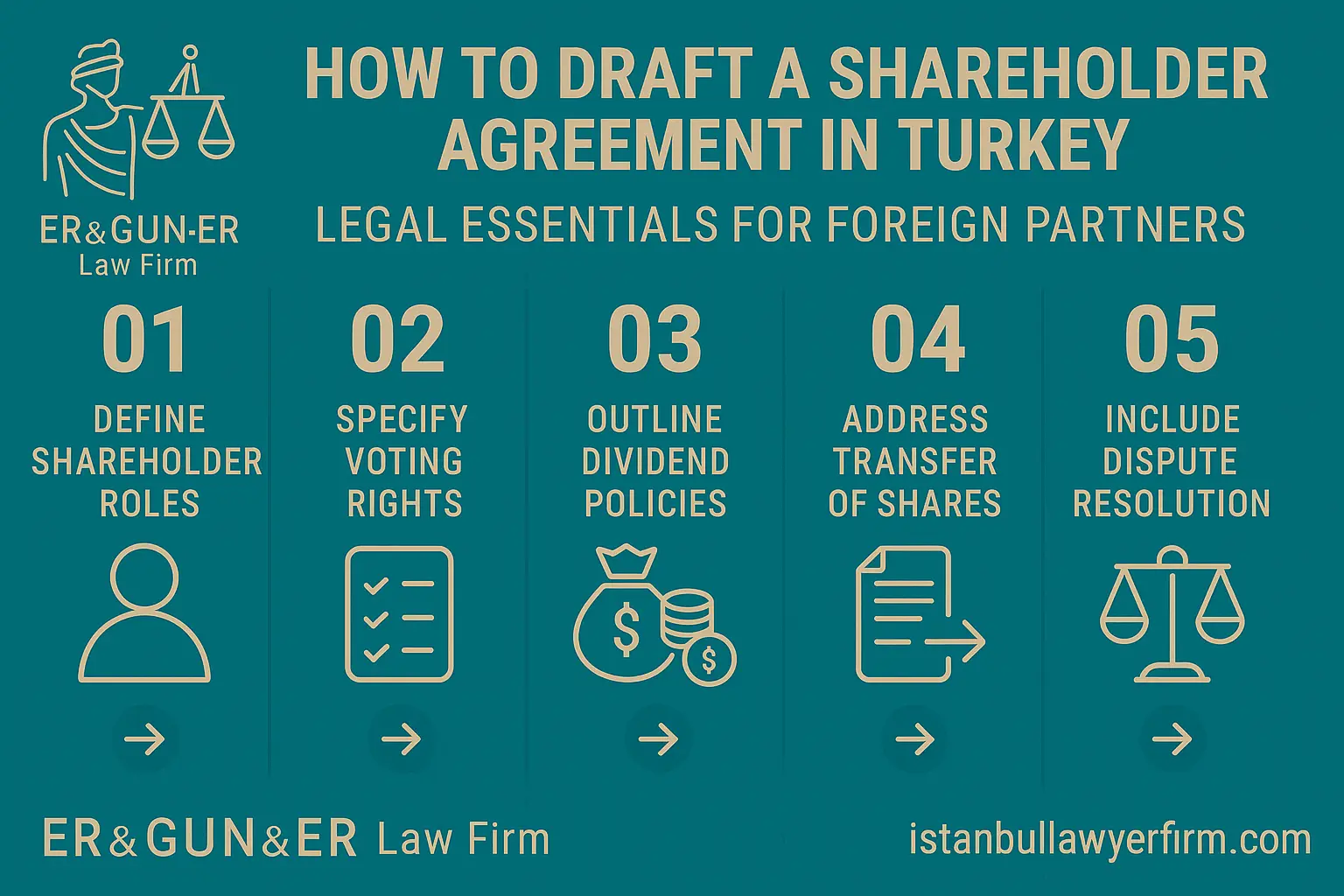
A shareholder agreement (pay sahipleri sözleşmesi, "SHA") is the principal contractual instrument that governs the relationship among the owners of a Turkish company beyond what the articles of association can address. The Turkish Commercial Code (Law No. 6102, "TTK") does not regulate SHAs as a standalone contract type. They live instead in the territory of contract freedom under Article 26 of the Code of Obligations (Law No. 6098, "TBK"), enforceable as private contracts among their signatories on the same basis as any commercial agreement governed by Turkish law. This is the doctrinal starting point that determines what an SHA can and cannot do in Turkey.
The most important consequence of this characterisation is the doctrine of relativity of contract: an SHA binds the parties who signed it, and only those parties. The company itself is not bound by an SHA unless it is a signatory, which is uncommon in Turkish practice. A board decision taken in violation of an SHA voting commitment is not invalid as a corporate act; it is a breach of contract giving the aggrieved party a damages claim against the breaching shareholder, but it does not unwind the corporate decision. Understanding this distinction shapes everything that follows in the drafting analysis. ER&GUN&ER Law Firm advises foreign investors, founders, family offices, and joint venture parties on Turkish SHAs covering voting and board control, reserved matters and veto rights, transfer restrictions and exit mechanisms, founder vesting, minority protection, deadlock resolution, and dispute resolution architecture.
The Legal Nature of an SHA Under Turkish Law
SHAs are governed by the general contract rules of the Code of Obligations supplemented by the corporate-law context of the Commercial Code. As private contracts, they are enforceable according to their terms as between the signing shareholders, with damages as the standard remedy for breach and specific performance available where the breach can be cured by a specific act (such as a forced share transfer under a drag-along clause). The body of TBK general provisions — Article 27 on impossibility, Article 26 on contract freedom, Articles 112-126 on debtor's liability — applies in the standard way.
The doctrinal contrast with the articles of association (esas sözleşme) is structural. The AoA is a corporate document filed with the Trade Registry, binding on the company and on third parties dealing with the company in good faith, and amendable only through the formal procedures of TTK Articles 421 (for joint stock companies) or 589 (for limited liability companies). The AoA establishes the corporate constitution. The SHA is a private contract layered above it, binding only the signatories, modifiable by their unanimous agreement, and not visible to third parties unless one of the parties chooses to disclose it.
This creates the standard drafting principle: where a provision must bind the company or affect third-party rights, it must go in the AoA; where a provision regulates the relationship among shareholders without needing to bind anyone else, it goes in the SHA. Reserved matters that need to bind the board's authority belong in the AoA. Founder vesting that operates as a buy-back commitment among shareholders belongs in the SHA. Pre-emption rights restricting share transfer effectiveness against the company belong in the AoA. Drag-along rights compelling a co-shareholder to sell their shares are SHA territory. Mixing these up creates enforceability gaps that surface only when the dispute arises.
Articles of Association vs Shareholder Agreement: Where Each Operates
The TTK's joint stock company regime grants the AoA significant scope to modify default rules. Articles 478-481 permit the creation of privileged shares carrying voting weight, dividend preference, or liquidation preference. Article 421 sets the supermajority thresholds for AoA amendments, with specific qualified majorities for capital increases, mergers, conversion of share form, and other fundamental changes. Article 492 permits transfer restrictions on registered shares, and Article 493 sets the procedural framework for the company's refusal of share transfers on AoA-permitted grounds.
The SHA picks up where the AoA leaves off. Founder vesting, deferred consideration mechanics, earn-outs on initial investment, side letters on information rights, voting commitments among specific shareholders without binding all shareholders, drag-along and tag-along rights, exit-event triggers, deadlock resolution mechanisms, founder leaver provisions — all of these are SHA territory because the AoA either cannot accommodate them or doing so would create disclosure or formality issues the parties prefer to avoid.
The two documents must be drafted in alignment. An AoA pre-emption right that contradicts an SHA right of first refusal creates an internal conflict, and the AoA wins as a matter of corporate law. A reserved matter veto in the AoA that grants the foreign investor a vote on capital increases must be matched by an SHA undertaking from the founder shareholders not to circumvent the veto through alternative structures. We draft the AoA and the SHA together for every transaction where both documents are needed, because reviewing the SHA in isolation from the AoA misses cross-document conflicts that matter at enforcement.
Voting Agreements and Board Control
Voting agreements (oy sözleşmeleri) are the SHA mechanism by which shareholders commit to vote their shares in defined ways. They are valid under Turkish law as private contracts among the parties, and they are enforceable through the standard breach-of-contract remedies. The classic enforceability point — settled in Turkish doctrine and Court of Cassation case law — is that a vote cast in violation of a voting commitment remains a valid corporate act; the consequence of the breach runs against the breaching shareholder personally, in the form of damages and (where the SHA so provides) liquidated damages, not against the corporate decision the vote produced.
This is why voting agreements are typically reinforced with two structural mechanisms in well-drafted SHAs. First, a meaningful liquidated damages clause — calibrated to a multiple of the pecuniary value of the breached vote — that converts the breach into a clear financial cost. Second, a proxy or irrevocable proxy mechanism whereby the parties grant a designated person the authority to cast the vote on behalf of the committed shareholder, neutralising the unilateral defection risk. Neither mechanism is perfect, but the combination materially reduces the practical defection rate from voting commitments.
For board representation, the voting agreement architecture extends to a commitment to elect specified directors at the general assembly. The investor's nominee right at the board level is operationally implemented through the SHA's voting commitment to support the nominee at every general assembly election cycle, plus the AoA's allocation of board seats to specified share groups under TTK Article 360 where the AoA permits group-allocated seats. We typically use a hybrid: the SHA carries the voting commitment from all signing shareholders, and the AoA reflects the structural board-seat allocation through privileged share classes or board-nomination rights tied to share categories.
Reserved Matters and Veto Rights
Reserved matters (onaya tabi konular) are decisions that require approval of specified shareholders or director categories beyond the default majority threshold. They are the primary mechanism through which minority investors retain meaningful control over key strategic and financial decisions in a company they do not formally control. A foreign investor holding 25% of a Turkish A.Ş. can — through carefully drafted reserved matters — effectively block capital increases, M&A transactions, change of business purpose, related-party transactions, change of auditor, dismissal of senior management, change of dividend policy, and other strategic moves that would otherwise be carried by the majority.
The drafting question is whether the reserved matter sits at the shareholder level (general assembly approval requirement) or at the board level (board approval requirement with the investor's nominee director's vote being the practical block), and whether the veto is implemented through the AoA's qualified majority requirements or through the SHA's voting commitments. Each route has trade-offs. The AoA route makes the veto a corporate-law fact: a decision taken without the qualified majority is invalid as a corporate act. The SHA route keeps the structure private but produces only a damages remedy if the veto is breached.
For investments where the foreign investor's veto is economically central to the deal — such as private equity investments where the investor's ability to block down rounds, dilutive issuances, and exit timing is the core protection — we typically push the reserved matters into the AoA, even at the cost of disclosure, because the corporate-law force of the AoA-based veto is materially stronger than an SHA-based equivalent. For lighter joint-venture structures where the parties have ongoing operational alignment, SHA-based reserved matters with voting commitments and liquidated damages clauses are the standard practice.
Transfer Restrictions: ROFR, Pre-emption, Tag-Along, Drag-Along
The TTK provides default transfer rules: registered shares of an A.Ş. transfer through endorsement and entry in the share register under TTK Articles 490-491; bearer shares transfer through delivery plus MKK notification under TTK Article 489 as amended by Law No. 7262 effective 5 April 2021; Ltd. Şti. shares transfer through notarised written agreement plus general assembly consent plus Trade Registry registration under TTK Articles 595-598. The AoA can restrict transfers under TTK Article 492 on grounds set out in the articles. Above and beyond the AoA, the SHA can layer additional contractual restrictions binding only the signing shareholders.
The standard SHA transfer restrictions are: a right of first refusal (ROFR, ön alım hakkı in contractual rather than statutory form) requiring a selling shareholder to first offer the shares to the other SHA parties at the third-party offer price; a right of first offer (ROFO) requiring the seller to negotiate with the SHA parties before approaching third parties; tag-along rights (birlikte satış hakkı) entitling minority shareholders to participate in a sale by majority shareholders at the same per-share price; and drag-along rights (birlikte satışa zorlama hakkı) enabling majority shareholders to compel minority shareholders to sell at the negotiated terms.
Each of these mechanisms is contractual, with no specific TTK basis, and each requires careful drafting on triggers, notification mechanics, exercise periods, calculation of the offer price, and consequences of non-compliance. Drag-along clauses in particular require attention because they involve compelling a person to transfer property: the drafting must include a power of attorney mechanism (often an irrevocable power of attorney appointing the majority shareholder as agent for the limited purpose of executing the transfer documentation) to ensure the drag is operationally executable even if the dragged shareholder refuses to sign. Practice may vary by authority and year on the validity of irrevocable powers of attorney for share transfers; the Court of Cassation has accepted them in commercial contexts subject to specific conditions on their scope and term.
Exit Mechanisms: Put/Call, Russian Roulette, Texas Shootout
The classic exit mechanisms in joint-venture SHAs are put options (the minority's right to sell to the majority on triggering events), call options (the majority's right to buy out the minority on triggering events), and the various forced-buy-or-sell mechanisms used to break deadlocks. Put and call options are standard contractual instruments, valid under Turkish law as conditional promises to enter into a sale, with the trigger conditions, exercise periods, and price calculation methodology all freely set by the parties.
The deadlock-breaking mechanisms — Russian roulette (one party offers a price, the other can either buy at that price or sell at that price), Texas shootout (sealed bids by both parties, highest bidder buys), and Mexican shootout (modified Texas with multiple round bidding) — are used in joint-venture SHAs where two equal parties need a mechanism for situations where they cannot agree on the company's direction. Each of these mechanisms is enforceable under Turkish contract law, with the practical caveat that the mechanism only works if one party has the capital to follow through on the trigger; an evenly-matched standoff between two cash-strapped parties produces no transaction even when the mechanism formally applies.
The price calculation methodology is the drafting battleground for all exit mechanisms. EBITDA multiples, revenue multiples, net asset value, discounted cash flow, last-round investor valuation, third-party fair-market-value appraisal — each produces different numbers in different scenarios, and the choice should reflect the specific commercial logic of the deal. We typically use a tiered approach: a formula price (EBITDA multiple or similar) for friendly exits, a third-party expert valuation for contested exits, and a fair-market-value with discount for forced-sale scenarios such as bad leaver buyouts. Practice may vary by authority and year on the enforceability of formula prices that materially deviate from market value at exercise; the Court of Cassation has occasionally adjusted contractual prices on equity grounds where the deviation reflects a manifest disparity.
Founder Vesting and Good/Bad Leaver Provisions
Founder vesting (kurucu pay vesting) is the mechanism by which founder shareholders earn their shares over time, typically with a four-year vesting period and a one-year cliff. The structure is implemented as a buy-back right held by the company or by the investor: if the founder leaves the company before the vesting completes, the unvested portion of their shares can be repurchased at a nominal price or at the original issuance price. Vesting protects the company and the investor from a founder who takes equity and then disengages early without contributing the contemplated work and value.
The good leaver / bad leaver distinction modulates the buy-back price. A good leaver — someone who leaves due to death, permanent disability, or termination without cause — typically receives fair market value for their vested shares and a higher percentage on the unvested. A bad leaver — someone terminated for cause, or who resigns voluntarily before the vesting completes, or who breaches a non-compete — receives a nominal or low formula price for the unvested shares and possibly a discount on the vested shares as well. The drafting of the leaver classification is the most contested part of the SHA in founder-investor negotiations, because the difference between good and bad leaver classification can mean order-of-magnitude differences in the founder's payout.
Implementing vesting in a Turkish SHA requires reconciliation with the TTK rules on share buy-backs. TTK Article 379 limits a Turkish A.Ş.'s ability to acquire its own shares to 10% of issued capital, with the acquisition financed from distributable funds and subject to general assembly authorisation. For larger vesting buy-backs, the structure typically uses a co-shareholder buy-back (the investor or founder co-shareholders acquiring the unvested shares) rather than a company buy-back, to avoid the TTK Article 379 cap. The SHA needs to track this structural choice consistently across the vesting trigger, the buyer designation, the price mechanism, and the share transfer execution.
Privileged Shares Under TTK Article 478 and Contractual Equivalents
TTK Article 478 permits the creation of privileged shares (imtiyazlı paylar) carrying voting privilege, dividend privilege, liquidation privilege, or other privilege specified in the AoA. Voting privilege under Article 479 is capped at 15 votes per privileged share, with the cap not applying where the privilege is necessary for institutional protection. Dividend privilege grants a preferential right to dividend distribution. Liquidation privilege grants a preferential right to the proceeds in a liquidation event. These are corporate-law instruments embedded in the AoA, and they bind the company and third parties.
The SHA can replicate or extend the privileged share concept through contractual equivalents. A liquidation preference SHA clause obligates the founder shareholders to distribute exit proceeds to the investor at the agreed preference level before any pro rata distribution. A dividend preference SHA clause obligates the founder shareholders to vote for a specified dividend in any year where distributable profits exceed a threshold. A board nomination right SHA clause obligates the founder shareholders to vote for the investor's nominee at every board election cycle.
The choice between AoA-based privileged shares and SHA-based contractual equivalents is again about corporate-law force versus contractual privacy. AoA privileged shares are a public corporate fact that binds the company and is visible to third parties (creditors, future investors, acquirers); SHA contractual equivalents bind only the signing shareholders and remain confidential between them. For early-stage and growth investments where the investor wants institutional-grade protection, AoA privileged shares are usually the right answer. For joint ventures and family-business arrangements where confidentiality matters more than corporate-law force, SHA contractual equivalents are the working choice. We model both routes for every investment that has a meaningful preference component.
Minority Protection: TTK Statutory Rights Plus Contractual Layering
The TTK grants minority shareholders a defined set of statutory rights independent of any SHA: the right to call a general assembly under Article 411 (for shareholders representing at least 10% of capital, or 5% in publicly held companies), the right to demand items on the agenda under Article 412, the information and inspection rights under Article 437, the special audit right under Articles 438-444, the right to challenge general assembly decisions under Articles 445-451, the right to bring liability claims against directors under Articles 553-555, and the right to seek dissolution for just cause under Article 531.
These statutory rights operate as the floor below which minority protection cannot be reduced by AoA or SHA. An SHA provision purporting to waive a minority shareholder's right to challenge general assembly decisions would be unenforceable as contrary to mandatory law. The contractual layering above this statutory floor is where minority protection actually gets built: information rights more frequent than the TTK default, audit rights with the auditor selected by the minority, board observer rights with attendance and information access, veto rights on reserved matters, and the consent rights tied to capital increases that determine whether the minority can be diluted in down rounds.
For foreign investors taking minority positions in Turkish targets, the right combination is typically: the AoA carrying the qualified-majority reserved matters and the privileged share classes, the SHA carrying the operational information and audit rights and the additional contractual reserved matters, and the side letter (where the deal architecture supports it) carrying the most sensitive bilateral commitments. Each layer plays a specific role, and the combination produces the minority protection package that institutional investors expect.
Deadlock Resolution and the TTK 531 / 638 Dissolution Path
A deadlock between shareholders or between board members aligned with different shareholder factions is the specific scenario that breaks joint ventures. The SHA's deadlock resolution architecture typically follows a graduated path: first, escalation to senior representatives of each party for negotiation in good faith over a defined period; second, mediation under a recognised institutional procedure (the Istanbul Mediation Centre, ICC mediation, or similar); third, binding arbitration under the dispute resolution clause if mediation fails; and fourth, the deadlock-breaking mechanisms (Russian roulette, Texas shootout) as the last contractual resort.
Where the SHA's mechanisms fail to produce a resolution, the TTK provides a statutory backstop. For A.Ş. companies, Article 531 gives shareholders representing at least 10% of capital (5% in publicly held companies) the right to seek dissolution for just cause before the commercial court. The court can order dissolution, can order a forced share purchase by the company or by other shareholders at fair value, or can order any other appropriate remedy. The "just cause" standard is intentionally broad and has been applied by Turkish courts to cover persistent voting deadlocks, abuse of majority, exclusion of minority from management, and breakdown of trust between shareholders.
For Ltd. Şti. companies, Article 638 grants any shareholder the right to seek dissolution for just cause, with the court able to order dissolution or substitute remedies including forced exit of the requesting shareholder against fair value compensation. The Article 638 procedure is the standard exit route for Turkish Ltd. Şti. minority shareholders trapped in unproductive co-ownership relationships, and the case law has matured significantly since the TTK came into force in 2012. Practice may vary by authority and year on the specific remedies the courts grant; the trend has been toward forced-exit remedies rather than full dissolution where the company is operationally viable.
Confidentiality, Non-Compete, and Non-Solicit Clauses
Confidentiality undertakings in SHAs cover the SHA itself, the company's commercially sensitive information, the parties' business strategies, and any third-party information the parties exchange in connection with the investment. The drafting follows standard NDA architecture with carve-outs for legally compelled disclosure, public domain information, independently developed information, and information disclosed to professional advisers under their own confidentiality duties. Turkish law treats confidentiality undertakings as freely enforceable under TBK Article 26, with breach giving rise to damages and (where the SHA provides) liquidated damages.
Non-compete (rekabet yasağı) and non-solicit clauses in SHAs are enforceable subject to the limitations of TBK Articles 444-447 (which apply directly to employment relationships) and the analogous principles applied by analogy to commercial relationships. The enforceability test requires that the non-compete be reasonable in scope (geographic, temporal, and substantive), proportionate to the legitimate interests being protected, and not so broad as to deprive the bound party of the ability to earn a living in their profession. The Turkish courts have been willing to enforce non-competes against founder-shareholders for two-to-three-year periods covering the geographic markets where the company operates, but have struck down non-competes that were broader than the company's actual market footprint.
Non-solicit clauses — restricting the bound party from hiring the company's employees or soliciting its customers — face a lower enforceability threshold than non-competes because they restrict less of the bound party's economic activity. Turkish courts have generally enforced non-solicits for two-to-three-year periods covering the company's actual employee base and customer base. Practice may vary by authority and year on the specific scope test the courts apply; the Constitutional Court's case law on the right to free economic activity has refined the analysis multiple times since 2010.
Dispute Resolution and Enforcement
SHA dispute resolution clauses typically choose between Turkish commercial court litigation and arbitration, with arbitration being the preferred choice in most institutional-grade SHAs. The most common venues are the Istanbul Arbitration Centre (ISTAC) under Law No. 6570 of 29 November 2014 for Turkish-domestic disputes, ICC arbitration for cross-border investments where the foreign investor wants institutional familiarity, and occasionally LCIA or SCC arbitration for specific industries. The seat is typically Istanbul for ISTAC and ICC arbitrations, though the seat can be moved abroad where the parties prefer.
The substantive law of the SHA is almost always Turkish law, because the underlying corporate structure is governed by Turkish law and applying foreign law to the SHA would create internal inconsistencies in interpretation. The procedural framework is the chosen institution's rules. The language is typically English with Turkish translations where required for execution against domestic assets. Awards are enforceable in Turkey under Article 18 of Law No. 6570 (for Turkish-seated arbitrations) or under the New York Convention 1958 acceded to by Turkey through Law No. 3731 effective 25 September 1991 (for foreign-seated arbitrations).
For specific clauses that require court intervention — such as injunctive relief to prevent share transfers in violation of an SHA, or recognition of a forced share transfer under a drag-along — the SHA should preserve the right to seek interim measures from the Turkish commercial courts pending the arbitration outcome. ISTAC and ICC rules both permit this carve-out without prejudicing the arbitration agreement. We draft the carve-out specifically to ensure that the foreign investor can secure injunctive relief in real time even where the substantive dispute proceeds under arbitration on the standard timeline. Practice may vary by authority and year on the Turkish courts' willingness to grant injunctive relief in support of pending arbitration; the trend has been increasingly receptive since 2018.
Frequently Asked Questions
- Is a shareholder agreement regulated by the Turkish Commercial Code? No. SHAs are private contracts under Article 26 of the Code of Obligations, enforceable as commercial agreements among their signatories. The TTK governs the corporate-law layer above which the SHA operates.
- Does an SHA bind the company itself? Only if the company is a signatory, which is uncommon in Turkish practice. SHAs typically bind only the signing shareholders, with damages as the remedy for breach.
- Can an SHA override the articles of association? No. Where the AoA and the SHA conflict, the AoA prevails as a corporate-law document. The SHA can supplement and add to the AoA but cannot override it as against the company.
- Are voting agreements enforceable? Yes, as private contracts. A vote cast in violation of a voting commitment is a valid corporate act, but the breaching shareholder is liable for damages and (where the SHA provides) liquidated damages.
- Can drag-along clauses force a minority to sell? Yes, when properly drafted with a power-of-attorney mechanism enabling execution of the transfer documentation by the dragging party. The price calculation methodology and trigger conditions need careful drafting.
- What are reserved matters? Decisions that require a higher consent threshold than the default majority, typically used to give minority investors veto power over key strategic and financial decisions. They can be implemented in the AoA (corporate-law force) or in the SHA (contractual force only).
- Is founder vesting recognised under Turkish law? Yes, as a contractual buy-back commitment among shareholders. The buy-back is typically structured as a co-shareholder purchase rather than a company purchase to avoid the TTK Article 379 10% cap on company self-acquisition.
- Can a shareholder seek dissolution of the company? Yes, under TTK Article 531 for A.Ş. (shareholders holding at least 10% of capital) or Article 638 for Ltd. Şti. (any shareholder), where there is just cause. The court can order dissolution or substitute remedies including forced share purchase at fair value.
- What are the privileged share rights under TTK Article 478? The AoA can grant voting privilege (capped at 15 votes per share under Article 479), dividend privilege (preferential dividend right), liquidation privilege (preferential liquidation proceeds), and other AoA-specified privileges.
- Are non-compete clauses enforceable against founders? Yes, subject to reasonable scope (geographic, temporal, substantive) and proportionality to the legitimate interests protected. Turkish courts have enforced non-competes for two-to-three-year periods covering the company's actual market footprint.
- What dispute resolution forums work for Turkish SHAs? ISTAC arbitration under Law No. 6570 for Turkish-domestic disputes; ICC arbitration for cross-border investments; Turkish commercial courts where arbitration is not chosen. Foreign awards are enforceable under the New York Convention 1958.
- Can the SHA be in English only? The SHA can be in English as the operative language. A Turkish translation may be required for execution against domestic assets, registration where applicable, and court proceedings before Turkish courts. Bilingual execution is the standard practice.
- Are SHAs disclosed publicly? No. Unlike the AoA, the SHA is a private document not filed with the Trade Registry and not visible to third parties unless a party chooses to disclose it.
- Can a Turkish company acquire its own shares? Yes, up to 10% of issued capital under TTK Article 379, financed from distributable funds and subject to general assembly authorisation. Larger buy-backs require co-shareholder structures.
- Where does ER&GUN&ER Law Firm support SHA matters? Pre-investment structuring, AoA-SHA architecture, voting and reserved matter design, transfer restriction drafting, founder vesting and leaver provisions, deadlock resolution, dispute resolution clauses, and SHA enforcement (including TTK Article 531/638 dissolution claims) before the commercial courts and arbitration.
Author: Mirkan Topcu is an attorney registered with the Istanbul Bar Association (Istanbul 1st Bar), Bar Registration No: 67874. His practice focuses on cross-border and high-stakes matters where evidence discipline, procedural accuracy, and risk control are decisive.
He advises foreign and Turkish founders, investors, family offices, and joint venture parties across Shareholder Agreements, Joint Ventures, Mergers and Acquisitions, Corporate and Commercial Law, Minority Protection, Founder Disputes, and cross-border documentation matters where procedural accuracy and evidence discipline are decisive.
Education: Istanbul University Faculty of Law (2018); Galatasaray University, LL.M. (2022). LinkedIn: Profile. Istanbul Bar Association: Official website.