

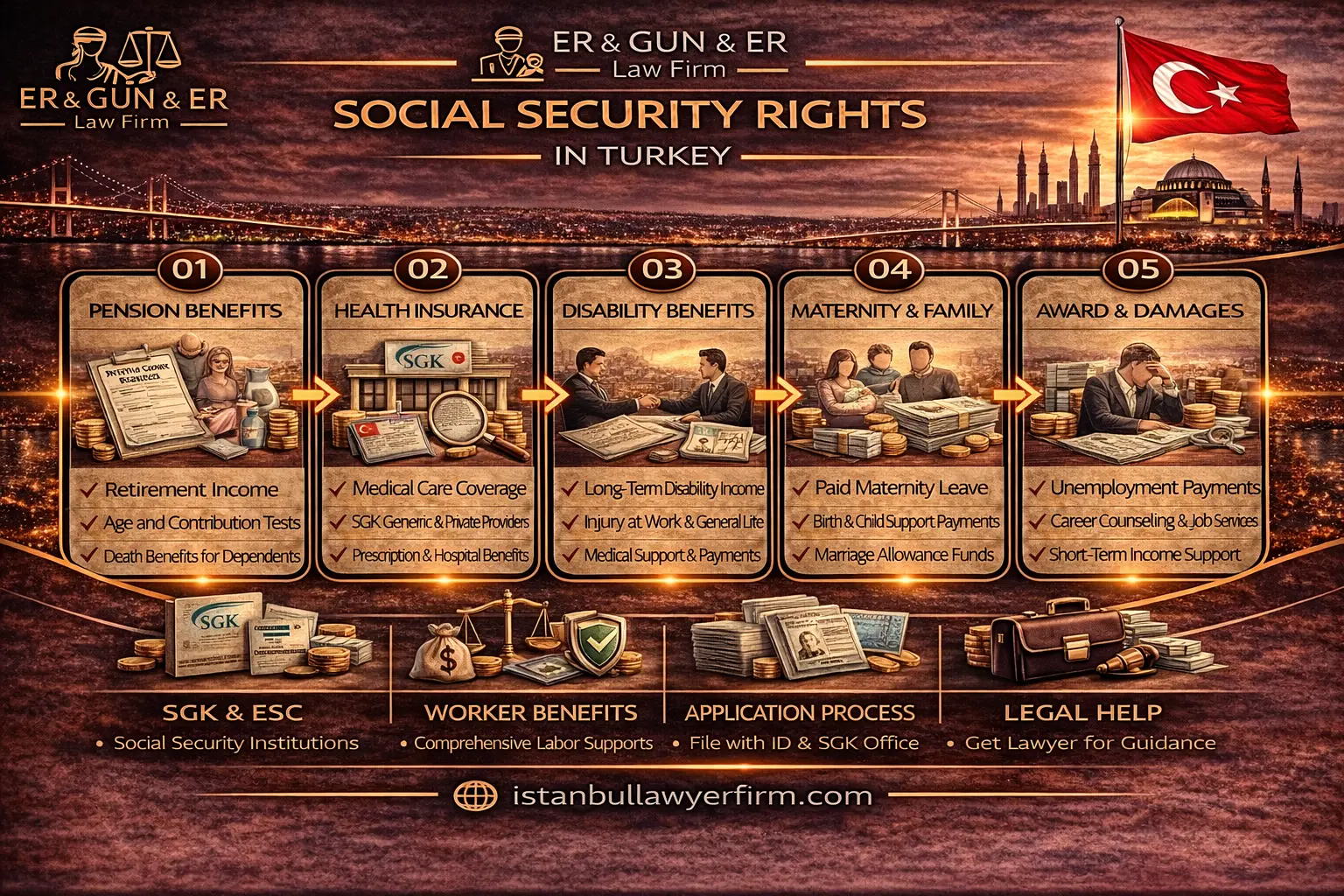
Social security rights in Turkey and SGK benefits

Social security rights in Turkey are primarily administered through SGK and depend on how a person is registered, how contributions are reported, and what evidence exists in the official records. The phrase social security rights Turkey is practical because entitlements are rarely assessed by intention, but by contribution history and status category shown in the system. For employees, the most common problems arise when payroll reality and SGK reporting diverge, which later affects health coverage, incident protections, and retirement logic. For employers, compliance risk arises when reporting is incomplete, late, or inconsistent with employment documents, even if wages were paid. Disputes are usually resolved through a combination of administrative requests, objections, and court pathways, and the correct lane depends on the record set. “practice may vary by authority and year — check current guidance.” When the file is cross-language or the employment structure is complex, many parties work with English speaking lawyer in Turkey to keep submissions, translations, and evidence packs consistent.

What SGK rights include

SGK rights and benefits Turkey cover multiple entitlement lanes, and each lane is tied to recorded status and contribution history. The first lane is health coverage access and the ability to receive services under the registered health framework. The second lane is work-incident protections that connect workplace events to benefit pathways when evidence exists. The third lane is occupational disease protections that require recognition and documentation over time. The fourth lane is sickness and disability supports that depend on medical evidence and recorded insurance status. The fifth lane is maternity and family supports that follow status and recorded contribution conditions. The sixth lane is retirement and pension logic that is built from contribution days, status categories, and official record integrity. None of these lanes can be evaluated safely by quoting generic thresholds in a static article, because parameters vary and must be verified for the person and period. “practice may vary by authority and year — check current guidance.” A practical way to understand scope is to view SGK as a record-driven system where rights follow documented facts rather than verbal assurances. When the record is clean, access to services and benefits is usually straightforward in administrative terms. When the record is inconsistent, the first battle is often about reconstructing what should have been recorded. The right-holder should therefore begin by extracting the record set and creating a timeline of registrations, employers, and declared periods. The timeline should be built from official prints and screenshots captured with dates. The timeline should then be compared to employment documents and bank payment proofs as context evidence. The file should remain neutral and focus on what can be proven rather than on what was expected emotionally. A disciplined approach keeps the issue in the correct lane rather than mixing all benefits into one complaint. In complex cases, coordination with lawyer in Turkey helps keep the file consistent across SGK and labor dispute steps.

Entitlements also include procedural rights, meaning the right to request explanations, to access records, and to challenge incorrect registrations through formal channels. A person should treat the SGK record as the first exhibit and not rely on memory for employment dates. A person should also understand that different insurance status categories may exist across a career and each category can affect what is counted for entitlement logic. A person should not assume that one period of employment automatically validates another period, because each period is recorded and assessed separately. A person should capture the current SGK registration summary and store it as a dated record. A person should then capture contribution summaries and any visible employer declarations in the system. A person should then create an evidence map that links each period to a contract, a payroll slip, or a bank transfer proof if available. The evidence map is used later in dispute lanes because SGK and courts often test whether the claimed work was real and continuous. “practice may vary by authority and year — check current guidance.” A person should also treat employer identity as a key variable, because group structures and subcontracting arrangements can create confusion in records. A person should avoid informal communications that contain legal conclusions and instead keep a factual statement of what happened and when. The record should also be checked for obvious inconsistencies like missing months or wrong workplace codes, but the article avoids listing codes because practice evolves. If inconsistencies exist, the first step is usually to request clarification and correction through formal channels, not to jump to litigation. Litigation is reserved for when administrative correction is refused or insufficient. For procedural orientation, the overview at labor law updates overview can help frame how documentation and record discipline affect disputes without introducing numeric claims.

Scope also includes employer-side duties because employer SGK premium obligations Turkey are the mechanism that funds entitlements. Employers must register employees correctly and maintain consistency between payroll, employment documents, and reported contributions. Employers must preserve employment contracts and onboarding records to prove status and start dates. Employers must preserve time and wage records that explain why contributions were declared at certain bases, without guessing rates in communications. Employers must preserve termination records because end dates affect the record timeline and later entitlements. Employers must also coordinate subcontracting relationships because subcontractor failures can create downstream disputes for workers and principal employers. Workers should keep their own copies of contracts, payslips, and bank transfers as secondary evidence in case employer records are incomplete. “practice may vary by authority and year — check current guidance.” A disciplined approach treats every employment event as a dated record change that must be reflected in both HR files and SGK outputs. This is why file integrity is as important as substantive entitlement rules. When disputes arise, the strongest cases are usually the ones with clean timelines and consistent exhibits. For sustained compliance, many organizations rely on Turkish Law Firm to set a repeatable documentation and reconciliation workflow.

Insurance status categories

Insurance status categories determine how a person is recorded and which entitlement lane is triggered in SGK practice. The first category concept is employee coverage where work is performed under an employment relationship and the employer reports the person. The second category concept is self-employment style coverage where the person’s registration and payments follow a different administrative track. The third category concept is special categories that can apply to public roles or other legally defined groups, depending on the person’s career history. The practical rule is that status is what the system records, and correcting status requires evidence and proper procedure. A person should not assume that the label used in a workplace conversation matches the SGK status category on record. A person should first obtain the official record summary and identify what status codes or descriptions are shown, without relying on informal paraphrases. A person should then map each employment period to the employer identity and the registration type as shown. If the person changed status categories over time, the file should record the change events as dated items and identify the evidence that caused the change. “practice may vary by authority and year — check current guidance.” A clean status map helps determine what records will be requested and what objections are relevant. It also helps avoid filing the wrong claim type, which wastes time and creates confusion. Where the person worked through multiple employers, the map should show each employer and the transition points. Where the person worked through subcontractors, the map should show the contracting chain and the visible employer in SGK records. If the person has gaps, the map should show whether the gap is genuine unemployment, unregistered work, or a record error. A structured map becomes the backbone of later dispute steps because it tells the story in a verifiable way. In cross-border employment structures, many parties seek English speaking lawyer in Turkey to align English contracts with Turkish status records without drift.

Status categories also affect how general health insurance Turkey SGK is experienced, because access can depend on current registration and contribution continuity in the record. A person should not assume that a past registration guarantees ongoing coverage if the current status is unclear or inactive. A person should therefore treat coverage as a record check, not as a belief. A person should download or print the relevant status and coverage screens as dated exhibits for future reference. A person should also check whether dependents are included where applicable, but the details depend on status and current guidance. “practice may vary by authority and year — check current guidance.” Employers should also understand that misclassification can harm workers and can create employer dispute exposure later. If a worker is treated as independent contractor but the reality looks like employment, the mismatch can create both labor and SGK disputes. That mismatch should be evaluated carefully and corrected through proper channels where necessary, rather than being left to “later.” The file should preserve the work reality evidence, such as schedules, supervision records, and payments, because classification disputes turn on substance. The file should remain factual and avoid broad legal labels in routine communications, because those labels can backfire. If a correction is needed, it should be pursued through documented steps with a clear evidence pack. In difficult classification patterns, consultation with Turkish lawyers can help align employment structure, documentation, and SGK posture without guessing outcomes.

Status categories can also influence dispute routes, because some disputes are handled primarily through SGK administrative channels while others require labor court involvement. A person should therefore avoid jumping to a court filing without first understanding what record is being challenged and what administrative remedy exists. “practice may vary by authority and year — check current guidance.” For example, if a record period is missing entirely, a service detection lawsuit Turkey SGK may be considered, but only after the file is built and the lane is appropriate. If the dispute is about an employer’s declaration accuracy, the evidence pack may need payroll, bank transfers, and witness context. If the dispute is about entitlement, the evidence pack may need medical records and administrative decision papers. The file should keep each lane separated: status proof lane, contribution proof lane, benefit event lane, and dispute lane. This separation prevents the common failure where a complaint tries to cover everything at once and therefore proves nothing. A disciplined status analysis also helps employers implement compliance controls, such as onboarding checklists and termination checklists, that prevent record drift. Employers can align their HR file discipline with the internal guidance at employee file documents overview to keep records consistent without making numeric claims. When a status category dispute exists, a well-documented file often resolves faster because the facts are clear and the questions are narrow.

Contribution records importance

SGK contribution records Turkey are the primary factual basis for most entitlements, and weak records are the most common reason disputes escalate. A person should treat contribution records as the “spine” of the SGK file because they show who reported, when they reported, and what period was recorded. A person should obtain the contribution record extracts and store them as dated exhibits, because records can be updated and the history matters. A person should compare contribution records to contracts and payslips to detect gaps and mismatches. A person should compare contribution records to bank payment history where available, because bank transfers often support the reality of employment. A person should detect whether a gap is due to unemployment, a reporting error, or unregistered work. A person should document each gap as a ticket and assign a verification step rather than speculating. “practice may vary by authority and year — check current guidance.” An employer should reconcile payroll and SGK submissions routinely to prevent mismatches from accumulating. An employer should keep submission receipts and internal payroll reports as evidence of what was intended. An employer should maintain a correction procedure for reporting errors and document each correction as a change event. A person should avoid relying on “it will be fixed later,” because later fixes are harder when documents are lost. A person should preserve employment communications that show start dates and working reality, but keep privacy proportional. A person should build a timeline that links each month to a document or an explanation. A clean timeline can be used in administrative objections and in court pleadings later if necessary. A person should avoid making legal conclusions in the timeline and keep it factual. A disciplined contribution record file often resolves disputes earlier because it reduces ambiguity.

Contribution records also matter for retirement eligibility Turkey SGK discussions, but this article will not state numeric age tables or day thresholds because those must be verified for the person and period. “practice may vary by authority and year — check current guidance.” The safe approach is to explain that retirement logic depends on recorded days, insured periods, and status categories, and therefore record integrity is essential. If a record period is missing, a person may find that projected entitlement is affected, which is why early detection is important. The file should therefore include a “projection memo” that is internal and states that projections are provisional and depend on verified records. The file should focus on correcting record issues first, then assessing entitlement logic based on updated records. If the employer misreported, the file should document the misreporting evidence and pursue the correct lane for correction. If the work was unregistered, the file should document the work reality evidence and consider the correct dispute route, but without promising outcomes. Employers should understand that record drift is not only an SGK issue; it is also a labor dispute risk because it affects severance and notice calculations in some contexts. The conceptual link between employment documentation and disputes is explained in termination overview and severance overview, and those can be used to reinforce file discipline without using numeric claims. A coherent contribution record approach is therefore both a benefits protection and a dispute prevention tool.

Contribution record discipline also supports benefit event claims such as work accidents and occupational disease, because those claims often require proving status and coverage at the relevant time. If records are missing for the period when an event occurred, proving coverage becomes harder and disputes become more likely. “practice may vary by authority and year — check current guidance.” That is why both workers and employers should treat record integrity as a safety net. Workers should keep copies of contracts, payroll slips, and bank transfers for critical periods. Employers should keep HR files and payroll submission receipts for the same periods. Employers should also keep incident reports and workplace logs where incidents occur, because those documents interact with SGK event claims. The file should implement a “document preservation rule” when a dispute or incident arises, meaning documents are archived and not overwritten. The file should also maintain a “correction log” when records are updated, because later disputes can ask what changed and why. A disciplined record approach reduces the need for witnesses because documentary proof is stronger and less contested. It also reduces internal conflict because records provide objective reference points. For complex records with multiple employers, many parties work with law firm in Istanbul to build a clean consolidated timeline and to avoid inconsistent narratives across different lanes.

Employer reporting duties

Employer reporting duties are the operational obligations that turn employment reality into SGK record reality, and failures in this area drive many disputes. The phrase employer SGK premium obligations Turkey is often discussed as numbers, but this article does not state premium rates because they must be verified and vary by status and period. “practice may vary by authority and year — check current guidance.” The practical duties include registering the employee correctly at the start, reporting declared periods consistently, and maintaining records that match payroll and timekeeping. Employers must keep employment contracts, onboarding forms, and identity proofs in an employee file so start and end dates are provable. Employers must keep payroll records that explain declared bases without improvising labels. Employers must reconcile payroll outputs with SGK submissions to detect mismatches early. Employers must preserve submission receipts and the logic of any corrections made. Employers must handle termination reporting in a way that matches termination documents and delivery proofs. Employers must keep internal approvals for payroll changes that affect declared bases so later questions can be answered. Employers must not rely on verbal assurances to employees that a record will be corrected later, because later correction is harder if documents are missing. Employers must manage subcontractor relationships because subcontractor failures can create indirect exposure and disputes. Employers must maintain an incident response protocol for work accidents because SGK event claims depend on timely, documented reporting. Employers must maintain a privacy discipline for employee data because employment files contain sensitive information. Employers must ensure HR and payroll speak one language in records because inconsistent narratives create credibility problems. A disciplined employer workflow reduces disputes because it prevents gaps from forming in the first place.

Employer duties also include responding to employee questions and correction requests in a documented way. If an employee points out missing periods, the employer should investigate and document the outcome, rather than dismissing the issue informally. “practice may vary by authority and year — check current guidance.” If a correction is needed, the employer should implement it through proper procedure and store proof of correction. The employer should avoid retaliatory behavior when employees raise record concerns, because retaliation creates a separate dispute lane and undermines credibility. If management pressure exists, employers should route the issue through compliance owners rather than through supervisors who may improvise. Employers should train managers not to promise benefits or entitlements, because entitlements depend on recorded facts and SGK determinations. Employers should also train managers on documentation discipline, such as not rewriting time records without a logged correction. If workplace harassment allegations exist, employers should handle them through neutral investigations and preserve evidence, because harassment claims can intersect with employment disputes. The conceptual framework at mobbing overview can help align investigation discipline with documentation without promising outcomes. Employer duty compliance is not only about avoiding disputes; it is about ensuring employees can access health and benefit pathways when events occur. A well-run reporting process is therefore both a compliance requirement and a risk management tool.

Employer reporting duties also shape the later dispute forum because the better the internal record, the less the employee must rely on witness testimony. A strong employer file includes contracts, payroll slips, bank transfer proofs, time records, and submission receipts. A strong employer file includes a correction log and clear ownership for each file. A strong employer file includes a documented process for addressing missing records and communicating outcomes. “practice may vary by authority and year — check current guidance.” If a dispute escalates, the employer should be prepared to produce the file in an indexed form rather than as scattered pages. That indexed file helps mediation and court procedures by narrowing issues to provable facts. The procedural context for disputes can be understood through labor court procedure overview, which emphasizes evidence and process without promising results. Employers should also ensure that their compliance program tracks labor law updates that affect documentation culture, and labor law updates overview can help frame that program. When employers want to reduce disputes and improve record integrity, a structured compliance review with Turkish lawyers can help align HR files, payroll practice, and SGK reporting so later benefits and disputes are easier to handle.

Health coverage basics

Health coverage under SGK is primarily a record-driven entitlement, meaning access depends on what the system shows for status and contributions rather than on workplace promises. The phrase general health insurance Turkey SGK describes the baseline concept that coverage is administered through SGK registration and verified through official records. A person should begin by checking their current coverage status in official channels and saving a dated copy for the file. A person should then compare that status to recent contribution and employer reporting history, because coverage questions often trace back to record gaps. Coverage issues often arise during job transitions, because employers may end reporting and a new employer may start reporting with a delay or mistake. Coverage issues also arise when a person moves between status categories, because continuity can be affected by category-specific rules. Coverage issues can also arise for dependents, because dependent access relies on the primary insured record and current practice. “practice may vary by authority and year — check current guidance.” A practical control is to treat coverage as a periodic audit item, especially when the person expects to use healthcare services. If a coverage gap appears, the first response should be to identify whether it is a true gap or a system display issue by collecting the underlying record extracts. The second response should be to request clarification and correction through proper administrative channels, rather than relying on informal advice. Workers should keep payslips, bank transfers, and contract copies because those can support correction narratives if reporting is incomplete. Employers should keep onboarding and termination documentation because those records often explain why a coverage gap appeared. Where the employment arrangement is unclear, such as in subcontracting or flexible work, coverage disputes can overlap with employment classification disputes, so keep files separated but coordinated. An evidence-led approach reduces stress because it replaces “I think I’m covered” with “this is what the record shows today.”

Coverage is also linked to contribution record integrity, so a person should treat the SGK record as a living file rather than as a one-time check. A person should preserve the record history for critical periods such as pregnancy, surgery planning, or chronic treatment, because later disputes can hinge on what was recorded then. A person should also understand that some healthcare entitlements can be affected by family status changes, and the file should document those changes with official proofs where needed. “practice may vary by authority and year — check current guidance.” Employers should avoid telling employees that coverage will be “fixed automatically,” because employee trust can be damaged when records do not update as expected. Instead, employers should provide a documented internal process for checking and correcting reporting. Workers should also avoid assuming that a single hospital rejection proves permanent loss of coverage, because sometimes data sync issues exist and can be corrected. The correct method is to obtain the official coverage status output and compare it to the contribution records for the relevant period. If the issue persists, the person should build a correction request pack with dated records and submit it through the correct channel. Employers should use a consistent documentation culture so that coverage questions can be answered quickly with onboarding and payroll evidence. The conceptual discipline for recordkeeping can be reinforced by reviewing the internal reference at employee file documents overview. That reference helps HR teams understand what should exist without relying on numeric assumptions. In practice, the best prevention is periodic reconciliation of payroll, employment status, and SGK outputs so gaps are caught early. An early fix is easier than reconstructing a year of missing records. A stable record also reduces disputes because it narrows questions to specific months and specific reporting events.

Health coverage basics also require a communication plan because many disputes arise from misunderstandings about who is responsible for which step. Employers are responsible for accurate reporting during employment, but employees should still check their own records and raise concerns promptly with documentation. “practice may vary by authority and year — check current guidance.” If a worker changes jobs, the worker should capture the pre-exit record state and the post-entry record state as dated exhibits, because those snapshots often explain continuity issues. If a worker experiences a coverage denial, the worker should request the reason in a documentable way and preserve any written response. The worker should then build a factual memo that states dates, employer names, and what the record shows, and avoid legal conclusions in that memo. The employer should respond with a documented investigation and provide evidence of what was reported and when, rather than relying on informal assurances. Where a dispute overlaps with termination documentation, the internal reference at termination procedure overview can help HR keep records consistent without making timeline promises. The key is to keep the health lane neutral and evidence-led, because health access depends on administrative verification. A clean file also supports later benefit claims, because medical events often overlap with sickness and disability lanes. By treating health coverage as record integrity, parties reduce the risk that a future benefit claim fails due to a preventable record gap. The compliance goal is not only access today, but a continuous record that supports future entitlements. That record continuity is the core protection for workers and the core risk control for employers.

Work accident protections

Work accident protections operate through an event-driven pathway, meaning an incident must be documented and linked to SGK coverage status to trigger the benefit process. The phrase work accident SGK compensation Turkey is commonly used, but the legal and administrative reality is evidence-based and fact-sensitive. The first step is to define the incident as a workplace event with a clear date, location, and factual description, recorded without exaggeration. The second step is to ensure that the employer’s incident reporting and internal investigation steps create a coherent evidence record. The third step is to preserve medical treatment records that show injury and immediate care, because medical records anchor the event timeline. The fourth step is to preserve workplace logs, witness observations, and any incident photos where lawfully obtained, because these show what occurred. The fifth step is to preserve employment status and contribution records for the incident period, because coverage questions can arise in disputes. “practice may vary by authority and year — check current guidance.” The sixth step is to avoid assuming that every workplace injury is treated the same; classification depends on facts, workplace context, and record proof. The seventh step is to avoid relying on oral recollections; instead, write a factual incident memo and store it as a dated exhibit. The eighth step is to ensure that the employer preserves the file and does not overwrite digital logs, because evidence integrity matters later. The ninth step is to keep communications neutral because disputes often arise between employer and worker about causation and context. The tenth step is to coordinate with occupational safety documentation, because safety records can become evidence in both SGK and labor disputes. The eleventh step is to coordinate with payroll and timekeeping, because time records can confirm presence at work at the relevant time. The twelfth step is to avoid promising benefit outcomes because SGK assessment depends on administrative evaluation and evidence. The thirteenth step is to maintain privacy discipline because medical data is sensitive. The fourteenth step is to preserve every submission receipt and every SGK communication as part of the chronology. By treating the incident as a record project, parties reduce the chance that later disputes become credibility wars.

Work accident files also interact with employer reporting duties, and the employer should treat incident reporting as a compliance duty rather than as a discretionary step. Workers should be informed about the reporting process and should be able to access the basic incident file documents relevant to their claim, subject to privacy rules. “practice may vary by authority and year — check current guidance.” If the employer fails to document properly, later reconstruction is difficult and can trigger service detection and unregistered employment arguments if records are weak. If the worker was unregistered, the incident can become a dual dispute: one about the incident, and one about whether the employment relationship existed and should have been reported. In such cases, the worker’s bank transfers, messages, schedules, and workplace access logs become critical. Employers should preserve security camera footage where it exists and where lawful, but they must act quickly because footage is often overwritten, and they should document any retention limitations. Workers should preserve their own medical documents and keep a chronology of treatment, because later questions often focus on treatment continuity. Both sides should preserve witness identities and contact details, because witnesses may move and memories fade. The file should also include a “causation memo” that is factual and notes what is known and unknown, because causation is contested often. The file should avoid accusations in the memo and should focus on dates and documents. If disputes escalate, the labor court route may be relevant for certain issues, but the incident file should still be built as a neutral evidence pack. A disciplined incident file supports faster administrative processing because it gives SGK a clear narrative with exhibits. It also supports later court review because courts often rely on the same evidence set. The practical outcome is reduced uncertainty and reduced conflict.

Work accident protections also require coordination with the broader employment file so the incident does not become isolated from the employment reality. A person’s employment contract, workplace assignment, and job description can help explain why the person was in the place where the incident occurred. “practice may vary by authority and year — check current guidance.” Employers should ensure that job assignments and location changes are documented, because undocumented assignment changes can create disputes about whether the incident was “within work.” Workers should ensure that any instructions received for the task are preserved in messages or emails where possible, because those instructions show work connection. Employers should ensure that internal investigation notes are dated and consistent and that they include the worker’s response where appropriate, because one-sided notes are challenged easily. The file should preserve any occupational health and safety training records relevant to the task, because training can become evidence in liability and compliance disputes. The file should preserve any equipment maintenance records relevant to the incident, because those can be requested later. The file should also preserve any third-party contractor involvement records, because subcontracting can complicate responsibility narratives. The file should avoid converting an incident file into a blame file; the objective is proof, not emotion. The file should also include a “benefit pathway memo” that explains which administrative steps have been taken and what remains pending, without promising timelines. The memo should be updated through version control and should cite submission receipts. By maintaining one integrated evidence pack, the parties reduce the risk that the incident becomes a fragmented story with missing dates. A coherent pack is also the best defense against later allegations of concealment or manipulation. That coherence is the practical foundation for protecting rights under the SGK system.

Occupational disease claims

Occupational disease claims involve longer timelines and more complex causation narratives, which makes documentation and medical evidence more central than in single-event accidents. The phrase occupational disease SGK claim Turkey should be understood as a pathway that relies on medical diagnosis, workplace exposure evidence, and contribution record continuity. The first step is to document the work history and exposure history in a factual timeline that includes employers, job roles, and durations, based on records rather than recollection. The second step is to collect medical records that show symptoms, diagnosis evolution, and treatment, preserving dates and issuing institutions. The third step is to collect workplace records that show exposure conditions, such as job descriptions, workplace risk assessments, and safety training records where relevant. The fourth step is to reconcile the medical timeline with the employment timeline, because claims depend on linking exposure to disease. “practice may vary by authority and year — check current guidance.” The fifth step is to preserve SGK contribution records for the full period, because gaps can trigger coverage disputes or classification disputes. The sixth step is to preserve any internal incident reports and health surveillance records where the workplace conducted periodic checks. The seventh step is to identify witnesses who can describe workplace conditions and exposures, and to document their observations in lawful statements where possible. The eighth step is to avoid claiming certainty about causation without medical basis, because overstatement harms credibility. The ninth step is to anticipate expert involvement, because occupational disease cases often rely on expert evaluation of medical and workplace evidence. The tenth step is to keep the file neutral and evidence-led, because these disputes can become emotional and politically charged. The eleventh step is to maintain privacy discipline because medical records are sensitive. The twelfth step is to preserve every administrative submission and response as part of the chronology. By treating the claim as a structured record problem, parties reduce the risk that the case collapses under missing history.

Occupational disease claims also intersect with workplace harassment and mobbing allegations sometimes, but those lanes should be kept separate unless the facts require overlap. “practice may vary by authority and year — check current guidance.” Where a worker alleges that workplace stress contributed, keep that narrative cautious and supported by medical records, and do not rely on generalized statements. Where an employer disputes exposure, the employer should respond with objective workplace records and risk assessments, not with blanket denial. Where employment is unregistered, occupational disease claims become harder because the work history is contested, and the file may need a service detection lane as well. Workers should therefore preserve any evidence of work reality, such as schedules, instructions, access records, and payments, especially where SGK records are incomplete. Employers should preserve their own risk assessment archives and training records, because those can be requested later. The file should also consider that workplace conditions can differ by department and by time period, so the exposure narrative must be time-bound and role-bound, not generic. The file should avoid using one medical report as if it covers every period of exposure; instead, map each report to the relevant time window. The file should also be careful with translations in cross-border employment histories, because translation drift can create identity and employer mismatch. The file should maintain one master employment and exposure chronology and update it through version control as new records arrive. A disciplined approach improves credibility because it shows diligence rather than selective storytelling. It also supports settlement because parties can see what is provable. In complex cases, coordination with Turkish lawyers helps keep the narrative restrained and exhibit-led.

Because occupational disease claims are complex, the evidence architecture is often the deciding factor. The file should begin with an index and a chronology so a reviewer can navigate without guessing. The file should keep the work history tab separate from the medical tab but cross-referenced through dates. “practice may vary by authority and year — check current guidance.” The file should keep a “workplace evidence memo” that lists what objective documents exist for exposure, such as job descriptions, risk assessments, and training, and identifies gaps. The file should keep a “medical evidence memo” that lists what objective documents exist for diagnosis and treatment and identifies gaps. The file should keep a “causation question memo” that states what must be explained by expert review, without asserting the answer. The file should preserve any SGK correspondence, decisions, or requests as exhibits, because administrative posture matters. The file should preserve any employer communications about workplace assignment changes, because assignment changes can change exposure. The file should also preserve termination documents if employment ended, because end dates affect exposure windows and record continuity. The file should remain calm and factual because long-running disputes are sensitive to credibility. A coherent evidence structure reduces the likelihood that the case becomes a generalized grievance. It keeps it instead as a verifiable claim with dated exhibits. That is the best practical approach under variable practice conditions.

Sickness and disability benefits

Sickness and disability benefits operate through a combination of medical proof and recorded contribution status, and disputes often arise when one of those pillars is weak. The phrase disability pension Turkey SGK is widely used, but entitlement logic depends on individual status category, recorded contributions, and medical assessment pathways. The first step is to build a medical file that is complete, dated, and sourced from recognized institutions, with a chronology of diagnosis and treatment. The second step is to build a contribution record file that covers the relevant period and is stored as dated exhibits. The third step is to reconcile the medical timeline with the contribution timeline so there is no unexplained gap that triggers coverage questions. The fourth step is to preserve administrative submissions and responses as exhibits, because the benefit pathway is procedural and record-driven. “practice may vary by authority and year — check current guidance.” The fifth step is to avoid quoting numeric thresholds or benefit amounts, because those vary and must be verified for the person and year. The sixth step is to avoid promising outcomes, because SGK assessment is fact-based and can require additional reviews. The seventh step is to keep privacy discipline in medical documents, sharing only what is necessary for the claim. The eighth step is to maintain translation integrity if foreign medical records are used, because mistranslation can change meaning. The ninth step is to document employment status during sickness, because employment relationship affects reporting and certain benefit logic in practice. The tenth step is to keep the employer reporting lane aligned, because employer reporting errors can create disputes about coverage during sickness. The eleventh step is to preserve sick leave documents and workplace communications about leave, because those can become evidence. The twelfth step is to keep an internal “benefit pathway memo” that lists what has been submitted and what remains pending, without dates promises. A disciplined file reduces stress because it makes the process navigable.

Sickness benefit disputes often arise when the employer and employee have inconsistent records about leave periods, wage payments, and reporting. Employers should maintain clear leave approval records and preserve them as exhibits. Employees should preserve medical reports and leave approvals and keep a chronology of what was submitted and when. “practice may vary by authority and year — check current guidance.” If an employer disputes a worker’s sickness status, the dispute can spill into labor litigation, so file discipline matters. If a worker claims that pressure or harassment affected their health, keep that lane separate and evidence-led, because mixing lanes without structure weakens credibility. The file should also consider that sickness and disability benefits can be affected by unregistered employment; if the employment was not recorded, the worker may need to prove service existence through a separate lane. The conceptual risk in such situations is explained in undocumented employment risks, which highlights why record gaps matter without stating numeric penalties. When benefit claims overlap with termination disputes, keep the termination lane separate but consistent in dates and facts, because contradictory dates are easy to attack. The file should also preserve bank transfer proofs where wages were paid, because wage payment can support the existence of employment even when SGK reporting is missing. The file should remain neutral and avoid accusing fraud without evidence, because accusations can inflame disputes and delay administrative processing. A calm, evidence-led posture is often the fastest way to reach clarity, even when the substantive outcome is uncertain.

Disability pathways often involve expert and board-style evaluations, so preparing a coherent record set is essential. The file should ensure that medical reports are legible and complete and that diagnoses are linked to functional limitations where relevant. The file should ensure that all medical documents are indexed and that each item is tied to a date in the chronology. “practice may vary by authority and year — check current guidance.” The file should also preserve SGK decisions and correspondence because those documents define what is being asked and what was decided. If an administrative objection is needed, the objection should cite exhibits and address specific points rather than re-litigating the whole story. If court review is needed, the court file should include the administrative record and the evidence pack in an indexed format. The file should also maintain a “data integrity memo” that records how documents were obtained and stored, because missing pages and inconsistent versions are common attack points. The file should also maintain a privacy memo that limits internal sharing of medical documents, because these are sensitive. A disciplined sickness and disability lane supports entitlement protection because it prevents preventable denials based on missing paperwork. It also supports fair employer practice because it clarifies what the employer should document and preserve. In complex cases, consultation with Turkish lawyers helps keep the lane structured, calm, and consistent across administrative and court pathways.

Maternity and family benefits

Maternity and family benefits are administered through SGK and depend on recorded status, contribution history, and documented events, which is why the file must be evidence-led. The phrase maternity benefits Turkey SGK is commonly used, but this article does not state numeric eligibility thresholds or payment amounts because they vary by period and must be verified. “practice may vary by authority and year — check current guidance.” The first step is to confirm the insured status category and preserve a dated record snapshot, because category influences which pathway applies. The second step is to preserve medical documentation that confirms the event and the relevant dates, because dates anchor administrative processing. The third step is to preserve employment documentation showing active employment status during the relevant period, because employer reporting affects the record. The fourth step is to preserve leave approvals and workplace communications as exhibits, because disputes often start from conflicting leave records. The fifth step is to preserve payroll records and bank transfer proofs as context evidence where needed, because reporting mismatches can create processing issues. The sixth step is to preserve any SGK submissions and responses as exhibits, because the pathway is procedural. The seventh step is to avoid relying on oral statements about “automatic” benefits and instead confirm through record checks and official outputs. The eighth step is to ensure that dependents and family status data is consistent in the record, because family benefits can depend on correct registry data. The ninth step is to keep privacy discipline because medical documents are sensitive and should be shared only with those who need them. The tenth step is to keep a chronology memo that lists what was submitted and what was received, without guessing processing times. The eleventh step is to treat employer reporting issues as a separate correction lane, because maternity benefit processing can be disrupted by missing or inaccurate reporting. The twelfth step is to respond to any request for additional documents with an indexed supplement pack rather than an email narrative. A disciplined maternity file reduces stress because it turns “benefit uncertainty” into “record clarity.”

Family benefits also require careful management of identity and registry records, because mismatches in family status can cause administrative questions. Workers should ensure that official identity and family status records are consistent, and employers should avoid making assumptions about family status without documentation. “practice may vary by authority and year — check current guidance.” Where a worker has multiple employers or a recent job transition, the file should preserve pre-transition and post-transition record snapshots because continuity issues can arise. Where a worker has unregistered employment periods, the risk is that maternity and family benefit pathways are disrupted, and that risk should be addressed early by correcting records where possible. The conceptual warning in undocumented employment risks explains why missing reporting is not just a compliance risk but also an employee rights risk. Where a worker experiences workplace harassment related to pregnancy or family status, keep that lane separate and evidence-led, because harassment disputes are different from SGK benefit processing. The file should ensure that any HR communications about leave and return-to-work are stored in the employee file, because those documents support both benefit processing and later labor disputes. The internal discipline on recordkeeping can be aligned with employee file documents, which helps show what should exist. The file should remain factual and avoid blaming narratives because administrative processing is evidence-driven. If a dispute arises about whether leave was granted or whether employment continued, preserve the termination and employment contract lane separately but consistent in dates. The employment contract baseline in employment contract overview can help HR keep documents consistent without making numeric claims. A calm, documented approach prevents small record errors from becoming major disputes.

Because practice differs across periods and status categories, the key to family and maternity benefit protection is ongoing record hygiene. Workers should check their record periodically and capture outputs around major life events. Employers should reconcile payroll and SGK submissions routinely and correct mismatches promptly with a documented change log. “practice may vary by authority and year — check current guidance.” Employers should also train managers to avoid informal communications that contradict formal leave records, because contradictions become evidence in later disputes. Workers should communicate leave requests and returns in a documented way rather than relying on verbal conversations, because documentation reduces later conflict. If a worker needs to file an administrative objection, the objection should cite exhibits and avoid generalized statements. If a worker needs to escalate to court, keep the court file structured, with a chronology, an index, and a clear mapping from facts to record entries. A disciplined file also helps prevent retaliation narratives because it shows what was requested and how the employer responded. This is an important protection in practice because maternity-related disputes can spill into termination disputes. If termination occurs, keep the termination lane consistent in dates and preserve delivery proof; the internal reference at termination procedure helps maintain consistency. A coherent maternity and family lane is therefore not only about benefits, but also about preserving a clean record for future disputes. In complex files, a structured review by Turkish lawyers can keep lanes separated and aligned.

Retirement entitlement logic

Retirement eligibility Turkey SGK is the area where record integrity matters most because the logic is computed from recorded contributions, recorded status categories, and recorded insured periods. This article will not state numeric age tables or contribution day thresholds because those are period-sensitive and must be verified for the person and the relevant rule set. “practice may vary by authority and year — check current guidance.” The first practical step is to extract the complete contribution record and to store it as a dated exhibit. The second step is to map status categories over time, because different categories can have different counting logic. The third step is to identify gaps and anomalies in the record and to treat them as correction tickets, because anomalies often explain why projections differ from expectation. The fourth step is to reconcile the SGK record with employment contracts, payroll slips, and bank transfers where the record appears incomplete. The fifth step is to separate “eligibility logic” from “benefit amount logic,” because amount calculations are another layer and not discussed with numbers here. The sixth step is to preserve administrative outputs and written guidance used for interpretation, because verbal explanations can drift. The seventh step is to build a “projection memo” that is explicitly provisional and evidence-led and that states that parameters must be checked against current guidance. The eighth step is to keep a correction log for any amended records, because amendments change projections and must be explained. The ninth step is to maintain a service detection lane if missing periods are due to unregistered employment, but treat that as a separate dispute lane. The tenth step is to avoid relying on third-party calculators without verifying that they match the person’s status history. The eleventh step is to maintain a retirement planning file that includes all key records and is stored securely, because it will be reused repeatedly. The twelfth step is to avoid promising outcomes based on incomplete records, because completion depends on correction success. A disciplined retirement file turns retirement planning into a record validation project rather than a rumor-driven expectation.

Retirement disputes often arise from missing contributions, misclassified status, or mismatched employer reporting, so retirement planning must include employer and worker responsibilities. Workers should preserve their own employment and payroll documentation for each employer, because employer records can be lost or reorganized. Employers should preserve submission receipts and keep HR files complete, because old periods may be questioned years later. “practice may vary by authority and year — check current guidance.” If a worker discovers a missing period, the worker should document discovery as a dated event and gather supporting evidence promptly, because evidence degrades over time. If an employer is still active, the employer may be able to correct records; if the employer is inactive, the dispute lane may be different, but the evidence pack remains the same. The evidence pack should include contracts, payroll slips, bank transfers, and workplace communications that show work reality. The file should also include witness possibilities, but witness use should be cautious and supported by documentary proof because courts prefer objective records. Retirement planning also intersects with termination disputes because termination files often contain dates and payroll calculations that align with SGK submissions. If termination occurred, keep termination proofs, such as delivery and payment receipts, as part of the record archive. The conceptual separation between employment and SGK lanes can be reinforced through labor court procedure overview, which emphasizes evidence mapping. The worker should also understand that retirement planning can be affected by status changes, and those changes must be documented as dated events in the status map. A well-built file is valuable because it reduces the chance that retirement becomes a last-minute crisis due to missing records.

Because retirement logic can vary by period and status, the safe public-facing statement is always that the person must verify parameters with current guidance for their specific profile. “practice may vary by authority and year — check current guidance.” In internal planning, the worker should treat retirement planning as an audit: check records, correct gaps, then re-check. The employer should treat retirement disputes as a compliance indicator: if multiple workers have missing records, the employer’s reporting process is likely weak. Employers can improve by implementing the documentation culture described in labor law updates overview, focusing on reconciliations and change logs. Workers can improve by maintaining their own archive of contracts, payslips, and bank transfers and by checking SGK record snapshots periodically. Both sides can reduce disputes by using consistent identity tokens and avoiding name drift in records. If a dispute escalates to administrative objection or court, the same disciplined evidence pack is required, so building it early saves time later. A retirement file should therefore include a chronology, an index, and a custody log, and it should be stored securely because it contains sensitive personal data. A coherent file also reduces the temptation to rely on hearsay about retirement ages and thresholds, which often leads to false expectations. In complex histories with multiple status categories and cross-border work, a structured review with Turkish lawyers can help align the record map with the correct dispute lane without promising outcomes.

Service detection lawsuits

A service detection lawsuit Turkey SGK is the court route used when a worker claims that actual work periods were not recorded as insured service and administrative correction is not sufficient. This lane is highly evidence-driven because the court is being asked to recognize a period of work and to order record correction effects. The first control is to define the claimed period precisely, including start and end dates, workplace location, and employer identity, based on evidence rather than memory. The second control is to build a work reality evidence pack that includes contracts, payroll slips, bank transfers, work schedules, and communications. The third control is to include workplace access evidence where it exists, such as badge logs or entry records, obtained lawfully. The fourth control is to include witness evidence that is specific, neutral, and tied to dates, because general statements are weak. The fifth control is to preserve any prior administrative requests or objections and the responses, because courts often examine what was attempted before litigation. The sixth control is to coordinate with labor dispute lanes such as termination claims only when necessary, because mixing lanes can confuse the case theory. The seventh control is to avoid promising success, because outcomes depend on proof quality and judicial evaluation. “practice may vary by authority and year — check current guidance.” The eighth control is to keep a chronology and an index so the court can see the sequence of work and evidence without inference. The ninth control is to preserve employer identity proofs, because group structures and subcontracting can complicate the employer definition. The tenth control is to preserve workplace role proofs, because role descriptions can support presence at the workplace. The eleventh control is to preserve any tax or invoice evidence that shows wage payments or work relationship, but keep it relevant and not speculative. The twelfth control is to maintain privacy discipline for third-party data. The thirteenth control is to keep the claim narrow and provable rather than broad and emotional. A disciplined service detection file is a record reconstruction project, and it succeeds only when the reconstruction is supported by objective documents.

Service detection disputes frequently arise in unregistered work contexts, which is why unregistered employment SGK rights Turkey is a practical risk label. The internal warning in undocumented employment risks explains how missing reporting creates both employer exposure and worker rights loss. “practice may vary by authority and year — check current guidance.” Workers should understand that proving unregistered work often requires multiple types of evidence because there is no official registration baseline. Bank transfers can support wage payment, but they may be explained as something else by the employer, so corroboration helps. Messages can support scheduling and supervision, but they must be preserved with context and timestamps. Witnesses can support work reality, but their credibility is tested, so objective documents are better. Workplace photos can support presence, but they must be dated and contextual to avoid challenge. Customer records can support work activity, but privacy considerations apply. Employers may contest employer identity, so the file should include evidence of who directed the work and who benefited. The file should also include evidence of the worker’s duties and location, because that helps place the worker in the workplace. If the dispute involves subcontracting, the file should map the chain and identify who controlled daily work, because control can affect who is treated as employer in substance. The file should remain factual and avoid moral claims, because courts decide based on proof. The file should also preserve any prior settlement discussions separately, because settlement language can be misread. The file should coordinate with the labor court procedure context and the internal overview at labor court procedure can help parties understand evidence sequencing without promising results. A structured service detection lane is often the only way to correct long-term record gaps, but it must be built with care and consistent dates.

Service detection also requires careful handling of time-limit and procedural posture, but this article does not state numeric deadlines or limitation periods because those depend on the case and must be verified. “practice may vary by authority and year — check current guidance.” The safe approach is to document discovery date, document the first administrative request date, and document the decision to litigate as dated events in the chronology. The file should also preserve employment contract templates and HR policies where they exist, because they can show typical employment structure and support the worker’s narrative. Employers should also understand that weak HR file culture increases service detection risk because the employer cannot rebut the worker’s evidence effectively. Employers can reduce risk by maintaining employee files consistent with employee file discipline. Employers should also maintain consistent termination documentation, because termination disputes often reveal SGK inconsistencies, and termination overview provides a conceptual map. If service detection is proven, it can affect later retirement logic and benefit pathways, so record correction is not only about the past; it changes future entitlements. That is why workers should act promptly when they detect missing periods and should preserve evidence early. The case is often decided on whether the file is coherent and whether the timeline is consistent. A disciplined chronology and index reduce the chance that a court sees the file as speculative. In complex files, a structured approach with Turkish lawyers helps keep the claim narrow, evidence-led, and consistent across all exhibits.

Undocumented employment risks

Undocumented work is one of the most damaging patterns for social security rights because it removes the official record that almost every entitlement depends on. The phrase unregistered employment SGK rights Turkey captures the practical reality that benefits and coverage are triggered by registered service, not by private wage payments alone. The first risk is loss of health coverage continuity, which can appear suddenly when a person needs care. The second risk is loss of work incident protection pathways, because coverage disputes arise about whether the person was insured at the relevant time. The third risk is loss of sickness and disability pathway continuity, because status and contribution history are contested. The fourth risk is retirement planning disruption, because missing periods change the record spine that retirement eligibility is computed from. The fifth risk is evidence degradation, because proof of unregistered work is harder to collect as time passes. The sixth risk is retaliation risk, because workers who raise reporting issues may face pressure or termination, creating a second dispute lane. The seventh risk is employer-side exposure, because reporting failures can trigger administrative and court consequences, but this article does not state penalty figures. “practice may vary by authority and year — check current guidance.” The eighth risk is subcontracting opacity, where workers do not know who the true employer is in record terms. The ninth risk is migrant and foreign worker vulnerability, where documentation gaps are more frequent. The tenth risk is loss of bargaining power in disputes, because without official records, parties rely on witnesses and fragments. The eleventh risk is that later corrections require litigation lanes like service detection, which are heavier than administrative corrections. The twelfth risk is that family benefits and dependent coverage can be affected when the primary record is missing. The practical control is early detection: check records periodically, capture dated snapshots, and raise discrepancies promptly with documentation.

Preventing undocumented work problems requires a dual approach: workers preserving proof and employers maintaining compliance culture. Workers should keep employment contracts, onboarding emails, and payslips, but also keep bank transfers because they show wage patterns. Workers should preserve schedules, messages, and task instructions because these show control and work reality. Workers should preserve workplace access evidence where it exists, such as badge photos and entry logs, but they must be collected lawfully and with context. Employers should maintain employee file discipline, and the internal reference at employee file documents can help HR teams align templates. “practice may vary by authority and year — check current guidance.” Employers should also ensure that subcontractor relationships are documented and that responsibility for reporting is clear, because subcontracting can hide gaps. Employers should implement periodic reconciliation between payroll and SGK submissions and store reconciliation memos and submission receipts. Employers should train managers not to make informal promises about reporting, and instead route issues through documented processes. If a worker raises a concern, employers should document the investigation and the cure, because undocumented cures lead to later disputes. Workers should avoid relying on verbal assurances and should request written confirmation when corrections are made. When disputes escalate, the labor court lane may be used, but the strongest cases still rely on a coherent evidence pack. The background guide at undocumented employment risks can help frame why the issue is critical without citing penalty numbers. A disciplined approach reduces harm because it prevents years of missing record accumulation.

Undocumented employment disputes often intersect with termination disputes, because reporting issues are discovered when employment ends. If termination occurs, preserve the termination notice, delivery proof, and payment receipts, because these documents anchor dates and employer identity. “practice may vary by authority and year — check current guidance.” If severance is paid, preserve severance documentation because it can support the existence of an employment relationship, even though severance law is a separate lane; the overview at severance overview can help keep documentation consistent. If the worker alleges workplace pressure or mobbing connected to reporting, keep that lane separate and evidence-led, and use mobbing overview as conceptual context. Avoid mixing emotional narratives with record proof; courts and SGK channels are record-driven. The safest path is to build a chronology of work reality, then match it to whatever official records exist, then show the mismatch with exhibits. If a service detection lawsuit is needed, the evidence pack should already be ready because evidence gathering after the fact is harder. A disciplined file also improves settlement options because parties can see what is provable. Undocumented work is not only a compliance issue; it is a life-impact issue because it affects access to health and future pension logic. That is why early detection and documented correction is the best practical risk control.

Administrative objections SGK

Administrative objection pathways are the first formal step when a person believes an SGK record or decision is wrong, and the phrase SGK administrative objection Turkey captures that lane. The first control is to identify the specific record entry or decision being challenged, because broad complaints are not actionable. The second control is to obtain the official record print or decision letter and store it as a dated exhibit. The third control is to build a factual memo that states what is wrong, what the correct position is, and what exhibits support the correction. The fourth control is to attach supporting documents in an indexed way, such as employment contracts, payslips, and bank transfers, without dumping unrelated materials. The fifth control is to keep the tone neutral because administrative reviewers focus on documents, not on rhetoric. The sixth control is to preserve proof of submission and any reference numbers, because later court lanes may examine whether administrative steps were attempted. The seventh control is to preserve any response received and to record it as a dated event in the chronology. The eighth control is to avoid stating strict deadlines in public guidance because timing rules depend on the case type and must be verified; “practice may vary by authority and year — check current guidance.” The ninth control is to keep a supplement protocol so if the office requests more proof, the response is organized. The tenth control is to keep privacy discipline because submissions include personal and financial data. The eleventh control is to keep one spokesperson rule so multiple conflicting submissions are not made by different family members or colleagues. The twelfth control is to separate labor dispute claims from SGK objection claims unless they share the same factual base, because mixing lanes causes confusion. Administrative objections are often resolved when the file is clear, narrow, and exhibit-led.

Administrative objections are also a risk-control tool for employers because they reveal where reporting processes failed. When employers receive an SGK query or objection, they should treat it as a compliance ticket and investigate objectively. Employers should gather payroll records, submission receipts, onboarding documents, and termination documents and compare them to the SGK record. “practice may vary by authority and year — check current guidance.” Employers should document the investigation outcome and record any correction steps taken as change events, including what was corrected and why. Employers should avoid informal agreements to “fix later” without documentation because undocumented fixes create future disputes. Employers should also avoid retaliatory behavior because retaliation creates new labor disputes and undermines credibility. If the issue arises from subcontractors, employers should review the subcontractor reporting chain and document who was responsible for registration and submissions. Employers should also consider whether internal HR file discipline is weak, and align improvements with the employee file guidance at employee file documents. If administrative objections cannot resolve the issue, the file should be prepared for court review, but the administrative lane still matters because it shows diligence and clarifies what the dispute is. Keep the administrative lane factual and evidence-led, because that is what makes it effective.

Administrative objection success often depends on clarity about what outcome is being requested. If the requested outcome is record correction, state which period and what employer identity is in issue. If the requested outcome is benefit reassessment, state which decision and what medical or status evidence is being offered. “practice may vary by authority and year — check current guidance.” The file should avoid turning an objection into a long narrative; instead, it should be a structured packet with an index and a chronology. The file should also avoid sending originals without a custody plan; prefer certified copies where appropriate and keep a log of what was submitted. The file should maintain a timeline of communications because later disputes about “did you object” are resolved by submission proofs. If the office responds by requesting additional evidence, respond quickly with an indexed supplement pack and preserve proof of submission. If the office rejects, preserve the rejection and its reasoning because court lanes may focus on the reasoning. Administrative objections also help the person understand which facts are disputed and therefore what evidence is missing. That feedback can be used to build a stronger court file if needed. The key is to treat administrative objection as a structured record correction process, not as an emotional complaint. In complex cases, a structured review by Turkish lawyers can ensure the objection is narrow, consistent, and supported by the right exhibits.

Labor court dispute route

When administrative correction is insufficient or when the dispute is fundamentally about employment reality and record recognition, the labor court SGK dispute Turkey lane may be relevant. This lane is often used where service periods are contested, where employer identity is disputed, or where unregistered work must be proven through court recognition. The first control is to define the claim precisely, including which period is missing and what facts prove that work occurred. The second control is to build a court-ready evidence pack with contracts, payroll slips, bank transfers, schedules, and communications, indexed and dated. The third control is to separate SGK record correction aims from employment-law compensation aims unless both are properly pleaded, because mixing claims without structure weakens clarity. The fourth control is to preserve the administrative objection record and responses as exhibits, because courts often examine what administrative steps were attempted. The fifth control is to preserve witness evidence, but to treat it as supporting evidence rather than the entire case, because courts prefer objective documents. The sixth control is to avoid stating strict filing time limits because limitation rules and procedural periods depend on facts and case type; “practice may vary by authority and year — check current guidance.” The seventh control is to coordinate the court file with labor procedure expectations, and the internal guide at labor court procedure can help teams structure evidence without promising outcomes. The eighth control is to keep the tone factual and avoid criminal accusations unless evidence and separate procedures support them. The ninth control is to preserve privacy and limit unnecessary personal data in court submissions. The tenth control is to maintain a consistent chronology across all lanes so pleadings do not contradict earlier submissions. A disciplined court lane is a record reconstruction project presented in a legal structure.

Labor court disputes also intersect with termination and severance lanes because those lanes contain dates and employment facts that can support SGK record arguments. If termination is involved, preserve termination letters, delivery proofs, and payment receipts and keep them indexed. “practice may vary by authority and year — check current guidance.” For conceptual alignment of employment end events, the overview at termination procedure helps keep dates consistent across files. For severance-related documentation that may support employment existence, the overview at severance overview helps ensure receipts and calculation memos are preserved. Employers should also understand that weak documentation increases court risk because the employer cannot rebut the worker’s evidence effectively. Employers can reduce risk by maintaining onboarding, payroll, timekeeping, and exit files consistently and by keeping correction logs. Workers can reduce risk by preserving their own documents and by capturing record snapshots periodically. Courts also examine whether the worker’s narrative is consistent across communications and documents, so avoid conflicting statements about dates and employer names. The file should also map subcontracting chains carefully because employer identity can be disputed. If the dispute involves subcontracting, preserve contracts, invoices, and supervision evidence where relevant, but keep it focused on proving work reality. A disciplined court file increases the chance that the court focuses on the specific period and the specific evidence rather than being lost in a general story.

The labor court lane should also anticipate that the dispute may require expert calculations or record reconciliations, so the file should include clean, machine-readable evidence where possible. Keep bank transfer lists with dates and amounts, but do not present them as proof without tying them to employment context evidence. Keep payroll extracts with employer identifiers and period labels, but do not present them without explaining what they represent in a short memo. “practice may vary by authority and year — check current guidance.” Keep workplace access logs with timestamps and explain how they indicate presence, but ensure lawful acquisition and privacy considerations. Keep messaging evidence with full context and timestamps because selective screenshots are challenged easily. Keep witness lists with a short factual statement of what each witness observed, and avoid hearsay. Keep administrative correspondence because it shows what was requested and what was refused. Maintain a “claims map” that states what is being asked from the court and why, and link each element to exhibits. Maintain a “remedy memo” that is cautious and avoids promising outcomes. The court route is often longer and more complex than administrative objection, so the best practical control is to build the strongest evidence pack possible before filing and to keep the story narrow and provable. In complex disputes, coordination with best lawyer in Turkey can help keep pleadings structured, evidence-led, and consistent with SGK records.

Evidence and documentation

Evidence for SGK claims Turkey is the common denominator across benefits, objections, and court disputes, because SGK rights are record-driven. The first principle is chronology: every claim should be presented as a timeline with dated exhibits. The second principle is identity: names and identifiers must be token-consistent across every document, because mismatch causes rejection and doubt. The third principle is source integrity: use official outputs and preserve screenshots with dates and context. The fourth principle is completeness: include both supporting and limiting documents so the file looks honest. The fifth principle is lane separation: keep health, accident, service detection, and administrative objection files in separate tabs but cross-referenced through the master chronology. “practice may vary by authority and year — check current guidance.” The sixth principle is custody: store originals and certified copies with a custody log to prevent loss and disputes about authenticity. The seventh principle is version control: if a document is corrected or replaced, store both versions and mark one as superseded. The eighth principle is minimization: share only what is needed because medical and payroll data are sensitive. The ninth principle is reproducibility: calculations and summaries must point to underlying exhibits so they can be rechecked. The tenth principle is consistent language: avoid making legal conclusions in evidence memos; keep memos factual and exhibit-led. The eleventh principle is response readiness: build the file so an SGK query can be answered quickly with a specific exhibit. The twelfth principle is training: employers should train HR and managers to produce and preserve documents in a way that supports future disputes. The file discipline baseline can be reinforced by employment contract overview and the employee file guidance, without inserting numeric claims. Evidence discipline reduces disputes because it narrows arguments to provable facts.

Documentation is also the core employer safeguard because employer records are often treated as primary evidence in disputes. Employers should keep complete onboarding records that show start date, role, workplace, and signatory authority. Employers should keep payroll records that show wages and declared bases consistently. Employers should keep timekeeping records that show presence and overtime approvals, with logged corrections. Employers should keep incident reports and safety training records for work accident and occupational disease lanes. Employers should keep termination records with delivery proofs and payment receipts. “practice may vary by authority and year — check current guidance.” Employers should keep complaint and investigation files for harassment and mobbing allegations, because those allegations can intersect with employment disputes and evidence evaluation; the conceptual context at mobbing overview helps structure investigation records. Workers should keep their own copies of contracts, payslips, and bank transfers, because employers may not produce documents promptly in disputes. Workers should keep their own record snapshots, because official outputs can change and snapshots show what was seen at a given time. Both sides should keep communications factual and avoid contradictory narratives across different submissions. The file should also include a “document dictionary” that explains what each type of document is and what it proves, because reviewers may not know internal labels. This dictionary should be internal and exhibit-led, not a marketing note. A disciplined evidence file improves the quality of both administrative and court disputes because it provides clarity and reduces speculation.

Evidence discipline also supports settlement because parties can see what is provable and what is not. When a worker has a coherent service proof pack, employers can evaluate settlement risk realistically. When an employer has a coherent reporting proof pack, workers can see which parts are misunderstandings versus which parts are real gaps. “practice may vary by authority and year — check current guidance.” Documentation also prevents retaliation narratives because the file can show what was requested and how the employer responded. Documentation also prevents accidental admissions because scripts and memos can be standardized. Documentation also helps SGK benefit pathways because the same evidence pack can be reused across multiple benefit claims. A disciplined archive reduces business disruption because the team does not have to reconstruct history for every new inquiry. It also protects workers because missing records are the main practical barrier to accessing benefits. The best practical recommendation is to treat the SGK record and the HR file as a single integrated evidence system that is periodically audited. For employers, this is a compliance program; for workers, it is rights protection. In complex cases or multi-employer histories, structured review by Turkish lawyers can help ensure the evidence pack is coherent, consistent, and ready for whichever lane becomes necessary.

Compliance roadmap

A compliance roadmap is a lane-based plan that prevents SGK disputes by maintaining record integrity and response readiness. The first lane is status mapping: identify insurance status categories over time and store dated record snapshots. The second lane is contribution reconciliation: compare payroll outputs to SGK submissions and store reconciliation memos with receipts. The third lane is HR file discipline: maintain contracts, onboarding proofs, wage records, time records, and exit files, aligned with employee file documents. The fourth lane is incident readiness: maintain work accident and occupational disease documentation protocols and preserve logs and training records. The fifth lane is benefit readiness: maintain medical record indexes and submission logs for sickness, disability, and maternity pathways. The sixth lane is objection readiness: maintain administrative objection templates that are exhibit-led and maintain submission receipts. The seventh lane is dispute readiness: maintain a court-ready evidence pack with chronology and index, aligned with labor court procedure. “practice may vary by authority and year — check current guidance.” The eighth lane is subcontractor governance: ensure reporting responsibility is clear and audit subcontractor compliance where permissible. The ninth lane is training: train managers not to improvise and to use documented processes. The tenth lane is monitoring: periodically check records and capture snapshots to detect drift early. The eleventh lane is privacy: implement access controls and minimization for sensitive employee data. The twelfth lane is change control: log corrections and propagate them across all lanes. A roadmap reduces disputes because it replaces panic reactions with a repeatable process.

The roadmap should also include escalation triggers so teams know when to seek professional review rather than improvising. Escalate when a missing service period is discovered and evidence is time-sensitive. Escalate when a work accident occurs and evidence such as camera footage may be overwritten. Escalate when a worker alleges occupational disease and the exposure timeline must be reconstructed across years. Escalate when an administrative objection is rejected and a court lane is contemplated. “practice may vary by authority and year — check current guidance.” Escalate when subcontractor structures create uncertain employer identity. Escalate when termination and SGK disputes overlap and documents must be consistent. Escalate when harassment allegations intersect with employment disputes because investigation integrity matters. The roadmap should also define who owns each lane so accountability exists, such as HR owner, payroll owner, legal owner, and safety owner. The roadmap should include a quarterly internal audit routine that samples files and reconciliations and produces remediation tasks. The roadmap should include a repository structure that stores exhibits with dates and versions so evidence can be retrieved fast. The roadmap should include a standard memo format: factual, dated, exhibit-referenced, and privacy-conscious. This structure is the most practical way to protect social security rights and to reduce employer exposure without relying on numeric claims.

Finally, the roadmap should be embedded into daily operations so it survives staff changes and vendor changes. Integrate onboarding checklists into HR systems so reporting cannot start without required documents. Integrate payroll reconciliation into monthly close so discrepancies are caught quickly. Integrate incident documentation into safety routines so events are recorded consistently. Integrate change logs into corrections so no one silently overwrites records. “practice may vary by authority and year — check current guidance.” Integrate training into manager onboarding so supervisors understand that messaging and documentation are evidence. Integrate record snapshots into employee self-service routines so workers can detect issues early. Integrate dispute preparation into mediation readiness so files are ready before conflicts escalate. The internal overview at labor law updates supports the idea that “updates” often mean documentation expectations shifting, not only legal text changing. A robust roadmap reduces conflict because it makes the system predictable and evidence-led. It protects workers because it preserves entitlement records. It protects employers because it reduces correction and litigation cost. In complex or high-stakes situations, counsel review can help keep lanes aligned and communications consistent without promising outcomes.

FAQ

Q1: social security rights Turkey are primarily record-driven and depend on SGK status and contribution history shown in official records. Start by capturing dated record snapshots and building a timeline. “practice may vary by authority and year — check current guidance.”

Q2: SGK rights and benefits Turkey include health coverage, incident protections, sickness and disability pathways, and retirement logic, but parameters vary by period and status. Avoid relying on generic tables and verify current guidance for your profile. Keep documents indexed.

Q3: SGK contribution records Turkey are the spine of entitlement logic and should be reconciled against contracts, payslips, and bank transfers. Treat gaps as tickets with evidence plans. “practice may vary by authority and year — check current guidance.”

Q4: employer SGK premium obligations Turkey compliance failures commonly appear as missing or inconsistent reporting rather than as overt disputes. Employers should keep submission receipts and reconciliation logs. Workers should keep personal copies of contracts and payslips.

Q5: general health insurance Turkey SGK coverage issues should be handled as record checks and corrections, not as assumptions. Capture the coverage screen and compare it to contribution history. “practice may vary by authority and year — check current guidance.”

Q6: work accident SGK compensation Turkey pathways require dated incident documentation, medical records, and status proof for the period. Preserve evidence early and keep a neutral incident chronology. Avoid promising outcomes.

Q7: occupational disease SGK claim Turkey cases require long-term work history, exposure proof, and medical chronology, often with expert review. Keep tabs per lane and preserve administrative correspondence. “practice may vary by authority and year — check current guidance.”

Q8: disability pension Turkey SGK and sickness pathways depend on medical evidence and recorded coverage status, and disputes often arise from incomplete records. Keep a complete indexed medical file and a submission log. Avoid numeric assumptions.

Q9: maternity benefits Turkey SGK processing depends on documented events, leave records, and consistent employer reporting. Preserve leave approvals and HR communications as exhibits. “practice may vary by authority and year — check current guidance.”

Q10: retirement eligibility Turkey SGK should be approached as a record audit rather than a calculator result, because status categories and periods vary. Build a provisional projection memo and verify current guidance for your period. Keep a correction log.

Q11: service detection lawsuit Turkey SGK is the court lane used when unreported work periods must be proven and recorded. Build a work reality evidence pack and preserve administrative attempts. “practice may vary by authority and year — check current guidance.”

Q12: unregistered employment SGK rights Turkey disputes are preventable through early record checks, disciplined HR files, and reconciliation routines. If escalation is needed, keep a structured chronology and indexed exhibits. For complex files, a social security lawyer Turkey SGK can coordinate lanes and evidence without promising outcomes.