

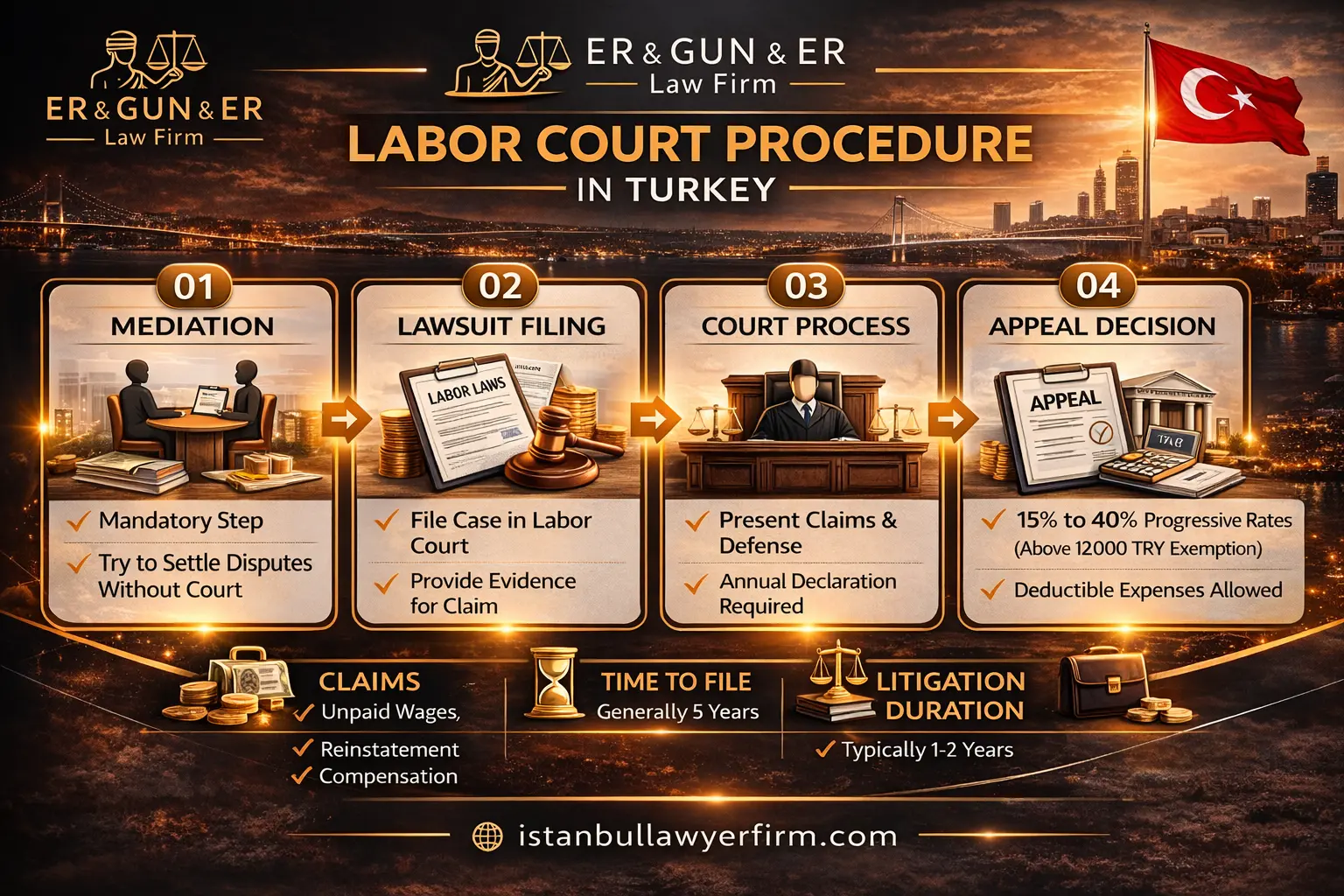
Labor disputes in Turkey follow a structured sequence that begins before the courtroom with mandatory mediation and proceeds through a specialized court framework with distinct procedural and evidentiary characteristics. The architecture rests on the Labor Courts Law No. 7036, which establishes specialized labor courts, defines their jurisdiction, and — through amendments to the Mediation Law — imposes mandatory mediation as a condition of admissibility for most labor claims. Procedural mechanics fill in from the Code of Civil Procedure No. 6100 (HMK) including the statement of claim, response, preliminary examination, investigation hearings, expert review, and judgment framework, while service practice follows the Notification Law No. 7201. The substantive claim analysis draws on the Labor Law No. 4857 and, where applicable, sectoral statutes and social security legislation. Enforcement after judgment proceeds through the general enforcement framework under the Enforcement and Bankruptcy Law No. 2004. For practitioners and parties, success in labor litigation depends less on courtroom performance than on file discipline — a case built through indexed exhibits, consistent chronology, documented calculations, and careful handling of service and response deadlines produces better outcomes than one relying on oral narrative alone. Practice may vary by authority and year, courthouse by courthouse, and through case law evolution; every procedural step discussed below should be verified against current practice and the specific facts of the matter. This guide is general legal information rather than advice for any specific dispute. A lawyer in Turkey engaged at intake — ideally before mediation rather than after litigation begins — can shape the evidentiary architecture in a way that benefits every later procedural step.
Court system overview and mandatory mediation
A Turkish Law Firm opening a labor litigation engagement begins with the court system framework that channels labor disputes to specialized labor courts (İş Mahkemeleri) with expertise in the substantive and procedural dimensions of workplace claims. Under the Labor Courts Law No. 7036, specialized labor courts hear employment disputes between employees and employers, claims arising from social security relationships in specific categories, and disputes within the statutory catalogue of labor-related matters. In locations without dedicated labor courts, general civil courts (Asliye Hukuk) designated by the Supreme Board of Judges and Prosecutors hear labor disputes applying the same procedural framework. The procedural backbone comes from the Code of Civil Procedure No. 6100, which governs pleading form, evidence rules, hearing structure, expert appointments, and the judgment framework, adapted by the Labor Courts Law for specific labor characteristics. Appeal from first instance labor court decisions proceeds through the intermediate regional courts of appeal (Bölge Adliye Mahkemeleri) on İstinaf review, with further review by the Court of Cassation (Yargıtay) on Temyiz available for matters exceeding statutory monetary thresholds or involving legal questions warranting higher review. Practice may vary by authority and year, and the specific appeal route should be verified against current thresholds and statutory framework because monetary limits adjust periodically and affect the availability of Temyiz review.
Turkish lawyers who handle the mandatory mediation stage work within the framework established by the Labor Courts Law No. 7036 amendments to the Mediation Law No. 6325, which make mediation a condition of admissibility for most labor claims — filing a lawsuit without completing mediation produces procedural dismissal that consumes time and creates evidentiary complications when the case is eventually refiled. The mediation framework covers money claims between employees and employers including severance pay, notice pay, wage and overtime claims, and reinstatement disputes, with specific exclusions for claims arising from occupational accidents and occupational diseases where specific procedural treatment applies. The mediation application specifies the parties, the workplace, and the claims with amounts where applicable, creating the initial documented record that the subsequent court file must align with for credibility. Mediation sessions proceed before a mediator listed on the official registry who facilitates settlement discussions without authority to impose outcomes. Settlement reached in mediation produces a final protocol (anlaşma tutanağı) that has the force of an enforceable document, bypassing the need for subsequent court proceedings on settled matters. Failure to reach settlement produces a non-settlement report (anlaşmama son tutanağı) that the claimant attaches to the subsequent statement of claim as proof of mandatory mediation completion. For structural framework on the mediation process, readers can consult our mandatory mediation process guide. Practice may vary by authority and year, and mediation file discipline — maintaining consistent amounts, party identification, and claim descriptions between mediation and subsequent litigation — substantially affects the credibility posture in court.
An English speaking lawyer in Turkey coordinating labor litigation for foreign clients addresses the specific considerations that arise from cross-border employment contexts, international corporate groups, and employees with multi-jurisdictional documentation. Foreign employers with Turkish operations should maintain employment documentation that satisfies Turkish evidentiary expectations — signed Turkish-language employment contracts, payroll records aligned with social security declarations, and employee file materials organized for potential future review. Foreign employees should preserve documentation of their residency status, work permit records, and communications demonstrating the employment relationship because these materials can be critical when formal employer records are disputed. Language management throughout the process requires careful attention — documents submitted to court should be in Turkish or accompanied by sworn translations, consistent terminology should be used across all submissions, and oral testimony should be properly interpreted when language barriers exist. Coordination with foreign counsel in the employee's home country may be relevant when the employment had pre-departure or post-departure components, when specific tax or social security consequences flow from the litigation outcome, or when the underlying employment relationship involved cross-border secondment arrangements. Practice may vary by authority and year, and foreign national employment matters require integrated analysis of the immigration, tax, and employment dimensions because outcomes in one area affect the others in ways that pure employment analysis may miss.
Jurisdiction, venue, and claim types
A lawyer in Turkey analyzing jurisdiction and venue in labor matters works through the specific framework established by the Labor Courts Law No. 7036 that determines which specific labor court hears a particular dispute. Venue is typically at the workplace location where the employee performed the work, or at the employer's domicile, with the Labor Courts Law providing specific options based on the type of claim. For workplace-based venue, the relevant workplace is the location where the employee actually performed work rather than the administrative center or registered seat of the employer, which may be different. For multi-workplace situations, the employee's principal work location typically controls. For remote work arrangements that have become common, analysis focuses on the agreed primary work location, the location from which the employer manages the employment relationship, and the specific work performance locations — remote work does not automatically create venue at the employee's residence if the employment framework is anchored elsewhere. Wrong venue choice produces either dismissal or transfer to the correct court, both of which consume time and create procedural friction, so venue analysis should be supported by documentary evidence including employment contracts specifying work location, payroll records showing the workplace identification, social security declarations confirming workplace registration, and assignment communications. Practice may vary by authority and year, and venue challenges should be responded to with exhibit-led submissions rather than oral assertions because the court evaluates venue on documentary support.
Turkish lawyers who identify the correct defendant entity address the common complication where the workplace operates through group structures or where multiple entities appear in employment documentation. The correct defendant is typically the entity that is the employer of record — the entity that entered the employment contract, issued payroll, made social security declarations, and held the ultimate authority over the employment relationship. Where group structures create overlap, analysis should establish which entity actually functioned as the employer through documentary evidence including employment contract signatories, payroll source entity, social security (SGK) declaration entity, and management authority over the employee's work. Contractor and subcontractor situations create specific complications — the subcontracting framework under the Labor Law No. 4857 establishes joint and several liability in defined circumstances, which may support claims against both the nominal employer and the principal employer. Joint venture, partnership, and branch structures each carry specific analysis under both labor law and the commercial structures applicable. Trade registry extracts, tax office records, and social security records support the defendant identification analysis. For related context on employee file architecture that supports identification of employment relationships, readers can consult our guide on required employee file documents. Practice may vary by authority and year, and defendant identification errors in the initial pleading create amendment complications, so preliminary due diligence on the employment relationship structure reduces avoidable procedural issues.
An Istanbul Law Firm structuring claim framing in labor cases addresses the distinct pleading requirements for different claim categories because labor disputes cover multiple legal theories each with specific proof elements. Severance pay (kıdem tazminatı) and notice pay (ihbar tazminatı) claims under the Labor Law No. 4857 require proof of termination circumstances, employment duration, and wage base elements, with specific attention to whether the termination falls within the categories that support severance entitlement versus the categories that eliminate entitlement. Overtime pay (fazla çalışma ücreti) claims require proof of working hours exceeding statutory or contractual thresholds, with the specific evidentiary framework depending on whether timekeeping records exist. Reinstatement (işe iade) claims under the Labor Law No. 4857 Article 18 and following require specific procedural discipline including filing within the statutory period — typically one month from termination notice — and satisfying the jurisdictional prerequisites including minimum employer size and employee service duration. Discrimination and equal treatment claims require comparative evidence addressing the specific differential treatment alleged. Mobbing claims — while not explicitly codified — develop through case law applying general personality rights and good faith principles. For structural overview of termination procedure that underlies severance and notice pay claims, readers can consult our termination of employment guide. Practice may vary by authority and year, and claim framing should match the specific proof available because ambitious framing unsupported by evidence produces worse outcomes than disciplined framing tied to documentary support.
Filing, service, and response practice
A Turkish Law Firm preparing the statement of claim (dava dilekçesi) works within the specific content requirements under the Code of Civil Procedure No. 6100 Article 119 that governs the pleading form for labor matters as for general civil litigation. The pleading includes party identification with full names, identification numbers, and addresses; the subject matter clearly stating each specific claim with amounts where applicable; the factual basis with chronological description of relevant events; the legal basis citing the statutes supporting each claim; the evidence indicating exhibits to be relied upon and witness topics; and the specific relief requested with monetary amounts and any non-monetary remedies. The pleading must attach the non-settlement mediation report as proof of mandatory mediation completion, the employment contract and key employment documents as baseline exhibits, and the initial evidence that supports the claims. Factual narrative should follow chronology rather than legal category because chronology supports credibility while legal-category organization can create overlaps and gaps. Claim-by-claim itemization with amounts and periods allows the court and any subsequent expert to evaluate each claim independently. The pleading should avoid emotional language, invented statutory citations, and specific procedural timeline promises that depend on court calendar variability. Practice may vary by authority and year, and the initial pleading shapes the entire subsequent litigation, so preparation discipline at this stage produces compound benefits throughout the case.
Turkish lawyers who coordinate service of process work within the framework of the Notification Law No. 7201 that governs court-initiated service and the electronic service framework that has become standard for represented parties. Service to the defendant occurs through the court's service channel with proof of service returning to the file as the foundation for response timeline calculation. Delays or failures in service can produce significant schedule impact because response periods and subsequent procedural steps begin from successful service rather than from filing. Parties represented by counsel typically receive service through the national electronic notification system (UETS), with specific rules governing when electronic service is completed and how response periods calculate. Address issues producing service difficulties — out-of-date registered addresses, foreign recipient complications, deliberate avoidance — should be cured through documented address verification and, where necessary, court-ordered service by publication after the procedural prerequisites are met. Service documentation — the served bundle as received, the service confirmation, the date and manner of service — should be preserved carefully because service record becomes central to any subsequent procedural fairness arguments including appeal review. Practice may vary by authority and year, and service discipline applies to both parties — the plaintiff ensuring proper service to the defendant and the defendant maintaining clean internal receipt records for subsequent reference.
An English speaking lawyer in Turkey managing the response practice coordinates the answer submission (cevap dilekçesi) that the defendant files within the statutory period — typically two weeks from service under the Code of Civil Procedure framework for labor matters with specific adjustment based on the court's case management approach. The answer addresses each claim with specific admissions, denials, or qualified responses, with each denial supported by the factual basis and evidence where available. Preliminary objections including jurisdiction, venue, capacity, and procedural preconditions should be raised in the initial response rather than waited upon, because late objections face specific procedural limitations on their availability. Substantive defenses including termination justification with cause, payment of claimed amounts, settlement and release, statutory exceptions to specific claim categories, and limitation period defenses where applicable should be developed with supporting exhibits. Counterclaims are permitted where the defendant has affirmative claims against the plaintiff arising from the same or related employment relationship. Reply (replik) and rejoinder (düplik) exchanges may follow where the responsive pleadings raise new matters requiring specific reply, with the Code of Civil Procedure framework governing the specific exchange structure. Practice may vary by authority and year, and response practice benefits from treating each pleading as a record-building exercise rather than as a reactive submission, because each document becomes part of the record that the court evaluates in final judgment.
Evidence planning and burden of proof
A lawyer in Turkey coordinating evidence strategy in labor cases works through the integrated framework that matches documentary, testimonial, and expert evidence against the specific proof elements for each claim. Documentary evidence takes priority in labor proceedings because documents provide independently verifiable proof less susceptible to credibility challenges than testimony. Core document categories include the employment contract and any amendments anchoring the legal relationship, payroll records and payslips documenting wage history, social security (SGK) service records confirming employment periods, bank statements showing actual net pay receipts, time attendance records or system outputs for working time claims, termination notices and any preceding disciplinary documentation, policy acknowledgments and training records where relevant, and communications between employee and employer through email or workplace platforms. Digital evidence including emails, messaging communications, and electronic system records requires preservation with integrity — original format retention, metadata where available, chain of custody documentation, and lawful collection are all relevant to admissibility and weight. Screenshots and printouts should be supplemented with native format preservation where possible because native format carries the metadata that supports authenticity. For related context on labor contract architecture that anchors many evidentiary questions, readers can consult our employment contract essentials guide. Practice may vary by authority and year, and evidence planning should begin at the earliest intake stage because key documents can become harder to obtain as time passes from the employment termination or underlying events.
Turkish lawyers who address burden of proof allocation work through the specific framework that determines which party must prove which element of each claim. The general framework allocates burden to the party asserting the affirmative claim — the employee claiming unpaid amounts must prove the entitlement and the amount, the employer claiming termination for cause must prove the factual basis of the cause, the party alleging discrimination must prove the differential treatment and the absence of legitimate justification. Specific Labor Law provisions shift burdens in specific circumstances — reinstatement cases require the employer to prove the termination was valid with a sufficient cause, wage claims where the employer has not maintained proper records may trigger evidentiary presumptions favorable to the employee, and overtime claims where the employer's records are inadequate may be proven through reasonable alternative evidence. The specific burden allocation for each element should be mapped at the claim framing stage so that evidence gathering addresses the specific elements the party must prove. Proof quality standards vary by claim type — monetary amounts typically require specific documentary support, while subjective elements like the atmosphere of workplace mobbing may develop through patterns of evidence with each element individually modest but cumulatively persuasive. For context on discrimination and mobbing-adjacent claims that operate on specific proof frameworks, readers can consult our workplace discrimination guide and our mobbing under Turkish law guide. Practice may vary by authority and year, and burden allocation analysis should be refreshed as the specific factual matrix develops during the proceedings.
An Istanbul Law Firm handling evidence preservation and production requests addresses the specific procedural tools for obtaining evidence held by the opposing party or third parties. The Code of Civil Procedure provides frameworks for requesting production of specific documents with identifiable categories and time periods rather than fishing expeditions — well-framed requests identify the specific document categories, the relevant time period, and the factual basis supporting the document's existence and relevance. Employer-held records including payroll systems, time attendance systems, HR files, and internal investigation records are frequent targets of production requests because the employer typically holds the best records of workplace facts. Third-party records including banking records, social security (SGK) files, and regulatory records may require specific procedural mechanisms for access. Digital evidence preservation where systems may be modified or data deleted requires prompt action including preservation requests to custodians, interim measures where appropriate under the Code of Civil Procedure interim relief framework, and specific handling of custody evidence. Where undocumented employment elements are involved, evidentiary challenges compound and the file should address the specific proof approach without overstating what the available evidence supports — our undocumented employment risks overview frames these evidential challenges. Practice may vary by authority and year, and evidence preservation should be integrated with the party's litigation hold and document retention practices because gaps created by ordinary document destruction schedules can hurt the case.
Hearings, witnesses, and expert review
A Turkish Law Firm managing hearing practice in labor litigation works through the structured hearing framework under the Code of Civil Procedure that distinguishes preliminary examination (ön inceleme) from substantive investigation (tahkikat) hearings. The preliminary examination addresses procedural matters including jurisdiction and venue, preliminary objections, witness and expert planning, evidence list finalization, and the litigation calendar for subsequent hearings. The preliminary examination also allows the court to attempt settlement one final time, and parties' positions at this stage can affect the subsequent trajectory. Substantive investigation hearings address the specific evidence including witness testimony, documentary evidence review, expert report presentation, and oral argument on specific issues. The hearing sequence allows the court to develop the factual record progressively, with each hearing serving specific procedural functions rather than extending into general narrative presentation. Hearing minutes (duruşma tutanağı) record the procedural steps taken, evidence received, and specific statements made — the minutes become part of the permanent record that appeal review examines, so minutes review after each hearing for accuracy is important. Corrections to minutes follow the specific procedural framework and should be pursued promptly when inaccuracies appear. Practice may vary by authority and year, and hearing preparation benefits from pre-hearing submissions that narrow the issues and identify the specific procedural actions needed, because hearings with unclear agendas tend to be less productive and produce less useful records.
Turkish lawyers who coordinate witness testimony work within the framework that admits witnesses based on their direct knowledge of relevant facts rather than on general character or opinion. The party calling a witness identifies the witness, the topics of testimony, and the specific factual areas in advance so that the court and the opposing party can prepare. Witness preparation focuses on accurate recollection of specific events with documentary anchors where available, avoiding rehearsed testimony that becomes vulnerable on cross-examination and avoiding coaching that can itself create issues. Coworkers, supervisors, subordinates, and former employees with direct knowledge of the disputed facts are typical witnesses, with the specific credibility weight depending on their direct involvement versus peripheral awareness. Cross-examination of opposing witnesses focuses on tested facts rather than general argument, with specific contradictions between testimony and documentary record pursued carefully. Witness availability, travel costs, and interpretation for non-Turkish-speaking witnesses should be addressed through the procedural framework. Former employees as witnesses frequently appear in labor litigation, with the specific considerations including their current employment status, any ongoing relationship with either party, and the time elapsed since the relevant events. Practice may vary by authority and year, and witness planning should be integrated with documentary evidence so that testimony reinforces rather than contradicts the documentary record.
An English speaking lawyer in Turkey handling expert report (bilirkişi raporu) engagement works within the framework under the Code of Civil Procedure that allows courts to appoint experts for technical matters requiring specialized analysis beyond general legal expertise. In labor cases, experts frequently address wage calculations including severance, notice, overtime, and accrued leave pay calculations; working time analysis reconstructing hours worked from available records; specific workplace safety or medical questions in occupational injury cases; and forensic handwriting or document authenticity questions where specific challenges arise. The expert engagement begins with the court's appointment order specifying the questions, the documents provided, and the expected scope. Parties submit raw data and documentary evidence for the expert's analysis, with data quality and consistency significantly affecting the expert's ability to provide useful analysis. The expert report (bilirkişi raporu) presents findings and responds to the court's questions, with parties having the opportunity to submit objections (itiraz) identifying specific errors, methodological issues, or additional factors the expert did not address. Supplementary report (ek rapor) practice allows the court to direct the expert to address specific objections or additional questions. For severance and wage calculation context that commonly drives expert analysis, readers can consult our severance pay overview. Practice may vary by authority and year, and expert engagement outcomes correlate strongly with data preparation quality — organized data supports accurate analysis while disorganized data invites expert interpretation that may not match the party's intended position.
Interim measures and calculation discipline
A lawyer in Turkey handling interim measures in labor proceedings works within the framework of the Code of Civil Procedure Articles 389 and following that govern precautionary injunction (ihtiyati tedbir) as the primary interim tool for protecting rights during proceedings. Precautionary injunction requires demonstration of a likelihood of success on the merits, a risk of irreparable harm or significant prejudice if the measure is not granted, and the proportionality of the requested measure to the identified risk. In labor contexts, injunction requests commonly relate to evidence preservation where documents or electronic records may be altered or destroyed, to workplace access preservation in specific reinstatement or continuing employment disputes, and occasionally to asset preservation where enforcement risk is identified. The party requesting the measure typically provides security (teminat) in an amount the court determines, which can be released or applied to damages depending on the outcome. Parallel frameworks under the Code of Civil Procedure Article 400 and following address evidence preservation (delil tespiti) for situations where the specific concern is preservation rather than injunctive relief against ongoing conduct. Precautionary attachment (ihtiyati haciz) under the Enforcement and Bankruptcy Law No. 2004 provides monetary-claim-specific asset preservation for liquid debts meeting the specific criteria. Practice may vary by authority and year, and interim measures are fact-specific and should be pursued based on specific documented risks rather than general apprehension, because speculative applications without concrete basis are typically denied and waste credibility.
Turkish lawyers who build calculation discipline in labor cases work through the methodology that produces defensible monetary claims supported by documentary sources and reconciled through consistent assumptions. The wage base analysis — fundamental to severance, notice, overtime, and many other calculations — requires identification of the applicable wage components under the Labor Law framework including base wage, regular allowances qualifying for inclusion, and excluded items with specific justification for exclusions. Employment duration calculation for severance requires careful chronology construction including initial employment date, any service interruptions and the reasons, related company transfers affecting continuity under the Labor Law's specific framework, and the termination date. Working time calculation for overtime claims requires reconciliation of working day patterns, weekly working hour analysis against the statutory 45-hour framework, and specific treatment of paid vs unpaid meal breaks and preparation periods. Leave pay calculation addresses accrued but unused annual leave, with specific analysis of the employment period, leave earning rates, and any leave taken during the employment. The calculation presentation should include source document references, methodology explanations, period-by-period breakdowns where relevant, and consistency across related claims. Practice may vary by authority and year, and calculation disputes frequently become the primary focus of labor litigation because the underlying factual matrix is often less disputed than the numerical consequences.
An Istanbul Law Firm supporting clients through calculation development and expert interface addresses the specific workflow that produces expert-ready data packages. Raw source materials including payroll extracts, bank statements, time attendance records, and SGK service records should be organized in a consistent format with clear field identification. Data dictionaries explaining each column, each field, and any coding conventions support accurate third-party interpretation. Version control on calculation spreadsheets preserves the analytical progression and supports explanation of any changes between versions. Reconciliation memos addressing differences between sources — payroll vs bank vs SGK — explain the reasoning for specific treatment choices. Party submissions of competing calculations should use compatible methodology so that any differences can be traced to specific assumption or data differences rather than to fundamentally different frameworks. When expert review begins, the goal is for the expert to be able to evaluate the data without having to reconstruct the methodology, which makes the expert's work faster and more likely to align with well-prepared submissions. Objections to expert reports should focus on specific errors or omissions with supporting exhibits rather than on general disagreement, because targeted objections are more likely to produce supplementary reports addressing the specific points. For related overtime calculation frameworks, readers can consult calculations tied to specific labor claim types and documentation discipline. Practice may vary by authority and year, and calculation discipline in labor cases is often the single highest-leverage investment because it drives both expert outcomes and settlement dynamics.
Settlement, releases, and judgment
A Turkish Law Firm coordinating settlement in labor proceedings works through the specific timing windows where settlement can resolve matters most efficiently. Pre-litigation settlement during mandatory mediation provides the earliest opportunity, with settlement protocols from mediation carrying the force of enforceable documents that require no subsequent court proceedings on the settled matters. Settlement during early litigation stages — typically during or after preliminary examination — can resolve matters before the parties have committed to the full litigation cost, with court-approved settlement integrated into the judicial record. Settlement during later stages including after expert report issuance or after judgment but before finalization remains available and may be influenced by the developing factual clarity that the proceedings have produced. Settlement protocol discipline includes precise identification of the claims being settled, specific monetary amounts with payment timing, the mechanism of payment with verifiable banking trail, any non-monetary elements such as reinstatement waiver or reference letter agreements, and clear release language matching the actual scope of settlement. Authority verification for settlement execution — corporate authorization for employers, independent consultation confirmation for employees — supports the settlement's durability against subsequent challenges. Practice may vary by authority and year, and settlement coordination benefits from treating the settlement document as a litigation-quality instrument rather than as a commercial memorandum because labor settlement challenges frequently surface later when settlement terms are disputed.
Turkish lawyers who handle release (ibraname) drafting work within the specific framework under the Labor Law No. 4857 that imposes formal requirements on employee releases to prevent coerced or uninformed waivers. The release must be in writing and specifically identify the matters released. The release must be executed no earlier than one month after termination, preventing same-day release practices that could compromise voluntariness. Payment of the claim amount must precede or accompany the release execution, with banking trail documentation rather than cash payment to support subsequent verification. Releases that do not satisfy the formal requirements do not extinguish employee claims, and even releases that satisfy formal requirements can be challenged on specific grounds including fraud, coercion, or material misrepresentation of the underlying facts. Broad "all claims" release language without specific identification of covered matters carries specific interpretive risk because courts may limit the release to matters the employee could have reasonably known and identified at the time of signing. Release structure benefits from claim-by-claim itemization showing the specific amount attributed to each category of claim, supporting both the validity analysis and the subsequent enforcement of the release if challenged. Practice may vary by authority and year, and release drafting for labor matters requires specialist attention because general release templates from commercial contexts typically do not satisfy the Labor Law requirements.
An English speaking lawyer in Turkey managing judgment review and remedy implementation works through the specific post-judgment workflow that converts the court's decision into operational outcome. The judgment (karar) issues after the final hearing with the court's findings on factual issues, legal characterization, and specific remedies granted. The reasoned decision (gerekçeli karar) following shortly after explains the reasoning in detail and forms the basis for appeal evaluation. Parties review the reasoned decision against the exhibit index, hearing minutes, and expert reports to identify alignment or disagreement, with specific attention to factual findings that differ from expectations and legal conclusions that may support appeal grounds. Remedy implementation begins after service of the reasoned decision, with monetary remedies calculated based on the judgment's specific items and non-monetary remedies including reinstatement implemented according to the judgment's specific terms. Employer reinstatement obligations following a successful reinstatement lawsuit carry specific Labor Law consequences including the employer's choice between actual reinstatement and payment of statutory amounts in lieu, within defined time periods. Interest calculation on delayed payments follows the applicable interest framework, with the specific rate and start date subject to the specific judgment provisions. Practice may vary by authority and year, and post-judgment discipline matters because subsequent enforcement and appeal proceedings depend on the clean record preservation from the immediate post-judgment period.
Appeal and enforcement
A lawyer in Turkey handling appeal (İstinaf) to the regional courts of appeal (Bölge Adliye Mahkemeleri) works within the framework that governs the intermediate appellate review available for first instance decisions. İstinaf review covers both factual and legal issues, distinguishing it from the higher-level Temyiz review at the Court of Cassation (Yargıtay) which focuses primarily on legal questions. İstinaf is available within the statutory period from service of the reasoned decision — commonly two weeks though specific frameworks may extend this — so prompt calendar management after decision service is essential. The appeal submission identifies the specific grounds including factual findings disputed, legal conclusions challenged, and procedural issues affecting the decision, with each ground supported by reference to the first instance record rather than by new factual submissions except in limited circumstances where the procedural framework allows. Response from the opposing party addresses each ground raised, with the İstinaf court evaluating the appeal against the complete first instance record. The İstinaf decision may affirm the first instance decision, reverse and remand for further proceedings, or in some cases decide the matter directly. Temyiz review at the Court of Cassation remains available in certain cases meeting the statutory monetary threshold or involving specific legal questions, with Temyiz focusing primarily on legal correctness rather than factual re-examination. Practice may vary by authority and year, and the specific appeal routes and thresholds should be verified against current statutory framework because monetary limits are periodically revalued and the availability of Temyiz review depends on current limits.
Turkish lawyers who handle enforcement (icra) of labor judgments work within the framework of the Enforcement and Bankruptcy Law No. 2004 that governs both general enforcement and specific enforcement procedures. Monetary judgments proceed through the general enforcement framework with the judgment creditor filing an enforcement application at the competent enforcement office (icra dairesi), which issues a payment order (ödeme emri) to the debtor. The debtor has a statutory period to pay or to raise specific objections within the narrow grounds available after a final judgment has issued. Absent payment or successful objection, the enforcement proceeds to asset identification and attachment. For employee creditors enforcing against corporate employers, asset identification typically begins with bank account attachment given the common visibility of corporate bank accounts, with additional asset categories including receivables, inventory, real estate, and other assets pursued as necessary. For corporate creditors enforcing against individuals — less common in labor contexts but occurring in specific counterclaim scenarios — asset identification and attachment follows similar principles adapted to individual debtor circumstances. Third-party garnishment allows attachment of wages, receivables held by third parties for the debtor, and similar assets. Practice may vary by authority and year, and enforcement efficiency depends significantly on pre-judgment preservation of information about the debtor's asset base because judgment without enforceable assets produces decreed victory without recovery.
An Istanbul Law Firm coordinating collections strategy and enforcement discipline addresses the specific workflow that maximizes actual recovery from favorable judgments. Pre-enforcement preparation during the litigation phase includes tracking the debtor's asset base, preserving information about specific accounts and holdings, and identifying changes in the debtor's structure that could affect enforcement. Enforcement commencement requires careful preparation of the enforcement file including the certified judgment copy, the judgment creditor's representative authorizations, and any supporting documentation for the specific enforcement pathway. Asset identification during enforcement proceeds through available information channels including bank inquiry mechanisms, trade registry research for corporate debtors, and real estate registry searches. Contested enforcement — where the debtor raises objections or seeks to challenge specific enforcement actions — requires response through the specific procedural mechanisms for each objection type. Installment arrangements or voluntary payment agreements during enforcement can resolve matters efficiently when the debtor has payment capacity but faces liquidity or cooperation constraints that make structured payment preferable to continued adversarial enforcement. Enforcement file closure after full satisfaction requires proper documentation of payment receipts, application of payments to specific judgment items, and the formal closure documentation that prevents subsequent enforcement-related disputes. Practice may vary by authority and year, and collections strategy benefits from treating enforcement as a continuation of the litigation project rather than as a separate administrative function, because the coordination between litigation and enforcement phases significantly affects practical recovery.
Author: Mirkan Topcu is an attorney registered with the Istanbul Bar Association (Istanbul 1st Bar), Bar Registration No: 67874. His practice focuses on cross-border and high-stakes matters where evidence discipline, procedural accuracy, and risk control are decisive, with particular concentration on Turkish labor litigation under the Labor Courts Law No. 7036 framework, mandatory mediation preparation and follow-on litigation strategy, severance and notice pay disputes under the Labor Law No. 4857, overtime and working time claims, reinstatement proceedings and their post-judgment implementation, expert report coordination for wage and working time calculations, interim measures under the Code of Civil Procedure, appeal strategy through İstinaf and Temyiz routes, and enforcement of labor judgments through the Enforcement and Bankruptcy Law framework.
He advises individuals and companies across Labor and Employment Law, Commercial and Corporate Law, Commercial Contracts, Arbitration and Dispute Resolution, Enforcement and Insolvency, Citizenship and Immigration (including Turkish Citizenship by Investment), Real Estate (including acquisitions and rental disputes), International Tax, International Trade, Foreigners Law, Sports Law, Health Law, and Criminal Law. He regularly supports Turkish and international clients on pre-litigation labor dispute strategy, mediation preparation and settlement discipline, labor court pleading development with supporting evidence architecture, hearing and expert process coordination, interim relief for evidence preservation, settlement and release structuring with labor-law-specific formalities, appeal assessment and brief preparation based on first instance record discipline, and enforcement of favorable judgments including asset identification and collections coordination.
Education: Istanbul University Faculty of Law (2018); Galatasaray University, LL.M. (2022). LinkedIn: Profile. Istanbul Bar Association: Official website.
Frequently asked questions
- What statute governs the labor court system in Turkey? The Labor Courts Law No. 7036 establishes specialized labor courts, defines their jurisdiction, and — through amendments to the Mediation Law No. 6325 — imposes mandatory mediation as a condition of admissibility for most labor claims. Procedural mechanics derive from the Code of Civil Procedure No. 6100.
- Which labor claims require mandatory mediation? Money claims between employees and employers including severance pay, notice pay, wage claims, overtime claims, and reinstatement disputes require mediation before litigation. Specific exclusions apply including claims arising from occupational accidents and occupational diseases where specific procedural frameworks apply.
- What happens if a party files without completing mediation? The claim faces procedural dismissal because mandatory mediation is a condition of admissibility. The proper path is to complete mediation and attach the non-settlement report to the subsequent statement of claim.
- How is venue determined in labor cases? Venue is typically at the workplace location where the employee performed work or at the employer's domicile, with the Labor Courts Law providing specific options. For remote work arrangements, analysis focuses on the agreed primary work location rather than incidental work locations.
- What is the deadline for filing a reinstatement lawsuit? Reinstatement (işe iade) lawsuits under the Labor Law No. 4857 must be filed within one month of termination notice, following completion of mandatory mediation. This deadline is strict and failure produces loss of the reinstatement remedy even where the termination may otherwise have been unlawful.
- How long is the response period after service? The answer (cevap dilekçesi) is typically due within two weeks from service under the Code of Civil Procedure framework for labor matters, subject to specific adjustments based on the court's case management. Extensions may be available through the applicable procedural framework.
- What evidence is typically most important in labor cases? Documentary evidence including employment contracts, payroll records, SGK service records, bank statements, time attendance records, termination notices, and communications typically outweighs testimonial evidence. Digital evidence requires preservation with integrity including metadata and chain of custody where applicable.
- Who bears the burden of proof for termination justification? In reinstatement cases, the employer bears the burden of proving that the termination was valid with a sufficient cause. In other termination-related claims including severance pay disputes, the burden allocation depends on the specific claim element with the employee typically proving entitlement and the employer proving payment or specific defenses.
- What is the role of the expert report (bilirkişi raporu)? Courts frequently appoint experts for technical matters including wage calculations, working time analysis, and document authenticity questions. The expert report's quality depends significantly on the data parties provide, and objections should focus on specific errors supported by exhibits rather than general disagreement.
- What interim measures are available in labor cases? Precautionary injunction (ihtiyati tedbir) under the Code of Civil Procedure Articles 389 and following addresses ongoing conduct or evidence preservation concerns. Precautionary attachment (ihtiyati haciz) under the Enforcement and Bankruptcy Law addresses monetary claim asset preservation. Evidence determination (delil tespiti) procedures address specific preservation needs.
- How are employee releases (ibraname) handled under the Labor Law? Releases must be in writing, specifically identify matters released, be executed no earlier than one month after termination, and be accompanied by banking trail payment documentation. Releases not satisfying these requirements do not extinguish employee claims, and even formally compliant releases can be challenged on specific grounds.
- What is the appeal route for labor court decisions? First instance decisions are appealed to the regional courts of appeal (Bölge Adliye Mahkemeleri) through İstinaf review covering both factual and legal issues. Further review by the Court of Cassation (Yargıtay) through Temyiz is available for matters meeting the statutory monetary threshold or involving specific legal questions.
- How is a labor judgment enforced? Monetary judgments proceed through general enforcement under the Enforcement and Bankruptcy Law No. 2004, with the enforcement office issuing a payment order and, absent satisfaction, proceeding to asset identification and attachment. Reinstatement judgments have specific Labor Law implementation frameworks including the employer's option between actual reinstatement and payment of statutory amounts.
- How do parties handle cross-border elements in labor cases? Foreign employers with Turkish operations and foreign employees require integrated analysis of immigration, tax, and employment dimensions. Document preservation across jurisdictions, language management through sworn translations, and coordination with foreign counsel where parallel proceedings exist all affect the ultimate outcome.
- How does ER&GUN&ER Law Firm structure labor litigation engagements? Engagements begin with case and evidence profile assessment — employment relationship facts, documentary state, risk profile, and anticipated dispute scope — translated into mediation strategy, litigation preparation with integrated evidence planning, hearing and expert coordination, settlement structuring with labor-law-specific formalities, and post-judgment enforcement or appeal strategy as the case trajectory requires.