
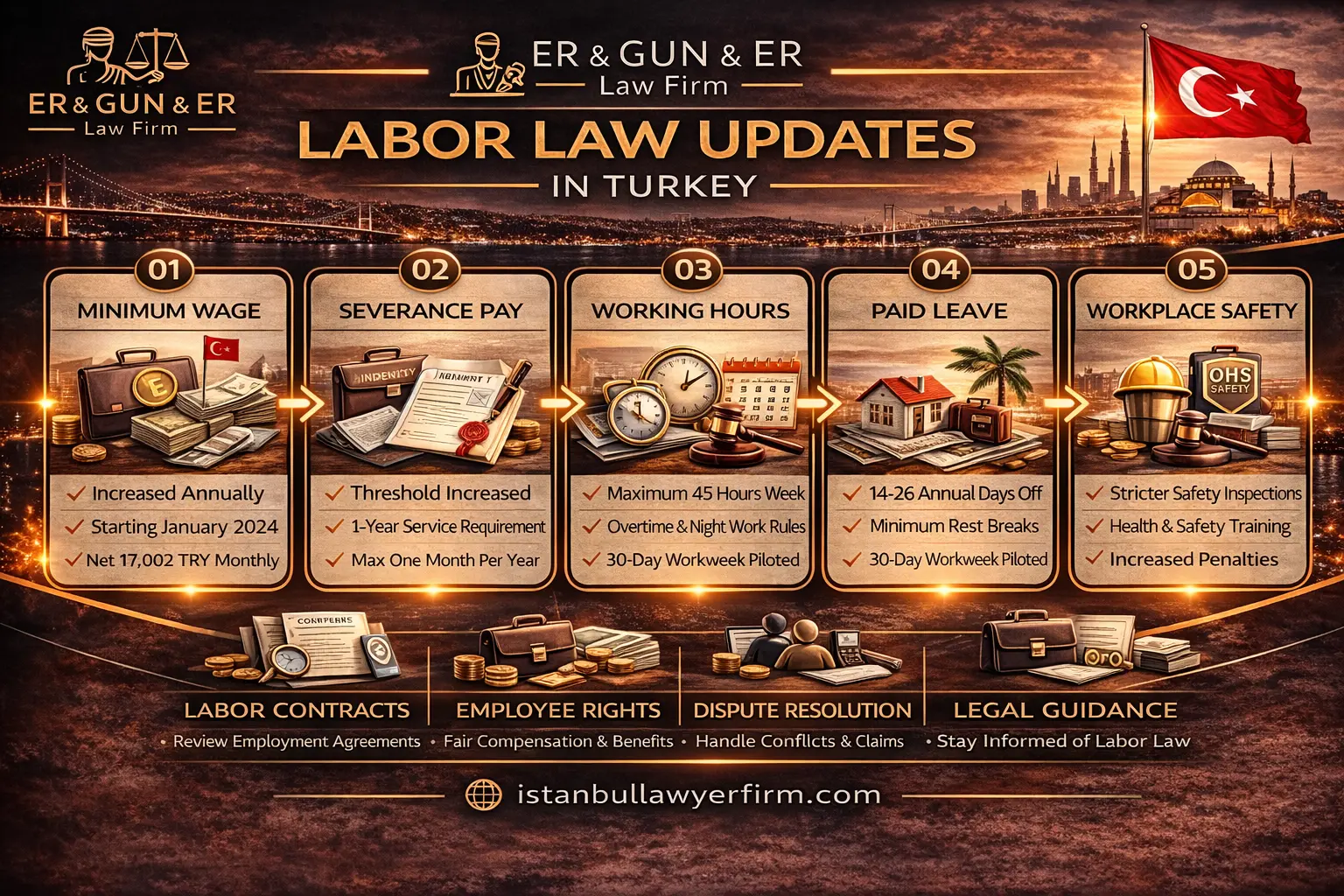
Labor law updates in Turkey are frequently discussed in social media, vendor newsletters, and informal corporate channels as if every headline were a statutory amendment, but the practical reality is that the category includes statute changes under the Labor Law No. 4857 and related statutes, implementing regulations published in the Official Gazette, administrative circulars issued by the Ministry of Labor and Social Security, binding guidance from the Social Security Institution (SGK) on specific compliance topics, and developing judicial trends through higher court decisions that shape how existing rules are applied. Each of these source categories carries different evidentiary weight and different implementation implications, and they should not be conflated in the compliance framework that translates "updates" into operational changes. For annually-adjusted parameters including minimum wage, severance pay ceiling, and social security contribution elements, specific figures should be verified against current official sources before implementation rather than assumed based on prior years or unverified summaries, because these parameters adjust periodically through official revaluation processes and informal assumptions create payroll errors with compounding consequences. The source-led approach to labor law monitoring treats every claimed "update" as a verification task — identifying the authoritative issuer, the date of publication, the specific scope of change, and the effective date before translating the change into internal policy or system adjustments. Practice may vary by authority and year, courthouse by courthouse, and through case law evolution; every element discussed below should be verified against current practice rather than treated as a settled rule. This guide is general legal information for building a monitoring framework rather than a list of specific 2026 amendments; a lawyer in Turkey coordinating the monitoring function translates source variety into controlled operational response without the overreach that creates its own compliance exposure.
Update taxonomy and source hierarchy
A Turkish Law Firm establishing a labor law monitoring framework begins with the taxonomy that separates different categories of claimed "updates" because each category warrants different verification discipline and different implementation pathways. Primary statutory changes appear in the Official Gazette as amendments to specific laws including the Labor Law No. 4857, the Labor Courts Law No. 7036, the Social Insurance and General Health Insurance Law No. 5510, the Occupational Health and Safety Law No. 6331, and related statutes, with each amendment carrying specific effective dates and often transition provisions for existing relationships. Regulatory changes appear as new or amended regulations (yönetmelik) and communiqués (tebliğ) published in the Official Gazette that operationalize statutory frameworks with specific procedural and substantive detail. Administrative guidance from the Ministry of Labor and Social Security and sector-specific authorities provides interpretive direction that, while not formally binding in the same way as statutes and regulations, substantially shapes enforcement practice and should be incorporated into compliance positions. Higher court decisions from the Court of Cassation (Yargıtay) and the Constitutional Court (Anayasa Mahkemesi) develop case law that influences how existing rules are applied, with consistent patterns of decisions carrying weight similar to formal guidance. Practice may vary by authority and year, and the monitoring taxonomy should be documented at the compliance program level so that all team members apply consistent categorization when encountering new information.
Turkish lawyers who structure the source hierarchy within a monitoring program tier information sources by reliability and binding effect. Tier one sources include the Official Gazette, the official websites of issuing authorities, and the published decisions of higher courts — these are primary sources whose authenticity and content can be verified directly. Tier two sources include administrative circulars and formal guidance documents issued by the competent authorities that, while not always legally binding in the strict sense, carry substantial enforcement weight and shape audit expectations. Tier three sources include specialized legal publications, professional body communications, and expert commentary that interprets primary and secondary sources without constituting authority in itself. Social media posts, vendor newsletters without source citations, and informal corporate communications are not sources in any meaningful sense and should not drive compliance decisions regardless of how widely they circulate. The monitoring register entries for each claimed update should identify the specific source by tier, the date of issuance, the issuing authority, and the specific reference including article or paragraph where applicable. This documentation discipline produces the audit trail that supports any subsequent compliance decisions and prevents the drift where informal summaries gradually replace verified source material in organizational memory. Practice may vary by authority and year, and source tiering discipline matters most when pressure emerges to implement changes quickly — the faster the perceived urgency, the more important the source verification step becomes because rushed implementation based on inaccurate summaries produces more severe downstream problems than delayed implementation based on verified sources.
An English speaking lawyer in Turkey coordinating monitoring for international corporate groups addresses the specific challenge of distinguishing genuine Turkish regulatory changes from international or group-level policy changes that corporate headquarters sometimes communicates as if they were Turkish legal updates. Global privacy framework updates, group-level HR policy revisions, or international parent company compliance initiatives are internal organizational changes rather than Turkish legal updates — they may require Turkish localization but they do not replace the need to verify whether specific Turkish legal changes support or require the proposed internal changes. Translation and communication discipline matters because English-language summaries of Turkish developments frequently contain inaccuracies that propagate through international organizations, and Turkish-language summaries of group-level changes can inadvertently imply Turkish legal mandates that do not exist. The monitoring register should therefore separately track Turkish legal developments and group-level policy developments, with cross-references where the two interact but without conflating their authorities. For structural context on foundational employment documentation that anchors compliance across changes, readers can consult our employment contract essentials guide. Practice may vary by authority and year, and international corporate group monitoring functions work best when they maintain distinct workflows for legal developments by jurisdiction and for group-level initiatives, with integration at the implementation stage rather than at the source tracking stage.
Reading amendments and implementation discipline
A lawyer in Turkey reading a specific amendment begins with the identification of what legal instrument changed, what exactly changed within that instrument, and what the statutory or regulatory text provides as effective date and transition framework. The reading exercise proceeds through scope identification — which employers, which workers, which employment relationships, which specific situations the amendment covers — because coverage limitations are common and over-implementation beyond the statutory scope creates its own compliance burden without corresponding protection benefit. Transition provisions including grandfather clauses for existing relationships, phased implementation schedules, and interim compliance frameworks should be analyzed carefully because they often create specific pathways that differ from the treatment applied to new relationships commenced after the amendment effective date. Substantive content analysis distinguishes what is being required, what is being prohibited, what is being permitted with conditions, and what is merely being clarified — each category carries different operational implications and different documentation requirements. The reading output is a structured analysis memo that identifies the source reference, the specific change, the scope and transition framework, the substantive requirements, the affected internal documents, the required system changes, the communication needs, and the evidence retention implications. Practice may vary by authority and year, and reading discipline benefits from treating each amendment as a project with a completion checklist rather than as an information item consumed through reading alone.
Turkish lawyers who translate amendment reading into implementation discipline work through the operational pathway that converts the legal analysis into organizational change. Document updates include specific revisions to employment contracts for new hires, policy revisions in employee handbooks and specific policies, template updates for HR and operational workflows, and privacy notice updates where processing changes flow from the amendment. System configuration changes include payroll software updates where wage components or calculations are affected, timekeeping system changes where working time or overtime frameworks shift, HR information system updates where data fields or workflows require modification, and reporting system changes where compliance reporting needs adjustment. Training delivery to affected personnel including HR staff, payroll administrators, line managers, and workers themselves where relevant should use the verified source material rather than informal summaries to prevent the degradation of accuracy through successive communication layers. Communication to workforce through formal channels with dated notices and proof of delivery documents the employer's compliance posture for potential future review. Practice may vary by authority and year, and implementation discipline pays compound returns because consistent application across amendment implementation cycles produces organizational capacity that handles subsequent amendments more efficiently, while inconsistent implementation creates accumulating technical debt that eventually requires major remediation projects to address.
An Istanbul Law Firm addressing the common scenario where claimed amendments cannot be verified or where the specific scope is unclear works through the protective posture that avoids compliance errors from unverified assertions. Where a reported amendment cannot be located through primary sources, the appropriate response is not implementation based on the report but verification through authoritative channels or waiting for the report to be confirmed by primary sources. Where the scope of a verified amendment is unclear — whether specific worker categories, specific workplace types, or specific situations fall within coverage — the compliance position should document the uncertainty, apply the conservative interpretation that errs toward compliance, and monitor for clarifying guidance. Where transition provisions create uncertainty about treatment of specific existing relationships, the analysis should document the reasoning applied and maintain the underlying evidence supporting the position taken. Where implementation requires specific timing coordination, the project plan should identify dependencies and sequence steps to avoid creating temporary non-compliance during implementation. For documentation architecture that supports evidence preservation through amendment cycles, readers can consult our guide on required employee file documents. Practice may vary by authority and year, and defensive implementation posture — documenting the reasoning, preserving the analysis, and maintaining cautious positions where uncertainty exists — produces better outcomes than aggressive positions taken on weak authority.
Pay parameters, severance ceiling, and social security compliance
A Turkish Law Firm handling annually-adjusted pay parameter compliance works within the framework where specific figures including the minimum wage, the severance pay ceiling applied under the Labor Law No. 4857 framework, social security contribution earning bases, and related parameters are established through official processes and adjusted periodically. Minimum wage is determined through the Minimum Wage Determination Commission (Asgari Ücret Tespit Komisyonu) process with the resulting amount announced through official publication. Severance pay ceiling applicable to statutory severance calculations adjusts based on the mechanism specified in the applicable statutory framework, with the specific amount verified each adjustment cycle. Social security contribution earning bases including the lower and upper limits for contribution calculations adjust through SGK processes with specific parameters published for each applicable period. The compliance framework for these parameters requires tracking the official announcements, archiving the source documents with dates and references, implementing the parameter changes through payroll system configuration with appropriate testing, training payroll and HR personnel on the changes using the verified source material, and documenting the implementation through dated memos that support subsequent audit review. Specific parameter values for any given period should not be assumed based on prior periods or unverified summaries because the adjustment mechanisms produce specific values that must be verified for accurate payroll application. Practice may vary by authority and year, and parameter compliance is among the most inspection-sensitive areas of labor compliance because payroll records are centralized and discrepancies with the correct parameters are easily identified during audit review.
Turkish lawyers who address the social security compliance dimension work through the framework under the Social Insurance and General Health Insurance Law No. 5510 that governs employee registration, contribution declaration, and compliance reporting. The employer's obligations include timely registration of new employees before employment commences, accurate declaration of wages and hours in monthly social security declarations, timely payment of employee and employer contribution amounts, proper handling of specific situations including medical leave, maternity leave, and work accident circumstances, and appropriate handling of termination including deregistration procedures. The compliance file for social security should include the full employee registration records, the monthly declaration submissions with confirmation receipts, the contribution payment records with banking trail, the reconciliation between payroll outputs and social security declarations, and the documentation of any specific events including leave, accidents, and employment changes. Inspection practice in social security compliance is rigorous because the centralized records allow systematic comparison between declarations and other available information including tax records, bank payment patterns, and employee complaint data. Subcontracting scenarios create specific social security compliance complexity because the principal employer can face joint and several liability under defined circumstances for subcontractor compliance failures, making subcontractor compliance monitoring a principal employer concern rather than purely a subcontractor concern. For context on documentation risks where informal or partially documented employment exists, readers can consult our undocumented employment risks overview. Practice may vary by authority and year, and social security compliance should be treated as a core operational function with designated owners, documented workflows, and regular reconciliation rather than as a periodic administrative task.
An Istanbul Law Firm structuring the integration between pay parameter tracking and severance calculation discipline addresses the specific scenario where severance pay calculations must apply the correct ceiling for the period in question. Severance calculations under the Labor Law No. 4857 framework apply the statutory methodology with the ceiling parameter applicable to the specific calculation period, which requires identification of which parameter applies to which service period within the total employment. For terminations occurring in a specific period, the applicable ceiling for that period's last period of service generally controls, though specific circumstances and interpretations can affect the application. For calculations during litigation, the period-specific parameters for each relevant service period should be applied with documentation supporting each specific parameter used. The calculation memo should include the source documentation for each parameter applied, the methodology explanation, and the period-by-period breakdown where relevant. For comprehensive severance calculation framework context, readers can consult our severance pay overview. Practice may vary by authority and year, and severance calculation discipline in an environment of periodically adjusting parameters requires the infrastructure to track parameter values by period rather than the simpler but error-prone approach of applying current parameters to historical calculations. This infrastructure investment pays compound returns through reduced calculation disputes and better litigation outcomes when severance becomes the subject of formal proceedings.
Working time and remote work governance
A lawyer in Turkey handling working time compliance works within the Labor Law No. 4857 framework that establishes the weekly working hour standard, overtime rules, rest breaks, and related working time protections, with specific implementation details developed through regulations and judicial interpretation. The core working time standard is forty-five hours per week with specific provisions for distribution across workdays, overtime calculation at premium rates, and specific circumstances including shift work, night work, and on-call arrangements. Implementation requires accurate timekeeping systems that record actual working hours, approval workflows for overtime that document who authorized hours beyond standard periods, payroll calculation that applies the correct premium rates based on overtime classification, and evidence preservation that supports subsequent verification of working time claims. Common compliance failures arise from informal overtime expectations without documentation, managers communicating work demands through messaging channels that create implicit overtime without approval workflow, remote work arrangements where the boundary between working time and personal time becomes unclear, and reliance on hand-written records or easily-modified electronic records that do not survive credibility testing. The solution framework includes written working time policies communicated to all workers, automated timekeeping with immutable logs, explicit overtime approval workflows, regular audit of actual working patterns against recorded hours, and specific training for line managers on the communications that can inadvertently create overtime without following proper processes. Practice may vary by authority and year, and working time compliance benefits from treating the topic as both a preventive control and a dispute evidence foundation because the same infrastructure serves both functions.
Turkish lawyers who coordinate remote work compliance work within the Remote Work Regulation (Uzaktan Çalışma Yönetmeliği) published in the Official Gazette on March 10, 2021 that establishes specific requirements for remote work arrangements including the written form requirement for remote work agreements, the content requirements for remote work contracts, the employer obligations for equipment provision and occupational health and safety at the remote location, and the data protection considerations for employer-provided or employee-used systems. The written agreement requirement means that remote work should be established through a written contract or addendum specifying the arrangement's terms including the remote work location, the working time framework, the communication expectations, the equipment and expense arrangements, and the return-to-office conditions. Occupational health and safety at remote work locations requires risk assessment appropriate to the role and location, with specific training and guidance supporting the safety framework. Data protection for remote work requires consideration of the information security implications of off-premises access, monitoring proportionality for worker oversight, and specific handling of personal device use where applicable. Working time recording in remote environments requires specific attention because the traditional workplace-based time recording may not function naturally at remote locations — explicit recording mechanisms, workday boundary communications, and break periods structure the working time framework. Practice may vary by authority and year, and remote work governance should be documented in a way that survives credibility testing because remote work disputes frequently turn on whether the employer actually established and maintained the governance framework the policy documents describe.
An English speaking lawyer in Turkey addressing occupational health and safety integration with working time and remote work governance works within the Occupational Health and Safety Law No. 6331 framework that establishes employer duties across all work settings including remote locations. The OHS framework includes risk assessment obligations, occupational physician and occupational safety expert service requirements based on workplace classification, worker training requirements, incident reporting and investigation, and specific controls for identified risks. Remote work adds complexity because the worker's home or other remote location becomes a de facto workplace for OHS analysis, with specific obligations adapted to the remote context. The working time framework intersects with OHS through the risk factors that extended or irregular working hours create, with specific restrictions on certain work types including night work limitations and minimum rest period requirements. Integration of working time records, remote work arrangements, and OHS compliance in a unified governance framework reduces the gaps that develop when these are treated as separate silos. For structural context on the labor court procedure through which working time and related disputes are litigated, readers can consult our labor court procedure guide. Practice may vary by authority and year, and integrated governance across working time, remote work, and OHS produces both stronger compliance outcomes and more efficient response when specific incidents or disputes arise because the relevant documentation is already organized in the form that subsequent review will examine.
Termination practice and documentation discipline
A Turkish Law Firm addressing termination practice works within the Labor Law No. 4857 framework that establishes the substantive rules for termination including valid reasons for termination, notice period requirements, severance pay entitlement conditions, reinstatement protections for qualifying employees, and specific procedural requirements for termination implementation. Valid reason analysis distinguishes termination for valid reason with proper notice from termination for just cause (derhal fesih) that permits immediate termination without notice period, with specific evidence requirements supporting each category. Notice period calculations depend on employment duration under the statutory framework, with specific provisions for notice pay (ihbar tazminatı) where the employer terminates without providing the full notice period. Severance pay entitlement applies where termination circumstances meet the statutory conditions, with specific exclusions for termination categories that eliminate entitlement and specific inclusions that preserve it. Reinstatement protection under Labor Law Articles 18 and following applies to employees meeting specific criteria including minimum employer size, minimum employee service duration, and specific employment status requirements, with termination of protected employees subject to the reinstatement challenge framework. The termination project workflow includes the decision documentation with supporting evidence, the communication to the worker with formal written notice and delivery proof, the calculation and payment of applicable amounts including severance, notice, accrued leave, and any other entitlements, and the preservation of the complete termination file for potential future review. Practice may vary by authority and year, and termination practice discipline is among the highest-leverage compliance investments because the documentary record established at termination drives subsequent litigation outcomes.
Turkish lawyers who address the documentation architecture supporting termination integrity work through the complete file framework that demonstrates the legitimacy of the termination decision and the proper implementation of termination obligations. The file includes the employment contract and any amendments establishing the employment relationship terms. The file includes performance management records including goal-setting, feedback, and any improvement processes where performance-related termination is at issue. The file includes disciplinary records where misconduct-related termination is at issue, with specific attention to whether prior warnings were given, how incidents were investigated, and what evidence supports the conclusions reached. The file includes the termination decision documentation including the specific reason identified, the decision-maker with appropriate authority, and the date of decision. The file includes the termination notice with formal content meeting Labor Law requirements, the delivery documentation confirming the worker received the notice, and the acknowledgment or documentation where the worker refused to acknowledge. The file includes the calculation documentation supporting any severance, notice, accrued leave, and other amounts paid, with methodology explanations and source document references. The file includes the payment documentation with banking trail confirming amounts paid and receipts where applicable. For structural context on termination procedure including specific compliance steps, readers can consult our termination of employment guide. Practice may vary by authority and year, and the documentation discipline supporting termination should be built through ongoing employment events rather than assembled at termination, because contemporaneous documentation carries credibility that retrospective assembly cannot reproduce.
An Istanbul Law Firm coordinating documentation discipline across the employment lifecycle addresses the specific compliance architecture that supports both ongoing operations and potential future disputes. Employment file architecture should include the onboarding documentation with signed contract, policy acknowledgments, and compliance attestations; the change event documentation with dated records for promotions, salary adjustments, role changes, remote work agreements, and other material changes; the performance management records maintained contemporaneously rather than retrospectively; the training records documenting specific training completion with dated attendance and content verification; the leave and absence records with appropriate supporting documentation; the disciplinary records where applicable with investigation evidence and outcome documentation; and the termination records with the complete termination project file. Digital file architecture should support retrieval by employee, by date range, and by document category, with access controls appropriate to the sensitive nature of employment information. Retention discipline should preserve documents for the periods relevant to potential claims — employment disputes can arise long after termination, so retention beyond the active employment period continues for appropriate durations. Data protection integration with employment documentation recognizes that employment files contain substantial personal data subject to KVKK No. 6698 requirements including purpose limitation, retention limitation, and access restriction. Practice may vary by authority and year, and documentation discipline produces benefits beyond compliance — better operational decisions, more consistent management practice, and stronger organizational resilience when disputes arise.
Mediation readiness and labor court developments
A lawyer in Turkey addressing mediation readiness works within the Labor Courts Law No. 7036 framework that establishes mandatory mediation as a condition of admissibility for most labor claims. The mediation readiness framework includes the organizational capacity to respond to mediation invitations promptly, the documentation packages prepared in advance for likely dispute categories, the authorized representatives with settlement authority and clear settlement parameters, and the coordination between legal, HR, and management functions that supports consistent mediation posture. Pre-mediation preparation includes factual chronology construction tied to documentary evidence, calculation preparation for monetary dispute aspects, position development distinguishing settlement floor from preferred resolution range, and strategic assessment of the relative strengths and weaknesses of each party's position. Mediation conduct discipline focuses on factual presentation supported by exhibits rather than argument unsupported by evidence, avoiding admissions that could harm subsequent litigation positions, preserving confidentiality of mediation communications as required by the Mediation Law framework, and documenting the mediation record accurately for potential subsequent use. Settlement protocol drafting during successful mediation requires specific attention to the scope definition, the payment mechanics, the release language, and the enforcement framework that makes the settlement effectively binding. For structural context on the mandatory mediation framework, readers can consult our mandatory mediation process guide. Practice may vary by authority and year, and mediation readiness produces both direct benefits through better mediation outcomes and indirect benefits through the organizational discipline that mediation-ready files require.
Turkish lawyers who monitor labor court developments distinguish genuine procedural or substantive changes from evolving judicial practice that operates within existing frameworks. Genuine procedural changes arise through amendments to the Labor Courts Law No. 7036, changes to the Code of Civil Procedure provisions applicable to labor matters, or new regulations affecting procedural framework. Evolving judicial practice arises through accumulation of higher court decisions that clarify how existing rules apply to specific factual patterns, with consistent patterns across decisions indicating settled interpretation and inconsistent patterns indicating continued uncertainty. Specific areas where judicial practice evolution has been significant include evidence discipline around working time claims where courts have increasingly emphasized contemporaneous record requirements, documentation expectations for termination where courts have become more rigorous about the specific record supporting termination decisions, burden allocation in specific dispute types where case law has refined the framework, and expert report treatment where courts have developed specific approaches to the weight given to expert analysis. The monitoring framework should track both categories separately because they carry different implementation implications — procedural changes typically require specific template or system adjustments while judicial practice evolution typically requires training and documentation refinement without specific template changes. Practice may vary by authority and year, and the specific pattern of labor court decisions varies by region and chamber, so monitoring should include geographic and chamber-specific dimensions rather than assuming uniform practice across Turkey.
An English speaking lawyer in Turkey coordinating dispute readiness for international clients addresses the integration between Turkish mediation and court practice and the client's broader dispute management framework. Pre-dispute response protocols should include specific provisions for employment disputes in Turkey with designated escalation pathways, authorized settlement parameters, and documentation retrieval procedures. In-house counsel coordination should establish the division between in-house analysis and external Turkish counsel engagement, with clear triggering criteria for specific escalation levels. Insurance coordination where employment practices liability coverage exists requires notification compliance with policy terms and cooperation with carriers throughout dispute handling. Communication discipline including management communications about disputes, workforce communications about outcomes, and external communications including potential media engagement requires coordination to maintain consistent positions. Analytics and reporting on dispute patterns support continuous improvement in the compliance framework that produces disputes, with specific attention to whether dispute patterns suggest systemic issues warranting broader changes. Practice may vary by authority and year, and dispute readiness frameworks should be tested through tabletop exercises before actual disputes arise, because the first dispute during which a response framework is tested typically reveals gaps that can be addressed through iteration rather than dramatic failure.
Investigations, harassment, and equality framework
A Turkish Law Firm handling workplace investigation practice works within the framework that supports fair, documented, and legally defensible response to specific workplace incidents or complaints. The investigation framework includes the intake procedure through which complaints and reports enter the formal process with appropriate documentation, confidentiality protections, and initial assessment. The scoping phase identifies what is alleged, which policies and legal frameworks potentially apply, who are the involved parties, and what evidence needs to be collected. The evidence collection phase secures documents, electronic records, and other evidence with chain of custody documentation and lawful collection practices that preserve evidentiary value. The interview phase engages the complainant, the subject of the complaint, and relevant witnesses through structured interviews with appropriate documentation of statements made. The analysis phase evaluates the evidence against the applicable standards, developing findings that are supported by the record rather than by predetermined conclusions. The outcome phase documents findings through a reasoned memorandum, implements appropriate remedial actions, and preserves the complete investigation file for future reference. For structural context on mobbing and related workplace conduct frameworks that often drive investigations, readers can consult our mobbing under Turkish law guide. Practice may vary by authority and year, and investigation discipline is critical because subsequent disputes — whether arising from the original complainant dissatisfied with outcome, from the subject of the complaint challenging remedial action, or from broader litigation — frequently turn on whether the investigation was conducted with appropriate rigor.
Turkish lawyers who coordinate harassment and equality framework implementation address the specific substantive requirements beyond the procedural investigation framework. Harassment prohibitions under the Labor Law No. 4857 and related frameworks cover sexual harassment, general harassment, mobbing, and discriminatory treatment based on protected characteristics. Policy frameworks should define prohibited conduct with specific examples, specify reporting channels with multiple options to accommodate different complainant preferences, articulate the investigation framework that will be applied, describe the non-retaliation protections that support worker willingness to report, and identify potential consequences for substantiated conduct. Training frameworks should deliver policy content to all workers and supervisors with documented attendance and content verification, with refresher training on regular cycles and additional training for role-specific contexts. Supervisor training should address the specific responsibilities of supervisors including the duty to address issues brought to their attention, the prohibition on retaliation, and the escalation pathways for matters they cannot or should not handle themselves. Equality framework implementation extends beyond harassment prevention to affirmative practices including fair recruitment, objective performance evaluation, equitable compensation, fair promotion practices, and accommodation processes where applicable. Audit and assessment mechanisms test whether the policy framework and training produce actual practice consistent with the framework, with specific attention to patterns that may indicate systemic issues. Practice may vary by authority and year, and harassment and equality framework discipline produces measurable improvements in both compliance outcomes and workforce engagement when implemented with genuine commitment rather than as form-over-substance compliance.
An Istanbul Law Firm coordinating employee data protection integration with investigation and harassment framework addresses the specific KVKK No. 6698 obligations that flow from the personal data processing inherent in workplace investigations. Investigation activities involve processing of personal data including the complainant's information, the subject of investigation's information, witness information, and the substantive details of the allegations that typically include sensitive personal information. Legal basis for processing investigation data typically draws on the employer's legitimate interests in maintaining workplace safety and compliance, with specific analysis of proportionality and necessity for each processing activity. Data minimization applies — collecting only what is necessary for the investigation purpose rather than expansive data gathering that exceeds the investigation scope. Access controls limit investigation file access to those with legitimate need to know, with audit logs documenting who accessed what and when. Retention limitation requires deletion of investigation files when retention no longer serves legitimate purposes, with specific consideration of how subsequent potential disputes affect retention needs. Cross-border data transfer implications arise where investigation records are shared with foreign parent companies or external counsel, with specific KVKK Article 9 framework application. Specific KVKK framework for workplace investigations supports both the investigation integrity and the data protection compliance when integrated thoughtfully rather than treated as separate compliance tracks. Practice may vary by authority and year, and the integrated framework between investigation practice and data protection produces more robust outcomes than siloed compliance in either area.
Subcontracting, cross-border governance, and compliance roadmap
A lawyer in Turkey handling subcontracting compliance works within the framework under the Labor Law No. 4857 that governs the relationship between principal employer and subcontractor, with specific provisions establishing joint and several liability in defined circumstances for employment law obligations. The statutory framework distinguishes legitimate subcontracting arrangements from arrangements that may be recharacterized based on the factual circumstances including the specific work subcontracted, the continuity of the arrangement, and the actual control patterns in daily operations. Legitimate subcontracting typically involves specific auxiliary or support services that are distinct from the principal employer's core business activity, with the subcontractor maintaining operational independence in the execution of the subcontracted work. Recharacterization risk arises where the subcontracting arrangement effectively provides labor for the principal employer's core operations with the subcontractor functioning as a labor supply intermediary without independent service delivery. Compliance discipline for principal employers includes specific contract terms defining the subcontracting scope, operational practice consistent with the contractual framework, subcontractor compliance monitoring that does not itself undermine the subcontractor's independence, and documentation supporting the legitimate nature of the arrangement. Subcontractor obligations include employer-level compliance for the subcontractor's workforce including employment contracts, payroll compliance, social security registration and reporting, working time compliance, and occupational health and safety obligations. Practice may vary by authority and year, and subcontracting compliance is an increasingly audit-sensitive area where weak documentation can convert legitimate arrangements into recharacterization risk through inability to demonstrate the legitimate pattern.
Turkish lawyers who coordinate cross-border employer compliance address the specific integration between Turkish legal requirements and international corporate group practices. Turkish legal requirements for employers apply regardless of the employer's foreign ownership or international affiliation — Labor Law obligations, social security obligations, occupational health and safety obligations, and data protection obligations apply to the Turkish legal entity employing workers in Turkey. Foreign parent company practices including global HR policies, international privacy frameworks, and cross-border internal investigation practices do not replace Turkish legal compliance but must be adapted to Turkish requirements where they affect Turkish employment relationships. Specific complexity arises from dual employment structures where workers have formal employment with a Turkish entity while receiving direction or assignments from foreign affiliates, from matrix management where authority is dispersed across corporate structure creating ambiguity about which entity bears specific responsibilities, and from cross-border data flows involving employee personal data that must satisfy both Turkish KVKK requirements and applicable foreign privacy frameworks. Communication discipline between Turkish entities and foreign parent companies about employment matters should maintain Turkish legal positions as authoritative rather than overriding them with foreign framework assumptions. Practice may vary by authority and year, and cross-border employer compliance succeeds when structured with clear recognition that Turkish employment relationships are governed by Turkish law regardless of the broader corporate architecture, with foreign frameworks adapted to complement rather than replace the Turkish requirements.
An English speaking lawyer in Turkey coordinating the overall compliance roadmap integrates the monitoring framework, implementation discipline, and specific topic compliance into a repeatable cycle that handles both current obligations and evolving requirements. The monitoring function tracks source developments across all relevant categories with documented sources, dates, and responsible owners. The verification function tests claimed updates against authoritative sources before implementation proceeds. The analysis function translates verified changes into specific implementation requirements including document updates, system changes, training delivery, and communication needs. The implementation function executes the analysis through coordinated work across affected functions with documented completion. The training function delivers change awareness to affected personnel using verified source material with documented attendance. The audit function tests whether implemented changes produce actual practice consistent with the change, identifying gaps for further attention. The archive function preserves source documents, analysis memos, implementation records, training materials, and audit results in an organized repository accessible for subsequent review. The integration function ensures that changes in one area do not create inconsistencies with compliance frameworks in other areas. Practice may vary by authority and year, and the compliance roadmap discipline produces compound benefits as each cycle improves the organizational capacity to handle subsequent cycles, transforming labor law updates from anxiety-producing external pressure into routine operational activity supported by robust processes.
Author: Mirkan Topcu is an attorney registered with the Istanbul Bar Association (Istanbul 1st Bar), Bar Registration No: 67874. His practice focuses on cross-border and high-stakes matters where evidence discipline, procedural accuracy, and risk control are decisive, with particular concentration on Turkish labor law monitoring and compliance including statutory and regulatory update tracking, source hierarchy discipline across Labor Law No. 4857 and related frameworks, pay parameter and severance ceiling compliance in an environment of periodic adjustment, social security compliance under Law No. 5510 with specific attention to SGK filing integrity, working time and remote work governance, occupational health and safety integration, termination practice and documentation architecture, mediation readiness and labor court dispute management, workplace investigation and harassment framework design, subcontracting compliance, and cross-border employer governance for international corporate groups.
He advises individuals and companies across Labor and Employment Law, Commercial and Corporate Law, Commercial Contracts, Arbitration and Dispute Resolution, Enforcement and Insolvency, Data Protection and Privacy, Citizenship and Immigration (including Turkish Citizenship by Investment), Real Estate (including acquisitions and rental disputes), International Tax, International Trade, Foreigners Law, Sports Law, Health Law, and Criminal Law. He regularly supports Turkish and international clients on compliance monitoring program design, labor law amendment reading and implementation coordination, pay parameter and social security compliance maintenance, working time and remote work framework documentation, termination project coordination with complete documentation architecture, mediation preparation and response strategy, workplace investigation protocols aligned with privacy requirements, subcontracting governance design, cross-border employer localization of global policies to Turkish requirements, and compliance audit coordination producing dated evidence trails that survive subsequent review.
Education: Istanbul University Faculty of Law (2018); Galatasaray University, LL.M. (2022). LinkedIn: Profile. Istanbul Bar Association: Official website.
Frequently asked questions
- What counts as a Turkish labor law update? An update is a verified change from a primary source — statutory amendment in the Official Gazette, new or amended regulation, formal administrative guidance, or settled higher court pattern. Headlines without dates, social media posts, and vendor newsletters without source citations are not updates and should not drive compliance decisions.
- Where do Turkish labor law updates come from? Primary statutory changes appear in the Official Gazette; regulatory changes appear as regulations and communiqués; administrative guidance comes from the Ministry of Labor and Social Security and sector-specific authorities; judicial patterns develop through higher court decisions. Each category warrants different verification and implementation pathways.
- Should I assume specific 2026 pay parameter figures from prior years? No. Minimum wage, severance pay ceiling, and social security earning bases adjust through specific official processes, with values established for each applicable period. Figures should be verified against current official sources before payroll implementation rather than assumed from prior periods or unverified summaries.
- How should SGK updates be handled? SGK updates should be tracked through official SGK guidance and implemented through specific system changes with testing, training, and documented approval. Monthly reconciliation between payroll outputs and SGK declarations identifies discrepancies before they accumulate into audit issues.
- What does remote work compliance require? The Remote Work Regulation (Uzaktan Çalışma Yönetmeliği) published March 10, 2021 requires written remote work agreements with specific content, equipment and expense arrangements, occupational health and safety framework adapted to remote locations, working time recording mechanisms, and data protection controls.
- How should overtime be documented? Overtime should be documented through automated timekeeping with immutable logs, explicit approval workflows before overtime occurs, payroll calculation applying correct premium rates, and regular audit comparing actual work patterns to recorded hours. Informal overtime expectations without documentation create compliance exposure and dispute risk.
- What does termination documentation discipline require? The termination file should include the employment contract, performance and disciplinary records, termination decision documentation, termination notice with delivery proof, calculation documentation for amounts paid, and payment documentation with banking trail. Contemporaneous documentation carries credibility that retrospective assembly cannot reproduce.
- How does mandatory mediation affect labor disputes? Mandatory mediation is a condition of admissibility for most labor claims under the Labor Courts Law No. 7036 amendments. Filing without completing mediation produces procedural dismissal. Mediation readiness with prepared documentation packages, authorized representatives, and clear settlement parameters produces better outcomes.
- What are labor court development patterns? Genuine procedural changes arise through statutory or regulatory amendments. Evolving judicial practice develops through higher court decision patterns that clarify how existing rules apply, with specific emphasis on contemporaneous documentation, evidence discipline, and expert report treatment.
- What framework applies to workplace investigations? Investigations proceed through intake, scoping, evidence collection, interviews, analysis, and outcome phases with documentation at each stage. Data protection integration under KVKK No. 6698 requires purpose limitation, data minimization, access controls, and retention limitation in investigation practice.
- How are harassment and equality requirements implemented? Implementation requires policy frameworks with specific prohibited conduct definitions, reporting channels with multiple options, training frameworks with documented delivery, non-retaliation protections, and audit mechanisms testing actual practice. Substantive requirements extend beyond harassment prevention to affirmative equality practices.
- What are the risks in subcontracting arrangements? Joint and several liability applies in defined circumstances under Labor Law No. 4857 for employment obligations of the subcontractor. Recharacterization risk arises where arrangements function as labor supply rather than independent service delivery. Legitimate subcontracting requires specific contract terms, consistent operational practice, and supporting documentation.
- How should cross-border employers approach Turkish compliance? Turkish legal requirements apply regardless of foreign ownership or international affiliation. Foreign parent company practices must be adapted to Turkish requirements where they affect Turkish employment relationships. Dual employment structures, matrix management, and cross-border data flows require specific analysis.
- How does occupational health and safety integrate with other labor compliance? Occupational Health and Safety Law No. 6331 establishes employer duties including risk assessment, professional service requirements, training obligations, incident reporting, and specific controls for identified risks. OHS integrates with working time through extended hours risks and with remote work through adapted obligations for remote work locations.
- How does ER&GUN&ER Law Firm structure labor compliance engagements? Engagements begin with compliance program assessment — monitoring framework, source tracking discipline, implementation pathways, documentation architecture, and audit infrastructure — translated into specific improvement work across identified gaps, ongoing monitoring and implementation coordination, and periodic review supporting continuous improvement through each amendment and practice evolution cycle.