

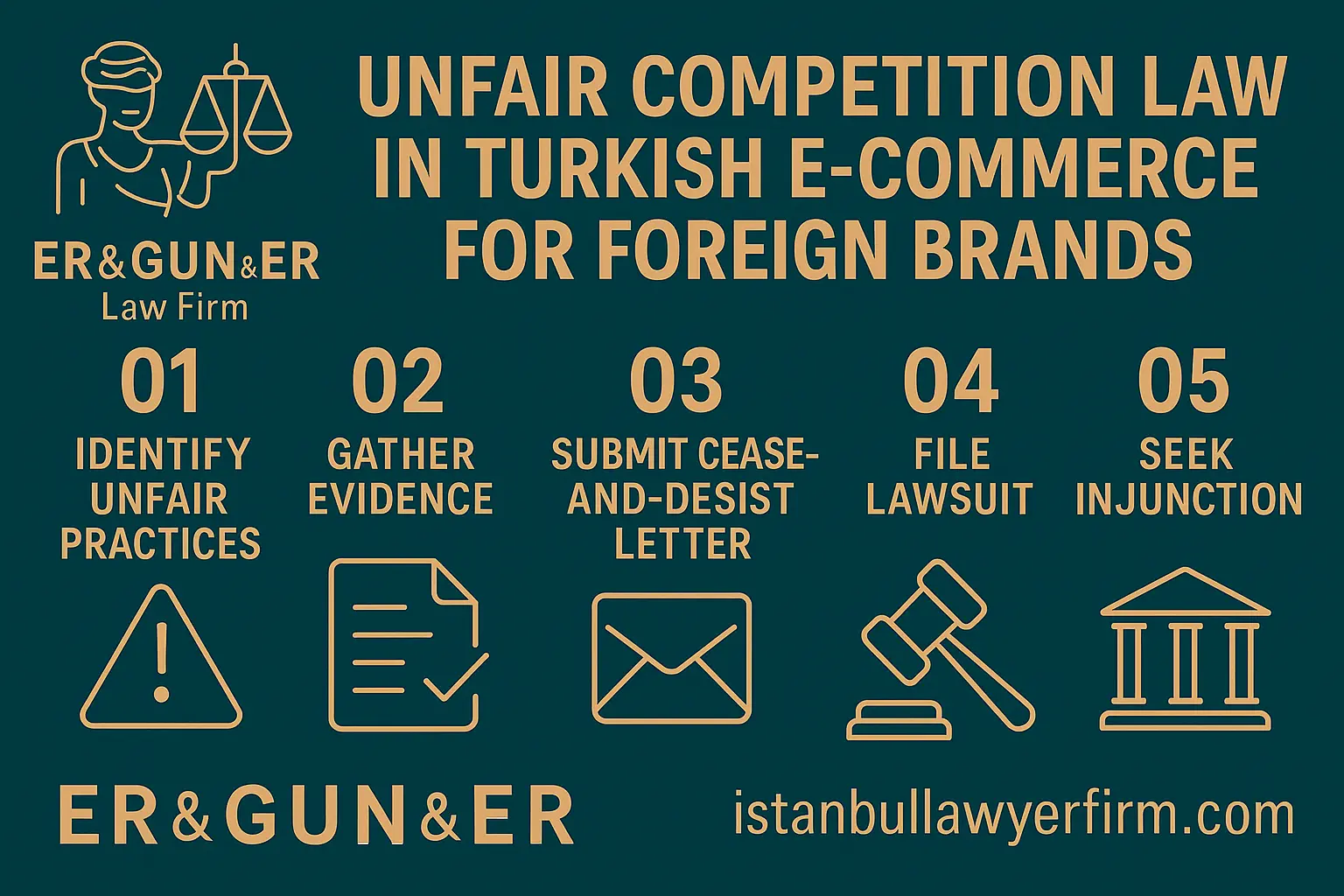
Unfair competition (haksız rekabet) in Türkiye's e-commerce market operates through coordinated multi-statute framework producing meaningful enforcement pathways for foreign brands and substantive remedies against infringing parties. Foreign brands operating across Turkish e-commerce platforms (Trendyol, Hepsiburada, N11, Amazon Türkiye, GittiGidiyor, similar) face specific exposure scenarios including counterfeit listings, trademark misuse, ad hijacking, parallel imports producing consumer confusion, unauthorised reseller activity, false comparative advertising, and similar substantive harms. The framework's enforcement architecture combines civil litigation, criminal prosecution, administrative penalties, and platform-level takedowns.
The substantive law operates through Türk Ticaret Kanunu (Turkish Commercial Code, TTK, Law No. 6102) of 13 January 2011 (Resmi Gazete 14 February 2011 No. 27846) Articles 54-63 establishing comprehensive unfair competition framework with Article 54 general rule, Article 55 unfair competition acts catalogue, Article 56 civil remedies (tespit, men, ref, tazminat, ilan davaları), Article 58 criminal liability, Article 62 limitation periods (1 year subjective / 3 year objective), and Article 63 preliminary injunction framework; Sınai Mülkiyet Kanunu (Industrial Property Code, SMK, Law No. 6769) of 22 December 2016 (Resmi Gazete 10 January 2017 No. 29944) governing trademark, patent, design, and geographical indication framework; Fikir ve Sanat Eserleri Kanunu (Intellectual and Artistic Works Code, FSEK, Law No. 5846) of 5 December 1951 governing copyright framework; Elektronik Ticaretin Düzenlenmesi Hakkında Kanun (E-Commerce Code, Law No. 6563) of 23 October 2014 (Resmi Gazete 5 November 2014 No. 29166) with Article 9 intermediary service provider framework and substantial 2022 reform through Law No. 7416 of 1 July 2022 introducing marketplace-specific framework; Tüketicinin Korunması Hakkında Kanun (Consumer Protection Code, Law No. 6502) of 7 November 2013 (Resmi Gazete 28 November 2013 No. 28835) Articles 61-63 commercial advertising and unfair commercial practices framework; Rekabetin Korunması Hakkında Kanun (Competition Protection Code, Law No. 4054) of 7 December 1994 (Resmi Gazete 13 December 1994 No. 22140) competition law framework; and 5651 sayılı Kanun internet content takedown framework.
The institutional architecture spans Fikri ve Sınai Haklar Hukuk Mahkemesi (Specialised Intellectual Property Civil Courts) for IP-related claims; Asliye Ticaret Mahkemesi (Commercial Courts of First Instance) for haksız rekabet matters where IP courts not jurisdictional; Fikri ve Sınai Haklar Ceza Mahkemesi (Specialised IP Criminal Courts) for criminal IP matters; Rekabet Kurumu (Competition Authority) with Rekabet Kurulu (Competition Board) decisions for competition law matters; Reklam Kurulu (Advertising Board) under Ticaret Bakanlığı (Ministry of Trade) for advertising-related administrative penalties; Türk Patent ve Marka Kurumu (TÜRKPATENT — Turkish Patent and Trademark Office) for trademark registration and disputes; Gümrük ve Ticaret Bakanlığı for customs enforcement; Cumhuriyet Başsavcılığı for criminal prosecutions; Bilgi Teknolojileri ve İletişim Kurumu (BTK) for internet content blocking; and platform legal departments for marketplace-level enforcement.
TTK Articles 54-63 Unfair Competition Framework
Unfair competition framework under TTK 6102 Articles 54-63 establishes comprehensive substantive and procedural framework for haksız rekabet claims. Foreign brands benefit from understanding specific framework structure rather than treating unfair competition as generic concept.
General rule under TTK Article 54 establishes substantive prohibition. Article 54/1 prohibits any conduct (eylem) or commercial practice (ticari uygulama) that is contrary to dürüst (honest) commercial practices and good faith. Article 54/2 emphasises that the unfair competition framework protects all market participants — competitors, suppliers, consumers, and the integrity of competition itself. The framework's scope is broader than purely competitor-focused unfair competition concepts in some other jurisdictions.
Catalogue of unfair acts under TTK Article 55 enumerates specific scenarios. Article 55/1(a) covers honesty violations including: aldatıcı veya yanıltıcı reklam (misleading advertising); başkalarını veya başkalarının emtiasını çekememe (disparaging others or others' goods); aldatıcı bilgilerle iş ilişkilerine girme (entering business relationships with deceptive information); başkasının emtiasını veya iş ürünlerini gerçek olmayan vasıflarla teklif etme (offering others' goods with false attributes); başkasının emtiasıyla karıştırılma yaratma (creating confusion with others' goods); başkasının emtiasını veya iş ürünlerini izinsiz olarak kullanma (unauthorised use of others' goods or work products).
Article 55/1(b) covers business breaches including: sözleşmeye taraf olanları ihlale yönlendirme (inducing contractual breach); rakipleri çıkarına çalışan kişileri görevlerini ihlale yönlendirme (inducing employees to breach duties); ticaret sırlarını ele geçirme veya ifşa etme (acquiring or disclosing trade secrets); rakibin sözleşme ihlalini bilerek faydalanma (knowingly benefiting from competitor's contractual breach); rakipleri haksız rekabet teşkil eden çalışma şartlarına bağlamaya çalışma (forcing competitors into unfair working conditions).
Article 55/1(c) covers business standard violations addressing technical and commercial standards manipulation. Article 55/1(d) covers haksız reklam (unfair advertising) framework with specific provisions on comparative advertising, aggressive practices, and similar content. Article 55/1(e) covers other unfair acts as residual category supporting framework flexibility.
Civil remedies framework under TTK Article 56 produces substantive recovery pathways. Tespit davası (declaratory action) seeks court declaration of unfair competition occurrence. Men davası (cessation action) seeks court order halting ongoing unfair competition. Ref davası (removal action) seeks court order eliminating ongoing harmful effects. Maddi tazminat davası (material damages action) seeks compensation for proven monetary harm. Manevi tazminat davası (moral damages action) seeks compensation for reputational and similar non-monetary harm. İlan davası (publication action) seeks court order requiring publication of judgment supporting reputational restoration.
Cumulative claim framework supports combined pursuit of multiple remedies in single proceeding. Tespit, men, ref, tazminat, and ilan claims may be combined in single complaint producing comprehensive remedy framework. Strategic combination supports comprehensive harm response producing substantial overall recovery.
Criminal liability framework under TTK Article 58 establishes specific cezai sorumluluk (criminal responsibility) for severe unfair competition scenarios. Substantive elements include intentional conduct (kasıt) producing specific harm to competitor or consumer. Penalty framework operates through specific procedural framework with imprisonment and judicial fine exposure. Most unfair competition scenarios pursue civil remedies; criminal pathway reserved for severe intentional scenarios.
Limitation framework under TTK Article 62 produces specific timing requirements. Subjective limitation period of 1 year from claimant awareness of conduct and identity of responsible party. Objective limitation period of 3 years from conduct occurrence regardless of awareness. Specific provisions on continuous violations producing continuing limitation periods. Strategic timing essential for claim preservation.
Preliminary injunction framework under TTK Article 63 supports interim relief during proceedings. Substantive prerequisites include likelihood of success on merits and irreparable harm absent injunction. Procedural framework operates through specific procedure including ex parte applications for urgent scenarios. Effective interim relief frequently determines practical outcome of unfair competition disputes given speed of digital market harm.
Forum framework operates through specific jurisdictional rules. Fikri ve Sınai Haklar Hukuk Mahkemesi (Specialised IP Civil Courts) where established for unfair competition claims involving IP elements. Asliye Ticaret Mahkemesi (Commercial Courts) for non-IP unfair competition claims. Procedural rules under HMK 6100 sayılı Hukuk Muhakemeleri Kanunu (Civil Procedure Code) framework support proceedings.
Yargıtay 11. Hukuk Dairesi specialised IP and commercial appellate framework produces substantive case law guidance. The Chamber addresses recurring unfair competition scenarios with consistent substantive principles. Reliance on specific Yargıtay decisions supports substantive arguments alongside statutory framework.
SMK 6769 Trademark Rights and E-Commerce Brand Misuse
Trademark framework under Sınai Mülkiyet Kanunu (Law No. 6769) of 22 December 2016 (Resmi Gazete 10 January 2017 No. 29944) operates as critical brand protection layer for foreign brands in Turkish e-commerce market. The framework's substantive content produces specific enforcement pathways for trademark misuse scenarios.
Trademark rights framework under SMK Article 7 establishes substantive rights of trademark owner. Registered trademark produces exclusive rights including: prevention of unauthorised use of identical mark for identical goods/services; prevention of unauthorised use of similar mark for similar goods/services creating likelihood of confusion; prevention of unauthorised use of identical or similar mark for non-similar goods/services where Turkish-recognised mark with distinctive character. Unregistered mark protection through TTK haksız rekabet framework provides supplementary protection but with reduced scope.
Trademark infringement framework under SMK Article 29 enumerates specific infringement acts. Article 29/1(a) covers identical or confusingly similar mark use without authorisation. Article 29/1(b) covers application of mark to goods or packaging. Article 29/1(c) covers offering or selling goods bearing infringing mark. Article 29/1(d) covers importation or exportation of infringing goods. Article 29/1(e) covers using mark on commercial documents or advertising. Article 29/1(f) covers using mark in domain names, sub-domains, redirects, and similar internet usage — direct relevance for e-commerce.
Civil remedies under SMK Articles 149-151 produce comprehensive enforcement framework. Article 149 covers tecavüzün önlenmesi (prevention of infringement) and tecavüzün durdurulması (cessation of infringement). Article 149 also covers tecavüzü ortadan kaldırma (removal of infringement). Article 150 covers maddi ve manevi tazminat (material and moral damages) framework. Article 151 covers ürünlere el konulması (seizure of goods) and imha (destruction) framework supporting substantive removal of infringing inventory.
Damages calculation under SMK Article 150 produces specific framework. Maddi tazminat options include: loss suffered by trademark owner; profit gained by infringer; reasonable royalty (lisans bedeli) representing what infringer would have paid for legitimate license. Trademark owner selects calculation method most favourable to substantive recovery. Manevi tazminat addresses reputational and brand dilution harm separately from monetary calculations.
Criminal liability under SMK Article 30 establishes substantive cyber-crime framework. Article 30/1 establishes specific imprisonment exposure for trademark counterfeiting (1-3 years plus judicial fine) for typical cases with aggravation framework for specific scenarios. Article 30/2 establishes specific liability for knowingly selling, distributing, or possessing counterfeit goods. Article 30/3 addresses specific aggravating circumstances. The framework's criminal exposure produces meaningful enforcement leverage.
E-commerce specific application of SMK framework produces case-specific scenarios. Marketplace listings using identical or confusingly similar marks for genuine product categories trigger Article 29/1(a) framework. Counterfeit goods listings trigger both Article 29/1(c) commercial offering framework and SMK Article 30 criminal framework. Advertising copy mimicking trademark elements triggers Article 29/1(e). Domain name infringement (typosquatting, brand-similar domains) triggers Article 29/1(f).
Keyword advertising scenarios produce specific framework application. Search engine and marketplace keyword bidding using competitors' trademarks produces specific framework analysis. Distinguishing legitimate competitive marketing from confusion-creating trademark hijacking requires substantive analysis. Yargıtay case law provides specific guidance on case-by-case analysis.
Parallel import (paralel ithalat) scenarios produce specific framework complications. Genuine goods imported through unauthorised channels into Turkish market generally do not constitute trademark infringement under exhaustion doctrine — once trademark owner places goods on market in EEA-equivalent jurisdiction, owner cannot prevent subsequent resale. However, specific scenarios including: goods materially different from Turkish-marketed versions; warranty or service variations producing consumer confusion; quality differences producing consumer harm; and similar substantive scenarios may produce trademark infringement exposure for parallel imports.
Unfair competition framework integration with trademark framework supports comprehensive enforcement. Trademark infringement under SMK frequently constitutes simultaneous unfair competition under TTK Article 55. Combined claims produce maximum substantive coverage and strategic procedural flexibility. Courts often address both frameworks in single proceeding producing efficient handling.
TÜRKPATENT (Türk Patent ve Marka Kurumu — Turkish Patent and Trademark Office) framework supports trademark registration and opposition. Foreign brands without Turkish trademark registration face reduced enforcement capacity — Turkish registration through Madrid Protocol or direct application supports enforcement framework. Türkiye is party to Madrid Protocol facilitating international registration coverage.
Trademark recordal with customs framework supports border enforcement. SMK Article 159 establishes customs intervention framework with TÜRKPATENT trademark recordal supporting Turkish customs intervention against infringing imports. Recordal produces specific procedural framework including monitoring registered marks at Turkish ports and providing intervention authority.
E-Commerce Platform Liability Under 6563 and 7416 Reform
E-commerce platform liability framework under 6563 sayılı Elektronik Ticaretin Düzenlenmesi Hakkında Kanun of 23 October 2014 with substantial 2022 reform through Law No. 7416 of 1 July 2022 produces specific framework for platform-related enforcement scenarios. Foreign brands benefit from understanding the framework's substantive content given platforms' central role in e-commerce dispute resolution.
Pre-2022 framework under 6563 Article 9 established hizmet sağlayıcı (service provider) and aracı hizmet sağlayıcı (intermediary service provider) framework. Hizmet sağlayıcı operate as direct sellers facing direct liability for sold goods. Aracı hizmet sağlayıcı operate as marketplace platforms facing reduced liability framework with notice-and-takedown safe harbour. The framework drew substantially from EU E-Commerce Directive (2000/31/EC) framework.
2022 reform through Law No. 7416 introduced substantial framework changes. Elektronik Ticaret Aracı Hizmet Sağlayıcı (E-Commerce Intermediary Service Provider) and Elektronik Ticaret Hizmet Sağlayıcı (E-Commerce Service Provider) categories with specific substantive content. Net işlem hacmi (net transaction volume) thresholds determining specific obligation tiers. The reform produced significant additional obligations on major marketplace platforms while maintaining basic notice-and-takedown framework.
Tier-based obligation framework under 7416 reform produces specific scaled requirements. Largest platforms (örn. Trendyol, Hepsiburada with substantial transaction volumes) face most extensive obligations including substantial advertising spending limits, platform-level fairness requirements, and similar substantive content. Mid-tier platforms face reduced obligations. Smaller platforms face minimal additional obligations beyond basic 6563 framework.
Notice-and-takedown framework under 6563 Article 9 (and post-reform framework) produces foundational enforcement pathway. Trademark owners or interested parties submit specific notice to platform with substantive content including: identification of allegedly infringing listing; substantive grounds for claim; supporting documentation including trademark registration evidence; and similar substantive content. Platform reviews notice and takes appropriate action including listing removal where claim substantiated.
Platform safe harbour framework operates through specific compliance with notice-and-takedown framework. Platforms maintaining safe harbour avoid direct liability for infringing third-party listings. Loss of safe harbour through inadequate notice-and-takedown response or substantive knowledge of infringement produces direct platform liability. The framework structure produces meaningful platform incentive for substantive notice handling.
Platform-specific notice procedures produce variation across platforms. Trendyol brand protection programme operates through specific online portal with specific procedural framework. Hepsiburada brand protection operates through specific channels. Amazon Türkiye brand registry framework parallels global Amazon framework. N11, GittiGidiyor, and similar platforms operate specific frameworks. Counsel familiarity with platform-specific procedures supports efficient takedown processing.
Repeat offender framework supports escalating action against persistent infringers. Platforms typically maintain specific frameworks for handling repeat infringers including listing removal escalation, seller account suspension, account termination, and similar substantive content. Documentation supporting repeat infringement patterns produces substantive escalation arguments.
Counter-notification framework under specific platform procedures supports allegedly infringing party response to takedown. Sellers may submit counter-notifications challenging takedown with specific procedural framework. Counter-notification triggers specific platform review including potential listing reinstatement pending substantive review. Trademark owners must respond to counter-notifications with substantive content to maintain takedown.
Platform-level mediation and dispute resolution framework supports specific scenario resolution. Some platforms maintain internal mediation programmes for trademark/seller disputes producing alternative pathway to litigation. Substantive resolution through platform mediation supports cost-efficient dispute handling for specific scenarios.
Marketplace seller verification framework under 7416 reform produces specific seller authentication requirements. Platforms maintain specific seller identity verification, business registration verification, and similar substantive content reducing anonymous infringer scenarios. The framework's structure supports identification of infringing parties for subsequent legal action.
Cross-border platform considerations produce specific complications. International platforms (Amazon, AliExpress, similar) maintaining Turkish operations face Turkish framework alongside home jurisdiction frameworks. Turkish law application to cross-border listings (Turkish-language listings, Turkish-denominated pricing, Turkish delivery) typically supports Turkish jurisdiction. Coordinated cross-border counsel supports specific scenario handling.
Failure to comply with notice framework produces platform exposure. Platforms ignoring substantive notices or maintaining inadequate notice-and-takedown procedures lose safe harbour producing direct liability for infringement. Platform-level lawsuits supplementing seller-level lawsuits produce comprehensive enforcement against systemic platform failures.
Notice-and-Takedown and Platform Enforcement Procedures
Notice-and-takedown enforcement framework supports primary e-commerce dispute resolution pathway producing efficient response to infringement scenarios. Substantive engagement with platform-specific procedures produces favourable enforcement outcomes alongside formal litigation.
Pre-notice preparation framework includes substantive evidence collection. Documented evidence of infringement including: substantive screenshots of infringing listings with timestamp documentation; URL preservation through specific archival framework; product characterisation analysis; seller identity research where available; pricing comparison data; and similar substantive content support effective notice. Yeminli tercüman (sworn translator) translation of foreign-language elements supports Turkish framework presentation.
Noter (notary) preservation framework supports evidence quality. Web sayfası tespit (web page determination) through noter produces formally admissible evidence framework with specific procedural validity. Notary-prepared evidence carries additional weight in subsequent litigation compared to ad-hoc screenshot evidence. The framework supports evidence preservation while subsequent litigation pursued.
Notice content framework includes substantive elements. Trademark owner identification with specific registration documentation. Allegedly infringing listing identification with specific URL and visual evidence. Substantive grounds for infringement claim including specific SMK provision references and substantive comparison with registered mark. Supporting documentation including TÜRKPATENT registration certificates, prior court decisions, and similar substantive content.
Platform submission framework operates through specific channels. Online forms through platform brand protection programmes with specific field requirements. Email submissions to specific platform brand protection email addresses. Physical correspondence for specific traditional procedures. Platform-specific procedural compliance supports notice acceptance and processing.
Trendyol-specific framework operates through Marka Koruma Programı (Brand Protection Programme) with specific online portal. Brand registration with specific verification, listing-by-listing reporting framework, repeat offender escalation pathway, and specific other substantive content support trademark owner engagement. Foreign trademark owners typically benefit from local counsel coordination for Turkish-language platform engagement.
Hepsiburada-specific framework operates through similar brand protection programme. Specific online portal supports trademark owner engagement with platform-specific procedural framework. Brand registration verification, reporting procedures, and escalation pathways operate through specific framework.
Amazon Türkiye framework integrates with global Amazon Brand Registry framework. Foreign brands with Brand Registry enrolment access Turkish-language enforcement through familiar Amazon framework. Specific Turkish marketplace considerations supplement global framework. Brand Registry's substantive content produces meaningful enforcement leverage.
N11 and GittiGidiyor frameworks operate through specific platform procedures. Specific procedural frameworks vary by platform with substantive consistency in basic notice-and-takedown structure. Counsel familiarity supports efficient engagement across platforms.
Response timeline framework produces specific expectations. Platforms typically process notices within specific timeframes (24-72 hours for typical cases, longer for complex cases). Urgent scenarios involving substantial harm potential may receive expedited processing through specific channels. Documentation supporting urgency claims (counterfeit safety risks, substantial market disruption, similar) supports expedited processing.
Listing removal scope framework varies by claim substantiation. Single-listing removal for specific identified infringement. Seller-wide listing removal where pattern of infringement demonstrated. Seller account suspension for repeat infringement scenarios. Account termination for severe repeat infringement. The framework's scaled response supports proportional enforcement.
Counter-notification handling framework supports response to seller challenges. Sellers may submit counter-notifications challenging takedown decisions. Trademark owner response with substantive content (additional evidence, legal analysis, prior decisions) supports maintenance of takedown. Failure to respond to counter-notifications may result in listing reinstatement.
Documentation framework for ongoing enforcement supports pattern recognition and substantive arguments. Comprehensive notice and response logs, infringement pattern documentation, repeat offender tracking, escalation history, and similar substantive content produce comprehensive enforcement record supporting subsequent platform-level escalation or litigation.
Takedown limitation framework recognises specific scenarios where takedown alone insufficient. Persistent re-listing by same seller after takedowns; multi-account infringement networks; substantial financial damages requiring recovery beyond takedown; severe scenarios warranting criminal investigation; and similar substantive scenarios warrant escalation to formal litigation, criminal complaint, or both.
Rekabet Kurulu and Reklam Kurulu Administrative Pathways
Administrative enforcement pathways through Rekabet Kurulu and Reklam Kurulu produce substantive complementary enforcement framework alongside civil and criminal pathways. Foreign brands benefit from understanding administrative pathway availability for specific scenario types.
Rekabet Kurulu framework operates under 4054 sayılı Rekabetin Korunması Hakkında Kanun (Competition Protection Code, Law No. 4054) of 7 December 1994 (Resmi Gazete 13 December 1994 No. 22140). Substantive scope covers anti-competitive agreements, dominant position abuse, and merger control rather than typical unfair competition scenarios. Specific overlap exists where unfair competition rises to anti-competitive conduct levels.
4054 Article 4 prohibits anti-competitive agreements between competitors including price-fixing, market allocation, output restriction, and similar substantive content. E-commerce scenarios producing 4054/4 exposure include: coordinated pricing among competitors; market allocation agreements; collective boycotts of specific sellers or platforms; and similar substantive content.
4054 Article 6 prohibits abuse of dominant position. E-commerce scenarios producing 4054/6 exposure include: dominant marketplace platform exclusionary conduct; dominant brand abuse against retailers or distributors; predatory pricing; similar substantive content. The framework's application to e-commerce specifically continues to develop with increasing platform regulatory attention.
Procedural framework before Rekabet Kurulu includes complaint submission with substantive evidence, preliminary investigation by Rekabet Kurumu, full investigation where preliminary findings warrant, and Rekabet Kurulu decision with potential penalties. Penalty framework under 4054 Articles 16-17 produces substantial penalty exposure (up to 10% of annual turnover for serious violations).
Strategic Rekabet Kurulu engagement produces specific scenarios. Major dominant platform abuses warranting regulatory attention; coordinated competitive misconduct producing market-level harm; and similar substantive scenarios may warrant Rekabet Kurulu engagement alongside private litigation. Most typical unfair competition scenarios remain in civil/criminal pathways with Rekabet Kurulu engagement reserved for specific antitrust scenarios.
Reklam Kurulu framework operates under 6502 sayılı Tüketicinin Korunması Hakkında Kanun and Ticari Reklam ve Haksız Ticari Uygulamalar Yönetmeliği (Commercial Advertising and Unfair Commercial Practices Regulation). Reklam Kurulu under Ticaret Bakanlığı administers advertising standards with specific administrative penalty framework.
6502 Articles 61-63 framework establishes substantive advertising regulation. Article 61 prohibits aldatıcı reklam (misleading advertising). Article 62 prohibits örtülü reklam (hidden advertising) with specific provisions on disclosure requirements. Article 63 establishes karşılaştırmalı reklam (comparative advertising) framework with specific substantive limitations.
Unfair commercial practices framework prohibits specific listed practices alongside general unfair commercial practices prohibition. Specific listed practices include: false claims regarding product approvals, certifications, or quality marks; aggressive practices targeting consumers; specific other listed practices. The framework's substantive content produces meaningful consumer protection alongside competitor protection.
Reklam Kurulu procedural framework operates through complaint submission, investigation by Reklam Kurulu Sekreteryası, Reklam Kurulu decision, and penalty issuance with specific framework. Penalty framework includes administrative monetary penalties, advertising stop orders, public correction requirements, and similar substantive content.
E-commerce specific application of Reklam Kurulu framework produces case-specific scenarios. False product claims in marketplace listings, misleading comparative advertising between competitors, hidden influencer marketing without proper disclosure, deceptive promotional pricing, and similar substantive scenarios face Reklam Kurulu jurisdiction.
Influencer marketing specifically faces Reklam Kurulu attention. 2020 Influencer Marketing Guidelines (Etki Pazarlama Kılavuzu) establish specific framework on disclosure requirements for sponsored content. Failure to disclose paid relationships, false claims about products, and similar substantive issues produce Reklam Kurulu exposure for both influencers and sponsoring brands.
Parallel pathway strategy supports comprehensive enforcement. Reklam Kurulu administrative complaint alongside civil litigation produces multi-pronged pressure on infringers. Administrative pathway provides faster initial response for specific scenarios while civil pathway supports substantial damage recovery. Strategic combination enhances overall enforcement effectiveness.
Tüketici Hakem Heyeti (Consumer Arbitration Committee) framework operates for consumer-specific disputes under specific monetary thresholds. While typically not direct unfair competition forum, consumer-initiated disputes regarding specific marketplace transactions may produce evidence relevant to broader unfair competition claims.
Counterfeit Goods, Customs Watch, and SMK Article 30 Criminal Liability
Counterfeit goods enforcement framework operates through coordinated civil, criminal, and customs enforcement pathways. SMK Article 30 criminal framework alongside SMK Article 159 customs framework produces substantial enforcement leverage against counterfeiting operations.
Counterfeit goods definition under SMK framework covers goods bearing trademark identical or confusingly similar to registered trademark without authorisation. Substantive scope includes: identical mark on identical products (classic counterfeiting); confusingly similar marks producing consumer confusion; partial mark imitation creating brand association; packaging imitation; and similar substantive content. Distinguishing counterfeit goods from genuine parallel imports requires substantive analysis.
SMK Article 30 criminal framework establishes substantive criminal exposure. Article 30/1 covers production, importation, exportation, sale, distribution, or holding of counterfeit goods with imprisonment exposure (typically 1-3 years for basic offenses). Article 30/2 addresses specific aggravated scenarios. Article 30/3 covers organised criminal counterfeiting framework with enhanced penalties.
Procedural framework for criminal complaint operates through Cumhuriyet Başsavcılığı with specific procedural pathway. Trademark owner files complaint (şikayet) with substantive evidence; prosecutor evaluates and may initiate investigation; police investigation (typically through specialised units); prosecution decision; trial through Fikri ve Sınai Haklar Ceza Mahkemesi (Specialised IP Criminal Courts) where established or general Asliye Ceza Mahkemesi.
Şikayete bağlı suç framework under SMK Article 30 makes most counterfeiting offenses dependent on trademark owner complaint rather than ex officio prosecution. Trademark owner control over criminal pathway produces strategic flexibility. Withdrawal of complaint typically terminates prosecution producing settlement leverage.
Police investigation framework includes specialised units. Asayiş Şube Müdürlüğü (Public Security Branch) typically handles general counterfeiting; KOM (Kaçakçılık ve Organize Suçlarla Mücadele) Şube Müdürlüğü (Smuggling and Organised Crime Branch) handles organised counterfeiting; Siber Suçlarla Mücadele Daire Başkanlığı (Cybercrime Combat Department) handles online counterfeiting elements. Specialised units coordinate with prosecution and trademark owner for effective investigation.
Customs intervention framework under SMK Article 159 supports border enforcement. Trademark recordal with TÜRKPATENT supports Turkish customs intervention against infringing imports. Recordal produces specific procedural framework: customs identification of suspect goods at ports; trademark owner notification; trademark owner verification of counterfeit status; customs seizure pending court decision; subsequent court proceedings supporting destruction or release determination.
Gümrük Kanunu Law No. 4458 framework supports customs enforcement procedure. Customs authorities (Gümrük ve Ticaret Bakanlığı) operate specific procedures for IP-related interventions. Coordination between customs, trademark owner, and infringer produces specific procedural framework with court oversight where necessary.
Civil seizure framework under SMK Articles 149-151 supports court-ordered seizure of counterfeit goods. Preliminary injunction (ihtiyati tedbir) under HMK Article 389 framework supports interim seizure pending substantive litigation. Final judgment may order destruction of counterfeit goods supporting permanent removal from market.
Aggregate counterfeit enforcement strategy combines multiple pathways. Customs recordal and intervention preventing import; civil litigation pursuing damages and injunction; criminal complaint pursuing imprisonment and judicial fine; platform-level takedowns removing online listings; and coordinated enforcement across multiple infringers. Strategic combination produces comprehensive counterfeit response.
International cooperation framework supports cross-border counterfeit enforcement. INTERPOL coordination for international counterfeiting networks; EUIPO (European Union Intellectual Property Office) coordination for EU dimensions; bilateral cooperation with major source countries (China particularly) through specific frameworks; mutual legal assistance treaties supporting cross-border investigations. Foreign brand engagement with international cooperation framework produces enhanced enforcement capacity.
Compensation framework for counterfeiting victims includes both civil damages under SMK Articles 149-151 and criminal restitution where applicable. Maddi tazminat for documented monetary harm; manevi tazminat for reputational and brand dilution harm; royalty-based calculations supporting substantial recovery; punitive elements where specific framework supports. Aggregate recovery for substantial counterfeiting reaches substantial amounts particularly with multiple defendants.
Sentencing framework under SMK Article 30 produces specific penalties. Imprisonment ranging from 1-3 years for basic offenses with specific aggravation framework reaching higher penalties for organised criminal scenarios. Judicial fine alongside imprisonment. Specific provisions on suspended sentences and probation framework producing case-specific outcomes.
Civil Litigation Through Fikri ve Sınai Haklar Hukuk Mahkemesi
Civil litigation framework through Fikri ve Sınai Haklar Hukuk Mahkemesi (Specialised IP Civil Courts) produces substantive enforcement pathway for foreign brands pursuing comprehensive remedies. The specialised court framework provides substantive expertise alongside general civil court framework.
Specialised court framework operates in major cities where established. İstanbul, Ankara, İzmir, and similar major cities maintain specialised IP courts with subject matter expertise. Cities without specialised courts handle IP matters through Asliye Hukuk Mahkemesi or Asliye Ticaret Mahkemesi general courts. Specialised court engagement produces substantive expertise advantage where available.
Jurisdictional framework under HMK 6100 sayılı Hukuk Muhakemeleri Kanunu (Civil Procedure Code) and SMK provisions produces specific framework. SMK Articles 156-158 establish specific IP jurisdictional provisions. Yetkili mahkeme (jurisdiction) framework includes: trademark owner's domicile; defendant's domicile; place of infringement occurrence; specific other connecting factors. Strategic jurisdiction selection supports favourable proceedings.
Pre-litigation framework includes substantive preparation. Comprehensive evidence collection through noter (notary) preservation, witness statements, expert evidence preparation, and similar substantive content. Compliance with arabuluculuk (mediation) requirements where applicable — 7036 Labour Court mediation framework is mandatory for employment but commercial disputes have specific framework on voluntary versus mandatory mediation depending on subject matter.
Filing framework through dilekçe (complaint) with specific procedural content. Substantive complaint includes: parties' identification; substantive allegations of infringement; specific legal grounds (TTK 54-63 and SMK 6769 typical combination); specific relief sought (tespit, men, ref, tazminat, ilan); supporting evidence summary. Procedural compliance with specific HMK requirements supports admissibility.
Preliminary injunction framework under HMK Articles 389-396 alongside SMK Article 159 supports interim relief. Substantive prerequisites include: likelihood of success on merits demonstrated through prima facie evidence; irreparable harm absent injunction. Procedural framework operates through specific procedure including ex parte applications for urgent scenarios. Preliminary injunctions for trademark cases frequently include: cessation of infringing conduct; preservation of inventory; account freezing; specific other interim measures.
Ihtiyati tedbir effectiveness produces specific framework. Granted preliminary injunctions support interim relief during litigation. Specific procedural compliance including security deposit (teminat) where required, and specific other procedural framework. Effective preliminary injunctions frequently determine practical case outcome given speed of digital market harm.
Discovery framework under HMK supports substantive evidence development. Document production, witness testimony, expert evidence (bilirkişi incelemesi), site inspection, and similar substantive content support evidence framework. Bilirkişi (expert witness) appointment for technical IP matters produces substantive expertise input.
Bilirkişi framework for IP disputes produces specific analysis. Court-appointed experts examine: trademark similarity analysis; consumer confusion likelihood; technical product comparison; market data analysis; financial harm calculations. Trademark owner expert reports supplement court-appointed expert reports producing comprehensive evidence framework.
Settlement framework supports specific scenario resolution. Mediation through arabuluculuk where applicable; sulh (settlement) through court-supervised settlement; specific other resolution mechanisms. Settlement frequently includes: cessation commitments; financial compensation; specific other substantive content. Court-supervised settlement produces enforceable agreements.
Trial framework operates through specific procedural pathway. Initial hearing (ön inceleme); preliminary issues addressing; substantive evidence presentation; expert reports and testimony; closing arguments; and judgment. Procedural framework supports substantive review with specific timeline framework.
Judgment framework produces specific outcomes. Successful cases produce: tespit (declaration of infringement); men (cessation order); ref (removal order); maddi tazminat (material damages); manevi tazminat (moral damages); ilan (publication order). Comprehensive judgment supports substantive market remedy.
Appeal framework operates through İstinaf (Court of Appeals — Bölge Adliye Mahkemesi) and subsequently Yargıtay 11. Hukuk Dairesi for IP and commercial matters. Specific procedural framework includes timing requirements, substantive grounds, and similar substantive content. Yargıtay 11. Hukuk Dairesi case law produces substantive guidance for future similar cases.
Enforcement framework supports judgment execution. İcra ve İflas Kanunu (Enforcement and Bankruptcy Code, Law No. 2004) framework supports asset attachment, judgment execution, and similar substantive enforcement. Specific provisions for IP-related enforcement including specific seizure and destruction procedures supplement general enforcement framework.
Cross-Border Brand Enforcement and Foreign Judgment Recognition
Cross-border brand enforcement framework supports foreign brands' integrated enforcement across multiple jurisdictions. The framework's substantive content addresses scenarios where Turkish e-commerce infringement involves cross-border elements or where Turkish judgments require enforcement abroad.
Foreign judgment recognition framework under MÖHUK Articles 50-59 (international private and procedural law code) supports Turkish recognition of foreign judgments. Substantive prerequisites include: jurisdictional appropriateness of foreign court; reciprocity (mütekabiliyet) between Turkey and foreign jurisdiction; substantive due process in foreign proceedings; finality (kesinleşme) of foreign judgment; substantive compatibility with Turkish public order (kamu düzeni).
Turkish judgment enforcement abroad operates through reciprocal frameworks in foreign jurisdictions. Most major jurisdictions provide framework for Turkish judgment enforcement subject to similar substantive prerequisites. Specific bilateral treaties and multilateral frameworks may simplify recognition for specific jurisdictions.
EU-Türkiye framework for judgment recognition operates through multiple frameworks. While Türkiye is not EU member, specific bilateral frameworks with EU member states support judgment recognition. EU member state frameworks (Brussels I Recast for civil and commercial judgments) generally support Turkish judgment recognition where substantive prerequisites met.
Hague Convention frameworks provide additional cross-border support. 1958 New York Convention supports arbitration award recognition. Specific other Hague conventions address specific subject matter areas. Türkiye's party status to multiple frameworks supports cross-border enforcement.
Cross-border counterfeit enforcement coordination produces specific framework. Türkiye-China bilateral cooperation for combating counterfeit goods origin scenarios; Türkiye-EU cooperation for EU-Türkiye counterfeit flows; specific other bilateral frameworks. INTERPOL coordination for international counterfeiting networks supplements bilateral cooperation.
EUIPO framework relevance for Türkiye-EU brand protection produces specific scenarios. EU trademark registrations (EUTM) provide protection across EU member states; specific Turkish recognition of EU rights through bilateral framework. Madrid Protocol enables international trademark registration covering both Türkiye and EU member states through single application.
Cross-border platform enforcement coordination produces specific complexity. International platforms with Turkish operations face Turkish framework alongside home jurisdiction framework. Coordinated counsel teams across Turkish and home jurisdiction support comprehensive platform engagement.
Domain name disputes produce specific cross-border framework. ICANN UDRP (Uniform Dispute Resolution Policy) framework for gTLD domain disputes produces global resolution pathway. Specific Turkish .tr domain framework operates through Türk Telekom and TR-NIC with specific procedural framework. Cross-border domain disputes frequently span multiple frameworks requiring coordinated handling.
Anti-counterfeiting cooperation through specific frameworks produces enhanced enforcement. Anti-Counterfeiting Trade Agreement (ACTA) framework historically; bilateral anti-counterfeiting cooperation with major partners; specific industry-specific cooperation through sector frameworks. Foreign brand engagement with cooperation frameworks produces enhanced enforcement capacity.
FDI (Foreign Direct Investment) integration with brand protection produces specific scenarios. Foreign brands establishing Turkish subsidiaries for substantive Turkish operations face specific FDI framework alongside brand protection framework. Coordinated handling supports both operational and protection objectives.
Tax framework integration with cross-border brand enforcement produces specific scenarios. Brand royalty payments to foreign trademark owners face Turkish withholding tax framework with DTAA modifications where applicable. Counterfeit goods producing tax evasion scenarios face VUK framework alongside brand framework.
Strategic cross-border counsel coordination produces effective handling. Turkish counsel coordination with home jurisdiction counsel addresses: substantive coordination of legal strategies across jurisdictions; evidence sharing and translation; coordinated procedural timing; specific other substantive coordination. Foreign brand engagement with experienced cross-border counsel teams supports effective comprehensive enforcement.
Franchise and Distribution Agreement Disputes in E-Commerce
Franchise and distribution agreement framework integration with e-commerce unfair competition scenarios produces specific framework. Foreign brands operating through Turkish franchise or distribution arrangements face specific scenarios where partner conduct produces unfair competition exposure.
Franchise framework under TTK general framework alongside specific franchise principles produces foundation. Türk Borçlar Kanunu (TBK, Law No. 6098) general contractual framework supplemented by specific franchise law principles developed through Yargıtay case law. Specific franchise legislation does not exist in Türkiye — framework operates through general commercial principles with specific Yargıtay guidance.
Franchise agreement substantive content typically includes: territorial exclusivity provisions; brand usage authorisations and limitations; quality standards and operational requirements; royalty and fee structure; term and termination provisions; specific other substantive content. E-commerce specific provisions including online sales authorisations, platform restrictions, and similar substantive content produce specific framework.
Distribution agreement framework operates similarly through general contractual framework. Specific distribution arrangements (exclusive distribution, selective distribution, non-exclusive distribution) produce specific framework variations. E-commerce considerations including online sales rights, platform-specific restrictions, and similar substantive content produce specific framework.
Common dispute scenarios include territorial breach by partners. Partners exceeding territorial scope through online sales producing brand control issues; selling outside designated territories through e-commerce; specific other territorial scope violations. Substantive analysis of contract scope and applicable law produces case-specific outcomes.
Pricing manipulation scenarios produce specific framework. Partners undercutting brand-recommended pricing through aggressive online discounting; predatory pricing producing market disruption; specific other pricing-related disputes. Resale price maintenance (RPM) restrictions under 4054 framework produce specific limitations on brand pricing control supporting partner pricing flexibility within framework.
Brand misuse scenarios within partner relationships produce specific framework. Partners using brand elements beyond authorised scope; partners failing to maintain brand standards in online presence; partners using brand for unauthorised purposes; specific other brand-related disputes. Brand owner enforcement through contract framework alongside trademark framework produces comprehensive response.
Termination scenarios produce specific complications. Brand owner termination for partner misconduct; partner termination for brand owner conduct; mutual termination through specific procedural framework. Termination effects on remaining brand inventory, online listings, customer transitions, and similar substantive content require specific procedural framework. Yargıtay case law on franchise termination and unjust enrichment produces specific framework.
Post-termination obligation framework includes specific substantive content. Trademark and brand element non-use commitments; non-compete obligations within specific scope; customer information return; specific other substantive content. Breach of post-termination obligations produces specific contractual and trademark framework exposure.
Grey-market and parallel sales scenarios produce specific framework complications. Authorised partners selling beyond authorised channels; cross-territory sales between authorised partners; specific other unauthorised channel scenarios. Distinguishing legitimate exhaustion-protected resale from contract breach requires substantive analysis.
Joint enforcement scenarios produce specific opportunities. Brand owner and authorised partners joint enforcement against unauthorised infringers; coordinated action against systematic infringement networks; specific other joint enforcement frameworks. Strategic coordination produces enhanced enforcement effectiveness.
Arbitration framework under specific franchise/distribution agreements produces alternative dispute resolution pathway. International arbitration through ICC, LCIA, ISTAC (Istanbul Arbitration Centre), and similar frameworks provides alternative to court litigation. Specific arbitration clause analysis and arbitration framework engagement support effective handling.
Combined contract and IP litigation supports comprehensive enforcement. Breach of contract claims combined with trademark infringement claims, unfair competition claims, and similar substantive content produce comprehensive litigation framework. Specific procedural complexity managed through coordinated counsel team.
Counsel Engagement Across E-Commerce Brand Protection
Counsel engagement across e-commerce brand protection scenarios benefits from substantive expertise integrating multi-statute framework knowledge with practical platform engagement experience. The framework's complexity produces meaningful value from professional support throughout the brand protection lifecycle. A Turkish Law Firm experienced in unfair competition, trademark, and e-commerce matters approaches the engagement substantively rather than treating brand protection as routine administrative work.
Pre-engagement strategic assessment establishes substantive baseline. Foreign brands entering Turkish e-commerce market or expanding existing presence benefit from comprehensive brand protection assessment. TÜRKPATENT trademark registration verification including Madrid Protocol coverage; customs recordal status; platform-specific Brand Registry/protection programme enrolment; specific contractual framework with Turkish partners; and similar substantive content produce baseline assessment supporting strategic enforcement framework.
Trademark portfolio coordination supports comprehensive protection foundation. Turkish trademark registration through TÜRKPATENT direct application or Madrid Protocol designation; defensive registrations against typosquatting and confusingly similar marks; specific class coverage analysis for Turkish market; and similar substantive content produce comprehensive trademark foundation. The Turkish Law Firm engagement coordinates with trademark attorneys for technical registration matters while supporting strategic framework.
Platform engagement and notice-and-takedown coordination addresses ongoing infringement scenarios. Comprehensive platform Brand Registry/protection programme enrolment, ongoing infringement monitoring through specific tools, notice preparation with substantive evidence, platform engagement coordination, repeat offender escalation, and similar substantive content produce systematic platform-level enforcement framework. Counsel familiarity with platform-specific procedures supports efficient engagement.
Civil litigation engagement specifically addresses substantive infringement scenarios. Pre-litigation evidence preservation through noter procedures; pre-litigation cease-and-desist correspondence with specific framework; mediation engagement where applicable; Fikri ve Sınai Haklar Hukuk Mahkemesi or Asliye Ticaret Mahkemesi litigation with substantive evidence framework; preliminary injunction pursuit; substantive trial advocacy; appellate work through İstinaf and Yargıtay framework; judgment enforcement; and similar substantive content produce comprehensive civil litigation framework.
Criminal complaint engagement addresses severe scenarios warranting criminal pathway. SMK Article 30 criminal framework for counterfeiting; TTK Article 58 criminal framework for severe unfair competition; TCK frameworks for specific scenarios; coordination with prosecutor's office; coordination with specialised police units (KOM, Siber Suçlarla Mücadele); criminal trial representation; and similar substantive content produce comprehensive criminal framework engagement.
Customs enforcement engagement specifically addresses border-level enforcement. TÜRKPATENT customs recordal coordination; Gümrük Kanunu framework engagement; customs intervention support during specific seizures; substantive analysis of seized goods supporting destruction or release determinations; coordination with customs authorities; and similar substantive content produce comprehensive customs framework engagement.
Administrative pathway engagement addresses Reklam Kurulu and Rekabet Kurulu scenarios. Reklam Kurulu complaints for advertising-related infringement; Rekabet Kurulu engagement for substantial competition law scenarios; administrative penalty appeal where adverse outcomes occur; and similar substantive content produce administrative framework engagement.
Cross-border coordination addresses international enforcement scenarios. Coordination with home jurisdiction counsel for parallel proceedings; cross-border evidence sharing and translation; foreign judgment recognition and enforcement through MÖHUK framework; international cooperation through INTERPOL, EUIPO, and similar frameworks where applicable; and similar substantive content produce comprehensive cross-border framework engagement.
Franchise and distribution agreement scenarios produce specific framework. Contract drafting and negotiation with substantive brand protection provisions; ongoing partner relationship management; partner dispute handling combining contract and IP frameworks; termination scenario management; post-termination enforcement; and similar substantive content produce comprehensive partner-related framework engagement. The Turkish Law Firm engagement integrates contract and IP expertise producing case-specific outcomes that an Istanbul Law Firm experienced in e-commerce matters can deliver alongside specialised partner counsel.
Crisis management for severe brand emergencies addresses substantial brand harm scenarios. Coordinated handling across civil litigation, criminal prosecution, regulatory engagement, customs intervention, platform-level escalation, public relations management, and stakeholder communication produces comprehensive crisis response. Counsel coordination with crisis management consultants, public relations specialists, and similar professional support produces effective handling.
Ongoing brand monitoring and enforcement framework provides sustained engagement. Periodic brand monitoring through specific tools and services; ongoing infringement response through systematic notice procedures; repeat offender escalation through coordinated framework; periodic legal landscape monitoring including new platform regulations and substantive law developments; and similar substantive content produce sustained brand protection framework. Cost-effective engagement through retainer arrangements supports sustained monitoring economics.
Strategic IP portfolio development supports forward-looking brand protection. Trademark portfolio expansion supporting market growth, design and patent considerations for specific product categories, copyright considerations for content-based brands, geographical indication considerations where applicable, and similar substantive content produce forward-looking IP framework. Coordinated counsel engagement supports comprehensive portfolio development.
Frequently Asked Questions
- What is the framework for unfair competition? Türk Ticaret Kanunu (TTK, Law No. 6102) of 13.1.2011 (RG 14.2.2011 No. 27846) Articles 54-63 establish framework. Article 54 general rule prohibiting conduct contrary to honest commercial practices. Article 55 enumerates specific unfair acts including misleading advertising, disparagement, deception, contractual breach inducement, trade secret misuse, unauthorised brand usage, similar substantive content. Article 56 civil remedies (tespit, men, ref, tazminat, ilan davaları). Article 58 criminal liability. Article 62 limitations (1 year subjective / 3 year objective). Article 63 preliminary injunction.
- What about trademark protection? Sınai Mülkiyet Kanunu (SMK, Law No. 6769) of 22.12.2016 (RG 10.1.2017 No. 29944) framework. Article 7 trademark rights with exclusivity provisions. Article 29 infringement acts including identical/similar mark use, application to goods, sale, importation/exportation, commercial documents, internet/domain usage. Article 30 criminal liability for counterfeiting (1-3 years imprisonment plus judicial fine for basic offenses). Articles 149-151 civil remedies including prevention, cessation, removal, damages, seizure, destruction.
- What about e-commerce platform liability? 6563 sayılı Elektronik Ticaretin Düzenlenmesi Hakkında Kanun of 23.10.2014 (RG 5.11.2014 No. 29166) Article 9 establishes hizmet sağlayıcı (service provider) and aracı hizmet sağlayıcı (intermediary service provider) framework. Law No. 7416 of 1.7.2022 introduced substantial reform with E-Commerce Intermediary Service Provider categories, transaction volume thresholds, tier-based obligations, advertising spending limits for largest platforms. Notice-and-takedown safe harbour for compliant platforms.
- How does notice-and-takedown work? Trademark owner submits specific notice to platform with substantive evidence including listing identification, infringement grounds, supporting documentation. Platform reviews and takes action including listing removal where substantiated. Platform-specific procedures vary: Trendyol Marka Koruma Programı, Hepsiburada brand protection, Amazon Türkiye Brand Registry, N11, GittiGidiyor specific frameworks. Response timeline typically 24-72 hours for typical cases. Counter-notification framework supports seller challenges.
- What about Reklam Kurulu? Under Ticaret Bakanlığı with 6502 sayılı Tüketicinin Korunması Hakkında Kanun Articles 61-63 commercial advertising framework. Article 61 prohibits misleading advertising. Article 62 prohibits hidden advertising with disclosure requirements. Article 63 comparative advertising framework with substantive limitations. 2020 Influencer Marketing Guidelines establish disclosure framework for sponsored content. Administrative penalties, advertising stop orders, public correction requirements.
- What about Rekabet Kurulu? Under 4054 sayılı Rekabetin Korunması Hakkında Kanun of 7.12.1994 (RG 13.12.1994 No. 22140) framework. Article 4 prohibits anti-competitive agreements. Article 6 prohibits dominant position abuse. E-commerce scenarios include coordinated pricing, market allocation, dominant platform exclusionary conduct, predatory pricing. Penalty framework Article 16-17 reaches up to 10% of annual turnover for serious violations. Reserved for substantial antitrust scenarios; most unfair competition pursues civil/criminal pathway.
- What about counterfeit goods? SMK Article 30 criminal framework: 1-3 years imprisonment for production, importation, exportation, sale, distribution, holding of counterfeit goods with judicial fine. Aggravated framework for organised criminal counterfeiting reaches higher penalties. Şikayete bağlı suç (complaint-dependent offense) framework gives trademark owner control. SMK Article 159 customs intervention framework with TÜRKPATENT recordal supporting Turkish customs intervention. Civil remedies under Articles 149-151 including seizure and destruction.
- What courts handle disputes? Fikri ve Sınai Haklar Hukuk Mahkemesi (Specialised IP Civil Courts) where established (İstanbul, Ankara, İzmir, similar) for IP-related claims. Asliye Ticaret Mahkemesi (Commercial Courts) for non-IP unfair competition. Fikri ve Sınai Haklar Ceza Mahkemesi (Specialised IP Criminal Courts) for criminal IP matters. Yargıtay 11. Hukuk Dairesi specialised IP and commercial appellate framework with substantive case law guidance.
- What about preliminary injunctions? TTK Article 63 unfair competition framework alongside SMK Article 159 trademark framework alongside HMK Articles 389-396 general framework. Substantive prerequisites: likelihood of success on merits and irreparable harm absent injunction. Procedural framework includes ex parte applications for urgent scenarios. Effective interim relief frequently determines practical case outcome given speed of digital market harm. Security deposit (teminat) requirements with case-specific framework.
- What damages are available? Maddi tazminat under SMK Article 150: claimant's loss; infringer's profit; reasonable royalty representing legitimate license fee. Trademark owner selects most favourable calculation. Manevi tazminat for reputational and brand dilution harm. Aggregate recovery for substantial cases reaches substantial amounts. TTK Article 56 unfair competition framework provides parallel remedies. Combined claims under both frameworks supported.
- What about parallel imports? Generally protected under exhaustion doctrine — once trademark owner places goods on market in EEA-equivalent jurisdiction, owner cannot prevent subsequent resale. However specific scenarios may produce infringement: goods materially different from Turkish-marketed versions; warranty/service variations producing consumer confusion; quality differences producing consumer harm. Substantive analysis required for case-specific outcomes.
- What about cross-border enforcement? MÖHUK Articles 50-59 foreign judgment recognition framework with substantive prerequisites including jurisdictional appropriateness, reciprocity, due process, finality, public order compatibility. EU-Türkiye bilateral frameworks supplement general framework. Madrid Protocol enables international trademark registration. INTERPOL, EUIPO coordination for international counterfeiting. ICANN UDRP for gTLD domain disputes. ISTAC and similar arbitration frameworks for contract-based disputes.
- What about franchise and distribution disputes? Türk Borçlar Kanunu (TBK) general contractual framework supplemented by Yargıtay case law. Common scenarios: territorial breach through online sales; pricing manipulation including predatory pricing (subject to 4054 RPM framework limits); brand misuse beyond authorised scope; termination disputes. Combined contract and IP litigation supports comprehensive enforcement. Arbitration through ICC, LCIA, ISTAC where contract provides framework.
- What about evidence preservation? Noter (notary) web sayfası tespit (web page determination) produces formally admissible evidence with specific procedural validity supporting subsequent litigation. HTML source preservation, URL recording with timestamp, payment trail tracing, WHOIS reports, IP log preservation. Yeminli tercüman (sworn translator) translation for foreign-language elements supporting Turkish framework presentation. Forensic accountant support for damage calculations.
- Where does ER&GUN&ER Law Firm support brand protection? As a Turkish Law Firm experienced in unfair competition, trademark, and e-commerce matters, support across the brand protection lifecycle: Pre-Engagement Strategic Assessment under Türk Ticaret Kanunu (Law No. 6102) of 13 January 2011 (RG 14.2.2011 No. 27846) Articles 54-63 unfair competition framework with Article 54 general rule Article 55 unfair competition acts catalogue Article 56 civil remedies tespit men ref tazminat ilan davaları Article 58 criminal liability Article 62 limitations Article 63 preliminary injunction; Trademark Portfolio Coordination under Sınai Mülkiyet Kanunu (Law No. 6769) of 22 December 2016 (RG 10.1.2017 No. 29944) framework with Article 7 trademark rights Article 29 infringement acts Article 30 criminal liability with 1-3 years imprisonment for counterfeiting Articles 149-151 civil remedies Article 159 customs intervention Madrid Protocol designation TÜRKPATENT direct application defensive registrations class coverage analysis; Platform Engagement and Notice-and-Takedown under 6563 sayılı Elektronik Ticaretin Düzenlenmesi Hakkında Kanun of 23 October 2014 (RG 5.11.2014 No. 29166) framework with Article 9 intermediary service provider framework Law No. 7416 of 1 July 2022 reform establishing E-Commerce Intermediary Service Provider categories tier-based obligations Trendyol Marka Koruma Programı Hepsiburada brand protection Amazon Türkiye Brand Registry N11 GittiGidiyor platform-specific procedures noter web sayfası tespit evidence preservation; Civil Litigation through Fikri ve Sınai Haklar Hukuk Mahkemesi (Specialised IP Civil Courts) or Asliye Ticaret Mahkemesi general courts with HMK 6100 sayılı Hukuk Muhakemeleri Kanunu procedural framework preliminary injunction under Articles 389-396 framework substantive trial advocacy bilirkişi expert witness coordination İstinaf appellate work Yargıtay 11. Hukuk Dairesi specialised appellate framework İcra ve İflas Kanunu enforcement; Criminal Complaint Engagement under SMK Article 30 framework for counterfeiting TTK Article 58 framework for severe unfair competition coordination with Cumhuriyet Başsavcılığı specialised police units including KOM Kaçakçılık ve Organize Suçlarla Mücadele and Siber Suçlarla Mücadele Daire Başkanlığı; Customs Enforcement under SMK Article 159 framework with TÜRKPATENT recordal Gümrük Kanunu Law No. 4458 framework customs intervention support during specific seizures; Administrative Pathway through Reklam Kurulu under Ticaret Bakanlığı with 6502 sayılı Tüketicinin Korunması Hakkında Kanun of 7 November 2013 (RG 28.11.2013 No. 28835) Articles 61-63 framework 2020 Influencer Marketing Guidelines and Rekabet Kurumu Rekabet Kurulu under 4054 sayılı Rekabetin Korunması Hakkında Kanun of 7 December 1994 (RG 13.12.1994 No. 22140) framework with Article 4 anti-competitive agreements Article 6 dominant position abuse Articles 16-17 penalties; Cross-Border Coordination under MÖHUK 5718 Articles 50-59 foreign judgment recognition framework Madrid Protocol international trademark registration EUIPO coordination ICANN UDRP for gTLD domain disputes ISTAC arbitration framework INTERPOL coordination for international counterfeiting; Franchise and Distribution Agreement Coordination under TBK 6098 contractual framework with brand protection provisions partner relationship management dispute handling combining contract and IP frameworks termination scenario management post-termination enforcement; Crisis Management for severe brand emergencies with coordinated handling across civil litigation criminal prosecution regulatory engagement customs intervention platform escalation public relations stakeholder communication; Power of Attorney (vekaletname) coordination through Turkish consulate abroad without apostille requirement or foreign notary with apostille under 1961 Hague Apostille Convention (Türkiye party since 1985) plus Turkish sworn translation enabling representation across strategic assessment trademark portfolio coordination platform engagement civil litigation criminal complaint customs enforcement administrative pathway cross-border coordination franchise and distribution disputes and crisis management scenarios; coordination with trademark attorneys for technical registration matters foreign jurisdiction counsel for parallel proceedings forensic experts for evidence preservation sworn translators for documentary translation public relations specialists for crisis management; integrated multi-disciplinary engagement across substantive unfair competition law under TTK 6102 Articles 54-63 trademark law under SMK 6769 copyright law under 5846 FSEK e-commerce law under 6563 with 7416 reform consumer protection under 6502 competition law under 4054 internet content under 5651 procedural law under HMK 6100 cross-border framework under MÖHUK 5718 contract framework under TBK 6098 commercial framework under TTK 6102 customs framework under 4458 Gümrük Kanunu and cross-border coordination dimensions throughout the brand protection lifecycle from strategic assessment through ongoing enforcement to crisis response and dispute resolution where applicable.
Author: Mirkan Topcu is an attorney registered with the Istanbul Bar Association (Istanbul 1st Bar), Bar Registration No: 67874. His practice at this Turkish Law Firm focuses on cross-border and high-stakes matters where evidence discipline, procedural accuracy, and risk control are decisive.
He advises foreign brands entering Turkish e-commerce market, multinational corporations protecting global brands in Turkish operations, luxury goods manufacturers facing counterfeit scenarios, fashion and cosmetics brands managing parallel import scenarios, technology companies addressing trademark and copyright issues, franchise systems managing partner-related brand exposure, and individuals facing complex e-commerce brand protection scenarios across Turkish unfair competition and brand protection engagements under Türk Ticaret Kanunu (Turkish Commercial Code, TTK, Law No. 6102) of 13 January 2011 (Resmi Gazete 14 February 2011 No. 27846) Articles 54-63 unfair competition framework with Article 54 general rule prohibiting conduct contrary to honest commercial practices, Article 55 unfair competition acts catalogue including 55/1(a) honesty violations covering misleading advertising disparagement deception confusion creation unauthorised brand use, 55/1(b) business breach including contractual breach inducement employee duty breach inducement trade secret acquisition disclosure, 55/1(c) business standards violations, 55/1(d) unfair advertising including aggressive practices, 55/1(e) other unfair acts residual category, Article 56 civil remedies including tespit (declaratory action) men (cessation action) ref (removal action) maddi tazminat (material damages) manevi tazminat (moral damages) ilan davası (publication action), Article 58 criminal liability framework, Article 62 limitations with 1-year subjective and 3-year objective periods, Article 63 preliminary injunction framework; Sınai Mülkiyet Kanunu (Industrial Property Code, SMK, Law No. 6769) of 22 December 2016 (Resmi Gazete 10 January 2017 No. 29944) framework with Article 7 trademark rights including exclusivity provisions for identical mark identical goods similar mark similar goods Turkish-recognised mark distinctive character protection, Article 29 infringement acts including 29/1(a) identical/similar mark use, 29/1(b) application to goods packaging, 29/1(c) commercial offering sale, 29/1(d) importation exportation, 29/1(e) commercial documents advertising, 29/1(f) internet domain usage, Article 30 criminal liability with 30/1 1-3 years imprisonment for counterfeiting basic offenses 30/2 aggravated scenarios 30/3 organised criminal counterfeiting framework, Articles 149-151 civil remedies with 149 prevention cessation removal 150 damages calculation including loss-based profit-based royalty-based options 151 seizure destruction framework, Article 159 customs intervention framework, Articles 156-158 jurisdictional framework, şikayete bağlı suç (complaint-dependent offense) framework giving trademark owner pathway control; Fikir ve Sanat Eserleri Kanunu (Intellectual and Artistic Works Code, FSEK, Law No. 5846) of 5 December 1951 framework for copyright matters; Elektronik Ticaretin Düzenlenmesi Hakkında Kanun (E-Commerce Code, Law No. 6563) of 23 October 2014 (Resmi Gazete 5 November 2014 No. 29166) framework with Article 9 hizmet sağlayıcı (service provider) and aracı hizmet sağlayıcı (intermediary service provider) framework, Law No. 7416 of 1 July 2022 substantial reform introducing Elektronik Ticaret Aracı Hizmet Sağlayıcı and Elektronik Ticaret Hizmet Sağlayıcı categories with net işlem hacmi (net transaction volume) thresholds and tier-based obligations including advertising spending limits for largest platforms, notice-and-takedown safe harbour framework, repeat offender escalation framework; Tüketicinin Korunması Hakkında Kanun (Consumer Protection Code, Law No. 6502) of 7 November 2013 (Resmi Gazete 28 November 2013 No. 28835) Articles 61-63 commercial advertising and unfair commercial practices framework with Article 61 misleading advertising prohibition Article 62 hidden advertising with disclosure requirements Article 63 comparative advertising framework, 2020 Influencer Marketing Guidelines (Etki Pazarlama Kılavuzu) for sponsored content disclosure; Rekabetin Korunması Hakkında Kanun (Competition Protection Code, Law No. 4054) of 7 December 1994 (Resmi Gazete 13 December 1994 No. 22140) framework with Article 4 anti-competitive agreements prohibition Article 6 dominant position abuse prohibition Articles 16-17 penalty framework reaching up to 10% of annual turnover for serious violations; 5651 sayılı İnternet Ortamında Yapılan Yayınların Düzenlenmesi ve Bu Yayınlar Yoluyla İşlenen Suçlarla Mücadele Edilmesi Hakkında Kanun internet content takedown framework where applicable; Hukuk Muhakemeleri Kanunu (Civil Procedure Code, HMK, Law No. 6100) framework with Articles 389-396 preliminary injunction (ihtiyati tedbir) framework, jurisdictional provisions, evidentiary framework including bilirkişi (expert witness) appointment; Milletlerarası Özel Hukuk ve Usul Hukuku Hakkında Kanun (MÖHUK, Law No. 5718) Articles 50-59 foreign judgment recognition (tanıma) and enforcement (tenfiz) framework with substantive prerequisites including jurisdictional appropriateness reciprocity due process finality public order compatibility; Türk Borçlar Kanunu (TBK, Law No. 6098) general contractual framework supporting franchise and distribution agreement disputes; Gümrük Kanunu (Customs Code, Law No. 4458) framework supporting customs enforcement procedures; Türk Ceza Kanunu (TCK, Law No. 5237) frameworks where applicable for severe scenarios; institutional coordination including Fikri ve Sınai Haklar Hukuk Mahkemesi (Specialised IP Civil Courts) in major cities, Asliye Ticaret Mahkemesi (Commercial Courts), Fikri ve Sınai Haklar Ceza Mahkemesi (Specialised IP Criminal Courts), Yargıtay 11. Hukuk Dairesi (Court of Cassation 11th Civil Chamber) specialised IP and commercial appellate framework, Rekabet Kurumu Rekabet Kurulu (Competition Authority and Board), Reklam Kurulu (Advertising Board) under Ticaret Bakanlığı, Türk Patent ve Marka Kurumu (TÜRKPATENT — Turkish Patent and Trademark Office), Gümrük ve Ticaret Bakanlığı for customs enforcement, Cumhuriyet Başsavcılığı for criminal prosecutions, specialised police units including KOM (Kaçakçılık ve Organize Suçlarla Mücadele) Şube Müdürlüğü and Siber Suçlarla Mücadele Daire Başkanlığı, Bilgi Teknolojileri ve İletişim Kurumu (BTK) for content blocking, platform legal departments for marketplace-level enforcement; international frameworks including 1958 New York Convention for arbitration award recognition, Madrid Protocol for international trademark registration with Türkiye party status, ICANN UDRP for gTLD domain disputes, EUIPO coordination for EU-Türkiye dimensions, INTERPOL coordination for international counterfeiting networks, bilateral cooperation frameworks with major partners; Power of Attorney (vekaletname) coordination through Turkish consulate abroad without apostille requirement or foreign notary with apostille under 1961 Hague Apostille Convention (Türkiye party since 1985) plus Turkish sworn translation; coordination with trademark attorneys for technical registration matters, foreign jurisdiction counsel for parallel proceedings and judgment enforcement, forensic experts for evidence preservation including HTML source analysis WHOIS lookup IP log analysis, sworn translators (yeminli tercüman) for documentary translation, public relations specialists for crisis management scenarios, customs broker coordination for substantive customs enforcement; integrated multi-disciplinary engagement across substantive unfair competition law under TTK 6102 Articles 54-63, trademark and IP law under SMK 6769, copyright under FSEK 5846, e-commerce law under 6563 with 7416 reform, consumer protection under 6502, competition law under 4054, internet content under 5651, procedural framework under HMK 6100, cross-border framework under MÖHUK 5718, contract framework under TBK 6098, commercial framework under TTK 6102, customs framework under 4458, criminal frameworks under TCK 5237 and SMK 6769 Article 30, and cross-border coordination dimensions throughout the brand protection lifecycle from strategic assessment through ongoing enforcement to crisis response and dispute resolution where applicable.
Education: Istanbul University Faculty of Law (2018); Galatasaray University, LL.M. (2022). LinkedIn: Profile. Istanbul Bar Association: Official website.