

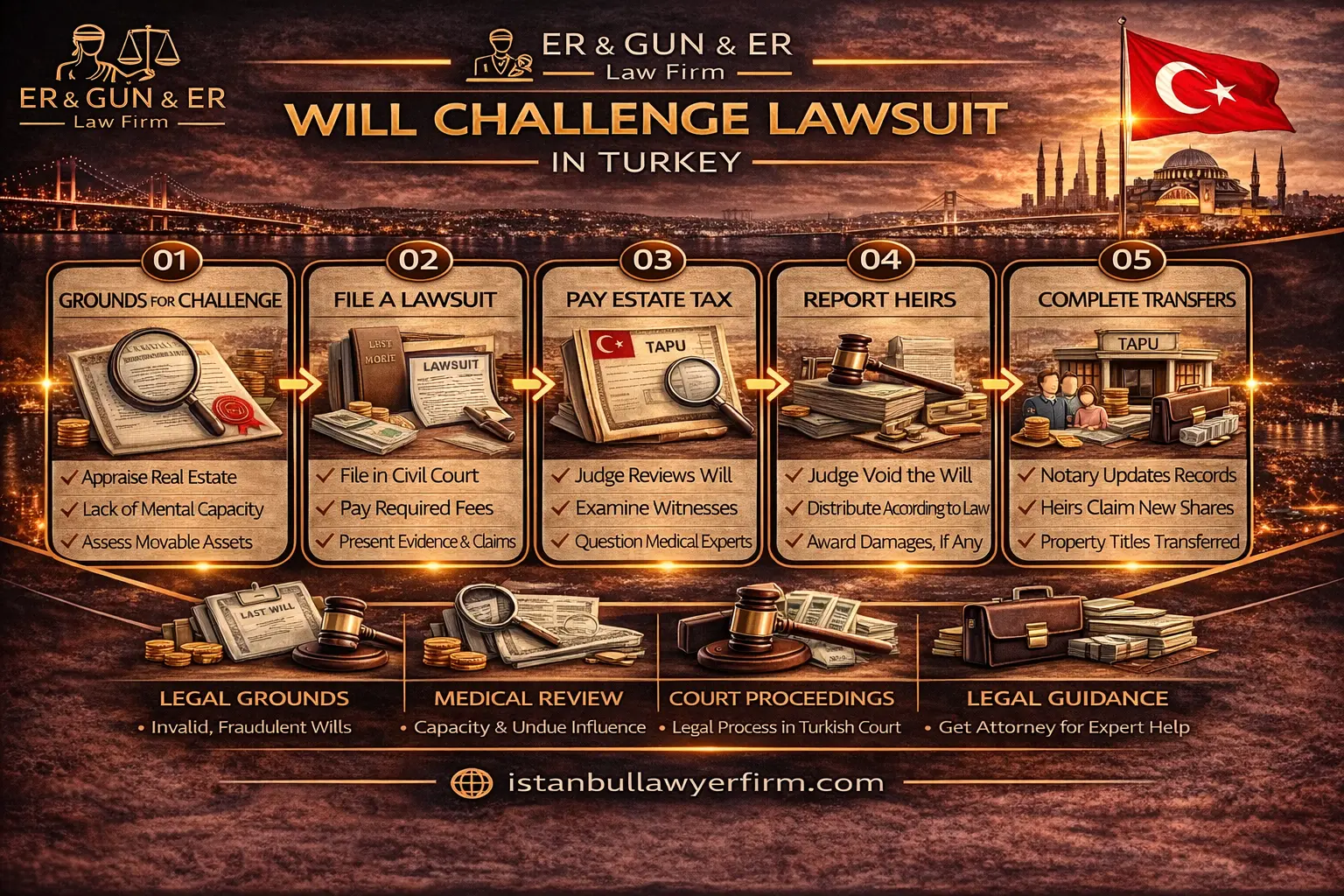
A will challenge in Turkey is a civil action seeking annulment of a testamentary disposition on one of the statutory grounds set out in the Turkish Civil Code (Türk Medeni Kanunu, Law No. 4721, abbreviated TMK). The grounds are not open-ended. Article 557 of the Civil Code limits the action to three categories: testamentary incapacity at the time the will was executed, defects in the testator's volition (mistake, fraud, duress, or undue influence), and defects in the form of the will itself. A challenge does not turn on the heir's view of whether the disposition is fair; it turns on whether the will satisfies the statutory requirements for validity. The action is brought in the Civil Court of First Instance (Asliye Hukuk Mahkemesi) of the location where the will was opened, runs under the Civil Procedure Code (Hukuk Muhakemeleri Kanunu, Law No. 6100), and is subject to the layered statutory time limits in Article 559: one year from the claimant's discovery of the will, the ground, and their own right; in any case ten years from the will's opening for good-faith respondents and twenty years for bad-faith respondents. This guide explains the framework foreign clients and their international counsel encounter when a will challenge becomes necessary in Turkey, with the relevant Turkish legal terminology identified at first mention.
1. The Civil Code Framework: Articles 502, 532–540, 557 and 559
A Turkish Law Firm running an inheritance dispute file works against Book Three of the Civil Code, which covers the entirety of Turkish succession law from intestate-succession rules through the form and content of testamentary dispositions, the protection of reserved-share heirs, and the procedural mechanics of administering an estate. The will-validity framework sits in three connected provisions. Article 502 defines who has capacity to make a will: a person of sound judgment who has reached the age of fifteen. Articles 532 to 540 govern the three recognised will forms — official will (resmi vasiyetname), handwritten will (el yazılı vasiyetname), and oral will (sözlü vasiyetname). Article 557 then sets out the three categories of invalidity that support a challenge action. Article 559 establishes the statutory time limits within which the action must be brought.
An Istanbul Law Firm advising a foreign claimant on a will-challenge file also has to position the action against the related but distinct remedies that the Civil Code makes available. The reserved-share reduction action (tenkis davası) under Articles 560 to 571 is a separate remedy through which protected heirs can claw back dispositions that exceed the testator's freely disposable share. The action for cancellation of registered title (tapu iptal ve tescil davası) is the operative remedy where the disputed will has produced a real-estate transfer that needs to be unwound. The action for restitution of unjust transfers and the action against improperly conducted gifts both live in adjacent provisions. Counsel running an inheritance dispute therefore selects the correct cause of action — sometimes only one, sometimes a combination filed together — based on the relief the claimant actually needs rather than on the heir's general dissatisfaction with the testator's choices.
A lawyer in Turkey advising on the cross-border dimension of a will-challenge file works through the Code on Private International Law and Procedural Law (Milletlerarası Özel Hukuk ve Usul Hukuku Hakkında Kanun, Law No. 5718), which sets the conflict-of-laws rules for the Turkish-located portion of a foreign decedent's estate. Article 20 of the Code on Private International Law applies the deceased's national law to movable property and Turkish law to immovable property located in Turkey. The form of the will, by contrast, is governed by Article 22, which accepts a will as formally valid if it complies with either the law of the place of execution, the deceased's national law, or Turkish law. The conflict-of-laws structure produces situations where a will may be valid in form under one applicable law but contested in substance under another, and where Turkish law's reserved-share regime applies to the immovable portion of the estate even where the deceased's national law would have permitted broader testamentary freedom. The cross-border layer is one of the most distinctive features of Turkish will-challenge practice for foreign families.
2. Types of Wills Under Turkish Law: Resmi, El Yazılı, Sözlü
An English speaking lawyer in Turkey explaining the will-form catalogue to a foreign claimant covers the three statutory forms recognised by the Civil Code. The official will (resmi vasiyetname) under Articles 532 to 537 is executed before a notary, justice of the peace, or other authorised official, in the presence of two witnesses, with the will text either dictated by the testator or read by the testator, then read back, signed by the testator, signed by the official, and signed by the witnesses. The procedure is heavily formalised; deviations from any required step are grounds for invalidation under Article 557. The handwritten will (el yazılı vasiyetname) under Article 538 must be entirely written in the testator's own hand, dated, and signed by the testator; a typewritten or computer-printed will fails the form requirement regardless of the strength of evidence that the testator dictated the text. The oral will (sözlü vasiyetname) under Articles 539 to 540 is available only in extraordinary circumstances such as imminent death or inaccessibility, where neither the official nor the handwritten form can be used, and is itself subject to additional procedural requirements including witness recording and post-emergency court confirmation.
A Turkish Law Firm running due diligence on a contested will identifies which form the will is and assesses the form-specific vulnerabilities. Official wills are challenged most commonly on capacity grounds (the testator's mental state at the moment of execution), undue influence (whether a third party manipulated the procedure), and procedural-irregularity grounds (whether the witness, signature, and attestation requirements were actually met). The notarial file holds the supporting evidence on each of these points: the notary's identity verification, the contemporaneous record of the procedure, the witnesses' identification details, and any annotations the notary made about the testator's apparent state. Counsel obtains the notarial file at an early stage of the engagement because the file is the operative record against which the witness testimony, the medical evidence, and the testator's contemporaneous communications are assessed.
Turkish lawyers who handle handwritten-will disputes work on a substantially different evidence map. Authenticity becomes the first battleground: was the will actually written by the testator, or by a third party imitating the testator's hand. The expert-witness analysis (bilirkişi incelemesi) under Article 266 of the Civil Procedure Code is typically the determinative element, with the court appointing a handwriting expert to compare the disputed will against verified handwriting samples drawn from bank records, notarial files, employment records, and personal correspondence collected at the diligence stage. The chain-of-custody discipline on the original will and the comparison samples is critical: a contaminated specimen produces an inconclusive expert report, and an inconclusive report shifts the litigation back onto the secondary indicators (the storage location, the discovery circumstances, the testator's communications about the disposition during their lifetime) that are themselves easier to dispute. Oral wills are rare in practice but, when they appear, are challenged most often on whether the extraordinary circumstance that justified the form actually existed and on whether the witness-recording mechanics were properly followed.
3. Formal Validity Requirements and Form Defects
A Turkish Law Firm advising a claimant on a form-defect challenge under Article 557/1 of the Civil Code works the documentary record against the statutory checklist for the will form at issue. The most defensible challenges are those where the form defect is visible on the document itself or in the file record. A handwritten will lacking a date is a form defect on the face of the document. A handwritten will containing typewritten passages has been formally invalidated even where the typewritten portion was not material. An official will whose attestation page does not show all required signatures is a form defect on the file record. An official will whose witnesses fall outside the eligibility criteria — being beneficiaries, being relatives of beneficiaries, or otherwise being statutorily disqualified — is invalidated on the file record. Form-defect challenges have the structural advantage that the evidence is documentary rather than testimonial, and the analysis turns on the application of the statutory rule rather than on a credibility contest between witnesses.
An Istanbul Law Firm running a notarial-will form challenge also has to obtain and analyse the notary's procedural file (noter tutanağı) for the execution. The notary maintains a record of every notarised will that includes the date and time of execution, the identification documents presented by the testator, the witnesses' identification, the procedural steps the notary followed (dictation versus reading, the read-back step, the signatures), and any contemporaneous observations the notary recorded about the testator. This record is producible by court order and is the central documentary exhibit in most notarial-will challenges. The defence on a notarial-will form challenge typically argues that the notary's certification is presumptively reliable; the claimant's response is to identify a specific deviation from the statutory procedure that the file itself reveals, rather than to attack the notary's general credibility.
A lawyer in Turkey running a handwritten-will form challenge focuses on the three statutory elements at Article 538: full handwriting, dated, signed by the testator. A will written partly by the testator and partly by another hand fails the requirement. A will lacking a date — or a will dated incompletely (year only, or month and year without the day) — fails the requirement; the case-law of the Court of Cassation has consistently treated incomplete dating as fatal to validity. A signature that is materially different from the testator's standard signature triggers an authenticity challenge that runs through the handwriting-expert mechanism. A will written on multiple pages without continuous handwriting between pages produces a question about which pages are valid. Each of these defects is identifiable on the document itself, which gives the claimant a structural advantage on the documentary evidence layer that capacity and influence challenges do not have.
4. Lack of Testamentary Capacity at the Time of Execution
An English speaking lawyer in Turkey running a capacity-based challenge under Article 557/2 of the Civil Code, in conjunction with Article 502, works on a temporal evidence problem. The question is not whether the testator was generally diminished in capacity, or whether the testator declined into incapacity at some point. The question is whether, at the moment the will was executed, the testator possessed the sound judgment (temyiz kudreti) that Article 502 requires — the ability to understand the nature of the document, the property being disposed of, and the natural beneficiaries of the testator's bounty. A diagnosis of dementia, Alzheimer's disease, or other cognitive impairment is relevant but not dispositive: a testator with a chronic cognitive condition may have executed the will during a period of relative lucidity, and a testator without any chronic diagnosis may have executed the will during an acute episode of impairment.
A Turkish Law Firm running the medical-evidence layer of a capacity challenge collects records from the relevant period using lawful access channels: the testator's medical history through requests to treating institutions, prescription records, hospital admission and discharge records, cognitive-assessment scores where available, and care-facility records where the testator was institutionalised. Foreign-resident testators add a layer of complexity because medical records originating abroad require apostille authentication and sworn translation before being admissible in the Turkish proceeding. The claimant's medical-exhibit pack is structured chronologically against the will's execution date, with each record indexed by date, issuing institution, and relevance to the capacity question. The court typically appoints a forensic-medicine expert under Article 266 of the Civil Procedure Code to evaluate the records and produce a written opinion; counsel's task at the expert-engagement stage is to ensure the expert receives a complete record set rather than a curated subset, because incompleteness is one of the most common bases for challenging an unfavourable expert opinion.
Turkish lawyers who handle capacity challenges also build the supporting non-medical evidence layer. Contemporaneous testimony from neutral observers — the testator's bank manager, neighbours, professional caregivers, family acquaintances who were not beneficiaries — addresses the testator's day-to-day functioning during the period in question. Bank records showing dependency on others to manage finances, sudden unexplained changes in financial behaviour, or signature variations across the relevant period support an inference of diminished capacity. Communications from the testator during the period — letters, emails, recorded conversations where lawfully obtained — speak to the testator's coherence and decision-making. The defence in a capacity challenge typically produces counter-evidence of moments where the testator appeared coherent and acted with apparent understanding; the claimant therefore avoids overstating the case as continuous incapacity and focuses on the execution moment, supported by the surrounding period evidence to establish that the moment is consistent with the broader pattern. The claimant also coordinates the capacity narrative with the documentary record of the will-making procedure itself. Where the will is an official will, the notarial file's contemporaneous observations about the testator's apparent state become a focal point: a notary who recorded that the testator was lucid, oriented, and able to articulate the dispositions creates a documentary obstacle the claimant must overcome with stronger competing evidence. Where the will is a handwritten will, the absence of a contemporaneous procedural record shifts more weight onto the medical evidence and the surrounding-period testimony. The strategic choice between focusing on the execution moment and arguing a longer period of impairment depends on the strength of the medical record at each temporal point, and is one of the determinative early-stage decisions in the case.
5. Defects of Volition: Mistake, Fraud, Duress and Undue Influence
A Turkish Law Firm running a volition-defect challenge under Articles 504 to 507 and Article 557/2 of the Civil Code addresses claims that the testator's free will was distorted at the moment of execution by an external factor. Article 504 covers mistake (hata), where the testator was operating under a material misapprehension about the legal or factual context of the disposition. Article 505 covers fraud (hile), where a third party intentionally deceived the testator about a material matter that influenced the disposition. Article 506 covers duress (ikrah), where the testator's volition was overborne by threats or coercion. Article 507 covers undue influence (yöneltme), where a third party exploited a relationship of trust or dependence to direct the testator's testamentary decision against the testator's autonomous preference. Each of these grounds requires a different evidence map, and the claimant typically pleads the most defensible single ground rather than a kitchen-sink combination of overlapping grounds.
An Istanbul Law Firm running an undue-influence file works on what is in practice a relational-pattern proof problem. The claimant must show three connected elements: a relationship of trust or dependence between the testator and the alleged influencer at the relevant time; conduct by the influencer that exploited that relationship; and a resulting testamentary disposition that materially favours the influencer in a way that departs from the testator's autonomous preference. The evidence layer typically includes documented dependency (medical, financial, residential), a pattern of isolation from prior relationships, contemporaneous control of the testator's communications and external contacts, sudden changes in beneficiary designations and financial arrangements during the period of dependency, and where available the testator's earlier testamentary documents or expressed intentions that the disputed will materially departs from. The bar is high: undue influence is not the same as persuasion, and a beneficiary who cared for the testator does not become an undue influencer merely because the testator's gratitude is reflected in the disposition. The case-law of the Court of Cassation has developed a recurring pattern test under which the strongest cases are those where the disputed will represents a sharp and unexplained departure from the testator's prior testamentary pattern in favour of a person who had recently assumed a position of dependency-creating influence. A testator who has consistently divided the estate among children and then, in a final will executed during a period of caregiving dependency, leaves the substantial portion to a single caregiver, has produced the kind of factual configuration that supports an undue-influence inference. By contrast, a testator who has consistently favoured a particular beneficiary across multiple lifetime statements and a series of testamentary documents, and whose final will continues that pattern, presents a much weaker undue-influence case even where the favoured beneficiary occupied a caregiving role.
A lawyer in Turkey running a duress challenge under Article 506 addresses a narrower fact pattern. The claimant must identify the specific threat or coercion, the time it occurred, and the connection between the coercion and the execution of the disputed will. Police records, medical-incident records, contemporaneous communications expressing fear, and witness testimony from neutral parties who observed the coercive environment are the standard evidence types. Family conflict — even acute family conflict — is not duress within the statutory meaning unless it produced a specific coercive episode that overrode the testator's volition at the relevant time. Mistake claims under Article 504 are rarer and typically require evidence that the testator misapprehended a legally material fact that, but for the misapprehension, would have produced a different disposition. Fraud claims under Article 505 require an intentional deception, the testator's reliance on the deception, and a causal link between the deception and the disposition. Each volition-defect ground turns on the specificity of the pleaded conduct and the documentary or testimonial evidence supporting it.
6. Standing, Forum and Procedure Under HMK 6100
An Istanbul Law Firm running the procedural layer of a will-challenge file works through the Civil Procedure Code (Hukuk Muhakemeleri Kanunu, Law No. 6100). Standing (dava ehliyeti) to bring an invalidity action under Article 558 of the Civil Code is granted to any person whose interest would be affected by the will's invalidity — typically a statutory heir who would receive a larger share under intestate-succession rules, a previously named beneficiary whose share would be increased, or a creditor of one of those persons. Foreign claimants have standing on the same basis as Turkish claimants; nationality is not a bar. Standing is established documentarily through the chain of family-status records (the deceased's death certificate, the family-composition records from the Civil Registry, and where applicable the inheritance certificate) that establish the claimant's position in the statutory succession order.
A Turkish Law Firm running the venue analysis works through Article 11 of the Civil Procedure Code, which establishes that inheritance-related actions are heard at the court of the deceased's last residence. For wills opened in Turkey, this is typically the Civil Court of First Instance (Asliye Hukuk Mahkemesi) of the district where the deceased was last resident. For non-resident decedents whose Turkish-located assets generate an inheritance dispute, the venue is determined by the location of the disputed Turkish assets or by the will's opening venue. The probate court that opened the will (Sulh Hukuk Mahkemesi, the Civil Court of Peace) is a different court from the court that hears the validity challenge: the Civil Court of Peace performs the will-opening procedure under Articles 596 to 600 of the Civil Code, while the validity action is heard by the Civil Court of First Instance with the will-opening record as a foundational exhibit.
Turkish lawyers who handle the procedural mechanics of a will challenge also coordinate with the parallel administrative tracks that the dispute does not pause. The probate court's will-opening procedure produces a certificate of inheritance (mirasçılık belgesi) that is the operative document for asset-administration purposes, and the certificate continues to exist alongside the validity challenge. Banks, the Land Registry, and other asset-holding institutions will act on the certificate of inheritance during the litigation unless the claimant obtains an injunction (ihtiyati tedbir) under the Civil Procedure Code preventing specific transactions. Counsel runs the injunction analysis at an early stage where the assets are at risk of dissipation: a real estate transfer to a third-party purchaser, a banking transaction depleting the disputed account, a corporate action transferring shares. The injunction is granted on a discretionary basis where the claimant shows a colourable claim, irreparable harm absent the injunction, and proportionality between the requested measure and the harm to be prevented.
7. Statutory Time Limits Under Civil Code Article 559
A lawyer in Turkey advising a foreign claimant on the time-limit position works through Article 559 of the Civil Code, which establishes a layered limitation regime that is distinctive in its structure. The headline limitation is one year from the date the claimant learned of three combined elements: the disposition itself, the ground for invalidity, and their own right to bring the action. This subjective limitation runs from actual knowledge rather than from the will-opening date, which means a foreign-resident heir who learns of the will only after a delay can still bring the action within one year of that actual learning. The objective long-stop limitation is ten years from the will-opening date for actions brought against good-faith respondents — beneficiaries who took the disposition without knowledge of the invalidating ground — and twenty years against bad-faith respondents who knew or should have known of the invalidating ground at the time of taking the disposition.
A Turkish Law Firm running the time-limit analysis on a developing matter builds the documentary record around the limitation triggers. The will-opening record (vasiyetnamenin açılması tutanağı) issued by the Civil Court of Peace establishes the start of the objective long-stop. The service records and notification documents around the will opening establish when the heir was on formal notice. Communications, family correspondence, and direct evidence of when the heir actually saw the will text and learned of its terms establish the start of the subjective one-year period. Counsel preserves these documents as a date map (a structured chronology with each document tied to the limitation event it triggers) so the court can assess the limitation position from the file rather than from competing testimony. The case-law of the Court of Cassation has consistently held that the one-year subjective limitation does not start running until the claimant has actual knowledge of all three elements — the will, the ground, and the right — and that constructive notice based on a reasonable possibility of knowledge is generally insufficient. This subjective character of the headline limitation is the most distinctive feature of the Turkish regime and is materially more claimant-protective than the objective limitation regimes operating in many common-law jurisdictions. It is also the feature that most often justifies a delayed filing where a foreign claimant only learns of the disposition through subsequent family communications, post-mortem document discovery, or the practical effects of the will surfacing through the asset-administration process.
An Istanbul Law Firm advising a foreign claimant whose discovery has been delayed by language, distance, or family withholding builds the evidence supporting the late-discovery position. The cases that produce the most extended limitation periods are those where the will was withheld from the claimant by the favoured beneficiary, where the claimant lives abroad and was not served with the will-opening notice, or where the claimant only learned of the invalidating ground (for example, evidence of incapacity that emerged later) after the will's contents were already known. The defendant in these cases typically argues that the claimant could and should have learned earlier; the claimant's response is built on the documentary record showing when actual knowledge arrived. The twenty-year long-stop against bad-faith respondents is an important protection in cases where the favoured beneficiary actively concealed the will or the supporting evidence; the claimant must, however, plead and prove the bad faith specifically, which requires evidence beyond the mere fact of the disposition.
8. Evidence Strategy: Documents, Witnesses and Expert Reports
A Turkish Law Firm running the evidence layer of a will-challenge file builds the documentary record before the testimonial layer. The anchor exhibits are the will text, the will-opening record, the certificate of inheritance, the notarial procedural file (for official wills), and the family-status records that establish standing. The next layer is the substantive evidence specific to the pleaded ground: medical records and forensic-medicine analysis for capacity challenges; communications, witness testimony, and pattern documentation for undue-influence challenges; the disputed document itself and the comparison handwriting samples for handwritten-will authenticity challenges; and the specific contextual evidence (police records, medical incident records, contemporaneous communications) for duress challenges. The Civil Procedure Code's evidence framework at Articles 187 to 268 governs the rules of admissibility, the burden of proof, and the procedural mechanics of evidence presentation.
An Istanbul Law Firm running the expert-witness layer works through Article 266 of the Civil Procedure Code, which authorises the court to appoint an expert (bilirkişi) where the dispute requires specialised knowledge beyond the court's competence. In will-challenge proceedings, three categories of expert engagement recur. The first is the forensic-medicine expert for capacity disputes, who reviews the medical record and produces a written opinion on the testator's capacity at the time of execution. The second is the handwriting expert for handwritten-will authenticity disputes, who compares the disputed will against verified samples and produces a written opinion on whether the handwriting is consistent with the testator's. The third is the document-analysis expert for cases involving alterations, ink-aging questions, or paper-aging questions on official wills. The expert's opinion is not binding on the court, but in practice carries substantial weight; the claimant's procedural task is to ensure that the expert receives a complete, indexed record set and has the opportunity to engage with the claimant's specific factual and analytical concerns.
Turkish lawyers who handle the witness-testimony layer of a will challenge work against a procedural framework that differs materially from common-law systems. Civil Procedure Code Articles 240 to 265 govern witness testimony: witnesses are examined by the judge, with party counsel proposing questions through the bench rather than conducting direct cross-examination of the common-law type. Witness selection accordingly emphasises clarity of recollection on specific dated events rather than the rhetorical capability that drives common-law witness preparation. Witnesses on a will challenge typically include neutral observers of the testator's day-to-day functioning during the relevant period, the witnesses to the will's execution where applicable (their identification is in the notarial file or on the will itself for handwritten wills witnessed by additional persons), the persons who were present in the testator's household during the period of alleged influence, and, in certain cases, professional advisers (the testator's accountant, banker, or family physician) who can speak to specific dated events.
9. Reserved-Share Reduction Action: Tenkis Davası Under Articles 560–571
A Turkish Law Firm advising a foreign claimant whose objective is to recover a statutory minimum share rather than to invalidate the will entirely runs the reserved-share reduction action (tenkis davası) under Articles 560 to 571 of the Civil Code. The reserved share (saklı pay) is the statutory minimum that protected heirs are entitled to receive regardless of the testator's testamentary disposition. The protected categories are the deceased's descendants, the surviving spouse, and in the absence of descendants the deceased's parents. The reserved share is calculated as a fraction of the heir's statutory intestate share: half of the intestate share for descendants and the surviving spouse where descendants survive, and one-quarter of the intestate share for parents where they qualify. Where the testator's disposition exceeds the freely disposable portion (saklı paya ek olarak tasarruf edilebilen kısım), protected heirs whose reserved share is impaired can bring the reduction action against the over-favoured beneficiaries.
An Istanbul Law Firm running the calculation layer of a tenkis davası works against a calculation framework that turns on the deceased's net estate value at the time of death (Article 565), adjusted for lifetime gifts and dispositions made during the deceased's lifetime that fall within Article 565's add-back categories. The reserved-share calculation is therefore not a simple division of the will's named bequests; it is a structured estate valuation that requires inventory work, appraisal of the constituent assets, and identification of the lifetime dispositions that the law treats as part of the calculation base even though they were not dispositions through the will. Counsel coordinates the inventory and appraisal layer with forensic-accounting support where the estate is sufficiently complex, and produces a calculation memorandum that documents the inputs and the arithmetic. A simplified illustration helps clarify the structure: where a deceased leaves a surviving spouse and two children with a net estate of one hundred units, the intestate-succession rules under Articles 495 to 499 of the Civil Code allocate one-quarter to the spouse and three-quarters split equally between the children, producing twenty-five units to the spouse and thirty-seven and a half units each to the children. The reserved-share fraction (one-half for descendants and the surviving spouse where descendants survive) translates these intestate shares into reserved shares of twelve and a half units for the spouse and eighteen and three-quarters units for each child. A will leaving the entire estate to one of the children would impair the spouse's reserved share by twelve and a half units and the other child's reserved share by eighteen and three-quarters units, and would be subject to a reduction action on those amounts.
A lawyer in Turkey advising on the relationship between the reduction action and the invalidity action covers a strategic decision that the claimant typically faces at the outset. A successful invalidity action voids the will entirely (or the invalidated portion of it), with the consequence that the affected disposition reverts to intestate succession and the claimant takes their statutory intestate share. A successful reduction action leaves the will in place but reduces the over-favoured dispositions to the extent necessary to restore the protected heir's reserved share. The two remedies produce different outcomes on the same fact pattern: invalidation generally produces a larger recovery for the claimant where invalidation is established, but is harder to prove because it requires one of the Article 557 grounds. Reduction is easier to establish (the calculation is statute-driven and does not depend on capacity, volition, or form challenges) but produces a smaller recovery limited to the reserved-share entitlement. Counsel typically pleads them in the alternative where the fact pattern supports both, with the invalidity action as the primary claim and the reduction action as the fallback.
10. Settlement, Partition and Implementation
An English speaking lawyer in Turkey advising a foreign claimant on the resolution architecture of a will-challenge file covers three resolution paths that often run in sequence. The first is settlement at the pre-litigation or early-litigation stage, typically through mandatory pre-action mediation under the Mediation Law (Law No. 6325) for inheritance-adjacent commercial disputes or through voluntary mediation more broadly. Settlement is pragmatic where the parties' positions are factually defensible on both sides and the cost and time of full litigation exceed the expected differential outcome. A settlement agreement is recorded in writing, signed by all heirs, and where applicable converted into an enforceable instrument through court endorsement or notarial certification depending on the dispositions involved. Settlement avoids the litigation outcome's binary character and allows the parties to structure compensation, asset allocation, and ongoing relationships in ways that a court judgment cannot.
A Turkish Law Firm running the partition (paylaşma) layer addresses the post-resolution allocation of co-owned estate assets. Where the estate includes Turkish real estate held by multiple heirs as co-owners, partition under Articles 642 to 651 of the Civil Code can proceed by agreement among the heirs (rızai paylaşma) or, where agreement cannot be reached, through a partition action (ortaklığın giderilmesi davası) brought before the Civil Court of Peace. The partition action results either in a physical division of the property where physical division is feasible or in a judicial sale of the property with distribution of the proceeds in proportion to the heirs' shares. Foreign-resident heirs holding shares in Turkish real estate frequently encounter the partition forum even where the will-validity dispute itself was settled, because the settlement allocates entitlements but does not always allocate specific assets.
Turkish lawyers who handle the implementation layer of a will-challenge resolution coordinate the post-judgment or post-settlement administrative steps that translate the legal outcome into operative changes at the relevant registries and institutions. A judgment invalidating a will produces a corresponding administrative consequence: the certificate of inheritance is reissued by the Civil Court of Peace to reflect the intestate-succession entitlements, the Land Registry records are updated to reflect the corrected ownership, the bank accounts are released to the corrected beneficiaries, and the inheritance tax filing under the Inheritance and Transfer Tax Law (Law No. 7338) is adjusted to reflect the new distribution. Each implementation step has its own procedural mechanics and its own documentary requirements, and the implementation phase often runs for weeks or months after the judgment becomes final. Counsel produces a close-out memorandum at the end of the implementation phase documenting which steps have been completed and which remain pending, which provides the foreign client with a clean record of the resolution.
Frequently Asked Questions
- What is a will challenge in Turkey? A will challenge is a civil action under Article 557 of the Turkish Civil Code seeking annulment of a testamentary disposition on one of three grounds: lack of testamentary capacity at the time of execution, defects of volition (mistake, fraud, duress, or undue influence), or defects in the form of the will itself.
- Who has standing to bring a will challenge? Any person whose interest would be affected by the will's invalidity. Typically this includes statutory heirs whose intestate share would be larger absent the will, previously named beneficiaries whose share would be increased, and creditors of those persons. Foreign claimants have standing on the same basis as Turkish claimants.
- What is the time limit for bringing a will challenge? Article 559 of the Civil Code establishes a layered limitation. The headline limitation is one year from the claimant's actual knowledge of the disposition, the ground for invalidity, and the claimant's own right. The objective long-stop is ten years from the will's opening for good-faith respondents and twenty years for bad-faith respondents.
- What forms of will does Turkish law recognise? Three forms. The official will (resmi vasiyetname) is executed before a notary or other authorised official with two witnesses. The handwritten will (el yazılı vasiyetname) is entirely written, dated, and signed in the testator's own hand. The oral will (sözlü vasiyetname) is permitted only in extraordinary circumstances such as imminent death.
- Where is a will challenge filed? In the Civil Court of First Instance (Asliye Hukuk Mahkemesi) of the location where the will was opened, typically the deceased's last residence. The probate court that opened the will (Civil Court of Peace, Sulh Hukuk Mahkemesi) is a different court from the court that hears the validity challenge.
- What is the difference between an invalidity action and a reduction action? An invalidity action under Article 557 voids the will or the invalidated portion entirely, reverting the affected disposition to intestate succession. A reduction action (tenkis davası) under Articles 560 to 571 leaves the will in place but reduces over-favoured dispositions to restore the protected heir's reserved share. The two are often pleaded in the alternative.
- How is testamentary capacity determined? Article 502 of the Civil Code requires that the testator be at least fifteen years old and possess sound judgment at the time of execution. The court typically appoints a forensic-medicine expert under Article 266 of the Civil Procedure Code to review the medical record and produce a written opinion on the testator's capacity at the relevant moment.
- How are handwritten wills challenged on authenticity? Through a court-appointed handwriting expert who compares the disputed will against verified handwriting samples drawn from bank records, notarial files, employment records, and personal correspondence. The chain-of-custody discipline on the original will and the comparison samples is critical to the expert's analysis.
- What is the difference between persuasion and undue influence? Persuasion is permissible. Undue influence under Article 507 of the Civil Code requires a relationship of trust or dependence between the testator and the alleged influencer, conduct exploiting that relationship, and a resulting disposition that materially favours the influencer in a way that departs from the testator's autonomous preference. The standard of proof is high.
- Can a foreign-jurisdiction will be challenged in Turkey? Yes, where the will affects Turkish-located property. The Code on Private International Law (Law No. 5718) applies the deceased's national law to movable property and Turkish law to immovable property located in Turkey. Form is governed by Article 22 of the Code, which accepts a will valid under any of the law of the place of execution, the deceased's national law, or Turkish law.
- Does a will challenge pause the distribution of the estate? Not automatically. The certificate of inheritance issued by the Civil Court of Peace continues to operate alongside the validity challenge, and asset-holding institutions act on the certificate. Where the assets are at risk of dissipation, the claimant can apply for an injunction (ihtiyati tedbir) preventing specific transactions during the litigation.
- What is the reserved share in Turkish inheritance law? The reserved share (saklı pay) is the statutory minimum that protected heirs (descendants, surviving spouse, and in their absence parents) are entitled to receive regardless of the testator's disposition. It is calculated as a fraction of the heir's intestate share — half for descendants and the surviving spouse where descendants survive, and one-quarter for qualifying parents.
- How long does a will challenge typically take? Civil first-instance commercial proceedings of comparable complexity typically take a year or more, with appellate review through the regional appeal court and the Court of Cassation adding additional time. Cases turning on extensive expert reports or cross-border evidence collection take materially longer than cases resolved on the documentary record alone.
- Can a will challenge be settled out of court? Yes, and settlement is a common resolution path. Settlement agreements are recorded in writing, signed by all heirs, and where applicable converted into enforceable instruments through court endorsement or notarial certification. The implementation steps at the registries and institutions follow the same mechanics as a litigated outcome.
- What documents does counsel need to begin a will-challenge engagement? The will text, the will-opening record from the Civil Court of Peace, the certificate of inheritance, the family-status records establishing standing, the notarial procedural file for official wills, and where available the deceased's medical records, bank records, and correspondence covering the period before and around the will's execution. Cross-border documents require apostille authentication and sworn translation.
About the Author
Av. Mirkan Günay Topcu is the managing partner of ER&GUN&ER Law Firm (Istanbul) and is registered with the Istanbul Bar Association under No. 67874. The firm advises foreign nationals, foreign-incorporated entities, and multinational legal teams on Turkish inheritance disputes — will-validity challenges, reserved-share reduction actions, partition proceedings, the cross-border conflict-of-laws coordination on multi-jurisdictional estates, and the post-judgment implementation work at the Land Registry, the banking system, and the Inheritance Tax administration.
The author works principally in English with foreign principals and home-jurisdiction counsel, with day-to-day case work covering will-opening procedures before the Civil Court of Peace, validity actions before the Civil Court of First Instance, expert-witness coordination on forensic-medicine and handwriting analysis, the reserved-share calculation work for tenkis davası proceedings, and the settlement-and-implementation architecture that translates legal outcomes into administrative reality at the relevant registries.
Profile: LinkedIn. Foreign clients with related Turkish-located property and inheritance matters may also wish to read the companion guides on why foreigners choose a Turkish law firm and why you need a real estate lawyer in Turkey, which cover the broader Turkish-legal-interface architecture within which an inheritance dispute typically sits.
Contact ER&GUN&ER Law Firm