

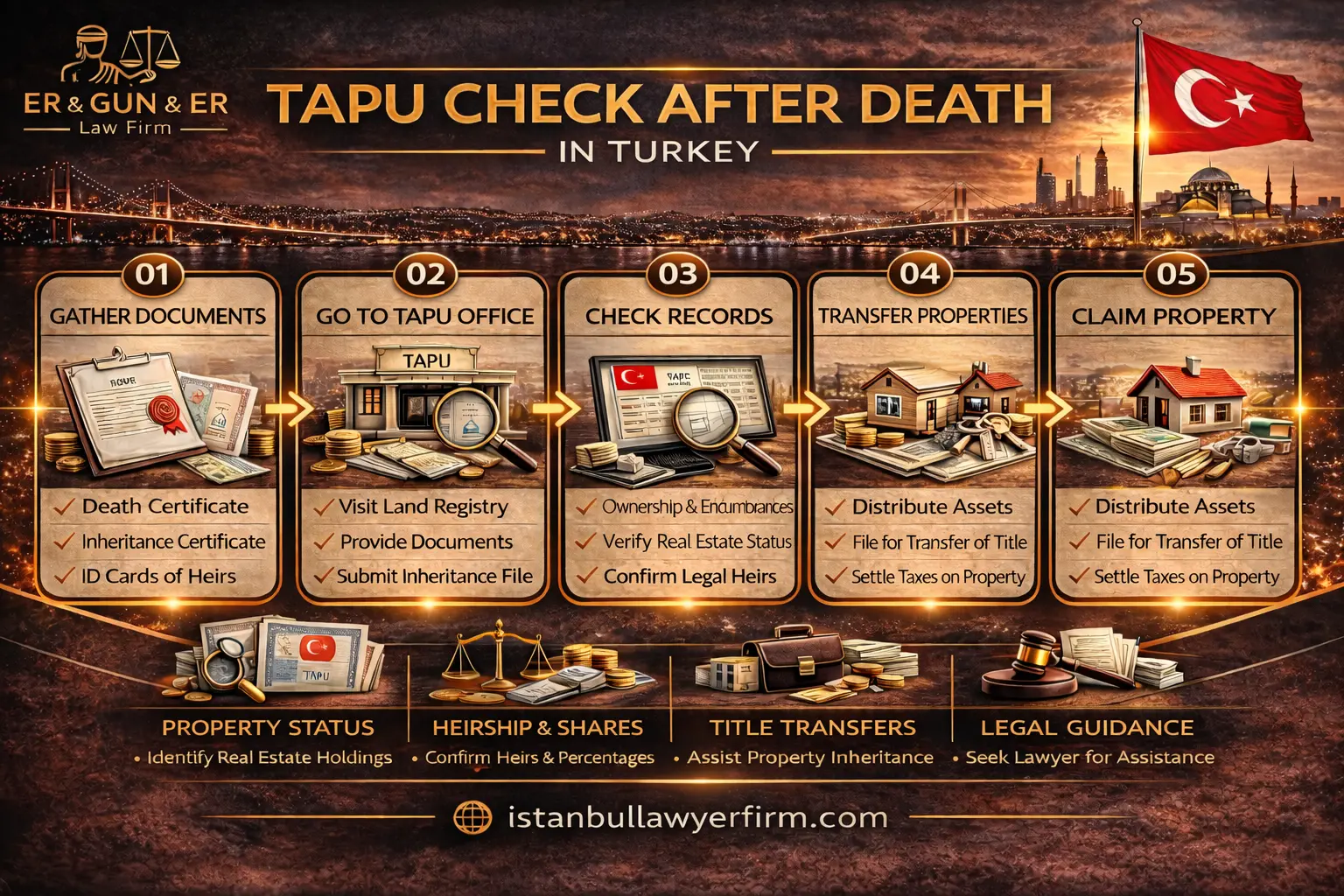
A "tapu check after death" means verifying, through lawful channels, whether a deceased person had real estate registered in Türkiye and what the current title records show. The legal framework rests on the Turkish Civil Code (Law No. 4721, the "TMK") inheritance provisions in Articles 495-682, the Tapu Code (Law No. 2644) and the Tapu Sicil Tüzüğü (Land Registry Regulation), the Land Registry and Cadastre Information System (Tapu ve Kadastro Bilgi Sistemi, "TAKBİS") operated by the General Directorate of Land Registry and Cadastre (Tapu ve Kadastro Genel Müdürlüğü, "TKGM"), and the digital interfaces e-Devlet (operated by the Presidency Digital Transformation Office) and Web Tapu (operated by TKGM). Standing for the inquiry rests on the inheritance certificate (veraset ilamı) under TMK Article 598, which can be issued by either the magistrate court (sulh hukuk mahkemesi) under the standard procedure or by a notary under the streamlined procedure introduced by Law No. 6217 of 14 January 2011.
The tapu check after death is not a private search; it is a controlled inquiry tied to heirship under TMK Articles 495-501 (intestate succession) or TMK Articles 502-544 (testamentary succession), identity verification, and TKGM Land Registry practice. The practical reasons are clear: heirs need a complete picture of estate real estate before they can coordinate inheritance transfer under the Tapu Code Law 2644 framework, bank releases under TTK and Banking Law (Law No. 5411) standards, and tax filings under the Inheritance and Gift Tax Law (Law No. 7338). A second reason is fraud prevention under the Penal Code (Law No. 5237) Articles 204-207 (official and private document forgery) and Article 158 (qualified fraud), because unauthorized acts can occur around sensitive moments if heirs do not stabilise records and evidence quickly. A third reason is planning, because heirs often discover co-ownership shares, annotations, or encumbrances that affect what can be transferred and when. ER&GUN&ER Law Firm advises heirs, foreign beneficiaries, and estate representatives on standing documentation, lawful title inquiry through TAKBİS-linked digital and office channels, fraud detection and response, encumbrance review, and the eventual tapu transfer to heirs procedure under Law 2644 with parallel coordination of bank releases and Law 7338 inheritance tax clearance. Practice may vary by authority and year — check current guidance.
Why Tapu Checks Matter
A tapu check is the point where assumptions turn into registrable facts under the TKGM TAKBİS system. It shows whether the deceased appears in TAKBİS-linked title records for any parcel registered under Law 2644 and the Tapu Sicil Tüzüğü. It also shows how the ownership is recorded, including shares (hisse) and parcel identifiers (ada, parsel, pafta). It allows heirs to build an inherited property inquiry file that is evidence-led. It reduces the risk of missing a property because no one remembers it. It reduces the risk of relying on old copies of deeds that no longer reflect the registry. It helps identify if there are multiple properties across different provinces. It helps identify if the property is held in co-ownership (paylı mülkiyet under TMK Articles 688-700, or elbirliği mülkiyeti under TMK Articles 701-703) with third parties or with other heirs. It helps identify if the property is subject to mortgage (ipotek) annotations under TMK Articles 850-897, lien records, or restrictions. Practice may vary by authority and year — check current guidance.
Heirs should understand that title records are the controlling source under Law 2644 Article 26 (registry as authoritative evidence), not family statements. A person may believe a property exists, yet the registry may show a sale or transfer before death. A person may believe no property exists, yet the registry may show a share in a distant parcel. A person may believe a property is "in the family," yet the registry may show co-ownership fractions that change the practical strategy. A tapu check after death is therefore a risk-control step under the broader TMK inheritance framework, not a formality. It also supports preventing fraudulent title transfer under TCK Articles 204-207 by spotting unusual changes early. It lets the heirs ask the right questions at the right office with the right identifiers. It supports later requests for certified records (tasdikli suret) where those are needed under HMK Article 199 documentary evidence framework. It also highlights whether foreign heirs will need additional documentation under the Hague Apostille Convention 1961 (to which Türkiye is party since 1985 through Law No. 6303) and HMK Article 223 (sworn translation requirements).
A tapu check also matters because downstream offices ask questions in the language of title identifiers. A bank under Banking Law (Law No. 5411) and MASAK regulations under Law No. 5549 wants to know whether real estate exists and whether it will be transferred. A tax office under Tax Procedure Law (Law No. 213) and Inheritance and Gift Tax Law (Law No. 7338) wants to know which assets are in scope and how they will be valued. A land registry office wants exact parcel identifiers under Law 2644 to open the file and to schedule the transfer. If the estate includes multiple properties, a single missing parcel can block overall planning because heirs must coordinate shares across assets under TMK Articles 640-682 (estate liquidation framework). If one property has a mortgage under TMK Articles 850-897, heirs must plan whether to keep or discharge it. The check therefore supports a structured property inventory that can be used across the estate process. A disciplined archive is the simplest way to reduce conflict, because it replaces memory with a dated record under HMK evidence standards.
Who Can Request Records
Access to deceased title records is not a public search under Law 2644 Article 7 (registry confidentiality) and is tied to legal interest and identity verified through the General Directorate of Civil Registration and Citizenship Affairs (Nüfus ve Vatandaşlık İşleri Genel Müdürlüğü, "NVİ") records. In practice, heirs are the primary persons who can request and view relevant records, as their legal interest derives from their TMK Article 599 capacity as universal successors (külli halefler) automatically entitled to the deceased's assets and liabilities at the moment of death. A representative can act if authority is documented through a properly executed power of attorney (vekaletname) under TBK Articles 502-514 and accepted by TKGM. The request must be supported by identity proof that matches the civil registry records under Law 5490 (Population Services Law) and the inheritance certificate under TMK Article 598. Practice may vary by authority and year — check current guidance.
Request eligibility also depends on the specific channel used. For e-Devlet title deed queries, the system requires authentication through e-Devlet password, electronic signature (e-imza) under Electronic Signature Law (Law No. 5070), mobile signature, or another approved identity verification method, and the system links the user to NVİ records. For Web Tapu inheritance property queries, the user must have access to the relevant interface operated by TKGM and the system's query options. If the heirship proof is not in the system because the inheritance certificate has not been digitally registered, the digital route may not display results even if property exists. In that case, the office route directly to the Tapu Müdürlüğü (Land Registry Directorate) where the property is registered may be necessary. The file should therefore treat access as a stepwise ladder, starting with digital where available and moving to office requests where required. The safest approach is to designate one request owner, keep an index of outputs, and record the date each query was made.
Heirs should also understand that requesting records is not the same as transferring title under Law 2644. A record view helps build the estate inventory, but transfer requires inheritance steps under TMK Articles 599-616 (acceptance and registration) and registry transactions under Law 2644 Article 12 (registration procedure). That means record requests should be planned as part of a larger probate chain and not as a one-off curiosity. A good file starts with a request plan, then moves to heirship proof through veraset ilamı under TMK Article 598, then moves to transfer planning. Heirs should avoid sending multiple people to request different pieces of the file with different names and spellings, because that creates confusion at the registry under TKGM identity-matching practice. Heirs should avoid relying on unofficial intermediaries who cannot lawfully access or who create privacy risks under the Personal Data Protection Law (Law No. 6698, "KVKK").
Inheritance Certificate Role
The inheritance certificate (veraset ilamı or mirasçılık belgesi) under TMK Article 598 is the document that links a person's claim of being an heir to a proof that offices and systems accept. The certificate states who the heirs are and what their shares are under TMK Articles 495-501 (intestate succession order — children and spouse, parents, grandparents, surviving spouse alone), and that share table is used across estate steps. Many land registry inquiries after death require this proof to move beyond generic questions into formal processing under Law 2644. Banks under Banking Law and MASAK rely on it when they release balances and allocate shares under inheritance succession. Tax offices under Law 7338 (Inheritance and Gift Tax Law) rely on it when they allocate taxable bases to heirs. The certificate therefore stabilises the estate file by providing a recognised share map. Practice may vary by authority and year — check current guidance.
Two issuing channels are available. Under the original TMK Article 598 framework, the magistrate court (sulh hukuk mahkemesi) issues the certificate after a non-contentious proceeding (çekişmesiz yargı işi). Under the streamlined procedure introduced by Law No. 6217 of 14 January 2011, notaries (noter) can issue the certificate where the heirship is clear from civil registry records and no dispute exists; complex cases (foreign heirs, contested heirs, missing civil records) typically require the court route. The certificate also affects what digital systems can show, because systems often match heir status through linked NVİ records. If the certificate is properly issued and recorded in the inheritance information system, it can enable system queries that otherwise show nothing. If the certificate is not in the system, heirs may need to rely on office requests and certified paper copies under HMK Article 199. The file should keep the certificate in a secure folder under KVKK Article 12 security requirements.
The certificate role is also practical in fraud prevention because it establishes who should be contacted and who can object under TKGM standing rules. If an unusual registry change is suspected, the heirs need a clear proof of standing to raise the issue quickly. If the heirs need to place or check an annotation under Law 2644, they need standing proofs to be taken seriously. The certificate therefore supports preventing fraudulent title transfer under TCK Articles 204-207 by enabling prompt, lawful interactions with offices. It also supports a controlled power-of-attorney approach when heirs are abroad, because the authority chain is anchored in the heirship table under TMK Article 598. The file should maintain a certificate and standing memo that lists who can act and under what authority documents under TBK 502-514 mandate framework. The file should avoid using multiple inconsistent authority documents, because inconsistent authority creates vulnerability.
e-Devlet Inquiry Pathway
The e-Devlet inquiry pathway exists as a practical digital method for heirs to view title information recorded in TAKBİS, but it remains an authenticated, lawful access channel operated by the Presidency Digital Transformation Office. The e-Devlet title deed query for heirs allows authenticated users to query TAKBİS-registered tapu information for a deceased person where the system can match heir status through NVİ-linked inheritance certificate records. The user must authenticate through e-Devlet password, electronic signature under Electronic Signature Law (Law No. 5070), mobile signature, or another approved method. The operational benefit is speed and traceability because the user can generate a record of what was seen at a given time. The operational limit is that the system shows what is in the database and what is linked to the user's heir status, and it may not show assets that are not properly linked or recorded under Law 2644 framework. Practice may vary by authority and year — check current guidance.
In practice, the e-Devlet query is strongest when the heirs first stabilise the heirship lane and identity lane. If the system cannot recognise the person as heir, the query may not produce meaningful results even if property exists. That means the correct workflow is to secure the inheritance certificate under TMK Article 598 and identity alignment with NVİ records first, then run the e-Devlet query as an evidence capture step. The file should also run the query as a repeatable process, for example once at the start and again before transfer, because records can change and fraud risk under TCK Articles 204-207 exists. If a difference appears between two query dates, the file should treat it as a red flag and investigate through official channels under Law 2644 and TKGM procedures, not through assumptions. The file should also know that digital systems can have intermittent availability, so the evidence pack should include date-stamped captures rather than relying on memory.
The e-Devlet pathway is also useful for fraud prevention because it provides a quick check baseline. If heirs suspect that an unauthorised transfer occurred, the first step is to confirm what the system currently shows and to preserve proof of that view. The second step is to obtain official office extracts and transaction history (tapu kayıt örneği under Law 2644) where available, because screenshots alone may not be sufficient for formal challenge under HMK Article 199 documentary evidence requirements. The third step is to coordinate with the Tapu Müdürlüğü using the correct parcel identifiers and heirship proof under TMK Article 598. The fourth step is to coordinate with any fraud-response lane under TCK Articles 204-207 and Article 158, including potential criminal complaint (suç duyurusu) to the Public Prosecutor (Cumhuriyet Başsavcılığı) under CMK procedural framework, without treating any pathway as a guarantee of outcomes.
Web Tapu Access Principles
Web Tapu is the digital interface operated by TKGM under Law 2644 framework for certain title-related functions, and it can support heirs when their access is properly established through authenticated identity verification. Web Tapu inheritance property query refers to using the Web Tapu environment to view or manage relevant title information, subject to identity and access controls aligned with KVKK Article 12 security requirements. Web Tapu is not a public search engine and it does not replace heirship proof under TMK Article 598 when the user is acting as an heir. The first principle is that access is identity-based and role-based, so the system will display what the user is authorised to see. The second principle is that the system is designed to support transactions and inquiries that align with TAKBİS-registered data. The third principle is that the user should treat Web Tapu outputs as evidence snapshots and archive them with dates and query context. The fourth principle is that sensitive identifiers should be handled with confidentiality under KVKK Articles 4 and 12. Practice may vary by authority and year — check current guidance.
Web Tapu access also depends on how heirs manage the single file concept for the estate. If multiple heirs independently access Web Tapu and create separate parcel lists with different spellings or different capture dates, the family risks internal contradictions. The safer approach is to appoint one evidence owner and maintain one indexed archive of Web Tapu outputs. That archive should include a cover memo stating the capture date, the system view used, and the identity of the account that performed the query. The archive should include a parcel table in prose form that lists the properties and share information as shown, but the table should be embedded in paragraphs rather than presented as bullet lists. The archive should include a "what we still do not know" memo that flags uncertainties such as missing properties, unclear shares, or unclear annotations under Law 2644. The archive should also include a plan for office verification at the relevant Tapu Müdürlüğü where needed.
Web Tapu access principles should also include a fraud-prevention mindset, because sudden changes in what the system shows can indicate a need for urgent verification. Heirs should consider periodic checks when the estate is not yet transferred under TMK Articles 599-616, especially if the deceased had high-value assets or a history of disputes. A periodic check should be documented as a dated event in the chronology, with the same capture method used each time. If a new encumbrance or annotation appears under Law 2644, the file should treat it as a ticket and request official confirmation through the Tapu Müdürlüğü. If a parcel disappears from the list, the file should treat it as a ticket and verify whether a transfer occurred and when, using official transaction records (tapu işlem geçmişi). The file should not publish suspicion publicly, and should not accuse individuals without evidence, because those actions create additional legal risks including defamation exposure under TCK Article 125. A structured file that blends Web Tapu snapshots with official extracts is the strongest defense against both real fraud and false alarms.
Land Registry Office Requests
When digital channels cannot provide enough clarity, heirs must move to land registry office requests using formal proofs and parcel identifiers under Law 2644 and the Tapu Sicil Tüzüğü. Land registry inquiry after death refers to requesting official extracts (tapu kayıt örneği), ownership histories (tapu işlem geçmişi), and annotation details (şerhler) through the relevant Tapu Müdürlüğü. The first step is to identify the correct office based on the property's registry location, which is determined by parcel and district data under TKGM territorial jurisdiction. The second step is to prepare an office request pack that includes identity proof and heirship proof under TMK Article 598, because office staff must confirm standing before disclosing records under Law 2644 Article 7 confidentiality framework. The third step is to prepare a property tab that includes the parcel identifiers (ada, parsel, pafta) and any prior deed copies. Practice may vary by authority and year — check current guidance.
Office requests also require careful management of what the heir actually needs at each stage. At the inquiry stage, heirs often need confirmation of existence, current ownership, share fractions, and any encumbrances or annotations under Law 2644 (mortgage under TMK Articles 850-897, easements under TMK Articles 779-819, occupancy rights, restrictions). At the transfer stage under Law 2644 Article 12, heirs need additional documents and a transaction appointment, but that is later and should not be mixed into the inquiry request. The file should therefore separate inquiry requests from transfer requests and keep a clean narrative. If a fraud concern exists under TCK Articles 204-207, inquiry requests should also focus on identifying the date and document basis of any suspicious transaction. If a property is jointly owned, office extracts should clarify the co-owner identities and shares under TMK paylı or elbirliği mülkiyet framework. If the property is subject to a mortgage under TMK Articles 850-897, office extracts should clarify the creditor identity and the formal basis.
Land registry office requests are also an opportunity to correct mistakes early, such as mismatched names between the deceased's NVİ civil records and the title record. If a mismatch exists, the file should document it and plan how it will be reconciled before the transfer appointment under Law 2644. If heirs wait until transfer day, the registry may reject the transaction and require new proof. The file should therefore use inquiry outputs to run a transfer readiness audit that identifies what must be corrected. The audit should list missing identity reconciliations, missing certified copies under HMK Article 199, missing heirship proof updates under TMK Article 598, and any encumbrance issues. If a fraud pattern is suspected, the audit should include a fraud response lane that preserves evidence and sets out official steps to request transaction history under Law 2644 and to consider potential criminal complaint under CMK before the Cumhuriyet Başsavcılığı. The audit should also coordinate with bank and tax lanes because those lanes often run in parallel and depend on the same TMK 598 share table.
Identity and Kinship Proof
Identity and kinship proof is the permission layer for accessing deceased title records, because privacy rules under KVKK and Law 2644 Article 7 prevent open access. The file should build a token sheet that matches the deceased's identity across NVİ civil records under Law 5490, passports, and TAKBİS title records. The file should build an heir identity tab for each heir, including passport or Turkish ID (T.C. Kimlik), address details registered with NVİ Adres Kayıt Sistemi (AKS) under Law 5490 Article 50, and contact details for notices. The file should then build a kinship tab that proves the heir relationship under TMK Articles 495-501 (intestate succession order), using NVİ family registry evidence (aile bireyleri belgesi) where available. In cross-border cases, kinship proof may rely on foreign civil documents that must be legalised under the Hague Apostille Convention 1961 and translated under HMK Article 223 before use. Practice may vary by authority and year — check current guidance.
Kinship proof should also be designed with downstream use in mind, because banks under Banking Law and MASAK and tax offices under Law 7338 will request the same proof and will compare it to title outputs from TAKBİS. That means the file should build one master kinship pack and reuse it consistently. The master pack should include the inheritance certificate under TMK Article 598, key NVİ civil registry extracts under Law 5490, and foreign documents where applicable, all indexed and dated. The file should include a short kinship memo that describes the family tree in factual terms and points to exhibits, without legal argument. If there are minors or predeceased heirs, the file should include chain proof under TMK Article 501 (representation per stirpes) and representation proof under TBK 502-514 mandate framework, because shares and standing depend on those facts. If a will exists, the file should keep will documents in a separate lane under TMK Articles 502-544 (testamentary succession) and avoid mixing them into the tapu inquiry narrative unless required.
Identity and kinship proof is also the foundation for fraud prevention, because fraud often exploits confusion about who is entitled to act. If heirs cannot prove standing under TMK Article 598 quickly, they may be slow to respond to suspicious records under Law 2644. The file should therefore prepare standing documents early, even before the full asset inventory is complete. The file should also designate a single custodian for original documents and keep a custody log so originals are not lost across family members. The file should keep certified copies (tasdikli suret) ready for office presentations under HMK Article 199, because offices may not accept plain photocopies. The file should keep a secure digital archive under KVKK Article 12 security standards with high-resolution scans. The file should also plan for cross-border signatures by preparing authority documents (vekaletname) under TBK 502-514 early if heirs are abroad, with apostille legalisation under the Hague Convention 1961. The file should avoid giving sensitive identity documents to unauthorised intermediaries.
Foreign Heirs Documentation
Foreign heirs documentation is a separate lane because foreign identity and civil documents must be made usable in Turkish registry practice under Law 2644 and HMK Article 223. Foreign heir property search Turkey reflects that foreign heirs often cannot simply log in and view records without bridging documentation gaps. The file should start by collecting each foreign heir's passport and address proof and ensuring the name tokens match the inheritance certificate under TMK Article 598. The file should then collect kinship documents that prove the relationship where Turkish registry evidence is incomplete or unavailable. The file should then plan legalisation steps: apostille death certificate under the Hague Apostille Convention 1961 (Türkiye party since 1985 through Law No. 6303) for documents from member countries, or consular legalisation for non-Hague countries through the Turkish consulate. The file should then plan sworn translations into Turkish under HMK Article 223 by translators registered with Turkish notaries. Practice may vary by authority and year — check current guidance.
Foreign heirs also face practical issues in timing and coordination because documents must move across countries and offices. The file should therefore use a pipeline memo that lists which documents are in which stage, such as issued, legalised, translated, notarised, and archived. The memo should be updated as a version-controlled document so the family can coordinate without confusion. The file should also designate a custodian for originals, because originals may be needed for office presentations and repeated couriering increases loss risk. The file should also reconcile foreign naming conventions, such as patronymics or multiple surnames, with Turkish token formats so offices can match identity across NVİ records. If the foreign heir is also dealing with foreign probate decisions, those may require recognition under the International Private and Procedural Law (Law No. 5718, MÖHUK) Articles 50-59 — keep that lane separate. Under MÖHUK Article 20, succession to immovable property is governed by the law of the location of the property (lex rei sitae), so Turkish real estate inheritance is governed by Turkish law (TMK) regardless of the deceased's nationality.
Foreign heirs documentation also affects fraud prevention because delays create windows where records can change without heirs noticing under TCK Articles 204-207 risk framework. The file should therefore prioritise obtaining the inheritance certificate under TMK Article 598 and standing documents quickly so the inquiry can begin even while some foreign documents are still in the pipeline. If foreign heirs cannot act directly, they should authorise a representative early using a proper authority bundle under TBK 502-514, and the file should index that bundle for later reuse. The file should also coordinate periodic checks of TAKBİS title records, using digital snapshots where available and office extracts under Law 2644 where needed. If a discrepancy is detected, the file should treat it as a ticket and request official transaction history promptly. A foreign-heir-ready file is one where every foreign document is properly apostilled or legalised, sworn-translated under HMK 223, and token-matched, and where a representative can act without new paperwork surprises.
Apostille and Translation Steps
Cross-border estates often stall at the title inquiry stage because foreign documents are not yet usable in Turkish land registry practice under Law 2644. The apostille death certificate captures a common starting point, but the correct approach is to map every foreign civil document needed for standing under TMK Article 598. A foreign death certificate may be required to support heirship and to reconcile identity tokens in the title system. Some countries use apostille under the Hague Apostille Convention 1961, and some require consular legalisation through the Turkish consulate, so the file must confirm the applicable path for the issuing country. The file should preserve the original document or a certified copy as the anchor exhibit. The file should preserve legalisation pages together with the source document as a single bundle. The file should then plan translation as a controlled token exercise under HMK Article 223, not as a last-minute language step. The translator must be a sworn translator (yeminli tercüman) registered with a Turkish notary. Practice may vary by authority and year — check current guidance.
Apostille and translation steps should be managed as a pipeline with clear stages rather than as a single "get it translated" task. Stage one is issuance, meaning the record must be obtained from the correct issuing authority and in the correct format. Stage two is legalisation under the Hague Convention 1961 or consular framework. Stage three is translation under HMK Article 223 by a sworn translator registered with a Turkish notary. Stage four is notarisation, meaning the translator declaration is formalised. Stage five is archiving under KVKK Article 12 security standards. Stage six is reuse, meaning the same bundle is used across the title inquiry under Law 2644, inheritance certificate under TMK Article 598, bank release, and tax lanes under Law 7338 to avoid token drift. The file should also create a short legalisation memo that explains what method was used and why. The file should avoid asserting fixed processing periods for legalisation because timelines depend on issuing authority and consular workload.
The apostille and translation lane also intersects with how to find deceased property in Türkiye because standing proof under TMK Article 598 must be ready before deeper TKGM registry disclosure is possible. If the heirship lane is incomplete, e-Devlet and Web Tapu systems may not display complete results and office requests at the Tapu Müdürlüğü may be limited. That is why the file should prioritise standing bundles even before the full property inventory is complete. The file should also treat every foreign document as a separate bundle and not mix pages across different persons, because mixed bundles are a common rejection reason under HMK Article 199 documentary evidence framework. The file should also be careful about translating place names and administrative regions consistently, because inconsistencies can create identity doubt. The file should record uncertainty where it exists, rather than presenting a practice assumption as settled.
Privacy and Access Limits
Title deed records are not open to the public in an unrestricted way under Law 2644 Article 7 (registry confidentiality) and KVKK framework, and heirs should treat access as a legally conditioned privilege tied to standing under TMK Article 598. TAKBİS title deed records are accessed through identity-based and role-based controls operated by TKGM. The land registry and related digital tools (e-Devlet, Web Tapu) apply identity-based access under Law 5070 (Electronic Signature) and KVKK Article 12 security framework, and will not show full information to a person who cannot prove a legal interest. This protects the deceased's privacy under KVKK personal data framework and reduces misuse of property data. It also means that heirs must build a standing file under TMK Article 598 before expecting comprehensive results. Practice may vary by authority and year — check current guidance.
Privacy and access limits also mean that searching for property should not be attempted through unofficial intermediaries who promise secret access. Such behaviour can create legal risk under KVKK Article 12 (data security violations) and Article 17 (administrative fines for unauthorised access), and can contaminate the evidence trail if a dispute later arises. The safer approach is to use official channels under Law 2644 and to document every request and response as an event under HMK evidence standards. The file should keep a request log that lists what was requested, by whom, and on what date, using factual language. The file should keep the response in a secure folder under KVKK Article 12 and note whether it is a screenshot, an official print, or a certified extract under Law 2644. The file should also keep a redaction rule for sharing, because family members often forward documents without understanding what identifiers are exposed. The file should designate a single communication channel for office interactions so multiple heirs do not send contradictory requests.
Privacy and access limits also influence fraud response under TCK Articles 204-207 because urgent action still must follow lawful channels. If heirs suspect a suspicious change, they should not attempt to pull records through questionable methods and should instead obtain official extracts and transaction history through proper requests under Law 2644. They should preserve the system snapshot, then request the certified history (tapu işlem geçmişi tasdikli suret), then escalate through the correct formal mechanism — including criminal complaint under CMK to the Cumhuriyet Başsavcılığı if document forgery under TCK Articles 204-207 or qualified fraud under TCK Article 158 is suspected. The file should also coordinate with the bank lane under Banking Law and MASAK Law 5549, because bank compliance teams also apply privacy rules and will not release information without standing proof under TMK Article 598. The file should coordinate with the tax lane under Law 7338, because tax files also contain sensitive data. For privacy-aware coordination in bilingual families, controlled summaries that keep sensitive identifiers out of casual communications protect the integrity of the evidence pack.
Detecting Unauthorized Transfers
Unauthorised transfer detection is a realistic concern because sensitive periods can create opportunities for abuse under TCK Articles 204-207 (document forgery) and TCK Article 158 (qualified fraud) when heirs are not yet organised. Preventing fraudulent title transfer after death is best treated as a checklist of red flags supported by official records under Law 2644, not as a presumption of wrongdoing. The first red flag is a change in owner name or share in the TAKBİS system that the heirs cannot explain with documents. The second red flag is a newly appearing annotation or removal of an annotation under Law 2644 without a known reason. The third red flag is a property disappearing from the digital view where it previously appeared. The fourth red flag is a new power-of-attorney claim by a third party without the family's knowledge — particularly significant given that PoA-based fraud has been a recurring concern in Turkish real estate practice, leading to TKGM PoA verification reforms. The fifth red flag is a bank or registry communication that references a transaction the family did not initiate.
The correct response is to capture a dated snapshot, then obtain a certified extract under Law 2644 (tapu kayıt örneği), then request the transaction history (tapu işlem geçmişi) through the appropriate Tapu Müdürlüğü procedure. The file should avoid informal accusations and should focus on what can be proven under HMK evidence standards. The file should preserve every office request and response as exhibits because fraud disputes are record disputes under TCK Article 158 and Articles 204-207 frameworks. Where document forgery is established, civil remedies include reversal of the fraudulent transaction under TMK Article 1024 (registry correction action, tapu iptali ve tescili davası) before the Asliye Hukuk Mahkemesi, and criminal remedies include complaint under TCK Articles 204-207 to the Cumhuriyet Başsavcılığı. Practice may vary by authority and year — check current guidance.
Fraud detection also depends on understanding what changes are normal and what changes are abnormal. Some changes occur because of late data synchronisation in TAKBİS or because an office corrected a clerical error under Law 2644 procedural framework, and those changes can look suspicious without context. That is why the file must include official extracts and not rely only on screenshots. The file should also include a transaction chronology once available, because chronology helps distinguish normal processing from unusual patterns. If the family has old deed copies, compare them to the current registry state to see if the change predates death. If a property is in co-ownership under TMK paylı or elbirliği framework, a co-owner may have performed a legitimate transaction on their share, and the file must separate co-owner actions from estate actions. The file should coordinate with professional advice rather than with unofficial consultants who claim special access. The file should also limit public discussion because public discussion can alert wrongdoers and can create defamation exposure under TCK Article 125.
Encumbrances and Annotations
Encumbrances and annotations are the registry signals under Law 2644 that determine whether property can be transferred, sold, or used as collateral, and they must be checked early. Title deed annotation inheritance Turkey captures the practical fact that many inherited properties carry notes that affect heirs. An annotation can be a mortgage (ipotek) under TMK Articles 850-897, a lien (haciz) under İcra ve İflas Kanunu (Law No. 2004), a precautionary attachment (ihtiyati haciz) under İİK Articles 257-268, a precautionary injunction (ihtiyati tedbir) under HMK Articles 389-399, an easement (irtifak hakkı) under TMK Articles 779-819, a usufruct (intifa hakkı) under TMK Articles 794-822, or another registry note depending on the case. The file should not assume that a clean deed copy means clean registry, because annotations can change over time. The correct method is to obtain current registry information under Law 2644 and to preserve it as an exhibit. Practice may vary by authority and year — check current guidance.
Annotation checks also protect heirs from surprises during transfer planning under Law 2644, because transfer appointments can fail if annotations are not understood. Heirs should treat annotation review as a transfer readiness audit step, even before scheduling a transfer at the Tapu Müdürlüğü. If a mortgage exists under TMK Articles 850-897, the file should identify the creditor and request the relevant bank documentation through lawful channels. If a lien exists under İİK, the file should identify the basis and whether it can be lifted. If a restriction (kısıtlama) exists, the file should identify whether it is temporary or structural under Law 2644, and what office controls it. The file should avoid relying on informal interpretations, because annotation meanings can be technical. The file should instead request office clarification at the Tapu Müdürlüğü and preserve the response as an exhibit under HMK Article 199. The file should keep a clearance plan memo that lists what must be done to clear each annotation, in factual steps.
Encumbrance review also informs whether the heirs should proceed with transfer immediately under TMK Articles 599-616 or whether they should first resolve debts and obligations under TMK Articles 540-545 (estate debts) and TMK Articles 605-618 (acceptance under benefit of inventory or rejection of inheritance). If a property is heavily encumbered, heirs may consider reddi miras (rejection of inheritance) under TMK Article 605 within the 3-month period from learning of death, or kayıt kabul (acceptance under benefit of inventory) under TMK Article 619, but these choices must be documented and coordinated through professional advice. The file should also ensure that all heirs understand the annotation status, because misunderstanding creates internal conflict under TMK 644 (estate community) framework. A cohesive file architecture is to keep one property tab, one annotation summary, one clearance plan memo, and one communication log per property.
Transfer to Heirs Workflow
The tapu transfer to heirs Turkey procedure under Law 2644 is the sequence where the registry updates ownership from the deceased to the heirs, based on heirship proof under TMK Article 598 and TMK Articles 599-616 (acceptance and registration of inheritance). The title inquiry lane provides the parcel identifiers and current state, but transfer requires a transaction lane with formal steps under Law 2644 Article 12. The file should begin transfer planning by confirming that the inheritance certificate share table matches the registry owner identity tokens in TAKBİS. The file should then confirm that each property tab contains current title extracts and annotation status under Law 2644. The file should then confirm that heirs' identity proofs and any representative authority documents under TBK 502-514 are complete and token-consistent with NVİ records. The file should then plan the transaction request to the relevant Tapu Müdürlüğü, using the correct office for the parcel's location. Practice may vary by authority and year — check current guidance.
Transfer workflow must also account for co-ownership and multiple heirs, because the registry will register shares as stated by the certificate under TMK Article 598 unless a separate legal allocation is formalised. Pending estate division (mirasın paylaşılması) under TMK Articles 642-679, heirs hold the estate in elbirliği mülkiyeti (joint ownership without specified shares) under TMK Article 701-703. To convert elbirliği into paylı mülkiyet (co-ownership with specified shares) under TMK Articles 688-700, or to allocate specific properties to specific heirs, heirs can execute an estate division agreement (mirasın paylaşılması sözleşmesi) under TMK Article 676 in writing or proceed through a partition action (ortaklığın giderilmesi davası) under TMK Article 642 before the Sulh Hukuk Mahkemesi. The file should keep any private settlement lane separate and should keep the registry lane neutral and evidence-led. If a property has co-owners outside the estate, the transfer will cover only the deceased's share. If a property has annotations under Law 2644, the transfer may still proceed but later transactions may be constrained.
Transfer workflow is also connected to fraud prevention under TCK Articles 204-207 because the act of transfer changes registry state under Law 2644 and can close the window for certain unauthorised acts. The file should therefore schedule periodic checks up to the transfer event and preserve snapshots. The file should also ensure that communications with the registry are centralised so unauthorised persons cannot exploit confusion. The file should record every office instruction and every submitted document as an exhibit, because later disputes often ask what was presented under HMK evidence framework. If the registry requests additional documents, the file should treat that as a ticket, cure it with proper certified copies and translations under HMK 199 and 223, and update the change log. The file should also coordinate with bank and tax lanes so heirs know what can be done before transfer and what must wait under Law 7338 (inheritance tax).
Tax Clearance Coordination
Tax clearance coordination is the lane where heirs align the title transfer with inheritance tax under the Inheritance and Gift Tax Law (Law No. 7338) and related documentation required by offices. Inheritance tax clearance for title transfer is used in practice to describe the evidence that tax steps are addressed before or during transfer under Law 2644. Under Law 7338, heirs must file an inheritance and gift tax declaration (veraset ve intikal vergisi beyannamesi) within four months of death (or six months if heirs are abroad, under Law 7338 Article 9), at the tax office of the deceased's last residence, with extension possible. The Land Registry under Law 2644 typically requires evidence of tax declaration filing or tax clearance certificate (vergi ilişiksizlik belgesi) before completing the transfer. The file should treat the inheritance certificate under TMK Article 598 as the share table used for tax allocation. Practice may vary by authority and year — check current guidance.
Tax coordination also requires careful sequencing, because families often need liquidity from banks to pay taxes and fees, while banks under Banking Law and MASAK rules may require tax evidence before releasing funds. The solution is evidence planning, not guessing. Build a combined bank and tax coordination memo that lists what documents each office requires and what can be obtained first. Keep that memo factual and update it with exhibits rather than assumptions. If a bank requires proof that a declaration was filed under Law 7338, store the declaration submission proof in the bank pack. If a registry under Law 2644 requires proof that tax steps are addressed, store the relevant tax communication in the registry pack. The file should avoid mixing different share tables or different asset lists across packs, because that creates contradictory narratives. The file should also coordinate foreign heirs' documentation, because tax offices may require identity and address proofs in cross-border cases under HMK Article 223 and the Hague Apostille Convention 1961.
Tax clearance coordination also supports fraud prevention under TCK Articles 204-207 because it forces the family to maintain a documented chronology and to engage only through official channels. Fraud often thrives where families take shortcuts and share documents widely. A controlled tax lane uses a custodian, secure archiving under KVKK Article 12, and limited disclosure. The file should record each tax step as an event and store receipts and communications as exhibits under HMK Article 199. The file should also record what was presented to which office and when, because later questions can arise about what was known at transfer time. If a tax-related issue is disputed, the family can respond with exhibits rather than with reconstructed stories. A disciplined tax lane also reduces internal conflict because payments and allocations can be explained with receipts and TMK 598 share tables rather than informal calculations.
Disputes and Risk Controls
Disputes and risk controls are necessary because estates can involve missing records, family conflict, and opportunistic behaviour by third parties. The file should treat disputes as evidence questions first under HMK framework, because evidence drives what can be corrected and how. The file should preserve every snapshot, every office extract under Law 2644, and every communication as dated exhibits so later disputes can be anchored to record. The file should use one master index and one master chronology to prevent conflicting narratives between heirs. The file should use a single custodian rule for originals and certified copies under HMK Article 199. The file should use a single spokesperson rule for office communications. The file should run a periodic check plan while transfer is pending under TMK 599-616, because delays create risk windows under TCK Articles 204-207 framework. The file should implement a red flag list, but should treat red flags as prompts for verification, not as accusations. The file should request official transaction history promptly when a discrepancy appears under Law 2644. Practice may vary by authority and year — check current guidance.
Risk controls also include preventing internal mistakes that look like fraud, such as inconsistent spellings, wrong parcel identifiers, or mismatched share tables. The file should run a pre-submission audit before any major office step under Law 2644, such as a registry appointment or tax filing under Law 7338. The audit should confirm that the inheritance certificate under TMK Article 598 is the latest version and that all packs use the same share table. The audit should confirm that each property tab has the correct parcel identifiers (ada, parsel, pafta) copied from official records. The audit should confirm that identity tokens match across passports, certificates, and TAKBİS title extracts. The audit should confirm that foreign documents are legalised under the Hague Apostille Convention 1961 and translated under HMK 223 under the same token sheet. The audit should confirm that representative authority documents under TBK 502-514 are in scope and properly legalised if issued abroad. The audit should also confirm that confidentiality controls are followed under KVKK Article 12.
Disputes are also managed by having a clear escalation plan that remains within lawful channels. If a suspected unauthorised transfer is detected under TCK Articles 204-207, the plan should start with evidence capture, then office extracts under Law 2644, then formal challenge steps including TMK Article 1024 registry correction action (tapu iptali ve tescili davası) before the Asliye Hukuk Mahkemesi and criminal complaint to the Cumhuriyet Başsavcılığı under CMK procedural framework. If a bank dispute arises, the plan should start with proof of standing under TMK Article 598 and a record of communications, then formal bank channels under Banking Law and BDDK supervisory framework. If a family dispute arises under TMK 642-679 (estate division), the plan should keep office submissions neutral and evidence-led, and handle private disputes through appropriate legal lanes including Sulh Hukuk Mahkemesi partition action under TMK 642 (ortaklığın giderilmesi davası). For families that need structured coordination across heirs and countries, a counsel-led file discipline often reduces conflict because everyone works from the same exhibits.
Frequently Asked Questions
- What law governs inheritance in Türkiye? The Turkish Civil Code (Law No. 4721) Articles 495-682 — intestate succession (Articles 495-501), testamentary succession (Articles 502-544), inheritance certificate (Article 598), acceptance and rejection (Articles 605-618), and estate division (Articles 642-679).
- What is the inheritance certificate? The veraset ilamı (or mirasçılık belgesi) under TMK Article 598 — the document that proves who the heirs are and what their shares are. Issued by the Sulh Hukuk Mahkemesi (magistrate court) or by a notary under the Law No. 6217 streamlined procedure.
- What law governs the title deed registry? The Tapu Code (Law No. 2644) and the Tapu Sicil Tüzüğü (Land Registry Regulation), administered by the General Directorate of Land Registry and Cadastre (TKGM) through TAKBİS (Land Registry and Cadastre Information System).
- What is e-Devlet? The Turkish electronic government portal operated by the Presidency Digital Transformation Office, accessed through e-Devlet password, electronic signature under Law 5070, mobile signature, or other approved authentication methods.
- What is Web Tapu? The TKGM digital interface for certain title-related functions and inquiries, operated under Law 2644 framework with identity-based and role-based access controls aligned with KVKK Article 12.
- What governs co-ownership in inherited property? Pending estate division, heirs hold the estate in elbirliği mülkiyeti (joint ownership) under TMK Articles 701-703. After division, conversion to paylı mülkiyeti (co-ownership with shares) under TMK Articles 688-700 is possible.
- How is estate division handled? Through estate division agreement (mirasın paylaşılması sözleşmesi) under TMK Article 676 if heirs agree, or through partition action (ortaklığın giderilmesi davası) under TMK Article 642 before the Sulh Hukuk Mahkemesi.
- What if heirs reject the inheritance? Rejection of inheritance (reddi miras) under TMK Article 605 within 3 months of learning of death, or acceptance under benefit of inventory (kayıt kabul) under TMK Article 619 to limit liability for estate debts.
- What is the inheritance tax framework? The Inheritance and Gift Tax Law (Law No. 7338) requires declaration within 4 months of death (6 months for heirs abroad) at the tax office of the deceased's last residence. Land Registry transfer under Law 2644 typically requires tax clearance certificate.
- What about foreign heirs? Foreign documents require apostille under the Hague Apostille Convention 1961 (Türkiye party since 1985 through Law 6303) for Hague countries, or consular legalisation for non-Hague countries, plus sworn translations under HMK Article 223. Under MÖHUK Article 20, succession to immovable property follows the law of the property's location (lex rei sitae) — Turkish law.
- How are unauthorised transfers challenged? Civil challenge through TMK Article 1024 registry correction action (tapu iptali ve tescili davası) before the Asliye Hukuk Mahkemesi. Criminal complaint under TCK Articles 204-207 (document forgery) or TCK Article 158 (qualified fraud) to the Cumhuriyet Başsavcılığı.
- What annotations affect inherited property? Mortgage (ipotek) under TMK Articles 850-897, lien (haciz) under İİK, easements (irtifak hakkı) under TMK Articles 779-819, usufruct (intifa hakkı) under TMK Articles 794-822, precautionary attachment under İİK Articles 257-268, precautionary injunction under HMK Articles 389-399.
- Are foreign probate decisions recognised? Under MÖHUK Articles 50-59, with grounds for refusal under MÖHUK Article 54 (lack of reciprocity, non-finality, public policy violation, due process violation, exclusive Turkish jurisdiction). For Turkish real estate, MÖHUK Article 20 applies Turkish substantive law regardless.
- How is privacy protected? Under KVKK (Law No. 6698) generally, with specific Land Registry confidentiality under Law 2644 Article 7. Special category data under KVKK Article 6 receives stricter processing standards. Cross-border transfers under KVKK Article 9 require adequate safeguards.
- Where does ER&GUN&ER Law Firm support tapu inquiry after death? Veraset ilamı procurement under TMK Article 598; lawful TAKBİS, e-Devlet, and Web Tapu inquiry under Law 2644; Tapu Müdürlüğü office requests; encumbrance and annotation review; foreign heir documentation including Hague Apostille and HMK 223 translation; tapu transfer under Law 2644; Law 7338 inheritance tax coordination; and TCK Article 204-207 fraud response including TMK Article 1024 registry correction actions.
Author: Mirkan Topcu is an attorney registered with the Istanbul Bar Association (Istanbul 1st Bar), Bar Registration No: 67874. His practice focuses on cross-border and high-stakes matters where evidence discipline, procedural accuracy, and risk control are decisive.
He advises heirs, foreign beneficiaries, estate representatives, and family offices across Veraset İlamı procurement under TMK Article 598, lawful TAKBİS and Land Registry inquiry under Law 2644, e-Devlet and Web Tapu access discipline, foreign heir documentation under the Hague Apostille Convention 1961 and HMK Article 223, encumbrance and annotation review under TMK Articles 779-897, Tapu transfer to heirs under Law 2644 with TMK 599-616 acceptance framework, Law 7338 inheritance tax clearance coordination, and TCK Articles 204-207 fraud response including TMK Article 1024 registry correction actions before the Asliye Hukuk Mahkemesi.
Education: Istanbul University Faculty of Law (2018); Galatasaray University, LL.M. (2022). LinkedIn: Profile. Istanbul Bar Association: Official website.