

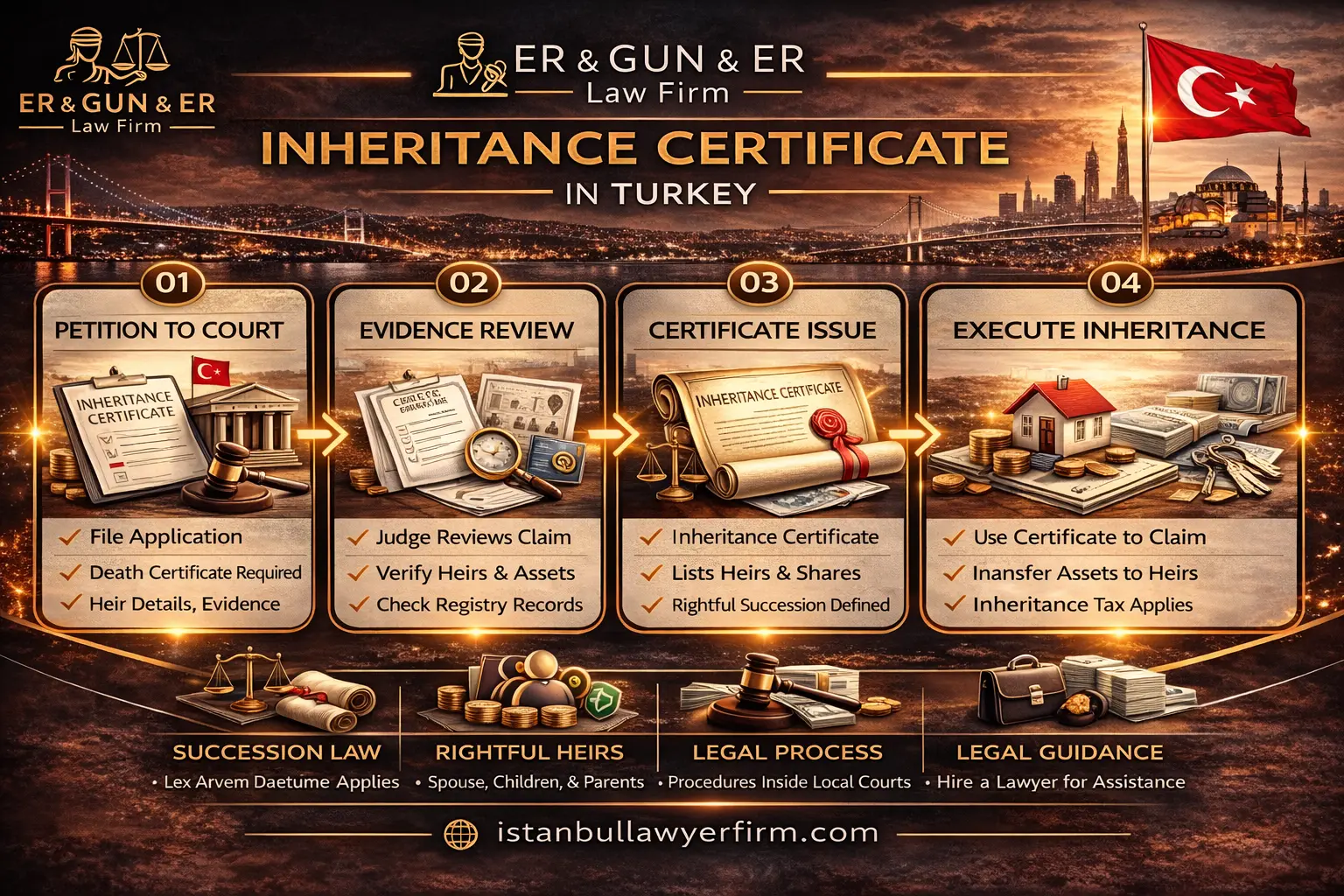
An inheritance certificate (veraset ilamı, also designated mirasçılık belgesi in current statutory nomenclature) is the official Turkish document evidencing who the legal heirs are and what fractional shares they hold in the deceased's estate. It functions as the procedural gateway that banks, the Tapu Müdürlüğü land registry, and the Vergi Dairesi tax office require before processing inherited assets. The certificate identifies heirs and shares based on civil status records and statutory succession rules rather than on family agreements. Foreign heirs and expatriates with Turkish-situated assets ordinarily encounter additional complexity because foreign civil documents must be made procedurally usable in Türkiye through legalisation, sworn translation, and identity reconciliation across naming conventions.
The substantive framework operates under 4721 sayılı Türk Medeni Kanunu (Turkish Civil Code, TMK) of 22 November 2001 (Resmi Gazete 8 December 2001 No. 24607) Articles 495-501 governing the classes of legal heirs (yasal mirasçılar) with Article 499 governing the spouse share, Article 502 governing the state's residual claim, Articles 514-549 governing testamentary dispositions (ölüme bağlı tasarruflar), Article 598 governing the certificate of inheritance issuance, and Article 599 governing transfer authority over estate assets; 6100 sayılı Hukuk Muhakemeleri Kanunu (HMK) of 12 January 2011 (Resmi Gazete 4 February 2011 No. 27836) Article 4(1)(b) governing sulh hukuk mahkemesi jurisdiction over inheritance certificate proceedings; 1512 sayılı Noterlik Kanunu of 18 January 1972 governing the noter route to certificate issuance under TMK Article 598/2; 5718 sayılı Milletlerarası Özel Hukuk ve Usul Hukuku Hakkında Kanun (MÖHUK) of 27 November 2007 (Resmi Gazete 12 December 2007 No. 26728) Article 20 governing succession choice of law and Articles 50-58 governing recognition (tanıma) and enforcement (tenfiz) of foreign judgments; 7338 sayılı Veraset ve İntikal Vergisi Kanunu of 8 June 1959 (Resmi Gazete 15 June 1959 No. 10231) governing inheritance tax; and 2644 sayılı Tapu Kanunu governing the land registry interface.
Institutional architecture supporting Turkish inheritance certificate practice includes the Sulh Hukuk Mahkemesi (Peace Civil Court) issuing certificates by judgment under HMK Article 4 jurisdiction, the Noter (Turkish notary) issuing certificates under the alternative route established by TMK Article 598/2 read with Noterlik Kanunu 1512, the İl Nüfus ve Vatandaşlık Müdürlüğü maintaining aile kütüğü (family registry) records that anchor kinship proof, the Tapu ve Kadastro Genel Müdürlüğü operating the title registry through district Tapu Müdürlüğü offices for inherited share registration, the Vergi Dairesi receiving inheritance tax declarations under 7338 sayılı Kanun, and Yargıtay 14. Hukuk Dairesi as the Court of Cassation chamber specialised in succession matters whose case law shapes current sulh hukuk mahkemesi practice. Türkiye is a contracting party to the 1961 Hague Apostille Convention since 1985, which determines the legalisation route for foreign civil documents from contracting states. The framework's complexity produces meaningful value from coordinated counsel engagement, particularly for cross-border estates.
TMK 4721 Succession Framework and the Veraset İlamı
The veraset ilamı is a procedural proof tool, not a private statement of family preference. It identifies heirs and fractional shares determined by 4721 sayılı Türk Medeni Kanunu Articles 495-501 governing the zümre sistemi (degree system) of legal succession. Article 495 establishes the first zümre comprising the deceased's descendants (children and their descendants by representation); Article 496 establishes the second zümre comprising the deceased's parents and their descendants where no first-zümre heirs exist; Article 497 establishes the third zümre comprising the grandparents and their descendants. Article 499 governs the spouse's share alongside the relevant zümre, with the fraction varying by which zümre is involved. Article 502 establishes the State as residual heir where no statutory heirs exist. The certificate reflects these statutory shares and is therefore an evidence-based output rather than a negotiated family allocation.
An Istanbul Law Firm advising on a veraset ilamı engagement separates the certificate from related but distinct documents. A vasiyetname (testamentary will) under TMK Articles 514-543 expresses the testator's dispositive intent within the statutory framework, but institutions still ordinarily require an inheritance certificate that states heirs and shares before they execute administrative steps. A miras sözleşmesi (inheritance contract) under TMK Articles 527-535 binds the parties to specific dispositions but does not replace the certificate for third-party administrative reliance. A foreign probate decision may exist but its effect on Turkish-situated assets depends on recognition under MÖHUK Articles 50-58 framework. The certificate therefore functions as the day-to-day procedural document most Turkish offices ask to see, regardless of the existence of these supplementary instruments.
The legal effects of the certificate operate at the operational entitlement level rather than at the title transfer level. A bank receiving a certified copy of the veraset ilamı recognises which individuals may instruct the institution and in what proportions, freezing unauthorised actions and preparing release procedures. The Tapu Müdürlüğü recognises which heirs may request registration of inherited shares against the title record. The Vergi Dairesi links the inheritance tax declaration under 7338 sayılı Veraset ve İntikal Vergisi Kanunu to the correct heirs and allocation. The certificate itself does not transfer property, does not guarantee asset existence, and does not extinguish family disputes; it produces a standardised share table that third parties rely upon because they cannot make family-law judgments independently. Yargıtay 14. Hukuk Dairesi has produced material decisions on certificate scope, content, and challenge procedures that shape current sulh hukuk mahkemesi and noter intake practice. The certificate's evidentiary baseline is civil registry data combined with statutory share rules, not informal family statements or unverified claims.
HMK 6100 Article 4 Sulh Hukuk Mahkemesi and Noterlik Kanunu 1512 Notary Route
Two procedural routes produce a Turkish veraset ilamı. The court route operates through the sulh hukuk mahkemesi under 6100 sayılı Hukuk Muhakemeleri Kanunu Article 4(1)(b), which assigns subject-matter jurisdiction over inheritance certificate proceedings to the peace civil court. The notary route operates through the noter under TMK Article 598/2 read with 1512 sayılı Noterlik Kanunu, introduced as an administrative alternative for non-contested cases meeting the statutory conditions. Both routes rely on the same evidentiary substrate: civil registry proof of identity, civil registry proof of death, civil registry or supplementary proof of kinship, and where applicable, evidence of testamentary instruments. The procedural channel differs in formality, timing rhythm, and intake practice for foreign-element cases.
A Turkish Law Firm selecting between routes analyses the case profile against the noter route's eligibility limits. The noter route generally suits non-contested cases where heirs and shares are clearly evidenced by Turkish civil registry data and where no foreign-element complication or contested allegation is present. Where a foreign deceased, foreign heirs, missing aile kütüğü records for the deceased or heirs, contested kinship, contested will validity, or other factual disputes appear in the file, the sulh hukuk mahkemesi route ordinarily provides the procedurally robust pathway. Notaries may decline files presenting cross-border complexities and direct applicants to the court. The route memorandum should document why one channel was selected and identify a fallback to the other channel if intake rejection occurs. Aspirational selection of the noter route for files with significant foreign elements ordinarily produces submission rejection and lost time.
Venue (yetki) analysis for the sulh hukuk mahkemesi route follows HMK general jurisdictional rules supplemented by succession-specific principles. The deceased's last registered domicile (yerleşim yeri) under TMK Articles 19-22 ordinarily anchors venue, with İl Nüfus ve Vatandaşlık Müdürlüğü records confirming the registered address. The noter route accommodates a broader practical venue analysis because notaries operate as administrative offices rather than as territorial courts. For deceased foreign nationals without a Turkish registered domicile, the venue analysis examines the location of the principal Turkish-situated assets, the practical accessibility of Turkish civil registry data, and any specific MÖHUK Article 40-43 jurisdictional rules engaged by the foreign element. An Istanbul Law Firm advising on venue documents the rationale in a short memorandum, identifies the receiving office, and prepares the evidence pack to align with that office's intake practice rather than relying on universal templates.
Standing to Apply and Heir Identification
Standing to apply for the veraset ilamı belongs to persons holding a legal interest in the estate proven by identity and kinship evidence. The principal applicants are the legal heirs identified under TMK Articles 495-501: descendants through the first zümre, parents and their descendants through the second zümre, and grandparents and their descendants through the third zümre, alongside the surviving spouse with the share calibrated under TMK Article 499. The applicant must establish identity through passport or Turkish identity documents and establish the kinship link through aile kütüğü records or supplementary civil documents where the registry data is incomplete for cross-border heirs. Multiple heirs may apply individually or jointly, but the resulting certificate ordinarily lists all heirs and their respective shares regardless of which heir initiated the application.
Representation operates through vekaletname (power of attorney) executed by the heir in favour of an attorney-in-fact. Where the heir is in Türkiye, the vekaletname is executed before a Turkish noter. Where the heir is abroad, the vekaletname is ordinarily executed before a Turkish consulate (Türk konsolosluğu) without apostille requirement, or before a foreign notary with the document subsequently legalised under the 1961 Hague Apostille Convention for contracting states or via consular legalisation for non-contracting states, accompanied by sworn translation (yeminli tercüman tercümesi) into Turkish. The vekaletname scope must specifically authorise the inheritance certificate application, the receipt of court or noter notices, and the collection of certified copies. Generic templates may not meet sulh hukuk mahkemesi or noter intake requirements; the scope clause must address veraset ilamı işlemleri explicitly. A Turkish Law Firm preparing vekaletname documentation aligns the heir's name spelling, identity numbers, and address tokens to the master token sheet used across the file to prevent rejection on identity-mismatch grounds.
Standing analysis becomes more complex with cross-border heirs because aile kütüğü records may be incomplete, with foreign marriages, divorces, births, and deaths not always reflected in the Turkish registry without specific registration steps. Foreign heirs may need to supplement Turkish records with foreign civil documents, legalised under the apostille framework where the issuing state is a 1961 Hague Convention contracting party (such as the United States, the United Kingdom, Germany, France, Italy, the Netherlands, and most EU member states) or via consular legalisation for non-contracting states. The applicant identification matrix should map each claimed heir to a kinship document, with name reconciliation memoranda covering transliteration variations, surname changes through marriage or divorce, and patronymic differences. An English speaking lawyer in Turkey supports cross-border applicants by maintaining bilingual identity reconciliation memoranda that align Turkish file content with foreign-source documents without creating contradictory narrative versions.
Documentary Evidence Architecture and Token Discipline
The documentary architecture for a veraset ilamı application is best understood as four evidence bundles plus a token sheet rather than as a flat checklist. Bundle one is identity proof for each applicant or represented heir, comprising passport copies for non-resident heirs and nüfus cüzdanı or Turkish identity card copies for residents, with reconciliation memoranda where naming conventions differ across documents. Bundle two is death proof, comprising Turkish ölüm raporu where the death occurred in Türkiye or was registered with Turkish nüfus authorities, or a foreign death certificate legalised and translated where the death occurred abroad and Turkish registration has not occurred. Bundle three is kinship proof, comprising aile kütüğü extracts (aile nüfus kayıt örneği) for first-circle Turkish records and supplementary foreign civil records (birth certificates, marriage certificates) legalised and translated where the registry data is incomplete. Bundle four is testamentary evidence (vasiyetname or miras sözleşmesi) where applicable, with custody documentation and any noter or court registration evidence preserved.
Token discipline operates as a single sheet derived from the most authoritative identity sources for each individual in the file: passport for foreign heirs, nüfus cüzdanı or kimlik for Turkish residents, with the deceased's identity tokens drawn from the most current identity document held at death. The token sheet records the canonical name spelling, the canonical date of birth format, the canonical nationality designation, the canonical patronymic where used, and the canonical identification number. Every translation, every notarisation, every vekaletname, and every application form references the token sheet to prevent spelling drift across the file. Where the deceased's name appears differently on the title deed (tapu senedi) versus the aile kütüğü versus a foreign passport, a reconciliation memorandum supported by objective identity documents demonstrates the linkage rather than relying on assertion. Identity drift is the single most common reason for sulh hukuk mahkemesi or noter intake rejection and downstream Tapu Müdürlüğü or bank refusal.
An Istanbul Law Firm coordinating a multi-heir cross-border evidence pack maintains a chronological evidence map distinguishing Turkish-source documents from foreign-source documents, with each foreign document tracked through its legalisation stage (apostille obtained, consular legalisation obtained, awaiting legalisation) and translation stage (sworn translation completed, noter authenticated, awaiting). The file separates asset documentation (bank statements, title deeds, vehicle registrations) into a distinct lane because the certificate application is concerned with heirs and shares rather than with valuing specific assets. Asset documentation becomes central later for the bank pack, the Tapu Müdürlüğü pack, and the Vergi Dairesi declaration under 7338 sayılı Veraset ve İntikal Vergisi Kanunu, but mixing it into the certificate application creates clutter that complicates the reviewer's analysis. The four-bundle architecture combined with token discipline produces a clean submission that minimises follow-up requests and rejection cycles.
Pre-submission verification operates through a structured checklist applied to the assembled evidence pack. The checklist verifies that each applicant's identity tokens align across passport, nüfus cüzdanı, vekaletname, and any accompanying signature pages; that the death proof bundle is complete with legalisation and translation stages aligned; that the kinship proof bundle traces every claimed heir to a registry or supplementary document; that the testamentary evidence (where applicable) is preserved with custody documentation and any registration evidence; and that the chronology memorandum cross-references every exhibit to its file location. The checklist also verifies that any version-superseded documents are flagged with superseding notes rather than discarded, because the chronology of evidence acquisition itself becomes relevant if the certificate is later challenged. A Turkish Law Firm conducting this verification before sulh hukuk mahkemesi or noter intake reduces the most common rejection patterns: identity mismatch across exhibits, incomplete legalisation chains, missing translation pages for annexes containing identifiers, and inconsistent date formats. The verification produces a one-page submission cover memorandum identifying each bundle, its primary exhibits, and the chronology of legalisation and translation events.
Foreign Death Certificates and 1961 Hague Apostille Convention
Foreign death certificates require legalisation before they become procedurally usable in Türkiye. The legalisation pathway depends on whether the issuing state is a contracting party to the 1961 Hague Apostille Convention. For contracting states (including the United States, the United Kingdom, Germany, France, Italy, Spain, the Netherlands, Switzerland, and most EU member states), the death certificate is authenticated by the competent designated authority of the issuing state and the apostille certificate accompanies the document. Türkiye accepts apostille-legalised documents from contracting states without consular involvement. For non-contracting states, consular legalisation (konsolosluk tasdiki) operates through the Turkish consulate having jurisdiction over the issuing region, with the document first authenticated by the relevant authorities of the issuing state and then certified by the Turkish consulate. The two pathways produce equivalent procedural usability but require distinct preparation logistics.
A Turkish Law Firm advising on foreign death certificate handling addresses common identity reconciliation problems before legalisation rather than after. Where the deceased had multiple nationalities producing different name spellings across passports, where the death certificate uses a transliteration scheme inconsistent with the Turkish records, or where the death certificate omits parental names that are recorded in Turkish aile kütüğü data, the file requires a reconciliation memorandum supported by objective identity documents (multiple passports, prior identity cards, marriage certificates establishing surname changes). The reconciliation memorandum is filed with the legalisation bundle and the translation bundle as a coherent unit. Correcting identity inconsistencies after legalisation is procedurally costly because the legalisation preserves the inconsistent text; corrections at the issuing-authority level should occur before legalisation where the issuing state's procedures permit such correction.
The custody plan for foreign death certificates anticipates downstream use across multiple Turkish offices. The legalised and translated bundle ordinarily becomes an anchor exhibit reused at the sulh hukuk mahkemesi or noter intake, the bank pack, the Tapu Müdürlüğü pack, and the Vergi Dairesi declaration. Maintaining a single legalised bundle with multiple certified copies prevents the alternative of preparing separate translations for each office, which produces inconsistent versions and triggers identity-matching concerns. The custody log records which certified copy is presented to which office, because some offices retain the copy presented. An Istanbul Law Firm advising on custody also anticipates that some offices may request the original legalised document for inspection rather than a certified copy alone, and the custody plan accommodates that contingency. Where the deceased's death is not yet registered in Turkish nüfus records, the file may need to coordinate Turkish death registration through the relevant nüfus müdürlüğü to support downstream steps requiring a Turkish-system reference.
Sworn Translation, Noter Authentication, and Bilingual File Control
Sworn translation by a yeminli tercüman is the procedural step that converts foreign-language documents into Turkish-file exhibits acceptable to courts, notaries, and administrative offices. The yeminli tercüman framework operates through translators registered with Turkish noters who have taken the prescribed oath; their translations bear the translator's stamp, signature, and statement of accuracy. Subsequent noter authentication of the translation (tercüme tasdiki) confirms the translator's identity and the translation's procedural form, although it does not adjudicate the underlying foreign document's substantive accuracy. The standard pipeline is: legalisation of the foreign source (apostille or consular), sworn translation under the token sheet, and noter authentication of the translation as a single coherent bundle stored together for reuse.
An Istanbul Law Firm coordinating sworn translation maintains a glossary of recurring kinship and civil-status terms to prevent inconsistent rendering across multiple documents. The glossary covers eş (spouse), çocuk (child), evlatlık (adopted child), ana (mother), baba (father), büyükanne (grandmother), büyükbaba (grandfather), kardeş (sibling), torun (grandchild), and the principal civil-status terms (evli married, dul widowed, boşanmış divorced, bekar single, evlatlık verilmiş given for adoption). Where a foreign document uses unfamiliar civil-status terminology, the translator selects the closest Turkish statutory equivalent and notes any divergence in the translation memorandum. Place names and administrative regions translate consistently across documents because some Turkish offices compare place data across exhibits. Date formats and calendar systems convert into the Gregorian Turkish format with original-form notation in parentheses where the source document uses an alternative system.
Translation discipline directly affects share computation outcomes because kinship-term and marital-status-term renderings determine which heirs are recognised. A Turkish Law Firm conducting pre-submission review verifies that the translated kinship terminology aligns with the share computation memorandum and the proposed certificate share table. If the translator renders a foreign-document term ambiguously (rendering ofallthechilren rather than distinguishing biological from adopted children, or using a generic relative term where the Turkish framework distinguishes degrees), the file should obtain a clarified translation supported by the source document's underlying text. Where multiple translators have prepared different translations of overlapping documents at different stages of the case, the file consolidates to a single coherent set rather than retaining inconsistent legacy translations. Token consistency, glossary discipline, and version control across the translation bundle protect the file from later challenges based on alleged identity-matching failures.
Aile Kütüğü Records and Heir Share Computation Under TMK 4721
Aile kütüğü (family registry) records maintained by İl Nüfus ve Vatandaşlık Müdürlüğü are the foundational kinship-proof source for Turkish veraset ilamı applications involving Turkish-citizen deceased persons or Turkish-citizen heirs. The aile nüfus kayıt örneği produced from the registry shows the deceased's recorded family relationships, marital history, descendants, and parental connections. Where the registry data is current and complete, the certificate application proceeds with this extract as the primary kinship exhibit. Where corrections, updates, or registrations are needed (for example, where a foreign marriage was not registered with Turkish authorities, or where a child born abroad has not been registered in the Turkish system), the file coordinates with İl Nüfus ve Vatandaşlık Müdürlüğü on the necessary updating procedures before the certificate application progresses.
Heir share computation operates from the registry and supplementary kinship evidence under TMK Articles 495-501 zümre framework. In the first zümre, the deceased's children inherit in equal shares with representation by descendants of predeceased children. In the second zümre, where no first-zümre heirs exist, the deceased's parents inherit in equal shares with representation by their descendants (siblings of the deceased and their descendants). In the third zümre, where no first or second-zümre heirs exist, the grandparents and their descendants inherit. The surviving spouse's share under TMK Article 499 varies by zümre: one-quarter alongside first-zümre descendants, one-half alongside second-zümre heirs, three-quarters alongside third-zümre heirs, and the entire estate where no zümre heirs exist. State succession under Article 502 applies only where no statutory heirs exist. The share computation memorandum documents the applicable zümre, the surviving spouse's share, the per-stirpes distribution within the zümre, and any representation chain for predeceased heirs.
An Istanbul Law Firm conducting share computation verification anticipates the most common error patterns. Omitted heirs typically arise where a child from a prior marriage, an adopted child, or a non-marital child whose paternity has been established is not recorded in the working family tree; the registry extract and supplementary documents address this by reflecting all legal-kinship connections regardless of family-relationship dynamics. Predeceased heir substitution errors arise where the chain to descendants of the predeceased heir is not fully documented; each substitution requires its own death proof and kinship proof for the descendants. Transliteration drift across heir names produces apparent multiple-person identification problems for the reviewer; the token sheet and reconciliation memoranda address this. Will-effect errors arise where a vasiyetname's effect on shares is assumed without recognition of TMK reserved-share (saklı pay) rules under Articles 506-509, which limit testamentary freedom in favour of mandatory heir shares. The share computation must reflect the saklı pay rules where the will purports to allocate shares contrary to those minima.
Bank Account Release and Tapu Müdürlüğü Title Transfer Use
Bank account release procedures use the veraset ilamı as the entitlement anchor that authorises the institution to recognise heirs, halt unauthorised actions, and prepare release steps. The bank ordinarily requires a certified copy of the certificate, identity proofs for each heir or the representative under vekaletname, the death proof bundle, and any institution-specific forms. The bank pack architecture maintains the certificate, identity documents, and the death proof as a coherent unit consistent with the wider file rather than as a separately-prepared submission. Banks operate compliance frameworks under banking regulation and anti-money-laundering rules that may produce additional verification requests, but the certificate is the primary procedural anchor that opens the engagement. A Turkish Law Firm preparing the bank pack maintains a tab per institution because different banks have different format preferences, document retention practices, and post-submission communication rhythms.
The Tapu Müdürlüğü land registry interface uses the certificate to register inherited shares against the title (tapu senedi) of real estate held by the deceased. The framework operates under 2644 sayılı Tapu Kanunu supplemented by Tapu ve Kadastro Genel Müdürlüğü implementing regulations. The Tapu Müdürlüğü application requires the certificate, identity proofs for the heirs, the existing title record extracts (tapu kayıt örneği), and a property token sheet recording parcel identifiers (ada/parsel numerals), the registered address, and the deceased's recorded ownership token. The reference to the title deed verification framework at title deed check guidance supports the property token sheet preparation. The Tapu Müdürlüğü scrutinises consistency between the deceased's name on the title and the deceased's name on the certificate; transliteration variations between older title records and current certificate text require the reconciliation memorandum supported by objective identity documents.
Real estate registration challenges typically arise from procedural inconsistencies rather than substantive law disputes. Common failure patterns include mismatched spelling of the deceased's name between the title and the civil-registry-derived certificate, missing or incorrect parcel identifiers in the application form, presentation of a superseded certificate version following correction, and incomplete identity proofs for foreign heirs. The remediation is procedural discipline: the property token sheet aligning title and registry data, the master token sheet aligning identity tokens across the certificate and identity documents, the version-control discipline ensuring the latest certified copy is presented, and the reconciliation memoranda documenting any required identity linkages with supporting evidence. An Istanbul Law Firm coordinating multi-property administration maintains one tab per property to prevent exhibit cross-contamination across parcels and to support sequential registration of inherited shares as the file progresses through district Tapu Müdürlüğü offices having jurisdiction over each parcel.
Custody coordination across the bank and Tapu Müdürlüğü workstreams maintains the certificate as a controlled exhibit rather than as an uncontrolled circulating document. The file holds a master original certificate (or master certified copy where the issuing court or noter retains the principal), with a controlled-distribution log recording which certified copies are presented to which institutions and which copies are retained by the institution. Where multiple banks and multiple Tapu Müdürlüğü offices operate in parallel, the file maintains a separate certified-copy stock with each copy tracked through its institution-presentation date and retention status. Replacement certified copies are obtained from the issuing sulh hukuk mahkemesi or noter when stock depletes; the replacement process operates under a procedural request to the issuing office. Where the certificate is subsequently corrected through a sulh hukuk mahkemesi proceeding, all institutions holding the prior version receive the updated certificate with a transmittal memorandum identifying the correction. The custody framework prevents the alternative of inconsistent certificate versions circulating across institutions, which produces compliance queries and processing delays.
Veraset ve İntikal Vergisi 7338 Tax Office Interface
The Vergi Dairesi tax office interface operates under 7338 sayılı Veraset ve İntikal Vergisi Kanunu of 8 June 1959 (Resmi Gazete 15 June 1959 No. 10231) governing inheritance and gift tax in Türkiye. The veraset ilamı functions as the entitlement proof that links the inheritance tax declaration to the correct heirs and shares. Each heir's share, derived from the certificate share table, drives the allocation of the deceased's estate across the inheritance tax declaration. Asset valuations (real estate, bank balances, vehicles, securities, business interests) are allocated to heirs proportionate to the certificate share table. The Vergi Dairesi requires the certificate as a core exhibit alongside the asset inventory and valuation evidence. A Turkish Law Firm coordinating the inheritance tax filing preserves the certificate, identity proofs, and asset summary in a tax pack while maintaining the detailed valuation lane separately and indexed.
The three-lane file architecture supports clean coordination across the certificate, asset, and tax workstreams. Lane one (heirship and shares) is anchored by the certificate, the aile kütüğü extracts, and the supplementary kinship evidence. Lane two (asset inventory and valuation) is anchored by tapu kayıt örneği for real estate, bank balance letters for accounts, vehicle registry extracts (trafik tescil belgesi) for motor vehicles, securities account statements, and business participation evidence. Lane three (declaration and payment evidence) is anchored by the inheritance tax beyanname submitted to the Vergi Dairesi and the receipt evidence (makbuz) for tax payments at the prescribed instalment dates. The certificate sits in lane one but cross-references into lanes two and three as the entitlement basis for allocation. The cross-reference at inheritance tax rate framework supports the tax-lane architecture without duplicating the substantive 7338 content here.
Tax-office interactions for cross-border estates often require additional evidence beyond the standard pack. Foreign-situated assets of a deceased with Turkish-citizen heirs may engage 7338 sayılı Kanun depending on the residence and nationality factors, and the file analyses scope before declaration. Foreign-resident heirs may require address evidence and identity proofs in formats acceptable to the Vergi Dairesi, with sworn translations where the source documents are foreign-language. The Vergi Dairesi may issue clarification requests during the assessment process, and the file responds with documented exhibits rather than narrative explanations. The certificate share table functions as the master allocation reference; the file maintains version control so that any post-issuance correction to the certificate produces synchronised updates across the asset pack and the tax pack. An Istanbul Law Firm coordinating the tax interface anticipates the Vergi Dairesi's substantive assessment timeline and aligns instalment payment planning with the declaration evidence retention.
Disputes, Vekaletname Use, and MÖHUK 5718 Cross-Border Recognition
Disputes affecting the veraset ilamı arise where an heir is omitted, share fractions are incorrect, identity tokens are inconsistent across exhibits, or the certificate content conflicts with later-discovered will, marriage, divorce, or paternity evidence. The challenge framework operates through the sulh hukuk mahkemesi where the certificate was issued by court, or through a court application where the certificate was issued by noter. The correction pack architecture begins with preserving the existing certificate as evidence of the prior baseline, building the corrective evidence (registry updates, supplementary kinship documents, foreign civil records) as a coherent bundle, and presenting a factual memorandum identifying the alleged error and the proposed correction with citation to the supporting exhibits. Yargıtay 14. Hukuk Dairesi case law on certificate challenges shapes the procedural standards expected at the first-instance level. The challenge proceeding does not extinguish the certificate's effect during pendency; institutions ordinarily continue to rely on the existing certificate until a corrective decision is rendered.
Cross-border recognition issues operate under 5718 sayılı Milletlerarası Özel Hukuk ve Usul Hukuku Hakkında Kanun (MÖHUK). Article 20 of MÖHUK addresses succession choice of law: succession to movable assets follows the deceased's national law, succession to immovable assets follows the law of the situs (Türkiye's law for Turkish-situated real estate). Articles 50-58 of MÖHUK address recognition (tanıma) and enforcement (tenfiz) of foreign judgments, including foreign probate or inheritance certificates. A foreign succession decision does not automatically determine Turkish-situated asset distribution; recognition requires a Turkish court proceeding examining the foreign judgment against MÖHUK Article 54 conditions including reciprocity, due process, and Turkish public policy. For Turkish-situated assets where no foreign decision is recognised, a Turkish veraset ilamı remains the operationally necessary document. The reference at foreign inheritance claims overview supports the broader cross-border framework analysis.
Vekaletname use across the dispute, correction, and recognition workstreams requires careful scope drafting. The vekaletname must specifically authorise the inheritance certificate application or challenge, the receipt of court or noter notices, the collection of certified copies, and where applicable, the bank, Tapu Müdürlüğü, and Vergi Dairesi follow-up engagements. Generic representation clauses may produce intake rejection at specific institutions. The single-spokesperson principle improves communication consistency: one representative engages with the sulh hukuk mahkemesi or noter, the banks, the Tapu Müdürlüğü offices, and the Vergi Dairesi, maintaining a unified communication log and custody record across the lanes. Where multiple heirs are involved, separate vekaletname documents may operate in coordination, with a coordination memorandum identifying the principal point of contact and the scope of each authority. For controlled foreign-element coordination, an Istanbul Law Firm aligns the vekaletname legalisation pathway (consulate-executed without apostille, or foreign-notary-executed with apostille and sworn translation) to the prevailing 1961 Hague Apostille framework based on the heir's residence state. The reference at power of attorney guidance for foreigners supports the broader vekaletname framework analysis.
Practical office-rejection patterns affect even well-prepared files and warrant specific procedural planning. A bank may reject a certified copy citing readability concerns, requiring procurement of a fresher copy from the issuing sulh hukuk mahkemesi or noter. A Tapu Müdürlüğü may decline to register an inherited share citing a name-spelling inconsistency between the title record and the certificate, requiring a reconciliation memorandum supported by historical identity documents. The Vergi Dairesi may issue clarification requests during inheritance tax assessment, particularly where foreign assets or foreign-resident heirs are involved. Each rejection produces a documented chronology entry with the institution name, the rejection reason, the corrective action taken, and the resubmission date. A Turkish Law Firm maintaining this rejection log over the file's lifetime supports any later challenge proceeding and protects against the alternative pattern of repeated rejections without learning across the workstream. The rejection log also supports realistic expectations among heirs regarding processing rhythm because Turkish administrative practice produces follow-up requests in many cross-border files even where the initial submission is well-prepared. Coordination with foreign jurisdiction counsel for parallel home-jurisdiction probate or asset-transfer steps maintains consistent narrative across the multi-jurisdictional engagement.
Frequently Asked Questions
- What is a veraset ilamı under Turkish law? A veraset ilamı (also designated mirasçılık belgesi) is the official Turkish document evidencing who the legal heirs of a deceased person are and what fractional shares they hold. It is issued under 4721 sayılı Türk Medeni Kanunu Article 598, governed by the succession framework of Articles 495-501 zümre system with Article 499 spouse-share rules. It functions as the procedural gateway document required by banks, the Tapu Müdürlüğü land registry, and the Vergi Dairesi tax office before processing inherited assets.
- What are the procedural routes to obtain the certificate? Two routes exist: the sulh hukuk mahkemesi (peace civil court) under 6100 sayılı Hukuk Muhakemeleri Kanunu Article 4(1)(b) which assigns subject-matter jurisdiction; and the noter (Turkish notary) under TMK Article 598/2 read with 1512 sayılı Noterlik Kanunu, which provides an administrative alternative for non-contested cases. The court route ordinarily handles cross-border or contested cases; the noter route handles straightforward Turkish-only files.
- Who has standing to apply? The legal heirs identified under TMK Articles 495-501 hold standing, including descendants in the first zümre, parents and their descendants in the second zümre, grandparents and their descendants in the third zümre, and the surviving spouse with the share calibrated under TMK Article 499. Standing also extends to attorneys-in-fact acting under a properly-scoped vekaletname authorising the inheritance certificate application.
- What documents support the application? Four evidence bundles are required: identity proof (passport or nüfus cüzdanı for each applicant), death proof (Turkish ölüm raporu or legalised foreign death certificate), kinship proof (aile kütüğü extracts and supplementary foreign civil documents where needed), and testamentary evidence (vasiyetname or miras sözleşmesi if applicable). A token sheet derived from the most authoritative identity sources controls naming and date consistency across all exhibits.
- How is a foreign death certificate made usable in Türkiye? The foreign death certificate requires legalisation followed by sworn translation. For 1961 Hague Apostille Convention contracting states (Türkiye party since 1985), the apostille certificate from the issuing state's competent authority is the legalisation pathway. For non-contracting states, consular legalisation (konsolosluk tasdiki) through the Turkish consulate having jurisdiction over the issuing region is the pathway. Sworn translation by a yeminli tercüman with noter authentication completes the procedural chain.
- What is the role of the aile kütüğü in the application? The aile kütüğü (family registry) maintained by İl Nüfus ve Vatandaşlık Müdürlüğü is the foundational kinship-proof source. The aile nüfus kayıt örneği extract demonstrates the deceased's recorded family relationships, marital history, descendants, and parental connections. Where the registry data is incomplete (foreign marriages or births not registered with Turkish authorities), supplementary foreign civil records legalised and translated bridge the gap.
- How are heir shares computed under TMK 4721? Shares follow the zümre system: first zümre descendants inherit in equal shares with representation; second zümre parents and their descendants inherit where no first-zümre heirs exist; third zümre grandparents and their descendants inherit where no first or second-zümre heirs exist. The surviving spouse's share under TMK Article 499 is one-quarter with first zümre, one-half with second zümre, three-quarters with third zümre, and the entire estate where no zümre heirs exist. The State inherits under Article 502 only where no statutory heirs exist.
- What is the saklı pay reserved-share rule? TMK Articles 506-509 establish saklı pay (reserved share) protections for descendants, parents, and the surviving spouse, limiting the testator's freedom to allocate the estate by will. A vasiyetname purporting to allocate shares below the saklı pay minima may be challenged by the affected heirs through tenkis davası (reduction action). The certificate share computation reflects the saklı pay rules where a will purports to allocate contrary to those minima.
- How is the certificate used at banks? Banks require a certified copy of the certificate, identity proofs for each heir or representative under vekaletname, and the death proof bundle. The certificate functions as the entitlement anchor authorising the bank to recognise heirs, halt unauthorised actions, and prepare release steps. Different banks maintain different format preferences and post-submission communication rhythms; the bank pack architecture maintains one tab per institution to prevent exhibit cross-contamination.
- How is the certificate used at the Tapu Müdürlüğü? The Tapu Müdürlüğü uses the certificate to register inherited shares against the deceased's real estate titles under 2644 sayılı Tapu Kanunu and Tapu ve Kadastro Genel Müdürlüğü implementing regulations. The application requires the certificate, identity proofs, the existing tapu kayıt örneği, and a property token sheet recording parcel identifiers (ada/parsel) and the registered address. Consistency between the deceased's name on the title and on the certificate is verified at intake.
- How does the certificate interface with inheritance tax? The Vergi Dairesi requires the certificate as a core exhibit linking the inheritance tax declaration under 7338 sayılı Veraset ve İntikal Vergisi Kanunu to the correct heirs and shares. Asset valuations are allocated to heirs proportionate to the certificate share table. The three-lane file architecture (heirship, assets, tax declaration) maintains the certificate as the master allocation reference across all tax workstreams.
- How does the certificate accommodate foreign heirs? Foreign heirs participate through identity reconciliation, vekaletname representation, and supplementary foreign civil documents legalised under the 1961 Hague Apostille Convention or via consular legalisation, with sworn translation by yeminli tercüman. The vekaletname is ordinarily executed before a Turkish consulate (without apostille requirement) or before a foreign notary with subsequent apostille legalisation and sworn translation. The vekaletname scope must specifically authorise the veraset ilamı işlemleri.
- How does MÖHUK 5718 affect cross-border succession? MÖHUK Article 20 governs succession choice of law: movables follow the deceased's national law; immovables follow the law of the situs (Turkish law for Turkish-situated real estate). MÖHUK Articles 50-58 govern recognition and enforcement of foreign judgments including foreign probate decisions. A foreign succession decision does not automatically determine Turkish-situated asset distribution; Turkish recognition through tanıma proceedings is required. For Turkish-situated assets where no foreign decision is recognised, a Turkish veraset ilamı remains operationally necessary.
- How are certificate disputes corrected? Disputes arising from omitted heirs, incorrect shares, identity inconsistencies, or conflicting subsequent evidence are corrected through the sulh hukuk mahkemesi (where the certificate was issued by court) or through a court application (where issued by noter). The correction pack preserves the existing certificate as baseline evidence, builds corrective registry and civil-status evidence, and presents a factual memorandum identifying the error with exhibit citation. Yargıtay 14. Hukuk Dairesi case law shapes the procedural standards.
- Where does ER&GUN&ER Law Firm support these matters? As a Turkish Law Firm experienced in Turkish succession engagements, support across the inheritance certificate lifecycle covers route selection between sulh hukuk mahkemesi under HMK 6100 m.4 and noter under Noterlik Kanunu 1512 against TMK Article 598/2 framework, jurisdictional analysis identifying the appropriate sulh hukuk mahkemesi or noter intake, four-bundle evidence architecture preparation (identity, death, kinship, testamentary) with token discipline, foreign death certificate legalisation under the 1961 Hague Apostille Convention or via Turkish consular legalisation, sworn translation coordination with yeminli tercüman and subsequent noter authentication, aile kütüğü records analysis through İl Nüfus ve Vatandaşlık Müdürlüğü, share computation under TMK 4721 Articles 495-501 zümre system with Article 499 spouse share calibration and Articles 506-509 saklı pay reserved-share preservation, vekaletname coordination through Turkish consulate (without apostille requirement) or foreign notary with apostille under the 1961 Hague Apostille Convention plus sworn translation, certificate use coordination at banks with one-tab-per-institution architecture, Tapu Müdürlüğü inherited share registration under 2644 sayılı Tapu Kanunu with property token sheet and parcel identifier discipline, Vergi Dairesi inheritance tax interface under 7338 sayılı Veraset ve İntikal Vergisi Kanunu with three-lane file architecture, certificate dispute correction through sulh hukuk mahkemesi proceedings shaped by Yargıtay 14. Hukuk Dairesi case law, MÖHUK 5718 Article 20 succession choice of law analysis and Articles 50-58 tanıma ve tenfiz of foreign probate decisions, coordination with foreign jurisdiction counsel, sworn translators (yeminli tercüman), Turkish notaries (noter), banking partners, custodians, and tax advisers as applicable, with integrated multi-disciplinary engagement across substantive frameworks and lifecycle stages from initial heir-identification analysis through to certificate issuance, asset administration, tax filing, and any necessary correction or recognition proceedings.
Author: Mirkan Topcu is an attorney registered with the Istanbul Bar Association (Istanbul 1st Bar), Bar Registration No: 67874. His practice at this Turkish Law Firm focuses on cross-border and high-stakes matters where evidence discipline, procedural accuracy, and risk control are decisive.
He advises Turkish-citizen heirs administering domestic estates, foreign-resident heirs of Turkish-citizen decedents managing Turkish-situated assets, foreign-citizen heirs of decedents holding Turkish real estate or bank accounts, expatriate executors coordinating cross-border probate, and family advisers seeking Turkish-side support for multi-jurisdictional succession planning operating against 4721 sayılı Türk Medeni Kanunu of 22 November 2001 (Resmi Gazete 8 December 2001 No. 24607) Articles 495-501 yasal mirasçılar zümre framework with Article 499 spouse share, Article 502 state heir, Articles 506-509 saklı pay reserved share, Articles 514-549 testamentary dispositions, Article 598 mirasçılık belgesi issuance, and Article 599 transfer authority; 6100 sayılı Hukuk Muhakemeleri Kanunu of 12 January 2011 (Resmi Gazete 4 February 2011 No. 27836) Article 4(1)(b) sulh hukuk mahkemesi jurisdiction; 1512 sayılı Noterlik Kanunu of 18 January 1972 noter route under TMK Article 598/2; 5718 sayılı Milletlerarası Özel Hukuk ve Usul Hukuku Hakkında Kanun of 27 November 2007 (Resmi Gazete 12 December 2007 No. 26728) Article 20 succession choice of law and Articles 50-58 tanıma ve tenfiz framework; 7338 sayılı Veraset ve İntikal Vergisi Kanunu of 8 June 1959 (Resmi Gazete 15 June 1959 No. 10231); 2644 sayılı Tapu Kanunu of 22 December 1934; 6698 sayılı Kişisel Verilerin Korunması Kanunu (KVKK) where heir data processing is engaged; international frameworks including the 1961 Hague Apostille Convention (Türkiye party since 1985); institutional coordination across the Sulh Hukuk Mahkemesi, Noter, İl Nüfus ve Vatandaşlık Müdürlüğü aile kütüğü records, Tapu ve Kadastro Genel Müdürlüğü with district Tapu Müdürlüğü, Vergi Dairesi, Türkiye Cumhuriyet Konsoloslukları (Turkish consulates abroad) for vekaletname execution, and Yargıtay 14. Hukuk Dairesi as the Court of Cassation chamber specialised in succession matters; vekaletname coordination through Turkish consulate without apostille requirement or foreign notary with apostille under the 1961 Hague Apostille Convention plus Turkish sworn translation by yeminli tercüman; coordination with foreign jurisdiction counsel, sworn translators, yeminli tercüman, Turkish notaries, banking partners, custodians, tax advisers, and family-office advisers as applicable; and integrated multi-disciplinary engagement across substantive frameworks and lifecycle stages from initial heir identification and route selection through to certificate issuance, multi-office administrative use, inheritance tax declaration, and any required correction or cross-border recognition proceedings.
Education: Istanbul University Faculty of Law (2018); Galatasaray University, LL.M. (2022). LinkedIn: Profile. Istanbul Bar Association: Official website.