

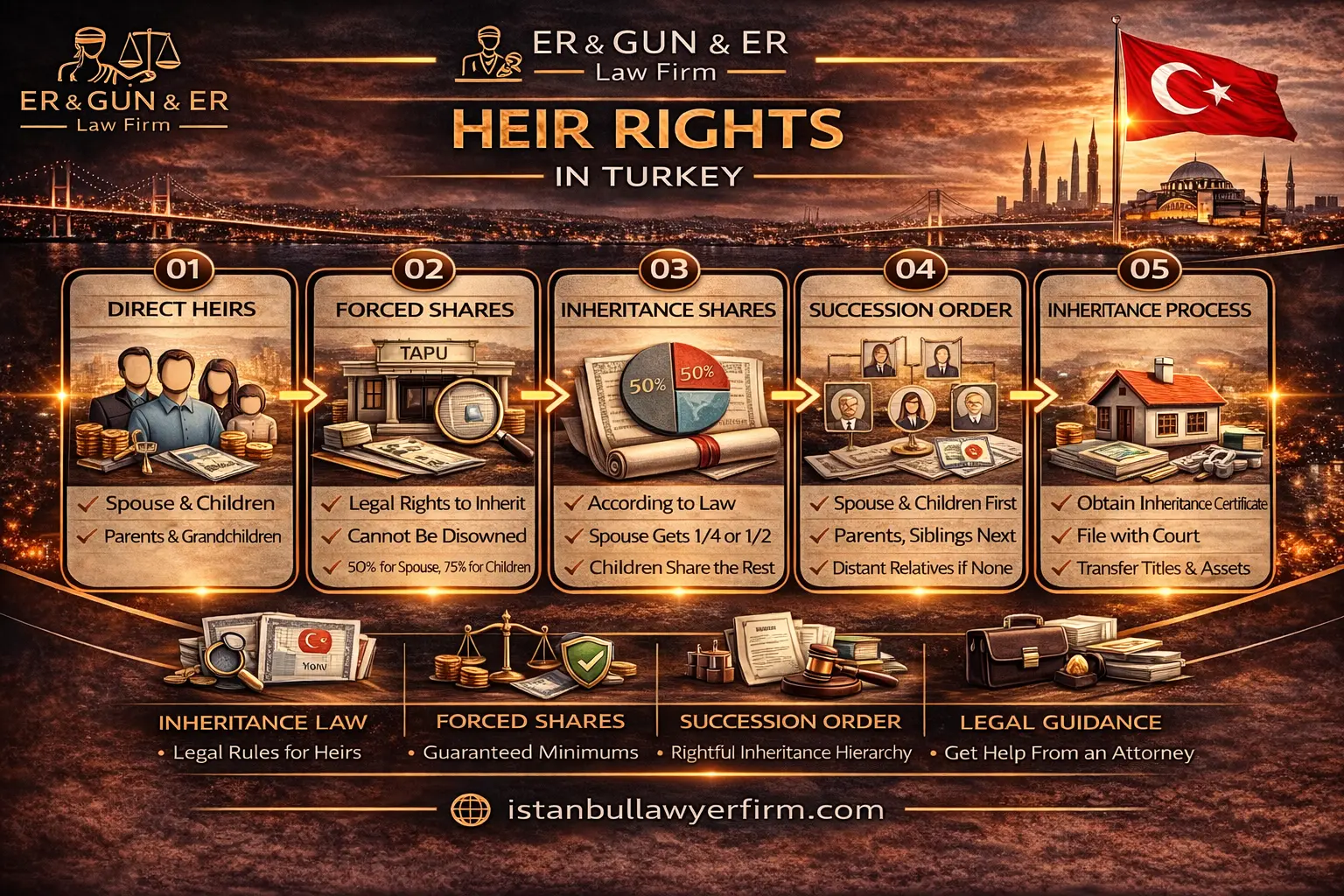
A lawyer in Turkey who advises heirs on inheritance matters understands that heir rights in Turkey are a combination of substantive rules and practical tools that heirs use to identify the estate, secure assets, and enforce their shares—beginning with statutory heirship that determines who qualifies as an heir and how shares are allocated when no valid instrument changes the default, and including reserved share protection that limits how far a will or lifetime transfers can prejudice certain close relatives. An Istanbul Law Firm that advises heirs on Turkish inheritance matters explains that these rights are not self-executing: banks, land registry offices, and tax authorities act only when standing and evidence are presented in an accepted format, which means the first practical step is obtaining the inheritance certificate and then building an estate inventory that is consistent across every office interaction. A Turkish Law Firm that handles inheritance enforcement for both Turkish and foreign heirs provides the integrated legal service that enables heirs to exercise their statutory rights through the evidence-led administrative and litigation steps that Turkish institutions require: establishing standing through the inheritance certificate, inventorying estate assets, protecting assets against unauthorized transfers, challenging suspicious lifetime gifts, registering title deed shares for real estate, obtaining bank account releases, managing co-ownership, and litigating reserved share claims where distribution violates statutory protections. An English speaking lawyer in Turkey who advises foreign heirs on Turkish inheritance proceedings provides the bilingual coordination that enables heirs outside Turkey to exercise rights over Turkish assets without being present at every administrative step. Practice may vary by authority and year — verify current Turkish inheritance law provisions, current inheritance certificate procedures, current bank and land registry documentation requirements, and current reserved share calculation rules with qualified counsel before initiating any inheritance proceeding in Turkey, since the administrative practice at specific banks and provincial land registry offices may differ from general guidance in ways that require province-specific and institution-specific confirmation before finalizing document preparation strategies.
Qualifying as Heir and Statutory Shares Under Turkish Law
A lawyer in Turkey who advises on heir qualification explains that statutory heirs Turkey are determined through the Turkish Civil Code succession order and official civil status records rather than by family expectation or informal caregiving relationships—and that qualifying as an heir requires proving the specific legal kinship that places a person in the statutory succession classes. An Istanbul Law Firm that assists heirs in establishing qualification helps clients build the specific proof set that Turkish institutions require: the family registry extract confirming the heir's relationship to the deceased; civil status records reflecting the deceased's marriage and divorce history that determines who is in the spousal category; records confirming whether children are recognized in official registries, since recognition and adoption issues change the statutory heir map; and documentation addressing whether any heir predeceased the deceased, because substitution can bring descendants into the heir set. Turkish lawyers advising on heir qualification help clients understand the specific negative checks that prevent disputes: a partner without a recognized marriage record is not treated as a spouse in the statutory scheme; a stepchild without adoption is not in the default succession order; a caregiver with no legal kinship is not a statutory heir unless a valid instrument creates a right under the law; and a relative may be excluded by closer statutory classes whose priority must be clearly explained and documented. Practice may vary by authority and year.
An Istanbul Law Firm that advises on statutory share calculation for Turkish inheritance matters explains that once the heir class is established, statutory shares are fractions that banks and land registries use to split assets, and that the share computation must be presented as a table that totals one whole—because arithmetic errors block office processing. Turkish lawyers advising on statutory share computation help heirs implement the specific controls most important for administrative compliance: computing shares based on the confirmed heir class and the number of surviving heirs in that class; confirming that the spouse's fraction is correctly integrated with the class present—because the spouse's portion changes depending on whether children, parents, or more distant relatives are the co-heirs; and ensuring that the share table matches exactly what appears on the inheritance certificate, since institutions rely on the certificate rather than on internal family calculations. An English speaking lawyer in Turkey who coordinates statutory share computation for foreign heir files provides the share table in a format consistent across Turkish bank submissions, land registry requests, and family internal administration—preventing the contradictory share narratives that are among the most common causes of administrative freezes and repeated documentation requests. Practice may vary by authority and year.
A Turkish Law Firm that advises on the practical implications of statutory shares explains that shares determine standing for later enforcement actions—including objecting to suspicious transfers, requesting inventory measures, and initiating litigation—so even a small share provides legal interest and must be proven cleanly. An English speaking lawyer in Turkey who manages statutory share files for heirs with complex family structures helps heirs understand that the share table is not only a distribution tool but a standing document: where the estate includes real estate, share fractions will be registered as co-ownership shares unless partition or allocation is later formalized; where it includes bank deposits, share fractions determine how funds are released; and where it includes disputed assets, share fractions define who must be party to litigation and who can consent to settlement. The file should avoid creating alternative share narratives in different offices, because contradictory share narratives are a common cause of freezes and repeated requests—and should keep one master share table requiring every institutional submission to match it unless a formal correction event occurs, with each correction documented as a dated memo that identifies what changed and why so the correction does not create new credibility questions. Practice may vary by authority and year.
Reserved Share Protection, Forced Heirship and Will Limitations
A lawyer in Turkey who advises on reserved share Turkey inheritance explains that the Turkish Civil Code limits how far certain close relatives can be deprived below a protected minimum through wills or disguised lifetime transfers—a protection known in comparative terms as forced heirship Turkey—and that enforcing this protection requires identifying which heirs have reserved share status in the specific family tree, mapping what instruments may have affected the protected share, and building an evidence file that compares what the protected heir received to what the protected baseline would suggest. An Istanbul Law Firm that manages reserved share enforcement for heirs helps clients implement the specific evidence approach most effective for each claim situation: preserving registry histories for real estate transfers—because timing and stated consideration are evidence of whether a transfer was a genuine sale or a disguised gift; preserving bank trails and payment evidence—because absence of payment can support a disguised transfer allegation; and preserving communications that show intent, while handling personal data proportionately. Turkish lawyers advising on reserved share claims help heirs understand that the reserved share analysis must be kept separate from immediate administrative steps—banks and registries will not adjudicate reserved share disputes—and that litigation should be planned only after evidence is stabilized and standing is clear through the inheritance certificate. Practice may vary by authority and year — verify current Turkish Civil Code reserved share provisions and current limitation period rules for reserved share claims with qualified counsel before initiating any claim.
An Istanbul Law Firm that advises on will limitations in Turkish inheritance explains that wills can shape distribution but operate within constraints created by reserved share protection and formal validity requirements—and that the practical evaluation of a will requires identifying whether it was executed in a form recognized under Turkish succession practice, what it actually disposes of, and how its dispositions compare to the statutory baseline and reserved share constraints. Turkish lawyers advising on will evaluation help heirs implement the specific approach most effective for each will situation: securing the original or certified copy of the will before any other steps to prevent evidence loss; preserving evidence about the will's execution including witness information where relevant, since disputes often focus on form; keeping will disputes in a separate lane from administrative inventory steps, because administrative steps can still proceed to establish the estate picture; and avoiding treating a will as a direct land registry or bank instruction, since both offices still require formal heirship proof and procedural compliance even when a will exists. An English speaking lawyer in Turkey who advises on cross-border will situations helps foreign-connected estates understand that foreign wills may require additional recognition or proof steps for Turkish assets, and that the file must preserve foreign will documents with legalization and translation bundles while keeping identity token consistency across names and dates. Practice may vary by authority and year.
A Turkish Law Firm that advises on reserved share negotiation and settlement explains that reserved share protection creates a negotiation environment because many families prefer settlement to litigation when evidence is clear and relationships matter—and that a protected heir can use a clean evidence pack to negotiate on objective transfers and their effects without threats. An English speaking lawyer in Turkey who facilitates reserved share negotiations for families in dispute helps clients understand that settlement discussions must be documented carefully and separated from the merits evidence file, that public pressure through social media creates new legal risk rather than resolving disputes, and that the strongest negotiating approach is to keep the narrative factual and exhibit-led while coordinating with administrative steps such as obtaining the inheritance certificate and running land registry checks. The challenge gift transfers Turkey inheritance lane requires proof of gift intent or lack of real consideration, often through bank trails and transaction histories—and the file must be designed from the beginning with this evidentiary standard in mind rather than built retroactively after administrative steps have already created a confusing record. Practice may vary by authority and year.
Inheritance Certificate and Estate Inventory
A lawyer in Turkey who advises on the inheritance certificate Turkey explains that the certificate is the standing document that turns a family claim into an institution-usable entitlement record—the practical bridge between Turkish inheritance law heirs and the banks, land registry offices, and tax authorities that control estate assets. An Istanbul Law Firm that manages inheritance certificate proceedings for heirs helps clients understand why the certificate must be obtained promptly and kept consistent: it provides the share table that every downstream file must match; it reduces internal family conflict by replacing informal allocation statements with an official baseline; and it unlocks access to formal record requests and formal objections against suspicious actions. Turkish lawyers advising on inheritance certificate management help heirs implement the disciplined approach most important for avoiding administrative failures: treating the certificate as a master exhibit with a custody log for certified copies; implementing version control because corrections can occur and stale certificates are rejected by banks and registries; and coordinating the inheritance certificate lane with tapu inquiry and bank submission lanes so the same share table and identity tokens appear everywhere. Practice may vary by authority and year — verify current Turkish court and notary procedures for obtaining inheritance certificates with qualified counsel before initiating the application.
An Istanbul Law Firm that advises on estate inventory Turkey construction explains that a complete estate inventory is the factual foundation for enforcing heir rights, because heirs cannot protect or distribute assets they cannot identify—and that building the inventory requires a lane-based approach separating real estate, bank assets, securities, business interests, vehicles, and receivables. Turkish lawyers advising on estate inventory construction help heirs implement the specific steps most important for a defensible, court-ready inventory: pulling official records rather than relying on family memory, since memory is incomplete and can be contested; recording each obtained record as a dated exhibit with a chronology showing when and how each item was obtained; documenting encumbrances and annotations for each real estate asset since those features shape what can be transferred; and identifying assets that are jointly owned with non-heirs, since joint ownership changes the execution plan. An English speaking lawyer in Turkey who manages multi-asset estate inventories for cross-border heir files provides the coordinated inquiry process across land registry, bank, and company registry that produces a dated, exhibit-supported inventory whose completeness enables effective reserved share analysis, suspicious transfer challenges, and partition planning. Practice may vary by authority and year.
A Turkish Law Firm that advises on estate inventory management explains that inventory is not only a list of assets but also a list of risks and controls—and that the inventory must be paired with a custody and update routine: appointing a custodian who maintains the master index, using a change log so corrections are traceable, scheduling periodic checks while the estate is unsettled, and maintaining a secure archive for sensitive documents especially bank letters and title extracts. An English speaking lawyer in Turkey who coordinates estate inventory management across multiple heirs and multiple offices explains that the inventory also supports reserved share and suspicious transfer challenges because it establishes what existed in the estate, what was transferred, and what remains—requiring that the inventory extend beyond current assets to include transfer histories where accessible, requested through lawful channels and documented carefully. The probate process Turkey heirs framework is most efficient when the inventory is treated as a living document that is updated as assets are discovered and as administrative steps produce new official records—not as a one-time compilation that is filed and forgotten. Practice may vary by authority and year.
Protecting Estate Assets and Challenging Suspicious Transfers
A lawyer in Turkey who advises on protecting estate assets explains that protection starts with stabilizing records and preventing unilateral actions—and that the practical protection tools available to heirs are evidence preservation through official records rather than informal family monitoring, access control restricting who can interact with sensitive documents, and communication control designating a single spokesperson for bank and registry interactions to prevent contradictory narratives. An Istanbul Law Firm that advises on estate asset protection helps heirs implement the specific approach most effective for each asset category: for real estate, monitoring title records and requesting official extracts when a change is suspected; for bank assets, ensuring the institution is aware of the death and that heir standing is formally presented to control account access; and for business interests, preserving company records and share ledgers where relevant. Turkish lawyers advising on estate protection help heirs understand that protection must be proportionate and lawful—overreach creates unnecessary conflict and liability—and that the correct response to fraud suspicion is to obtain official transaction histories through lawful channels rather than through public accusation or informal pressure on family members. Practice may vary by authority and year.
An Istanbul Law Firm that advises on challenging suspicious transfers explains that the annulment of title deed inheritance Turkey lane requires official records as the foundation—not screenshots or family statements—beginning with the title history extract that shows what transfer occurred, the parties, the stated basis, and the pre- and post-transfer state of the property. Turkish lawyers advising on suspicious transfer challenges help heirs implement the specific evidence approach most effective for each theory: for disguised sale allegations, collecting contracts, bank receipts, and correspondence that shows whether consideration was actually paid; for undue influence or capacity allegations, gathering authority documents and communications cautiously and proportionately rather than through speculation; and for post-death unauthorized transfers, mapping who had access and what authority documents existed. An English speaking lawyer in Turkey who manages suspicious transfer challenge files for heirs coordinates the official record requests, financial evidence gathering, and standing proof that enable the challenge to be presented in the legally effective format—keeping accusatory language out of administrative correspondence so banks and registries continue processing undisputed assets while the challenge proceeds in the appropriate dispute lane. Practice may vary by authority and year — verify current Turkish court precedents, applicable claim timelines, and current land registry practice for suspicious transfer challenges with qualified counsel before initiating any claim, since Turkish civil court practice on estate-related transfer challenges has evolved with recent judicial decisions whose implications for evidence standards and claim structure should be specifically assessed for each case. Practice may vary by authority and year.
A Turkish Law Firm that advises on risk controls in estate protection explains that the challenge itself must avoid creating new harms: accusatory mass communications to third parties create defamation and unfair practice risk; unofficial intermediaries who promise registry reversals destroy evidence integrity; and multiple competing versions of the same evidence create credibility attacks. An English speaking lawyer in Turkey who manages disputed estate files for contentious family situations maintains the single master chronology and exhibit index whose integrity is essential for credibility in both administrative and judicial proceedings—and ensures that personal data is minimized and privacy-conscious throughout the process, since family inheritance disputes expose sensitive information that must be protected rather than circulated through informal channels. The annulment of title deed inheritance Turkey remedy and the challenge gift transfers Turkey inheritance remedy are both record-driven, which means that the quality and integrity of the evidence file is ultimately more important than the legal theory advanced—and that building this file from the beginning with disciplined custody, dating, and exhibit control is the most important investment a family in a contentious inheritance situation can make. Practice may vary by authority and year.
Real Estate, Tapu Issues and Bank Assets
A lawyer in Turkey who advises on inheritance property rights Turkey through the land registry explains that real estate is often the most visible estate asset and that inheritance property rights Turkey are frequently enforced through land registry practice rather than through abstract legal theory—requiring heirs to confirm the deceased's registered holdings through an official tapu inquiry, verify parcel identifiers and any encumbrances or annotations, and align the title record identity tokens with the inheritance certificate identity tokens. An Istanbul Law Firm that manages land registry proceedings for heirs helps clients implement the specific approach most effective for each real estate situation: building a property tab per parcel with official extracts, dated snapshots, and a memo explaining what each annotation means operationally; confirming whether the property is held solely or in co-ownership since co-ownership changes decision rules; confirming whether any suspicious transfer occurred near death or after death; and coordinating with the estate inventory and share table so later allocations are consistent. Turkish lawyers advising on tapu issues in inheritance matters help heirs understand the common sources of land registry disputes: mortgages, liens, cautions, and restrictive annotations that families did not know existed; identity mismatches where the deceased's name appears differently on old title records than on current civil records, cured through token reconciliation with official identity documents; and alleged misuse of powers of attorney that requires a separate proof lane including authority documents and transaction history. Practice may vary by authority and year.
An Istanbul Law Firm that advises on bank asset disclosure and release explains that bank assets are often the first practical friction point because banks lock accounts after death and require standing proof before disclosure—and that the inheritance certificate is typically the anchor standing document that the file must present through the bank's formal channel. Turkish lawyers advising on bank asset management help heirs implement the specific approach most effective for each banking situation: creating one bank tab per institution and avoiding mixing correspondence across institutions; requesting balance confirmations and account existence confirmations through formal channels and preserving responses as exhibits; coordinating bank evidence with the reserved share dispute lane because bank trails can prove disguised gifts or lack of consideration; and coordinating bank evidence with suspicious transfer challenges because payment trails often show whether a property sale was genuinely arm's-length. An English speaking lawyer in Turkey who manages bank asset release for foreign heir files provides the bilingual coordination that enables foreign heirs to participate in Turkish bank proceedings through properly documented representatives whose authority scope specifically covers bank actions—preventing the frozen-account situations that arise when multiple heirs send contradictory instructions from abroad. Practice may vary by authority and year.
A Turkish Law Firm that advises on integrated real estate and bank asset enforcement explains that real estate enforcement includes planning for partition and settlement because registering co-ownership shares is only the beginning of administration, not its end. An English speaking lawyer in Turkey who advises heirs on post-registration co-ownership explains that if heirs agree on allocation they must still document that agreement in a procedurally implementable form—and that if they disagree they must preserve proof of attempts to agree because partition claims focus on whether agreement was possible. The partition lawsuit Turkey inheritance becomes the relevant remedy when co-owners cannot agree on use or sale, and the file must then contain evidence of co-ownership, evidence of failed negotiation attempts, and a property plan memo that states whether partition by physical division or judicial sale is sought. Bank enforcement also requires safeguarding against unauthorized withdrawals by documenting who has authority, keeping authority documents secure, and implementing a two-person internal review for major instructions where possible—so that bank instruction trails remain complete and non-contradictory in any later dispute, particularly because bank trails are often the primary evidence source in both reserved share claims and suspicious transfer challenges where the question of whether a transfer was a genuine commercial transaction turns on the financial record. Practice may vary by authority and year.
Foreign Heirs, Joint Ownership and Renunciation
A lawyer in Turkey who advises on foreign heirs rights in Turkey explains that foreign heirs' rights are real but must be exercised through a Turkish-usable evidence pack rather than through informal claims from abroad—and that the practical issues requiring early planning are standing proof in a form Turkish offices accept, identity token consistency across passports and registry extracts, conflict of laws analysis for which succession rules apply to which assets, and document usability through apostille or consular legalization with sworn translation. An Istanbul Law Firm that manages cross-border inheritance files for foreign heirs helps clients address the specific challenges most significant for each foreign heir situation: cross-border document pipelines that create timing delays requiring proactive timeline planning; the risk that foreign heirs suspect concealment when they cannot see local steps, cured through transparency via a controlled shared index and chronology; and the common error of relying on foreign probate documents and assuming they automatically control Turkish assets without the recognition or procedural steps that Turkish practice requires. Turkish lawyers advising on foreign heir rights in Turkey help families adopt the single narrative memo rule—one factual memo updated with version control and shared with all heirs—rather than multiple competing explanations in different languages that create credibility contradictions across offices, since a bank in Istanbul and a land registry in Ankara each review the documents independently and will identify inconsistencies that the family assumed were invisible because they were sent through different channels. Practice may vary by authority and year.
An Istanbul Law Firm that advises on joint ownership management following inheritance explains that co-ownership created by statutory shares is both a legal state and a practical coordination challenge that frequently triggers an inheritance dispute Turkey when heir expectations differ. Turkish lawyers advising on joint ownership management help co-owner heirs implement the specific controls most important for operational coherence: appointing a coordinator with documented authority to handle routine administration; creating a decision log recording co-owner decisions with dates and signatures; creating a cost ledger and revenue ledger to prevent financial disputes over estate expenses and income; implementing a communication rule preventing contradictory instructions to banks and registries; and keeping the co-ownership lane separate from reserved share litigation lanes so offices are not confused about what is disputed and what is being administered. An English speaking lawyer in Turkey who coordinates joint ownership administration for multi-country heir groups provides the centralized file management that keeps share tables, decision records, and communication logs consistent across heirs in different locations—and plans representation and signature logistics early for foreign co-owners who cannot attend meetings or sign documents easily. Practice may vary by authority and year.
A Turkish Law Firm that advises on renunciation of inheritance Turkey explains that renunciation is a major decision with procedural form requirements—not a casual family statement—and that it changes the heir map, affects who can request records and challenge transfers, and must be approached with a complete evidence picture of both known liabilities and known assets. An English speaking lawyer in Turkey who advises heirs considering renunciation helps clients implement the specific considerations most important before taking formal steps: understanding that early actions by a heir such as requesting bank releases or registering title shares may be interpreted as acceptance even without a formal declaration; coordinating renunciation decisions across heirs because one renunciation affects distribution among others; and understanding that standing for reserved share claims or suspicious transfer challenges may be affected by renunciation, which must be verified before litigation planning. The renunciation-and-acceptance decision must be integrated into the enforcement roadmap rather than treated as a separate family decision, because standing is essential for bringing every type of inheritance claim and renunciation can eliminate it—making early counsel consultation before any formal step one of the most consequential investments a heir can make in a contentious estate situation. Practice may vary by authority and year.
Inheritance Disputes, Litigation, Settlement and Enforcement
A lawyer in Turkey who advises on inheritance dispute Turkey litigation explains that litigation is the enforcement lane used when rights cannot be secured through administrative steps or agreement—and that it must be built on a stabilized evidence pack because courts test credibility through documents rather than through family narratives. An Istanbul Law Firm that manages inheritance litigation for heirs helps clients implement the specific approach most effective for each claim type: confirming party structure using the inheritance certificate and identity tokens; building an exhibit-led estate inventory sufficient to show the impact of disputed transfers; preserving title histories and bank transaction trails as core proof sources; and separating claim types because each remedy—annulment of title deed inheritance Turkey, challenge gift transfers Turkey inheritance, partition lawsuit Turkey inheritance, reserved share protection—has its own proof requirements and procedural posture. Turkish lawyers advising on inheritance litigation help heirs understand that pleadings must be factual and must avoid accusing intent without evidence, since overstatement can backfire in proceedings where courts assess credibility through the documentary record. Practice may vary by authority and year — court timelines and procedural schedules vary and must not be predicted by counsel; verify current Turkish court practice for each specific claim type.
An Istanbul Law Firm that advises on settlement and partition as alternatives to litigation explains that settlement and partition often deliver faster and more predictable outcomes than prolonged litigation—and that a settlement should begin with a shared factual baseline where the estate inventory and share table are agreed or at least clearly documented. Turkish lawyers advising on settlement structure help heirs implement the specific documentation most important for implementing a settlement through banks and registries: referencing the official heir list and share table rather than creating a private alternative that offices cannot implement; defining concrete acts and documents rather than vague cooperation promises; including a verification plan requiring updated title extracts and bank receipts after each step; and including a dispute resolution clause for future disagreements. An English speaking lawyer in Turkey who drafts settlement agreements for multi-country heir groups ensures that settlement terms are aligned with the procedural steps required by Turkish institutions—so that an agreed distribution cannot be stalled by a bank or registry that requires formalities the settlement document did not anticipate. The partition lawsuit Turkey inheritance becomes the formal path only when co-owners cannot agree despite documented negotiation attempts, and the partition file must then contain evidence of co-ownership, failed agreements, and a property plan memo. Practice may vary by authority and year.
A Turkish Law Firm that advises on enforcement safeguards for Turkish inheritance proceedings explains that enforcement begins with controlling standing documents and ensuring every office sees the same share table and identity tokens—and that the safeguards maintaining enforcement effectiveness are: version control for the inheritance certificate preventing stale submissions; periodic asset checks while the estate is unsettled; a no-unilateral-action rule for major decisions; secure communications with privacy discipline; and a dispute lane separation allowing administrative steps to proceed for undisputed assets. An English speaking lawyer in Turkey who coordinates enforcement across multiple offices for complex heir groups maintains a master chronology and index whose consistency is the primary safeguard against contradictions that weaken standing—and prepares office-specific submission packs drawn from the same master evidence base but tailored to each institution's checklist requirements. The enforcement goal is to secure the estate and distribute it according to lawful shares and enforceable agreements rather than to punish, and a disciplined safeguard program reduces the frequency of litigation by preventing the ambiguity and misuse opportunities that arise when evidence is disorganized—with the practical benefit that even contentious families find that shared access to a well-organized, factually neutral evidence file produces faster resolution than competing narrative strategies pursued independently by each heir. Practice may vary by authority and year.
Tax Obligations, Reporting and Cross-Border Compliance for Heirs
A lawyer in Turkey who advises on the tax dimensions of Turkish inheritance explains that heirs acquiring Turkish estate assets through inheritance face specific tax reporting and payment obligations under Turkish Inheritance and Gift Tax Law—and that the inheritance tax declaration must be filed with the competent local tax office within the applicable deadline following the death, based on the inventory of Turkish assets and the heir fractions established by the inheritance certificate. An Istanbul Law Firm that advises heirs on inheritance tax compliance helps clients implement the specific approach most effective for each estate situation: building the asset inventory in a format that supports the tax declaration, since the same official records that document estate assets for administrative purposes also form the basis of the tax filing; coordinating the tax declaration timeline with the inheritance certificate lane so standing is established before the declaration deadline; and maintaining documentation of each asset's assessed value and each heir's allocated share so the tax declaration reflects the same share table used in land registry and bank proceedings. Turkish lawyers advising on inheritance tax compliance help heirs understand that tax rates and thresholds are determined by the relationship between the heir and the deceased and by the total value of the inheritance—and that these rates are subject to legislative change, making verification with current guidance essential before any calculation is treated as definitive. Practice may vary by authority and year — verify current Turkish inheritance tax rates, current declaration deadlines, and current payment installment options with qualified Turkish tax and legal counsel before submitting any inheritance tax declaration.
An Istanbul Law Firm that advises on cross-border tax compliance for heirs with Turkish and foreign assets explains that heirs who are tax resident outside Turkey may face reporting obligations in their home country for inherited Turkish assets alongside their Turkish inheritance tax obligations—and that coordinating these parallel obligations requires understanding which country's tax rules apply to which asset category. Turkish lawyers advising on cross-border tax compliance for foreign heirs help clients implement the specific documentation approach most effective for each cross-border situation: obtaining official Turkish inheritance tax receipts and payment confirmations that can be presented to foreign tax authorities as evidence of Turkish tax paid; coordinating the timing of Turkish tax payments and foreign declarations to avoid double-counting of tax obligations; and maintaining Turkish estate documents—including the inheritance certificate, asset valuations, and transfer records—in a format that foreign tax authorities can assess without requiring Turkish-language expertise. An English speaking lawyer in Turkey who coordinates cross-border inheritance tax compliance for foreign heirs provides the bilingual documentation management that enables each heir to satisfy both Turkish and home-country tax obligations from a single organized evidence file rather than creating parallel and potentially contradictory asset records for different tax authorities. Practice may vary by authority and year.
A Turkish Law Firm that advises on tax compliance coordination within the overall inheritance administration explains that the tax lane should be maintained as a separate but coordinated track rather than mixed into the administrative or dispute lanes—because tax offices need asset inventories and share tables, but they also need valuations and payment documentation whose preparation is distinct from standing documents and transfer records. An English speaking lawyer in Turkey who advises on tax lane coordination for complex heir files helps clients understand that the tax lane should not be used to invent asset values or share allocations that differ from the official records in the land registry and bank files—since contradictions between tax declarations and institutional records create new disputes and regulatory risk. The tax declaration should reference the inheritance certificate share table and the estate inventory, should be filed with careful attention to current deadlines rather than assumed timelines, and should be preserved as a dated exhibit in the master evidence file so it can be produced when banks, registries, or other institutions request evidence of tax compliance before processing inheritance-related transactions. Practice may vary by authority and year.
Frequently Asked Questions
- Who qualifies as a statutory heir under Turkish inheritance law? Statutory heirs Turkey are determined through the Turkish Civil Code succession order applied to official civil status records—not through informal family expectations. The succession classes prioritize descendants, then parents, then grandparents, with the surviving spouse participating across classes in a fraction that depends on which class is present. Qualification must be proven through official family registry extracts, not through family statements. Practice may vary by authority and year.
- What is the inheritance certificate and why is it the first step? The inheritance certificate Turkey is the official standing document issued by Turkish courts or notaries that identifies the heirs and their fractional shares—and it is the primary document that banks, land registry offices, and tax authorities require before disclosing account information, processing transfers, or releasing funds. Without it, heirs cannot formally exercise any institutional rights over estate assets. Keep one current version and update every downstream submission if a correction occurs. Practice may vary by authority and year.
- What are reserved shares and who has protected shares under Turkish law? Reserved share Turkey inheritance—forced heirship Turkey—is the legal protection preventing certain close relatives from being deprived below a statutory minimum through wills or lifetime transfers. The specific heirs entitled to reserved share protection and the protected fractions depend on the family composition and must be assessed against the specific case. Reserved share enforcement requires an estate inventory, a transfer history, and proof that the protected minimum was not actually delivered. Practice may vary by authority and year.
- How is the estate inventory built and why does it matter? Estate inventory Turkey construction begins with the inheritance certificate establishing heir standing, then uses official records from land registry, banks, company registries, and tax authorities to identify each asset. Family memory is not a reliable foundation because it is incomplete and can be contested. The inventory is the factual foundation for reserved share claims, suspicious transfer challenges, partition proceedings, and tax compliance—and must be built as a dated exhibit set with a custody log. Practice may vary by authority and year.
- What can heirs do to protect estate assets while the inheritance is being administered? Protection begins with evidence preservation through official records—land registry extracts, bank correspondence, company records—followed by communication control designating a single spokesperson for institutional interactions. Heirs should promptly notify relevant banks of the death and present standing proof to restrict unilateral account access. For real estate, periodic title record checks identify unauthorized transfers early. The protection file must be kept separate from dispute allegations so administrative steps can continue for undisputed assets. Practice may vary by authority and year.
- How can heirs challenge a suspicious gift or transfer made before or after death? Challenge gift transfers Turkey inheritance requires official records as the foundation: the title transfer history from the land registry, payment evidence or evidence of lack of payment from bank records, and the stated consideration in the transfer instrument. The file must map whether the transfer was a genuine arm's-length sale or a disguised gift that affected reserved shares. Challenges are record-driven proceedings before Turkish courts and should be built from official exhibits rather than from family accounts. Practice may vary by authority and year.
- What does annulment of a title deed transfer in inheritance proceedings require? Annulment of title deed inheritance Turkey claims require the pre-transfer title state, the post-transfer title state, the transaction basis as recorded in official documents, financial evidence about whether consideration was genuinely paid, and proof that the claimant has standing as an heir with a recognized share. The remedy is pursued through Turkish civil courts and depends on the specific legal basis—whether the transfer was unauthorized, a disguised gift, or made under circumstances affecting capacity. Practice may vary by authority and year.
- How are real estate shares registered in the land registry after an inheritance? Following the inheritance certificate, heirs can apply to the Turkish Land Registry to register their fractional shares as co-owners of each real estate parcel. The application requires the inheritance certificate, identity documents for all heirs or their representatives, and payment of applicable transfer levies. Co-ownership registration is the beginning of administration rather than its end—practical use, rental, sale, or partition all require additional steps and often additional agreements among co-owners. Practice may vary by authority and year.
- How do heirs access and release bank accounts held by the deceased? Bank account release typically requires presenting the inheritance certificate as standing proof, identity documents for the heirs or their representative, and any additional bank-specific documentation. Banks verify standing before disclosing balances or releasing funds, and they will not act on contradictory instructions from multiple heirs simultaneously. Coordination through a single representative with documented authority prevents account freezes caused by conflicting instructions. Practice may vary by authority and year.
- When does a partition lawsuit become necessary and what does it involve? Partition lawsuit Turkey inheritance becomes the formal remedy when co-owner heirs cannot agree on the use, management, or sale of a co-owned asset after documented negotiation attempts. The file must show the co-ownership shares, documented negotiation proposals and refusals, and a property plan. Turkish courts can order physical partition where feasible or judicial sale where physical division is not practical, with proceeds distributed by shares. Practice may vary by authority and year.
- What are the specific legal steps for foreign heirs asserting rights over Turkish estate assets? Foreign heirs rights in Turkey require a Turkish-usable evidence pack including apostilled or consularly legalized foreign civil documents, certified Turkish translations, and consistent identity tokens across all submissions. Foreign probate documents do not automatically control Turkish assets without appropriate recognition or procedural steps. Foreign heirs typically need a Turkish-based representative authorized by a properly legalized power of attorney to interact with banks, land registries, and courts. Practice may vary by authority and year.
- Can a heir renounce Turkish inheritance and what are the consequences? Renunciation of inheritance Turkey is a formal legal act with procedural requirements—not a casual family decision—whose consequences include losing standing to challenge suspicious transfers and losing any share in estate assets. The decision should be made only after building an inventory of both assets and liabilities. Renunciation changes the heir map and requires updating all downstream institutional submissions. Timing and procedure must be verified for the specific case. Practice may vary by authority and year.
- What is the difference between administrative steps and litigation in Turkish inheritance proceedings? Administrative steps—obtaining the inheritance certificate, inventorying assets, registering title shares, releasing bank accounts—proceed through courts, notaries, land registries, and banks and do not require active dispute resolution. Litigation steps—reserved share claims, suspicious transfer annulments, partition lawsuits—require filing claims with Turkish civil courts and building an exhibit-led case file. Keeping these lanes separate prevents disputes from freezing administrative steps that could proceed for undisputed assets. Practice may vary by authority and year.
- What are the most important risk controls in contentious Turkish inheritance proceedings? The most important risk controls are maintaining one master evidence file with version control and custody notes; designating a single spokesperson for institutional communications; implementing a no-unilateral-action rule for major decisions; keeping dispute allegations out of administrative correspondence; preserving evidence of suspicious transactions through official channels before approaching any counterparty; and maintaining privacy discipline because estate files contain sensitive identity and financial data. Contradictory narratives across offices are the most common weakness in contentious inheritance files—because judges, bank compliance officers, and land registry clerks each independently assess the consistency of the file they receive, and a narrative that appears coherent in isolation becomes obviously contradictory when all submissions are compared. Practice may vary by authority and year.
- Does ER&GUN&ER Law Firm provide legal services for heir rights in Turkey? Yes. ER&GUN&ER Law Firm provides comprehensive legal services for heir rights in Turkey including inheritance certificate proceedings, statutory share computation, estate inventory construction across real estate and bank assets, reserved share analysis and enforcement, suspicious transfer challenges and annulment proceedings, land registry tapu issue management, bank account disclosure and release coordination, joint ownership administration, partition lawsuit representation, foreign heir cross-border coordination with document legalization and translation management, renunciation and acceptance advisory, settlement negotiation and drafting, and litigation representation before Turkish civil courts—with English-language client communication and bilingual documentation throughout each engagement.
Author: Mirkan Topcu is an attorney registered with the Istanbul Bar Association (Istanbul 1st Bar), Bar Registration No: 67874. His practice focuses on cross-border and high-stakes matters where evidence discipline, procedural accuracy, and risk control are decisive.
He advises individuals and companies across Immigration and Residency, Real Estate Law, Tax Law, and cross-border documentation matters where procedural accuracy and evidence discipline are decisive.
Education: Istanbul University Faculty of Law (2018); Galatasaray University, LL.M. (2022). LinkedIn: Profile. Istanbul Bar Association: Official website.