

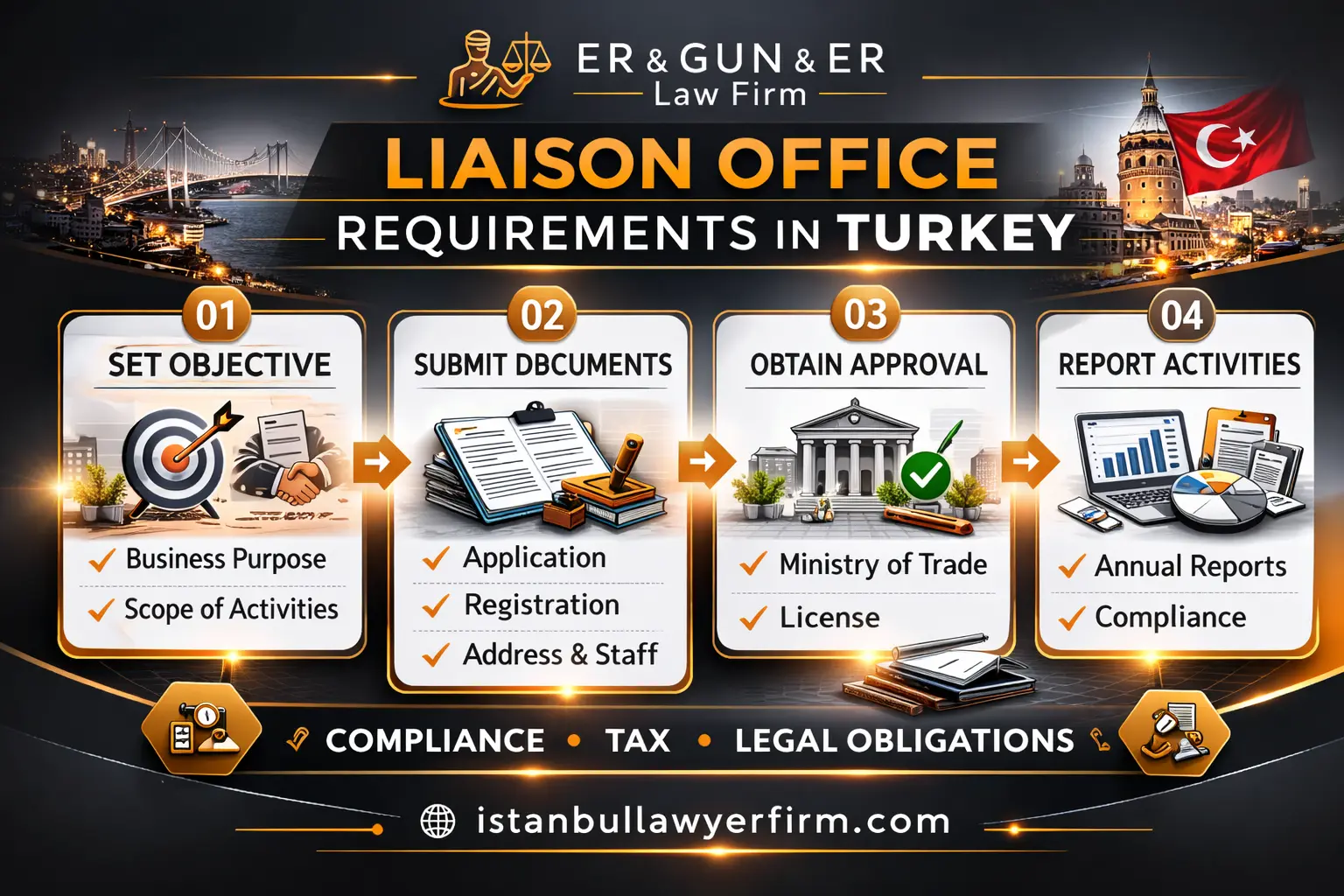
A liaison office (irtibat bürosu) is a regulated presence that allows a foreign company to operate in Turkey without forming a Turkish commercial entity, provided the office remains within the permitted non-commercial perimeter established by the Foreign Direct Investment Law No. 4875 of 17 June 2003 and the FDI Implementation Regulation (Doğrudan Yabancı Yatırımlar Kanunu Uygulama Yönetmeliği) of 20 August 2003 (Official Gazette No. 25205), particularly Article 6 which governs liaison office establishment, permitted activities, and operational discipline. The competent licensing authority is the Ministry of Industry and Technology (Sanayi ve Teknoloji Bakanlığı) General Directorate of Incentive Implementation and Foreign Capital (Teşvik Uygulama ve Yabancı Sermaye Genel Müdürlüğü — TUYSG), operating through the e-TUYS (Electronic Incentive Application and Foreign Investment Information System) platform. The licensing process is document-driven, and the file is assessed on whether stated activities remain non-commercial and evidence-ready. The office has no separate legal personality under Turkish law — the foreign parent company retains full legal responsibility, and the office operates exclusively under the parent's legal identity through a locally appointed representative with power of attorney (vekaletname). Banking is part of the compliance story because KYC files under MASAK Law No. 5549 must align with the permit narrative and the funding flow from abroad. Employment and payroll create a parallel compliance lane under Labor Law No. 4857 of 22 May 2003, Social Insurance Law No. 5510 of 16 June 2006, and Work Permit for Foreigners Law No. 6735 of 13 August 2016, with Income Tax Law No. 193 Article 23/14 providing a wage tax exemption for employees paid through foreign-source transfers from the foreign parent. Annual activity reports are due to the Ministry by 15 January each year documenting the prior year's operations. Renewals and closure follow defined procedural frameworks with document retention obligations continuing under Tax Procedure Law No. 213 Article 253. Practice may vary by authority and year, and liaison office management benefits from treating the file as a production process rather than episodic compliance. When cross-language execution is required, an English speaking lawyer in Turkey can keep Turkish filings and English governance documents aligned without drift. For background on the liaison office concept and operational architecture, readers can consult our liaison office overview.
Liaison office concept, licensing authority, and statutory basis
A liaison office in Turkey is a licensed presence of a foreign parent registered for a defined purpose under FDI Implementation Regulation Article 3/h definition and Article 6 operational framework. It is not a Turkish company in corporate law terms, it acts through a locally appointed representative, its identity is tied to the parent's legal name, and it exists to observe, coordinate, or represent within a narrowly-defined non-commercial perimeter. The file approach should treat the office as a controlled project — scope definition and evidence design at the front, filings and notifications during operations, and renewals or closure at the back. Every step should be written and dated. Every document should be stored once with version control. Every change should be logged as an event. The competent licensing authority is the Ministry of Industry and Technology's General Directorate of Incentive Implementation and Foreign Capital — not YOİKK (Yatırım Ortamını İyileştirme Koordinasyon Kurulu), which is an investment-climate coordination council without liaison licensing authority and should not be confused with the competent directorate. Applications and ongoing interactions use the e-TUYS electronic platform with standardized forms and documentation requirements. Practice may vary by authority and year, and statutory framework understanding is the foundation for effective liaison office operation.
In practice the liaison office sits between market entry and full establishment. It lets the parent build contacts and internal routines, test compliance capacity, and establish Turkish presence without share capital or separate Turkish legal personality. It does not create shareholders locally, relies entirely on the parent for authority and funding, and must avoid revenue patterns that could be characterized as commercial activity. The safest file begins with a written scope note that mirrors the permit application language, aligns with employment and lease planning, and documents internal approvals in board minutes. When the parent engages a locally experienced counsel, internal stakeholders can align on one approach and the office can translate the concept into executable workflows. A Turkish Law Firm can stress-test the scope narrative, draft internal scripts that prevent drift, and define the escalation framework for potential boundary incidents before they arise. The office operates through the representative's authority derived from the parent's power of attorney, which must be apostilled under the Hague Convention (Turkey acceded on 29 September 1985 through Law No. 3028) or consularly legalized for non-Convention countries, then sworn-translated under Notary Law No. 1512 Article 96.
A buyer should ask how the file will be built. The answer should be an evidence pack and a timeline. The pack starts with parent authority documents, includes the representative appointment instrument, a statement of intended activities within the Implementation Regulation Article 6 categories, a commitment to stay non-commercial, proof of parent existence and good standing, the office address plan, a funding plan consistent with non-commercial status, a tax registration plan for payroll, a compliance calendar for annual reports, and a renewal or closure decision point. Engaging a lawyer in Turkey early supports scope narrative stress-testing, internal script drafting that prevents drift, and escalation framework definition. The statutory basis rests on FDI Law No. 4875 Article 3/h which defines foreign investor status, the Implementation Regulation's Article 6 which governs liaison office establishment framework, and the Ministry's administrative practice developed over the two decades since the 2003 framework came into effect. For procedural checklists on liaison office opening sequencing, readers can consult our liaison office opening procedural guide. Practice may vary by authority and year, and file architecture at initial setup determines the quality of subsequent renewal and audit experience.
Permitted activities and commercial activity prohibition
The permit should be drafted around the Implementation Regulation Article 6 permitted activity categories as a defined operational boundary. The boundary is usually described in a narrative activity statement that must be narrow, testable, consistent with the parent's global function, and matched to headcount, budget, and funding method. Permitted work centers on communication and coordination — collecting market information, promoting the parent's products without selling them locally, supporting distributors with information, quality follow-up and feedback with Turkish suppliers or customers, feasibility studies for investment, administrative support for the parent, regional management center coordination where the parent uses Turkey as a hub for broader regional operations, and representative hosting of parent company personnel and their Turkish business contacts. Each allowed task should be described as a process with a document output stored in the repository. If staff meet customers, scripts should be written. If staff attend fairs, reports should be produced. If staff coordinate suppliers, minutes should be kept. If staff receive payments, the task is likely wrong and requires immediate internal escalation. Practice may vary by authority and year, and scope boundary discipline is the fundamental compliance requirement that all other procedures build upon.
The central constraint is the absolute commercial activity prohibition, and it must be operationalized through documented daily practice. The office should not issue sales invoices, should not collect local revenue, should not sign supply contracts for profit, should not provide paid services to Turkish customers, should not act as a commission agent, should not hold inventory for sale, should not perform deliveries, and should not negotiate pricing as a seller. The office may communicate offers as information to be routed to the parent for commercial decision and execution. The office may coordinate meetings and document minutes, may collect market information and transmit it to the parent, and may label its communications as originating from the parent rather than as independent commercial action. The office must keep proof of its limited role through email templates that disclaim selling authority, signatures showing the office as liaison only, avoidance of local business cards that imply trading, avoidance of local purchase orders from the office name, and documented supplier meeting minutes rather than purchase agreements. Deposits and retainers must not be accepted locally. Expenses must be paid from parent funding only. The bank narrative must remain consistent with inbound parent transfers rather than commercial receipts. Practice may vary by authority and year, and the commercial prohibition requires continuous discipline rather than occasional attention.
If the boundary is crossed, Ministry authorities may reassess the office status with consequences including permit cancellation, retroactive tax assessment (the office being reassessed as a permanent establishment generating Turkish-source income), retroactive VAT assessment, SGK reassessment, reputational damage affecting future Turkish engagement, and potentially administrative fines. Cross-jurisdictional consequences may include the parent's home-country tax authority questioning Turkish arrangements, banking relationships being reconsidered under MASAK Law No. 5549 and KYC standards, and counterparty disputes where the office's lack of authority to commit the parent becomes material. The practical control is to define red-line behaviors clearly in internal policy, train staff on what falls inside versus outside permitted scope, audit quarterly for drift patterns, and document any boundary incidents with immediate cure (reversal of improper receipts, written explanation to counterparties, internal memo documenting the incident and cure). Practice may vary by authority and year, and boundary enforcement benefits from integrated legal-operational coordination rather than isolated compliance checkbox exercises.
Vehicle choice: liaison versus branch versus company
Vehicle choice is a foundational risk decision. A liaison office under FDI Implementation Regulation Article 6 is suitable for non-commercial presence — market research, supplier audit, technical support, regional coordination, and representation without revenue generation. A branch office (şube) under Turkish Commercial Code No. 6102 Article 40 is suitable for operating the parent's business locally as a Turkish extension of the foreign parent, with Trade Registry registration, full tax registration including corporate income tax and VAT, commercial contracting capability, and continuing parent liability because the branch has no separate legal personality. A Turkish company — joint stock company (A.Ş.) under TTK Articles 329-572 with TRY 250,000 minimum capital effective 1 January 2024, or limited liability company (Ltd. Şti.) under TTK Articles 573-644 with TRY 50,000 minimum capital — is suitable for full local trading with separate Turkish legal personality and limited parent liability through subsidiary structure. The decision should be tied to revenue intent, regulatory exposure, contracting needs, employment scale, banking expectations, and customer onboarding requirements. If the goal is observation and coordination, liaison fits. If the goal is Turkish sales, liaison is wrong. If the goal is service delivery to Turkish customers for compensation, liaison is risky and likely inappropriate.
Branches can sign contracts and invoice locally within the parent's business scope. They also carry broader tax footprints including Turkish corporate income tax on attributable profits, VAT registration and compliance, withholding obligations on payments to foreign parties, and specific accounting obligations under Turkish Financial Reporting Standards. They require Trade Registry registration under TTK Article 40 with apostilled parent company documentation, appointment of Turkish representative with specific authority, and sector-regulator authorization where applicable (banking, insurance, capital markets, energy, telecommunications). Branches are often used when the parent wants Turkish commercial presence without the complexity of establishing a subsidiary. They can be combined with local staff and assets, they are not limited to liaison non-commercial activities, and they integrate into the parent's existing global structure as a direct extension. If a commercial roadmap develops, readers can consult our branch office establishment guide. A practical path many foreign parents follow is starting with liaison presence to understand the Turkish market, then migrating to branch or subsidiary as commercial readiness develops — migration should be planned as a project with contract novation, tax registration change, employment continuity, and specific cross-functional coordination.
A local company ring-fences liability through separate Turkish legal personality. It simplifies local contracting because counterparties deal with a Turkish entity rather than a foreign parent. It may be required by Turkish customers who prefer Turkish counterparty for administrative or risk reasons, by Turkish tenders that require Turkish bidder status, and by Turkish banks for local credit facilities. It holds assets in its own name, operates as separate taxpayer, and creates corporate infrastructure that enables scaling. Company formation requires constitutive steps including articles of association drafting, Trade Registry filings, tax registration, SGK workplace registration, signatory documentation, and address and lease arrangements. For the formation sequence, readers can consult our company formation guide. Subsidiary alternative through representative office arrangements in sector-regulated contexts (particularly banking and capital markets under BDDK and CMB frameworks) provides another alternative — for framework comparison across representative structures, readers can consult our representative office guide. The vehicle choice should be made before contracts are signed because changing structure mid-stream creates operational complexity and counterparty disruption. Practice may vary by authority and year, and vehicle choice benefits from integrated analysis across legal, tax, operational, and commercial dimensions.
Application dossier, legalization, and sworn translation
The liaison office establishment procedure works best when the dossier tells one coherent story supported by exhibits rather than narrative. The dossier includes the Ministry application form with complete and internally consistent information, the activity statement declared narrowly within Implementation Regulation Article 6 categories, the explicit non-commercial undertaking, parent company authority documentation (certificate of incorporation or equivalent, articles of association, good standing certificate within the current validity window typically three to six months from issuance), parent financial statements from the most recent reporting period (typically audited where available), board resolution authorizing the Turkish liaison office establishment and appointing the Turkish representative, power of attorney from the parent to the Turkish representative with specific authority scope, representative identification documentation, and the office address plan evidenced by draft or executed lease. Treat the dossier as a filing-ready product. Use a cover letter with numbered exhibits. Use consistent tokens for names and addresses across all documents. Plan for the specific channel (currently e-TUYS for most procedures). If wet signatures are required for specific elements, plan for originals with tracked delivery. If scans are accepted, ensure legibility. If e-signature is used where available, preserve the audit trail. Practice may vary by authority and year, and dossier quality determines approval timeline and subsequent renewal smoothness.
Foreign documents must be made usable in Turkey through apostille or consular legalization. Hague Apostille Convention member states (Turkey acceded on 29 September 1985 through Law No. 3028, with over 120 state parties currently) support apostille authentication where the issuing state's designated competent authority affixes the standardized apostille certificate. The certificate contains ten standardized elements including country of issue, signatory name and capacity, seal authority, place and date, issuing authority, certificate number, and authentication signature. For non-Convention states, consular legalization through the originating country's foreign ministry and the Turkish embassy or consulate in that country provides the authentication chain. The correct route depends on the issuing country's Convention status, which should be verified for each specific document source. After authentication, the document is sworn-translated into Turkish by a translator registered with a Turkish notary under Notary Law No. 1512 Article 96. The sworn translator signs and seals the translation, and the notary authenticates the translator signature, producing the notarized sworn translation (tasdikli yeminli tercüme) accepted by Turkish authorities. For framework on sworn translation procedures, readers can consult our legal translation services guide. Practice may vary by authority and year, and authentication-translation sequencing matters because authentication must precede translation to ensure the translator captures all authenticated elements.
Translation errors create legal errors that compound through the dossier and into operational use. Translation discipline includes a single glossary for transliteration with tokens copied rather than free-typed, names matched across all documents (passport spelling, corporate register spelling, POA spelling must all align), dates matched across documents, registration numbers copied exactly, and signature blocks reproduced accurately. If stamps are faint or documents are damaged, clearer copies should be obtained before translation. Source and translation should be stored together with notary pages in one file unit. Many applications are filed through an agent (often Turkish counsel) rather than directly by the parent. An agent needs a vekaletname (power of attorney) that matches the parent resolution and defines filing authority clearly. The POA should cover specific categories as planned — tax office registrations, bank onboarding, lease signing (only where appropriate), and Ministry filings. Overbroad powers create governance risk because the agent can commit the parent beyond intent; underbroad powers create operational delay because procedural steps require specific authority. POAs should be version-controlled with originals tracked and notarized copies kept for daily use. An English speaking lawyer in Turkey can align bilingual powers with the permit narrative without drift between language versions. Practice may vary by authority and year, and POA drafting benefits from careful calibration of scope to intended operations.
Address, lease, and banking discipline
A liaison office needs a stable local address for tax and notification purposes. The address should be verifiable through a physical premises inspection, supported by a formal lease, and consistent across Ministry records, Tax Office registration, SGK workplace registration, and banking records. A virtual address arrangement may create risk if it does not support actual operational presence, and Turkish authorities increasingly verify physical operations through site inspections. Landlords may resist foreign-controlled occupants because of perceived administrative complexity — mitigation includes parent guarantee, prepayment of several months rent, or Turkish counsel support for lease negotiation. Lease terms should permit office use consistent with liaison activities, allow inspection by tax officers when applicable, address early termination scenarios, allocate utilities and common charges, and document landlord title to the premises. The office should keep the lease, landlord identification, and title data in the repository. For framework on legal address arrangements including virtual office alternatives, readers can consult our legal address guide for foreign companies. Practice may vary by authority and year, and address hygiene affects all downstream registrations.
Address changes trigger multiple notifications that should be treated as a controlled project rather than an administrative afterthought. The licensing authority must be notified with proof of the new address and updated lease, the Tax Office must receive the new lease and address update, the bank must receive updated documents for KYC refresh, the SGK workplace registration must be updated, service providers and utilities need updated service addresses, and internal documentation including letterheads, stamps, employment contracts, and communications templates must reflect the new address. Failure to update address notifications can create procedural confusion when tax or SGK communications attempt service at the old address, and unreceived notifications can trigger default treatments that affect compliance standing. Address change planning should include timing coordination — the new lease signing, the authority notifications, the bank updates, and the operational move should sequence to avoid compliance gaps. Store delivery receipts for each notification to document timely compliance. Practice may vary by authority and year, and address management is an ongoing compliance activity rather than a one-time setup element.
Banking is central to liaison office compliance because the absence of revenue means all funds flow from the parent through documented channels. Account opening requires the Ministry license, representative identification, parent company documentation aligned with Ministry-filed documents, and specific KYC documentation under MASAK Law No. 5549 and banking regulations. Banks typically request a short cover note explaining the liaison model, the non-commercial boundary, parent funding logic, signatory arrangements, and internal expense approval mechanics. Inbound transfers should originate from the parent company (not from third parties), be labeled consistently with operational funding purpose rather than commercial receipts, and be reconciled monthly against expense records. Cash funding should be avoided to preserve clear banking trail. Expense approval should follow documented internal procedures with approvals in minutes or internal memos. Salary payments, rent, utilities, professional fees, and similar operational expenses should be documented with invoices or receipts and stored by period for retention purposes. If the bank flags inconsistencies during periodic KYC refresh or transaction monitoring, a reconciliation pack aligning names and dates across exhibits supports cure. Practice may vary by authority and year, and banking discipline both protects compliance standing and supports ongoing bank relationship quality.
Tax posture, payroll, and the Article 23/14 wage exemption
Tax posture follows substance rather than labels. The liaison office tax profile depends on maintaining non-commercial status — the absence of Turkish-source income eliminates the corporate income tax base under Corporate Tax Law No. 5520 (this is not a specific statutory exemption but rather the absence of a taxable event), VAT under Law No. 3065 does not apply because the office does not engage in taxable transactions, and withholding tax on payments to foreign parties applies only to the limited categories of payments the office actually makes (typically none, because major expenses like salaries follow the GVK Article 23/14 framework discussed below). The office typically registers with the local Tax Office for a tax identification number supporting payroll tax withholding (where applicable after exemption analysis), stamp tax on specific documents, and other limited tax obligations. If the office crosses into commercial conduct, tax risk rises substantially — tax authorities may retroactively characterize the office as a permanent establishment of the parent company generating Turkish-source income, triggering corporate income tax liability, VAT liability on deemed transactions, and specific interest and penalty exposure. The practical control is to document permitted scope consistently across activity records, funding records, and expense records so that the non-commercial characterization is evidence-supported during any subsequent audit.
Accounting should be designed for audit rather than operational convenience. Use a chart of accounts suited to cost-center tracking matching the activity categories declared in the permit. Record expenses by activity line — representation, technical support, market research, regional coordination — to demonstrate alignment with permitted scope. Keep supporting documents attached to entries with clear chronological and transactional traceability. Archive bank statements with the same period labels used for expense records so reconciliation is straightforward. Keep payroll declarations archived with receipts. Keep SGK declarations archived with submission receipts. If tax officers visit, prepare an on-site binder containing the Ministry permit, lease, representative appointment documentation, funding evidence from abroad showing parent transfers, internal policies confirming non-commercial conduct, and employee files. The binder should be accessible on short notice because surprise tax visits, while uncommon for compliant liaison offices, can occur. A lawyer in Turkey can coordinate accounting narratives with legal scope so audit interactions remain calm and evidence-supported. Even without sales revenue, payroll creates statutory duties — SGK registration and contributions, payroll records, employment contracts, and periodic filings apply regardless of the non-commercial business character.
The distinctive tax feature of liaison office operations is the Income Tax Law No. 193 Article 23/14 wage exemption. Under Article 23/14 (formerly numbered differently but maintained in substance across GVK revisions), wages paid by foreign employers without legal or business centers in Turkey (dar mükellefiyete tabi işverenler — limited-tax-liability employers) to employees in Turkey, through transfers of the employer's foreign-sourced earnings, are exempt from Turkish income tax. The exemption requires three elements: the employer must be a limited-tax-liability entity with no legal or business center in Turkey (the foreign parent typically qualifies because its legal and business center is abroad), the wages must be paid through foreign-source transfers rather than from Turkish-sourced income of the employer (parent transfers to the liaison office bank account for salary payment typically qualify when properly documented), and specific documentation supports the foreign-source origin (SWIFT confirmations showing foreign transfers, internal transfer memos, payroll records tied to the transfers). The exemption provides substantial compensation efficiency — employees receive gross wages without Turkish income tax withholding, allowing higher net compensation for the same cost to the parent. However, SGK contributions continue to apply at approximately 37.5% combined rate because the Article 23/14 exemption is limited to income tax and does not extend to social security. Practice may vary by authority and year, and the Article 23/14 exemption documentation should be maintained systematically to support exemption claims during any subsequent review.
Employment and work permits for foreign staff
Employment decisions must align with permitted scope. Job descriptions should reflect non-commercial tasks consistent with the Implementation Regulation Article 6 categories. Titles should avoid sales and contracting language — "Sales Representative" suggests commercial activity while "Regional Coordinator" or "Technical Support Specialist" align with liaison scope. Targets and incentives should avoid revenue metrics that imply commercial objectives — activity metrics, coordination effectiveness, and information-gathering quality are appropriate indicators; sales targets and commission structures are not. Employment contracts should specify confidentiality duties, device and data handling policies, expense approval procedures, and travel reporting requirements. Managers should review activity logs monthly and correct drift early through coaching or policy clarification. HR should keep employee files per person with employment contract, SGK enrollment documentation, identification copies, qualifications, and performance documentation. For standard framework on employment compliance, employers should address the 45-hour weekly limit, overtime at 1.5x rate capped at 270 annual hours, rest periods, annual leave accrual (14-20-26 days by service duration), and termination procedures including notice periods under Labor Law Article 17 and severance under Labor Law No. 1475 Article 14 accruing from day one.
Payroll operates as a controlled workflow where income tax withholding applies unless Article 23/14 exemption qualifies, SGK contributions apply universally at the combined rate on the base wage, stamp tax applies to employment contracts, and specific other payroll taxes may apply based on compensation structure. Payroll records including gross wages, exemption calculations, SGK contributions, net payments, and supporting transfer documentation should be archived monthly. Social security premiums are remitted through the SGK system with monthly declarations by the 23rd of the following month under Law No. 5510. If payroll is paid through foreign-source parent transfers to support Article 23/14 exemption, the transfer documentation should be traceable from SWIFT confirmation through bank statement through payroll disbursement, with the audit trail supporting exemption eligibility. Employee benefits including private health insurance supplementing mandatory SGK coverage, private pension contributions under Law No. 4632 if applicable, and specific allowances should be documented with internal policy support. Overtime, termination payments, expense reimbursements, and specific other payroll elements require documentation sufficient to support both SGK and Income Tax Law compliance. Practice may vary by authority and year, and payroll discipline is essential because employment compliance issues compound over time and affect both office operations and future audit positioning.
Foreign staff require work permits under Work Permit for Foreigners Law No. 6735 of 13 August 2016 through the e-İzin electronic platform. The sponsoring employer (the liaison office operating under the parent's legal identity) submits the application with documentation including the Ministry liaison office license, parent company documentation, the employment contract structured consistently with non-commercial scope, the foreign employee's diploma with apostille and sworn translation, CV, previous experience documentation, passport copy, and specific sector-specific materials. Role design should be defensibly non-commercial — described in neutral terms aligned with permit scope rather than sales or revenue-generating language. The 5:1 Turkish-to-foreign employee ratio applies to most employment contexts with specific exceptions for qualifying categories. Minimum salary thresholds require compensation at specific multiples of the minimum wage — currently 6.5x for senior managers, 4x for engineers and architects, and specific multiples for specific qualification categories (verification against current Ministry regulations required for precise values). Turquoise Card (Turkuaz Kart) under Law No. 6735 Article 11 provides indefinite work authorization for qualified foreign nationals meeting educational, experience, investment, or recognized expertise criteria. Family residence permits under YUKK Law No. 6458 Article 34 support family unification. For broader framework on work permits, readers can consult our work permit guide for foreigners. Practice may vary by authority and year, and work permit planning benefits from coordination with the liaison office license timeline to avoid employment gaps.
Annual reporting, renewal, and closure
A liaison office is supervised over time rather than only at entry. Annual activity reports are due to the Ministry's General Directorate by 15 January each year for the preceding calendar year's operations. Reports should match the permitted activity scope declared in the permit, align with staffing patterns, corroborate with funding flows from the parent, and avoid commercial language that could trigger inquiry. The report includes a short chronology of the year's key events, summary of activities by declared category, proof of parent funding flows (bank statements showing inbound transfers), reconciliation memo for operational expenses against funding, payroll summaries and receipts, lease and address confirmations, any representative change documents, and any parent title change documents. Use the same tokens as the permit file — consistency across the permit file and annual reports supports audit-readiness. If gaps exist (missed filings, activity pattern questions, staffing transitions), write a cure plan with dates demonstrating proactive correction rather than reactive response. Reports are submitted through the e-TUYS platform or the current channel specified by the Ministry. Submission receipts should be archived as part of the annual report file. Practice may vary by authority and year, and reporting governance should be owned with clear responsibility allocation across finance, HR, legal, and the representative rather than shared vaguely.
The initial permit term is three years from the approval date under Implementation Regulation Article 6, with renewal required for continued operation. Renewal planning should begin well before expiry — the renewal application must be submitted with at least two months advance notice, and preparation typically requires four to eight weeks from engagement through submission. The renewal dossier draws from the annual report evidence pack with additional elements confirming continued compliance, updated parent company documentation, updated financial capacity evidence, continued representative authority, continued address evidence, and a future activity plan for the extended period (framed in neutral terms without promises about market size or sales because commercial intent language undermines liaison status). Activity category determines extension eligibility — representation, hosting, quality control, technical support, communication, information transfer, and similar operational categories generally support five-year renewal periods; regional management center activities support longer extensions; market research activities face restrictive extension with Ministry discretion. Renewal review examines compliance history including annual report completeness, absence of complaints or enforcement actions, continued parent commitment through funding and operational investment, and continued alignment with declared activity scope. Renewal is also a strategic checkpoint — if commercial needs have developed, migration to branch or subsidiary should be planned rather than attempting to expand liaison scope beyond its statutory limits.
Closure should be planned as a regulated sequence rather than rushed. The closure decision by the parent company through board resolution or equivalent corporate action initiates the process. Closure notification (kapanış bildirimi) to the Ministry's General Directorate includes parent closure decision documentation, representative closure confirmation, final activity report covering operations from the last annual report through closure date, employment termination documentation, and specific closure materials. Employment termination under Labor Law No. 4857 requires notice periods under Article 17 (calibrated to service duration), severance pay under Labor Law No. 1475 Article 14 for eligible employees, notice pay where notice periods are compensated rather than worked, and SGK employee exit notification within 10 days of termination. SGK workplace deregistration (işyeri kapatılması) through SGK procedures documents employment cessation. Tax Office deregistration through final tax declarations and closure notification completes tax presence termination. Bank account closure after final reconciliation completes financial deregistration. Record retention under Tax Procedure Law No. 213 Article 253 requires five-year retention of tax records (extendable for specific categories), and KVKK No. 6698 data protection requirements apply to personal data retention, deletion, or transfer. For broader context on liaison office procedures, readers can consult our liaison office procedural guide. Practice may vary by authority and year, and orderly closure protects the parent's ability to reestablish Turkish presence in the future through a fresh application if circumstances evolve.
Author: Mirkan Topcu is an attorney registered with the Istanbul Bar Association (Istanbul 1st Bar), Bar Registration No: 67874. His practice focuses on cross-border and high-stakes matters where evidence discipline, procedural accuracy, and risk control are decisive, with particular concentration on liaison office licensing and operation in Turkey including Foreign Direct Investment Law No. 4875 of 17 June 2003 and Implementation Regulation Article 6 framework, Ministry of Industry and Technology General Directorate of Incentive Implementation and Foreign Capital (TUYSG) licensing through the e-TUYS platform with clear distinction from YOİKK investment-climate coordination council which lacks liaison licensing authority, permitted activity categories across representation and hosting, quality control and supplier audit, technical support, communication and information transfer, regional management centers, and market research, the absolute commercial activity prohibition with operational discipline including email templates, signature conventions, and non-revenue banking patterns, vehicle choice analysis across liaison, branch under TTK Article 40, and subsidiary structures under TTK Articles 329-572 and Articles 573-644, dossier construction with apostille coordination under the Hague Convention (Turkey acceded 29 September 1985 through Law No. 3028) and consular legalization for non-Convention states, sworn translation under Notary Law No. 1512 Article 96, address and lease discipline with change management protocols, banking KYC under MASAK Law No. 5549 with parent funding flow documentation, tax posture analysis including the distinctive Income Tax Law No. 193 Article 23/14 wage exemption for employees paid through foreign-source transfers from limited-tax-liability parent companies, employment under Labor Law No. 4857 with SGK registration under Law No. 5510 and work permits under Law No. 6735 of 13 August 2016 with Turquoise Card framework, annual activity reporting by 15 January each year, renewal planning with activity-category-specific extension frameworks, strategic transition to branch or subsidiary structures, and orderly closure with post-closure record retention under Tax Procedure Law No. 213 Article 253 and KVKK No. 6698 data protection compliance.
He advises foreign parent companies on liaison office strategic positioning, application documentation preparation with apostille and sworn translation coordination, Ministry interaction through e-TUYS platform, post-approval operational setup including Tax Office and SGK registration, bank account opening, and lease execution, ongoing compliance including quarterly scope audits and incident cure documentation, employment architecture with Article 23/14 exemption documentation, annual reporting preparation and submission, renewal applications with evidence pack assembly, transition planning to branch or subsidiary structures as commercial needs develop, and orderly closure with employment termination, tax and SGK deregistration, and post-closure documentation retention. His practice spans Commercial and Corporate Law, Commercial Contracts, Foreign Investment, Data Protection and Privacy, Intellectual Property, Arbitration and Dispute Resolution, Enforcement and Insolvency, Citizenship and Immigration, Real Estate, International Tax, International Trade, Foreigners Law, Sports Law, Health Law, and Criminal Law.
Education: Istanbul University Faculty of Law (2018); Galatasaray University, LL.M. (2022). LinkedIn: Profile. Istanbul Bar Association: Official website.
Frequently asked questions
- What is a liaison office under Turkish law? A licensed presence of a foreign parent company under FDI Law No. 4875 and Implementation Regulation Article 6, without separate Turkish legal personality, authorized to engage in non-commercial activities only. The parent retains full legal responsibility through the representative it appoints.
- Which authority licenses liaison offices? The Ministry of Industry and Technology General Directorate of Incentive Implementation and Foreign Capital (Teşvik Uygulama ve Yabancı Sermaye Genel Müdürlüğü) through the e-TUYS platform. YOİKK is an investment-climate coordination council and does not issue liaison licenses.
- What activities are permitted? Implementation Regulation Article 6 permits representation and hosting, quality control and supplier audit, technical support, communication and information transfer, regional management center activities, and market research. Commercial transactions are absolutely prohibited.
- What happens if the office conducts commercial activity? The Ministry may cancel the license and the office may be retroactively characterized as a permanent establishment with corporate income tax liability, VAT liability, SGK reassessment, administrative fines, and reputational consequences. The practical control is documented non-commercial conduct with cure procedures for incidents.
- What is the Article 23/14 wage exemption? Income Tax Law No. 193 Article 23/14 exempts from Turkish income tax the wages paid by foreign employers without legal or business centers in Turkey to employees in Turkey through transfers of the employer's foreign-source earnings. Liaison office employees paid through parent company foreign-source transfers typically qualify. SGK contributions continue to apply.
- How long does the initial license last? Three years from approval date under Implementation Regulation Article 6. Renewal is available for additional periods varying by activity category — typically five years for operational categories, with restrictive extensions for market research activities.
- When is the annual activity report due? By 15 January each year for the preceding calendar year's operations, submitted through the e-TUYS platform or the current channel specified by the Ministry. Failure to submit can result in license cancellation.
- Can foreign nationals work at the office? Yes, with work permits under Work Permit for Foreigners Law No. 6735 through the e-İzin platform. Role design should be defensibly non-commercial. Turquoise Card under Article 11 provides indefinite authorization for qualified candidates meeting specific criteria.
- What documents are required for application? Parent company certificate of incorporation, articles of association, good-standing certificate, recent financials, board resolution authorizing the Turkish office, power of attorney to Turkish representative — all with apostille or consular legalization and sworn translation under Notary Law Article 96. Activity declaration and representative documentation complete the package.
- Can a liaison office pay corporate income tax or VAT? The office does not pay corporate income tax or VAT because it generates no Turkish-source income or taxable transactions. The exemption flows from absence of taxable events rather than specific statutory exemption. Stamp tax and specific other limited tax obligations may apply.
- How does banking work for a liaison office? Account opening requires Ministry license, representative identification, parent documentation, and MASAK No. 5549 KYC compliance. Inbound transfers originate from the parent and are labeled as operational funding rather than commercial receipts. Monthly reconciliation supports ongoing bank relationship quality.
- Can the office be converted to a branch or company? Yes. Branch establishment under TTK Article 40 creates commercial Turkish presence; subsidiary establishment as A.Ş. (TRY 250,000 minimum capital) or Ltd. Şti. (TRY 50,000 minimum capital) creates separate Turkish legal personality. Migration should be planned as a project with continuity across employment, tax, banking, and commercial operations.
- What happens at closure? Closure notification to the Ministry, final activity report, employment termination with Labor Law severance and notice, SGK workplace deregistration within 10 days of final employment, Tax Office deregistration through final declarations, bank account closure with final reconciliation, and record retention under Tax Procedure Law No. 213 Article 253 for five years.
- Can a new liaison office be established after closure? Yes, through fresh application meeting current standards. The new application is independent of any prior operation without presumption of prior approval — current documentation and current regulatory requirements apply to the fresh submission.
- How does ER&GUN&ER Law Firm structure liaison office engagements? Engagements begin with scope strategy and file architecture, proceed through dossier assembly with authentication and translation coordination, Ministry submission through e-TUYS, post-approval operational setup, ongoing compliance with quarterly audits and annual reporting, renewal planning, and orderly closure or transition as strategic needs evolve.