

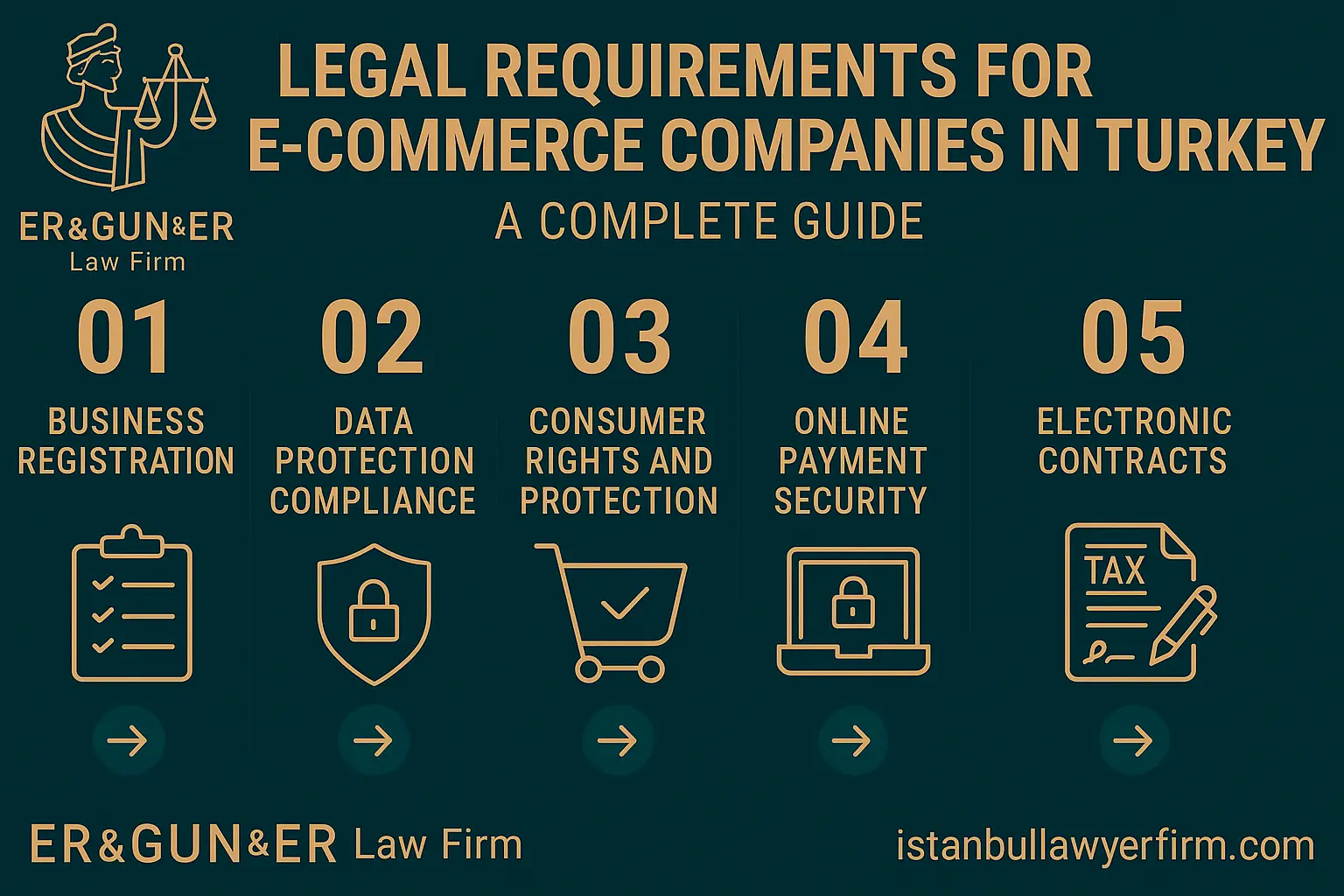
E-commerce operations in Turkey face an integrated regulatory framework spanning commercial law for the underlying business entity, specialized e-commerce regulation governing online commercial activities, consumer protection for B2C relationships, data protection for personal data handling, intellectual property for brand and content protection, taxation including electronic documentation requirements, customs regulation for cross-border activities, competition law for specific arrangements, advertising regulation, and platform-specific obligations for marketplace operators. The foundational commercial framework derives from the Turkish Commercial Code No. 6102 (TTK) governing company formation, trade registry obligations, and general commercial operations. The specialized e-commerce framework derives from the Electronic Commerce Regulation Law No. 6563 enacted in 2014, substantially amended by Law No. 7416 published in the Official Gazette No. 31889 of 7 July 2022, with most provisions effective 1 January 2023, data and reporting obligations effective 1 January 2024, and the e-commerce license obligation under Additional Articles 3 and 4 effective 1 January 2025. Implementing secondary regulation followed through the Regulation on Electronic Commerce Intermediary Service Providers and Electronic Commerce Service Providers published 29 December 2022 (Official Gazette No. 32058). Consumer protection operates through Law No. 6502 on Consumer Protection with distance contract provisions under Article 48, 14-day withdrawal right, unfair terms control under Article 5, and Consumer Arbitration Committees (Tüketici Hakem Heyetleri) under Article 68. Data protection flows from the Personal Data Protection Law No. 6698 (KVKK) with Article 9 cross-border transfer framework reformed by Law No. 7499 in March 2024 and the Data Transfer Module operational from July 2024. Intellectual property protection operates through Industrial Property Law No. 6769 for trademarks and related IP, and Intellectual and Artistic Works Law No. 5846 for copyright. Taxation framework includes Tax Procedure Law No. 213 with e-invoice, e-archive, and e-ledger obligations, VAT Law No. 3065 (standard rate 20% since July 2023), Corporate Tax Law No. 5520, and Digital Services Tax Law No. 7194 of 2019 imposing 7.5% tax on specific digital services. Customs operations fall under Customs Law No. 4458. Competition Law No. 4054 and Block Exemption Communiqué 2002/2 apply to specific commercial arrangements. Practice may vary by authority and year, and integrated e-commerce compliance benefits from systematic attention because these framework layers interact in ways that isolated compliance cannot address. A lawyer in Turkey coordinating e-commerce compliance establishes the foundation supporting the business lifecycle from formation through scale to potential exit.
Company registration, licensing, and trade registry obligations under TTK No. 6102
A Turkish Law Firm coordinating e-commerce company formation works through the corporate structuring decisions that shape subsequent compliance. Entity selection between limited liability company (Ltd.Şti.) and joint-stock company (A.Ş.) depends on ownership structure, capital plans, governance preferences, and commercial trajectory. Effective 1 January 2024, the minimum capital for non-public A.Ş. was increased to 250,000 TL and for Ltd.Şti. to 50,000 TL by Presidential Decree, with both forms permitting single-founder formation since the 2012 TTK reform. For e-commerce operations, A.Ş. is typically the preferred form where external investment rounds, capital markets access, or future IPO are contemplated, because its share transfer mechanics and differentiated share classes under TTK Articles 478-480 support flexible capital evolution. Ltd.Şti. suits smaller operations with simpler governance needs and lower initial capital. Foreign ownership is generally permitted without nationality-based restrictions under the Foreign Direct Investment Law No. 4875 national treatment principle, with E-TUYS (Electronic Incentive Implementation and Foreign Investment Information System) reporting for foreign investor corporate events. Trade registry (Ticaret Sicili) incorporation through the competent trade registry directorate produces formal corporate existence. Chamber of commerce membership, tax registration with the local tax office producing the tax identification number (vergi kimlik numarası), and SGK registration as employer within 30 days of first hiring are the core post-incorporation steps. E-commerce-specific identification and registration obligations under Law No. 6563 apply in addition to the standard company registration. For framework on company formation, readers can consult our company formation guide. Practice may vary by authority and year, and entity structuring benefits from integrated analysis of corporate, tax, e-commerce, and sector-specific considerations because decisions at formation shape the compliance trajectory.
Turkish lawyers who address mandatory information disclosure obligations work through Electronic Commerce Law No. 6563 and related regulations. Service provider identification disclosure under Articles 3 and 4 requires that the e-commerce operator's trade name, central office address, contact information including telephone and e-mail, trade registry information, tax identification, and other identification elements be displayed in an accessible manner on the e-commerce platform — typically in the footer and on an About Us / Contact page. Platform operator disclosure for multi-vendor marketplaces requires additional identification of the platform operator and, under the 2022 amendments, the intermediary service provider's status with the registered e-commerce service providers. Terms of service, a privacy policy that satisfies both Electronic Commerce Law and KVKK disclosure requirements, and a cookie policy addressing cookie categories and consent mechanism must be published. Sector-specific disclosure obligations apply to regulated product categories: pharmaceuticals have specific Ministry of Health disclosures, food products have Turkish Food Codex and labelling requirements, cosmetics have Ministry of Health cosmetic regulation disclosures, electronics have Ministry of Industry and Technology conformity requirements, and other regulated categories carry their own informational frameworks. The distance contract pre-contract information form under Consumer Protection Law No. 6502 Article 48 is itself a mandatory disclosure, discussed further below. Practice may vary by authority and year, and disclosure compliance benefits from systematic review because disclosures frequently become outdated as the business evolves (new products, new addresses, new corporate structure) and outdated disclosures are themselves compliance violations.
An English speaking lawyer in Turkey coordinating ongoing trade registry compliance for e-commerce companies addresses the framework where corporate changes require filings. Corporate governance changes — board additions, manager changes, share transfers, address changes — require trade registry filings within the specified period (generally 15 days for most changes under TTK framework). Capital changes require general assembly or equivalent decision, documentation of the change, and registry filing before the change is effective against third parties. Amendments to articles of association require general assembly resolution with the applicable qualified majority (typically two-thirds for fundamental amendments under TTK Article 421 for A.Ş.), publication in the Trade Registry Gazette (Türkiye Ticaret Sicili Gazetesi), and filing with the trade registry. Annual general assembly meetings with minutes, financial statement approval, and dividend decisions are standard governance events for both A.Ş. and Ltd.Şti. Financial statement filing obligations vary by entity size: qualifying A.Ş. companies face independent audit requirements with Turkish Financial Reporting Standards (TFRS) compliance; smaller entities operate under simpler accounting frameworks. Foreign shareholder compliance under Law No. 4875 and E-TUYS reporting applies to qualifying corporate events involving foreign investors. Practice may vary by authority and year, and ongoing corporate compliance benefits from systematic calendar management because missed filings produce administrative consequences, including personal liability for directors under TTK Articles 553-558 in aggravated cases.
Consumer protection, distance contracts, and terms of service under Law No. 6502
A lawyer in Turkey coordinating consumer protection compliance for e-commerce works through Consumer Protection Law No. 6502 and the Distance Contracts Regulation (Mesafeli Sözleşmeler Yönetmeliği). Article 48 applies to distance contracts concluded through remote communication including e-commerce transactions, and imposes pre-contract information obligations: the seller must provide, before contract conclusion, the seller's identity, the essential characteristics of the product or service, the total price including all taxes and additional costs (delivery, installation, etc.), payment and delivery terms, the withdrawal right and how to exercise it, complaint and dispute resolution information, and other required elements. The pre-contract information form must be delivered durably — in practice this means by e-mail with download capability, or via the customer account with export function. The 14-day withdrawal right (cayma hakkı) under Article 48/4 allows the consumer to withdraw from most distance contracts within 14 days without stating a reason, counted from delivery for physical goods and from contract formation for services and digital content. The Distance Contracts Regulation was amended in August 2022 (effective 1 January 2024) to shift the return-shipping cost burden to the seller in most consumer scenarios unless the seller clearly informed the consumer pre-contract that the consumer would bear the cost. The withdrawal process requires the consumer's notice within 14 days, return shipping per the terms, and a refund by the seller within 14 days of return receipt. For framework on consumer protection generally, readers can consult our consumer protection laws guide. Practice may vary by authority and year, and consumer protection compliance benefits from systematic documentation because enforcement outcomes frequently turn on documentation adequacy at the contract formation stage.
Turkish lawyers who address Consumer Arbitration Committee (Tüketici Hakem Heyeti) proceedings under Article 68 work through the tiered dispute resolution framework for consumer claims. Monetary thresholds for mandatory Consumer Arbitration Committee jurisdiction are updated annually by Ministry of Trade tariff; current thresholds should be verified against the current official publication because they change each calendar year. Above the threshold, consumer disputes proceed to Consumer Courts (Tüketici Mahkemeleri) under Article 73. Consumer Arbitration Committee procedure is streamlined: the consumer files an application at the district (ilçe) or provincial (il) committee (category depending on claim amount), the seller responds within the stated period, evidence is submitted, and the committee issues a decision typically within a few months of filing. Committee decisions bind the parties but are subject to judicial objection at the Consumer Court within 15 days of notification — an objection has the effect of a full-merit review in Consumer Court rather than a limited appellate review. E-commerce disputes frequently before the Committees include withdrawal right disputes (seller's refusal of a timely withdrawal, refund delay, deductions from the refund), delivery disputes (non-delivery, wrong item, damage), quality disputes (conformity of the product with description), and refund disputes. Attorney representation is available in Committee proceedings but the procedure is designed to be accessible to consumers without counsel. Business response discipline — timely response to applications, clear documentation of the transaction and of the seller's compliance, and compliance with unfavourable decisions — substantially affects outcomes across the cumulative consumer profile. Practice may vary by authority and year, and Consumer Arbitration Committee compliance benefits from systematic response protocols because cumulative committee outcomes shape the seller's regulatory profile.
An Istanbul Law Firm coordinating terms of service architecture for e-commerce works through the drafting framework that addresses both legal compliance and commercial operations. Terms of use for platform access cover user registration, permitted use, prohibited activities, account termination, intellectual property in platform content, limitations of liability within legally permissible scope, governing law, and dispute resolution. Purchase terms for transactions cover order processing, pricing, payment methods, delivery terms, return and refund procedures, warranty terms (including the two-year conformity warranty under Consumer Protection Law), and applicable limitations. Privacy policy under KVKK Article 10 addresses data controller identity, processing purposes, lawful bases, recipients of data, cross-border transfer mechanisms, retention periods, data subject rights, and contact points for rights exercise. Cookie policy specifies cookie categories, purposes, consent mechanism, and user control options; Turkish practice has moved toward explicit consent for non-essential cookies in alignment with KVKK principles. The Article 48 pre-contract information form must be technically integrated so that the consumer sees and confirms the form before completing the purchase, with a durable record of that confirmation retained by the seller. A withdrawal form template must be provided, whether through a link in the order confirmation or a form available in the customer account. Complaint handling procedures specify the complaint channel, acknowledgment timeframe, processing timeframe, and escalation pathway to Consumer Arbitration Committee or other forum. Bilingual implementation with a controlling Turkish version and reference English translation is the practical approach for international platforms; Turkish enforcement requires Turkish-language presentation, and controlling-language clauses avoid later translation disputes. Electronic acceptance through click-wrap with server-side logging — timestamp, IP, consent event — provides the evidentiary record of consent. Practice may vary by authority and year, and terms of service architecture benefits from integrated legal-commercial-technical coordination because isolated legal drafting misses operational requirements while isolated commercial drafting misses mandatory legal elements.
Data protection and KVKK compliance with 2024 Article 9 reform
A Turkish Law Firm coordinating KVKK compliance for e-commerce operations works through the data protection framework that applies intensively to consumer-facing commerce. Data controller and processor characterization is the first analytical step: e-commerce operators typically act as data controllers for their own processing — customer account management, order processing, marketing, fraud prevention, analytics — while engaging processors (hosting providers, payment processors, delivery services, email service providers, analytics tools) that process under contract. Lawful basis analysis under KVKK Article 5 covers the applicable ground for each processing activity: contract necessity for order processing and delivery, legal obligation for tax and regulatory reporting, legitimate interests for fraud prevention and basic analytics (where a balancing test supports the processing), and explicit consent for marketing communications and non-essential cookies. Special category data under Article 6 (health, biometric, religious belief, political opinion, sexual life, and others) requires enhanced bases — most e-commerce does not process special category data extensively, but specific scenarios (health-related product sales, religious-preference-based recommendations in limited cases) require specific attention. Privacy notice architecture under Article 10 requires clear disclosure to data subjects about controller identity, processing purposes, recipients, methods, lawful basis, and data subject rights; layered notices with a short summary and accessible detail serve both compliance and user experience. VERBIS (Veri Sorumluları Sicili) registration is mandatory where the applicable thresholds are met — thresholds are keyed to employee count, annual balance sheet total, and specific processing categories, and organizations near the thresholds should verify current requirements. Data subject rights handling under Article 11 (access, rectification, deletion, objection to automated decisions, right to withdraw consent) requires operational infrastructure supporting responses within 30 days under Article 13. Practice may vary by authority and year, and KVKK compliance for e-commerce benefits from privacy-by-design during platform development because retroactive retrofit of compliance features is substantially more expensive than building them in from the start.
Turkish lawyers who address the reformed cross-border transfer framework under KVKK Article 9 as amended by Law No. 7499 in March 2024 work within a three-tier architecture particularly relevant to e-commerce operations with international technology stacks. Adequacy-based transfers apply where the Personal Data Protection Authority issues a formal adequacy decision for the destination country; as of this material's drafting, the Authority has not yet published formal adequacy decisions, so this tier is prospective. Appropriate safeguards-based transfers are the primary practical mechanism, operating through Authority-approved standard contractual clauses, binding corporate rules for intra-group transfers after Authority approval, international agreements, or case-specific written undertakings approved by the Authority. Standard contractual clause-based transfers must be notified to the Authority within five business days of execution through the Data Transfer Module (Veri Aktarım Modülü) operational since the July 2024 Regulation. Derogations under Article 9/6 apply to narrow circumstances — explicit consent of the data subject to the specific transfer, contract necessity where the transfer is necessary to perform the specific contract, protection of vital interests, public interest, legal claims establishment or defense, and limited other grounds — and should not be relied on as a systematic basis because their scope is intentionally narrow. Typical e-commerce cross-border flows requiring mechanism coverage include hosting infrastructure on foreign-located cloud providers, analytics services (Google Analytics and comparable tools), payment processors with global operations, marketing and CRM platforms, customer support tools, fraud prevention services, and logistics providers. Sub-processor arrangements — where the primary service provider engages further processors including foreign sub-processors — require contractual cascading of transfer protections. For detailed framework on cross-border data transfers under the reformed framework, readers can consult our KVKK cross-border transfers guide. Practice may vary by authority and year, and cross-border transfer compliance benefits from systematic data flow inventory because the cumulative flow complexity across a modern e-commerce stack requires integrated management rather than ad hoc analysis per vendor.
An English speaking lawyer in Turkey coordinating data breach response for e-commerce addresses KVKK Article 12 and Personal Data Protection Authority secondary regulation. The Authority's Decision of 24 January 2019 and subsequent guidance have set the 72-hour notification standard: breach notification to the Authority must be made without undue delay and in any case within 72 hours of awareness, with a detailed breach notification form covering the incident nature, data categories affected, number of data subjects, likely consequences, technical and organizational measures taken, and contact point. Data subject notification applies where the breach is likely to result in high risk to rights and freedoms of affected individuals, typically through direct communication with clear description of the breach and recommended protective steps. Breach response plan development, in place before an incident occurs, covers detection mechanisms, initial response team composition, assessment procedures, containment procedures, notification procedures, remediation, and post-incident review. Technical and organizational measures (TOM) under Article 12 include access controls, encryption for data at rest and in transit where appropriate to the risk, logging and monitoring, backup and recovery, secure software development practices, and regular security testing. Vendor and sub-processor breach coordination — when the incident occurs at a third-party processor, the e-commerce operator remains responsible for notifications and must have contractual terms requiring the processor's prompt notification and cooperation. Cross-border breach coordination is required where the breach affects data subjects in multiple jurisdictions — EU data subjects' GDPR-based notification obligations, for example, run in parallel to KVKK notification. Practice may vary by authority and year, and breach response benefits from advance preparation because the 72-hour timeframe does not permit ad hoc response architecture to be developed from scratch.
Intellectual property: trademark, domain, and copyright protection
A lawyer in Turkey coordinating trademark protection for e-commerce brands works through Industrial Property Law No. 6769 (SMK) and trademark-related operations. Trademark registration through the Turkish Patent and Trademark Office (TÜRKPATENT) under SMK Articles 4-32 provides the primary trademark protection mechanism for Turkey. Pre-filing trademark search reveals existing registrations, pending applications, similar marks, and broader trademark landscape elements affecting filing strategy. Nice Classification (currently Nice 12th Edition) covers 45 classes (34 goods classes 1-34 and 11 services classes 35-45); e-commerce typically requires coverage in at least Class 35 (advertising, business management, commercial services including online retail), Class 38 (telecommunications and online services), Class 42 (scientific and technological services, including SaaS), and the product-category-specific classes for actual goods sold. Application filing through TÜRKPATENT's electronic filing system produces a formal filing date that establishes priority under the first-to-file framework. Examination proceeds through formal examination, absolute grounds examination under SMK Article 5 (distinctiveness, descriptiveness, bad faith, scandalous marks, and other absolute grounds), publication in the Official Trademark Bulletin for a two-month opposition period, and consideration of any oppositions filed by third parties. Registration certificate issuance on successful examination and fee payment produces the formal right with a ten-year renewable term. International protection through the Madrid Protocol (Turkey is a member) permits designation of Turkey through a WIPO filing originating from a home trademark office, or designation of foreign jurisdictions through a Turkish home filing. For framework on trademark registration specifically for foreign businesses, readers can consult our trademark registration guide for foreign businesses. Practice may vary by authority and year, and trademark strategy benefits from early filing because priority dates determine rights in contested scenarios.
Turkish lawyers who address domain name protection for e-commerce work through the framework where domains represent critical commercial assets. The .tr domain space operates under the Information and Communication Technologies Authority (BTK) framework, which assumed administration through TRABİS (.tr Network Information System) operational from 14 September 2022, replacing the prior Middle East Technical University (ODTÜ / Nic.tr) administration. TRABİS liberalized .tr registration by opening second-level .tr (directly under .tr) to general registration alongside the established third-level categories (.com.tr, .org.tr, .net.tr, .gov.tr, .edu.tr, and others). Registration eligibility for specific extensions varies: .com.tr historically required documentation of commercial activity but has been simplified, while .gov.tr and .edu.tr are restricted to qualifying entities. Generic top-level domain (gTLD) registration — .com, .net, .org, and newer gTLDs — proceeds through ICANN-accredited registrars and provides global presence. Domain registration timing relative to trademark filing benefits from simultaneous or near-simultaneous execution: filing a trademark application without securing the domain invites third-party registration of the domain; securing the domain without trademark protection leaves the brand exposed to trademark claims from others. Cybersquatting and bad-faith domain disputes have two main pathways: UDRP (Uniform Domain-Name Dispute-Resolution Policy) for gTLDs, administered through WIPO and other accredited providers, and TRABİS Dispute Resolution Procedure for .tr domains with specific arbitration provider designation. Domain transfer security through authorization codes (EPP codes) and registrar-level security measures protects the domain asset from unauthorized transfer. Corporate email infrastructure tied to the primary domain requires business continuity planning: a lost domain can paralyze operations, and domain hijack scenarios have occurred even to sophisticated companies. Practice may vary by authority and year, and domain strategy benefits from integrated approach with trademark strategy because managing them as separate assets produces conflicts that integrated management avoids.
An Istanbul Law Firm coordinating copyright protection for e-commerce content addresses Intellectual and Artistic Works Law No. 5846 (FSEK) for content categories. FSEK Article 1/B and Article 2 framework provides automatic copyright protection for qualifying creative works from the moment of creation, without registration requirement. Protected categories include platform content (if sufficiently creative to meet the originality threshold), product descriptions where creative expression exists beyond mere factual description, photography, graphic design, advertising copy, software (explicitly protected under FSEK), and other creative content. Ministry of Culture and Tourism optional copyright registration provides documentary evidence of creation date and content that supports enforcement in disputes. User-generated content (UGC) — product reviews, uploaded photographs, forum posts, social content — requires a structured handling framework: terms of service provisions granting the platform a license to use the UGC (while preserving the user's underlying rights), user representations that the content is their own or lawfully used, takedown procedures for infringement claims, and DMCA-style notice-and-takedown analog under Turkish framework (the 2022 amendments to Law No. 6563 specifically strengthened the takedown framework for IP infringement on e-commerce platforms, requiring intermediary action on substantiated complaints). Content licensing for third-party content (stock photography, music, fonts) requires license compliance — using content outside license scope produces infringement exposure, and many common licenses have restrictions that e-commerce use may exceed. Online infringement response includes takedown notices to hosting providers under Internet Law No. 5651 framework, coordination with search engines for indexing removal, evidence preservation through notarized screenshots or digital forensics for potential enforcement, and enforcement actions in IP Courts (Fikri ve Sınai Haklar Mahkemeleri) where damages and injunctive relief are sought. Cross-border copyright enforcement under the Berne Convention framework supports protection across member states. Practice may vary by authority and year, and e-commerce copyright protection benefits from systematic content management because cumulative UGC and licensed content across a modern e-commerce platform creates compliance exposure that systematic approaches address and ad hoc approaches miss.
Taxation, e-invoicing, and tax compliance under VUK No. 213
A Turkish Law Firm coordinating e-commerce taxation works through the integrated framework spanning multiple tax categories and extensive electronic documentation. VAT under Law No. 3065 applies to most e-commerce transactions at the standard rate of 20% (raised from 18% effective 10 July 2023), with the 10% reduced rate for specific categories (certain food products, basic textiles, certain services) and the 1% rate for specified basic necessities (basic bread, certain agricultural products, and specific other categories listed in the VAT general communique). VAT registration follows from standard business registration; voluntary VAT-exempt treatment is not available for commercial operations above negligible scale. Monthly VAT declaration and payment through the Revenue Administration's GİB electronic system is the ongoing compliance rhythm. VAT export exemption under Article 11 applies to qualifying export transactions subject to documentation requirements (customs declaration, foreign exchange documentation, delivery documentation); exports to EU customers under the Customs Union framework for industrial goods receive specific treatment. Corporate tax under Law No. 5520 applies at the prevailing corporate income tax rate (subject to periodic legislative adjustment — the rate should be verified against current official publication) on Turkish-resident entities' worldwide income and non-resident entities' Turkish-source income. Digital Services Tax under Law No. 7194 of 2019 imposes 7.5% tax on specific digital services — online advertising, sales and provision of digital content, streaming services, and intermediary services through digital platforms — provided to Turkish users by service providers meeting the revenue threshold (currently 20 million TL Turkish revenue and 750 million TL worldwide with aggregation rules). DST is on gross revenue, not profit, and is paid monthly. Withholding tax obligations on payments to non-residents (royalties, interest, certain service fees) under Income Tax Law Article 94 apply at rates reduced by applicable double taxation treaties. Transfer pricing under Corporate Tax Law Article 13 governs related-party transactions with arm's length pricing and documentation obligations. For framework on VAT compliance, readers can consult our VAT compliance guide. Practice may vary by authority and year, and e-commerce taxation benefits from integrated sector expertise because generic approaches miss e-commerce-specific considerations.
Turkish lawyers who address electronic documentation obligations under VUK No. 213 and Revenue Administration (Gelir İdaresi Başkanlığı — GİB) secondary regulations work through the e-documentation framework affecting virtually all significant e-commerce operations. E-invoice (e-fatura) under General Communique Series No. 509 and updates applies to qualifying taxpayers based on annual revenue thresholds (the threshold has been adjusted downward progressively, with 3 million TL previous-year gross sales currently triggering mandatory integration, subject to verification against the current threshold), specific sector categorization (e-commerce operations were designated within the mandatory scope regardless of revenue through specific Revenue Administration determinations), and other qualifying criteria. E-fatura operates between qualifying taxpayers (B2B where both are integrated) with invoice flow through the GİB system. E-archive invoice (e-arşiv fatura) covers B2C invoices and B2B invoices where the recipient is not e-fatura qualified, with invoice issuance from the e-archive system and delivery to recipients. E-ledger (e-defter) requires electronic maintenance of the journal and ledger books in XBRL format with monthly submission to GİB. E-waybill (e-irsaliye) applies to qualifying taxpayers for physical goods shipments, providing electronic waybill generation and flow. Electronic signature under Electronic Signature Law No. 5070 — qualified electronic signature (nitelikli elektronik imza, NES) — authenticates electronic documents, and financial seal (mali mühür) authenticates e-fatura and e-arşiv specifically. Special integrator (özel entegratör) services from GİB-authorized service providers offer an alternative to direct GİB integration for taxpayers who prefer outsourced electronic documentation infrastructure. Document retention for electronic documents follows the same framework as paper documents with additional technical requirements: integrity preservation (electronic signature validation), accessibility (ability to retrieve and present to auditors), and readability (continued ability to open documents despite technology evolution). Practice may vary by authority and year, and electronic documentation compliance benefits from specific technical-legal coordination because the system integration requires both technical capability and regulatory understanding that a single-discipline approach cannot deliver.
An English speaking lawyer in Turkey coordinating tax audit readiness and record retention for e-commerce addresses the framework supporting favourable audit outcomes. Tax audit authority under VUK provides Revenue Administration with broad examination authority including documentary review, system access, and interviews. Record retention under VUK Article 253 requires tax-related records retention for the zamanaşımı (statute of limitations) period — generally five years under VUK Article 114, extending in specific circumstances (fraud, loss declarations carried forward). Commercial book retention under TTK Article 82 is ten years from the end of the calendar year in which entries were made, operating independently of the VUK tax framework — the longer period controls for documents covered by both frameworks. Invoice records (e-fatura and e-arşiv archives, supporting records for invoice content, delivery documentation), customer records (identification documentation especially for KVKK and for fraud investigation response, transaction records, communication records), and cross-border transaction records (export documentation, customs records, foreign counterparty records) all fall within the retention framework. VAT audit preparation covers VAT calculation documentation for each period, VAT return supporting records including input tax deduction documentation, export exemption documentation with the customs and banking evidence, and reconciliation between VAT accounting and financial accounting. Transfer pricing documentation under Corporate Tax Law Article 13 and the OECD-aligned country-by-country reporting rules applies to qualifying multinationals and large-scale related-party transactions. Voluntary disclosure under VUK Article 371 (pişmanlık) can mitigate penalties for self-reported errors submitted before specific triggering events; taxpayer-initiated reconciliation (uzlaşma) under VUK Article 376 can reduce assessed penalties in the reconciliation framework. Practice may vary by authority and year, and tax audit preparedness benefits from ongoing discipline because cumulative documentation across years cannot be reconstructed at the audit stage.
Shipping, customs, and cross-border sales under Customs Law No. 4458
A lawyer in Turkey coordinating customs compliance for cross-border e-commerce works through Customs Law No. 4458 (Gümrük Kanunu) and related regulations. Import operations involve customs declaration procedures, tariff classification under Harmonized System (HS) codes which determine the duty rate, customs value determination (typically transaction value under WTO valuation framework), applicable duties including customs duty and import VAT, and documentation (commercial invoice, packing list, bill of lading or airway bill, certificate of origin where preferential treatment is claimed). Export operations mirror the process with customs declaration, export documentation, VAT export exemption application under VAT Law Article 11, and specific export incentive frameworks where applicable (export credit, export VAT refund). Tariff classification accuracy is the first line of customs compliance: HS code selection determines duty rate, trade remedy exposure, and whether trade-agreement preferences apply. Misclassification — whether accidental or aggressive — produces customs audits, retroactive duty collection, and penalties. Rules of origin analysis affects preferential treatment under Turkey's free trade agreement network and under the Customs Union with the EU for industrial goods, with specific rules for determining originating status (wholly obtained goods, substantial transformation, specific product-process rules). Turkey has FTAs with numerous jurisdictions, and the EU Customs Union framework provides duty-free circulation for most industrial goods with the ATR movement certificate. Authorized Economic Operator (AEO — Yetkilendirilmiş Yükümlü Statüsü) status provides customs facilitations (simplified procedures, priority treatment, reduced inspection rates) for qualifying traders who meet reliability and internal control standards. Customs warehousing (antrepo) permits deferred duty payment for goods awaiting distribution or re-export. For framework on import-export regulations, readers can consult our import-export regulations guide. Practice may vary by authority and year, and customs compliance benefits from customs expertise because the technical framework requires specialist attention that generic trade compliance approaches cannot deliver.
Turkish lawyers who address cross-border e-commerce VAT and indirect tax considerations work through the framework where cross-border flows produce VAT obligations in multiple jurisdictions. Turkish VAT on imports is calculated on customs value plus customs duty plus specific other import charges, payable at import clearance, with input VAT credit available for VAT-registered importers. Turkish VAT export exemption under Article 11 applies to qualifying export transactions subject to documentation — customs export declaration, foreign exchange conversion through authorized banks, delivery documentation. B2B versus B2C treatment differs across jurisdictions and can affect invoicing, VAT collection, and compliance. EU VAT for e-commerce sales to EU consumers operates under the EU One-Stop Shop (OSS) framework effective 1 July 2021 (for distance sales of goods from outside the EU) and 1 July 2021 more broadly; non-EU sellers with EU customers can register in one EU Member State and file a single VAT return covering all EU B2C sales. The 150-euro de minimis threshold for import VAT on goods from outside the EU was removed in July 2021, making VAT collection relevant to virtually all EU-bound sales. UK VAT post-Brexit operates on a separate regime with its own VAT registration thresholds and Making Tax Digital compliance. US sales tax varies by state with post-Wayfair economic nexus rules affecting Turkish sellers making specific volume of sales to a US state. Digital services cross-border rules include Turkey's Digital Services Tax for inbound digital services and the EU's VAT on telecommunications, broadcasting, and electronically supplied services rules for Turkish providers to EU consumers. Intercompany pricing for cross-border arrangements requires transfer pricing coordination across VAT, customs, and income tax dimensions. Practice may vary by authority and year, and cross-border VAT benefits from multi-jurisdictional coordination because isolated single-jurisdiction analysis misses cumulative obligations.
An Istanbul Law Firm coordinating cross-border e-commerce operational frameworks addresses the practical elements supporting sustainable international operations. Incoterms 2020 integration for cross-border commercial arrangements addresses risk transfer, cost allocation, and responsibility allocation: the Incoterm selection (EXW, FCA, CPT, CIP, DAP, DPU, DDP for all transport modes; FAS, FOB, CFR, CIF for sea and inland waterway) materially affects which party bears shipping cost, insurance, customs clearance, and loss risk. International shipping partner selection — global couriers (DHL, FedEx, UPS), specialized e-commerce logistics providers, regional consolidators — involves trade-offs between service coverage, cost, customs clearance capability, and returns handling. Customs broker engagement supports complex customs matters: large-volume shippers typically maintain customs broker relationships for declaration preparation, tariff classification consultation, and customs dispute handling. International payment processing across cross-border corridors involves currency conversion, foreign exchange exposure, payment method availability in the destination market, chargeback handling, and compliance with Decision No. 32 foreign exchange framework on the Turkish side. International returns management requires a clear returns process: return shipping responsibility, customs implications of returns (re-import of Turkish-origin goods, potential duty recovery for returned imports), refund processing timing, and returns documentation. Cross-border dispute resolution design — forum selection, applicable law, enforcement considerations — should be addressed at the contract formation stage for B2B arrangements, while consumer cross-border disputes often land in consumer-protective forums regardless of contract language. Destination-market regulatory compliance covers product registration requirements (medical devices, cosmetics, electronics with conformity marks), labelling requirements (language, content, safety warnings), and specific category-specific regulations. Practice may vary by authority and year, and cross-border operations benefit from integrated strategic and operational planning because the dimensions interact across activities.
2022 Electronic Commerce Law No. 7416 marketplace framework
A Turkish Law Firm addressing the 2022 amendments to Electronic Commerce Law No. 6563 through Law No. 7416 works within the substantially revised framework that restructured Turkish e-commerce regulation. Law No. 7416 was published in the Official Gazette No. 31889 of 7 July 2022, with most provisions effective 1 January 2023, data and reporting obligations effective 1 January 2024, and the e-commerce license requirement under Additional Articles 3 and 4 effective 1 January 2025. Implementing secondary regulation followed through the Regulation on Electronic Commerce Intermediary Service Providers and Electronic Commerce Service Providers published 29 December 2022 (Official Gazette No. 32058). The framework introduced new definitions: electronic commerce service provider (elektronik ticaret hizmet sağlayıcı — ETHS) covers entities selling directly to consumers through their own digital channels; electronic commerce intermediary service provider (elektronik ticaret aracı hizmet sağlayıcı — ETAHS) covers platforms providing intermediary services to other e-commerce service providers, i.e., marketplaces; electronic commerce marketplace (elektronik ticaret pazar yeri) is the platform environment itself; net transaction volume (net işlem hacmi) is the metric used for tiering obligations, calculated based on the platform's total transaction value over the relevant period. Net transaction volume thresholds trigger tiered obligation frameworks, with larger platforms facing progressively enhanced obligations. The tiers include platforms with net transaction volume above 10 billion TL, above 30 billion TL, and above 60 billion TL (thresholds adjusted periodically for inflation), with additional obligations at each tier including platform transparency requirements, advertising and promotional budget limitations scaled as a percentage of net transaction volume, limitations on self-preferencing and own-brand sales, and the e-commerce license requirement for the largest tier. Mass advertising budget limitations restrict advertising expenditure for large platforms to a specified percentage of net transaction volume, tapering the top-tier platforms' ability to use aggressive customer acquisition spending. Product tracking code (Mal Takip Kodu — MTK) requirement for specific product categories enables tracking through the supply chain. Practice may vary by authority and year, and the 2022 e-commerce framework benefits from systematic compliance architecture because the obligations affect operational, commercial, and financial dimensions of affected platforms.
Turkish lawyers who address the unfair commercial practices framework under the 2022 amendments work through the provisions protecting electronic commerce service providers from intermediary conduct. The amended Law introduces unfair commercial practice definitions specifically applicable to intermediary-service-provider relations with electronic commerce service providers operating on the platform. Prohibited practices include demanding that sellers match price disadvantages imposed on the platform's own branded products, compelling sellers to participate in promotional campaigns at their own cost as a condition of platform access, accessing or using sellers' commercial data for the platform's own competing activities, self-preferencing the platform's own products in search and recommendation results in ways that disadvantage sellers, and other enumerated conduct. The complaint mechanism allows electronic commerce service providers to challenge intermediary conduct through Ministry of Trade complaint procedures, with potential private remedies also available where conduct breaches contract or competition law. Documentation obligations on intermediaries include providing sellers with information on platform rules, ranking factors, advertising algorithm operation (to the extent specified in secondary regulation), and data access arrangements. Data portability and access framework gives sellers rights to access the commercial data generated through their sales on the platform, facilitating seller mobility between platforms and supporting competition. Platform termination protections apply procedural safeguards when an intermediary terminates or restricts a seller's access: notice, reason-giving, and a cure or appeal period are provided for in the secondary regulation. The framework draws partly from the EU's Platform-to-Business (P2B) Regulation 2019/1150, adapted to Turkish market structure. For framework on e-commerce tax obligations including dropshipping scenarios, readers can consult our e-commerce tax obligations and dropshipping guide. Practice may vary by authority and year, and unfair commercial practice compliance benefits from marketplace expertise because the provisions target platform-merchant dynamics that generic competition analysis does not capture.
An English speaking lawyer in Turkey coordinating commercial electronic communication compliance under Law No. 6563 Articles 6 and 7 addresses electronic marketing activities. Article 6 requires opt-in consent before sending commercial electronic communications (marketing e-mails, marketing SMS, marketing push notifications, marketing via other electronic channels), with a narrow exception for existing customer relationships under the specific conditions of the secondary regulation (communications relating to products or services similar to those the customer previously purchased, from the same seller, with a clear opt-out option). İYS (İleti Yönetim Sistemi — Message Management System) is the centralized consent registry administered under Ministry of Trade framework: commercial senders must query İYS before sending each commercial message and record consents through İYS; sending without verified consent exposes the sender to administrative fines. Consent requirements include free consent (not tied to unrelated services), informed consent (clear disclosure of the commercial communication purpose and sender identity), revocable consent (opt-out available at any time), and documented consent. Commercial electronic communication content must identify the sender, identify the subject matter (so the recipient can recognize the commercial nature), and provide a simple unsubscribe mechanism. Unsubscribe mechanisms must be accessible (single-click where technically feasible), simple, and processed within the specified timeframe (typically three business days under secondary regulation). The distinction between transactional communications (order confirmations, shipping notifications, payment receipts, account-related communications) and commercial communications matters: transactional communications operate under a different framework not requiring İYS consent, though the boundary is fact-specific and aggressive classification of marketing as "transactional" is a compliance risk. Cross-border commercial communication — Turkish senders to foreign recipients or foreign senders to Turkish recipients — requires jurisdictional analysis coordinating Turkish, destination-country, and potentially GDPR frameworks. Practice may vary by authority and year, and commercial communication compliance benefits from systematic consent management because cumulative compliance across high-volume marketing operations requires architecture rather than ad hoc decision-making.
Marketplace liability, dispute resolution, and consumer arbitration
A lawyer in Turkey coordinating marketplace liability allocation works through the framework addressing liability risks across marketplace participants. Intermediary service provider liability under Electronic Commerce Law Article 9 (as amended by Law No. 7416) operates with a modified safe harbor: the intermediary is generally not liable for illegal content provided by a service provider on the platform, but becomes liable if it becomes aware of the illegality and fails to remove the content. The 2022 amendments specifically strengthened intermediary obligations for IP infringement: on a substantiated IP rights holder complaint with supporting documentation, the intermediary must remove the challenged product without delay, and failure to act converts the intermediary from a neutral host to a contributor. Product liability under general civil law (TBK Articles 475-478 for sale-of-goods defect liability) and Consumer Protection Law No. 6502 framework imposes liability on the seller for defective products, with the producer and importer potentially also liable under Article 11 of Law No. 6502 for manufacturing defects. The marketplace's liability as a seller versus as an intermediary turns on whether it sold the product directly or merely facilitated the sale — marketplaces sometimes blur this line by, for example, providing fulfillment services that give the appearance of being seller-side, and the characterization has significant liability consequences. Content liability for product descriptions, user reviews, and other content involves different allocation: the seller is responsible for accuracy of its product descriptions, the platform may be responsible for user reviews in limited circumstances where it actively curates or for content that is manifestly illegal and notified, and users are responsible for their own submitted content. Marketplace-seller contractual terms address liability allocation, indemnification, insurance requirements, and compliance obligations. Brand protection on marketplaces against counterfeit and unauthorized listings uses the takedown framework discussed above plus, where available, brand registry programs through which brand owners obtain streamlined takedown with the marketplace. For framework on dropshipping compliance, readers can consult our dropshipping compliance guide. Practice may vary by authority and year, and marketplace liability benefits from specific expertise because the allocation questions materially affect participants' risk profiles.
Turkish lawyers who address dispute resolution architecture for e-commerce disputes work through the tiered framework for different dispute categories. Consumer disputes below the Consumer Arbitration Committee jurisdictional thresholds proceed through Consumer Arbitration Committees under Law No. 6502 Article 68 with the streamlined procedure; above the thresholds they proceed to Consumer Courts under Article 73 with consumer-favourable procedural rules (including the rebuttable presumption of consumer status in doubtful cases and the inadmissibility of certain standard terms). Merchant-to-merchant (B2B) commercial disputes proceed through Commercial Courts (Ticari Mahkemeler) or, for general commercial disputes where specialized commercial jurisdiction does not apply, through Civil Courts of First Instance (Asliye Hukuk Mahkemesi). Mandatory mediation under Law No. 6325 and Law No. 7155 of 2018 applies to specific commercial monetary disputes between merchants as a procedural precondition to court filing, with Law No. 7445 of 2023 expanding mediation to additional categories. Arbitration for contractual commercial relationships (platform-large-seller contracts with arbitration clauses, B2B supply agreements with arbitration clauses) provides an alternative dispute resolution pathway — International Arbitration Law No. 4686 governs international arbitration, ISTAC provides Turkish-seated institutional arbitration, and parties can select ICC, LCIA, SIAC, or HKIAC for institutional frameworks or UNCITRAL rules for ad hoc arbitration. The New York Convention 1958 supports enforcement of foreign arbitral awards in Turkey. Cross-border consumer disputes involve special complications: Turkish consumer protection rules generally override forum selection clauses in consumer contracts with Turkish consumers, and enforcement of consumer judgments from foreign courts faces the reciprocity requirements of MÖHUK Articles 50-58. Online dispute resolution (ODR) platforms for qualifying categories support streamlined resolution. Administrative complaints to the Ministry of Trade are available for regulatory consumer protection matters that do not reach the Committee or Court framework directly. Practice may vary by authority and year, and dispute resolution architecture benefits from integrated design because pathway selection materially affects cost, timing, and outcome characteristics.
An Istanbul Law Firm coordinating advertising and marketing compliance for e-commerce works through the advertising framework under Consumer Protection Law, Electronic Commerce Law, and sector-specific regulation. Commercial advertising under Consumer Protection Law No. 6502 Article 61 and the Commercial Advertising and Unfair Commercial Practices Regulation (Ticari Reklam ve Haksız Ticari Uygulamalar Yönetmeliği) establishes standards including truthfulness (ad content must be substantiated), comparative advertising rules (permitted under specific conditions, prohibited under others), price advertising requirements (pre-discount price must be a genuine prior price, not a fictitious reference), health and safety claim requirements (scientific substantiation for health claims), and other advertising standards. The Advertising Board (Reklam Kurulu), operating under the Ministry of Trade, enforces advertising compliance with authority to order correction, halt broadcasts or publications, and impose administrative fines for violations. Influencer marketing received specific Ministry of Trade guidance in 2022 addressing disclosure obligations ("sponsored," "collaboration," "gift," or equivalent clear markers), authenticity requirements (no fake testimonials or fabricated user-generated content), and content-specific rules. The guidance applies across influencer-driven campaigns, affiliate marketing with content creators, and sponsored content across social platforms. Comparative advertising restrictions permit factual, verifiable comparisons while prohibiting misleading comparisons or comparisons involving incomparable categories. Price advertising rules address discount advertising (the reference "original price" must be a genuine prior price, strike-through pricing is regulated), time-limited offers (must not be artificially "always on sale"), and bundled pricing. Native advertising must be clearly identified as commercial content despite its editorial format. Targeted advertising to children and other vulnerable audiences faces enhanced restrictions reflecting those audiences' reduced ability to evaluate commercial messaging. Practice may vary by authority and year, and advertising compliance benefits from integrated legal-marketing coordination because the regulatory framework materially affects marketing operations and commercial outcomes.
Author: Mirkan Topcu is an attorney registered with the Istanbul Bar Association (Istanbul 1st Bar), Bar Registration No: 67874. His practice focuses on cross-border and high-stakes matters where evidence discipline, procedural accuracy, and risk control are decisive, with particular concentration on e-commerce legal compliance including company formation under TTK No. 6102 with A.Ş. and Ltd.Şti. structuring under 2024 capital thresholds, Electronic Commerce Law No. 6563 and the Law No. 7416 of 7 July 2022 (Official Gazette No. 31889) amendments establishing the marketplace framework with intermediary service provider (ETAHS) and electronic commerce service provider (ETHS) classifications, net transaction volume tiered obligations with thresholds at 10, 30, and 60 billion TL, advertising and promotional budget limitations, MTK product tracking code, 29 December 2022 implementing Regulation (Official Gazette No. 32058), and the 1 January 2025 e-commerce license requirement under Additional Articles 3 and 4, Consumer Protection Law No. 6502 including Article 48 distance contracts with 14-day withdrawal right, the Distance Contracts Regulation as amended effective 1 January 2024 shifting return-shipping costs to sellers, Article 5 unfair terms control, Article 61 commercial advertising framework, and Article 68 Consumer Arbitration Committees and Article 73 Consumer Courts, KVKK No. 6698 data protection with Article 9 cross-border transfer framework reformed by Law No. 7499 in March 2024 and the July 2024 Data Transfer Module Regulation, Article 10 privacy notices, Article 11 data subject rights, Article 12 and 72-hour breach notification framework, VERBIS registration, Industrial Property Law No. 6769 trademark protection through TÜRKPATENT with Nice Classification 12th Edition coverage, FSEK No. 5846 copyright including user-generated content framework, Internet Law No. 5651 takedown procedures, TRABİS .tr domain framework operational from 14 September 2022 under BTK, Tax Procedure Law No. 213 electronic documentation including e-fatura, e-arşiv, e-defter, and e-irsaliye, VAT Law No. 3065 (20% standard rate effective 10 July 2023) and Corporate Tax Law No. 5520 compliance, Digital Services Tax Law No. 7194 of 2019 imposing 7.5% on qualifying digital services, Customs Law No. 4458 for cross-border operations including EU Customs Union ATR framework, Competition Law No. 4054 with Block Exemption Communiqué 2002/2 on Vertical Agreements, Commercial Advertising and Unfair Commercial Practices Regulation with Advertising Board (Reklam Kurulu) enforcement and 2022 Ministry of Trade influencer marketing guidance, and İYS (İleti Yönetim Sistemi) commercial communication consent framework under Law No. 6563 Articles 6 and 7.
He advises individuals and companies across Commercial and Corporate Law, E-Commerce Law, Consumer Protection, Foreign Investment, Data Protection and Privacy, Intellectual Property, Commercial Contracts, Arbitration and Dispute Resolution, Enforcement and Insolvency, Citizenship and Immigration (including Turkish Citizenship by Investment), Real Estate (including acquisitions and rental disputes), International Tax, International Trade, Foreigners Law, Sports Law, Health Law, and Criminal Law. He regularly supports e-commerce businesses on company formation with integrated tax and commercial planning, marketplace framework compliance under the 2022 amendments including ETAHS and ETHS classification analysis and net transaction volume threshold monitoring, terms of service and privacy policy architecture integrated with KVKK and Consumer Protection Law, cross-border taxation and customs coordination including DST and EU OSS considerations, intellectual property portfolio development across TÜRKPATENT trademarks and Madrid Protocol international protection, marketplace liability management including intermediary safe harbor architecture, advertising and marketing compliance including Reklam Kurulu defense and influencer marketing guidance, consumer dispute management through Consumer Arbitration Committees and Consumer Courts, and commercial dispute resolution through Turkish courts, mandatory mediation, and arbitration through ISTAC and international institutions.
Education: Istanbul University Faculty of Law (2018); Galatasaray University, LL.M. (2022). LinkedIn: Profile. Istanbul Bar Association: Official website.
Frequently asked questions
- What law primarily governs e-commerce in Turkey? Electronic Commerce Regulation Law No. 6563 enacted in 2014, substantially amended by Law No. 7416 of 7 July 2022 (Official Gazette No. 31889). Most provisions became effective 1 January 2023, data and reporting obligations effective 1 January 2024, and the e-commerce license requirement under Additional Articles 3 and 4 effective 1 January 2025.
- What changed with the 2022 amendments? Law No. 7416 introduced ETAHS (intermediary) and ETHS (direct seller) classifications, electronic commerce marketplace framework, net transaction volume tiered obligations (with thresholds currently at 10, 30, and 60 billion TL), e-commerce license requirement for the largest tier effective 1 January 2025, advertising budget limitations scaled to net transaction volume, unfair commercial practices framework protecting sellers from platform conduct, product tracking code (MTK), and other framework changes.
- What consumer rights apply to e-commerce? Consumer Protection Law No. 6502 Article 48 provides distance contract framework with pre-contract information obligations and the 14-day withdrawal right. Article 5 permits invalidation of unfair terms. Article 68 provides Consumer Arbitration Committee jurisdiction for disputes below thresholds; Article 73 provides Consumer Court jurisdiction above thresholds. The Distance Contracts Regulation as amended effective 1 January 2024 shifts return-shipping costs to sellers in most consumer scenarios.
- What data protection obligations apply? KVKK No. 6698 governs personal data processing: Article 10 privacy notices, Article 5 lawful bases (Article 6 for special category data), VERBIS registration where thresholds are met, Article 11 data subject rights with 30-day response under Article 13, Article 9 cross-border transfer framework reformed by Law No. 7499 in March 2024 with the three-tier architecture, and Article 12 security and 72-hour breach notification.
- Is e-fatura mandatory for all e-commerce sellers? E-fatura applies to qualifying taxpayers meeting revenue thresholds (currently 3 million TL previous-year gross sales triggering mandatory integration, subject to verification) and specific sector designations including e-commerce. E-arşiv fatura covers B2C invoices and B2B invoices where the recipient is not e-fatura qualified. Specific qualifying criteria are set by Revenue Administration secondary regulation.
- How long must e-commerce records be retained? VUK Article 253 generally requires tax-related records retention for the statute of limitations period (generally 5 years, with extensions in specific circumstances). TTK Article 82 separately requires commercial book retention for 10 years from the end of the calendar year of entry. The two frameworks operate independently with the longer period controlling for documents covered by both.
- What is the Digital Services Tax? Law No. 7194 of 2019 imposes 7.5% tax on specific digital services (online advertising, sales of digital content, streaming services, digital intermediary services) provided to Turkish users by qualifying service providers meeting the revenue threshold (currently 20 million TL Turkish revenue and 750 million TL global revenue with aggregation rules). DST is imposed on gross revenue, not profit, and is paid monthly.
- What trademark protection exists in Turkey? Industrial Property Law No. 6769 provides trademark protection through TÜRKPATENT registration under Articles 4-32. Nice Classification 12th Edition with 45 classes governs classification (Class 35 for online retail is particularly relevant to e-commerce). Registration provides 10-year protection renewable indefinitely. Madrid Protocol membership supports international protection.
- What consent framework applies to commercial electronic communications? Electronic Commerce Law No. 6563 Article 6 requires opt-in consent for commercial electronic communications (marketing emails, SMS, push notifications) with a narrow existing-customer exception. İYS (İleti Yönetim Sistemi) is the centralized consent registry: senders must query İYS before sending and record consents through İYS, with administrative fines for non-compliance.
- What customs framework applies to cross-border e-commerce? Customs Law No. 4458 governs import and export operations including HS code classification, customs value determination, applicable duties, and documentation. Turkey's Customs Union with the EU for industrial goods (with ATR movement certificate for duty-free circulation) and Turkey's FTA network affect applicable duty treatment.
- How do Consumer Arbitration Committees work? Under Article 68 of Law No. 6502, Consumer Arbitration Committees handle consumer disputes below monetary thresholds updated annually by Ministry of Trade tariff. Procedure involves application, seller response, evidence submission, and committee decision typically within a few months. Decisions bind the parties, subject to judicial objection at the Consumer Court within 15 days of notification with full-merit review.
- What advertising rules apply to e-commerce? Consumer Protection Law No. 6502 Article 61 and the Commercial Advertising and Unfair Commercial Practices Regulation establish advertising standards enforced by the Advertising Board (Reklam Kurulu). The 2022 Ministry of Trade influencer marketing guidance imposes disclosure obligations, authenticity requirements, and content-specific rules on sponsored content.
- What marketplace liability applies to platforms? Electronic Commerce Law Article 9 (as amended) provides intermediary safe harbor subject to takedown on awareness and strengthened IP-infringement takedown on substantiated rights-holder complaint. Product liability under TBK Articles 475-478 and Consumer Protection Law falls on the seller, with importer and producer liability under specific framework, and marketplace characterization depends on whether it acts as seller or intermediary.
- What dispute resolution options exist for e-commerce? Consumer Arbitration Committees for consumer disputes below thresholds, Consumer Courts above thresholds, Commercial Courts and Civil Courts for B2B disputes, mandatory mediation under Law No. 6325 and Law No. 7155 of 2018 as expanded by Law No. 7445 of 2023 for specific categories, arbitration for contractual arrangements through ISTAC, ICC, LCIA, SIAC, HKIAC, or UNCITRAL rules with New York Convention 1958 enforcement, and Ministry of Trade administrative complaints for regulatory matters.
- How does ER&GUN&ER Law Firm structure e-commerce engagements? Engagements begin with integrated assessment of corporate, tax, consumer protection, data protection, IP, customs, and platform-specific dimensions, proceed through company formation with integrated planning, marketplace compliance under the 2022 amendments with ETAHS/ETHS analysis and threshold monitoring, terms of service and privacy architecture, tax and customs coordination, IP portfolio development, advertising and marketing compliance, and extend to dispute resolution and regulatory monitoring supporting the business lifecycle.