

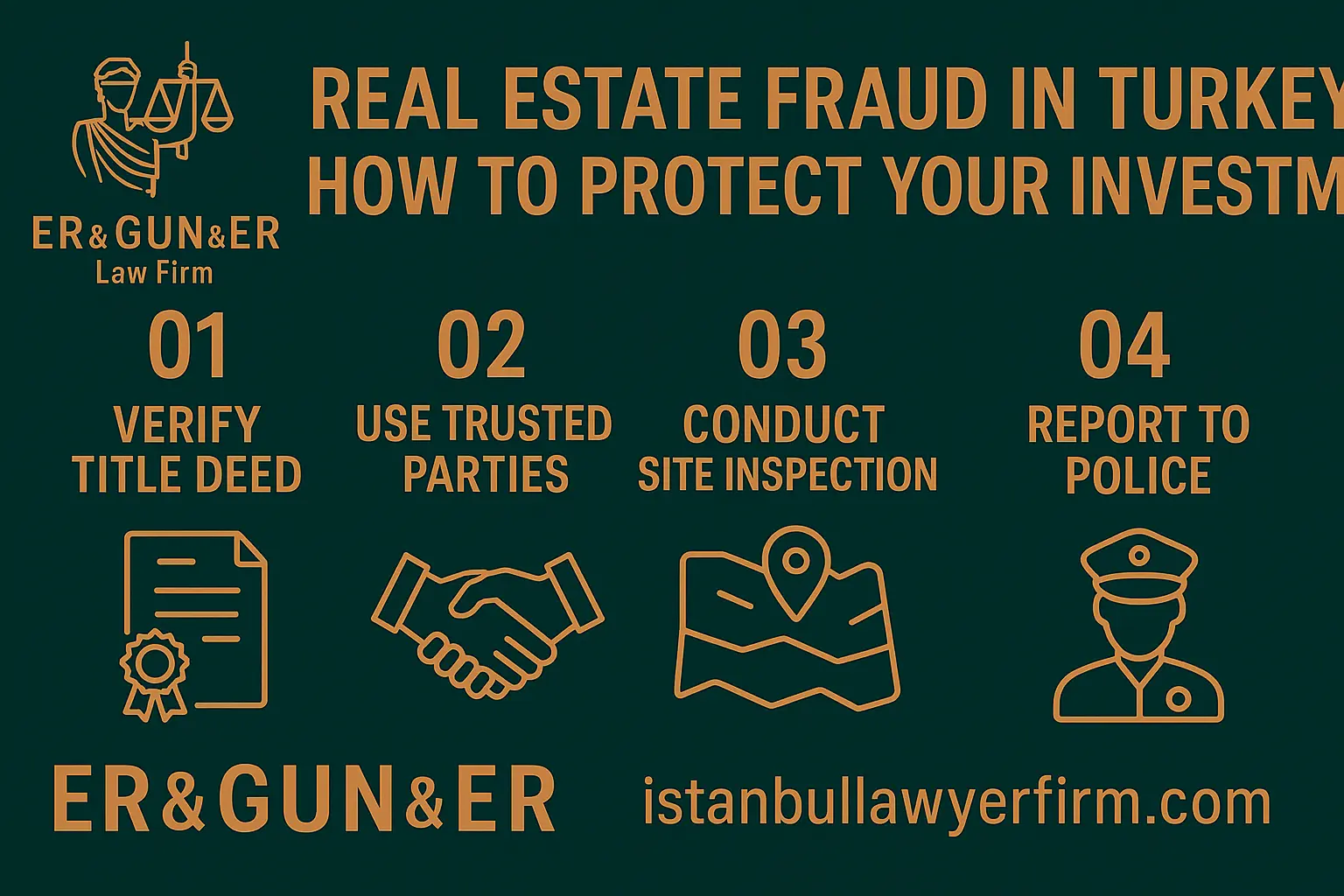
Real estate fraud in Turkey covers the spectrum of misconduct directed at property buyers — title deed (Tapu) misrepresentation, false ownership claims, double-sale schemes, off-plan project fraud, valuation manipulation, unauthorized representation, forged documentation and citizenship-by-investment-related fraud — and operates within a framework that combines protective mechanisms from multiple legal sources. The framework that governs the relevant legal questions is set primarily by the Tapu Kanunu (Law No. 2644, the Land Registry Law) governing real estate registration; the Türk Medeni Kanunu (Law No. 4721, the Turkish Civil Code) governing property rights, ownership categories, and protective annotations including şerh entries; the Türk Borçlar Kanunu (Law No. 6098, the Turkish Code of Obligations) governing the underlying contractual relationships and civil recovery actions; the Türk Ceza Kanunu (Law No. 5237, the Turkish Penal Code) covering dolandırıcılık (fraud) under m.157, nitelikli dolandırıcılık (aggravated fraud) under m.158, resmi belgede sahtecilik (forgery of public documents) under m.204, and özel belgede sahtecilik (forgery of private documents) under m.209; the Hukuk Muhakemeleri Kanunu (Law No. 6100, the Code of Civil Procedure) governing ihtiyati tedbir (precautionary injunction) and other procedural remedies; and the Ceza Muhakemesi Kanunu (Law No. 5271) governing criminal procedure including taşınmaza el koyma (property seizure) under m.128. Practice may vary by authority and year.
An English speaking lawyer in Turkey advising foreign investors on real estate fraud risk and recovery will explain that fraud prevention and fraud recovery operate through different toolkits, with prevention emphasizing pre-contract diligence and contract architecture while recovery emphasizes the parallel civil and criminal pathways that surface available after fraud has occurred. The body of this guide walks through the typical fraud scenarios encountered in the Turkish property market, the Tapu registry's protective architecture and statutory mechanisms, the pre-contract due diligence discipline that prevents fraud, the red-flag identification framework, the escrow and notarial discipline that controls financial exposure, the criminal and civil recovery pathways available to fraud victims, the regulatory and judicial environment shaping fraud cases, and the investment structuring that builds fraud resistance into the transaction architecture. For procedural orientation on adjacent topics, our notes on title deed verification in Turkey, real estate due diligence for foreign buyers, escrow structures in Turkey and real estate litigation can be read alongside this material.
1) Common Real Estate Fraud Scenarios in the Turkish Property Market
A lawyer in Turkey advising on the typology of real estate fraud encountered in the Turkish market will explain that the categories follow recognizable patterns rather than emerging through endless variation, and that pattern-recognition at the diligence stage substantially reduces exposure. The procedure ordinarily encounters several recurring fraud categories: title-misrepresentation fraud where the seller does not actually hold registered title to the property they are purporting to sell, with the seller relying on superficial documentary appearances (printed brochures, photocopied Tapu pages of properties they do not own, fabricated power-of-attorney instruments) to induce buyer commitment before the buyer verifies ownership; double-sale fraud where the seller sells the same property to multiple buyers in sequence, with each buyer paying purchase consideration before discovering the prior sales; and off-plan project fraud where developers collect significant pre-construction payments for projects that are subsequently abandoned, materially altered, or that never had the regulatory approvals the developer represented.
An Istanbul Law Firm advising on the documentary-fabrication category will note that forged documentation forms a recurring fraud vector, with various documentary categories subject to specific forgery patterns. The procedure ordinarily encounters fabricated Tapu documents purporting to show ownership the seller does not actually hold; forged powers of attorney (vekaletname) purporting to authorize the forger to transact on the actual owner's behalf; manipulated valuation reports inflating property values for citizenship-by-investment qualification or for bank financing approval; fake construction permits or occupancy certificates concealing that the building was constructed without authorization or in violation of zoning rules; and forged corporate documentation purporting to authorize representatives to act on behalf of corporate sellers. Each category triggers specific provisions under the Türk Ceza Kanunu — m.204 (resmi belgede sahtecilik) for forgery involving documents with public-act character, and m.209 (özel belgede sahtecilik) for forgery of private documents. The distinction between m.157 (basic dolandırıcılık) and m.158 (nitelikli dolandırıcılık) deserves separate operational treatment because the two provisions produce materially different sentencing outcomes and procedural treatments. The procedure ordinarily places property fraud under m.158 (the aggravated provision) rather than m.157 because the typical aggravating circumstances enumerated in m.158 apply to most property-fraud factual patterns: use of the banking system as part of the fraud architecture, use of public institutions in the fraud's execution, exploitation of victims' trust in regulated professional capacities, use of electronic devices and online channels, and conduct as part of an organized criminal structure. The m.158 application produces longer sentencing exposure for fraudsters and stronger procedural tools for victims, while m.157 application typically applies only to simpler fraud patterns without the architectural complexity that property fraud usually involves.
A Turkish Law Firm advising on the off-plan and citizenship-track fraud categories will identify the elevated risk profile that these transaction structures present. Off-plan fraud exploits the time gap between buyer payment and asset delivery, with the gap creating opportunities for developer default, project alteration, or fraudulent project marketing where the underlying project has fundamental regulatory issues that surface only after substantial buyer commitments. Citizenship-track fraud exploits the buyer's strong motivation to complete the transaction quickly to obtain citizenship benefits, with manipulation focused on inflated valuations (to meet the qualifying investment threshold without the underlying property actually meeting the value), property mis-classification, or fraudulent representation of citizenship-eligibility status. The discipline outlined in our note on real estate due diligence for foreign buyers covers the underlying diligence framework that addresses all the recurring fraud categories. Practice may vary by authority and year. The valuation-manipulation subspecies of citizenship-track fraud deserves separate attention because it operates through specific mechanisms that the standard property diligence may not surface absent specific attention. The procedure ordinarily encounters valuation-side manipulation through inflated comparable selection where the appraiser cherry-picks high-value comparables that do not reflect the subject property's actual market position; physical-attribute misrepresentation where the report describes attributes that do not match the actual property (square meterage, building quality, location characteristics); market-position misrepresentation where the report ignores material negative attributes that affect value; and methodological manipulation where the underlying valuation approach departs from the SPK-mandated methodology in ways that produce inflated outputs. The standard approach is to commission an independent valuation by an SPK-licensed appraiser engaged by the buyer rather than relying on a seller-supplied valuation, with the buyer's appraiser providing an independent assessment that the citizenship-track buyer can submit alongside any seller-supplied valuation.
2) Tapu Registry Architecture and Statutory Protection Mechanisms
An English speaking lawyer in Turkey explaining the Tapu registry's protective architecture will note that the Turkish land registry system, operated through the Tapu Müdürlüğü under the Tapu ve Kadastro Genel Müdürlüğü and supported by the TAKBİS (Tapu ve Kadastro Bilgi Sistemi) digital platform, provides several substantive protection mechanisms beyond simply recording ownership. The Türk Medeni Kanunu's tapu sicili (land registry) provisions establish the register's evidentiary force such that registered entries operate as constructive notice to third parties and create rebuttable presumptions of ownership and rights as registered. The procedure ordinarily allows registry-based intervention through several mechanisms that the buyer's protective strategy can deploy at different transaction phases.
A Turkish Law Firm advising on the şerh (annotation) framework will note that the Tapu's annotation section accommodates multiple categories of protective entries that buyers and other interested parties can register against the property. The procedure ordinarily allows lawsuits affecting property rights to be registered as dava şerhi (lawsuit annotation), giving constructive notice to subsequent transferees that the registered claim exists; ihtiyati tedbir (precautionary injunction) orders issued by courts under the HMK m.389 framework can be registered as protective annotations preventing transfer pending the underlying litigation; satış vaadi sözleşmesi (preliminary sales contract) annotations record buyer rights pending the principal transfer, providing protection against subsequent third-party transfers during the gap; and various other restriction categories produce specific transfer-restriction effects depending on their nature and the underlying legal basis. The annotation registration mechanics deserve separate attention because the protective effect depends on registration being completed promptly, with delays in registration creating windows where competing transactions can register first and defeat the protective intent. The procedure ordinarily requires the underlying basis (court order, notarized contract, or other valid documentation) to be presented at the Tapu Müdürlüğü with the registration request; the Tapu Müdürlüğü to process the registration and produce the updated registry record; and the buyer's protective annotation to be visible in the registry to subsequent third parties consulting the property's record. Where the protective basis is a notarized satış vaadi sözleşmesi, the registration produces particularly strong protection because subsequent buyers cannot claim iyiniyetli üçüncü kişi protection against the registered prior commitment.
An Istanbul Law Firm advising on the active monitoring framework will note that beyond the static annotation review, investment-grade fraud protection involves active monitoring of registry changes that could affect the property between the diligence date and the transaction's completion. The procedure ordinarily requires obtaining the most recent registry extract immediately before transaction execution to confirm no new encumbrances or annotations have been registered; monitoring the seller's activity for any indicators of parallel transactions with other buyers; and coordinating the closing-day registration to ensure the buyer's title becomes registered before any competing claims can be filed. Real-time registry monitoring substantially reduces exposure to last-minute fraud vectors that static-snapshot diligence cannot detect. The discipline outlined in our note on title deed verification in Turkey covers the foundational registry-review framework. Practice may vary by authority and year. The closing-day registration discipline deserves separate operational attention because the protective effect of registration depends substantially on the temporal sequence between buyer payment and buyer registration. The procedure ordinarily requires the title transfer at the Tapu Müdürlüğü to occur before any irrevocable buyer payment release, with the registration appointment scheduled in coordination with the payment-release sequence so that the buyer's payment becomes available to the seller only after the buyer's registration has been completed in the central system; the registration completion to be confirmed through the new Tapu issued in the buyer's name and through the central system's electronic confirmation of the registration; and the post-registration documentary chain to be assembled in completed form supporting subsequent verification. The closing-day discipline produces the operational link between the protective registry framework and the actual transaction outcome.
3) Pre-Contract Due Diligence Discipline
A lawyer in Turkey advising on the pre-contract diligence sequence will explain that fraud prevention is substantially more cost-effective and more reliable than fraud recovery, with diligence at the pre-contract stage routinely identifying issues that would otherwise produce significant downstream loss. The procedure ordinarily requires the diligence sequence to begin before any financial commitment, with the buyer holding back deposit payment, earnest money or any other consideration until the diligence has produced sufficient documentary confirmation to support the transaction's basic premises. The standard approach treats sales-pressure to commit funds before completing diligence as itself a red flag, because legitimate sellers typically accommodate reasonable diligence timelines while fraudulent operators frequently deploy urgency tactics to truncate the verification window.
An Istanbul Law Firm advising on the documentary verification chain will identify the core diligence layers that substantially reduce fraud exposure. The procedure ordinarily requires verifying the seller's identity through official identification documents matched against the Tapu's registered owner; obtaining the current Tapu extract directly from the Tapu Müdürlüğü rather than relying on copies provided by the seller; verifying the seller's authority to transact (for individuals: confirming they are the registered owner; for representatives: confirming the underlying vekaletname is authentic and grants the specific authority being exercised; for corporate sellers: confirming the corporate documentation, current ownership structure and representative authority); checking the encumbrance section for restrictions affecting transferability; and confirming the property's actual physical attributes match the registered descriptions through site inspection where appropriate. The corporate-side authority verification deserves particular attention for transactions involving corporate sellers because the verification chain extends through multiple documentary layers — the Ticaret Sicil Müdürlüğü extract showing the corporation's current legal status, the corporation's organizational documents establishing the representative authority structure, the corporate resolutions authorizing the specific transaction, and the individual representative's authority within that structure. Corporate sellers presenting incomplete corporate documentation or refusing source-side corporate verification produce particularly elevated fraud-risk indicators because the corporate veil itself can serve as a fraud-architecture mechanism.
A Turkish Law Firm advising on the documentary-authentication mechanics will note that document verification operates through both substantive analysis and source-side confirmation. The procedure ordinarily requires reviewing each document for internal consistency and for consistency with other documents in the package; matching documents against their issuing source through direct verification with the issuing authority where applicable (Tapu Müdürlüğü for Tapu records, the relevant noter for vekaletname authentication, the relevant municipality for permits, the relevant Ticaret Sicil Müdürlüğü for corporate documentation); and obtaining current-dated certifications rather than relying on older documents that may not reflect current status. The standard approach treats any documentary inconsistency, refusal to provide source-side verification, or unusual restrictions on the buyer's diligence as substantive red flags requiring resolution before transaction continuation. Practice may vary by authority and year. The vekaletname authentication mechanics deserve separate operational treatment because forged or altered vekaletnames are among the most common fraud vectors in property transactions, and their authentication requires specific verification techniques that buyers and their advisors should apply systematically. The procedure ordinarily requires obtaining the vekaletname's complete chain (the underlying authorization document, any revocation history, the authority granted, the timeframe and any limitations); verifying the vekaletname through the issuing noter (notary) where Turkish-executed, with the noter's records confirming the authentic execution and the absence of subsequent revocation; verifying the apostille or consular legalization chain where foreign-executed; verifying the sworn translation's accuracy and notarial certification where applicable; and matching the vekaletname's grant of authority against the specific transactional acts the representative is purporting to perform, because limited-scope vekaletnames cannot be expanded retroactively to support broader actions.
4) Red Flags and Fraud Indicators in Property Transactions
An English speaking lawyer in Turkey advising on red-flag identification will note that fraud indicators tend to cluster in recognizable patterns that buyers and their advisors can identify before fraud completes its harmful effect. The procedure ordinarily encounters several indicator categories: pricing anomalies where the asking price falls substantially below comparable market values without legitimate explanation, suggesting either underlying issues with the property or that the offer itself is part of a fraud structure; unusual urgency where the seller pressures the buyer to commit funds quickly with truncated diligence windows, particularly when the urgency is paired with claims that other buyers are competing for the property; informal payment structures where the seller proposes cash payments, offshore wire transfers, or other channels that depart from standard banking-side documentation; and resistance to professional involvement where the seller resists the buyer's engagement of independent counsel, independent valuers or independent inspectors. The pricing-anomaly indicator deserves particular attention because below-market pricing functions both as the fraud's attractor (drawing victims who interpret the discount as opportunity) and as a structural marker of the underlying transaction's fraudulent character. Legitimate sellers typically have rational explanations for below-market pricing (genuine motivation to dispose quickly, property attributes that depress value, market timing considerations) that the buyer's diligence can verify; the absence of any rational explanation, combined with seller resistance to documentation supporting the claimed reasons, substantially elevates the indicator's fraud-suggestion weight.
A lawyer in Turkey advising on the documentary-pattern indicators will identify the document-side red flags that diligence reviewers should recognize. The procedure ordinarily encounters document-level inconsistencies (mismatched names across documents, dates that do not align with the underlying transaction sequence, signatures that vary between documents purportedly signed by the same person); refusal to provide originals when copies are obviously photocopies of unclear quality; refusal to allow direct verification with issuing authorities; reliance on documents from unfamiliar or unverifiable sources; and unusual language or terminology in contracts and supporting documents that does not match standard Turkish legal drafting conventions. Each indicator individually may or may not signal fraud, but clustering of multiple indicators substantially elevates the probability that the transaction has fundamental issues warranting either intensive verification or transaction abandonment.
An Istanbul Law Firm advising on the relationship-pattern indicators will note that the seller-side relationship and operational patterns often signal fraud risk. The procedure ordinarily encounters seller patterns that warrant elevated scrutiny: sellers operating through multiple identities or shifting representations of who they are; sellers with no verifiable business history or no traceable connection to the property beyond the immediate transaction; sellers who actively avoid in-person meetings or substantive discussions about the property's specific attributes; sellers whose explanations of how they came to own the property do not match registry records; and sellers who deflect specific verification questions through generalities or by changing the subject. The standard approach treats relationship-pattern indicators as informational inputs to the broader diligence picture rather than as individually dispositive, with the cumulative pattern guiding the buyer's continued engagement decision. Practice may vary by authority and year. The cumulative-pattern threshold for transaction abandonment versus intensive verification deserves separate attention because the diligence response should be calibrated to the indicator profile rather than to a binary present/absent test. The standard approach treats isolated red flags as triggers for targeted verification (additional documentary requests, source-side verification of specific elements, structured questions designed to surface inconsistencies); clusters of multiple red flags as triggers for elevated diligence intensity (independent verification across all transaction elements, structured legal review of the entire transaction architecture, escrow holdback discussions with the seller); and severe clustering with multiple indicators across documentary, pricing, urgency, and relationship dimensions as triggers for serious consideration of transaction abandonment. The calibration approach avoids both under-reaction (proceeding through clear fraud patterns) and over-reaction (abandoning legitimate transactions because of single indicators that have benign explanations) by treating the indicator picture as informational input rather than as binary trigger.
5) Escrow Architecture and Notarial Discipline
A Turkish Law Firm advising on escrow architecture will explain that escrow mechanisms provide one of the most operationally effective fraud-prevention tools available to property buyers, particularly foreign buyers transacting at distance. The procedure ordinarily requires the escrow account to hold the buyer's funds with release conditioned on documented completion of specific transaction milestones rather than on calendar dates or seller representations; the escrow agent (typically a Turkish bank operating its own escrow facility, a notary operating a trust account, or a designated lawyer-administered trust account) to operate independently of both parties under written terms specifying the release conditions; the release conditions to map directly to verifiable events (Tapu Müdürlüğü registration completion with the buyer registered as new owner, encumbrance releases registered against pre-existing mortgages, completion of inspection-contingent conditions); and the documentary chain to support release verification through original documents rather than through second-hand representations.
An English speaking lawyer in Turkey advising on the notarial discipline will note that the noter (notary) plays a central role in Turkish transaction architecture, with several transaction-related acts requiring or benefiting from notarial form. The procedure ordinarily requires the satış vaadi sözleşmesi (preliminary sales contract) to be executed in notarized form to be enforceable as a transfer commitment under the Türk Borçlar Kanunu's framework; vekaletnames authorizing transaction-related acts to be executed in notarial form (or in consular form for foreign buyers executing abroad) to be valid under the Noterlik Kanunu's standards; and sworn translations to be certified by notarial registration where the documents are in foreign languages. The noter's role provides both authentication (confirming the signatories' identities and capacities) and documentation (creating an enduring official record of the executed instrument). The notarial enforceability dimension deserves separate attention because the notarized satış vaadi sözleşmesi produces specific procedural advantages: it can be registered as a Tapu annotation providing constructive notice to subsequent third parties; it can support specific performance claims compelling the seller to complete the title transfer; and it produces strong evidentiary weight in subsequent disputes about transaction terms.
A lawyer in Turkey advising on the integrated escrow-notarial framework will note that the strongest fraud-prevention architecture combines escrow mechanisms with notarial discipline rather than relying on either independently. The procedure ordinarily requires the satış vaadi sözleşmesi to be notarized with the satış vaadi sözleşmesi annotation registered against the property at the Tapu Müdürlüğü (providing third-party notice of the buyer's contract right); the deposit funds to be held in escrow with release conditioned on the notarized commitment's performance; the principal transfer to occur at the Tapu Müdürlüğü with the title registration occurring before any escrow release of the principal purchase consideration; and the post-closing documentation to be assembled in completed form supporting subsequent verification needs. The discipline outlined in our note on escrow structures in Turkey covers the underlying escrow mechanics. Practice may vary by authority and year. The simultaneous-payment-and-registration coordination deserves separate operational attention because the temporal sequence between payment release and title registration determines whether the protective architecture actually functions as intended. The procedure ordinarily requires either of two coordination mechanisms: simultaneous-execution where the payment release and the title registration occur in real-time coordination at the Tapu Müdürlüğü appointment, with the seller receiving payment confirmation only after the buyer's registration is completed; or sequential-execution with strict release conditions where the payment is held in escrow with release triggered exclusively by documented confirmation of the buyer's completed registration through the new Tapu and central system confirmation. The simultaneous mechanism provides stronger protection but requires more operational coordination; the sequential mechanism provides almost-as-strong protection with less coordination overhead but requires very strict release-condition documentation.
6) Criminal and Civil Recovery Pathways for Fraud Victims
An Istanbul Law Firm advising on the post-fraud recovery framework will explain that Turkish law provides parallel criminal and civil pathways that operate independently and can be pursued simultaneously, with each pathway producing different recovery outcomes and serving different strategic purposes. The criminal pathway operates through complaint to the Cumhuriyet Başsavcılığı (Public Prosecutor's Office) under the relevant Türk Ceza Kanunu provisions: m.157 covering the basic dolandırıcılık (fraud) offense involving deception inducing the victim to perform acts to their detriment; m.158 covering nitelikli dolandırıcılık (aggravated fraud) where the fraud is committed through specified aggravating circumstances including use of public institutions, banking systems, electronic devices, or while exercising a profession involving trust; m.204 covering resmi belgede sahtecilik (forgery of public documents); and m.209 covering özel belgede sahtecilik (forgery of private documents). The applicable provisions depend on the specific factual pattern and the documentary categories involved. The sentencing-exposure framework produces stronger deterrent and recovery dynamics under the aggravated provisions: m.158 typically carries substantially longer base imprisonment ranges than m.157, m.204 carries longer ranges than m.209 due to the public-document character involved, and the qualifying-circumstance enhancements operate cumulatively where multiple aggravators apply to the same factual pattern. The sentencing dynamics affect both the prosecutorial intensity and the defendant-side incentive structure for restitution-and-resolution outcomes.
A Turkish Law Firm advising on the criminal recovery mechanics will note that the criminal pathway provides specific recovery-supporting tools beyond the substantive prosecution. The procedure ordinarily allows complainants to pursue taşınmaza el koyma (property seizure) under the Ceza Muhakemesi Kanunu (Law No. 5271) m.128 governing seizure of property suspected of being fraud proceeds, providing protective preservation pending the criminal proceeding's conclusion; pursue malvarlığı dondurma (asset freezing) where the underlying offense and fact pattern support the procedural request; participate in the criminal proceeding as katılan (intervening party) preserving civil claim rights within the criminal context; and pursue parallel civil claims either independently of the criminal proceeding or as compensation claims integrated into the criminal proceeding under the relevant procedural framework. The criminal pathway's strategic value extends beyond its punishment effect to include its preservation and recovery support functions.
A lawyer in Turkey advising on the civil recovery framework will note that civil claims provide the primary pathway for restoration of the victim's economic position regardless of the criminal proceeding's outcome. The procedure ordinarily encompasses tapu iptal davası (action for cancellation of title registration) where the title transfer was procured through fraud, with the remedy operating to invalidate the fraudulent transfer and restore the original ownership status; tazminat davası (compensation claim) under the Türk Borçlar Kanunu's haksız fiil (tort) provisions seeking damages for the loss the fraud produced; and ihtiyati tedbir (precautionary injunction) under the HMK m.389 framework securing the property or other assets pending the underlying claim's resolution to prevent further dissipation. The discipline outlined in our note on real estate litigation covers the broader litigation framework within which fraud-recovery actions operate. Practice may vary by authority and year, and the limitation periods applicable to each cause of action depend on the specific provision invoked rather than on a uniform fraud-recovery period. The parallel-pathway coordination strategy deserves separate attention because the criminal and civil pathways produce different evidentiary opportunities and different recovery mechanics, with coordinated pursuit often producing better outcomes than sequential pursuit. The procedure ordinarily benefits from criminal complaint filing early in the post-fraud sequence to capture the prosecutorial investigative resources (which can produce evidence the civil litigation could not independently access through party-side discovery), to deploy the criminal procedural protections including taşınmaza el koyma against fraud proceeds, and to preserve the katılan participation rights that integrate civil compensation claims into the criminal proceeding. Civil litigation proceeds in parallel through tapu iptal davası and tazminat davası actions, with the civil pathway producing the substantive recovery outcomes (title restoration, monetary damages) regardless of the criminal proceeding's outcome. The evidentiary interaction between the criminal and civil pathways deserves particular operational attention because evidence developed in one pathway can typically be deployed in the other, with each pathway sometimes producing evidence the other could not independently access. Criminal investigations produce prosecutorial-level investigative resources including authority to compel records and statements, search-and-seizure authority where the underlying offense supports such measures, and inter-institutional cooperation through MASAK and other regulatory bodies; the civil litigation can subsequently use the records and findings developed in the criminal investigation as evidence in the civil case. Conversely, civil litigation produces party-side discovery, witness examination, expert analysis and structured presentation that can support the criminal proceeding's evidentiary needs.
7) Regulatory Framework and Judicial Trends
An English speaking lawyer in Turkey advising on the regulatory environment will note that the Tapu ve Kadastro Genel Müdürlüğü has progressively strengthened its operational framework over recent years through digitization initiatives, identity verification enhancements, and inter-institutional coordination improvements that reduce certain fraud vectors at the registration-level. The procedure ordinarily benefits from these enhancements through stricter identity verification at registration appointments; improved documentary verification through cross-checks against issuing institutions; expanded biometric verification at key transaction points; and improved coordination between the Tapu system and other regulatory frameworks (the citizenship-by-investment process, the foreign-currency transaction reporting framework, and the criminal enforcement framework) that produces faster surface-level detection of fraudulent patterns. The TAKBİS digital platform's expansion has been particularly consequential because the centralized digital registry reduces opportunities for paper-based forgery, allows cross-jurisdictional registry queries that previously required physical visits to multiple Tapu Müdürlüğü offices, and produces audit trails that support both ordinary registry operations and subsequent fraud investigations.
An Istanbul Law Firm advising on the Yargıtay (Court of Cassation) jurisprudence relevant to property fraud will note that case law has progressively clarified several substantive and procedural questions affecting fraud cases. The procedure ordinarily reflects judicial trends including the developing standard for the buyer's diligence threshold under the Türk Medeni Kanunu's iyiniyet (good faith) framework, with courts examining whether the buyer's pre-purchase diligence met objective standards reasonably expected from buyers in similar transaction profiles; the application of the iyiniyetli üçüncü kişi (good faith third party) protection under the TMK m.1023 framework, which protects subsequent buyers who acquire from registered owners in good faith but does not protect buyers whose own conduct involved bad faith or insufficient diligence; and the procedural requirements for documentary evidence in fraud cases, with courts emphasizing the importance of preserved transaction documentation, banking records, and authenticated communications. The TMK m.1023 protection creates a critical practical implication for fraud cases: even where the original transfer was fraudulent, a subsequent good-faith buyer who acquired the property from the apparent registered owner without knowledge of the fraud can sometimes retain title against the original true owner's claim. This protection both creates urgency for original owners to register protective annotations promptly when fraud is suspected (preventing the subsequent good-faith protection from arising) and creates limits on how far back fraud-victim recovery can reach when subsequent good-faith transfers have intervened.
Turkish lawyers who follow the broader policy and enforcement trends will note that real estate fraud has become a focus of inter-institutional coordination beyond the courts and prosecutors. The procedure ordinarily reflects coordination between the Tapu ve Kadastro Genel Müdürlüğü, the Mali Suçları Araştırma Kurulu (MASAK, the Financial Crimes Investigation Board), the Adalet Bakanlığı (Ministry of Justice) through its prosecutorial guidance, the Nüfus ve Vatandaşlık İşleri Genel Müdürlüğü for citizenship-track matters, and the Türkiye Cumhuriyet Merkez Bankası (TCMB) for currency-related transaction monitoring. The combined institutional attention has produced specific enforcement focus on citizenship-track real estate fraud with valuation manipulation, off-plan project fraud with regulatory non-compliance, and cross-border fraud schemes targeting foreign investors. Practice may vary by authority and year. The MASAK (Mali Suçları Araştırma Kurulu) enforcement dimension deserves separate operational attention because Turkish AML and financial-crimes regulation imposes specific requirements on parties involved in real estate transactions including reporting obligations on certain transaction profiles, record-keeping requirements, and cooperation obligations during investigations. The procedure ordinarily produces operational implications for legitimate buyers including documentary discipline that supports both fraud-defensive and AML-compliant transaction execution; bank-side reporting that may extend the documentary chain beyond the property-specific transaction architecture; and source-of-funds documentation that supports both legitimate transaction execution and protective evidence in the event subsequent fraud claims surface. The interaction between MASAK obligations and property-side fraud-recovery options means that early notification of MASAK where appropriate can support both the AML-compliance dimension and the fraud-recovery dimension simultaneously.
8) Investment Structuring for Fraud Resistance
A Turkish Law Firm advising on fraud-resistant investment architecture will note that thoughtful transaction structuring builds fraud-prevention into the transaction architecture rather than relying solely on after-the-fact remediation. The procedure ordinarily incorporates structural safeguards including phased payment structures (escrow-secured deposit; staged construction payments tied to verifiable milestones for off-plan transactions; final consideration release at title registration); contractual structures embedding representations and warranties covering ownership, encumbrance status, and regulatory compliance; indemnification provisions providing financial recourse against breaches; and walk-away rights where pre-closing diligence surfaces material concerns. The combination produces a transaction architecture that catches fraud at multiple checkpoints rather than at a single final review. The phased-payment-structure dimension deserves separate operational attention because the temporal allocation of payment exposure controls how much of the buyer's capital is at risk at each transaction phase. Initial deposits at modest scale (commonly five to ten percent of the purchase price) test the seller's documentary cooperation without exposing the full purchase consideration; staged construction payments for off-plan transactions tie payments to verified construction milestones rather than calendar dates; and final consideration release at the title registration moment ensures the largest portion of the buyer's capital is at risk only at the moment when the title transfer becomes effective.
A lawyer in Turkey advising on the corporate-and-fiduciary structuring options will note that ownership structures themselves can affect fraud exposure and recovery options. The procedure ordinarily considers individual ownership (simplest structure but with personal exposure); corporate ownership through a Turkish anonim şirket or limited şirket (providing entity-level isolation and clearer documentation chain but with corporate compliance overhead); fiduciary ownership through trust-like structures (providing additional control layers but with complexity costs); and joint ownership through co-ownership or partnership structures (providing shared control but with coordination complexity). The choice depends on the buyer's broader investment strategy, with no single structure optimal for all situations. Investment-grade fraud resistance considers the structural choice as part of the broader transaction design rather than as a post-transaction afterthought. The structural-choice trade-off framework deserves separate attention because each ownership structure produces specific advantages and corresponding costs that the buyer should weigh against the broader investment strategy. Individual ownership produces simplicity and direct control but exposes the owner's other assets to potential property-related liability; corporate ownership produces liability isolation and clearer documentation chains but introduces ongoing corporate compliance costs; fiduciary structures produce additional control flexibility but add layers of complexity that can complicate disposition and increase administrative cost.
An Istanbul Law Firm advising on the citizenship-track investment-structure intersection will note that the citizenship-by-investment context introduces specific structuring considerations that interact with fraud-resistance objectives. The citizenship-track architecture itself functions as a fraud-detection mechanism because the regulatory verification at multiple stages (SPK appraisal, Tapu Müdürlüğü registration with the three-year non-resale annotation, citizenship application review at the Nüfus ve Vatandaşlık İşleri Genel Müdürlüğü, and Bakanlar Kurulu decision) produces multiple checkpoints where fraudulent patterns can surface. The procedure ordinarily requires balancing the citizenship-track's specific requirements (the qualifying investment threshold; the SPK-licensed appraisal requirement; the three-year non-resale commitment registered as a Tapu annotation) against fraud-resistance objectives (independent valuation rather than seller-supplied valuation; verified property eligibility through direct registry verification rather than seller representation; payment-flow documentation through traceable banking channels supporting both citizenship-application proof and fraud-detection evidence). The standard approach integrates the citizenship requirements and the fraud-resistance requirements rather than treating them as separate concerns, because integrated treatment produces both stronger citizenship outcomes and stronger fraud protection. Practice may vary by authority and year. The payment-flow architecture for citizenship-track transactions deserves separate attention because the documentary chain that supports the citizenship application is also the documentary chain that supports fraud-recovery evidence if the transaction subsequently surfaces fraud issues. The procedure ordinarily requires structuring the foreign-currency-to-Turkish-lira conversion through a Turkish bank generating the Döviz Alım Belgesi (Foreign Currency Purchase Document); the Turkish-lira payment to the seller through traceable banking channels with full payment reference documentation; the payment timing to align with the title transfer rather than preceding it by an extended period that would expose the buyer to interim fraud; and the documentary chain to be assembled in completed form ready for both citizenship application submission and any subsequent fraud-related evidentiary needs. The integrated documentation discipline produces an audit trail that serves both the citizenship application's positive evidentiary needs and the fraud-recovery context's protective evidentiary needs.
9) Frequently Asked Questions for Foreign Investors and Property Buyers
- What is real estate fraud in Turkey? The spectrum of misconduct directed at property buyers including title deed misrepresentation, false ownership claims, double-sale schemes, off-plan project fraud, valuation manipulation, unauthorized representation, forged documentation, and citizenship-by-investment-related fraud. The category covers both the substantive misconduct that causes the buyer's loss and the documentary architecture (forged Tapu pages, fabricated vekaletnames, manipulated valuation reports, forged corporate authority documents) that the misconduct typically deploys. The economic exposure across these categories ranges from deposit-level loss in early-stage interception to full-purchase-consideration loss where the fraud completes before detection.
- What legal framework governs real estate fraud? The Tapu Kanunu (Law No. 2644), Türk Medeni Kanunu (Law No. 4721), Türk Borçlar Kanunu (Law No. 6098), Türk Ceza Kanunu (Law No. 5237) including m.157 dolandırıcılık and m.158 nitelikli dolandırıcılık and m.204/m.209 sahtecilik provisions, Hukuk Muhakemeleri Kanunu (Law No. 6100), and Ceza Muhakemesi Kanunu (Law No. 5271).
- What are the most common fraud scenarios? Title-misrepresentation fraud where the seller does not hold registered title; double-sale fraud where the same property is sold to multiple buyers; off-plan project fraud exploiting payment-delivery time gaps; documentary forgery including fabricated Tapu, vekaletname and valuation documents; and citizenship-track fraud through valuation manipulation or eligibility misrepresentation.
- How does the Tapu registry protect against fraud? Through the Türk Medeni Kanunu's tapu sicili evidentiary framework providing constructive notice and registration-based ownership presumptions; through the şerh annotation framework allowing dava şerhi (lawsuit annotations), ihtiyati tedbir (precautionary injunction) registrations, and satış vaadi sözleşmesi annotations; and through the TAKBİS digital platform supporting registry-level verification and monitoring.
- What is ihtiyati tedbir and how does it apply to property fraud? Ihtiyati tedbir (precautionary injunction) under HMK m.389 is a court-ordered protective measure that can be registered as a Tapu annotation to prevent transfer of disputed property pending the underlying litigation's resolution. It serves to preserve the asset for ultimate recovery rather than to determine the underlying merits.
- What pre-contract diligence prevents fraud? Verifying the seller's identity through official identification matched against registered ownership; obtaining the current Tapu extract directly from the Tapu Müdürlüğü; verifying authority to transact; checking the encumbrance section for transferability restrictions; and confirming property attributes through site inspection and source-side documentary verification.
- What are the main red flags? Pricing anomalies below market without explanation; unusual urgency truncating the diligence window; informal payment structures avoiding banking-side documentation; resistance to professional involvement; documentary inconsistencies across the transaction package; refusal to allow source-side verification; and seller-side relationship patterns inconsistent with legitimate transactions.
- How does escrow protect buyers? By holding buyer funds with release conditioned on documented completion of verifiable transaction milestones (Tapu registration with buyer as new owner, encumbrance releases, inspection-contingent condition fulfillment) rather than on calendar dates or seller representations. The escrow operates through a Turkish bank, notary, or lawyer-administered trust account.
- What criminal recovery pathways exist? Complaint to the Cumhuriyet Başsavcılığı under TCK m.157 (dolandırıcılık), m.158 (nitelikli dolandırıcılık) where aggravating circumstances apply, m.204 (resmi belgede sahtecilik) for forgery of public documents, and m.209 (özel belgede sahtecilik) for forgery of private documents. The pathway includes taşınmaza el koyma (property seizure) under CMK m.128 and katılan participation rights.
- What civil recovery pathways exist? Tapu iptal davası (action for cancellation of title registration) where title transfer was procured through fraud; tazminat davası (compensation claim) under the Türk Borçlar Kanunu's haksız fiil (tort) provisions; and ihtiyati tedbir (precautionary injunction) securing assets pending the underlying claim's resolution.
- What limitation periods apply? Limitation periods depend on the specific cause of action invoked rather than following a uniform fraud-recovery period. Civil tort claims under the Türk Borçlar Kanunu and contractual claims under the same framework have their own respective limitation rules; criminal prosecution has separate limitation periods under the Türk Ceza Kanunu's framework. The diligent approach is to pursue available remedies promptly rather than relying on extended limitation periods.
- What is the iyiniyetli üçüncü kişi protection? The TMK m.1023 protection for good-faith third-party buyers who acquire from registered owners without knowledge of underlying defects. The protection does not extend to buyers whose own conduct involved bad faith or whose pre-purchase diligence fell short of the objectively expected standard.
- How does notarial discipline support fraud prevention? Through notarized satış vaadi sözleşmesi (preliminary sales contract) creating enforceable transfer commitments and supporting Tapu annotation registration; through notarial vekaletname execution providing authority verification; through sworn-translation certification supporting foreign-language document admission; and through the noter's general authentication role across the transaction.
- What citizenship-track fraud risks deserve specific attention? Valuation manipulation inflating property values to meet the qualifying investment threshold; mis-classification of properties not actually meeting eligibility criteria; payment-flow misrepresentation where the foreign-currency-conversion documentation does not reflect actual transaction reality; and broader application package misrepresentation that can produce both initial application rejection and subsequent citizenship revocation if fraud surfaces post-grant.
- Does ER&GUN&ER Law Firm advise on real estate fraud prevention and recovery? Yes. ER&GUN&ER Law Firm is an Istanbul-based law firm advising foreign investors, expatriates, family offices and corporate buyers on Turkish real estate fraud prevention and recovery, including pre-contract due diligence covering Tapu Müdürlüğü registry verification through TAKBİS, vekaletname authentication, encumbrance and şerh review, identity and authority verification; transaction architecture through escrow structures, notarized satış vaadi sözleşmesi with Tapu annotation registration, and integrated payment-and-registration sequencing; criminal recovery through complaint coordination with the Cumhuriyet Başsavcılığı under TCK m.157, m.158, m.204 and m.209 with taşınmaza el koyma applications under CMK m.128 and katılan participation; civil recovery through tapu iptal davası, tazminat davası under the Türk Borçlar Kanunu, and ihtiyati tedbir under HMK m.389; and citizenship-track-specific fraud-resistance structuring — with English-language client communication and bilingual documentation throughout each engagement. Files in this area are typically led personally by the managing partner rather than delegated.
Author: Mirkan Topcu is an attorney registered with the Istanbul Bar Association (Istanbul 1st Bar), Bar Registration No: 67874. His practice focuses on cross-border and high-stakes matters where evidence discipline, procedural accuracy, and risk control are decisive.
He advises foreign investors, expatriates, family offices, corporate buyers and multinational groups on Turkish real estate fraud prevention and recovery under the Tapu Kanunu (Law No. 2644), the Türk Medeni Kanunu (Law No. 4721) including the tapu sicili and şerh frameworks, the Türk Borçlar Kanunu (Law No. 6098) including the haksız fiil provisions, the Türk Ceza Kanunu (Law No. 5237) including m.157 dolandırıcılık, m.158 nitelikli dolandırıcılık, m.204 resmi belgede sahtecilik and m.209 özel belgede sahtecilik provisions, the Hukuk Muhakemeleri Kanunu (Law No. 6100) governing ihtiyati tedbir under m.389, and the Ceza Muhakemesi Kanunu (Law No. 5271) governing taşınmaza el koyma under m.128. His advisory work covers pre-contract due diligence including Tapu Müdürlüğü registry verification through the TAKBİS digital platform, vekaletname authentication through noter-side verification, encumbrance categorization across mortgages, court annotations, tax liens and dismembered property rights, identity and authority verification, transaction architecture through escrow structures and notarized satış vaadi sözleşmesi with Tapu annotation registration, and integrated payment-and-registration sequencing for both individual and citizenship-by-investment buyers; his recovery work covers criminal complaint coordination with the Cumhuriyet Başsavcılığı, taşınmaza el koyma applications, katılan participation in criminal proceedings, civil recovery through tapu iptal davası and tazminat davası under the haksız fiil framework, ihtiyati tedbir applications, and integrated criminal-civil strategy where parallel pathways advance simultaneously.
Education: Istanbul University Faculty of Law (2018); Galatasaray University, LL.M. (2022). LinkedIn: Profile. Istanbul Bar Association: Official website.