

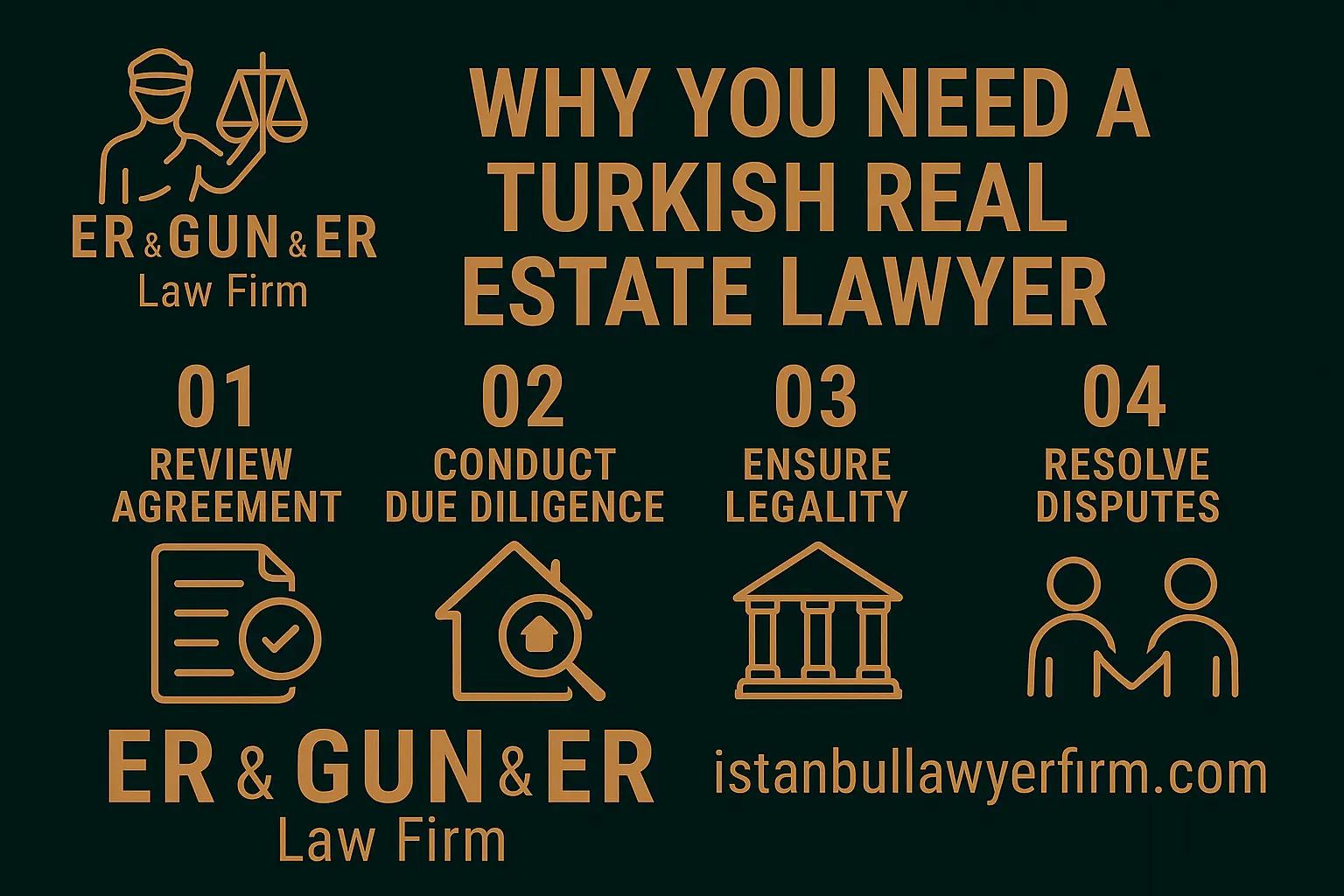
Buying property in Turkey involves a registry-based legal architecture that has very few direct equivalents in common-law systems. The transaction does not close at a closing table with a notary, an escrow agent, and a title insurance underwriter; it closes at the Land Registry Directorate (Tapu Müdürlüğü) where a state officer reads out the deed, verifies payment, takes the parties' signatures, and registers the title in the central title registry system known as TAKBİS. Most of the legal risk on a Turkish property purchase is not in the contract that the buyer signs with the seller — it is in the documents the buyer never asks for: the title registry record, the zoning certificate, the construction permit, the occupancy certificate, the condominium registry, the encumbrance history, the building's compliance with seismic and zoning codes. A Turkish real estate lawyer's job is to surface those documents, read them against each other, and tell the buyer whether the property they are buying is the property they think they are buying. This guide walks through the framework of Turkish real estate law as it applies to foreign buyers, explains what counsel actually does at each stage of a transaction, and identifies the specific legal points where the cost of attempting a self-managed purchase typically lands.
1. The Statutory Framework of Turkish Real Estate Law
A Turkish Law Firm advising a foreign buyer on a real estate transaction works against a layered statutory framework. The principal statute is the Land Registry Law (Tapu Kanunu, Law No. 2644), which dates from 1934 and remains the operative framework for the registration of immovable property in Turkey. The substantive property-law provisions sit in the Turkish Civil Code (Türk Medeni Kanunu, Law No. 4721), Book Four of which covers the constitution, transfer, and termination of property rights, easements, mortgages, and related immovable-property matters. The contractual framework for the sale itself is governed by the Turkish Code of Obligations (Türk Borçlar Kanunu, Law No. 6098), particularly the provisions on sale contracts, hidden defects, and seller's warranty. Condominium ownership — the form most foreign buyers acquire when buying an apartment in a multi-unit building — is governed by the Condominium Ownership Law (Kat Mülkiyeti Kanunu, Law No. 634), which establishes the regime for shared ownership of building common areas alongside individual ownership of units.
An Istanbul Law Firm advising on the construction and zoning side works through three further statutes that materially affect what the buyer can and cannot do with the property after purchase. The Zoning Law (İmar Kanunu, Law No. 3194) sets the framework for municipal zoning plans, building permits, and the categorisation of land use; a property's zoning status determines whether it can be developed, what height and density are permitted, and whether residential use is lawful. The Building Inspection Law (Yapı Denetim Hakkında Kanun, Law No. 4708) imposes mandatory third-party supervision on construction projects to ensure compliance with the building code and the seismic-safety standards. The Urban Transformation Law (Afet Riski Altındaki Alanların Dönüştürülmesi Hakkında Kanun, Law No. 6306) governs the demolition and reconstruction of buildings designated as seismically unsafe, which is a substantial real-estate-redevelopment programme that has reshaped large parts of Istanbul over the past decade.
A lawyer in Turkey running a foreign-buyer mandate also screens for the special-regime statutes that affect particular property categories. Agricultural land has its own regime under the Soil Conservation and Land Use Law (Law No. 5403). Coastal property is subject to the Coast Law (Kıyı Kanunu, Law No. 3621) and the prohibition on private ownership of the immediate shoreline strip. Forest land cannot be in private ownership at all under the Forest Law (Law No. 6831). Properties within boundaries of cultural and natural heritage sites are subject to the Cultural and Natural Heritage Law (Law No. 2863) and require approvals from the relevant cultural heritage board before being modified. Each of these regimes can produce a property that looks acquirable on the title deed but is in fact subject to restrictions that make it unfit for the buyer's intended use, and counsel screens for the regime applicable to the specific property at the front of the engagement. The screening also extends to less obvious overlays. Properties in proximity to the Bosphorus and the Marmara Sea may be subject to specific aesthetic and silhouette regulations administered by the Bosphorus Master Plan board. Properties in earthquake-zone reconstruction districts under Law No. 6306 may carry redevelopment annotations that affect the owner's ability to retain the existing structure. Properties on land that originated as treasury or municipal allocation may have residual rights of pre-emption in favour of the state or municipality. Properties subject to long-term leases registered against the title impose a tenant who comes with the property and cannot be removed without satisfying the lease's termination provisions. None of these layers is necessarily disqualifying, but each affects the bundle of rights the buyer is acquiring and the price the buyer should reasonably pay for that bundle.
2. Foreign-Buyer Eligibility: Reciprocity, Area Limits and Sensitive Zones
A Turkish Law Firm advising a foreign individual on property eligibility works through Article 35 of the Land Registry Law, which is the principal provision governing the acquisition of Turkish real estate by foreign nationals. Foreign individuals from most jurisdictions can acquire Turkish real estate, subject to three categories of limit. The first is the area limit: a foreign individual cannot acquire more than thirty hectares of property in Turkey nationwide, and within a single district cannot acquire more than ten per cent of the district's total private property area. The second is the security-sensitive zone limit: properties within designated military zones, security zones, and certain strategic areas are subject to clearance from the General Staff or the relevant security authority before acquisition can be registered. The third is the reciprocity consideration: although Turkey has moved away from the strict reciprocity test that applied historically, certain countries' nationals continue to face restrictions, and the list is reviewed and updated through Council of Ministers decisions.
An Istanbul Law Firm advising a foreign legal entity on property acquisition works through a more restrictive regime. Companies incorporated abroad can acquire Turkish real estate only in limited circumstances under specific statutes — the Petroleum Law, the Industrial Zones Law, the Tourism Encouragement Law — and outside those frameworks must typically structure the acquisition through a Turkish subsidiary. The Turkish-incorporated subsidiary, even if wholly foreign-owned, is treated as a Turkish legal entity for property-acquisition purposes, with the foreign-owned subsidiary's acquisition subject to Article 36 of the Land Registry Law and the implementing regulation. The structuring choice between buying as an individual and buying through a Turkish subsidiary has significant tax and operational consequences and is typically addressed at the front end of the engagement before the property search begins.
A lawyer in Turkey screening a target property for foreign-buyer eligibility runs a pre-purchase check against the security-sensitive-zone register before the buyer enters serious negotiations. The clearance procedure for properties in or near security-sensitive zones can take weeks to months and produces an outcome that the buyer cannot influence. A buyer who pays a deposit on a property that turns out to be in a clearance-required zone faces the choice between waiting through the clearance process with their funds locked or losing the deposit if the seller refuses to extend the closing window. The pre-purchase eligibility check is therefore one of the highest-leverage steps in the early-engagement phase: a brief eligibility screen at the start of the process can prevent a substantial financial loss later. The screen runs across three layers in parallel. The first layer is the buyer's nationality status — whether the buyer's country of citizenship is on the list of countries whose nationals can acquire property in Turkey, with what restrictions, and whether any pending review is in process. The second layer is the property's location and zoning — whether the property sits within a designated security-sensitive zone, a military zone, a strategic-area boundary, or any other zone that triggers clearance review. The third layer is the property's category — whether it is residential, commercial, agricultural, or coastal, and what category-specific limits apply. Counsel produces a written eligibility memorandum at the conclusion of the screen, documenting the conclusion and the supporting evidence, which both protects the buyer and is itself a document the seller's counsel can rely on when accepting the buyer's commitment.
3. Title Due Diligence: Tapu Kaydı, TAKBİS and Encumbrance Review
A Turkish Law Firm running title due diligence on a target property works through a sequence of registry searches that build a complete picture of the property's legal status. The starting document is the title deed (tapu) held by the current owner, but the operative document for due diligence is the title registry record (tapu kaydı) maintained by the Land Registry Directorate, accessible to authorised users through the central title registry system TAKBİS. The registry record shows the current owner, the previous owner sequence going back through the chain of title, the property's surface area and parcel boundaries, the zoning notation if applicable, the building information for built properties, and crucially the encumbrance history — mortgages, liens, court attachments, easements, rights of way, and other registrations that affect the title.
An Istanbul Law Firm running due diligence cross-checks the title registry record against several adjacent records before clearing the property for purchase. The cadastre map (kadastro haritası) shows the precise parcel boundaries and is checked against the physical site to identify any encroachment or boundary discrepancy. The municipal zoning plan (imar planı) shows the permitted use and density, and is checked against the building's actual configuration to identify any non-conforming use. The municipal records (belediye kayıtları) contain the building permit (yapı ruhsatı), the occupancy certificate (yapı kullanma izin belgesi, commonly known as iskan), and any zoning violations or demolition orders associated with the building. The court records show any pending litigation involving the property or the seller. The tax records show any unpaid property taxes that, under Turkish law, attach to the property rather than to the seller and become the buyer's liability on transfer if not cleared at closing.
A lawyer in Turkey advising on a built-property purchase pays particular attention to the occupancy certificate. The occupancy certificate is the municipal document that confirms the building was constructed in accordance with the building permit and is fit for its declared use. A property held under construction servitude (kat irtifakı) without a converted condominium ownership (kat mülkiyeti) is a meaningful indicator that the occupancy certificate has not been issued, which in turn typically means the building has not been formally inspected and certified for residential use. The legal consequence is significant: a property without an occupancy certificate can be lawfully held but cannot be lawfully connected to mains utilities under the formal procedure, cannot be financed through institutional mortgage lending, and is subject to municipal sanctions including in extreme cases demolition orders. Foreign buyers are routinely surprised that buildings that look complete and are inhabited may not have occupancy certificates, and the registry record alone does not surface the issue. The practical consequence runs across several dimensions. A building without an occupancy certificate cannot lawfully be connected to municipal mains utilities through the formal residential-tariff procedure, although informal connections are sometimes in place; the consequence is operational uncertainty and the prospect of higher industrial-tariff rates being applied retroactively. Institutional mortgage lenders typically refuse to finance properties without occupancy certificates, which materially restricts the future buyer pool when the current owner wishes to sell. Insurance coverage on a non-certified building can be more expensive or more restricted, and certain insurers refuse to write coverage at all on buildings outside the certified-residential category. Where the absence of the occupancy certificate reflects a deviation between the as-built condition and the approved project, retroactive certification typically requires the deviation to be remediated, which can mean structural changes the current owner is unwilling or unable to make. Counsel surfaces this issue at the due-diligence stage rather than after closing.
4. The Land Registry Transaction: Closing Day Mechanics
An English speaking lawyer in Turkey walking a foreign buyer through the closing-day mechanics covers a procedure that has very little in common with common-law closings. The transaction takes place at the Land Registry Directorate office for the district in which the property is located. Both buyer and seller appear in person, or through an attorney holding a properly drafted power of attorney that explicitly authorises the registration. The Land Registry officer (tapu memuru) reviews the parties' identification, the seller's title, the buyer's eligibility under Article 35 (where the buyer is a foreign individual), the appraisal report from a Capital Markets Board-licensed appraiser (a mandatory document for foreign-buyer transactions), and the payment evidence. The officer then reads out the deed text in the presence of both parties, the parties sign the deed, the officer signs and seals the deed, and the title is transferred and recorded in TAKBİS. The process takes a single appointment, typically lasting between thirty minutes and two hours depending on the office workload.
A Turkish Law Firm coordinating the closing also handles the payment-flow architecture that runs alongside the registration. The legal-economic reality is that title transfers at the moment the Land Registry officer signs the deed, regardless of whether payment has reached the seller. Payment is therefore typically structured to clear in synchrony with the registration: the buyer either makes the wire transfer the morning of the closing with confirmation of receipt before the parties enter the registry office, or operates through an escrow arrangement with a Turkish bank that releases funds against the registry confirmation. Buyers who attempt informal payment arrangements — bringing cash, paying after registration, accepting the seller's promise to pay later for a portion of the price — produce the most common payment-related disputes that surface in the months after closing. A disciplined closing-payment protocol is one of the operational items that justifies the engagement of counsel through to the closing rather than only through the contract stage.
Turkish lawyers who run foreign-buyer closings also handle the documentary infrastructure that the registry requires. The buyer's Turkish tax identification number must be obtained before the closing — through the Tax Office during a brief in-person appointment, or through counsel acting on power of attorney. The buyer's earthquake insurance (Doğal Afet Sigortaları Kurumu, abbreviated DASK) must be in force at closing. The seller's earthquake-insurance status, the seller's tax-arrears clearance, and the building's compulsory earthquake-insurance certificate are all checked. The appraisal report from the Capital Markets Board-licensed appraiser must be valid (typically with a three-month freshness window) and must reflect the actual market value rather than a notional value, because the registry's recorded transaction value is what drives the title registry fee assessment and is reviewed against the appraisal in the Tax Office's later cross-checks.
5. Off-Plan and Construction-Phase Properties
A Turkish Law Firm advising a foreign buyer on an off-plan property — a property purchased before construction is complete or, in some cases, before construction has begun — works on a substantially different risk profile from a built-property purchase. The legal interest the buyer is acquiring at the contract stage is typically a construction servitude (kat irtifakı), which is the predecessor right to the eventual condominium ownership (kat mülkiyeti) that emerges once the building is completed and the occupancy certificate is issued. The construction servitude entitles the buyer to a defined unit in the building once it exists; it does not give the buyer a completed unit on day one. The risk is that the construction is delayed, completed defectively, or in some cases not completed at all if the developer fails. The legal protection is the contract itself, the developer's licensing and standing, and where applicable the bank guarantee or construction-bond regime that some developers offer.
An Istanbul Law Firm running due diligence on the developer side checks the building permit (yapı ruhsatı) issued by the municipality, the developer's standing in the trade registry, the developer's prior project history including any litigation or completion delays, the construction supervision file under the Building Inspection Law, the soil report (zemin etüt raporu) and the seismic-safety analysis, the architectural project as approved by the municipality, and the projected occupancy certificate timing. For larger projects, the financing structure of the development — whether it is funded by pre-sales, by bank financing, by the construction-in-return-for-land-share mechanism (kat karşılığı inşaat) under which the landowner contributes the land and receives a percentage of the units — directly affects the risk profile of the buyer's contract.
A lawyer in Turkey negotiating the off-plan contract structures the buyer's protections through specific contractual provisions. Phased-payment schedules tied to construction milestones (foundation, structural frame, occupancy certificate) rather than calendar dates align the buyer's exposure with the developer's actual progress. Liquidated-damages clauses for delivery delays beyond a defined window create a financial incentive for completion. Specification clauses tied to the architectural project and the marketing materials lock in the buyer's expectations on materials, finishes, and unit configuration. Refund provisions for material defects or completion failure produce a defined exit option if the project deteriorates. The contractual sophistication required at the off-plan stage materially exceeds what a developer's standard pre-sale form provides, and the gap between the developer's form and a properly negotiated buyer-side contract is one of the most consistent areas where counsel adds value on a Turkish property purchase. Where the project subsequently runs into difficulty, the contract that was negotiated at the front becomes the entire basis for the buyer's recourse. A developer that has gone into financial distress, that has failed to obtain the occupancy certificate within the projected timeline, that has delivered a unit materially different from the specification, or that has assigned the project to a successor entity with different financial standing — each is a scenario that the contract either anticipates or does not. The buyer-side contract negotiated by counsel typically anticipates each of these scenarios with defined remedies; the developer's standard form typically does not. The differential value of the negotiation is most apparent precisely when the project deteriorates, which is also the moment at which the buyer has no remaining negotiating leverage to fix the contract retroactively.
6. Citizenship by Investment Through Real Estate Acquisition
An Istanbul Law Firm advising on a citizenship-by-investment property purchase works on a structured procedure that overlays the standard purchase mechanics. Turkish citizenship by exceptional naturalisation is available under the Turkish Citizenship Law (Law No. 5901) and its implementing regulation, with the real estate pathway being the most-used variant. The qualifying investment threshold has been adjusted by regulation over time and currently sits at four hundred thousand United States dollars or the equivalent for a property purchased and held for a minimum of three years, with the holding period recorded as an annotation (şerh) on the title at the Land Registry. Counsel coordinates the certification of the qualifying investment, the family inclusion (where the principal applies with a spouse and minor children), and the post-acquisition file at the Migration Directorate that converts the investment certification into an exceptional-naturalisation grant.
A Turkish Law Firm running the certification step handles a procedural sequence that the buyer cannot replicate without specialist support. The property must be appraised by a Capital Markets Board-licensed appraiser whose appraisal is filed through the regulator's electronic system. The purchase price must be transferred from abroad in foreign currency through Turkish-banking channels, with the foreign-exchange documentation produced at the bank in a specific format the certification authority accepts. The sale must close at the Land Registry with the three-year-holding annotation registered against the title at the moment of transfer rather than retroactively. The certification authority then reviews the file and issues a certificate of qualifying investment, which is the operative document for the citizenship application that follows. Each step has its own documentary requirements and its own rejection points, and a defective documentation chain produces a rejected certification with a delay measured in months.
Turkish lawyers who handle citizenship-by-investment files also coordinate the tax position of the property, which has consequences both at acquisition and during the three-year holding period. Foreign-currency-bringing first-time buyers of new construction qualify for a value added tax exemption on the purchase, subject to a precise sequence: the foreign currency must be transferred through documented Turkish-banking channels, the property must be a first sale by the developer, and the purchase must be funded from the imported foreign currency rather than from a Turkish-resident source. The exemption can produce a substantial saving on a citizenship-threshold property, but only where the documentation is structured correctly. The annual property tax on the holding period continues to accrue, and the title registry fee at acquisition (the harç) is paid by both buyer and seller at the time of closing. Counsel coordinates the tax position so that the citizenship file aligns with the tax file rather than producing inconsistencies that surface during a later audit. The citizenship application file at the Migration Directorate that follows the qualifying investment is itself a structured procedure with documentary specifications that benefit from local-counsel coordination. The principal applicant submits the application with the qualifying-investment certificate, the family-inclusion documentation for spouse and minor children, identity documents apostille-authenticated and sworn-translated where issued abroad, criminal-record clearance from the principal's home jurisdiction, and the supporting biometric and photographic submissions. The file is reviewed by the Migration Directorate in coordination with the certifying authority for the qualifying investment, with the eventual grant taking the form of a presidential decision. The grant operates as an exceptional naturalisation and produces full Turkish citizenship for the principal and the included family members, with a Turkish national identification number issued at the conclusion of the procedure. Counsel coordinates the operational steps that convert the abstract grant into operative identity records.
7. The Tax Position: Title Registry Fee, VAT, Property Tax and Capital Gains
A lawyer in Turkey advising a foreign buyer on the tax position at acquisition works through four principal layers. The first is the title registry fee (tapu harcı), payable to the state at the moment of the transaction. The harç is calculated as a percentage of the recorded transaction value, with the rate split between buyer and seller in equal shares unless the parties agree otherwise. The recorded value cannot be lower than the appraisal-supported market value, and the practice of recording artificially low transaction values to reduce the harç has become substantially riskier following the introduction of the mandatory appraisal regime for foreign-buyer transactions. The second layer is value added tax, which applies to first-sale new-construction property and is levied at a sectorally calibrated rate. Foreign-currency-bringing first-time buyers can qualify for an exemption, subject to the sequence described in the citizenship-by-investment context above.
An Istanbul Law Firm advising on the holding-period tax position covers the annual property tax (emlak vergisi), payable to the municipality in two annual instalments and calculated on the property's tax-assessed value rather than market value. The annual environmental tax (çevre temizlik vergisi) applies to occupied properties. Compulsory earthquake insurance (DASK) applies to all residential properties and must be renewed annually. Where the property is rented out, rental income is taxed under the income tax regime — at the headline progressive rate for residents, or at a flat withholding rate for non-residents — with a residential-rental exemption threshold that adjusts annually and a deduction regime for documented expenses. Foreign owners with rental income in Turkey are required to file annual returns even where the income falls below the threshold for tax payable, and the filing obligation is a recurring point of slip-up for foreign owners administering the property remotely.
A Turkish Law Firm advising on the disposal-stage tax position covers the capital gains framework. Capital gains on real estate are taxable in Turkey for both residents and non-residents, with the headline rule that gains realised on the sale of real estate held for fewer than five years are subject to income tax on the gain calculated as the difference between the sale price and the indexed acquisition cost. Real estate held for more than five years and disposed of by an individual is generally exempt from income tax under the value-increase exemption regime. Real estate held by a Turkish corporate entity is taxed under the corporate tax regime regardless of the holding period, with specific exemptions for property held for at least two years subject to the conditions in the Corporate Tax Law. Non-residents disposing of Turkish property are subject to specific withholding mechanics and may be eligible for double-taxation treaty relief depending on the recipient's home jurisdiction.
8. Rental Income, Property Management and the Lease Framework
A Turkish Law Firm advising a foreign owner on letting the property out works against the rental provisions in the Code of Obligations (Articles 299 to 378). The tenant-protective character of Turkish rental law materially exceeds what most foreign landlords expect from common-law systems. Residential leases are subject to mandatory rent-increase caps tied to the Consumer Price Index — adjusted by emergency legislation in periods of high inflation — that limit the landlord's ability to raise rent at renewal. Eviction grounds are restrictively defined: non-payment of rent that produces two valid eviction notices in a single twelve-month period, the landlord's own residential need under specified conditions, the tenant's material breach of the contract, the property's fundamental need for redevelopment, and the elapse of ten years for indefinite-term residential leases. A landlord who attempts to evict on any other grounds produces a court action that the tenant typically wins.
An Istanbul Law Firm running the lease-drafting work for a foreign owner produces a contract that protects the owner within the constraints of the tenant-protective framework. The standard package includes a clear identification of the parties and the property, a defined rental period, a payment schedule with bank-account routing rather than cash, a security deposit (depozito) capped under the Code of Obligations at three months' rent for residential leases, the rent-adjustment mechanism within the legal cap, the maintenance and repair allocation between landlord and tenant, the property's condition documented through a hand-over inventory at lease commencement, and the termination mechanics. For high-value rentals, an English-language parallel translation is produced for the tenant's reference even where the operative version is the Turkish-language original.
Turkish lawyers who advise foreign owners on rental administration also handle the operational layer that runs alongside the lease. Rental income must be received through a documented banking channel where the rent equals or exceeds a defined threshold under the anti-money-laundering and tax-tracking regulations; cash rentals above the threshold are subject to administrative fines on both landlord and tenant. Annual income tax filings are required regardless of whether tax is payable under the residential-rental exemption threshold. Building-management charges (aidat) are typically payable monthly to the building's property-management entity (yöneticilik), with collection mechanics that depend on the building's specific arrangements. Where the foreign owner administers the property remotely, counsel typically structures a property-management mandate with a Turkish-resident agent acting under a defined-scope power of attorney, and reviews the property-manager's performance against the mandate at agreed intervals.
9. Disputes, Hidden Defects and Construction Failures
An English speaking lawyer in Turkey representing a foreign buyer in a post-purchase dispute works against the seller-warranty framework in the Code of Obligations. The seller is liable for hidden defects (gizli ayıp) that existed at the time of sale and that the buyer could not reasonably have discovered through ordinary inspection. The buyer's remedies include rescission of the contract, reduction of the purchase price, repair of the defect, and where applicable damages for consequential loss. The buyer must, however, give notice of the defect to the seller within a reasonable period of discovery, and the limitation period for hidden-defect claims is two years from delivery of the property except where the seller has acted fraudulently or with gross negligence, in which case the longer general limitation periods apply. Foreign buyers who discover a defect after closing routinely lose claims because they fail to give notice in the period the statute requires.
A Turkish Law Firm representing a buyer against a developer in an off-plan dispute works on a different framework. The contractual terms govern in the first instance — the delivery date, the specifications, the developer's obligations on materials and finishes — but the statutory framework underneath provides additional protections including the seller's general warranty for completeness, the developer's licensing and supervision obligations under the Building Inspection Law, and the consumer-protection provisions where the buyer qualifies as a consumer under the Consumer Protection Law (Law No. 6502). Disputes typically run through the consumer arbitration committee for lower-value claims and through the courts for higher-value claims, with mandatory pre-action mediation under the Mediation Law (Law No. 6325) for most categories of commercial dispute including construction disputes against a corporate developer. The mediation stage is itself a meaningful settlement opportunity where the developer is solvent and the dispute is documented.
A lawyer in Turkey advising on litigation strategy on a real-estate matter also covers the enforcement framework that runs above the substantive court track. A money judgment against a developer or a defaulting seller is enforceable through the Enforcement Offices (İcra Daireleri) under the Enforcement and Bankruptcy Law (Law No. 2004). Where the dispute concerns title rather than money — the buyer paid but never received clean title, the buyer received title but later discovered an encumbrance — the substantive remedy is typically a court action for specific performance or for the cancellation of the transferred title (tapu iptal ve tescil davası), and the relief runs through the Land Registry rather than through enforcement. The choice of the appropriate cause of action and the appropriate forum at the front of a dispute is one of the determinative strategic decisions, and counsel structures the claim accordingly to align the desired remedy with the procedural mechanics that produce it.
10. Inheritance, Succession Planning and Foreign-Owned Property
An Istanbul Law Firm advising a foreign owner on succession planning for Turkish property works against the Civil Code's succession provisions and the conflicts-of-laws framework in the Code on Private International Law (Law No. 5718). The applicable succession law for a foreign individual's Turkish property is, under the Code on Private International Law, the deceased's national law for movable property and Turkish law for immovable property located in Turkey. This bifurcation produces conflicts that a coordinated estate plan can manage but that an uncoordinated plan typically does not. A foreign-resident testator who has executed a home-jurisdiction will distributing their entire estate without regard to the Turkish reserved-share regime can leave the Turkish property exposed to a reserved-share reduction action by a Turkish-law-protected heir; a foreign-resident testator who has executed no will at all leaves the intestate-succession rules to determine the distribution, with results that are often inconsistent with the testator's actual intentions.
A Turkish Law Firm running the post-death procedure on a foreign owner's Turkish property handles a sequence of steps that the heirs cannot replicate without local representation. The certificate of inheritance (mirasçılık belgesi) must be obtained, either from a Civil Court of Peace or, in straightforward cases, from a notary, with documentary support including the deceased's death certificate, family-composition records, and apostille-authenticated foreign documents where applicable. The inheritance tax filing under the Inheritance and Transfer Tax Law (Law No. 7338) must be made within the statutory window from the date of death (with extensions available for foreign heirs), and the tax must be paid before the title transfer to the heirs can be registered at the Land Registry. The transfer itself runs at the Land Registry against the certificate of inheritance and the tax-clearance evidence. Where the heirs include both Turkish-resident and foreign-resident parties, coordination across jurisdictions is required to keep the timing aligned across the various authority interfaces.
Turkish lawyers who handle estate-planning work for foreign property owners typically build the structure during the owner's lifetime rather than allowing the conflicts to surface posthumously. The standard tools include a Turkish-law-compliant will (vasiyetname) executed at a Turkish notary and registered in the central wills registry, a coordinated foreign-jurisdiction will that addresses the movable-property and non-Turkish assets without contradicting the Turkish-law disposition of the immovable property, lifetime gifts where the tax position supports them, and where the assets justify it the use of a Turkish corporate vehicle to hold the real estate so that the succession runs through the share register rather than through the Land Registry. The succession-planning conversation is rarely the first conversation a foreign buyer has with Turkish counsel, but for foreign owners holding meaningful Turkish property over a multi-decade horizon it is one of the most consequential.
Frequently Asked Questions
- Do I legally need a lawyer to buy property in Turkey? No, the law does not mandate legal representation for a property purchase. In practice, foreign buyers who proceed without local counsel face material risk on title due diligence, contract terms, closing-day mechanics, and post-purchase tax and inheritance issues. The cost of correcting a defective purchase materially exceeds the cost of running it correctly from the outset.
- Can a foreign individual buy property anywhere in Turkey? Most jurisdictions' nationals can acquire residential and commercial property, subject to area limits (thirty hectares nationwide and ten per cent of any single district's private property area), security-sensitive-zone clearance, and the country-specific restrictions reviewed and updated by Council of Ministers decisions. A pre-purchase eligibility check on the specific property is the standard first step.
- Can a foreign company buy Turkish real estate directly? Foreign companies are subject to a more restricted regime and typically structure acquisitions through a Turkish-incorporated subsidiary, which is treated as a Turkish legal entity for property-acquisition purposes. The structuring decision has tax and operational consequences and is addressed at the front of the engagement.
- What is TAPU and what is TAKBİS? The TAPU is the title deed — the document held by the owner. TAKBİS is the central electronic title registry system maintained by the Land Registry Directorate. Counsel works from the registry record (tapu kaydı) accessed through TAKBİS rather than from the owner's deed alone.
- What is the difference between kat irtifakı and kat mülkiyeti? Kat irtifakı (construction servitude) is the predecessor right that exists during construction; kat mülkiyeti (condominium ownership) is the final form that emerges once the building is complete and the occupancy certificate is issued. A property held under kat irtifakı without conversion to kat mülkiyeti is an indicator that the occupancy certificate has not been issued.
- Why does the occupancy certificate (iskan) matter? The occupancy certificate confirms the building was constructed in compliance with the building permit and is fit for use. Properties without an occupancy certificate cannot be financed through institutional mortgages, may have limited utility connections, and remain exposed to municipal sanctions. This document is one of the highest-priority items in due diligence.
- How does the Land Registry closing actually work? Both parties (or their attorneys under proper power of attorney) attend in person at the Land Registry Directorate. The officer reads out the deed, verifies the parties' identification and supporting documents, witnesses the signatures, and registers the title. The transaction is recorded in TAKBİS and the title transfers at the moment of registration.
- What is the appraisal requirement for foreign-buyer transactions? Foreign-buyer transactions require an appraisal by a Capital Markets Board-licensed appraiser, filed through the regulator's electronic system. The appraisal is a closing-day requirement and informs the registry's recorded transaction value.
- What is the citizenship-by-investment threshold for real estate? The qualifying investment threshold currently sits at four hundred thousand United States dollars or the equivalent, for a property held for a minimum of three years with the holding period recorded as an annotation on the title. The threshold has been adjusted by regulation over time, and counsel verifies the current threshold against the implementing regulation in force at the date of the application.
- Is value added tax payable on a real estate purchase? Value added tax applies to first-sale new-construction property at a sectorally calibrated rate. Foreign-currency-bringing first-time buyers can qualify for an exemption, subject to a precise sequence on the foreign-currency transfer, the developer's first-sale status, and the funding source.
- What annual taxes apply to a Turkish property? The annual property tax (emlak vergisi) is payable in two instalments to the municipality. The annual environmental tax (çevre temizlik vergisi) applies to occupied properties. Compulsory earthquake insurance (DASK) is renewed annually. Rental income, where applicable, is subject to income tax with annual filing obligations.
- How is rental income taxed for a foreign owner? Rental income is subject to income tax at the headline progressive rate for residents and at a different rate for non-residents, with a residential-rental exemption threshold that adjusts annually. Filing obligations apply even where the income falls below the threshold for tax payable. Documented expenses are deductible.
- What is the limitation period for hidden defects in a property purchase? Two years from delivery of the property under the Code of Obligations, with longer general limitation periods applicable where the seller has acted fraudulently or with gross negligence. The buyer must give notice of the defect within a reasonable period of discovery.
- How is foreign-owned property inherited in Turkey? The applicable succession law is, under the Code on Private International Law, the deceased's national law for movable property and Turkish law for immovable property located in Turkey. The certificate of inheritance is required to transfer title to heirs, the inheritance tax must be filed and paid, and the title transfer runs at the Land Registry. Coordinated estate planning during the owner's lifetime materially simplifies the post-death procedure.
- Can a foreign buyer use power of attorney to close remotely? Yes. A power of attorney executed at a Turkish notary or at a Turkish consulate abroad, explicitly authorising the attorney to register the transfer at the Land Registry, allows the closing to take place without the buyer's physical attendance. The power of attorney must include the matter-specific authorisations the registry requires.
About the Author
Av. Mirkan Günay Topcu is the managing partner of ER&GUN&ER Law Firm (Istanbul) and is registered with the Istanbul Bar Association under No. 67874. The firm advises foreign nationals, foreign-incorporated entities, and multinational legal teams on Turkish real estate transactions across the spectrum — residential and commercial purchases, off-plan and built-property work, citizenship-by-investment files, large-portfolio acquisitions, lease structuring, post-purchase disputes, and cross-border succession planning for Turkish-located property.
The author works principally in English with foreign principals and home-jurisdiction counsel, with day-to-day case work covering the Land Registry Directorate transaction layer, the municipal zoning and building-permit interface, the Capital Markets Board appraisal infrastructure, the citizenship-by-investment certification track at the Migration Directorate, the rental and property-management documentation, the consumer-protection and construction-defect dispute architecture, and the conflicts-of-laws coordination on succession matters under the Code on Private International Law.
Profile: LinkedIn. Foreign property buyers may also wish to read the companion practice-area survey on why foreigners choose a Turkish law firm and the operational guide on working with a Turkish law firm as a foreigner, both of which address the broader engagement architecture within which a real estate file typically sits.
Contact ER&GUN&ER Law Firm