

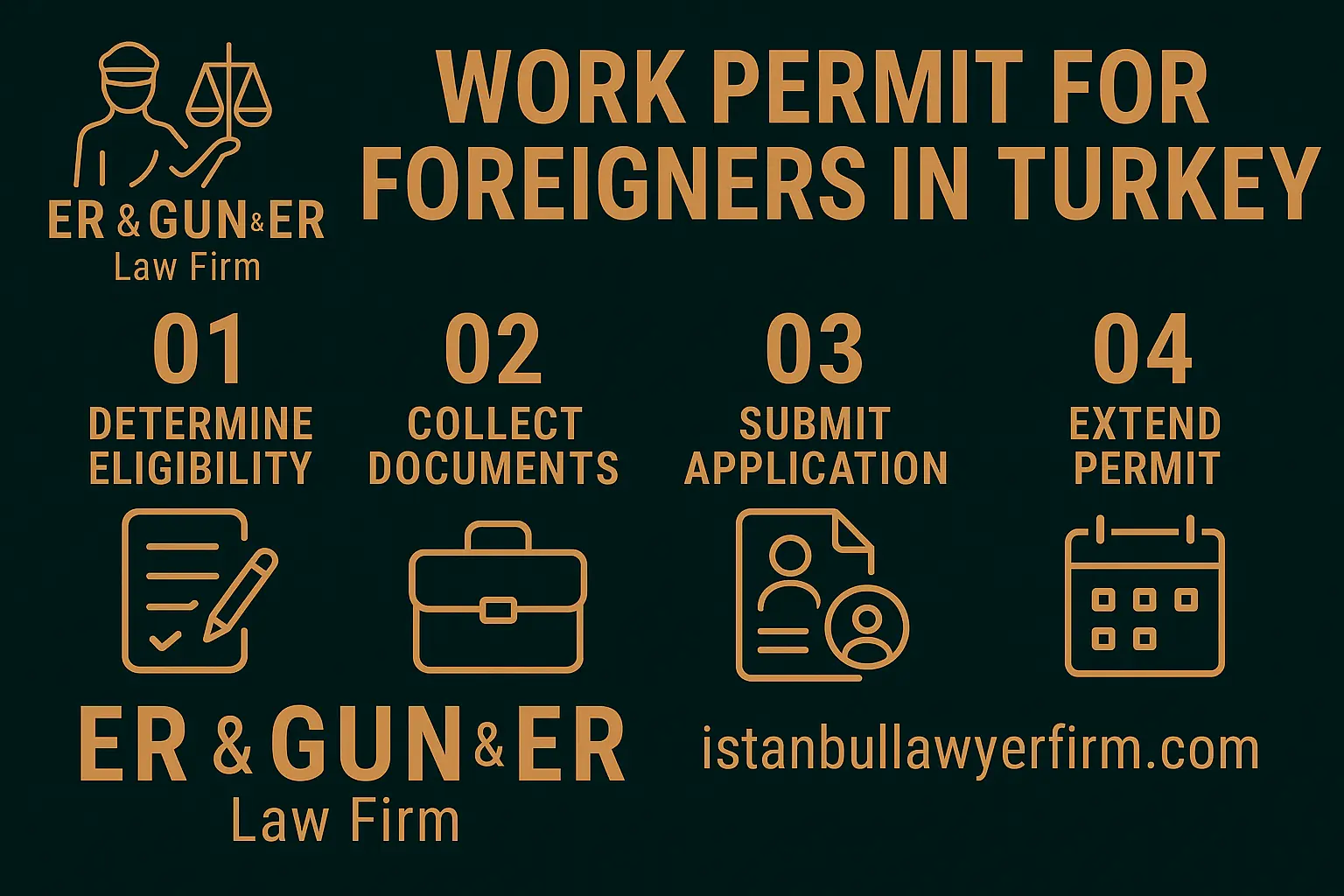
A work permit (çalışma izni) is the legal authorisation that permits a foreign national to work lawfully in Turkey, whether as an employee of a Turkish employer, as an independent professional, or as the executing officer or shareholder of a Turkish company. The framework sits in the International Labour Force Law (Uluslararası İşgücü Kanunu, Law No. 6735), which entered into force in 2016 and replaced the prior Foreign Workers' Permits Law No. 4817. Law No. 6735 consolidates work permit regulation under a single Ministry — the Ministry of Labour and Social Security (Çalışma ve Sosyal Güvenlik Bakanlığı), acting through the Directorate General of International Labour (Uluslararası İşgücü Genel Müdürlüğü, abbreviated DGIL) — and runs the application process through the e-Permit electronic portal that has eliminated most of the paper-based interface that existed under the prior regime. The framework operates alongside the Foreigners and International Protection Law (Yabancılar ve Uluslararası Koruma Kanunu, Law No. 6458) which governs the residence-permit dimension, the Labour Law (Law No. 4857) which establishes the substantive employment-rights framework, and the Social Security Law (Law No. 5510) which establishes the SGK registration obligations. This guide walks through the work-permit framework as it operates for foreign workers and Turkish employers in 2026.
1. The Statutory Framework: Law 6735 and the DGIL
A Turkish Law Firm advising on a work permit application works against Law No. 6735 as the primary statute, the implementing regulation issued under the law, and the operational practice of the Directorate General of International Labour. Law 6735 establishes the substantive eligibility framework, the work-permit categories, the employer-side obligations, and the cancellation and revocation grounds. The implementing regulation establishes the application procedure, the documentary requirements, the salary thresholds applicable by profession category, and the operational interface between the DGIL and the related authorities. The DGIL operates the e-Permit (e-İzin) electronic portal, evaluates applications against the statutory and regulatory criteria, issues the work permit decisions, and publishes the salary thresholds and procedural updates that apply across the framework.
An Istanbul Law Firm advising a foreign worker or a Turkish employer on the institutional architecture also covers the related authorities. The Migration Directorate (Göç İdaresi Genel Müdürlüğü) under the Ministry of Interior administers the residence-permit interface; under Law 6735 Article 13, a valid work permit also functions as a residence permit, so a worker who holds a current work permit does not need a separate residence permit during the work-permit period, and the work-permit-as-residence-title operates as a unified document on the e-Permit system. The Social Security Institution (SGK) administers the social-insurance registration that the employer must complete on the worker's behalf within statutory windows after the worker begins employment. Provincial Labour Directorates handle workplace inspections, audit the employer's compliance with foreign-worker employment rules, and process certain procedural steps where the e-Permit portal flow does not directly handle them.
A lawyer in Turkey advising on the relationship between Law 6735 and the Labour Law (Law No. 4857) explains an important point that work permit applicants frequently misunderstand. A valid work permit authorises the foreign worker to enter the Turkish labour market, but it does not by itself create the substantive employment rights — those rights flow from the underlying employment contract and from Law No. 4857 which applies to foreign workers on the same basis as Turkish workers. The work permit identifies the employer, the position, and the workplace, and a foreign worker cannot lawfully change employer, position, or workplace without a new application. The substantive employment relationship — minimum wage, working hours, severance, paid leave, occupational safety — is governed by Law 4857 and the related labour regulations, with the foreign worker entitled to the same protections and bound by the same obligations as a Turkish worker in the same position. The dual-statute interface produces practical consequences the foreign worker should understand at the engagement stage. A foreign worker whose work permit is cancelled retains the substantive Labour Law claims that accrued during the work-permit period — unpaid salary, accrued severance, untaken paid leave entitlements — and can pursue those claims through the Labour Court even after the work permit lapses and the worker has departed Turkey. The Labour Court can hear the claim with the worker represented through Turkish counsel under a notarised power of attorney, which means physical presence in Turkey is not required to maintain the claim through the standard procedural stages. Conversely, a foreign worker whose substantive employment claims succeed at the Labour Court does not automatically regain a work permit through the labour-claim recovery: the work permit is a separate authorisation that follows the work-permit framework regardless of the labour-claim outcome, and a worker who has prevailed on a labour claim but lost their work permit must still pursue a fresh permit through the standard procedural route to resume employment.
2. Categories of Work Permit Under Law 6735
An English speaking lawyer in Turkey explaining the work-permit categories to a foreign professional covers the framework at Articles 7 to 11 of Law 6735. The most common category is the dependent work permit (süreli çalışma izni) issued for a specific position with a specific Turkish employer at a specific workplace. The initial dependent work permit is issued for up to one year. The first renewal extends the permit for up to two additional years with the same employer. Subsequent renewals extend the permit for up to three additional years, with the same employer or with a different employer in the same profession. After the cumulative work-permit period reaches eight years, the worker becomes eligible for the indefinite work permit (süresiz çalışma izni) under Article 10 of Law 6735, which permits work in any profession with any employer without further renewal.
A Turkish Law Firm advising an investor, freelance professional, or sole-practitioner client works through the independent work permit (bağımsız çalışma izni) category at Article 10 of Law 6735. The independent work permit authorises the foreign national to work in Turkey without a sponsoring employer, on their own account in a profession or business activity. The category is available to foreigners who have lawfully resided in Turkey for at least five years in the case of dependent permits leading into independent status, or who satisfy the specific economic-contribution criteria the implementing regulation establishes for direct independent applications. The independent work permit holder is responsible for their own SGK registration and tax compliance, and operates without the employer-side procedural infrastructure that supports dependent work permits.
Turkish lawyers who handle the highest-tier category — the Turquoise Card (Turkuvaz Kart) under Article 11 of Law 6735 — work with a regime designed for highly qualified foreign nationals whose contribution to the Turkish economy, science, technology, or culture is sufficient to merit accelerated and indefinite work-residence status. The Turquoise Card is issued for a probationary three-year period followed by indefinite-status confirmation, and provides the holder with work and residence rights equivalent to those of Turkish citizens in most economic respects. Eligibility categories include foreigners who have made a prescribed level of fixed capital investment in Turkey, foreigners with internationally recognised academic or scientific qualifications, foreigners in strategic-priority sectors identified by the Ministry, and foreigners whose work in cultural, artistic, or sporting fields would benefit Turkey's international profile. The Turquoise Card application is more documentary-intensive than the standard work-permit application, with the qualifying credentials evaluated against international benchmarks rather than against the standard salary thresholds. The implementing regulation establishes specific qualifying frameworks for each Turquoise Card category. For the investor route, the qualifying investment must be documented through the trade registry records, the bank confirmation of paid-in capital, and the audited financial statements demonstrating the company's operational substance. For the academic-and-scientist route, the qualifying credentials include international publications in indexed journals, citation metrics meeting the prescribed thresholds, prior academic appointments at internationally recognised institutions, and where applicable patents or technology transfers attributable to the applicant. For the cultural-and-sporting route, the qualifying credentials include international competitions, awards, exhibitions, or comparable indicators of international recognition. The Turquoise Card decision is made by an inter-agency commission rather than by the DGIL alone, with the commission's evaluation incorporating input from the relevant sector-ministry alongside the DGIL's standard work-permit review.
3. The Application Procedure: e-Permit Portal and Consular Track
An Istanbul Law Firm running the application procedure works through one of two procedural tracks depending on whether the foreign worker is currently in Turkey or abroad. The domestic application track applies where the worker holds a valid Turkish residence permit valid for at least six additional months at the time of the application. The application is submitted electronically through the e-Permit portal by the employer (for dependent permits) or by the applicant (for independent permits and Turquoise Cards). The DGIL evaluates the application against the regulatory criteria and issues the decision through the portal, with the decision communicated to both the employer and the worker. The headline statutory processing window is thirty days from a complete application; in practice, the actual processing time varies with the application type, the documentary completeness, and the DGIL workload, with straightforward applications typically processed within the headline window and complex or incomplete applications running longer. The e-Permit portal handles the application end-to-end through a structured workflow that requires both the employer-side and the worker-side to complete designated procedural steps. The employer-side workflow includes the corporate-eligibility verification, the position description, the salary specification, and the financial-capacity documentation. The worker-side workflow includes the personal-data submission, the educational-and-professional-credential upload, the photograph and biometric submission, and the worker's confirmation of the position and salary terms. The portal does not accept the application for DGIL review until both sides have completed their respective workflows, which is why coordination between the employer and the worker — and where applicable between the employer's HR team and the worker's immigration counsel — is essential at the application-preparation stage.
A Turkish Law Firm running the consular track for a foreign worker not currently in Turkey works through a procedural sequence that begins at the Turkish consulate in the worker's home country. The worker first applies to the consulate for a work-purpose visa, presenting an offer letter from the Turkish employer and the supporting personal documentation. The consulate forwards the visa application to the DGIL, which conducts the substantive evaluation against the work-permit criteria. On approval, the worker enters Turkey on the work-purpose visa and the work permit is issued through the e-Permit portal. The total elapsed time for the consular track typically exceeds the domestic track because of the consulate-to-DGIL coordination layer, and the foreign worker cannot begin work until the work permit issues, which means the worker should not arrive in Turkey before the permit decision is communicated. Coordinated planning between the employer and the worker on the entry timing is one of the recurring practical issues on consular-track applications.
A lawyer in Turkey advising on the documentary chain at the application stage covers the apostille and translation requirements that apply to foreign-issued documents. Educational credentials, professional certifications, criminal-record certificates, and marriage or family-status documents issued by foreign authorities require apostille authentication under the 1961 Hague Convention (or consular legalisation for documents from non-Hague countries) before they can be used in the Turkish application. After apostille, the documents require sworn translation (yeminli tercüman) into Turkish by a translator registered with a Turkish notary, with the translation notarised. The chain is consistent across most foreign-document types and is one of the recurring areas where pre-application preparation reduces processing delays — applicants who arrive at the application stage with the apostille-and-translation chain already complete face materially shorter processing windows than applicants who initiate the chain only after the application is filed.
4. Required Documentation: Employer and Employee Side
A Turkish Law Firm running the employer-side documentation for a dependent work-permit application assembles a documentary package that addresses the company's eligibility to employ a foreign worker and the substantive justification for the specific employment. The corporate documentation includes the trade registry gazette (Ticaret Sicil Gazetesi) entry confirming the company's legal status and authorised representative, the most recent corporate tax certificate (vergi levhası), the signature circular (imza sirküleri) authorising the application, the company's most recent balance sheet and profit-and-loss statement supporting the financial-capacity assessment, the workplace registration with SGK, and where applicable the chamber of commerce membership certificate. The substantive justification consists of the offer letter or employment contract identifying the position, salary, and start date, the position description supporting the foreign-worker requirement, and where applicable the workplace's prior foreign-worker employment record on the e-Permit system.
An Istanbul Law Firm running the employee-side documentation assembles the worker's personal documentation. The standard package includes the worker's passport with at least six months' remaining validity, biometric photographs to specifications the implementing regulation establishes, the worker's educational credentials with apostille and sworn translation, professional certifications relevant to the position, a recent criminal-record certificate from the worker's home country with apostille and sworn translation, and where applicable evidence of prior work experience that supports the position. For renewal applications, the documentation extends to the worker's prior work permit, the SGK premium-payment records demonstrating the worker's continuous registration during the prior permit period, and the worker's tax-residency status documentation.
Turkish lawyers who handle the regulated-profession dimension also coordinate with the relevant professional licensing authority. Foreign physicians require recognition of their medical credentials by the Ministry of Health and registration with the Turkish Medical Association before they can practise. Foreign engineers in regulated sub-fields require recognition by the Council of Higher Education (Yükseköğretim Kurulu, YÖK) and registration with the Chamber of Engineers in the relevant specialisation. Foreign lawyers cannot practise Turkish law as licensed Turkish advocates regardless of their work permit status, and can only act as legal consultants on foreign or international law matters. Foreign teachers in regulated educational institutions require Ministry of Education recognition. The regulated-profession layer typically runs in parallel with the work-permit application and can become the gating constraint on the worker's effective start date even where the work permit itself issues on schedule.
5. Employer Eligibility: The Five-to-One Ratio and Capital Threshold
An Istanbul Law Firm advising a Turkish employer on the eligibility framework works through the implementing regulation's quantitative criteria. The headline rule is the five-to-one Turkish-worker ratio: for each foreign worker the employer wishes to hire, the workplace must employ at least five Turkish workers in registered SGK-compliant employment at the workplace. The ratio is assessed against the most recent SGK premium service list (aylık prim ve hizmet belgesi) and is a hard threshold for most employer-sponsored applications. The ratio applies at the workplace level rather than at the company level, which means a multi-workplace employer must satisfy the ratio at each workplace where foreign workers are stationed. Certain category exemptions apply — typically for the first foreign worker in a newly registered workplace within the first six months, for certain investor and shareholder-director profiles, and for sectors where the implementing regulation establishes alternative criteria. The ratio's operational mechanics produce planning consequences for employers seeking to scale their foreign-worker headcount. An employer with twenty Turkish workers can lawfully employ four foreign workers; the addition of a fifth foreign worker requires either the addition of five additional Turkish workers (raising the Turkish baseline to twenty-five) or the qualification of the fifth foreign worker under one of the ratio-exemption categories. Employers planning to scale up their foreign workforce typically forecast the Turkish-worker hiring required to support the planned foreign-worker headcount, and align the SGK registration of the additional Turkish workers in advance of the additional foreign-worker work-permit applications. The forecasting discipline matters because the SGK premium service list reflects the headcount as of a specific reporting period rather than as of the application date, and the DGIL evaluates the ratio against the most recent available service list.
A Turkish Law Firm advising on the corporate-capital dimension works through the implementing regulation's paid-in-capital threshold for employers seeking to hire foreign workers. The standard requirement is a minimum paid-in capital that the implementing regulation establishes, with adjustments for company type and sector. Companies whose paid-in capital does not satisfy the threshold can sometimes meet an alternative criterion based on gross sales, exports, or fixed-capital investment, but the alternative criteria are themselves quantitative and must be supported by audited financial statements. The capital threshold is assessed at the time of application and is verified against the trade registry records and the corporate financial statements; companies that do not meet the threshold cannot remedy the deficiency through informal arrangements and should plan capital increases or alternative qualification routes well in advance of the work-permit application.
A lawyer in Turkey advising a corporate client on the practical interface between the eligibility framework and the company's broader operations covers a recurring strategic question. Where a foreign-controlled company is establishing operations in Turkey, the standard sequence runs through company formation, paid-in-capital deposit, SGK workplace registration, the initial Turkish-worker hiring to satisfy the five-to-one ratio, and only then the foreign-worker work-permit application. The sequence cannot be compressed by hiring the foreign worker first and the Turkish workers afterwards, because the ratio is verified against the SGK records at the time of the work-permit application. Companies whose foreign-investor founders need work permits at the company-formation stage typically use the shareholder-director category (which has different eligibility criteria) for the founders' personal work permits and the standard dependent-permit category for additional foreign employees once the workforce has been built out.
6. Salary Thresholds and Profession-Specific Categories
A Turkish Law Firm advising on the salary-threshold dimension works through the implementing regulation's minimum-salary rules expressed as multiples of the Turkish minimum wage. The multipliers vary by profession category. Senior managers, pilots, and certain other high-skilled categories require salaries at the highest multiples of the minimum wage. Engineers and architects require salaries at intermediate multiples. Teachers in private educational institutions and licensed professionals in mid-tier categories require salaries at lower multiples but still at premium levels relative to the headline minimum wage. Other dependent-permit categories require salaries that match or exceed the minimum wage. The DGIL publishes the multipliers periodically and updates them when the minimum wage is revised. The salary-threshold framework is one of the most operationally consequential dimensions of the work-permit framework because it directly affects the cost structure of foreign-worker employment. An employer planning to hire a foreign senior manager must commit to a salary at the highest threshold multiple from the start of employment, which can substantially exceed the salary the employer would offer for an equivalent Turkish-employee role where the minimum-wage multiple does not apply. The threshold also affects the renewal trajectory: if the underlying minimum wage rises during the work-permit period, the worker's salary must keep pace with the renewed threshold at the next renewal application or the renewal will be rejected on threshold-failure grounds. Counsel advising an employer on the salary structure typically builds the threshold-tracking discipline into the worker's employment contract through a clause that adjusts the salary automatically with minimum-wage revisions, which avoids the renewal-application disruption that a lagging salary would produce.
An English speaking lawyer in Turkey advising a foreign worker on the salary-threshold mechanics explains an important practical implication. The salary stated in the work-permit application is binding on the employer for the duration of the permit period. An employer cannot pay the foreign worker less than the threshold even if the worker would accept a lower salary, and an employer who underpays the worker faces administrative penalties and possible work-permit cancellation on the worker's complaint or on a routine inspection. The salary must be paid through the formal banking system rather than in cash and must be reflected in the SGK premium calculations on the worker's full declared compensation. Splitting the worker's compensation between a declared on-permit salary at the threshold and an undeclared off-permit supplement is a violation that carries significant exposure for both the employer and the worker if discovered, and is a recurring issue at workplace inspections.
Turkish lawyers who handle profession-specific applications also coordinate with sector-specific regulatory frameworks. Foreign workers in the tourism sector face profession-specific quotas and language-skill requirements that the Ministry of Culture and Tourism administers in coordination with the DGIL. Foreign workers in the mining sector face occupational-safety qualifications under Law No. 6331. Foreign workers in the maritime and aviation sectors face profession-specific licensing under the relevant transportation-sector regulations. Foreign workers in the entertainment industry face short-term project-based permit categories that the implementing regulation handles under accelerated procedures. Each sector-specific framework operates alongside the general work-permit framework rather than in place of it, and the cumulative application package can extend beyond the standard documentation set.
7. Work Permits for Company Shareholders and Investors
A Turkish Law Firm advising a foreign investor or shareholder-director on the work-permit interface works through a category that operates with different eligibility criteria than the standard employee-permit framework. A foreign national who holds shares in a Turkish company and serves as a director (yönetim kurulu üyesi) or as the executive officer (genel müdür) is eligible for a work permit under the shareholder-director category, with the application supported by the company's trade registry records, the shareholder agreement or articles of association evidencing the shareholding, the board resolution appointing the foreign national to the executive role, and the personal documentation set that applies to all work-permit applications. The shareholder-director category is the standard route for foreign-investor founders of Turkish companies, foreign-incorporated parent companies' Turkish-subsidiary executives, and foreign nationals investing into existing Turkish companies in director-level positions.
An Istanbul Law Firm advising on the foreign-direct-investment dimension also covers the interface with the citizenship-by-investment programme under Article 12 of the Turkish Citizenship Regulation. A foreign investor who satisfies the investment thresholds for citizenship — a real-estate purchase of at least USD 400,000, a fixed-capital investment of at least USD 500,000, employment of at least fifty Turkish workers, or one of the alternative qualifying investments — is eligible for Turkish citizenship through the investment route. Investors at the threshold-satisfying level typically pursue the citizenship route in parallel with their immediate work-permit needs, with the work permit covering the period before citizenship issues and the citizenship eliminating the work-permit requirement once granted. The companion guide on why foreigners choose a Turkish law firm addresses the broader investor-side interface.
A lawyer in Turkey advising on the company-formation sequence for a foreign-investor founder covers the practical mechanics. The standard sequence runs through company formation under the Commercial Code (Türk Ticaret Kanunu, Law No. 6102) — typically as a limited liability company (limited şirket) or joint-stock company (anonim şirket) — followed by paid-in-capital deposit at a Turkish bank, trade-registry registration, tax-office and SGK workplace registration, and the foreign-investor work-permit application under the shareholder-director category. The shareholder-director category does not require the five-to-one Turkish-worker ratio for the foreign-investor founder personally, which is the key procedural advantage that distinguishes the founder's work permit from subsequent foreign-employee permits the company may seek as it scales up. Coordinated planning between the company-formation work and the work-permit application reduces the elapsed time between the foreign investor's commitment to the Turkish operation and their lawful operational engagement.
8. Renewal, Cancellation and the Indefinite Work Permit Track
An Istanbul Law Firm running renewal applications works through the procedural framework at Articles 12 to 14 of Law 6735. A dependent work permit can be renewed by application submitted within sixty days before the permit's expiry, with renewal applications submitted after expiry generally rejected as late filings. The first renewal extends the permit for up to two additional years with the same employer; subsequent renewals extend the permit for up to three additional years per renewal cycle. Renewal applications follow the same e-Permit procedural structure as initial applications but with reduced documentary requirements where the employer-employee relationship has been continuous and compliant.
A Turkish Law Firm advising on cancellation works through the grounds at Article 15 of Law 6735. A work permit is cancelled where the employment relationship terminates, where the employer or worker requests cancellation, where the worker's residence or qualifications no longer support the permit, where false statements made in the application are subsequently identified, or where the worker or employer engages in conduct that violates the work-permit framework. Cancellation produces immediate consequences for the worker's residence status: the work-permit-as-residence-title that operated under Article 13 ceases to provide residence authorisation, and the worker has a limited window to either obtain a new work permit, transition to a separate residence permit under Law 6458, or depart from Turkey. Counsel advising a worker facing cancellation triggered by employment termination accordingly addresses the residence-conversion route at the same time as the work-permit replacement route. The cancellation framework also distinguishes between voluntary and involuntary cancellation in ways that affect the worker's subsequent rights. A voluntary cancellation initiated by the worker — typically because the worker is leaving Turkey or transitioning to a new employer who will sponsor a fresh permit — does not produce adverse consequences for the worker's future work-permit applications. An involuntary cancellation triggered by the employer's termination of the employment relationship leaves the worker's record clean if the termination was without prejudicial cause, but a cancellation triggered by the worker's misconduct or by false statements identified retrospectively can produce a record entry that affects future applications. A cancellation triggered by employer-side compliance failures (for example, the employer's failure to maintain the five-to-one ratio after hiring the worker) does not adversely affect the worker's record and supports the worker's transition to a new employer who satisfies the ratio.
Turkish lawyers who handle the indefinite work-permit application work through the eligibility criteria at Article 10 of Law 6735. After a foreign worker has held lawful work permits for an aggregate of eight years, they become eligible to apply for the indefinite work permit (süresiz çalışma izni). The indefinite permit removes the position, employer, and workplace constraints that apply to dependent permits, and provides the holder with the right to work in any profession with any employer in Turkey. The indefinite permit also produces longer-term consequences for the worker's residence and citizenship trajectory: the cumulative legal residence under the work-permit periods counts toward the five-year residence requirement for ordinary naturalisation under the Citizenship Law (Law No. 5901), positioning long-term work-permit holders as candidates for Turkish citizenship through ordinary naturalisation regardless of whether they meet the citizenship-by-investment thresholds.
9. Rejection Grounds and Administrative Court Review
A Turkish Law Firm advising on a rejected work-permit application works through the rejection grounds and the appeal architecture at Article 16 of Law 6735. The DGIL is required to provide a written reasoned decision identifying the specific ground for rejection, which establishes the appeal target. The standard rejection grounds are documentary incompleteness or inconsistency, employer-eligibility failures (the five-to-one ratio, the capital threshold), salary-threshold failures, regulated-profession licensing gaps, and substantive grounds such as national-security concerns or labour-market priority concerns. A rejection on documentary or threshold grounds typically supports a corrected refile; a rejection on substantive grounds typically supports an administrative-court challenge.
An Istanbul Law Firm running the administrative-objection layer files the objection with the DGIL within thirty days of the rejection's notification under the Administrative Procedure Law (İdari Yargılama Usulü Kanunu, Law No. 2577). The objection identifies the rejection grounds, presents the legal and factual response, and where applicable submits supplementary documentation that addresses the identified deficiency. The DGIL is required to respond to the objection within a defined window, with a non-response treated as an implicit rejection that authorises the next-stage administrative-court challenge. The administrative-objection step is sometimes mandatory and sometimes optional depending on the rejection ground and the procedural posture; counsel handling the appeal trajectory accordingly addresses both layers in sequence. The objection-stage strategy varies by rejection type. For documentary rejections, the objection package focuses on producing the missing or corrected documentation and on demonstrating that the deficiency has been remedied. For threshold rejections, the objection package addresses the threshold calculation directly — for example, supplementing the SGK service list with a more recent reporting period that shows the required Turkish-worker headcount, or supplementing the financial statements with audited figures that satisfy the capital threshold. For substantive rejections, the objection package presents the legal and factual response on the merits, with supplementary evidence supporting the worker's qualifications, the position's legitimate business justification, and the absence of the concerns that motivated the rejection. The objection's quality and completeness materially affects the DGIL's reconsideration outcome, and a well-prepared objection often results in the rejection being reversed at the administrative-objection layer without the need for an administrative-court action.
A lawyer in Turkey running the administrative-court challenge files the action at the Ankara Administrative Court (Ankara İdare Mahkemesi), which is the venue for actions challenging DGIL decisions. The court reviews the rejection against the legal framework, the factual record, and the proportionality of the decision against the underlying interests. The court can sustain the rejection, annul the rejection and order the DGIL to issue the permit, or annul the rejection and order the DGIL to reconsider the application on a corrected basis. The administrative-court route can be combined with an interim-injunction request (yürütmeyi durdurma) where the rejection produces immediate prejudicial consequences for the worker's residence status. Appeal from the administrative-court decision lies to the Council of State (Danıştay), which is the apex court for administrative matters.
10. Foreign Worker Rights Under Turkish Labour Law
A Turkish Law Firm advising a foreign worker on the substantive rights framework explains that work-permit holders are entitled to the full protection of the Labour Law (Law No. 4857) on the same basis as Turkish workers. Foreign workers receive the same minimum wage, the same working-hour limits, the same overtime rules, the same paid leave entitlements, the same severance and notice rights, the same occupational-safety protections under Law No. 6331, and the same anti-discrimination protections that apply to Turkish workers. Foreign workers are also entitled to register with SGK under Law No. 5510 and to receive the corresponding health-insurance coverage, work-injury insurance, unemployment-insurance accumulation, and retirement-pension accumulation that the Turkish social-insurance framework provides.
An Istanbul Law Firm advising on the dispute-resolution architecture for foreign-worker employment claims works through the same procedural framework that applies to Turkish workers. Pre-litigation labour mediation is mandatory under Law No. 7036 (İş Mahkemeleri Kanunu) for most categories of employment dispute, with the mediation conducted before a Ministry-of-Justice-registered mediator. Where mediation does not resolve the dispute, the worker can file an action at the Labour Court (İş Mahkemesi), which has nationwide specialised jurisdiction over employment claims. Foreign-worker claims commonly include unpaid salary, unpaid overtime, severance and notice indemnities on improper termination, and reinstatement claims for workers terminated without valid grounds where the workplace satisfies the Law 4857 reinstatement-eligibility criteria (workplaces with thirty or more employees, workers with at least six months' tenure). Reinstatement claims under Articles 18 to 21 of Law 4857 produce a particular procedural sequence: where the Labour Court determines that the termination was not based on a valid ground, the court orders reinstatement of the worker to the former position, with the employer required to either reinstate the worker within one month or pay a substantial reinstatement-failure indemnity in addition to the standard severance and notice indemnities. The reinstatement remedy is technically available to foreign workers on the same basis as Turkish workers, but the practical recovery depends on the worker still holding a work permit at the reinstatement stage — a worker whose permit was cancelled at the original termination must regain a permit before the reinstatement can take effect, which produces a sequencing complication that does not arise for Turkish-worker reinstatement claims.
Turkish lawyers who handle foreign-worker employment claims also address the work-permit dimension that does not arise for Turkish-worker claims. Where a foreign worker's employment is terminated, the work permit is cancelled, which triggers the residence-conversion timeline. A worker pursuing a labour-court claim against the former employer therefore typically needs to either obtain a new work permit with a different employer (which requires that the new employer be willing to sponsor the application), transition to a residence permit under Law 6458 (which is available on certain grounds independent of employment), or pursue the claim from abroad after departure. The combined work-permit and labour-claim architecture for terminated foreign workers requires more careful planning than equivalent claims by Turkish workers, and the timing of the claim filing, the residence-conversion application, and the new-employer search must be coordinated to preserve the worker's lawful presence in Turkey while the claim proceeds.
Frequently Asked Questions
- What law governs work permits for foreigners in Turkey? The International Labour Force Law (Uluslararası İşgücü Kanunu, Law No. 6735), which entered into force in 2016 and replaced the prior Law No. 4817. The law is administered by the Ministry of Labour and Social Security through the Directorate General of International Labour.
- Can a foreigner work in Turkey without a work permit? No. Working without a valid work permit is a violation that triggers administrative penalties for both the worker and the employer, possible deportation of the worker, and entry-ban consequences. Limited statutory exceptions apply for certain short-term scientific, cultural, or sporting activities.
- How long does the work-permit application take? The headline statutory window is thirty days from a complete application. Actual processing time varies with application type, documentary completeness, and DGIL workload. Straightforward applications are typically processed within the headline window; complex applications run longer.
- Does a work permit also serve as a residence permit? Yes. Under Article 13 of Law 6735, a valid work permit also functions as a residence permit during the work-permit period. A separate residence permit is not required, and the work-permit-as-residence-title operates as a unified document.
- What is the five-to-one ratio? The implementing regulation requires that for each foreign worker an employer wishes to hire, the workplace must employ at least five Turkish workers in registered SGK-compliant employment. The ratio is assessed at the workplace level. Limited exemptions apply for the first foreign worker in a newly registered workplace and for certain investor and shareholder-director categories.
- What categories of work permit does Law 6735 recognise? Four primary categories. The dependent work permit (süreli çalışma izni) for employer-sponsored employment. The independent work permit (bağımsız çalışma izni) for foreigners working on their own account. The indefinite work permit (süresiz çalışma izni) for foreigners with eight years of cumulative legal work-permit history. The Turquoise Card (Turkuvaz Kart) for highly qualified foreigners.
- What are the salary thresholds for work-permit applications? The implementing regulation establishes minimum salaries expressed as multiples of the Turkish minimum wage, with the multiplier varying by profession category. Senior managers and certain high-skilled categories require the highest multiples; standard dependent-permit categories require salaries at or above the minimum wage. The DGIL publishes the multipliers and updates them when the minimum wage is revised.
- Can a work-permit holder change employers? Not without a new application. The work permit is tied to a specific employer, position, and workplace. Changing any of these elements requires a new work-permit application by the new employer or a renewal application reflecting the change.
- What is the Turquoise Card? The Turquoise Card under Article 11 of Law 6735 is the highest-tier work permit, issued for an initial three-year probationary period followed by indefinite-status confirmation. Eligibility includes prescribed-level fixed-capital investors, internationally recognised academics and scientists, and foreigners in strategic-priority sectors.
- What documentation does the employer need to provide? The trade registry gazette entry, the corporate tax certificate, the signature circular, the most recent balance sheet and profit-and-loss statement, the SGK workplace registration, the offer letter or employment contract, and the position description supporting the foreign-worker requirement.
- What documentation does the employee need to provide? The passport with at least six months' validity, biometric photographs, educational credentials with apostille and sworn translation, professional certifications, a recent criminal-record certificate from the home country with apostille and sworn translation, and where applicable evidence of prior work experience.
- What happens if my work permit is rejected? The rejection identifies the specific ground. Documentary or threshold rejections typically support a corrected refile. Substantive rejections support an administrative objection within thirty days, followed where necessary by an administrative-court challenge at the Ankara Administrative Court under the Administrative Procedure Law (Law No. 2577).
- Can I bring my family on a work permit? Yes. Family members of a work-permit holder can apply for family residence permits under Law 6458, subject to income and accommodation requirements. The family residence permit does not authorise work; family members seeking to work require their own work permits.
- How does the eight-year indefinite work permit work? After a foreign worker has held lawful work permits for an aggregate of eight years, they become eligible for the indefinite work permit (süresiz çalışma izni) under Article 10 of Law 6735. The indefinite permit removes the position, employer, and workplace constraints and authorises work in any profession with any employer.
- What rights does a foreign worker have under Turkish labour law? The full protection of Labour Law No. 4857 on the same basis as Turkish workers, including minimum wage, working-hour limits, overtime, paid leave, severance and notice rights, occupational safety under Law 6331, anti-discrimination protections, and SGK registration with the corresponding social-insurance benefits under Law 5510.
About the Author
Av. Mirkan Günay Topcu is the managing partner of ER&GUN&ER Law Firm (Istanbul) and is registered with the Istanbul Bar Association under No. 67874. The firm advises foreign nationals, foreign-incorporated entities, and multinational legal teams on the full Turkish work-permit and immigration interface — work-permit applications under Law No. 6735 across the dependent, independent, indefinite, and Turquoise Card categories, the corporate-side preparation of employer eligibility, salary-threshold and ratio analysis, residence-permit applications under Law No. 6458, foreign-worker employment claims under Law No. 4857, and the integrated work-permit-and-citizenship trajectory for long-term foreign residents and investor founders.
The author works principally in English with foreign principals and home-jurisdiction counsel, with day-to-day case work covering company-formation and shareholder-director work-permit packages for foreign-investor founders, the dependent-permit applications for foreign employees of Turkish corporate clients, the regulated-profession recognition layer for foreign physicians, engineers, and licensed professionals, the rejection-and-appeal track at the DGIL administrative-objection layer and at the Ankara Administrative Court, and the labour-claim representation for foreign workers facing termination disputes.
Profile: LinkedIn. Foreign clients with related Turkish-employment and immigration matters may also wish to read the companion guides on why foreigners choose a Turkish law firm and working with a Turkish law firm as a foreigner, which cover the broader investor and corporate-immigration interface within which work-permit matters typically sit.
Contact ER&GUN&ER Law Firm