

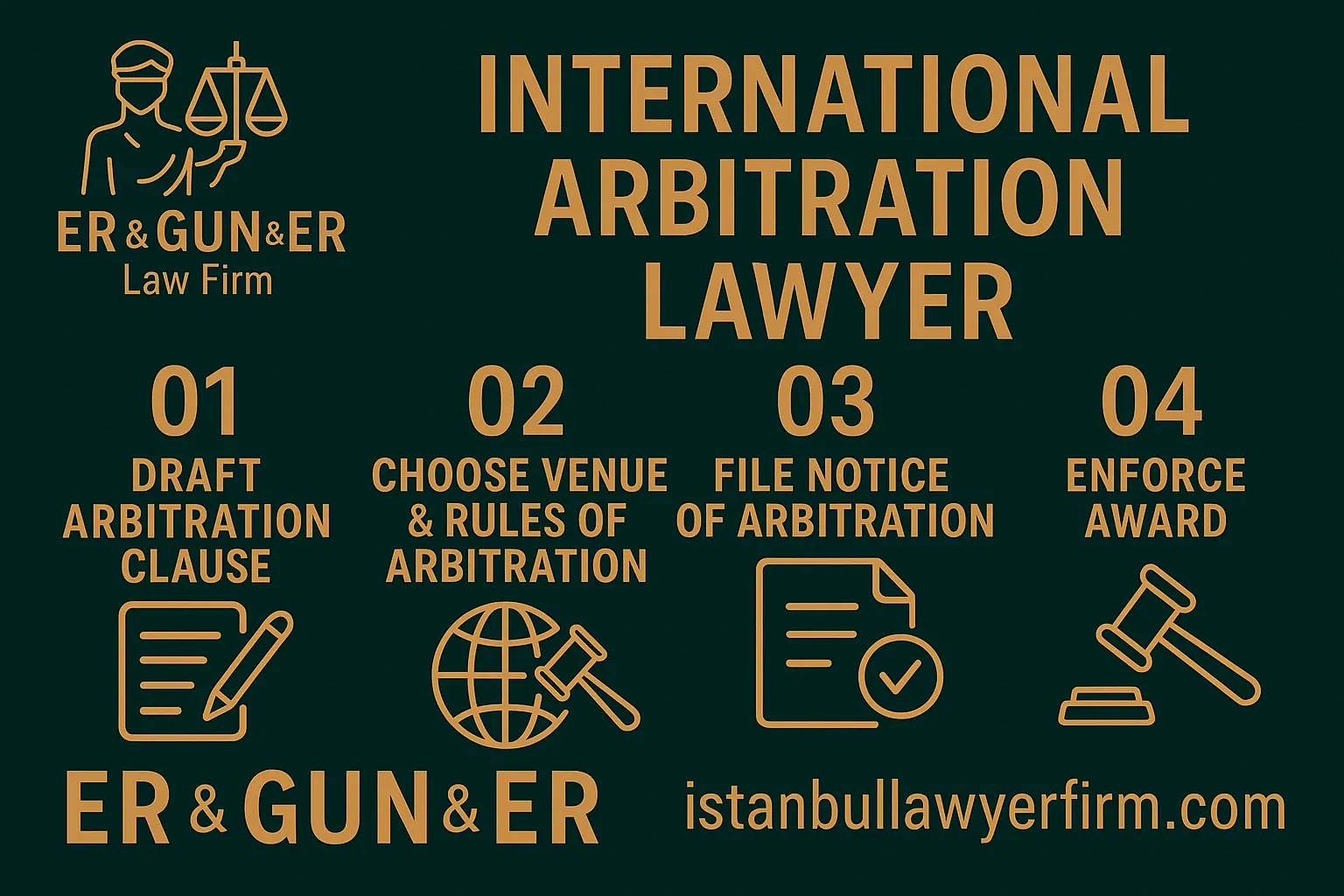
International arbitration involving Turkish parties or Turkish-seated proceedings requires counsel who can operate effectively across three different legal environments simultaneously: the procedural environment of the arbitral institution (whether ICC, ISTAC, LCIA, or UNCITRAL), the substantive law environment of the contract or treaty that governs the merits dispute, and the Turkish court environment that governs enforcement support, interim measure applications, and challenge proceedings. A lawyer who understands only the arbitration procedure without understanding the Turkish court's approach to interim measures has a gap in their enforcement toolkit. A lawyer who understands the substantive merits without understanding the arbitral institution's procedural calendar manages poorly in the proceeding. A lawyer who understands both but cannot coordinate them with the Turkish enforcement reality may win an award that is difficult to collect. Our approach integrates all three dimensions from the earliest stages of case preparation — because the decisions made when the notice of arbitration is filed and when the terms of reference are set have downstream consequences for enforcement options that only become apparent months or years later. For a comprehensive explanation of the Turkish arbitration law framework, see our guide on arbitration law Turkey. This page sets out how we work across the main international arbitration representation categories.
Case assessment and early strategic decisions
A lawyer in Turkey advising a client who has received a notice of arbitration or who is considering initiating arbitration must explain that the first 30 days of an arbitration matter are strategically decisive — because the decisions made in that period (whether to raise a jurisdictional objection immediately or at the merits stage, whether to seek an emergency arbitrator or a Turkish court interim measure, which arbitrator to nominate, and how to characterize the dispute in the response to the notice) shape the procedural trajectory of the entire case. A respondent who raises a jurisdictional objection in the terms of reference stage but fails to support it with specific, legally grounded argument typically loses that objection by default. A claimant who files without having completed the pre-arbitration steps required by the contract's tiered dispute resolution clause (notice, negotiation, mediation) may find the arbitration dismissed for non-compliance with a condition precedent, requiring the case to restart. We conduct a case assessment within 48 hours of engagement that maps the procedural timeline, identifies threshold issues that must be addressed immediately, and recommends the initial strategic posture. Practice may vary — verify current arbitral institution procedural rules and applicable procedural deadlines before making any initial strategic decisions in a pending arbitration.
An Istanbul Law Firm advising on arbitral institution selection must explain that where the parties have not yet agreed on an arbitration clause — for example, in pre-dispute dispute resolution negotiations, or in a new contract — the choice of institution affects not only the procedural rules but also the practical administration quality, the time to award, the cost structure, and the enforcement profile of the resulting award. ISTAC provides bilingual (Turkish/English) administration, lower filing fees for lower-value disputes, and an expedited procedure that can produce a final award within six months — making it appropriate for Turkey-centered commercial disputes where speed is a priority. ICC provides a globally recognized institutional imprimatur, a scrutiny mechanism for draft awards that reduces legal error risk, and an administration infrastructure that handles multi-party and multi-contract disputes well — making it appropriate for large, complex, or multi-jurisdiction disputes where the award's international enforceability is the primary concern. UNCITRAL ad hoc rules are appropriate for state entities or sophisticated commercial parties who want maximum procedural flexibility without institutional oversight cost. Practice may vary — verify current fee schedules and expedited procedure eligibility thresholds for each institution before recommending an institutional clause for a specific transaction.
Claim preparation and merits advocacy
A law firm in Istanbul advising on arbitration claim preparation must explain that the quality of the merits outcome in international arbitration is determined largely by the quality of the evidentiary record assembled before the hearing — because international arbitration tribunals decide from the documents and expert reports submitted, and a party that has a strong legal theory but an inadequate evidentiary foundation will lose to a party with a weaker legal theory but a complete, well-organized document record. We approach claim preparation as a document-first exercise: before drafting any pleading, we index and organize the complete document universe available to our client, identify the specific documents that prove each factual element of the claim or defense, identify the documents that are likely to exist on the other side (and plan the document production request accordingly), and assess the gaps in the record that require witness evidence or expert opinion to fill. This document-first approach produces pleadings that are grounded in specific exhibits rather than narrative, which is the format that experienced international arbitrators find most persuasive. Practice may vary — verify current arbitral institution document production rules and evidence protocol requirements before finalizing the evidence strategy for any pending arbitration.
An English speaking lawyer in Turkey advising on expert evidence management in international arbitration must explain that expert testimony — on quantum, on technical matters, on legal issues of foreign law — is frequently the most important evidence in high-value international arbitrations, and the quality of the expert's report and cross-examination performance is determined as much by how well the expert was instructed and prepared as by their technical credentials. We draft expert instructions that precisely frame the expert's task, provide the expert with the specific factual record relevant to their assignment, and review the expert's draft report for internal consistency, logical structure, and alignment with the legal case theory before submission. For quantum cases, we work with financial experts to build damages models that are transparent, methodologically sound, and defensible against cross-examination on their underlying assumptions. For technical cases in construction or energy, we coordinate between legal counsel and engineering experts to ensure the technical analysis maps onto the legal liability framework. Practice may vary by authority and year — verify current arbitral institution expert evidence rules and the specific expert report format requirements applicable to the arbitration's procedural order before finalizing expert instructions.
Enforcement of foreign arbitral awards in Turkey
A Turkish Law Firm advising on foreign award enforcement in Turkey must explain that the practical execution of an exequatur application in Turkey — while legally straightforward under the New York Convention framework — requires specific procedural management to minimize the time between filing and obtaining an enforceable Turkish enforcement title. The application must be filed at the competent Turkish civil court with certified copies of the award and the arbitration agreement, proper authentication of the documents (apostille for awards from Apostille Convention member states), and a sworn Turkish translation of all relevant documents prepared by a court-recognized translator. The respondent will be served and given an opportunity to raise objections — the most common being the public policy defense. We prepare the exequatur application with the specific documentation package that minimizes the grounds available for a procedurally-based delay tactic, and we simultaneously prepare the response to the most likely public policy objections based on the specific content of the award. The enforcing foreign awards Turkey framework — covering the complete exequatur procedure — is analyzed in the resource on enforcing foreign awards Turkey. Practice may vary — verify current Turkish court documentation requirements and the current processing timeline for exequatur applications before planning the enforcement timeline for any specific award.
A lawyer in Turkey advising on post-exequatur enforcement strategy must explain that obtaining the exequatur decision is not the end of the enforcement process — it is the point at which the foreign arbitral award becomes a Turkish enforcement title, allowing the award creditor to use the Turkish enforcement and execution system (İcra ve İflas Kanunu) to pursue the award debtor's Turkish-located assets. The practical enforcement strategy — which assets to attach, in what sequence, and with what urgency — depends on the award debtor's asset profile: bank accounts, real estate, trade receivables, and company shares each involve different attachment procedures with different processing timelines. Where the award debtor has significant Turkish banking relationships, simultaneous multi-bank account attachment notifications can produce rapid results. Where the debtor's assets are primarily in real estate or company shares, the attachment process is slower but the attached assets are typically more stable. We map the award debtor's Turkish asset profile before the exequatur application is filed so that enforcement can begin immediately upon the exequatur decision becoming final. Practice may vary by authority and year — verify current Turkish enforcement office procedures for post-exequatur asset attachment and the specific documentation required to commence enforcement proceedings against each asset type before finalizing the enforcement strategy.
Jurisdictional defense and challenge proceedings
An Istanbul Law Firm advising on jurisdictional objections in international arbitration must explain that a respondent who believes a claim has been brought in a forum with no jurisdiction to hear it — because the arbitration clause does not cover the dispute, because the clause is invalid under the applicable law, because the claimant does not qualify as a party to the clause, or because the tiered dispute resolution pre-conditions have not been satisfied — must make that objection clearly and promptly in accordance with the applicable institution's rules. Most institutional rules require jurisdictional objections to be raised no later than the filing of the statement of defense, and an objection that is not raised within the required timeframe may be treated as waived. We assess the strength of jurisdictional defenses as a first step in every respondent mandate, advise on whether to seek a bifurcated jurisdictional hearing (which can produce a cost-effective early termination of the arbitration if the objection succeeds) or to raise jurisdiction alongside the merits, and prepare the jurisdictional objection with specific, legally grounded analysis rather than a formulaic reservation of rights. Practice may vary — verify current arbitral institution rules on jurisdictional objection timing and bifurcation requests before advising on the jurisdictional defense strategy for any specific arbitration.
An English speaking lawyer in Turkey advising on Turkish court challenges to domestic and international awards must explain that a Turkish-seated international arbitral award can be challenged before the regional appellate court (Bölge Adliye Mahkemesi) for the seat on the grounds specified in the International Arbitration Law (MTK Article 15), which tracks the UNCITRAL Model Law's limited set of annulment grounds and does not permit merit review of the award. The most frequently raised grounds in practice are: excess of authority (where the award addresses matters not submitted to arbitration); violation of the parties' due process rights (where one party was not given a genuine opportunity to present its case); and public policy violation. A challenge filed on grounds that are in substance a disagreement with the tribunal's merits assessment — dressed in procedural language — will be dismissed by the Turkish court as outside the permissible scope of the annulment review. Conversely, a genuine procedural violation — for example, a failure to allow a party adequate time to respond to new evidence introduced late in the proceeding — can support a successful challenge. We assess challenge grounds against the MTK's specific requirements before recommending whether to pursue a challenge, because an unsuccessful challenge is costly and extends the period during which the award sits without enforcement. Practice may vary — verify current Turkish appellate court annulment jurisdiction and the specific grounds most recently sustained or rejected in Turkish arbitration challenge proceedings before recommending any challenge strategy.
Construction, energy, and investment arbitration
A law firm in Istanbul advising on construction arbitration must explain that construction disputes — which generate the largest volume of international arbitration involving Turkish parties — present specific case management challenges that distinguish them from commercial contract disputes: the factual record is typically enormous (construction projects generate millions of pages of documentation); the technical issues (delay analysis, disruption quantification, defect assessment) require specialist expertise that must be integrated with the legal case; and the quantum of construction claims frequently turns on methodologies (such as the different delay analysis methods — time impact analysis, as-planned versus as-built, windows analysis) that the expert must select, justify, and defend under cross-examination. We manage construction arbitration as a multi-disciplinary exercise from the outset, engaging construction scheduling experts, quantum experts, and technical defect specialists alongside the legal team, and coordinating the overall case presentation to ensure that the legal and technical narratives are mutually reinforcing. Practice may vary — verify current arbitral institution case management conference practices for construction disputes and the specific document production protocols applied in large construction arbitrations before finalizing the case management strategy.
A Turkish Law Firm advising on investor-state arbitration against Turkey must explain that disputes between foreign investors and the Turkish State under bilateral investment treaties (BITs) or the Energy Charter Treaty are conducted under specific procedural frameworks — most commonly ICSID arbitration under the Washington Convention (for investors from countries that have ratified ICSID) or UNCITRAL arbitration (for investors from countries whose BIT with Turkey provides for UNCITRAL arbitration). These proceedings involve specific threshold issues — treaty coverage, investor qualification, investment definition, and exhaustion of local remedies in some treaties — that must be carefully analyzed before any claim is filed. The factual record in investor-state arbitration must also demonstrate specific treaty standard violations (fair and equitable treatment, expropriation, full protection and security) rather than merely showing a breach of the investment contract, and the distinction between treaty claims and contract claims has significant jurisdictional implications. Practice may vary by authority and year — verify current BIT treaty coverage for the specific investor's nationality, the applicable arbitration rules, and the current status of Turkey's BIT treaty network before advising on any investor-state claim against Turkey. The commercial litigation Turkey framework — covering related Turkish court proceedings in investment disputes — is analyzed in the resource on commercial litigation Turkey.
How we work
A best lawyer in Turkey managing an international arbitration mandate begins with a written case assessment that addresses: the likely seat and applicable procedural law, the substantive law governing the merits, the strength of the claimant's factual record and the gaps that need to be filled, the enforcement asset profile of the likely opposing party, and the procedural timeline from filing through hearing to award. This assessment is shared with the client and updated as the case develops — because arbitration mandates typically run for 18 to 36 months, and strategic decisions made in the first month remain relevant throughout. For clients who are simultaneously parties to related litigation in Turkish courts or foreign courts — which occurs frequently in complex construction or joint venture disputes — we coordinate the arbitration strategy with the parallel litigation to ensure consistency across forums and to exploit procedural advantages that the different forums create. Practice may vary — check current guidance from applicable arbitral institutions and Turkish courts before acting on any arbitration strategy analysis.
ER&GUN&ER represents Turkish and foreign clients in ICC, ISTAC, LCIA, and UNCITRAL arbitrations; in Turkish court exequatur proceedings for foreign awards; in Turkish appellate court challenges to Turkish-seated arbitral awards; and in Turkish court interim measure applications in support of pending arbitrations. We work in English throughout all international mandates and coordinate with foreign co-counsel, technical experts, and quantum specialists as required by the specific matter. The Istanbul Bar Association at istanbulbarosu.org.tr provides resources for identifying qualified practitioners. Practice may vary — check current guidance before acting on any information on this page.
Frequently Asked Questions
- When must a jurisdictional objection be raised in ICC or ISTAC arbitration? Most institutional rules require jurisdictional objections to be raised no later than the statement of defense filing. An objection raised after this deadline may be treated as waived. Jurisdictional defenses should be assessed immediately upon receipt of the notice of arbitration.
- Can a Turkish court grant interim measures in support of a foreign-seated arbitration? Yes — Turkish courts can grant interim protective measures in support of arbitration proceedings seated outside Turkey where the respondent has assets or is present in Turkey, without this being treated as interference with the arbitration.
- What documents are required for a foreign award exequatur application in Turkey? Certified copies of the arbitral award and the arbitration agreement, apostille authentication (for awards from Apostille Convention states), and a sworn Turkish translation of all documents by a court-recognized translator.
- On what grounds can a foreign arbitral award be refused recognition in Turkey? Under the New York Convention Article V: incapacity of a party or invalidity of the agreement; lack of proper notice or inability to present case; award exceeds submission scope; tribunal or procedure not in conformity with agreement; award not yet binding or has been set aside; non-arbitrability; and public policy violation. Turkish courts apply these grounds narrowly and pro-enforcement.
- Can a Turkish-seated international award be annulled? Yes — on the limited grounds in MTK Article 15 (equivalent to UNCITRAL Model Law grounds). Merit review is not permitted — the court cannot substitute its assessment of the facts or law for the tribunal's. A challenge that is in substance a merits disagreement will be dismissed.
- What is the difference between ISTAC and ICC for Turkey-related disputes? ISTAC provides bilingual Turkish/English administration, lower fees for smaller disputes, and an expedited procedure target of six months. ICC provides global recognition, a draft award scrutiny mechanism, and infrastructure for complex multi-party cases. Choice depends on dispute value, complexity, and international enforceability priorities.
- How long does an international arbitration typically take involving Turkish parties? ISTAC expedited procedure: approximately six months. ISTAC standard: twelve to eighteen months. ICC with Turkish parties: eighteen to thirty months for complex commercial disputes. Investor-state arbitrations can take three to five years.
- Do you represent both claimants and respondents? Yes — we represent both claimants initiating arbitration proceedings and respondents defending against claims. Each mandate is assessed individually for conflict before acceptance.
- Can you coordinate with foreign co-counsel in parallel proceedings? Yes — for disputes involving parallel litigation or arbitration in multiple jurisdictions, we coordinate with foreign co-counsel to ensure consistent factual and legal positions across all forums.
- What specific challenges arise in construction arbitration involving Turkish parties? The factual record volume (construction projects generate millions of pages of documentation), the technical complexity of delay and quantum analysis (requiring scheduling and quantum experts), and the need to map technical and legal narratives consistently throughout the proceeding. Early multi-disciplinary team assembly is essential.
Author: Mirkan Topcu is an attorney registered with the Istanbul Bar Association (Istanbul 1st Bar), Bar Registration No: 67874. His practice focuses on cross-border and high-stakes matters where evidence discipline, procedural accuracy, and risk control are decisive.
He advises companies and investors across International Arbitration, Commercial Litigation, Corporate Law, and cross-border enforcement matters where procedural precision and jurisdictional strategy are decisive.
Education: Istanbul University Faculty of Law (2018); Galatasaray University, LL.M. (2022). LinkedIn: Profile. Istanbul Bar Association: Official website.