

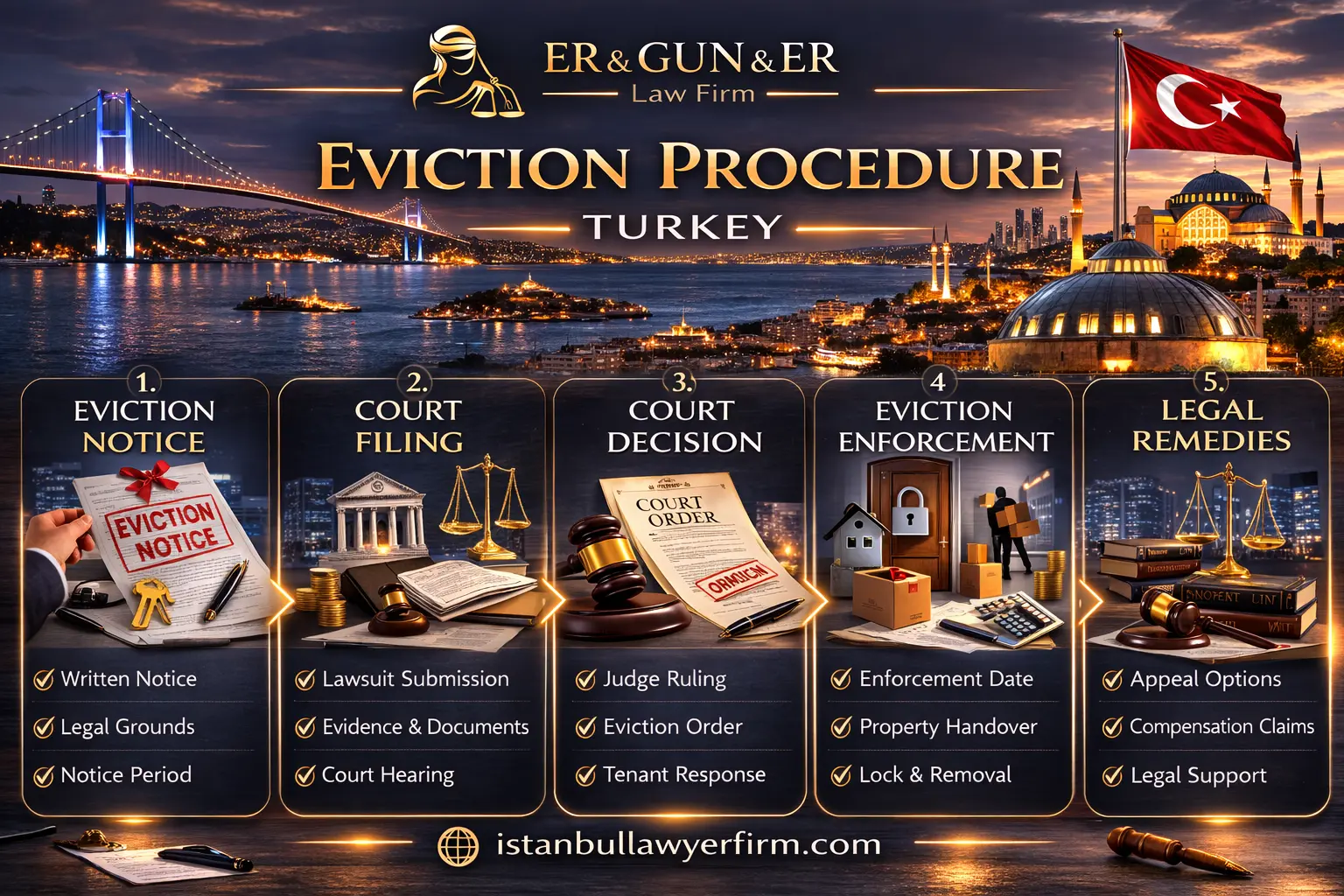
In eviction procedure Turkey, the outcome is driven by process before merits. Landlords lose strong cases when notices are missing or service is defective. Tenants gain leverage by objections because the lawsuit route and the enforcement route have different gates. A compliant eviction notice Turkey file starts with route selection and ends with execution planning. Evidence discipline matters because rent ledgers, invoices, and messages become exhibits. Coordinating filings, service, and execution is why a Turkish Law Firm should treat eviction as an end-to-end project file.
Eviction procedure overview
Eviction work in Turkey is structured around court litigation and enforcement-based filings. The correct route depends on the ground, the documents, and the tenant’s objection strategy. Grounds and remedies are rooted in lease rules and mandatory tenant protections. Core lease rules sit in the Turkish Code of Obligations, and consolidated texts are published on Mevzuat. The phrase eviction law Turkey is popular, but the decisive issue is procedural fit. A landlord eviction Turkey plan should be mapped before any notice is served. Many files fail because the landlord sends a notice that matches the wrong ground. The landlord should build the case file with dated exhibits from the first day. The lease, annexes, and correspondence should be preserved in their original form. Payment evidence should be stored as bank records, receipts, and consistent ledgers. If the tenant disputes rent amount, invoices and bank references become critical proof. If the tenant disputes service, the service method must be provable with official records. practice may vary by authority and year — check current guidance. A careful lawyer in Turkey treats each step as a future exhibit for review. This approach reduces surprises when the matter moves to execution.
The court track is used when the ground requires a judgment or when facts are contested. Landlords often start with an eviction law overview to classify the route. The enforcement track is used when the law allows an execution filing to trigger eviction steps. Practitioners call this eviction through enforcement Turkey, but compliance is still required. The litigation track is commonly described as eviction lawsuit Turkey, but filing alone does not deliver possession. Service, hearings, and decision finalization must be planned without assuming speed. The enforcement track requires accurate forms, provable service, and disciplined responses to objections. Tenants can push the dispute into court when objections are raised and sustained. That is why the landlord should keep one consistent narrative across both tracks. The most common error is mixing steps from different tracks in the same file. Self-help actions like lock changes should be avoided because they create liability. The file should be drafted as if a later judge will read every notice and receipt. A skilled law firm in Istanbul coordinates track choice with execution planning. Coordination includes preparing for tenant arguments and document challenges. Integrated planning reduces delays and prevents avoidable dismissals.
Execution is the stage where paperwork becomes physical possession. The decisive question is whether the file is ready for enforcement proceedings Turkey eviction at the right time. Enforcement offices act only on clear documents that match the chosen route. If resistance continues, the practical step can involve bailiff eviction Turkey under lawful supervision. Landlords should avoid promising dates to investors or buyers without the record. The file should include updated lease records, rent ledgers, and notice proofs. Any mismatch between the lease, the notice, and the claim invites objections. Landlords should also coordinate with managers to document inventory and handover condition. If the tenant claims verbal renewal, written evidence becomes central. If the tenant claims cash payment, consistent accounting evidence is needed. Courts and enforcement offices focus on proof, not frustration narratives. Even strong grounds can fail when service is defective or exhibits are incomplete. practice may vary by authority and year — check current guidance. Plan execution from the first notice and store every receipt. This planning makes enforcement a predictable final step.
Lease type and timeline logic
Lease classification drives which eviction doors are available. Residential and workplace leases follow different mandatory protections and renewal logic. Many landlords assume a lease ends on the written end date. That assumption can be wrong when mandatory rules extend the relationship. The safest approach is to read the Code of Obligations text and map it to the facts. Tenant eviction Turkey cases often fail because the landlord chooses a route that does not match the lease type. The landlord should confirm whether the tenant is an individual user or a business operator. The landlord should also confirm whether there are guarantors and how they are documented. If rent recovery is also required, the route should support both remedies. A landlord should keep a ledger that matches the signed rent clause. If the lease includes indexation, the signed clause should be preserved as an exhibit. Side payments and informal increases weaken later evidence. practice may vary by authority and year — check current guidance. A careful best lawyer in Turkey converts classification into a procedural plan with verifiable steps. When classification is correct, later drafting and filing becomes easier.
Timeline logic is a map of mandatory steps and likely objections. Landlord eviction Turkey outcomes depend on whether the ground is provable within the chosen route. Some grounds depend on documents created at the start of the lease. Other grounds depend on events that occur later and must be documented. If the landlord relies on non-payment, the file must show the rent schedule and missed payments. If the landlord relies on a written undertaking, the file must show correct execution and context. If the landlord relies on need or renovation, the file must show the factual basis and consistency. A landlord should anticipate defenses based on repairs, habitability, or deposit disputes. Timeline mistakes often begin with delayed notices or notices sent to the wrong address. A sound foundation is the framework in property rental law and then route mapping. The plan should identify which documents must exist before filing. It should also identify which documents created later may look self-serving. practice may vary by authority and year — check current guidance. Experienced Turkish lawyers reduce timeline risk by standardizing document packs early. This discipline prevents counterclaims triggered by procedural mistakes.
Lease timeline logic also depends on how the tenant status is documented over time. If the tenant changes, sublets, or adds occupants, the landlord should document the change promptly. Informal occupant changes can complicate notices because the wrong person may receive service. If a manager is involved, records should be consistent and handed to counsel quickly. Tenant protections are procedural as well as substantive, and they shape judicial review. A useful context source is tenant rights guidance because defenses often arise from the same facts landlords ignore. Eviction procedure Turkey is therefore not only about grounds but also about anticipating procedural moves. If the tenant claims payment, the landlord should respond with bank evidence. If the tenant claims defective notice, the landlord should respond with service proofs. If the tenant claims informal renewal, the landlord should respond with written renewal evidence or consistent accounting. If the tenant claims waiver, the landlord should respond with contemporaneous communications. practice may vary by authority and year — check current guidance. The landlord should avoid contradictory messages that later become exhibits. When timeline management is documented, delays through confusion become harder. This discipline also supports settlement because evidence positions become clear.
Notice and service basics
Notices are procedural triggers that shape what the landlord can file later. Many landlords draft an eviction notice Turkey letter that sounds strong but fails legal requirements. The correct format depends on the ground, the lease type, and the intended route. Service must comply with the Notification Law 7201 and accepted service methods. Landlords should avoid relying only on informal messaging for proof. When formal service is used, the full service packet should be archived. The notice should identify parties, lease, property, and the alleged breach clearly. It should state the demand and the next step if the tenant does not comply. If non-payment is alleged, the notice should match the ledger and rent clause. If a written undertaking is relied on, the notice should reference it accurately. If need or renovation is relied on, the notice should focus on provable facts. practice may vary by authority and year — check current guidance. Foreign landlords should ensure Turkish wording is consistent with their evidence file. A English speaking lawyer in Turkey can align the notice language with the landlord’s documentary proof. A correct notice often determines whether the file proceeds or collapses on procedure.
Service mistakes create tenant objections that are difficult to cure after filing. Courts and enforcement offices examine whether notice reached the correct address through a compliant method. Address selection should be evidence-based, using the lease address and any written updates. If the tenant moved, the landlord should document the move and not guess addresses. Every service attempt should be preserved with its official records. If the landlord is abroad, representatives should be coordinated so service is not delayed. If a manager is used, the manager should avoid informal service shortcuts. A cross-reference to the broader property framework is useful, and real estate law overview explains why record discipline matters. When a case becomes an eviction lawsuit Turkey, service defects can cause procedural rework. The landlord should plan service as a core litigation step and not as routine mail. Tenants sometimes use service objections as negotiation leverage even when rent is unpaid. practice may vary by authority and year — check current guidance. A careful Istanbul Law Firm approach standardizes service packets and verifies addresses before delivery. Standardization reduces inconsistent documents created by different staff members. When service is clean, the dispute moves to merits and execution.
Notice content must be consistent with the claim that will be filed later. If the notice alleges one breach and the filing alleges another, the tenant will argue contradiction. Contradiction is a common tenant defenses eviction Turkey tactic because it attacks credibility. The landlord should draft the notice with the filing template in mind. Written communications after the notice should be controlled because careless messages can waive rights. If the tenant requests more time, the landlord should respond in writing and reserve rights. If partial payment is offered, the landlord should document allocation and legal effect. If payment is accepted without reservation, leverage for some grounds may be weakened. Lawsuit procedure is governed by the Code of Civil Procedure 6100 and the court will focus on records. The landlord should keep copies of every notice version and every attachment. If delivery required multiple attempts, each attempt should be archived. Email copies can support context, but they rarely replace formal service proof. practice may vary by authority and year — check current guidance. The landlord should treat notice and service as the foundation for every later step. A solid foundation leaves fewer procedural tools for delay.
Non-payment eviction route
Non-payment is a common trigger because rent ledgers can create a clear factual baseline. In non-payment eviction Turkey files, success depends on proving the debt and proving compliant notices. The landlord should reconcile the lease rent clause with actual bank receipts. If irregular payments occurred, the landlord should document allocation month by month. If receipts or invoices exist, they should match the bank trail. Inconsistent invoice amounts can undermine credibility in later objections. The landlord should check whether the tenant claims set-off due to repairs or defects. Repair claims should be answered with written communications and inspection evidence. Route choice depends on document strength and expected objections. If the file is document-strong, eviction through enforcement Turkey may be considered with caution. If the file is document-weak, litigation may be safer even if slower. Self-help threats should be avoided because they create counterclaims and criminal exposure. practice may vary by authority and year — check current guidance. Standardize the ledger and align it with the lease clause before filing. A clean ledger narrows the dispute and improves execution readiness.
The non-payment route often begins with a formal demand that creates a filing-ready record. The demand content and delivery must be consistent with the later claim. If the landlord intends to proceed in court, the demand still preserves evidence. If the landlord intends to proceed in enforcement, the demand must fit enforcement practice. The procedural framework is anchored in the Execution and Bankruptcy Law 2004. This law controls how execution files are opened and how objections are processed. An eviction lawsuit Turkey may still become necessary when objections or disputes block enforcement. A strong notice file reduces the tenant’s ability to argue tolerance or waiver. A weak notice file gives the tenant room to deny default or dispute amounts. Bank receipts should show clear references so the tenant cannot claim a different purpose. If payments were made to a third party, authorization must be documented. practice may vary by authority and year — check current guidance. Landlords should avoid public accusations without evidence because side disputes can follow. Communications should remain professional and tied to records. When the file is coherent, the landlord can choose the path with less procedural risk.
Landlords should plan rent recovery alongside eviction because loss can remain after possession. If the tenant has assets, early collection planning can preserve leverage. Collection steps must be lawful and documented, and they should not be mixed with self-help. Security deposit disputes should be anticipated and documented from the start. Deposit clauses and bank holding evidence should be preserved as exhibits. If rental invoices exist, the invoice trail should be consistent because it shapes credibility. If the tenant claims cash payment, the landlord should rely on bank and invoice evidence. If the landlord proceeds with enforcement proceedings Turkey eviction, objections may shift the dispute into court. The landlord should treat that shift as normal and keep the narrative consistent. Habitability defenses should be answered with inspection records and repair logs. Payment allocation disputes should be answered with a month-by-month ledger. practice may vary by authority and year — check current guidance. The landlord should also preserve proof that notices were served to the correct address. A consistent file often pushes parties toward settlement because risk becomes visible. Without a consistent file, the dispute becomes a credibility contest that consumes time.
Written undertaking eviction
The written undertaking route is built around a document the tenant signs committing to vacate on a stated date. In practice, tahliye taahhudu Turkey is treated as an evidence-heavy ground because the paper controls the route. The first review question is whether the undertaking was executed in a way that can withstand authenticity objections. The second question is whether the document clearly identifies the leased premises and the parties. The third question is whether the vacate commitment is unambiguous, with no blank fields that could be filled later. Landlords should avoid relying on generic templates that do not match the actual lease file. If the undertaking is attached to an older lease or an older address, tenants will argue that it does not apply. Signature integrity matters, so the landlord should preserve the original and the context of signing. If the tenant later alleges coercion, the timeline and communications around signing become relevant. If the tenant alleges that the document was signed before the lease relationship began, the file must rebut that with credible evidence. If the tenant alleges that the date was inserted later, the handwriting and version history may be examined. The landlord should also check whether there are multiple undertakings and whether they contradict each other. Contradictions give the tenant a procedural defense that can delay eviction. Because the undertaking route can move quickly when it is clean, errors at drafting stage are disproportionately costly. A disciplined review by an Istanbul Law Firm focuses on exhibit quality and predictable objections rather than on aggressive language. Once the document is validated, the landlord can plan the filing sequence with far less uncertainty.
The next step is to align the undertaking with the landlord’s notice and filing plan, because mixed steps create confusion. Landlords should keep the lease, the undertaking, and the rent ledger in one indexed exhibit pack. The filing plan should anticipate that the tenant may claim the undertaking is invalid or unrelated to the current lease. For that reason, the landlord should preserve proof of tenant identity at signing and proof of the premises description used. If the tenant paid a security deposit, the landlord should document deposit handling separately and avoid using the deposit as informal leverage. Clear deposit treatment reduces counterclaims that distract from the undertaking ground, and the basics are summarized in security deposit rules. Service of the filing must be provable, because tenants often attack the route through service objections rather than through merits. If the tenant remains in possession after the stated date, the landlord should avoid informal extensions that undermine consistency. Any extension discussion should be in writing and should reserve the landlord’s rights. If the landlord accepts rent after the date, the landlord should document the legal basis and avoid messages that imply a new lease. The case file should also include a clear description of any rent arrears so the landlord can choose whether to pursue collection in parallel. Where a tenant claims that the undertaking was for a different unit, the landlord should respond with the address and delivery records in the file. practice may vary by authority and year — check current guidance. A careful lawyer in Turkey drafts the file so that the court or enforcement office can follow it without oral explanations. That drafting includes a chronology that shows lease commencement, undertaking execution, and post-date possession. When the chronology is clean, the tenant’s procedural space for delay becomes narrower.
In disputes, the tenant often argues that the landlord’s records are inconsistent, so the landlord should standardize all accounting exhibits. If the rent ledger differs from bank transfers, the tenant will claim that payments were made under a different arrangement. If the landlord issued invoices or receipts, those documents should match the lease amounts and the claimed arrears. Where invoices are part of the file, landlords should keep the compliance logic consistent, and a practical overview is in rental invoice documentation. The undertaking route also fails when landlords submit only a photocopy without a credible explanation of where the original is. If the original cannot be produced, the landlord should document the chain of custody and any notarized copy process. Tenants may also claim that their signature was copied, so contemporaneous communications and delivery records become important. If the landlord used a broker to collect signatures, the broker’s role should be documented to avoid confusion. If the tenant is a foreign national, identity checks should be backed by passport copies and consistent spelling across the file. If the landlord is a foreign owner, translation support is critical so the landlord’s declarations remain consistent. An English speaking lawyer in Turkey can keep the landlord’s narrative aligned with Turkish procedural terminology without introducing new facts. Landlords should also anticipate that tenants may claim they never received the filing, so service proofs must be complete. Any messaging after filing should be disciplined, because informal promises can be attached as exhibits. The landlord should avoid threats or humiliating statements, because those messages can shift the judge’s perception of fairness. When the file is clean and communications are controlled, the undertaking route becomes a practical tool rather than a litigation gamble. The core principle is that the document is only as strong as the record around it.
Need-based eviction claims
Need-based eviction claims are fact-intensive because the court tests whether the asserted need is genuine and current. The phrase need-based eviction Turkey typically covers situations where the landlord or close relatives plan to use the property personally. Courts focus on credibility, so the landlord should avoid filing while simultaneously marketing the unit for rent. If the landlord owns alternative suitable premises, the tenant will argue that the claimed need is not compelling. The landlord should therefore document why the specific unit is necessary and why alternatives are not suitable. If the landlord’s plan is tied to employment, health, or family circumstances, the file should include objective records that support the narrative. The landlord should also keep communications consistent, because contradictory messages can be used to impeach sincerity. Tenants often argue that the need is a pretext for rent increase, so the file must show a non-financial logic. If the landlord previously tolerated the tenancy for years, the landlord should explain what changed and when it changed. Need claims also require careful notice planning, because the tenant must be informed in a way that is provable. If the landlord anticipates that the tenant will resist, the landlord should plan evidence and witness strategy early. The landlord should avoid promising fixed completion dates for moving in, because relocation and logistics can shift. If the landlord later does not use the property as claimed, the tenant may pursue remedies under the legal framework. That downstream risk is why counsel should treat need claims as high-integrity litigation. A structured case assessment by a law firm in Istanbul focuses on proof quality, consistency, and foreseeable defenses. When those elements are strong, settlement discussions become more realistic because the tenant sees the evidentiary posture.
Need claims should be coordinated with property management records because those records often contain the most credible timeline. If the property is in a site, management minutes can show whether the landlord raised planned use changes earlier. If the landlord intends to move in, the landlord should document preparations such as utility transfer planning and relocation communications. If the landlord intends to house a family member, the landlord should document the family member’s housing context in a respectful way. Where a professional manager handles communications, the manager should avoid sending mixed messages that undermine the need narrative. Landlords who rely on managers should align the file with property management compliance so operational records support the legal story. If rent discussions occurred shortly before filing, the landlord should preserve those discussions and avoid mischaracterizing them. If the tenant offered a rent increase, the landlord should document why the increase does not resolve the need. If the landlord refused an increase, that refusal can support sincerity if the rest of the record is consistent. The notice should be drafted so that it is compatible with later pleadings and does not overclaim facts. If the file includes photographs or inspection notes, those exhibits should be dated and should avoid editorial labels. practice may vary by authority and year — check current guidance. Turkish lawyers often advise landlords to assume that the tenant will test every inconsistency and to eliminate them before filing. That advice includes creating a single chronology that ties the need event to the notice and to the filing. It also includes controlling public advertisements so the landlord is not seen as seeking a higher-paying tenant. When management records and legal filings speak the same language, the court’s trust is easier to earn.
Tenants commonly defend need claims by attacking proportionality and by pointing to alternative housing options. They may argue that the landlord’s plan is speculative or conditional and therefore not immediate enough. They may also argue that the landlord did not act consistently and tolerated the tenancy despite the alleged need. If the landlord’s evidence is thin, the tenant can turn the case into a credibility contest. Landlords should therefore avoid filing merely as leverage for renegotiation, because that tactic is visible in evidence. If settlement is pursued, the settlement should be documented in writing and should include a clear move-out date and handover protocol. If the tenant proposes staged move-out, the landlord should document the conditions and reserve rights if stages are missed. If the landlord intends to pursue arrears, the landlord should keep the arrears file separate from the possession file while keeping narratives consistent. Where the landlord’s need is tied to a planned sale, the landlord should reconsider whether a new owner route is more appropriate. Where the landlord’s need is tied to renovation, the landlord should reconsider whether renovation proof is stronger than personal use proof. The court will look for a coherent explanation of why this property is the necessary solution. If the tenant raises health or vulnerability arguments, the landlord should respond respectfully and focus on lawful procedure. Courts also evaluate whether the landlord gave realistic time and clear communication, within the legal framework, without promising fixed outcomes. practice may vary by authority and year — check current guidance. A calm, evidence-first posture reduces reputational friction and improves the odds of a controlled handover. Even when the landlord has a strong position, execution planning should be prepared early so the final step is not improvised.
Renovation and rebuilding route
Renovation-based eviction is judged by the seriousness of the project, not by the landlord’s frustration with the tenant. The phrase renovation eviction Turkey is used when the landlord claims the works cannot be performed while the unit is occupied. Courts typically expect objective evidence that the works are substantial and require vacancy. That evidence can include technical reports, contractor scopes, and permit-related documents where applicable. Landlords should avoid presenting vague renovation intentions, because vague intentions look like a rent-increase strategy. If the landlord previously performed similar works without eviction, the tenant will argue that eviction is unnecessary. The landlord should therefore explain why the planned works are different and why they require full access. If the landlord intends to rebuild or combine units, the file should include the project narrative supported by documents. If permits are needed, the file should show that the landlord is taking steps in the correct direction without claiming approvals are guaranteed. If financing is needed, the file should show that financing is realistic, because purely hypothetical projects are weak. Tenant objections often focus on pretext, so the landlord should keep communications consistent and avoid rent bargaining messages. The landlord should also anticipate that post-eviction use of the unit may be scrutinized for consistency with the renovation claim. If the landlord re-lets immediately after eviction, the tenant may claim that the renovation ground was abused. practice may vary by authority and year — check current guidance. A best lawyer in Turkey will typically insist on a document-backed project story before selecting this route. When the project story is credible, the court is more likely to view the claim as necessity rather than strategy.
Renovation claims require careful notice drafting because the notice becomes the first exhibit tested for coherence. The notice should identify the project purpose, the planned work category, and the reason occupancy blocks performance. It should avoid technical exaggeration and instead point to the supporting documents that will be submitted later. If the building is a site with management rules, the landlord should confirm whether common area works require management coordination. If the planned works involve structural changes, safety considerations and neighbor impacts may become part of the factual context. The landlord should also consider whether temporary relocation assistance is part of negotiation, even if not legally mandatory. Negotiation can reduce conflict when the tenant is willing to cooperate, but negotiation should not undermine the legal narrative. If the landlord offers compensation, the offer should be documented as a settlement proposal, not as an admission of weak grounds. If the tenant requests proof, the landlord should share sanitized documents that show the project reality without exposing sensitive cost data. If expert reports are used, the landlord should ensure the report identifies the unit correctly and is signed by the appropriate expert. If the tenant alleges that works can be performed while occupied, the landlord should be ready to show why that is impractical or unsafe. Courts tend to distrust generic contractor letters that are clearly drafted for litigation without real technical content. The landlord should preserve any prior maintenance records, because tenants may argue that the landlord created the need through neglect. practice may vary by authority and year — check current guidance. A coherent renovation file links the notice, the technical documents, and the intended post-works use into one story. When the story is coherent, the tenant’s ability to frame the claim as harassment is reduced.
If the renovation claim succeeds, the landlord should still plan how to take possession and secure the unit without escalation. Handover should be documented with an inventory and dated photographs to prevent later damage allegations. If the tenant leaves belongings, the landlord should follow lawful steps and avoid disposing of property informally. Tenants may later claim that they were forced out without due process, so service and execution records must be preserved. If the tenant resists, the landlord should rely on the execution pathway rather than on private pressure. Landlords should also document actual renovation works after possession, because later disputes may test whether the claimed plan was real. Contractor invoices, permit steps, and progress records can serve as proof of follow-through. If the landlord delays works for a long time, the tenant may argue that the eviction was not justified. The landlord should therefore treat post-eviction project implementation as part of risk management. If the tenant raises counterclaims for bad faith, the landlord should respond with the project evidence and a consistent chronology. If rent arrears exist, the landlord can pursue them separately, but narratives should remain consistent across files. If the tenant offers settlement after judgment, settlement terms should include clear surrender language and waiver structure. Courts and enforcement offices respond better when the landlord’s conduct is measured and documented. practice may vary by authority and year — check current guidance. A disciplined file makes it easier to close the dispute with minimal additional litigation. The core lesson is that renovation claims are defended by documents and follow-through, not by dramatic assertions.
New owner eviction route
New ownership changes the legal relationship, but it does not automatically cancel tenant protections. The phrase new owner eviction Turkey is used when the purchaser seeks possession based on the purchaser’s own planned use. This route requires careful sequencing because the purchaser must first perfect ownership and then act through the correct procedural steps. The purchaser should obtain and archive the title record and the purchase contract as foundational exhibits. The purchaser should also obtain the existing lease and all payment records from the prior owner to avoid gaps. If the prior owner’s records are incomplete, the tenant may exploit that gap to delay proceedings. The purchaser should identify whether the tenant has paid a deposit and how that deposit will be handled in the transfer. If deposit handling is unclear, deposit disputes can become a parallel fight that distracts from possession. The purchaser should also confirm whether the tenant has any side agreements, because those agreements can affect defenses. If the purchaser claims need, the purchaser must keep its story consistent from the first notice onward. If the purchaser negotiates a rent increase while claiming need, the tenant will argue pretext. The purchaser should avoid promising exact move-in dates because logistics can change. practice may vary by authority and year — check current guidance. A Turkish Law Firm handling a new owner file will usually start by securing the full lease history and mapping defenses. That mapping allows the purchaser to choose between a negotiated surrender and formal procedure without improvisation. When the file is complete, the purchaser can proceed with less risk of procedural surprises.
The new owner should serve the tenant with the relevant notice using a provable method and a verified address. If the tenant disputes the new owner’s standing, the file should show the completed transfer and the identity of the new owner. The new owner should also confirm who will receive rent during the transition period and document any changes in bank accounts. If rent is paid to the prior owner by mistake, the new owner should document communications and avoid contradictory instructions. Where arrears exist, the new owner may need a separate collection strategy, and collections should not be mixed into the possession narrative. If an enforcement filing is considered, the new owner should anticipate objections and prepare the court-bridge strategy in advance. A practical background on execution-office workflows is summarized in enforcement proceedings overview. The new owner should also coordinate with building management to document handover logistics and access rights. If the tenant requests time to relocate, the new owner should document any agreed timeline as a settlement instrument. Settlement language should include a clear surrender undertaking and a handover protocol to reduce later disputes. If the tenant refuses, the new owner should remain procedural and avoid private pressure tactics. If the tenant raises habitability issues, the new owner should document the condition of the unit at transfer and any repairs offered. practice may vary by authority and year — check current guidance. A clean notice, a clean transfer record, and a clean communication archive are the core assets of the new owner file. When these assets are preserved, the tenant’s tactical options become narrower and more predictable. This predictability improves negotiation leverage because each side can see the procedural risks clearly.
New owner cases often look simple but become complex when the tenant challenges standing, service, or good faith. Engaging an eviction lawyer Turkey early can prevent route mistakes that are expensive to correct later. Counsel can audit the purchase file, the lease file, and the communications file to identify contradictions. Counsel can also design the first notice so it matches the chosen ground and the evidence set. If the tenant raises objections, counsel can decide whether to push the matter into court or to continue through the execution track. If the tenant claims a separate agreement, counsel can demand documentary proof and isolate the issue. If the tenant claims repairs justify withholding, counsel can separate possession from payment disputes and preserve both files. If the tenant threatens counterclaims, counsel can keep communications disciplined and prevent admissions. The new owner should also plan how possession will be taken and how the unit will be secured after handover. Handover should be documented with a protocol and photographs to prevent later damage allegations. If the tenant remains after the final step, the new owner should rely on lawful execution measures rather than private confrontation. If the tenant leaves belongings, the new owner should follow lawful storage and notification steps. If the new owner plans to renovate immediately after possession, planning documents should be prepared so the narrative remains consistent. If the new owner plans to move in, relocation preparations should be documented without exaggeration. practice may vary by authority and year — check current guidance. A procedural mindset protects the new owner from turning a possession project into a multi-front dispute.
Termination and renewal limits
Termination in leases is rarely about a single sentence in the contract, because mandatory rules and factual conduct shape the outcome. A landlord should first classify whether the lease is treated as residential or as workplace use, because the renewal logic can differ in practice. The landlord should then confirm whether the lease term is fixed, indefinite, or renewed by conduct, because that changes which procedural doors are available. A frequent mistake is assuming that the written end date automatically ends possession rights, even when the tenant remains and rent is accepted. Another mistake is relying on verbal understandings about moving out, because those understandings are hard to prove and easy to deny. The landlord should treat every renewal season as an evidence moment and preserve the rent ledger, invoices, and communication history. If the lease contains side letters or protocols, those documents must be preserved because tenants often rely on them as a defense. If the tenant paid through different channels over time, the landlord should standardize the payment proof so it cannot be recharacterized later. A termination strategy should be route-driven, meaning it selects a ground that matches provable facts rather than frustration. If a landlord wants to regain possession, the landlord should avoid mixed messaging that implies continued consent to occupancy. If the landlord tolerates late payments repeatedly without reservations, the tenant may argue that default is waived or not material in the relationship. If the tenant raises habitability issues, the landlord should document inspections and repair responses to avoid the narrative that termination is retaliation. A termination plan should also anticipate whether rent recovery will be pursued separately, because mixing claims can complicate focus and proof. The safest approach is to build one chronology that starts at lease execution and ends at the intended filing date. “practice may vary by authority and year — check current guidance.”
Renewal limits are applied through procedure, so a landlord should treat notices and service as central rather than secondary. The landlord should confirm the tenant’s officially usable address from the lease and any documented updates before sending any termination statement. If the landlord uses a manager, the manager should follow the same notice template and should not improvise wording that later contradicts pleadings. Service should be performed with a method that can be proven later, because tenants often raise service objections as a first-line defense. If the landlord relies on a notice, the notice should describe the ground in plain terms that match the evidence set. If the landlord later changes the ground, the tenant will argue that the landlord is searching for reasons rather than acting on a genuine basis. A landlord should also keep the accounting side disciplined, because renewal disputes often include arguments about whether rent was accepted and for which period. If the landlord issues invoices or receipts, those documents should be consistent with the contract rent and should not create alternative stories. If the landlord is also managing reporting and documentation discipline, the broader tax record can matter for credibility, and rental income tax guidance provides context on how documentation is commonly organized. The landlord should avoid promising the tenant extra time in a way that looks like a new agreement, because that can undermine a termination narrative. Any extension discussion should be in writing and should reserve the landlord’s procedural rights without threatening language. If the tenant proposes a surrender protocol, the landlord should document it carefully so it cannot be denied later. If the tenant remains in the unit while negotiations continue, the landlord should keep a clear record of what payments were received and how they were allocated. “practice may vary by authority and year — check current guidance.”
Termination disputes often turn on credibility, so the landlord should align all documents, messages, and filings around one consistent story. The landlord should avoid public listings or marketing statements that contradict a claimed basis for termination, because tenants capture those statements as exhibits. If the landlord intends to negotiate a move-out, the negotiation should be structured as a written protocol with clear surrender terms and proof steps. The landlord should also plan the post-termination possession stage, including how handover will be documented and how the unit will be secured without confrontation. If the tenant indicates vulnerability, the landlord should keep communications respectful and procedural, because aggressive messages can be used to argue harassment. If the landlord plans to pursue arrears, the arrears claim should be documented with a ledger, bank records, and consistent invoice history. If the landlord plans to pursue damages, the damage claim should be documented with entry and exit photos and neutral inventory notes. If the tenant claims that the landlord refused repairs, the landlord should present repair tickets and contractor records rather than arguments. If the tenant claims that the landlord accepted renewal, the landlord should present reserved-right communications and consistent accounting. The landlord should also avoid self-help actions, because unlawful pressure can create criminal and civil exposure that overshadows the eviction goal. The best risk control is a structured file that a judge can follow without needing oral clarifications. This file should include all versions of notices and proof of each service step. It should also include the lease, annexes, and any amendments that might be invoked by the tenant. “practice may vary by authority and year — check current guidance.”
Lawsuit filing pathway
The lawsuit pathway is used when the ground requires judicial evaluation or when the tenant is expected to dispute facts aggressively. A landlord should select the claim theory based on provable documents, not based on the tenant’s personality or pressure tactics. The lawsuit file should start with a clean chronology that ties lease execution, payments, notices, and the triggering event together. The petition should describe facts in a neutral way and should avoid exaggeration, because exaggeration creates credibility vulnerabilities. The landlord should attach the lease, any amendments, and an indexed set of payment proofs that match the rent clause. If the tenant paid partially or irregularly, the landlord should explain allocation using bank records and consistent ledgers. If the landlord relies on a written document signed by the tenant, the landlord should attach the original or a defensible certified copy and explain chain of custody. If the landlord relies on need or renovation, the landlord should attach objective supporting documents and avoid speculative statements. The landlord should draft the petition so that each assertion is backed by an exhibit or by a provable inference that can be defended. The petition should also anticipate the tenant’s likely defenses and answer them with documents rather than with rhetorical claims. The landlord should ensure the notice language matches the petition language to prevent contradiction arguments. If service is challenged, the landlord should have a complete service packet ready as an exhibit set. The lawsuit plan should also include the execution plan, because a judgment is only useful if it can be executed. If the landlord expects counterclaims, the petition should be written with disciplined wording to avoid admissions. “practice may vary by authority and year — check current guidance.”
Procedural progress in court depends on service, hearings, and evidence review rather than on the landlord’s urgency. The landlord should treat the court file as a living file and update it with new payments, new messages, and new developments in a consistent way. If the tenant pays after filing, the landlord should record the payment and clarify whether it affects the eviction ground or only the debt component. If the tenant proposes settlement, the landlord should document the proposal and maintain the litigation narrative without contradictory statements. Courts may require clarifications, witness statements, or expert reviews depending on the allegations and the evidence condition. The landlord should prepare for evidence challenges by ensuring documents are legible, dated, and attributable to a source. If communications are used as exhibits, the landlord should preserve the full conversation context and avoid selective extracts that can be attacked. If the lease includes foreign elements or bilingual texts, the landlord should ensure that translations are consistent and sworn where needed. The court process is governed by procedural rules, so the landlord should keep filings aligned with accepted formats and deadlines without inventing dates. For a broader view of how civil business disputes are handled in practice and how evidence is evaluated, commercial litigation overview provides context that helps landlords avoid procedural surprises. The landlord should also plan hearing attendance, including interpreter needs where the landlord or witnesses are not fluent in Turkish. The landlord should keep communications with the tenant calm during the case, because messages sent during litigation often become exhibits. If the tenant alleges harassment, the landlord’s calm record can defeat the narrative. The landlord should avoid informal entry into the unit, because that can create criminal allegations and damage the lawsuit. If the tenant changes locks, the landlord should respond through lawful channels rather than confrontation. “practice may vary by authority and year — check current guidance.”
A well-managed lawsuit pathway also considers settlement leverage and execution readiness at each stage. The landlord should define what a workable settlement looks like, such as a surrender date, a handover protocol, and a debt payment schedule. The settlement language should be drafted to be enforceable and should include clear proofs for each obligation. If the tenant agrees to leave, the landlord should document the agreement in a form that can be used in the file without relying on oral assurances. If the tenant does not agree, the landlord should keep the case moving with complete submissions rather than repeated narrative arguments. The landlord should also plan post-judgment steps early, including how the decision will be obtained and how the execution request will be filed. If the tenant is likely to resist physically, the landlord should coordinate the safety and documentation aspects of execution without inflammatory language. The landlord should also plan how to document the state of the unit at handover to reduce damage disputes. If the landlord intends to rent again, the landlord should keep the new listing steps separate until possession is secured to avoid appearing inconsistent. If the landlord expects to sell, the landlord should disclose the litigation status transparently to avoid later liability. The landlord should also consider that delay risk increases when the file is incomplete, so completeness is a direct risk control. The landlord should keep all official receipts, hearing notices, and service records in a single archive. If the landlord is abroad, representation and communication discipline is crucial because inconsistent instructions create contradictions. A disciplined record reduces the tenant’s ability to stretch the case through procedural noise. This is also why professional file management is as important as legal argumentation. “practice may vary by authority and year — check current guidance.”
Enforcement filing pathway
The enforcement pathway is used when the law permits eviction-related action through an execution office file rather than through a full merits trial at the first step. This route is still procedure-driven and it fails when documents are incomplete or service is defective. The landlord should confirm that the selected enforcement route matches the ground and the documents available in the file. The landlord should prepare an exhibit pack that includes the lease, the relevant trigger document if any, and an updated rent ledger if payment default is involved. The enforcement request must use correct party identities, because a small spelling mismatch can cause service and objection confusion. The landlord should also ensure that the tenant’s address used for service is evidence-based and matches the lease file. Service is governed by formal rules and the landlord should preserve the complete service packet as proof. The tenant may file objections and the landlord must be ready to respond with documents rather than with verbal explanations. The landlord should also avoid mixing enforcement and court steps without a coherent bridge plan, because mixed steps invite procedural attacks. If the landlord’s goal includes rent recovery, the landlord should keep the debt logic consistent and avoid changing claimed amounts between documents. If invoices or receipts exist, they should match the ledger and the contract rent clause. If the tenant claims repairs justify withholding, the landlord should preserve repair communications and inspection notes. The landlord should avoid unlawful pressure during enforcement because it can generate counterclaims that stall the process. The landlord should treat every communication as a potential exhibit, especially after an enforcement file is opened. “practice may vary by authority and year — check current guidance.”
Objections are the central tenant tool in the enforcement route, so landlords should plan for them from the first day. The tenant may object to the debt, to service, to identity, or to the underlying document that supports eviction steps. If the tenant objects, the landlord may need to continue in court depending on the nature of the objection and the route used. That bridge should be planned so the landlord does not lose momentum through missing documents. Rent recovery planning can proceed in parallel, but it must remain consistent with the possession narrative so credibility is preserved. If the landlord wants a structured explanation of collections options and evidence discipline, debt collection guidance provides context that helps align arrears strategy with eviction steps. The landlord should also evaluate whether partial payments will be accepted and how they will be allocated, because allocation disputes can fuel objections. If the tenant claims cash payments, the landlord should insist on bank proof and should present a consistent accounting narrative. The landlord should keep the bank account information stable and verify any requested changes through independent channels to avoid account substitution fraud. If the tenant proposes settlement after an enforcement notice is served, the landlord should document the settlement in a form that can be executed if breached. Settlement language should include a surrender date, a handover method, and a payment protocol with proof requirements. The landlord should also preserve evidence of the tenant’s continued possession after breach, such as management logs and dated communications. Enforcement files also require disciplined response timing, but landlords should not promise fixed dates because office processing can vary. “practice may vary by authority and year — check current guidance.”
Execution readiness is the stage where the file must be clean enough for physical possession steps. The landlord should coordinate building management and security to ensure access is lawful and recorded. The landlord should prepare a neutral handover protocol and a photographic record to prevent later disputes about condition. If the tenant leaves belongings, the landlord should follow lawful notification and storage steps rather than disposing of items informally. The landlord should also ensure that utilities, keys, and access cards are transferred under documented control. If the tenant resists, the landlord should allow lawful authorities to conduct the final step and avoid confrontation. The landlord should keep the execution documents, minutes, and any official notes in a single archive as the final proof of possession. After possession is taken, the landlord should update internal records and preserve the tenant file for future disputes. If arrears remain, the landlord should continue collection through lawful channels using the same evidence set. If the landlord intends to re-let, the landlord should document the new lease separately and avoid mixing records with the prior tenant file. If the landlord intends to sell, the landlord should disclose the completed execution record as proof of clean possession. Execution success depends on disciplined paperwork and calm conduct, not on aggressive behavior. The landlord should also consider reputational risk and keep interactions professional in public settings. A coherent execution record is also a risk control against later claims of unlawful eviction conduct. “practice may vary by authority and year — check current guidance.”
Tenant objections and defenses
Tenant defenses often begin with procedure because procedure creates delay leverage. The tenant may argue that notices were not served properly or were served to the wrong address. The tenant may argue that the landlord’s claim is inconsistent with prior communications or prior acceptance of late payments. The tenant may argue that the landlord misallocated payments or failed to credit payments received. The tenant may argue that the landlord’s rent ledger is unreliable because it differs from bank records or invoices. The tenant may argue that the landlord waived the breach by accepting rent without reservation after the alleged default. The tenant may argue that the lease was renewed by conduct and that termination claims are premature or inconsistent. The tenant may argue that the landlord’s filing used the wrong route for the type of lease or the alleged ground. The tenant may argue that service defects prevent the tenant from defending properly and therefore the file must be restarted. The tenant may also argue that a third party is the real landlord because rent was paid to a different person or account. The tenant may claim that the landlord is acting in bad faith and that the stated ground is a pretext for higher rent. The tenant may claim that the property has defects and that the tenant is entitled to withhold or set off amounts. The tenant may also raise deposit disputes to create negotiation pressure and to argue unfairness. The tenant may claim that the landlord harassed the tenant, which can complicate the judge’s view of fairness. The landlord should anticipate these lines and keep a calm, documentary posture rather than responding emotionally. “practice may vary by authority and year — check current guidance.”
Substantive defenses focus on the ground itself and the credibility of the landlord’s narrative. If the landlord relies on non-payment, the tenant will test whether the landlord’s accounting is consistent and whether alleged arrears are real. If the landlord relies on a written undertaking, the tenant will test authenticity, timing, and whether the undertaking is linked to the current lease. If the landlord relies on need, the tenant will test sincerity by pointing to alternative housing, marketing behavior, and contradictory communications. If the landlord relies on renovation, the tenant will test whether the project is substantial, documented, and genuinely requires vacancy. If the landlord relies on new ownership, the tenant will test standing, service, and whether the new owner acted consistently after purchase. Tenants also raise defenses based on repairs and habitability, arguing that rent withholding was justified or that eviction is retaliatory. They may raise defenses based on deposit return disputes, claiming that the landlord is acting to seize the deposit unlawfully. They may raise defenses based on invoices and tax documentation, alleging that the landlord’s documentation is inconsistent or opportunistic. They may argue that the landlord’s notice language was vague and therefore did not create a valid procedural trigger. They may argue that the landlord’s requested remedy is disproportionate to the alleged breach. They may argue that the landlord is targeting the tenant for discriminatory reasons, which can complicate settlement even if not legally decisive. They may also raise procedural defenses based on jurisdiction and competence, especially when the property is managed through agents. The landlord should answer defenses with exhibits and neutral explanations rather than with accusations. A consistent, indexed file reduces the space for defenses to expand because contradictions are harder to manufacture. “practice may vary by authority and year — check current guidance.”
Landlords can reduce objection leverage by designing the file as if every point will be challenged. That starts with an address verification step and a service packet that is complete, dated, and archived. It continues with a rent ledger that matches bank transfers and any invoice trail, with consistent allocation logic. It also requires disciplined messaging, because casual texts can be used to claim extensions, waivers, or new agreements. If the tenant raises arrears disputes while the landlord needs quick leverage, landlords sometimes consider provisional measures for debt risk, and precautionary attachment strategy provides context for risk-based planning without mixing concepts improperly. Any provisional measure discussion should be coordinated with the main possession route so narratives remain coherent. The landlord should also preserve repair records and inspection logs so habitability defenses can be answered with facts. If the tenant alleges coercion or harassment, the landlord’s calm records and lawful conduct become decisive. Settlement proposals should be drafted with enforceable language and a clear surrender protocol, not as informal promises. The landlord should avoid accepting payments in a way that creates ambiguity about whether the landlord consented to continued occupancy. The landlord should also document any partial compliance by the tenant and respond proportionately, because overreaction can be used as a fairness argument. When the tenant is represented, communications should be routed through counsel to reduce misstatements and preserve an audit trail. The landlord should keep a single chronology that is updated as the case evolves and used consistently in all filings. The landlord should treat every new tenant claim as a prompt to add a supporting exhibit rather than as a reason to argue. “practice may vary by authority and year — check current guidance.”
Evidence and documentation
Evidence is the center of every eviction file, because procedure tests documents before it tests stories. The first exhibit is the signed lease, including annexes that define rent, payment method, and address. The second exhibit is the landlord’s payment ledger that mirrors the lease clause and uses one consistent allocation logic. Bank receipts, transfer references, and any receipt documents should be stored in original form and cross-referenced to the ledger. If invoices were issued, they should match the ledger amounts and should not create a second rent narrative. All notices should be archived together with their attachments, because tenants often attack what the notice did not say. Service proof is not a screenshot, and the file should preserve the full official service packet for each notice. If the route relies on a signed undertaking, the original document and chain of custody should be preserved as core evidence. If the route relies on need or renovation, objective supporting records should be collected early and kept consistent with communications. If the route relies on new ownership, the title record and purchase documents should be indexed so standing is obvious. Photographs and inspection notes should be dated and written in neutral terms so they read like records, not advocacy. A Turkish Law Firm will usually build an exhibit index that allows a reviewer to jump from a claim to its supporting page. A lawyer in Turkey will also insist that every exhibit has a clear source, a date, and a reason it matters to the chosen route. This discipline prevents the tenant from reframing the dispute as confusion about amounts, addresses, or versions. It also reduces the risk that the case becomes a credibility fight driven by missing documents rather than by provable facts. When the evidence pack is complete, settlement discussions become more structured because both sides see the same record.
Documentary hygiene also requires consistency across the landlord, the manager, and any agent who interacted with the tenant. If a manager collected rent, the manager’s records must align with bank transfers and with the lease rent clause. If the tenant claims cash payments, the landlord should respond with contemporaneous records that explain why cash is not credible in the file. If the tenant claims repairs justify withholding, the landlord should preserve inspection reports, contractor messages, and purchase receipts. The file should include any written complaints by the tenant and the landlord’s written responses, because silence can be framed as acceptance. Address history should be documented, including any written notice that the tenant changed address or authorized service to a different address. Identity copies used at lease signing should be stored so signature disputes can be answered without speculation. If guarantors exist, guarantor documents and notices must be included, because guarantor arguments can affect leverage in payment disputes. Deposits should be documented with bank evidence and with the contract clause that defines how the deposit is held and released. Utility transfer records and handover protocols become relevant when the tenant alleges forced entry or unlawful pressure. Communication logs should be preserved in full, because selective extracts can be attacked as misleading. A law firm in Istanbul typically standardizes file naming and version control so exhibits cannot be swapped during pressure moments. Turkish lawyers also prefer a written chronology that cites exhibit numbers, because it keeps hearings focused on proof. A clean chronology reduces the tenant’s ability to create delay by raising new factual theories at each step. The goal is not to overwhelm the court or office, but to make verification easy and repeatable. When verification is easy, procedural disputes shrink and execution planning becomes more predictable.
Foreign landlords and cross-border leases introduce language risk that must be controlled in the evidence pack. If the lease is bilingual, one controlling text should be identified and the other text should be treated as a reference exhibit. Notices should be drafted in Turkish for procedure, but the landlord should keep an aligned translation for internal decision-making. Translation should preserve amounts, dates, and addresses exactly, because small differences can create service and identity objections. If the landlord relies on messaging apps, the full conversation context should be preserved and exported in a verifiable format where possible. Witness statements should avoid speculation and should be tied to what the witness personally observed. If the tenant alleges harassment, neutral building management logs can be more persuasive than argumentative statements. If the tenant alleges unlawful entry, the file should show who had keys, when access occurred, and why access was lawful or not taken. If the tenant alleges discrimination, the landlord should preserve neutral communications that show the dispute is about procedure and payments. If experts are needed for authenticity or signatures, the file should preserve originals and avoid handling that could be alleged as alteration. Where a foreign landlord cannot attend, representation documents should be prepared early and stored as part of the evidence chain. An English speaking lawyer in Turkey helps prevent misunderstandings by aligning landlord instructions with the exact words used in the procedural file. An Istanbul Law Firm will often provide a standardized evidence checklist so that remote clients do not forget critical packets. This standardization reduces rework, because missing exhibits are the most common reason a strong case becomes a weak case. It also supports settlement, because the tenant’s counsel can evaluate the file without guessing what is missing. Evidence discipline is therefore not a bureaucratic preference, but the primary risk control in eviction work.
Court decisions and execution
A court decision is valuable only if it can be converted into a lawful possession change. The landlord should obtain the decision in the form required for execution and keep certified copies in the archive. The decision file should be checked for any procedural defects that could block execution, such as missing party identity or service gaps. If the tenant has filed objections or appeals, the landlord should coordinate strategy without assuming when the decision becomes enforceable. The landlord should also avoid acting on informal summaries, because execution offices act on formal documents. If the decision includes rent or cost components, those components should be separated in the execution plan so possession is not delayed by accounting disputes. If the tenant remains in the unit after the decision, the landlord should prepare a handover protocol and a neutral inventory template. The landlord should also plan how access will be taken safely and lawfully, avoiding confrontation and avoiding self-help conduct. If the tenant leaves belongings, lawful handling steps should be followed and documented rather than improvised. If building management is involved, management should be instructed to log events factually and to preserve key access records. The landlord should keep all execution communications written, because post-judgment messages frequently become exhibits in new disputes. A best lawyer in Turkey will treat execution as a separate project phase with its own risks, not as an automatic consequence of winning. A lawyer in Turkey will also ensure that the requested execution step matches the exact wording of the decision and the chosen route. This alignment reduces the chance that the tenant creates a new delay by arguing that execution exceeds the decision’s scope. It also protects the landlord from allegations of unlawful pressure, because every step is anchored in documents. The practical aim is a controlled possession change that closes the dispute rather than triggering a second wave of litigation.
Execution planning should start before the decision is served, because service and notice affect what can be done next. The landlord should verify the tenant address again and ensure execution notifications go to a provable address. If the tenant has multiple occupants, the landlord should document who is in possession to avoid confusion during handover. The landlord should also coordinate utility transfer planning so that utilities are not cut unlawfully during the process. If the tenant offers a voluntary move-out after decision, the landlord should document a surrender protocol with a clear date and evidence steps. A voluntary surrender should include key return, meter readings, and a written condition report to reduce later damage claims. If the tenant refuses, the landlord should rely on the execution office rather than on private pressure. The landlord should keep copies of every execution filing, receipt, and office note in the same case archive as the court file. If the tenant raises a new objection at the execution stage, the landlord should respond with the decision text and the service record. The landlord should avoid making public statements about the tenant, because reputational escalations create unnecessary counterclaims. If a manager is involved, the manager should be instructed not to negotiate in a way that contradicts the formal file. A Turkish Law Firm typically assigns one person to control execution documentation so the process does not fracture across emails and chats. A law firm in Istanbul will also coordinate with building management so access logs and handover records are preserved neutrally. This coordination reduces disputes about what happened on the execution day and what condition the unit was in. It also limits post-execution accusations that the landlord interfered with belongings or utilities unlawfully. Execution succeeds when the file is complete, the conduct is calm, and the steps match the written authority.
Physical possession steps should be planned with safety and documentation as priorities. The landlord should attend with a neutral witness when possible, and the witness should focus on facts rather than opinions. If the tenant is present, interactions should be respectful, brief, and recorded through official minutes rather than private recordings. If the tenant is absent, the landlord should still document access, key handling, and condition through a structured protocol. Photographs should be taken with date context and should focus on objective condition items rather than personal items. The landlord should also record meter readings and utility status to prevent later disputes about consumption after handover. If locks are changed after lawful handover, the lock change should be documented as a security step, not as punishment. If the tenant later claims missing items, the landlord’s inventory and photographs become the primary defense. If the tenant later claims unlawful entry before execution, access logs and communication archives become decisive. Post-execution, the landlord should preserve the execution minutes and attach them to the case archive immediately. The landlord should also preserve any correspondence with the tenant’s counsel about move-out, keys, and deposits. Turkish lawyers often recommend treating the execution minute as the closing document of the dispute and storing it like a deed. An Istanbul Law Firm will usually provide a post-execution checklist so clients do not forget deposits, utilities, and inventory evidence. This checklist reduces the risk that a resolved possession dispute becomes a new damages dispute. It also supports re-letting decisions, because the landlord can show a clean handover date and condition record. Execution is therefore not only the end of an eviction case, but the beginning of the landlord’s next compliance cycle.
Costs and risk controls
Costs in eviction work are driven by the chosen route, the tenant’s objection behavior, and the quality of the file. Court filings can trigger court fees, service costs, expert costs, and hearing logistics that vary by case and by courthouse practice. Enforcement filings can trigger filing costs, notice costs, and execution stage costs that depend on office processing and objections. Attorney fees are also affected by complexity, because mixed grounds and multiple tenants require more document work. Landlords should budget for translation and interpretation if parties are foreign or documents are bilingual. Evidence preparation costs can increase if originals are missing and certified copies must be obtained from multiple sources. Landlords should avoid wasting money on repeated notices that do not match the chosen ground, because repetition invites defenses. Risk control begins with route selection based on the strongest available documents, not on anger or speed expectations. Risk control also includes keeping all communications professional, because hostile messages can create counterclaims and extra legal work. If the landlord also pursues arrears, the landlord should decide whether to keep collection as a parallel file to avoid diluting the possession narrative. Settlement can reduce costs when it is drafted as an enforceable surrender protocol with clear evidence steps. A disciplined settlement can also reduce execution friction because it pre-defines handover and inventory steps. An English speaking lawyer in Turkey helps foreign landlords understand which steps are mandatory and which steps are strategic choices. A best lawyer in Turkey will also warn clients against assuming a fixed timeline or guaranteed outcome and will focus on controllable risk controls. “practice may vary by authority and year — check current guidance.” The practical objective is to spend resources on steps that move possession forward, not on steps that only create paper.
Another cost driver is document inconsistency, because inconsistency forces extra hearings, extra submissions, and extra objections. Landlords should keep one rent ledger format and one folder structure so the case can be handed to counsel without rework. If the landlord issues invoices, invoice practice should be consistent so it does not become a credibility issue during litigation. If the landlord plans to rely on bank transfers, bank reference texts should be standardized so payments are not mischaracterized. If the landlord accepts partial payments, allocation should be written and preserved so later disputes cannot rewrite the history. If the landlord holds a deposit, deposit handling should be documented neutrally and aligned with the lease clause. If the landlord wants to claim damages, entry photographs, inspection notes, and inventory records should be created early and stored. If the landlord wants to claim utilities, meter readings should be recorded at handover to prevent disputes about post-handover use. If building management is involved, management should be instructed to produce factual logs and to avoid editorial commentary. Landlords should avoid threatening language because threats can trigger criminal complaints and increase cost exposure. Landlords should also avoid informal lock-outs because unlawful conduct can create liabilities that exceed the rent dispute itself. Risk control includes deciding in advance who can communicate with the tenant to prevent mixed messages from family members and brokers. Risk control also includes keeping an archive of every official receipt, because missing receipts can cause repeated filings. If the tenant is vulnerable, the landlord should keep the process respectful and procedural, because fairness perceptions influence settlement. When costs are managed through discipline, landlords can negotiate from a stronger position because the tenant sees a credible file. The goal is a controlled process that minimizes both financial leakage and procedural surprise.
Risk controls should also address the landlord’s business model, because an eviction file often affects future renting and portfolio management. If the landlord manages multiple units, standardizing notices and ledgers reduces future cost across the portfolio. If the landlord uses property managers, the manager should be trained to preserve evidence and to avoid informal concessions. If the landlord plans to litigate, the landlord should also plan reputational exposure and keep public statements minimal. If the landlord plans to enforce, the landlord should plan operational resources for handover day and post-handover repairs. If the tenant is a business, the landlord should plan for inventory and equipment removal disputes and document communications carefully. If the tenant is an individual, the landlord should plan for family involvement and avoid confrontations that escalate. If the landlord is foreign, the landlord should plan representation documents early and keep them aligned with court and enforcement requirements. If the landlord expects objections, the landlord should prepare a response pack in advance so deadlines are not missed. If the landlord expects a settlement, the landlord should draft the settlement as an enforceable protocol, not as a friendly email. If the landlord expects a debt dispute after possession, the landlord should keep the debt file clean and separate while sharing core exhibits. If the landlord expects counterclaims, the landlord should preserve communications and avoid admissions that create unnecessary exposure. Procedural discipline is the cheapest risk control because it reduces repetitive work and keeps the dispute narrow. Good discipline also protects the landlord from claims of harassment or unlawful eviction conduct. “practice may vary by authority and year — check current guidance.” When risk controls are applied consistently, eviction becomes a managed process rather than a recurring crisis.
Practical roadmap
A practical roadmap begins with collecting the complete lease file, including annexes, renewals, and address updates. The landlord should then build a rent ledger that matches the lease clause and is supported by bank records. The landlord should collect every notice already sent and verify whether service proofs exist for each notice. If service proofs are missing, the landlord should treat the file as unready and correct the service record before escalation. The landlord should select the eviction ground that is supported by the strongest documents and the cleanest chronology. The landlord should avoid combining multiple grounds unless each ground can be proven without contradictions. The landlord should then draft a notice that matches the chosen ground and preserves later filing options. The landlord should serve the notice through a method that produces an official service packet that can be archived. The landlord should stop informal bargaining that creates contradictory messages after the notice is served. The landlord should document any payments received after the notice and state allocation in writing. If the tenant proposes settlement, the landlord should require an enforceable surrender protocol with a clear handover plan. If settlement fails, the landlord should prepare the filing pack with an exhibit index and a neutral chronology. The landlord should also plan execution readiness from the start by preparing inventory templates and handover documentation. The landlord should coordinate with building management so access logs and communications are preserved neutrally. “practice may vary by authority and year — check current guidance.” The roadmap works when each step produces a document that supports the next step.
After the notice stage, the landlord should decide whether the file is better suited for a court claim or an enforcement filing. That decision should be based on document strength, expected objections, and the landlord’s tolerance for procedural risk. If the landlord chooses court, the petition should be drafted around exhibits and should avoid unsupported accusations. If the landlord chooses enforcement, the filing should be prepared with the assumption that the tenant may object and force a court bridge. In both tracks, the landlord should keep the same chronology and the same ledger so credibility is preserved. The landlord should respond to tenant objections with documents rather than with new narratives or new grounds. If the tenant claims defects, the landlord should present inspection and repair records and keep the discussion factual. If the tenant claims improper service, the landlord should present the official service packet and avoid arguing from memory. If the tenant claims payments, the landlord should present bank records and allocation logic and avoid informal arithmetic in messages. During hearings, the landlord should keep statements consistent with the written file and avoid improvisation under pressure. The landlord should preserve every court notice, receipt, and decision copy in one archive folder. When a decision is obtained, the landlord should immediately plan the execution file and avoid delays that create new tenancy arguments. The landlord should prepare the handover protocol and condition record before the execution day so the day is controlled. After possession is taken, the landlord should secure the unit, document condition, and preserve the execution minute as a core exhibit. “practice may vary by authority and year — check current guidance.” The practical roadmap is successful when it closes the dispute and prevents it from mutating into a new conflict.
Post-eviction work should be treated as part of the same project because many disputes continue after possession changes. The landlord should document meter readings, key counts, and any remaining belongings immediately after handover. If belongings remain, the landlord should follow lawful notice and storage steps and document each action. The landlord should reconcile the deposit with documented damage and arrears, and keep calculations tied to evidence. The landlord should avoid informal deductions that cannot be proven later, because those deductions trigger new claims. Repairs should be documented with photographs and invoices so condition disputes do not reappear. If the landlord intends to re-let, marketing should begin only after possession is secure to avoid narrative contradictions. If the landlord intends to sell, the landlord should be ready to show a clean possession record and execution minute. The landlord should preserve the tenant file for a meaningful period because tax and litigation questions may arise later. The landlord should also preserve communications with managers and contractors because those communications can support defenses. If the landlord has multiple properties, the landlord should update templates and workflows based on lessons from the case. If the landlord is foreign, the landlord should store key documents with certified translations for later cross-border use. The landlord should keep a compliance mindset and avoid treating eviction as a one-off exception to normal documentation discipline. The landlord should also maintain respectful communication even after possession, because harassment claims can be raised late. “practice may vary by authority and year — check current guidance.” A complete roadmap ends when the file is archived in a way that can answer any future question without reconstruction.
Author: Mirkan Topcu is an attorney registered with the Istanbul Bar Association (Istanbul 1st Bar), Bar Registration No: 67874. His practice focuses on cross-border and high-stakes matters where evidence discipline, procedural accuracy, and risk control are decisive.
He advises individuals and companies across Sports Law, Criminal Law, Arbitration and Dispute Resolution, Health Law, Enforcement and Insolvency, Citizenship and Immigration (including Turkish Citizenship by Investment), Commercial and Corporate Law, Commercial Contracts, Real Estate (including acquisitions and rental disputes), and Foreigners Law. He regularly supports corporate clients on governance and contracting, shareholder and management disputes, receivables and enforcement strategy, and risk management in Turkey-facing transactions—often in matters involving foreign shareholders, investors, or cross-border documentation.
Education: Istanbul University Faculty of Law (2018); Galatasaray University, LL.M. (2022). LinkedIn: Profile. Istanbul Bar Association: Official website.