

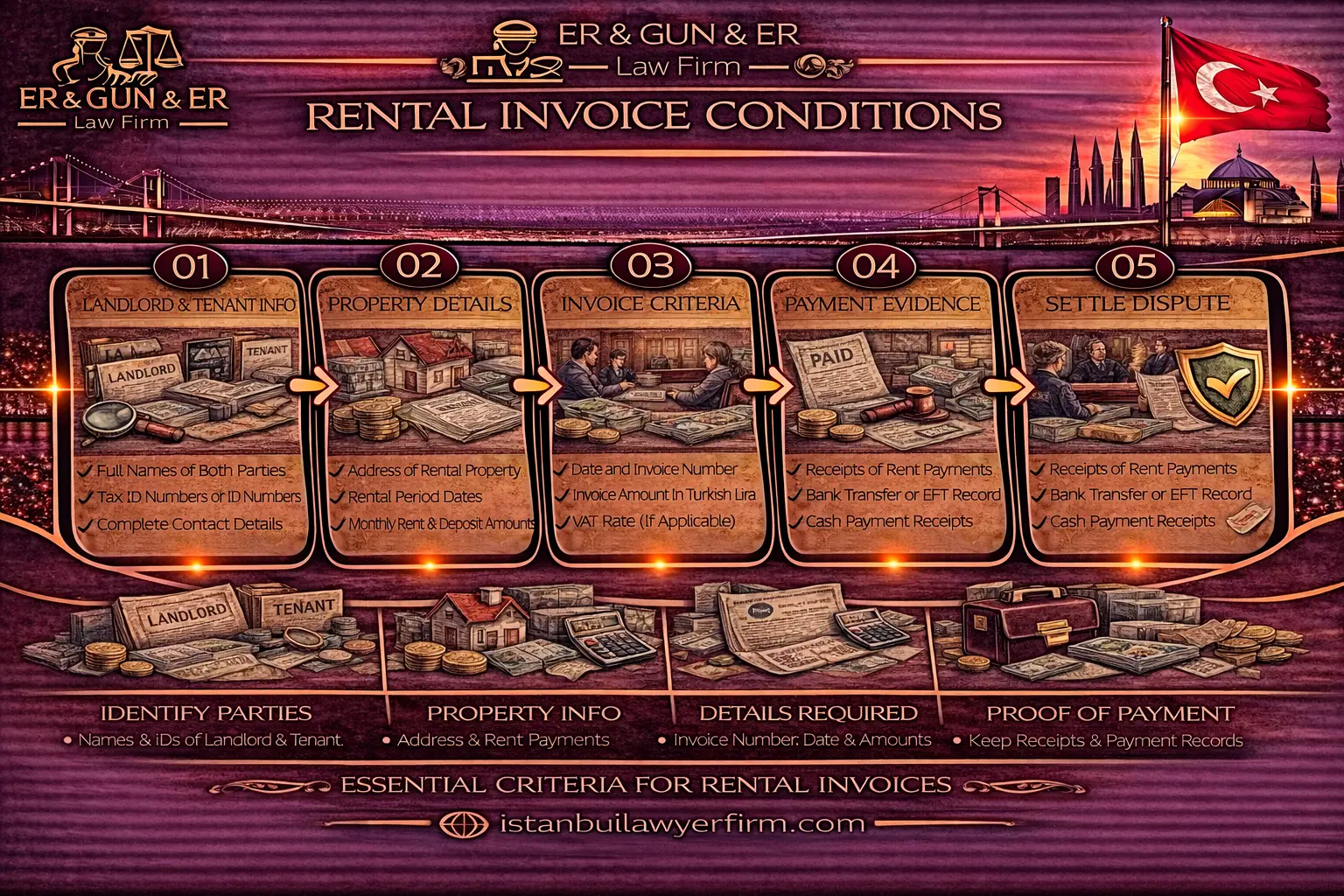
Rental documentation is not a cosmetic issue because it controls tax reporting, audit exposure, and courtroom proof. The phrase rental invoice conditions Turkey usually appears when a tenant cannot obtain formal documentation or when a landlord fears tax and penalty exposure. A rent relationship creates recurring payments, and those payments must be provable even if the parties never litigate. For tenants, rent payment proof Turkey is often the single most important exhibit in an eviction, deposit, or damages dispute. For landlords, invoice logic affects declared rental income, withholding positions, and the ability to reconcile bank inflows with the lease. For corporate tenants, documentation is also a compliance artifact that must match internal expense policies and external audit expectations. For foreign tenants, clear documents reduce banking friction when residence applications, reimbursements, or cross-border transfers are reviewed. The legal question is not only whether an invoice exists, but whether the issuer had the correct status and the document matches the payment trail. The tax question is not only what should have been issued, but how to correct documentation gaps without creating new contradictions. A structured approach coordinated with a lawyer in Turkey keeps the file consistent across lease, bank, and tax records.
Rental invoice overview
The concept of a rent invoice Turkey is tied to documenting a taxable and contractual payment, not merely producing paper for convenience. An invoice is typically used when the issuer is within a formal invoicing framework and the payment represents a reportable rental income stream. A lease can exist without an invoice, but a lease without consistent documentation often creates disputes about what was paid and when. In practice, the first question is who the landlord is, because the landlord’s status drives the documentation channel. The second question is who the tenant is, because corporate tenants usually need standardized documents for expense booking. The third question is what payment method is used, because bank transfers are easier to reconcile than cash. The fourth question is whether the rent includes additional items such as dues or utilities, because mixed charges need clear allocation. The fifth question is whether the property is residential or commercial, because reporting expectations and contract drafting styles differ. A well-run rent file begins with a signed lease, a rent schedule, and a bank reference format used every month. It continues with a monthly archive that stores the payment receipt and the landlord’s confirmation document if issued. It also includes any rent increase amendments and the dates those amendments became effective. Where a landlord collects through an agent, the file should show the agent authority and the agent receipts. Where the tenant pays via employer or parent, the file should document the payer and the payment purpose to avoid misclassification. When the parties treat documentation as optional, the first real problem appears at audit, at dispute, or at sale of the property. A disciplined documentation approach reduces conflict because each party can prove performance without relying on memory.
The reason a rental income invoice Turkey matters is that it connects the lease payment to a reportable income narrative. When documentation is inconsistent, banks and auditors often treat the inconsistency as a risk flag rather than as a harmless mistake. A landlord who issues documents should ensure that the document identity, date, amount, and address match the lease and the payment receipt. A tenant who receives documents should verify that the issuer name matches the landlord named in the lease. If the issuer is different, the tenant should request written explanation and supporting authority evidence. The document should also distinguish base rent from shared expenses if the lease separates them. If the lease is indexed or adjusted, the adjustment basis should be referenced consistently in the documentation trail. If the parties plan to use the rent file for corporate accounting, they should ensure that the documents are issued in the format accepted by the tenant’s auditors. If the rent is reimbursed by an employer, the employer may also request consistent documents to approve reimbursement. If the landlord is subject to additional reporting expectations, the landlord should coordinate with the accountant before issuing any recurring template. Errors repeated monthly become a pattern, and patterns are harder to explain than one-off mistakes. This is why the safest method is to design a monthly process that produces the same proof set each month. If the parties disagree on the correct document type, they should clarify the issuer status and the tenant use case in writing. In complex files, an Istanbul-based counsel team such as a law firm in Istanbul can align lease drafting, payment references, and documentation format. The objective is to create one coherent file that works for tax reporting and for dispute proof at the same time.
From a risk perspective, rental tax compliance Turkey is less about theory and more about consistent records that reconcile to bank inflows. A landlord who receives rent by bank transfer should maintain a clean statement archive that shows each monthly inflow. The landlord should also keep the lease and any amendments in the same archive so the rent amount is provable. If a tenant pays late, the landlord should document late payment and any agreed cure plan in writing. If the landlord accepts partial payments, the landlord should document allocation to avoid later disputes about arrears. If the property is managed, the landlord should ensure management reports and bank deposits are reconcilable. If the landlord uses different bank accounts over time, the landlord should notify the tenant in writing and preserve delivery proof. If the tenant changes payer identity, the tenant should explain the change so deposits are not treated as unrelated transfers. If the tenant is a company, the company should store documents in a way that passes its internal controls and external audit review. The file should also include any correspondence about invoice requests so later disputes about refusal are not speculative. In a dispute, courts tend to trust contemporaneous bank statements more than reconstructed ledgers. Therefore, the parties should avoid cash whenever possible and should avoid deleting bank notifications. If a dispute escalates, the same archive will be used for eviction, deposit, and damages arguments. An Istanbul Law Firm workflow often emphasizes building a single indexed binder so the file survives both tax and litigation scrutiny. Where reporting expectations change, “practice may vary by authority and year — check current guidance.”
Invoice versus receipt proof
Many disputes arise because parties confuse an invoice with a payment receipt and assume they are interchangeable. A receipt proves that a payment was made, while an invoice generally documents that a charge was issued and is recordable. The tenant rent invoice request Turkey issue usually appears when the tenant needs a formal document for internal accounting or reimbursement. In contrast, landlords often rely on bank transfer receipts as proof of collection because the bank record is objective. A tenant should store the bank receipt, the lease clause that states rent amount, and any landlord-issued document in one monthly folder. A landlord should store the bank statement page, the payment reference line, and any message that confirms allocation of partial payments. If a tenant pays cash, the tenant should insist on a detailed signed receipt because cash without receipt is a proof trap. If a landlord accepts cash without receipt discipline, the landlord creates future disputes about arrears and about tax reporting. If the landlord issues a document, the tenant should check that the address, period, and amount match the lease. If the landlord issues a document that mismatches the payment, keep both documents because mismatch evidence can support later correction requests. If the tenant’s auditor asks for documentation, provide the full set rather than only one piece because auditors test consistency. In disputes, the party with the cleanest monthly archive usually has stronger credibility. This is why counsel often advises to treat each month as a self-contained evidence unit with three proofs: lease, payment, and confirmation. Experienced Turkish lawyers often focus on building this monthly unit early because it prevents later argument drift. Where documentation forms differ by issuer status, “practice may vary by authority and year — check current guidance.”
The landlord rent invoice obligation Turkey question cannot be answered without first identifying the landlord’s tax status and documentation system. Some landlords can issue invoices through formal systems, while others document rent through alternative lawful records depending on status. Tenants sometimes demand invoices as if every landlord is an invoicing taxpayer, which can create friction and unrealistic expectations. Landlords sometimes refuse all documentation, which creates avoidable disputes and increases audit risk. The practical solution is to clarify, in writing, what document the landlord can issue and what document the tenant needs for its own file. If the landlord can issue an invoice, the tenant should request it with a clear period reference and delivery method. If the landlord cannot issue an invoice, the tenant should still insist on objective payment proof and a consistent confirmation record. Where a company tenant needs a formal document, the lease should address documentation and not leave it to informal monthly arguments. Where the tenant is reimbursed by an employer, the employer’s policy may require a formal invoice-like document, and that should be checked early. Landlords should also understand that refusing documents often escalates disputes because tenants then suspect undeclared income. Tenants should understand that labeling a landlord noncompliant without proof is not a legal strategy and can backfire. The best practice is to align documentation with the lease and with the payment channel so both sides can reconcile quickly. In high-value leases, parties often implement a monthly confirmation email that states the period, amount, and receipt of payment. A Turkish Law Firm compliance approach is to draft this confirmation language so it is neutral and does not create admissions. If authorities change documentation expectations over time, “practice may vary by authority and year — check current guidance.”
A rent invoice dispute Turkey often starts as a simple request but becomes a tax and litigation problem when it is handled informally. Tenants may claim that without an invoice they cannot book the expense and therefore cannot pay, which is usually a contract risk for the tenant. Landlords may claim that issuing documents is optional and refuse any confirmation, which is a risk for the landlord when proof is later needed. The first step is to read the lease and identify whether documentation is mentioned, because a silent lease creates negotiation space but no automatic entitlement. The second step is to separate payment duty from documentation duty, because paying rent is usually a contractual obligation regardless of monthly paperwork. The third step is to propose a practical documentation solution that can be produced monthly without creating new compliance risk. A common solution is bank transfer with a structured reference line that includes month and address. Another solution is a landlord confirmation letter that repeats the transfer details and confirms receipt. A tenant should avoid withholding rent solely to force an invoice because that behavior creates an arrears record that can be used against the tenant. A landlord should avoid issuing inconsistent documents because inconsistency can be interpreted as undisclosed income behavior. If the tenant is a company, the tenant should involve its finance team early because finance teams can often accept alternative documents if consistent. If the landlord is a company, the landlord should involve its accountant because the documentation format must match its reporting system. If the parties cannot agree, they should document their positions in writing so later the court sees good faith and clarity. If the dispute escalates into eviction threats, the parties should review how documentation disputes interact with lease default claims. Where legal obligations differ by status, “practice may vary by authority and year — check current guidance.”
Who must issue invoices
Who must issue rent documents depends first on whether the lessor is operating under an invoicing regime recognized by tax administration. The core framework for invoicing obligations and document validity sits within the Tax Procedure Law (VUK 213) and related guidance. An e-invoice rent Turkey requirement can arise for certain taxpayers, but the trigger conditions are not identical for every landlord profile. Landlords should therefore avoid assuming that a tenant request automatically creates an obligation to issue a specific document type. Tenants should also avoid assuming that every landlord can issue electronic documents on demand without prior system setup. The correct analysis begins with the landlord’s taxpayer status and whether the landlord is registered to issue invoices through the relevant platforms. If the landlord is a company, invoicing is usually part of the company’s regular reporting process and is integrated into its accounting system. If the landlord is an individual, the documentation channel may depend on how rental income is declared and how the landlord is classified for documentation purposes. If the property is sublet by a tenant, the tenant acting as sublessor may become the issuer for sublease documentation, depending on status. If the rent includes services bundled with lease, documentation may need to separate components to avoid later disputes about what was paid for what. If the tenant is a corporate entity, the tenant should clarify early whether its internal policy requires invoice format or whether bank documentation is acceptable. If the tenant is reimbursed, the reimbursement policy should be checked because reimbursement policies sometimes demand specific formats. If the parties are unsure, they should ask for written confirmation from accountants rather than improvising monthly. “practice may vary by authority and year — check current guidance.” A disciplined approach is to align document type, issuer capability, and payment channel so the monthly file is consistent.
Electronic documentation often includes multiple formats, and the correct format depends on the issuer’s system and the recipient’s status. The phrase e-archive invoice rent Turkey is used when a landlord issues an electronic invoice-like document to a recipient that is not in the e-invoice network. The practical issue is ensuring that the issued document is retrievable later, because disputes often occur months after payment. A landlord should store the issued document in a secure archive and should also store proof of delivery to the tenant. A tenant should store the document together with the bank receipt so the rent month is proven by two independent sources. If the tenant changes email address or contact details, the tenant should notify the landlord in writing so delivery disputes do not arise. If the landlord changes accounting software, the landlord should ensure past documents remain accessible and not locked in an old system. If the landlord uses a service provider to issue documents, the landlord should keep the service contract and understand retention duties. If the tenant uses a corporate expense system, the tenant should upload the document with metadata that matches the bank transfer date. If the document is issued with an incorrect address or period, the parties should correct it quickly and record the correction to avoid later confusion. If the document is issued with a wrong taxpayer identity, the tenant should request correction because wrong identity can harm deductibility and audit defense. If the document is issued late, parties should still record the payment month clearly so late issuance is not misread as non-payment. If the landlord cannot issue electronic documents, the tenant should adjust expectations and focus on bank proof and written confirmations. Where electronic document systems are expanded or changed, “practice may vary by authority and year — check current guidance.” The safest monthly routine is one where document issuance, bank payment, and lease period references are aligned every month.
The corporate tenant rent invoice Turkey question usually arises because corporate tenants need standardized documents that can be booked and audited. A corporate tenant is often unable to treat informal receipts as sufficient when internal policy demands a formal invoice-like document. Landlords should understand that corporate tenants may have audit requirements that are non-negotiable for the tenant. Tenants should understand that landlord capability is constrained by tax status and system enrollment, so demands must be realistic. The best approach is to clarify documentation in the lease clause so the parties are not negotiating each month under time pressure. If the tenant’s policy requires a specific format, the tenant should disclose that requirement during lease negotiation, not after move-in. If the landlord can issue the required format, the landlord should commit to a monthly delivery method and a consistent naming convention. If the landlord cannot issue the format, the tenant should decide whether alternative documents meet internal controls before signing. If the tenant withholds rent to force documentation, the tenant creates contractual default risk and weakens its negotiation position. If the landlord refuses to provide any documentation, the landlord increases dispute risk because the tenant will suspect undeclared income. A structured compromise is often bank transfer with a consistent reference line plus a landlord confirmation letter that can be archived. Another compromise is using a property management system that issues standardized statements, if the landlord’s status allows. When the tenant is a multinational, the file should also support cross-border audit questions about who received funds and why. In sensitive corporate disputes, advice from a best lawyer in Turkey can help align lease drafting, tax posture, and evidentiary strategy without creating admissions. If corporate invoicing obligations evolve, “practice may vary by authority and year — check current guidance.”
Individual landlord scenarios
The individual landlord rent invoice Turkey issue is often different from corporate leasing because individuals may not operate with corporate invoicing systems. Tenants should begin by identifying whether the landlord is acting as a private individual or as a registered business lessor. The lease should state the landlord identity clearly, including national identification or tax identification where appropriate. The payment method should be bank transfer whenever possible because bank proof is stronger than handwritten receipts. If a tenant pays cash, the tenant should insist on a detailed signed receipt that includes period and address. If the landlord provides a simple receipt, the tenant should store it with the lease and with the payment proof to create a complete monthly record. If the tenant requests an invoice-like document, the tenant should do so in writing and clarify the reason, such as corporate reimbursement. If the landlord cannot issue the requested document, the parties should agree on an alternative proof method rather than arguing each month. Alternative proof can include a landlord confirmation statement that references the bank transfer and the lease month. The landlord should also keep a ledger because later tax questions often ask how rental income was calculated. The tenant should also keep a ledger because later disputes often ask whether rent was paid consistently. If the landlord changes bank accounts, the landlord should notify the tenant in writing and the tenant should preserve that notice. If the tenant changes payer identity, the tenant should notify the landlord so deposits are not treated as unrelated transfers. Individuals sometimes use property managers, and in those cases the tenant should request proof of the manager authority. Where landlord status affects document type, “practice may vary by authority and year — check current guidance.”
The foreign tenant rent invoice Turkey question often arises because foreigners need documents for residence applications, employer reimbursements, or cross-border compliance checks. Foreign tenants should avoid paying cash because cash creates proof gaps that become difficult to explain outside Turkey. A bank transfer with a clear reference line is usually the strongest evidence because it is objective and easy to translate. Foreign tenants should also keep the signed lease and any extensions in one folder because consulates and banks may request it. If the landlord is an individual, the tenant should confirm what documentation the landlord can realistically provide and should not assume invoice availability. If the landlord is a company, the tenant should request the company’s standard monthly document and should store it together with bank receipts. If the tenant’s employer requests an invoice, the tenant should share the employer request in writing to support the tenant’s request to the landlord. If the tenant opens a local bank account, the tenant should keep account opening records because banks sometimes ask why rent payments were structured a certain way. If the tenant does not have a local account, the tenant should document how payments are transferred and what bank fees apply without claiming fixed rules. If the tenant is reimbursed, the tenant should ensure that the rental document shows the tenant name to avoid reimbursement denial. If the tenant pays from a family member’s account, document the relationship so later questions do not treat it as suspicious transfer. Foreign tenants should also plan exit documentation early because deposit and damage disputes often occur at move-out. When language barriers exist, advice from an English speaking lawyer in Turkey can help align lease drafting, invoice requests, and bank proof in a single coherent file. The tenant should store translations consistently and avoid multiple spellings of the same name across documents. Where banking and tax documentation requirements differ by profile, “practice may vary by authority and year — check current guidance.”
Individual landlord files often become contentious because the parties treat documentation as a matter of trust rather than as a matter of proof. The safest lease practice is to state the rent amount, the payment day, and the bank account in the contract so monthly disputes are reduced. Tenants should keep each month’s bank receipt and should not delete banking notifications because later disputes rely on these records. Landlords should label incoming transfers and should keep bank statements archived because later questions ask for reconciliation. If a landlord wants to increase rent, the landlord should document the increase agreement and the effective date to avoid later misallocation claims. If a tenant is late, the tenant should send a written explanation and a payment plan proposal rather than remaining silent. If a landlord accepts partial payment, the landlord should confirm allocation in writing so the tenant cannot claim that the payment covered a different month. If the parties use messaging apps, export the full thread rather than isolated screenshots to preserve context. If the landlord provides monthly confirmation statements, those statements should be dated and should reference the payment receipt details. If the landlord refuses confirmation, the tenant should still maintain bank proof and should record the refusal in writing to preserve good faith. If the landlord later claims non-payment, the tenant’s monthly archive will be the primary defense exhibit. If the tenant later claims overpayment, the same archive will support reconciliation. If a dispute escalates, parties should avoid informal threats and should shift to formal letters that align with the lease file. Informal threats often create secondary claims and distract from the main financial question. A clean documentation culture is therefore a practical risk control even when the relationship is friendly.
Corporate landlord scenarios
Corporate landlords usually run rent collection through formal accounting and treat rent as a recurring revenue stream. In that setup, the invoice for rent is part of the landlord’s monthly close, not an optional favor to the tenant. When the landlord is a company, rental income invoice Turkey must be consistent with the lease schedule and the bank inflows to avoid reconciliation gaps. The first control is to ensure the company’s tenant master data matches the tenant name in the lease and the tenant tax ID if available. The second control is to ensure the document period matches the month to which the bank transfer is allocated. The third control is to ensure that any side charges, such as dues or utilities, are clearly separated or clearly bundled according to the lease. Companies often use standardized billing templates, but templates should be reviewed before use because incorrect address or period fields create recurring errors. The tenant should verify that the issuer on the document is the actual lessor, not a management company that lacks contractual status, unless an authority chain is documented. The landlord should also confirm that corporate details on the document match Trade Registry records, because banks sometimes cross-check them during KYC refresh. If the tenant is a corporate group, the landlord should record the correct legal entity that will pay, because payment from an affiliate can create allocation disputes later. If the landlord receives partial payments, the landlord should document allocation in writing to prevent the tenant from claiming a different allocation later. A corporate landlord file should also store delivery proof for documents, because disputes often include arguments that the document was never received. The landlord rent invoice obligation Turkey question is usually answered by the landlord’s taxpayer status and the invoicing rules that apply to that status. Where rules are changing or depend on classification, “practice may vary by authority and year — check current guidance.” The core risk control is simple: the lease, the document data, and the bank statement must tell the same story.
Corporate landlords typically have accountants who reconcile rent collections with declared income and tax filings. That reconciliation is smoother when each payment is routed through bank transfer and the reference line matches the lease period. Corporate tenants often ask for documentation because they must justify rent expense in audits and internal controls. When documentation is provided, the landlord should keep the same document format every month so the tenant’s system can ingest it. If the landlord changes format, the tenant may reject the document and create payment delay that becomes a contractual dispute. Corporate landlords should also ensure that their rent records align with the broader rental tax compliance Turkey narrative they will use when responding to tax office questions. A practical way to keep this narrative consistent is to keep the lease, the bank statement page, and the issued document in one monthly folder. If the landlord receives deposits or advances, those items should be recorded distinctly so later months are not misread as unpaid. If the landlord uses a property manager, the landlord should document the manager’s authority and ensure the manager’s receipts match company books. If the landlord receives payment from a third party, the file should record why the third party paid and how the payment is allocated. If the lease is renewed or rent is increased, the company should update its billing parameters immediately and store the amendment with the billing logs. For a deeper discussion of how rental income is reported and reconciled, see rental income tax guidance and align your internal file structure with that logic. If the landlord is unsure which document type is expected in a specific scenario, counsel should coordinate with accounting rather than guessing. A Turkish Law Firm can also help draft consistent documentation clauses in the lease so the monthly routine is predictable. Where tax and document obligations depend on status or year, “practice may vary by authority and year — check current guidance.”
Corporate landlord disputes often start when the tenant claims the document was not issued correctly and delays payment to force correction. The landlord should respond by separating contractual payment duty from the administrative correction process and by keeping everything in writing. A rent invoice dispute Turkey is easier to resolve when both sides agree on a single correction workflow and a single delivery channel. The landlord should provide a dated response that confirms receipt of payment or confirms outstanding amounts, and then addresses documentation format as a separate item. If the tenant is a group, the landlord should identify the paying entity and the receiving entity so the dispute does not shift between affiliates. If the landlord is a group, the landlord should identify which group company is the lessor and which company issues documents so tenant compliance teams do not reject the file. Where the landlord issues electronic documents, the landlord should keep system logs that show issuance and delivery because those logs defeat “never received” arguments. Where the tenant uses internal purchase order systems, the tenant should disclose required fields early to avoid repeated rejection cycles. If the parties cannot align, the dispute can quickly expand into withholding of rent and allegations of default, which is why early written alignment matters. The landlord should also anticipate the audit risk rent invoices Turkey dimension because recurring mismatches between lease and document can trigger questions later. The tenant should also anticipate that refusing to pay rent due to paperwork can create evidence of default even when the tenant feels justified. If the relationship is already tense, counsel should use a controlled letter that proposes a correction plan and preserves rights without escalation. A coordinated Istanbul Law Firm workflow can standardize correction letters and keep the dispute from turning into monthly operational chaos. If litigation becomes likely, the parties should preserve the full correspondence chain and the delivery proofs for each document cycle. Where the acceptable correction method depends on the issuer’s system and the year’s guidance, “practice may vary by authority and year — check current guidance.”
Tenant type and documentation
Tenant documentation expectations depend on whether the tenant is an individual, a company, or a public body with strict expense rules. A corporate tenant rent invoice Turkey file is usually driven by internal audit requirements rather than by landlord preference. Corporate tenants often require documents that contain standardized fields, such as tenant name, address, period, and a clear description of the rent basis. If those fields are missing, corporate finance teams may not book the expense and may delay payment until the file is corrected. Individual tenants may be less formal in expense booking, but they still need proof when disputes arise or when immigration files require evidence. The tenant rent invoice request Turkey should therefore be framed as a documented request with a clear period and a clear delivery address. Tenants should also clarify whether they need the document for reimbursement, for corporate expense booking, or for tax reporting. Landlords respond better when they know the purpose because they can select the closest acceptable document type without guessing. If the tenant pays from a third-party account, the tenant should disclose that early so the landlord does not treat the payment as unrelated. If the tenant uses a purchase order system, the tenant should communicate required reference fields early to avoid repeated rejection cycles. If the tenant changes its legal name due to restructuring, the tenant should provide the new registration documents so the landlord can update billing data. If the tenant’s head office is abroad, the tenant should define where documents are archived and how originals are stored for audits. Tenants should also consider data security because rental documents include address and identity information that should not be shared widely. When the tenant’s documentation needs are unclear or evolving, “practice may vary by authority and year — check current guidance.” A practical approach is to agree a monthly document and payment routine in the lease and then follow it without improvisation.
Even when a tenant receives an invoice-like document, the tenant should treat bank transfer as the primary evidence because bank statements are objective. The rent payment proof Turkey should therefore be built around monthly bank receipts with consistent reference lines that state month and property. If the tenant pays cash, the tenant should insist on a signed receipt that identifies the period and the property, and should scan it immediately. Tenants should not assume that a landlord’s informal WhatsApp confirmation will be accepted by auditors or courts as a substitute for receipts. If the tenant is a foreigner, the foreign tenant rent invoice Turkey file should include translations of the lease and a consistent spelling of the tenant’s name across documents. Foreign tenants should also keep residence address registration proofs, because address proof often supports why a lease exists and why payments were made. Corporate tenants should store documents in a controlled repository so that later audits can retrieve the same version that was used for booking. Tenants should also keep proof of deposit payments separately because deposits are often disputed when the tenancy ends. If the tenant receives a correction document, the tenant should store both the original and the corrected version to show the history of the file. If the landlord refuses to issue documentation, the tenant should record the refusal in writing and continue paying through traceable channels to avoid default arguments. If the tenant plans to challenge the landlord’s tax posture, the tenant should still avoid turning rent payment into leverage because the lease payment duty remains. If the tenant is a company, the tenant should align the lease file with procurement rules and ensure approvals are stored with the lease. If the tenant is an individual, the tenant should still keep a monthly folder because future disputes often arise long after move-in. When documentation disputes become recurring, counsel from a law firm in Istanbul can help draft a neutral monthly confirmation template that preserves rights without escalating the relationship. Where acceptable proof formats differ by institution and year, “practice may vary by authority and year — check current guidance.”
Documentation choices should also anticipate disputes, because the same rent file is used in eviction, deposit, and damages arguments. A tenant who keeps a clean archive can answer allegations quickly without reconstructing payment history from memory. If the tenant later requests a refund of overpaid rent, the archive provides the reconciliation base. If the tenant later faces an eviction threat, the archive proves compliance and strengthens negotiation posture. If the tenant later disputes a deduction from the deposit, the archive shows whether rent was current and whether the landlord’s claims are linked to payment history. If the tenant later needs to prove residence for another process, the archive supports the narrative of lawful occupancy and consistent payments. Corporate tenants should align the lease archive with internal controls so that the same document set can be produced to auditors without delay. Individual tenants should also keep the archive because personal disputes often start years after the first payment was made. A recurring risk is that parties change emails and phone numbers and then claim they never received documents, so tenants should keep delivery confirmations. Another risk is that landlords change bank accounts and later deny receiving payment, so tenants should keep account change notices and match them to transfers. Tenants should also preserve any landlord acknowledgments about how partial payments were allocated, because allocation disputes are common. If the tenant is asked to explain why documentation differs from expectation, the tenant should respond with the proof set rather than with accusations. In high-stakes corporate audits, getting advice from Turkish lawyers early can prevent operational mistakes that later look like intentional non-compliance. The purpose of rental invoice conditions Turkey analysis is to align the tenant’s proof needs with the landlord’s compliance constraints in a realistic monthly routine. Where tenant documentation standards differ by auditor and year, “practice may vary by authority and year — check current guidance.”
E-invoice and e-archive basics
Electronic documentation is now the default expectation for many taxpayers, but the trigger conditions are not the same for every landlord profile. When parties discuss e-invoice rent Turkey, they should first identify whether the issuer is within the e-invoice network and what document type is permitted for the recipient. When parties discuss e-archive invoice rent Turkey, they should understand that e-archive is often used where the recipient is not an e-invoice taxpayer, but issuance rules are still tied to issuer status. The authoritative starting point for system concepts and official announcements is the Turkish Revenue Administration website, because it publishes guidance and links to official platforms. A landlord should avoid copying third-party blog claims about mandatory enrollment because those claims can be outdated quickly. A tenant should avoid insisting on a document type the landlord cannot lawfully issue because that creates monthly conflict without solving proof needs. The safest operational practice is to ask the landlord’s accountant which system the landlord is registered for and which output can be produced for the tenancy. The next step is to ensure that the electronic document includes correct period, address, and rent basis details so it matches the lease. The next step is to ensure that the electronic document can be verified later, because disputes often occur long after issuance. Verification matters because an electronic file that cannot be retrieved is practically useless as audit evidence. Archiving matters because electronic systems may change, but the tenant and landlord still need the past documents. If a tenant is corporate, the tenant should test whether its expense system accepts the landlord’s document format without manual edits. If a landlord is corporate, the landlord should test whether its billing system generates consistent files and delivery logs. In complex settings, counsel from a best lawyer in Turkey perspective focuses on building a retrieval-ready archive rather than chasing the “latest rule” by hearsay. Where electronic invoicing obligations depend on taxpayer status and the year’s guidance, “practice may vary by authority and year — check current guidance.”
The practical difference between electronic and paper documents is not only format but also how the issuer proves issuance and how the recipient proves receipt. The official gateway for many electronic document services is the e-Belge portal, which consolidates access to e-document frameworks. A landlord issuing electronic rent documentation should keep an issuance log and a delivery log because tenants frequently claim that documents were not delivered. A tenant receiving documents should store the file in a controlled repository and avoid relying only on an email inbox that may be deleted or changed. If the landlord corrects a document, the tenant should store both versions and record which version was used for expense booking. If the landlord issues a document with wrong period, the tenant should request correction promptly rather than waiting until year-end, because late corrections are harder to reconcile. If the landlord issues a document with wrong tenant name, the tenant should correct it because corporate auditors often reject mismatched names. If the landlord issues a document with wrong address, the landlord should correct it because address mismatch can undermine proof of occupancy. A consistent rent invoice Turkey file requires that each month’s document matches the payment receipt and the lease schedule. The tenant should also ensure that bank reference lines match the same month so the payment-to-document match is immediate. If the landlord receives payment from an affiliate company, document the affiliate relationship in writing to avoid later misclassification in the file. If the landlord has multiple properties, ensure that the document is mapped to the correct property to avoid mixing rent streams. When the tenant is reimbursed, the tenant should store a reimbursement approval alongside the rent document so the audit story is complete. If the tenant is preparing an audit binder, rental invoice conditions Turkey should be treated as a monthly routine rather than a year-end scramble. Where the acceptable e-document flow differs by issuer system, “practice may vary by authority and year — check current guidance.”
Electronic rent documentation failures usually appear as small technical errors that become large audit questions later. One common failure is issuing an electronic file that does not include the lease period clearly, which makes reconciliation hard. Another failure is using an inconsistent description line that changes each month, which triggers corporate tenant system rejection. Another failure is issuing documents to the wrong email or wrong recipient contact, which creates delivery disputes. Another failure is failing to archive the issued document in a retrievable structure, which prevents production during audit or dispute. If the landlord uses a third-party integrator, the landlord should have a written service contract that defines retention duties and retrieval support. If the tenant changes contact details, the tenant should notify the landlord in writing and preserve the notice so delivery disputes can be answered. If the landlord disputes whether it has a landlord rent invoice obligation Turkey in a specific scenario, the landlord should obtain accountant confirmation and document the conclusion. If the tenant insists on e-archive invoice rent Turkey documents, the tenant should confirm whether the landlord can issue that format lawfully and consistently. If the parties use electronic documents, they should also keep bank receipts because bank proof remains the strongest payment evidence even when documents exist. If a dispute arises, courts often focus first on payment proof and then on document integrity, because payment is the core contractual performance. Therefore, do not treat electronic documents as a substitute for bank evidence, and treat them as a complementary proof layer. If the tenant is foreign, translation and file sharing discipline matters because the tenant may need to present the documents to a bank or employer abroad. In cross-border situations, an English speaking lawyer in Turkey can help keep terminology consistent so the same document is not described differently in different languages. Where electronic issuance practices differ by platform and year, “practice may vary by authority and year — check current guidance.”
Banking payment trace rules
Bank transfers are the cleanest evidentiary tool in rent relationships because they create an objective timestamped record. A rent payment proof Turkey archive should therefore prioritize monthly bank receipts and full statement pages over informal confirmations. Tenants should use a stable reference line format that states the rent month and the property identifier to reduce allocation disputes. Landlords should also label incoming transfers in their internal ledger so reconciliation is immediate and not reconstructed later. If a tenant pays partial rent, the tenant should state in writing what the partial payment covers to prevent the landlord reallocating it. If a landlord accepts partial rent, the landlord should confirm allocation in writing so waiver arguments do not arise later. If the rent includes dues or utilities, parties should either pay them separately or specify allocation clearly so the bank trail matches the contract. If the tenant pays from an affiliate account, the tenant should document the affiliate relationship and preserve that documentation with the receipts. If the landlord changes bank accounts, the landlord should give written notice and the tenant should store the notice with the first payment to the new account. If a bank transfer is returned, preserve the return notice because it shows that the tenant attempted payment. If a tenant uses an international transfer, preserve SWIFT messages and keep them with the lease so the purpose is clear. If the landlord issues documentation, ensure that the rental income invoice Turkey record matches the bank inflow date and the period stated in the lease. If the tenant is audited, the bank record plus the lease is usually the most persuasive combination because it is third-party generated. If the landlord is audited, consistent bank inflows matching declared rent reduce suspicion and reduce later reconstruction burden. Where banking trace expectations differ by bank and year, “practice may vary by authority and year — check current guidance.”
Cross-border payment behavior creates extra questions because banks may ask why the rent payer and the tenant name differ or why amounts vary. A foreign tenant rent invoice Turkey file should therefore keep the lease, the residence address proof, and the bank receipts together in one folder. If the tenant does not have a Turkish bank account, the tenant should document how payments are initiated and what confirmations are received. If the tenant opens a Turkish account later, store the account opening confirmation because it can explain why payment channels changed mid-lease. If a tenant needs a guide for remote onboarding, remote account opening guidance is useful to understand what documents banks typically request. Tenants should avoid paying from multiple unrelated accounts because that pattern often triggers bank compliance questions and landlord reconciliation problems. Landlords should avoid insisting on cash payments because cash creates proof gaps that are hard to explain to banks and auditors. If the tenant is reimbursed by an employer, document employer reimbursement rules and match them to the rent documents so the story is consistent. If the tenant uses a payment service provider, export official receipts that show sender, receiver, date, and amount, and store them with bank statements. If the landlord refuses documentation, the tenant should still pay through traceable channels and request written confirmation of receipt. If the landlord provides documentation, the tenant should check that document identifiers match the payee bank account to avoid mismatch disputes. If the bank flags a payment as unusual, do not improvise an explanation and instead respond with lease and document proofs. If the dispute escalates, the bank trail often becomes the primary exhibit, which is why reference line discipline matters. In contested files, advice from a lawyer in Turkey helps keep bank communications and landlord communications consistent and prevents conflicting narratives. Where bank compliance expectations change over time, “practice may vary by authority and year — check current guidance.”
Payment trace discipline becomes decisive when the relationship deteriorates because parties start disputing months rather than days. A landlord who has a clean ledger can show default clearly without relying on interpretation. A tenant who has a clean ledger can show compliance clearly without relying on landlord goodwill. If a tenant claims that the landlord delayed issuing documentation, the tenant should still show that payments were made and should separate proof of payment from proof of documents. If a landlord claims that the tenant withheld payment due to paperwork, the landlord should show missing inflows and the dates they became missing. A rent invoice dispute Turkey often collapses into a default dispute when payments are not traceable, which is why bank references matter. Corporate tenants should avoid using internal netting or off-ledger offsets unless the lease explicitly permits it and it is documented in writing. Landlords should avoid accepting irregular cash arrangements because those arrangements create dispute narratives and audit exposure. If a tenant pays in advance, the tenant should document that the payment is an advance and should request a written allocation confirmation. If a landlord receives an advance, the landlord should record the advance separately so later months are not misread as unpaid. Corporate tenant rent invoice Turkey workflows often require that the bank receipt and the rent document match the same month, so mismatched months cause internal rejection. Therefore, tenants should coordinate payment date with documentation period to avoid a monthly mismatch cycle. If parties negotiate a settlement, the settlement should include a ledger reconciliation attached as an exhibit to avoid later disagreement about balances. If enforcement later becomes necessary, the enforcement file will rely on bank receipts and ledgers, not on verbal promises, so archive discipline saves cost. Where payment trace standards differ by institution and year, “practice may vary by authority and year — check current guidance.”
Withholding and tax logic
Withholding is the point where rent documentation becomes a tax workflow rather than only a private contract. Many disputes about rent invoices start because parties ignore who is responsible for reporting and remitting the tax component. The concept behind withholding tax on rent Turkey is that certain tenants may be required to deduct a portion of rent and remit it through their own tax reporting channels. Whether withholding applies depends on the tenant profile, the landlord profile, and the specific income characterization. You should treat this as a compliance question under the Income Tax Law (GVK 193) rather than as a negotiation tactic. Corporate tenants often ask for documents because they must reconcile the rent expense, the withholding, and the bank payment into one auditable chain. Individual tenants typically have fewer internal controls, but the landlord still needs consistency because bank inflows must align with declared rental income. The lease should clearly state whether rent is agreed as a gross amount or as a net amount after any statutory deductions. If the clause is unclear, parties later argue whether the tenant underpaid or whether the landlord over-demanded. A landlord who expects net payment should still document how the net is calculated and should store the tenant’s withholding proof if provided. A tenant who withholds should keep the remittance proof and should share a clear confirmation with the landlord to prevent arrears claims. If the tenant pays the full amount without withholding, the tenant should not assume that this choice is always neutral for the tenant’s own compliance. If the tenant withholds without sharing proof, the landlord may claim default because the landlord cannot verify that the missing portion was remitted. This is why the invoicing discussion cannot be separated from the payment trace and the tax trace. practice may vary by authority and year — check current guidance. The safest approach is to design a monthly file where the lease, the bank receipt, and the withholding confirmation tell the same story.
Once withholding is in play, the next question is how the rent file is reflected in the landlord’s broader reporting obligations. The landlord’s reporting route depends on whether the landlord is an individual or a corporate lessor and how the income is categorized in their filings. A consistent rental tax compliance Turkey record is built from three items: the signed lease, the bank inflow trail, and the document trail that explains any deductions or withholdings. If any item is missing, later audits often become a reconstruction exercise that consumes time and increases risk. Corporate tenants often require landlord documents because their own withholding or booking depends on matching identifiers and periods. Landlords should therefore keep tenant identity, property address, and period wording stable across the lease and every monthly document. If the landlord uses a property manager, manager remittances should be reconciled to the landlord’s bank statement and not treated as separate universe. If the landlord receives deposits or advance rent, those inflows should be labeled distinctly so they are not misread as monthly rent. If the landlord’s accountant asks for a consistent narrative, the easiest reference is the property and rental tax context explained in real estate tax guidance. Tenants should also understand that withholding and documentation choices can affect future disputes about overpayment or underpayment. Where the tenant withheld, the landlord should archive the tenant’s remittance confirmation together with the month’s bank receipt. Where the tenant did not withhold, the tenant should archive a written confirmation of the full payment so later arguments do not reclassify the payment. If the landlord issues electronic documents, keep delivery logs so the landlord can prove issuance and receipt without relying on memory. If the tenant is audited, the tenant should keep the lease and the payment trail together so the expense is defensible as a business expense. If either side argues that a different document type should have been used, the argument should be supported by accountant guidance rather than hearsay. practice may vary by authority and year — check current guidance.
Drafting and reconciliation are where most withholding disputes become litigation, because parties disagree about what the paid amount represents. A lease that states a net figure should also state how any statutory deductions are handled so the tenant cannot unilaterally change the net. A lease that states a gross figure should still anticipate how the tenant documents any deductions so the landlord can reconcile net receipts to gross rent. The best operational practice is to keep one monthly reconciliation sheet that records gross rent, paid amount, and the proof document identifiers. That reconciliation sheet should be kept with the bank receipt and with any document issued for that period. If the tenant provides a withholding confirmation, store it in the same month folder so future dispute questions can be answered in one minute. If the tenant does not provide confirmation, the landlord should request it in writing and preserve the request for later good faith evidence. If the tenant refuses to provide any confirmation, the landlord should treat the refusal as a risk signal and should consider revising the lease documentation clause for future months. When disputes escalate, the legal framing often references invoicing and recordkeeping duties under the Tax Procedure Law (VUK 213), but the decisive items are still the concrete receipts and logs. If the landlord expects a consistent method for correcting misissued documents, the landlord should coordinate with the accountant and avoid ad hoc corrections. If the tenant is a company, the tenant should coordinate with its finance team so that payment and documentation are aligned before the month closes. If a landlord receives a tax audit inquiry, a clean reconciliation file makes response faster because it shows the logic of each entry. If a tenant faces an expense audit, a clean reconciliation file makes defense easier because it ties the rent to a specific property and period. If the landlord later faces an assessment dispute, the procedural framing described in income tax assessment guidance can help structure responses without guessing fixed penalties or timelines. A good monthly routine prevents disputes because it makes underpayment and overpayment visible immediately rather than a year later. practice may vary by authority and year — check current guidance.
Foreign tenant considerations
Foreign tenants often need a stronger paper trail because third parties such as employers, banks, and immigration authorities ask for documentary consistency. The phrase foreign tenant rent invoice Turkey usually arises when a tenant is asked to show lawful accommodation and lawful payment history. The first step is ensuring the lease shows the tenant’s name exactly as in the passport, including consistent transliteration. The second step is ensuring the payment trail shows the same name or explains why a different payer sent the funds. If a spouse, employer, or parent pays rent, keep a written explanation of the relationship so the transfer does not look unrelated. The third step is ensuring that each month’s payment reference line identifies the rent period and the property address. The fourth step is storing the rent document, if any, together with the bank receipt in a monthly folder so retrieval is simple. The fifth step is controlling translations so that the same property address is not translated into multiple inconsistent versions. If the landlord issues electronic documents, the foreign tenant should store the original electronic file rather than only a screenshot. If the landlord issues a paper receipt, the tenant should scan it immediately and store the scan with the bank receipt. If the tenant pays from abroad, store the SWIFT confirmation and the bank charges details so the net amount is explained. If the landlord changes bank accounts, store the landlord’s written notice and the first payment to the new account side by side. If the tenant expects reimbursement, confirm the employer’s documentation policy before signing the lease to avoid later conflict. If the tenant must present documents to a foreign institution, keep a certified translation plan ready rather than translating under panic. If the tenant faces a dispute later, the monthly archive becomes evidence, so archive discipline is not optional. practice may vary by authority and year — check current guidance.
Foreign tenants sometimes assume that a rent invoice Turkey is the only acceptable proof, but courts and many institutions primarily rely on bank trace plus the signed lease. Therefore, the payment channel should be designed first and the document format second. If the tenant opens a Turkish account, keep account opening confirmations because they explain why payments moved from foreign transfers to domestic transfers. If the tenant cannot open a Turkish account, use one consistent foreign account rather than switching accounts monthly. If payments are split between multiple accounts, document the reason in writing so the landlord’s ledger remains coherent. If the landlord uses a manager, the tenant should request manager authority evidence and store it because payments to an unauthorized collector create dispute risk. If the tenant is a corporate expatriate, the tenant should ensure the lease names the correct employing entity if that entity is paying. If the tenant is self-employed, the tenant should store business travel records only if needed and should avoid oversharing irrelevant personal data. If the tenant wants a document for tax purposes abroad, the tenant should confirm what the foreign tax authority accepts before demanding a specific Turkish format. If the landlord is an individual, the tenant should clarify what document the landlord can provide and should not assume enrollment in electronic systems. If the landlord is a company, the tenant should confirm the monthly delivery channel and store delivery logs to avoid “never received” disputes. If the lease includes utilities in rent, the tenant should keep utility bills as supporting evidence of occupancy and payment logic. If the lease excludes utilities, the tenant should keep separate proofs of utility payments because they can support domicile narratives. If the tenant leaves Turkey, the tenant should provide updated contact details and bank details in writing to protect deposit return negotiations. If the tenant fears sudden eviction pressure, the tenant should keep a clean payment archive so default arguments are easily rebutted. practice may vary by authority and year — check current guidance.
Corporate expatriates often have stricter internal controls, which is why corporate tenant rent invoice Turkey questions appear frequently in multinational HR processes. The tenant should ask the employer whether a landlord confirmation letter is acceptable when the landlord cannot issue an invoice-like document. The tenant should also ask whether the employer requires the tenant name to appear as the payer or only as the beneficiary of the lease. If the employer pays directly, the lease should permit third-party payment and the landlord should confirm allocation monthly. If the tenant pays and is reimbursed, the tenant should store reimbursement approvals with the rent archive to create a complete audit story. If the employer requires electronic documents, confirm whether the landlord can issue electronic files consistently before signing. If the landlord cannot, negotiate an alternative proof method and record it in the lease so it becomes a contractual routine. If the tenant is moving between cities, the tenant should not reuse the old lease evidence for the new address, because address mismatch creates suspicion. If the tenant is renewing, the tenant should keep the renewal addendum and align the rent amount in the archive immediately. If the tenant expects to apply for residence permit extensions, the tenant should ensure address registration and lease documents are consistent. If the tenant is audited abroad, keep translations of the lease and key receipts in a single consistent set to avoid multiple conflicting versions. If the landlord requests extra KYC from the tenant, respond with documents but avoid sharing unnecessary sensitive data. If the tenant pays from a foreign account, document bank fees so small net differences are not misread as partial payment. If the tenant experiences payment delays due to banking compliance, the tenant should inform the landlord in writing and propose a cure schedule. If the landlord threatens default due to paperwork confusion, the tenant should respond with the bank proof set and keep the tone factual. practice may vary by authority and year — check current guidance.
Lease clauses on invoicing
The lease is the best place to prevent monthly disputes, because it can define what documentation will be provided and how it will be delivered. A tenant rent invoice request Turkey should not be negotiated after move-in, because after move-in the request becomes leverage and conflict. The clause should identify the document type the landlord will provide, such as an electronic document, a paper receipt, or a monthly confirmation statement. The clause should identify the delivery channel, such as email, portal, or physical delivery, so “never received” disputes are reduced. The clause should identify the period labeling format so the tenant and landlord can match documents to bank receipts easily. The clause should identify the correction workflow when a document is issued with wrong name, wrong address, or wrong period. The clause should also define whether the tenant’s payment duty is independent from documentation delivery, because withholding rent for paperwork is a common escalation trigger. The clause should define the bank reference line format and require that the tenant includes the rent month and the property reference. The clause should define whether side charges are invoiced separately or bundled, because bundling creates allocation disputes later. The clause should define whether deposits are documented separately and how deposit proof is stored, because deposit disputes often arise at move-out. For deposit documentation logic, a useful cross-reference is security deposit rules, which highlights why separate proof sets reduce later conflict. The clause should define record retention expectations, such as how long the landlord will keep delivery logs and how long the tenant will keep receipts. The clause should also include privacy discipline by limiting document sharing to the parties and their auditors where required. The clause should define who can request documents on the tenant side, especially when the tenant is a company with multiple departments. The clause should define what happens if the landlord changes bank account so the tenant is not paying to an obsolete account. practice may vary by authority and year — check current guidance.
A lease clause should also clarify which party bears the compliance burden when documentation obligations change. The landlord rent invoice obligation Turkey question is often misframed as a pure tenant entitlement, but it is primarily a landlord status and tax procedure issue. Therefore, the clause should acknowledge that the landlord will issue documents according to the landlord’s lawful system enrollment and the current guidance. The clause should avoid promising a specific electronic system if the landlord is not yet enrolled, because non-performance will be inevitable. Instead, the clause should describe an output obligation, such as providing an electronic document or a confirmation statement that includes required fields. If the tenant requires e-documents for corporate booking, the tenant should disclose that requirement and the landlord should confirm capability in writing. If capability cannot be confirmed, the parties should adopt a bank-proof plus confirmation-letter approach to protect both sides. The clause should clarify whether the rent is agreed as gross or net, because net clauses create withholding conflicts if not specified. The clause should define whether any withholding certificate or confirmation will be shared and within what practical time window, without stating statutory deadlines. The clause should define how corrections are handled when documents are issued late, because late corrections are common in the first months. The clause should define whether the tenant may use a third-party payer and how that payer is disclosed to the landlord. The clause should define whether the landlord may use a property manager to issue confirmations and what authority evidence supports that manager. The clause should define the language of the documents if the tenant is foreign and needs English summaries, while preserving Turkish originals. The clause should define that disputes about documents do not automatically justify non-payment unless the contract expressly provides otherwise. The clause should define a written notice channel for invoicing requests so requests are provable rather than verbal. practice may vary by authority and year — check current guidance.
A strong clause also anticipates what happens when the relationship deteriorates and the parties stop cooperating informally. The safest default is that the tenant continues paying through bank transfer and preserves rent payment proof Turkey in a monthly archive. The clause can require that the tenant uses one bank account and one reference format to prevent confusion about payer identity. The clause can require that the landlord acknowledges receipt by a short monthly confirmation email that references the transfer date and amount. The clause can also require that any dispute about period or amount is raised within a practical time window so errors are not carried for months. The clause can state that silence does not equal acceptance for disputed items, which reduces later waiver arguments. The clause can require that both parties keep updated contact details and that contact changes are notified in writing with delivery proof requirements. The clause can define how documents are re-sent if an email bounces, so “delivery failed” is handled systematically. The clause can define whether physical copies will be provided upon request and who bears courier cost if copies are needed abroad. The clause can define that the tenant may provide documents to auditors and regulators but not publish them publicly. The clause can define that the landlord may share limited rent data with its accountant and tax adviser for reporting. The clause can define whether the tenant may offset any claims against rent, and in most cases it should prohibit unilateral offsets to prevent default. The clause can define that disputes will be discussed first in writing and then escalated to counsel if unresolved. The clause can define that any settlement about documentation will be recorded as an addendum so it becomes part of the contract. The clause can define that the lease file is the single source of truth and that oral promises do not modify it. practice may vary by authority and year — check current guidance.
Disputes and evidentiary value
Documentation becomes most valuable when the parties are no longer cooperative and the dispute is being framed for court or enforcement. A rent invoice dispute Turkey often appears first as an accounting request but later becomes an eviction or deposit argument. Courts tend to prioritize objective proof, which means bank receipts and dated written notices usually carry more weight than informal messages. An invoice can support the narrative of what was charged for a period, but it does not replace proof of payment. A tenant who has bank proofs and a clean lease file can rebut default allegations more effectively than a tenant who relies on landlord confirmations alone. A landlord who has a clean lease file and a clean ledger can show default more effectively than a landlord who relies on memory. If the dispute escalates to eviction, the evidentiary discipline described in eviction procedure guidance becomes relevant because notices and payment proofs are central exhibits. Disputes also involve deposits and damages, and the deposit file often turns on whether rent was current and how deductions were documented. Corporate tenants also face internal disputes when documents are missing, because internal auditors may flag the expense even if rent was actually paid. Therefore, corporate tenants should store documents in a way that is retrievable years later rather than only at year-end. Landlords should also store documents in a way that is retrievable during tax review rather than relying on integrator access that may change. If a document was corrected, the parties should store both the original and corrected versions to show the timeline of correction. If the landlord refused documentation, the tenant should store the refusal in writing because it can explain why the tenant’s archive contains only bank proofs. If the tenant paid from a third-party account, the tenant should store the explanation so the landlord cannot later claim the payment is unrelated. If the rent includes side charges, allocation should be documented because allocation disputes are frequent in court. practice may vary by authority and year — check current guidance.
Documentation quality also influences tax exposure because inconsistencies are often treated as audit triggers rather than harmless mistakes. The phrase audit risk rent invoices Turkey captures the reality that recurring mismatches between lease, bank statements, and issued documents invite questions. When a landlord’s bank inflows do not match declared rent income, the first response is usually a request for explanation and supporting records. When a tenant’s rent expense does not have matching bank proof, internal auditors often flag the expense and require reconstruction. When the landlord issues documents with wrong periods, the mismatch can look like unreported months even if payments were made. When the tenant pays from multiple accounts without explanation, the inflows can look like unrelated transfers and require additional justification. When the tenant pays cash and the landlord does not issue detailed receipts, both parties lose proof strength in both tax and dispute contexts. The most reliable defense is a consistent monthly package that links lease, payment, and document for each month. If the package is incomplete, correction should be done promptly and documented as a correction rather than leaving silent gaps. If the landlord is unsure which document format is accepted, the landlord should follow official guidance and accountant instruction rather than hearsay. If the tenant is unsure whether a document is valid, the tenant should request correction in writing and preserve the request. In an audit, the issue is often not intent but inability to produce consistent records, and inability is treated as risk. Therefore, record retention and retrieval processes are part of tax governance even for simple leases. If a dispute becomes litigious, inconsistent tax records can be used by the other side to attack credibility. practice may vary by authority and year — check current guidance. The practical lesson is that consistent documentation reduces both tax friction and litigation friction.
When disputes persist, parties usually need a structured position that separates tax compliance concerns from contract performance concerns. A tax lawyer Turkey rental invoices perspective is useful because it forces you to reconcile what was charged, what was paid, and what was reported. For the tenant, the key question is whether the rent can be booked as an expense and defended with a clean payment trail and a consistent lease file. For the landlord, the key question is whether the inflows are explainable and consistent with the landlord’s reporting narrative and records. If the tenant threatens to stop paying until an invoice is issued, the tenant should understand the default risk created by withholding payment. If the landlord threatens eviction due to a paperwork dispute, the landlord should understand that courts still require a clean default proof set. Therefore, both sides should separate the payment plan from the document correction plan and run them in parallel. A correction plan should state which months are affected, which documents must be corrected, and how delivery will be proven. A payment plan should state which months are paid, how payments are referenced, and how any withheld component is documented if withholding applies. If the parties reach agreement, they should record the agreement as a lease addendum so the routine becomes contractual and not informal. If the landlord uses an integrator, the addendum should state who is responsible for retrieval if the tenant needs documents later. If the tenant is a company, the addendum should state who on the tenant side can request documents so requests are controlled. If the tenant is foreign, the addendum should state language and translation expectations while preserving original Turkish documents. If the parties cannot agree, they should keep correspondence factual and exhibit-backed so later litigation is about records, not accusations. If the dispute escalates to enforcement, the party with the cleaner bank trail and the cleaner notice chain usually has the advantage. practice may vary by authority and year — check current guidance.
Audit and penalty risk
An audit typically starts with a mismatch between declarations and bank inflows. In rent relationships, the mismatch is often a missing period alignment between the lease and the documents. Auditors look for consistency across contract, bank statement, and issued document. If months are missing, the first question becomes whether the payment was received but not recorded, or recorded but not documented. If payments are in cash, the absence of signed receipts becomes a structural weakness. If payments are from third parties, the absence of explanation notes makes inflows look unrelated. If the landlord issues invoices inconsistently, the inconsistency can be read as selective reporting. If the tenant books expenses without bank proof, the tenant’s file can be challenged in corporate audits. The phrase audit risk rent invoices Turkey describes this pattern of repeated inconsistencies rather than a single mistake. In rental tax compliance Turkey planning, the safest defense is a monthly folder that reconciles each period. Corrections are easier when performed close to the original month because banks and systems still retain logs. Corrections become harder when years pass and contact details and accountants change. Parties should avoid backfilling narratives that are not supported by contemporaneous records. A controlled review by a law firm in Istanbul can align the documentary story before submission. For high-stakes corporate files, a best lawyer in Turkey approach is to treat the rent file as audit evidence from day one.
Penalty exposure is usually triggered by document non-issuance, incorrect issuance, or lack of retention. The risk is higher when a landlord changes formats mid-year without preserving delivery logs. The risk is also higher when a tenant insists on an invoice but pays in a way that cannot be reconciled. In individual landlord rent invoice Turkey disputes, parties often mix legal entitlement debates with proof gaps. The more realistic approach is to document what can be issued lawfully by the landlord’s status. Where electronic documents are used, e-archive invoice rent Turkey files should be stored in retrievable form, not only emailed once. If a document is corrected, both the original and the corrected version should be archived with an explanation note. If a landlord uses an integrator, the landlord should confirm retention responsibilities contractually. If a tenant books rent without receiving any document, the tenant should keep a written request chain and bank proof. If the landlord receives rent from abroad, the landlord should keep SWIFT proofs to support the business purpose of inflows. If there is a dispute about who is the recipient, the bank account name and the lease lessor name must be reconciled. “practice may vary by authority and year — check current guidance.” A coordinated compliance file prepared by an Istanbul Law Firm reduces the chance that missing months become a pattern. A Turkish Law Firm can also coordinate accountant communication so the record is consistent in submissions. The key is not predicting penalties, but eliminating the underlying inconsistency that triggers them.
Audit risk is also shaped by how disputes are documented, because dispute letters become part of the record. If parties argue by phone, there is no traceable explanation for later discrepancies. If parties argue by message without attachments, the messages are hard to reconcile to bank statements. A rent invoice dispute Turkey should be handled with a written timeline that lists month, amount, and the document requested. If withholding is involved, the file should show whether withholding tax on rent Turkey was applied and how the withheld portion was documented. If the tenant withheld but did not share remittance proof, the landlord may treat it as arrears in the ledger. If the landlord treated it as arrears, the tenant may treat it as compliance, and the inconsistency becomes a dispute exhibit. The practical fix is to create a monthly reconciliation statement signed or confirmed by email. If the landlord refuses to confirm, the tenant should still keep bank proof and the request chain. If the tenant refuses to pay until documents are issued, the tenant creates default risk and adds new dispute layers. If the landlord threatens eviction based on paperwork alone, the landlord should still expect a court to test payment proofs first. “practice may vary by authority and year — check current guidance.” In cross-border tenancies, an English speaking lawyer in Turkey can help align the documentary story in one language set. In domestic high-volume portfolios, Turkish lawyers often implement a standardized monthly archive to reduce audit exposure. Audit safety is therefore a process design problem, not a one-time letter problem.
Corrective steps and disclosures
Corrective action starts with identifying exactly which months have missing or inconsistent documents. The next step is verifying the bank trail for those months and confirming that payments are traceable. Then verify the lease amendment history to ensure the correct amount and period were used. If the landlord issued a document with the wrong tenant name, correct it and preserve both versions. If the landlord issued the wrong period, issue a correction and record the correction reason. If the tenant used the wrong payer account, document the relationship between payer and tenant. If the landlord’s bank account changed, preserve the written notice and link it to the first payment. If the tenant paid cash, obtain missing receipts where possible and archive them immediately. Where electronic systems are involved, confirm that the correction method preserves retrievability for future audits. Do not attempt to fix the story by creating documents that contradict the bank statement dates. “practice may vary by authority and year — check current guidance.” A practical corrective plan for rental invoice conditions Turkey should be written as a month-by-month checklist, not as a vague promise. When a rent invoice Turkey is required for the tenant’s internal booking, the correction plan should specify delivery channel and retention. A lawyer in Turkey can coordinate correction letters so they preserve rights without triggering default arguments. For foreign tenants and foreign-funded rents, an English speaking lawyer in Turkey can ensure that the corrected file remains consistent across languages.
Disclosures are often necessary when corrections change what was previously communicated to accountants or auditors. The safest disclosure is one that states the factual correction without adding moral explanations. If the landlord is a company, internal accounting should be updated so the corrected document matches the ledger. If the tenant is a company, internal expense booking should be updated so the corrected document matches the bank receipt. If electronic documents are used, confirm whether the issuer’s system supports correction issuance and retrieval. If the issuer is enrolled in e-invoice rent Turkey flows, ensure the correction follows the issuer’s official method. If the issuer uses e-archive, ensure the corrected file is delivered and logged, not only generated. If third-party integrators are used, confirm that integrator logs are preserved for the correction cycle. If the correction changes net payment logic, communicate clearly whether any balance remains due. If the correction affects withholding records, request that the tenant provides updated confirmation records. If a dispute already exists, send corrections through counsel to avoid misinterpretation as admission. “practice may vary by authority and year — check current guidance.” In audit risk rent invoices Turkey planning, disclosures should be timed so they do not create a year-end scramble. A law firm in Istanbul can coordinate landlord and tenant communications so the correction process is controlled. An Istanbul Law Firm can also coordinate document indexing so the corrected versions are retrievable under pressure.
Corrective steps should also address future months by redesigning the monthly routine to prevent recurrence. If the problem was missing period labels, set a fixed reference line format for bank transfers. If the problem was delayed issuance, agree a monthly issuance date concept that matches the tenant’s closing calendar. If the problem was wrong recipient identity, update master data and confirm it in writing. If the problem was mixed charges, separate rent and utilities in payment and documentation where feasible. If the problem was withholding confusion, clarify gross versus net language in the lease and preserve remittance proofs. If the problem was lack of archive, create a shared folder structure with month identifiers and version control. If the tenant is corporate, ensure the monthly file meets internal audit acceptance before the next cycle closes. If the landlord is corporate, ensure the monthly file reconciles to declared rental income and bank statement. If the landlord is an individual, ensure the monthly file still supports rental tax compliance Turkey without relying on informal messages. If the landlord issues a rental income invoice Turkey document, verify that it matches the bank receipt in amount and period. “practice may vary by authority and year — check current guidance.” A conservative strategy preferred by a best lawyer in Turkey is to treat every correction as a chance to improve the control system. In portfolio settings, Turkish lawyers often implement standardized templates so corrections become rare. The objective is to reduce both tax exposure and litigation exposure by eliminating ambiguity.
Enforcement and collection use
Documentation is also used as leverage in enforcement and collection because execution files run on written proof. When arrears arise, the first question is whether the creditor can prove the contractual basis and the payment history. The lease, the payment ledger, and the monthly documents together form that proof set. Rent payment proof Turkey is usually shown by bank statements and consistent reference lines rather than by memory. If the landlord claims arrears, the landlord should provide a month-by-month ledger supported by receipts. If the tenant disputes arrears, the tenant should provide a reconciliation supported by receipts. When parties escalate beyond negotiation, the procedure described in enforcement proceedings workflow becomes relevant to understanding how documents are used. Enforcement offices typically focus on whether the document set is coherent, not on who is morally right. Therefore, a rent invoice dispute Turkey should be reduced to a numeric reconciliation rather than a broad accusation. If the dispute is about missing documentation, the correction history should be attached to show good faith. If the dispute is about withholding, remittance proof should be attached to prevent double-payment claims. If the dispute involves a corporate tenant, the corporate booking trail can support the fact of payment and period. If the dispute involves a foreign tenant, translations should be consistent so the same month is not described differently. A Turkish Law Firm can structure the enforcement-ready binder so each month is an exhibit. A lawyer in Turkey can also draft neutral reconciliation letters that preserve enforcement rights without escalation.
Collection planning should also separate possession disputes from money disputes because mixing them slows both tracks. If the landlord is pursuing unpaid rent, the landlord should treat the file as a receivable file with a clear ledger. If the tenant is disputing charges, the tenant should narrow disputes to specific months and specific documents. Corporate tenant rent invoice Turkey files often include internal approvals that can support or refute period allocation. If withholding tax on rent Turkey is relevant, the remittance confirmation becomes part of the collection binder. If the landlord ignores remittance proofs, the landlord may claim arrears that do not actually exist. If the tenant fails to provide remittance proofs, the tenant may lose credibility even when withholding was lawful. For collection mechanics and negotiation posture, debt collection strategy provides a structured approach that relies on documents rather than threats. Collection risk also depends on whether the debtor has attachable assets, which is a practical, not moral, question. Therefore, parties should evaluate settlement options early when collectability is uncertain. A settlement should include a signed ledger reconciliation and a bank transfer schedule with reference lines. If a settlement is not possible, the claimant should keep each month’s proof in a separate exhibit bundle. If the tenant is foreign or bilingual, the claimant should avoid inconsistent translations of amounts and periods. A English speaking lawyer in Turkey can help produce a bilingual proof package that banks and courts can read. “practice may vary by authority and year — check current guidance.”
A rent documentation file is also used defensively when the other side threatens eviction for alleged non-payment. The party who can produce a clean monthly ledger can often settle faster because default claims are easier to test. In an eviction context, courts usually ask first whether rent was paid and whether notices were served correctly. Therefore, rent documentation should be archived in a way that allows quick production of specific months. The file should include the lease clause that states the rent amount for that specific month. The file should include the bank receipt that shows the transfer date and amount for that month. The file should include any landlord confirmation or issued document for that month if available. The file should include any correspondence about allocation when payments were partial. The file should include any correspondence about bank account changes so payments are not misdirected. The file should include any correction documents and the explanation note for why correction was needed. If deposit or damages disputes arise at exit, the rent ledger also affects whether deductions are claimed as set-off. If a tenant claims overpayment, the same ledger supports refund calculations and reduces guesswork. If a landlord claims underpayment, the same ledger supports precise arrears calculation and reduces exaggeration. If parties want to avoid repeat litigation, they should close the file with a signed reconciliation at move-out. “practice may vary by authority and year — check current guidance.”
Practical roadmap
A practical routine starts with one clear lease file, one clear payment channel, and one clear document archive. Each month should produce a consistent bundle that includes the lease schedule for that period, the bank receipt, and the issued document or confirmation if applicable. Keep the payment reference line stable so the month is identifiable without interpretation. Store the bundle in a folder named with the month and year so retrieval is immediate. Record any rent increases with a written amendment and update the rent schedule on the same day. Record any bank account changes with written notice and store the notice with the first payment to the new account. If the tenant is corporate, confirm that the document format meets internal controls before the first month closes. If the landlord is corporate, confirm that the document format reconciles to accounting entries without manual edits. If the landlord is an individual, confirm what document can be provided consistently and record that agreement in writing. If the tenancy includes deposits, store deposit proof separately to avoid mixing it with monthly rent. If the tenancy includes utilities, store utility proofs separately to avoid allocation disputes. If an error occurs, correct it promptly and preserve both versions to show the correction trail. “practice may vary by authority and year — check current guidance.” A roadmap for rental invoice conditions Turkey should therefore be designed as a monthly control system, not as an annual panic response.
Foreign tenants should design the file for third-party review, because banks, employers, and immigration authorities often ask for consistent documents. Pay through bank transfer whenever possible and preserve rent payment proof Turkey in a monthly archive with stable file names. If the tenant needs a Turkish bank account but cannot attend in person, consult remote account onboarding guidance and align the account file with the lease. Avoid switching payer accounts without written explanation, because multiple payer identities are difficult to explain later. If an employer pays directly, preserve the employer instruction and the landlord acknowledgment so purpose is clear. If the landlord uses electronic documents, store original files and delivery logs rather than only screenshots. If the landlord provides paper receipts, scan them immediately and store them with the bank receipt. If the tenant changes email or phone, notify the landlord in writing and store the notice so delivery disputes are avoided. If the lease is renewed, store the renewal addendum and update the monthly schedule without delay. If the landlord changes bank accounts, store the change notice and verify the first payment to prevent misdirected transfers. If the tenant expects reimbursement, confirm what document is acceptable and record that in the lease clause for predictability. If the tenant expects later disputes, preserve all requests and refusals in one correspondence thread. “practice may vary by authority and year — check current guidance.” A foreign tenant rent invoice Turkey file that is organized from the first month is easier to defend than a file reconstructed after conflict.
Dispute readiness means you can answer a claim about arrears or documents within minutes using exhibits. Keep a reconciliation sheet that shows each month’s due rent, paid rent, and document identifier so disputes are numeric. If a rent invoice dispute Turkey arises, respond by pointing to specific months and specific missing items, not by general accusations. If an audit occurs, the same reconciliation sheet shows that the file is controlled and not improvised. The phrase audit risk rent invoices Turkey is reduced when the reconciliation sheet matches the bank statement and the lease amendments. If withholding is involved, store remittance proofs in the month folder so net and gross discussions are not speculative. If a tenant refuses to pay due to missing documents, document the refusal and propose a correction plan while continuing to pay through traceable channels where contractually required. If a landlord refuses to provide any document, document the refusal and rely on bank proof and written requests for later good faith evidence. If the case escalates to enforcement, the enforcement binder should include the same monthly bundles and the same reconciliation sheet so the office can verify quickly. If the case escalates to eviction, the rent bundles become the first defense or the first claim proof. If the parties settle, attach the reconciliation sheet to the settlement as a schedule so balances are closed. If the tenancy ends, close the file with a move-out protocol and keep the deposit file separate to prevent mixing. If the parties are cross-border, translate only key documents once and reuse the same translation to avoid drift. “practice may vary by authority and year — check current guidance.” A disciplined file reduces both litigation risk and tax exposure because it makes the story consistent and provable.
FAQ
Q1: Rental documentation matters because it drives tax reporting and later dispute proof. A consistent monthly archive is usually more persuasive than informal confirmations. Always preserve bank receipts with clear reference lines.
Q2: An invoice documents the charge, while a receipt or bank statement documents payment. In most disputes, payment proof is examined first. Keep both whenever available.
Q3: Whether a landlord must issue a specific document depends on taxpayer status and system enrollment. Do not assume universal obligations from templates. “practice may vary by authority and year — check current guidance.”
Q4: Corporate tenants often need standardized documents for expense booking and audits. Clarify documentation in the lease to avoid monthly conflict. If a format is not available, agree on an alternative proof method.
Q5: Individual landlords may document rent differently than corporate landlords. Tenants should still pay through traceable channels and preserve receipts. Documentation disputes should not be handled by withholding rent without legal review.
Q6: Electronic documents should be stored in original form with delivery logs. Screenshots are weak evidence compared to original files. Preserve both the original and any corrected versions.
Q7: Bank transfer is usually the strongest payment proof because it is third-party generated. Use a stable reference line that identifies month and property. Keep monthly folders for quick retrieval.
Q8: Withholding questions must be aligned with the lease clause and the payment ledger. If withholding is applied, keep remittance confirmations in the same month folder. “practice may vary by authority and year — check current guidance.”
Q9: Foreign tenants should prioritize consistent name spelling and consistent payment channels. If third parties pay, document the relationship and purpose. Keep translations consistent across filings.
Q10: Audit exposure increases when lease, bank statements, and documents do not match. A reconciliation sheet reduces risk because it explains each month’s story. Correct errors promptly and document corrections.
Q11: Documentation becomes crucial in eviction, deposit, and damages disputes. Courts usually test payment proof and notice discipline first. Keep a complete correspondence and receipt archive.
Q12: The safest approach is a monthly control system that produces the same proof set every month. Use written change notices for account changes and rent increases. “practice may vary by authority and year — check current guidance.”
Author: Mirkan Topcu is an attorney registered with the Istanbul Bar Association (Istanbul 1st Bar), Bar Registration No: 67874. His practice focuses on cross-border and high-stakes matters where evidence discipline, procedural accuracy, and risk control are decisive.
He advises individuals and companies across Sports Law, Criminal Law, Arbitration and Dispute Resolution, Health Law, Enforcement and Insolvency, Citizenship and Immigration (including Turkish Citizenship by Investment), Commercial and Corporate Law, Commercial Contracts, Real Estate (including acquisitions and rental disputes), and Foreigners Law. He regularly supports corporate clients on governance and contracting, shareholder and management disputes, receivables and enforcement strategy, and risk management in Turkey-facing transactions—often in matters involving foreign shareholders, investors, or cross-border documentation.
Education: Istanbul University Faculty of Law (2018); Galatasaray University, LL.M. (2022). LinkedIn: Profile.