

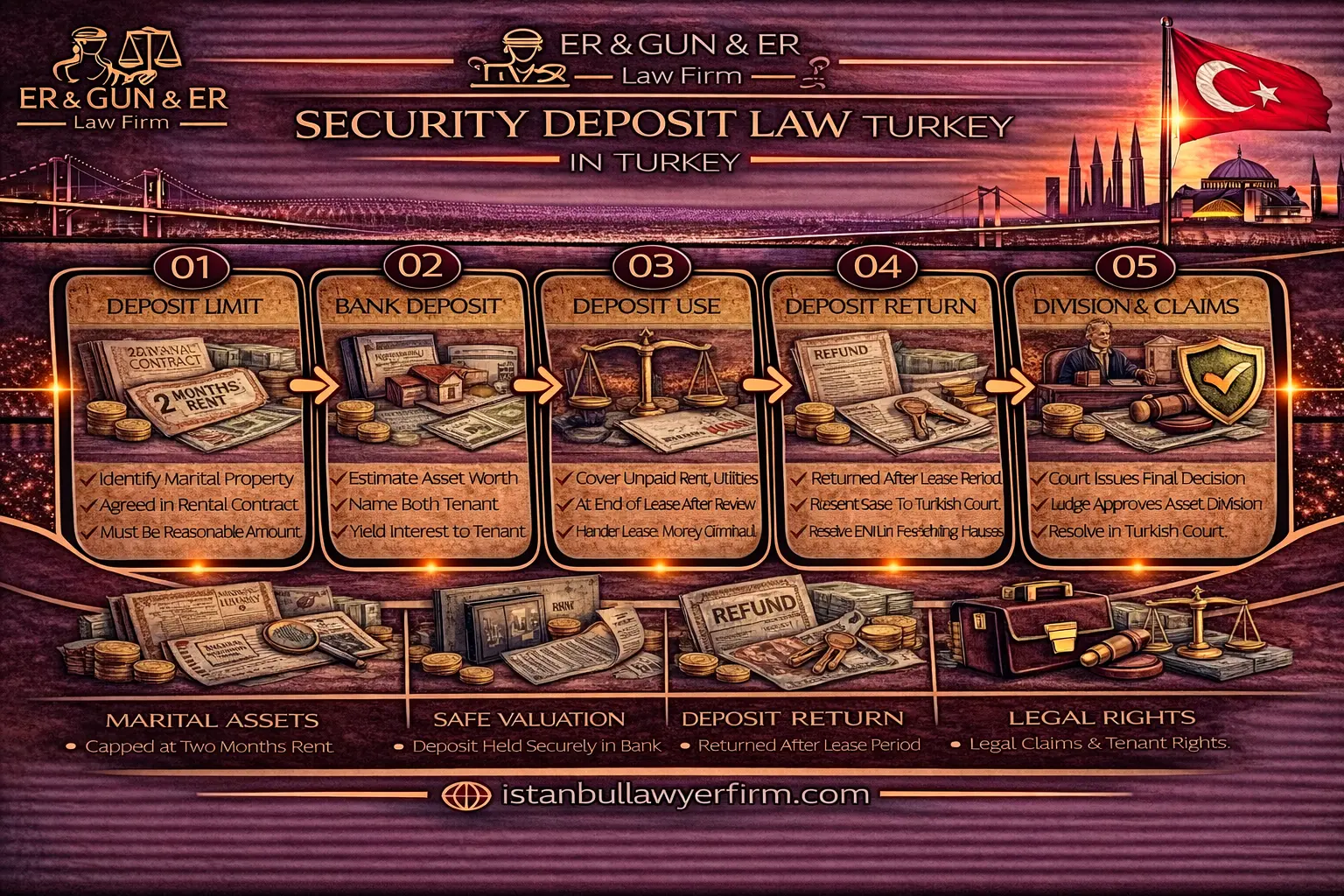
A security deposit is a financial security given under a lease to cover defined risks if the tenant fails to perform specific obligations. In Turkish lease practice, disputes arise because parties treat the deposit as a personal trust issue instead of a documented security mechanism. The handling method matters because the deposit can be held informally, held through a bank structure, or represented by another instrument, and each method changes evidence and leverage. The key legal framework is the Turkish Code of Obligations, but day-to-day outcomes are shaped by what the contract says and what the parties can prove at handover and return. Most conflicts start with unclear condition baselines, missing receipts, or missing final utility proofs, and then expand into broader rent and damage allegations. This is why the file should be built from day one with receipts, photos, written notices, and an exit protocol rather than relying on goodwill. Foreign tenants face additional risk because cross-border payments and language drift make proof harder, and an English speaking lawyer in Turkey can help keep correspondence and evidence consistent without inflaming the dispute. This guide explains prevention, lawful holding logic, deduction reasoning, and dispute-ready documentation so the deposit does not become a permanent conflict point.
Purpose of a deposit
A security deposit is intended to secure the tenant’s performance of specific lease obligations. In Turkish practice, the deposit should not be treated as advance rent or an automatic penalty fund. It is a limited guarantee that the landlord can access only under defined conditions and with proof. The starting point in security deposit law Turkey is separating normal use of the premises from compensable loss. If the property is returned in the same condition except ordinary wear, the deposit’s economic purpose is satisfied. If there are proven unpaid items or proven damage beyond wear, the deposit can function as a practical buffer. The deposit also reduces litigation pressure because it provides a readily identifiable fund linked to the lease. That said, the deposit is not meant to finance renovations or upgrades that increase the landlord’s asset value. A landlord who plans refurbishment regardless of tenant conduct should not shift that cost onto the deposit. The deposit is also not meant to cover speculative future losses that cannot be evidenced. Because disputes are evidence-driven, the deposit purpose should be documented in the contract and in handover records. Clear purpose language helps prevent later arguments that the deposit was paid as a gift or as a non-refundable fee. It also helps prevent arguments that every stain or scratch is “damage” without a baseline condition report. When parties want a document-led structure from the start, a Turkish Law Firm typically frames the deposit as a narrowly defined security, not as a discretionary reserve. This framing aligns incentives because it tells both sides what evidence will be needed if deductions are later claimed.
From the tenant perspective, a rental security deposit Turkey should be treated as the tenant’s money held for a specific risk purpose. That perspective matters because it shapes what the tenant records at move-in and move-out. A tenant who pays a deposit in cash without a receipt creates a future proof problem that is difficult to cure. A tenant who pays by bank transfer with a clear reference line creates a traceable record. The deposit also functions as leverage during the final month, so tenants should avoid informal deals that waive return. If the contract says the deposit is non-refundable, the tenant should ask for written clarification and legal review. Non-refundable language is often a red flag because it blurs deposit with penalty or key money. Tenants should insist that deposit handling is separated from rent payments in documentation and accounting. If rent is paid monthly, the deposit should not be merged into the same receipt set without labeling. If the landlord requests additional cash at handover, document whether it is deposit, rent, or utility advance. Tenants should also document what items are included in the premises, because missing items are often alleged later. A prudent tenant maintains a folder with the lease, receipts, photos, and written communications. That folder becomes the tenant’s defense if deductions are claimed without evidence. When a dispute becomes unavoidable, consulting a lawyer in Turkey early can prevent admissions and can focus the argument on provable items. The practical goal is to treat the deposit as a documented security, not as a relationship-based promise.
The tenant security deposit Turkey issue becomes more complex when the lease ends under conflict. If the tenant is evicted or leaves without a written handover protocol, each side later claims different facts. The landlord may argue that unpaid rent, utilities, or repairs justify retention, while the tenant argues the opposite. In this conflict setting, the deposit should be analyzed as a set of deductible categories, not as a single bucket. Each category must be proven with documents, such as invoices, meter readings, or written acknowledgments. If the landlord claims cleaning, the landlord should show the initial condition, the exit condition, and a reasonable cost. If the tenant claims full return, the tenant should show handover acceptance and payment history. If the deposit is held in cash, disputes often escalate because there is no neutral holding method. If the deposit is held in a controlled bank mechanism, parties can focus on merits rather than on possession. Eviction-related endings require careful documentation because handover is often incomplete at the time of exit. Tenants should avoid leaving keys informally without a signed handover note because key delivery marks possession change. Landlords should avoid changing locks and then claiming missing items without an inventory baseline. If the parties anticipate dispute, they should preserve evidence immediately and avoid emotional communications. A seasoned best lawyer in Turkey will usually begin by reconstructing the timeline and demanding documentary proof for each deduction head. This method keeps the dispute within objective boundaries and reduces the chance of outcomes driven by credibility impressions alone.
Which leases are covered
The first coverage question is which lease types are treated under the stricter deposit regime in Turkish practice. Residential leases often receive more protective interpretation because tenants are not assumed to be sophisticated negotiators. Workplace and other leases can still use deposits, but the factual context and documentation expectations differ. When clients ask about landlord security deposit Turkey, they usually want to know whether any default limits and holding methods apply to their lease type. The answer starts with classifying the lease as residential, roofed workplace, or another category under the Turkish Code of Obligations. Classification matters because the law treats certain categories as more regulated than others. A mixed-use property can create classification debate, especially when a unit is both residence and registered office. If the tenant is a company but the space is used as a home, the legal characterization may become contested. For a commercial lease, parties often negotiate broader deduction heads, but those heads still require evidence. For a residential lease, aggressive deposit clauses are more likely to be scrutinized and possibly disregarded in dispute. Foreign tenants may also face practical barriers in asserting return if receipts and communications are not in a consistent format. Therefore, the lease category should be confirmed in writing at the start, not only assumed. If the lease is tied to a property transaction, due diligence steps should be coordinated with the lease terms and handover protocol. For cross-border landlords and investors, a law firm in Istanbul can coordinate lease classification, evidence planning, and registry interface in one file. Correct classification is a preventive step because it reduces later arguments about whether a particular deposit clause is even enforceable in that lease context.
Many leases mention a security deposit cap Turkey rent concept, meaning parties expect some proportionality between rent and deposit. While the Turkish Code of Obligations contains rules for certain lease categories, parties often misapply rules across categories without checking the correct classification. A tenant may assume a cap applies in every situation, while a landlord may assume freedom of contract applies fully. The safer approach is to treat any cap discussion as a legal characterization issue and to confirm the applicable rule for the specific lease. If the lease is residential or a roofed workplace, you should examine whether the law requires a particular holding method and whether it restricts the deposit amount. If the lease is purely commercial and negotiated between sophisticated parties, courts may give more weight to written agreement terms. However, even in commercial leases, clauses that look like disguised penalties can trigger dispute because they conflict with good faith principles. This is why due diligence on the property and on the contractual framework should be coordinated before signing. A practical reference point for foreign investors is the real estate due diligence guide because it explains how document mismatches and missing proofs later become leverage. Deposit clauses should be reviewed together with rent indexation, maintenance clauses, and early termination clauses so the overall risk allocation is coherent. If a deposit amount is unusually high, it can also create regulatory and banking questions when paid by transfer, especially for foreign tenants. If a deposit amount is unusually low, it may not cover the landlord’s legitimate risk, leading to aggressive claims later. Therefore the right question is not only what number is acceptable, but what evidence will be available if deductions are later claimed. “practice may vary by authority and year — check current guidance.” A written legal review before signing is often cheaper than litigating later about whether the deposit clause was lawful or abusive.
Coverage analysis also changes when the premises is tied to ownership disputes or defective title, because possession and handover become uncertain. In a commercial lease security deposit Turkey context, landlords often try to allocate more risk to the tenant through broad deduction wording. That wording may still be challenged if it is applied without proof or if it contradicts the written handover baseline. Foreign tenant security deposit Turkey disputes are common when the tenant paid from abroad and did not obtain a clear deposit receipt or bank reference. A foreign tenant should also confirm the landlord identity and property authority before paying, because payments to the wrong person create recovery problems. One practical preventive step is verifying the property record and the landlord’s ownership chain before signing a long lease. The title deed check guide provides a useful workflow for confirming ownership and annotations before you rely on a landlord’s representation. If the landlord is not the registered owner, ensure that representation authority is documented and that the lease signatory can bind the owner. If the property is under mortgage or attachment, clarify whether the tenant could face sudden enforcement actions that disrupt the lease. These risks affect deposit planning because tenants may want safeguards such as bank holding or escrow-like mechanisms. When lease coverage and property coverage are mismatched, deposit disputes often become proxies for larger disputes about possession and authority. Therefore, the coverage analysis should include not only lease type but also the factual stability of possession and title. When parties want a defensible record from the start, Turkish lawyers often insist on a written handover protocol and a traceable deposit payment method. This reduces later arguments about whether the payment was rent, deposit, or an informal fee. It also reduces the chance that the deposit becomes trapped in a broader dispute where neither side can prove the basics cleanly.
Deposit forms and handling
Deposits can be structured in different forms, and form choice determines evidence quality. The most common form is a cash payment, but cash creates proof risk unless a detailed receipt is issued. A bank transfer is usually easier to evidence, but only if the transfer reference clearly states deposit purpose and lease identifier. Some parties use promissory notes or guarantees, but these instruments create their own enforcement disputes if drafting is unclear. Parties sometimes discuss an escrow security deposit Turkey approach, meaning a controlled holding method that prevents unilateral use. Controlled holding matters because many disputes are not about whether damage exists but about who can access the funds. If the landlord holds cash, the tenant must sue to recover, and the landlord can delay by contesting facts. If the funds are held in a controlled structure, both sides have incentive to settle based on documents. The lease clause should specify form, holding location, and release conditions in plain terms. If the deposit is paid in foreign currency, clarify the conversion method for any deductions and for return. If the deposit is paid by third party, clarify whether it is still security for the tenant’s obligations and how return is directed. If the deposit is represented by a bank letter, confirm whether the bank letter is unconditional and who can trigger it. If the deposit is represented by a note, confirm maturity date, protest mechanics, and whether the note is linked to breach proof. In complex holdings, an Istanbul Law Firm can design a deposit structure that is evidentiary and enforceable without over-complicating the lease. The practical goal is to choose a form that makes deductions provable and return administrable.
Handling rules should be written to minimize later factual ambiguity. If the deposit is paid in cash, the receipt should identify the deposit amount, currency, date, and the lease address. The receipt should also state that the payment is security and is not advance rent. If the deposit is paid by bank transfer, the tenant should keep the bank slip and the landlord should confirm receipt in writing. If the landlord refuses to issue a receipt, that refusal is itself a risk signal for future conflict. If the deposit is held by the landlord personally, tenants should ask how the amount will be returned and in what timeline concept. If the deposit is held by a bank mechanism, tenants should ask what document will be required for release. If the parties use a note or guarantee, they should define the trigger event clearly to avoid disputes about when it can be called. In many security deposit dispute Turkey files, the main fight is whether the landlord has a lawful set-off right or is simply withholding. Withholding narratives become stronger when the holding method is informal and the contract clause is vague. Therefore the clause should define which heads can be deducted and which heads require a final invoice or court decision. The clause should also define whether interest on the deposit is tracked and how it is returned. If the lease is long-term, the holding method should be robust against landlord death, bankruptcy, or sale of the property. If the property is sold, the parties should define whether the deposit is transferred to the new landlord and how proof is delivered. Well-written handling rules reduce litigation because they narrow disputes to provable deductions rather than vague fairness debates.
Foreign tenants should treat deposit handling as a compliance item, not only a commercial term. International transfers require clear purpose references and a contract copy that matches the bank reference line. If the tenant uses a third-party payer, the contract should record why and how refunds will be directed. If the tenant pays from a foreign bank, keep SWIFT messages because domestic receipts may not show all details. If the landlord requests cash for convenience, the tenant should consider whether that convenience will become a proof problem at exit. If the landlord insists on cash, the tenant should request a notarized receipt or at least a detailed signed receipt with ID details. If the lease is in foreign currency, the deposit return should be specified in the same currency or with a clear conversion method. If the lease includes furniture, the inventory list should be attached to the lease and signed to create a baseline. If the lease is for a business, the deposit may be larger and the landlord may attempt broader deduction categories. Broader deduction categories should still be linked to evidence, such as invoices, photos, and handover protocols. If the landlord uses the deposit as leverage to force additional payments, the tenant should respond with written requests and evidence. If the tenant plans to leave Turkey, plan the deposit return steps before departure so signatures and keys are handled properly. If the tenant changes address, keep updated contact details because landlords often claim they could not reach the tenant to return funds. If the tenant expects dispute, preserve all communications because courts often rely on early letters to assess good faith. A disciplined deposit structure therefore supports both compliance and efficient exit.
Bank deposit mechanism
A bank deposit mechanism aims to keep the deposit separate from the landlord’s personal funds. The concept behind security deposit in bank Turkey is that the money is held in a dedicated account connected to the lease. Holding in bank form reduces the risk of unilateral spending and later denial of receipt. It also creates a documentary trail because bank statements show balance, movements, and account identifiers. The lease should identify which bank and which account type will be used, but parties should confirm what the bank will actually open. Banks may have different operational forms for blocked accounts or joint instruction accounts. For that reason, parties should treat bank setup as a practical step that must be executed, not only promised in contract. A tenant should not transfer funds until the account structure is confirmed in writing. A landlord should not demand direct personal receipt if the contract promised bank holding. The account documentation should state who can request release and what documents are required for release. If release requires both signatures, the clause should also define what happens if one party refuses without reason. If release requires a court decision for disputed deductions, the clause should say so clearly to prevent surprise. If the bank requires a specific form signed by both parties, keep that form as part of the lease evidence vault. “practice may vary by authority and year — check current guidance.” A bank mechanism is therefore strongest when it is supported by a clean paper trail and an executed bank file.
A bank holding structure should include a clear release protocol that mirrors the lease’s deduction logic. If the lease says the landlord may deduct damages, the release protocol should require an invoice and a documented handover baseline. If the lease says the landlord may deduct unpaid utilities, the protocol should require final bills and meter handover records. If the lease says disputes go to court, the protocol should anticipate that the bank may not release until a final document is presented. This is why the return of security deposit Turkey depends as much on process discipline as on legal entitlement. Tenants should plan exit with a written handover date, a key delivery protocol, and a final condition check. Landlords should plan exit with a written inventory and a documented list of alleged defects, if any. If the parties agree on zero deductions, the bank release instruction should be signed immediately and stored as proof. If the parties disagree, both should avoid unilateral instructions to the bank that contradict the account rules. Unilateral instructions often fail operationally and increase hostility without changing the legal position. If the landlord claims deductions, the landlord should quantify them and propose partial release to show reasonableness. If the tenant disputes deductions, the tenant should request supporting documents and propose a joint inspection. If the dispute escalates, both sides should preserve the bank account record because it is neutral evidence of funds held. A bank mechanism also protects the landlord because it proves funds existed and were not commingled. The overall objective is to make release depend on documents, not on leverage.
Students and expatriates often ask about security deposit refund Turkey timeframe and expect a universal number. In reality, timing is driven by the lease clause, the handover protocol, and whether there is a dispute. If the tenant provides keys, signed inventory, and final bills quickly, return can be administratively faster. If the tenant leaves without a signed handover record, the landlord may delay while asserting defects. If the landlord refuses to schedule a joint inspection, the tenant should document that refusal and create independent condition evidence. If the landlord claims large damage, the landlord should obtain quotes and invoices rather than using estimates. If the bank requires written joint instruction, a non-cooperative party can cause delay even when the merits are weak. In those cases, the dispute often shifts from contract interpretation to procedural pressure. Tenants can reduce this pressure by planning the exit appointment early and by keeping all communications in writing. Landlords can reduce this pressure by providing a written deduction list with supporting documents and offering partial release. If the lease is terminated early, clarify whether early termination charges are allowed and how they are evidenced. If the tenant sublet without permission, deposit disputes can merge with breach disputes and become larger litigation. Because timing depends on these fact patterns, you should not rely on generic internet timelines. “practice may vary by authority and year — check current guidance.” The practical rule is that the party with the clearer handover record usually has stronger leverage on timing.
Drafting the deposit clause
A good clause starts by defining the deposit as security and not as advance rent. It should identify the deposit amount and the currency in the same sentence as the lease address. It should state the payment method and require a written receipt or a bank reference that links to the lease. It should state where the funds will be held and whether commingling is prohibited. It should define the release logic as a document-based process rather than a discretionary decision. It should list the deductible categories conceptually, such as proven damage and documented unpaid items. It should require that any deduction is supported by invoices, photographs, and a baseline condition record. It should define the baseline as a signed handover record and not as later memory. It should state that the deposit can only be used after the landlord provides a written itemization. It should state that the tenant can request supporting documents before accepting any deduction. It should address whether interest or bank yield is tracked and how it is handled on return. It should avoid open-ended phrases like “as the landlord sees fit” because they invite conflict. It should address the concept of security deposit cap Turkey rent without stating a number or presenting a universal rule. “practice may vary by authority and year — check current guidance.” A well-structured clause drafted with a Turkish Law Firm mindset focuses on evidentiary triggers and predictable release steps.
The clause should clarify whether the rental security deposit Turkey is paid at signing or at key delivery. It should require that the landlord confirms receipt in writing on the same day funds are transferred. It should state whether the deposit is held in the tenant’s name, the landlord’s name, or a blocked structure. It should define what happens if the property is sold and the landlord changes. It should require a written notice to the tenant when the deposit holder changes. It should state whether the deposit is transferred to the new landlord or refunded and re-posted. It should define whether the tenant must sign any bank instruction for release and in what form. It should define a reasonable process for partial release when only a small deduction is disputed. It should define that disputed items are reserved and that undisputed items are released without delay. It should state whether the parties will conduct a joint exit inspection and how inspection notes are recorded. It should address whether a representative can sign documents and whether a power of attorney is needed. It should define the language of the lease and how translations are handled for foreign parties. It should allocate responsibility for notarization and certified copies when they are used. It should avoid making bank procedure promises that the bank itself has not confirmed. Contract design with a law firm in Istanbul approach is strongest when it is tested against real bank forms and real handover workflows.
A clause should also anticipate disagreement and define how disagreement will be documented. It should require that the landlord states alleged defects in writing with dated photos. It should require that the tenant has a chance to cure simple issues such as cleaning before deductions are fixed. It should state that repair costs must be reasonable and connected to the tenant’s use beyond ordinary wear. It should separate renovation choices from compensable damage and say so clearly. It should clarify whether unpaid rent can be set off against the deposit and under what proof standard. It should clarify whether unpaid utilities can be deducted only after final bills are provided. It should clarify how exchange rates will be handled if the deposit is in foreign currency. It should clarify that the deposit is not a substitute for a separate claim for larger damages. It should clarify that the landlord cannot treat the deposit as automatic liquidated damages. It should define how keys will be returned and how key return will be evidenced. It should define what documents close the file, such as a signed handover note and final meter readings. It should define whether emails are acceptable notices and which email addresses are valid. It should state that disputes are addressed through written notice and documented negotiation before escalation. It should define the venue or dispute mechanism only if it is consistent with the overall lease structure. A security deposit dispute Turkey is usually avoided when the clause is drafted as a checklist of proofs, which is the practical discipline a best lawyer in Turkey would insist on.
Key documents at handover
The handover file should begin with a signed lease and a clear receipt trail for the tenant security deposit Turkey payment. The receipt should identify the lease address, the parties, the amount, and the date. The payment proof should be stored in a stable format that can be produced years later. The parties should also keep copies of identity documents used in signing to prevent later denial of signature authority. Key delivery should be documented with a short key delivery note that lists the number of keys and the date. Meter readings at move-in should be recorded in writing and confirmed by photo. If the building uses a management system, obtain a confirmation of current dues and any arrears at move-in. If the premises includes appliances, record serial numbers and visible condition at handover. If there is furniture, record the inventory in a signed annex rather than an informal message. If the walls and floors have visible defects, photograph them with timestamps and include them in the annex. If the parties agree on a cleaning baseline, record it so later “dirty return” claims are tested against a baseline. If the landlord claims the unit is newly renovated, record what that means with photos rather than adjectives. If the tenant plans to make permitted improvements, record the permission in writing so later deductions do not treat improvements as damage. If the tenant will have roommates or staff, record who is authorized to receive keys to avoid later identity disputes. If disagreement arises at move-in, pause and document rather than relying on oral assurances. In practice, a lawyer in Turkey will tell clients that a strong handover file is the cheapest form of dispute insurance.
Cross-border tenants should assume that documentation drift is the main risk in foreign tenant security deposit Turkey matters. Payment proofs should include SWIFT messages or bank confirmations that show sender identity and purpose. Lease signing copies should be scanned in high resolution and stored with immutable filenames. If the tenant signs remotely, record the signature method and keep the full signature audit trail. If a local representative signs, keep the representative authority evidence together with the lease. If the landlord communicates in Turkish while the tenant communicates in English, fix a bilingual glossary for names and addresses. If the tenant’s passport spelling differs from a local tax number spelling, reconcile the spelling in writing before handover. If the landlord provides a receipt in Turkish, translate it and store both versions so meaning is stable. If the tenant pays a deposit in cash, insist on a detailed receipt with ID details rather than a generic note. If the tenant pays in installments, record each installment separately and label it clearly as deposit, not rent. If the landlord requests “maintenance advance” in addition to deposit, record its nature separately to avoid later confusion. If the property is managed by an agent, confirm the agent’s authority and keep a copy of the authority evidence. If the parties will use email for notices, verify that emails are correct and active and keep a confirmation message. If the landlord is a company, keep the signatory circular evidence so corporate authority cannot be denied later. If the tenant is a company, keep trade registry extracts so identity and authority are clear. When language complexity exists, an English speaking lawyer in Turkey can standardize the handover pack and prevent avoidable mismatch disputes.
The exit handover file should be planned while the lease is still running and not only after the tenant moves out. The tenant should schedule a joint inspection date and confirm it in writing. The tenant should prepare final utility bills or final meter readings and request a written confirmation from providers where possible. The tenant should obtain a statement of account from building management for dues and shared expenses. The tenant should prepare a return condition photo set that mirrors the move-in photos for easy comparison. The tenant should return keys in a documented handover and obtain a signed receipt for key return. The landlord should provide a written list of claimed defects at the inspection rather than months later. If the landlord claims deductions, the landlord should provide supporting invoices or quotes promptly. If the parties agree on no deductions, they should sign a short release note and proceed to release instructions. If the deposit is in a bank mechanism, the parties should sign the bank release form at the same time as key return. If the tenant is leaving Turkey, plan signature logistics early so the deposit is not trapped due to missing signatures. If a representative will sign, prepare the representative authority file in advance. If a dispute arises, keep all communications in writing and avoid emotional allegations that change later. If the landlord refuses a joint inspection, the tenant should document the refusal and prepare independent evidence such as a notary record if appropriate. If the file is complex, an Istanbul Law Firm can manage exit documentation discipline and ensure the return of security deposit Turkey is linked to clean handover proofs.
Use of inventory reports
An inventory report is the baseline tool that tells the parties what the premises contained and in what condition it was delivered. It should be prepared at move-in and signed by both parties on the same day as key delivery. It should list rooms, fixtures, appliances, and any furniture in a structured order. It should record visible defects with photos rather than vague descriptions. It should include serial numbers for appliances where possible to prevent substitution disputes. It should record paint condition, floor scratches, window damage, and bathroom fixtures clearly. It should record whether walls were freshly painted or already marked at handover. It should record whether professional cleaning was done and what standard was accepted. It should record whether any items are excluded from tenant responsibility, such as structural defects. It should record whether any repairs are promised by the landlord and by what date concept. It should record whether any tenant improvements are authorized and how they will be treated at exit. It should be attached as an annex to the lease so it cannot be separated from the contract later. It should be stored in both parties’ archives in scanned form with stable filenames. If the inventory report is missing, later disputes become credibility contests instead of document tests. A disciplined inventory is where Turkish lawyers focus first because it prevents most deduction fights from starting.
The inventory should also cover the practical evidence items that later become contested, such as remote controls, keys, and access cards. It should state the number of each item and the condition of each item. If the building uses smart locks or smart devices, record access credentials and reset procedures. It should record the condition of meters and any visible tampering indicators. It should record the brand and model of installed appliances so replacement costs are not inflated later. It should record whether the tenant received manuals or warranties and where they are stored. It should record whether the tenant received contact details for emergency repairs. It should record whether the landlord agreed to a repaint at exit or not, because repaint assumptions drive disputes. It should record whether the tenant is allowed to drill walls and under what restoration standard. It should record whether the tenant is allowed to change locks and the procedure for returning keys. It should record whether the landlord will conduct periodic inspections and how they will be documented. It should record whether pets are allowed and what baseline condition is accepted in that context. It should record whether there are existing moisture issues and whether they are landlord responsibility. It should record whether the tenant is responsible for minor maintenance and what minor means in practice. It should be dated and should state the names of the signatories clearly to avoid later denial. It should avoid subjective terms like “good condition” and use observable facts instead. It should avoid legal arguments and remain a factual baseline document. A well-written inventory makes later deductions and set-off analysis objective rather than emotional.
At exit, the inventory becomes a comparison tool, not a weapon, and it should be used the same way by both sides. The parties should walk through the premises and mark deviations from the baseline item by item. Each deviation should be photographed with date metadata or a reliable timestamp method. If the parties disagree on a deviation, record the disagreement in writing rather than arguing orally. If the landlord alleges damage, the landlord should show why it is beyond ordinary use by referencing the baseline. If the tenant alleges ordinary use, the tenant should show the baseline and the comparable photos. This comparison logic tracks the causation approach used in tort causation principles when courts evaluate whether conduct caused compensable loss. If repairs are needed, document the scope and obtain multiple quotes to test reasonableness. If the tenant offers to cure, document the offer and the landlord response. If the landlord refuses cure and hires a contractor immediately, record the timing because it affects reasonableness. If the tenant leaves without inspection, the tenant should create an independent exit inventory record and deliver it to the landlord with proof. If the landlord refuses to sign, preserve the refusal and keep the delivered inventory as an exhibit. If the inventory is stored digitally, preserve the original file and do not overwrite photos because metadata can be relevant later. If the property is sold, deliver the inventory to the new landlord so deposit handling does not restart as a dispute. If the parties use a bank mechanism, align the inventory sign-off with the release instruction so facts and funds move together. A disciplined inventory workflow often prevents litigation because it converts the dispute into a provable comparison.
Deductions and set-off rules
Deductions must be tied to a provable breach and a provable cost, not to general dissatisfaction with the tenant. The phrase deductions from security deposit Turkey should be read as a strict evidence question rather than a bargaining position. The landlord should provide a written itemization that lists each deduction head and the document supporting it. The landlord should link each head to a baseline condition record or an agreed tenant obligation. The landlord should provide invoices, receipts, or credible quotes and should avoid inflated numbers with no sourcing. The tenant should request copies of the supporting documents and should respond in writing to preserve the dispute record. The tenant should distinguish between ordinary wear, minor maintenance, and compensable damage, and should link that distinction to the inventory baseline. If the landlord claims cleaning, the landlord should show that cleaning was required beyond ordinary handover cleaning. If the landlord claims repainting, the landlord should show baseline paint condition and why repainting is not renovation choice. If the landlord claims replacement, the landlord should show why repair was not possible and why replacement cost is reasonable. If the landlord claims missing items, the landlord should show inventory evidence that the items existed at move-in. If the tenant admits a deduction, the tenant should request partial release of the undisputed balance. If the tenant disputes a deduction, the tenant should propose a joint review meeting and record the proposal. If the deposit is held by bank structure, the bank may require joint instruction, which makes itemization even more important. “practice may vary by authority and year — check current guidance.” A disciplined deduction file is the difference between a quick settlement and a long security deposit dispute Turkey.
Set-off is often invoked to justify retention, but set-off should still be supported by documented, due obligations. If the landlord claims unpaid rent, the landlord should show the rent ledger and payment trail and not rely on memory. If the landlord claims unpaid utilities, the landlord should show final bills, meter readings, and the tenant’s contractual utility obligation. If the landlord claims late payment penalties, the landlord should show the written basis and the calculation method rather than a verbal assertion. If the tenant disputes the debt, unilateral set-off can become contested and can require court resolution. This is why a clean exit protocol matters more than clever clauses. If the tenant has a counterclaim, such as repairs the landlord failed to perform, document the repair request history and the landlord responses. If the landlord argues that repairs are the tenant’s responsibility, test that argument against the lease allocation and the baseline condition record. If the dispute escalates, a structured pathway through commercial court procedure can be relevant depending on the lease type and parties. If the landlord threatens execution steps, the tenant should respond with written objections and documentary proofs of payment. If the tenant threatens criminal complaints, avoid mixing criminal language into a contract dispute without evidence because it can backfire. If the parties want a pragmatic resolution, they should separate undisputed items from disputed items and release the undisputed portion. If a dispute is purely about amount, propose mediation and record offers and counteroffers in writing. If the landlord uses the deposit as leverage for unrelated claims, document the linkage and challenge it as bad faith. If eviction occurred, align the set-off claim with eviction documentation so the timeline is coherent. The topic eviction and deposit Turkey often becomes contested because handover and possession change are disputed, so document key delivery and exit steps carefully. “practice may vary by authority and year — check current guidance.”
Tenants should also understand that the deposit is not the only remedy and not the only exposure. If damage is higher than deposit, landlords may pursue separate claims, and tenants should plan evidence accordingly. If the landlord claims large damages, request a detailed scope and a contractor report rather than accepting a lump sum. If the landlord refuses detail, document that refusal and treat it as a negotiation red flag. If the tenant needs the deposit back, the tenant should prepare a formal demand letter with an exhibit index and a clear bank account for payment. If the demand is ignored, the tenant should consider whether a lawsuit for security deposit refund Turkey is cost-effective relative to the amount and time. If the tenant plans litigation, preserve all receipts, photos, and correspondence and avoid deleting messages. If the landlord is a company, confirm corporate identity and service address early so the demand reaches the correct legal entity. If the landlord is an individual with multiple properties, confirm identity through the contract and title record to avoid suing the wrong person. If the landlord is insolvent, deposit recovery can become a collectability issue rather than a merits issue, which is why enforcement planning matters. If insolvency risk exists, review the practical implications in bankruptcy procedures overview and plan whether security measures are needed. If the tenant is abroad, plan representation and signature logistics early so the case does not stall. If the parties negotiate a settlement, record the settlement with clear payment mechanics and release scope. If the settlement includes partial deductions, list them with invoices so the release is linked to proven costs. If the tenant accepts a settlement, ensure the payment is received before signing broad releases. If the landlord accepts a settlement, ensure keys and possession are documented to prevent later claims. A structured deduction record protects both parties because it converts a subjective dispute into a provable accounting exercise.
Wear and tear analysis
Wear and tear is the expected, gradual deterioration from normal, careful use of a rented property. Damage is a specific loss caused by negligence, misuse, or unauthorized alteration that exceeds that normal baseline. The phrase wear and tear versus damage Turkey rental is best treated as a comparison exercise, not a slogan. Start by reading the lease allocation clauses on maintenance, repairs, and tenant obligations. Then compare the move-in inventory and photos to the move-out inventory and photos. If an item was already worn at move-in, the deposit cannot fairly be used to replace it as if it were new. If the item was new at move-in, the landlord still needs to show that the condition change was not ordinary use. Paint marks, faded fabrics, and minor scratches can be ordinary, while broken fixtures or missing items can be damage. The most persuasive approach is to tie each claimed defect to one photo and one dated note. Do not rely on subjective words like dirty or bad condition without describing the observable fact. If cleaning is claimed, define whether the property was handed over professionally cleaned and document that baseline. If repainting is claimed, document whether the tenant had permission to drill, mount, or repaint. If moisture and mold are alleged, document whether the issue was pre-existing or caused by tenant actions. If the landlord wants to deduct renovation costs, separate renovation choice from compensable repair. A clear baseline file reduces disputes because it narrows arguments to what can be verified.
When parties disagree about deterioration, evidence quality matters more than opinion. A landlord should document the alleged damage with close photos, wide context photos, and a date reference. A tenant should document the same area from multiple angles to prevent selective framing. If a repair invoice is used, the invoice should describe the work scope and the repaired location. If only a quotation exists, the quotation should be comparable to market alternatives and not a premium vendor outlier. If the item has a typical service life, the parties should discuss whether replacement yields unjust enrichment to the landlord. Courts and experts often look at reasonableness, meaning whether repair was possible before replacement was chosen. If the landlord replaced an item immediately, the landlord should explain why urgent replacement was necessary. If the tenant offered to cure, keep the cure offer and the landlord’s reply, because it affects reasonableness. If the property has fixtures installed by the landlord, the landlord should keep purchase invoices and warranty records as baseline evidence. If the tenant installed fixtures with permission, keep the permission email and the agreed restoration method. A neutral joint inspection note signed by both sides can prevent later disputes about what existed at exit. If the relationship is hostile, consider an independent condition record created through a formal channel rather than informal selfies. In complex files, Turkish lawyers usually focus on building a defect-by-defect table that matches each claim to one proof item. That table helps both parties test what is provable before they argue about fairness.
The best time to resolve wear and tear disputes is immediately at move-out, before contractors enter the premises. A tenant should ask for a written defect list on the inspection day rather than accepting a later surprise list. A landlord should provide that list in a calm, factual tone and avoid accusations about intent. If only a few items are disputed, propose partial release of the undisputed portion of the deposit. Partial release reduces escalation because it shows good faith and isolates the real disagreement. If the landlord claims deep cleaning, ask for a baseline proof that deep cleaning was the move-in standard. If the landlord claims repainting, ask whether repainting is routine turnover work or tenant-caused correction. If the tenant admits minor issues, offer a short cure window and document the offer. If the landlord refuses a reasonable cure offer, preserve that refusal because it can matter later. If the tenant is leaving the country, obtain signatures and bank details before departure so the dispute is not amplified by distance. If the tenant is a foreigner, keep translations of key emails so meaning is stable if litigation occurs. If the landlord is a company, request that all communications come from an authorized representative to avoid shifting statements. If the dispute cannot be resolved informally, stop verbal negotiations and switch to written, exhibit-referenced correspondence. At that stage, a lawyer in Turkey can help frame the issue as an evidence comparison rather than a personality fight. Clear documentation reduces the chance that a deposit becomes a proxy for unrelated grievances.
Unpaid rent and utilities
Unpaid rent is the most common justification used to retain a deposit at the end of a lease. A landlord should not treat non-payment allegations as self-proving, because rent disputes are often factual. The first evidence item is the rent ledger showing due dates and amounts under the lease. The second evidence item is the tenant’s payment trail, such as bank transfer receipts and reference lines. If rent was paid in cash, the landlord must produce signed receipts, and missing receipts create evidentiary risk. If the tenant paid partially, the ledger should show how payments were allocated across months. If the landlord applies set-off, the landlord should state the set-off calculation in writing and attach the ledger. If the tenant disputes the ledger, the tenant should respond with a month-by-month bank receipt bundle. If the lease ended by notice, document the notice and the move-out date because the last rent period can be contested. If the lease ended under conflict, eviction and deposit Turkey disputes often arise because possession change dates are unclear. Key delivery receipts and handover notes are therefore critical to define when rent liability stopped. If the landlord claims rent for a period after key return, the landlord should show a contractual basis and a possession basis. If the tenant claims that the landlord re-let the unit, the tenant should request evidence of the re-let date to test mitigation. In contested files, a law firm in Istanbul can help structure the ledger proof and the possession chronology for negotiation or court. A clean rent record usually resolves most of the deposit retention debate without broader litigation.
Utility disputes are usually about evidence, not about principle. Utilities can include electricity, water, gas, internet, and building management dues depending on the lease. The landlord should distinguish between tenant-consumed utilities and building-level charges that were already included in rent. The tenant should collect final bills or meter reading confirmations as soon as the move-out date is known. If meters are in the tenant’s name, obtain closure confirmations and final reading documents from providers. If meters are in the landlord’s name, the tenant should request a provider statement showing consumption for the tenant period. If the landlord claims unpaid utilities, the landlord should produce the provider bill and the period covered. If the bill covers a period after move-out, the landlord should separate the tenant period and explain allocation. If the premises is in a managed site, obtain a written statement of account from management for dues and common expenses. If the tenant paid dues directly, keep receipts and reference them in a short reconciliation note. If the landlord paid dues and seeks reimbursement, the landlord should provide payment proof and the invoice basis. Many disputes arise because the parties did not record meter readings at key return. A signed handover note that includes meter readings can avoid months of argument. If the lease requires the tenant to provide clearance letters, treat that as a closing task and schedule it early. A tenant security deposit Turkey is easiest to recover when utilities are closed and documented with final proofs.
Set-off arguments become fragile when the landlord relies on estimates instead of invoices. If the landlord claims repair costs as utilities or maintenance, demand categorization and supporting documents. If the tenant believes the landlord is inflating utility claims, request the original bill and the payment receipt. If the landlord provides only a screenshot, ask for an official PDF statement or a stamped invoice. If the tenant has counterclaims for landlord failures, document repair requests and landlord responses in writing. Counterclaims can affect negotiation, but they should not be used as excuses to stop documenting payments. Where the deposit is held in a bank structure, propose releasing the undisputed balance and reserving only the disputed head. This approach reduces escalation and demonstrates reasoned conduct by both parties. If the landlord refuses to release any portion without explaining, record the refusal and preserve it. A security deposit dispute Turkey often becomes larger when parties mix rent issues with unrelated personal grievances. Keep communications limited to rent, utilities, condition, and release instructions. If the lease ended with a protocol or settlement, attach it and insist that the protocol governs the closing numbers. If the lease ended with no protocol, draft a closing reconciliation letter that lists each head and each supporting proof. In higher-value files, a Turkish Law Firm can coordinate the reconciliation letter and ensure that the set-off narrative remains consistent across all correspondence. A structured reconciliation often resolves deposit retention faster than threats because it forces the dispute into provable categories.
Return procedure and timing
The return procedure begins with a documented move-out date and a documented key delivery. Key delivery should be evidenced by a signed key receipt that lists how many keys and access cards were returned. The parties should then perform a joint exit inspection and sign an exit condition note. If an exit note cannot be signed, each party should at least issue a written summary on the same day. The exit note should include meter readings or a statement that readings were not available. The landlord should provide a preliminary deduction list quickly and in writing so the tenant knows what is being claimed. The tenant should respond with acceptance or objections linked to the inventory baseline. If the parties agree on a number, they should sign a short deposit release protocol that states the agreed deductions. The protocol should state the bank account for refund and the identity of the recipient. If the deposit is held in a bank account, the parties should sign the bank release instruction together. If the deposit is held in cash, the landlord should provide a written payment confirmation when it is refunded. If the deposit is withheld, the landlord should provide a detailed itemization with supporting documents, not a broad refusal. A clear return of security deposit Turkey procedure reduces the chance that the dispute becomes a personality conflict. Tenants should avoid leaving Turkey before signing the exit note or appointing a representative for closing. Landlords should avoid delaying inspection because delay usually increases disagreement rather than resolving it.
Timing conflicts usually come from missing final documents rather than from legal theory. Final utility bills, management dues statements, and repair invoices often arrive after key delivery. A landlord should communicate which document is still pending and why it matters to deductions. A tenant should ask for a deadline concept in writing and should track responses in a simple timeline. If the landlord claims that a bill is pending, the landlord should provide the bill request evidence or provider statement. If the tenant believes delay is strategic, the tenant should propose partial refund with reservation for disputed items. Partial refund is a strong signal of reasonableness and reduces escalation cost. If the landlord refuses partial refund, the tenant should request a written refusal reason and preserve it. If the deposit was held in a bank, the tenant should confirm whether the bank requires joint instruction or a court document. If the deposit was held in cash, the tenant should request written confirmation that the funds are still available. Disputes about security deposit refund Turkey timeframe are fact-driven and depend on how quickly closing proofs can be obtained. practice may vary by authority and year — check current guidance. If the parties cannot agree, move from informal messaging to a formal demand letter that lists exhibits. In contentious cases, a best lawyer in Turkey will often focus on narrowing the dispute to one or two deductible heads that can actually be proven. This narrowing helps the parties reach a settlement without turning the deposit into a full-scale lawsuit.
Cross-border tenants should plan refund logistics early because international bank transfers require accurate beneficiary data. Provide the landlord with an IBAN and beneficiary name that match your passport spelling. If you will close your Turkish bank account after move-out, inform the landlord and propose an alternative payment route. If the deposit was paid by a third party, clarify in writing whether the refund should go to that payer or to the tenant. If the landlord insists on refunding in cash, consider whether a cash pickup is practical after you depart. If you cannot pick up cash, appoint a representative and document authority to receive funds. Keep all bank transfer proofs because foreign tax and compliance questions may later require source documentation. If the landlord delays because of language misunderstanding, send a bilingual summary of the agreed steps. If the landlord sends a deduction list in Turkish, translate it and respond in writing to avoid silent disagreement. Maintain one email thread with clear subject references so the timeline is easy to audit. For a foreign tenant security deposit Turkey file, it is often helpful to keep all originals and translations in a single closing folder. If the landlord claims you were unreachable, show your written contact updates and delivery proofs. If you changed phone numbers, confirm the change by email before leaving. An English speaking lawyer in Turkey can coordinate bilingual closing letters and prevent terms from drifting between languages. Clear payment and communication planning often avoids litigation because the dispute stays procedural rather than emotional.
Notices and negotiation steps
Formal notices are the bridge between informal negotiation and enforceable dispute steps. A notice should be written, dated, and sent through a channel that produces delivery proof. The notice should state the lease address, the parties, and the deposit amount for identification. It should summarize the move-out date, key delivery, and the exit inspection outcome. It should request either full refund or a detailed deduction list with supporting documents. It should specify a bank account for payment and confirm contact details for responses. It should avoid personal accusations and focus on facts and exhibits. If the other side responds verbally, confirm the response in writing to avoid later denial. If you send photos, label them with location and date to prevent selective interpretation. If you send invoices, label them with the deductible head they support. A notice is stronger when it attaches the exit note and the inventory baseline rather than referencing them vaguely. If the landlord refuses to respond, the silence itself becomes an evidentiary item. If the tenant refuses to respond, the landlord can frame the tenant as obstructive, so respond in writing even when you disagree. In security deposit law Turkey practice, disciplined notices often resolve disputes because parties realize the record is being built. For complex multi-party files, an Istanbul Law Firm can manage the notice sequence and keep tone consistent across all letters.
Negotiation should be structured as a head-by-head reconciliation rather than a single global bargain. Start by listing the undisputed facts, such as move-out date, key delivery, and deposit payment proof. Then list each disputed head, such as repainting, cleaning, or a broken fixture, with the baseline photo reference. Ask the landlord to provide one invoice or quote per head so the discussion remains evidentiary. Ask the tenant to provide one response per head so objections are clear and not emotional. If the parties agree on some heads, document agreement in writing and proceed to partial refund. Partial refund reduces leverage games and shows that the dispute is narrow. If the landlord insists on retaining everything until every head is resolved, propose escrow-like reservation for the disputed amount. If the tenant insists on full refund despite admitting minor damage, propose a small agreed deduction to close quickly. When discussing deductions from security deposit Turkey, the question should be whether the cost is necessary, reasonable, and linked to tenant-caused breach. Avoid negotiating on hypothetical future bills, and instead wait for final bills where possible. If a bill is delayed, document the request to the provider and propose a provisional reserve with later adjustment. Keep all offers and counteroffers in the same email thread so the timeline is traceable. If settlement is reached, draft a short settlement protocol that states the amount, payment method, and release scope. A written protocol prevents later reopening of the same issue under a different label.
When negotiations stall, it helps to reframe the problem as process rather than blame. Ask whether the parties can agree on a neutral holding method for the disputed portion. If the funds are already in a bank, confirm whether the bank can block a portion until documents are produced. If the funds are not in a bank, propose converting the disputed amount into a security deposit in bank Turkey arrangement by joint instruction. If the landlord refuses bank holding, propose an escrow security deposit Turkey style protocol where a trusted third party holds the disputed portion. Any neutral holding protocol should define release triggers and documentary requirements clearly. If the parties cannot agree on neutral holding, the tenant should send a final written demand that attaches the full evidence index. The demand should state that litigation will be considered if no written response is received, without inserting threats about outcomes. The landlord should respond with either a payment date or a detailed itemization with documents. If the tenant receives an itemization, the tenant should respond to each head rather than rejecting the entire list in one sentence. If one party stops responding, shift from negotiation to formal dispute preparation and preserve the silence record. Avoid posting about the dispute publicly because public accusations can create separate liability and distract from recovery. If a guarantor exists, confirm whether the guarantor has any role in the deposit return, and document the answer. If the parties plan court, organize exhibits as a chronological bundle so the judge can verify quickly. Negotiation usually succeeds when the record is clean, because the weaker proof position becomes visible to the party holding funds.
Dispute resolution pathways
A dispute usually begins when the parties disagree on deductions and the deposit is withheld. The first pathway is structured negotiation supported by a written itemization and supporting documents. The tenant should request a written deduction list and copies of invoices and photographs. The landlord should request a written payment history if unpaid rent is alleged. Both parties should compare claims against the signed inventory and the exit condition record. If the inventory is missing, both parties should accept that proof will be harder and focus on objective third-party documents. A security deposit dispute Turkey is easier to resolve when the undisputed portion is released first. Partial release reduces leverage games and narrows the disagreement to a defined amount. If the parties cannot agree on partial release, they can agree on neutral holding for the disputed portion. Neutral holding can be a bank-based block or a written escrow-style protocol with defined release triggers. Any neutral holding should define what document ends the dispute, such as a signed settlement or a final decision. Communication should be limited to facts, dates, and exhibits to avoid escalation into personality claims. The lease type and the court competence can affect which forum is used in practice. practice may vary by authority and year — check current guidance. A memo reviewed by Turkish lawyers often reduces misunderstanding because it anchors the record in provable categories.
The second pathway depends on whether the lease contains a dispute clause or a defined negotiation protocol. If the contract specifies mediation or another precondition, follow it exactly and keep proof of compliance. If the contract is silent, a formal notice letter can function as a pre-litigation step that builds the evidentiary record. Notices should reference the lease, the address, the deposit payment proof, and the key return proof. The landlord’s reply should either confirm a refund date or provide an itemized deduction schedule with documents. The tenant’s reply should confirm acceptance or list objections head by head with exhibit references. If the deposit was paid by bank transfer, include the bank reference and the date to avoid denial of receipt. If the deposit was paid in cash, include the signed receipt and any witness or handover confirmation. If the dispute concerns utilities, attach final bills and meter reading photos to reduce speculation. If the dispute concerns repair costs, attach multiple quotes where possible to test reasonableness. If the dispute concerns repainting or cleaning, attach baseline photos to show what was ordinary. Settlement protocols should be short and should list deductions and net refund in one table-like narrative. Settlement protocols should define payment channel, payment confirmation, and release scope without adding unrelated waivers. If the parties are cross-border, bilingual summaries help prevent meaning drift. practice may vary by authority and year — check current guidance.
The third pathway is escalation to formal proceedings when written negotiation fails or when one party becomes unreachable. A lawsuit for security deposit refund Turkey should be treated as an evidence project rather than as a moral argument. The claimant must prove deposit payment, lease termination, and return conditions, and the defendant must prove deduction grounds with documents. The court will usually focus on the baseline condition and the causation link between alleged damage and claimed cost. If the landlord claims set-off for rent, the landlord must show a rent ledger and the underlying payment trail. If the tenant claims full return, the tenant must show a clean handover record and final bills where applicable. If the property was never inspected jointly, the party who refused inspection will face credibility questions. If the landlord changed locks or blocked access, that behavior should be documented because it affects inspection fairness. If the tenant left without notice, that behavior should be documented because it affects damage causation and mitigation. If the dispute amount is small, parties should still consider whether litigation cost is proportionate and whether settlement is rational. If the dispute amount is large, parties should preserve evidence early and avoid waiting for memories to fade. Where procedure becomes complex, a lawyer in Turkey can keep filings consistent and prevent contradictory statements across letters and pleadings. The selected path should match the evidence strength, the urgency, and the collectability of the opposing party. practice may vary by authority and year — check current guidance.
Evidence and burden of proof
Deposit disputes are decided on proof of three core facts: payment, condition, and justified deduction. The tenant should prove deposit payment through receipts, bank transfers, and the lease clause that labels the payment as deposit. The landlord should prove any deduction through a baseline inventory and a move-out condition record. If the baseline is missing, the landlord’s burden becomes harder because ordinary wear cannot be distinguished reliably. If the landlord alleges damage, the landlord should show a defect photo set and a repair invoice that matches location and scope. If the landlord alleges cleaning, the landlord should show the handover baseline and the cleaning invoice scope. If the landlord alleges missing items, the landlord should show the signed inventory that listed the items at move-in. If the tenant alleges that defects were pre-existing, the tenant should show move-in photos and any written defect notice sent early in the tenancy. If the tenant alleges that the landlord failed to repair structural issues, the tenant should show written repair requests and landlord responses. Courts typically test whether the claimed cost is necessary and reasonable, not only whether it exists. If a repair quote is used, the opposing party may challenge reasonableness by producing comparable quotes. If a defect is technical, parties may need an expert opinion, and the expert mandate should focus on causation and cost, not speculation. A structured evidence index prepared by Turkish Law Firm teams helps the judge verify each item without searching through loose photos. practice may vary by authority and year — check current guidance.
Burden allocation is often misunderstood because parties assume the holder of money must prove everything. In reality, each party must prove the facts it asserts, and the narrative must be consistent across documents. A tenant claiming full refund must show that the lease ended, keys were returned, and no deductible breach exists on the record. A landlord claiming retention must show a specific deductible head and a cost supported by invoice or comparable proof. If the landlord claims unpaid utilities, the landlord should show final bills and the tenant’s utility obligation clause. If the tenant claims that utilities were paid, the tenant should show payment receipts and closure confirmations. If the landlord claims rent arrears, the landlord should show a month-by-month ledger and the due dates under the lease. If the tenant claims payment, the tenant should show transfer receipts with reference lines that match the lease period. If the parties dispute possession end date, key return receipts and written notices become decisive. If a witness is used, courts often treat documentary evidence as stronger than memory, so prioritize documents. Digital evidence should be preserved with metadata where possible because screenshots alone can be challenged. If photos are used, label them by room and date to make them readable in court. When parties are in different cities, a law firm in Istanbul can coordinate certified copies, service logistics, and exhibit numbering consistently. The court will also consider whether the parties acted reasonably during negotiation, so preserve settlement offers and refusals. practice may vary by authority and year — check current guidance.
Evidence planning should begin before the lease ends because after exit the ability to document condition declines rapidly. Tenants should photograph at move-in, during key incidents, and at move-out, using consistent angles and lighting. Landlords should document condition at move-in and move-out and should avoid delaying inspection because delay increases uncertainty. If a repair is needed, document whether the tenant was offered a chance to cure, because cure offers affect reasonableness. If the landlord uses a contractor, document the contractor selection method to avoid allegations of inflated pricing. If the tenant uses a cleaner or painter before exit, keep invoices to prove that the tenant cured issues proactively. If the property has chronic defects like moisture, document whether the landlord was notified and whether repairs were done. If the dispute involves set-off, document whether the set-off was communicated in writing and how the calculation was made. If the dispute involves foreign parties, keep translations consistent and avoid multiple name spellings across exhibits. If the landlord refuses to provide documents, document the refusal because refusal supports adverse inference arguments in some case strategies. If the tenant refuses inspection, document that refusal because it weakens the tenant’s position on condition. If the parties agree on a handover protocol, treat the signed protocol as the central exhibit and keep it in original form. If the case escalates, present evidence as a chronology with an index so the judge can follow without guessing. Evidence discipline is the most reliable way to prevent the dispute from becoming a credibility contest. practice may vary by authority and year — check current guidance.
Enforcement and collection
Winning the merits is not enough if the opposing party does not pay voluntarily after agreement or judgment. The first step is identifying the correct debtor and the correct service address, because enforcement fails against the wrong person. If the landlord is a company, verify the trade registry identity and authorized signatory to avoid misdirected notices. If the tenant is a company, verify the company title and address to avoid execution against an inactive entity. If you have a signed settlement protocol, structure it so it is enforceable and includes clear payment proof and default consequences. If you have a court decision, align your execution request with what the decision actually awards and avoid assumptions about interest and costs. A practical starting point is reading the enforcement proceedings overview and matching it to your case posture. If the debtor refuses payment, execution steps may require bank and asset inquiries, so keep identity data accurate. If the debtor raises objections, you must respond with documents quickly to avoid delay. If the debtor claims offset after judgment, demand documentary proof rather than accepting verbal claims. If the debtor is insolvent, execution may yield little and strategy should shift to risk mitigation and settlement. If insolvency risk appears, plan carefully and avoid spending more than collectability supports. A coordinated Istanbul Law Firm can manage execution file hygiene, service proofs, and objection responses under one timeline. practice may vary by authority and year — check current guidance.
Collection strategy should be proportional to the amount at stake and the strength of evidence. If the deposit is small, a streamlined approach may be more rational than extended court cycles. If the deposit is large, proactive measures may be justified to protect collectability. Proactive measures can include asset tracing and, where legally available, interim protection steps that prevent dissipation. One such protection concept is precautionary attachment, and the precautionary attachment measures article provides a structured overview. Interim protection requires strong documentation of the claim and urgency, so do not seek it without an evidence index. If the landlord is selling assets or moving funds, preserve those indicators through documents and correspondence. If the tenant is leaving the country, preserve exit and contact details because service and payment can become harder. If the tenant is foreign, ensure you have a stable bank account for refund receipt and document it in your demand letter. If the landlord is foreign or remote, ensure you have a stable address and an email channel that creates delivery proof. If the dispute merges with other claims, keep the deposit claim separable so it can be settled independently. If the parties negotiate payment plans, document each installment and keep bank proofs so later default is easy to prove. If the debtor pays partially, record partial payment as partial and do not sign a broad release until full payment is confirmed. If you need a structured recovery plan, consult debt collection steps and align your demands with provable heads. practice may vary by authority and year — check current guidance.
Foreign parties should also consider currency and transfer compliance when collecting or refunding deposits. If the deposit was paid in foreign currency, the refund method should be documented to avoid disputes about conversion losses. If bank transfers are used, keep SWIFT messages and bank confirmations because they are stronger than screenshots. If the debtor refuses to transfer abroad, document the refusal and propose an alternative such as a Turkish bank account or a representative collection. If a representative collects, document authority and provide a written receipt to prevent later denial. If the debtor proposes cash payment, assess practical safety and proof risk and prefer bank transfers where possible. If the dispute involves multiple properties, keep each deposit file separate to prevent mixing evidence and weakening both cases. If the debtor is a professional landlord with multiple tenants, document patterns of retention because pattern can influence negotiation leverage, even if each case stands on its own. If the debtor alleges counterclaims, require documentary proof and do not accept vague threats as justification for non-payment. If the creditor wants to reduce delay, focus on enforceable settlement language rather than broad accusations in letters. If service is challenging, consider whether notary notices or other formal notice channels improve proof of delivery. Where cross-border coordination is needed, an English speaking lawyer in Turkey can prepare bilingual demand packs that preserve legal meaning and prevent inconsistent dates. The enforcement file should also include a clean chronology and a list of exhibits so any objection can be answered quickly. Enforcement is an operational discipline, not a single filing, and it succeeds when the file is clean. practice may vary by authority and year — check current guidance.
Practical checklist
A practical approach begins before signing, because most deposit disputes are seeded at day one. Verify landlord identity and authority and match it to the contract signatory. Confirm the lease address precisely and ensure it matches the property description and the delivery address. Decide the deposit form and insist on a traceable payment method with a clear reference line. If the deposit is cash, insist on a detailed receipt with ID details and a deposit label. If the deposit is bank transfer, store the bank slip and request a written confirmation of receipt. Attach an inventory and condition report to the lease and sign it on key delivery day. Photograph all rooms at move-in and store photos with stable filenames and date metadata. Record meter readings at move-in and attach them to the handover note. Clarify in writing which maintenance items are tenant duties and which are landlord duties. Clarify in writing whether repainting is expected at exit and under what standard. Keep all landlord repair notices and tenant repair requests in writing with delivery proof. Store all rent payments in a structured folder with month labels and reference lines. Store all utility bills and payment receipts in a structured folder with provider and period labels. This checklist reduces disputes because it makes the baseline provable and makes later deductions testable.
During the lease, treat every incident that might become a deduction claim as an evidence event. If something breaks, photograph it, report it in writing, and preserve the landlord response. If repairs are done by the tenant with permission, store permission and invoices so deductions do not treat repairs as unauthorized changes. If the landlord performs repairs, store invoices so later claims of pre-existing defects are provable. Keep building management dues statements and payment receipts because exit disputes often rely on these records. If you change address or contact details, confirm them in writing so later “unreachable tenant” claims fail. If the landlord inspects, ask for a short inspection note so the condition baseline is updated. If the tenant sublets or hosts long-term guests, document permission to avoid breach narratives being used to justify retention. If the parties agree on changes, confirm agreement in writing and store it in the lease folder. If the tenant’s payment method changes, keep bank confirmations that show continuity of payment. If the landlord accepts late payment without reservation, document the acceptance pattern because it can affect set-off arguments later. If the lease is commercial, align deposit logic with business operations and document equipment and fit-out baselines clearly. If the tenant is foreign, keep translations of key letters so meaning remains stable if litigation arises. The goal during the lease is not to build a lawsuit, but to preserve the ability to close cleanly.
At exit, schedule a joint inspection and confirm the time and place in writing. Prepare a move-out photo set that mirrors the move-in photo angles so comparison is easy. Record meter readings at move-out and obtain provider confirmations or photos as evidence. Obtain final utility bills or closure letters and store them in the exit folder. Obtain a management dues clearance statement where possible and store it with the exit note. Return keys with a signed key receipt that lists each key and access card. Ask the landlord to provide any claimed defect list at the inspection rather than later by surprise. If defects are claimed, request that the landlord attaches photos and cost proof for each head. If you agree on deductions, sign a short settlement protocol with a clear net refund amount and payment channel. If you dispute deductions, propose partial release of the undisputed portion and reserve only the disputed head. If the landlord refuses partial release, document the refusal and send a formal demand letter with an exhibit index. Preserve all exit communications and avoid changing narratives after the fact. If you must litigate, your exit folder becomes your case file, so keep it coherent and complete. A structured closing process is the most reliable way to obtain return of the deposit without prolonged conflict.
FAQ
Q1: A security deposit is a limited security for defined lease breaches, not a non-refundable fee. The handling method and the baseline condition record usually decide disputes. The key is to document payment and handover clearly.
Q2: The safest approach is a traceable payment method and a written receipt that labels the payment as a deposit. Cash payments without detailed receipts create proof problems later. practice may vary by authority and year — check current guidance.
Q3: Deductions should be itemized and supported by invoices, photos, and a move-in baseline. A landlord should not retain the full deposit without explaining the claimed heads. A tenant should object head by head and preserve delivery proofs.
Q4: Ordinary wear is expected from normal use, while damage requires proof of breach beyond ordinary use. The comparison should be done using move-in and move-out inventories and photos. Disputes are easier to resolve when the baseline is signed.
Q5: Unpaid rent claims should be supported by a rent ledger and payment trail, not by memory. Utility claims should be supported by final bills and meter readings. A reconciliation letter often resolves these issues faster than threats.
Q6: Timing depends on the handover record, final bills, and whether there is a dispute. Avoid relying on generic “timeframe” claims and focus on closing documents. practice may vary by authority and year — check current guidance.
Q7: A joint exit inspection and a signed exit note are the strongest tools to prevent later surprise deductions. If joint inspection is refused, create independent evidence and send it with delivery proof. Keep all photos labeled by room and date.
Q8: Partial refund of the undisputed portion often reduces escalation because it narrows the dispute. If the other side refuses partial refund, document the refusal and move to formal notice. Negotiation works best when each head is tied to an exhibit.
Q9: If a settlement is reached, record it in writing with a clear payment method and a narrow release scope. Do not sign broad releases before payment is confirmed. Keep bank proofs for every payment.
Q10: If litigation is needed, organize exhibits as an index and a chronology so the judge can verify facts quickly. Courts rely on documents such as receipts, inventories, and invoices. practice may vary by authority and year — check current guidance.
Q11: Enforcement depends on debtor identity, service proofs, and a clear enforceable document. If the debtor is insolvent, collectability may be the real risk. Plan proportionate strategy based on evidence and collectability.
Q12: The best prevention is a disciplined file from day one that includes payment proofs, inventories, and written notices. Most disputes are avoidable when move-in and move-out are documented in the same structure. A checklist approach usually saves time and cost.
Author: Mirkan Topcu is an attorney registered with the Istanbul Bar Association (Istanbul 1st Bar), Bar Registration No: 67874. His practice focuses on cross-border and high-stakes matters where evidence discipline, procedural accuracy, and risk control are decisive.
He advises individuals and companies across Sports Law, Criminal Law, Arbitration and Dispute Resolution, Health Law, Enforcement and Insolvency, Citizenship and Immigration (including Turkish Citizenship by Investment), Commercial and Corporate Law, Commercial Contracts, Real Estate (including acquisitions and rental disputes), and Foreigners Law. He regularly supports corporate clients on governance and contracting, shareholder and management disputes, receivables and enforcement strategy, and risk management in Turkey-facing transactions—often in matters involving foreign shareholders, investors, or cross-border documentation.
Education: Istanbul University Faculty of Law (2018); Galatasaray University, LL.M. (2022). LinkedIn: Profile.