

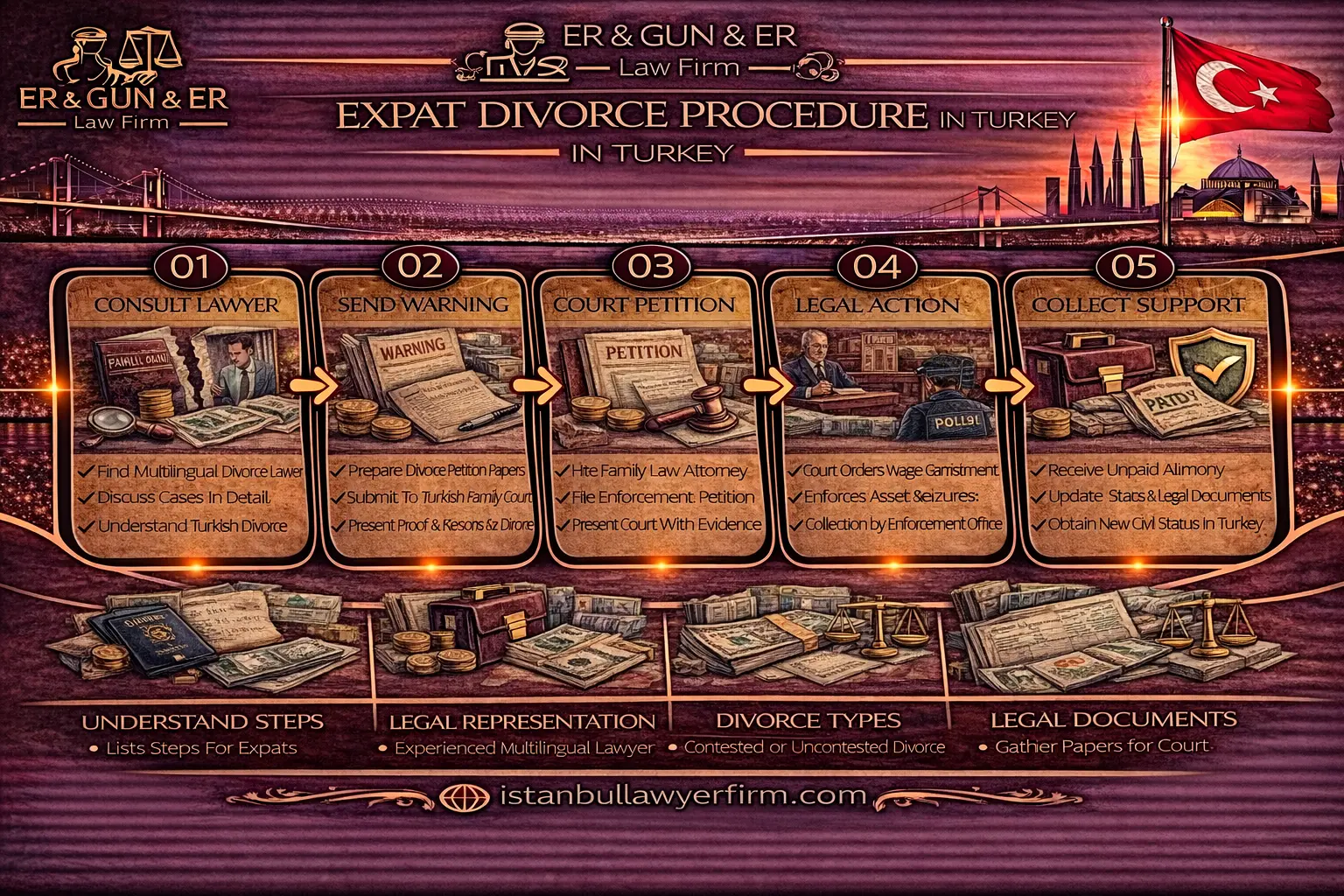
Expat divorces in Turkey are procedural before they are emotional, because the first questions are jurisdiction, notice, and usable evidence. The phrase divorce in Turkey for foreigners usually refers to cases where one or both spouses are non-citizens, live abroad, or hold assets in more than one country. A Turkish court cannot decide the merits fairly if the respondent was not served properly, so service abroad often becomes the longest and most risk-sensitive step. Custody, visitation, alimony, and property settlement are linked to procedure because interim orders and evidence timing can shape the final outcome. Foreign documents must usually be made usable through translation and authentication so the judge can rely on them without guessing. Property division and support enforcement also depend on whether the Turkish judgment will be recognized abroad, especially when parties relocate after divorce. Cross-border facts are highly variable, so a file must be built as an indexed chronology rather than a set of disconnected claims. “practice may vary by authority and year — check current guidance.” For coordinated filings and consistent wording across languages, many clients work with English speaking lawyer in Turkey support to keep the record coherent from petition to recognition.
Expat divorce overview
An expat case usually begins with confirming that a Turkish court can hear the dispute and that the chosen venue is procedurally correct. In expat divorce procedure Turkey, jurisdiction drives everything because an invalid filing can be dismissed even if the marriage is clearly broken. The petitioner should therefore gather basic connection facts such as residence history, last common address, and nationality information. Those facts are not trivia, because they determine whether Turkey is a proper forum and how the judgment will be treated abroad. Once the forum is stable, the next procedural focus is service, because the respondent must receive the petition through a legally valid channel. Service planning should be done before drafting detailed allegations, because allegations are useless if notice fails. After service, the court’s first work is often interim measures, especially for children, housing, and urgent support. Interim measures are not final decisions, but they shape daily reality and often create a de facto status quo. The petitioner should also plan the evidence pipeline early, because foreign documents take time to translate and authenticate. A clean evidence pipeline reduces adjournments because the court can evaluate exhibits without repeated corrections. Expat files also require strategy for parallel lanes, property, custody, and support, so pleadings remain consistent. Consistency matters because contradictory statements across lanes can undermine credibility and delay relief. If the parties have assets in multiple countries, the file should anticipate later recognition needs and collect identity proofs accordingly. If the parties have children, the file should anticipate travel consent and passport control questions from the start. A procedural-first mindset reduces surprises because each step is tied to a document and a service record.
Foreign spouses often assume that the divorce will move like a domestic case, but cross-border files require stronger front-end planning. The safest early step is to create a file map that lists which documents are in Turkey and which are abroad. The map should list who holds originals, who can obtain certified copies, and how each document will be translated. The map should also list which court will decide custody issues and which court will decide property liquidation issues. A petitioner should avoid filing broad claims without exhibits, because missing exhibits cause repeated requests and delays. The respondent should also avoid ignoring correspondence, because a default posture can lead to binding decisions once service is completed. If the respondent is abroad, communications should remain formal so later service proofs and notice proofs are not disputed. “practice may vary by authority and year — check current guidance.” Because procedural choices have long consequences, many parties consult a lawyer in Turkey to pressure-test venue, service route, and evidence readiness. This consultation is not about predicting an outcome, but about identifying procedural failure points before filing. Common failure points include wrong address declarations, missing translation pages, and inconsistent identity spellings. Another failure point is mixing support requests into the wrong petition without clear numbering and operative wording. Another failure point is overlooking how the divorce judgment will be used abroad, which affects what details must be in the judgment. A disciplined file also records every submission and receipt as dated exhibits so later recognition steps can rely on them. When the file is built as a chronology, the court can focus on merits instead of repairing procedural gaps.
A reliable expat strategy separates three workstreams, jurisdiction, service, and evidence, and keeps each workstream updated. Jurisdiction work includes collecting residence proofs and documenting the connection to the chosen Turkish court. Service work includes confirming the respondent’s current address and selecting the lawful service channel for that country. Evidence work includes collecting bank statements, school records, marriage certificates, and property documents in usable form. In cross-border households, the most common mistake is to start negotiations without knowing whether the Turkish petition can be served abroad. A second common mistake is to assume foreign documents can be filed as screenshots without full translation and certification. A third common mistake is to treat custody and property issues as separate stories with inconsistent timelines. To avoid these problems, parties often review procedural sequencing using a divorce lawyer guide and then build an indexed dossier that matches the court’s expectations. “practice may vary by authority and year — check current guidance.” When coordination across languages and institutions is heavy, a Turkish Law Firm can act as a single custodian for the file and maintain one consistent chronology. Custody requests should be supported by a routine plan and school documents that show the child’s stable environment. Support requests should be supported by income documents and a clear statement of the requested interim framework. Property requests should be supported by a first inventory and a tracing plan that identifies registries and banks. Recognition planning should be supported by identity documents and service proofs that will later be asked by foreign authorities. A single coherent dossier reduces conflict because both parties can see what is provable and what remains uncertain.
Jurisdiction and venue Turkey
Jurisdiction questions decide whether a Turkish court may hear the divorce and any connected custody and support requests. In jurisdiction for expat divorce Turkey analysis, courts look at connecting factors such as the spouses’ residence in Turkey and the location of the marital life. They also consider whether Turkey is the appropriate forum when one spouse is abroad and service must be completed internationally. Venue is then selected within Turkey, typically based on the last shared residence or the current residence of a spouse. Venue matters because filing in the wrong place can trigger procedural objections and delays even when jurisdiction exists. A petitioner should therefore collect address registration evidence, lease records, and utility records that show the relevant residence history. If the parties lived in multiple provinces, the file should explain the sequence with dates and supporting documents. If the parties recently moved, the court may ask for updated address evidence to confirm the connection. When the record is complex, a law firm in Istanbul can help align residence proofs and court filings to avoid mismatched addresses. Jurisdiction is also linked to later recognition abroad because foreign authorities often ask whether the deciding court was competent. For that reason, the file should preserve the jurisdiction proofs as a separate tab for later use. A clean jurisdiction tab includes marriage certificate copies, residence history documents, and any prior Turkish proceedings. It also includes identity copies that connect the spouses to the addresses and to the court district. If one spouse contests jurisdiction, the court may hold a preliminary hearing focused only on competence and notice. Preparing this competence record early prevents the case from stalling after service is completed.
Expat files often involve multiple possible forums, and the risk is parallel actions that create inconsistent judgments. A party should not assume that filing first automatically prevents proceedings elsewhere, because foreign systems may proceed independently. This is why the petition should explain the Turkish connection clearly and support it with documents. A party should also plan how to prevent conflicting interim custody decisions by informing the court of any foreign filings. Where foreign courts are involved, the Turkish International Private and Procedural Law framework guides how Turkish courts assess international competence. The framework may consider nationality and habitual residence concepts, and it may interact with treaty mechanisms where applicable. Because cross-border factors change frequently, courts may request updated address evidence during the case. “practice may vary by authority and year — check current guidance.” In practice, Turkish lawyers often advise building a venue memo that identifies why the chosen Turkish court is the most stable forum for the child’s routine. The memo should be factual and should avoid implying that the court was chosen only for advantage. If one spouse is a foreign national, the memo should also address how service will be achieved so the case is not delayed. If the spouses have assets abroad, the memo should note that property liquidation and enforcement may require recognition in other states. If the spouses have children, the memo should note the child’s school and medical ties to Turkey as stability indicators. The memo becomes useful later because foreign recognition files often ask for jurisdiction reasoning and factual connections. A coherent venue memo therefore supports both the Turkish procedure and the later cross-border recognition strategy.
Venue selection should also consider practical access to evidence and witnesses, because expat files rely heavily on documents. If the child attends school in Turkey, filing where school records and social investigation resources are accessible can reduce friction. If a spouse lives abroad, filing where international service coordination is routinely handled can also reduce delay. If a spouse cannot travel, remote participation requests may be needed, and court practice differs by courthouse. The court will generally apply the procedural rules of Turkey, even when foreign substantive law questions arise. Substantive law questions, such as which divorce law applies to foreigners, are assessed under international private law principles. Because those principles depend on nationality and habitual life facts, the case file should preserve passports and residence history carefully. If parties have multiple nationalities, the file should present the current nationality evidence with dates and official documents. If the spouses married abroad, the marriage certificate should be presented with full authenticity chain and translation. If the marriage certificate is missing pages, the court may treat the file as incomplete and request supplementation. If a spouse claims that a foreign prenuptial agreement affects the divorce, the agreement must be presented in usable form and then assessed. The court may still decide the divorce while leaving complex property liquidation issues to separate proceedings if needed. To prevent surprises, parties should map which claims they want to combine and which claims they want to separate at filing. A combined filing can be efficient but can also become slow if one foreign document blocks progress on all issues. A staged approach can sometimes protect the child’s routine and secure interim support while evidence is completed.
Filing grounds and petitions
The petition is the procedural engine of a Turkish family court divorce, because it defines the claims and the evidence scope. Foreign spouses should decide early whether they will pursue an uncontested protocol or a contested petition. An uncontested file requires a complete agreement, but it still requires valid service and clear identity documents when a spouse is abroad. A contested file requires stating the grounds in a way that is consistent with Turkish Civil Code concepts without quoting article numbers casually. The petition should also state the interim requests clearly, custody, contact, support, and protection, because interim orders shape daily life. If the spouses have assets in Turkey, the petition should preserve the right to property liquidation even if liquidation proceeds separately. If the spouses have children, the petition should propose a temporary routine rather than only request custody in abstract terms. If the spouses have foreign documents, the petition should identify which documents will be filed now and which documents will follow after translation. A petition should avoid relying on screenshots and instead attach official records where possible. A petition should also identify the respondent’s address for service and should explain how the address was verified. If the address is uncertain, the petition should request procedural assistance for address verification rather than guess. Because the first petition sets the tone, careful drafting helps prevent later contradictions across custody, alimony, and property submissions. In Istanbul practice, an Istanbul Law Firm can coordinate petition drafting with translation and service preparation so the file is coherent from day one. This coordination is most valuable when the spouses speak different languages and documents come from multiple jurisdictions. A disciplined petition package gives the judge a clear roadmap and reduces adjournments caused by missing procedural elements.
Grounds should be framed in a way that supports a clear evidentiary plan, because allegations without proof rarely change outcomes. For foreigners, the grounds discussion should also anticipate that service abroad may take time, so interim protection requests may be crucial. Petitions should separate custody facts, support facts, and property facts so the court can decide interim issues quickly. If you combine everything in one narrative, the judge may not find the operative requests and may postpone decisions. A good petition includes a short chronology that lists marriage date, separation date, child schooling status, and current residence addresses. It includes an exhibit list that identifies which documents are attached and which documents are pending translation. It includes a request for social investigation when household facts are contested and stability must be assessed. It includes a request for interim contact rules that are realistic with school schedules and travel realities. It includes a request for interim support framed as a provable need and a provable ability to pay, not as a punitive claim. “practice may vary by authority and year — check current guidance.” If you want a structured overview of how Turkish family files are organized, the baseline at family law guidance can help you align terminology and avoid mixing legal lanes. The petition should also include identity documents in full so the court can verify parties without confusion. If one spouse has multiple passports, the petition should present the controlling passport used for service and travel. If a child has dual nationality, the petition should mention it neutrally to support later travel consent planning. A petition that reads as an ordered plan is harder to resist procedurally because it makes each requested step verifiable.
Filing also requires that petitions are signed by the party or by a properly authorized representative. If the petitioner is abroad, power of attorney usability becomes a technical step that can delay filing if not planned early. The power document should be drafted to cover divorce filing, interim requests, and service management so the representative can act without repeated re-authorization. If the power document is issued abroad, authentication steps may be required before Turkish offices accept it. Because authentication practices vary, the safest approach is to obtain notary and legalization steps early and keep the chain pages together. A petition package should also include clear contact information so court notices reach the representative quickly. Court communications are procedural events, so missing a notice can delay a hearing or cause a missed deadline. If the respondent is abroad, the petitioner should collect multiple address proofs and document how the address was verified. If the respondent uses multiple residences, the petition should request court assistance for correct service channel selection. If the petitioner expects an uncontested protocol, the protocol should be drafted with custody, support, and property clauses that are executable. If the petitioner expects a contested case, the petition should identify which issues will be resolved now and which issues may be separated later. Separation can be useful when property evidence is abroad and would otherwise block urgent child and support decisions. The petition should also anticipate that translation of key foreign documents may take time and plan a supplement timeline accordingly. Supplements should be numbered and dated so the judge can track what was added and why. A disciplined filing package reduces later procedural disputes because the court record shows clarity from the first day.
Service abroad mechanics
Service is often the most delicate step in expat files because the court cannot proceed without proof that the respondent was notified lawfully. The phrase service of divorce papers abroad Turkey refers to sending the petition and court summons through a channel that the destination state recognizes. Where the Hague Service Convention applies, the court typically relies on central authority transmission rather than informal courier delivery. Where the convention does not apply, service may proceed through diplomatic or consular channels under Turkish International Private and Procedural Law practice. The petitioner must provide a correct foreign address, because an incorrect address can waste months and still produce no valid service. The service packet usually must include translated documents so the respondent can understand the claim and so the foreign authority accepts the request. Translation quality matters because wrong names and wrong dates can cause rejection by foreign authorities. A petitioner should also keep proof of address verification, such as official registry extracts or recent utility records, to rebut claims of bad faith. If the respondent is moving frequently, the petitioner should document multiple addresses and ask the court to choose the legally safest route. The petitioner should not rely on social media location claims as service proof, because courts and foreign authorities prefer official address evidence. Once service is sent, the petitioner should track the file number and preserve every outgoing request receipt as a dated exhibit. If service fails, the court often requires a new request with corrected documents and corrected translations. In high-stakes files, parties sometimes consult a best lawyer in Turkey to audit the service packet and prevent avoidable rejection by foreign authorities. This audit is practical because service errors are expensive to cure and can delay interim child protection decisions. A service plan should therefore be drafted at the same time as the petition, not after filing.
Service channels differ by destination state, and the court will usually require the channel that produces a verifiable certificate of service. The certificate is the proof that allows the Turkish file to continue to hearings without default risk. If a destination authority requests a particular form, the petitioner must comply and keep the full form set in the Turkish file. If the destination authority requests a translation, the translation should be prepared with consistent identity tokens matching passports. If the destination authority requests notarization or legalization, the chain pages should be preserved and submitted together. If the destination authority refuses service because the address is incomplete, the petitioner should cure the address and refile promptly. If the destination authority refuses service because the recipient moved, the petitioner should document the move evidence and seek updated address confirmation. “practice may vary by authority and year — check current guidance.” Some courts will allow limited interim measures before full foreign service when child safety requires urgency, but the approach depends on the file and the judge. For that reason, interim requests should be supported by strong evidence so the judge can act without waiting for full merits hearings. If the respondent later appears and contests service, the court will evaluate whether the service certificate meets procedural requirements. A petitioner should therefore keep the original service certificate and not rely on informal email confirmations. Where the respondent is in a state that is slow to respond, the petitioner should keep periodic status inquiries in writing as proof of diligence. These inquiry receipts can help rebut arguments that the petitioner delayed service intentionally. A disciplined service file also supports later recognition abroad because foreign authorities often ask for proof that the respondent had notice.
When the respondent’s address is unknown, the petitioner should not guess an address and instead should document search steps. Search steps can include checking prior residence registrations, checking known employer records, and requesting court assistance where available. If an address is discovered later, the petitioner should update the court immediately to avoid allegations of concealment. If the respondent is a national of the destination state, consular service may be possible in some scenarios, but it depends on international arrangements. Where consular service is used, the petitioner should still demand a written service confirmation that includes date and recipient details. If the respondent refuses to accept papers, the service authority may still record service as completed, depending on the destination rules. The petitioner should not assume refusal equals failure and should wait for the official certificate outcome. If the respondent does not appear after valid service, the court can proceed, but the petitioner must still prove claims with evidence. A default posture does not waive the need for custody proof, support proof, and property proof because courts still apply substantive standards. If the respondent appears later, the respondent may seek procedural remedies, and the strength of the service record becomes critical. This is why the petitioner should archive every version of the service packet, including translations, forms, and dispatch receipts. If the respondent participates remotely, the court may allow participation methods that depend on court technical capacity. If remote participation is granted, the petitioner should still serve every new submission through official channels so the record remains complete. In parallel, the petitioner should plan the recognition file early, because recognition abroad is easier when service proof is clean. A clean service record therefore protects both the Turkish judgment and any later cross-border enforcement of its effects.
Evidence and translations
Expat files rely on foreign documents, so the court must be able to read them. Judges usually require full, legible copies with consistent names and dates. The most common defect is a missing page in a certificate or an incomplete stamp chain. Another common defect is a translation that changes identity tokens or omits annexes. The phrase apostille and translation divorce Turkey captures the practical step of making foreign papers usable in court. If a document is issued abroad, you should obtain a certified copy and keep the issuance record. If legalization is needed, keep every chain page attached to the same document bundle. If a translator is used, one glossary should be applied across every exhibit. Courts tend to distrust last-minute reconstructions, so archive records as soon as you receive them. Preserve email headers and source files only as supplemental proof, not as the main proof. “practice may vary by authority and year — check current guidance.” A bilingual counsel such as English speaking lawyer in Turkey can align terminology between the petition and the foreign exhibits. The aim is not to impress the court, but to remove doubt about authenticity and meaning. A clean translation package also helps the other side respond without claiming surprise. When the record is complete, the case moves to merits rather than stalling on technical objections.
Evidence planning should start with a master index that lists each exhibit and its source. For each foreign document, record who issued it, where it was obtained, and on what date. Keep the original language version and the certified translation as one locked pair. If names are transliterated differently across passports and certificates, add a short reconciliation note with copies. Courts and experts read faster when each exhibit is numbered and referenced consistently in petitions. This discipline becomes critical when you later seek recognition abroad, because foreign authorities ask for the same chain. The background at recognition and enforcement procedures helps you anticipate what proof is expected after judgment. If financial records are foreign, obtain bank statements that clearly show account holder identity and the reporting period. If records are downloadable, preserve the bank confirmation page that shows the statement was generated officially. If the other spouse challenges authenticity, you should be ready to request verification through the issuing authority. “practice may vary by authority and year — check current guidance.” A coordinated file room managed by Turkish Law Firm can prevent multiple translations of the same document from drifting. Drifting translations create contradictory dates and can undermine the credibility of otherwise strong claims. Keep translations neutral and avoid adding interpretive commentary inside the translated text. When exhibits are consistent, interim requests and final findings can be drafted with less procedural risk.
Evidence is not limited to official certificates, because expat cases often rely on practical proof of residence and routine. Use address registrations, leases, and school records to show where family life actually occurred. For communications, select only the small set that proves a specific issue, such as notice attempts or handover coordination. Courts generally prefer complete threads with timestamps rather than isolated screenshots. When you file digital exhibits, ensure the metadata is preserved in the submission record and the printouts remain readable. If you rely on photos or videos, focus on objective conditions such as housing suitability and not on sensational framing. If an exhibit is likely to be contested, prepare an alternate source such as a third-party confirmation letter. Third-party letters should identify the writer’s role and the basis of their knowledge, and they should be dated. Expat files also require a custody log, a payment log, and a property inventory so the court sees structure. Each log should cite the exhibit page that supports the entry, so the log is not treated as opinion. “practice may vary by authority and year — check current guidance.” Many parties centralize these logs with a law firm in Istanbul so numbering and captions stay consistent. Consistent captions matter because the same exhibit may be used in custody, support, and recognition steps. Avoid reusing the same document under different names, because that creates confusion and invites objections. A disciplined evidence room keeps the proceeding focused on decisions rather than document disputes.
Interim measures and protection
Interim relief is used to stabilize safety, housing, and finances while the divorce is pending. In expat files, interim measures are often the only practical way to prevent sudden relocation or asset dissipation. The topic interim measures divorce Turkey covers temporary custody, temporary support, and protective orders that manage urgent risk. The court usually expects a narrow request that identifies the immediate problem and proposes a workable temporary rule. For children, the request should set a temporary residence and a school continuity plan. For support, the request should state the claimed amount and attach income indicators and household expense proof. For property, the request should identify the specific asset and explain why preservation is needed. If the other spouse is abroad, the request should anticipate service delays and explain why waiting would cause harm. The motion should attach a chronology of recent events, such as blocked contact, threats, or rapid transfers. The motion should avoid speculation and use objective exhibits like bank statements and registry extracts. “practice may vary by authority and year — check current guidance.” A responsive counsel such as lawyer in Turkey can package these requests with an index that the judge can verify quickly. Judges tend to reject requests that look punitive rather than protective, so tone matters. Interim orders are also easier to enforce when they contain precise dates, times, and identifiers. A clear interim order reduces repeated emergency hearings because each parent knows what to do.
Protection requests can include measures that reduce direct contact between spouses while preserving the child’s routine. When exchange points are conflict-heavy, courts sometimes prefer neutral handover locations and written communication protocols. If a protective measure exists, the interim custody and contact plan should be drafted to comply with it. This prevents one order from unintentionally causing a violation of another order. Interim financial protection can also include targeted preservation steps for assets that are likely to be sold quickly. The preservation request should name the asset precisely and attach current registry or bank snapshot evidence. If the debtor has a salary, a temporary wage deduction request may be more practical than a broad asset freeze. If the debtor is self-employed, a bank sweep strategy may be more effective, but it requires bank identifiers. Interim orders should be served and implemented through the proper channel, and service proof should be archived. Service proof later becomes an enforcement exhibit when one party claims they did not know the order. “practice may vary by authority and year — check current guidance.” In Istanbul, parties often use Istanbul Law Firm style file custody to ensure every interim order and receipt is preserved. Preservation matters because interim orders can be modified, and the court will ask what happened under the earlier order. If an interim request is refused, the refusal should be kept so later motions can address the stated deficiency. The goal of interim practice is to keep the case stable enough that final hearings can focus on merits.
Interim work should also anticipate cross-border practicalities like passports, visas, and school calendars. A temporary travel restriction, if sought, should be tied to a concrete risk and a clear return protocol. Courts are cautious with travel bans, so requests should be narrow and evidence-based. If the child has dual nationality, the file should explain how passports will be stored and accessed for lawful travel. If one parent proposes relocation, interim measures may include preserving the child’s current school placement until hearing. That preservation often prevents a unilateral move from becoming an irreversible status quo. If the case includes urgent housing needs, interim orders can define who stays in which home temporarily. Housing orders should avoid vague terms and should specify address and access rules to prevent conflict. If the other spouse is abroad, interim communication rules should be written so they can be implemented across time zones. Interim relief should also coordinate with property settlement tracing so asset preservation does not conflict with later valuation. “practice may vary by authority and year — check current guidance.” Many Turkish lawyers recommend filing interim requests with a tight exhibit set rather than with a full narrative. A tight exhibit set signals seriousness and reduces the chance of procedural delay due to irrelevant material. After an interim order is issued, parties should keep compliance logs because compliance behavior affects credibility. Interim strategy is therefore not only about getting an order, but also about building a provable stability record.
Child custody framework
Child custody decisions in expat files rely on the same welfare logic, but the procedural stakes are higher. The phrase child custody expat divorce Turkey reflects that jurisdiction, schooling, and travel proofs often sit across borders. Courts ask where the child’s stable routine exists and which parent can maintain it consistently. They also ask how the child will keep meaningful contact with the other parent after divorce. Interim arrangements are often decisive because they establish school continuity and daily supervision patterns. Parents should prepare a routine plan with school hours, pickup arrangements, and homework supervision. Parents should also prepare housing proofs that show the child has a stable sleep and study space. If extended family supports caregiving, document roles and schedules without exaggeration. If the child is enrolled in a school in Turkey, obtain official school letters and attendance summaries. If the child is enrolled abroad, obtain equivalent documents and prepare usable translations. “practice may vary by authority and year — check current guidance.” For a deeper procedural map, the child custody law guide helps you understand how courts structure interim and final custody decisions. Counsel guidance from best lawyer in Turkey profiles often focuses on making the routine plan executable rather than argumentative. An executable plan reduces conflict because it answers practical questions before they become accusations. A custody file should therefore be built as a calendar and evidence pack, not as a moral narrative.
Courts usually separate custody from financial disputes, but in practice finances affect feasibility of proposed schedules. If one parent proposes a distant residence, transport cost and time must be addressed realistically. If one parent proposes international schooling, the file should show how contact will be maintained without exhausting the child. Courts often request social investigation reports to assess household conditions and caregiving capacity. Parents should cooperate with investigations and provide neutral documents like school calendars and medical appointment logs. Avoid coaching the child, because investigators record pressure dynamics and conflict exposure. If there are safety allegations, the file should rely on official records and protective orders rather than rumor. Where protective measures exist, the proposed contact plan should comply with them and include safe exchange logistics. If parents communicate in different languages, agree on a written translation protocol for school notices and court notices. Mixed-language misunderstandings can lead to missed appointments and missed contact, which then become evidence. “practice may vary by authority and year — check current guidance.” A parent should also keep a handover log because enforcement of contact depends on dated attempts and responses. If the other parent blocks contact, document the block with full message context and neutral witnesses where possible. If the child’s routine changes, record the change date and attach proof, such as a new school enrollment letter. Custody litigation becomes more predictable when each change is documented as a dated event.
Expat custody files often involve passports, border controls, and competing school systems. The court will typically want a clear consent protocol for international travel to prevent recurring conflict. A consent protocol should specify how requests are made, what itinerary details are provided, and how return is confirmed. If one parent fears non-return, the parent should raise the concern through interim motions rather than through unilateral passport retention. Unilateral passport retention can be framed as contact obstruction and can harm credibility if not justified by proof. If a child has multiple nationalities, the file should list documents neutrally and keep identity spellings consistent across all pages. If a child’s residence status in Turkey depends on immigration paperwork, keep the status record consistent with the custody schedule. This avoids border confusion that can undermine school continuity and routine. If one parent lives abroad, video contact can be structured to preserve routine without replacing in-person contact entirely. Courts often ask for holiday schedules that are realistic with school terms and flight logistics. “practice may vary by authority and year — check current guidance.” Parents should therefore prepare a school-year calendar and propose contact blocks that minimize mid-week disruptions. The file should also anticipate that foreign authorities may request certified copies of Turkish interim orders during travel. Keep certified copies and translations ready so travel does not become an emergency evidence chase. A custody framework that anticipates these practicalities reduces litigation because fewer surprises appear during the year.
Visitation and travel consent
Contact rules are the operational core of most expat divorce disputes because distance amplifies small conflicts. The phrase visitation rights expat divorce Turkey captures the need for a detailed schedule that survives travel and time zone changes. A schedule should be built around the child’s school week first and the parents’ travel preferences second. Exchanges should be planned at low-conflict locations that do not expose the child to arguments. If one parent is abroad, the schedule should include longer holiday blocks rather than frequent short weekends. Longer blocks reduce flight fatigue and reduce repeated handover disputes. The plan should specify who buys tickets, who escorts the child, and how itinerary changes are communicated. The plan should also specify how video contact occurs between trips, including days and times. If the child has exams or medical appointments, the plan should prioritize those events and then compensate contact fairly. Parents should avoid using contact as a bargaining chip for property or support issues. “practice may vary by authority and year — check current guidance.” Courts often respond better to proposals that include clear calendars rather than vague promises of reasonable contact. A party seeking reduced contact should explain concrete harm risks and propose alternative safe contact structures. A party seeking expanded contact should show practical availability and stable housing for overnight care. Clear contact drafting reduces enforcement disputes because the obligation is testable by date and time.
Travel consent disputes usually arise when one parent fears that a trip will become a relocation. The safest practice is to require written consent for international travel unless the court order states otherwise. Consent should identify destination, travel dates, accommodation, and return flights so it is verifiable. If consent is refused, the refusing parent should state a reason in writing to create a record for court review. If consent is granted, store it with the itinerary so later accusations about scope are avoided. Passport custody should be addressed explicitly, including where passports are stored and how access is granted. Shared storage can work when parents cooperate, but it requires a strict handover protocol with receipts. If cooperation is poor, the court may order a single custodian with an obligation to provide passports for approved trips. The plan should also address domestic travel within Turkey when it affects school attendance and handover times. If a parent repeatedly travels without notice, document the pattern because it affects trust and routine. “practice may vary by authority and year — check current guidance.” Courts also examine whether travel proposals interfere with the other parent’s scheduled contact time. A fair plan either avoids conflict dates or provides make-up time in writing. Parents should keep communications child-focused and avoid threats, because threats often trigger stricter travel controls. A travel consent protocol that is written and followed reduces the need for emergency motions.
Implementation is the real test, so parties should treat the first months after interim orders as a compliance record period. Keep a calendar that records each contact day, each missed day, and each make-up day with written confirmations. If an exchange fails, record the location, time, and message trail without escalating the conflict at the scene. If a child refuses travel, the court may examine whether refusal is child-driven or conflict-driven, so calm documentation matters. When exchanges are at airports, keep boarding confirmations as objective proof of performance. When exchanges are at schools, keep school notices that confirm pickups when available. If the order requires a parent to share school updates, preserve examples of compliance and noncompliance. These examples often become the basis for enforcement motions and later modification requests. If a parent is abroad, ensure that electronic contact is consistent and recorded, because missed calls become disputes. Use one communication channel for logistics to reduce contradictory threads. “practice may vary by authority and year — check current guidance.” If the other parent blocks contact, proceed through the court and enforcement channels rather than through retaliation. Retaliation creates a mutual noncompliance record that harms both parties and prolongs litigation. A well-documented protocol also supports later recognition abroad because foreign authorities ask whether contact was implemented. Predictable, recorded implementation is therefore both a child welfare tool and a procedural risk control tool.
Alimony and interim support
In expat files, support claims are often urgent because the spouses may not share a stable household income stream anymore. Courts treat interim support as a temporary stabilizer while the divorce merits and evidence are processed. The practical question is what expenses must be covered to keep housing, schooling, and basic care stable. A claimant should present a simple monthly budget supported by rent contracts, invoices, and bank statements. A respondent should respond with verifiable income evidence rather than with general hardship claims. If income is paid abroad, the file should include payslips, bank credits, and employer confirmations in usable form. If income is irregular, the file should show a realistic average pattern rather than a single high or low month. Courts also examine whether the claimant has independent resources and how those resources are documented. Interim support is not a final allocation of wealth, so the order can change when the final decision is issued. In many cases the parties also litigate child support separately from spousal maintenance, so the labels must be clear. The phrase alimony expat divorce Turkey often covers both interim and final maintenance, but each requires a different evidence focus. Payments should be requested through traceable channels so later enforcement can be proven month by month. If the payer proposes paying in cash, insist on written receipts that specify the month covered and the amount. If the payer is likely to relocate, early planning for collection tools should be discussed alongside the interim request. For a coherent interim package and cautious wording, working with lawyer in Turkey counsel can keep the support request focused on documents rather than accusations.
The court will typically ask what type of alimony is being requested and on what legal basis it is framed. In mixed-nationality marriages, parties sometimes misunderstand which support types the Turkish court can order in the same petition. A practical way to avoid confusion is to align your terminology to the core concepts explained in the alimony law overview. That overview helps you separate interim support from long-term maintenance and to state each request in plain procedural language. The support file should also state whether the payments are intended to be made inside Turkey or from abroad. If payments come from abroad, state the bank account details and require a transfer reference that identifies the month covered. If the paying spouse uses multiple accounts, require the payer to confirm which account will be used so statements remain readable. When parties fight about currency, the safest approach is to focus on provable expenses and provable income rather than on speculative exchange movements. Courts may request additional documents when the income picture is unclear, and delays are common when documents are incomplete. “practice may vary by authority and year — check current guidance.” If the respondent claims that a foreign tax or payroll rule blocks payment, request written proof and avoid accepting vague explanations. If the claimant receives payments from relatives, document them transparently so the court can assess real need. If the claimant works, document actual wages and work schedule so the court does not rely on assumptions about earning capacity. Interim orders should be drafted so they are enforceable, with a clear amount, a clear periodicity, and a clear start point. In Istanbul-based expat files, a law firm in Istanbul can help keep the interim support binder consistent across translations, statements, and court submissions.
Support disputes often overlap with parenting disputes because parents ask who will pay specific child expenses during the case. Turkish courts generally treat the child’s routine costs as a separate track from spousal maintenance, even when both are requested together. If the child’s expenses are the main urgent issue, you should align the request to the concepts described in the child support guide. That guide helps you present school fees, healthcare costs, and daily expenses as verifiable items rather than as estimates. In expat households, some expenses are paid in foreign currency, so the file should show actual invoices and bank debits. Where expenses are paid by one parent abroad, include the payment proof so the court sees the real cost pattern. If the other parent reimburses irregularly, build a reimbursement ledger that ties each request to an invoice and a response. Interim support should also consider housing stability, because repeated moves can harm the child’s schooling and wellbeing. If one spouse controls the family bank account, request interim measures that prevent sudden account closures without notice. “practice may vary by authority and year — check current guidance.” A support order is easier to enforce when it specifies a payment channel and a reference standard for monthly transfers. If the parties plan to settle, they should define arrears treatment clearly so old months are not silently forgiven by accident. If the payer proposes a reduced amount due to temporary hardship, require documentary proof and a defined review point. Keep all support communications polite and written, because hostile messages are often attached to objections later. In complicated cross-border income files, a targeted review by best lawyer in Turkey can help identify the minimum document set needed to support an interim request without overloading the case.
Property settlement structure
Property liquidation in cross-border divorces usually requires a separate structure plan because assets and documents are spread across jurisdictions. The phrase property settlement expat divorce Turkey is used when parties need to combine Turkish property regime rules with foreign evidence pipelines. In many cases the divorce decree ends the marriage, while the property settlement claim proceeds as a distinct accounting phase. The first procedural task is to identify the governing matrimonial property regime and its effective dates for the couple. The second task is to build an asset inventory that lists real estate, bank accounts, vehicles, and company interests with identifiers. The third task is to classify each asset as acquired or personal using traceable funding evidence rather than assumptions. The fourth task is to plan valuation, because courts rely on expert methodology for disputed items such as real estate and business shares. If the couple has Turkish assets, early registry snapshots help prevent later disputes about what existed on key dates. If the couple has foreign assets, decide early whether the Turkish case will address them directly or whether a foreign proceeding is needed. “practice may vary by authority and year — check current guidance.” A practical way to understand the Turkish-side structure is to compare it with the liquidation roadmap explained in the property settlement guide. That roadmap helps you build an exhibit index that ties each asset to a deed extract, statement page, or corporate record. It also helps you decide whether interim preservation measures are needed to stop dissipation while valuation is pending. Parties should avoid negotiating numbers before they agree on the asset list, because missing assets later reopen conflict. A structured plan reduces costs because experts receive organized inputs instead of receiving fragmented documents.
Expat couples often hold assets through nominee accounts, family transfers, or overseas companies, which makes tracing the main battleground. When records are abroad, obtaining certified statements and usable translations is often slower than the Turkish court’s hearing rhythm. A sensible approach is to run an evidence pipeline in parallel so foreign documents are ready when the Turkish expert asks for them. Where property is in Turkey, land registry extracts and title history provide objective starting points for tracing. Where property is abroad, you should preserve foreign title documents and service records because later recognition may require them. Business assets require special care because corporate books can be edited, so early snapshot requests reduce later manipulation claims. If one spouse controls the business, request ledger-level accounting documents through court-assisted disclosure rather than rely on summaries. If the business holds Turkish real estate, separate the company valuation from the real estate valuation to avoid double counting. If the parties used foreign currency transfers, keep conversion documents and bank memos because they explain funding origin. “practice may vary by authority and year — check current guidance.” Settlement negotiations are more realistic when each asset has a supporting exhibit and a proposed valuation method. A party should also plan enforcement while negotiating, because an uncollectable settlement is a future dispute. Enforcement planning includes identifying where the other spouse’s assets actually sit and which jurisdiction can reach them. In complex portfolios, Turkish lawyers often focus on building an auditable asset schedule with cross-references rather than on broad allegations. That discipline helps the court because the judge can see what is proven, what is contested, and what is simply unknown.
Property settlement structure should also anticipate that some assets are illiquid and cannot be divided by simply splitting balances. Real estate may require sale, transfer, or a balancing payment, and each option has different execution steps. Company shares may be restricted by shareholder agreements, so a court award may require additional corporate steps to implement. Bank accounts can be frozen quickly, but they can also be emptied quickly, so timing and snapshots matter. Household debt can distort net outcomes, so every claimed loan should be supported by a contract and repayment trail. If the spouses have assets in multiple states, they should avoid contradictory narratives between Turkish pleadings and foreign filings. A consistent narrative helps later because foreign authorities scrutinize whether the Turkish judgment was issued with proper notice and competence. If a party expects to enforce abroad, keep certified copies and service proofs ready from the start, not after judgment. “practice may vary by authority and year — check current guidance.” A practical drafting rule is to avoid vague asset descriptions and instead use identifiers such as parcel numbers and account references. Another drafting rule is to separate the asset list from the argument, so later updates do not rewrite the entire petition. In settlement drafts, define who will sign transfer documents and how the parties will exchange originals and certified copies. In cross-border settlements, define payment channel, currency, and proof standard to avoid later disputes about what was paid. If one spouse has unstable income, consider security instruments, but do not assume any instrument is available without checking practice. A well-designed structure turns a complex expat portfolio into a manageable set of verifiable steps, which reduces both delay and distrust.
Hidden assets and tracing
Hidden asset disputes are common in expat divorces because spouses often have accounts and companies outside the country where they litigate. The practical starting point is to define what you already know, which banks, which properties, which companies, and which employers. Then you convert that knowledge into targeted disclosure requests rather than broad accusations. Courts respond better to precise identifiers, such as a specific bank branch or a specific parcel, than to general suspicion. Tracing begins with timeline discipline, meaning you map separation events and then mark unusual transactions close to those dates. Unusual transactions can include repeated cash withdrawals, transfers to relatives, and sudden changes in shareholding. The goal is to show a pattern that suggests dissipation without relying on personal attacks. Where money moved abroad, preserve transfer references, SWIFT confirmations, and receiving account evidence where possible. Where a spouse claims that a transfer was a loan repayment, demand the original loan agreement and prior repayment history. Where a spouse claims that a transfer was a sale, demand the sale contract and payment proof to test whether value was real. “practice may vary by authority and year — check current guidance.” Tracing also requires documenting control, who can sign, who can withdraw, and who continues to use the asset after transfer. Control can be shown through ongoing maintenance payments, tax payments, and continued occupancy patterns. A clean concealment file therefore looks like an accounting worksheet with exhibit references, not like a narrative of distrust. When documents are in multiple languages, English speaking lawyer in Turkey coordination can prevent translation drift that makes the same account appear to belong to different identities.
In cross-border files, the biggest obstacle is often not the law, but the availability of usable records. Some banks provide detailed statements only to account holders, so court-assisted disclosure may be needed when one spouse controls access. When court-assisted disclosure is sought, requests should be framed with specific periods and account identifiers to avoid partial responses. If the debtor spouse uses multiple banks, build a bank map from past incoming payment references and from known employers. If the spouse runs a business, trade registry records can reveal signatory authority changes and capital changes that suggest value movement. Business concealment often happens through related-party invoices, shareholder loans, and expense payments that function as personal withdrawals. To test these, request ledger-level accounting and bank statements for key corporate accounts rather than only annual summaries. If the business holds real estate, obtain land registry extracts for the company as well as for the spouse personally. If the spouse holds foreign shares, collect the foreign corporate extracts and ensure they are translated consistently and completely. “practice may vary by authority and year — check current guidance.” A frequent tracing trap is to assume that a foreign account is unreachable, so the party stops collecting evidence too early. Even when enforcement abroad is difficult, foreign statements can still prove that funds existed and were moved in specific months. Those proofs can influence settlement leverage because they reduce the credibility of hardship defenses. If the other spouse claims that funds belong to relatives, ask for beneficiary evidence and the reason the spouse controls the payments. Tracing becomes effective when each claim is tied to a dated transaction and a document that the court can verify.
Hidden asset tracing should be coordinated with interim measure requests so evidence and preservation support each other. If a bank sweep is requested, the court and execution office need a clean arrears or claim schedule to justify scope. If a registry annotation is requested, the parcel identifiers must be precise and supported by current extracts. If a share transfer is suspected, the timing should be supported by trade registry records and, where possible, payment trail evidence. The court is cautious about freezing everything, so you should prioritize the assets that are most liquid or most easily moved. Prioritization reduces procedural pushback because the request looks proportional and fact-driven. If you later discover new assets, add them as dated supplements rather than rewriting your original list. A dated supplement log also helps rebut accusations that you are shifting your story for tactical reasons. “practice may vary by authority and year — check current guidance.” When the other spouse offers settlement, test the offer against tracing findings, because a low offer may reflect hidden value. If the offer depends on foreign transfers, require traceable payment channels and documentary proof standards. If the offer allocates Turkish assets but ignores foreign assets, record whether the allocation is a compromise or a denial. If a party threatens to move assets, do not respond with threats, and instead file the targeted preservation motion supported by exhibits. Tracing evidence is also useful in support disputes because it can show ability to pay despite claimed hardship. The most durable approach is to treat tracing as an ongoing evidence project that is updated calmly as new data appears.
Enforcement inside Turkey
After a judgment, the next challenge is turning paper orders into real transfers, payments, and implemented schedules. The phrase enforcement of divorce judgment Turkey covers execution of support orders, property allocations, and certain custody-related orders through the Turkish enforcement machinery. Enforcement requires a certified judgment copy, proof of notification, and a clear description of what must be done. Execution offices act on documents, so unclear identifiers can block implementation even when the decision is favorable. If the judgment orders a payment, the creditor typically opens an execution file and serves the debtor with a payment demand. If the judgment orders transfer of a registrable asset, the creditor must coordinate with the relevant registry and provide the judgment as authority. If the judgment includes child contact rules, implementation usually relies on family court procedures and enforcement tools designed for contact. In expat files, enforcement is complicated by distance, so appointing a local representative and keeping a clean document binder matters. “practice may vary by authority and year — check current guidance.” A creditor should prepare an enforcement binder that separates title pages, service proofs, and a running ledger of what was performed. A debtor should also keep performance proofs to prevent double collection and to demonstrate good faith compliance. If the debtor’s assets are in Turkey, early attachment steps can prevent dissipation during appeal or negotiation. If the debtor’s assets are abroad, Turkish enforcement may secure only the Turkey-based portion, so cross-border planning remains necessary. For Istanbul-based implementation and document custody, some parties use Istanbul Law Firm coordination to keep registry steps, bank steps, and service proofs aligned. Clear enforcement planning reduces re-litigation because parties can show what was done and what remains outstanding by date.
Support enforcement is often the first enforcement lane expats encounter because monthly payments create recurring arrears quickly. A creditor should separate spousal support and child-related support in the ledger so execution offices can apply payments correctly. If a debtor is salaried in Turkey, wage deduction tools can create steady collection once the employer is correctly identified. If a debtor is self-employed, bank attachments and receivable attachments often become the practical tools. Where the debtor disputes arrears, the fastest response is usually a month-by-month statement pack that shows non-payment. If the debtor claims that a modification is pending, ask for the modification decision, not only the filing receipt, before changing the ledger. If the debtor offers a payment plan, document it in writing and keep the execution file consistent with the plan terms. For a focused procedural roadmap on collection of support orders, the enforcement structure described in the alimony enforcement guide can help parties separate execution steps from divorce arguments. “practice may vary by authority and year — check current guidance.” Property enforcement requires additional planning because transfers require registry appointments and identity proofs, not only a payment demand. If a property is mortgaged, enforcement must account for secured creditor rights and the practical net value available. If company shares are awarded or if a balancing payment is ordered based on share value, corporate books may need updating to implement the decision. If the debtor tries to avoid enforcement by transferring assets to relatives, consider challenging transfers with evidence and targeted motions. A coordinated approach is easier when one custodian maintains the ledger, service proofs, and attachment requests in one index, which is a role a Turkish Law Firm can perform in complex portfolios. The practical aim is to turn each enforcement step into a dated exhibit so later recognition abroad is not undermined by unclear performance history.
Enforcement inside Turkey also interacts with ongoing divorce proceedings when interim orders and final orders coexist. Parties should label each order as interim or final and record the effective dates so offices do not apply the wrong text. Where custody and visitation are ordered, the implementation record should be preserved because later modification requests rely on patterns. If one parent blocks contact, the enforcement file should contain handover logs and copies of court orders with precise times. If one parent relocates within Turkey, update address and school information in the file so handover logistics remain workable. For property allocations, execution planning should include who will pay transfer costs and which documents are needed for registry appointments. For bank claims, execution planning should include which banks to notify and how to update the claim when payments arrive. When the debtor complies partially, record partial compliance as dated receipts so the remaining claim is not disputed. “practice may vary by authority and year — check current guidance.” If the debtor appeals, enforcement posture may depend on whether a stay is granted, so check the procedural record rather than assume. If the debtor threatens insolvency, monitor corporate registry and enforcement actions early because collectability can change quickly. If insolvency proceedings begin, coordinate claim registration and keep proof of registration as part of the enforcement binder. If the parties settle after judgment, close execution files properly and keep closure receipts so restrictions do not remain accidentally. A disciplined enforcement archive also supports foreign recognition later because it proves notice, performance, and any arrears history clearly. The strongest expat enforcement outcomes come from calm, procedural steps that are backed by a clean ledger and a stable exhibit index.
Recognition abroad strategy
Recognition planning matters when you need the Turkish decree to update civil status, remarry, or register parental authority in another country. Many expats discover the issue only when a foreign registry refuses to accept a Turkish copy without certification. The objective is to make the decree usable under the destination state’s private international law and administrative rules. Start by identifying which authority will consume the document, such as a civil registry, a court, an immigration authority, or a school administration. That authority often asks for a certified decree, a finality confirmation, and proof that the respondent had notice and an opportunity to participate. If the respondent was served abroad, preserve the service certificate and every transmission receipt in one continuous bundle. If the respondent appeared voluntarily, preserve the hearing attendance record and any written waiver of formal service that appears in the court minutes. If the decree includes custody and contact terms, ensure the operative wording is clear and not lost in long reasoning pages. Many foreign offices want the operative section first, and they reject packs that look incomplete or confusing. Obtain multiple certified copies early, because later requests can be slower once the file moves to archives. Then plan apostille and translation divorce Turkey steps only after you know what the destination authority accepts in your profile. Some states require apostille, while others require consular legalization, and using the wrong chain wastes time. The phrase recognition of Turkish divorce abroad describes this packaging and usability step, not a re-hearing of the merits. Keep a file map that lists which pages are the operative decree, which are annexes, and which are service proofs. A clean map prevents rejection based on missing pages and helps the foreign reviewer verify the record quickly. When the record is complex, a lawyer in Turkey can help present a concise, verifiable pack without rewriting facts.
Foreign authorities usually test due process before they accept a foreign divorce as legally effective. They focus on whether the respondent had meaningful notice and an opportunity to be heard. That is why the service record can be more important than the narrative of why the marriage ended. If your file used service of divorce papers abroad Turkey, preserve the full chain, request forms, translations, dispatch receipts, and the final service certificate. If the address changed mid-process, keep the court record showing the updated address decision and the re-service outcome. If the recipient refused delivery, keep the official certificate that records refusal under the destination rules. If the respondent was represented, keep the power of attorney and appearance record because representation can defeat notice objections. Some jurisdictions also ask why Turkey was a competent forum, so preserve residence proofs and any venue reasoning in a separate tab. If jurisdiction was contested, keep the preliminary competence decision and the hearing record that resolved it. Prepare a short cover note that lists the enclosed documents and the purpose of each document, and keep it factual. The cover note should not argue merits, because foreign registries typically confirm procedural validity, not marital fault. “practice may vary by authority and year — check current guidance.” For consistent presentation and address hygiene, many expats instruct a law firm in Istanbul to manage certified copies and translations centrally. Central custody reduces the risk that different versions circulate with different page counts and inconsistent identity spellings. It also helps when multiple foreign authorities request the same pack in slightly different formats. Recognition becomes smoother when the pack is stable, complete, and supported by a clean certificate trail.
Recognition planning should start while the case is pending, because notice defects are difficult to cure after judgment. If you expect to live abroad with the child, foreign schools and immigration offices may ask for a recognizable custody paragraph and clear contact terms. They may also ask for proof that travel consent terms were part of the decree or part of a court-recorded protocol. If the decree is silent, you can still enforce the domestic order, but foreign authorities may hesitate to act without explicit wording. This is why counsel often drafts operative paragraphs with clear custody, contact, and passport handling language that can be understood outside Turkey. The same clarity helps in enforcement of divorce judgment Turkey because execution offices and registries need identifiers and unambiguous commands. If the debtor does not comply, you may need certified copies repeatedly, so order multiple certified sets early and store them securely. Keep a payment ledger for support and store bank references, because foreign authorities sometimes ask whether support is being paid and how arrears are tracked. If you later seek recognition of a support order abroad, the same service and finality proofs will be requested again. For property awards, foreign recognition may depend on whether the Turkish judgment is final and whether the respondent was heard, so store those proofs with the decree. Some families therefore prefer to settle and record the settlement in court, because the record can be cleaner for foreign registry use. A settlement recorded by the court can still face foreign procedural questions, but the due process pack is often easier to assemble. In complex portfolios, an early review by a best lawyer in Turkey can prevent gaps that later block foreign civil status updates. The review should focus on proof completeness and identity consistency rather than on optimistic assumptions about foreign acceptance. If you need counsel language to match foreign administrative expectations, use a divorce lawyer Turkey for foreigners who understands how operative wording affects later registry use. Recognition succeeds when the pack is complete, consistent, and anchored in service proof.
Parallel proceedings risks
Parallel filings are common when spouses live in different countries and each believes their home forum is better. The phrase parallel divorce proceedings Turkey describes the risk that a Turkish case and a foreign case run at the same time. Parallel cases create contradictory interim orders, especially for custody, travel, and support. They also create duplicated costs because each court requests its own translations, certifications, and procedural confirmations. The first defense is transparency, tell the Turkish court what foreign steps exist, and tell foreign counsel what Turkish steps exist. The second defense is sequencing, decide which forum should decide which issue, such as divorce status, custody routine, support, and property. If you try to litigate everything everywhere, you often end with inconsistent orders that are hard to enforce and hard to explain to schools. A parent can receive one custody order in Turkey and another abroad, and third parties may not know which one to follow. A spouse can receive a property judgment in one state while assets sit in another state, making collection uncertain. Parallel cases also increase strategic delay, because a party can claim they are waiting for the other court to move first. Judges dislike being used as chess pieces, so procedural clarity helps credibility. If the Turkish case is your anchor, keep the expat divorce procedure Turkey record disciplined so foreign courts see a coherent file. If a foreign case is your anchor, still manage Turkish service and representation so you are not surprised by a Turkish default record. “practice may vary by authority and year — check current guidance.” In complex coordination, Turkish lawyers often recommend a written forum memo that explains which court should handle which question and why. A forum memo is not a guarantee, but it reduces confusion and helps prevent inconsistent interim measures.
When two courts are seized, each may ask whether it should proceed or defer based on its own competence rules. Turkish private international law analysis considers connections such as residence, nationality, and the location of family life. A foreign court may use habitual residence or domicile tests that are not identical to the Turkish approach. Because the tests differ, both courts can consider themselves competent at the same time. This competence overlap is why early coordination matters more than blame narratives. In a Turkish family court divorce file, the court still requires valid service and evidence even if a foreign case exists. The foreign court may also demand proof that the Turkish respondent was served properly before it respects the Turkish timeline. If you ignore the foreign case, you risk obtaining a Turkish judgment that is later difficult to use abroad due to due process objections. If you ignore the Turkish case, you risk asset and support exposure in Turkey if the other spouse enforces locally. The practical solution is to keep both counsel teams aligned on dates, addresses, and the children’s routine facts. Alignment is easier when one bilingual coordinator controls translations and identity tokens across both cases. For mixed-language couples, an English speaking lawyer in Turkey can keep terminology stable so one filing does not contradict another. divorce in Turkey for foreigners often involves civil registry documents, bank records, and school documents, and those documents must be consistent across both forums. If the same document is translated twice with different spellings, both courts may question authenticity and delay decisions. “practice may vary by authority and year — check current guidance.” Parallel management succeeds when each court receives a coherent procedural story and the parties avoid opportunistic forum shopping behavior.
Parallel custody motions are particularly risky because interim routines can become entrenched quickly. If one court grants a temporary residence and another court grants a different temporary residence, the child’s routine can be destabilized. The Turkish court typically applies best-interests analysis based on the child’s schooling and caregiving environment shown in the record. A foreign court may apply a similar welfare test but with different evidentiary expectations and different report formats. This is why parents should avoid unilateral school changes while both courts are watching the same facts. If you need immediate stability, file interim measures divorce Turkey requests with a tight evidence pack and a realistic routine plan. The plan should include school attendance proof, housing proof, and a neutral exchange protocol that reduces conflict. child custody expat divorce Turkey disputes also require a travel consent protocol because border checks amplify enforcement risk. If one court restricts travel and the other court permits travel, airlines and border officers may demand clarity that the parties cannot improvise. The safest practice is to obtain one clear written order and then use it consistently for school and travel communications. If a foreign authority asks for the Turkish interim order, provide a certified copy and a complete translation pack with consistent identity tokens. If the Turkish court asks for foreign interim orders, provide full certified copies and avoid selective excerpts. Parallel investigations can also contradict if parents present different facts to different investigators, so keep one routine narrative across forums. For record consistency, an Istanbul Law Firm can maintain a single chronology and exhibit index that is reused in both forums. “practice may vary by authority and year — check current guidance.” Parallel risk is reduced when the parties coordinate one factual record and limit contradictory filings.
Settlement and protocols
Settlement is often the safest path in expat files because it reduces service disputes, parallel filings, and recognition uncertainty. A settlement agreement expat divorce Turkey should be drafted as an execution plan rather than a narrative of compromise. Execution planning means each clause describes a concrete step, a trigger, and a proof standard that can be verified later. For custody, the protocol should state primary residence, a dated contact calendar, and information sharing rules. For support, the protocol should state payment channel, transfer reference format, and allocation rules for partial payments. For property, the protocol should include a property settlement expat divorce Turkey schedule with identifiers and transfer steps. Identifiers include parcel numbers, account identifiers, and company share details, not vague asset labels. The protocol should also state what happens if a transfer step fails, such as if a bank refuses due to incomplete documentation. If assets are abroad, the protocol should state whether enforcement will be pursued abroad and what documents will be produced for recognition. The protocol should include a disclosure annex list that shows which bank statements, registry extracts, and corporate records were exchanged. It should include a privacy clause that protects the child’s information without blocking necessary school communications. If one party is abroad, signature logistics must be planned so the protocol is executed with valid authority and complete chain pages. “practice may vary by authority and year — check current guidance.” For controlled drafting and version custody, a Turkish Law Firm can keep bilingual clauses consistent with Turkish court language. Consistency matters because inconsistent translations can later be framed as lack of informed consent. A good protocol reduces future litigation because it converts uncertainty into measurable steps.
A settlement should address ongoing monthly duties with the same precision as one-time asset transfers. In alimony expat divorce Turkey negotiations, ambiguity about due dates and payment references creates future enforcement fights. The protocol should state the receiving bank account clearly and require a transfer reference that identifies the month covered. The protocol should also state whether payments continue during holidays and travel periods, so no month becomes disputed later. If child expenses are included, the protocol should separate them from spousal maintenance so allocation remains clear. For visitation rights expat divorce Turkey, the protocol should specify exchange points, travel responsibilities, and holiday blocks by date. If one parent lives abroad, the protocol should include video contact windows that are stable across time zones. If the child attends an international school, the protocol should state how school notices are shared and who may access school portals. If one parent fears travel risk, the protocol should define a consent method that is written, verifiable, and tied to itineraries. The protocol should avoid punitive language and focus on child routine and enforceable logistics. Where the parties agree to resolve minor disputes through written notice before court filings, define the notice channel and the basic response method. If the parties agree to mediation later, the protocol should still define interim performance so there is no vacuum. A protocol should state which language version controls if the document is bilingual, to prevent meaning disputes. It should include a clause that requires updated address exchange, because service and enforcement depend on current addresses. For execution readability, a lawyer in Turkey can review whether each clause can be implemented by a registry, a bank, or an enforcement office. A settlement is durable when it reads like instructions, not like aspirations.
Expat protocols should also anticipate administrative steps after judgment, such as updating civil registries and school files. Many parties sign a protocol but forget that foreign authorities may ask for a final decree and proof of service. To prevent this, attach a document production clause that lists which certified copies will be requested after judgment. The clause should also state who pays translation and certification steps without stating fixed amounts or timelines. If the parties expect recognition of Turkish divorce abroad, they should agree on who will obtain certified copies and how they will be shared. They should also agree on which translator will be used so the same decree is not translated in conflicting versions. If apostille and translation divorce Turkey steps are required, the protocol should state who will coordinate them and where originals will be stored. The protocol should require that service certificates and hearing attendance records are preserved as part of the recognition pack. If the parties have assets in Turkey, the protocol should specify how transfers will be executed and what documents each party must sign. If the parties have assets abroad, the protocol should specify whether the Turkish protocol will be used as evidence in the foreign jurisdiction and how. If the parties plan to remarry abroad, they should ensure the Turkish decree wording is clear and contains no ambiguous conditions that confuse registries. The protocol should define how communications will occur after divorce, focusing on child logistics and payment proofs. “practice may vary by authority and year — check current guidance.” For cross-border coordination and document custody, some parties appoint a law firm in Istanbul to hold originals and manage certified copy requests. Custody of originals reduces lost-page risk, which is a common reason foreign authorities reject a pack. A protocol that anticipates recognition steps usually prevents a second wave of litigation about documents.
Practical checklist
A practical checklist starts with confirming that Turkey is a competent forum and that the chosen court district is defensible. Collect residence proofs, last common address proofs, and marriage certificate proofs before drafting your petition. Verify jurisdiction for expat divorce Turkey using documents rather than assumptions, because foreign recognition later may scrutinize competence. Identify the respondent’s current foreign address and document how you verified it through official sources. Build the service packet early, because service of divorce papers abroad Turkey can stall the case if translations or forms are incomplete. Prepare certified translations of the petition and annex list where the destination state requires them. Prepare a power of attorney plan if a party cannot travel for signatures or hearings. Create a master exhibit index and a chronology that will be reused for interim motions and final submissions. Separate custody evidence, support evidence, and property evidence into tabs so interim rulings are not delayed by property documents. Take early registry snapshots for Turkish assets so later transfers can be detected objectively. Take early bank statement snapshots for key accounts so non-payment and dissipation patterns are provable. Create a child routine plan that fits school hours and work schedules and can be implemented immediately. Create a support budget with invoices and bank proofs so interim support requests are evidence-led. Create a property inventory table that lists each asset identifier and the proof source, registry, bank, or trade register. “practice may vary by authority and year — check current guidance.” For a structured start, a best lawyer in Turkey can audit the checklist and identify which missing document would stop service or interim relief.
After filing, keep every court notice, receipt, and service certificate as part of a recognition-ready archive. The archive should include the petition, annex list, translations, and the final service certificate when service was abroad. When interim orders are issued, obtain certified copies so schools and banks can rely on them without dispute. Keep a compliance log that records whether interim contact was implemented and whether support was paid. A compliance log supports later modification requests and also supports enforcement steps if noncompliance appears. If the respondent does not pay support, preserve bank statements and allocate each payment to a specific month immediately. If the respondent moves assets, preserve updated registry extracts and request interim preservation when risk is documented. After judgment, request certified copies and a finality confirmation so the decree is usable in administrative processes. If you need recognition of Turkish divorce abroad, keep the due process record complete because foreign registries often ask for notice proof. If you expect enforcement of divorce judgment Turkey, open execution files with a clean ledger and avoid mixing different obligations. Keep support and property enforcement in separate folders so attachments and payments are allocated correctly. If your protocol includes travel consent clauses, keep written consents and itineraries archived to prevent later disputes. If foreign enforcement is needed, prepare a translated decree pack and preserve all chain pages without separating stamps. “practice may vary by authority and year — check current guidance.” Many Turkish lawyers recommend ordering multiple certified sets early in the enforcement stage to avoid repeated court registry visits. A complete archive reduces future cost because the same documents are reused for school registration, immigration updates, and foreign civil status changes.
The checklist should also include a parallel proceeding scan, meaning you confirm whether any foreign case has started and how it will interact. If a foreign case exists, coordinate counsel so pleadings do not contradict each other on dates, residences, and the child’s routine facts. Maintain one translation glossary so the same term is not translated differently across petitions, protocols, and foreign submissions. Keep identity tokens consistent across passports, marriage certificates, and children’s documents to prevent service failures. If you anticipate settlement, draft the protocol as an execution plan and test each clause against registry and bank requirements. If you anticipate litigation, prepare expert requests early for property and income issues so the file does not stall later. Keep a safe storage plan for originals and certified copies so documents are not lost between countries. Use traceable payment channels and insist on month references so support records remain auditable. If one spouse is abroad, define one communication channel for logistics and keep messages child-focused and factual. If passports are in issue, define custody and access rules in writing and avoid self-help retention unless ordered. If you expect frequent travel, keep itineraries and consents together with interim orders so border checks are manageable. A settlement agreement expat divorce Turkey should include a disclosure annex list so later hidden asset accusations are reduced. If the case becomes contested, a divorce lawyer Turkey for foreigners can coordinate the Turkey file and the foreign recognition pack without changing facts. For bilingual communication control, an English speaking lawyer in Turkey can keep translations aligned and prevent terminology drift. “practice may vary by authority and year — check current guidance.” A checklist is successful when it produces one coherent dossier that can be used for court, enforcement, and foreign recognition without rework.
FAQ
Q1: recognition of Turkish divorce abroad usually requires a certified decree, finality proof, and a service certificate if the respondent was abroad. Foreign registries often reject incomplete packs even when the divorce is valid. A coordinated dossier managed through Istanbul Law Firm custody can prevent missing-page problems.
Q2: service of divorce papers abroad Turkey must follow the destination state’s accepted channel, often through convention or diplomatic routes. Address accuracy and complete translations are the most common practical blockers. A Turkish Law Firm can standardize the service packet so the file does not stall on avoidable defects.
Q3: expat divorce procedure Turkey usually succeeds faster when the petition, exhibits, and service plan are prepared as one indexed timeline. Missing proofs often delay interim decisions for children and support. If the file is high-risk, consult a lawyer in Turkey for evidence discipline rather than assumptions.
Q4: apostille and translation divorce Turkey requirements depend on the document and the destination authority. Always keep the full chain pages together, including stamps and annexes. Using a law firm in Istanbul as a document custodian can reduce version drift across translations.
Q5: parallel divorce proceedings Turkey can create conflicting interim orders about children, travel, and support. Coordination between counsel teams and consistent date narratives reduce conflict. A review by best lawyer in Turkey profiles can help pressure-test which forum should decide which issues.
Q6: child custody expat divorce Turkey filings should be built around the child’s school routine and a realistic contact plan. Courts rely on neutral documents like school records and housing proofs. Many Turkish lawyers recommend keeping a handover log from day one.
Q7: alimony expat divorce Turkey requests work best when supported by income indicators and a simple expense ledger. Courts are cautious with unsupported numbers and prefer traceable payment channels. An English speaking lawyer in Turkey can keep foreign payroll exhibits consistent with Turkish pleadings.
Q8: enforcement of divorce judgment Turkey is typically handled through execution files for money claims and through family court mechanisms for child contact. Keep certified copies, service proofs, and a month-by-month ledger. Many clients ask Istanbul Law Firm teams to centralize the enforcement binder.
Q9: property settlement expat divorce Turkey usually requires an asset inventory, tracing plan, and expert-ready valuation inputs. Cross-border assets often require separate evidence pipelines and consistent translations. A Turkish Law Firm can manage the index and supplement log to reduce contradictions.
Q10: visitation rights expat divorce Turkey schedules should be calendar-based and school-centered, with clear exchange points and travel responsibilities. Vague “reasonable contact” terms frequently trigger enforcement disputes. “practice may vary by authority and year — check current guidance.”
Q11: jurisdiction for expat divorce Turkey depends on factual connections such as residence and venue ties, and it must be proven by documents. Courts and foreign registries may ask for competence proof later. “practice may vary by authority and year — check current guidance.”
Q12: divorce in Turkey for foreigners often requires early planning for service, interim child routine orders, and recognition abroad. Build one index, one chronology, and one translation glossary to avoid contradictions. “practice may vary by authority and year — check current guidance.”
Author: Mirkan Topcu is an attorney registered with the Istanbul Bar Association (Istanbul 1st Bar), Bar Registration No: 67874. His practice focuses on cross-border and high-stakes matters where evidence discipline, procedural accuracy, and risk control are decisive.
He advises individuals and companies across Sports Law, Criminal Law, Arbitration and Dispute Resolution, Health Law, Enforcement and Insolvency, Citizenship and Immigration (including Turkish Citizenship by Investment), Commercial and Corporate Law, Commercial Contracts, Real Estate (including acquisitions and rental disputes), and Foreigners Law. He regularly supports corporate clients on governance and contracting, shareholder and management disputes, receivables and enforcement strategy, and risk management in Turkey-facing transactions—often in matters involving foreign shareholders, investors, or cross-border documentation.
Education: Istanbul University Faculty of Law (2018); Galatasaray University, LL.M. (2022). LinkedIn: Profile.