

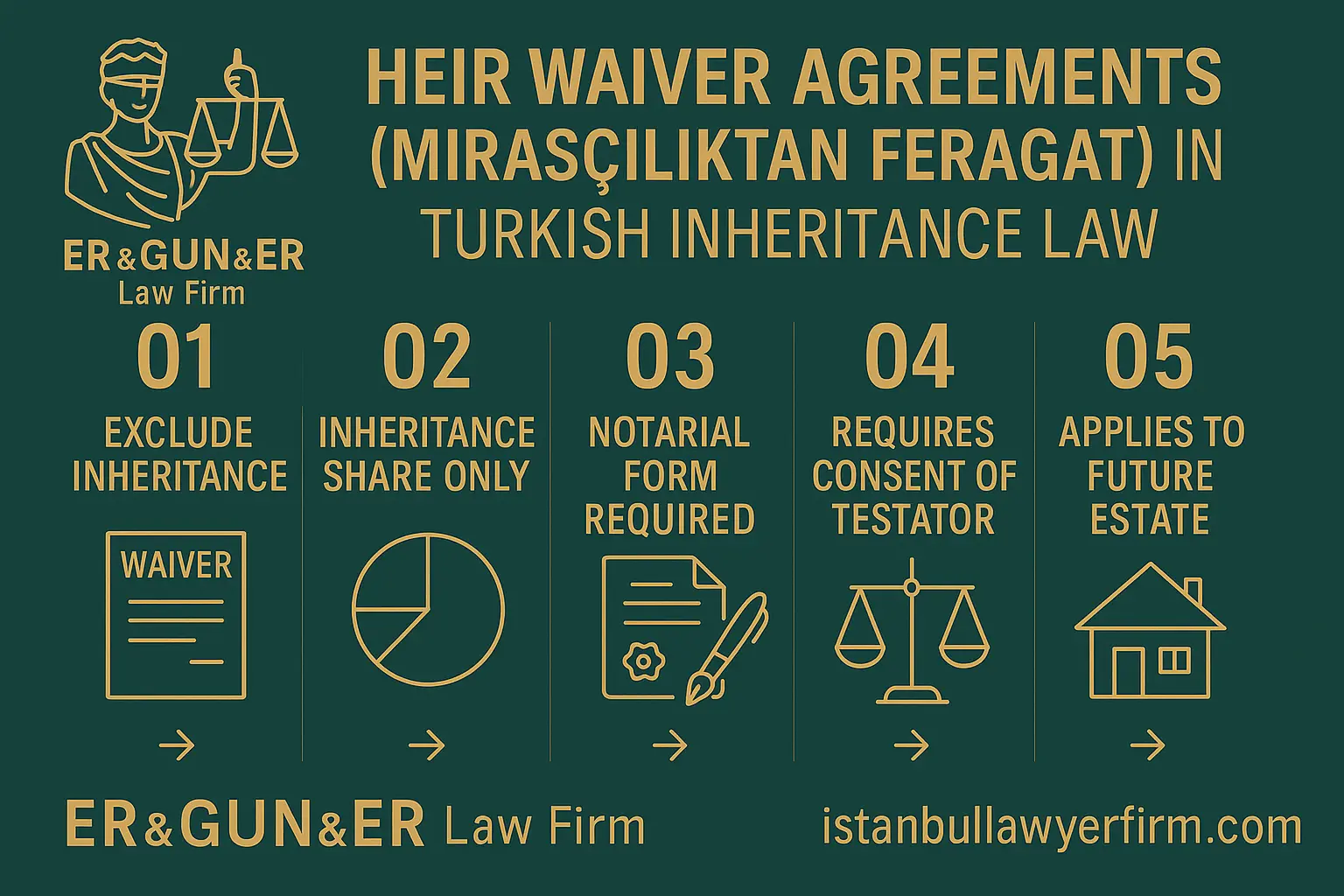
A lawyer in Turkey who advises on inheritance planning understands that heir waiver agreements—referred to in Turkish law as mirastan feragat sozlesmesi—are binding legal instruments through which an individual renounces their future inheritance rights from a specific person during that person's lifetime, and that these instruments are used in complex estate planning scenarios to prevent future disputes among heirs, to secure and legitimize lifetime gifts, and to protect business succession arrangements from later challenge. An Istanbul Law Firm that advises on heir waiver agreements in Turkey explains that the legal enforceability of such agreements requires strict formalities prescribed by the Turkish Civil Code—including notarized execution with both parties present, clear specification of the waiver's scope, and in the case of conditional waivers, documentation of the consideration provided—and that misunderstandings, ambiguous language, or procedural defects can result in court challenges that undermine estate plans years or decades after execution. A Turkish Law Firm that handles heir waiver matters for both testators and heirs provides the integrated legal service that covers the complete lifecycle of these instruments: drafting agreements that comply with Turkish Civil Code Articles 528–531; advising on conditional versus unconditional structures; coordinating notarization in Turkey and abroad; integrating waivers with lifetime real estate transfers and business succession plans; defending valid agreements against challenge; and representing heirs who believe a waiver was executed under conditions that affect its validity. An English speaking lawyer in Turkey who advises on mirastan feragat sozlesmesi for international clients provides the bilingual guidance that enables foreign heirs and testators unfamiliar with Turkish succession principles to understand the legal consequences of waiver agreements before signing and to structure these instruments in a way that remains enforceable in Turkish courts. Practice may vary by authority and year — verify current Turkish Civil Code provisions on heir waiver agreements, current notarization requirements, current court interpretation standards for proportionality and informed consent, and current practice at Turkish notary offices and consulates for parties residing abroad with qualified counsel before executing or challenging any heir waiver agreement in Turkey, since the administrative and judicial environment applicable to mirastan feragat sozlesmesi has evolved with legislative updates and appellate decisions whose most recent implications for execution strategy, evidence requirements, and challenge defense should be specifically confirmed rather than assumed from earlier practice or comparative foreign law.
Legal Nature, Elements and Conditional vs Unconditional Structures
A lawyer in Turkey who advises on the legal nature of heir waiver agreements explains that the mirastan feragat sozlesmesi allows a legal heir to voluntarily give up inheritance rights before the testator's death—a mechanism fundamentally different from post-mortem disclaimer, which occurs after death and is subject to different formal and tax rules. An Istanbul Law Firm that drafts heir waiver agreements helps clients understand the specific elements that determine a waiver's legal effectiveness: the agreement must be executed as a notarized deed signed by both the testator and the heir with both present before the notary; it must clearly state which inheritance rights are being waived—whether total or limited to specific assets or categories; and where compensation is provided, the nature, amount, and timing of that compensation must be specified with sufficient clarity to withstand later challenge. Turkish lawyers advising on waiver structure help clients choose between conditional and unconditional arrangements: conditional waivers—more common in family business succession where one child receives assets during the parent's lifetime in exchange for renouncing future claims—require particular attention to proving that the compensation was fair, documented, and understood at signing, since courts may partially annul a conditional waiver whose exchange is found disproportionate or unclear at the time of the testator's death. Practice may vary by authority and year.
An Istanbul Law Firm that advises on conditional heir waiver agreements explains that the legal risk in exchange-based structures lies in two areas: proving that the consideration was fair relative to the inheritance rights waived, and proving that both parties understood the agreement's legal consequences at execution. Turkish lawyers advising on conditional waiver documentation help clients implement the specific documentation approach most effective for each structure: including valuation reports prepared by independent experts for any real estate or business interest transferred as consideration; ensuring the exchange is contemporaneously documented in bank transfer records or official delivery protocols rather than established only by the waiver document itself; and involving independent legal representation for the heir so that post-death challenge based on lack of understanding or advice is specifically foreclosed. An English speaking lawyer in Turkey who advises on conditional heir waiver agreements for foreign-connected families provides the multilingual documentation that enables heirs residing abroad or not fluent in Turkish to demonstrate genuine informed consent—which is the single most important evidentiary requirement when conditional waivers are challenged after the testator's death. Practice may vary by authority and year.
A Turkish Law Firm that advises on unconditional heir waiver agreements explains that these instruments are particularly vulnerable to challenge when heirs later claim they were pressured, misled, or unaware of the document's implications—and that Turkish courts are cautious about enforcing unconditional waivers without specific proof of informed consent and notarial explanation. An English speaking lawyer in Turkey who advises on unconditional waiver execution explains that the practical protections for unconditional waivers include ensuring the heir is independently represented before signing, providing plain-language explanations of the agreement's permanent consequences in the heir's language, and creating a notarial record that specifically captures the heir's understanding and voluntary agreement. When done correctly, unconditional heir waiver agreements offer powerful estate planning benefits for families seeking to prevent future disputes—but these benefits are realized only when the execution process is legally sound and the evidence of voluntary, informed consent is specifically preserved in the notarial and supporting record. Practice may vary by authority and year.
A Turkish Law Firm that advises on the strategic selection between unconditional and conditional heir waiver structures explains that the choice should be made based on the specific family dynamics and estate profile rather than on a default preference—because conditional waivers whose compensation is well-documented and proportionate are generally easier to defend than unconditional waivers whose voluntary nature must be established through evidence alone, while unconditional waivers correctly executed with full informed consent documentation can be the more administratively clean solution when no practical consideration is being exchanged. An English speaking lawyer in Turkey who advises on waiver structure selection for international families explains that the single most important structural decision is whether the heir has received qualified independent legal advice before signing—because this fact, when specifically documented in the notarial record, addresses the single most common invalidity argument raised in post-death challenges regardless of whether the waiver is conditional or unconditional. Practice may vary by authority and year.
Legal Risks, Invalidity Scenarios and Court Challenge Grounds
A lawyer in Turkey who advises on heir waiver invalidity explains that despite their utility, heir waiver agreements can be declared partially or fully invalid when they fail to meet the legal requirements of the Turkish Civil Code—and that the most common defects are using private contracts rather than notarized deeds, failing to disclose the agreement's existence and terms to all heirs affected by its operation, leaving waiver scope ambiguous so that later interpretation disputes are inevitable, and executing agreements when the testator's mental capacity is questionable. An Istanbul Law Firm that conducts pre-execution reviews of heir waiver agreements helps testators and heirs implement the specific controls most important for validity: confirming through contemporaneous medical documentation that the testator is legally competent at the time of signing; ensuring the heir receives independent legal advice so that later uninformed-consent challenges are specifically foreclosed; and drafting comprehensive scope clauses—including annexes listing relevant assets, company shares, and rights—so that the waiver's boundaries are objectively determinable rather than subject to interpretation. Turkish lawyers advising on waiver risk management help clients understand that the risk of invalidity is highest when agreements are executed close to the testator's death, when family relationships are strained, and when the consideration provided is below market value for the rights waived. Practice may vary by authority and year.
An Istanbul Law Firm that advises on partial waiver risks explains that waivers that do not address all inheritance elements—including movable property, company shares, and assets acquired after the waiver is signed—may be interpreted narrowly by Turkish courts, leaving claims open that the testator assumed were foreclosed. Turkish lawyers advising on comprehensive waiver drafting help clients implement the specific approach most effective for each estate situation: specifying whether the waiver covers future-acquired assets or only assets existing at execution; defining how company shares, intellectual property, and financial instruments are treated; and including dispute resolution provisions that designate the forum for interpreting contested scope questions. An English speaking lawyer in Turkey who drafts heir waiver agreements for international families provides the comprehensive scope language that prevents the narrow interpretation problem from arising—by specifically addressing every asset category relevant to the specific family's estate profile rather than using generic language whose application to specific assets can always be disputed. Practice may vary by authority and year — verify current Turkish court interpretation standards for waiver scope provisions with qualified counsel before relying on any specific drafting approach.
A Turkish Law Firm that advises on blended family and cross-border waiver challenges explains that heir waiver disputes become more complex when some heirs live abroad, when family members speak different languages, or when cultural expectations about inheritance create background assumptions that contradict the legal instrument. An English speaking lawyer in Turkey who advises on cross-border waiver disputes provides the neutral legal advisory that enables families with members in multiple jurisdictions to navigate waiver negotiations with full understanding of both the Turkish legal framework and the comparable inheritance concepts in the heirs' home countries. Language misunderstandings, unequal treatment among heirs, and unfamiliarity with Turkish formal requirements are all specifically addressed in the pre-execution process rather than left to produce post-death litigation—because the investment in ensuring genuine understanding and procedural correctness at the execution stage is consistently less expensive than managing the legal proceedings that arise when these issues are discovered after the testator's death when correction is no longer possible. Practice may vary by authority and year.
Enforceability Standards, Evidence and Burden of Proof
A lawyer in Turkey who advises on heir waiver enforceability explains that Turkish courts assess enforceability primarily through three filters: the agreement's formal compliance with notarized deed requirements; the substantive fairness of any exchange provided; and the quality of the evidence demonstrating both parties' informed consent and the testator's legal competence at execution. An Istanbul Law Firm that defends heir waiver agreements in probate and inheritance proceedings builds the specific evidence set most effective for each defense situation: expert legal opinions confirming the agreement's procedural compliance; valuation reports demonstrating that compensation was proportionate to the rights waived; witness affidavits capturing what the notary explained and how both parties responded; and bank records and tax filings validating that any financial consideration was actually transferred rather than simply promised. Turkish lawyers advising on waiver defense help clients understand that courts give significant weight to the quality and contemporaneity of this supporting documentation—and that assembling it after a challenge has been filed is significantly less effective than preserving it at execution. Practice may vary by authority and year.
An Istanbul Law Firm that advises on timing-related enforceability risks explains that waivers executed close to the testator's death face heightened scrutiny on grounds of undue influence, diminished mental capacity, and pressure—and that courts regularly request medical records, psychiatric evaluations, and notary testimony to confirm the testator's legal competence at signing. Turkish lawyers advising on timing and execution strategy help clients understand that heir waiver agreements should be completed as part of broader estate planning rather than as last-minute instruments, since early execution with deliberate process creates a stronger evidentiary record. An English speaking lawyer in Turkey who consults on waiver timing for international clients who must coordinate across jurisdictions provides the scheduling guidance that enables foreign-connected families to execute agreements with appropriate preparation—including independent legal representation for heirs, medical documentation for testators whose health may become relevant, and notarized interviews that capture each party's statements as a contemporaneous record. Practice may vary by authority and year.
A Turkish Law Firm that advises on burden of proof in heir waiver challenges explains that in Turkish proceedings, the burden of proving invalidity typically falls on the heir seeking to invalidate the waiver—who must demonstrate coercion, lack of understanding, fraud, or defective execution. An English speaking lawyer in Turkey who represents testators' estates in waiver enforcement proceedings builds the specific defense showing that due process was followed, that the exchange was fair, and that documentation practices were consistent—enabling the court to uphold the agreement against challenge. Where a waiver is challenged on capacity grounds, the defense file should include specifically dated medical records, the notary's contemporaneous statement about the testator's condition, and any independent medical assessment obtained close to execution. The best lawyer in Turkey for heir waiver enforcement combines knowledge of Turkish Civil Code provisions, Turkish court evidentiary practice, cross-border documentation requirements, and the specific evidence standards that Turkish probate courts apply when assessing capacity, proportionality, and informed consent with the strategic presentation that makes the difference between an agreement that holds and one that is partially or fully annulled after years of litigation—providing the family with legal certainty that enables the testator's succession plan to be implemented as intended rather than subjected to the outcomes of contested proceedings whose results neither party can reliably predict. Practice may vary by authority and year.
Lifetime Gifting, Real Estate Transfers and Waiver Integration
A lawyer in Turkey who advises on lifetime gifting integrated with heir waivers explains that these instruments are frequently paired with real estate transfers, bank asset gifts, or business share transfers as a single legal event—where the testator transfers a substantial asset during their lifetime and the heir simultaneously executes a waiver preventing future inheritance claims. An Istanbul Law Firm that structures integrated gift-and-waiver transactions helps clients implement the specific documentation approach most effective for each transfer type: preparing gift agreements legally recognized in Turkish law and tied to the waiver through cross-referenced annexes; coordinating with real estate registry offices and notaries to record and cross-reference all documents so the transfer and waiver are part of a single traceable legal event; and aligning gift tax reporting with the waiver's characterization of the exchange so tax filings and the waiver document present a consistent narrative. Turkish lawyers advising on gift-and-waiver integration help clients understand the specific risks most common in practice: testators sometimes sign a waiver but do not complete the property transfer, creating a legal gap that invalidates the exchange basis; heirs sometimes challenge gifts claiming they were informal or lacked the supporting waiver; and valuation mismatches between the gift value and the inheritance rights waived create the proportionality disputes that are most common in contested waiver proceedings. Practice may vary by authority and year.
An Istanbul Law Firm that advises on real estate-linked heir waiver agreements explains that lifetime real estate transfers related to waivers require specific planning for gift tax implications, land registry annotation requirements, and valuation standards—because under Turkish law, lifetime transfers between parents and children are subject to inheritance and gift tax unless structured through applicable exemptions, and the tax treatment of a gift must be consistent with the waiver's characterization of the exchange. Turkish lawyers advising on real estate gift and waiver coordination help clients implement the specific steps most important for compliant integration: preparing independent valuation reports to both prevent proportionality challenges and establish the tax basis; ensuring title deed transfer accurately reflects the legal intent of the combined gift-and-waiver transaction; annotating the waiver at the land registry so its existence is discoverable by future title searches; and confirming that the authority documents used for any foreign-domiciled heir include specifically the power to execute waiver agreements. An English speaking lawyer in Turkey who manages real estate gift and waiver transactions for foreign-connected families provides the bilingual documentation that ensures the property transfer and the waiver are understood and accepted by both Turkish institutional requirements and the heirs' home country legal frameworks. Practice may vary by authority and year.
A Turkish Law Firm that advises on business succession waivers explains that heir waiver agreements are especially valuable in family business contexts where concentrating ownership in one successor requires foreclosing the inheritance claims of siblings who may receive other compensation. An English speaking lawyer in Turkey who structures business succession waivers for family companies helps clients understand the specific design requirements for these arrangements: the waiver must specifically address company shares, dividends, and any related intellectual property or real estate that the company holds; compensation to the waiving heir must be valued in relation to both the current and reasonably foreseeable future value of the business interest, since courts examining proportionality look at what the heir actually gave up rather than what a simplified transfer valuation suggests; and shareholder agreements, corporate succession plans, and heir waiver agreements should be specifically cross-referenced to create a coherent and mutually consistent legal ecosystem. Practice may vary by authority and year.
An English speaking lawyer in Turkey who advises on the integration of heir waivers into family business succession plans explains that the business succession context creates specific drafting requirements that generic waiver templates do not address: the waiver must cover not only current share value but the reasonably foreseeable appreciation of the business—since courts examining proportionality look at what the heir actually gave up rather than book value at execution; the waiver should address how it interacts with any existing shareholder agreement to prevent the two instruments from creating contradictory obligations; and the compensation structure should be designed to satisfy the waiving heir's legitimate economic expectations over time, since lump-sum payments whose real value erodes can become the basis for later proportionality challenges. Structured correctly, the business succession waiver transforms a potentially contentious inheritance into a planned, documented transfer that both the successor and the waiving heir can rely on as a final settlement of their respective expectations. Practice may vary by authority and year.
Heir Waiver vs Inheritance Renunciation: Distinctions, Notarization and International Coordination
A lawyer in Turkey who advises on the distinction between heir waiver agreements and inheritance renunciation explains that mirastan feragat—waiver—is executed during the testator's lifetime and is permanent and irrevocable once properly notarized, while mirasi reddetme—renunciation—takes place after the testator's death, must be declared in Turkish court within the applicable period after learning of the inheritance, and is often used defensively to avoid liability for the deceased's debts rather than proactively as part of succession planning. An Istanbul Law Firm that advises on both instruments helps clients select the legally appropriate mechanism based on their specific situation: waiver agreements serve testators who want to finalize succession arrangements while alive and heirs who agree to exchange inheritance rights for immediate benefits; renunciation serves heirs who learn of an inheritance whose debts or complications make acceptance undesirable. Turkish lawyers advising on waiver versus renunciation selection help international clients understand that the tools cannot substitute for each other—using renunciation where a waiver was appropriate, or vice versa, creates procedural failures that cannot be easily corrected after the moment of decision. Practice may vary by authority and year — verify current timing and procedural requirements for both instruments with qualified counsel before taking any formal step, since the procedural timelines and evidence requirements applicable to both mirastan feragat and mirasi reddetme are subject to judicial interpretation in specific cases whose outcomes should be specifically confirmed rather than assumed from general descriptions of the rule. Practice may vary by authority and year.
An Istanbul Law Firm that advises on heir waiver notarization requirements explains that under Turkish Civil Code, a valid heir waiver agreement must be signed as an official notarized deed—resmi senet—in the presence of both the testator and the heir, with both parties attending personally or through properly authorized representatives. Turkish lawyers advising on waiver execution requirements help clients implement the specific notarization approach most effective for each logistical situation: scheduling the notarization as a managed event where both parties are separately briefed on the agreement's content and consequences before appearing together; including legal safeguard clauses—jurisdictional consent, valuation acknowledgment, and fair disclosure certifications—that reduce the probability of post-death challenge; and in multilingual families, providing notarized dual-language versions of the document to prevent misinterpretation among heirs who do not read Turkish. An English speaking lawyer in Turkey who manages international waiver notarization—including through Turkish consulates for parties residing abroad—provides the coordination that enables the agreement to be executed with the formalities that make it resistant to the challenges most commonly asserted by co-heirs seeking to reopen settled succession arrangements, and ensures that the notarial record created at execution captures the specific factual elements—each party's acknowledgment of the agreement's content, the notary's explanation of legal consequences, and the independent nature of each party's consent—whose documentation turns a procedurally complete notarization into an evidentiary asset rather than merely a formal requirement. Practice may vary by authority and year.
A Turkish Law Firm that advises on international estate planning coordination explains that for foreign nationals holding Turkish property or residing in Turkey, heir waiver agreements must be harmonized with their broader international estate planning because conflicting laws between Turkish inheritance rules and foreign succession regimes can undermine otherwise valid documents. An English speaking lawyer in Turkey who coordinates international waiver strategies for cross-border families helps clients address the specific coordination requirements most significant for each jurisdiction combination: ensuring Turkish waiver agreements do not contradict existing foreign legal instruments—including wills, trust arrangements, and probate plans—by reviewing the cross-border estate structure before execution; preparing notarized legal opinions accompanying the Turkish waiver for jurisdictions where waiver agreements require court authorization or additional proof for recognition; and securing apostille certification and court-attested translations that enable the waiver to function in multiple legal systems without creating parallel litigation in different countries. Practice may vary by authority and year.
A Turkish Law Firm that advises on coordinating Turkish heir waivers with EU succession regulation frameworks explains that for Turkish nationals and foreign nationals with connections to EU member states, the interaction between Turkish succession law and European Union succession rules creates specific planning considerations—including whether the EU Succession Regulation's "habitual residence" principle affects which succession law governs which assets, and how this interacts with Turkish private international law rules that may determine which country's law applies to Turkish-sited assets regardless of the testator's habitual residence. An English speaking lawyer in Turkey who advises on Turkish-EU succession planning for dual-connected families provides the cross-jurisdictional analysis that enables families to structure their heir waiver agreements in a way that is recognized and implemented consistently across both the Turkish succession law framework and the EU jurisdiction's applicable rules—preventing the partial-invalidation scenarios that arise when a document is valid under one system but unrecognized under the other. Practice may vary by authority and year.
Long-Term Estate Strategy, Digital Reforms and Multi-Generational Planning
A lawyer in Turkey who advises on long-term heir waiver strategy explains that heir waiver agreements should never be viewed as standalone documents but as components of a broader legal and financial succession strategy that includes wills, shareholder agreements, property declarations, real estate transfer plans, and where applicable, corporate holding structures. An Istanbul Law Firm that integrates heir waivers into comprehensive estate plans helps clients build the specific succession ecosystem most appropriate for each family's asset profile and relationship dynamics: aligning waiver scope with the will's residuary provisions so no assets fall into an unintended gap between the two instruments; ensuring shareholder agreements and heir waiver agreements are cross-referenced for business interests; and scheduling periodic review of the integrated plan after major life events—marriage, divorce, birth, death—to ensure continued legal coherence. Turkish lawyers advising on long-term waiver strategy help clients understand that the value of a properly executed heir waiver agreement is realized not at signing but at the testator's death, making the quality of its integration with the complete estate plan the primary determinant of its practical effectiveness. Practice may vary by authority and year.
An Istanbul Law Firm that advises on legislative developments in Turkish inheritance planning explains that Turkey is moving toward digital transformation in notarial and inheritance procedures—including electronic document storage, blockchain-based asset records, and centralized family agreement archives—and that proposed reforms include digital heir registration and pre-mortem property declaration portals. Turkish lawyers who monitor Turkish inheritance law legislative developments help clients understand how upcoming regulatory changes may affect waiver documentation standards, financial disclosure requirements for conditional agreements, and valuation certification obligations—and help families complete and structure agreements under current law in a way that remains effective as the regulatory framework evolves. An English speaking lawyer in Turkey who advises on inheritance law regulatory developments for international clients tracks all appellate decisions shaping waiver enforcement and applies this insight in drafting and courtroom defense, ensuring each agreement reflects the most current judicial interpretation rather than outdated practice. Practice may vary by authority and year.
A Turkish Law Firm that advises on multi-generational heir waiver planning explains that for complex family situations—second marriages, mixed citizenships, international assets, and blended family dynamics—long-term inheritance strategy requires specifically addressing how heir waivers interact with phased gift transfers, income rights, asset freeze clauses, and the succession arrangements of subsequent generations. An English speaking lawyer in Turkey who provides multi-generational planning services for international families helps heirs and testators build the documentary infrastructure that preserves the waiver's legal and practical effectiveness across generations: legal family handbooks documenting the rationale and terms of each waiver; digital archive systems securing every executed document; and structured communication plans that educate future heirs on the terms and impact of agreements signed by earlier generations. The best lawyer in Turkey for heir waiver and estate planning matters combines specific knowledge of Turkish Civil Code waiver provisions, Turkish court evidentiary standards, Turkish notarization requirements, cross-border coordination between Turkish and foreign succession systems, and long-term succession strategy with the English-language communication that enables international families to plan their Turkish succession arrangements with the same precision and foresight they apply to their other jurisdictions—providing not only the documents but the strategic framework that ensures the documents remain effective as the family's circumstances evolve and as the Turkish legal environment develops through legislative reform and judicial decision-making over the years between execution and the testator's death. Practice may vary by authority and year.
Case Studies: Enforced and Contested Heir Waivers in Practice
A lawyer in Turkey who advises on heir waiver dispute resolution explains that the most valuable preparation for waiver enforcement comes from understanding what actually determines outcomes in contested proceedings—and that the common thread across successfully defended waivers is the quality and completeness of contemporaneous documentation rather than the legal theory advanced. An Istanbul Law Firm that has defended heir waiver agreements in probate proceedings explains the specific evidentiary factors most consistently decisive: in cases where siblings challenge a conditional waiver on proportionality grounds, independently prepared valuation reports contemporaneous with the exchange are the primary evidence whose presence or absence determines the outcome; in cases where heirs allege uninformed consent, notarial records specifically capturing the heir's acknowledgment and the independent legal advice received at execution foreclose the challenge most effectively; and in cases involving foreign-executed waivers, the apostille certification and certified Turkish translation chain determines whether the document enters the proceeding as reliable evidence or is rejected at the threshold. Turkish lawyers advising on waiver enforcement help clients understand that a waiver defended with complete contemporaneous documentation—bank transfer records, valuation reports, notary statements, witness affidavits, and medical capacity evidence where relevant—is resistant to challenge even in adversarial family dynamics, while a waiver defended only through the agreement itself is vulnerable to arguments about every element whose proof is missing. Practice may vary by authority and year.
An Istanbul Law Firm that has represented challengers seeking to invalidate heir waiver agreements explains the specific fact patterns that most commonly support successful invalidity arguments: waivers executed very close to the testator's death when capacity is contested and undue influence is plausible; conditional waivers where the consideration was transferred years before the waiver was executed making contemporaneous connection difficult to establish; and foreign-executed waivers whose notarization did not meet Turkish formal requirements because the parties relied on informal advice about what foreign notarization would suffice. Turkish lawyers advising on waiver challenge proceedings help challenger heirs implement the specific evidence approach most effective for each invalidity theory: for capacity challenges, obtaining the testator's medical records from the period around execution through formal legal channels; for proportionality challenges, commissioning expert valuations of both the asset transferred and the inheritance rights waived; and for formality challenges, submitting a qualified legal opinion on the gap between the foreign notarization performed and the Turkish Civil Code's specific requirements. An English speaking lawyer in Turkey who advises on waiver challenge proceedings for foreign heirs provides the Turkish court procedural guidance that enables foreign challengers to present their evidence in the format that Turkish courts assess most effectively. Practice may vary by authority and year.
A Turkish Law Firm that advises on settlement of heir waiver disputes explains that many contested waiver proceedings settle when both sides obtain qualified legal advice that clarifies the realistic range of judicial outcomes—because the cost and unpredictability of Turkish inheritance litigation is frequently a more powerful motivation for settlement than the legal merits of each position. An English speaking lawyer in Turkey who facilitates heir waiver settlement negotiations for families with members across multiple countries provides the structured negotiation process that enables parties to reach agreed outcomes covering both the contested waiver and any related estate administration questions whose resolution enables the family to finalize succession without prolonged litigation—and facilitates the translation of technical legal positions into practical settlement terms that all heirs can understand and commit to regardless of their familiarity with Turkish succession law. Settlement documentation in heir waiver disputes should specifically reference the inheritance certificate, the asset inventory, and the share table so that agreed modifications to the waiver's effect can be implemented through Turkish banks and land registry offices without creating new disputes about what was agreed—and should include an implementation checklist with specifically designated responsibilities for each step, deadlines calibrated to realistic institutional processing times, and a dispute resolution clause defining how implementation disagreements will be resolved so that the settlement itself does not become the subject of a new proceeding. Practice may vary by authority and year.
Turkish lawyers who advise on heir waiver documentation explain that the evidentiary difference between a waiver that survives challenge and one that does not is almost always traceable to decisions made at the execution stage rather than after a dispute has begun. Practice may vary by authority and year.
Protecting Surviving Spouses and Vulnerable Heirs Through Waiver Structures
A lawyer in Turkey who advises on heir waiver structures for surviving spouses and vulnerable heirs explains that while waiver agreements are most commonly associated with reducing inheritance conflicts among adult children, they are also specifically useful for protecting the interests of surviving spouses and dependent family members who might otherwise face challenges from other heirs after the testator's death. An Istanbul Law Firm that structures protective heir waivers for vulnerable family members helps clients implement the specific design most effective for each family situation: waivers executed by other heirs that include conditions protecting the surviving spouse's lifetime usage rights over the family home; waivers paired with guaranteed income obligations ensuring the surviving spouse receives regular payments funded by the estate assets allocated to the waiving heir; and waivers specifically addressing what happens to the surviving spouse's rights if they remarry or if the family relationship changes in ways the testator wanted to specifically address. Turkish lawyers advising on protective waiver structures help families understand that the surviving spouse's mandatory inheritance rights under Turkish Civil Code cannot be waived away by others without the spouse's own consent—but that the interaction between the spouse's rights and the children's inheritance can be structured through appropriately drafted waivers that produce predictable outcomes rather than litigation. Practice may vary by authority and year.
An Istanbul Law Firm that advises on heir waiver agreements for families with disabled or financially dependent heirs explains that these situations require specific design considerations because the waiving heir may later experience changed financial circumstances that make the waiver disproportionately harmful—and that Turkish courts examine the totality of circumstances in challenged waivers, including whether the waiving heir was in a position of financial vulnerability at execution. Turkish lawyers advising on protective structures for vulnerable heirs help clients implement the specific safeguards most appropriate for each situation: including revision clauses that allow the agreement to be reviewed if specific changed circumstances occur; structuring the consideration in ways that provide long-term income rather than a single lump sum whose value may erode; and ensuring the vulnerable heir receives independent legal advice whose documentation is specifically preserved in the execution record. An English speaking lawyer in Turkey who advises on heir waiver structures for blended families with vulnerable members provides the specific drafting guidance that prevents future claims that the agreement's terms were exploitative or that the heir's consent was not genuinely informed and voluntary—including specifically drafting provisions that address the vulnerable heir's future circumstances, since Turkish courts examining protective waiver validity look at whether the agreement appropriately accounted for the heir's situation at execution rather than only at whether the formal requirements were satisfied. Practice may vary by authority and year.
A Turkish Law Firm that advises on heir waiver strategies for families with multiple generations of potential claimants explains that the interaction between a waiver signed by one heir and the rights of that heir's children—who would inherit in the waiving heir's place if the heir predeceased the testator—must be specifically addressed in the waiver agreement. An English speaking lawyer in Turkey who drafts multi-generational waiver provisions for families with complex succession structures helps clients understand that under Turkish substitution rules, a waiving heir's descendants may have separate rights unless the waiver specifically addresses whether it binds descendant claims—and that this question requires specific legal analysis tailored to each family's structure rather than a standard answer. The best lawyer in Turkey for heir waiver and estate planning matters understands that protective waiver structures require the same technical precision as adversarial enforcement proceedings, because the goal in both cases is to produce a legal instrument whose provisions will be applied exactly as the parties intended by Turkish courts evaluating the agreement long after the testator and the contemporaneous knowledge of the agreement's purpose are gone. Practice may vary by authority and year.
Frequently Asked Questions
- What is a mirastan feragat sozlesmesi and how does it differ from other inheritance instruments? A mirastan feragat sozlesmesi is a notarized legal agreement through which an heir voluntarily renounces future inheritance rights from a specific person during that person's lifetime. It differs from post-mortem renunciation—mirasi reddetme—which occurs after death, must be declared in Turkish court within the applicable period, and is typically used to avoid liability for estate debts rather than as proactive estate planning. Practice may vary by authority and year.
- What formal requirements make a Turkish heir waiver agreement legally valid? Under Turkish Civil Code Articles 528–531, a valid heir waiver agreement must be executed as a notarized deed—resmi senet—signed by both the testator and the heir with both parties present before a Turkish notary or a Turkish consular official for parties abroad. Private contracts, handwritten notes, or electronic communications cannot substitute for the notarized deed requirement. Practice may vary by authority and year.
- Can an heir receive compensation in exchange for signing a waiver agreement? Yes. Conditional heir waiver agreements—where the heir receives property, money, or other consideration in exchange for renouncing inheritance rights—are specifically recognized under Turkish law. The compensation must be clearly documented, valued at a level proportionate to the rights waived, and supported by contemporaneous evidence of actual transfer, since courts examine proportionality when conditional waivers are challenged. Practice may vary by authority and year.
- Can a heir waiver cover only some assets and not others? Yes. Partial heir waiver agreements are permitted under Turkish law provided the scope is clearly and specifically defined. Ambiguous scope provisions are one of the most common grounds for post-death challenge, as courts may interpret undefined scope narrowly. Comprehensive scope clauses—including annexes listing specific assets, company shares, and asset categories—reduce interpretation disputes. Practice may vary by authority and year.
- Can an heir change their mind after signing a waiver agreement? Generally no. A properly executed notarized heir waiver agreement is permanent and irrevocable once signed. Challenge is possible only if the heir can demonstrate specific grounds including coercion, fraud, lack of legal capacity, or defective execution. The burden of proving invalidity falls on the challenging heir. Practice may vary by authority and year.
- What happens if a waiver agreement is signed abroad? A waiver signed abroad may be valid if executed with proper notarization and apostilled for use in Turkish proceedings. However, the specific formalities required by the country of execution may differ from Turkish requirements, creating gaps. Turkish consulates can perform notarizations for parties abroad under specific conditions. Foreign waivers should be reviewed by qualified Turkish legal counsel before reliance. Practice may vary by authority and year.
- Do heir waiver agreements override what a Turkish will says? Generally yes. A valid heir waiver agreement extinguishes the heir's statutory inheritance rights, so the will cannot restore what the heir has formally waived. However, the interaction between a waiver and a will depends on the waiver's specific scope, and cases where the will and waiver address different asset categories may require specific interpretation. Practice may vary by authority and year.
- How does a Turkish court assess whether a conditional waiver's exchange was fair? Courts examine the value of the consideration provided relative to the inheritance rights waived, using valuation reports, market comparisons, and expert opinion. Independently prepared contemporaneous valuation reports are the most persuasive evidence of proportionate exchange. Post-hoc valuation arguments—prepared after a challenge is filed—are consistently less effective than documentation created at execution. Practice may vary by authority and year.
- Can the testator's mental capacity affect an heir waiver agreement's enforceability? Yes. Turkish courts scrutinize the testator's mental capacity at the time of waiver execution, particularly when agreements are signed close to death or during serious illness. Medical records, psychiatric evaluations, and contemporaneous notary statements are the primary evidence of capacity. Agreements executed with clear contemporaneous documentation of capacity are significantly more defensible. Practice may vary by authority and year.
- Are heir waiver agreements useful in family business succession? Yes. Waivers are particularly valuable in family business contexts where concentrating ownership in a single successor requires extinguishing siblings' inheritance claims. The waiver must specifically address company shares, related real estate, and any dividends or future equity—and the compensation provided must be assessed against the business's reasonably foreseeable value, not just current book value. Practice may vary by authority and year.
- What is the relationship between heir waivers and inheritance tax in Turkey? Heir waiver agreements do not automatically eliminate inheritance or gift tax obligations. Lifetime transfers provided as consideration in conditional waivers may be subject to gift tax under Turkish law. The tax treatment of each transfer should be specifically assessed, and tax filings should be consistent with the waiver's characterization of the exchange. Practice may vary by authority and year.
- How should heir waiver agreements be coordinated with foreign succession plans? Foreign nationals with Turkish assets must ensure Turkish waiver agreements do not contradict existing foreign wills, trust arrangements, or probate plans. Jurisdictions with forced heirship rules may require court authorization or specific formalities for waiver recognition. Apostille certification and certified Turkish translations are typically required for documents crossing jurisdictions. Practice may vary by authority and year.
- What role does notarization play in making heir waivers resistant to challenge? Notarization is the primary formal requirement that distinguishes an enforceable heir waiver from an unenforceable private agreement. Beyond satisfying the legal form requirement, notarization creates a contemporaneous official record of both parties' presence, identity, and the agreement's terms—making it specifically harder for challengers to assert that the heir was uninformed or that the agreement was not properly executed. Practice may vary by authority and year.
- Can heir waiver agreements be used in blended families with stepchildren and surviving spouses? Yes. Heir waivers are specifically useful in blended family situations where the testator wants to define inheritance rights in advance to prevent conflict between children from different relationships and a surviving spouse. Waivers for surviving spouses must be structured with particular care given the mandatory provisions protecting spousal inheritance rights, and conditions including lifetime usage rights and guaranteed income streams are commonly included. Practice may vary by authority and year.
- Does ER&GUN&ER Law Firm provide legal services for heir waiver agreements in Turkey? Yes. ER&GUN&ER Law Firm provides comprehensive legal services for heir waiver agreements in Turkey including conditional and unconditional waiver drafting, notarization coordination in Turkey and through Turkish consulates abroad, scope clause design with asset-specific annexes, real estate and business succession integration, cross-border harmonization with foreign estate plans, waiver enforcement representation, challenge defense, partial and full invalidity proceedings, and long-term multi-generational estate planning—with English-language client communication and bilingual documentation throughout each engagement.
Author: Mirkan Topcu is an attorney registered with the Istanbul Bar Association (Istanbul 1st Bar), Bar Registration No: 67874. His practice focuses on cross-border and high-stakes matters where evidence discipline, procedural accuracy, and risk control are decisive.
He advises individuals and companies across Immigration and Residency, Real Estate Law, Tax Law, and cross-border documentation matters where procedural accuracy and evidence discipline are decisive.
Education: Istanbul University Faculty of Law (2018); Galatasaray University, LL.M. (2022). LinkedIn: Profile. Istanbul Bar Association: Official website.