

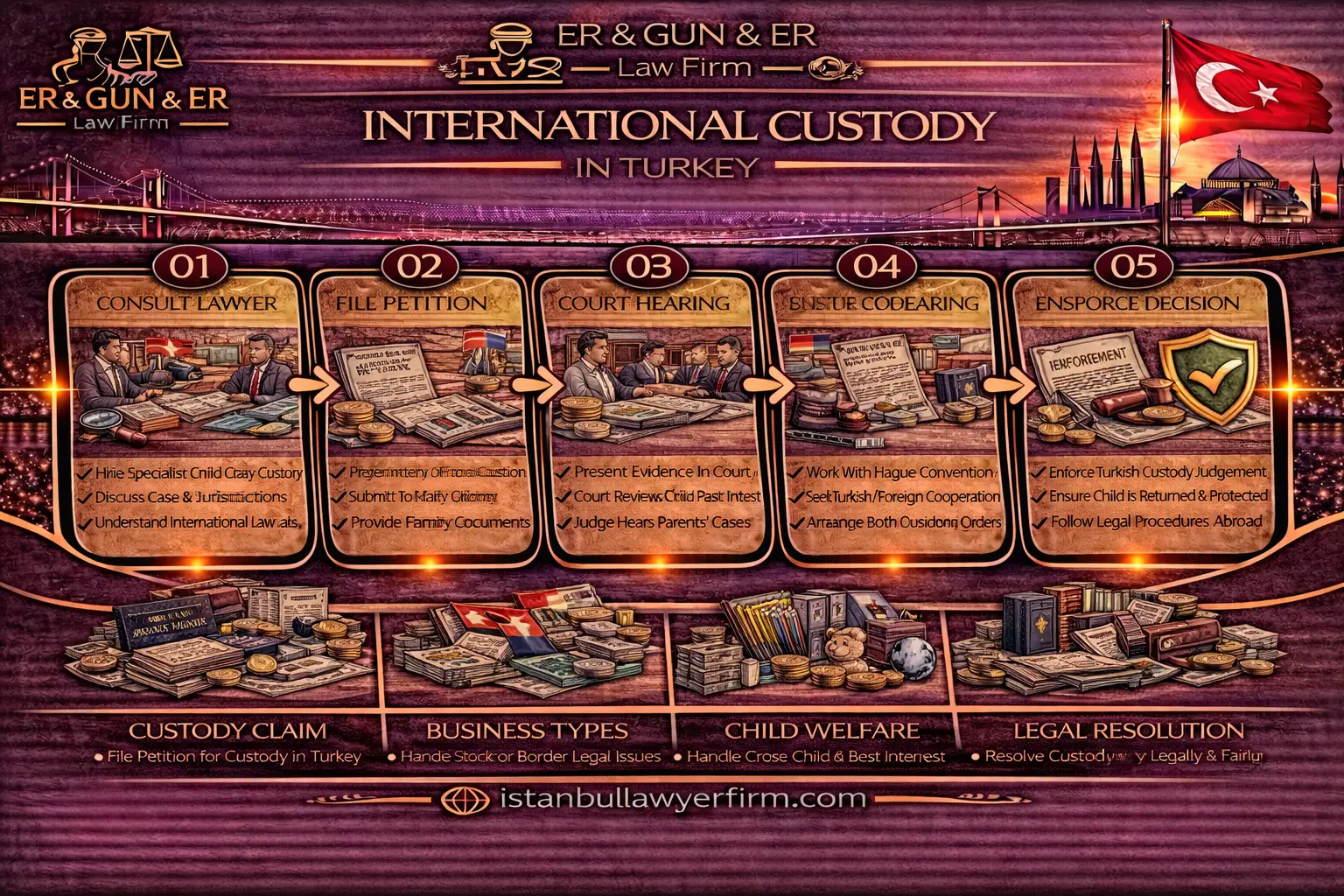
International custody disputes are procedural first because the decisive issues are jurisdiction, enforceable orders, and travel control, not rhetoric. International custody Turkey files usually turn on where the child’s life is centered and which court can issue orders that are actually enforceable. A cross-border case also requires a disciplined record of travel history, consent communications, and the child’s schooling ties. If you wait to collect evidence until after a flight is booked or a move is announced, the court may be forced to react to a new status quo rather than decide calmly. Interim measures matter because a child’s routine cannot pause while service, translations, and reports are completed. Enforcement matters because a custody order without compliance and handover mechanics becomes a recurring conflict rather than a solution. “practice may vary by authority and year — check current guidance.” For bilingual coordination of petitions and exhibits, many parents consult English speaking lawyer in Turkey so the record stays consistent across borders and institutions.
International custody overview
International custody Turkey disputes combine family law with private international law and practical enforcement. cross-border child custody Turkey issues often start as ordinary separation conflict and then escalate when one parent plans international travel. The court will ask where the child’s daily life is anchored, not where the parents prefer to litigate. The court will also ask what order can be enforced against real people, schools, border officers, and airlines. A cross-border file therefore needs an evidence map, not only a narrative. The evidence map should include addresses, school enrollment, healthcare registration, and caregiving routine proofs. It should also include travel documents such as tickets, stamps, and itinerary confirmations. It should include written consent records, because consent disputes are central in travel and relocation cases. The file should be built with an index and a chronology so each event is dated and verifiable. “practice may vary by authority and year — check current guidance.” A parent should avoid making claims that require medical or psychological profiling, because courts prefer objective routine indicators. A parent should also avoid using the child as a messenger, because that conduct becomes evidence of conflict exposure. Cross-border cases often require coordination with foreign counsel, so consistent terminology matters across languages. If you do not control terminology, you can create contradictory statements across jurisdictions. A structured approach keeps the case focused on child welfare and enforceable logistics rather than adult conflict.
Many parents misunderstand the difference between a custody judgment and a travel control order. A custody judgment allocates caregiving authority and sets a residence framework. A travel control order regulates passport handling and border exit permissions. Turkish family court international custody practice often requires both, because custody alone does not prevent unilateral travel. Courts also distinguish between long-term custody allocations and interim stabilization orders. Interim orders can shape the case because they set the first workable routine while the court collects evidence. Interim routines become persuasive when they are stable and school-centered. This is why early document collection and calm compliance are strategic advantages. A parent should also think about the enforcement lane from the start, because enforcement is where many cases fail in practice. If the other parent ignores contact times, a vague order does not help. If the other parent refuses passport access, a vague order does not help. If the other parent relocates within Turkey, the order must still be implementable. If the other parent relocates abroad, the order must be usable in a recognition file. A good file therefore includes clear identifiers, clear addresses, and clear schedules. For tactical planning and motion drafting, a lawyer in Turkey can frame requests in enforceable language rather than in general appeals to fairness.
International custody disputes also overlap with divorce procedure because service abroad and jurisdiction questions can delay hearings. If the divorce is cross-border, the custody file should be coordinated with the overall procedural plan so submissions do not contradict each other. The procedural mapping in the child custody law guide helps you understand how domestic custody tools are adapted to cross-border facts. A foreign parent often worries that nationality alone will decide the case, but courts focus on routine, stability, and enforceability. foreign parent custody Turkey files therefore require proof of housing, schooling plan, and cooperation behavior. Proof can include school notices, attendance records, and neutral caregiver confirmations. Proof can also include communication logs that show cooperative scheduling and information sharing. A parent should present these logs with context and dates rather than with selective screenshots. A parent should also preserve proof of compliance with any existing interim order, because compliance patterns matter. If you argue for stronger travel controls, you must show why the risk is real and why the safeguard is proportionate. If you argue for broader contact, you must show a realistic travel and accommodation plan that protects schooling. Courts are cautious about relocating a child suddenly, so child-centered alternatives should be presented. “practice may vary by authority and year — check current guidance.” In complex multi-jurisdiction files, Turkish lawyers often focus on building a single chronology that can be reused in recognition and enforcement steps. A coherent chronology prevents the case from turning into conflicting stories about dates and consent.
Jurisdiction and habitual residence
Jurisdiction questions decide which court can issue binding custody orders and which court should defer. jurisdiction for custody Turkey international analysis is usually fact-driven and depends on where the child’s life is centered. The concept of habitual residence focuses on the child’s real routine, not the parent’s declared intention. Courts examine schooling, healthcare registration, caregiver network, and daily stability indicators. A parent should therefore preserve school enrollment letters, attendance summaries, and address records. Courts also examine travel patterns, because frequent border crossings can blur the routine center. Consent communications matter because consent can explain why a child was in a location temporarily. If the child is in Turkey for school, preserve term calendars and tuition invoices where relevant. If the child is in Turkey for medical treatment, preserve appointment schedules and hospital registrations without unnecessary private detail. If the child arrived recently, preserve entry records and the reason for entry as objective evidence. “practice may vary by authority and year — check current guidance.” The forum story should be presented with a dated timeline that ties each move to a document. In Istanbul-based disputes, filing strategy is often coordinated through a law firm in Istanbul to keep venue proofs, translations, and service records consistent. Consistency matters because jurisdiction fights often hinge on one inconsistent address or one missing school record. A clean jurisdiction tab therefore reduces delay because it gives the judge a verifiable picture early.
habitual residence child Turkey custody is proved by objective ties, not by subjective preferences. Courts often ask which school the child attends and how long the child has been in that school environment. Courts also ask who takes the child to school and who manages homework, because those facts show daily stability. Healthcare registration and routine checkups can also show where the child’s life is organized. If the child participates in activities, preserve enrollment confirmations because they show social integration. If the child moved recently, preserve the prior school records as well to show continuity and the reason for change. If a parent claims that the child’s stay is temporary, the claim should be supported by return tickets, written agreements, or consistent communications. If a parent claims that the move was unilateral, preserve the lack of consent record and the return requests. If a parent claims consent existed, preserve the consent in writing and show its scope by dates. Courts are cautious when consent is ambiguous, so clear wording and dates are valuable. “practice may vary by authority and year — check current guidance.” For cross-border presentation and consistent translation of residence proofs, an Istanbul Law Firm can act as a document custodian and maintain a stable exhibit index. A stable index helps because habitual residence arguments often require dozens of small documents rather than one decisive certificate. If the same document is translated twice with different spellings, the child can appear as two different identities, which slows the case. A disciplined file avoids that by using one token sheet and one translation glossary. The goal is to present a forum story that can be verified quickly without speculation.
Jurisdiction disputes also interact with divorce procedure because parents sometimes file in different countries at the same time. If a parallel divorce file exists, disclose it carefully and keep facts consistent across filings. Parallel filings can produce inconsistent interim travel restrictions that confuse airlines and border officers. A parent should therefore prioritize obtaining one clear order and then using it consistently for school and travel communications. If a foreign court has issued an order, document it as a full certified pack and keep the Turkish court informed through proper submissions. If the Turkish court has issued an order, preserve certified copies and translations for any foreign process that may require them. In cross-border cases, service abroad and jurisdiction analysis can take time, so interim measures should be requested early where risk exists. The procedural workflow described in the expat divorce procedure guide explains how service and forum issues can slow family cases and why early evidence matters. “practice may vary by authority and year — check current guidance.” A parent should also avoid changing the child’s school unilaterally while jurisdiction is disputed, because unilateral changes can be framed as forum manipulation. If a school change is necessary, document the necessity with objective reasons and provide notice to the other parent. Courts tend to distrust sudden moves without documentation, especially when a travel plan is pending. A disciplined approach is to treat every move and every consent as a dated event with a supporting document. This approach keeps the jurisdiction debate factual rather than emotional.
Turkish court competence
Turkish court competence depends on both domestic family law and the international private law framework that allocates cross-border authority. Turkish family court international custody work begins by identifying whether the child is in Turkey and whether Turkey has sufficient connection to decide protective measures. Courts may also consider whether a foreign court is already seized and whether Turkey should coordinate rather than duplicate. Competence is not only about theory, because a competent court must also be able to enforce its own orders in practice. If the child is physically in Turkey, Turkish courts can often issue immediate protective orders to stabilize routine. If the child is abroad, Turkish courts may still decide certain aspects, but enforcement and recognition become harder. A parent should therefore map where the child is physically present and where the enforceable assets of compliance exist. If the case involves foreign orders, document them with certified copies and full translations so the Turkish judge can understand scope. If the foreign order is interim, label it clearly so it is not misread as final. If the foreign order includes travel permissions, show the exact wording because border disputes turn on details. “practice may vary by authority and year — check current guidance.” For structured filings and consistent bilingual exhibits, a Turkish Law Firm can coordinate the competence tab and keep identity tokens stable. Stable identity tokens matter because competence disputes often hinge on whether the child and parents are correctly identified across passports and school records. A competent court file must be readable and verifiable, not only legally plausible. The main objective is to secure a forum that can issue orders that schools and authorities can apply without confusion.
Competence also interacts with the type of relief requested, because some requests are urgent and others are final. Interim relief requests often focus on temporary residence, temporary contact, and temporary travel limits. Final relief requests focus on long-term custody allocation and long-term visitation architecture. A Turkish court may be more willing to issue interim measures when the child is present in Turkey and risk is documented. A parent seeking interim relief should present a short routine plan supported by school schedules and housing proofs. A parent opposing interim relief should present stability evidence and propose a less disruptive alternative rather than only objecting. Courts tend to prefer child-centered proposals that preserve schooling and reduce conflict exposure. Competence also requires proper notice, so service and participation records remain important even for interim decisions. If one parent is abroad, participation may occur through counsel and certified powers, and those documents should be prepared early. If the case is bilingual, translation governance is critical because inconsistent translation can look like inconsistency of fact. “practice may vary by authority and year — check current guidance.” The court will also evaluate the feasibility of any order, meaning whether the parties can realistically comply. If a parent proposes weekly cross-border contact, feasibility must be proven with travel logistics and cost reality. If a parent proposes a travel ban, proportionality must be shown with risk evidence. The court’s competence exercise is therefore intertwined with enforceability, because an unenforceable order creates more litigation. A disciplined competence posture presents enforceable options rather than maximal demands.
Turkish courts also assess whether a request is an attempt to change the child’s status quo through litigation rather than through cooperation. A parent should therefore avoid unilateral moves that create a new routine without court approval. If a move already occurred, document how and why it occurred and whether consent existed. Consent is a central competence fact, because consent can explain temporary stays and reduce wrongful removal narratives. If consent was limited, document the limit by date and show the return request when the limit expired. If consent was unclear, preserve the full message thread so context can be evaluated. A court will also examine whether parents are cooperating with information sharing, because cooperation affects best-interests analysis. If the other parent blocks school information, document the requests and refusals calmly. If the other parent blocks contact, keep a dated handover log and message trail. Evidence in international custody case Turkey is therefore built from routine documents and cooperation behavior, not from adult accusations. Courts may request social investigation reports, and those reports require stable address and caregiver evidence. If you anticipate a report, prepare a home environment that supports study and sleep and keep the routine consistent. “practice may vary by authority and year — check current guidance.” Competence decisions can influence recognition abroad later, so preserve competence reasoning and service proofs in a separate archive. This archive becomes useful when a foreign authority asks why Turkey decided the case. A coherent archive reduces delay because you can answer those questions with documents rather than reconstructions.
Interim travel restrictions
Interim travel restrictions are used to prevent irreversible cross-border changes while the court assesses the case. interim travel ban custody Turkey requests are usually framed as risk management, not as punishment. The court typically asks what risk exists, what evidence supports the risk, and what alternative safeguards might be sufficient. A parent seeking a restriction should identify the specific travel scenario, such as international relocation or repeated cross-border trips without notice. The parent should also attach objective evidence, such as booked tickets, sudden passport requests, or prior failures to return on time. If the parent relies on a wrongful retention narrative, the file should show consent scope and return requests in writing. Courts are cautious about broad bans, so specificity helps proportionality. A narrow restriction can be more credible than a total ban when the child’s welfare requires some travel. Courts may also consider passport custody arrangements as a less intrusive safeguard. If the child has dual nationality, document the passports neutrally and propose a safe storage protocol. If the child’s schooling calendar is relevant, show term dates and exams so travel is scheduled around stability. If the parents can agree on a consent protocol, the court may adopt it as an interim rule. “practice may vary by authority and year — check current guidance.” Interim restrictions should be drafted in enforceable language so border and airport questions are minimized. Clear orders reduce conflict because they prevent last-minute confrontations. The objective is preserving the child’s routine while the court collects evidence and reports.
Travel consent child Turkey disputes often arise when one parent fears that a trip will become a relocation. A consent protocol should therefore define what information must be provided, itinerary, accommodation, return flights, and contact during travel. The protocol should also define how consent is documented, written message, signed form, or court-approved schedule. If consent is refused, the refusing parent should state reasons in writing to create a reviewable record. If consent is granted, the granting parent should keep the consent with the itinerary so later disputes about scope are avoided. Passport custody is a practical friction point, so interim orders often specify who holds passports and how they are released. A parent should avoid self-help passport retention unless the court ordered it, because self-help can be framed as contact obstruction. The court may also order that passports are deposited with a neutral custodian, but the feasibility depends on local practice. “practice may vary by authority and year — check current guidance.” For proportional motion drafting and evidence packaging, a best lawyer in Turkey can help ensure the request is narrow, provable, and enforceable. A narrow request often succeeds because it looks like child protection rather than adult leverage. A parent should also propose make-up contact if travel overlaps with scheduled visitation, because fairness improves credibility. If the other parent previously complied with travel returns, the court may prefer consent protocols over bans. If the other parent previously violated returns, the court may prefer stricter controls backed by proof. The file should therefore focus on documented behavior patterns rather than on fears. Interim orders are more likely to be respected when they are precise and grounded in the evidence record.
Implementation matters because a travel restriction that cannot be enforced creates false security. After an interim order is issued, obtain certified copies and store them in the travel file. Provide the order to relevant institutions only when necessary, and keep communications factual to protect the child’s privacy. If the order requires passport storage, document each passport handover with a dated receipt or message confirmation. If the order permits travel under conditions, document each condition as satisfied, itinerary provided, consent recorded, and return confirmed. If a parent violates the order, preserve proof and return to court rather than escalating at the airport. A violation record should include the order page, the travel evidence, and the refusal or violation message trail. Courts respond better to calm, exhibit-led violation records than to emotional accusations. If travel is urgent for medical or family reasons, propose a temporary conditional permission supported by objective documents. If the child has an upcoming school event, propose a travel plan that protects it rather than ignoring it. Interim orders also interact with visitation, because travel can reduce contact, so make-up contact should be planned in writing. If the family has parallel divorce filings, keep travel orders consistent across files to avoid contradictory evidence. If a foreign court issued travel permissions, present them as full certified packs and request a consistent interim approach. “practice may vary by authority and year — check current guidance.” The safest practical rule is to treat travel as a documented event that always has a paper trail. This discipline protects both parents because it reduces misunderstandings and prevents escalation. A well-managed interim travel restriction phase often resolves the biggest risk before final custody is decided.
Passport and consent issues
Passport control is often the practical lever in cross-border child custody Turkey disputes because a passport determines whether a plan can be enforced at a border. Courts typically want clear rules that reduce last-minute conflict and prevent unilateral travel. The first question is who physically holds the passports and how access is recorded. The second question is what counts as valid consent and whether consent must be written. travel consent child Turkey is safer when it is documented as a dated message or signed form that identifies destination and return date. Ambiguous verbal consent creates disputes because it cannot be verified by third parties. Parents should preserve past consent patterns, because patterns often show how the family actually traveled before conflict began. If a parent previously allowed travel regularly and suddenly objects, the court may ask what changed and why. If a parent previously blocked travel, the court may ask whether blocking was used as leverage. Courts often prefer solutions that keep passports secure but accessible for agreed trips. A neutral storage protocol can reduce escalation when parents cannot meet calmly. If consent disputes exist, keep a consent log that records requests, responses, and outcomes by date. That log should be supported by messages and itinerary documents rather than by memory. The domestic custody baseline still matters in international files, and the framework in custody law guide helps align terminology to Turkish practice. When the file is complex and bilingual, a lawyer in Turkey can help convert communications into a clear evidence pack without adding emotion.
Courts usually examine whether a passport dispute is truly about safety or about control. If a parent alleges non-return risk, the allegation should be supported by objective indicators such as past noncompliance or concrete travel plans. interim travel ban custody Turkey requests should be framed as proportionate safeguards rather than as permanent bans. A proportionate request identifies the specific trip risk and proposes a narrower alternative, such as requiring written itinerary disclosure. If the child has dual nationality, courts may ask how multiple passports will be handled and whether both parents know where they are stored. Parents should avoid hiding passports because concealment often escalates conflict and undermines credibility. If a parent insists on sole custody of passports, the parent should explain how lawful travel will still be enabled without repeated court motions. A practical protocol includes a request format, a response format, and a clear return confirmation step. The protocol should also address emergency travel, because emergencies are used as excuses when rules are unclear. If a parent previously consented to travel, keep the earlier consents because they show the family’s established routine. If a parent previously refused travel, keep refusal messages because they show the pattern and the reasons given. “practice may vary by authority and year — check current guidance.” In Istanbul practice, many families ask a law firm in Istanbul to store certified copies and maintain a dated consent file so later disputes are about documents, not allegations. A stable consent file reduces court workload because the judge can see patterns quickly. It also protects the child because fewer airport conflicts occur when permissions are clear.
Consent disputes also affect schools and airlines because third parties often ask which parent can authorize travel. A vague custody order may not answer that question, especially when the child’s name appears in different spellings across passports. Parents should therefore keep an identity token sheet that matches the child’s passports and court documents. If a parent requests travel, the request should include the exact passport spelling to prevent confusion at booking. If a parent grants consent, the consent should reference the same spelling and the same passport number where possible. If a parent refuses consent, the refusal should be written and factual so it can be reviewed later by the court. Courts generally prefer that parents cooperate on reasonable travel that does not disrupt schooling and contact schedules. When cooperation fails, courts may impose detailed consent rules to prevent repeated emergency motions. Those rules work only when parents treat them as compliance obligations and record each step. A parent should avoid using passport disputes as retaliation for financial conflict because courts treat that as harmful to the child’s welfare. If the child must travel for schooling or medical reasons, the file should include those reasons in objective documents. If the travel is for holiday, the file should show how contact time will be compensated fairly. custody lawyer Turkey international support is often used to draft consent language that is enforceable and understood by third parties. If you want a second opinion on proportional safeguards, a best lawyer in Turkey can review the proposed protocol for clarity and enforceability. The practical goal is predictable travel control that reduces conflict exposure for the child.
Relocation disputes framework
Relocation is a high-stakes issue because it can change the child’s school, language environment, and contact frequency in one step. relocation with child Turkey custody disputes are therefore decided by concrete welfare impact rather than by adult preference. Courts usually start by identifying the child’s current routine and the stability indicators supporting it. Then they test whether the proposed move improves or harms that routine in measurable ways. A moving parent should present housing proof, school plan proof, and a caregiving schedule that fits real work hours. A non-moving parent should present current stability evidence, such as school continuity records and contact implementation history. habitual residence child Turkey custody analysis is often central because relocation can shift the habitual center of life. If the child’s routine is anchored in one city, a sudden move can be treated as disruptive unless justified by strong welfare reasons. Courts also test whether the moving parent will support the child’s relationship with the other parent after the move. That support is tested through proposed contact schedules, travel funding plans, and communication protocols. If the moving parent proposes vague “holiday contact,” the court may treat it as inadequate because it is not implementable. If the non-moving parent proposes unrealistic weekly travel, the court may treat it as harmful because of fatigue and schooling disruption. A relocation file should include a comparative calendar that shows the child’s week before and after the move. It should also include transport time calculations based on real distances and school start times. “practice may vary by authority and year — check current guidance.” Relocation disputes are best handled with a structured evidence pack rather than with accusations, because the judge must compare two routines, not choose a winner.
Relocation also interacts with contact enforcement because distance makes missed handovers harder to cure. visitation across borders Turkey plans must therefore be drafted with school terms, flight realities, and time zones in mind. Courts often prefer fewer but longer contact blocks rather than frequent short trips that exhaust the child. The plan should define who books travel, who escorts the child, and how itinerary changes are communicated. It should also define video contact rules during non-visit periods so the relationship is maintained consistently. If the child is of school age, the plan should avoid repeated mid-week travel that harms attendance. If the move is within Turkey but far from the other parent, the same fatigue logic applies and should be documented. If the move is abroad, the plan must address passport access, consent mechanics, and return confirmation in writing. The court will also consider whether relocation is linked to a new partner or a new job, but it still tests the child’s routine impact. If the moving parent claims a job necessity, the job should be documented, not asserted. If the moving parent claims family support necessity, the support should be shown as a caregiving plan, not as a promise. A relocation request should avoid creating a new status quo by unilateral school transfers before the court rules. Unilateral transfers often trigger emergency motions and can harm credibility. The procedural sequencing described in expat divorce procedure helps show why early interim requests and service planning matter when relocation is in play. “practice may vary by authority and year — check current guidance.” In practice, a neutral, calendar-based proposal often persuades more than a broad demand because it shows the plan can be implemented. The child’s routine is the center, and the parents’ convenience is secondary in the analysis.
Relocation disputes also require a clear view of enforceability because an order that cannot be enforced invites repeated conflict. If a relocation is approved, the order should specify how contact will be executed and what documents must be provided for each trip. If a relocation is refused, the order should specify whether the child’s school and residence must remain unchanged during the proceedings. Courts often ask whether the moving parent can stay in Turkey lawfully and practically if relocation is refused. If immigration status is in issue, present it as a procedural fact with documents, not as a threat narrative. If the non-moving parent claims that the moving parent will not return the child after travel, the claim must be supported by concrete indicators and past behavior. If the moving parent claims that the other parent blocks travel out of spite, the record should show repeated reasonable requests and unreasonable refusals. The court may also consider whether a staged transition could reduce harm, such as delaying a move until the end of a school term. A staged transition must be written with dates and review points or it becomes vague and unworkable. If the move is tied to schooling, provide admission letters and term dates rather than assumptions. If the move is tied to healthcare, provide appointment schedules and provider letters without unnecessary private details. Turkish family court international custody practice typically rewards plans that reduce conflict exposure and preserve schooling continuity. For coordinated drafting and consistent exhibit numbering, an Istanbul Law Firm can maintain one chronology that is used across motions. The goal is to present relocation as a structured welfare comparison rather than as a power contest.
Hague Convention interface
The Hague Convention child abduction Turkey framework, where applicable, is not a general custody hearing and should not be treated as one. Convention proceedings typically focus on whether a child should be returned to the state of habitual residence so that custody can be decided there. This distinction matters because parents sometimes file broad custody arguments when the legal question is procedural return. A Hague file therefore begins with defining the child’s habitual residence indicators through school, healthcare, and daily routine proofs. It then examines whether removal or retention occurred without proper rights of custody and without consent. Consent analysis is document-led, so messages, emails, and written agreements become central exhibits. Courts often ask for a chronology that shows the travel date, the promised return date, and the point where return was refused. A parent who alleges wrongful retention should show written return requests and the other parent’s responses. A parent who defends retention should show consent scope, protective concerns, or other recognized defenses with objective proof. Because convention proceedings move on documentary proof, translation quality and identity consistency become critical. If documents are foreign, they should be presented with complete chain pages and consistent spellings. If the other parent was served abroad, service proofs should be preserved because due process still matters. “practice may vary by authority and year — check current guidance.” In complex convention files, early coordination with a Turkish Law Firm can help keep the record focused on return criteria rather than drifting into merits arguments. A focused record protects the child because it reduces prolonged procedural conflict. The aim is to put the dispute into the correct forum with the correct evidence set.
Convention interface also matters because parents sometimes confuse recognition of a foreign custody order with return proceedings. recognition of foreign custody order Turkey is a separate pathway that can make a foreign decision usable locally, but it does not replace the convention criteria when wrongful retention is alleged. A parent should therefore classify the legal lane correctly before filing, because the remedies and evidence are different. If the objective is return, the file should focus on habitual residence, consent, and timing, not on long-term welfare comparisons. If the objective is recognition, the file should focus on competence, due process, and finality of the foreign decision. If the objective is a fresh Turkish custody decision, the file should focus on Turkish competence and current routine evidence. Mixed filings can create confusion and delay if the court cannot tell which remedy is being pursued. Parents should also understand that convention proceedings can run alongside domestic interim protection orders to manage immediate safety in Turkey. Courts may issue interim safeguards while still treating the return issue as a separate legal question. “practice may vary by authority and year — check current guidance.” For procedural orientation on how foreign judgments are made usable, the overview at recognition and enforcement process can help you separate lanes without mixing remedies. Parents should avoid using convention language as a threat in negotiation because it can trigger defensive behavior and rapid moves. A better approach is to build a dated evidence pack and file in the correct lane. When the lane is clear, courts can act faster because the legal test is defined. A clear lane also reduces conflicting orders because each court understands what it is deciding.
Hague interface cases also require careful communication with schools and border authorities because the child’s routine continues while litigation runs. Parents should avoid telling schools that one parent is “abducting” the child without a court finding, because that creates unnecessary conflict around the child. Instead, share only the minimum necessary court orders and keep communications factual. If the court issues a travel restriction, keep certified copies and use them consistently for travel-related interactions. If the court issues a temporary contact schedule, implement it and document compliance because compliance patterns matter later. Convention cases also require careful handling of passports and identity documents, because identity confusion can derail an otherwise clear claim. Preserve passport copies, entry stamps, and travel tickets as primary exhibits rather than rely on oral descriptions. If the child has multiple nationalities, document them neutrally and keep the focus on residence and consent facts. If a parent claims that return would create risk, present objective safety evidence and avoid speculative claims. If a parent claims that the other parent consented, present the full message context and avoid selective excerpts. Courts often test credibility by comparing message tone before conflict to message tone after conflict. This is why calm, factual communication is a strategic asset. “practice may vary by authority and year — check current guidance.” In many files, the biggest procedural risk is delay caused by missing translations or missing chain pages, so prepare documents early. If you need a bilingual record that will be read by multiple authorities, an English speaking lawyer in Turkey can help keep translations stable and reduce misinterpretation risk. A stable record reduces the child’s exposure to prolonged uncertainty because the court can decide based on a complete pack.
Wrongful removal indicators
wrongful removal child Turkey allegations are often built on timing, consent scope, and change of routine, not on adult blame. The first indicator is a trip that was framed as temporary but becomes indefinite without a documented reason. The second indicator is refusal to share itinerary details or refusal to provide a return ticket when requested. The third indicator is sudden school enrollment in a new country without notice to the other parent. The fourth indicator is abrupt change of the child’s address registration and healthcare registration without communication. The fifth indicator is the withholding of passports or identity documents to prevent the other parent from taking action. The sixth indicator is blocking of regular contact in a way that breaks the established relationship pattern. The seventh indicator is inconsistent messages about return dates that change repeatedly without objective explanation. The eighth indicator is a pattern of avoiding service or avoiding official communications once conflict begins. The ninth indicator is liquidating assets or closing bank accounts in anticipation of leaving, which can signal a plan to relocate permanently. The tenth indicator is refusal to cooperate with a neutral handover arrangement even when the court suggests one. Each indicator must be supported by documents, such as messages, travel records, and school letters, because courts decide from proof. A parent should therefore preserve the full communication thread rather than only the most dramatic lines. “practice may vary by authority and year — check current guidance.” Indicators alone do not decide the case, but they guide which evidence requests and interim safeguards are most urgent.
Evidence in international custody case Turkey disputes should be gathered early because later reconstruction is unreliable. Preserve flight confirmations, boarding passes, and entry stamps to show exact travel dates. Preserve written consent messages and show the scope of consent, including destination and return dates. Preserve return requests and the other parent’s responses to show whether refusal occurred and when. Preserve school enrollment records and tuition receipts when the child’s school changes, because school change is a strong routine indicator. Preserve address change records and healthcare registration changes where available, because those show relocation of daily life. Preserve bank transfers and accommodation bookings if they show the intention of a long stay. If the other parent claims that the move was agreed, demand the agreement in writing and test it against the travel sequence. If the other parent claims that return was impossible due to external events, request objective documentation and avoid relying on speculation. Courts often test whether the parent acted transparently, meaning whether they shared itinerary and maintained contact during travel. Transparency is provable through messages and call logs, not through assertions. “practice may vary by authority and year — check current guidance.” In high-risk profiles, a lawyer in Turkey can help structure the indicator file as a dated chronology and attach the minimum necessary exhibits for interim relief. Interim relief is often needed because once a child is enrolled and settled elsewhere, reversing routine becomes harder. A disciplined chronology therefore protects the child by allowing earlier court action. It also protects the alleging parent by keeping the claim within provable facts.
Indicators also matter for enforcement planning, because the case is not over when an order is issued. enforcement of custody order Turkey depends on whether the order can be implemented at exchange points and through institutions like schools. If the case involves cross-border return, enforcement may require coordination with central authorities and local police in a lawful process. Parents should not attempt self-help recovery because self-help can create new legal exposure and can harm the child. Instead, focus on obtaining clear interim orders and then documenting noncompliance with those orders. If a parent violates a travel restriction, document it with tickets and timestamps and return to court promptly. If a parent blocks contact, document the block with dated messages and a handover log and seek enforcement clarification. If a parent refuses to provide passports when ordered, document refusal and request compliance orders rather than escalating at home. Courts often evaluate whether each parent is acting to reduce harm, so calm procedural steps matter. In foreign parent custody Turkey files, identity and translation discipline are also enforcement tools because border and school staff rely on clear documents. If the child has dual nationality, keep passport copies and identity tokens consistent so enforcement officers can verify quickly. If parallel proceedings exist, avoid using inconsistent terminology because inconsistent terminology can undermine enforcement trust. “practice may vary by authority and year — check current guidance.” The practical objective is to convert indicators into enforceable safeguards and then into a stable routine. A stable routine is the strongest long-term protection against repeated cross-border conflict.
Evidence and documentation
Evidence is the decisive currency in cross-border custody because courts must choose safeguards based on provable facts. A strong file starts with identity documents, passports, and consistent spellings for the child and both parents. It then adds schooling proofs, enrollment letters, attendance summaries, and term calendars that show routine. It adds healthcare registration and appointment scheduling evidence that shows where daily life is organized. It adds travel records, tickets, boarding confirmations, and entry stamps that show where the child was and when. It adds consent records, including emails or messages that show destination, dates, and return expectations. It adds refusal records when consent was denied, because refusal dates often explain why a trip did not happen. It adds return requests when a child was not returned, because return requests show the moment the dispute crystallized. The file should avoid selective screenshots and instead preserve full threads with timestamps for context. Where documents are foreign, translations must be complete and consistent so the court can rely on them. Where authentication is needed, keep chain pages together so no stamp is separated from its source document. “practice may vary by authority and year — check current guidance.” A clean evidence index helps because judges and experts read under time pressure and need to find key pages quickly. In evidence in international custody case Turkey files, numbering each exhibit and citing it consistently reduces confusion and reduces delay. If multiple jurisdictions are involved, keep a parallel folder for foreign orders and foreign service proofs so the Turkish file remains coherent. For long cases with heavy translation workflows, a law firm in Istanbul can maintain the archive and prevent version drift across submissions.
Cross-border custody files often include residence permits, visas, and address registrations that affect the feasibility of a proposed routine. The court does not decide immigration status, but it evaluates how lawful stay affects schooling continuity and travel logistics. If a parent’s right to remain in Turkey is limited, the file should present documents neutrally and explain practical contingencies. If a child’s residence status depends on one parent’s permit, the case must plan how documents will be renewed without conflict. Travel planning should also account for whether the child can re-enter Turkey easily under the current status. Parents should therefore preserve residence cards, entry records, and address registration confirmations in the same evidence folder. These documents are also useful when third parties such as schools ask who is authorized to sign and who is the child’s legal contact. If the other parent argues that relocation is impossible due to status, require objective documents rather than assertions. If the other parent argues that a move is urgent due to status, require objective notices and a realistic timeline rather than panic. Courts generally prefer child-centered plans that do not use status as a pressure tool against the other parent. For procedural framing and document types, immigration law context can help you understand what records are typically generated without turning custody into an immigration argument. “practice may vary by authority and year — check current guidance.” In foreign parent custody Turkey disputes, identity token consistency across passports and permits is critical, because mismatches can block travel and can confuse investigators. A token sheet that lists the exact passport spelling and the exact permit spelling can prevent this avoidable friction. When submissions must stay calm and exhibit-led, a lawyer in Turkey can help keep the record procedural and prevent unnecessary profiling language.
Digital evidence can be important, but it must be handled carefully so authenticity is not challenged. Keep original files, export logs, and full message threads rather than cropped images, because context prevents misinterpretation. If you rely on email consent, keep headers and the full chain so the court can see date and recipients clearly. If you rely on messaging consent, export the chat in a format that preserves timestamps and participant identifiers. travel consent child Turkey disputes often turn on whether consent was limited to one trip or extended to relocation, so wording and dates matter. If a message is ambiguous, do not rewrite it in your petition and instead quote it accurately with the exhibit reference. If the other parent sent mixed messages, preserve the whole thread so the court can see the pattern rather than a single line. Courts often prefer objective third-party records over private messages, so combine messages with tickets, school letters, and booking confirmations. Where online platform content is used, preserve a dated screenshot plus a link record or platform export where available. Do not collect evidence through unlawful surveillance, because illegality arguments can distract from the child’s welfare analysis. If the case involves repeated travel, maintain a travel table that lists dates and destinations and cites the ticket exhibits. “practice may vary by authority and year — check current guidance.” A disciplined evidence pack is also useful for foreign proceedings, because foreign courts ask the same questions about dates and consent. Many Turkish lawyers recommend building an evidence index before filing any emergency motion so the judge can verify quickly. The practical goal is that every factual claim in the petition can be traced to a dated exhibit without requiring the judge to infer intent.
Social reports and experts
Social investigation reports and expert assessments are often central because judges need structured observations about the child’s living conditions. In Turkish family court international custody files, these reports usually summarize home environment, caregiving routine, and the child’s schooling stability. Investigators often focus on practical details such as study space, sleep arrangements, and who supervises daily tasks. Parents should treat the visit as professional fact-finding and avoid coaching the child or staging scenes. Provide the investigator with neutral documents such as school schedules and medical appointment calendars to confirm routine. If extended family members live in the home, explain roles factually and avoid negative character descriptions of the other side. If a parent works irregular hours, document who provides supervision during those hours and how supervision is consistent. Investigators may ask about travel and passports, because travel risk affects routine and enforcement. When travel is frequent, show a travel log and show how schooling continuity is protected. If the other parent alleges instability, respond with documents rather than arguments during the visit. After the report is issued, read it line by line and separate factual observations from interpretive comments. If a factual detail is wrong, correct it with an exhibit such as an address registration or school letter. “practice may vary by authority and year — check current guidance.” For coordinated scheduling and secure custody of the report and annexes, an Istanbul Law Firm can maintain the file room and prevent missing pages. A complete report pack is important because foreign authorities often request the same report when recognition questions arise. The strategic objective is to ensure the report reflects the child’s real routine and is supported by documents that can be verified.
In cross-border cases, investigators may need to review foreign school records, foreign medical summaries, and travel documents issued in another language. Translation quality matters because an investigator who misreads a date can misread the child’s residence timeline. Parents should therefore provide certified translations for key foreign documents and keep source and translation together. Avoid providing multiple competing translations of the same document, because competing translations create identity and date confusion. If the child attends an international school, provide official letters and calendars rather than informal screenshots from portals. If the child has a passport in another language system, provide a token sheet that maps spellings across passports and filings. international custody Turkey files also involve different cultural expectations, but the court’s focus remains stability and best interests. Experts are asked to observe practical environment and routine, not to rank cultures or nationalities. Parents should avoid statements that suggest cultural superiority because they distract from the child’s concrete needs. When experts ask about communication between parents, show practical message examples about school updates and travel scheduling. If the case is high conflict, propose a neutral communication protocol and show prior attempts to implement it. “practice may vary by authority and year — check current guidance.” In bilingual interviews, an interpreter should translate faithfully and should not add commentary that alters meaning. For consistent bilingual submission and to reduce misunderstandings in expert interviews, an English speaking lawyer in Turkey can prepare a glossary of key terms and dates. A glossary helps because consent, temporary stay, and relocation can be misinterpreted across languages. The goal is that the expert report reflects accurate facts and does not become a new dispute about translation.
Expert reports can be persuasive, but they are not automatic outcomes, and they must be tested against the full record. If the report omits key documents, submit a numbered supplement and request that the court direct the expert to review it. If the report relies on assumptions about travel, provide ticket exhibits and border stamp records to correct the assumption. If the report misstates school attendance, provide official attendance summaries rather than verbal correction. If the report misstates who provides daily supervision, provide work schedules and caregiver confirmations where lawful. Objections should be written calmly and should cite the exact page and paragraph in the report that is contested. Courts respond better to exhibit-led corrections than to generalized disagreement with the expert. If a party plans to use the report abroad, ensure the report is obtained as a certified copy with annexes intact. This becomes relevant when a parent later seeks recognition of foreign custody order Turkey and foreign authorities ask what investigations were done in Turkey. If the court orders a second report, keep the earlier report in the file and label it as earlier to avoid version confusion. Where multiple reports exist, create a comparison table that lists which facts changed and why they changed. “practice may vary by authority and year — check current guidance.” A consistent exhibit index helps prevent the expert from reviewing the wrong version of a document. For rigorous file governance, a Turkish Law Firm can maintain an exhibit register and a report register so the court sees one coherent record. Coherent governance also protects the child because it reduces repeated investigations and repeated interviews. The objective is to make expert work a stabilizing tool that clarifies facts, not a battlefield that adds delay.
Visitation across borders
Cross-border contact schedules must be drafted as logistics plans, not as vague promises. visitation across borders Turkey requires calendar clarity because flights, school terms, and time zones constrain what is realistic. Courts usually prefer fewer, longer contact blocks rather than frequent short trips that exhaust the child. A workable plan identifies who books tickets, who escorts the child, and who pays ancillary travel costs without making unrealistic assumptions. The plan also specifies exchange points, such as an airport handover, and the documentation required for the handover. If one parent lives abroad, the plan should include stable video contact windows to maintain routine between visits. The plan should also include a rule for make-up time when travel is cancelled due to documented reasons. If the child has exams or health appointments, the plan should prioritize them and then compensate contact fairly. Courts often examine whether the plan preserves meaningful relationship with both parents, not only a symbolic connection. If the plan requires a parent to travel frequently, feasibility should be proven with work schedule evidence. If the plan requires a child to travel frequently, the child’s fatigue and school attendance implications should be addressed. “practice may vary by authority and year — check current guidance.” Cross-border plans should also include information sharing duties so the traveling parent receives school notices and medical updates. Poor information sharing often becomes the hidden reason contact fails, because parents argue about what the other parent knew. For a realism review of the travel logistics and schedule language, a best lawyer in Turkey can stress-test whether the plan can actually be implemented. A plan that is implementable reduces enforcement disputes because compliance can be measured by dates and tickets.
When cross-border contact is ordered, the practical question becomes how to enforce compliance when a parent is outside Turkey. Enforcement planning begins with ensuring the order is precise on dates, exchange location, and documentation duties. An order that says reasonable contact is hard to enforce because there is no measurable breach. A precise order is easier because each missed exchange can be documented with tickets and written notices. enforcement of custody order Turkey mechanisms are most effective when the parent keeps a handover log and preserves message trails. A handover log should record date, time, location, and whether the child was delivered as ordered. If an exchange fails, preserve the airport receipts, the boarding status, and the communication thread showing cooperation attempts. If the other parent claims illness, request neutral proof and offer a make-up date in writing to show good faith. If the other parent refuses to sign travel documents, record refusal and apply to court for clarification rather than escalating at the airport. If the child is abroad and the Turkish order must be used abroad, certified copies and translations should be prepared early. If a foreign authority requests proof of return, provide ticket and entry stamp evidence rather than verbal assurances. “practice may vary by authority and year — check current guidance.” Many Turkish lawyers advise parents to keep communications child-focused and logistics-focused because hostile messages often undermine enforcement credibility. They also advise separating support disputes from contact compliance because linking them creates leverage conflict and harms the child. If support and contact are both in dispute, keep separate ledgers and separate logs so one dispute does not contaminate another. A disciplined enforcement record often leads the court to refine the schedule instead of reopening the merits repeatedly.
Cross-border contact frequently creates cost disputes because flights and accommodation are expensive and predictable. Courts decide contact in the child’s best interests, but they still expect a plan that is financially feasible. If one parent proposes long holiday visits, the plan should state who funds travel and how tickets are purchased without creating last-minute bargaining. If one parent proposes that the other parent always funds travel, the request should be supported by income evidence rather than assumption. Support orders and travel costs often interact, so parties should keep the legal lanes clear and avoid informal set-offs. If a parent pays a flight instead of paying support, the other parent may dispute whether the payment offsets the ordered amount. The safer approach is to keep support payments traceable and separate and then handle travel allocation as a separate documented agreement or court term. For conceptual separation of support duties from custody logistics, the alimony framework can help you present arguments without mixing obligations. If the child support lane is also active, travel cost sharing should not be used to justify nonpayment of monthly duties. If a parent is abroad, currency conversion can also create confusion, so agreements should specify the payment channel and proof standard. If the parents agree on cost sharing, confirm it in writing and store it with the contact schedule so it can be verified later. “practice may vary by authority and year — check current guidance.” If the contact plan depends on school calendar, keep the calendar as an exhibit so travel windows are realistic. If a parent cancels travel repeatedly, document cancellations and the reasons, because repeated cancellations can justify schedule redesign. If a parent refuses to fund agreed travel, document refusal and propose alternatives that preserve the child’s relationship. A workable cross-border plan is one that has a realistic budget logic and a clear proof trail for every trip.
Enforcement of custody orders
Enforcement is where many cross-border cases fail because paper orders do not automatically produce compliance. enforcement of custody order Turkey begins with a clear order that specifies residence, contact schedule, and exchange mechanics. If the order is vague, enforcement officers cannot measure breach and the case returns to court repeatedly. A parent should therefore request precise dates, times, and locations in interim orders and final orders. A parent should also request clear rules on information sharing, because hidden school updates often trigger conflict and missed exchanges. Enforcement relies on service and proof, so obtain certified copies and preserve service receipts for each order. If a parent fails to deliver the child, document the failure with a handover log and the communication thread. If a parent claims the child refused, document how the parent responded and whether the parent encouraged compliance. Courts often consider whether noncompliance is repeated and intentional, so patterns matter more than one incident. If the order includes travel restrictions, document any attempted violations with ticket and booking evidence. If the order includes passport custody rules, document passport handovers with dated confirmations. “practice may vary by authority and year — check current guidance.” In cross-border profiles, enforcement also includes preparing translations for foreign institutions that request the order. Even when foreign institutions are involved, the Turkish enforcement record remains the anchor for what was ordered and what was violated. A disciplined enforcement record protects the child because it reduces repeated chaotic exchanges. It also protects the compliant parent because it shows good faith cooperation and consistent efforts.
Custody enforcement frequently runs in parallel with financial support enforcement, and the files should not be mixed. Parents sometimes try to condition contact on payments, but courts treat that behavior as harmful to the child’s relationship stability. If child expenses are disputed, use the appropriate legal channel and keep proof of payments and receipts separately. For procedural orientation on how child support is handled, child support process can help you keep arguments within the correct lane. If a parent refuses contact because of money, document the refusal and ask the court for enforcement clarification rather than retaliate. Retaliation creates mutual noncompliance and reduces credibility on both sides. A parent should also keep communications child-focused and avoid threatening language that escalates conflict. If foreign parent custody Turkey issues are present, the enforcement file should also track travel documents and return confirmations. Return confirmations can include border stamps, flight confirmations, and school attendance on the day after return. These proofs show that the child’s routine was preserved and that travel was not used to disrupt stability. If a parent moves within Turkey, update addresses in the enforcement file so service and exchange logistics remain workable. “practice may vary by authority and year — check current guidance.” If a parent moves abroad, the enforcement strategy may shift toward recognition abroad and coordination with foreign authorities. Even then, keep the Turkish enforcement log updated because foreign authorities often ask what breaches occurred and when. A clean separation between contact enforcement and support enforcement reduces manipulation, because each lane has its own proof standards. The practical outcome is fewer emergency motions and more predictable contact for the child.
Cross-border enforcement often depends on whether the Turkish order can be used in the other country where the child or parent is located. If the other country requires recognition, the parent should prepare certified copies, service proofs, and complete translations early. Recognition preparation is easier when the Turkish order is precise and contains clear operative paragraphs on residence and contact. If the Turkish order is ambiguous, foreign authorities may hesitate because they cannot tell what exactly is ordered. A parent should therefore request clarifying orders in Turkey when needed, rather than assume foreign staff will interpret. Where the case is under a convention return framework, enforcement may involve central authority coordination and local implementation. Parents should avoid self-help measures because self-help can create new legal exposure and can undermine the child’s stability. Instead, follow the procedural path and keep each step documented with receipts and dated communications. If the child must travel for contact, keep travel itineraries and consent documents archived so compliance is provable. If a parent violates travel restrictions, document the attempt and return to court promptly with a narrow request. If a parent blocks contact, document the block and propose a revised exchange method that reduces conflict. “practice may vary by authority and year — check current guidance.” Courts often respond better to a practical fix proposal than to a broad accusation, because practical fixes protect the child quickly. Enforcement success often depends on coordination between family court orders and immigration reality, such as visa validity and entry permissions. When immigration obstacles exist, document them objectively and propose alternatives that preserve routine. A cross-border enforcement plan is therefore a combination of precise orders, a disciplined log, and realistic travel mechanisms.
Recognition of foreign orders
Recognition questions arise when a parent brings a custody decision from another country and needs it to be usable in Turkey. The phrase recognition of foreign custody order Turkey refers to the procedural path that allows Turkish institutions to treat a foreign decision as legally relevant. Parents should first confirm whether they need simple recognition for status purposes or enforcement power for implementation steps. A foreign order can be persuasive in a Turkish file even before full recognition, but enforceability usually requires the formal recognition lane. The first practical task is to collect the complete foreign decision, including annexes, service proofs, and any finality confirmation that shows it is not provisional. The second task is to prepare a translation that preserves names, dates, and operative clauses without drift. The third task is to assemble the authentication chain required for that foreign decision to be accepted in Turkish practice. The fourth task is to map the foreign order’s concepts into Turkish terminology so the judge can understand what was decided and what was not decided. The fifth task is to check whether the foreign order conflicts with an existing Turkish interim order, because conflicts must be managed procedurally. The sixth task is to decide whether you will seek recognition only or recognition plus enforcement, because the requested relief changes what evidence is required. Courts will often test whether the respondent had proper notice and whether the foreign court was competent under its own rules. Courts may also test whether implementing the foreign order would contradict fundamental principles of Turkish procedure and child welfare practice. “practice may vary by authority and year — check current guidance.” When families need to coordinate a foreign order package with Turkish court filings and translations, a lawyer in Turkey can help keep identity tokens and operative wording consistent. A consistent package reduces delay because it prevents repetitive requests for missing pages and missing certificates. Recognition success is mostly an evidence packaging exercise, not an argument contest.
Foreign custody orders often come with separate documents that prove participation, such as service certificates, hearing notices, and appearance records. These documents are not optional, because Turkish judges often focus first on due process before they read the merits. If the foreign order is interim, label it as interim and provide any update notices that show whether it remains in force. If the foreign order is final, provide the finality proof in the format the issuing court uses, because generic statements are frequently challenged. If the foreign order includes travel permissions, provide the exact wording and any conditions, because border disputes turn on details. If the foreign order includes supervised contact, provide the supervision structure so Turkish authorities can understand whether it is implementable. If the order relies on a foreign social report, include the report and translations if it is being used as a supporting exhibit. If the foreign order is being used to support a return request, the file should still preserve the child’s current routine evidence in Turkey to explain interim protection needs. If the order is being used to block relocation, the file should include current school records and address records to show stability. Many recognition disputes are actually identity disputes, where names and dates differ across passports and foreign documents. Use a token sheet that maps spellings across documents and attach passport copies to prevent identity splitting. “practice may vary by authority and year — check current guidance.” In document-heavy recognition files, a law firm in Istanbul can act as a custodian so certified copies, translations, and chain pages remain together and are not lost between submissions. Custody of originals matters because missing stamps often cause rejections even when the underlying order is valid. Recognition preparation is also a future-proofing step because the same pack may be needed later for schools, banks, and travel authorities. The core rule is completeness and consistency across every page you submit.
Recognition strategy should also anticipate how the foreign order will interact with ongoing Turkish proceedings. If a Turkish interim order exists, explain the chronology and show why the foreign order should be respected or how conflicts should be resolved. If the foreign order was issued after the Turkish case began, be transparent about parallel filings and provide the court with the procedural record to prevent suspicion. If the foreign order was issued first, provide the initial filing date and service record to show procedural priority in context. If the foreign order is based on habitual residence findings, provide the underlying routine evidence because Turkish courts often want to see the factual basis. If the child has been in Turkey for a long period, the Turkish court may focus on current best interests even while recognition is sought. This means you should keep current schooling and healthcare records updated and ready as supplements. If the parent seeks enforcement steps inside Turkey, identify which institutions must act, such as schools, passport desks, or local enforcement channels. Institutions typically require clear operative clauses rather than long reasoning, so your translation should highlight operative clauses without altering meaning. If the foreign order requires contact travel, ensure your plan is realistic and supported by itinerary logic that preserves schooling. If the foreign order requires a return, preserve travel history and consent records so the return request stays evidence-led. “practice may vary by authority and year — check current guidance.” When a case involves multiple jurisdictions and multiple translations, an early review by a best lawyer in Turkey can prevent contradictions that later block recognition and enforcement. Contradictions are often small, such as a different return date or a different address line, but they create credibility problems. Recognition is easier when the record reads as one coherent timeline rather than competing narratives.
Criminal law overlaps
Cross-border custody cases sometimes intersect with criminal allegations, but the legal lanes should be kept separate. A custody order is enforced through family court and enforcement mechanisms, not through criminal punishment narratives. Wrongful removal claims can trigger reports and investigations, yet the custody judge still needs an evidence-led welfare file. Parents should avoid using criminal complaints as leverage in parenting negotiations because it escalates conflict and harms the child’s stability. If a parent alleges threats, intimidation, or unlawful restraint, the claim should be supported by official records rather than by speculation. The family court will usually focus on immediate safety measures and contact logistics rather than on assigning criminal responsibility. If protective measures exist, the custody schedule must comply with them and exchange logistics must be safe and neutral. If a parent is accused of hiding passports, the file should still focus on court-ordered custody and documented compliance steps. Courts often test behavior patterns, such as repeated refusal to return, repeated refusal to share school information, and repeated violation of interim travel limits. These patterns can be documented without labeling the other parent as a criminal. If a criminal investigation is opened, keep the custody file consistent with the investigation facts and avoid contradictory dates and locations. If the investigation produces an official document, submit the minimum necessary pages to support custody safety requests. Avoid adding unnecessary personal detail because custody decisions are procedural and child-centered. “practice may vary by authority and year — check current guidance.” Many Turkish lawyers advise writing custody submissions in a calm, factual tone so the family court record remains usable even if separate investigations exist. A clean procedural record is also important for international coordination because foreign authorities examine due process and consistent chronology. The practical objective is to protect the child’s routine while legal lanes proceed in parallel.
Criminal-law overlap also appears when a parent seeks emergency travel controls after a sudden booking or after a threat message. Emergency requests should be supported by objective evidence, such as tickets, itinerary emails, or a refusal to confirm return dates. Courts generally want proportional measures, such as passport custody rules, rather than broad bans without evidence. If a parent alleges a risk of non-return, the file should focus on prior noncompliance and documented consent scope rather than assumptions about nationality. If a parent alleges document fraud, the file should provide the contested document and the comparison document and request verification through proper channels. If a parent alleges that the other parent used false addresses, the file should provide address registration records and service proofs to show what is known. Courts may also consider whether the child is being exposed to adult conflict through repeated police interventions, and they prefer stable, low-conflict exchange methods. If criminal allegations exist, supervised contact may be discussed, but it should be tied to documented risk and to a feasible supervision method. A supervision method should state where contact occurs, who supervises, and how communication is recorded. If the child is old enough to have independent school communications, avoid involving the child in producing evidence, because that is usually viewed as harmful. The best way to manage overlap is to keep the family court file about welfare and enforceable routines while leaving criminal responsibility to the appropriate lane. “practice may vary by authority and year — check current guidance.” If the family later seeks recognition abroad, foreign authorities often ask whether there were safety findings, so keep safety exhibits clear and dated. Clear exhibits reduce misunderstandings because they show what was ordered and why. A calm file reduces escalation because it avoids turning every dispute into an accusation.
Overlap management also requires communication discipline, because hostile messages are frequently filed as exhibits and can distort the welfare picture. Use one channel for logistics and keep messages short and child-focused. If a parent threatens self-help retrieval, do not respond with counter-threats, and instead move to court for interim safeguards. Courts prefer documented requests for relief because they can measure the request against evidence and issue a precise order. If the order is violated, document the violation with tickets, timestamps, and refusal messages rather than rely on verbal descriptions. If the other parent claims the child refused, document how the parent encouraged compliance and whether neutral alternatives were offered. If the other parent claims emergency reasons, request objective proof and offer a make-up schedule in writing. Courts often adjust the schedule based on documented performance, so compliance logs become important. Compliance logs should record handover attempts, outcomes, and any third-party confirmations such as school pickups. When a case is cross-border, border officers and airlines may also see the conflict, so ensure you carry certified copies of operative orders when traveling. If you have a protective order, follow it strictly so you do not create a new violation narrative. “practice may vary by authority and year — check current guidance.” The goal is to reduce the child’s exposure to repeated police or emergency interventions by creating a stable, court-supervised routine. Stability is the best preventive measure because it reduces the opportunity for crisis escalation. A well-managed overlap record also makes later modifications easier because the court can see what actually happened, not what was alleged.
Settlement and parenting protocols
Settlement can be a strong option in cross-border cases because it reduces repeated emergency motions and reduces travel conflict. A cross-border protocol must be drafted as an operational manual, not as a vague promise to cooperate. It should state the child’s primary residence, schooling continuity plan, and the method for sharing school information. It should state contact schedules in calendar terms and include exchange points, travel responsibilities, and video contact windows. It should include a travel consent protocol that requires itinerary disclosure and written consent records that are verifiable. It should define passport custody and passport access rules so the child is not trapped by leverage games. It should define make-up contact rules when flights are cancelled for documented reasons. It should define a dispute escalation step, such as written notice and a cooling period, before court filings. It should define which language version controls and attach a glossary for key terms such as consent, temporary stay, and relocation. It should define how new addresses are exchanged because service and enforcement depend on updated addresses. If the family is divorcing by agreement, the procedural structure described at mutual divorce procedure can help you understand how protocols are recorded and made executable. “practice may vary by authority and year — check current guidance.” For bilingual drafting and controlled exhibit attachment, an English speaking lawyer in Turkey can keep the protocol consistent with Turkish court practice while remaining readable abroad. A readable protocol reduces foreign recognition friction because foreign authorities can see clear operative terms. The goal is a protocol that can be implemented without constant negotiation.
Cross-border protocols should also anticipate financial and administrative logistics because travel and schooling create predictable costs. The protocol should allocate who pays which travel costs and how proof of purchase is shared. It should allocate who pays which school costs and how invoices are shared, without mixing payments into contact compliance. If child support is also ordered, keep the support lane separate so a travel disagreement does not become a payment dispute. If one parent lives abroad, the protocol should specify the time zone used for video calls to prevent confusion. If one parent frequently travels for work, the protocol should include a notice rule and a substitute contact method. If the child has dual nationality, the protocol should include a neutral identity token sheet so passport spellings are consistent. If a parent plans relocation, the protocol should define the evidence required before relocation is requested, such as school admission proof and housing proof. If the protocol anticipates foreign recognition, attach a clause that identifies which certified documents will be produced after judgment. If the protocol anticipates remittances or cross-border payments, plan compliance narratives carefully and avoid stating tax numbers as facts. The background at international tax coordination can help families keep documentation consistent when money crosses borders, without changing the custody analysis. “practice may vary by authority and year — check current guidance.” For document custody and version control, a Istanbul Law Firm can hold the signed protocol and maintain a certified copy archive for school and travel use. Version control matters because inconsistent versions create new disputes about what was agreed. A protocol succeeds when it reduces ambiguity and creates predictable routines that third parties can rely on.
Settlement also needs an enforcement fallback, because not every agreement is performed without conflict. Write the protocol in a way that can be converted into a court order with measurable obligations. Measurable obligations include dates, times, locations, and documentary duties, not general promises of cooperation. Define how consent is given and what happens if consent is not answered, because silence disputes are common in travel cases. Define the return confirmation method, such as sending boarding confirmation and sending a message after entry, to prevent false non-return alarms. Define a handover log expectation, because logs reduce later arguments about who complied. Define school communication rules, such as sharing portal notices and sending summary messages after meetings, to reduce secrecy disputes. Define privacy rules that prevent public posting of the child’s location, because public posting can increase safety risk. Define how changes are requested, such as requiring written proposal and supporting documents, to prevent unilateral changes. If the protocol is bilingual, define the controlling language and ensure both parties acknowledge understanding in writing. If the protocol involves foreign travel, ensure the protocol can be shown to airlines without revealing unnecessary personal details. “practice may vary by authority and year — check current guidance.” For enforceability review and to ensure the protocol matches Turkish court language, a Turkish Law Firm can check whether each clause is implementable without ambiguity. Implementability matters because ambiguous clauses lead to repeated enforcement motions. A protocol should reduce litigation, not create a second wave of disputes. The practical test is whether a third party can read the clause and know what must happen on a specific date.
Practical checklist
A practical checklist starts with building a jurisdiction file that proves where the child’s routine is anchored. Collect school enrollment letters, attendance summaries, and term calendars, and store them as dated exhibits. Collect healthcare registration and appointment scheduling evidence that shows where routine care is organized. Collect address registration proofs and leases that show stable residence and the caregiver arrangement. Collect travel records, tickets, boarding confirmations, and entry stamps, and build a travel table with dates and destinations. Collect consent records and refusal records, and store full threads with timestamps to preserve context. Collect return requests and response messages when a return dispute exists, and label the moment the dispute crystallized. Collect passport copies and create a token sheet that maps spellings across passports and filings. Collect interim court orders and service proofs, and store certified copies for school and travel use. Collect handover logs and communication logs, and keep them child-focused and factual. If a foreign order exists, collect the full certified pack, annexes, and service certificates, and prepare complete translations. “practice may vary by authority and year — check current guidance.” For cross-border coordination and document custody, a Turkish Law Firm can maintain one exhibit index and one chronology so filings stay consistent. A consistent index prevents the case from drifting into argument about pages rather than about welfare. The objective is a dossier that answers jurisdiction, consent, and enforcement questions without reconstruction.
The checklist should also include an interim motion kit because cross-border facts can change quickly. The kit should include a proposed interim residence plan, a school-centered contact schedule, and a travel consent protocol. It should include the evidence that supports urgency, such as booked tickets, sudden passport requests, or sudden school transfer notices. It should include a proportional safeguard proposal, such as passport custody rules, rather than a blanket ban when narrower tools are enough. It should include a service plan for the other parent, including current address evidence and contact identifiers. It should include an enforcement plan, including how missed exchanges will be logged and how make-up time will be proposed in writing. It should include a translation plan for foreign documents so interim hearings are not delayed by missing pages. It should include a communication plan, one channel, one tone rule, and one information sharing method, to reduce conflict exposure. It should include privacy steps, such as avoiding public posting of the child’s location and itinerary. It should include a school communication plan so both parents receive notices without fighting for portal access. It should include a medical communication plan so appointment decisions are shared without delay. “practice may vary by authority and year — check current guidance.” If the family is also in divorce procedure, coordinate the custody file with divorce service steps so filings do not contradict each other. If support disputes exist, keep separate ledgers so contact compliance is not conditioned on money. A disciplined interim kit reduces crisis filings because the parent can respond quickly with exhibits, not with panic.
The checklist should end with a recognition and enforcement pack design, because cross-border cases rarely end at the judgment page. Prepare a certified copy plan, because multiple institutions and foreign authorities may request certified copies at different times. Prepare a translation plan, because different authorities may require different language formats, and consistent glossaries prevent drift. Prepare a due process pack, service certificates, hearing attendance records, and participation proofs, because recognition often turns on notice. Prepare an implementation pack for visitation across borders, itineraries, consent forms, and return confirmations, because enforcement depends on measurable proof. Prepare a compliance pack for existing orders, handover logs, school notices, and payment receipts where relevant, because modification requests depend on patterns. Prepare an asset and finance awareness pack for relocation, housing proofs and school admission proofs, because relocation decisions are fact-driven. Prepare a cross-border communication log, because consistent messages help prove cooperation and reduce credibility disputes. Prepare a document custody plan, where originals are stored and how certified copies are issued, because lost stamps create delays. “practice may vary by authority and year — check current guidance.” When parents want a single file custodian and consistent bilingual packaging, a law firm in Istanbul can manage certified copy ordering and exhibit indexing. A stable pack reduces the need for repeated hearings because the parties and third parties can rely on the same documents. The long-term goal is to convert conflict into predictable routine through enforceable, documented steps.
FAQ
Q1: international custody Turkey cases usually turn on jurisdiction, travel control, and enforceable orders, not on slogans. Start with school and address evidence to show the child’s routine center. “practice may vary by authority and year — check current guidance.”
Q2: habitual residence child Turkey custody is proven through routine indicators like school, healthcare registration, and stable address records. Courts prefer dated documents over generalized statements. “practice may vary by authority and year — check current guidance.”
Q3: travel consent child Turkey disputes are easiest to manage with written requests, written consents, and itinerary proof. Keep a consent log with dates and message exhibits. “practice may vary by authority and year — check current guidance.”
Q4: interim travel ban custody Turkey requests should be proportional and supported by objective risk evidence such as booked tickets or prior non-return patterns. Courts often prefer narrower safeguards like passport custody rules. “practice may vary by authority and year — check current guidance.”
Q5: Hague Convention child abduction Turkey proceedings, where applicable, focus on return and habitual residence rather than full custody merits. Evidence is usually travel history, consent scope, and return requests. “practice may vary by authority and year — check current guidance.”
Q6: wrongful removal child Turkey allegations should be built as a dated chronology with tickets, stamps, consent messages, and school changes. Avoid relying on suspicion without documents. “practice may vary by authority and year — check current guidance.”
Q7: recognition of foreign custody order Turkey often requires full certified copies, service proofs, and complete translations. Missing annexes and inconsistent spellings are common reasons for delay. “practice may vary by authority and year — check current guidance.”
Q8: enforcement of custody order Turkey depends on precise orders, measurable schedules, and a calm handover log. Vague orders lead to repeated conflict because breaches cannot be measured. “practice may vary by authority and year — check current guidance.”
Q9: visitation across borders Turkey plans should be school-centered and logistics-based, with clear travel responsibilities and make-up rules. Preserve boarding confirmations and return proofs for compliance records. “practice may vary by authority and year — check current guidance.”
Q10: foreign parent custody Turkey files are evaluated through stability, routine, and cooperation indicators, not nationality labels. Keep residence status documents neutral and consistent with custody submissions. “practice may vary by authority and year — check current guidance.”
Q11: evidence in international custody case Turkey should be indexed and dated so interim motions can be decided quickly. Use neutral third-party records like schools and clinics where possible. “practice may vary by authority and year — check current guidance.”
Q12: custody lawyer Turkey international support is most valuable when you need a coherent chronology, enforceable interim requests, and a recognition-ready document pack. The case is usually won by documentation discipline and realistic routines. “practice may vary by authority and year — check current guidance.”
Author: Mirkan Topcu is an attorney registered with the Istanbul Bar Association (Istanbul 1st Bar), Bar Registration No: 67874. His practice focuses on cross-border and high-stakes matters where evidence discipline, procedural accuracy, and risk control are decisive.
He advises individuals and companies across Sports Law, Criminal Law, Arbitration and Dispute Resolution, Health Law, Enforcement and Insolvency, Citizenship and Immigration (including Turkish Citizenship by Investment), Commercial and Corporate Law, Commercial Contracts, Real Estate (including acquisitions and rental disputes), and Foreigners Law. He regularly supports corporate clients on governance and contracting, shareholder and management disputes, receivables and enforcement strategy, and risk management in Turkey-facing transactions—often in matters involving foreign shareholders, investors, or cross-border documentation.
Education: Istanbul University Faculty of Law (2018); Galatasaray University, LL.M. (2022). LinkedIn: Profile.