

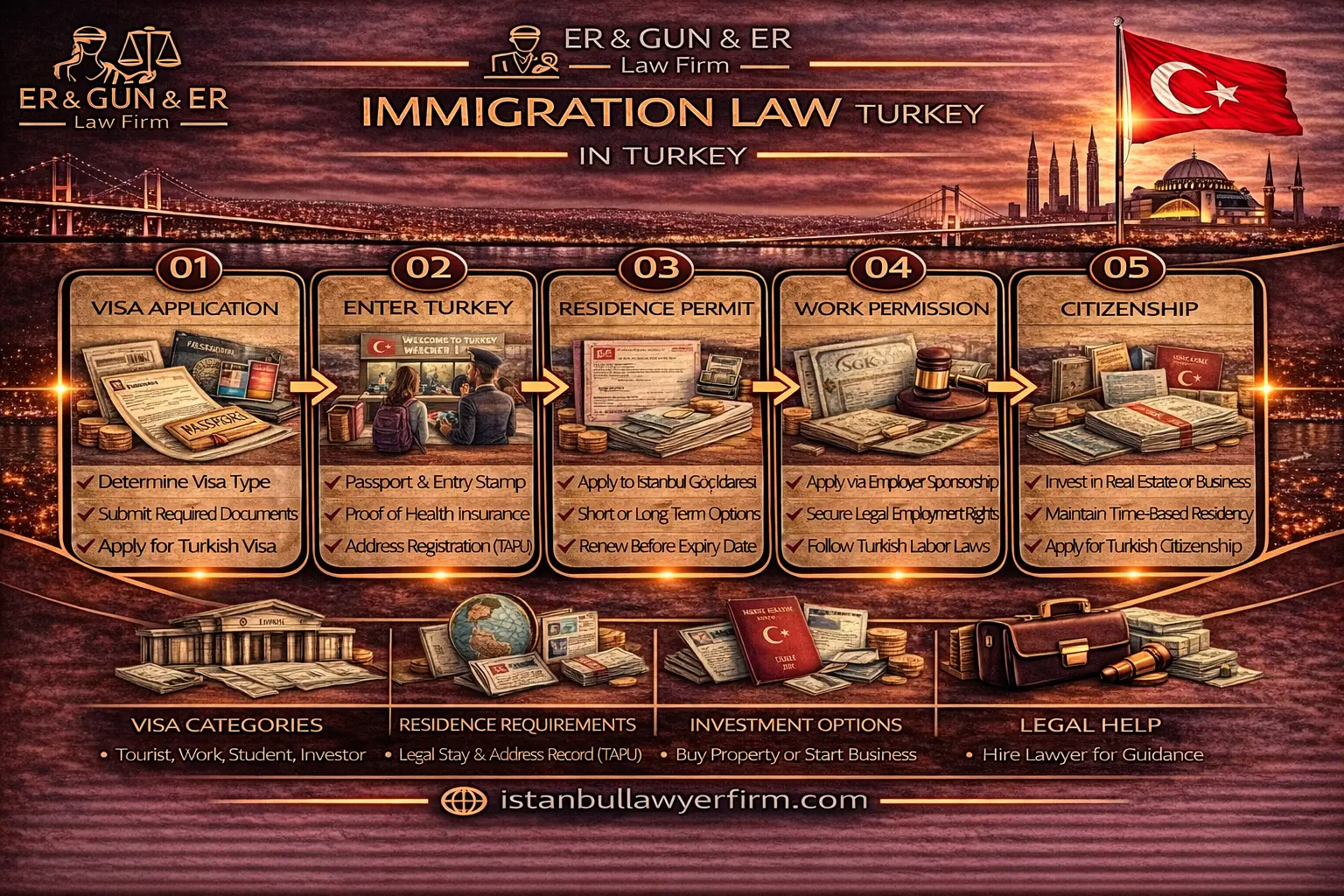
A lawyer in Turkey who advises on immigration law understands that Turkish immigration law is a structured system regulating how a foreign national enters, stays, works, and exits Turkey—and that this system is applied through administrative files, databases, and documentary proof rather than informal explanations, which means that a well-organized, internally consistent evidence archive is the primary practical tool for navigating each stage of immigration compliance and enforcement successfully. An Istanbul Law Firm that advises on Turkish immigration law provides the integrated legal guidance covering every dimension of this regulatory system: advising on entry posture and visa categories; selecting the correct residence permit type for each declared purpose of stay; managing the ongoing compliance obligations that attach to each permit category including address registration, health insurance continuity, and identity token consistency; advising on work permit authorization and employer sponsorship obligations; managing long-term residence and citizenship interface planning; addressing overstay and entry ban risk; responding to enforcement measures including deportation proceedings; and pursuing administrative objections and court appeals through the correct procedural pathways. A Turkish Law Firm that advises on immigration law for foreign nationals and multinational employers understands that residence status and work authorization operate as parallel streams whose alignment is essential—and that a gap or contradiction between the two streams creates compliance exposure that affects both the individual and the sponsoring employer. An English speaking lawyer in Turkey who advises on Turkish immigration law provides the bilingual guidance that enables foreign nationals to understand their obligations and build the evidence file that authorities require without the language barrier creating additional compliance risk at each procedural stage. Practice may vary by authority and year — verify current Turkish immigration law requirements, current permit category eligibility conditions, current supporting document standards, and current authority portal procedures with qualified counsel before taking any step based on general guidance, since the Directorate of Migration Management and labor ministry practice can change in ways that affect the specific requirements applicable to each applicant's situation, and since provincial office practice can differ from central guidance in ways that require locally-informed advice rather than reliance on descriptions that may not reflect the current approach at the applicable office. Practice may vary by authority and year.
Turkish Immigration Law Framework, Legal Basis and Key Authorities
A lawyer in Turkey who advises on the legal framework for immigration explains that Turkish immigration law is primarily anchored in the Law on Foreigners and International Protection Turkey—Law No. 6458—which defines the categories of lawful stay, the administrative measures applicable when compliance fails, the procedural rights of foreign nationals, and the institutional responsibilities of the relevant authorities. An Istanbul Law Firm that advises on the Turkish immigration legal framework helps individuals and employers understand the specific legal dimensions most practically significant for each situation: the Law establishes the Directorate of Migration Management Turkey as the central authority for residence permit decisions and enforcement measures, operating through provincial directorates whose local practice can differ from central guidance in ways that require locally-informed advice; work authorization is governed through a separate labor framework administered by the Ministry of Labor and Social Security, creating a dual-stream system where residence compliance and work authorization must both be managed and must remain consistent with each other; and international protection—asylum and refugee status—follows a distinct procedural pathway under the same Law whose requirements differ from ordinary residence permit processing. Turkish lawyers advising on the immigration legal framework help individuals and employers understand that the system is records-driven rather than explanation-driven—meaning that decisions are taken from the documentary file, portal records, and database entries rather than from personal narratives—and that the practical consequence of this approach is that evidence architecture, token consistency, and submission record-keeping are as important as substantive legal eligibility. Practice may vary by authority and year.
An Istanbul Law Firm that advises on the institutional landscape of Turkish immigration law explains that because multiple authorities touch the same person's immigration record, coordination across these authorities is often the decisive difference between a clean file and a fragmented one. Turkish lawyers advising on authority coordination help individuals and employers implement the specific coordination approach most effective for each situation: mapping each compliance task to the specific authority that will review it—provincial Migration Management Directorate for residence permits, Ministry of Labor for work permits, civil registry for address-linked verification, and Tax Office for some employer compliance verifications; maintaining one master identity record that uses the exact passport spelling of the applicant's name and a consistent date format across every submission to every authority; preserving a submission log that records what was submitted to which authority on which date, with the receipt reference that allows later verification; and designating a single coordinator who manages communications with all relevant authorities to prevent the contradictory statements that arise when different individuals in a company or family interact with different offices without coordinating their information. An English speaking lawyer in Turkey who coordinates immigration submissions across multiple Turkish authorities provides the bilingual coordination that prevents the token drift and inconsistent narratives that are among the most common sources of authority requests for clarification and consequent delays. Practice may vary by authority and year.
A Turkish Law Firm that advises on the practical implications of the records-driven immigration system explains that the most important operational consequence of this system is that every significant event in an applicant's immigration history should be treated as a compliance record to be documented rather than a personal matter to be managed informally. An English speaking lawyer in Turkey who advises on immigration record architecture for foreign nationals helps individuals understand the specific documentation practices most important for each stage of the immigration lifecycle: preserving every submission receipt, every written authority request, and every approval document in an indexed archive with dates and reference numbers; recording every material change—address move, passport renewal, change in employment, change in civil status—in a dated change log with supporting documentary proof; maintaining a master chronology that tracks entries, exits, filings, approvals, renewals, and enforcement interactions in date order backed by verifiable documents; and enforcing one consistent token sheet for name spellings and document numbers so that the file does not create multiple apparent identities for the same person across different submissions over time. Practice may vary by authority and year.
Entry, Visa Rules and Residence Permit Categories
A lawyer in Turkey who advises on entry and visa compliance explains that entry into Turkey is the first chapter of the immigration record—and that the stated purpose at the border, the documents carried, and the activities undertaken during the initial period establish a factual record that later residence and work permit filings will be assessed against for consistency. An Istanbul Law Firm that advises on entry compliance helps individuals understand the specific approach most important for each entry scenario: ensuring that verbal answers to border questions match the documents carried rather than contradicting them; avoiding entry postures that are inconsistent with the actual plan—such as entering as a tourist while intending to immediately begin employment—because this inconsistency creates a documentary mismatch that is difficult to address in later permit applications; preserving entry stamps and travel documents organized with prior passports rather than discarding them, since entry records remain relevant evidence in later status filings; and planning any transition from visitor status to residence status with sufficient lead time to collect and prepare the required documentation before any application submission; and treating each border interaction as a step in the ongoing immigration record that will be assessed for consistency with later permit applications. Turkish lawyers advising on entry compliance help individuals understand that border interactions create official records and that a statement or document presented at the border can be referenced in subsequent authority review of residence and work permit applications. Practice may vary by authority and year.
An Istanbul Law Firm that advises on residence permit categories in Turkey explains that the correct selection of permit category is the foundation of every immigration compliance program—because each category has different eligibility conditions, different ongoing compliance obligations, and different implications for future pathways. Turkish lawyers advising on residence permit Turkey category selection help individuals understand the specific categories most applicable to their situations: short-term residence permits covering a range of general and specific purposes including property ownership, business-related presence, and certain family situations; family residence permits Turkey requiring civil status documentation and genuine household evidence; student residence permits Turkey requiring active enrollment documentation and ongoing academic status; and long-term residence permits Turkey for individuals who demonstrate stable lawful continuous residence over the required period with consistent compliance behavior throughout. An English speaking lawyer in Turkey who advises on permit category selection for foreign nationals helps individuals understand that categories are not merely administrative labels but compliance commitments—a student permit requires maintained enrollment; a family permit requires maintained civil status evidence; and a permit whose declared purpose does not match actual activities becomes vulnerable during renewal review even if the card has not expired. Practice may vary by authority and year — verify current eligibility conditions for each category, current supporting document requirements, current appointment scheduling procedures, and current portal system requirements with qualified counsel before submitting any residence permit application, since the acceptance of specific document formats and the current appointment availability can differ between provinces and can change more frequently than formal legislative guidance. Practice may vary by authority and year.
A Turkish Law Firm that advises on residence permit renewal Turkey explains that renewal is where many applicants discover that compliance is evaluated as a timeline rather than a snapshot—because officers reviewing renewals assess whether the declared purpose, the address registration, the insurance coverage, and the identity records remained consistent and current throughout the prior permit period. An English speaking lawyer in Turkey who manages residence permit renewals for foreign national clients implements the specific renewal approach most effective for each permit type: beginning the renewal process with a file audit that checks address record currency, insurance continuity, travel pattern consistency with the declared residence purpose, and identity token consistency across passports, prior permits, and application forms; collecting the complete prior history of permits and submission receipts to allow the officer to see continuity without searching multiple systems; and ensuring that the renewed application uses the same name spellings and document identifiers as prior accepted submissions unless a documented correction is needed. Practice may vary by authority and year.
Work Permit Authorization, Employer Sponsorship and Employment Compliance
A lawyer in Turkey who advises on work authorization explains that work permit Turkey authorization operates as a scope document rather than a general permission—defining the role, employer, and worksite within which the foreign national is authorized to work—and that both employer and worker are responsible for ensuring that activities actually performed match the authorization scope throughout the permit period. An Istanbul Law Firm that advises on work permit compliance helps employers and workers implement the specific authorization management approach most effective for each employment situation: defining the role, worksite, and reporting line in writing before any application is filed; ensuring that the employment contract, job description, HR records, and payroll records all describe the same role in consistent language; maintaining documentary proof of the start of authorized work and the internal approval of work assignment; and treating any change in job title, department, worksite, or reporting line as a compliance event that requires review before the change takes effect to assess whether an update or new authorization is needed. Turkish lawyers advising on work permit compliance help individuals and employers understand that operational scope drift—where the work actually performed gradually diverges from the authorized role description without a documented compliance review—is one of the most common inspection findings in immigration audits. Practice may vary by authority and year.
An Istanbul Law Firm that advises on employer sponsorship duties explains that employer immigration compliance Turkey extends well beyond submitting a work permit application to include ongoing obligations that continue throughout the employment relationship and affect both the employer's regulatory standing and the employee's immigration record. Turkish lawyers advising on employer sponsorship help companies implement the specific compliance approach most effective for each workforce situation: maintaining a standardized file structure for each sponsored foreign worker with consistent exhibit organization; implementing an onboarding control that prevents any foreign national from beginning system access, payroll, or work tasks until the authorization is documented and archived; keeping payroll, attendance, and social security records that are internally consistent with the permit details; implementing a travel clearance protocol that verifies current authorization status before approving international travel for foreign employees; and maintaining a log of all authority communications—permit submissions, inspection contacts, and official requests—so the company can demonstrate systematic governance rather than ad hoc responses. An English speaking lawyer in Turkey who advises on employer immigration compliance for multinational companies provides the bilingual compliance coordination that ensures HR, payroll, legal, and operations teams are all working from the same authorization record without the information asymmetry that commonly produces contradictory employer submissions. Practice may vary by authority and year.
A Turkish Law Firm that advises on work authorization transitions explains that employment changes—including change of employer, change of role, secondments, and termination—require specific compliance management because the work permit file must reflect the current employment reality and because gaps between the employment record and the immigration file create enforcement exposure for both employer and employee. An English speaking lawyer in Turkey who manages work permit transitions for foreign national employees helps coordinate the specific steps most important for each transition type: documenting role changes before they take effect with a dated change memo that assesses whether the change is within the existing authorization scope; ensuring that termination records are closed in HR, payroll, and immigration systems consistently and promptly; coordinating employer communication during any pending authorization period to ensure that no work begins before the new authorization is confirmed; and maintaining the immigration file through transitions so the officer reviewing the next application can see a clean chronology without unexplained gaps. Practice may vary by authority and year.
Family Permits, Student Routes and Long-Term Residence Pathway
A lawyer in Turkey who advises on family and student immigration routes explains that these routes provide stable lawful stay for many of the largest groups of foreign nationals in Turkey—but that they require genuine ongoing evidence of the underlying relationship or enrollment whose absence during a renewal review creates refusal risk even when the applicant would otherwise be eligible for renewal. An Istanbul Law Firm that advises on family residence permit Turkey applications helps applicants structure the evidence most effectively for each family situation: keeping civil status documentation—marriage certificates, birth certificates, and kinship records—properly translated with consistent name tokens and stored with their original versions; maintaining household evidence in the form of address records and shared residence proofs that demonstrate a genuine domestic relationship rather than a formally registered but practically separate arrangement; updating the permit file whenever the sponsoring family member's status changes, since the family permit is dependent on the sponsor's continued lawful status in Turkey; and treating any change in civil status—including changes to a marriage, changes in custody arrangements, or a dependent reaching adulthood—as a compliance event that requires file review and potentially a change in the appropriate permit category. Turkish lawyers advising on family permit compliance help applicants understand that inconsistency between the declared household arrangement and the address records is one of the most common grounds for additional scrutiny in family permit renewal reviews. Practice may vary by authority and year.
An Istanbul Law Firm that advises on student residence permit Turkey applications explains that student permit compliance requires active management of the enrollment record because the permit's validity depends on genuine ongoing academic status rather than on a one-time admission letter. Turkish lawyers advising on student permit compliance help students implement the specific management approach most effective for each academic situation: keeping current enrollment confirmation letters issued by the school in the permit file rather than relying on admission documents from an earlier year; documenting any program transfers, leave of absence periods, or academic status changes at the time they occur rather than reconstructing them during renewal; confirming that the address used in student permit applications matches the actual residential address registered with the authority rather than using the university address; and planning permit renewal preparation to begin well before the permit expiry date so that appointment scheduling, document collection, and translation can be completed without pressure. An English speaking lawyer in Turkey who manages student permit renewals for foreign students at Turkish universities provides the practical guidance that prevents the common situation where a student in their second or third year applies for renewal and discovers that their academic history documentation is incomplete. Practice may vary by authority and year.
A Turkish Law Firm that advises on the long-term residence permit Turkey pathway explains that this status is built on demonstrating stable lawful residence over the required period with consistent compliance behavior—and that the key practical challenge is that the required period must be documented through the permit history file rather than through memory or verbal description. An English speaking lawyer in Turkey who advises on long-term residence planning helps applicants implement the specific preparation approach most effective for each residency history situation: maintaining an indexed archive of every prior permit approval, every renewal receipt, and every address registration change that covers the full required period; auditing the permit history for any gaps in coverage, inconsistent address records, or insurance continuity breaks that would weaken the continuity narrative; documenting travel patterns with a travel log and retained boarding passes where lawful and relevant, since extended absences may lead officers to question whether the residence was genuinely continuous; and building a reconciliation memo for any passport renewals during the period so that the identity chain across multiple document numbers is clearly established. Practice may vary by authority and year.
Address Registration, Insurance Compliance and Citizenship Interface
A lawyer in Turkey who advises on address registration compliance explains that address registration is a core ongoing obligation—not a one-time filing—because authorities use the registered address to link the permit holder to a provincial file and a local office workflow, and because inconsistencies between the declared address and the address visible in linked administrative systems are among the most common triggers for authority requests during renewal review. An Istanbul Law Firm that advises on address registration foreigners Turkey compliance helps permit holders implement the specific address management approach most effective for each housing situation: treating every address change as a compliance event requiring prompt action rather than treating the address as a background personal detail; maintaining a dated address change log that records when each move occurred and what official proof was used; ensuring that the address used in permit applications, in employer letters, and in health insurance policies consistently refers to the same location; and confirming that the address format—building name, door number, district, and province—is consistent across different document types rather than allowing small format differences to create apparent discrepancies. Turkish lawyers advising on address compliance help permit holders understand that an address mismatch discovered during renewal review tends to expand the scope of the authority's scrutiny beyond the specific mismatch to the overall credibility of the file. Practice may vary by authority and year.
An Istanbul Law Firm that advises on health insurance residence permit Turkey compliance explains that continuous health insurance coverage is a recurring permit condition whose management requires ongoing attention because the insurance must remain valid and adequately documented throughout the permit period—not only at the moment of application. Turkish lawyers advising on insurance compliance help permit holders implement the specific insurance management approach most effective for each coverage situation: keeping the full policy text with payment evidence and any endorsements or renewals in the same indexed archive as the permit file; ensuring that the insured party's name and identity tokens match the exact passport spelling used in the permit application throughout the policy period; tracking insurance validity end dates separately from permit validity end dates and building a renewal trigger into the compliance calendar so that coverage is renewed before gaps occur; and for permit holders with dependent family members, ensuring that each dependent has a clearly traceable coverage record with consistent identity tokens rather than assuming inclusion in a family policy without documentary confirmation. An English speaking lawyer in Turkey who manages insurance compliance for foreign national clients provides the pre-renewal audit that confirms the insurance archive satisfies current authority standards before the renewal filing is submitted—identifying any gaps, spelling mismatches, or coverage format issues at the preparation stage rather than discovering them after an officer has requested clarification and the renewal timeline has been extended. Practice may vary by authority and year.
A Turkish Law Firm that advises on citizenship planning in the context of Turkish immigration law explains that citizenship evaluation frequently examines the applicant's documented lawful residence history—and that a clean, consistent, well-organized immigration file is the most practically important preparation for a citizenship application rather than any particular advocacy strategy. An English speaking lawyer in Turkey who advises on citizenship planning as part of immigration compliance management helps applicants build the specific file structure most effective for demonstrating stable, continuous, compliant residence: a permit history tab with indexed approvals and renewals covering the full required period; an address history tab with dated proofs of each registered address and a reconciliation note for any municipal street name or building number changes; an insurance history tab showing continuous coverage; a work activity tab where relevant showing authorized employment with documents consistent across permits, contracts, and payroll; and a travel history tab with a ledger of significant absences and supporting documentary proof whose completeness allows the officer to assess the full residence chronology without requesting additional clarification for periods that appear undocumented. Practice may vary by authority and year.
Travel, Re-Entry Risks, Overstay and Entry Ban Management
A lawyer in Turkey who advises on travel compliance explains that border interactions are compliance events—not routine administrative formalities—because border systems display the person's stay basis, permit validity, and entry/exit history in real time, and because a traveler whose documents, declarations, and system records are inconsistent can face questions that create official records even when their underlying legal status is valid. An Istanbul Law Firm that advises on travel risk management for foreign nationals helps individuals and employers implement the specific travel planning approach most effective for each travel situation: verifying the current permit status and validity period before every trip and carrying a copy of the latest submission receipt for any pending renewal accessible offline; ensuring the passport used for travel matches the passport number linked to the current permit record—and updating the immigration file to reflect a new passport number before travel if the passport was recently renewed; implementing a corporate travel clearance process that requires HR confirmation of current authorization status before any foreign employee's travel is approved; and training travelers to carry consistent documentation that answers the questions most commonly posed at Turkish border controls in a way that matches the filed purpose of stay. Turkish lawyers advising on travel compliance help both individuals and employers understand that statements made at border interactions create records that are accessible in later permit reviews—and that an inconsistent border statement is harder to correct than a missing document because it involves an official recorded interaction rather than a documentation gap. Practice may vary by authority and year.
An Istanbul Law Firm that advises on overstay prevention and management explains that overstay risk arises when the gap between when a person should have acted—applying for renewal, departing, or changing status—and when they actually acted is not documented and managed as a compliance incident requiring immediate attention. Turkish lawyers advising on visa overstay penalties Turkey compliance help individuals implement the specific prevention approach most effective for each risk scenario: treating the lawful stay expiry date as a hard planning trigger rather than an approximate guideline; understanding which pending application procedures maintain authorized presence during processing and which do not, since this distinction varies by permit type and significantly affects enforcement risk; preserving every filing receipt as the primary proof of compliance intent; and if a potential overstay is identified, building a precise chronology of lawful entries, filings, and permit records before any statement is made or any action is taken. An English speaking lawyer in Turkey who advises on overstay situations provides the specific analysis calibrated to the individual's actual documented history—which is essential because generalized information about overstay consequences cannot substitute for assessment of the specific facts. Practice may vary by authority and year.
A Turkish Law Firm that advises on entry ban risk management Turkey explains that entry restrictions typically become apparent only when a person attempts re-entry after a period away—making proactive compliance management consistently more effective than crisis response. An English speaking lawyer in Turkey who advises on entry ban situations helps individuals implement the specific approach most effective for each restriction scenario: treating any written border notice or reference number as a compliance artifact to be preserved immediately; avoiding repeated unplanned border attempts that generate additional adverse records without a documented strategy; building a complete chronology of entries, exits, filings, and status records before any challenge is initiated; and—where the restriction appears to be recorded in error—identifying the specific identity token or date mismatch that may explain the discrepancy before filing any challenge that assumes the restriction is substantively incorrect. Practice may vary by authority and year — verify current appeal procedures and current authority practice with qualified counsel before filing any entry ban challenge.
Enforcement, Deportation Measures and Administrative Objection Procedures
A lawyer in Turkey who advises on immigration enforcement explains that deportation and removal measures are administrative decisions issued under the Law on Foreigners and International Protection Turkey whose procedural and substantive requirements create specific obligations on the issuing authority—and whose review through the correct procedural channels is most effective when the individual's evidence file is organized and complete from the earliest stage of the enforcement interaction. An Istanbul Law Firm that advises on deportation defense for foreign nationals implements the specific response approach most effective for each enforcement situation: obtaining the written decision record and the notification proof as the first priority because the written basis determines which procedural remedies are available and the notification record determines when applicable deadlines begin to run; compiling a complete chronology of the individual's permit history, address records, and entry/exit records that allows counsel to assess the enforcement decision against the documentary record rather than against the individual's description of events; separating removal center procedural steps from the main merits review so that detention rights and enforcement procedures are managed in parallel with rather than instead of the substantive challenge; and preserving counsel access and representation arrangements early because access constraints in removal facilities can create procedural lockouts if not addressed proactively. Turkish lawyers advising on deportation defense help individuals and families understand that the most effective response is a structured dossier that addresses the authority's stated reasoning with document-backed arguments—and that emotional or unsupported statements typically do not advance the procedural position and can sometimes be counterproductive. Practice may vary by authority and year.
An Istanbul Law Firm that advises on administrative objections in immigration cases explains that an administrative objection is the structured first response to an adverse immigration decision—providing an opportunity to correct record-based errors, supply missing documentation, and demonstrate compliance before resorting to court proceedings. Turkish lawyers advising on administrative objection procedures help applicants structure the objection most effectively for each decision type: identifying the issuing authority, the decision date, and the reference number; stating the specific remedy requested—reconsideration, record correction, or withdrawal of the measure—in operational terms rather than in abstract legal principles; attaching a complete indexed exhibit set that directly addresses the decision's stated reasons; and drafting the objection in language that assumes it may later be read by an administrative court judge, since objection responses often become exhibits in subsequent litigation. An English speaking lawyer in Turkey who manages administrative objections for foreign nationals provides the bilingual drafting service that ensures the Turkish-language objection accurately reflects the client's instructions and maintains complete consistency with all prior submissions to the same authority and to other authorities. Practice may vary by authority and year.
A Turkish Law Firm that advises on objection record preservation explains that the disciplined preservation of every submission receipt, every official request, and every authority response is as important as the substantive content of the objection—because the objection record becomes the foundation of any subsequent court challenge and because timing disputes are one of the most common procedural issues in immigration appeal proceedings. An English speaking lawyer in Turkey who manages immigration objection proceedings for foreign national clients preserves the submitted bundle as a frozen dated exhibit immediately after filing, stores the proof of submission alongside it, and records every subsequent authority interaction as a dated event—creating the organized record that allows a court to assess the chronology of the administrative process without reconstruction. Practice may vary by authority and year.
Administrative Court Appeals, Interim Stays and Corporate Compliance
A lawyer in Turkey who advises on administrative court appeals in immigration cases explains that court review in Turkish administrative litigation tests whether the immigration decision was based on facts, proper procedure, and lawful interpretation—rather than re-examining the substance of the application from scratch—and that the most effective court filings are those that identify specific verifiable defects in the administrative record rather than those that make broad arguments about the decision's fairness or proportionality. An Istanbul Law Firm that advises on administrative court litigation for immigration cases helps applicants structure the court petition most effectively for each decision type: defining the challenged act precisely by reference to the decision date and reference number; framing the legal grounds around the specific factual or procedural defects in the administrative decision that are supported by documents in the file; attaching an indexed exhibit set whose structure mirrors the decision's stated reasons; and avoiding the introduction of new facts that were not presented to the administrative authority unless they constitute documented new events whose admission can be legally justified. Turkish lawyers advising on immigration court petitions help applicants understand that court filings in Turkish administrative litigation are primarily document cases—and that a well-organized, coherent, consistent evidence file consistently produces more effective court representation than an eloquently argued petition supported by a fragmented or internally inconsistent record. Practice may vary by authority and year.
An Istanbul Law Firm that advises on interim stay requests in immigration court proceedings explains that a stay of execution—suspending enforcement of the challenged decision while the court reviews the merits—requires a separate motion supported by specific evidence of urgency and the plausibility of the legal challenge whose standard should be verified with qualified counsel. Turkish lawyers advising on stay request preparation help applicants build the specific evidence package most persuasive for each urgency situation: identifying the exact enforcement risk in concrete terms with supporting documents—the notification record, travel constraints, employment obligations, or family circumstances that demonstrate why enforcement before court review would produce irreversible harm; keeping the stay request fully consistent with the main petition by using the same identity tokens, the same factual narrative, and the same exhibit numbers; and submitting the stay request as a separate indexed motion rather than embedding the urgency argument in the main petition where it may receive less focused attention. An English speaking lawyer in Turkey who prepares stay requests for foreign nationals provides the bilingual coordination that ensures the urgency narrative in English accurately reflects the Turkish procedural motion and maintains the factual consistency that is essential because the stay request and the main petition will be reviewed together. Practice may vary by authority and year.
A Turkish Law Firm that advises on corporate immigration governance explains that the most defensible corporate immigration compliance program is one that can demonstrate to an inspector that the company runs systematic controls—onboarding gates, change management reviews, document retention rules, and audit routines—rather than a program that produces good individual files without systematic governance. An English speaking lawyer in Turkey who advises on corporate immigration policy Turkey helps employers implement the specific governance framework most effective for each organization's structure: a written policy that defines who may authorize foreign national engagements, what pre-start verification is required, how role and location changes are managed, and who may communicate with authorities; a standardized file structure for every foreign worker with consistent exhibit organization and a token sheet enforced across all submissions; a periodic internal audit that tests a sample of files for identity consistency, authorization scope currency, address and insurance continuity, and HR record alignment; a dispute response protocol that designates a single coordinator, freezes the relevant file version, and logs all communications as dated exhibits; and a training program for managers that explains authorization scope limits before they supervise foreign staff rather than after an inspection identifies a problem. A lawyer in Turkey for immigration law matters combines knowledge of the Law on Foreigners and International Protection No. 6458, work permit law under the International Labor Force Law, administrative procedure law, administrative court litigation procedure, enforcement and removal procedures, and the practical requirements of each Turkish provincial Migration Management Directorate with the English-language communication that enables foreign nationals and multinational employers to navigate Turkish immigration law effectively. Practice may vary by authority and year.
Frequently Asked Questions
- What is the primary legal framework governing immigration in Turkey? Turkish immigration law is primarily governed by the Law on Foreigners and International Protection Turkey—Law No. 6458—which defines residence permit categories, procedural rights, enforcement measures, and international protection procedures. Work authorization operates under a separate labor law framework administered by the Ministry of Labor. Both streams must be managed consistently since gaps or contradictions between residence status and work authorization create compliance exposure. Practice may vary by authority and year.
- Which authority issues residence permits in Turkey? Residence permits are issued by the Directorate of Migration Management Turkey through its provincial directorates. Applications are submitted through the designated portal system and processed at the Provincial Directorate level. Work permits are issued separately by the Ministry of Labor and Social Security. Because these authorities operate independently, separate but coordinated file management is required. Practice may vary by authority and year.
- What residence permit categories are available in Turkey for foreign nationals? Available categories include short-term residence permits for various declared purposes, family residence permits based on civil status ties to Turkish citizens or legal residents, student residence permits based on active enrollment, humanitarian residence permits for specific discretionary circumstances, and long-term residence permits for individuals with established continuous lawful presence. Each category has different eligibility conditions and different ongoing compliance obligations. Practice may vary by authority and year.
- What is required to maintain a valid residence permit between renewals? Permit conditions that must be maintained typically include continuous health insurance coverage at the required level, current address registration updated whenever the holder moves, identity records consistent across passports and permit files, and activities that remain consistent with the permit's declared purpose. Material changes in circumstances may require reporting. These conditions are evaluated during renewal review. Practice may vary by authority and year.
- How does work authorization differ from residence permit status in Turkey? Residence permits authorize lawful stay for the declared purpose but do not automatically authorize employment or commercial service activities. Work authorization requires a separate work permit issued by the Ministry of Labor and Social Security, and its scope is specific to the role, employer, and worksite described in the authorization. Foreign nationals who perform work without a valid work permit may face both immigration and labor enforcement consequences. Practice may vary by authority and year.
- What are the key employer obligations when sponsoring a foreign worker in Turkey? Employers must verify and archive work authorization before any foreign national begins tasks; maintain employment contracts, job descriptions, and payroll records consistent with the authorization; document any role, worksite, or title changes before they take effect; implement a travel clearance protocol for foreign employees; maintain a log of all authority communications; and train managers on authorization scope limitations. Inspectors compare immigration files with HR and payroll records. Practice may vary by authority and year.
- What documentation is required for a residence permit renewal in Turkey? Renewal files typically require evidence of continuous insurance coverage, current address proof consistent with the registered address, consistent identity documentation across the current and any prior passports, supporting documents specific to the permit category—enrollment records for students, civil status records for family permits—and the history of prior approvals and submission receipts. A file audit before renewal preparation identifies gaps that must be resolved before submission. Practice may vary by authority and year.
- How is the long-term residence permit obtained in Turkey? Long-term residence Turkey requires demonstrating stable lawful continuous residence over the required period with consistent compliance behavior throughout, documented through an indexed archive of prior permits, renewals, address registration history, and insurance continuity. Travel patterns are assessed against the claimed residence continuity. Gaps in coverage, inconsistent address records, or extended unexplained absences can undermine the application. Practice may vary by authority and year.
- What happens if a foreign national overstays their permitted period of stay in Turkey? Overstay creates enforcement risk whose assessment depends on the specific duration, whether any filing was pending during the period, and the individual's complete documented entry and status history. Proactive response—building a precise chronology and seeking qualified advice before any statement is made to authorities—is consistently more effective than improvised explanation at the point of enforcement contact. Filing receipts and permit approval records are the primary proof of compliance intent. Practice may vary by authority and year.
- How can a foreign national challenge an entry ban recorded in Turkey? An entry ban challenge should begin with obtaining the written basis for the restriction rather than assuming its reason. A complete travel and status chronology supported by documentary proof should be compiled before any challenge is filed. The correct procedural route—administrative objection to the issuing authority, administrative court litigation, or both in sequence—depends on the specific classification of the decision. Repeated unplanned border attempts without a documented strategy should be avoided. Practice may vary by authority and year.
- What procedural remedies are available when an immigration decision is refused or canceled in Turkey? Available remedies include administrative objection to the issuing authority—often required as a preliminary step before court access—and administrative court litigation before an Administrative Court. Each remedy has specific deadlines running from notification of the decision. Interim stay requests can ask the court to suspend enforcement while the merits are reviewed. The correct route and deadline depend on the specific decision type and require verification with qualified counsel. Practice may vary by authority and year.
- What evidence is needed for an administrative court petition in an immigration case? The court file should include the challenged decision text, the notification proof, a complete permit history chronology, identity continuity evidence across all passports, address and insurance compliance records for the relevant period, and an indexed exhibit set that links each document to a specific factual statement in the petition. Courts review the administrative record rather than conducting a fresh assessment, so identifying specific defects in the authority's stated reasoning is more effective than general hardship arguments. Practice may vary by authority and year.
- How should companies manage immigration compliance for their international workforce in Turkey? Companies should implement a written immigration policy with onboarding gates, change management reviews, and a single authorized communications channel; maintain standardized file structures for every foreign worker; run periodic internal audits comparing immigration files against HR and payroll records; designate a compliance coordinator with a backup; and train managers on authorization scope limitations. A system that can demonstrate controlled governance—rather than individual good files—handles inspections most effectively. Practice may vary by authority and year.
- What are the main compliance obligations for address and insurance in Turkish immigration law? Address registration must be kept current and updated with documentary proof whenever the holder moves, with a dated change log that explains differences across systems. Health insurance must remain continuously in force with the insured person's identity tokens matching the permit file. Both address and insurance records should be indexed and archived together with the permit file so they are immediately available during renewal review or inspection. Practice may vary by authority and year.
- Does ER&GUN&ER Law Firm provide legal services for immigration law matters in Turkey? Yes. ER&GUN&ER Law Firm provides comprehensive legal services for immigration law matters in Turkey including residence permit category selection and application management, work permit applications and employer compliance advisory, family and student permit management, long-term residence and citizenship interface planning, address registration and insurance compliance review, renewal preparation and file audits, travel risk assessment, overstay situation analysis, entry ban challenge coordination, deportation defense and removal center representation, administrative objection drafting, administrative court petition preparation, interim stay requests, and corporate immigration governance design—with English-language client communication and bilingual documentation throughout each engagement.
Author: Mirkan Topcu is an attorney registered with the Istanbul Bar Association (Istanbul 1st Bar), Bar Registration No: 67874. His practice focuses on cross-border and high-stakes matters where evidence discipline, procedural accuracy, and risk control are decisive.
He advises individuals and companies across Immigration and Residency, Real Estate Law, Tax Law, and cross-border documentation matters where procedural accuracy and evidence discipline are decisive.
Education: Istanbul University Faculty of Law (2018); Galatasaray University, LL.M. (2022). LinkedIn: Profile. Istanbul Bar Association: Official website.