

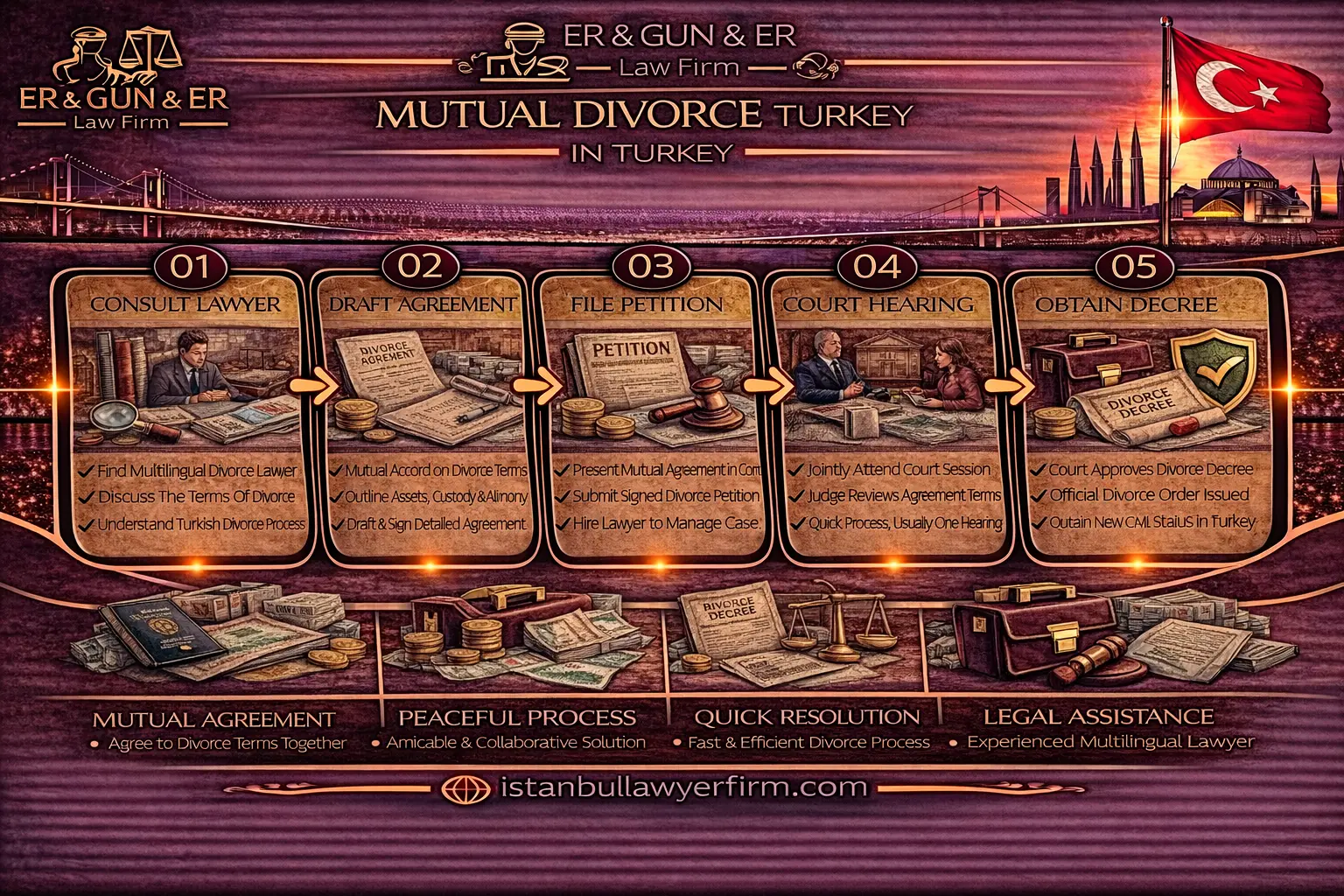
Mutual divorce Turkey is the practical route for spouses who want to end the marriage by a written agreement and a controlled court hearing. Uncontested divorce Turkey is not only “both parties agree,” because the court still checks voluntariness, child welfare, and whether the protocol can be enforced. The divorce protocol Turkey is the engine of the case because the judge will base the judgment on what is written and what is confirmed at the hearing. A protocol that is vague or internally contradictory can delay the case, trigger a refusal to approve terms, or create years of enforcement disputes. Courts focus on children first, then on whether financial terms are fair enough to be sustainable, and then on whether the parties truly understand what they are signing. Evidence matters even in an agreed divorce because the judge may ask how the parties will implement custody, payments, and property transfer steps. If the spouses are negotiating from different countries, a disciplined translation and signature strategy is necessary, and an English speaking lawyer in Turkey can keep names, dates, and commitments consistent across documents.
Mutual divorce overview
Divorce by mutual agreement Turkey is a court-based procedure even when spouses are aligned on every term. The court does not rubber-stamp a private contract without a hearing. The judge will confirm that both spouses genuinely intend to divorce. The judge will confirm that the protocol reflects free will. The judge will confirm that child-related terms protect the child’s best interests. The judge will also check that payment terms are clear enough to be enforceable. The protocol is therefore not a symbolic attachment but the operative document. A mutual divorce file typically includes a petition, the signed protocol, and basic civil status documents. If one spouse tries to avoid appearing or tries to change terms at the last moment, the “mutual” structure can collapse. That collapse usually forces either a revised protocol or a contested case track. Many parties search for speed, but speed depends on court scheduling and protocol quality, not on slogans. practice may vary by authority and year — check current guidance. A careful lawyer in Turkey will treat mutual divorce as a project with checklists, not as a single meeting.
Mutual divorce is attractive because it reduces uncertainty, but it does not remove the need for precision. The protocol must cover custody, visitation, child support, spousal support if any, and property allocation if any. If the protocol leaves a major topic blank, the judge may refuse to approve or may ask the parties to clarify immediately. If the parties clarify orally but do not revise the text, enforcement later becomes difficult. If a child is involved, vague phrases like “reasonable visitation” are usually not enough for predictable execution. If financial payments are involved, vague phrases like “support as needed” are not executable. If property transfer is promised, the protocol must align with the actual asset record and the steps needed to transfer. If debts exist, the protocol should say who will pay which debt and how proof will be produced. The court hearing is also a credibility checkpoint because the judge will ask short questions to test whether the parties understand the protocol. If the parties give inconsistent answers, the judge may treat the protocol as unstable. The safest method is to draft the protocol as if it will be enforced years later by documents alone. A professional Turkish Law Firm approach is to define every obligation with a date concept, a payment method, and a proof method.
A mutual divorce case also creates a future compliance record that can matter for travel, status, and cross-border recognition. If one spouse is a foreign national, the divorce record can be needed for residence status updates and civil registry updates. If the spouses have assets abroad, they may need the Turkish judgment for foreign procedures. If the spouses plan to remarry, they need a clear and final record that their marriage ended. If the protocol includes ongoing payments, the payer needs a clean payment proof system to avoid later “unpaid” allegations. If the protocol includes visitation travel permissions, clarity prevents border disputes and police station conflicts. If the protocol includes property settlement, clarity prevents later claims of fraud or non-performance. Mutual divorce is therefore not only a legal termination but also a future-risk management step. If your file involves complex assets or international elements, a law firm in Istanbul can coordinate registry steps and certified copy logistics consistently. practice may vary by authority and year — check current guidance. A well-managed mutual divorce reduces long-term conflict by making obligations easy to prove and easy to enforce.
Eligibility and key conditions
Eligibility is not only about agreement, because the law imposes baseline conditions for an uncontested track. The Turkish Civil Code mutual divorce provisions include minimum structural requirements that the court must verify. One requirement relates to the existence of a valid marriage and the ability of the court to register its termination. Another requirement relates to the parties’ joint intention and their personal appearance before the judge. Another requirement relates to having a written protocol that covers mandatory topics with enforceable clarity. If children exist, eligibility also includes the court’s acceptance of the child arrangements as protective. If a spouse appears coerced or confused, the judge may refuse to approve the protocol even if signatures exist. If the protocol appears one-sided without explanation, the judge may ask for clarification and may require revisions. If a spouse is under guardianship or has capacity questions, additional documentation may be needed. If a spouse is abroad, logistics become eligibility-adjacent because personal appearance requirements must be addressed lawfully. practice may vary by authority and year — check current guidance. A best lawyer in Turkey will screen eligibility by checking marriage status, child status, and protocol completeness before scheduling the filing.
Mutual divorce also requires that both spouses are aligned not only on divorce but on the consequences of divorce. If one spouse expects to renegotiate property later, the protocol must state whether property issues are settled or reserved. If one spouse expects to renegotiate support later, the protocol must state modification expectations conceptually and within lawful limits. If one spouse expects to relocate with the child, the protocol must address relocation and consent mechanics to prevent immediate conflict. If one spouse expects to change custody later, the protocol should still record the current agreed framework clearly. A court will usually test whether the parties understand these consequences through direct questions. The parties should prepare for those questions by reading the protocol carefully and confirming that they can explain it in consistent language. If one spouse is a foreigner, ensure that the spouse understands the protocol language and that translation is accurate. If one spouse is financially vulnerable, the protocol should explain how basic needs will be met without creating an unworkable promise. If the protocol includes asset transfers, ensure that the assets exist and are transferable. If the protocol includes debt allocation, ensure that the debt is identified and that third-party creditor reality is understood. Eligibility is therefore a combination of formal conditions and practical coherence. A disciplined team of Turkish lawyers will treat “agreement” as an evidence fact shown by signatures, hearing statements, and consistent attachments.
Key conditions also include procedural conditions that affect whether the case will be processed smoothly. The petition must be filed with proper civil status attachments and proper address details for service. The protocol must be signed by both parties and should be dated consistently with the petition. If the parties sign different versions, the court file can become inconsistent and the judge may ask which version is binding. If the parties have different surnames after marriage due to local rules, the protocol should reflect passport spelling and registry spelling consistently. If a spouse uses a different alphabet, transliteration should be fixed once and used everywhere. If a spouse is represented by counsel, representation must not substitute for personal voluntariness, because the judge will ask the spouse directly. If the parties plan a fast outcome, they should still avoid claiming “guaranteed same-day” results because scheduling depends on court workload. practice may vary by authority and year — check current guidance. If your matter involves multiple countries, avoid booking travel based on assumptions and instead plan around the court’s confirmed hearing date. A consistent, complete file is the primary condition for a smooth uncontested divorce process.
Court jurisdiction and venue
Venue selection matters because mutual divorce is still a Family Court process with procedural rules. The court competence and venue are typically linked to residence connections and procedural practice. A petitioner should confirm which Family Court is competent based on the parties’ addresses and the case type. If spouses live in different cities, venue choice should be discussed and documented to avoid later venue objections. If one spouse is abroad, the Turkish connection must be documented so the court can proceed without ambiguity. If the parties file in a court with heavy scheduling, the hearing date may be later than expected. practice may vary by authority and year — check current guidance. Therefore, parties should not treat venue as a neutral detail, because it affects timeline and administrative friction. Venue also affects practical service, because notices must reach correct addresses and missed service can cause adjournments. If you need a structured understanding of how venue choices fit into the broader system, review family court framework and align your filing plan with it. A coordinated Istanbul Law Firm can manage filing logistics and prevent address mismatches that cause avoidable delays.
Venue should also be chosen with enforceability in mind, because the same file later supports enforcement and cross-border recognition. A judgment issued from a clearly competent court with clean service proofs is easier to enforce. If the parties anticipate future enforcement of protocol terms, they should insist on clean hearing minutes and clear judgment wording. If the parties anticipate international recognition, they should ensure the case file shows that both parties were present and that the judge confirmed voluntariness. Foreign authorities often care about due process indicators, and the Turkish file can provide them through minutes and certified copies. If a party later challenges the divorce abroad, a clean Turkish file reduces the risk of recognition refusal. If the parties later need to amend custody or support, a clear record of the original venue and terms helps the later court understand baseline. Venue selection is therefore part of risk management, not only convenience. If a spouse is concerned about travel, choose a venue that both parties can attend without stress. If a spouse has safety concerns, venue choice can also intersect with protective measures, and counsel should plan accordingly. practice may vary by authority and year — check current guidance. A law firm in Istanbul can also coordinate with provincial correspondents when attendance logistics require it, but the client should know who will appear and who will sign filings.
Procedural discipline in venue also includes correctly identifying the parties’ identities and addresses as they will appear in the national registry. Use the same spelling and ID details across the petition, the protocol, and attachments. If one spouse is a foreigner, include passport details and any local identification used in Turkey consistently. If the spouses have children, ensure that child identity details match civil records and school records where referenced. If the spouses have prior cases between them, coordinate case references carefully and avoid mixing file numbers incorrectly. If the parties have moved recently, update address records and use the current address for service, not an old address used in previous matters. If a spouse wants notices to go to counsel, the spouse should still provide a valid residence address because courts may require it. If the protocol includes property in another city, venue does not change automatically, but enforcement steps later may require coordination. If the protocol includes foreign assets, venue still depends on the divorce case rules, but cross-border recognition planning should begin early. These procedural basics are often the difference between a single hearing and repeated adjournments. practice may vary by authority and year — check current guidance. Clean venue practice is one of the easiest wins in uncontested divorce because it is fully controllable by correct drafting and correct attachments.
Drafting the divorce protocol
The protocol is the engine because it becomes the legal content of the judgment once approved. A divorce protocol Turkey should be drafted like an enforcement document, not like a friendly letter. It should identify spouses with full identity details and consistent name spelling. It should state that the parties jointly request divorce by mutual agreement Turkey and confirm voluntariness. It should define custody, visitation, and travel consent in child-centered terms if children exist. It should define child support protocol Turkey items with payment method, payment proof, and adjustment concept where relevant. It should define spousal alimony protocol Turkey items with clear amount and payment method if spousal support is agreed. It should define property settlement protocol Turkey items with asset identifiers and transfer steps, not only promises. It should define debt allocation with creditor names and proof method where possible. It should define who pays which costs, such as school, healthcare, and extraordinary expenses, without double counting. It should define what happens if a payment is late and how notices are sent, without inventing statutory deadlines. It should define that bank transfer is the proof method and specify reference lines to avoid later disputes. It should define whether future modifications will be addressed through written agreement or court process, conceptually and realistically. practice may vary by authority and year — check current guidance. A protocol drafted by experienced Turkish lawyers is usually shorter but more executable because it uses clear triggers and proof standards.
Protocol drafting should also avoid silent contradictions between different sections. If the custody section says the child lives with one parent but the support section assumes equal time, the judge may question coherence. If the visitation section allows international travel but the consent section is silent, border disputes can arise later. If the property section says the parties waive claims but the debt section lists shared debts, the waiver language can create confusion. Therefore, drafting should be done with a consistency audit where each clause is checked against the others. Protocols should also anticipate administrative steps such as updating civil registry status and issuing certified copies. If one spouse is abroad, signature logistics must be planned so that the signed protocol is accepted and consistent with court expectations. If the protocol is bilingual, define the controlling language and ensure translations are faithful and consistent. Avoid open-ended phrases like “as soon as possible” without specifying a concrete proof event such as bank receipt or registry extract. Avoid using non-executable moral language such as “will be supportive,” because enforcement requires measurable obligations. If a party agrees to transfer a car or property, list the plate number or title details and list the handover steps. If a party agrees to pay a lump sum, define installment schedule conceptually and define payment security expectations. If the parties agree to waive spousal support, state the waiver clearly and confirm that the parties understand it, because the judge may ask at hearing. A Turkish Law Firm can also integrate protocol drafting with hearing preparation so the parties answer judge questions consistently. The best protocol is one that does not require later interpretation by third parties.
Protocol drafting should be approached as a controlled negotiation where each concession is tied to an enforceable output. If the parties disagree on a clause, do not paper it over with vague wording, because vague wording will become litigation later. Instead, narrow the disagreement to a measurable parameter, such as a specific weekend schedule or a specific payment date concept. If the parties cannot agree on a long-term support amount, consider a phased concept but document the trigger events and proof requirements. If the parties cannot agree on property, separate property settlement from the divorce protocol only if the legal strategy supports it and the parties understand the risk. For a deeper view of how property settlement terms should be structured, refer to property settlement roadmap and align protocol clauses with real transfer steps. If the parties have foreign elements, consult expat divorce procedure to align signature and service planning with the protocol. Keep all draft versions version-controlled and do not allow two different signed versions to exist. If counsel is involved, counsel should manage a single master document with tracked changes to prevent drift. If one spouse is represented and the other is not, ensure the unrepresented spouse has time to review and understand the protocol to reduce later “coercion” allegations. The judge will test voluntariness, and a rushed signature increases risk. practice may vary by authority and year — check current guidance. The protocol’s quality is the main predictor of whether the case ends cleanly or becomes years of enforcement disputes.
Custody terms in protocol
Custody is the section that the judge reads first when children exist. The protocol should describe the child’s primary residence and daily care plan in plain terms. A custody agreement mutual divorce Turkey must be written as an executable routine, not as a hope. The text should identify who will make routine daily decisions and who will make major decisions. Major decisions should be defined by examples such as school enrollment and medical procedures. The protocol should state how parents will communicate about these decisions and what proof method will be used. If you rely on informal messaging, you risk later denial and conflicting screenshots. The protocol should state the child’s current school and healthcare routine to show stability. It should describe how the routine will be preserved after the divorce judgment. It should describe how address changes will be handled so the child is not moved unilaterally. It should state how the child’s identity documents and passport will be held and used. It should state how emergency decisions are made and how the other parent is informed. It should state how the child will be introduced to new households and what notice will be given. It should state that the parties will cooperate on official registrations and school communications. If the case has complex parenting dynamics, a lawyer in Turkey can structure this section to be readable and enforceable.
Custody wording should avoid ambiguous phrases such as shared custody without defining what is shared. Turkish practice distinguishes between legal authority and physical care in a way that must be reflected in the protocol. The protocol should specify whether both parents keep joint authority for major decisions or whether one parent will decide alone. If joint authority is chosen, the protocol should define how disagreement is resolved without blocking the child’s routine. The protocol should define a response time concept for decision requests without claiming a statutory deadline. The protocol should define what happens if a parent is unreachable during an emergency. The protocol should define who can sign school forms and consent forms and how copies are shared. The protocol should define how medical records and prescriptions are accessed and stored. The protocol should define who pays which routine child costs only in the child support section to avoid duplication here. The protocol should clarify whether the child can attend extracurricular activities and how parent consent is handled. The protocol should define how the child’s phone and online accounts are managed as the child grows. The protocol should define how parental communication will be kept respectful and child-focused to reduce escalation. The protocol should clarify that the child is not used as a messenger for conflict. The protocol should be consistent with any current interim measures in the court file. The protocol should be consistent with the broader custody framework, and custody law guidance can help align concepts with practice.
Judges tend to react negatively to custody clauses that read like punishment of the other parent. A protocol should instead show that both parents support the child’s stability and education. If relocation is possible, the protocol should state how notice is given and how schooling continuity is protected. The protocol should state how the child’s routine contact with the non-resident parent will be preserved. If one parent will travel frequently, the protocol should state how alternative contact is arranged. If one parent has safety concerns, the protocol should address safe handover logistics without inflammatory accusations. The protocol should avoid overly rigid clauses that cannot be followed in real life because they often fail in enforcement. The protocol should also avoid overly vague clauses that cannot be enforced because they create future litigation. A good risk control is to attach a short parenting plan annex if the court accepts attachments in practice. practice may vary by authority and year — check current guidance. The parties should plan how to prove compliance, such as keeping a shared calendar and preserving school emails. The protocol should specify which city the child will reside in immediately after divorce to prevent address disputes. The protocol should also specify how the child’s residence registration updates will be completed. A professionally drafted section from a Turkish Law Firm perspective is designed to survive conflict, not only to reflect agreement on the signing day.
Visitation and travel consent
Visitation is the operational part of the parenting plan because it becomes the weekly reality after the hearing. A visitation schedule divorce protocol Turkey should be written with dates, locations, and handover method concepts that can be proven. The schedule should define weekdays, weekends, and holiday periods without relying on informal verbal coordination. It should define handover location and who provides transportation in a neutral way. It should define what happens if the child is sick and cannot travel on a planned day. It should define make-up time logic so missed contact does not become permanent loss. It should define communication between the child and the other parent when the child is with one parent. It should define video call or phone call expectations in a realistic frequency concept. It should define how school events and birthdays are handled so parents do not compete at the child’s expense. It should define how the parents will share school calendar information and activity schedules. It should define how the parents will handle delays and traffic issues without escalation. It should define how the child’s belongings will move between homes to prevent petty disputes. It should define whether third parties can pick up the child and how identity is verified. It should define whether the child can stay overnight with relatives during a parent’s time and how notice is given. If the parties want a predictable structure that courts accept, a law firm in Istanbul can draft a schedule that is detailed but still workable.
International travel consent often becomes the hidden conflict point in expat mutual divorce Turkey files. The protocol should specify who holds the passport and how travel consent will be given. It should specify whether consent must be notarized or whether written consent is sufficient for the planned travel context. practice may vary by authority and year — check current guidance. It should specify the notice period concept before travel without claiming a statutory rule. It should specify the documents to be shared, such as flight itinerary and accommodation address. It should specify how the other parent will be informed of emergency changes while abroad. It should specify whether the traveling parent must provide return ticket proof. It should specify whether the traveling parent must provide contact details and how often updates are provided. It should specify how travel costs are allocated if travel is necessary for family reasons. It should specify how passports are returned after travel to avoid passport retention disputes. It should specify whether the child can be taken to a different country than the itinerary without new consent. It should specify whether dual nationality issues exist and how they are managed for exit and entry. It should specify that travel is not used to frustrate visitation time and how compensatory time is handled. It should specify how visas are handled if a visa requires both parents’ signatures. It should specify what happens if the non-traveling parent unreasonably refuses consent and how the parties will seek court guidance. This section is stronger when written for proof rather than for emotion, and a coordinated Istanbul Law Firm can keep it consistent across languages.
Domestic travel inside Turkey can also create conflict if the protocol is silent. The protocol should state whether the child can travel to other cities during a parent’s visitation time. It should state whether the other parent must be informed and what notice method is used. It should state whether school attendance limits travel during term time. It should state whether travel can occur during the other parent’s scheduled contact time and how make-up time works. It should state whether overnight stays outside the city require consent. It should state how handover works if the traveling parent returns late. It should state whether the child can be enrolled in out-of-city camps or courses and how consent is obtained. It should state whether the child can travel with third parties such as grandparents and how written consent is issued. It should state that the child’s safety is the primary objective and that travel plans are shared in good faith. It should state that the child will not be used as leverage for payment disputes. It should state that travel consent disputes are addressed through written negotiation first. It should state that if urgent court clarification is needed, the parties will pursue it without delaying the child’s stability. It should state that both parents will keep their contact details current for emergencies. It should state that both parents will cooperate with passport renewals and national ID updates. A clear travel clause prevents later airport disputes and police station arguments because the expectations are documented. The goal is to make the plan executable even if communication quality declines after divorce.
Child support arrangements
Child support should be drafted as a practical monthly system, not as a vague promise to help. A child support protocol Turkey should separate regular monthly support from extraordinary expenses such as school registration and medical procedures. It should state the payment method, preferably bank transfer, so proof exists without argument. It should state the payment reference line concept so allocation is clear month by month. It should state which parent pays which routine costs, such as school transport or daycare, without creating double counting. It should state how extraordinary expenses are approved, such as written consent before payment. It should state how receipts are shared and how reimbursements are calculated. It should state whether the paying parent can pay providers directly and what proof is required. It should state how foreign currency schooling costs are handled conceptually without claiming fixed exchange rules. It should state how inflation and changing child needs are handled conceptually without claiming automatic statutory indexation. practice may vary by authority and year — check current guidance. It should state how arrears will be handled if a payment is missed and what written notice is sent. It should state that child expenses are distinct from spousal support and will not be withheld due to adult disputes. It should state how school changes or medical changes will be documented and communicated. When one parent lives abroad, a bilingual drafting process with an English speaking lawyer in Turkey can prevent later arguments about what was agreed.
Child support terms should align with the actual custody schedule to avoid silent inequity. If one parent has most physical care time, that parent will carry more day-to-day incidental costs, and the protocol should recognize that reality. If time is shared more evenly, the protocol can allocate expenses by category rather than by a single monthly payment. The protocol should identify the child’s current school and expected education path to make school costs predictable. It should specify who pays school fees and how proof of payment is delivered. It should specify who pays health insurance, medications, and routine doctor visits, and how invoices are shared. It should specify how emergency expenses are handled when consent cannot be obtained in time. It should specify whether extracurricular activities require both parents’ approval and how approval is proven. It should specify how travel costs for visitation are allocated if parents live in different cities. It should specify whether the child will have a dedicated bank account and who can view it. It should specify whether the paying parent can request a spending ledger and what the ledger must include. It should avoid language that implies the recipient must justify every grocery receipt because that is rarely workable. It should instead focus on big-ticket categories and periodic transparency. It should be consistent with the spouse support section so totals are not confused. It should also be consistent with the court’s child welfare focus so the judge can approve it confidently.
Support disputes often become enforcement disputes if the protocol is not written for execution. The protocol should therefore anticipate default and define what evidence proves default. It should define that bank receipt is the primary proof and that cash is avoided. It should define the notice channel for payment reminders and keep a stable email address for each party. It should define whether partial payments are accepted and how they are allocated. It should define whether payments cover arrears first or current month first and how that is recorded. It should define whether the payer must share updated employer details if employment changes. It should define whether the recipient must share updated bank account details and how changes are notified. It should define whether the parties will use a joint spreadsheet ledger and how it is backed up. It should define that disputes about adult property do not justify withholding child support. It should define how enforcement will be pursued if negotiation fails, without stating fixed enforcement timelines. practice may vary by authority and year — check current guidance. For a procedural reference on execution posture, the parties can consult enforcement guidance and align protocol wording with realistic proof standards. A disciplined approach supported by Turkish lawyers often reduces future conflict because the protocol answers the most common default and proof questions in advance. The objective is to keep child stability insulated from adult conflict by making payment and proof mechanical.
Spousal support arrangements
Spousal support terms should be drafted as either a clear waiver or a clear obligation, because ambiguous language creates later litigation. A spousal alimony protocol Turkey clause should state whether support exists, the amount concept, and the payment method. It should confirm whether the support is periodic or lump-sum and how proof of payment is produced. It should state whether the support is temporary or open-ended and what event ends it conceptually. It should avoid claiming fixed statutory termination triggers unless you can verify them for the exact case posture. It should clarify whether the parties can request modification if circumstances change and how that request is documented. It should clarify whether payments are made in local currency or foreign currency and how transfers are made. It should clarify whether the payer can pay through a third party and how third-party payments are evidenced. It should clarify that spousal support is separate from child support so payments are not mixed. It should clarify whether the recipient will keep a bank account in Turkey and whether international transfers are expected. It should clarify whether any lump-sum is linked to property settlement or is independent. It should clarify whether a receipt or bank reference is required for each payment. It should clarify what happens if a payment is missed and how notices are sent. It should clarify that the parties understand the obligation and accept it voluntarily. This section must be drafted to survive later disagreement, because support disputes often reappear years later.
Spousal support is fact-driven, and courts will still ask whether the protocol is realistic and voluntary. Therefore, the clause should be consistent with the parties’ income reality and their settlement package. If one spouse waives support, the waiver should be stated clearly and confirmed at the hearing to reduce later “I did not understand” claims. If one spouse receives support, the amount should not be written in a way that is impossible to pay, because default leads to enforcement conflict. If the payer is self-employed, consider whether installment structures are more realistic than rigid monthly promises. If the payer is salaried, bank transfer and standing order concepts are usually easier to prove. The clause should state the reference line format so payments are not reclassified later. If the parties want a deeper understanding of how courts view alimony, alimony law guidance provides a structured framework for needs and ability logic. If the clause uses foreign currency, define payment channel and proof method carefully, because foreign transfers can trigger compliance questions. If the parties anticipate future relocation, include an address update duty and a bank account update duty with delivery proof requirements. If the parties anticipate a new marriage, avoid speculative language and focus on objective record updates rather than moral predictions. If the clause is complex, review by a best lawyer in Turkey can reduce enforceability problems by removing vague triggers and inserting clear proof standards. practice may vary by authority and year — check current guidance. The aim is to ensure that the clause is readable to a judge and executable by an enforcement office without interpretation.
Spousal support terms should also align with property settlement provisions so the total package is coherent. If the payer transfers an asset in exchange for a waiver, record that exchange in both sections to avoid later re-characterization. If the recipient receives a lump sum, define whether it is final settlement or whether periodic support continues. If periodic support continues, define whether the lump sum affects the periodic amount and how. If one spouse assumes a debt, define whether that assumption is part of support economics or property economics, and document it consistently. If the parties agree on future communication limits, ensure that support communication channels remain open for payment proofs and notices. If one spouse will be abroad, define the language of communications and ensure translations are consistent. If a party changes bank accounts, require written notice and confirm that payments to the old account are not treated as default if the payer lacked notice. If the parties fear harassment, limit communications to written channels and define acceptable hours conceptually. If a party seeks confidentiality, keep confidentiality narrow so enforcement steps and court submissions remain possible. If a party defaults, avoid escalating to emotional messages and instead use formal written notices that preserve evidence. If enforcement becomes necessary, the debtor identity and address must be clear, which is why protocol identity details matter. The protocol should also state that each party will keep contact information updated to avoid missed notices. The objective is to make future disputes less personal by making payment obligations mechanical and provable. A well-drafted spousal support clause often prevents later litigation because it answers the predictable questions before they arise.
Property settlement provisions
Property settlement is usually the most delicate part of a mutual divorce file because it mixes emotional value with legal proof. A property settlement protocol Turkey clause must identify assets precisely and define transfer steps that match real-world registries and bank practices. Start by classifying each asset category, such as real estate, vehicles, bank accounts, business shares, and household items. Then list the asset identifiers that make the asset legally recognizable, such as title deed details, plate numbers, bank account identifiers, and shareholding records. Avoid vague statements like “all assets are divided equally,” because such phrases are not executable. Instead, state who receives which asset and what action is required to transfer. If an asset will be sold and proceeds divided, define who will manage the sale, how the sale price is set, and how proceeds are distributed. If a party will be paid a balancing payment, define amount conceptually and payment method, and link it to a proof standard such as bank receipt. If one party keeps the marital home, define whether the other party will sign any required consent and when. If assets are abroad, clarify whether the Turkish protocol will govern them or whether separate foreign documentation is needed. If the parties use a waiver of claims, define waiver scope carefully so you do not waive unknown rights unintentionally. If the parties have a prenuptial or marital property agreement, attach it or reference it explicitly so the protocol is consistent. For a structured approach to this section, consult property settlement guidance and then tailor each clause to the actual asset record. practice may vary by authority and year — check current guidance. A well-drafted clause is one that a third party, such as a notary or registry officer, can read and execute without asking the spouses what they meant.
Real estate clauses are where many protocols fail because parties promise transfers without understanding registry steps. If a property is in one spouse’s name, the other spouse’s waiver does not transfer title by itself. The protocol must state that the owner spouse will appear and sign the necessary transfer documents when required. If the property is jointly owned, the protocol must state how the co-ownership will be ended, whether by transfer to one spouse or by sale. If the property is mortgaged, clarify whether the mortgage remains and who will pay it, because the bank’s consent may be needed for certain changes. If the property has tenants, clarify who receives rent and who manages the lease after divorce. If a vehicle is allocated, state who pays taxes, insurance, and penalties after the transfer, because these liabilities often cause post-divorce conflict. If bank accounts are allocated, clarify whether accounts will be closed, whether funds will be transferred, and what proof is required. If business shares are allocated, clarify whether shareholder approvals are needed and whether transfer restrictions exist. If the parties have debts tied to assets, such as loans secured by the home, link debt clauses to the asset clause so the package remains coherent. If a spouse is foreign, consider whether immigration or banking compliance requires additional proof for transfers. If the parties want to prevent later disputes, attach a simple asset schedule with identifiers and attach it to the protocol. practice may vary by authority and year — check current guidance. A disciplined law firm in Istanbul will often insist on this schedule because it prevents “I did not know” conflicts later.
Household items and personal items should be treated with the same clarity as financial assets if the parties want finality. If the parties agree that household items are already divided, record that statement clearly and confirm that no further claims will be made on that head. If specific items are valuable, list them explicitly rather than assuming they will be handled later. If a spouse will remove items on a certain date, define the date concept and define access logistics to avoid confrontation. If a spouse will compensate the other for an item, define payment method and proof standard. If the parties agree on storage, define storage cost allocation and access rules. If the parties agree on shared items, define how shared use will work or convert them to a sale-and-split plan to avoid future conflict. If one spouse claims that an item belongs to a third party, clarify whether that item is excluded and how proof is provided. If the parties have valuables such as jewelry, define whether jewelry is being returned and how it is acknowledged to avoid later allegations of concealment. Avoid mixing emotional language into this section because emotional language is not enforceable and triggers disputes. Instead, focus on the transfer steps and the proof steps. If the parties want enforceability, each performance obligation should be matched to one proof item, such as a bank receipt or a signed delivery note. The enforceability of divorce protocol Turkey depends on this proof matching. practice may vary by authority and year — check current guidance. When property issues are drafted clearly, the mutual divorce is more likely to remain mutual after the hearing because there is less room for reinterpretation.
Debt and liabilities allocation
Debt allocation clauses prevent post-divorce surprises because creditors do not disappear when spouses agree to divorce. The protocol should list major debts, the creditor identity, and the repayment plan concept. It should clarify whether the debt is personal or jointly incurred and whether the creditor can pursue both spouses regardless of the protocol. Because creditor rights are usually not changed by a private protocol, the clause should treat the protocol as an internal allocation between spouses. If one spouse assumes a joint debt, that spouse should also commit to indemnify the other spouse if the creditor pursues them. Indemnity language should be clear, including what proof triggers indemnity and how reimbursement is paid. If a loan is secured by an asset, link the loan clause to the asset clause so it is clear who will manage the collateral risk. If credit card debts exist, list them and state who will pay and when the account will be closed. If utility debts exist, define the cut-off date and the proof method for closure. If tax debts exist, define responsibility and require the responsible spouse to provide clearance proof. If a spouse is a business owner, clarify whether business debts are excluded and how personal guarantees are treated. If guarantees exist, list them and state whether the guaranteeing spouse will seek release or whether the risk remains. Do not promise that a bank will release a spouse from a loan without the bank’s written consent. practice may vary by authority and year — check current guidance. A strong clause is one that anticipates real creditor behavior rather than assuming the protocol controls the creditor. A disciplined Turkish Law Firm will draft this section with proof triggers and indemnity mechanics so enforcement is realistic.
Debt allocation should also be aligned with support and property clauses to avoid contradictions. If one spouse is paying a lump sum and also taking a debt, the protocol should show the total package so the judge can see fairness. If one spouse is waiving spousal support because they receive property, the protocol should define whether the receiving spouse will also assume certain debts, because debt burden affects need. If the parties agree that each spouse pays their own personal debts, define what counts as personal and how disputes will be resolved. If the parties agree to split a debt, define the split and the payment schedule concept and define proof of each payment. If one spouse pays a shared debt and expects reimbursement, define reimbursement timing and bank proof method. If the parties anticipate refinancing, do not promise refinancing success, and instead state that the parties will cooperate with the refinancing process. If refinancing fails, state what happens next, such as sale of the asset or continued shared payment, to avoid deadlock. If a debt is in foreign currency, define the payment channel and proof method, and avoid claiming fixed exchange outcomes. If a spouse is abroad, define how notices about debt default will be delivered and what constitutes delivery. If a spouse is concerned about enforcement, consider whether security measures are needed, but do not claim automatic security rights. If third parties, such as parents, are creditors, clarify whether the debt is real and provide written acknowledgment to avoid future disputes. Avoid vague statements like “all debts will be handled amicably,” because that is not enforceable and often leads to litigation later. practice may vary by authority and year — check current guidance. Debt clauses are a common source of post-divorce conflict because they trigger external enforcement, so clarity is essential.
Liabilities also include ongoing obligations such as rent, maintenance, and child-related expenses that are not labeled as debts. The protocol should clarify who pays rent until a move-out date if one spouse remains temporarily in the home. It should clarify who pays site management dues and utilities during any transition period. It should clarify who pays car insurance and vehicle taxes until the vehicle transfer is completed. It should clarify who pays school fees and whether those fees are part of child support protocol Turkey or separate extraordinary expenses. It should clarify who pays health insurance for the child and how premium proof is shared. It should clarify how joint subscriptions such as internet or mobile plans are closed and who pays final bills. It should clarify how shared memberships are cancelled and whether any refunds are split. It should clarify how unexpected liabilities discovered later are handled and whether notice and negotiation steps are required. If the spouses want finality, they should include a representation that each disclosed all known debts, but avoid claiming perfect knowledge if it is not true. If a hidden liability is discovered, the protocol should state whether it will be treated as personal liability or shared liability depending on origin. If the parties anticipate that one spouse may default, the protocol can include a requirement to provide periodic payment receipts, but it should be realistic and not overly burdensome. If disputes arise, the protocol should define which court or process will hear enforcement disputes, but do not invent statutory deadlines. The goal is to reduce future litigation by turning liabilities into documented obligations with clear proof standards. A well-drafted debt section often prevents the most painful post-divorce surprises.
Evidence and attachments
Even in a mutual divorce, the court file must contain enough attachments to verify identity, marriage, and the existence of a genuine agreement. The basic attachment set usually includes identity documents and civil status records, and it should be clean and consistent. If a spouse is foreign, include passport copies and any local identity used in Turkey consistently. If a spouse changed name, include name linkage evidence to prevent identity mismatch in the registry. If children exist, include child identity records and, where helpful, a short school confirmation that shows stability, without oversharing private data. The protocol should be signed, dated, and printed in a format that shows original signatures clearly. If the protocol is bilingual, include the controlling language statement and keep translations consistent. If the protocol includes payment obligations, attach bank account details in a controlled way and define privacy boundaries. If the protocol includes property transfers, attach asset schedules or at least provide identifiers that make assets verifiable. If the protocol includes debts, attach loan account references or a debt schedule to avoid later “which debt” disputes. If the spouses want the court to approve specific terms, ensure those terms are readable and not buried in annexes. If the protocol refers to external documents such as a marital property agreement, attach them or reference where they are stored officially. The aim is to make the file self-contained so the judge can approve without guesswork. practice may vary by authority and year — check current guidance. A disciplined evidence pack is where Turkish lawyers reduce adjournment risk because the judge sees completeness on the first review.
Attachments should be minimal but decisive, because excessive attachments can confuse the judge and raise privacy issues. Provide the documents that prove identity and voluntariness first, then provide child-related attachments if children exist, and then provide property schedules if the protocol relies on them. If a spouse is abroad and signed abroad, include signature authentication evidence where relevant so the court trusts the signature. If a spouse signed through counsel, ensure that personal voluntariness will still be confirmed at hearing, because counsel signature cannot substitute personal confirmation. If the spouses use powers of attorney for logistics, remember that personal appearance issues may remain, so do not build a plan that assumes POA replaces appearance. practice may vary by authority and year — check current guidance. If attachments contain foreign language documents, provide certified translations and keep transliteration consistent. If the protocol includes foreign elements, such as foreign property, attach a brief disclosure note that explains that foreign execution may require separate steps and that the parties understand this. Do not attach sensitive medical records unless necessary for custody or support, because unnecessary disclosure can create privacy harm. If the protocol includes a waiver, attach the waiver text inside the protocol so it is part of the judgment rather than a separate private letter. If the parties have prior interim orders, attach them to show continuity and avoid contradictory terms. If the parties have pending enforcement files, disclose them where relevant so the court understands why the protocol includes arrears settlement. A clear evidence folder also helps later cross-border recognition because foreign authorities often ask for proof that both parties were present and agreed. Keep certified copies of the judgment and protocol in a secure archive after the hearing.
Evidence discipline also includes how the protocol is presented and how consistency is maintained across drafts. Use one master protocol version and do not allow parallel edits that create two signed versions. Use version control and keep a short change log so both spouses can confirm that they signed the final version. If the spouses negotiate in English but sign in Turkish, keep a bilingual comparison so meaning does not drift. If the spouses negotiated by email, keep key emails in a private archive but do not flood the court file with negotiation emails unless needed. The court typically needs the final protocol and basic civil status proofs, not the negotiation history. If later enforcement disputes arise, the negotiation history may become relevant, so keep it, but keep it separate from the court file. If the spouses plan cross-border recognition, keep proof of hearing attendance and proof that the judge questioned voluntariness. In some cases, foreign authorities ask for the hearing minutes or a transcript-like record, so ask counsel what can be obtained as certified copy. If the spouses have different nationalities, keep passport spelling consistent and ensure the judgment uses correct identity details. If a spouse has a transliteration issue, fix it before the hearing rather than trying to correct it later. If the case includes property transfers, keep registry proof of completion in the archive because later disputes often arise when one spouse claims the other did not perform. The protocol should include proof standards, such as bank receipts and registry extracts, to make these disputes easy to resolve. A disciplined law firm in Istanbul can manage the attachment pack and keep privacy boundaries while still meeting court completeness expectations. practice may vary by authority and year — check current guidance. The objective is to make the mutual divorce file clean enough that the court focuses on approval rather than on missing documents.
Hearing and judge questions
In uncontested divorce Turkey hearings, the judge still conducts an active review of the file. A Turkish family court uncontested divorce session is usually short, but it is not ceremonial. Both spouses are expected to appear and confirm their identity with original documents. The judge will ask whether each spouse freely wants the divorce and understands the consequences. The judge will ask whether the protocol was read and signed voluntarily. If a spouse hesitates, the judge may ask follow-up questions to test pressure or misunderstanding. The judge will typically check that the protocol covers children, payments, and property with clear wording. If a clause is vague, the judge may instruct the parties to rewrite that clause before approval. If children exist, the judge may ask how the child’s schooling and medical routines will be protected. If support is agreed, the judge may ask how payments will be made and how proof will be kept. If property transfers are promised, the judge may ask whether the spouses know the practical steps for transfer. You should answer calmly, stick to the text, and avoid introducing new terms at the hearing. Bring a printed clean copy of the protocol and attachments so the judge can follow without searching. Scheduling and the length of the hearing can change based on the court’s calendar and workload. For structured preparation, review divorce lawyer guidance and insist on a best lawyer in Turkey standard of clarity and proof.
Judges often test the divorce protocol Turkey by asking each spouse to summarize key clauses in their own words. This test is not about eloquence, but about confirming that divorce by mutual agreement Turkey is genuine. If the spouses use different languages, the court still expects consistent understanding of the same text. A bilingual protocol should define the controlling language and avoid contradictory phrasing between versions. If one spouse is foreign, provide a certified translation and avoid informal paraphrases at the hearing. The judge may ask whether the spouses discussed custody, support, and property without hidden side deals. If a spouse says there is an extra oral promise, the judge may treat the written protocol as unreliable. Therefore, do not leave any material term outside the written protocol. If the protocol includes waivers, the judge may ask whether the spouse understands the waiver and accepts it. If the protocol includes future cooperation duties, describe them as concrete steps, not as moral commitments. If the protocol includes travel permissions, the judge may ask whether both spouses consent and understand the limits. If the protocol includes payments, the judge may ask whether bank transfer proof will be used. If the protocol includes property transfers, the judge may ask whether the spouses can execute those transfers promptly. If you need language support, a English speaking lawyer in Turkey can help you keep answers consistent with the signed text. practice may vary by authority and year — check current guidance.
When children are involved, the judge will focus on the custody agreement mutual divorce Turkey section before anything else. The judge will usually ask where the child will live, who will manage daily routines, and how the child will contact the other parent. The judge may ask whether the child is used to the proposed arrangement and whether school continuity is protected. The judge may ask whether the parents understand that the child’s interests override adult bargaining. If the protocol assigns one parent primary residence, the judge may ask how the other parent will remain involved. The judge may ask how holidays, birthdays, and exam periods are handled to prevent repeated conflict. The judge may ask how the visitation schedule divorce protocol Turkey will work in practice with transportation and handover location. If the protocol is overly vague, the judge may request a clearer schedule to prevent immediate disputes. If the protocol is overly rigid, the judge may question whether it is realistic for work schedules and school calendars. The judge may ask about travel consent and whether the child can travel domestically and internationally. If one parent plans to relocate, the judge may ask how relocation will be coordinated and documented. The judge may ask whether child support terms match the custody schedule and the child’s actual needs. If the parents propose direct payments to school or clinic, the judge may ask how receipts will be shared. If the parties disagree in the hearing, the judge may adjourn and require a revised protocol. A disciplined hearing strategy is to answer with the protocol text, confirm voluntariness, and avoid introducing new disputes.
Judgment and finalization
After the hearing, the court will issue a judgment that reflects the approved protocol and the spouses’ statements. In mutual divorce Turkey, the protocol becomes the content source for custody, support, and property commitments. The judgment should identify each spouse clearly and should state that the divorce is granted by consent. The judgment should also state the custody and visitation framework and the support obligations if any. You should read the judgment carefully because small wording differences can change enforcement later. If a clause is missing or mis-stated, request correction through the proper procedural channel rather than ignoring it. Finalization of divorce Turkey is not only the hearing day, because civil registry updates and certified copies matter afterward. You should obtain certified copies of the judgment and the protocol as approved, not only draft copies. If you need to update passports, residence permits, or bank records, certified copies are often required. If you need to remarry, you will usually need a clear civil status update based on the finalized record. If the spouses have children, school and healthcare records may need updates to reflect the new custody arrangement. If the protocol includes property transfers, plan transfer steps immediately so performance is not delayed by logistics. If the protocol includes payment obligations, start paying through traceable channels from the first agreed cycle. If a party delays performance, the other party should document the delay in writing to preserve enforceability. Because court steps and registry updates differ by location and workload, practice may vary by authority and year — check current guidance.
Certified copies are the working tools of a divorce file, because institutions accept certificates, not narratives. Ask the court clerk how to request certified copies and store receipts of your request. If you need multiple copies for different institutions, request them in one organized batch. If you will use the judgment abroad, ask whether an apostille is needed and plan translation logistics early. Do not rely on scanned screenshots when an institution requests a certified copy with stamp and signature. If the spouses live in different cities, coordinate who will collect copies and how originals will be stored. If one spouse is abroad, plan courier logistics and keep delivery proof to avoid later denial of receipt. If you need to update bank accounts or property registrations, prepare a short cover letter that attaches the certified copy. If a surname change is involved, coordinate civil registry updates so identity records remain consistent. If the spouses have a child, coordinate school notices so the school receives a consistent custody and contact statement. If one spouse cannot attend post-judgment steps, plan a limited power of attorney for administrative collection only. If a party later challenges what was approved, the certified copy is the primary shield against revisionist claims. A careful lawyer in Turkey will also advise you to preserve hearing attendance proof and service proof for later use. If the court issues an electronic notice system printout, store it together with the certified copies in one folder. Keeping a clean archive reduces future costs because modifications and enforcement start from that archive.
Parties often ask whether the judgment is immediately effective, and the answer depends on procedural posture. Some files become executable quickly because both parties accept the decision and do not file further challenges. Other files require additional procedural steps before the record is treated as final by institutions. If either spouse intends to challenge the judgment, they should do so through lawful channels and with written reasons. If both spouses want closure, they should avoid contradictory statements after the hearing that suggest coercion. If a spouse later claims they did not understand the protocol, the court record and hearing statements become decisive. Therefore, consistency in hearing answers and in protocol language is a practical finality protection. If the parties must travel, do not assume the file is final until you obtain the necessary certified documents and updates. If the parties must update foreign records, check foreign authority requirements early to avoid last-minute surprises. If a party delays signing transfer documents promised in the protocol, document the delay and propose a scheduled signing date. If a party delays by claiming missing documents, ask for a written list of what is missing and provide it promptly. If payments are promised, begin the payment trail immediately because later disputes often start from missing first payments. If the parties agreed on child arrangements, implement them as written to avoid early conflict that triggers new litigation. If the protocol must be amended after the hearing, consider whether a new written agreement and court confirmation is required. practice may vary by authority and year — check current guidance.
Enforcement of protocol terms
The enforceability of divorce protocol Turkey depends on whether each obligation is measurable and provable. A protocol that says a spouse will pay support must also say how, when, and how proof is produced. A protocol that says a spouse will transfer property must also identify the asset and the transfer step. If the obligation is vague, enforcement offices and courts have little to execute. This is why the protocol should be drafted like an execution file, not like a relationship memo. For property settlement protocol Turkey clauses, list the asset identifiers and the exact signatures required for transfer. For payment clauses, require bank transfer and define the reference line format so allocation disputes are minimized. For custody and visitation, define schedule basics and define how make-up time is recorded when a day is missed. For travel consent, define the consent format and the proof method so airport disputes are reduced. If a party defaults, the first step is a written notice that cites the protocol clause and attaches the proof of default. Default proof is typically a bank ledger, a missed handover record, or a refused signature request. If the default is disputed, preserve the correspondence chain with delivery proofs and timestamps. If the parties want to reduce future enforcement conflict, they should keep a shared calendar and preserve messages in one thread. When enforcement is likely, a controlled archive and consistent notices prepared by an Istanbul Law Firm can reduce procedural friction. practice may vary by authority and year — check current guidance.
Payment enforcement starts with clean proof that the payer missed a defined obligation. Use bank statements and your own ledger to show due date and non-payment clearly. If the payer paid in cash, insist on receipts because cash disputes are hard to resolve. If the payer paid partially, record partial payment as partial and show remaining balance. If the payer claims offset, require written proof and compare it to the protocol terms. If the protocol requires direct payments to school or clinic, demand invoice and payment proof for each item. If the protocol requires reimbursement, define the reimbursement trigger by receipt delivery and written request. If the payer refuses, send a formal demand that attaches the receipts and references the clause. If the parties agreed on arrears settlement, attach the arrears schedule and the installment proof. If enforcement becomes necessary, the executing authority will rely on documents, not on phone calls. Therefore, keep every notice and response in a dated archive. If the debtor changes address, document the change and update service addresses promptly. If the debtor changes employer, document it and preserve payroll indicators when lawfully available. A lawyer in Turkey can help you choose between negotiated cure, execution, and court clarification based on the record. The goal is to enforce the protocol without escalating into a new contested divorce case.
Custody and visitation clauses are enforced differently from money clauses, so the protocol must be realistic. If the visitation schedule is unclear, enforcement often turns into repeated police station visits without durable solution. Therefore, define handover location and time windows and keep a written calendar. If a parent blocks contact, document each blocked attempt with messages and witnesses where lawful. If the child is sick, document medical notes and propose make-up time in writing. If travel consent is refused, document the request, the itinerary, and the refusal reason. If the refusal is unreasonable, the remedy may be a court application rather than a private argument. If the child’s passport is held by one parent, document the storage plan and the retrieval plan. If a parent relocates, document relocation notice and propose an updated schedule that preserves contact. If the parties disagree, avoid confrontation in front of the child and shift to written proposals. If a third party is involved in handover, document authorization and identity verification to prevent disputes. If the protocol requires co-signature for school decisions, keep school emails archived to prove requests and responses. If a parent ignores school communications, document the non-response and keep the email headers. Where cooperation fails repeatedly, the court may require a revised arrangement that reflects reality. practice may vary by authority and year — check current guidance.
Cross-border recognition
Cross-border recognition becomes relevant when the spouses need the divorce record to produce legal effects outside Turkey. Recognition of Turkish divorce abroad is usually a document-based process that tests due process and finality indicators. In expat mutual divorce Turkey files, parties should plan recognition needs before drafting the protocol because wording and attendance records matter. Foreign authorities often ask for a certified judgment copy, proof of finality, and proof that both parties were heard. They may also ask for translations that preserve names and dates exactly as in passports. Therefore, keep passport spelling consistent across the Turkish file and the translation file. If a foreign authority requests an apostille, plan it early and keep courier delivery proofs. If a foreign authority requests hearing minutes, ask counsel which certified records can be obtained from the court file. If the spouses have children, foreign authorities may focus on custody and travel clauses, so clarity is important. If foreign authorities question voluntariness, the Turkish hearing record is the strongest proof because the judge asked direct questions. You should also keep proof of hearing attendance and service in your archive because they are due process indicators. For a structured overview of recognition logic, see recognition and enforcement guidance and adapt the document list to your target country. If the spouses use different languages, keep a certified translation strategy so meaning does not drift between countries. An English speaking lawyer in Turkey can coordinate the translation glossary and prevent identity mismatches that derail recognition. practice may vary by authority and year — check current guidance.
Foreign spouse mutual divorce Turkey cases often require extra attention to civil status updates and name harmonization. If a spouse changed surname after marriage, ensure the judgment reflects the correct post-divorce name choice and the registry update plan. If a spouse is a dual national, clarify which nationality records will be updated first to avoid contradictory civil status entries. If a spouse holds residence status in another country, check whether that country requires a specific certificate format for the divorce update. Some countries require additional steps such as legalization or certified translations from specific translators, so plan early. If the spouse will remarry abroad, confirm what the foreign registry requires and obtain the required certified copies. If the spouse needs the judgment for immigration status updates, ensure the judgment is final and certified before submission. If the spouses plan to register the divorce in multiple countries, use one master translation set to keep terms consistent. If the divorce includes child arrangements, coordinate travel consent language with the reality of foreign border controls. If a foreign authority challenges Turkish custody terms, you may need separate local proceedings, so do not assume automatic adoption. If the spouses need ongoing payments across borders, document bank channels and reference lines to reduce later proof disputes. If you anticipate cross-border coordination, a structured archive maintained by an Istanbul Law Firm can reduce rework and contradictory submissions. Keep the protocol and judgment in a secure folder with a chronology and an exhibit list so foreign counsel can verify quickly. Do not rely on informal summaries for foreign authorities because summaries often omit critical due process indicators. practice may vary by authority and year — check current guidance.
Recognition planning should also consider whether the protocol obligations are intended to be used abroad. If the spouses expect a foreign court or authority to rely on the protocol, write clauses in a way that a foreign reader can interpret. Avoid local jargon that depends on Turkish institutional context without explanation. Define who pays, what is paid, and how payment is proven in neutral language. Define custody and visitation schedules with dates and calendar concepts that can be mapped to foreign holidays. Define travel consent in a format that can be presented to airlines and border officers as documentary proof. If the child will travel frequently, consider attaching a separate consent schedule annex that is consistent with the main protocol. If the spouses will live in different countries, include a method for updating addresses and contact details with delivery proof. If foreign enforcement is expected, keep bank transfer receipts and payment references consistent from the first month. If a spouse later claims they were not notified, your delivery proofs will be more valuable than oral explanations. If foreign authorities require notarization of translations, plan that requirement early because it can take time. If the spouses use different alphabets, keep a single transliteration scheme across all certified copies and translations. If a spouse later challenges the divorce abroad, the Turkish hearing record and the signed protocol are the core defense. If you need foreign counsel, give them an indexed bundle rather than sending scattered screenshots. Cross-border success is mostly administrative discipline supported by consistent evidence.
Practical checklist
A practical checklist starts by confirming that mutual divorce Turkey is the correct track for your situation. If either spouse is unsure or expects to litigate, do not force the uncontested path because instability will surface at hearing. Confirm that both spouses can attend the hearing in person and can answer questions consistently. Draft one master protocol and prevent parallel versions from circulating. Verify identity details, names, and addresses across the petition, protocol, and civil records. If children exist, draft a custody clause that protects routine and is readable to a judge. Draft a visitation schedule with handover logistics and a make-up time concept. Draft child support terms with bank transfer proof and clear expense allocation. Draft spousal support terms as either a clear waiver or a clear payment obligation. Draft property clauses with asset identifiers and transfer steps rather than general promises. Draft debt clauses with creditor names, indemnity language, and proof standards. Prepare a clean attachment pack with identity documents and any required schedules. Keep an exhibit index and keep delivery proofs for submissions. Prepare for judge questions by reading the protocol aloud and verifying that both spouses understand it. If you need professional drafting discipline, select counsel under the keyword divorce lawyer Turkey mutual divorce and insist on evidence-first drafting.
Protocol quality is the single biggest determinant of whether an uncontested divorce Turkey file ends cleanly or becomes contested later. Read the divorce protocol Turkey line by line and remove every ambiguous phrase that cannot be proven or enforced. Replace vague words like reasonable and appropriate with a concrete schedule or a concrete payment method. Ensure every payment clause has a bank account, a reference line concept, and a proof rule. Ensure every custody clause has an address anchor and a decision-making rule for major issues. Ensure every visitation clause has a calendar structure that can survive work changes and school exams. Ensure every travel clause defines consent format and what documents are exchanged before travel. Ensure every property clause identifies the asset and the transfer step that will actually occur. Ensure every debt clause states indemnity and reimbursement mechanics if a creditor pursues the non-paying spouse. Ensure every waiver clause is stated clearly and confirmed at the hearing to reduce later claims of misunderstanding. Ensure that the protocol language matches how you will answer judge questions so the record remains consistent. If one spouse is foreign, ensure translations are certified and name spellings match passports exactly. If one spouse is abroad, plan signature logistics and hearing attendance logistics early to avoid last-minute collapse. If the spouses want a fast closure, they should still plan around court scheduling and avoid unrealistic expectations. A best lawyer in Turkey approach is to treat the protocol as an enforcement file and to test each clause against real-world execution steps.
After the hearing, collect certified copies and store them together with the signed protocol. Update civil registry records and keep proof of updates for future use. If payments are due, begin transfers immediately and keep receipts in a monthly folder. If custody schedules begin immediately, implement them and keep a shared calendar record. If a parent misses contact, document the miss and propose make-up time in writing. If property transfers are due, schedule signature meetings and record each step with receipts and registry extracts. If a spouse delays performance, send a written reminder that cites the clause and the due event. If a spouse performs, confirm performance in writing to close the record. If future modification is anticipated, keep change evidence such as new employment contracts and new housing contracts. If cross-border use is needed, obtain apostille and translations early and store courier delivery proofs. If you need enforcement later, a clean archive will save time because you can prove terms without reconstructing. Avoid sending emotional messages after divorce because they create new disputes unrelated to protocol performance. Keep communication channels limited to logistics and proof to reduce escalation. If the parties want to close everything, they can sign a post-performance acknowledgment once all terms are executed. A mutual divorce is most successful when the protocol is treated as a living compliance file until every obligation is completed.
FAQ
Q1: Mutual divorce Turkey is a court-approved divorce based on a written protocol and a hearing where both spouses confirm voluntariness. The court reviews children’s arrangements and the clarity of financial terms. practice may vary by authority and year — check current guidance.
Q2: Uncontested divorce Turkey is not automatic even when both spouses agree, because the judge can request revisions to unclear protocol clauses. The safest approach is to draft the protocol as an enforcement-ready document. A vague protocol is the most common cause of delay.
Q3: A divorce protocol Turkey should cover custody, visitation, child support, spousal support if any, property allocation, and debt allocation. Each obligation should have a proof method such as bank receipt or signed handover note. This makes later enforcement predictable.
Q4: Turkish family court uncontested divorce hearings often include short direct questions about voluntariness and understanding. Both spouses should answer consistently with the signed text. practice may vary by authority and year — check current guidance.
Q5: Custody agreement mutual divorce Turkey clauses should describe routine residence, decision-making, and communication method. Vague clauses create later disputes because they cannot be executed. Courts usually prioritize child stability and schooling continuity.
Q6: Visitation schedule divorce protocol Turkey clauses should be calendar-based and should define handover logistics and make-up time. Travel consent should be documented with a clear consent format and notice method. practice may vary by authority and year — check current guidance.
Q7: Child support protocol Turkey terms should separate regular monthly support from extraordinary expenses and should use bank transfer proof. Avoid mixing child support with spousal support because it creates allocation disputes. Keep receipts and ledgers in a shared folder.
Q8: Spousal alimony protocol Turkey terms should be either a clear waiver or a clear payment obligation with proof standards. Ambiguity is the main enforcement risk. If circumstances change later, modification routes depend on facts and proof.
Q9: Property settlement protocol Turkey clauses should identify assets with real identifiers and specify transfer steps that match registry practice. A waiver sentence alone does not transfer title. practice may vary by authority and year — check current guidance.
Q10: Enforceability of divorce protocol Turkey depends on clarity, measurable obligations, and provable performance. If a party defaults, written notices and bank receipts usually decide the dispute. Keep a clean archive from the first month.
Q11: Recognition of Turkish divorce abroad usually requires certified judgment copies, finality evidence, and translations. Requirements differ by country and can include apostille or local registration steps. practice may vary by authority and year — check current guidance.
Q12: Expat mutual divorce Turkey and foreign spouse mutual divorce Turkey files should plan hearing attendance, translation consistency, and cross-border document use from day one. A single indexed archive reduces rework and contradictions. The protocol should be written so a foreign authority can understand who must do what.
Author: Mirkan Topcu is an attorney registered with the Istanbul Bar Association (Istanbul 1st Bar), Bar Registration No: 67874. His practice focuses on cross-border and high-stakes matters where evidence discipline, procedural accuracy, and risk control are decisive.
He advises individuals and companies across Sports Law, Criminal Law, Arbitration and Dispute Resolution, Health Law, Enforcement and Insolvency, Citizenship and Immigration (including Turkish Citizenship by Investment), Commercial and Corporate Law, Commercial Contracts, Real Estate (including acquisitions and rental disputes), and Foreigners Law. He regularly supports corporate clients on governance and contracting, shareholder and management disputes, receivables and enforcement strategy, and risk management in Turkey-facing transactions—often in matters involving foreign shareholders, investors, or cross-border documentation.
Education: Istanbul University Faculty of Law (2018); Galatasaray University, LL.M. (2022). LinkedIn: Profile.