

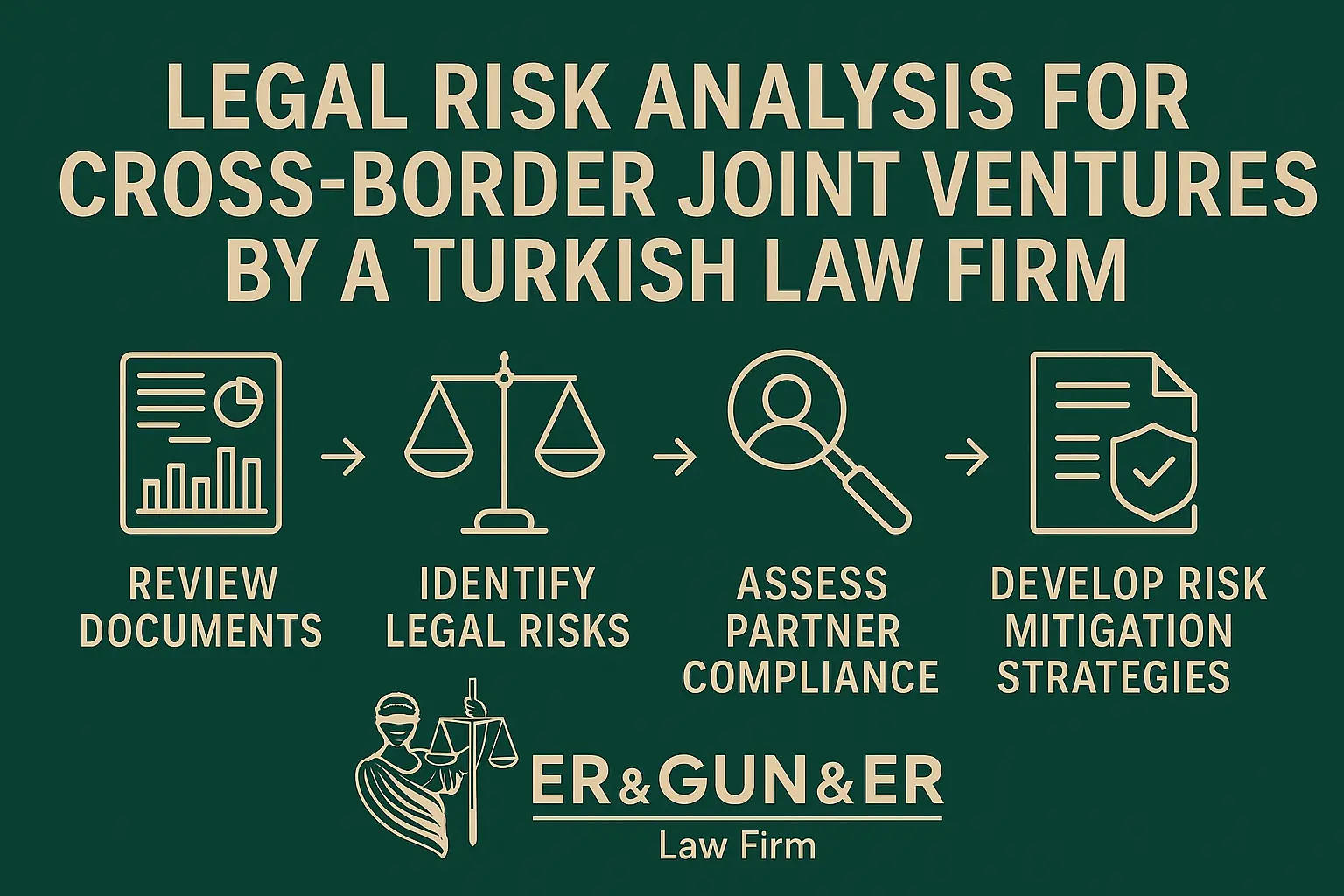
Cross-border joint venture risk analysis for Turkey operates within an integrated legal framework spanning company law, competition law, sectoral regulation, tax, intellectual property, and dispute resolution. The foundational framework derives from the Turkish Commercial Code No. 6102 (TTK — Türk Ticaret Kanunu) of 2011, with Articles 329-563 governing joint-stock companies (anonim şirket — A.Ş.) and Articles 573-644 governing limited liability companies (limited şirket — Ltd.Şti.), the two corporate forms most frequently used for Turkish JVs. Foreign investor rights operate under Foreign Direct Investment Law No. 4875 of 2003, which established national treatment and eliminated general pre-approval for most sectors while preserving sector-specific restrictions and reporting obligations through the Electronic Incentive Implementation and Foreign Investment Information System (E-TUYS). Competition Law No. 4054 with Communique No. 2010/4 sets the merger and acquisition notification framework through the Competition Board (Rekabet Kurulu), and Block Exemption Communique 2002/2 governs vertical agreements. Sectoral regulation adds further layers under Capital Markets Law No. 6362 (SPK/CMB), Banking Law No. 5411 (BDDK/BRSA), Radio and Television Law No. 6112 (RTÜK), Energy Market Regulatory Authority (EPDK), and other sectoral regulators. KVKK Law No. 6698 as updated through Law No. 7499 of March 2024 governs personal data protection. Dispute resolution operates through MÖHUK No. 5718 private international law framework, International Arbitration Law No. 4686, the Istanbul Arbitration Centre (ISTAC, established 2015), and the New York Convention 1958. TTK Article 5/A and Law No. 7155 of 2018 establish mandatory mediation for specific commercial disputes. Practice may vary by authority and year, and JV risk analysis benefits from integrated legal architecture because the framework layers require coordinated design. A lawyer in Turkey coordinating cross-border JV architecture establishes the foundation for durable partnerships.
Due diligence and partner screening
A Turkish Law Firm conducting due diligence on a prospective Turkish JV partner begins with entity-level verification. The Trade Registry Gazette (Türkiye Ticaret Sicili Gazetesi) confirms the entity's existence, registered address, share capital and paid-in capital, articles of association (esas sözleşme), authorized signatories, and history of material corporate actions. Cross-checking the signatories who will execute the JV documents against the most recent signature circular (imza sirküleri) is a standard step that foreign counterparties frequently skip; a signature mismatch at this stage is a recurring procedural defect. Beneficial ownership analysis under MASAK Law No. 5549 and its UBO identification framework goes beyond the direct shareholder level — where the partner sits within a holding or family group, the ultimate beneficial owner chain, cross-shareholdings, and affiliated-entity relationships all affect the true counterparty being engaged. Financial condition verification draws on audited financial statements where available, independent financial advisor review for material investments, trade references from key customers and suppliers, and, where proportionate, engagement of a commercial investigation firm for deeper scrutiny. Regulatory compliance history — Competition Board decisions, SPK or BDDK enforcement, tax authority disclosures — rounds out the profile.
Turkish lawyers who address litigation and enforcement history work through several public and quasi-public databases. UYAP (Ulusal Yargı Ağı Projesi — National Judicial Informatics System) allows verified counsel to review case histories filed by or against the entity and its common directors: commercial disputes, contract enforcement actions, employment claims, and administrative challenges produce a pattern picture that is more informative than any single case. Enforcement office (icra dairesi) records reveal outstanding enforcement proceedings against the entity — icra takibi by suppliers, landlords, or lenders is the first external indicator of cash flow strain. Criminal records for directors and key personnel, where relevant and lawfully obtainable, surface issues that do not appear in corporate filings. Arbitration history is harder to verify because arbitral proceedings are typically confidential, but discreet market inquiry in the partner's industry sometimes produces informal knowledge of unresolved prior disputes. Regulatory enforcement — Competition Board fines, SPK or BDDK enforcement actions, KVKK administrative fines, RTÜK penalties for broadcasters — should be compiled and analyzed. Media and reputation analysis, including both mainstream business press and industry publications, adds context that formal records alone do not provide. For framework on due diligence methodology applied to real estate contexts, readers can consult our real estate due diligence guide for foreigners. Practice may vary by authority and year, and litigation and enforcement analysis benefits from systematic investigation because historical patterns materially affect future partnership reliability.
An English speaking lawyer in Turkey coordinating strategic and operational alignment analysis works beyond surface compliance to evaluate partnership viability. Business strategy alignment examines product and service overlap, geographic market compatibility, customer base relationships, and technology compatibility — misalignment here rarely appears in formal records but frequently predicts operational friction. Operational capacity assessment covers production capacity, technical capability, quality management systems, and management depth, all of which affect the JV's ability to meet its business plan without unplanned capital injections or operational intervention. Cultural and management-style compatibility is particularly important in cross-border contexts: decision-making pace, hierarchy expectations, risk tolerance, communication norms, and conflict-handling style differ materially between jurisdictions and, within Turkey, between traditional family businesses, professionalized mid-market companies, and multinational-culture institutions. Prior partnership history — the way the candidate has handled earlier JV relationships, dissolutions, and conflicts — is one of the strongest predictive indicators. Reference checks through prior business partners, prior advisors, or prior senior employees of the candidate's management provide information not available in public records. Conflict-of-interest analysis examines the candidate's other business interests and identifies situations where the candidate's parallel activities could compete with, draw resources from, or otherwise undermine the JV. Practice may vary by authority and year, and alignment analysis benefits from qualitative integration with quantitative due diligence because partnership failure frequently originates in alignment gaps rather than formal compliance failures.
Structuring JV under TTK 6102
A lawyer in Turkey coordinating JV structural choice works through the A.Ş. versus Ltd.Şti. selection and the hybrid variants that exist for specific configurations. The joint-stock company (A.Ş.) under TTK Articles 329-563 is the standard form for larger JVs: it can be formed with a single founder since the 2012 TTK reform (the old three-founder minimum of TTK No. 6762 was abolished), uses a board of directors structure, allows differentiated share classes under TTK Articles 478-480, and supports public offering through SPK-regulated capital markets access. The minimum capital threshold for non-public A.Ş. was increased to 250,000 TL effective 1 January 2024 through Presidential Decree, subject to any subsequent regulatory adjustment. The limited liability company (Ltd.Şti.) under TTK Articles 573-644 is frequently used for smaller or mid-sized JVs: it uses a manager (müdür) structure rather than a board, the minimum capital was increased to 50,000 TL in the same January 2024 update, and share transfers require general assembly approval unlike the freely transferable shares of a non-public A.Ş. Selection factors include planned business scale, capital market access plans, governance flexibility needs, expected frequency of share transfers, and tax considerations. The articles of association (esas sözleşme for A.Ş., şirket sözleşmesi for Ltd.Şti.) establish the public corporate foundation; the shareholder agreement (pay sahipleri sözleşmesi) supplements it with the bilateral arrangements between partners that go beyond what the articles can or should contain.
A Turkish Law Firm working through capital contribution architecture addresses both the initial formation and the subsequent capital mechanics that shape partner relationships. Cash contributions require deposit into a blocked bank account before Trade Registry registration, with the deposit confirmation forming part of the registration file. In-kind contributions (ayni sermaye) — real estate, IP, machinery, shares in other companies — require independent expert appraisal by court-appointed experts (mahkeme tarafından atanan bilirkişi) under TTK framework, and the resulting valuation report binds the founders. Undervaluation or overvaluation exposes founders to later liability, so the appraisal is genuine rather than nominal. For A.Ş., at least 25% of the subscribed capital must be paid in at formation, with the balance payable within 24 months of registration; for Ltd.Şti., the full subscribed capital must be paid in at formation. Subsequent capital increases proceed through general assembly resolution with the majorities TTK requires, with existing shareholders holding pre-emption rights (rüçhan hakkı) under TTK Article 461 to maintain their proportional ownership unless the general assembly validly waives the right by supermajority. Capital call mechanics in the shareholder agreement specify the triggering events, pro rata allocation among partners, default consequences including dilution of the defaulting partner, and protective mechanisms for the compliant partner who funds more than its share. Share class differentiation under TTK Articles 478-480 permits preferred voting rights, preferred dividend rights, and other differentiated economic or governance rights, subject to the fairness limits that protect minority shareholders from oppressive preferences. For framework on foreign investor company law, readers can consult our foreign investor company law guide. Practice may vary by authority and year, and capital architecture benefits from careful design because capital disputes are among the most common JV conflict sources.
An Istanbul Law Firm coordinating governance foundation within the articles and the shareholder agreement works through the framework that establishes the decision-making architecture at inception. For an A.Ş., the board of directors under TTK Articles 359-375 exercises management authority: board composition, independent director considerations for public companies, director nomination rights typically allocated between partners in the shareholder agreement, meeting frequency, quorum, and term limits are all foundational choices. The manager structure for Ltd.Şti. under TTK Articles 623-630 serves the analogous function with typically simpler architecture. The general assembly (genel kurul) under TTK Articles 408-452 for A.Ş. and 616-622 for Ltd.Şti. addresses ordinary business — annual financial statement approval, director elections, dividend decisions, auditor appointment — and extraordinary matters including articles amendments, capital changes, mergers, spin-offs, and transformation or liquidation decisions. Reserved matters in the shareholder agreement, requiring enhanced majorities beyond simple majority, typically cover articles amendments, share class rights modifications, annual budget and business plan approval, capital raises and material debt, acquisitions and divestitures above specified thresholds, material related-party transactions, senior management appointments and terminations, and dissolution or liquidation. Director duties under TTK Articles 369-375 include duty of care and duty of loyalty; the competition prohibition under TTK Article 395 restricts directors from competing activities; and director liability under TTK Articles 553-558 exposes directors to fault-based liability toward the company, shareholders, and creditors. Practice may vary by authority and year, and governance foundation benefits from careful architectural design because foundational governance provisions are difficult to modify later without full partner consensus.
Regulatory compliance and sectoral oversight
A Turkish Law Firm coordinating FDI compliance under Law No. 4875 of 2003 works through a framework that is substantially more open than the pre-2003 regime but retains sector-specific restrictions. The national treatment principle means that foreign investors receive treatment equivalent to Turkish investors for most activities: company formation, share acquisition, branch establishment, and liaison office establishment for non-commercial activities are generally available without pre-approval. Sectoral restrictions persist in defined areas: defense and dual-use sectors require approvals up to the Presidential level; broadcasting under RTÜK imposes foreign ownership caps; banking under BDDK requires specific approvals for bank formation or acquisition of qualifying holdings; aviation and maritime activities require sectoral licensing; mining and energy operate under separate regulatory frameworks. Reporting obligations under Law 4875's secondary regulation require foreign investors to report through E-TUYS (Elektronik Teşvik Uygulama ve Yabancı Sermaye Bilgi Sistemi — Electronic Incentive Implementation and Foreign Investment Information System) for specified corporate events, including share transfers involving foreign investors, capital changes, and other reportable actions. Bilateral investment treaty (BIT) coverage — where the foreign investor's home state has a BIT with Turkey — provides substantive protections (fair and equitable treatment, protection from uncompensated expropriation) and procedural access to investor-state dispute settlement (typically ICSID arbitration under the Washington Convention or UNCITRAL arbitration depending on the specific BIT). Practice may vary by authority and year, and FDI compliance benefits from early sectoral analysis because sector-specific restrictions can require structural adjustments that are best identified before commitments are made.
Turkish lawyers who address Competition Law compliance in JV formation work through Law No. 4054 of 1994 and its implementing communiques. Merger control under Article 7 and Communique No. 2010/4 on Mergers and Acquisitions Subject to Approval of the Competition Board requires pre-closing notification for transactions meeting the turnover thresholds, which are adjusted periodically and must be verified at the transaction date. The JV-specific question is characterization: a JV that will operate as a "full-function" undertaking — performing on a lasting basis all the functions of an autonomous economic entity — is treated as a concentration subject to merger control, while a non-full-function JV may fall outside merger control and instead require analysis under Article 4 restrictive agreements. Notification requires submission of a detailed Form including transaction description, party information, affected market analysis, and competition effect assessment. Phase I review runs for thirty days with possible extensions; Phase II review applies to transactions raising competition concerns and extends the timeline materially. Substantive assessment applies the Significant Impediment of Effective Competition (SIEC) test. Where competition concerns are identified, the Competition Board can require remedies — divestitures, behavioral commitments, structural undertakings — as a condition of clearance. Block Exemption Communique 2002/2 on Vertical Agreements provides safe harbor for vertical agreements that meet the market-share and conduct conditions, relevant for JV supply, distribution, and licensing arrangements. Notification failure can produce administrative fines and transaction voidability, so the analysis should precede signing rather than follow closing. Practice may vary by authority and year, and competition compliance benefits from early analysis because threshold issues and characterization questions shape transaction timing and structure.
An English speaking lawyer in Turkey coordinating sectoral regulatory compliance addresses the framework that adds industry-specific layers beyond the general corporate and competition rules. Capital Markets Law No. 6362 applies to activities including public offering, investment services, asset management, mutual funds, and, since Law No. 7518 of 2 July 2024, crypto asset service providers — JVs in these activities require SPK licensing and face ongoing supervisory obligations. Banking Law No. 5411 governs banks, payment service providers, electronic money institutions, and other financial institutions under BDDK oversight; foreign bank acquisitions, qualifying holding acquisitions, and cross-border financial JVs face specific approval and ongoing supervision. Radio and Television Law No. 6112 regulates broadcasting through RTÜK with foreign ownership restrictions that can require careful structuring. Energy sector JVs operate under EPDK (Energy Market Regulatory Authority) framework across electricity, natural gas, petroleum, and LPG segments. Telecommunications operates under BTK (Information and Communication Technologies Authority). Civil aviation operates under SHGM (Directorate General of Civil Aviation). Data protection compliance under KVKK No. 6698 as updated by Law No. 7499 of March 2024 — which introduced the three-tier lawful cross-border transfer framework under Article 9 — affects any JV processing personal data, which in practice is nearly all JVs. For framework on KVKK audit defense covering data protection compliance, readers can consult our KVKK audit defense guide. Practice may vary by authority and year, and sectoral compliance benefits from early sectoral mapping because late discovery of a regulatory requirement can add months to the timeline.
Governance and shareholder rights
A lawyer in Turkey coordinating governance architecture beyond the articles of association works through the shareholder agreement that provides the real partner-level protections. Reserved matters define decisions requiring enhanced majority or unanimous consent — typically covering articles amendments, share class rights modifications, annual budget and business plan approval, capital raises and material debt, acquisitions and divestitures above specified thresholds, material related-party transactions, senior management appointments and terminations, and dissolution or liquidation. The scope of the reserved matters list is where partner negotiation concentrates: a broader list gives more protection to the minority partner but also more potential for deadlock; a narrower list gives the majority more operational control but reduces minority comfort. Deadlock resolution mechanisms provide structured pathways when partners cannot agree on reserved matters: good-faith negotiation at the operational level, escalation to senior executive level, independent-expert referral for technical matters, mediation (including under Law 7155 mandatory framework where applicable), and, as a final resort, buy-sell mechanisms such as Russian roulette (one partner sets a price, the other chooses to buy or sell at that price), Texas shoot-out (both partners submit sealed bids, the higher bidder buys), or pre-agreed put/call options at defined valuations. Each mechanism has its own risk-allocation profile, and the selection should reflect the partners' relative financial capacity and strategic commitment. For framework on shareholder agreement drafting, readers can consult our shareholder agreement guide. Practice may vary by authority and year, and governance architecture benefits from upfront anticipation of conflict scenarios because retrofitting governance provisions after disputes emerge is substantially harder than designing them at formation.
Turkish lawyers who address statutory minority protections under TTK work through the framework that operates independently of the shareholder agreement. Information rights under TTK include the annual report access under Article 437, the special audit (özel denetim) right under Articles 438-440 available to minority shareholders holding at least 10% (5% in public A.Ş.) when specific conditions are met, the general assembly call right under Article 411 available to minority shareholders meeting the statutory threshold, and the agenda supplementation right under Article 412. Approval rights for fundamental decisions include the qualified majority requirements under Article 421 for articles amendments (typically two-thirds of the represented capital), enhanced approvals for capital reductions, and supermajority requirements for mergers, spin-offs, and transformations under TTK Articles 134-190. Pre-emption rights on capital increases under TTK Article 461 protect existing shareholders against dilution; waiver of pre-emption requires a supermajority decision with a substantive business justification. Director liability actions under TTK Articles 553-558 allow shareholders to pursue directors who caused damage through fault; derivative actions on the company's behalf are available in specific configurations. General assembly resolution annulment under TTK Article 445 addresses procedurally or substantively defective resolutions. The exit right (çıkma hakkı) is more limited in non-public A.Ş. than the US "dissenters' rights" model but is available in defined triggering events. Practice may vary by authority and year, and minority protection analysis benefits from coordinated statutory and contractual mapping because the combined framework provides broader protection than either layer alone.
An Istanbul Law Firm coordinating transfer restrictions and exit mechanisms addresses the framework that governs partner exits and third-party entries over the JV lifecycle. Right of first refusal (ROFR) gives the remaining partner the opportunity to match a bona fide third-party offer before the transferring partner completes the external sale; right of first offer (ROFO) requires the transferring partner to offer the stake internally first before soliciting external interest. Lock-up periods restrict transfers during the initial JV phase when both partners' continued commitment is most important. Permitted transfer exceptions for intra-group transfers (to affiliates) and other defined scenarios give the partners flexibility to reorganize their holdings without triggering ROFR or ROFO. Drag-along rights permit the majority to compel minority participation in a third-party sale on the same terms, subject to minimum-price protections and pro rata treatment. Tag-along rights give the minority a corresponding right to participate in a majority sale on equivalent terms, preventing the majority from exiting while leaving the minority locked in with an unknown new partner. Put and call options structured with defined triggering events, valuation methodologies, pricing schedules, and payment terms create exit certainty for specified scenarios. Change-of-control provisions adjust partner rights when an upstream change affects one of the partners. Trade Registry registration of transfer restrictions affects third-party enforceability, so the mechanical side of recording the provisions matters as much as the drafting. Practice may vary by authority and year, and transfer-framework design benefits from careful drafting because transfer disputes are common JV lifecycle events.
Financial risk, tax structuring, and FX
A Turkish Law Firm coordinating tax-efficient JV structuring addresses the framework that materially affects JV economics from formation through exit. Corporate income tax under Law No. 5520 applies to the JV entity's profits at the applicable corporate rate, which has been subject to periodic adjustment; sector-specific rates apply to qualifying activities, and reduced rates apply for investment-incentive qualifying operations. Investment incentive certificates issued by the Ministry of Industry and Technology provide VAT exemption, customs duty exemption, interest support, land allocation, and corporate tax reductions for qualifying investments classified into regional and strategic categories. Technology development zones (teknopark), free zones (serbest bölge), industrial zones, and R&D centers provide additional tax benefits for qualifying activities. Dividend withholding tax under Income Tax Law No. 193 Article 94 applies to distributions to foreign shareholders, subject to reductions under double taxation treaties — Turkey's treaty network covers more than 85 jurisdictions, and proper treaty application frequently reduces the effective withholding to a small fraction of the statutory rate. Transfer pricing compliance under Corporate Tax Law Article 13 requires arm's length pricing for related-party transactions, with documentation obligations including country-by-country reporting for multinational groups above the applicable threshold. VAT under Law No. 3065 applies at the standard rate (currently 20%) with reduced rates for qualifying categories and exemptions for exports and specific other activities. For framework on tax advantages for foreigners, readers can consult our tax advantages for foreigners guide. Practice may vary by authority and year, and tax structuring benefits from early coordination with tax counsel because decisions at formation shape the tax outcome at every subsequent lifecycle event.
Turkish lawyers who address foreign exchange compliance work through Decision No. 32 on Protection of the Value of Turkish Currency, which has been materially tightened since September 2018. Decision 32 restricts foreign currency denomination of contracts between Turkish residents in several categories: real estate sale and lease contracts, employment contracts for Turkish-resident employees working in Turkey, and certain service and work contracts generally must be denominated in Turkish Lira, with defined exceptions. Cross-border payments are subject to documentation requirements and, for specific categories, reporting through authorized banks. Foreign currency borrowing by Turkish residents is restricted, with exceptions for entities with qualifying foreign currency revenue (primarily exporters), for specified financial institutions, and for other defined categories. Foreign investor inflows benefit from specific treatment under Decision 32 — conversion of incoming foreign currency through authorized Turkish banks is a standard step that generates the documentation later needed for dividend repatriation, capital reduction return, or exit proceeds. Central Bank of the Republic of Turkey (CBRT) oversight operates through the authorized bank network, which implements the controls at the transactional level. Amendments to Decision 32 occur periodically and can materially affect JV operations; for example, the 2018 amendments produced a wave of required contract renegotiations to move from foreign currency denomination to Turkish Lira. Practice may vary by authority and year, and FX compliance benefits from ongoing monitoring because policy adjustments directly affect JV contract design, cash flow patterns, and capital movement.
An English speaking lawyer in Turkey coordinating financing architecture works through the capital structure options and their interaction with tax and regulatory frameworks. Equity financing from JV partners is the foundational layer, with subsequent rounds using either additional equity subscriptions or convertible instruments that provide flexibility on timing and valuation. Debt financing options include Turkish bank loans, international bank loans subject to FX-regulation compliance, bond issuance for qualifying entities, and shareholder loans. Shareholder loans carry a specific risk under the thin capitalization rule in Corporate Tax Law Article 12: related-party debt exceeding a 3:1 debt-to-equity ratio with the same related party produces disallowance of the interest deduction on the excess and recharacterization as a deemed dividend, with corresponding withholding tax consequences. JV shareholder loan planning must respect this ratio, and concentration of debt from a single related party above the threshold is a common tax-planning error. Mezzanine financing combining debt and equity features supports growth-stage JVs where pure debt is too conservative and pure equity dilutes too aggressively. Investment incentive programs add a further dimension — JVs in qualifying regional or strategic categories can access material tax and financial support through the Ministry of Industry and Technology framework. Foreign exchange hedging through forward contracts, options, and swaps is important for multi-currency JV operations where revenue and cost are denominated in different currencies. Practice may vary by authority and year, and financing architecture benefits from integrated legal-tax coordination because decisions about capital structure affect tax outcomes, regulatory compliance, and future flexibility in ways that do not always align.
IP and confidentiality
A lawyer in Turkey coordinating IP architecture for JVs works through the framework that defines ownership, licensing, and protection across the JV lifecycle. Industrial Property Law No. 6769 (SMK) governs trademarks (Articles 4-32 across Nice Classification classes), patents (Articles 82-156), utility models (Articles 142-149 for lower-inventive-step innovations), industrial designs (Articles 55-81), and geographical indications. Registration and examination proceed through the Turkish Patent and Trademark Office (TÜRKPATENT). Copyright under FSEK No. 5846 protects literary, musical, artistic, cinematographic, and software works automatically from creation, without registration requirement, but with voluntary registration available for evidentiary purposes through the Ministry of Culture and Tourism. JV IP contribution architecture addresses a sequence of distinct decisions: which pre-existing IP each partner brings, whether the partner licenses the IP to the JV or assigns it to the JV, what happens to the licensed or assigned IP on JV dissolution, and how JV-generated IP (created during operations) is owned and used going forward. Licensing typically preserves partner ownership while giving the JV operational rights; assignment transfers ownership outright and is more common where the IP is tightly tied to the JV's specific business. JV-generated IP default rules differ under contract, employment, and commissioned-work frameworks, and the shareholder agreement should expressly address ownership to avoid later disputes about who owns what was created during the partnership. Licensing terms between partners and the JV — scope, field of use, geographic coverage, duration, royalty or fee structure, sublicensing rights — are the economic allocation of the IP value and should be priced at arm's length for transfer-pricing purposes. For framework on intellectual property licensing, readers can consult our intellectual property licensing guide. Practice may vary by authority and year, and IP architecture benefits from early comprehensive planning because post-formation IP disputes are among the most damaging JV conflicts.
A Turkish Law Firm addressing confidentiality and trade secret protection works through the overlapping legal frameworks that protect non-public JV information. Trade secret protection draws on TTK unfair competition provisions under Articles 54-63, which prohibit specific forms of misappropriation of commercial information, on employment law loyalty duties under the Labour Code No. 4857, and on general tort principles under TBK Article 49 and following for intentional or negligent harm. Non-disclosure agreements (NDAs) with partners, employees, contractors, and consultants define the protected information, the permitted uses, the duration of the obligation (often extending beyond the immediate engagement), and the remedies for breach including liquidated damages where legally sustainable. Employment confidentiality provisions, including post-employment non-competition clauses subject to Labour Code Article 444 limits on scope, duration, geography, and compensation requirement, and invention assignment clauses addressing employee-created IP under FSEK and SMK rules, are the operational layer that complements the partner-level NDAs. Practical information security controls — access permissioning, encryption at rest and in transit, audit trails, physical security for documented material — convert contractual protection into effective protection. IP due diligence on incoming partners is also part of this architecture: verifying that the partner actually owns what it purports to contribute, that there is no third-party freedom-to-operate issue, and that the partner has not infringed third-party IP in ways that could be imputed to the JV. Practice may vary by authority and year, and confidentiality architecture benefits from layered protection because single-layer protection — agreements alone or technology controls alone — proves insufficient in practice.
An Istanbul Law Firm coordinating IP enforcement architecture addresses the framework that supports rights protection when infringement occurs. The specialized IP Courts (Fikri ve Sınai Haklar Hukuk Mahkemeleri for civil matters and Fikri ve Sınai Haklar Ceza Mahkemeleri for criminal matters), located in major commercial centers including Istanbul, Ankara, and Izmir, provide subject-matter-expert adjudication with streamlined procedures for IP disputes. Civil enforcement remedies include infringement damages, interim injunctive relief (ihtiyati tedbir) under HMK Articles 389-399 and SMK Article 159 where interim protection is needed before final judgment, permanent injunctions, destruction orders for infringing goods, and account of profits. Interim injunctive relief is particularly valuable because IP harm accumulates rapidly, and the standard conditions — prima facie case demonstration, risk of irreparable or substantial harm, and, in many cases, bond posting — are achievable where the rights holder prepares properly. Criminal enforcement through the IP Ceza Mahkemesi addresses trademark counterfeiting, copyright piracy, and qualifying patent infringement with custodial and monetary penalties. Customs enforcement under SMK Articles 166-169 and FSEK Articles 77-78 permits rights-holder registration with Turkish Customs, which can then detain suspected infringing imports and initiate the seizure and destruction process. Domain name disputes involving .tr domains proceed through designated dispute resolution providers. International IP coordination through the Madrid System (trademarks), the Patent Cooperation Treaty (PCT), the Hague Agreement (designs), and the Berne Convention (copyright) supports cross-border protection for JV IP. Practice may vary by authority and year, and IP enforcement benefits from early registration and systematic monitoring because infringement discovery requires active detection capability.
Exit planning and dispute resolution
A Turkish Law Firm coordinating JV exit architecture works through the pathway options that provide flexibility across the lifecycle. Strategic sale to a third-party acquirer is the most common exit: it can be implemented through drag-along coordinated with tag-along to produce a unified outcome, or through a secondary sale from one partner to the other (typically the partner with long-term strategic commitment buying out the financial-partner). Initial public offering (IPO) is available where the JV has reached sufficient scale and SPK public-offering requirements can be met — prospectus preparation, corporate governance upgrades, ongoing disclosure, and the substantial cost and timeline of the offering process. Liquidation with asset distribution to partners pro rata or per the shareholder agreement formula is the baseline alternative when neither strategic sale nor IPO is viable, with the TTK liquidation framework under Articles 529-548 governing the process. Management buyout (MBO) is used where the operational management has the capability and financing to take ownership from the current financial partners. Unplanned exit triggers — partner default under the shareholder agreement, material adverse change, regulatory impossibility, prolonged force majeure — activate contractual exit mechanisms that should be designed at formation rather than improvised during crisis. Valuation methodology matters substantially: book value is simplest but can significantly under- or over-value depending on asset composition; fair market value through independent appraisal produces the most defensible figure; discounted cash flow captures expected future performance; comparable transaction multiples anchor to market evidence; formulaic valuations (multiples of EBITDA or revenue) are fast but rigid. Payment structures — upfront cash, installments, earnouts, holdbacks for representations and warranties claims — allocate post-closing risk. Post-exit obligations — non-competition, non-solicitation, continuing confidentiality, transition services — complete the clean separation. Practice may vary by authority and year, and exit architecture benefits from early planning because exit conflicts frequently originate in inadequate upfront preparation.
Turkish lawyers who address dispute resolution architecture for cross-border JVs work through the framework that combines Turkish and international dispute resolution options. Choice of law under MÖHUK No. 5718 Article 24 generally respects party autonomy in contract matters, subject to Turkish mandatory rules and the public policy limits of MÖHUK Article 5. For the JV agreement itself — shareholder agreement, governance arrangements, dispute resolution clauses — a choice of foreign law is generally recognized, though matters governed by TTK mandatory rules (corporate governance, shareholder rights, director duties, insolvency rules) will apply regardless. Court-based dispute resolution uses either Turkish courts (with jurisdiction typically based on the JV's seat, the defendant's domicile, or specific contract provisions) or foreign courts; foreign judgments require recognition and enforcement in Turkey through MÖHUK Articles 50-58 tenfiz procedure, which requires reciprocity and does not review the foreign judgment on the merits. International arbitration under Arbitration Law No. 4686 is the preferred mechanism for cross-border JV disputes because the New York Convention 1958 — to which Turkey is party — provides recognition of foreign arbitral awards across 170+ contracting states on limited challenge grounds. Institutional options include ISTAC (Istanbul Arbitration Centre, established 2015) as the Turkish-seated institution with modernized rules and English-language proceedings, and international institutions — ICC in Paris, LCIA in London, SIAC in Singapore, HKIAC in Hong Kong — each with distinct rules and administrative characteristics. Ad hoc arbitration under UNCITRAL Rules is available where party flexibility is preferred over institutional administration. Arbitration clause drafting addresses seat, governing institutional rules, substantive law, language, arbitrator number, and appointment method; poor drafting here is a frequent source of enforceability challenges later. For framework on arbitration clause drafting, readers can consult our arbitration clause drafting guide. Practice may vary by authority and year, and dispute resolution architecture benefits from upfront drafting discipline because forum and governing law arguments after dispute emerges are substantially more difficult to structure than before.
An English speaking lawyer in Turkey coordinating mandatory mediation and pre-litigation procedures addresses the framework that requires specific procedural steps before specified court filings. TTK Article 5/A (added by Law No. 7155 of 2018) establishes mandatory mediation for specific commercial monetary disputes, requiring mediation completion as a procedural precondition to court filing. The mediator (arabulucu) must be registered with the Ministry of Justice, and the mediation proceeds on a compressed timeline — typically three to four weeks from application. The outcome possibilities are agreement (anlaşma) with a binding settlement enforceable as a court judgment, partial agreement leaving remaining issues for litigation, or disagreement (anlaşmazlık) allowing subsequent litigation. The mediation failure report (anlaşmazlık tutanağı) must accompany any subsequent court petition, or the petition is dismissed on procedural grounds. International arbitration is carved out from mandatory mediation for qualifying international disputes — a JV agreement providing for foreign-seated arbitration between parties from different states generally does not face the mediation precondition. Domestic arbitration (Turkish-seated arbitration under Arbitration Law No. 4686) intersects with mandatory mediation in more complex ways depending on the dispute type and party composition. Law No. 7445 of 2023, effective 1 September 2023, expanded mandatory mediation to specific additional categories including certain real estate and tenancy disputes. Practice may vary by authority and year, and procedural compliance with mediation preconditions benefits from early mapping because non-compliance forecloses the court pathway until the defect is cured.
Post-formation crisis management, compliance monitoring, and strategic evolution
A lawyer in Turkey coordinating post-formation JV management works through the framework that sustains legal integrity across the operational lifecycle. Ongoing compliance monitoring spans several dimensions that do not coincide with a single internal function: corporate governance compliance (Trade Registry notifications for share transfers, capital changes, director changes, articles amendments; general assembly meeting scheduling and minutes preparation; mandatory independent audit for qualifying A.Ş. companies); tax compliance (corporate tax quarterly provisional payments and annual return, VAT monthly returns, withholding tax on dividends, interest, and service payments to non-residents, transfer pricing documentation); employment compliance (payroll tax, SGK contributions, labor law observance including working time and leave records); data protection compliance (KVKK registry, data subject request handling, cross-border transfer compliance under the Law 7499 three-tier framework). Periodic compliance reviews at a defined cadence — quarterly for material areas, semi-annual or annual for lower-risk areas — with documented outputs, identified gaps, and board-level reporting create a structured compliance process that is auditable and defensible if issues arise. Regulatory change monitoring — TTK amendments, tax law updates, Competition Law guideline changes, sectoral regulation updates, KVKK developments — should be integrated into the compliance cycle, because Turkish regulatory change pace in several areas (tax, FX, data protection, capital markets) is high enough that a static compliance program drifts out of date quickly. For framework on contract law for foreign companies, readers can consult our contract law guide for foreign companies. Practice may vary by authority and year, and post-formation compliance benefits from structured calendar and clear responsibility allocation because compliance failures typically originate in calendar gaps or responsibility ambiguity rather than in substantive legal misunderstanding.
Turkish lawyers who address JV crisis management work through the framework that responds to operational, governance, regulatory, or financial crises. Crisis categorization is the first step: governance deadlock where partners cannot reach required decisions is different from financial distress approaching insolvency, and both are different from a regulatory enforcement crisis triggered by an investigation or sanction. Immediate response architecture involves identification of the crisis, internal escalation to the appropriate decision-makers, external advisor engagement (legal, financial, sometimes communications), stakeholder communication management (partners, lenders, key customers, employees), regulatory notification where required (MASAK STR, KVKK breach notification under the 72-hour framework, SPK or BDDK notifications depending on sector), and legal position preservation through careful documentation and privilege management. Resolution pathways depend on crisis type: negotiated resolution between partners with independent facilitator support is often the least destructive; judicial or arbitral resolution becomes necessary when negotiation fails; regulatory resolution requires coordinated response to authority requirements; partner separation through buy-sell mechanisms or court-ordered dissolution addresses situations where continued partnership is not viable; liquidation is the final option. Documentation preservation during active crises — systematic record retention, legal privilege protection, communication documentation, evidence preservation for potential litigation — supports subsequent resolution and is harder to do well in the middle of a crisis than before. Practice may vary by authority and year, and crisis management benefits from pre-crisis preparation because improvisation under time pressure produces substantially worse outcomes than executing a previously-designed response.
An Istanbul Law Firm coordinating strategic evolution addresses the framework that supports JV adaptation over time. Expansion — geographic into new Turkish regions or international markets, product or service line additions, vertical integration upstream or downstream, horizontal integration through complementary business acquisition — requires analysis across structural, regulatory, and tax dimensions. Restructuring pathways include capital restructuring (equity and debt recomposition), corporate restructuring through spin-offs (bölünme) under TTK Articles 159-179, mergers under TTK Articles 134-158, and company transformation (tür değiştirme) under TTK Articles 180-190. Each of these corporate restructuring routes has specific documentation, approval, and regulatory filing requirements, including Competition Board notification where thresholds are met and Trade Registry registration. Partner evolution — adding new partners through capital increase with new subscription, buying out existing partners through tender or negotiated purchase, dilution through disproportionate capital increase — affects ownership composition and can trigger change-of-control provisions in shareholder agreements and third-party contracts. M&A activity involving the JV — as target, as acquirer, or as seller of assets — requires full transactional discipline including due diligence, structuring, competition notification, tax planning, and post-merger integration. IPO pathway for qualifying JVs adds SPK public offering compliance including prospectus requirements, corporate governance upgrades to meet listed-company standards, and ongoing disclosure obligations. Practice may vary by authority and year, and strategic evolution benefits from integrated legal-commercial planning because evolution decisions affect ownership, tax, regulatory, and operational dimensions simultaneously, and sequencing matters.
Author: Mirkan Topcu is an attorney registered with the Istanbul Bar Association (Istanbul 1st Bar), Bar Registration No: 67874. His practice focuses on cross-border and high-stakes matters where evidence discipline, procedural accuracy, and risk control are decisive, with particular concentration on cross-border joint ventures including Turkish Commercial Code No. 6102 Articles 329-563 A.Ş. framework and Articles 573-644 Ltd.Şti. framework, Articles 359-375 board of directors and duties, Articles 395 competition prohibition, Articles 408-452 general assembly A.Ş. and Articles 616-622 general assembly Ltd.Şti., Articles 411-412 minority meeting and agenda rights, Articles 421 qualified majority, Article 437 annual report access, Articles 438-440 special audit, Article 445 resolution annulment, Article 461 pre-emption rights, Articles 478-480 share class differentiation, Articles 553-558 director liability, Articles 54-63 unfair competition, Article 5/A mandatory mediation, Articles 134-158 mergers, Articles 159-179 spin-offs, Articles 180-190 company transformation, Articles 529-548 liquidation, Foreign Direct Investment Law No. 4875 of 2003 national treatment framework with E-TUYS reporting, Competition Law No. 4054 with Communique No. 2010/4 merger control framework and Block Exemption Communique 2002/2 vertical agreements, Capital Markets Law No. 6362 (SPK/CMB) including Law 7518 of 2 July 2024 crypto asset service provider amendments, Banking Law No. 5411 (BDDK/BRSA), Radio and Television Law No. 6112 (RTÜK), KVKK No. 6698 as updated through Law No. 7499 of March 2024 with Article 9 three-tier cross-border transfer framework, MÖHUK No. 5718 Article 5 public policy, Article 24 contract choice of law, and Articles 50-58 foreign judgment and arbitral award enforcement (tenfiz), International Arbitration Law No. 4686, ISTAC Istanbul Arbitration Centre established 2015, New York Convention 1958, Law No. 7155 of 2018 mandatory mediation for commercial disputes, Law No. 7445 of 2023 expanded mandatory mediation, Industrial Property Law No. 6769 (SMK) covering trademarks, patents, utility models, designs, and geographical indications with TÜRKPATENT registration, Copyright Law No. 5846 (FSEK), Fikri ve Sınai Haklar Hukuk and Ceza Mahkemeleri civil and criminal IP enforcement, Decision No. 32 foreign exchange controls, Corporate Tax Law No. 5520 including Article 12 thin capitalization and Article 13 transfer pricing, VAT Law No. 3065, Income Tax Law No. 193 Article 94 withholding framework, Labour Code No. 4857 including Article 444 post-employment non-competition framework, MASAK Law No. 5549 anti-money laundering and UBO framework, HMK No. 6100 Articles 389-399 provisional measures and SMK Article 159 IP-specific interim relief, and investment incentive framework through the Ministry of Industry and Technology including technology development zones, free zones, and R&D centers.
He advises individuals and companies across Commercial and Corporate Law (including joint ventures, M&A, corporate governance, shareholder disputes, and company restructuring including mergers, spin-offs, and transformations), Foreign Investment, Competition Law, Capital Markets, Banking and Finance, Data Protection and Privacy, Intellectual Property, Arbitration and Dispute Resolution (including ISTAC, ICC, LCIA, SIAC, HKIAC, and UNCITRAL proceedings), International Tax, Enforcement and Insolvency, Foreigners Law, Citizenship and Immigration, Real Estate, Sports Law, Health Law, and Criminal Law. He regularly supports foreign investors on cross-border JV partner due diligence through Trade Registry, UYAP, enforcement, regulatory, and reputational investigation, JV structural architecture under TTK A.Ş. or Ltd.Şti. selection, shareholder agreement drafting and negotiation including reserved matters and deadlock mechanisms, Competition Board merger notification coordination including full-function JV characterization, sectoral regulatory compliance across SPK, BDDK, RTÜK, EPDK, BTK, SHGM, and KVKK, IP ownership and licensing architecture with pre-existing and JV-generated IP allocation, exit planning including put/call options, drag-along and tag-along mechanisms, and buy-sell structures, dispute resolution architecture coordinating Turkish and international arbitration with ISTAC, ICC, and other institutions, mandatory mediation procedural compliance, post-formation compliance monitoring, and crisis management including governance deadlock, regulatory enforcement, and strategic restructuring.
Education: Istanbul University Faculty of Law (2018); Galatasaray University, LL.M. (2022). LinkedIn: Profile. Istanbul Bar Association: Official website.
Frequently asked questions
- What is the primary legal framework for JVs in Turkey? Turkish Commercial Code No. 6102 governs company structures with Articles 329-563 for joint-stock companies (A.Ş.) and Articles 573-644 for limited liability companies (Ltd.Şti.), the two primary JV corporate forms. Sectoral, competition, tax, and dispute resolution frameworks overlay the TTK architecture.
- A.Ş. or Ltd.Şti. — which is better for a JV? A.Ş. suits larger JVs requiring share transfer flexibility, differentiated share classes, and capital markets access; minimum capital was increased to 250,000 TL effective 1 January 2024. Ltd.Şti. suits smaller JVs with simpler manager structure; minimum capital was increased to 50,000 TL on the same date. Both permit single-shareholder formation since the 2012 TTK reform.
- Does Turkey require approval for foreign JV partners? Foreign Direct Investment Law No. 4875 of 2003 established national treatment, eliminating general pre-approval for most sectors. Sectoral restrictions remain in defense, broadcasting, banking, aviation, mining, and specific other sectors. E-TUYS reporting applies to qualifying corporate events.
- When does a JV require Competition Board notification? Competition Law No. 4054 with Communique No. 2010/4 requires pre-closing notification when the turnover thresholds are met and the JV qualifies as a concentration under Article 7. Full-function JVs (operating autonomously in the market) are treated as concentrations; non-full-function JVs may instead face Article 4 restrictive agreement analysis.
- What sectoral regulations apply? Capital Markets Law No. 6362 (SPK/CMB) for capital markets activities, Banking Law No. 5411 (BDDK/BRSA) for financial services, Radio and Television Law No. 6112 (RTÜK) for broadcasting, EPDK for energy, BTK for telecommunications, SHGM for civil aviation, and KVKK for personal data add industry-specific licensing and ongoing compliance.
- How should shareholder agreements address reserved matters? Reserved matters typically cover articles amendments, share class modifications, annual budget and business plan approval, capital raises and material debt, acquisitions and divestitures above threshold, material related-party transactions, senior management changes, and dissolution. The scope should match the JV partners' sensitivity analysis and their relative commitments.
- What minority protections exist under TTK? Annual report access under Article 437, special audit right under Articles 438-440 for qualifying minority shareholders, general assembly call right under Article 411, agenda supplementation under Article 412, pre-emption rights under Article 461, qualified majority requirements under Article 421, director liability actions under Articles 553-558, and resolution annulment under Article 445.
- How is JV IP treated? Industrial Property Law No. 6769 (SMK) governs trademarks, patents, utility models, designs, and geographical indications through TÜRKPATENT. Copyright Law No. 5846 (FSEK) governs copyright including software. JV agreements should specify pre-existing IP licensing or assignment, JV-generated IP ownership, and post-dissolution IP treatment.
- What are the tax implications of a Turkish JV? Corporate Tax Law No. 5520 applies to JV profits at the applicable corporate rate. Dividend withholding tax under Income Tax Law No. 193 Article 94 applies to foreign shareholder distributions subject to double taxation treaty reductions. Thin capitalization under Corporate Tax Law Article 12 limits related-party debt above 3:1 ratio. VAT under Law No. 3065 applies to qualifying transactions.
- What FX restrictions affect JVs? Decision No. 32 on Protection of the Value of Turkish Currency restricts specific foreign currency denomination between Turkish residents, particularly after September 2018 tightening. Real estate leases, employment contracts, and specified service contracts must generally be in Turkish Lira. Foreign currency borrowing is restricted with exceptions for qualifying exporters and specified categories.
- Which dispute resolution mechanism suits cross-border JVs? International arbitration under Arbitration Law No. 4686 with Turkish or foreign seat is preferred for cross-border disputes because the New York Convention 1958 supports recognition across 170+ states. ISTAC, ICC, LCIA, SIAC, and HKIAC provide institutional options. Court-based dispute resolution is available but faces enforceability complications across borders.
- Does mandatory mediation apply to JV disputes? TTK Article 5/A and Law No. 7155 of 2018 require mediation completion before court filing for specific commercial monetary disputes. International arbitration for qualifying international disputes generally escapes the mediation precondition. Domestic arbitration intersection is dispute-type specific.
- How can deadlocks be resolved? Shareholder agreements typically include good-faith negotiation, senior executive escalation, independent expert referral for technical matters, mediation, and buy-sell mechanisms (Russian roulette, Texas shoot-out, put/call options) providing a progressive resolution framework ending in partner separation if no agreement is reached.
- What exit pathways are available? Strategic sale with drag-along and tag-along coordination, IPO subject to SPK compliance, secondary sale to the other partner through pre-agreed mechanisms, liquidation with distribution under TTK Articles 529-548, and management buyout provide the principal pathways. Valuation methodology (book value, fair market value, DCF, comparable transactions, formulaic) shapes the pricing outcome.
- How does ER&GUN&ER Law Firm structure JV engagements? Engagements begin with integrated pre-formation analysis (partner due diligence, structural architecture, regulatory mapping, tax structuring, IP architecture, dispute resolution design), proceed through company formation, shareholder agreement drafting and negotiation, Competition Board notification, sectoral approvals, and ongoing compliance monitoring, and extend to crisis management and strategic evolution support across the JV lifecycle.