

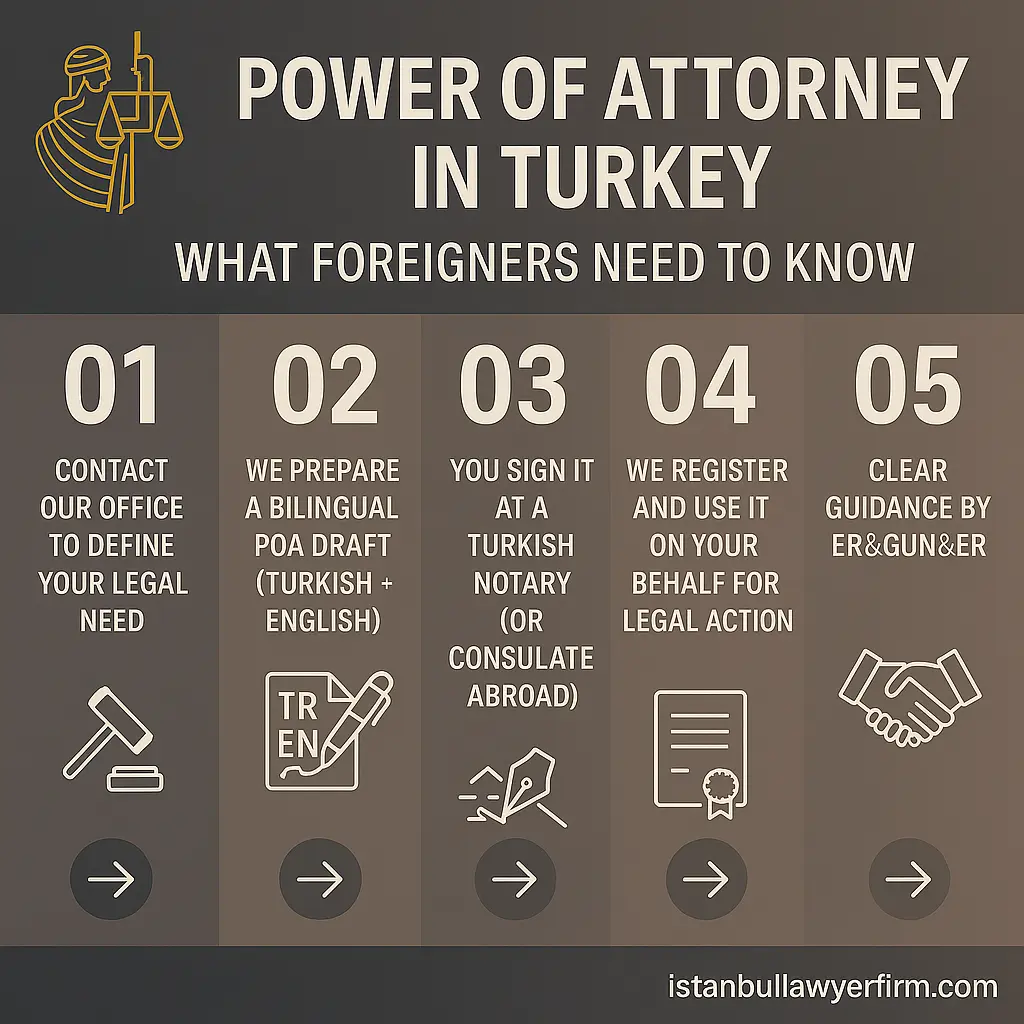
A Turkish power of attorney (vekaletname) is the principal instrument through which foreign nationals authorize Turkish counsel or other agents to perform legal acts in Turkey on their behalf, allowing transactions to proceed remotely without requiring the principal's personal presence at every counter, court hearing or institutional appointment. The framework that governs the document is set primarily by the Türk Borçlar Kanunu (Law No. 6098), which codifies the substantive agency relationship between principal (vekalet veren) and agent (vekil); the Noterlik Kanunu (Law No. 1512), which sets out the formal requirements for notarial execution; the Avukatlık Kanunu (Law No. 1136), which adds specific powers and discipline for vekaletnames issued to attorneys for litigation; and the Hague Apostille Convention together with bilateral consular conventions, which govern the cross-border authentication of foreign-issued instruments for use in Turkey. The discussion below describes how foreign nationals build and use vekaletnames across the principal categories of Turkish legal matters that arise in their files. Practice may vary by authority and year.
An English speaking lawyer in Turkey who handles vekaletname files for foreign clients will tell foreign principals that the document operates as the legal hinge between the principal's intent and the receiving institution's acceptance, and that the document fails wherever the substantive scope, the formal authentication and the institutional acceptance layer fall out of alignment. Foreign clients use vekaletnames across a broad range of matters — property purchases and sales at the Tapu Müdürlüğü, court representation through the Avukatlık Kanunu's litigation powers, Turkish citizenship by investment applications coordinated with the Nüfus ve Vatandaşlık İşleri Genel Müdürlüğü, residence permit and family reunification filings before the Göç İdaresi Müdürlüğü, inheritance proceedings before the Sulh Hukuk Mahkemesi, family-law matters including marriage, divorce and custody, and routine commercial and banking matters — and each category carries its own scope-discipline, authentication-chain and institutional-acceptance specifics. The body of this guide walks through these layers in the order in which foreign-client files are typically built, so that foreign principals can use the material as a working reference rather than as background reading. For the framework on foreign-client lawyer selection that operates alongside the vekaletname mechanics, see the resources on finding a lawyer in Turkey for foreigners and how to hire a lawyer in Turkey; for procedural orientation on the property-specific track, our note on power of attorney for property transactions can be read alongside this material.
1) Vekaletname Framework: Civil and Notarial Foundations for Foreigners
A lawyer in Turkey who maps the vekaletname framework for foreign nationals will start with the substantive agency framework of the Türk Borçlar Kanunu, which establishes the agency relationship as a contract between principal and agent under which the agent undertakes to perform defined legal acts on the principal's behalf. The framework covers the agent's duty of care (özen yükümlülüğü), the agent's duty of loyalty (sadakat yükümlülüğü), the agent's duty to follow the principal's instructions (talimatlara uyma yükümlülüğü), the principal's duty to compensate the agent for permitted expenses, and the rules on the agent's liability for damages caused by acts beyond the granted scope or by violation of the duty of care. The agent's binding authority on third parties extends only as far as the granted scope; acts beyond the scope produce liability of the agent toward the principal and may not bind the principal toward the third party at all. Practice may vary by authority and year.
An Istanbul Law Firm advising on the formal authentication layer will explain that the Noterlik Kanunu superimposes specific execution requirements on vekaletnames intended for use in particular categories of legal matters. Vekaletnames authorizing real estate acts must be executed before a Turkish notary in the form prescribed for that subject matter, with the principal's photograph affixed by the notary at the time of execution; vekaletnames authorizing court representation must include the specific litigation powers required by the Avukatlık Kanunu and the Hukuk Muhakemeleri Kanunu; vekaletnames authorizing inheritance proceedings must include the specific powers required to participate in the inheritance procedure before the competent Sulh Hukuk Mahkemesi or the notary acting under the inheritance regime. The standard approach is to draft the scope language in coordination with the Turkish counsel handling the underlying matter before the notary appointment, because the notary works from standard templates that may not capture the specific transactional needs of foreign-client files.
A Turkish Law Firm coordinating the foreign-client interface will identify three issuance routes for foreign principals: execution at a Turkish notary while the principal is physically present in Turkey (the most direct route, producing a document that does not require apostille, consular legalization or translation); execution at a Turkish consulate abroad while the principal is in their home country, with the consulate acting as the equivalent of a Turkish notary under the Noterlik Kanunu's consular extension provisions (producing a document that proceeds directly into use without separate authentication); and execution before a foreign notary in the principal's country of residence, with subsequent apostille (for Hague Apostille Convention member states) or consular legalization (for non-member states) followed by sworn Turkish translation in Turkey. The procedure ordinarily requires the choice of route to be made early in the engagement, because each route carries its own timing, document-format and operational implications that affect the broader matter's calendar. The Turkish-notary route typically completes within a single half-day appointment when scope language has been pre-drafted, with the executed document available the same business day; the Turkish-consulate-abroad route depends on the consulate's appointment availability and has historically ranged from a few days to several weeks depending on the country and season; the foreign-notary-with-apostille route runs across the longest end-to-end window because it combines the foreign notary's processing time, the issuing-country authority's apostille processing window, the international courier transit, and the Turkish-side translation and certification step. Where the underlying matter has a fixed date — a Tapu transfer scheduled for a specific day, a court hearing notified by the registry, an appointment confirmation from the Göç İdaresi — the route choice should sequence backward from that fixed date with adequate buffer for unforeseen delays. Practice may vary by authority and year, and consulate appointment availability has shown material month-to-month variation across the recent cycle.
2) Issuance Routes: Turkish Notary, Turkish Consulate Abroad, Foreign Notary with Apostille
An English speaking lawyer in Turkey advising foreign principals on the choice of issuance route will weigh three factors: the principal's physical location and travel feasibility, the urgency of the underlying matter, and the principal's preference for documentary simplicity. The Turkish-notary route is the most operationally straightforward where the principal is in Turkey, because it produces a document that proceeds into use immediately without the additional authentication layers that foreign-issued instruments require, and because the notary's identity verification and the principal's photograph affixation occur in real time rather than across a cross-border chain. The Turkish-consulate-abroad route is the second-most operationally straightforward where the principal cannot travel to Turkey, because the consulate executes the document under the same Noterlik Kanunu framework as a Turkish notary, with the resulting document proceeding into use in Turkey without separate apostille or legalization. The foreign-notary-with-apostille route is the most flexible because it can be executed in any country the principal happens to be in, but it carries the longest processing chain and is most exposed to format-mismatch risks at the Turkish receiving end.
Turkish lawyers who run the Turkish-consulate route for foreign principals will identify the operational steps: the principal contacts the relevant Turkish consulate or embassy in their country of residence, schedules a notarial appointment under the consulate's procedures, and attends the appointment with valid identification (passport for foreign nationals, Türk kimlik kartı for Turkish citizens) and any supporting documents the consulate requires. The consulate executes the vekaletname under the same legal framework as a Turkish notary, including the principal's photograph affixation, and issues the document with the consular seal and signature. The procedure ordinarily requires the principal to bring the vekaletname text drafted in advance by Turkish counsel, because consulate staff typically do not draft substantive scope language and because consulate appointments work most efficiently with pre-prepared documents. Practice may vary by authority and year, and Turkish consulate appointment availability has continued to vary by mission and country.
An Istanbul Law Firm supporting the foreign-notary route will draft the vekaletname text and circulate it to the principal in the format the foreign notary will require. The standard approach is to provide the document in Turkish (which the foreign notary executes regardless of the foreign notary's local language, with the foreign notary's role typically limited to verifying the principal's identity and authenticating the principal's signature on a document drafted in advance), or in a parallel-column bilingual format with Turkish in one column and the local language in the other. Some foreign notaries prefer to execute the document in the local language with a separate Turkish translation prepared in Turkey after authentication; others accept Turkish-only documents and limit their role to identity and signature verification. The standard approach is to confirm the foreign notary's preferred format before the appointment, because re-execution after a format mismatch is expensive in cross-border timing. The format-mismatch risks worth anticipating include: the foreign notary's refusal to execute a document drafted in a language the notary cannot review (typical in jurisdictions where notarial practice expects local-language documents); the foreign notary's execution of the document without affixing the principal's photograph (where Turkish receiving institutions later treat the absence as a format defect for property vekaletnames); the foreign notary's certification of the principal's signature without a notarial declaration of identity verification (where Turkish authorities later question the authentication standard); and the issuing authority's apostille placement on a separate sheet rather than physically bound to the notarial document (where Turkish authorities may treat the binding as procedurally non-conforming). Where any of these risks materializes, cure typically requires re-execution rather than supplementary documentation in Turkey, and the cure cycle adds the original timeline to itself. Pre-appointment coordination through Turkish counsel — sending the foreign notary precise format expectations including photograph affixation, identity-verification statement and document binding — typically prevents these mismatches and is materially less costly than cure. The framework for evaluating English-language legal capacity of the Turkish counsel coordinating these cross-border execution chains is analyzed in the resource on English speaking lawyer in Turkey.
3) Authentication Chain: Apostille, Consular Legalization and Sworn Translation
A lawyer in Turkey running the post-execution authentication chain for foreign-notary-issued vekaletnames will guide foreign principals through the apostille or consular legalization step in the country of execution. For principals in countries that are members of the Hague Apostille Convention, the foreign-executed document is authenticated by an apostille issued by the competent authority in the country of execution — typically the foreign ministry, the secretary of state's office, or another designated authority depending on the country — and the apostilled document then proceeds to sworn Turkish translation and notarial certification of the translation in Turkey. For principals in countries that are not members of the Apostille Convention, the foreign-executed document is authenticated through consular legalization, with the document first certified by the relevant authority in the country of execution and then legalized by a Turkish consulate or embassy in that country, before proceeding to sworn translation in Turkey.
An Istanbul Law Firm receiving the apostilled or legalized source document will engage a sworn Turkish translator (yeminli tercüman) and obtain notarial certification of the translation. The procedure ordinarily requires the translator's translation to be physically bound to a copy of the source vekaletname (with the apostille or consular legalization stamp visible in the bound packet), the translator's notarized declaration to be added to the package, and the resulting bound document to be presented at the receiving Turkish institution together with the original apostilled or legalized source document. Where the source document includes apostille text in a foreign language, the translation must include the apostille text translated into Turkish, and the notarial certification covers both the body of the document and the apostille. Where the source document was executed in two or more languages on the same instrument (for example, a parallel-column bilingual format), the translation should reflect the document's structure and the notarial certification should identify the source language whose translation is being certified. Practice may vary by authority and year. The cost of the post-execution authentication chain is itself worth budgeting at the outset of the engagement: the apostille fee in the country of execution (typically a fixed administrative fee that varies by country), the international courier fee for delivery to Turkey (typically charged by the courier provider per shipment), the sworn translator's fee in Turkey (typically charged per page or per character of source text), and the Turkish notary's certification fee for the translation (charged under the official notary tariff). Where the principal is using the vekaletname for a high-stakes matter — a major property acquisition, a complex inheritance file, a citizenship-by-investment application — the cost of the authentication chain is generally a small fraction of the underlying matter's overall cost, and the time saved by avoiding format-mismatch cure cycles is typically the more valuable consideration. Practice may vary by authority and year.
Turkish lawyers who coordinate the cross-border authentication timeline for foreign principals will identify the typical processing windows. The foreign notary execution itself is typically same-day. The apostille step varies by country: in some jurisdictions the apostille is issued same-day at a designated counter, in others it requires postal submission with processing windows of one to four weeks. Consular legalization at a Turkish consulate adds an additional appointment window. International courier delivery to Turkey typically takes three to seven business days. The sworn translation and notarial certification in Turkey typically take one to three business days. The end-to-end chain — foreign notary execution to ready-for-Tapu-or-court use in Turkey — typically takes between two and six weeks depending on the country of origin and the speed of consular services where applicable, and foreign principals planning around urgent matters should sequence the chain accordingly. The country-specific authentication landscape varies materially: in the United Kingdom, apostille is issued by the Foreign, Commonwealth and Development Office's Legalisation Office, with same-day premium service available at the public counter and standard service typically processed within several business days; in the United States, apostille is issued at the state level by the Secretary of State of the state where the notary is commissioned, with timing varying by state from same-day to two weeks; in Germany, apostille is issued by the relevant Land authority with timing generally measured in days; in Russia and other non-Convention or partially-Convention jurisdictions for specific document types, consular legalization through the Turkish consulate may be the operative authentication pathway and timing depends on the consular appointment schedule. Practice may vary by authority and year, and foreign principals should confirm the country-specific authentication pathway before finalizing travel and matter timelines around the resulting document.
4) Property POAs: Tapu Müdürlüğü Mechanics for Foreign Buyers and Sellers
An English speaking lawyer in Turkey advising foreign buyers and sellers on property vekaletnames will explain that real estate matters carry the strictest formal requirements among the categories of foreign-client vekaletname use, because the Tapu Kanunu and the Tapu Sicili Tüzüğü impose specific authentication and content standards that the Tapu Müdürlüğü officer evaluates at the moment of the underlying transaction. The procedure ordinarily requires the vekaletname to include the principal's photograph affixed at execution (whether by Turkish notary, Turkish consulate or, where applicable in the foreign-notary route, by the foreign notary subject to the Turkish receiving institution's recognition of the format), the explicit substantive powers needed for the specific Tapu act being performed (purchase, sale, exchange, mortgage, partition, inheritance transfer, establishment of usufruct or other real rights), and the procedural powers required to interface with related authorities (Vergi Dairesi, authorized banks for the Foreign Currency Purchase Document, the SPK-licensed valuer for the property valuation report). The complete real estate law framework for foreign buyers — covering due diligence, transaction structuring, and the SPK appraisal requirements for citizenship-qualifying purchases — is analyzed in the resource on real estate law Turkey.
Turkish lawyers who handle property vekaletnames for foreign clients will draft the scope language to cover the operational chain end to end, because gaps in the scope produce counter-side rejection that is expensive to cure across cross-border timing. The standard scope set for a foreign-buyer property acquisition includes the powers to identify and select the property, to negotiate the purchase price within parameters set by the principal in the underlying instruction memo, to sign the purchase contract (satış sözleşmesi), to apply for the Foreign Currency Purchase Document (döviz alım belgesi) at an authorized bank, to obtain the property valuation report, to obtain the energy performance certificate, to procure the compulsory earthquake insurance (DASK) policy, to interact with the Vergi Dairesi for tax registration and tax clearance, to sign the Tapu transfer instrument (resmi senet), to receive Tapu receipts and copies in the principal's name, to receive keys, and to register utility accounts and update address records post-closing. For citizenship-by-investment acquisitions, additional powers cover the holding-period annotation on the Tapu and the citizenship application's documentary requirements.
An Istanbul Law Firm supporting foreign sellers will mirror the scope discipline on the sale side: powers to negotiate the sale price within parameters set in the instruction memo, to sign the sale contract, to obtain tax clearances, to interact with the buyer's Foreign Currency Purchase Document where the buyer is a foreign national, to sign the Tapu transfer instrument, to receive sale proceeds in the principal's bank account or in escrow with the principal as ultimate beneficiary, and to handle post-closing tax filings on the capital gain where applicable. The discipline outlined in our note on power of attorney for property transactions covers the property-specific Tapu mechanics in greater depth, and the procedural orientation in our note on title deed verification in Turkey can be read alongside this material for buyer due diligence integration. Foreign sellers in particular benefit from coordinating the vekaletname's execution with the underlying tax-clearance steps that the sale triggers, because the Vergi Dairesi clearances required at the Tapu Müdürlüğü counter — primarily the property tax clearance from the relevant municipality and, where applicable, the value-increment tax (değer artış kazancı) framework that affects sales by sellers who have held the property for less than five years from acquisition — depend on tax filings and payments that the agent must be expressly authorized to perform. The standard approach is to draft the seller-side vekaletname with explicit power to file tax declarations on the principal's behalf, to make tax payments through the vekaletname-holder's personal account or through a dedicated client-funds account, and to receive tax receipts in the principal's name for use in subsequent foreign-jurisdiction tax reporting. Practice may vary by authority and year, and the value-increment tax framework has continued to evolve through Vergi Usul Kanunu amendments and associated General Communiqués of the Revenue Administration.
5) Litigation POAs: Court Representation, UYAP Filing and Avukatlık Kanunu Powers
A Turkish Law Firm advising foreign nationals on litigation vekaletnames will explain that court representation requires a vekaletname satisfying the Avukatlık Kanunu's specific requirements for litigation powers, which extend beyond the general agency framework to include procedural acts that the general framework does not automatically authorize. The procedure ordinarily requires the vekaletname to include the powers to file a claim or to defend a claim, to appear at hearings (duruşma), to compromise (sulh olma), to acknowledge claims (kabul), to waive claims (feragat), to receive funds in the principal's name, to appoint substitute counsel (tevkil) where the principal authorizes sub-delegation, to initiate or withdraw proceedings, to participate as a complainant (katılan) in criminal proceedings where applicable, and to take procedural acts before the Bölge Adliye Mahkemesi (Regional Court of Appeal) and the Yargıtay (Court of Cassation) on appeal. Where the vekaletname omits these specific powers, supplementary vekaletnames must be executed during the litigation, which adds cross-border timing risk if the principal is abroad.
An English speaking lawyer in Turkey filing the litigation vekaletname will route it through the UYAP (Ulusal Yargı Ağı Bilişim Sistemi) e-filing system together with the underlying claim petition or response, with the original or notarially certified copy retained in the case file. The court evaluates the vekaletname for compliance with the Avukatlık Kanunu's requirements before accepting subsequent procedural acts, and an inadequate vekaletname produces rejection of the filing or a procedural defect notice requiring cure within a defined window. The standard approach is to draft the litigation vekaletname comprehensively at the outset of the engagement, covering all anticipated procedural eventualities, rather than relying on minimum-scope drafting that would require supplementary executions during the proceeding. Where the foreign principal is involved in multiple parallel proceedings, separate vekaletnames may be executed for each proceeding to allow file-specific scope tailoring, or a single comprehensive vekaletname may cover all proceedings depending on the structural fit. Practice may vary by authority and year, and the procedural rules on vekaletname validity have been refined through accumulated decisions of the Yargıtay. The UYAP system itself maintains the vekaletname as part of the electronic case file, and counsel filing the document attaches the original or a notarially certified copy depending on the procedural rule governing the specific filing. Where the case progresses through stages — first instance, regional appeal, court of cassation — the same vekaletname typically continues to operate provided its scope expressly extends to appellate proceedings, but counsel should confirm continuing validity at each stage and substitute or supplement the document where the principal's circumstances have materially changed (passport renewal, address change, change in personal status). Where the principal has revoked the vekaletname during the proceedings, counsel must withdraw from representation through the procedural mechanism the relevant procedural code prescribes, and the principal must arrange substitute counsel within the procedural deadlines to avoid procedural default.
Turkish lawyers handling foreign-principal litigation will also identify the parallel criminal-track considerations where the underlying dispute involves alleged criminal conduct. The vekaletname must include the powers to participate as a complainant before the Cumhuriyet Başsavcılığı (Public Prosecutor's Office) and the competent criminal court, to file motions on evidence and procedure, and to receive criminal-case documents on the principal's behalf. Where the foreign principal is the defendant in criminal proceedings, the vekaletname must include the defense-specific powers required by the Ceza Muhakemesi Kanunu, with separate or augmented scope language reflecting the criminal-procedure requirements that differ from civil-procedure litigation. The complete framework for choosing the right Turkish law firm for litigation matters — covering practice area matching, conflict of interest assessment, and engagement agreement evaluation — is analyzed in the resource on how to choose the best Turkish law firm.
6) Citizenship, Residence Permit and Migration POAs
A lawyer in Turkey advising on Turkish citizenship by investment vekaletnames will draft the scope to cover the full application chain: powers to coordinate the qualifying property acquisition or other qualifying investment under the citizenship-by-investment framework, to obtain the Tapu transfer with the holding-period annotation that confirms the investment's citizenship eligibility, to procure the property valuation report at the level required by the citizenship file, to apply for the Foreign Currency Purchase Document, to interact with the Çevre, Şehircilik ve İklim Değişikliği Bakanlığı for the property valuation confirmation, to file the citizenship application with the Nüfus ve Vatandaşlık İşleri Genel Müdürlüğü, to attend appointments at the relevant directorate where biometric or signature requirements apply (subject to the principal's personal appearance requirements that some procedural steps may impose), to receive the citizenship decision and the resulting Türk kimlik kartı and passport on the principal's behalf, and to handle the post-citizenship registration steps with the relevant Turkish authorities. Practice may vary by authority and year, and the citizenship-by-investment framework has been refined through periodic regulatory adjustments that affect the qualifying investment thresholds, the holding-period requirements and the supporting documentation that the Nüfus ve Vatandaşlık İşleri Genel Müdürlüğü expects with the application file.
An Istanbul Law Firm advising on residence permit (ikamet izni) vekaletnames will draft the scope for the relevant permit category — short-term residence permit for foreign nationals whose Turkey activities fall within that category's scope (real estate ownership, tourism, remote work where covered), family residence permit for spouses and dependent children of qualifying sponsors, long-term residence permit for foreign nationals who have accumulated continuous lawful residence under the qualifying period, work permit support where the worker's residence is grounded on the work permit, and humanitarian residence permit where the personal circumstances support the category. The procedure ordinarily requires the vekaletname to include the powers to apply through the e-Ikamet portal of the Göç İdaresi Müdürlüğü, to mail supporting documentation, to attend in-person appointments at the provincial migration directorate where the applicant's personal appearance is not required by the procedural rule, to receive correspondence from the directorate, and to handle related insurance and address-registration steps. Practice may vary by authority and year. The category-specific drafting of residence permit vekaletnames deserves attention because the Göç İdaresi Müdürlüğü evaluates the agent's authority against the specific permit category being applied for, and a vekaletname tailored for a different category may be treated as scope-insufficient for the application at hand. Short-term residence permit applications grounded on real estate ownership require the vekaletname to authorize submission of the property documentation supporting the ownership-based application; family residence permit applications require the vekaletname to authorize submission of the family relationship documentation including marriage certificates and birth certificates with their authentication chain; long-term residence permit applications require the vekaletname to authorize submission of the residency-history documentation demonstrating the qualifying period of continuous lawful residence; humanitarian residence permit applications require the vekaletname to authorize submission of the personal-circumstances documentation supporting the humanitarian basis. Where the application is rejected and an administrative objection or court appeal becomes necessary, the vekaletname's scope must extend to the remedy proceedings, with supplementary execution where the original document was limited to the initial application stage. The complete citizenship and immigration framework for foreign nationals is analyzed in the resource on citizenship and immigration law Turkey.
Turkish lawyers who handle migration vekaletnames will note that some procedural steps require the foreign principal's personal appearance and cannot be performed entirely through the agent — for example, biometric data collection at the time of certain residence permit applications and appointments where personal interview is procedurally required. The standard approach is to identify these in-person requirements at the outset of the engagement, sequence them around the principal's travel availability, and reserve the agent's role for the steps that can lawfully be delegated. Where the principal cannot travel to Turkey for a required in-person step, alternative pathways — including, for some applications, the option of initial application through the relevant Turkish consulate in the country of residence — may be available depending on the category. The discipline outlined in our note on Turkish citizenship by investment covers the broader citizenship pathway in which the vekaletname operates.
7) Inheritance, Marriage and Family Law POAs
An English speaking lawyer in Turkey advising foreign heirs of Turkish-property estates will draft the inheritance vekaletname (veraset için vekaletname) to cover the principal categories of acts the inheritance procedure requires. The procedure ordinarily requires the vekaletname to include the powers to apply for the inheritance certificate (mirasçılık belgesi or veraset ilamı) through the competent Sulh Hukuk Mahkemesi or, in non-contentious cases, through a Turkish notary acting under the inheritance regime; to participate in the inheritance proceeding before the court where applicable; to interact with the Vergi Dairesi for the inheritance tax declaration and payment; to register the inherited property in the heirs' names at the Tapu Müdürlüğü; to handle banking and other registry actions implicated by the inherited assets; and, where the foreign heir wishes to renounce the inheritance under the Türk Medeni Kanunu's renunciation framework, to file the renunciation declaration within the statutory window.
Turkish lawyers who handle multi-heir foreign-family inheritance files will draft separate vekaletnames for each heir rather than a consolidated document, because each heir's authentication chain (passport, address, identity verification, apostille or consular legalization) must be independently maintained, and consolidation introduces cross-heir authentication friction that the inheritance courts and registries treat as procedural deficiency. The standard approach is to map the family tree at the kick-off stage with documentary support — birth certificates, marriage certificates, death certificate of the deceased, prior inheritance declarations where the deceased was previously involved in inheritance proceedings — with each foreign-issued vital record apostilled or consularly legalized and sworn-translated for use in Turkey. The discipline outlined in our note on property inheritance laws in Turkey covers the broader inheritance framework in which the vekaletname operates. Where the foreign heirs include minors, the vekaletname for the minor heir cannot be issued by the minor directly; instead, the legal representative — typically the surviving parent or a court-appointed guardian — issues the vekaletname on the minor's behalf, with the legal representative's authority documented through the relevant family-law records (parental status documentation, court guardianship orders) authenticated for use in Turkey. Where the heirs include parties who themselves are deceased — for example, where a grandparent's estate is being administered and one of the children-heirs has subsequently died, with that line of inheritance now passing to the grandchildren — the vekaletname structure becomes layered, with each successive generation requiring its own authentication and the relationships between generations documented through the chain of vital records. The standard approach in complex multi-generational foreign-family inheritance files is to map the family tree as a documentary annex at the kick-off stage and to align each heir's vekaletname execution against the documentary chain, so that the inheritance court reviewing the application sees a coherent set of records rather than a series of unconnected authentications.
A Turkish Law Firm advising on family law vekaletnames will distinguish between contested and uncontested matters. For uncontested divorces (anlaşmalı boşanma) where the parties agree on the terms of separation, the vekaletname authorizes the agent to file the joint application before the competent Aile Mahkemesi, to attend the procedural hearing at which the parties' agreement is confirmed, to submit the parties' protocol on division of assets, custody and alimony, and to receive the divorce decree. For contested divorces (çekişmeli boşanma), the vekaletname must include the broader litigation powers covered by the Avukatlık Kanunu's framework, including the powers to file a contested claim, to attend hearings, to submit evidence, to compromise on specific issues without compromising others, and to handle appellate proceedings before the Bölge Adliye Mahkemesi where applicable. For child custody, alimony enforcement, marriage registration with a Turkish citizen, and adoption proceedings, the scope is tailored to the specific procedural framework of each category. Custody proceedings before the Aile Mahkemesi require the vekaletname to include powers covering the substantive custody claim, the related personal-relationship arrangement (kişisel ilişki düzenlemesi) for the non-custodial parent, the related child-support claim, the participation of expert witnesses and the social investigation report (sosyal inceleme raporu) that the court typically commissions in contested custody matters. Marriage registration with a Turkish citizen — where the foreign principal arranges to marry through a Turkish civil registrar (evlendirme memuru) and cannot personally attend the registrar's appointment — operates under a narrow set of procedural rules and requires careful confirmation in advance because the personal-appearance requirements for civil marriage are typically more restrictive than for other family-law matters. Adoption proceedings under the Türk Medeni Kanunu's adoption framework involve the Aile Mahkemesi and require detailed scope language covering the social investigation, the expert assessments, the trial period (deneme süresi) and the final adoption decision. Practice may vary by authority and year, and family courts have continued to apply the personal-appearance requirements with discretion that depends on the specific procedural posture of each matter.
8) Revocation, Risk Management and Disputes Concerning Vekaletnames
A lawyer in Turkey advising on revocation of vekaletnames will explain that the principal may revoke a vekaletname at any time under the Türk Borçlar Kanunu's agency framework, with the revocation effective from the moment it is properly executed and notified to the agent and to relevant third parties. The procedure ordinarily requires the principal to execute a revocation instrument (azilname) through a Turkish notary, a Turkish consulate abroad or a foreign notary with apostille or consular legalization and sworn Turkish translation, applying the same authentication chain that applies to the original vekaletname. The notary records the revocation in the notary's register and issues a notarized azilname document that the principal — through counsel — delivers to the agent and to the institutions where the original vekaletname has been or could be presented, including the Tapu Müdürlüğü where property is involved, the relevant Vergi Dairesi, the principal's Turkish bank, the relevant courts where pending litigation is in progress, and any counterparty identified in pending transactions.
An Istanbul Law Firm coordinating risk management around vekaletname use will treat the agent's identity and credentials as a primary risk control. Where the agent is the principal's Turkish counsel, the professional regulation of the Avukatlık Kanunu provides supervisory oversight and the principal's recourse extends to the bar association's disciplinary mechanisms in cases of professional misconduct. Where the agent is a third party — a real estate professional, a relative, or another individual identified by the principal — the principal should anticipate that the regulatory layer is thinner and that recourse is limited to civil action under the agency-liability framework. The standard approach is to grant the vekaletname to a Turkish-licensed attorney handling the matter as part of professional engagement, with operational tasks (key collection, utility setup, post-closing administration) delegated through subordinate authorizations issued by the attorney within the chain-of-authority structure rather than through separate vekaletnames issued by the principal abroad. Where the foreign principal wishes to verify the agent attorney's bar registration before issuing the vekaletname, the relevant Turkish bar association — Istanbul Bar Association (İstanbul Barosu), Ankara Bar Association (Ankara Barosu), or the bar of the city where the attorney practices — maintains a public register that confirms the attorney's active registration, the registration number and the registration date. The Turkish bar association's professional regulatory framework includes disciplinary procedures (disiplin işlemleri) for attorney misconduct, with sanctions ranging from warning to disbarment depending on the severity of the breach, and the foreign principal's recourse against an attorney agent for misconduct in the engagement extends beyond civil liability to professional disciplinary remedies that can be initiated by complaint to the bar association.
Turkish lawyers handling disputes that arise from vekaletname use will identify the principal categories: disputes between principal and agent over scope, performance and accounting (resolved through civil court litigation under the Türk Borçlar Kanunu's agency framework, typically before the Asliye Hukuk Mahkemesi competent for the principal's place of residence or the agent's place of business under the Hukuk Muhakemeleri Kanunu); disputes over the validity of acts performed under the vekaletname (resolved through civil court annulment proceedings where the act was performed beyond scope, after revocation but before notice to the third party, or where the original vekaletname was procured through fraud or duress); and disputes with third parties claiming priority or competing rights against acts performed under the vekaletname (resolved through registry-administrative remedies and, where necessary, civil court annulment of registry entries). Where forgery or fraud is alleged, parallel criminal complaint to the Cumhuriyet Başsavcılığı runs alongside the civil annulment proceeding. Practice may vary by authority and year. The criminal investigation into vekaletname forgery typically focuses on the document's execution chain — whether the principal's signature or photograph in the notary register is genuine, whether the notary's record reflects an in-person execution that did not occur, whether the apostille or consular legalization stamp was authentic, whether the sworn translation accurately reflected the source document — and the forensic evidence produced through the criminal investigation (handwriting analysis, notary register examination, witness statements from the notary's staff or the consulate's staff, electronic records of appointment scheduling) typically becomes available to the civil annulment proceeding. Where the principal seeks to annul not only the vekaletname itself but also third-party transactions performed under the alleged forgery — for example, a Tapu transfer registered on the basis of the disputed vekaletname — the civil claim extends to annulment of the registry entries with restoration of the prior status. The documentary discipline maintained from the original execution chain — preserving notary office name, appointment date, executing notary identity, apostille or consular legalization stamp details, sworn translator identity, courier tracking — typically determines the outcome more than substantive argument on the merits in disputes of this kind.
9) Frequently Asked Questions for Foreign Principals and International Investors
- What is a vekaletname and when do foreign nationals need one? A vekaletname is the Turkish power of attorney through which a principal authorizes an agent to perform legal acts on the principal's behalf. Foreign nationals need a vekaletname for any matter in Turkey where the principal cannot or chooses not to attend personally — property transactions at the Tapu Müdürlüğü, court representation, citizenship and residence permit applications, inheritance proceedings, family law matters, and routine commercial and banking acts.
- Where can a foreign national execute a vekaletname? At a Turkish notary while present in Turkey, at a Turkish consulate abroad while in the country of residence (with the consulate acting as the equivalent of a Turkish notary under the Noterlik Kanunu's consular extension provisions), or before a foreign notary in the country of residence with subsequent apostille or consular legalization and sworn Turkish translation.
- Is apostille always required for foreign-issued vekaletnames? Apostille applies to documents issued in countries that are members of the Hague Apostille Convention. For documents issued in non-member countries, consular legalization through a Turkish consulate or embassy in the country of execution serves as the equivalent authentication. Sworn Turkish translation with notarial certification follows in either case.
- Can a foreign-language vekaletname be used directly in Turkey? No. Vekaletnames executed in foreign languages must be accompanied by sworn Turkish translation with notarial certification of the translation, physically bound to the apostilled or consularly legalized source document.
- Must the principal's photograph be affixed for real estate vekaletnames? Yes. Real estate vekaletnames must include the principal's photograph affixed at execution by the Turkish notary or by the Turkish consulate abroad. For foreign-notary-route documents, the receiving Turkish institution's recognition of the format is part of the acceptance evaluation, and Turkish counsel should confirm format expectations before execution.
- Can a single vekaletname cover multiple types of matters? Yes, provided the scope language explicitly covers each category — property, litigation, citizenship, inheritance, family law, banking — and each category's specific procedural powers are included. The standard approach is to draft category-specific scope language rather than to rely on generic broad authorization.
- What specific powers must a litigation vekaletname include? Under the Avukatlık Kanunu and the Hukuk Muhakemeleri Kanunu, litigation vekaletnames must include the powers to file or defend a claim, to attend hearings, to compromise (sulh olma), to acknowledge or waive claims (kabul, feragat), to receive funds, to appoint substitute counsel where authorized, to initiate or withdraw proceedings, and to take procedural acts before the Bölge Adliye Mahkemesi and the Yargıtay on appeal.
- Can a vekaletname be used for Turkish citizenship by investment? Yes. The vekaletname covers the qualifying property acquisition, the Foreign Currency Purchase Document, the Tapu transfer with the holding-period annotation, the property valuation, the citizenship application before the Nüfus ve Vatandaşlık İşleri Genel Müdürlüğü, and the related coordination with the Çevre, Şehircilik ve İklim Değişikliği Bakanlığı, subject to any procedural steps that require the principal's personal appearance.
- Can a vekaletname be used for residence permit applications? Yes, for the procedural steps that can lawfully be delegated. Some steps — notably biometric data collection and certain personal interview requirements — require the principal's personal appearance and cannot be performed entirely through the agent. The standard approach is to map in-person requirements at the outset and sequence them around the principal's travel availability.
- Can a vekaletname be used for inheritance proceedings? Yes. The vekaletname covers the application for the inheritance certificate, participation in the inheritance proceeding, interaction with the Vergi Dairesi for inheritance tax, registration of inherited property at the Tapu Müdürlüğü, banking and registry actions for inherited assets, and renunciation of the inheritance within the statutory window where applicable.
- How is a vekaletname revoked? Through a notarized revocation instrument (azilname) executed before a Turkish notary, a Turkish consulate abroad, or a foreign notary with apostille or consular legalization and sworn Turkish translation. The revocation is then notified in writing to the agent and to relevant third parties — Tapu Müdürlüğü, banks, courts, counterparties — with delivery confirmation retained as evidence.
- Does a vekaletname survive the principal's death? No. The vekaletname terminates upon the principal's death by operation of law, and the agent's authority ends at that moment. Continued matters proceed under the inheritance framework with new authorizations issued by the heirs.
- What if the agent acts beyond the granted scope? Acts beyond the scope produce liability of the agent toward the principal under the Türk Borçlar Kanunu's agency framework and may not bind the principal toward the third party. The principal can pursue civil remedies against the agent and may seek annulment of the third-party act through the competent civil court.
- How long does the cross-border execution chain typically take? The chain — foreign notary execution, apostille or consular legalization, courier to Turkey, sworn translation, notarial certification of translation — typically takes between two and six weeks depending on the country of origin and the speed of consular services where applicable. Turkish-consulate-abroad execution typically compresses the chain because no separate authentication is required.
- Does ER&GUN&ER Law Firm advise foreign nationals on vekaletname structuring across all matter categories? Yes. ER&GUN&ER Law Firm is an Istanbul-based law firm advising foreign nationals, international families, foreign investors and cross-border claimants on the complete vekaletname lifecycle, including substantive scope drafting under the Türk Borçlar Kanunu, formal notarial execution under the Noterlik Kanunu, foreign-issued POA authentication via apostille or consular legalization with sworn Turkish translation, property and Tapu Müdürlüğü mechanics, court representation under the Avukatlık Kanunu and the Hukuk Muhakemeleri Kanunu, citizenship and residence permit applications, inheritance and family law matters, and revocation through azilname execution and notification — with English-language client communication and bilingual documentation throughout each engagement. The full team of English-speaking lawyers in Turkey is described in the team resource.
Author: Mirkan Topcu is an attorney registered with the Istanbul Bar Association (Istanbul 1st Bar), Bar Registration No: 67874. His practice focuses on cross-border and high-stakes matters where evidence discipline, procedural accuracy, and risk control are decisive.
He advises foreign nationals, international families and foreign investors on Turkish power of attorney structuring across the full range of matter categories — property and Tapu Müdürlüğü mechanics, court representation under the Avukatlık Kanunu, citizenship-by-investment and residence permit applications, inheritance and family law authorizations — together with the cross-border authentication chain (apostille, consular legalization and sworn translation) and on revocation, risk management and dispute proceedings before the competent Turkish courts.
Education: Istanbul University Faculty of Law (2018); Galatasaray University, LL.M. (2022). LinkedIn: Profile. Istanbul Bar Association: Official website.